
Crypto World
Prediction market users report 79% loss rate in US survey



A new U.S. survey has found that 79% of prediction-market users lost money during the past year, while 51% used borrowed funds to place bets.
Summary
- 79% of users reported losses, including 27% who lost more than $500.
- Among users who borrowed money, 88% reported losses, compared with 69% of non-borrowers.
- 53% joined for income-related reasons, nearly twice the share motivated by entertainment or curiosity.
- The online survey covered 1,000 U.S. adults, with results based on raw, unweighted responses.
Prediction market losses rise among borrowers
BadCredit.org surveyed 1,000 U.S. adults and found that 15% had used a platform such as Kalshi, Polymarket, or PredictIt, placing the consumer findings against a period of rapid trading growth and continued regulatory debate.
Among self-reported users, 79% said they had lost money on prediction markets in the past year. More than one-quarter, or 27%, reported losses above $500, including 9% who lost over $1,000. Only 21% said they had not lost money during the period.
Losses were more common among people who financed their positions with debt. According to the study, 51% of users had funded bets through a credit card, personal loan, or another form of borrowing. Of that group, 88% reported losing money, compared with 69% of users who did not borrow.
Consumer finance expert Erica Sandberg warned that debt adds repayment costs to an already uncertain outcome. Borrowers may owe interest after losing the original amount, increasing the total cost beyond the value placed on the contract.
“Although tempting, borrowing money to place a bet is a universally bad idea,” Sandberg said.
Credit cards and personal loans are meant to finance purchases that borrowers can repay, she added, rather than speculative contracts whose value depends on the result of a future event. Sandberg advised participants to use only cash they can afford to lose without affecting bills or creating debt.
The study measured whether respondents experienced losses during the previous year, but it did not publish platform-level account records or calculate net returns from verified transaction histories. Its results therefore represent participants’ own reports rather than audited trading data.
Income needs are drawing users to prediction markets
Financial motives ranked above entertainment when respondents explained why they began using prediction markets. The survey found that 44% wanted to earn extra income, while another 9% were struggling financially and needed an additional source of money.
Combined, 53% entered for an income-related reason. Entertainment or curiosity attracted 27%, social-media content influenced 10%, and recommendations from friends or relatives brought in 7%. Another 3% said conventional investing felt inaccessible.
Across all surveyed adults, 30% believed prediction markets could realistically improve their financial situation. Men expressed that belief more often than women, at 37% versus 25%.
Usage also showed a gender difference. According to the survey, 24% of men had tried a prediction-market platform, compared with 9% of women. BadCredit.org did not provide account-level data to determine whether bet sizes, contract choices, or returns differed by gender.
The income findings come as prediction markets offer contracts tied to elections, economic releases, cryptocurrency prices, sports, and other events. Participants generally buy contracts priced between $0 and $1, with the value moving according to the market’s estimated probability before settlement.
Separate transaction research has also found that profits can be concentrated among a small number of accounts. In April, crypto.news covered an academic study of 1.72 million Polymarket accounts and about $13.76 billion in volume from 2023 through 2025.
Researchers from London Business School and Yale classified 3.14% of the accounts as skilled winners. Skilled traders and market makers, who together represented less than 3.5% of accounts, captured more than 30% of gains, while 67% of accounts categorized as unlucky or unskilled losers absorbed the platform’s total losses.
Prediction market volume has reached record levels
Consumer losses have drawn attention during a sharp rise in platform activity. Kalshi, Polymarket, and Polymarket US generated a combined $50.59 billion in July trading volume, according to recent market data published on Aug. 3.
The monthly total increased 7.8% from a revised $46.95 billion in June. Kalshi accounted for $37.7 billion, or about 74.5% of the combined figure, while Polymarket US grew 54% to $5 billion.
Polymarket’s international venue recorded $7.9 billion, down 26% from June. Combined activity across its U.S. and international operations reached $12.9 billion.
The figures represent taker notional volume, not customer deposits, platform revenue, or trader losses. Because one contract can change hands several times before settlement, the same capital may contribute to volume repeatedly.
World Cup contracts supplied a large share of summer activity. Chainalysis estimated that about 400,000 wallets generated $5.7 billion during the five-week tournament and that World Cup markets accounted for roughly 63% of prediction-market activity over that period.
Open interest across Kalshi and the two Polymarket venues fell from around $2 billion near the start of July to about $1.2 billion by month-end as tournament positions closed or settled. The decline occurred even as monthly turnover reached a record.
US regulators are examining customer protection
Prediction markets in the United States sit between federal derivatives oversight and state gambling rules. Kalshi operates as a Commodity Futures Trading Commission-designated contract market, while QCX, which operates Polymarket US, also appears on the CFTC’s list of designated markets.
Federal registration has not ended disputes over sports contracts. Several states maintain that products tied to games resemble conventional wagers and require local gambling licenses, while the platforms argue that the Commodity Exchange Act places their event contracts under federal supervision.
In July, the U.S. House Agriculture Committee scheduled a hearing focused on customer protection and market integrity as gaming groups pressed Congress to restrict sports-based contracts. As reported at the time, representatives of the American Gaming Association and Indian Gaming Association argued that some prediction products perform the same economic function as sports bets.
CFTC officials have also told regulated platforms to avoid presenting contracts through American-style gambling odds, which use formats such as +150 or -200. The agency reminded operators that event contracts remain subject to derivatives laws and that marketing, listings, and solicitations cannot use deceptive practices.
State litigation continues alongside federal scrutiny. Courts in different jurisdictions have reached conflicting early decisions on whether commodities law prevents states from applying gambling rules, leaving access and product availability dependent partly on where a user lives.
BadCredit.org conducted its survey through an online panel and used raw, unweighted responses. Questions about borrowing, losses, and motivations went only to respondents who said they had used a prediction market. The organization calculated a margin of error of about ±3.1 percentage points for the full sample and approximately ±8 percentage points for findings drawn from the user subgroup.

Ripple has backed the fixCleanup3_3_0 amendment, and the move pushes the XRP Ledger toward its 3.3.0 upgrade. The amendment bundles several bug fixes and protocol cleanups into one package. It targets Single Asset Vaults, the Lending Protocol, and other core ledger components.
FixCleanup3_3_0 Amendment Gains Early Support
Ripple cast its vote during the early voting stage, and the action signals strong company support. Eight of 35 UNL validators currently back the proposal, according to the latest voting data. The amendment still needs wider validator backing before it can activate.
Mainnet activation requires an 80% threshold, or 28 of 35 validator votes. Validators must also sustain that support for two consecutive weeks. Only then does the amendment take effect on the live network.
The fixCleanup3_3_0 package covers fixes for Automated Market Makers and the permissioned DEX. It also addresses Checks and pseudo-accounts within the ledger. Node operators must upgrade to XRP Ledger 3.3.0, or they risk amendment-blocked status once the upgrade activates.
XRP Ledger 3.3.0 Upgrade Moves Forward
Five other amendments remain in the voting stage alongside fixCleanup3_3_0. These include Confidential Transfer, BatchV1_1, and DynamicMPT. PermissionDelegationV1_1 and Sponsor round out the current list of proposals.
Developers have also outlined several non-feature improvements tied to the upgrade. The changes include a 10-15% reduction in memory usage. Online delete and node sync performance also see notable gains.
The upgrade further expands test coverage across the network’s codebase. These changes aim to boost stability and improve overall performance. Ripple positions the release as groundwork for institutional and tokenization use cases.
XRP Price Reacts Amid Mixed Derivatives Signals
XRP has risen almost 3% over the past 24 hours, and whale wallet activity has climbed alongside it. The token trades at $1.02 as network activity picks up. Trading volume has rebounded 16% within the same 24-hour window.
Derivatives data from CoinGlass tells a different story, though. Selling activity has increased in the futures market despite falling CPI inflation. Total XRP futures open interest dropped more than 0.65% within an hour.
That decline followed a recent bounce above $2.70 billion in open interest. CME futures open interest still holds a 1.31% gain over 24 hours. Open interest has slipped on Binance, OKX, Bybit, and other major exchanges.
The mixed derivatives picture contrasts with the network’s broader upgrade momentum. Ripple’s support for fixCleanup3_3_0 adds weight to the 3.3.0 rollout. Validators now hold the next steps toward full amendment activation in their hands.
Traders tracking this shift can compare features across major crypto derivative platforms. Funding rates and liquidity depth vary widely between exchanges. Such comparisons help traders position themselves as the upgrade unfolds.


Anchorpoint Financial, a Hong Kong-licensed stablecoin issuer, has added HashKey Exchange as an authorized distributor for its Hong Kong dollar stablecoin, HKDAP, potentially expanding access to the fiat-backed asset as Hong Kong’s regulated stablecoin market takes shape.
The companies announced on Tuesday that the arrangement is part of a beta rollout allowing eligible institutions and professional investors to access the stablecoin through HashKey and other supported channels. HashKey said it has already completed its first HKDAP minting and redemption transaction with eligible clients, including fiat on- and off-ramping.
The companies said they plan to expand distribution over time and explore additional uses for HKDAP, including cross-border payments, settlement and tokenized finance.
HKDAP, short for “HKD At Par,” is a regulated Hong Kong dollar stablecoin designed to function as tokenized money for payments and other financial transactions. Anchorpoint is a joint venture established by Standard Chartered Bank (Hong Kong), HKT and Animoca Brands, and was among the first companies to receive a stablecoin issuer license from the Hong Kong Monetary Authority.
As Cointelegraph reported, Anchorpoint was established in April 2025, two months after Standard Chartered and Animoca announced plans to launch a Hong Kong dollar-backed stablecoin.
Related: Circle expands USDC to OKX ecosystem with X Layer launch
Hong Kong stablecoin market takes shape
Hong Kong dollar-backed stablecoins could develop into a sizable market, with a 2025 Citi report estimating that circulation could reach $16 billion following the introduction of the city’s stablecoin licensing regime.
For now, however, US dollar-pegged tokens account for the overwhelming majority of the global stablecoin market, while synthetic stablecoins represent a smaller emerging segment. Reliable data on the circulation and adoption of Hong Kong dollar-backed stablecoins remains limited, making it difficult to gauge the market’s current size or growth trajectory.
Meanwhile, stablecoin transactions continue to surge, with the combined adjusted transaction volume of USDC (USDC) and USDt (USDT) reaching roughly $3.8 trillion in the first quarter of the year, according to Bernstein.
Magazine: The real reason DeFi projects that survived 2022 crash are shutting down now
Crypto World
Prediction markets should dial back faulty filings for incentives to boost trading: CFTC
Like any regulated trading platform under authority of the Commodity Futures Trading Commission, prediction markets firms try to encourage heavy traders and for firms to act as market makers in ways that can deepen participation and trading volume. But the CFTC is concerned about how they’re doing it, according to guidance issued on Wednesday.
The U.S. derivatives regulator cautioned the event-contracts platforms that it’s seeing an increase in their filings in pursuit of incentive programs, and they are often “procedurally or substantively deficient,” the document said. That hinders the agency from figuring out whether the platform “has provided adequate notice of the terms of the program and sufficiently evaluated the program’s compliance.”
The CFTC is seeing some of the features of these rewards programs “present compliance concerns.” Some of the rewards for high-volume participants can encourage them “to trade solely to reach volume targets, heightening risks of wash-trading, pre-arranged trading, or other fraudulent, manipulative, or disruptive trading practices.”
And market-maker programs, in which firms are encouraged to handle either side of a market, have been guaranteeing net process or to cover losses “through stipends and rebates,” which the regulator warned could also encourage fraudulent behavior and market manipulation.
The Bank of England’s Digital Pound Lab is testing whether stablecoins and a potential digital British pound can operate within the same cross-border payment flow as part of an experiment focused on trade finance.
The experiment involves NOBO Finance, Dun & Bradstreet and Polygon Labs, with an exporter receiving an advance via a stablecoin rail while a UK importer completes settlement using simulated digital pounds, according to a Wednesday announcement from the three companies.
The project also includes a separate workstream aimed at creating reusable credit profiles for small businesses by combining transaction data, open-finance information and Dun & Bradstreet’s commercial risk data, with Polygon providing the smart contract infrastructure.
The test is aimed at reducing settlement delays and financing constraints for small- and medium-sized businesses engaged in cross-border trade. Exporters can wait days to receive payment after shipping goods, tying up working capital and making access to trade finance particularly important for smaller firms.
The Digital Pound Lab uses no real customers or money, and the Bank of England has not committed to issuing a digital pound. The central bank has said that participant-designed experiments in the lab should not be interpreted as indications of future bank policy or as endorsements of the companies or their products.
Related: UK regulators to prepare tokenized gold framework: Report
UK pushes ahead with stablecoin, tokenization framework
The Digital Pound Lab experiment comes as UK regulators develop rules for stablecoins while preparing the country’s financial infrastructure for a broader shift toward tokenized assets.
In June, the Bank of England published draft rules for sterling-denominated stablecoins considered systemic to the UK financial system. The proposal allows issuers to hold as much as 70% of their reserves in interest-bearing government debt and introduces a temporary 40-billion-pound ($52.8 billion) issuance cap for each systemic stablecoin, replacing previously proposed limits on individual and business holdings.
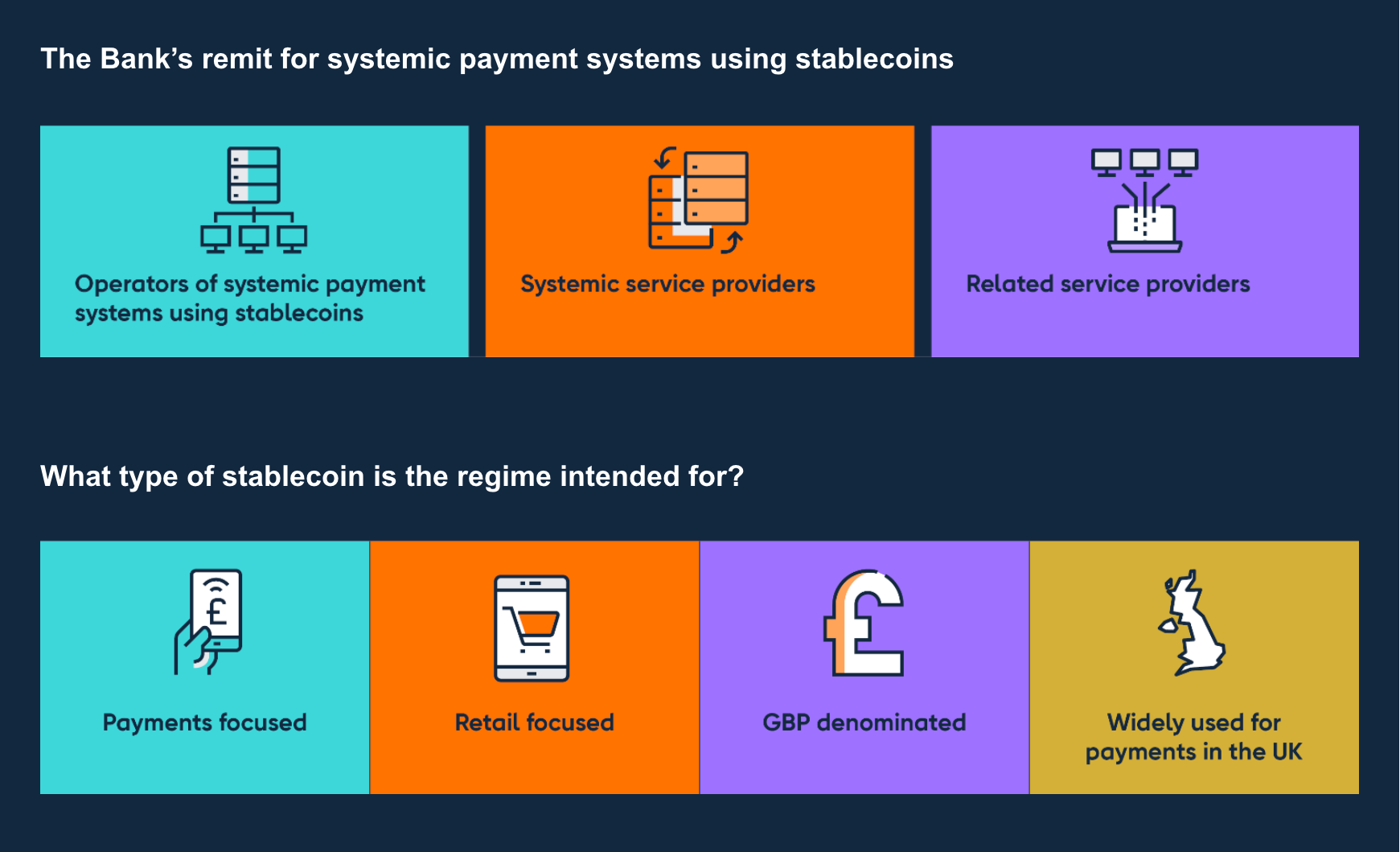
The central bank aims to finalize the rules by the end of 2026 ahead of a planned 2027 rollout. Stablecoins deemed systemic, meaning their use is significant enough to potentially pose risks to UK financial stability, would fall under the Bank of England’s regulatory regime, while non-systemic stablecoins would remain under the country’s Financial Conduct Authority.
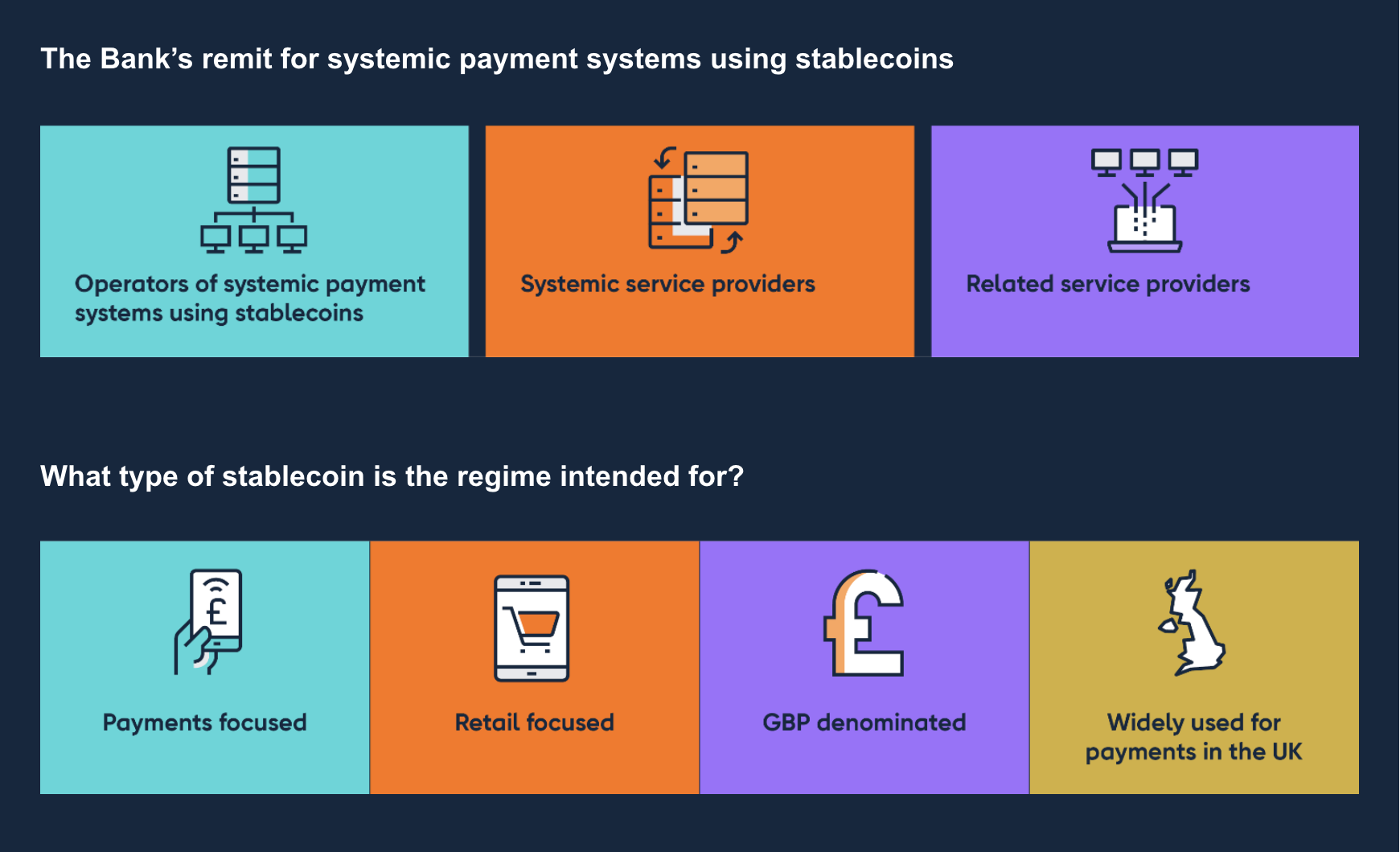
Systemic stablecoins entail payments and retail-focused tokens. Source: Bank of England
The regulatory work is unfolding alongside efforts to modernize traditional payment infrastructure. In May, the BoE proposed moving its Real-Time Gross Settlement (RTGS) and Clearing House Automated Payments System (CHAPS) toward near-24/7 operation, including weekend and extended daily hours, in part to support cross-border payments and new settlement models as tokenization develops.
In July, the central bank also approved HSBC’s Orion platform to operate in the UK’s Digital Securities Sandbox, where it is expected to support digital bond issuance, including the country’s planned Digital Gilt Instrument.
Magazine: El Salvador’s Bitcoin experiment turns 5: ‘It was for us, not them’


Securitize (SECZ) shares plunged 20% in after-hours trading Wednesday after the tokenization firm fell short of Wall Street’s second-quarter expectations in its first earnings report since going public last month.
The company, best known for issuing and managing BlackRock’s BUIDL tokenized money-market fund, reported revenue of $14.4 million, down 5% from a year earlier and missing analyst estimates of $20.6 million.
Securitize posted a $2.37 per-share loss, compared with an expected loss of just $0.15 per share. Its net loss totaled $21.7 million, while adjusted EBITDA swung to a $5.5 million loss from a $1.8 million gain a year ago.
Wall Street has grown increasingly excited about tokenization, the effort to bring funds, equities and other financial assets onto blockchain rails. Securitize sits at the center of that push, but the growing interest has yet to materialize as sustained revenue growth.
CEO Carlos Domingo called the quarter “softer” when reporting earnings on Wednesday, while pointing to a stronger start to the year. First-half revenue remained 16% higher year-over-year, including a record $19.5 million in the first quarter.
Crypto World
Pump.fun's Share Of Launchpad Fees Fell To 27% In July. Four Weeks Later It's Back Above Half


A wave of launchpads on Robinhood Chain took most of pump.fun's share of the token-launch business in the first two weeks of July. Still, pump.fun is now earning more per week than before they arrived. The launchpad business grew faster than pump.fun lost ground in it. Weekly fees across the… Read the full story at The Defiant


Crypto companies from including Coinbase, BitGo, Robinhood, Polygon and Pump.fun have announced workforce reductions this year, citing a variety of reasons, including shifting to AI and market forces.


The U.S. Securities and Exchange Commission’s Division of Investment Management said Wednesday that it would not recommend enforcement action if Franklin Templeton’s U.S. registered funds hold shares of its onchain money market fund through an affiliated blockchain-integrated custody and… Read the full story at The Defiant


Council Speaker Julie Menin sent letters to four companies offering prediction market services to New Yorkers as part of an investigation into their marketing practices.

It’s an exciting finding, says Rimas Orentas, an adjunct professor at Johns Hopkins Bloomberg School of Public Health and head of immunotherapy at Miltenyi Biotec who was not involved in the study. “Solid tumors are enmeshed in your tissues,” he says. That makes it quite difficult for engineered T-cells to work. “That’s the surprising part of this paper.”
As with many engineered T-cell discoveries, this particular approach, if it reaches the clinic, is unlikely to work for every patient or every cancer. Still, with many of these approaches, says Orentas, “just a few patients benefit, but when they benefit, they really benefit. I think that’s where we’re headed with this.”
Seitz, who is now planning a clinical trial of the treatment with 18 pediatric cancer patients who all have PRAME in their tumors, just saw his recovered patient this week. Over the weekend, the boy had been part of an extreme cycling event. “Apparently, they drive uphill, and then they go nuts downhill between trees and rocks,” Seitz says. “And I was like, ‘Oh my God…please don’t crash into a tree! It’s not worth it!’ But he really loves it”—and Seitz feels honored to have helped him reclaim his life.

Ripple Backs FixCleanup3_3_0 Amendment As XRP Ledger 3.3.0 Nears

Teen Drowns In Rip Current At Rockaway Beach

Military helicopter crashes in Texas, killing 2 pilots


-

 Fashion5 days ago
Weekend Open Thread: Mattifying Sunscreen
-

 Fashion5 days ago
Frugal Friday’s Workwear Report: Cap-Sleeve Pointelle Crewneck Sweater
-

 News Videos5 days ago
Can Astrology Help Find Gold and Silver Trends? A Financial Astrology Guide
-

 Sports7 days ago
Jordan Coyle & Cordiamo take Laya Arena Stakes at RDS
-

 Politics7 days ago
Reform UK And Greens Sink To Lowest Favourability Ratings To Date
-

 Tech5 days ago
Rinn Pharma & Biopharma to join NordicPharmaTrain network
-

 Business4 days ago
How to Start a Cleaning Business: A Step-by-Step Guide
-

 Business4 days ago
Datadog: Best Of Breed For Multiple Reasons
-

 Business4 days ago
BDC Weekly Review: Private BDC Q2 Numbers Are Strong
-
 NewsBeat1 day ago
Communication cards help banking customers access services or report scams
-
Sports7 days ago
Spider-Man: Brand New Day ending explained: Is Peter Parker alive?
-

 Tech6 days ago
Price Hikes May Be Coming for PC Motherboards Next
-

 Business6 days ago
Brightwater secures funding for WA-first dementia projects
-
 Crypto World7 days ago
Galaxy Digital Stock Slides 14% as Crypto Prices Hit Earnings
-

 Politics7 days ago
The Not-So Talented Mr Arday
-

 Business7 days ago
SpaceX Shares Plunge 13.6% After First Public Earnings as AI Capex Surge and Lockup Spark Selloff
-
 Business2 days ago
Oil Price Today (August 11): Crude oil rises to $88 after Trump’s compensation demand dents Hormuz opening. Here’s why
-

 Tech7 days ago
How to Use Your Phone as a Webcam on PC and Mac (2026)
-

 Fashion5 days ago
Weekly News Update, 8.6.26 – Corporette.com
-
 Tech7 days ago
Meta enters the AI coding wars with Muse Spark 1.2 and Muse Code with persistent async background agents
You must be logged in to post a comment Login