
Crypto World
Psyence Biomedical (PBM) Stock Soars 200%+ on White House Ibogaine Executive Order


Key Highlights
- Shares of PBM surged as much as 203.8% on April 16, 2026, following reports that the White House plans to issue an executive order promoting ibogaine research.
- Psyence Biomedical announced the expansion of its Australian clinical trial infrastructure from three to five locations for its NPX-5 Phase IIb psilocybin program.
- The biotech firm postponed a planned 1-for-6.25 reverse stock split, allowing shares to continue trading without adjustment.
- Market watchers view the rally as speculative momentum amplified by low liquidity rather than fundamental catalyst strength.
- With a market capitalization of only $11.63 million and a GF Score of 20/100, PBM remains highly speculative with a profitability score of just 1/10.
On April 16, 2026, Psyence Biomedical (PBM) delivered one of the most dramatic single-day performances in the psychedelic biotech sector. Shares rocketed more than 200% as traders reacted to breaking news that the White House is working on an executive order designed to advance ibogaine research, a compound being explored for PTSD and addiction treatment.
According to Quiver PriceTracker, PBM finished the trading day up roughly 203.8%. GuruFocus data indicated intraday peaks reached approximately 105.96%.
The anticipated White House directive represents a meaningful policy evolution in federal attitudes toward psychedelic medicine. Ibogaine, which has garnered attention for its potential in addressing substance use disorders and psychological trauma, would receive expanded federal support for clinical investigation.
While Psyence Biomedical’s primary focus is natural psilocybin rather than ibogaine, the broader legitimization of psychedelic therapies created a sector-wide wave that carried PBM significantly higher.
Australian Trial Sites Double in Strategic Expansion
Beyond the macroeconomic catalyst, Psyence Biomedical provided company-specific updates that contributed to investor enthusiasm. The firm recently doubled its Australian clinical research footprint, growing from three to five operational sites. This infrastructure enhancement supports the ongoing Phase IIb evaluation of NPX-5, the company’s naturally derived psilocybin candidate being studied in Adjustment Disorder among cancer patients in palliative settings.
The additional sites are intended to accelerate participant enrollment and maintain continuous dosing schedules throughout the trial. These operational details were disclosed through an SEC Form 6-K filing submitted in April 2026.
Notably, no fresh efficacy or safety results were announced on April 16. Market analysts characterized the price action as momentum-driven speculation, magnified by limited share liquidity.
Additionally, Psyence Biomedical confirmed the postponement of a previously scheduled 1-for-6.25 reverse stock split. Shares will continue trading at their current structure until management establishes a new implementation timeline. This decision maintained the existing float size, potentially contributing to the volatility and rapid price appreciation observed.
Financial Profile and Investor Positioning
Psyence Biomedical operates as a micro-cap entity with a total market valuation of approximately $11.63 million. Prior to the surge, shares were changing hands near $5.08—significantly below the 52-week peak of $74.94.
The company’s GF Score registers at 20 out of a possible 100. While financial strength receives a respectable 8/10 rating, profitability scores a minimal 1/10. The absence of a price-to-earnings ratio reflects ongoing losses.
Institutional engagement remains limited. During Q4 2025, five institutional holders reduced or eliminated their positions entirely. Parallel Advisors divested its complete stake of 151,250 shares. UBS Group represented the sole new institutional entrant, acquiring 1,007 shares.
Insider transaction activity has been absent over the trailing twelve-month period.
The company maintains a federally licensed psilocybin cultivation operation in Southern Africa, supplying material to international research collaborators.
As of April 16, 2026, Psyence Biomedical has yet to generate revenue or achieve profitability, with its clinical development programs still navigating mid-stage evaluation phases.




Solana announced wXRP is live on Titan Exchange, Real, Phantom, Jupiter, and Meteora, expanding cross-chain asset availability on the blockchain.
Solana announced Friday that wrapped XRP (wXRP) is now available across multiple major Solana ecosystem applications, including Titan Exchange, Real, Phantom wallet, Jupiter aggregator, and Meteora. The listing enables Solana users to access XRP-backed assets natively within the Solana network through these popular trading, wallet, and DEX platforms.
The launch expands interoperability between the XRP Ledger and Solana blockchain, allowing users to trade and hold wrapped versions of the Ripple-native asset. wXRP bridges assets across chains, enabling broader liquidity and market access for XRP holders seeking exposure within the Solana DeFi ecosystem.
Sources: Solana
This article was generated automatically by The Defiant’s AI news system from publicly available sources.
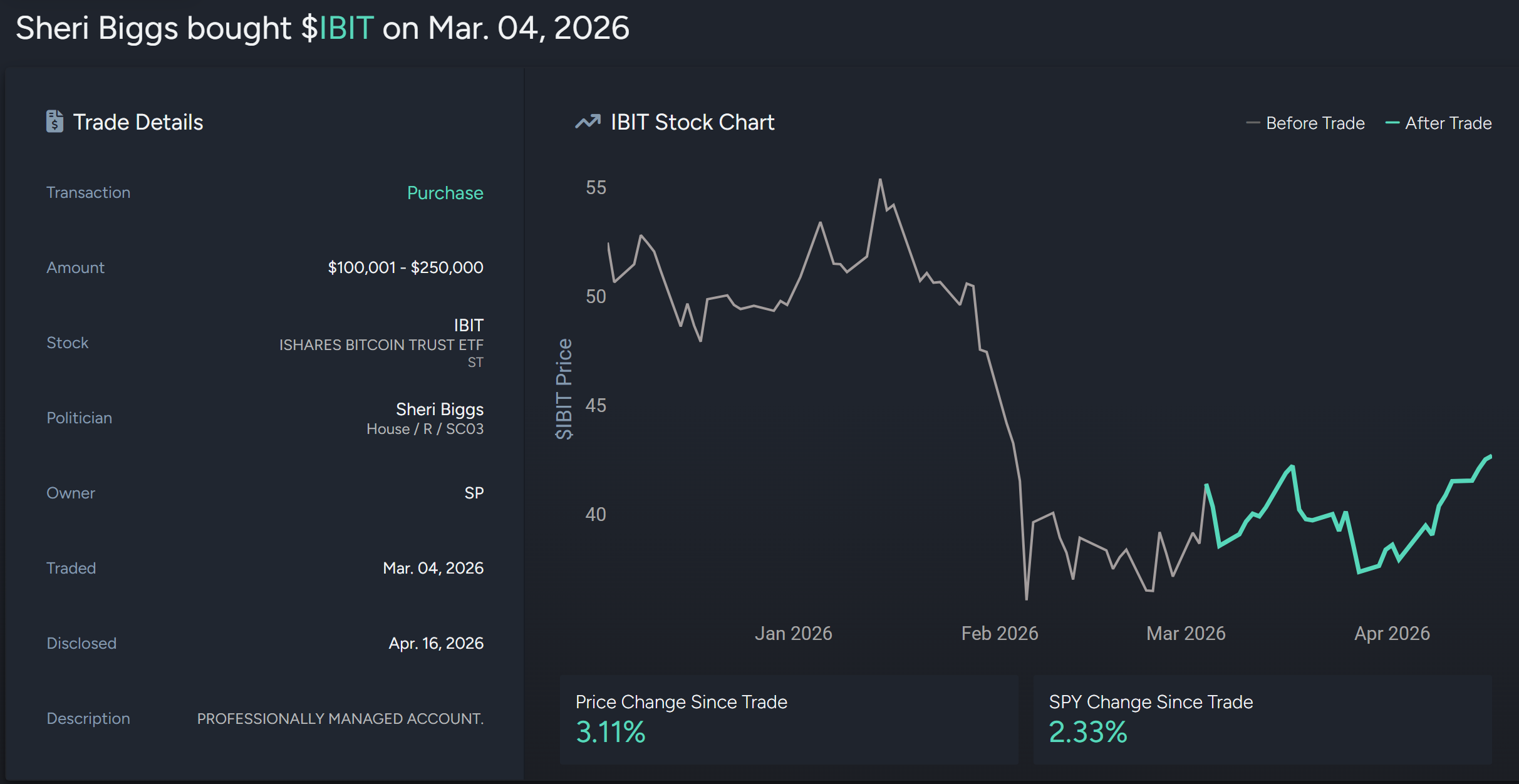
Rep. Sheri Biggs (R-SC) disclosed a purchase of $100,001 to $250,000 in BlackRock’s iShares Bitcoin Trust ETF (IBIT) on March 4, made through her spouse’s professionally managed account at UBS Financial Services.
The filing, submitted to the House Clerk on April 16, landed within the STOCK Act’s 45-day reporting window. It arrives as the Senate weighs legislation that could turn the federal government into a large-scale Bitcoin (BTC) buyer.
Biggs Adds to Growing Bitcoin Position
The March trade marks at least the second six-figure IBIT purchase by the Biggs household. In July 2025, her husband acquired between $100,001 and $250,000 of the same ETF roughly one week before pro-crypto legislation passed the House.
That earlier transaction was disclosed months late, violating the STOCK Act’s 45-day rule and triggering a $200 penalty. Trackers noted IBIT gained about 12% in the three months following the buy.
The same April filing also listed two smaller purchases of Apollo Debt Solutions BDC and a sale of Oaktree Strategic Credit Fund holdings, signaling a broader portfolio shift toward crypto and debt exposure.
Strategic Bitcoin Reserve Bill Looms in Senate
The timing draws additional scrutiny because S.954, the BITCOIN Act of 2025, remains before the Senate Banking Committee.
Introduced by Sen. Cynthia Lummis (R-WY), the bill would direct the Treasury to acquire one million BTC over five years and store them in a decentralized network of secure federal facilities with a 20-year minimum hold.
Related efforts continue to build momentum. The Mined in America Act, introduced March 30 by Sens.
Cassidy and Lummis, would codify President Trump’s executive order establishing the reserve and let certified U.S. miners sell newly mined BTC directly to the Treasury.
If passed, these measures could make the federal government one of the largest holders of Bitcoin globally, a catalyst for assets like IBIT, which already manages roughly $55 billion and commands about 70% market share among U.S. spot Bitcoin ETFs.
Congressional members remain legally permitted to trade stocks and ETFs under current rules. However, repeated timing controversies have fueled bipartisan calls for a full trading ban.
The post Rep. Sheri Biggs Discloses $250,000 Bitcoin ETF Buy Amid Reserve Bill Push appeared first on BeInCrypto.

TLDR:
- TradFi assets now make up 9% of Binance futures volume, signaling a shift in trading behavior
- Rising stock market volatility is pushing traders to explore crypto-linked derivative markets
- S&P 500 drawdowns show that corrections are frequent, even during extended bull market phases
- Faster recoveries after 2010 reflect changing market dynamics and stronger policy responses
Global trading patterns are shifting as traditional financial assets gain ground within crypto derivatives markets. Recent data shows a steady rise in cross-market activity, while long-term equity drawdowns continue to shape how traders assess risk and timing across asset classes.
TradFi Assets Gain Ground in Crypto Futures
CryptoQuant reported that traditional financial assets now account for about 9% of Binance futures volume. The update came through a post shared by CryptoQuant, citing analyst JA Maartun. The data points to a gradual shift in trader focus beyond digital assets.
The tweet noted that rising volatility in stock markets is drawing more attention from crypto traders. As a result, exposure to equities through derivatives platforms is increasing. This trend reflects how trading strategies are expanding across asset classes.
Market participants are no longer focused only on altcoins or major cryptocurrencies. Instead, they are engaging with broader financial instruments. This shift suggests a blending of strategies between crypto-native and traditional market participants.
At the same time, volatility in equities appears to play a key role in this transition. When stock markets become unstable, traders often seek opportunities in derivative products. Binance futures markets now serve as one such venue for this activity.
This movement also aligns with the growing overlap between crypto infrastructure and traditional finance. As platforms expand their offerings, traders gain easier access to diversified instruments. That accessibility continues to reshape trading behavior.
S&P 500 Drawdowns Reflect Market Stress Cycles
Alongside this trend, long-term data on the S&P 500 provides context for how traders respond to volatility. The chart shared in the update tracks drawdowns from all-time highs between 2000 and 2026. It presents a clear view of market stress periods.
Major downturns stand out across the timeline. The early 2000s dot-com crash saw a drawdown near 45%. The global financial crisis pushed losses close to 50%, marking the deepest decline. Meanwhile, the 2020 pandemic shock caused a rapid drop of about 35%.
More recent movements show different patterns. The 2022 bear market recorded a decline near 25%, but it lasted longer. In contrast, post-2020 recoveries have been faster, often supported by policy responses and liquidity measures.
The data also shows that smaller corrections occur frequently. Declines between 5% and 15% appear even during strong market phases. These movements are part of normal volatility rather than signs of structural breakdown.
Another pattern emerges in recovery timing. Before 2010, markets often took several years to regain previous highs. Since then, recoveries have become quicker, especially after major shocks. This shift reflects changing market dynamics and intervention tools.
The chart further indicates that markets spend more time near peak levels than in deep declines. Most of the timeline stays close to all-time highs. This pattern suggests a tendency toward recovery rather than prolonged downturns.
Periods of calm also alternate with bursts of volatility. Stable phases, such as 2016 and 2017, are followed by more turbulent conditions. These cycles show that risk does not appear evenly over time.
Taken together, the rise in TradFi participation on crypto platforms and the history of equity drawdowns present a connected narrative. Traders are adapting to volatility across markets while using new tools to manage exposure.

Russia’s lower house of parliament received a draft law aimed at tightening criminal accountability for crypto services operating without regulatory approval. The legislation would attach criminal liability to entities that organize digital currency circulation without a Bank of Russia license, signaling a tougher stance as Moscow moves to regulate the sector ahead of broader digital-asset rules.
Under the draft, individuals who provide crypto-related services without registration with the central bank could face fines of up to 4,000 USD and up to four years in prison. More severe penalties would apply to organized groups or cases involving large-scale damage or illicit gains. The bill envisions compulsory labor for up to five years or imprisonment for as long as seven years when the act is committed by an organized group or causes significant harm. A separate provision would allow fines of up to 1 million rubles (approximately 13,100 USD) or profit-linked penalties for up to five years, depending on the circumstances.
Key takeaways
- The draft law would criminalize unregistered crypto-asset services, expanding the regulatory net beyond existing licensing regimes.
- Penalties scale with the nature of the violation—from individuals facing modest fines and potential prison time to harsher outcomes for organized groups or large-scale wrongdoing.
- The move aligns with Russia’s broader push to regulate digital currencies, but comes while a broader “Digital Currency and Digital Rights” framework is still being formalized and set to take effect in July.
- Russia’s Supreme Court has questioned the necessity of criminal penalties in the absence of the accompanying digital-currency law, calling the measure premature.
- In parallel, Russia faces high-profile crypto-security incidents, such as the Grinex exchange hack, underscoring the real-world risks for traders and exchanges as oversight tightens.
- Earlier in March, a package of crypto regulation proposals included penalties for illegal miners, indicating a multi-pronged regulatory approach that could shape market dynamics going forward.
Regulatory tightening and the licensing regime
The core of the draft law is a licensing regime led by the Bank of Russia. By tying criminal liability to activities that “carry out the organization of digital currency circulation” without a license, lawmakers appear to be moving beyond civil or administrative remedies and into criminal enforcement. The intent, as described in the draft, is to deter unregistered providers and bring a centralized oversight mechanism to what Moscow views as a growing sector with potential for misuse.
Specifically, individuals operating without registration could be fined as much as 4,000 USD and face up to four years in prison. If the operation involves an organized group or yields particularly large profits or damages, penalties would intensify to compulsory labor for up to five years or imprisonment for up to seven years. In addition, the bill contemplates fines up to 1 million rubles or an income-based penalty for up to five years, depending on the case’s particulars.
The legislation is part of a broader trend in Russia toward formalizing oversight of crypto activities, including licensing requirements and centralized supervision. It follows a March package that proposed criminal penalties for illegal crypto mining, signaling a comprehensive framework that would address both exchange activity and mining under a unified regulatory lens.
Judicial cautions and timing concerns
Even as lawmakers push for stricter enforcement, Russia’s Supreme Court has voiced concerns about the bill’s approach. In recent remarks reported by RBC, the court suggested that criminal penalties lack a “reasoned justification” and argued that the measure could be premature before the full regulatory architecture is in place. The court noted the forthcoming Digital Currency and Digital Rights law, expected to take effect in July, would set the groundwork for how digital assets are treated in Russia and how enforcement should be structured.
Observers note the tension between urgency on the legislative side and the Court’s call for measured steps that align with a coherent regulatory framework. If the Digital Currency and Digital Rights law does pass and comes into force on schedule, it could provide the statutory basis for the more punitive powers envisaged in the draft law. Until then, advocates of a cautious, rules-based approach argue that criminal penalties should wait for a clearer legal foundation and for the details of licensing, supervision, and consumer protections to be finalized.
As Russia moves toward more formalized oversight, the debate underscores a key question for the market: what level of risk will participants bear while the regulatory framework remains in flux? For crypto services, the path to compliance may require not only licensing but a broader readiness to meet centralized data-sharing, capital-adequacy, and anti-money-laundering standards that critics say could raise barriers to entry and reshape the competitive landscape.
Grinex hack as a reminder of operational risk
Against the backdrop of regulatory maneuvering, Russia-based exchange Grinex has been dealing with a high-profile security incident. The platform halted trading after reporting losses exceeding 1 billion rubles (roughly 13.7 million USD) in a hack it suspects involved “hostile state” entities. Grinex has since alerted law enforcement and filed a criminal complaint as it works to resolve the incident and safeguard user funds.
The Grinex event highlights the real-world risks that exchanges and users face even as regulators step up scrutiny. Security incidents can complicate compliance efforts by drawing attention from authorities and potentially increasing the appetite for stringent enforcement. The parallel tracks of tightening regulation and cybersecurity stress-testing may influence how quickly market participants seek licensing, improve risk controls, and pursue clearer governance structures.
In the same vein, Russian media coverage and industry reporting have connected these regulatory developments to broader shifts in the country’s crypto landscape. The ongoing discourse reflects a market watching closely for a coherent rulebook that balances innovation with investor protection and national-security considerations.
What to watch next
The most immediate milestones are July’s implementation of the Digital Currency and Digital Rights framework and the legal clarifications that will follow. If the new law enshrines the central-bank licensing regime and criminal penalties for unregistered services, market participants could see a rapid shift toward greater formalization, with more entities seeking compliance measures and registration to avoid potential penalties.
Market observers will also be watching for further clarifications on enforcement practices, including how authorities interpret “organization of digital currency circulation” and what constitutes the threshold for “large-scale” offenses. As the Grinex case unfolds, regulators may use real-world incidents to calibrate enforcement intensity and to demonstrate the practical costs of cyber breaches within a tightly regulated environment.
For investors and builders in Russia’s crypto ecosystem, the current phase signals both caution and opportunity. While the tightening stance could raise compliance costs and limit gray-market activity, it may also foster a more stable regulatory climate that could eventually attract legitimate businesses and institutional participation. The coming weeks will be telling as lawmakers lay out the legislative language and courts weigh the appropriate balance between enforcement and innovation.


Bitcoin price prediction turned aggressively bullish early Friday as CoinDesk reported that perpetual funding rates dropped to their most negative level since 2023 on a seven-day moving average, with ZeroStack CEO Daniel Reis-Faria targeting $125,000 within 30 to 60 days if the market’s heavily short positioning is forced to unwind.
Summary
- BTC was trading near $74,700 in Asian morning hours Friday, up 3.5% on the week but down 0.4% on the day, with the 10-day global equity rally pausing ahead of the April 22 Iran ceasefire expiry.
- The 7-day moving average funding rate dropped to approximately -0.005% per Glassnode data, last seen during the FTX crash bottom in late 2022, with every prior historical episode of similar funding extremes — March 2020, mid-2021, August 2024 — aligning with local price lows.
- On-chain data shows many active bitcoin holders are currently underwater relative to their cost basis, meaning a squeeze-driven rally could face material sell pressure from holders who acquired BTC in the $75,000 to $95,000 range during 2025.
Bitcoin (BTC) price prediction turned aggressively bullish early Friday as CoinDesk reported that perpetual funding rates dropped to their most negative level since 2023 on a seven-day moving average, with ZeroStack CEO Daniel Reis-Faria targeting $125,000 within 30 to 60 days if the market’s heavily short positioning is forced to unwind.
BTC was changing hands near $74,700 in early Asia trading Friday, up 3.5% on the week but down 0.4% on the day as a 10-day global equity rally paused ahead of next week’s Iran ceasefire deadline. The asset has climbed from the mid-$60,000s through March and April despite persistently negative funding, meaning shorts have been paying longs for weeks while price continued to grind higher.
Funding rates are periodic payments between long and short holders in perpetual futures contracts, designed to keep contract prices aligned with spot. When rates go negative, shorts pay longs — a condition that only develops when speculative positioning is tilted heavily against price. The 7-day moving average rate has dropped to approximately -0.005%, per Glassnode data, a reading last seen at the FTX crash bottom in late 2022.
“Funding rates this negative tell you the market is heavily short,” Reis-Faria said. “If Bitcoin continues to move higher despite that, a lot of those positions could get liquidated, and the move can accelerate quickly.” He targets $125,000 within 30 to 60 days if the short base unwinds, citing buy pressure from large corporate accumulators as the force most likely to trigger forced liquidations across the short base.
Every prior historical episode of similar funding extremes has aligned with a local price floor. March 2020, mid-2021, the FTX collapse in late 2022, the yen carry trade unwind in August 2024, and the Liberation Day selloff in April 2025 all featured deeply negative funding that resolved with sharp recoveries. For traders tracking the ceasefire hopes around the April 22 deadline as a timing catalyst, this historical pattern reinforces a bullish view on the near-term setup.
What Could Prevent a Squeeze Rally
On-chain data introduces a structural counterpoint. Many active bitcoin holders are currently underwater relative to their acquisition cost, meaning any squeeze-driven rally that approaches their cost basis could generate significant sell pressure from holders who bought in the $75,000 to $95,000 range during 2025’s peak accumulation period. This is sometimes called the “wall of worried holders” — participants who will not be forced to sell but will sell when they can.
A rally to $125,000 would require absorbing that supply sequentially, moving through each cost-basis cluster without capitulating. The oversold signals visible in on-chain and technical data support the bullish case structurally, but the distribution of underwater holders complicates a clean short-squeeze-to-new-high scenario without a strong macro catalyst doing the heavy lifting.
The Catalyst Calendar
Three events over the next two weeks will resolve the current setup. The April 22 Iran ceasefire expiry is the first: a credible extension removes the geopolitical tail risk that has capped risk-asset rallies since February, while a breakdown would likely push BTC toward the $68,000 structural support floor. The FOMC meets April 28-29, and any dovish signal from Chair Powell would reduce the opportunity cost of holding BTC. A confirmed CLARITY Act committee date in early May would add a third potential trigger specific to the digital asset market.


Russia’s government submitted a bill to its parliament’s lower house in an effort to amend the country’s legal code to attach criminal liability for crypto services offered without regulatory approval or licensing.
In a draft law sent to the State Duma on Friday, Russian lawmakers proposed that entities “carrying out activities related to the organization of digital currency circulation,” that operate without a license from Russia’s central bank, could be subject to criminal liability.
Without registration with the Bank of Russia, individuals could face up to $4,000 in fines and up to four years in prison, or more severe penalties if part of an organized group.
“The same act committed by an organized group, or involving the infliction of damage or the extraction of income on a particularly large scale, would be punishable by compulsory labor for up to five years or imprisonment for up to seven years,” the bill’s text said.
The bill also proposes a “fine of up to 1 million rubles [$13,100] or an amount equal to the convicted person’s salary or other income for a period of up to five years.”
The draft law followed a package of bills initially proposed in March that included criminal penalties for illegal crypto miners, but the most recent legislation included details on fines and potential prison time for any unregistered digital asset services.
According to Russian media outlet RBC, the country’s Supreme Court said that the crypto bill lacks “reasoned justification” for criminal penalties.
The court said that the measure was “premature” until Russia enacted its “Digital Currency and Digital Rights law,” expected to go into effect in July. If the bill passes it would give Russia’s government more control and oversight over the crypto industry.
Related: At least a dozen crypto entities attacked since Drift Protocol hack
Russian crypto exchange Grinex still reeling from $14 million hack
Grinex, a Russia-based crypto exchange currently being sanctioned, halted trading for users on Thursday after losing more than 1 billion rubles — about $13.7 million — in a hack it suspected was carried out by “entities of hostile states.”
The company said it forwarded relevant information on the attack to law enforcement agencies and filed a criminal complaint.
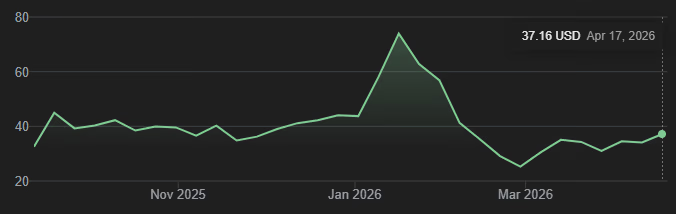
Morpheus Research’s report alleges that the $7.7B fintech is exaggerating its use of blockchain technology, while Figure and asset manager Van Eck dispute the findings.
Figure Technology Solutions found itself at the center of a public battle this week after short-seller Morpheus Research published a detailed report accusing the blockchain-focused HELOC lender of overstating its use of on-chain technology.
Morpheus, which disclosed it holds short positions in FIGR, called the Nasdaq-listed fintech “little more than a risky home equity lender masquerading as a blockchain innovator.” The firm alleged that Figure’s loan origination system does not rely on blockchain, citing the company’s own SEC filings, and argued that its suite of crypto-native products, including Figure Connect, Democratized Prime, YLDS, and the OPEN equity network, has either stalled or is propped up internally.
FIGR shares have been under pressure in recent weeks, falling from a January high of $78 to roughly $37 as of today. The company went public in September 2025 at $25 per share, raising $787.5 million.

Figure responded on X, calling the allegations a “misunderstanding of how blockchain is integrated into the Figure loan lifecycle.” The company acknowledged that certain legal steps, particularly for HELOCs, still require traditional documentation to comply with existing regulations. But it said that from the moment a loan is funded, it is represented on blockchain, and all subsequent ownership transfers and pledges are recorded and executed on-chain.
“Participants in our ecosystem are contractually required to transact on blockchain, making it the operational system of record for loan ownership and activity, while traditional documents serve primarily as legal formalities,” the company wrote.
Figure pushed back on claims of deteriorating loan performance, citing a weighted-average delinquency rate of 0.80% across roughly $4.6 billion of securitized assets. It also cited borrower fundamentals, including an average FICO score of approximately 754, average income of around $187,000, and a combined post-loan-to-value ratio of about 62%.
On the question of institutional demand, Figure said over $1.15 billion in whole loan sales were executed on its marketplace in March 2026 alone, and that a recent loan auction on its platform resulted in a record-low spread to the risk-free rate.
Matthew Sigel, head of digital assets research at Van Eck, offered a separate defense of the company. Sigel argued that the bear case relies on a “fundamental misunderstanding of how blockchain features actually work” and focuses on “process issues long solved.” He highlighted Figure’s Digital Asset Registry Technology, or DART, which he said replaces the legacy MERS paper registry with an active digital system that connects via APIs to institutional data aggregators and records liens on the Provenance Blockchain.
Sigel also noted that Figure’s deterministic underwriting model has compressed production costs to roughly $700 per loan, compared with an $11,000 average for legacy banks, and pointed to preliminary Q1 operating data showing marketplace volume of $2.9 billion, up 113% year over year.
Morpheus Research’s report also took aim at the Provenance Blockchain, which Figure describes as an independent Layer 1 network. Morpheus alleged that Figure, its affiliates, and co-founder Mike Cagney collectively control over 65% of the chain’s native HASH governance token, and that a small number of accounts could theoretically halt or alter the network. Figure countered that it holds approximately 25% of outstanding HASH tokens and that key decisions are made through a broader governance framework.
Cagney, who co-founded Figure in 2018, has sold roughly $64 million worth of stock since the IPO at an average price of $28.50, according to the Morpheus report. Figure said the sales occurred pursuant to standard pre-established trading plans or in connection with stock vesting and associated tax obligations.
This article was written with the assistance of AI workflows. All our stories are curated, edited and fact-checked by a human.
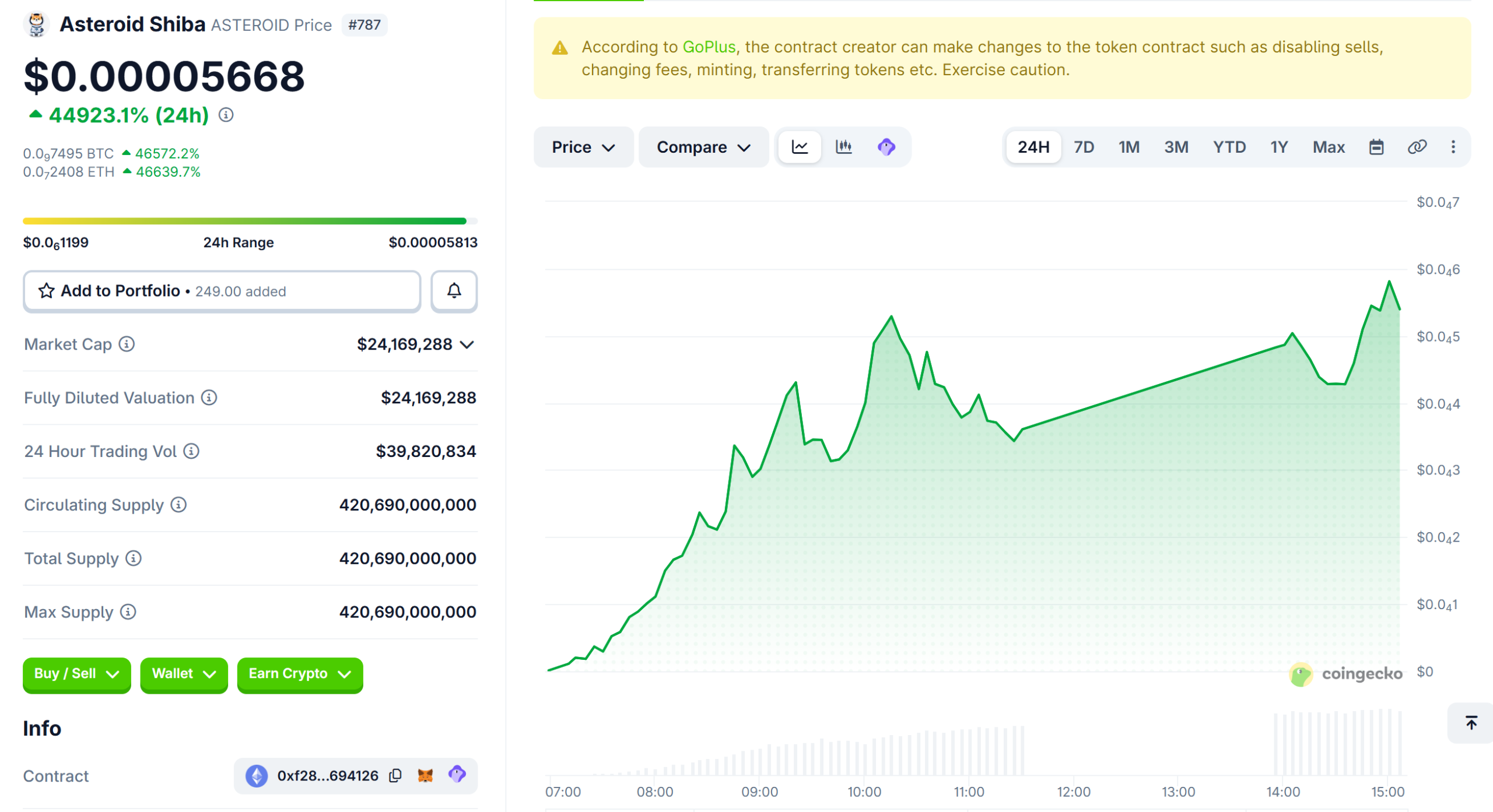
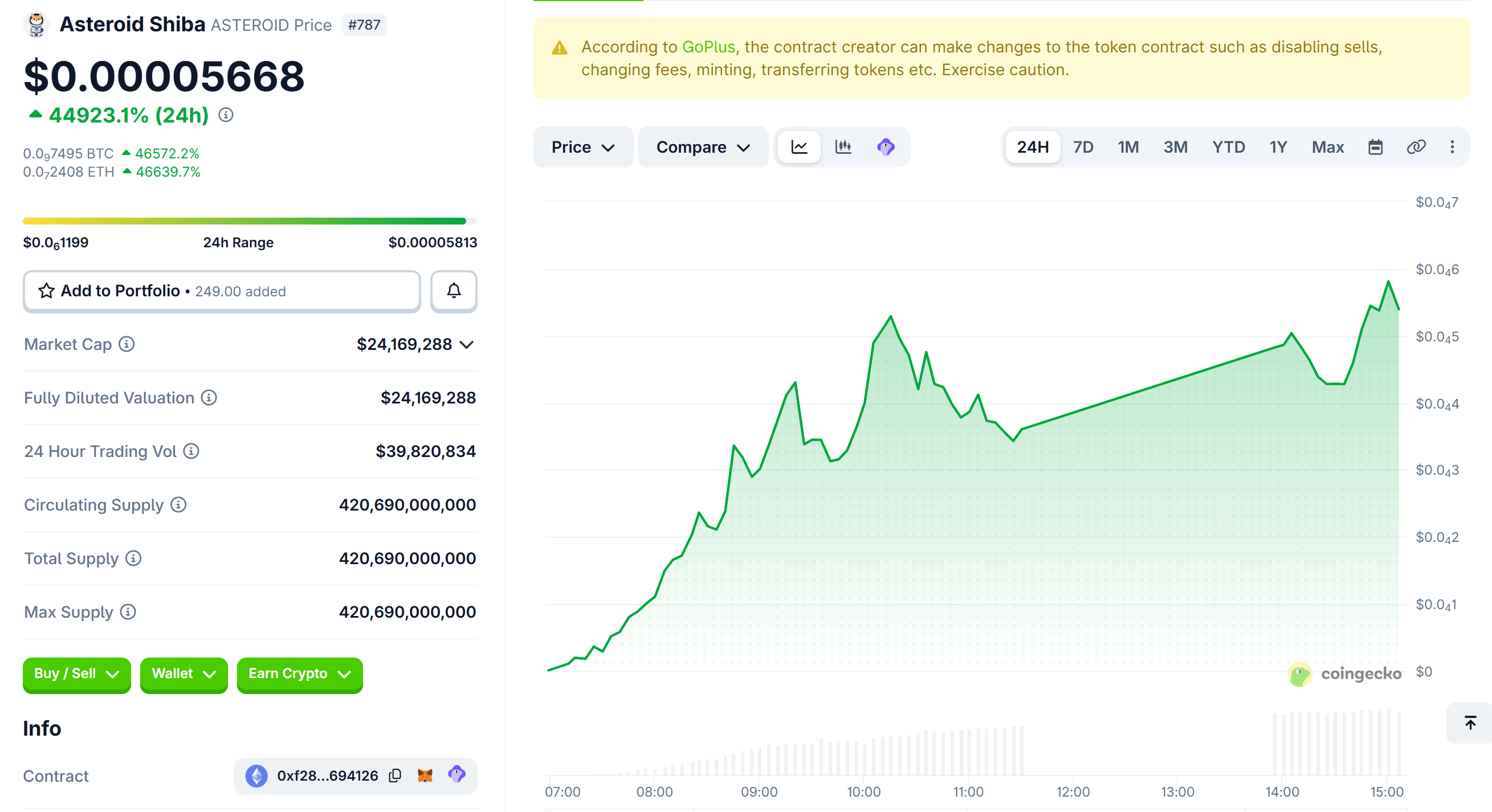
Asteroid Shiba (ASTEROID) gained over 45,000% in 24 hours while Asteroid Bot (ASTEROIDBOT) rallied 15% in the same timeframe. The rally followed Elon Musk’s response to a viral post linking the token to SpaceX’s Polaris Dawn mission.
The move started after radio host Glenn Beck shared Liv Perrotto’s story. The teenager designed a plush Shiba Inu named Asteroid.
Musk’s Reply Ignites Speculative Trading
The Asteroid flew as the zero-gravity indicator on SpaceX’s Polaris Dawn mission in 2024. Perrotto passed away from cancer, leaving behind a list of unanswered questions for Musk.
Among her questions was whether Asteroid could become SpaceX’s official mascot.
Musk responded with “Will answer shortly,” and speculative traders moved within minutes. One meme coin, ASTEROID, rallied by 44,923% while another, and was trading for $0.00005668 as of this writing.
Elsewhere, blockchain analytics firm Arkham identified several traders who profited from the move.
- One swapped 1 ETH into an ASTEROID token position now worth nearly $474,000 within three hours.
- Another early buyer generated $210,000 in profit while still holding $84,000 in the token.
- A dormant holder who spent $21,390 buying ASTEROID at launch in September 2024 has not moved tokens for three months. That position is now worth roughly $370,000.
Sell-Off Risk Grows
The concentration of gains among a small number of wallets raises the prospect of a sharp correction. If early holders begin taking profit, the thin liquidity typical of low-cap meme tokens could amplify any downturn.
Meanwhile, Asteroid Bot (ASTEROIDBOT), a separate token riding the same narrative, posted a more modest 15% gain
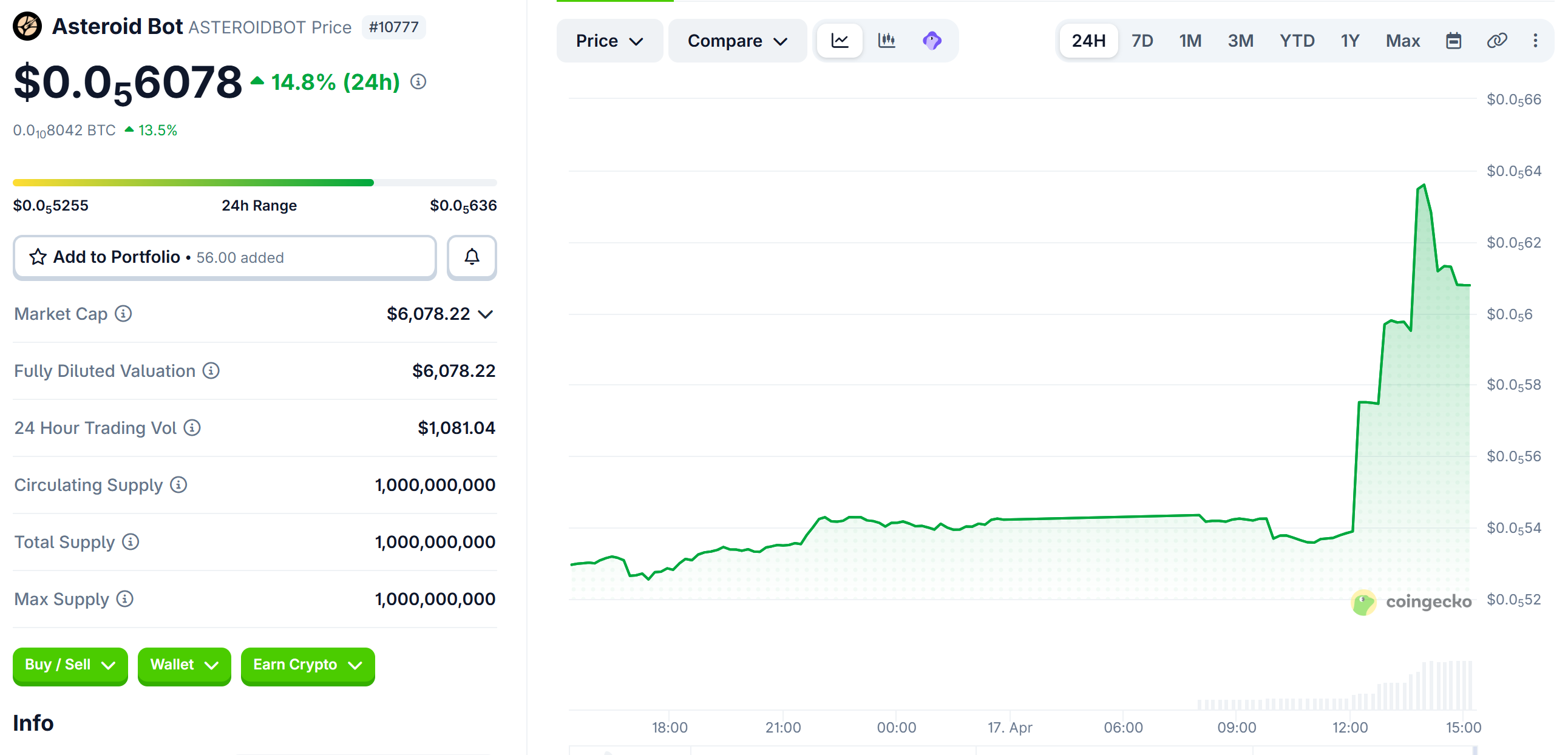
.Whether Musk’s eventual answer to Perrotto’s questions sustains or deflates the speculative interest remains the key variable for ASTEROID’s near-term direction.
The post Elon Musk Fuels ASTEROID Crypto Frenzy, Scores 500X Windfall For One Trader appeared first on BeInCrypto.
X’s Cashtags feature has driven an estimated $1 billion in global trading volume since its pilot launch on Tuesday, according to the platform’s Head of Product Nikita Bier.
The trading milestone arrived just 48 hours after the social media platform introduced Smart Cashtags for crypto and stock assets.
X Cashtags Turn Timeline Into a Trading Gateway
Bier revealed the volume figures on April 17, noting the data came from aggregated trading activity tied to the pilot.
The feature lets users tap cashtags such as $BTC, $ETH, $XRP, and $DOGE to view real-time price charts, sentiment data, and related posts without leaving the app.
A pilot integration with Canadian brokerage Wealthsimple also enables direct trading from the timeline.
However, the pilot remains limited in scope. Only iPhone users in the US and Canada have access, and the buy button is not yet active for US users. Android and web support have not yet rolled out.
DeFi analyst Tat Thang highlighted the scale of X’s early traction, noting that Robinhood needed years to reach comparable daily volumes.
“Robinhood’s first year: 500K users. “Thousands of trades per week.” X’s first 48 hours: $1 billion. $1B in estimated volume from a pilot that hasn’t even hit Android yet,” wrote Thang.
Indeed, Robinhood launched its app publicly in April 2015 after a long private beta (waitlist phase) starting in 2013–2014. By the end of 2015 (roughly its first full year), it had around 500,000 funded accounts or users.
X Money Launch Remains Uncertain
The Cashtags rollout comes as X prepares to launch its broader payments platform, X Money. Elon Musk stated in March that early public access would begin in April.
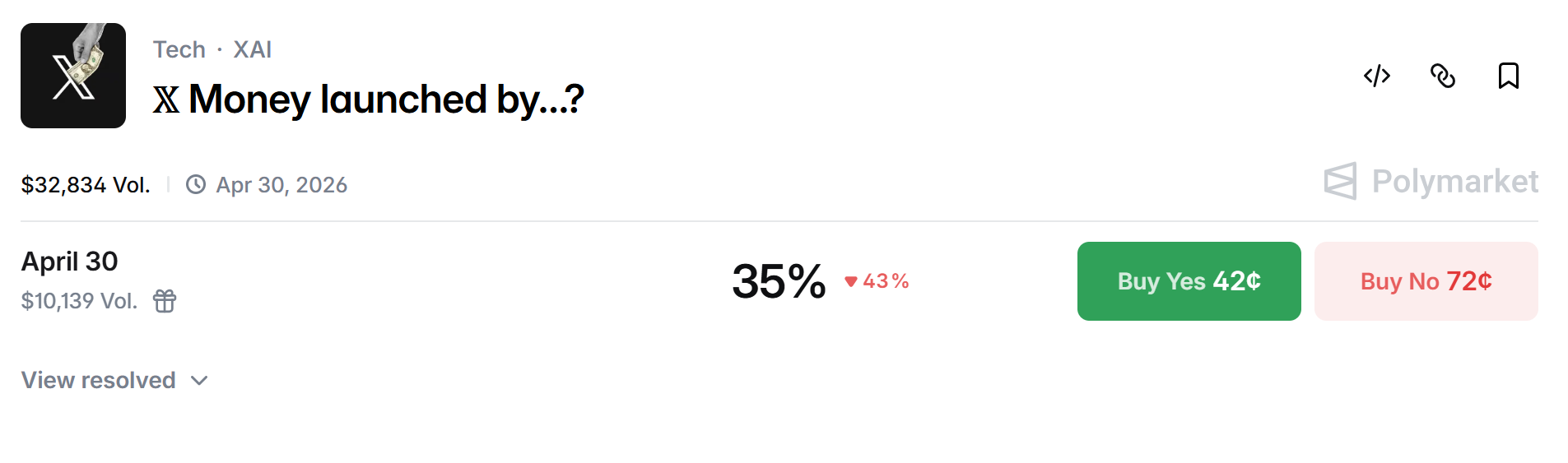
Polymarket data currently shows a 36% chance that X Money will launch by April 30, suggesting most traders remain skeptical.
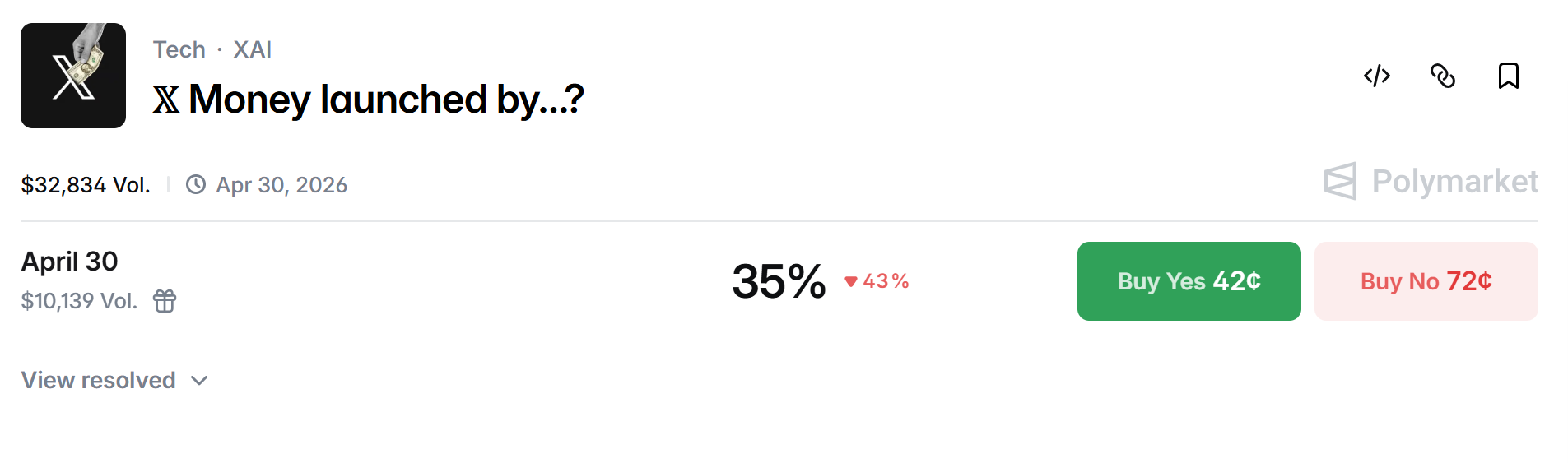
Senator Elizabeth Warren has also raised concerns about the platform’s proposed 6% APY and potential stablecoin issuance, requesting Musk provide a written response by April 21.
The post X Cashtags Trigger Estimated $1 Billion Surge In Crypto Trading appeared first on BeInCrypto.
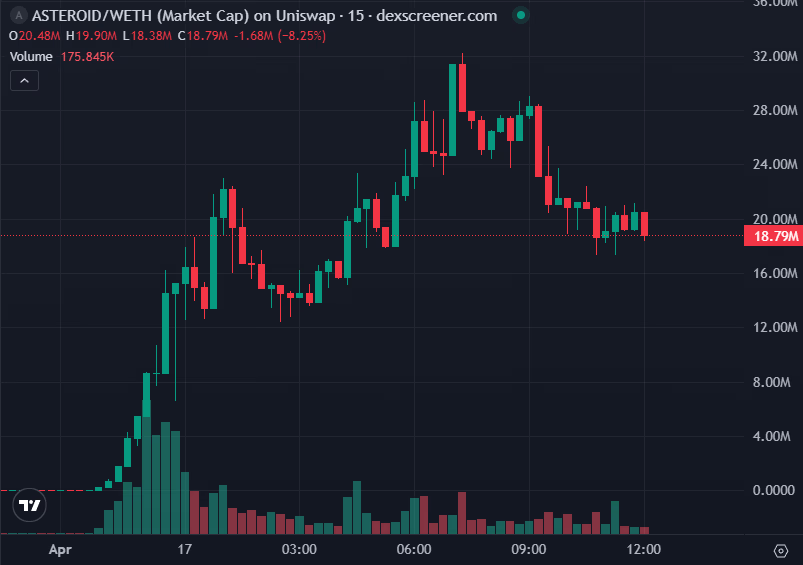
Narrative-driven tokens are catching bids again as the broader memecoin sector attempts to recover from a bruising 2025.
The memecoin trenches are showing signs of renewed life this week, led by an unlikely catalyst, a Shiba Inu plush toy that once floated in zero gravity aboard a SpaceX spacecraft.
ASTEROID, an Ethereum-based memecoin named after the toy that flew on SpaceX’s Polaris Dawn mission in September 2024, surged more than 70,000% in 24 hours to a $28 million market cap on Friday. Trading volume spiked above $43 million, according to DexScreener data, with some early holders recording six-figure gains.

The rally was sparked by a viral post from Glenn Beck on X highlighting the story of Liv Perrotto, the 15-year-old cancer patient who designed the Asteroid plush. Perrotto, who passed away from cancer, had dreamed of meeting Elon Musk and had written a list of questions for him, including whether he would make Asteroid SpaceX’s official mascot. Her mother, Rebecca Perrotto, shared the story through Beck’s platform.
Musk replied to the post with “Will answer shortly,” and that response was all the memecoin market needed. Buying pressure flooded both the Ethereum and Solana versions of the token.
On-chain analyst Lookonchain flagged a wallet that spent 12 ETH (about $31,000) on ASTEROID back in September 2024 and held it for more than 580 days at near-zero value. After Musk’s engagement, that position swelled to roughly $292,000 in unrealized gains.
Arkham highlighted another wallet that is sitting on more than $400,000 in unrealized profits after spending 1 ETH ($2,400) on the token shortly after Musk’s response.
UNC Catches a Bid
ASTEROID is not the only micro-cap drawing attention. On Solana, the UNC memecoin surged above $21 million on Thursday with $15.3 million in trading volume, the highest on the chain that day.
The token, built around Gen Z “cool uncle” internet culture, caught fire after a trader known as fibonacki purchased 37.45% of UNC’s supply when its market cap sat at just $6,000. That trader then airdropped 33.85% of the total supply to over 2,000 on-chain addresses, including several well-known figures.
Broader Memecoin Sector Stirs
The micro-cap action comes as the broader memecoin sector attempts to stabilize after a punishing 2025, during which total memecoin market capitalization fell from $93.1 billion to roughly $36.5 billion.
Data from CoinGecko shows the sector currently sits near $39 billion, up 10% over the past 24 hours.
All of the top-10 memecoins by market cap, including DOGE, SHIB, PEPE, TRUMP, BONK, Pudgy Penguins (PENGU), and FLOKI, are green on the week as activity has picked up alongside the broader risk-on rotation earlier this week.
This article was written with the assistance of AI workflows. All our stories are curated, edited and fact-checked by a human.

2026 RBC Heritage leaderboard: Matt Fitzpatrick takes control with Friday 63, Viktor Hovland hot in pursuit

Quordle hints and answers for Saturday, April 18 (game #1545)

'I'm the lucky one' – more than one in three young men now live with their parents

Why Israel is blocking foreign journalists from entering

Bitcoin: We’re Entering The Most Dangerous Phase

Alan Cumming Brands Baftas Ceremony A ‘Triggering S**tshow’

Lukey ka Financial Game | Lukey Bhaskar Movie #bollywoodshorts #bollywood #whowillbemylifepartnerta

AP Politics, Buggana Analyzes Reasons For Financial Instability Due To Amaravati

Crypto Gold Live Trading 17 April | Market Trader | #goldtrading #cryptotrading #bitcoin
-
 NewsBeat5 days ago
Pep Guardiola and Gary Neville agree over Arsenal title problem that benefits Man City
-

 Politics5 days ago
World Cup exit makes Italy enter crisis mode
-

 Crypto World4 days ago
The SEC Conditionalises DeFi Platforms to Be Avoided for Broker Registration
-

 Crypto World4 days ago
SEC Signals Exemption for Crypto Interfaces From Broker Registration
-

 News Videos3 days ago
Secure crypto trading starts with an FIU-registered
-

 Sports14 hours ago
NWFL Suspends Two Players Over Post-Match Clash in Ado-Ekiti
-

 Crypto World4 days ago
SEC Proposes Certain Crypto Interfaces Don’t Need to Register as Brokers
-

 Business6 days ago
Ireland Fuel Protests Enter Day 5 as Blockades Spark Shortages and Government Prepares Support Package
-

 NewsBeat4 days ago
Trump and Pope Leo: Behind their disagreement over Iran war
-

 Crypto World7 days ago
Federal judge blocks Arizona from bringing criminal charges against Kalshi
-
 NewsBeat6 days ago
JD Vance announces ‘no agreement’ with Iran over nuclear weapons fear
-

 Business7 days ago
IMF retains floor for precautionary balances at SDR 20 billion
-
Sports6 days ago
Dexter Lawrence, Stefon Diggs, Trading for De’Von Achane
-

 Crypto World5 days ago
Trump whales load up ahead of Mar-a-Lago luncheon.
-

 Business7 days ago
Former Liverpool CEO eviscerates FIFA for World Cup ticket pricing
-
Crypto World5 days ago
Sei Network Enters Quiet Reset Phase as On-Chain Metrics Signal a Slowdown in 2026
-
Business7 days ago
Coreweave CSO Venturo sells $5.5m in class a common stock
-
Sports7 days ago
1st-Round WR Enters Vikings Mock Draft Orbit
-
Business5 days ago
Kering slides after Morgan Stanley downgrade, Gucci woes loom
-
 Business1 day ago
Creo Medical agree sale of its manufacturing operation
You must be logged in to post a comment Login