

Crypto World
Pump.fun Drives Over a Third of Solana’s Q1 Revenue Despite Memecoin Slowdown

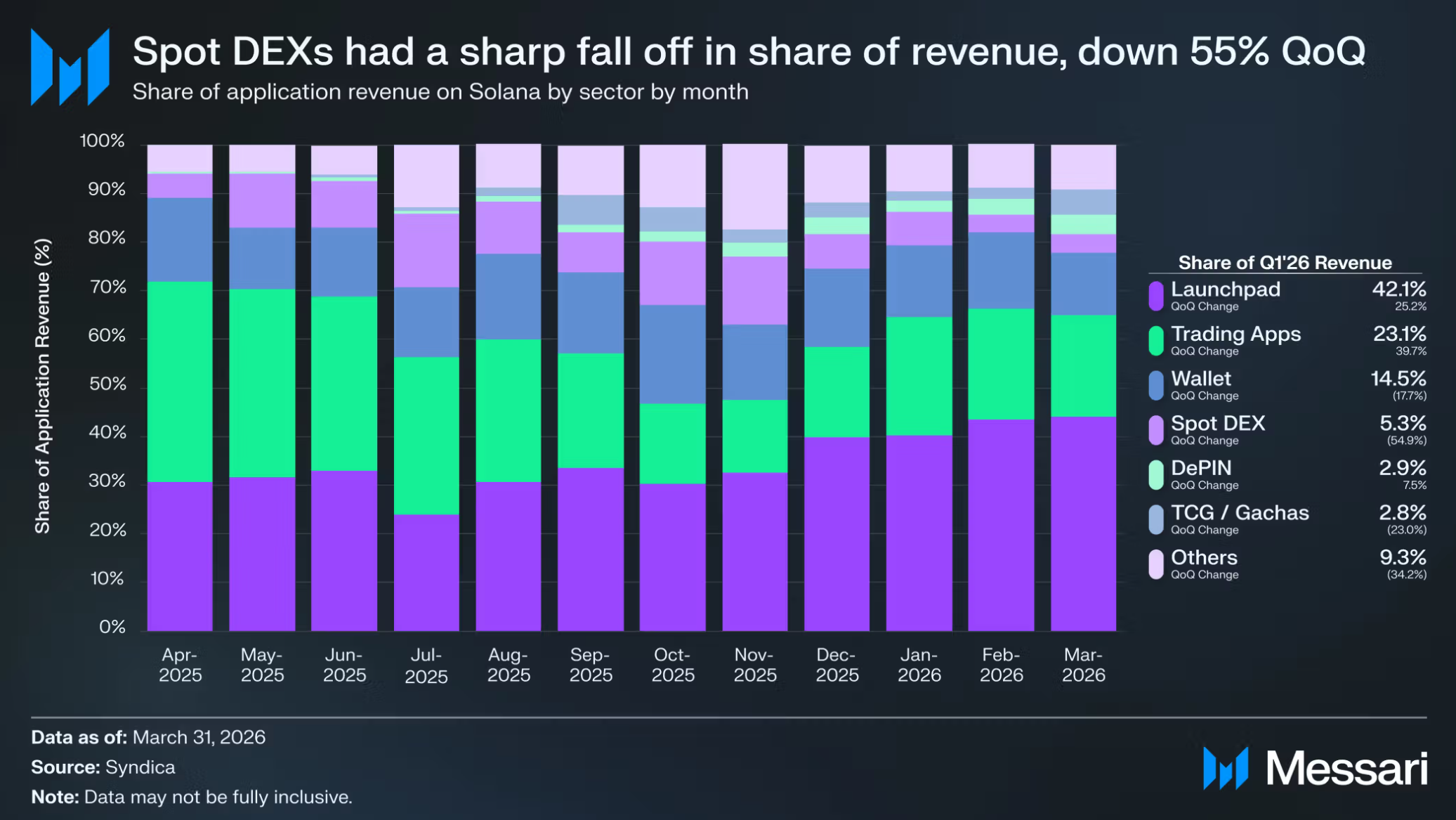
Pump.fun remained Solana’s largest revenue generator in the first quarter of 2026, pulling in $124.7 million, more than a third of the network’s $342.2 million in total app revenue, despite cooling memecoin activity.
The memecoin launchpad’s revenue rose 17% quarter over quarter, a sign that its core business remains resilient, Messari said in its Solana Q1 report.
Launchpads generated $144 million in Q1, roughly 42% of Solana’s total app revenue. A standout within the sector was Bags, whose quarterly revenue surged 1,347% to $11.5 million, fueled by a wave of AI-themed memecoins in January. The surge proved short-lived, with monthly revenue dropping 85% by February.
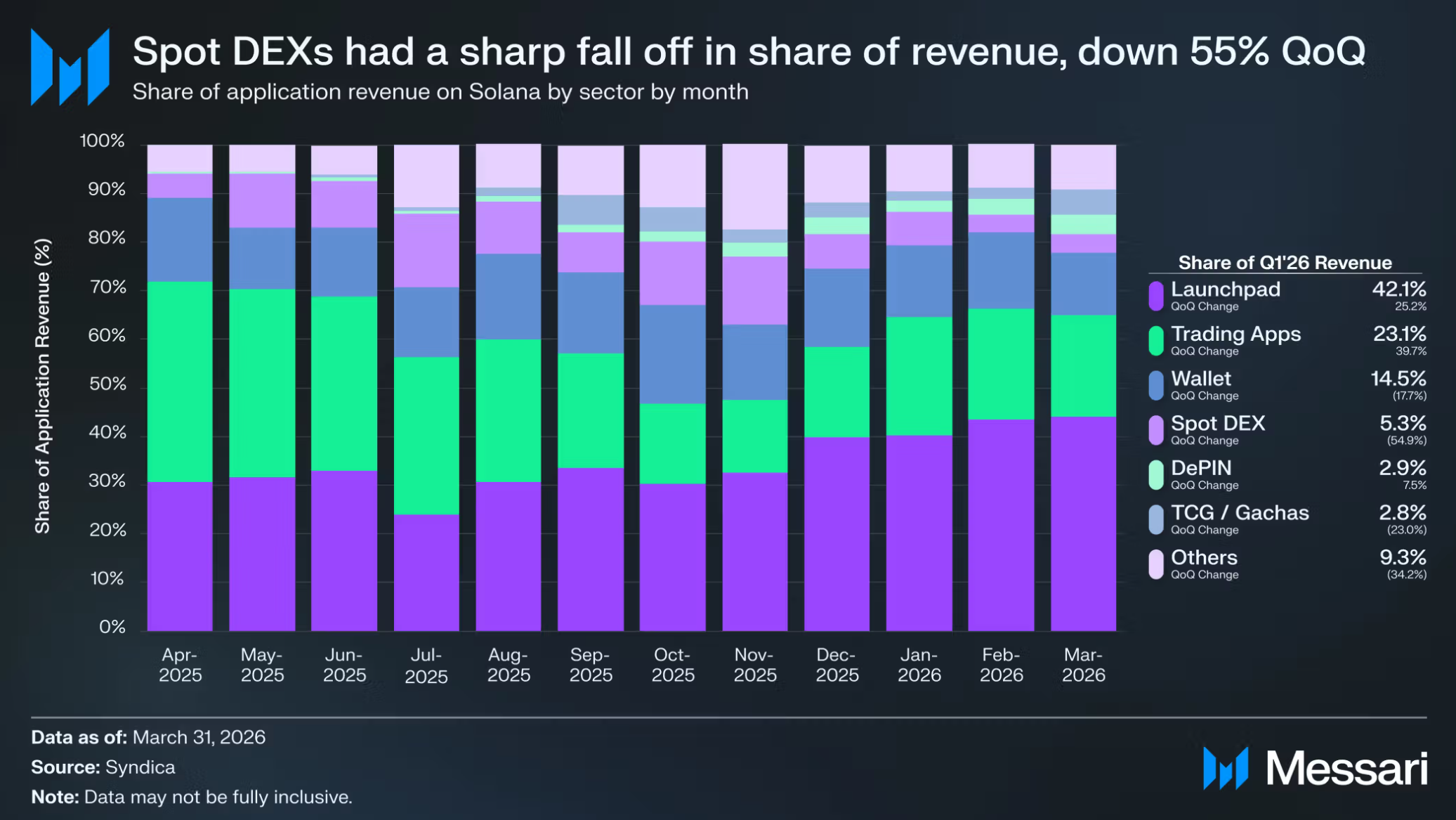
Solana revenue. Source: Messari
Solana’s memecoin revenue is holding up even as the network increasingly attracts a broader range of users, with major institutions like BlackRock, Visa and JPMorgan expanding their presence across its payments and tokenization ecosystem.
“Memecoins don’t define Solana,” Lily Liu, president of the Solana Foundation, said in a recent interview.
Related: MoonPay Acquires DFlow, Adding Solana Trading Infrastructure
Trading apps, RWAs grow on Solana
Trading apps on Solana were the quarter’s strongest-growing sector overall, with revenue rising 40% to $79 million. Axiom led the pack at $42.4 million, making it the second-highest revenue-generating app on the network.
Elsewhere, Solana’s real-world asset market cap crossed $2 billion, up 43% in the quarter, led by BlackRock’s BUIDL doubling to $525 million after Anchorage Digital added custody support.
DeFi total value locked fell 22% to $6.16 billion, though Messari researchers attributed the decline largely to SOL’s 33% price drop rather than user exits. The network’s share of total DeFi TVL remained roughly flat at 6.7%.
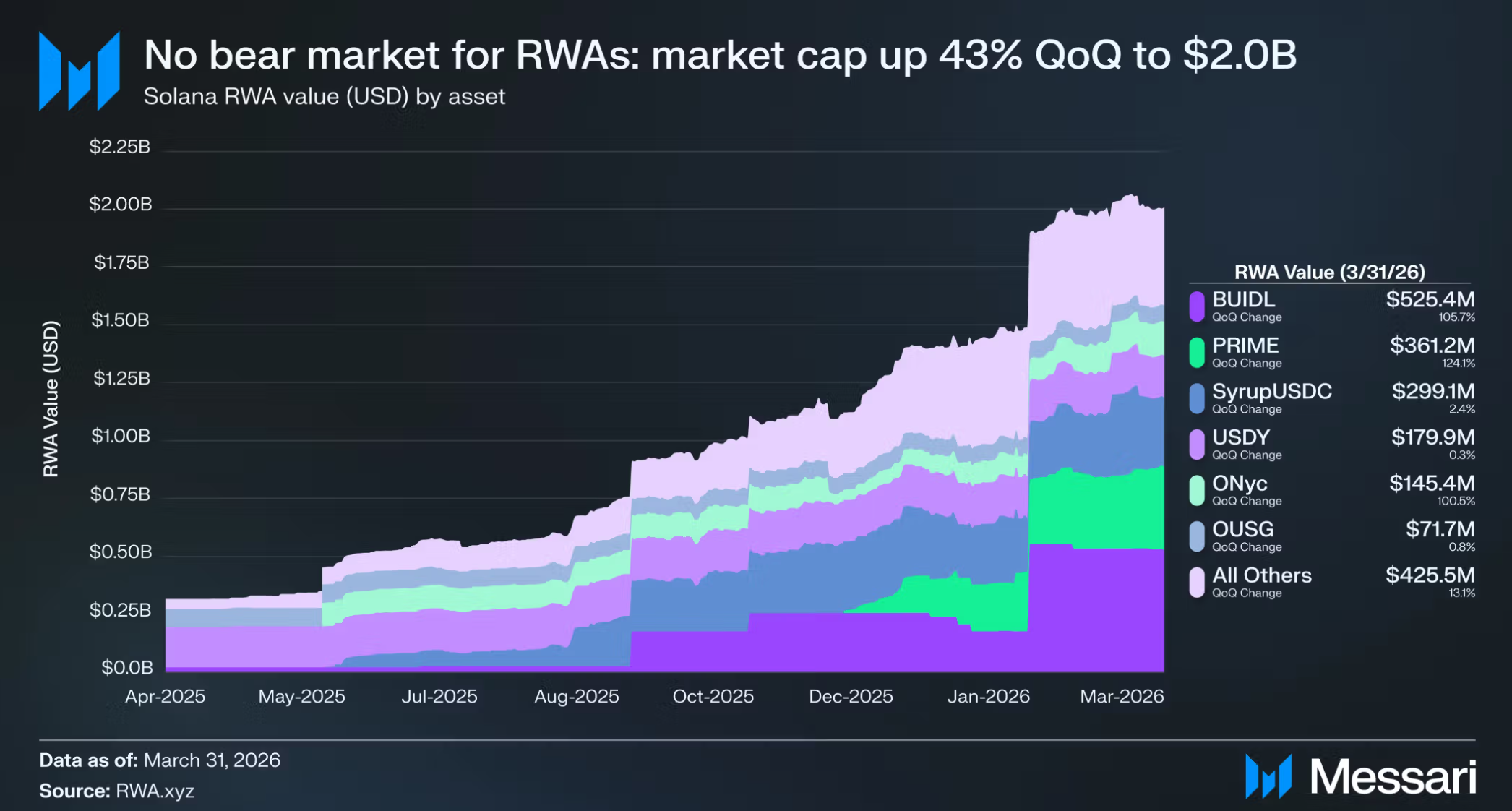
RWAs grow on Solana, fueled by institutional inflows. Source: Messari
On the infrastructure side, the focus is on Alpenglow, a sweeping consensus upgrade targeting the Agave 4.1 release. If it ships as planned, the upgrade would cut Solana’s transaction finality from around 12.8 seconds to 150 milliseconds.
Related: Solana Clients Introduce Post-Quantum Solution Falcon
Goldman Sachs exits Solana positions
As Cointelegraph reported, Goldman Sachs exited its Solana ETF positions in Q1 2026, dropping stakes in funds from Grayscale, Bitwise and Fidelity.
Italy’s largest bank, Intesa Sanpaolo, also nearly wiped out its Solana position in Q1 2026, slashing its stake in Bitwise’s Solana ETF from 266,320 shares to just 2,817, even as it more than doubled its total crypto holdings to $235 million by piling into Bitcoin ETFs from ARK 21Shares and BlackRock.
Market Moves: Why is Ethereum Foundation selling? BTC futures warning signs


Key Takeaways
- MediaTek is pivoting from traditional chip design to comprehensive system-level AI hardware solutions, pursuing opportunities with Google’s TPU and AI infrastructure projects linked to Elon Musk’s ventures.
- TF International Securities analyst Ming-Chi Kuo notes this strategic transformation won’t significantly affect MediaTek’s financials in the immediate two-year window but establishes groundwork for future expansion.
- Google is pursuing discussions with Samsung for manufacturing components of its upcoming AI processor, designated Icefish, as TSMC faces capacity constraints.
- The Google-Samsung negotiations underscore the intense competition for advanced AI chip fabrication, forcing even premium clients to seek alternative manufacturing partners.
- MediaTek’s expansion into system-level solutions aims for 40–50% gross margins using an asset-light approach, outsourcing production while maintaining control over design and quality assurance.
MediaTek is undertaking a significant transformation in its artificial intelligence business model, moving beyond traditional semiconductor design toward comprehensive system-level hardware solutions. The Taiwanese technology firm is pursuing two strategic opportunities: managing printed circuit board assembly for Google’s Tensor Processing Unit and developing rack-level infrastructure for AI companies associated with Elon Musk.
According to Ming-Chi Kuo from TF International Securities, this strategic realignment represents a fundamental business evolution rather than a short-term revenue initiative.
“MediaTek has elevated its AI business strategy from integrated circuit and application-specific integrated circuit design to comprehensive system-level design,” Kuo explained. He emphasized the transition carries “minimal impact on core business fundamentals through the next 24 months.”
Dual-Track Approach: Pursuing Google and Musk-Connected Ventures
These two strategic pathways present distinct characteristics and challenges. Google operates an established and mature hardware manufacturing network, making MediaTek’s prospects for securing premium rack-level integration contracts somewhat limited.
MediaTek’s more viable entry into Google’s ecosystem lies at the circuit board level, beginning with the tenth-generation TPU processor codenamed Icefish.
The opportunity with Musk-affiliated enterprises presents a contrasting scenario. These organizations are currently developing proprietary AI processors at commercial scale, and their rack assembly infrastructure remains in nascent stages.
“This represents MediaTek’s strategic window,” Kuo stated. He emphasized that sustained success hinges on MediaTek capitalizing on Taiwan’s robust hardware manufacturing ecosystem and its collaboration with Terafab, while acknowledging the initiative “currently lacks definitive timeline clarity.”
MediaTek’s financial model for this segment targets gross profit margins between 40% and 50% by maintaining leadership in design and validation processes while delegating actual manufacturing to third parties, ensuring operational efficiency.
Google Explores Samsung Partnership Amid TSMC Production Constraints
Simultaneously, Google is reportedly negotiating with Samsung to produce a memory input-output component for the Icefish processor. TSMC would continue manufacturing the primary computational core utilizing its cutting-edge 1.4-nanometer fabrication technology.
Wedbush Securities analysts suggest the Samsung discussions primarily stem from constrained manufacturing capacity at TSMC rather than signaling dissatisfaction with their services. Essentially, the extraordinary demand for advanced AI semiconductor production has reached levels where even flagship customers like Google must diversify their manufacturing partnerships.
Employing Samsung introduces operational complexities. Distributing chip fabrication across multiple foundries increases coordination challenges and potentially impacts production yields and economic efficiency.
For Google, the objective centers on guaranteeing adequate supply to support expanding AI infrastructure requirements. For Samsung, this opportunity represents a pathway to secure additional high-value foundry contracts.
Kuo’s broader analysis suggests MediaTek’s current ASIC chip design operations may experience deceleration within two to three years as the semiconductor industry transitions toward emerging architectures. This potential headwind underscores why the system-level expansion represents a strategic imperative, despite contributing minimal near-term revenue growth.
The most significant near-term indicator will be whether MediaTek secures qualification contracts for the TPU v10 Icefish processor. Regarding the Musk-affiliated ventures, specific implementation timelines remain undefined.

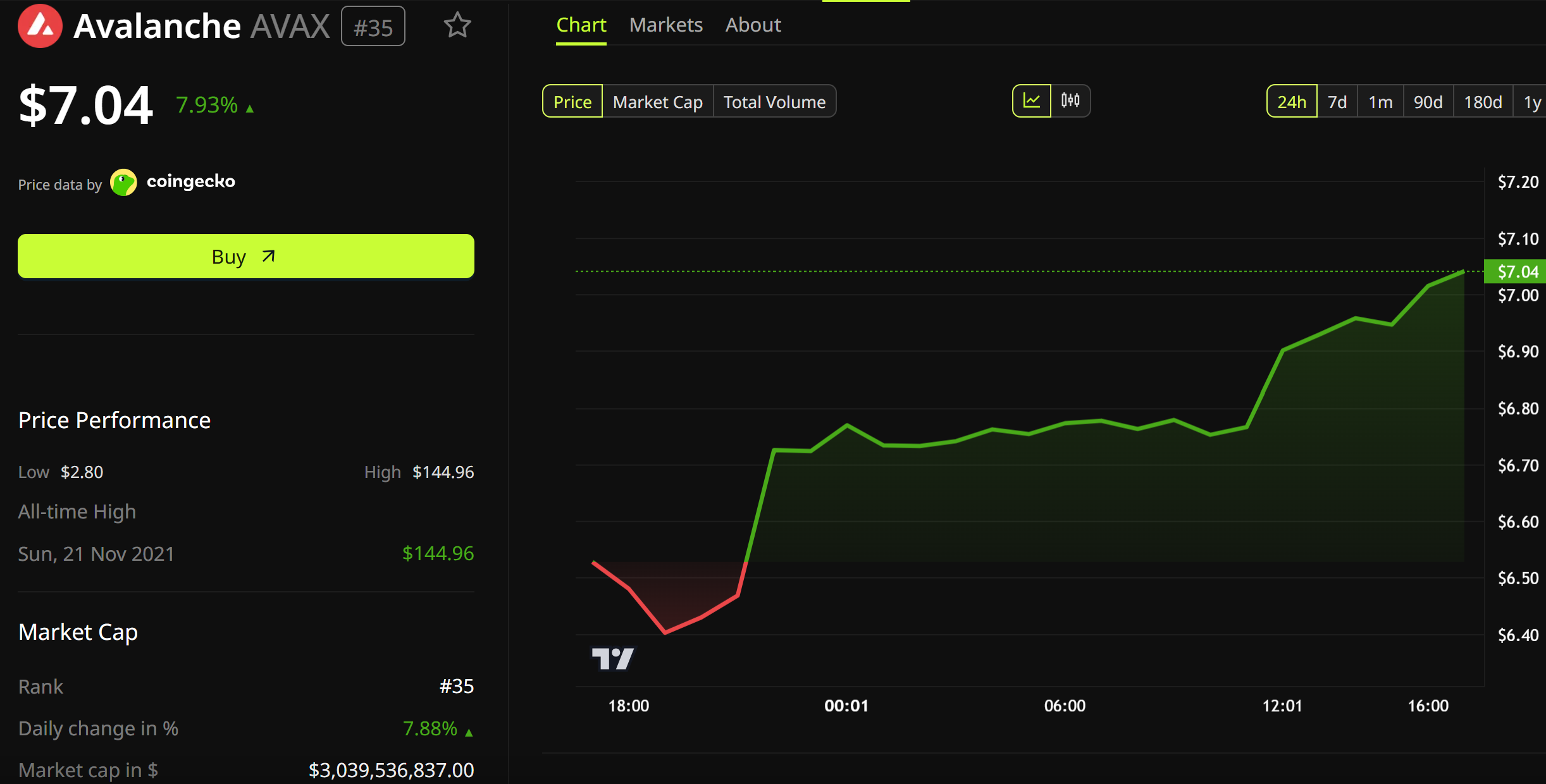
FIFA is running ticketing, loyalty, and digital collectibles for the 2026 World Cup on a custom Avalanche blockchain. The adoption story arrives as Avalanche (AVAX) posts its first bullish signal in a month.
The token climbed nearly 8% in 24 hours. That move tracks a broader recovery in crypto sentiment, yet the World Cup hands Avalanche a fresh real-world hook that few rivals can match this summer.

FIFA’s World Cup Push Runs on Avalanche
FIFA announced its dedicated Avalanche blockchain in May 2025. The network is a custom Layer 1 built for digital collectibles and global-scale fan engagement.
The first step was migrating FIFA Collect, the official collectibles platform, to the new chain. Technology partner Modex leads development of the marketplace.
Right-to-Ticket collectibles now grant verified access to official 2026 World Cup match tickets. Holders convert them through a dedicated portal up to three days before each match.
Ava Labs President John Wu has confirmed the scope of the integration in recent interviews.
“We’re super excited that FIFA and the World Cup that’s coming this summer is doing their loyalty and the right to buy tickets and ticket platform on an Avalanche blockchain,” John Wu, Ava Labs president.
Follow us on X to get the latest news as it happens
Adoption Meets a Sentiment Recovery
Avalanche has already seen a surge in new users tied to the FIFA partnership and rising institutional interest.
On-chain activity picked up again as Right-to-Ticket redemptions went live during the tournament.
Still, the latest price move owes much to improving market-wide sentiment. AVAX had fallen more than 24% over the past 30 days before this week’s bounce.

The FIFA link does give Avalanche a marketing advantage among World Cup crypto coins. However, whether that translates into lasting demand for the token remains to be seen.
AVAX Price Outlook
The Avalanche price is trading near $7.07 as it consolidates within a falling wedge pattern that capped price action since early 2026.
However, the falling wedge is a bullish reversal pattern in technical analysis. The target objective is determined by measuring the technical formation’s maximum height and superimposing it at the expected breakout point.
With price now challenging the 50-day EMA cluster near $7.44, immediate support rests at the lower boundary of the technical formation at $6.22.
Increased buyer momentum above current levels would see the AVAX price test the 50-day EMA before confronting the confluence resistance between the 100-day EMA and the upper boundary of the falling wedge at $8.29.
A confirmed move above this level could activate the 49% rally, with the AVAX price potentially extending gains to $13.08.
Based on the volume profiles (green horizontal bars), bulls are waiting to interact with the Avalanche price above the falling wedge, adding credence to the prospective 49% climb.
The Relative Strength Index (RSI) trajectory also shows growing momentum, with the bullish crossover above its signal line (yellow) indicating a green signal for AVAX.

Conversely, loss of $6.22 support would shift focus back to the lower range, potentially forming a lower low. A decisive daily close below this area would invalidate the bullish structure and open the door for a leg lower.
The RSI below 50 is also concerning, indicating that while momentum continues to build, the bears still hold the upper hand.
The post FIFA World Cup Push Lifts Avalanche Adoption: Will AVAX Price Rally? appeared first on BeInCrypto.


Bitcoin (BTC) traded at $0.20 when South Africa hosted the 2010 FIFA World Cup. With North America now staging the 2026 edition, BTC sits near $66,258, a gain of more than 328,000% across five consecutive tournaments.
The timing has never broken down. Each World Cup since 2010 opened with Bitcoin higher than the one before: $620 in Brazil 2014, $6,500 in Russia 2018, $16,800 in Qatar 2022, and roughly four times that figure today.
Bitcoin’s Halving Makes the World Cup Timeline Look Less Like Luck
The Bitcoin ETF and liquidity cycle analysis published in 2026 points to a structural reason the four-year pattern persists.
Bitcoin’s halving cuts miner rewards in half on the same four-year schedule as the World Cup, tightening new supply each time. Bull markets have historically followed within 12 to 18 months of each reduction.
The current cycle saw BTC peak near $126,000 in early 2025 before sharply pulling back.
The Bitcoin price near $66,258 today sits roughly halfway between the Qatar 2022 price and that peak, consistent with previous post-peak drawdowns within the same cycle.
The Returns are Compressing
The math across each four-year hold tells its own story. Buying at the 2010 tournament and holding to 2014 would have returned roughly 3,100x. The 2014-to-2018 window delivered around 10x. Qatar 2022 holders from 2018 saw approximately 2.6x. The 2022-to-2026 gain sits near 3.9x.
The direction is clear. As Bitcoin matures into a multi-trillion-dollar asset, each successive multiplier shrinks. Institutional capital and ETF flows now shape price behavior in ways that block-reward mechanics alone cannot explain.
New demand layers add structural support but also absorb the volatility that produced early-cycle windfalls.
Will 2030 be Different?
Crypto’s presence at the 2026 World Cup spans prediction markets, fan tokens, and on-chain betting, a sign of mainstream penetration that could sustain demand or simply price the next move in earlier.
The streak stands unbroken, but holding through a full cycle now requires patience for a smaller reward than the previous generation received.
The Bitcoin outlook through 2030 ultimately depends on US monetary policy, sovereign accumulation, and whether ETF-driven demand continues to absorb sell pressure. The pattern has held through five tournaments. The question now is whether five becomes six.
The post Bitcoin Has Gained at Every FIFA World Cup: Will the 2030 Cycle Hold? appeared first on BeInCrypto.
Crypto World
Market Movers Today: SpaceX IPO Shatters Records, AI Stocks Expand, and Airlines Take Flight

Quick Overview
- SpaceX’s public debut has become the biggest IPO ever recorded, fundamentally altering investor perspectives on private technology enterprises
- Reports indicate OpenAI submitted confidential IPO paperwork, generating substantial excitement throughout the investment community
- Market participants are diversifying AI investments beyond Nvidia, turning attention to Broadcom, TSMC, AMD, and Micron
- Energy markets found equilibrium following recent turbulence, supported by positive signals from US-Iran negotiations
- Airlines experienced strong gains driven by reduced fuel expenses and robust leisure travel demand
While the SpaceX public offering captured headlines throughout the week, numerous other developments commanded investor focus. From emerging AI investment opportunities to shifting energy dynamics, here’s what drove market activity today.
SpaceX’s Market Debut Reshapes Growth Investment Strategy
The space exploration company completed an unprecedented public offering that now stands as history’s largest. Exceptional investor appetite propelled the stock into the spotlight as one of Wall Street’s most closely monitored equities.
This landmark event has fundamentally transformed how the investment community evaluates privately-held technology enterprises. Market experts suggest the overwhelming response may accelerate public listing timelines for other prominent private companies.
Firms including OpenAI, Anthropic, Databricks, and Stripe have emerged as potential IPO prospects in current discussions. The successful SpaceX launch has made public market entry significantly more appealing for mature private enterprises.
The commercial space industry received broader momentum as well. Market participants are actively seeking additional companies positioned to capitalize on increasing commercial space investment.
OpenAI and Other AI Companies Eye Public Markets
Emerging reports indicate OpenAI has submitted confidential IPO documentation. Should this materialize, it would rank among the most significant technology listings in history.
Previously, investors gained AI market exposure primarily through established companies like Nvidia, Microsoft, Broadcom, and Amazon. A direct OpenAI public offering would fundamentally alter this landscape.
Anthropic and additional private artificial intelligence companies remain under close observation. Financial industry experts anticipate these enterprises could generate significant investor demand, particularly as AI implementation continues accelerating.
The possibility of several major AI public offerings within the coming years has emerged as a dominant conversation topic among investment professionals currently.
Expanding AI Investment Opportunities Beyond Nvidia
While Nvidia maintains its position as the leading AI equity, investors are actively exploring alternative sector opportunities.
Broadcom has gained considerable traction due to its specialized AI processors and network infrastructure products. Taiwan Semiconductor Manufacturing continues benefiting from strong demand for cutting-edge chip fabrication capabilities.
Both AMD and Micron are attracting increased interest as market participants seek diversified exposure throughout the AI supply ecosystem.
This expanded investment approach has elevated semiconductors, cloud infrastructure, networking equipment, and software companies throughout 2026. Investors have shifted from concentrated Nvidia positions toward broader infrastructure plays supporting the technology.
Energy Markets and Aviation Sector Return to Investor Radar
Oil prices stabilized following a period of significant fluctuation. Encouraging developments surrounding US-Iran diplomatic discussions helped alleviate concerns regarding potential supply interruptions.
Decreasing crude prices benefit both consumers and enterprises. Reduced fuel and logistics expenses contribute to maintaining inflation pressures under control.
Airline stocks have delivered exceptional returns recently. Given that fuel represents airlines’ largest operational expense, declining oil costs directly enhance profit margins.
Multiple carriers have experienced substantial gains as investors develop greater confidence regarding travel volumes and financial performance. Consumer enthusiasm for leisure travel continues demonstrating resilience despite wider economic uncertainties.
Should oil prices remain contained, airline equities could sustain strong performance through the latter portion of 2026.
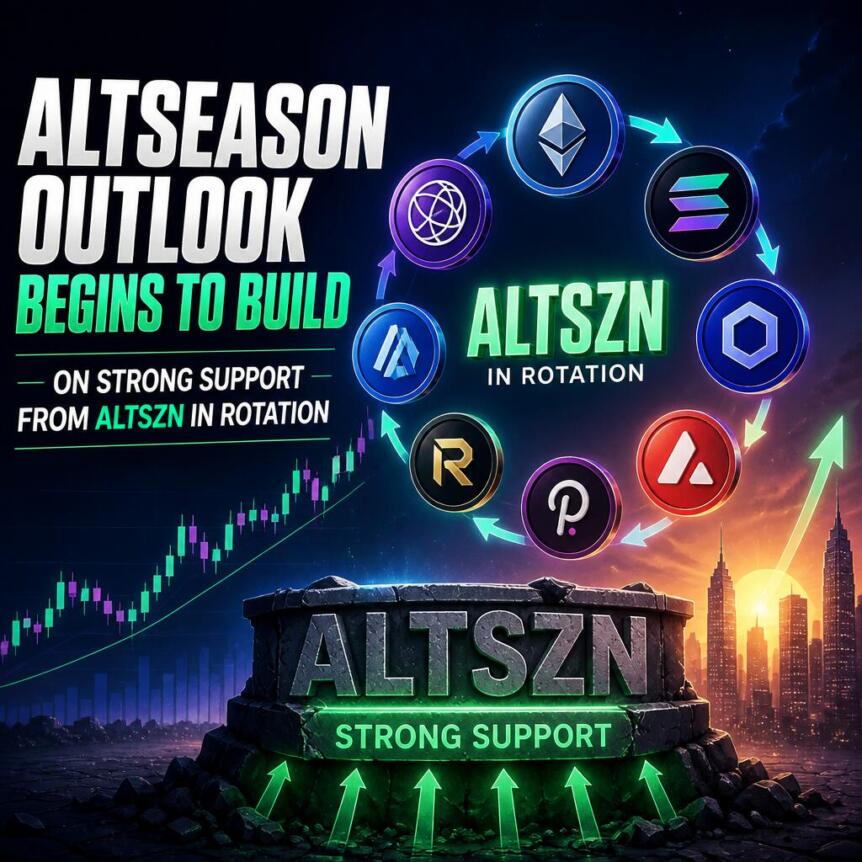
Altseason outlook is starting to build as ALTSZN consolidates close to support following a rally while altcoin cycles and increased volumes indicate the possibility of rotation taking place. Traders are eyeing key resistances ahead of any momentum.
Key Insights
- There has been consolidation close to support for ALTSZN following a small rally, with resistance currently testing $0.00520.
- Altseason cycles have always followed accumulation of OTHERS/BTC.
- No altseason signal yet, even as traders expect rotation.
Altseason Outlook Is Becoming Popular Amid the Consolidation in Market Structure
The altseason outlook has received considerable popularity as the structure of ALTSZN has consolidated in the wake of a previous uptrend. Having undergone a short-term rally, the token seems to be consolidating, meaning that there is tight action within the range bounded by the existing level of support and resistance. This pattern may be regarded as evidence of market indecision and hesitation in terms of further price movement.
At the moment, the token is changing hands at close proximity to its bottom level, with support ranging from $0.00460 to $0.00465. Resistance has shown its existence near $0.00485 and $0.00515 to $0.00520, and each attempt to reach above this level failed due to selling activity.
Altcoin Season Rotation Theory Gaining Momentum From the Larger Picture
While ALTSZN price performance alone supports the theory of an upcoming rotation season for altcoins, the broader picture of the market is another supporting factor. The OTHERS/BTC ratio continues to draw attention due to its similarities with trends observed during previous cycles in the market history.
Historically, a period of dominance of one asset tends to lead to a massive run-up in other coins once the capital is rotated away from that coin into other alternatives. This is something that analysts, who use data from past market cycles, point out when they describe two main phases, Altseason 1 (2017-2018) and Altseason 2 (2020-2021).
According to analysts’ observations, both events featured a long consolidation phase before massive bull runs in alternative coins took place. Once the rotation started, the price of other cryptocurrencies skyrocketed. Now the market structure implies that we might be observing a similar consolidation phase with the same future upside expectations.
Consolidation of ALTSZN Is Due to Indecisiveness of the Market Participants
In terms of micro-analysis, one can see how ALTSZN is undergoing a regular consolidation process following a rally. In particular, after rising from the levels of $0.00445, the token managed to test the resistance at $0.00480 but could not push its way beyond it. Instead, this resulted in range-bound behavior, where price failed to make any gains above $0.00520.
So far, the price has not been able to continue rising due to selling pressure near the said resistance. On the other hand, price correction to lower levels has also been held back by buying pressure coming from around the support area of $0.00460 to $0.00465.
Market Outlook: Confirmation Still Needed
At this point in time, the general outlook for altseason is still unclear. Even as certain parallels exist from other cycles in the past, there is yet to be any definite breakthrough in terms of an altseason rotation. It is currently left to be seen if ALTSZN can break its way to higher resistances, or if the cycle of consolidation continues until another accumulation phase emerges. The prevailing attitude is still cautious, as more confirmation needs to be made first.
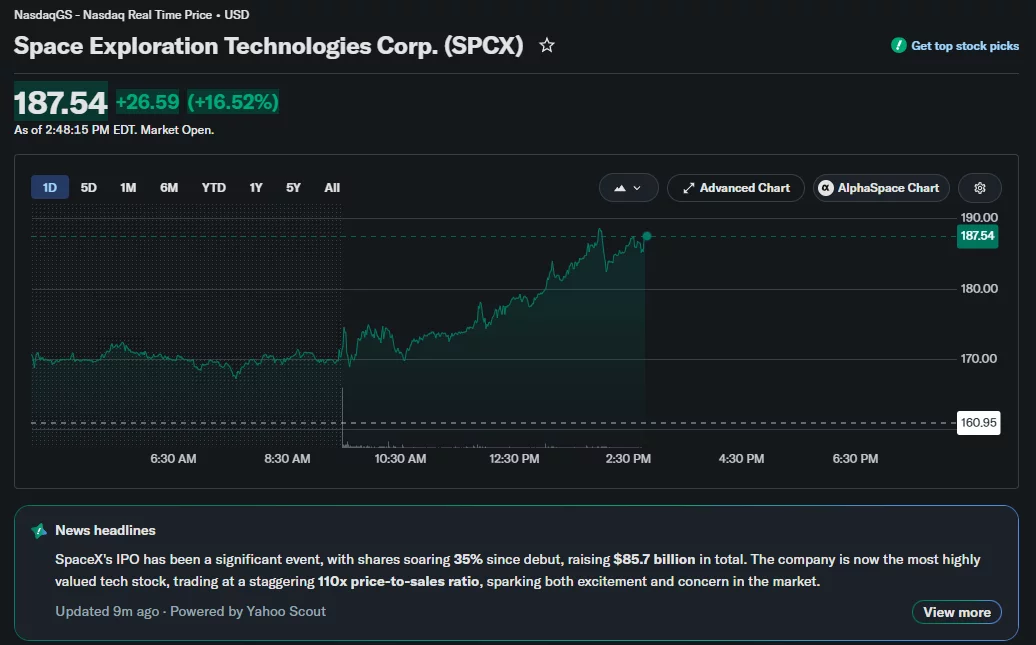
SpaceX’s market value has climbed past $2.43 trillion on the second day of its Nasdaq debut, pushing the stock far beyond several pre-listing valuation estimates and cementing its place among the world’s most valuable public companies.
Summary
- SpaceX’s valuation climbed to roughly $2.43 trillion as shares surged more than 16% on the second day of trading.
- The stock traded near three times Morningstar’s $63 fair value estimate, defying several pre-IPO valuation concerns.
- ARK Invest bought $444 million worth of SpaceX shares, while Michael Saylor highlighted the company’s 18,712 BTC holdings.
According to Yahoo Finance data, shares of Elon Musk’s rocket and satellite company rose over 16% on Monday to $187.5 in afternoon trading. The move added about $26 per share in the session and lifted SpaceX’s intraday valuation to approximately $2.43 trillion.
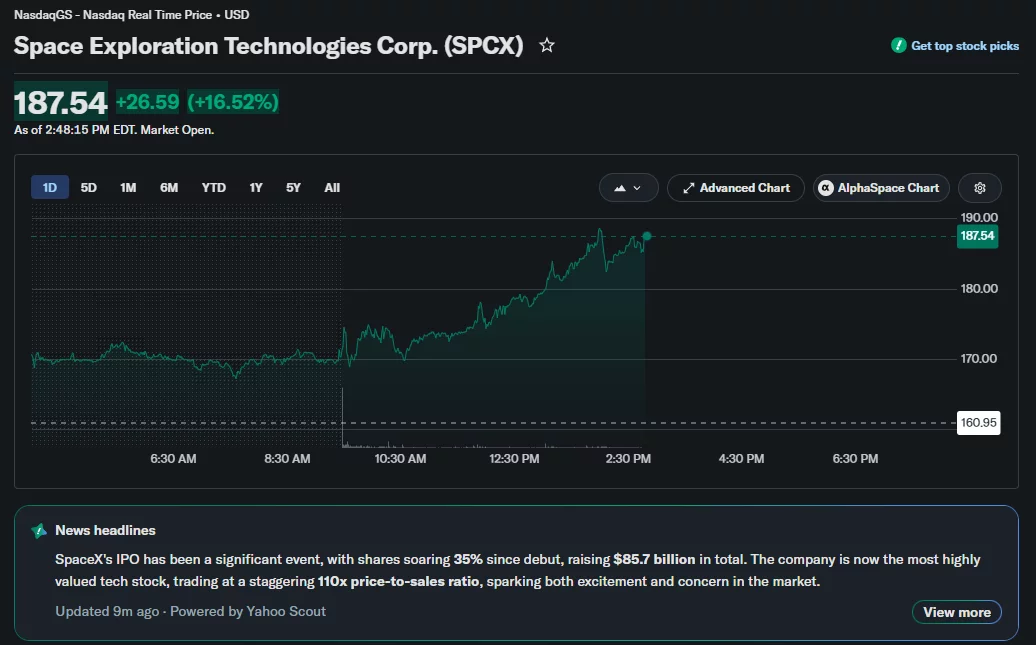
Trading activity remained elevated during the stock’s second session. Yahoo Finance data showed the shares opening at $171.81 and reaching an intraday high near $188.80, while volume surpassed 196 million shares. The gains extended a rally that began immediately after the company’s historic market debut.
Wall Street valuation concerns have not slowed demand
Before the listing, several analysts and market commentators questioned whether SpaceX’s valuation could be justified given the company’s financial profile. Morningstar estimated a fair value of $63 per share, a figure that sat well below the company’s $135 offering price. SpaceX has since climbed to nearly $188, trading at almost three times that estimate.
Investor appetite has moved in the opposite direction. As previously reported, SpaceX raised roughly $75 billion by selling more than 555 million shares at $135 each in the largest IPO on record. The stock opened at $150 on its first trading day, climbed as high as $176.52, and finished more than 19% above the offer price.
Reports surrounding the offering also highlighted concerns that a deal of such size could struggle to attract sufficient demand. Instead, orders reportedly exceeded available shares by a substantial margin, helping SpaceX surpass a $2 trillion valuation during its first days as a public company.
Even with the rally, questions about fundamentals remain. Notably, SpaceX generated $18.7 billion in revenue last year while posting a loss of $8.7 billion between the beginning of 2025 and March 31, 2026. MarketBeat data places the average one-year analyst price target near $161.25, below the stock’s current trading range.
Institutional investors continue backing the stock
While some analysts remain cautious, several high-profile investors have publicly supported SpaceX’s valuation. Kevin O’Leary has argued that investors are assigning value based on the company’s future opportunities rather than its current earnings.
Institutional demand has also accompanied the rally. As previously reported by crypto.news, Cathie Wood’s ARK Invest acquired 3,291,184 SpaceX shares across its exchange-traded funds on June 12, a purchase valued at roughly $444 million. The transaction ranked among ARK’s largest portfolio moves as the company entered public markets.
Meanwhile, SpaceX’s listing has drawn attention beyond traditional equity investors because of the company’s Bitcoin holdings. Commenting on the debut, Strategy Executive Chairman Michael Saylor said the IPO means 25% of the so-called Mag 8 companies now hold Bitcoin on their balance sheets. According to Bitcoin Treasuries data cited by crypto.news, SpaceX holds 18,712 BTC.
The listing has also strengthened Elon Musk’s position among the world’s wealthiest individuals. With SpaceX now trading publicly at a valuation above $2.4 trillion, the company ranks ahead of several established technology giants, including Meta, Samsung and Tesla, while remaining behind Nvidia by market value.
TLDR:
- Spot HYPE ETFs have attracted $153 million in net inflows within their first month of trading.
- Cumulative trading volume across THYP, BHYP, and HYPG has approached $900 million since launch.
- All three ETFs hold HYPE directly and offer staking rewards at an annual rate of around 2.25%.
- About 97% of Hyperliquid trading fees fund an automatic HYPE buyback via the Assistance Fund.
Spot HYPE ETFs have recorded approximately $153 million in net inflows within their first month of trading. Cumulative trading volume across the three available products has approached $900 million since launch.
The three issuers — 21Shares, Bitwise, and Grayscale — each hold HYPE directly and pass staking rewards to investors. Early data points to growing institutional appetite for regulated exposure to Hyperliquid.
Early Volume Data Points to Institutional Demand for Hyperliquid
Three regulated products currently offer brokerage-accessible exposure to HYPE. These are 21Shares’ THYP, Bitwise’s BHYP, and Grayscale’s HYPG.
Together, they have generated nearly $900 million in cumulative trading volume in roughly one month. Net inflows across all three have reached $153 million over the same period.
Trading activity across the products has not been evenly distributed. BHYP and THYP account for the bulk of volume recorded so far.
HYPG, the most recent entrant, is still in its early ramp-up phase. The gap likely reflects differences in launch timing and distribution reach rather than investor preference.
All three ETFs hold HYPE directly and distribute staking rewards to investors. Rewards accrue every minute, are distributed daily, and are automatically compounded. The current annual staking reward rate stands at approximately 2.25%, based on present staking levels.
Approximately 434 million HYPE tokens are currently staked, representing about 45% of the eligible supply. That staking participation rate reflects meaningful on-chain engagement beyond the ETF products themselves. Months two and three of trading will provide a more reliable read on sustained institutional conviction.
Fee Buyback Mechanism Sets HYPE Apart From Speculative Tokens
HYPE carries a structural characteristic that separates it from many other tokens in the market. About 97% of Hyperliquid’s trading fees flow directly into the Assistance Fund. This creates an automatic buyback mechanism tied directly to platform trading volume.
That fee-to-buyback link establishes a direct relationship between platform activity and token demand. As trading volumes on Hyperliquid grow, so does the programmatic demand for HYPE. This makes HYPE less dependent on speculative narratives than many comparable assets.
The ETF structure also adds a layer of accessibility for institutional investors who cannot hold crypto directly. Regulated brokerage exposure lowers the operational barrier for funds, family offices, and other large allocators. That accessibility may partly explain the strong early inflow figures.
For context, U.S. spot Bitcoin ETFs are approaching a $2 trillion cumulative trading volume milestone. That benchmark took years to reach and now serves as a reference point for newer crypto ETF products.
HYPE ETF performance in the coming months will determine how that comparison holds up.


Bitcoin has climbed above $67,000 after U.S. President Donald Trump confirmed that the U.S. and Iran have signed a peace agreement, helping push the total crypto market capitalization to $2.37 trillion.
Summary
- Bitcoin climbed above $67,000 after Trump confirmed the U.S. and Iran had signed a peace agreement.
- The crypto market cap rose 4.7% to $2.37 trillion, while Ethereum gained over 10% and several altcoins posted double-digit advances.
- Oil fell more than 5% below $80 as the reopening of the Strait of Hormuz appeared closer, lifting stocks, gold, and silver alongside crypto.
According to statements made by Trump ahead of a bilateral meeting with French President Emmanuel Macron, the peace deal has already been signed despite a formal signing ceremony still scheduled for Friday in Geneva.
Trump added that Iran will reopen the Strait of Hormuz by Friday and that vessels passing through the waterway will not be charged tolls for 60 days.
The latest comments followed an earlier Truth Social post highlighted by crypto.news, in which Trump claimed ships were already moving out of the Strait of Hormuz. Cryptocurrency prices extended their advance after the president later confirmed that the agreement had been signed.
Bitcoin (BTC) rose more than 5% on Monday to an intraday high of $67,217 before settling near $66,560 at press time.
Ethereum (ETH) outperformed Bitcoin, climbing more than 10% to $1,846. Other major cryptocurrencies, including XRP, Solana, and Hyperliquid, posted double-digit gains, while Zcash, Stellar, and Worldcoin led the market with advances of 23%, 21%, and 18%, respectively. These gains have helped push the total crypto market up by 4.7% over the past 24 hours to $2.37 trillion.
Pakistan Prime Minister Shehbaz Sharif had previously stated that a public signing ceremony for the U.S.-Iran peace agreement would take place on Friday. However, Trump’s latest comments suggest the agreement has already been finalized. The president also said he was unsure whether he would attend the Geneva event.
Officials say both sides have signed the agreement
Additional details emerged after a senior U.S. official confirmed that both countries had already signed the agreement. According to the official, Trump and Vice President J.D. Vance signed on behalf of the United States, while Iran’s parliamentary speaker signed for Iran.
The same official stated that the full agreement could be released within the next 48 hours. According to the official, the deal provides for the immediate opening of the Strait of Hormuz and includes the removal of the U.S. blockade on Iranian ports.
While the official noted that mines in the waterway would delay a full reopening, they said shipping traffic through Hormuz is expected to increase over the next one to two weeks.
Falling oil prices add support to risk assets
Commodity markets reacted sharply to the prospect of normal shipping activity returning to the Persian Gulf. Notably, crude oil fell more than 5% to below $80 per barrel, touching its lowest level in roughly two months after news of the agreement emerged.
Trump also stated that oil shipments from the Persian Gulf could resume soon, reinforcing expectations that supply disruptions in the region may ease.
The prospect of renewed shipping activity through the Strait of Hormuz and lower energy costs coincided with gains across cryptocurrencies, U.S. equities, and precious metals.
U.S. equities moved higher, with the Nasdaq Composite gaining roughly 3%, the S&P 500 rising 1.7%, the Russell 2000 adding 1.5%, and the Dow Jones Industrial Average advancing about 1%.
Precious metals also joined the advance, with gold climbing around 0.8% and silver gaining roughly 1.2% during the session.
Disclosure: This article does not represent investment advice. The content and materials featured on this page are for educational purposes only.


Robinhood stock has surged more than 7% and briefly crossed the $100 mark after the company opened its AI-powered Agentic Trading platform to all customers.
Summary
- Robinhood shares jumped more than 7% and briefly topped $100 after the company opened its Agentic Trading platform to all users.
- The new feature allows customers to connect AI agents that can research markets, execute trades, and rebalance portfolios.
- Bernstein expects Robinhood’s prediction market revenue to reach $586 million in 2026, while Goldman Sachs recently raised its HOOD price target to $108.
According to an update shared by Robinhood on X, users can now connect artificial intelligence agents through the company’s MCP server and assign them investing tasks such as market research, trade execution, and portfolio rebalancing.
The company said customers can create dedicated accounts for AI-driven investing while remaining in control of how much authority is delegated to automated systems.
The launch introduces AI agents directly into the investing process, allowing users to automate selected activities based on instructions they set themselves. Robinhood said the feature is now available across its customer base, expanding access beyond earlier testing phases.
Investor enthusiasm around the announcement helped lift Robinhood shares during Tuesday’s session. HOOD stock rose above $99 and reached an intraday high of $100.87 before pulling back slightly.
AI-powered investing reaches Robinhood’s full customer base
Through Agentic Trading, Robinhood customers can deploy AI agents to analyze markets, place trades, and manage portfolios within dedicated investing accounts.
According to the company, users retain oversight of their accounts while allowing automated systems to carry out specific tasks.
The rollout comes as financial firms increasingly explore AI tools for investment research and portfolio management. By opening Agentic Trading to all users, Robinhood is adding another technology-focused product to its growing platform.
Additional growth drivers support investor interest
Beyond its AI initiatives, Robinhood has continued expanding its financial services business.
As crypto.news reported earlier, chief executive Vlad Tenev recently disclosed that Robinhood Securities had received approval to act as an underwriter, allowing the company to participate directly in helping companies go public rather than only distributing IPO shares through its IPO Access program.
Analysts have also highlighted strong growth in the company’s prediction market business.
In a client note published Monday, Bernstein projected Robinhood’s prediction market revenue could increase to $586 million in 2026 from roughly $150 million in 2025, citing a surge in World Cup-related trading activity. The research firm estimated the segment could contribute about 17% of transaction-based revenue next year.
Wall Street has become increasingly positive on the stock as new products continue to roll out. Goldman Sachs recently raised its price target on Robinhood shares from $105 to $108. The firm’s analyst James Yaro also maintained a Buy rating on the stock, indicating that Goldman Sachs continues to see further upside potential despite Robinhood’s recent gains.
Disclosure: This article does not represent investment advice. The content and materials featured on this page are for educational purposes only.

The U.S. Commodity Futures Trading Commission (CFTC) has appointed Donald Battle as its new chief data innovation officer, a role that signals the regulator is placing more emphasis on data-driven approaches, including blockchain analysis and forensics, in its oversight of digital assets.
According to a notice from CFTC Chair Michael Selig, Battle brings experience spanning “data science, blockchain forensics, programming interfaces, and cutting-edge AI solutions.” Selig also pointed to Battle’s background across multiple U.S. government agencies involved in crypto-related enforcement and policy work.
Key takeaways
- Donald Battle will serve as CFTC’s chief data innovation officer, with responsibilities tied to data science and blockchain forensics, according to Chair Michael Selig.
- Battle previously worked with both the CFTC and the Treasury’s Financial Crimes Enforcement Network, after serving as an adviser to the SEC’s crypto task force.
- The appointment arrives as lawmakers consider the CLARITY Act, which aims to reshape U.S. digital asset market structure and roles between the SEC and CFTC.
- The CFTC is simultaneously advancing a proposed framework for how sports event contracts are regulated, opening a public comment window.
- As the CFTC pursues enforcement through jurisdictional positions, observers may expect more technical monitoring and analytical capabilities.
What the CFTC appointment changes
Selig announced the hire in a Monday notice, naming Donald Battle as the CFTC’s chief data innovation officer. Battle is described as an adviser to the SEC crypto task force—an assignment he received in January 2025 alongside the incoming Trump administration—and as someone with prior direct involvement in blockchain data work at the CFTC.
Before that, the notice states that Battle worked as a blockchain data adviser for the CFTC and previously worked as a crypto enforcement specialist with the U.S. Treasury Department’s Financial Crimes Enforcement Network (FinCEN). The combination of CFTC and Treasury experience matters because it suggests the CFTC intends to integrate forensics-grade analytics into how it evaluates digital asset activity, particularly where enforcement and market integrity concerns overlap.
Battle’s stated competencies—data science, programming interfaces, and blockchain forensics—also indicate that the role is not limited to internal reporting. Instead, it points toward improved systems for detecting patterns, tracing flows, and supporting investigations using large-scale data and technical intelligence.
Why it matters amid SEC–CFTC policy pressure
The CFTC appointment comes at a time when Congress is working through legislation aimed at clarifying digital asset responsibilities across U.S. agencies. The notice ties the hire to a broader push to address both crypto regulation and enforcement more systematically, in the context of the CLARITY Act—a digital asset market structure bill described as seeking to overhaul how the SEC and CFTC define and handle roles.
At the same time, the CFTC has recently faced continued scrutiny over how far it can go in regulating certain digital asset-adjacent markets. Chair Selig remains the CFTC’s sole commissioner, a fact that matters given how legal authority and institutional capacity can affect enforcement approaches.
Under Selig, the CFTC has argued for exclusion jurisdiction in matters involving prediction market platforms such as Kalshi and Polymarket, according to prior reporting cited by the article. That stance has contributed to lawsuits against state-level authorities that sought to crack down on what they characterized as illegal gambling.
In practical terms, a data innovation officer with blockchain forensics expertise could help the agency build more durable technical evidence and monitoring capabilities—especially relevant in cases where regulators must demonstrate how a platform’s structure, trading mechanics, or information flows fit within federal frameworks.
Public comment opens for sports event contract rules
While the CFTC hires for data innovation, it is also actively shaping regulatory boundaries through rulemaking. The CFTC released a proposed rule last week that would help distinguish certain sports event contracts—offered on platforms such as Kalshi and Polymarket—from what it called “games of random chance,” a framing associated with gambling.
As reported, the public has 45 days to submit comments on the draft rule. The proposal could influence how the CFTC addresses sports event contracts and betting at both state and federal levels, particularly as regulators and courts continue to grapple with how prediction markets should be classified.
For market participants, this matters because the comment period affects how quickly the agency might move from contested jurisdictional claims toward a clearer, rules-based framework. For state regulators and legal challengers, it also sets the stage for arguments over how federal and state authority should interact when these platforms operate across jurisdictions.
Signals of a more technical enforcement posture
None of the CFTC’s announcement directly states that Battle’s appointment will result in new enforcement targets or a specific regulatory product. Still, the emphasis in the notice—especially on blockchain forensics and AI solutions—suggests the agency wants stronger technical tools as it navigates complex digital asset market categories.
That direction may be particularly important given the CFTC’s ongoing legal posture in prediction market disputes, where enforcement outcomes often hinge on detailed assessments of product design, participant access, and how rules are implemented in practice.
Investors, traders, and builders operating in adjacent areas such as sports event derivatives and prediction markets should watch how the proposed sports event contract framework evolves through the 45-day comment period, and whether the CFTC’s enhanced data capabilities coincide with changes in how it frames market classification and jurisdiction.
Beyond the immediate hire, the next key question for the CFTC will be whether its data-focused modernization translates into more consistent regulatory guidance—especially as Congress considers the CLARITY Act and as courts and agencies continue to test the boundaries of federal authority over prediction-style markets.
Is GOLDEN Money Soap a Scam?

Sensex, Nifty rally 1% as US-Iran peace hopes spark risk-on sentiment
MediaTek’s AI Pivot and Google’s Samsung Partnership: Inside the TSMC Capacity Squeeze


-

 Business1 day ago
No Jackpot Winner as $257 Million Prize Rolls Over to $269 Million Monday Draw
-

 Crypto World4 days ago
Oppenheimer backs SpaceX as $70 billion retail frenzy builds
-

 Crypto World4 days ago
Markets Rally as SpaceX IPO Looms Amid Iran Tensions and Inflation Surge
-

 Fashion3 days ago
Weekend Open Thread: Tuckernuck – Corporette.com
-
Crypto World1 day ago
Zimbabwe Requires Crypto Businesses to Register Annually Under New FIU Regulations
-

 Entertainment7 days ago
The Ryan Gosling True Crime Thriller On Netflix That Gets Even Stranger, Stream It Now
-
 Sports6 days ago
Bangladesh beat Australia after 20 years in ODIs, register only their second win over six-time world champions | Cricket News
-

 Tech3 days ago
NanoClaw integrates JFrog registries to secure AI agent downloads
-

 Crypto World3 days ago
Bitget enters Argentina’s regulated crypto market through PSAV registration
-

 Tech4 days ago
This Week In Security: Microsoft On Microsoft, Register Your Domains, Linux On ARM, And FreeBSD Joins The File Cache Club
-
 Tech4 days ago
Dutton Ranch star claims they ‘didn’t see any disruption’ on set following Chad Feehan’s exit from Yellowstone spinoff fueled by Taylor Sheridan clash rumors
-

 NewsBeat4 days ago
El Nino has formed in the Pacific and could set records, forecasters say
-

 Politics5 days ago
Politics Home | Healey Resignation Is “Colossal Failure Of Government”, Says Former Labour Defence Secretary
-

 Tech6 days ago
‘This is Seattle’s position on AI’: City Council votes unanimously to pause big new data centers
-

 Business6 days ago
Thailand Ranks Second Worldwide for AI Adoption Growth, Microsoft Reports
-
 Entertainment4 days ago
Donnie Wahlberg & More Heat Up Las Vegas at Circa’s Barry’s Downtown Prime
-

 Sports5 days ago
First Time Since 1971: Australia Register Historic Low In ODI Cricket
-
 Tech4 days ago
Opendoor Ends India Operations, Fueling a Bigger Conversation About AI and Outsourcing
-

 Politics4 days ago
Belfast burns, while Met chief points finger at Iran and Russia
-

 NewsBeat3 days ago
FBI searches office of Ohio voter registration group
You must be logged in to post a comment Login