

Crypto World
Real Finance, Anchorage Digital partner to expand RWA infrastructure

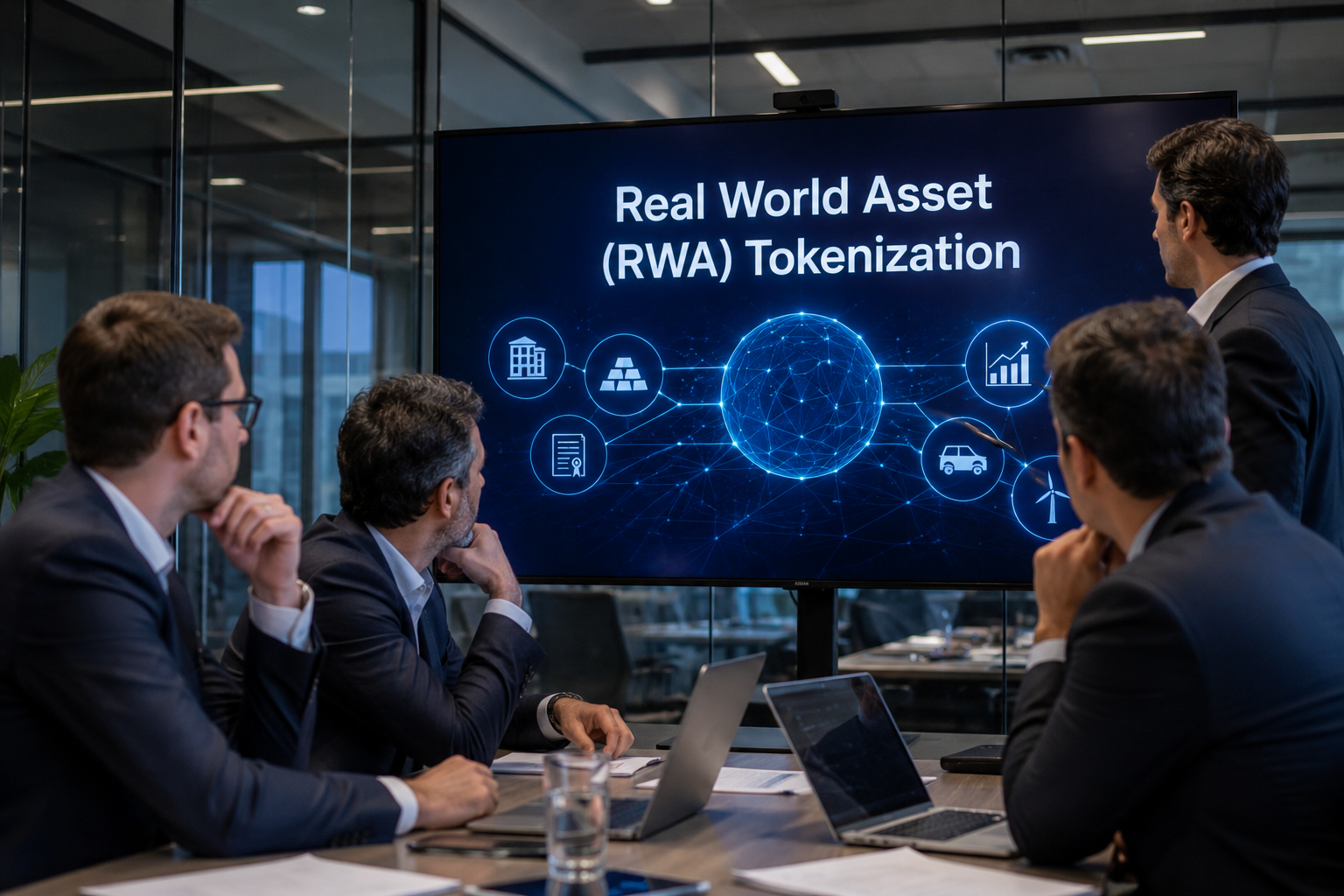

- Real Finance and Anchorage Digital form RWA infrastructure pact.
- Partnership combines tokenization, custody, and settlement tools.
- Firms target institutional adoption of on-chain capital markets.
Real Finance and Anchorage Digital have entered into a strategic partnership aimed at supporting the full lifecycle of tokenized assets, as institutional interest in real-world asset (RWA) tokenization continues to grow.
The collaboration combines Real Finance’s blockchain-based tokenization infrastructure with Anchorage Digital’s regulated custody, treasury management, settlement, and institutional security capabilities.
The companies said the partnership is designed to address key operational challenges that have slowed broader institutional adoption of tokenized financial products.
Under the agreement, the two firms will work together across asset issuance, custody, settlement, servicing, and secondary market liquidity.
The initiative is intended to provide a more integrated framework for institutions looking to participate in on-chain capital markets.
Focus on custody and tokenization infrastructure
Real Finance operates an Ethereum Virtual Machine (EVM)-compatible Layer 1 blockchain developed specifically for real-world asset tokenization.
Anchorage Digital, meanwhile, is the parent company of the first federally chartered crypto bank in the United States and serves as a qualified institutional custodian.
As part of the partnership, Anchorage Digital will provide regulated custody and treasury infrastructure for the Real Finance ecosystem and its native ASSET token.
The companies also said Anchorage Digital will act as a foundational custody layer for tokenized financial instruments launched on the Real Finance blockchain.
The arrangement is intended to support broader institutional participation by offering regulated custody services alongside tokenized asset issuance.
In addition, both firms will support each other’s institutional client pipelines.
Real Finance expects to generate additional demand for custody services through asset issuers and onboarding initiatives, while Anchorage Digital plans to connect institutional clients with tokenization and blockchain infrastructure solutions built on Real Finance.
Companies target institutional adoption
Executives from both companies said the partnership is focused on building the infrastructure required for institutional-scale adoption of tokenized assets.
Ivo Grigorov, CEO of Real Finance, said:
“Real Finance and Anchorage Digital are collaboratively building the institutional infrastructure for the next generation of tokenized financial markets. Tokenization alone is not enough. Institutions need trusted, regulated layers that integrate custody, servicing, settlement, and lifecycle management. Together we are moving the industry from experimentation toward functional on-chain capital markets and delivering the unified experience institutions demand.”
Nathan McCauley, Co-Founder and CEO, Anchorage Digital, added:
“RWAs are one of the clearest examples of how blockchain can modernize capital markets, but institutions need more than tokenization rails alone. They need regulated, secure infrastructure that can support custody, settlement, and lifecycle connectivity at scale. Our partnership with Real Finance brings together the core building blocks institutions need to move from isolated pilots to real onchain capital markets.”
Addressing fragmentation in tokenized markets
The companies said the tokenized asset ecosystem remains fragmented across issuance, custody, compliance, settlement, servicing, and liquidity infrastructure.
According to the firms, institutions frequently cite operational trust concerns and disconnected counterparties as obstacles to wider adoption.
The partnership is intended to create a more connected framework by combining blockchain infrastructure, regulated custody, treasury management, settlement capabilities, and tokenization tools.
Real Finance and Anchorage Digital said the framework could support a range of tokenized asset classes, including private credit, investment funds, real estate, structured products, and bank-integrated financial instruments.
The announcement comes as financial institutions continue exploring tokenized assets as a way to modernize capital markets infrastructure and expand access to blockchain-based financial services.
By integrating custody, settlement, and tokenization capabilities within a single ecosystem, the two companies aim to address some of the operational challenges that have limited the growth of institutional on-chain markets.

Crypto World
Kraken parent plans to offer tokenized IPO access as investors await SpaceX, Anthropic debut
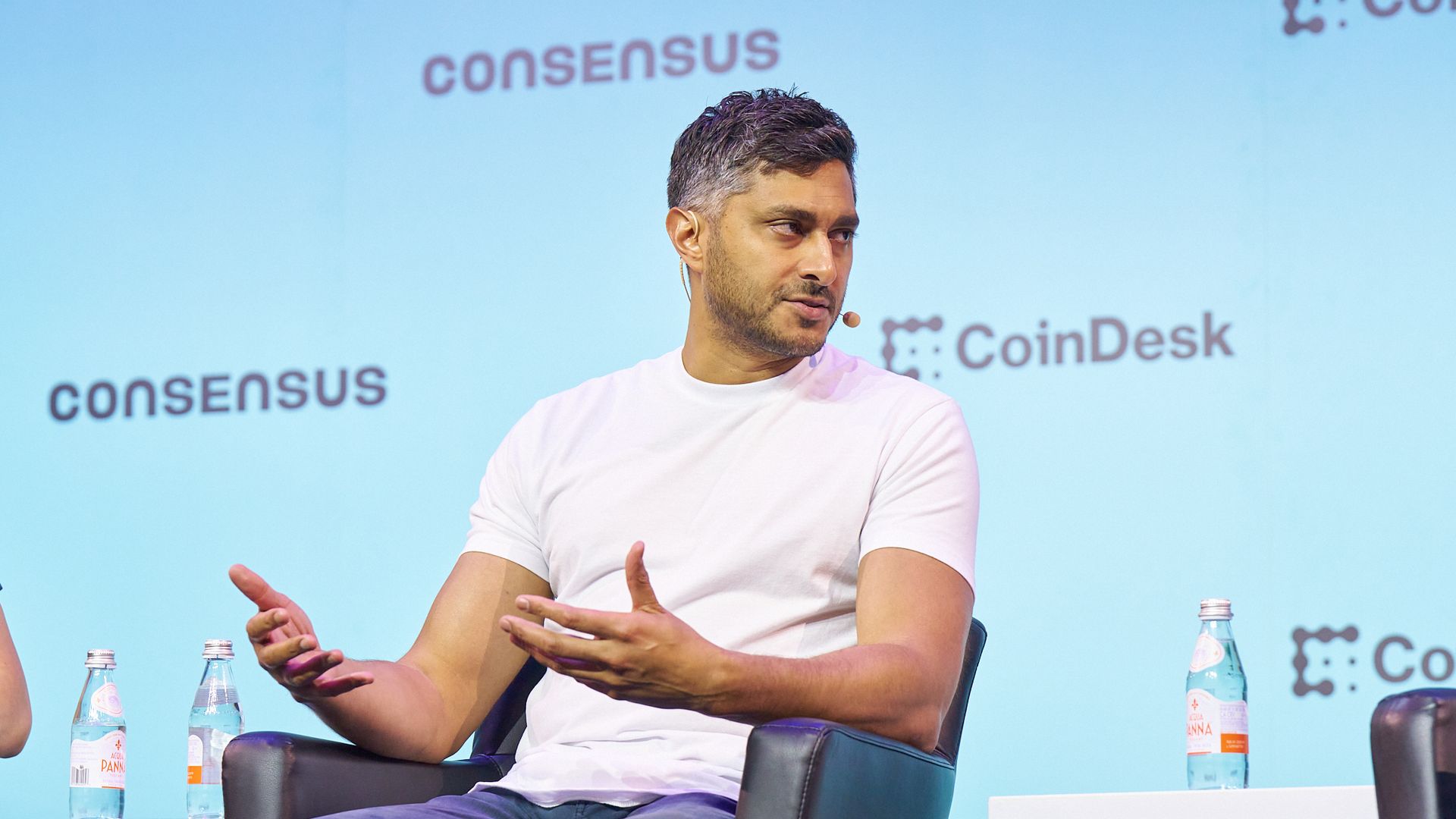
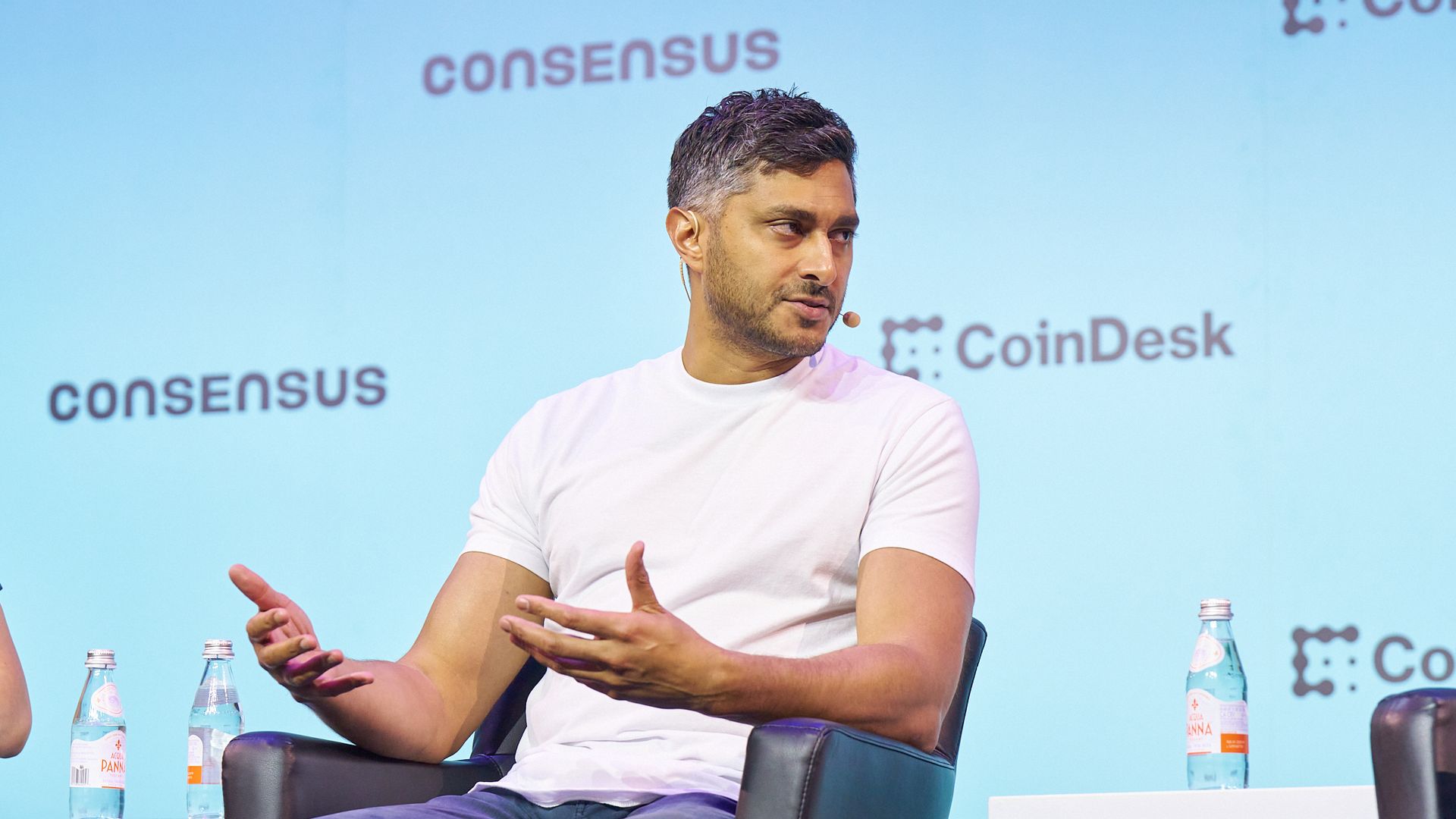
Kraken’s parent company is bringing one of Wall Street’s most coveted opportunities to crypto investors: buying into IPOs at the same price as institutional investors.
Payward, the parent company of the crypto exchange, said Wednesday it will “soon” allow customers of Kraken and other members of its xStocks Alliance to participate in U.S.-listed initial public offerings through tokenized shares. The offering would give eligible investors a chance to receive allocations at the IPO price rather than purchasing shares after trading begins on public markets.
The first tokenized IPO offerings are expected to become available through Kraken and other xStocks Alliance members in the coming weeks, the firm said.
The launch comes as investors await a new crop of high-profile public offerings. SpaceX and AI startups Anthropic and OpenAI are among the companies widely viewed as potential IPO candidates in the coming months, fueling demand for access to deals that have traditionally been dominated by institutional investors, private banks and wealthy clients.
Under Payward’s model, investors would submit non-binding indications of interest before an IPO. The company would aggregate demand across participating exchanges and work with underwriting syndicates to secure allocations. Once a company lists, shares would be tokenized, backed one-for-one by the underlying stock held by a regulated custodian and distributed to investors through participating platforms.
The initiative is part of a broader push to use blockchain technology to expand access to capital markets.
Tokenization — the process of creating blockchain-based representations of traditional assets — has become one of the fastest-growing areas of digital assets. The sector has expanded beyond cryptocurrencies into Treasury funds, private credit, money-market products and, increasingly, equities.
Supporters argue tokenization can make assets easier to access, transfer and trade across jurisdictions. For equities, the technology could help remove some of the geographic and brokerage barriers that have historically limited access to IPOs and foreign-listed stocks.
Still, pre-IPO investing carries risks. IPO allocations are often oversubscribed and not guaranteed, offering prices can change during the book-building process and newly listed stocks frequently experience sharp price swings once public trading begins.
The firm will only offer IPOs where it has secured allocations for investors, a Payward spokesperson told CoinDesk.
Payward said its xStocks framework currently supports tokenized equities backed one-for-one by underlying shares held in custody. The company said the framework has processed more than $30 billion in transaction volume and over $6 billion in onchain settlements across more than 125,000 holders.
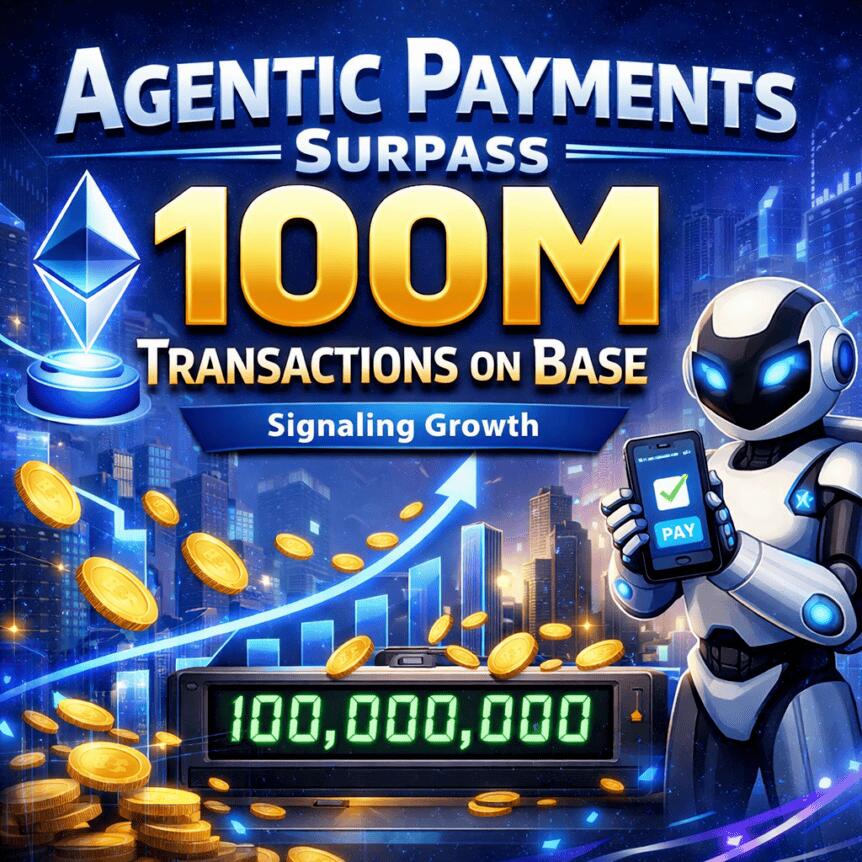
Chainalysis’ analysis shows more than 100 million agentic transactions on Coinbase’s Base network via the x402 protocol within roughly nine months of its launch, signaling that machine-to-machine payments are advancing from proof-of-concept to a functioning on-chain pattern.
In a report published this week, wallets interacting with x402 completed these transactions on Base, underscoring a shift toward autonomous payments where software agents can request resources and settle with stablecoins without human intervention.
Key takeaways
- Over 100 million agentic transactions on Base through the x402 protocol within nine months of launch, according to Chainalysis.
- The early growth was propelled by the PING memecoin experiment, which required users to transact via x402 to mint tokens.
- Value moved through x402 has shifted from micropayments toward higher-value transfers, rising from about 49% of total value above $1 in early 2025 to roughly 95% by early 2026.
- Weekly wallet retention for agentic payments on Base has been trending upward, suggesting durable usage beyond initial hype.
- Industry observers see AI agents as a potential driver of on-chain activity and stablecoin demand, with implications for developers, users, and investors.
Agentic payments take root on Base
The x402 protocol is designed to let software agents perform on-chain payments directly through web requests. When an agent seeks access to a resource—such as a data feed or an API—it can automatically complete a stablecoin transfer without awaiting human approval. This capability embodies a broader push toward autonomous, programmatic commerce on public networks and could redefine how apps interact with blockchain ecosystems.
From memecoin surge to sustained activity
The initial surge in activity was tied to PING, a memecoin experiment that incentivized users to pay via x402 to mint new tokens. That burst attracted large user participation and a rapid uptick in transaction volume. Once the frenzy subsided, activity did not collapse; usage persisted, and the total value moved through the protocol continued to climb, signaling a transition from novelty to practical utility in agentic payments.
Value moves up the chain: from micropayments to larger transfers
Chainalysis highlights a notable evolution in the types of transfers. In early 2025, payments valued at more than $1 accounted for approximately 49% of the total value moved through x402. By early 2026, that share had risen to about 95%, indicating a shift toward more substantial on-chain value being processed through agentic payments.
Observers have pointed to the broader implications of this trend. The growth of higher-value transactions suggests that AI-driven, automated payments are finding practical use cases beyond microtransactions, potentially expanding the scope of what autonomous on-chain interactions can support.
The underlying data and trendlines are drawn from Chainalysis’ ongoing monitoring of the Base ecosystem’s agentic activity. For readers seeking the upstream data, Chainalysis’ analysis on x402 is available in their report on agentic payments adoption.
Industry voices and what to watch
As AI tooling becomes more capable, leaders in the crypto space have framed agentic payments as a possible accelerant for on-chain activity. Coinbase CEO Brian Armstrong has suggested that AI agents could soon account for a meaningful share of on-chain transactions, while Circle CEO Jeremy Allaire has articulated a similar optimistic view about automated payments in crypto networks. Earlier coverage highlighted Changpeng Zhao’s assertion that crypto could serve as the native currency for AI agents, underscoring a cross-pollination between AI and blockchain ecosystems.
Beyond the Base/X402 narrative, the concept has gained attention in related tech and payments circles. A Forrester report highlighted Stripe’s Machine Payments Protocol as a potential catalyst for reviving micropayments through AI agents, while Bernstein analysts have noted that AI agents could boost demand for stablecoins—an outcome that would reinforce the role of ecosystems like x402 in automating on-chain value transfers.
Industry data points to an expanding landscape for agentic payments, including on-demand resources in decentralized computing and data marketplaces where automated transactions enable seamless access to services and data. The interplay between AI-driven automation and programmable money is likely to be a central theme as ecosystems test how far autonomous on-chain payments can scale.
As this space evolves, market participants will be watching not only for continued growth in transaction counts but for durability in value flows, ecosystem incentives, and how regulators respond to automated, recurring payments on public blockchains. Weekly wallet retention metrics cited by Chainalysis offer a first glimpse that interest is translating into repeated use rather than a one-off spike.
Related reading and ongoing coverage explore how AI agents intersect with prediction markets, arbitrage opportunities, and broader DeFi security considerations. For background on the AI-agent theme across crypto media, see coverage of how AI agents could reshape arbitrage and other on-chain activity, as well as discussions around Stripe’s and other providers’ approaches to automated payments.
What remains uncertain is how quickly larger value transfers will stabilize across diverse networks, how developers will optimize agentic payment flows, and how regulators will approach automated, programmatic payments in a cross-border, cross-application context. Keep an eye on Base’s evolving ecosystem, new agentic-use cases, and any regulatory signals that could shape the path of autonomous on-chain commerce.
Crypto World
Blockmaze Defines the Future of RWA Tokenisation with Compliance-First Infrastructure for a $500T On-Chain World
[PRESS RELEASE – Dubai, UAE, June 3rd, 2026]

Backed by Finvasia Group, Blockmaze bridges traditional finance and blockchain through compliance-first infrastructure designed to bring trust, transparency, and legal recognition to tokenised assets
Blockmaze, the largest regulated ecosystem for tokenised assets backed by Finvasia Group, is setting new standards by building the most compliant infrastructure to bridge traditional financial markets and blockchain technology in a way that has never been done before. Built to solve one of the biggest challenges in tokenisation—trust and legal ownership, Blockmaze connects digital assets with real-world regulatory frameworks through its presence across 45+ regulatory registrations, including Europe, the GCC, and Asia, with licenses across eight jurisdictions.
Designed to accelerate the adoption of real-world asset (RWA) tokenisation, Blockmaze ensures tokenised assets are not just created, but legally recognised, compliant, and connected to real-world ownership across a global asset market estimated at more than US$500 trillion. This strengthens the tokenisation ecosystem, enabling issuers to bring assets on-chain faster, more securely, and with greater regulatory confidence.
Through its regulated ecosystem, Blockmaze provides ready-to-launch solutions for issuers, institutions, brokers, exchanges, and financial platforms looking to participate in the next era of on-chain finance. Built for compliant players, by compliant players, Blockmaze enables traditional assets to move on-chain at a time when the world is moving rapidly into the Web3 blockchain environment. More than US$2 trillion worth of assets could move on-chain by 2030, according to McKinsey.
Tokenisation and Real-World Assets (RWAs) represent the next evolution of financial markets by bringing traditional assets onto blockchain infrastructure. While the current crypto market is approximately US$3 trillion, global investable assets represent an estimated US$500+ trillion opportunity across real estate, stocks, bonds, gold, commodities, and other financial assets.
Blockmaze’s growth comes at a time when the momentum to tokenise RWAs is accelerating worldwide but the industry continues to face a critical challenge – bridging the gap between digital tokens and legally recognised ownership. As governments and regulators worldwide build clearer frameworks for tokenised assets, regulated infrastructure will become the foundation for sustainable adoption.
Blockmaze is addressing this gap by embedding compliance at the core of its infrastructure rather than treating it as an additional layer. Through its regulatory-first framework, the platform enables issuers to build tokenised assets supported by licensing, verification, and connectivity with traditional financial systems. This foundation is designed to unlock institutional confidence and support the next phase of RWA adoption, where the future of tokenisation will be defined not just by technology, but by trust.
“The future opportunity is not limited to crypto. The larger transformation is bringing the world’s existing financial assets on-chain. Current penetration remains extremely low, with only around US$40 billion of the US$500 trillion global asset opportunity tokenised today. While the technology to create tokens already exists, the biggest challenge has always been connecting those tokens to real-world ownership, regulatory acceptance, and institutional trust. This is the gap Blockmaze was built to solve,” said Tajinder Virk, Co-Founder & CEO of Blockmaze and Finvasia Group.
“The next era of tokenisation will not be defined by who can create compliant and licensed digital tokens the fastest. It will be defined by who can create trusted, legally recognised assets backed by strong regulatory frameworks. The world is moving fast towards a regulated blockchain environment where tokenised assets will need to be supported by licensing, compliance, and legal recognition to build long-term trust.”
“Blockmaze combines regulatory-first infrastructure with the finality of blockchain to enable secure, transparent and verifiable ownership of tokenised assets – protecting both issuers and investors across the asset lifecycle”, he added.
“Although blockchain technology has been around for more than a decade, mainstream adoption requires institutions, regulators, and governments to transition from legacy financial systems into trusted digital infrastructure” Tajinder Virk explains.
“The biggest challenge is not token creation — it is trust, legal recognition, and regulatory acceptance. Today, anyone can create a token, but the question is whether the token represents a genuine underlying asset and whether ownership is recognised and enforceable beyond the blockchain,” he stresses.
“A token representing real estate only creates true value when ownership rights are recognised beyond the blockchain and connected to the legal framework of that jurisdiction. Tokenisation needs to connect digital ownership with real-world ownership – and Blockmaze has been built to bridge this gap.
“We are future-proofing tokenised assets through legal compliance, transparency, real-time transactions, and blockchain efficiency to support secure adoption at scale.”
Blockmaze enables traditional financial assets to transition into the digital asset economy by connecting real-world ownership with blockchain technology. Unlike conventional crypto platforms, Blockmaze is purpose-built to enable issuers and institutions to transform traditional assets into secure, accessible, and compliant digital investment products. Developed through first-hand experience in regulated financial markets, Blockmaze combines deep financial expertise, regulatory understanding, and blockchain innovation to support the future of tokenised finance.
It has been built specifically for real-world assets with a regulation-first infrastructure, focused on security, compliance, and institutional adoption. Designed for issuers and institutions, Blockmaze is backed by a strong licensing footprint across key financial jurisdictions including the UAE, Europe, and the GCC. The company has built regulatory coverage through licenses and registrations across multiple jurisdictions, supporting its global vision for trusted tokenised finance.
Blockmaze is a Layer-1 blockchain infrastructure designed to power the inevitable tokenisation of real-world assets. It is not just another blockchain — it is a regulated financial infrastructure designed for a future where real-world assets can move on-chain securely, transparently, and with legal recognition.
About Blockmaze
Blockmaze is a regulated tokenised asset infrastructure platform backed by Finvasia Group, focused on bridging traditional finance and the digital asset economy. Positioned as one of the largest regulated ecosystems for tokenised assets, Blockmaze enables businesses and institutions to launch, manage, and scale compliant tokenised asset offerings across multiple jurisdictions.
The platform provides enterprise-grade solutions spanning tokenised stocks, tokenised CFDs, tokenised gold, tokenised real estate, and white-label tokenisation infrastructure, supported by integrated payment, compliance, custody, and regulatory frameworks. By combining blockchain innovation with institutional-grade governance, licensing, and operational trust, Blockmaze aims to accelerate the adoption of legally recognised real-world asset tokenisation globally.
Blockmaze operates across key financial jurisdictions, including the UAE, Europe, and the GCC, helping financial institutions, brokers, exchanges, wealth managers, fintechs, and payment providers participate in the next evolution of global capital markets.
For more information, users can visit www.blockmaze.org
Users can tag Blockmaze when sharing this information on their social media accounts.
Twitter – @BlockmazeRWA
Linkedin – https://www.linkedin.com/company/bmzcoin
Telegram – https://t.me/blockmazeRWA
The post Blockmaze Defines the Future of RWA Tokenisation with Compliance-First Infrastructure for a $500T On-Chain World appeared first on CryptoPotato.

TLDR:
- Variant Fund has closed a $222M fourth vehicle targeting early-stage crypto and AI startups globally.
- The firm’s thesis has evolved from digital ownership to a broader focus on user autonomy and agency.
- Recent portfolio bets include agentic memory, cryptographic location proofs, and AI artifact ownership.
- Crypto VC activity is rebounding, with a16z and Haun Ventures also closing large funds in 2026.
Variant Fund has raised a new $222 million vehicle targeting early-stage crypto and AI startups. The fund, announced on Wednesday, marks the firm’s fourth vehicle and reflects an evolved investment thesis centered on “autonomy.”
Founder Jesse Walden said the firm will lead at the earliest possible stage while participating in liquid and growth investments as projects mature.
The raise arrives amid a broader uptick in crypto venture activity, with The Block Pro data showing $1.63 billion in VC investments so far in Q2 2026.
Variant Reframes Its Thesis Around Autonomy
Variant’s updated thesis represents a natural extension of its founding principles. Since its inception, the firm has gravitated toward permissionless markets, open-source software, composability, and decentralization.
By 2020, those themes had coalesced into a focus on digital ownership — covering money, identity, data, and everyday products.
The firm now frames digital ownership as one pillar within a broader concept: autonomy. Walden described it as fundamentally about human agency — the degree to which users control their lives, assets, and identities.
“Autonomy is fundamentally about human agency: the degree to which users are in control of their lives, assets, and identities,” he wrote in an X post announcing the fund.
Walden was also careful to separate autonomy from mere automation. He noted that intelligent automation is a major technological frontier, but whether it enhances agency depends on who it ultimately serves.
“We distinguish autonomy from mere automation,” he wrote, adding that this distinction remains a guiding principle in evaluating which projects the firm pursues.
Past investments already reflect this principle. The portfolio has consistently backed projects where users hold meaningful control over the systems they participate in.
This includes category leaders in public blockchains, developer infrastructure, and consumer-facing applications such as Phantom and World Network.
Agentic and Permissionless Finance in Focus
Among the firm’s newest portfolio companies are several projects at the intersection of AI and blockchain. Walden outlined three in his announcement: “These include Honcho, a solution for self-custodial agentic memory; Octet, which lets applications cryptographically verify a user’s physical location as a building block of digital identity; and here.now, a ‘cloud for agents’ that enables ownership and composability of generated artifacts.”
Octet expands what users can verify about themselves on-chain, functioning as a building block for decentralized identity systems. here.now, meanwhile, targets the growing agentic computing space by giving users ownership over the outputs their AI agents generate.
Both projects align with Variant’s broader argument that the next phase of the internet will shift agency back toward users.
Walden summarized this outlook directly: “It’s likely that agentic intelligence and open, global financial rails will transform the structure of the internet: from one where users are often the product to one where they have unprecedented agency.”
The fundraise arrives alongside a broader resurgence in crypto venture capital. Competitor a16z recently announced a new $2.2 billion crypto fund, its fifth, while Haun Ventures closed a $1 billion vehicle targeting blockchain and AI projects.
Despite crypto VC activity remaining below the peak levels seen in 2022, recent quarters have shown a clear uptick in both deal volume and capital deployed.


XRP price has touched a 15-week low of $1.18 before clawing back to stabilize near $1.20, and the prediction setup heading into the next few sessions is anything but clean.
The decisive break came yesterday when volume surged to 205.7 million XRP and drove price through the $1.25 support level. That triggered a cascade before buyers stepped in.
$XRP SLIDES 5% TO $1.20, BREAKS $1.25 SUPPORT ON 205M TOKEN VOLUME; EXCHANGE BALANCES SHRINK, ETF INFLOWS REMAIN STRONG, $1.13 IN VIEW
—
 BDN NEWS WIRE (@BCDNewsBot) June 3, 2026
What makes the selloff unusual is the backdrop. More than 25 million XRP have been left on exchanges in recent days, a supply contraction that typically signals accumulation. This, while Binance inflows fell to their lowest levels of 2026.
Bullish on-chain data. Bearish price. What’s next? Here’s our latest XRP price prediction.
Discover: The Best Crypto to Diversify Your Portfolio
XRP Price Prediction: Can It Recover This Week?
XRP is currently trading in the $1.21–$1.26 range, down 2% over 24 hours and 7% over the last seven days. The Fear & Greed Index sits at 23 or Extreme Fear, and momentum is visibly weak.
Technically, the 4-hour chart is bearish. The 50-day moving average is falling, and the 200-day moving average has been declining since May. Resistance levels cluster at $1.32, $1.36, and $1.38. Immediate support sits at $1.21, with the next meaningful floor not far below at $1.18, the recent intraday wick low.

Three scenarios are plausible from here. If buyers defend $1.21 with conviction, volume could dry up on further dips, so XRP can grind back toward $1.27. Reclaiming the first meaningful resistance. Or, price consolidates in the $1.20–$1.24 range through the week.
However, a close below $1.18 opens the door to a deeper flush, invalidating the current stabilization thesis entirely.
The on-chain divergence of exchange outflows and slowing inflows could act as a lagging tailwind, but technical selling has consistently overridden those signals this week.
Discover: The Best Token Presales
LiquidChain Builds as XRP Falls
When an established asset like XRP sheds 7% in a week while sitting at 15-week lows, it raises a fair question: where is asymmetric upside actually sitting right now?
For those rotating out of large-caps during drawdowns, early-stage infrastructure plays have historically absorbed that capital, and one project drawing attention in the current cycle is LiquidChain.
LiquidChain is cooking. — LiquidChain (@getliquidchain) June 3, 2026
The Order doesn't sleep. ⟁ pic.twitter.com/CXY4ya0MC5
LiquidChain ($LIQUID) is a Layer 3 infrastructure protocol positioning itself as the cross-chain liquidity layer, fusing Bitcoin, Ethereum, and Solana liquidity into a single execution environment.
The architecture is built around four pillars: a Unified Liquidity Layer, Single-Step Execution, Verifiable Settlement, and a Deploy-Once Architecture that lets developers access all three ecosystems without redeployment overhead. The token is currently priced at $0.01466, with the project having raised $820K to date in its presale phase.
Traders wanting to examine the fundamentals can research LiquidChain here.
The post XRP Price Prediction: Falling But Bullish Signals Stacking appeared first on Cryptonews.
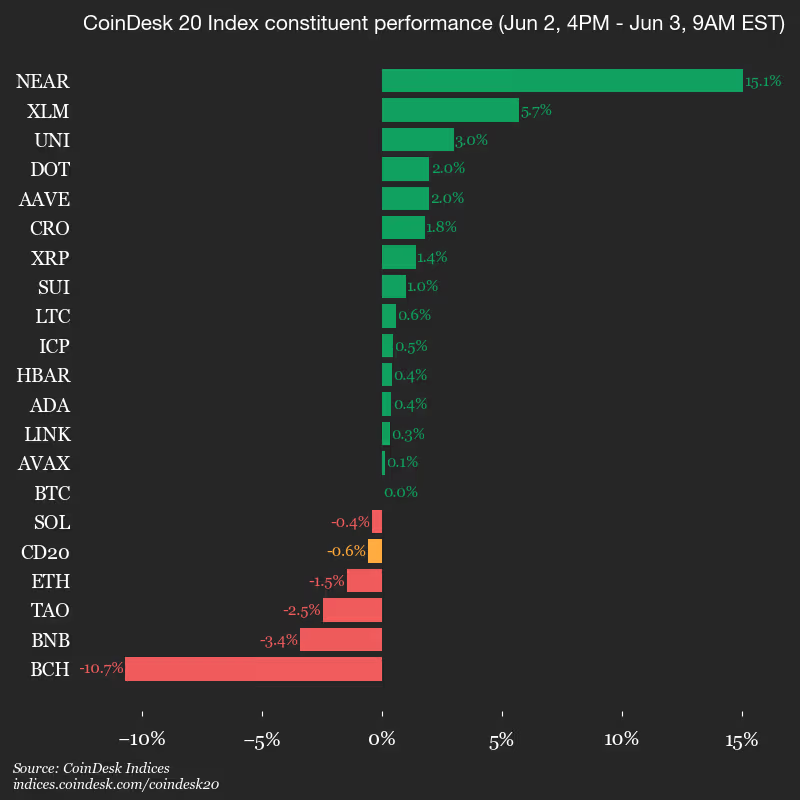
CoinDesk Indices presents its daily market update, highlighting the performance of leaders and laggards in the CoinDesk 20 Index.
The CoinDesk 20 is currently trading at 1862.4, down 0.6% (-11.0) since 4 p.m. ET on Tuesday.
Fifteen of the 20 assets are trading higher.

Leaders: NEAR (+15.1%) and XLM (+5.7%).
Laggards: BCH (-10.7%) and BNB (-3.4%).
The CoinDesk 20 is a broad-based index traded on multiple platforms in several regions globally.
Crypto World
‘Dead Meme’ or Major Opportunity? DOGE Is Flashing The Same Signal That Preceded Its Biggest Rallies

Dogecoin (DOGE) suffered a fresh decline of over 5% on Wednesday amid continued selling pressure. However, the OG meme coin is trading at a level that has historically served as an accumulation zone, as flagged by a largely overlooked setup based on its CVDD (Cumulative Value Days Destroyed) Channel model.
According to Alphractal, the CVDD Channel is a thermodynamic floor model that estimates an asset’s structural cost basis by weighting each on-chain coin movement according to both its value and the number of days since it last moved. Historically, Dogecoin’s price approaching the lower CVDD bands has coincided with the deepest long-term accumulation zones, while touches of the upper Alpha CVDD band have aligned with every major DOGE market top over the past decade.
DOGE’s Next Structural Target At $0.85
Alphractal said Dogecoin is currently trading near the lower CVDD band at around $0.10-$0.11, a level that has previously appeared before major price rallies. Similar setups appeared in late 2014, mid-2020, and mid-2023, with the meme coin later posting gains of approximately 25,000%, 18,000%, and 500% after those periods.
According to Alphractal, the current lack of a strong narrative around DOGE is not unusual, as major narratives typically emerge after accumulation phases. The analytics firm also explained that DOGE’s year-long sideways trading indicates accumulation and a rebuilding of its cost basis rather than weakness.
It added that traditional volume metrics may not fully capture this activity because the CVDD model focuses on value-days rather than raw transaction volume, with the current chart showing what it described as “quiet absorption.”
Alphractal said its Alpha CVDD model, which it claims has successfully identified every major Dogecoin market top in previous cycles, currently places the upper target band at around $0.85. This means a potential 7.7-fold increase from its current price levels.
“DOGE is the largest, most liquid, most distributed memecoin in existence. It has the longest historical CVDD record of any meme asset by a decade. The current print is mechanically identical to every prior bottom – and the upper Alpha CVDD band has held as resistance every single cycle without exception. The market is reading DOGE as a dead meme. The chart is reading it as a coiled spring.”
Breakout Calls
Alphractal predicted that DOGE could deliver a 3x gain before AI-themed meme coin narratives become the market’s main focus.
Meanwhile, analyst Ali Martinez also noted that the TD Sequential indicator had flashed a buy signal on Dogecoin. Several other market observers suggested that the asset could be on the verge of a major breakout.
The post ‘Dead Meme’ or Major Opportunity? DOGE Is Flashing The Same Signal That Preceded Its Biggest Rallies appeared first on CryptoPotato.
Raoul Pal, who ran European hedge-fund sales at Goldman Sachs before founding Real Vision, has rejected claims that money is fleeing crypto for technology stocks. He says the data tell a different story.
His pushback came as US equities slipped at Wednesday’s open, pressured by fears of a hawkish Federal Reserve and stalled Iran-US talks.

Why Raoul Pal Is Pushing Back on the Crypto Doom Narrative
Pal challenges the crypto is finished narrative, rejecting the sentiment that capital now favors AI and chip makers.
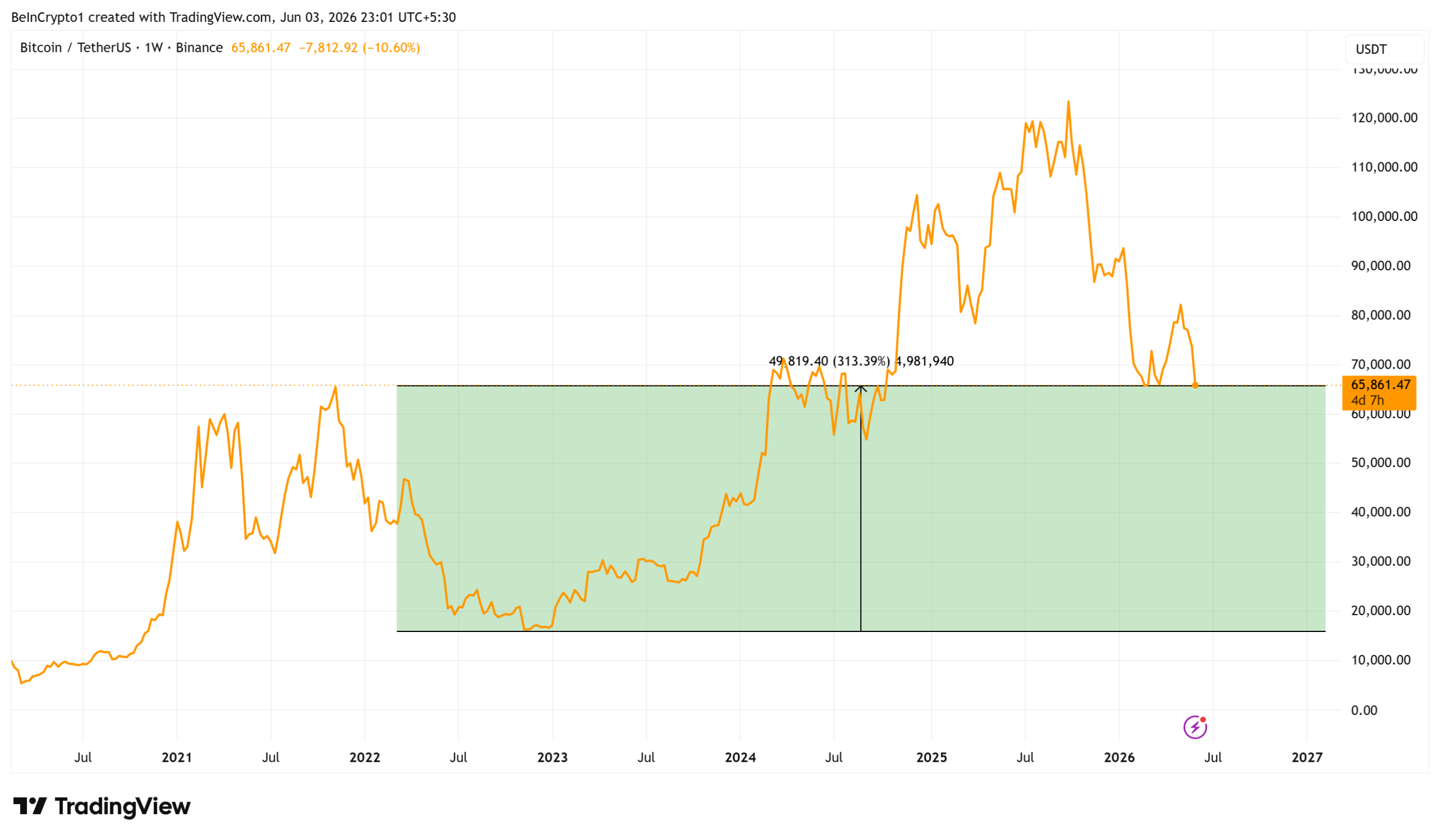
To back the claims, he measures returns from the 2022 liquidity-cycle low, when the FTX collapse drove Bitcoin near $15,700 in November.
From that trough, Bitcoin has gained about 318%, trading near $65,800. The Nasdaq 100 has risen roughly 187% over the same span, to near 30,660.
That gap is the heart of his case. Bitcoin has outpaced the tech benchmark by a wide margin, even after a steep recent pullback.

Pal argues that liquidity cycles, not market narratives, drive prices. He has made that case since launching Global Macro Investor in 2005, and frames the current weakness as a mid-cycle correction.
“The ‘Crypto is dead, its all going to tech stocks’ narrative is alluring but overall this is the actual results from the liquidity cycle low in 2022…” Pal wrote.
Other analysts also expect crypto to outperform tech stocks.
Follow us on X to get the latest news as it happens
Bitcoin Trades Below Its Record as Stocks Wobble
Despite the cumulative gains, Bitcoin has cooled lately. The token traded near $65,800 on Wednesday, down about 2.7% over 24 hours. That sits far below its record high of $126,080, though its market value still tops $1.3 trillion.

Stocks, meanwhile, opened weak. Over $500 billion was wiped from US equities within 20 minutes of the open, analyst Bull Theory said.

“US equity indices pulled back from records amid risks of a hawkish Federal Reserve and the lack of progress between Iran and the US. The S&P 500, Nasdaq 100 edged lower and the Dow lost 0.5%. Data from the ADP showed the private sector added a net 122,000 jobs in May, above expectations, to add leeway for the Fed to raise rates and fight inflation.,” wrote analysts at Trading Economics.
Pal’s framework has both supporters and critics. Backers say the data confirms that global liquidity expansion rewards high-beta assets like Bitcoin.
Skeptics argue he picked the exact low. Others say AI has changed how capital now flows into equities.
Pal also contends Bitcoin trades at a discount to liquidity conditions. His models point toward a higher liquidity target once financial conditions ease again.
The token’s link to the Nasdaq has tightened over the past year. That connection cuts both ways, since Bitcoin tends to fall harder when stocks drop.
The post Raoul Pal Shuts Down ‘Crypto Is Dead’ Narrative With One Chart appeared first on BeInCrypto.
Another crypto-focused political action committee, the Defend Developers PAC, has joined the field of campaign-funding operations that have in recent years put the industry on the political map.
The new entrant won’t rival the sector’s leading super PAC, Fairshake, nor is it expected to jump to the scale of the mid-level committees that include the Fellowship PAC linked to Tether and the Digital Freedom Fund tied to Tyler and Cameron Winklevoss at Gemini. But it’s approaching the political field differently than others, by backing incumbent lawmakers who’ve already proven to be allies to its cause: the legal protection of crypto developers and creators of decentralized finance (DeFi) projects.
“We plan to raise and contribute more than six figures across dozens of key races in the midterms, because crypto technologists deserve champions in Congress who will go to bat for them,” said Gavin Zavatone, the PAC’s founder, in a Wednesday statement announcing the effort. Zavatone is also the policy lead at the DeFi Education Fund, a trade association that lobbies for DeFi-friendly policymaking.
Defend Developers — federally registered last month — is what’s known as a hybrid PAC, meaning it can make direct contributions to candidates that follow the Federal Election Commission limits as well as channeling unlimited corporate contributions into independent ads. The bulk of the crypto sector’s high-profile political intervention has been through super PACs that have no monetary limits, though another new PAC, the Blockchain Leadership Fund established by Anchorage Digital and Chainlink, is also a hybrid.
“As a hybrid PAC, we’re building the political infrastructure to ensure the United States remains the best place in the world to build blockchain technology freely — and we’re doing it the right way, powered by individual contributions raised directly from the founders, builders, and CEOs who have the most at stake,” Zavatone said. The board of directors behind him include members from Uniswap Labs, DEF and the Solana Policy Institute, though no dollar amounts have yet been disclosed about its initial funding.
Without the tens of millions deployed by Fairshake and its affiliates, a new crypto PAC isn’t likely to make major waves. Fairshake is coming away with its latest primary election wins this week, having backed nine Democratic U.S. House of Representatives candidates in California, one in New Jersey and Republican U.S. Senate Mike Rounds in South Dakota. All of them won their primaries on Tuesday, maintaining a high win record for crypto-supporting politicians that Fairshake bought independent ads for, though the PAC didn’t expend more than $476,000 (for U.S. Representative George Whitsides) on this week’s races.
Fairshake had expended $6.5 million in its successful effort to make sure veteran House lawmaker and crypto critic Al Green lost out to Christian Menefee in their Texas primary last week. However, the super PAC — one of the largest in U.S. politics — has also seen a few misfires, such as in Illinois.
The general election in November brings extremely high stakes, with the potential to shift the party majority to Democrats in at least one chamber of Congress.
Read More: The crypto industry’s massive political war chest is starting to lean Republican ahead of midterms
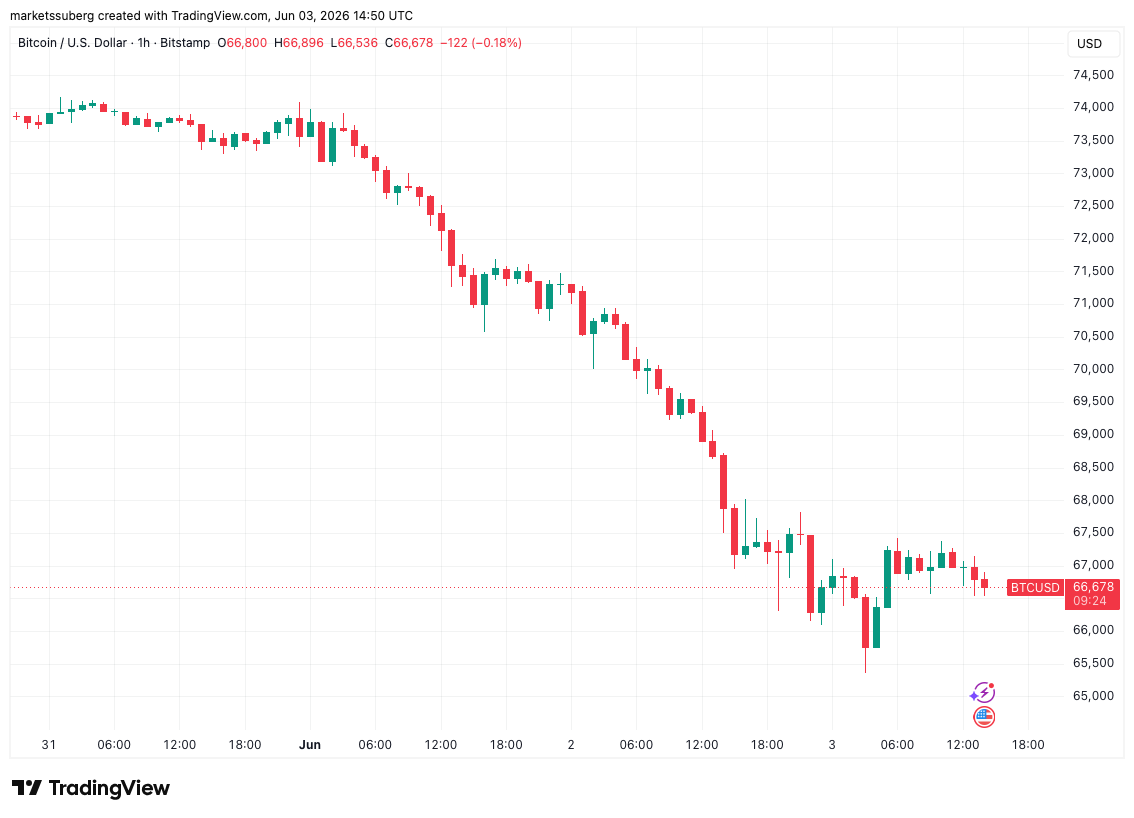
Bitcoin (BTC) hovered near two-month lows on Wednesday as 2022 bear-market comparisons returned.
Key points:
- Bitcoin traders bring back the 2022 bear market to assess where BTC price action might go next.
- History shows a new lower high followed by a breakdown of a key 50-month trend line.
- That trend line has held throughout 2026 so far.
Analysis: Bitcoin 50-month trend line break down “likely”
Data from TradingView showed cooling BTC price volatility after a trip to $65,362 on Bitstamp — a level last seen in early April.
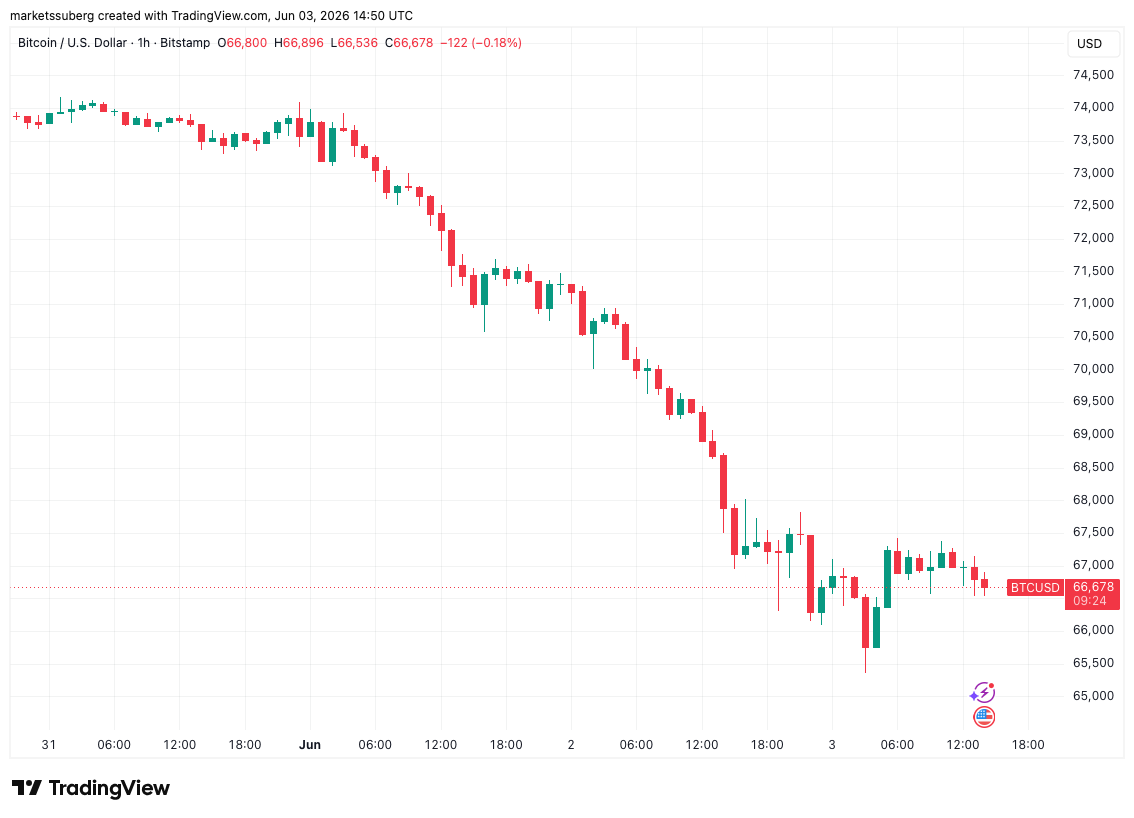
BTC/USD one-hour chart. Source: Cointelegraph/TradingView
After billions of dollars in liquidations, BTC/USD fielded new warnings that the worst of the bear market may still be ahead.
Trader and analyst Rekt Capital focused on the 50-month exponential moving average (EMA) trend line at $66,628.
“Over time, Bitcoin is likely to breakdown from this EMA and continue macro downside in this Bear Market,” he warned in one of several posts on X.
Rekt Capital said that if history were to repeat from the 2022 bear market, price should now see a relief bounce to form a lower high before returning to the 50-month EMA, which would in turn fail as support.
“Historically, Bitcoin tends to rebound initially from the 50-Month EMA but then loses it as support as the Bear Cycle progresses,” he added.
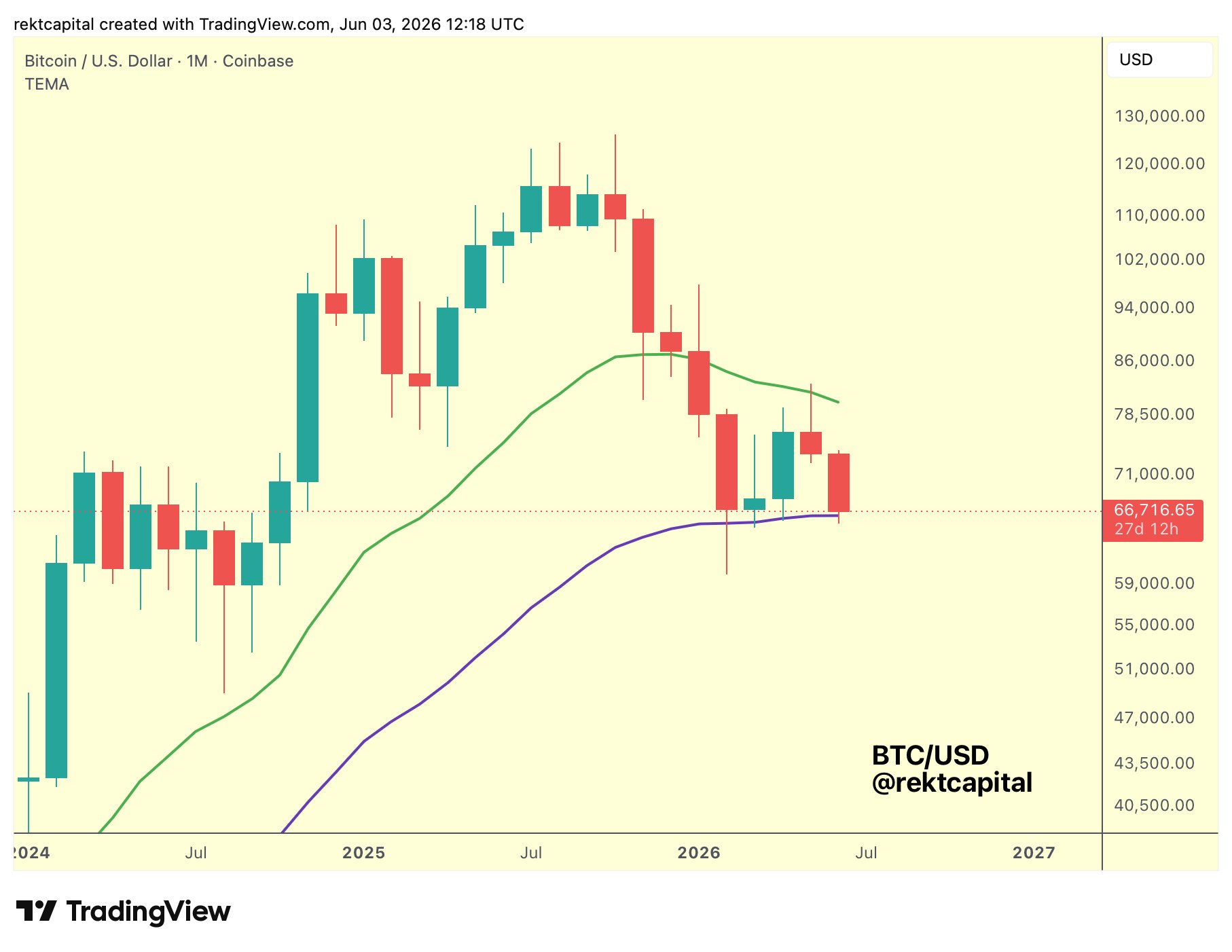
BTC/USD one-month chart with 21, 50EMA. Source: Rekt Capital/X
Continuing, trader Leviathan argued that the 2026 bear market was copying its predecessor “almost perfectly.”
“Every stage printing in the same order,” an X post reported, calling $60,000 the “line that matters.”
“Hold it – liquidity flush complete, recovery begins. Lose it – deeper correction, no support below. One level, two completely different outcomes. Market makes the call soon.”
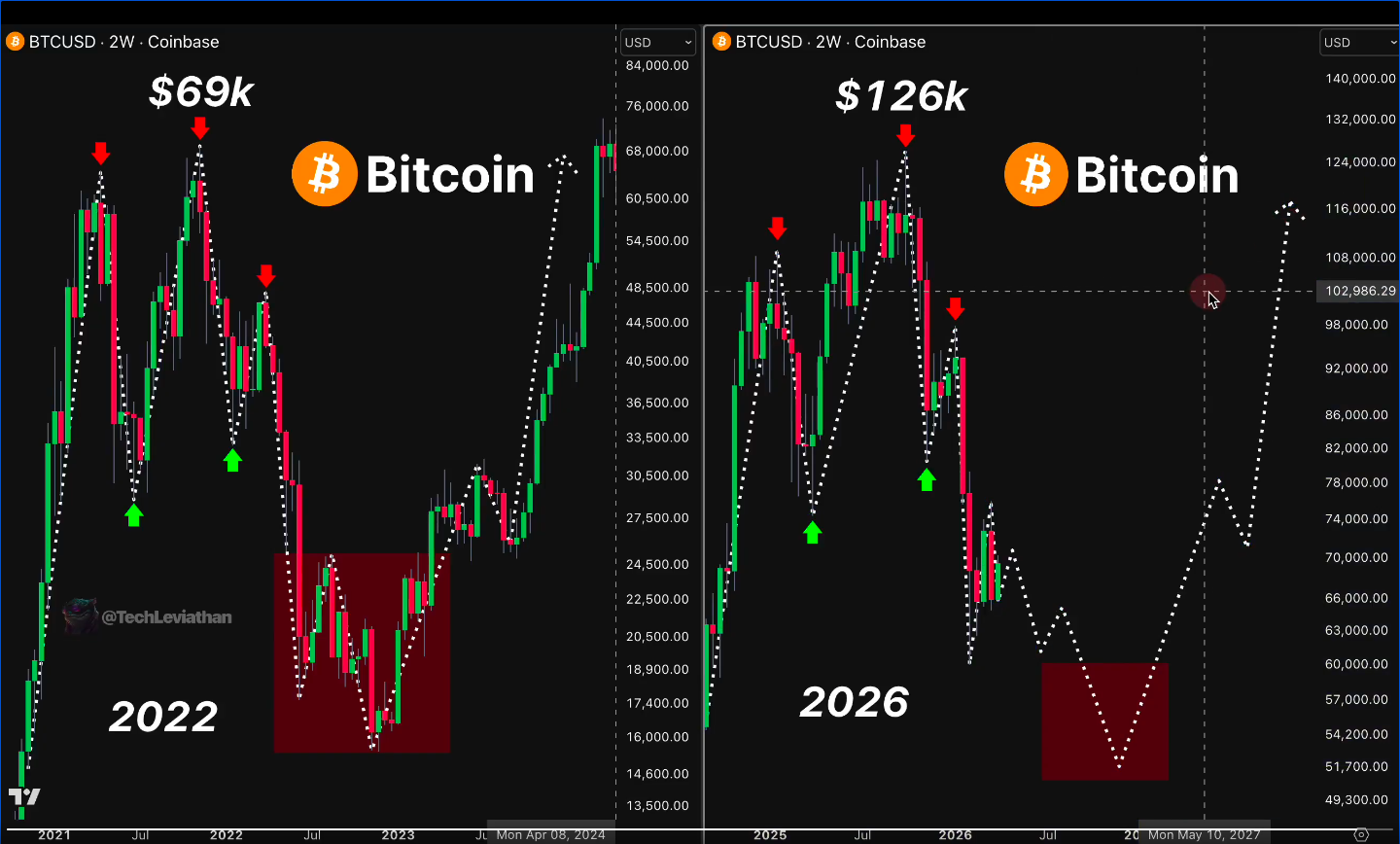
BTC/USD two-week chart comparison. Source: Leviathan/X
Another trader, Killa, leveraged 2022 price action to suggest “weeks” of consolidatory movement between $63,000 and $65,000 next.
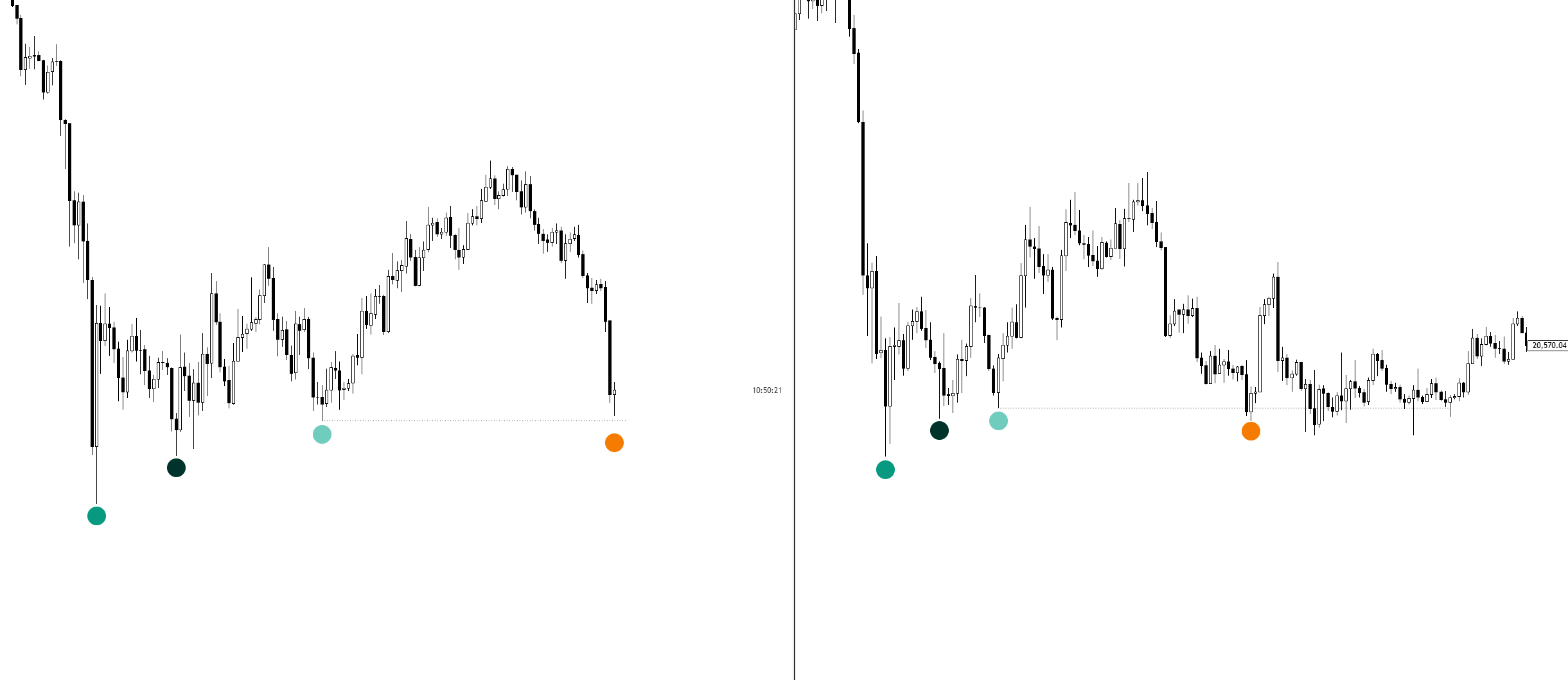
BTC price chart comparison. Source: Killa/X
BTC price support reclaim could offer 700%+ returns
A silver lining on the day came from historical reactions to the 50-month EMA.
Related: Bitcoin has hit ‘max fear’ below $67K as analysis sees BTC price rebound
Analytics account Paradox noted the extent of potential gains that could come from Bitcoin’s eventual reclaim of the trend line after losing it.
“$BTC lost the monthly 50MA in 2022. It reclaimed it 5 months later, delivering a 715% return over the next 2 years,” it told X followers.
In February, BTC/USD saw several daily closes below the trend line, ultimately avoiding a full breakdown. In March and April, meanwhile, it functioned successfully as support.
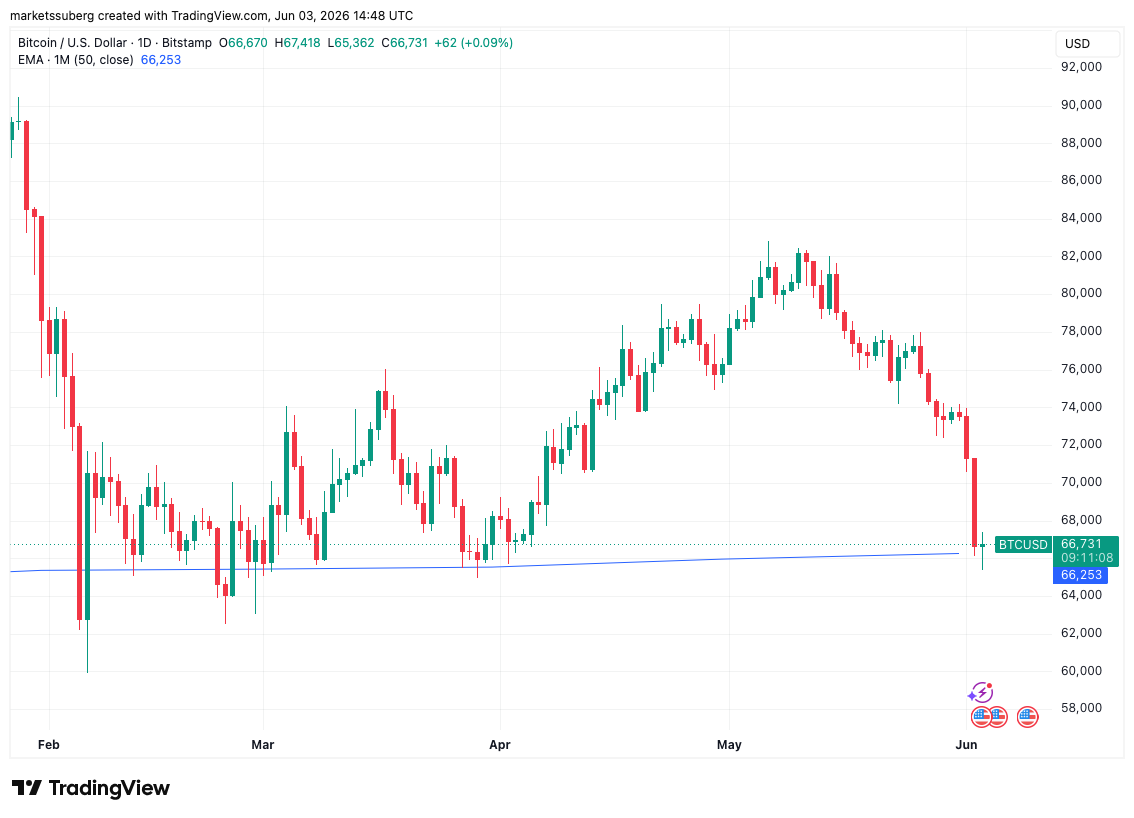
BTC/USD one-day chart with 50-month EMA (blue line). Source: Cointelegraph/TradingView

Man who took 10 hostages in hours-long ‘bomb’ standoff at Bakersfield bank is shot dead
Form 13D/A Repay Holdings Corp For: 3 June

Kraken parent plans to offer tokenized IPO access as investors await SpaceX, Anthropic debut



-

 Tech6 days ago
Waymo dominates autonomous vehicle registrations as Tesla trails behind
-

 News Videos5 days ago
This is BROKEN! INSANE 5x MONEY CAR WASH WEEK! The NEW GTA Online UPDATE Today! (GTA5 New Update)
-
 Tech4 days ago
SpaceX just won a second Golden Dome contract. This one is $4.16 billion.
-

 Business2 days ago
Jade Biosciences, Inc. (JBIO) Discusses Positive Interim Results From JADE101 Phase I Healthy Volunteer Study and Development Plans Transcript
-

 News Videos5 days ago
SHE IS KILLING XRP!!! WATCH URGENT AND ACT FAST
-
 NewsBeat5 days ago
FIRST NIGHT REVIEW: Take That bring the Circus back to life in spectacular sun-soaked style
-
Crypto World5 days ago
CFTC Has Approved the First Regulated Bitcoin Perpetual Contract in the U.S.
-

 Business4 days ago
Is the Spurs Phenom Already Better Than Prime Diesel?
-
 NewsBeat5 days ago
Novak Djokovic v Joao Fonseca LIVE: French Open latest scores and results after Jannik Sinner’s shocking collapse
-
 Crypto World5 days ago
Snowflake (SNOW) Stock Rallies on Strong Q1 Results and AI Product Growth
-
 Entertainment5 days ago
Weak ‘Supergirl’ Box Office Tracking Amid Milly Alcock Backlash
-

 Business5 days ago
Demand Conditions Improve In Chemicals Sector In April 2026
-
 Crypto World5 days ago
MicroStrategy Moves $30 Million in BTC to Coinbase Prime: Is the Bitcoin Sell-Off Already Here?
-

 Politics5 days ago
The House | Inside Andy Burnham’s Makerfield Campaign: “Nobody Thinks This Is In The Bag”
-

 Tech5 days ago
This Week In Security: Ubiquiti Fixes, And FreeBSD Joins The Club You Don’t Want To Join
-
 Entertainment4 days ago
One of the Greatest Sitcoms of All Time Shoots Up Apple TV’s Charts 11 Years Later
-

 Entertainment5 days ago
Maddox Jolie-Pitt Legally Requests to Drop Brad’s Surname
-
 Crypto World1 day ago
Seagate (STX) Stock Surges to Record High on AI Boom and Legal Settlement
-
 Entertainment5 days ago
Britney Spears Shares Troubling Update After Hard Year
-
 Entertainment5 days ago
Bruce Willis’ Generosity Resurfaces Amid His Dementia
You must be logged in to post a comment Login