
Crypto World
Replace 21M Bitcoin cap with 4% annual inflation

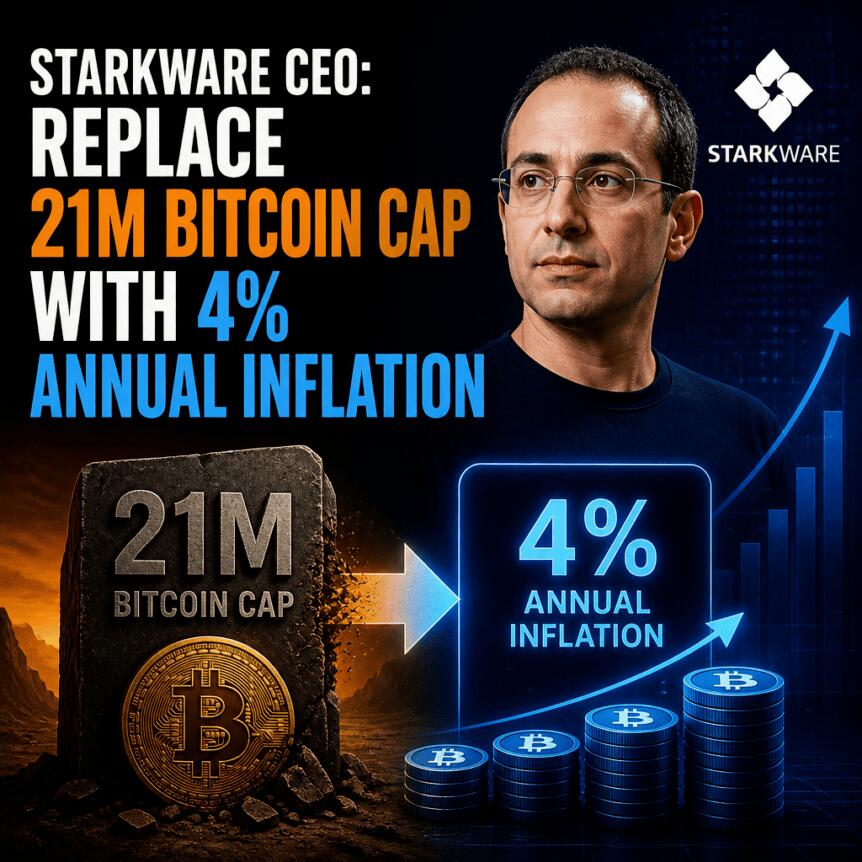
StarkWare CEO Eli Ben-Sasson has reignited a long-running Bitcoin debate by arguing that the network’s fixed 21 million coin cap “doesn’t make sense” and should be replaced with a steady 4% annual issuance model. His position challenges a foundational pillar of Bitcoin’s monetary narrative: that a hard supply limit protects the asset from monetary debasement and preserves purchasing power over time.
In a post on X Tuesday, Ben-Sasson said the cap becomes less meaningful as time passes because private keys are lost, eventually leaving holders unable to access their coins. He linked that concern to the idea that, as the timeline approaches infinity, the usable supply trends toward zero—an argument that directly contrasts with the traditional “digital gold” framing of Bitcoin’s capped issuance. Source: Eli Ben-Sasson on X
Key takeaways
- Ben-Sasson argues Bitcoin’s 21 million cap is undermined over long time horizons by lost private keys.
- He suggested replacing the fixed cap with an issuance rate of about 4% per year, while still maintaining a form of long-term scarcity.
- Ledger has previously estimated that millions of Bitcoin may already be permanently lost, feeding into the “lost keys” argument.
- Critics on X say Bitcoin’s divisibility and fixed supply mechanics still address “not enough to go around,” and that changing the cap would make Bitcoin more like other cryptocurrencies.
- A potential workaround discussed in the Zcash ecosystem—burning with periodic reissuance—highlights how miner economics could be addressed without removing a hard cap, but it would still require broad Bitcoin consensus.
Why Ben-Sasson thinks the cap will fail over time
Ben-Sasson’s core claim is not simply that Bitcoin supply will be inadequate, but that the economic effect of a cap is eroded if a growing share of coins become inaccessible. He pointed to the long-run reality that private keys can be lost, making coins effectively unrecoverable.
To anchor that idea in publicly available estimates, the proposal also echoes figures cited by Ledger. In November, Ledger estimated that up to 4 million Bitcoin have been burned or permanently lost. Ledger estimate (via Ledger Academy)
Ben-Sasson said he still supports a hard upper bound on supply. But rather than relying on a one-time fixed limit, he argued that a consistent 4% annual issuance rate better matches real-world population growth—an analogy meant to address whether Bitcoin’s supply schedule remains economically aligned as adoption expands.
Bitcoin maximalists push back: scarcity, divisibility, and “lost keys”
Ben-Sasson’s proposal met quick and pointed criticism from the Bitcoin community on X. One user challenged the premise that Bitcoin would run out “to go around,” citing Bitcoin’s divisibility into 2.1 quadrillion satoshis (the smallest base unit). Source: X user response
Ben-Sasson replied that satoshis are not a permanent solution if private keys continue to be lost. In his view, even though Bitcoin is divisible, the accessible balance still trends toward zero over time as keys go missing. Source: Ben-Sasson follow-up on X
Other opponents framed the debate around identity: lifting the fixed cap, they argued, would move Bitcoin toward the behavior of other cryptocurrencies that issue supply through inflation. Ben-Sasson countered that Bitcoin would retain scarcity as long as the inflation rate stayed fixed. Source: X user response
The clash reflects a deeper asymmetry in how people interpret Bitcoin’s supply mechanics. For many Bitcoiners, lost keys can be viewed as a feature rather than a flaw: if coins are permanently inaccessible, they effectively reduce circulating supply and reinforce supply-demand dynamics. A prominent example is Michael Saylor, who has said he plans to burn his Bitcoin private keys after his death as a “pro-rata contribution” to other holders—an act intended to make other coins scarcer by reducing the amount of reachable supply.
Looking for a middle path: Zcash’s approach to cap sustainability
As the debate intensified, Zcash founder Bryce “Zooko” Wilcox suggested Bitcoin developers look at a proposal being discussed in the Zcash ecosystem. Zcash also has a fixed supply cap set at 21 million ZEC, and Wilcox argued that Bitcoin could study how Zcash addresses miner incentives without removing its hard limit. Source: Zooko on X
The proposal Wilcox referenced is the “Network Sustainability Mechanism.” Its design aims to keep ZEC’s 21 million cap intact by allowing users to burn tokens, which are then reissued gradually as block rewards over a four-year period. The intent is to relieve pressure on miner incentives without changing the hard supply cap.
While the concept is attractive in theory—seeking to balance network security incentives with a capped supply—Bitcoin would face a different practical environment. Implementing a protocol-level mechanism would require agreement across Bitcoin’s decentralized ecosystem, including developers, miners, and node operators. That coordination challenge is a major reason Bitcoin’s core monetary rules have historically been difficult to change even when a proposal is technically feasible.
What this debate means for Bitcoin’s future trajectory
Ben-Sasson’s argument is likely to keep circulating precisely because it targets a common point of tension: the difference between theoretical supply and economically usable supply over very long time horizons. The discussion also highlights that “hard cap” supporters and critics may not be speaking about the same problem. One side focuses on monetary predictability and the protection against debasement; the other side emphasizes that lost keys reduce the practical share of supply and may eventually distort the cap’s economic assumptions.
For investors and builders, the more immediate takeaway may not be whether a cap change happens, but what kinds of proposals gain traction around the margins of Bitcoin’s monetary design. A cap-preserving mechanism inspired by other networks would still require broad consent, yet it signals a potential direction for future debate: adjusting incentives and usability while trying to preserve the properties Bitcoin is known for.
As this topic continues to trend, watch for whether any proposal gains concrete supporters beyond social commentary—especially ideas that address miner and security incentives without directly abandoning the cap narrative that underpins Bitcoin’s cultural and market identity.



The American Arbitration Association (AAA), one of the world’s largest providers of private dispute-resolution services, has launched a specialist panel for blockchain and digital-asset cases, giving companies access to arbitrators with expertise in the technical and legal complexities of crypto disputes.
On Wednesday, the AAA said that its new Web3 Panel brings together arbitrators with experience across law, technology, academia, litigation and digital-asset businesses.
The panel is designed to address disputes arising from increasingly automated and decentralized commercial systems, including disagreements over contract interpretation, governance, asset control, cybersecurity, transaction records and cross-border enforcement.
The move signals that mainstream legal institutions are building specialist infrastructure to handle the increasingly complex disputes emerging as blockchain and automated transactions enter commercial use.
“Web3 disputes involve familiar commercial questions in a highly technical environment,” said Eric Dill, the AAA’s senior vice president and head of panel relations.
Initial members include lawyers specializing in digital-asset and technology disputes, University of Pennsylvania law professor David Hoffman and Rich Widmann, Google Cloud’s global head of Web3 strategy.
The panel also covers disputes involving agentic commerce and autonomous transactions, where software or artificial intelligence systems may initiate or execute agreements with limited human involvement.
The panel does not give the AAA regulatory authority over the crypto industry. Arbitration generally requires the parties involved to agree to submit their dispute to a private arbitrator.
Related: US arbitration giant rolls out ‘legal layer’ for agentic commerce

Disclosure: This article does not represent investment advice. The content and materials featured on this page are for educational purposes only.
Amid crypto market uncertainty, Long DeFi highlights AI-driven analytics and automated strategies to help users navigate BTC and XRP market volatility.
Summary
- Long DeFi promotes AI-powered cloud mining, highlighting automated hashrate management and daily crypto reward settlements.
- Long DeFi expands its AI-driven cloud mining platform with automated contracts, renewable energy, and multi-crypto support.
- The AI-powered cloud mining platform highlights automated mining services and renewable energy infrastructure for investors.
Amidst the impact of inflation, major cryptocurrencies like BTC and XRP have been sluggish recently. Countless investors have watched their assets shrink, feeling utterly lost.
However, crisis often presents an opportunity! Long DeFi, leveraging its top-tier AI-powered precise computing power, through intelligent network-wide judgment and multi-dimensional analysis, provided real-time, accurate advice before the storm hit: hold (hashrate hedging) or sell (high-point hedging). This successfully helped users worldwide lock in funds and recover immeasurable wealth losses.

Founded in 2020 and headquartered in the UK, Long DeFi operates 150 data centers globally, serving nearly 5 million registered users in 180 countries and regions.
In 2026, the platform completely redefined how digital assets are acquired, making mining incredibly simple, sparking a global investor frenzy!
Achieve financial freedom with just 3 steps to start a smart mining contract:
- Click “Register Now” (Receive a $17 USD starter bonus upon registration; no service/management fees)
- Choose a smart mining contract that fits a particular budget and instantly start passive income!
Green New Energy Profits: Long DeFi’s over 100 top-tier global mining farms are all located in regions with abundant solar and wind resources, powered by 100% solar and wind energy. This not only reduces mining costs to near zero but also allows for grid connection of surplus electricity to generate secondary income, maximizing the potential for every investment!
- Military-Grade Security: Impeccable fund security behind the stable operation of tens of thousands of professional devices worldwide is the dual military-grade security protection of McAfee and Cloudflare, coupled with 24/7 customer service, ensuring a worry-free journey to wealth!
- Blockbuster Wealth Creation Plan: Real, rapidly growing digital value in the account! Long DeFi doesn’t just offer empty promises; digital wealth grows exponentially every day. The platform supports settlement in multiple mainstream cryptocurrencies, including BTC, ETH, XRP, SOL, and USDT. All earnings are settled daily, and funds can be withdrawn to a personal wallet anytime once they reach $100! Users can either secure their profits or leverage compound interest for exponential wealth growth!
Mining contract options
Beginner Experience (Starting Point): Invest just $100, and after a 2-day contract, the principal is fully refunded, netting $8!
Steady Progression (Mainstream Choice): Invest $500 and reap a pure profit of $31.25 in just 5 days!
Accelerated Growth (Wealth Driving Force): Invest $3000, lock in a 17-day contract, and earn an additional $698.70 in passive income!
Wealth Upgrade (Elite Exclusive): Invest $10,000 and earn passively for 35 days. $5,530 Super Return!
Supreme Strategy (Capital Frenzy): Invest $50,000, and after 40 days, accumulate a net profit of $34,200!
Zero-Cost Transformation: The craziest zero-cost profit opportunity on the entire internet in 2026! Even if someone doesn’t want to invest a single penny today, Long DeFi still opens up a golden channel to make a fortune every day!
Simply share an exclusive link: Unconditionally receive up to 5% cash referral commission for every friend who registers and participates! Reaching team activity user milestones will unlock a one-time super cash prize of up to $50,000! The more people are invited, the more the user earn, with no upper limit!
The frenzy is counting down; don’t let wealth slip away
The bull market window in the crypto market never waits for anyone; wealth always belongs to those who are prescient and decisive. When XRP’s big rally is poised to take off, when Long DeFi. All technical and capital barriers have been cleared. The only thing separating anyone from financial freedom is the decision to start!
From $100 to tens of thousands of dollars, it’s not a myth, but the absolute inevitability of choosing the right path, timing moves perfectly, and reaping steady rewards! Take action now and start the wealth-creating miracle!
For more information, visit the official website.
Disclosure: This content is provided by a third party. Neither crypto.news nor the author of this article endorses any product mentioned on this page. Users should conduct their own research before taking any action related to the company.


Binance has disappeared from Google Play in parts of the European Union as questions have emerged over whether the app’s availability is being affected by MiCA-related compliance requirements.
Summary
- Binance has disappeared from Google Play in some European Union countries as questions grow over MiCA related compliance.
- The exchange said Google Play policy updates have affected crypto app availability in certain markets and it is working on a solution.
- Users in Spain and Latvia reported the app missing, while it remains available on Google Play in Poland.
- The development comes after Binance scaled back services in parts of the EU following the end of MiCA’s transition period.
According to a local, users in Spain and Latvia can no longer find the Binance Android app on Google Play, while checks in Poland showed the app remained available, indicating the issue is limited to certain European Union markets rather than the entire region.
Responding to the reports, a Binance spokesperson said the exchange is aware that Google Play has updated its policies, affecting crypto app updates in “certain markets.” The company said it is working with Google to resolve the issue but did not identify which countries are affected or explain which policy changes resulted in the restrictions.
The development comes as Binance continues to adjust its European operations after the European Union’s Markets in Crypto-Assets (MiCA) framework entered full effect on July 1, requiring crypto-asset service providers to obtain authorization in at least one member state before offering regulated services across the bloc.
Binance cites Google policy changes as app disappears
A user in Spain confirmed to Cointelegraph on Monday that Binance no longer appeared in Google Play search results. The app, however, remained available through Oppo’s App Market, suggesting the restriction does not extend to every Android app marketplace.
Another user in Latvia reported the same issue, while searches conducted in Poland still showed the Binance application on Google Play.
Although the first public reports linked the disappearance to MiCA licensing rules, Binance has not confirmed that regulatory requirements directly caused the app’s removal. Instead, the exchange pointed to recent Google Play policy updates affecting crypto applications in selected markets.
The exchange added that it is working with Google to restore normal availability but did not provide a timeline.
MiCA questions follow earlier Binance service restrictions
Public discussion around the missing app began last week after OKX Europe CEO Erald Ghoos wrote on X that Binance had been removed from Google Play because of MiCA licensing requirements.
The timing has drawn attention because Binance recently withdrew its MiCA license application in Greece shortly before the EU’s transitional period expired on July 1. After the deadline, the company informed some European users that certain services would become unavailable while cryptocurrency withdrawals would continue.
Earlier this month, crypto.news reported that Binance also stopped offering several trading services in France and other European countries where it had not secured MiCA authorization. French customers retained access to withdrawals, but spot and margin trading were suspended after the regulatory transition period ended.
At the time, Binance assured users that their assets remained secure while encouraging customers who required uninterrupted trading access to transfer assets to regulated platforms or self-custody wallets.
Licensed exchanges have expanded as MiCA takes effect
MiCA has changed the competitive landscape across Europe by allowing exchanges with authorization from one member state to passport services throughout the European Union and the wider European Economic Area.
While Binance continues navigating MiCA-related restrictions, Coinbase has established Luxembourg as its European regulatory hub after securing authorization from the country’s financial regulator, allowing it to operate across all 27 EU member states as well as Iceland, Liechtenstein and Norway.
Ripple followed a similar route by obtaining full authorization in Luxembourg after first receiving preliminary approval. Combined with its existing Electronic Money Institution license, the authorization allows Ripple to provide regulated payment, custody and stablecoin services throughout the European Economic Area.
Licensed exchanges have also sought to attract customers affected by Binance’s restrictions. Coinbase launched a campaign offering eligible European users a 5% bonus for transferring assets from exchanges that had not completed the MiCA licensing process, while OKX promoted regulated alternatives to users across eligible markets.
Meanwhile, Bruna Szego, chair of the EU Authority for Anti-Money Laundering and Countering the Financing of Terrorism, previously warned that exchanges leaving the market could experience heavy withdrawal activity while licensed platforms could face operational pressure from large numbers of incoming customers.
Binance continues adjusting to regional regulatory rules
Binance has not announced whether the Google Play availability issue will affect access to existing customer accounts. Users who already have the application installed have not been told that access has changed, and the company has only stated that it is working with Google on a solution.
Outside Europe, Binance’s regional businesses continue to pursue separate regulatory strategies. In the United States, Binance.US chief executive Stephen Gregory said the exchange is working to rebuild its market position after two years of regulatory setbacks, targeting a return to a 20% share of the domestic crypto trading market. Gregory also stressed that Binance.US operates as a separate U.S.-only entity with its own governance despite sharing the Binance brand.
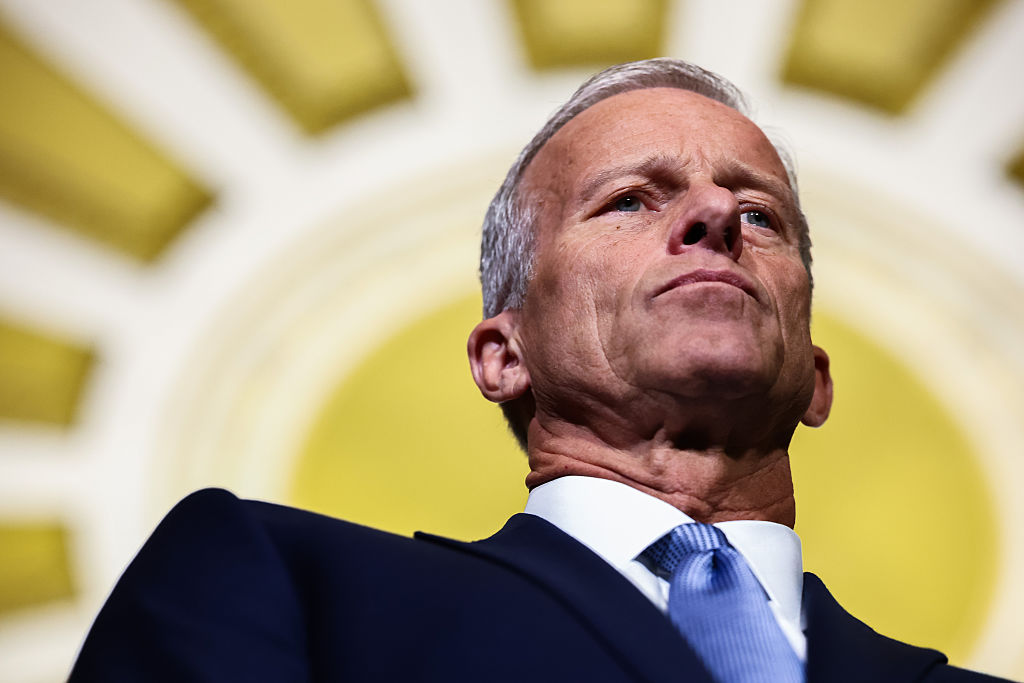
There’s an inherent tension between any President and the Senate Majority Leader. George W. Bush and his team did everything they could in 2004 to make Tom Daschle the first party leader in the Senate to lose re-election since 1952. Barack Obama, who hired Daschle’s top aide as his own when he won a seat in the the Senate that same year, had a respectful but strained relationship with Harry Reid, who praised him as a “light-skinned African-American” with “no Negro dialect, unless he wanted to have one.” Donald Trump insulted Mitch McConnell as “Old Crow.” And Chuck Schumer drove out to Joe Biden’s beach house in Delaware after a calamitous debate performance against Trump to tell his former Senate colleague that he had to end his re-election bid for the good of the party.
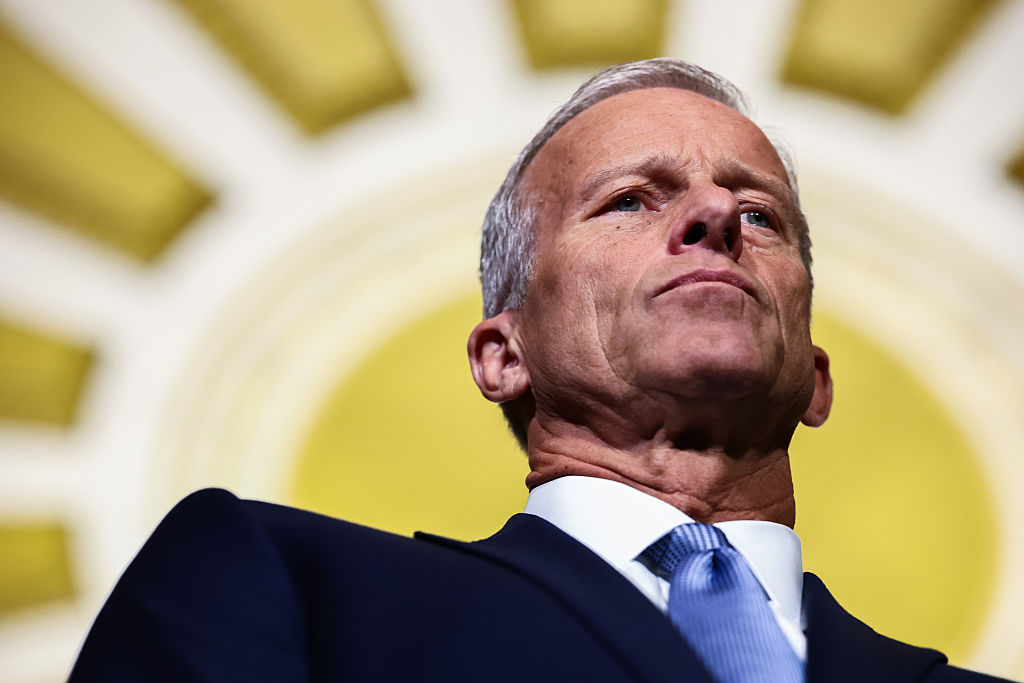
Trump’s dynamic with his current counterpart John Thune is now rapidly climbing that pressure scale.
“That’s too bad for him and too bad for the Republican Party. He’s got the votes. He should get it done,” Trump told reporters of Thune in the Oval Office on Wednesday when asked about a restrictive voting measure that is, at least for now, D.O.A. in the upper chamber.
It was mild ding by Trump’s standards, for sure. But it speaks to the frayed relationship between the two Republicans, who are in a standoff over Trump’s latest fixation, a bill that would remake how Americans vote. Thune has been clear that the proposed legislation, which has cleared the House, lacks the votes it needs in the Senate and there is no appetite for changing the rules to ease its passage. Put plainly: Thune knows the headcount and isn’t wasting the time on something that is doomed, and Trump does not much care for that.
“If I thought there was a path to getting a result, I’m all for it,” Thune told reporters this week.
The Senate is racing toward an August recess with a packed to-do list that seems doable: a sanctions bill targeting Russia, a stopgap funding measure to keep the government open through Election Day, movement on a catch-all reconciliation bill, and a bunch of nominees, including one that on Wednesday seemed to inch closer to giving Trump an up-or-down on his imperiled pick for Attorney General. But Trump says the upper chamber should not leave town until it gives him the SAVE America Act, his voting bill. He also wants the Senate to change its threshold for moving most legislation from 60 votes to 51 votes, ending the delay machine of the filibuster.
“John Thune should not allow the United States Senate to ‘leave town’ until it passes The Save America Act or, far better still, TERMINATES THE FILIBUSTER, where Republicans can then quickly pass everything they ever dreamed of, including a full and deep throated SAVE AMERICA ACT, the Budget, and the ever looming Debt Ceiling disaster, 1929!” the President wrote on his social media platform. “The Dumocrats will do it on day one, and can’t believe how lucky they got with this Senate leadership.”
In response to which Thune had a polite brush-off.
“If the endgame is, we actually get an outcome or result, we could stay here until Christmas,” Thune said. “But Democrats aren’t voting for this, I’m just telling you. And the Republicans are not getting rid of the legislative filibuster.”
The situation has left nerves raw at the Capitol, with the typically staid Thune showing signs of frustration. “Show me how this ends. What’s the picture of victory at the end?” Thune said.
The White House has already summoned close to two dozen Republican Senators to pressure them directly to end the filibuster. According to a senior Republican aide on the Hill, 15 of the 20 who took the meetings told the White House staff directly that they were a hard no on the shift when it comes to the sacrosanct tool of obstruction.
“This is not an open question. It’s just a fact, and the facts don’t change,” Thune said.
That doesn’t mean the White House accepts it. Last week, White House press secretary Karoline Leavitt ominously told reporters that Trump’s “patience is running out” when it comes to the Senate passing the SAVE America Act.
But that fuse has flames racing from both ends.
Unlike House Speaker Mike Johnson, the GOP in the Senate is largely of the same mind that Trumpism will ultimately be only an era. Also, unlike the election to pick the chief of the House, Senate leadership elections are conducted by private ballot, so there’s less risk of running afoul of Trump’s whims. And added to that, Senators are elected to six-year terms, meaning they have a little more padding against any one vote.
It’s also just seen as bad politics in an environment that could give Democrats the Senate majority if the GOP base stays home. “Disappointing [the President] but also our voters 99 days before the election strikes me as a bad idea,” said Sen. John Cornyn, a Texas Republican who once was a contender for Thune’s role and lost his primary this year to a Trump-backed candidate.
As a result, Senate Republicans are more hardened against Trump’s pressure than their House colleagues—and the understood reality is that Thune himself is nowhere near risk, even as the current storm between the Senate Majority leader and the President builds.
Cornyn was blunt in his assessment of the situation: the Senate “can stay here ‘til the cows come home, and it’s not going to change anything.”
The conservative Senate Republican Conference has been circulating a memo to members telling them that staying in Washington for August would make sense if it could move the needle—but it won’t.
“I don’t think staying in session will make more votes appear. … And we have work to do at home to make sure that we beat the Democrats in November,” the memo advises lawmakers to say.
That said, Trump has gotten some lawmakers on side in publicly backing his desire for the upper chamber to spend a sticky August casting votes for legislation that would likely not make much of a difference in this year’s midterms in any case. They include Mike Lee of Utah, Rick Scott and Ashley Moody of Florida, Tommy Tuberville of Alabama, Jim Banks of Indiana, Darlene Graham of South Carolina and Bill Hagerty of Tennessee—all red-state Republicans whose seats are generally seen as safe holds.
But even if the Senate were to stay in town, the math is not mathing. “We simply don’t have the votes,” Sen. Mike Rounds of South Dakota said.
That doesn’t mean Trump will stop pushing for them.


Cathie Wood’s ARK Invest bought about $40.2 million in Tesla, SpaceX and Nvidia shares on July 28 as a global technology sell-off hit AI and semiconductor stocks.
Summary
- ARK Invest purchased 40,281 Tesla shares worth about $12.38 million across four ETFs.
- The firm added 105,108 SpaceX shares, valued at approximately $12.24 million.
- Five ARK funds bought 78,965 Nvidia shares worth roughly $15.56 million.
- ARK also invested about $32,667 in the 3iQ Solana Staking ETF.
ARK Invest adds Tesla, SpaceX and Nvidia shares
ARK Invest spread its Tesla purchases across four exchange-traded funds, according to the firm’s daily trade disclosures.
The ARK Innovation ETF (ARKK) bought 26,920 Tesla shares, the largest portion of the purchase. ARK Autonomous Technology & Robotics ETF (ARKQ) acquired 5,785 shares, while ARK Next Generation Internet ETF (ARKW) and ARK Space & Defense Innovation ETF (ARKX) added 5,119 and 2,457 shares, respectively.
The 40,281 Tesla shares were worth about $12.38 million based on the stock’s July 28 closing price of $307.44.
ARK also purchased 105,108 SpaceX shares across the same four funds. ARKK acquired 70,773 shares, followed by 15,213 for ARKQ, 9,426 for ARKW and 9,696 for ARKX.
The SpaceX investment was valued at about $12.24 million using the company’s $116.41 closing price. ARK had already purchased approximately $14 million in SpaceX shares earlier in the week, extending its exposure to Elon Musk’s aerospace company.
Nvidia purchase reaches $15.56 million
Nvidia was added to all five of ARK Invest’s active ETFs included in the July 28 disclosure.
ARKK bought 42,072 Nvidia shares, while ARKQ and ARKW purchased 13,639 and 11,984 shares. The ARK Fintech Innovation ETF (ARKF) added 5,471 shares, and ARKX acquired another 5,799.
The combined purchase of 78,965 shares was worth about $15.56 million based on Nvidia’s closing price of $197.01.
ARK’s buying followed a sharp decline in Nvidia shares on Monday as investors reassessed the cost and financing of AI infrastructure. The chipmaker also lost its position as the world’s most valuable publicly traded company to Apple during the market rotation.
Other U.S. semiconductor and data-storage stocks remained under pressure on Tuesday. Intel, AMD, SanDisk, Western Digital and Seagate Technology each fell more than 4% as concerns over data-center spending spread across the sector.
Global AI sell-off hits Asian markets
Asian equities recorded some of the steepest losses during the global retreat. South Korea’s Kospi dropped 10.8%, triggering a temporary circuit breaker after losses crossed 8%.
Samsung Electronics and SK Hynix fell by double digits as investors reacted to concerns over China’s progress in chipmaking equipment and the sustainability of AI investment. Japan’s Nikkei 225 also finished nearly 4% lower.
The sell-off followed a long rally in AI-linked companies and renewed debate over whether revenue from AI services can justify the amount being invested in chips, power supplies and data centers. ARK’s purchases indicate the investment manager used the decline to expand positions in companies tied to autonomous vehicles, space technology and computing infrastructure.
For U.S. investors, ARK’s trades offer exposure to those sectors through its actively managed ETFs. However, the purchases also increase sensitivity to further declines in high-valuation technology stocks if AI spending slows or financing costs remain elevated.
ARK adds Solana exposure as crypto consolidates
ARK also increased its indirect Solana exposure through the 3iQ Solana Staking ETF. ARKW bought 2,997 shares, while ARKF purchased 2,255 shares.
The combined 5,252-share purchase was valued at about $32,667 based on the fund’s $6.22 closing price. It followed ARK’s purchase of BitMine Immersion Technologies shares and the same Solana fund on July 24, when the firm invested roughly $251,500 across three ETFs.
ARK Invest’s director of digital assets research, Lorenzo Valente, separately warned on July 28 that the crypto industry was entering its deepest consolidation phase. He claimed Hyperliquid and Pump.fun generated 67% of application revenue, with Ethena lifting the top-three share to almost 80%.
Valente expects more acquisitions, bankruptcies and shutdowns as capital moves toward fewer businesses. However, his post did not disclose the dataset, category definitions, or measurement period used to calculate those figures.


The CEO of the US crypto exchange said that the company would apply for a license with the CFTC in August allowing it to offer prediction markets.

Bill T/305 passed parliamentary vote 143-46, with 1 abstention, on July 28, 2026.
Prior to this vote, it was illegal to trade crypto in Hungary without clearance from government-approved verifiers.
These validators were tasked with checking asset sources, wallet ownership, and client information before certifying any prospective crypto transactions as compliant.
‘Crypto Asset Abuse’ Laws Lifted
Laws pertaining to the ‘abuse of crypto assets’ were introduced in 2025 under Prime Minister Viktor Orbán’s government. Transactions between 5 and 15 million forints (roughly $15,000 – $150,000) were reportedly punishable by a two-year prison sentence, with up to five years for higher amounts.
Hungarian Finance Minister András Kármán states that the rules disrupted the market and caused providers such as Revolut, eToro, and CoinCash to halt or limit their operations.
The EU Commission opened infringement proceedings against these laws in early 2026 on the basis that they conflicted with MiCA regulations.
Crypto oversight is still in place, as the new bill does not remove or restrict existing MiCA compliance guidelines.
Are Hungary’s New Laws Good for Crypto?
Opponents of the bill argue that repealing existing regulations creates opportunities for money laundering and for financing by terrorist groups or political parties.
Supporters, on the other hand, point out that AML and KYC laws remain covered by MiCA.
Very few firms were licensed as validators since 2025. 74% of active Hungarian crypto users traded with Revolut, and the company ceased local operations; the number of citizens trading crypto fell by 80,000, a 38% drop, according to PwC.
The lifting of these restrictions is believed by many to encourage crypto operators to re-enter Hungary, signaling a crypto-friendly environment that remains compliant with EU laws.
The post Hungarian Parliament Scraps Crypto Verifier Rule: What Does it Mean? appeared first on CryptoPotato.


Disclosure: This content is provided by a third party. Neither crypto.news nor the author of this article endorses any product mentioned on this page. Users should conduct their own research before taking any action related to the company.
The Digital Asset Market Clarity Act (H.R. 3633) a major U.S. digital asset legislative proposal that divides regulatory power between the SEC and CFTC, while sparking intense debates over privacy, developer liability, and anti-money laundering (AML) enforcement has been effectively shelved in the U.S. Senate ahead of the August recess, until September delayed by a crowded legislative agenda, alongside opposition from a bloc of Democratic senators over ethics terms.
Summary
- The Senate delayed action on the Digital Asset Market Clarity Act until September after disagreements over ethics rules and a packed legislative calendar.
- The updated bill would split crypto oversight between the SEC and CFTC while adding new ethics restrictions for federal officials and stablecoin enforcement powers.
- Banking groups warned the proposal leaves anti money laundering gaps for DeFi platforms and transaction mixers, while several major financial firms backed the legislation.
- Seven Senate Democrats said the revised ethics and stablecoin provisions do not go far enough, leaving the bill short of the votes needed before the August recess.
Senate Republicans released an updated 616-page text of the Digital Asset Market Clarity Act (H.R. 3633), which merges Senate Banking and Agriculture Committees’ texts into a single framework. [A bill text and a section-by-section summary are also available]. The bill assigns spot market authority over “digital commodities” to the CFTC and investment contract assets to the SEC. And seeks to protect software/blockchain developers and decentralized networks that do not hold customer assets from illicit liability.
The new draft includes a White House-backed ethics title barring covered federal officials and their spouses from issuing or sponsoring digital assets during public service, law enforcement stablecoin seizure powers, and temporary bans on digital asset issuance by federal officials through January 20, 2029. Enforcement actions under the updated ethics title are restricted exclusively to the Attorney General, excluding state attorneys general or private parties.
Lawmakers remain divided over the Digital Asset Market Clarity Act (CLARITY Act), specifically concerning ethics enforcement authority, anti-money laundering scope for decentralized finance (DeFi), and federal powers over privacy tools.
Disagreements exist over whether the U.S. Department of Justice or state attorneys general should enforce bans preventing federal officials from issuing or sponsoring digital assets. Critics argue the proposed bans leave passive crypto investments and prior revenue streams untouched. Proposed text includes fines up to $250,000 per day for violators, which critics view as insufficient.
Major banking groups warn the CLARITY Act leaves critical anti-money laundering gaps inviting illicit finance risks and threaten traditional financial safeguards. Critics argue it excludes decentralized entities from Bank Secrecy Act rules and lacks clear authority to target transaction mixers. The bill does not apply traditional bank rules to many unhosted wallets and decentralized finance networks with Federal agencies lacking direct statutory power to restrict or track transaction mixers under the current text.
Major financial institutions including BlackRock, Fidelity, Franklin Templeton, Goldman Sachs, and SoFi publicly urged passage of the bill. On July 24, the Fraternal Order of Police wrote a letter supporting the Clarity Act, reversing an April letter opposing the bill over provisions of the Blockchain Regulatory Certainty Act, which would protect certain developers and firms that do not control customer assets from prosecution for illicit activity conducted by others on the platforms they build. Nevertheless, a group of seven Senate Democrats expressed that the updated ethics safeguards and stablecoin rules remain insufficient, stalling the 60-vote threshold needed to clear the floor before the summer break. A vote on the Clarity Act could be pushed to September 2026, though its final passage remains uncertain due to ongoing political debates and a crowded legislative calendar ahead of the midterm elections.
William Quigley, a cryptocurrency and blockchain investor and co-founder of WAX and Tether, said “There are three things I am focused on with respect to the Clarity Act:
1. Stablecoin Activity Based Rewards & Temporarily Freezing Accounts: The two main friction points in the Clarity Act have been Section 404 (stablecoin activity based rewards) and Section 304 (temporarily freezing accounts and indemnification for doing so). These are mostly resolved at the legislative level. But there will be a lot of drama over these provisions as the responsible federal regulators draft specific rules and guidance to industry participants.
2. What Counts as Activity Based Rewards: Congress is giving the Treasury, SEC and CFTC a year post Clarity Act enactment to jointly define what counts as an activity based reward. The banking and crypto industry will be deeply involved in helping shape the definitions in their favor.
3. Stable Coin Yield: Coinbase seems confident it has a work around to the prohibition in stablecoin yield. But investors should be wary of financial products marketed as passive yield earning investments. Activity based rewards are not in any way the same as the passive yield a customer earns in a savings account.”
At the Securities Exchange Commission (SEC), Commissioner Hester Peirce views payment stablecoins as essential tools for blockchain transactions, supporting a practical 2% net capital haircut for broker-dealers and warning that yield-generating on-chain activities remain bound by securities laws.
He states that payment stablecoins are necessary for transacting on blockchain rails and expanding tokenized asset business. He applauded SEC staff guidance allowing a reduced 2% haircut instead of punitive 100% requirements, aligning stablecoins with money market funds. Warning that moving traditional financial services like lending or yield vaults onto blockchain rails does not exempt them from federal securities regulations.
The People’s Bank of China already made its central bank digital currency (the digital yuan or e-CNY) interest-bearing starting January 1, 2026, while simultaneously banning private yuan-pegged stablecoins. Yifan He, CEO of Red Date Technology and architect of China’s Blockchain-based Service Network (BSN), in an interview published by Irish Tech News on May 15, 2026 stated that he regards stablecoins as practical payment tools if properly regulated. While not a proponent of decentralized yield-farming or crypto-earning protocols, he acknowledges that stablecoins serve a functional purpose for enterprise settlement, fast payments, and international transactions when managed inside compliant frameworks for digital currency integration. He maintains that mainstream blockchain evolution relies on regulated, institutional implementation rather than decentralized retail yield-chasing.
About the Author:
Selva Ozelli Esq, CPA, is an international digital asset legal expert and author of Sustainably Investing in Digital Assets Globally. Her writings are translated into 45 languages and republished in over 200 global publications. She is recognized as an expert media/TV commentator on global digital asset regulation, tax, and technology matters.
Disclosure: This content is provided by a third party. Neither crypto.news nor the author of this article endorses any product mentioned on this page. Users should conduct their own research before taking any action related to the company.
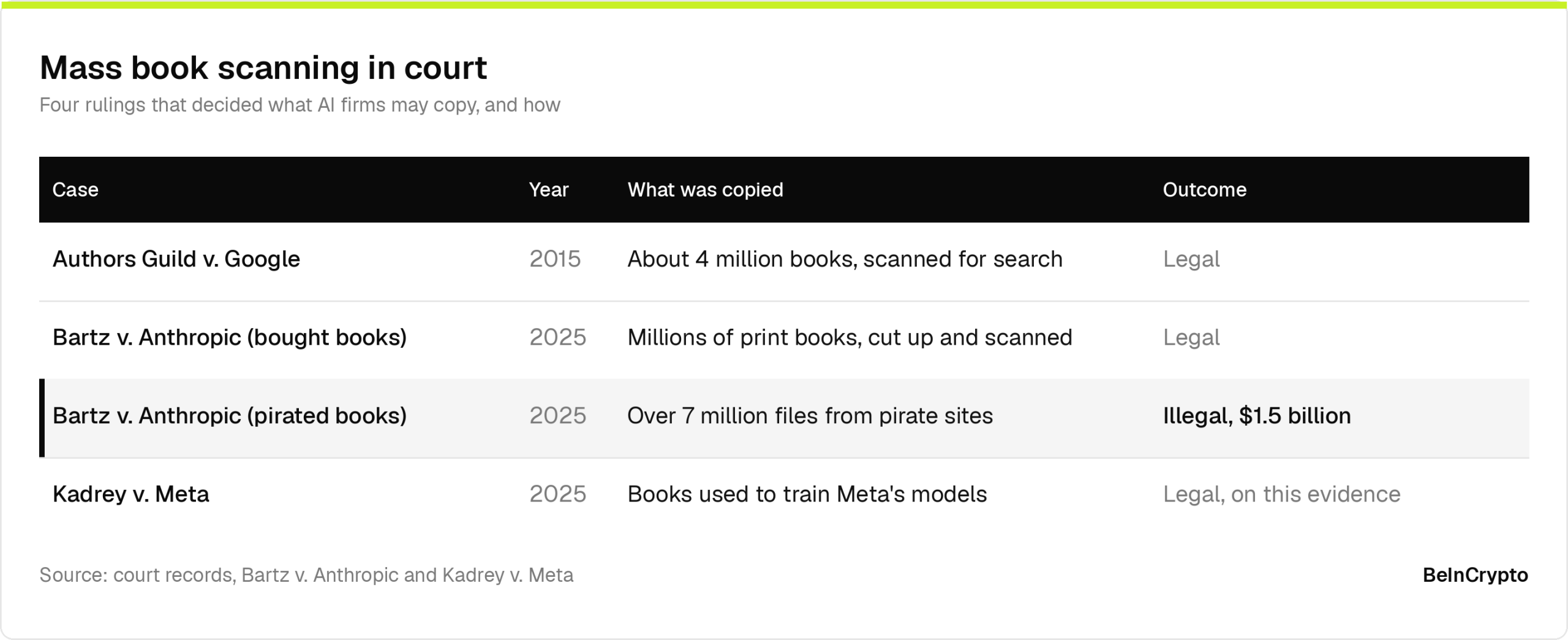
Anthropic bought millions of used books, sliced off the covers, and scanned every page to train Claude. A federal judge ruled that destroying books this way was legal.
Court files exposed the program in January under the internal name Project Panama. Brokers now sell the same book-buying service to other artificial intelligence (AI) firms.
Why Anthropic Destroying Books Was Ruled Legal
The rule is older than AI. When you buy a book, it is yours. You can resell it, lend it, or bin it. Lawyers call that the first-sale doctrine.
Judge William Alsup applied it plainly. Anthropic “purchased its print copies fair and square,” he wrote in his June 2025 order. So the authors were not arguing about payment. They were arguing about the switch from paper to PDF.
Alsup found that switch added no copy at all.
“Here, every purchased print copy was copied in order to save storage space and to enable searchability as a digital copy. The print original was destroyed. One replaced the other,” wrote Alsup in the Bartz v. Anthropic case.
Here is the strange part. Destroying the book is what kept it legal. Keep the paper and you hold two copies. Shred it and you hold one.
Mass book scanning has reached court before, and the precedents cut both ways.

Inside Project Panama, Anthropic’s Book Scanning Program
Anthropic tried the free route first. It had “many places from which” it could buy books, Alsup wrote. Instead, chief executive Dario Amodei took them, to skip the “legal/practice/business slog.”
Cofounder Ben Mann downloaded Books3 in early 2021, a library of 196,640 pirated titles. Five million more came from Library Genesis that June. Two million followed from the Pirate Library Mirror in 2022.
Buying started later. Anthropic hired Tom Turvey in February 2024, who had run book deals at Google. His brief was to obtain “all the books in the world.” Contractors then cut the bindings, trimmed the pages, and scanned each copy.
The order names no supplier. However, the Washington Post reported two, the used-book sellers Better World Books and World of Books. It also described hydraulic cutters removing the spines.
Only the piracy cost money. A judge approved a $1.5 billion payout on July 20, worth roughly $3,000 per book. Anthropic must delete the pirated files within 30 days of judgment. It still faces a separate $75 million claim and music publishers suing Anthropic over lyrics.
Why Old Books Became the Hottest AI Commodity
Old print is clean, and that is the whole point. AI text now floods the web. Feed it back into a model and the model degrades. A 2024 Nature study called this model collapse.
So books printed before ChatGPT cannot contain machine writing. Brokers spotted the gap. ISBNdb sells book sourcing to AI firms. “The world’s best AI training data is sitting on a shelf,” its site says.
Meanwhile, the cost barely registers. Anthropic raised $65 billion in May at a $965 billion valuation, on revenue running at $47 billion a year. The settlement equals about 3% of that.
For crypto readers the thread is provenance. Proving where data came from is now a legal cost rather than a bonus. That same problem drives decentralized AI market forecasts and the case for blockchain based data ownership.
Not everyone accepts the trade-off. Elon Musk, chief executive of SpaceX and Tesla, says his team will scan differently.
Follow us on X to get the latest news as it happens
Gentle scanning has existed for decades. It is simply slower and dearer. So the open question is whether public anger moves an industry the law currently rewards for shredding.
The post Anthropic Destroyed Millions of Books to Train Claude: Was That Legal? appeared first on BeInCrypto.


Exchanges advertise leverage the way carriers advertise data speeds, as a capability offered for your benefit. The arithmetic says something else. A venue earns on notional, so the slider that multiplies your position multiplies its revenue identically while collapsing your survival odds, and the deleveraging queue ranks you first for forced closure because the venue knows exactly which accounts are fragile.
Summary
- Trading fees are charged on notional value, meaning the size of the position, not the collateral behind it, so a 50-times position generates 50 times the fee revenue from the same deposit.
- The trader’s outcome moves in the opposite direction: at 10 times leverage, roughly a 10% adverse move eliminates the position; at 50 times, roughly 2% does, and 2% moves occur in crypto several times a day.
- Funding payments in perpetual futures also apply to notional and not margin, so leverage multiplies the recurring holding cost identically.
- Auto-deleveraging queues rank candidates for forced closure by unrealised profit and effective leverage, which means high leverage raises your position in the queue even when you are winning.
- Every element of that structure is disclosed in exchange documentation; what is absent is the connection between them, because the party best positioned to explain it earns more when it is not explained.
Open any major derivatives venue and the leverage control is presented as a capability. A slider, a dropdown, a set of preset multipliers running from 2 times up to 100 or beyond, framed in the marketing as capital efficiency and in the tooltips as a tool for experienced traders. The framing is not false. Leverage is a legitimate instrument; professionals use it, and its existence is not evidence of bad faith.
But the framing omits an arithmetic relationship that determines almost everything about outcomes on these platforms, and the omission is not random: a venue earning fees on notional value collects more from a leveraged position than from an unleveraged one funded with identical collateral, while the leveraged position is substantially likelier to be liquidated. The interests are not aligned; the misalignment is mechanical, not conspiratorial, and it is visible to anyone who does the multiplication. This guide does the multiplication.
The fee arithmetic
Start with how trading fees are actually assessed, because this is the fact the whole argument rests on and it is not hidden anywhere.
Fees on derivatives venues are charged as a percentage of notional value, which is the full size of the position, not the margin posted to open it. A trader depositing $1,000 and opening an unleveraged position pays fees on $1,000 of notional. The same trader using 50 times leverage opens a $50,000 position and pays fees on $50,000 of notional, from the same deposit.
Fee rates vary by venue and by whether an order adds or removes liquidity, but the structure is uniform: the multiplier applied to the position is applied identically to the fee. At a taker rate of a few basis points, a round trip on a $50,000 notional position costs a meaningful fraction of a $1,000 deposit before the market has moved at all.
The same multiplication applies to funding. In perpetual futures, the periodic payment flowing between longs and shorts is calculated on notional, a detail one major wallet provider’s documentation flags explicitly as mattering for true holding costs. A leveraged position pays leveraged funding, so a persistently crowded side becomes expensive at a rate proportional to the multiplier chosen.
Nothing here is concealed. It is in every fee schedule. What is rarely stated in the same place is the consequence: for the venue, the leverage slider is a revenue multiplier applied to the same customer deposit, and its effect on revenue is linear and certain while its effect on the trader’s outcome is negative and probabilistic.
What leverage does to survival
Now the other side of the same multiplication, stated as plainly as the fee side.
Leverage compresses the distance between your entry price and the point at which your collateral no longer supports the position. At 10 times, roughly a 10% adverse move exhausts the margin. At 25 times, roughly 4%. At 50 times, roughly 2%. At 100 times, the margin for error falls below 1%, and one industry glossary states the position bluntly: a 1% market movement can result in a total loss of capital.
Those figures are approximations before fees, funding, and maintenance-margin buffers, all of which move the liquidation point closer, not further. They also assume the reference price behaves smoothly, which in stressed conditions it does not.
Set that against how crypto actually trades. 2% intraday moves are routine, occurring on most assets multiple times in a typical week and repeatedly within single days during volatility. A 50-times position is therefore not a bet on direction; it is a bet that ordinary noise does not arrive before your thesis plays out, and ordinary noise arrives constantly. Being correct about direction and wrong about sequence produces the same result as being wrong about everything.
One further asymmetry deserves stating. Stop-loss orders do not reliably protect high-leverage positions, because in fast markets the gap between the trigger and the fill can exceed the entire remaining margin. The tool most often recommended alongside leverage is least effective at exactly the leverage levels where it is most needed.
The deleveraging queue ranks you
Here is the element almost nobody connects to the rest, and it is the clearest evidence that venues understand the relationship perfectly.
When a liquidation cannot be cleared in the market, and a venue’s backstop fund or protocol vault is exhausted, the exchange reduces positions on the profitable side to keep its books balanced. That mechanism is auto-deleveraging, and this publication covers it in detail in a dedicated guide. The relevant point here is how the venue chooses whose positions to close.
Selection is formulaic and published. Venues rank candidates by a combination of unrealised profit and effective leverage, closing the most profitable and most leveraged positions first, and many display each trader’s rank as a live indicator on the interface.
Read that ranking as what it is: the venue’s own statement about which accounts are fragile. An exchange that sorts by leverage when deciding whose winning positions to terminate has encoded, in its risk engine, the judgment that high leverage marks a position as expendable. The marketing presents the slider as a feature. The risk engine treats the same setting as a liability marker.
The practical consequence is that leverage costs you twice on the same position: it shortens the distance to liquidation when you are losing, and it raises your rank for forced closure when you are winning.
Why the slider exists at all
The uncharitable reading is that venues offer extreme leverage to harvest fees from accounts that will not survive. The charitable reading is that leverage is a legitimate tool and competitive pressure forces every venue to match the maximum its rivals advertise. Both are partly true, and the second explains the escalation better than the first.
Maximum leverage functions as a marketing number in this industry the way megapixels once did in cameras. It appears in comparison tables, it differentiates venues that are otherwise similar, and no exchange wants to be the one advertising a lower ceiling. That dynamic ratchets upward regardless of whether anyone believes high leverage serves customers, which is why the figures have climbed steadily while the arithmetic behind them has not changed.
It is worth noting who does not permit this. Most regulatory regimes restrict or prohibit extreme leverage for retail participants in traditional markets, and that restriction was not arrived at casually. Retail leverage limits exist because supervisors examined outcome data and concluded the products were unsuitable at those levels. Crypto venues operating outside those perimeters are not evading a rule so much as operating where the rule was never written.
What experienced traders actually do
The gap between advertised maximums and professional practice is the most useful thing a new participant can know.
Professionals use leverage, and they use far less of it than platforms permit. The reason is not caution as a personality trait; it is that position sizing is the variable with the largest effect on long-run outcomes, and high leverage removes the ability to be early. A trader with a correct thesis and low leverage survives being wrong about timing. The same trader at 50 times does not, and being right eventually is worth nothing once the position is closed.
The second practice is treating leverage as a cost input instead of a capability. Before entering, calculate the fee on the intended notional, add the expected funding over the intended holding period, and compare that total against the edge the trade is supposed to capture. Strategies that require high leverage to be worth executing are strategies whose edge is too small to survive their own costs, and the calculation reveals it in under a minute.
The third is watching the deleveraging indicator where a venue provides one. A rising rank during a favourable move is the venue telling you, in advance, that it considers your position a candidate for termination.
The honest use cases
None of this argues that leverage should never be used, and a guide that concluded otherwise would be ignoring why the instrument exists.
Hedging: A holder with substantial spot exposure can use a small leveraged short to reduce net risk without selling the underlying. Here leverage is capital efficiency in the genuine sense: the alternative is tying up equivalent capital to achieve the same protection.
Defined-risk short-term positions: A trader with a specific thesis, a predetermined invalidation point, and a position sized so that reaching that point costs an acceptable fraction of capital is using leverage as intended, and the leverage figure is an output of the sizing, not an input.
Capital efficiency for market makers: Professionals quoting both sides need leverage to run inventory without locking up disproportionate collateral, and their risk is managed through hedging, not through directional conviction.
What connects all three is that the leverage number falls out of the risk decision rather than driving it. The failure mode the interface encourages is the reverse: choosing a multiplier first, sizing to it, and discovering the risk afterwards.
The summary worth carrying is that everything in this guide is disclosed. Fee schedules state that fees apply to notional. Documentation states that funding applies to notional. Deleveraging pages state the ranking formula. Risk warnings state that a 1% move can end a 100-times position. What no venue publishes is the paragraph connecting them, because the connection is that the setting generating the most revenue is the setting most likely to end the account generating it.
The traditional-market comparison
The clearest way to see how unusual crypto leverage is comes from looking at what other markets permit, because the limits elsewhere were set deliberately after examining outcomes.
Retail participants in most regulated markets face leverage caps well below what crypto venues advertise, and the caps exist because supervisors studied client outcome data and concluded that higher levels produced consistent losses across the retail population. The details vary by jurisdiction and instrument, and the direction is uniform: where a regulator has examined retail leverage empirically, the response has been to restrict it. Crypto venues offering multiples several times higher are not evading those rules so much as operating in a space where the rules were never written.
There is a second structural difference worth naming. Regulated futures markets sit behind a clearinghouse with a layered default waterfall: the defaulting member’s margin, then their guaranty fund contribution, then the clearinghouse’s own capital, then mutualised contributions from surviving members. Losses reach ordinary participants only after several institutional layers absorb them, which is why retail futures traders essentially never experience anything resembling auto-deleveraging.
Crypto venues compressed that structure into a single insurance fund or protocol vault. The compression is what makes leverage instantly available to anyone with a wallet, and it is also why the loss-allocation mechanism reaches ordinary traders in conditions where a traditional market would never expose them.
Neither design is simply better: one buys accessibility with tail risk, the other buys insulation with cost and gatekeeping. But a trader comparing a crypto venue’s 100-times offering to a regulated broker’s much lower cap should understand that the difference reflects a deliberate judgment somewhere, and it is not the venue offering the higher number that made it.
A closing note on the one number that would settle this debate and that no venue publishes.
Every exchange knows, precisely, what percentage of accounts using each leverage tier are profitable over a given period. The data sits in their systems; it requires no research to produce, and it would answer the question this guide approaches through arithmetic: whether high leverage works for the people using it. Some regulated brokers in other markets are required to disclose exactly that figure, and where they do, the published numbers have been consistently unflattering.
No major crypto derivatives venue publishes it voluntarily. That absence is not proof of anything, and there are defensible reasons a venue might not want to advertise client outcome statistics, including that the figure varies enormously with how it is defined. But the absence is conspicuous in a sector that publishes volume, open interest, insurance fund balances, liquidation feeds, and deleveraging rankings in real time.
A venue willing to show you your own position in the deleveraging queue is a venue with the data infrastructure to show you the survival rate at your chosen leverage tier, and it does not.
Until someone does, the honest position for a trader is the one the arithmetic supports: leverage is a cost multiplier with certain effect and a return multiplier with probabilistic effect, the venue collects the first regardless of the second, and the setting that generates the most revenue is the setting the venue’s own risk engine flags as most fragile. That is enough to size positions by, without needing anyone’s disclosure.
Frequently Asked Questions
How does leverage affect trading fees?
Directly and proportionally. Fees are charged on notional value, the full size of the position, not on the margin posted. A $1,000 deposit at 50 times leverage opens a $50,000 position and pays fees on $50,000, so the venue earns 50 times more from the same customer deposit than it would unleveraged.
Does funding also scale with leverage?
Yes. Funding payments in perpetual futures are calculated on the position’s notional value rather than the deposited margin, which means a leveraged position pays leveraged funding. Over multi-day holds in persistently crowded markets, that recurring cost can exceed the profit from a correct directional call.
How much can the price move before I am liquidated?
Approximately the inverse of your leverage, before costs. 10 times leverage gives roughly 10% of room, 25 times roughly 4%, 50 times roughly 2%, and 100 times under 1%. Fees, funding, and maintenance margin requirements move the liquidation point closer, and 2% intraday moves are routine in crypto.
Do stop-losses protect a high-leverage position?
Not reliably. In fast markets, the gap between a stop trigger and the actual fill can exceed the remaining margin on a highly leveraged position, meaning the stop executes after liquidation would already have occurred. The tool most often recommended alongside leverage is least effective at the leverage levels where it matters most.
What is the deleveraging queue and why does leverage matter for it?
When a liquidation cannot clear, and the venue’s backstop is exhausted, the exchange force-closes profitable positions on the opposite side to balance its books. Venues rank candidates by unrealised profit and effective leverage, closing the most profitable and most leveraged first, and many display each trader’s rank live. High leverage raises your position in that queue even when you are winning.
Why do exchanges offer leverage they know most traders cannot handle?
Partly fee economics, since notional-based fees make leveraged accounts more valuable per dollar deposited, and partly competitive dynamics, since maximum leverage functions as a comparison-table marketing number that ratchets upward regardless of suitability. Most regulatory regimes restrict comparable leverage for retail participants in traditional markets, having examined the outcome data.
Is leverage ever the right tool?
Yes, in three cases: hedging existing spot exposure without selling it, defined-risk short-term positions sized so that reaching the invalidation point costs an acceptable fraction of capital, and professional market making that requires inventory without disproportionate collateral. What these share is that the leverage figure is an output of the risk decision rather than the starting point.
What should a beginner actually do?
Use far less leverage than the platform permits, calculate fees on intended notional plus expected funding before entering, and compare that to the edge you expect; size positions on the assumption that ordinary volatility will test them, and watch the deleveraging indicator if the venue provides one. The traders who last in these markets use a fraction of what is offered. This is educational information, not investment advice.
Disclaimer: This article is for information and educational purposes only and does not constitute financial or investment advice. Leveraged derivatives trading carries substantial risk of loss, including total loss of collateral; fee structures and mechanisms vary by venue, and products described may be restricted in your jurisdiction. Always do your own research. Information is accurate as of July 29, 2026.

Daily horoscope July 30, 2026: Predictions for your star sign
Oil prices slip as tankers continue to ply Middle East conflict zones

AAA Launches Web3 Panel for Crypto Disputes


-

 Fashion5 days ago
Weekend Open Thread: Brooks Brothers
-
 Sports3 days ago
Commonwealth Games boxing: Jadumani Singh seals dominant 5-0 win over Pakistan’s Sumama Rehman to enter quarter-finals | Commonwealth Games News
-

 Tech3 days ago
Intel is reversing course and bringing hyper-threading back to its server chips
-

 Business4 hours ago
Why Trees Belong on the Risk Register
-

 Politics3 days ago
Luke Littler dismantles Gerwyn Price to retain title in Blackpool
-

 Crypto World4 days ago
Ripple bought a bank in pieces. The $4 billion audit
-
 Entertainment5 days ago
A New Post-Apocalyptic Gundam Anime Series Blasts Into SDCC
-

 News Videos3 days ago
BITCOIN JUST ENTERED THIS CRITICAL ZONE…
-

 Politics2 days ago
The Part of the Electric Transition Nobody Wants to Discuss
-

 Sports6 days ago
2026 3M Open leaderboard: Scottie Scheffler finds putter in Round 1, sits three back
-

 Fashion6 days ago
16 Dresses for the High Summer Event
-

 News Videos6 days ago
The Peugeot Family: How 200 Years of an “Old Money” Dynasty Died in A Boardroom
-

 Business20 hours ago
Major shareholder moves on Canyon
-

 Crypto World4 days ago
XRP Ledger adds $2.6B as RWA inflows rank second
-

 Politics4 days ago
Spain sweeps the board at 2026 World Cup with individual awards
-

 Crypto World6 days ago
Uniswap (UNI) pushes deeper into tokenized RWAs with permissioned trading pools
-
 Entertainment1 day ago
‘Stargate’ Creator’s New Sci-Fi Series Returns for Season 3 Tomorrow
-
Crypto World7 days ago
SEC Agrees to Overhaul Recordkeeping After Settling Coinbase Lawsuit Over Gensler’s Lost Texts
-

 Tech5 days ago
Anthropic launches Claude Opus 5, a cheaper AI model for coding, agents and enterprise workflows
-

 Entertainment4 days ago
Sara Gilson Killed By Husband After Viral “Pedophile” TikTok Video
You must be logged in to post a comment Login