

Crypto World
Revolut Builds $200 Billion IPO Case on Record Profits



Revolut has told investors it is targeting a valuation of $150 billion to $200 billion for a future initial public offering (IPO), the Financial Times reported on Tuesday.
The London-based fintech, which was valued at $75 billion in a secondary share sale last November, would not seek a stock market listing before 2028. No formal valuation target has been set, a source close to the company told the FT.
Revolut Eyes Up to $200 Billion Valuation in Future IPO
The company’s financial performance supports the ambition. Revolut’s pre-tax profit hit a record £1.7 billion ($2.3 billion) in 2025, a 57% increase from the prior year.
Revenue climbed 46% to £4.5 billion as its retail customer base grew 30% to 68.3 million.
Reports also indicate that Revolut is preparing for a secondary share sale in the second half of 2026. That transaction could value the company at around $100 billion, laying a stepping stone toward the IPO target.
Co-founder Nik Storonsky said in December that his personal stake would be worth roughly $80 billion if the company reached a $200 billion valuation.
Banking Licenses Fuel Global Expansion
Revolut received a full UK banking license from the Prudential Regulation Authority in March 2026, ending a years-long application process.
The license allows the crypto-friendly fintech to offer lending, savings, and credit products to UK customers.
The company also applied for a US banking license with the Office of the Comptroller of the Currency (OCC) in early March.
If approved, Revolut would operate more like a traditional bank in the world’s largest economy.
Can Revolut justify a $200 billion price tag? This may hinge on how quickly it converts new banking powers into lending revenue and grows its US footprint before any listing.
The post Revolut Builds $200 Billion IPO Case on Record Profits appeared first on BeInCrypto.



U.S. producer prices for April came in far hotter than expected on Wednesday, complicating the Federal Reserve’s path forward to ease monetary policy later this year.
The April Producer Price Index rose 1.4% month-over-month, nearly triple economists’ expectations for a 0.5% increase. Annual producer inflation accelerated to 6%, while core PPI excluding food and energy climbed 1% on the month and 5.2% year-over-year, both well above forecasts.
The report reinforced that inflation is reaccelerating after Tuesday’s consumer price index (CPI) rose 3.8% year-over-year, the hottest inflation reading in almost three years.
Bitcoin (BTC), which traded above $81,000 overnight, quickly dropped below the key $80,000 level in the minutes following the release before recovering slightly. The largest cryptocurrency was recently changing hands just above $80,000, down about 0.8% over the past 24 hours.
Equity futures held relatively steady ahead of the U.S. open, with Nasdaq 100 futures up 0.2% and S&P 500 futures little changed.
The inflation surprise adds another layer of uncertainty for the Fed as policymakers navigate rising energy prices tied to the ongoing Iran conflict and persistent concerns over supply disruptions around the Strait of Hormuz. Higher oil prices risk feeding further into inflation data in the months ahead.
The report could also revive discussion of whether the central bank may need to consider additional tightening rather than cuts, even as President Donald Trump continues to pressure the Fed to lower interest rates.
That backdrop is especially delicate as Kevin Warsh prepares to take over leadership of the central bank, with investors closely watching how the incoming chair will balance slowing growth risks against resurgent inflation pressures.

Bitcoin could be poised for another push to fresh all-time highs within a year if a familiar price pattern holds, according to research from network economist Timothy Peterson. With BTC hovering around $81,000 after rebounding from a February dip below $60,000, the setup echoes past bear-market recoveries, where BTC rebuilt strength from a -50% to -35% drawdown and then surged higher. The signal sits atop a broader valuation discussion: VanEck analyst Matthew Sigel argues that the Buffett indicator implies a path toward a $160,000 price level if market dynamics align, a scenario that would simply bring Bitcoin in line with equities’ overall asset pricing.
Key points:
- Bitcoin’s current configuration mirrors a historically favorable window: after falling from -50% to -35% from its all-time high, BTC has often advanced to new peaks within about a year, according to Timothy Peterson’s analysis.
- As of now, Bitcoin trades near $81,000, with the drawdown from its October 2025 high standing at roughly 35% after a dip below $60,000 in February.
- Past episodes show that similar recoveries culminated in new all-time highs, a pattern reinforced by on-chain analytics and historical price data.
- Valuation signals, including the Buffett indicator, have been cited by observers as suggesting a longer-term upward re-rating of Bitcoin could materialize, potentially targeting well into the six-figure range.
Pattern repeats as BTC rebounds from bear-market drawdowns
Timothy Peterson laid out a concise framework for interpreting Bitcoin’s price action when it rebounds from a large drawdown. In a post on X, he noted: “I looked at every time Bitcoin went from a -50% drawdown to a -35% drawdown (the situation we are in today).” The implication is that when BTC retraces from its deepest losses toward a shallower drawdown, historical precedent favors a resume of bullish momentum that can culminate in a new all-time high within roughly a year.
Bitcoin’s recent path has featured a sharp correction that began in earnest during the 2022 bear market, followed by a multi-quarter recovery. In February, BTC briefly dipped below the $60,000 level, deepening its drawdown against the all-time high around $126,200. Since then, the price has rebounded to around $81,000, narrowing the drawdown to about 35% versus that October 2025 peak, according to data from TradingView. The cycle aligns with Peterson’s narrative: a shift from the harsher drawdown toward a less severe trough often precedes renewed upside momentum.
Historical precedents and what they imply
To contextualize the current setup, market analytics platform Glassnode provides a longer lens on drawdowns in Bitcoin’s price history. Glassnode data illustrate that during the last major drawdown, the market didn’t stabilize at a 35% retreat from the prior all-time high until December 2023—roughly two years after the peak. That period of stabilization preceded Bitcoin’s next notable price peak in March 2024, underscoring a pattern in which extended bear-market correction can set the stage for a renewed ascent later in the cycle.
The narrative that a measured rebound often follows a deep drawdown aligns with several prior cycles. After the 2022 bear market saw an extreme drop, the subsequent period of consolidation and resilience culminated in a fresh breakout in the following year. While not a guaranteed outcome, the historical sequence—deep drawdown, slower recovery, then new highs—has appeared with sufficient frequency to merit attention from believers in a cyclical, macro-driven recovery.
Valuation signals and the Buffett indicator
Beyond pure price action, a separate line of reasoning centers on valuation. VanEck’s Matthew Sigel has argued that Bitcoin appears cheap relative to equities when viewed through the Buffett indicator—the ratio of the total US stock market to GDP. In a post on X, Sigel suggested that if Bitcoin were to regain the level implied by the 35x XBT/XAU cross embedded in that indicator, the price could potentially reach around $160,000. He framed the scenario as a re-pricing mechanism that would bring Bitcoin in line with where equities already stand on a valuation basis.
“Bitcoin looks cheap,” he told X followers. “If it regains the 35x XBT/XAU cross implied by current levels of the Buffett Indicator, we’re looking at $160k, and that’s just catching up to where equities already are.”
The Buffett indicator has long been cited as a broad gauge of whether risk assets are over- or under-priced relative to macro fundamentals. In the Bitcoin context, proponents see it as a cross-asset justification for higher prices if the market’s risk premium shifts in step with the equity complex. Critics, however, caution that the indicator is a back-tested, broad-strokes tool and should be interpreted within a wider set of catalysts, including adoption trends, on-chain activity, and regulatory developments.
What this means for investors and traders
The convergence of a pattern-based setup and valuation commentary creates a nuanced scene for market participants. On one hand, Peterson’s drawdown framework—paired with recent resilience—offers a probabilistic case for upside in the months ahead, especially if Bitcoin can sustain momentum through key liquidity and macro crossroads. On the other hand, the signal is not a guarantee. The broader macro environment remains uncertain, with geopolitical tensions, regulatory scrutiny, and shifting risk appetites continuing to shape crypto markets.
Traders may watch several factors closely. On-chain indicators that track capitalization cycles and exchange flows could reveal whether new supply is entering the market in a way that sustains a rally. Additionally, any shifts in macro policy or inflation expectations could influence the pace at which risk assets reprice, including Bitcoin. While the Buffett-indicator perspective adds an intriguing long-term valuation narrative, it should be weighed alongside price action, market sentiment, and the evolving regulatory backdrop that continues to influence institutional participation in crypto markets.
In this context, the next few months could prove pivotal. If the historical tendency of a post-drawdown rally holds, BTC might test fresh highs within the year. If, however, macro risks intensify or demand falters, the path could diverge from the prior cycles. What remains certain is that investors will be watching both the price drivers and the broader narrative around Bitcoin’s role in portfolios as a non-sovereign store of value and a networked medium of exchange in an increasingly digitized financial landscape.
As the market navigates these crosscurrents, observers will likely weigh both the momentum signals from previous cycles and the evolving macro framework that could either validate or challenge the notion of a swift transition to new all-time highs.
Keep an eye on evolving data points and market commentary in the coming weeks, including on-chain metrics, global macro guidance, and any shifts in institutional commentary on Bitcoin’s long-run role in diversified portfolios.
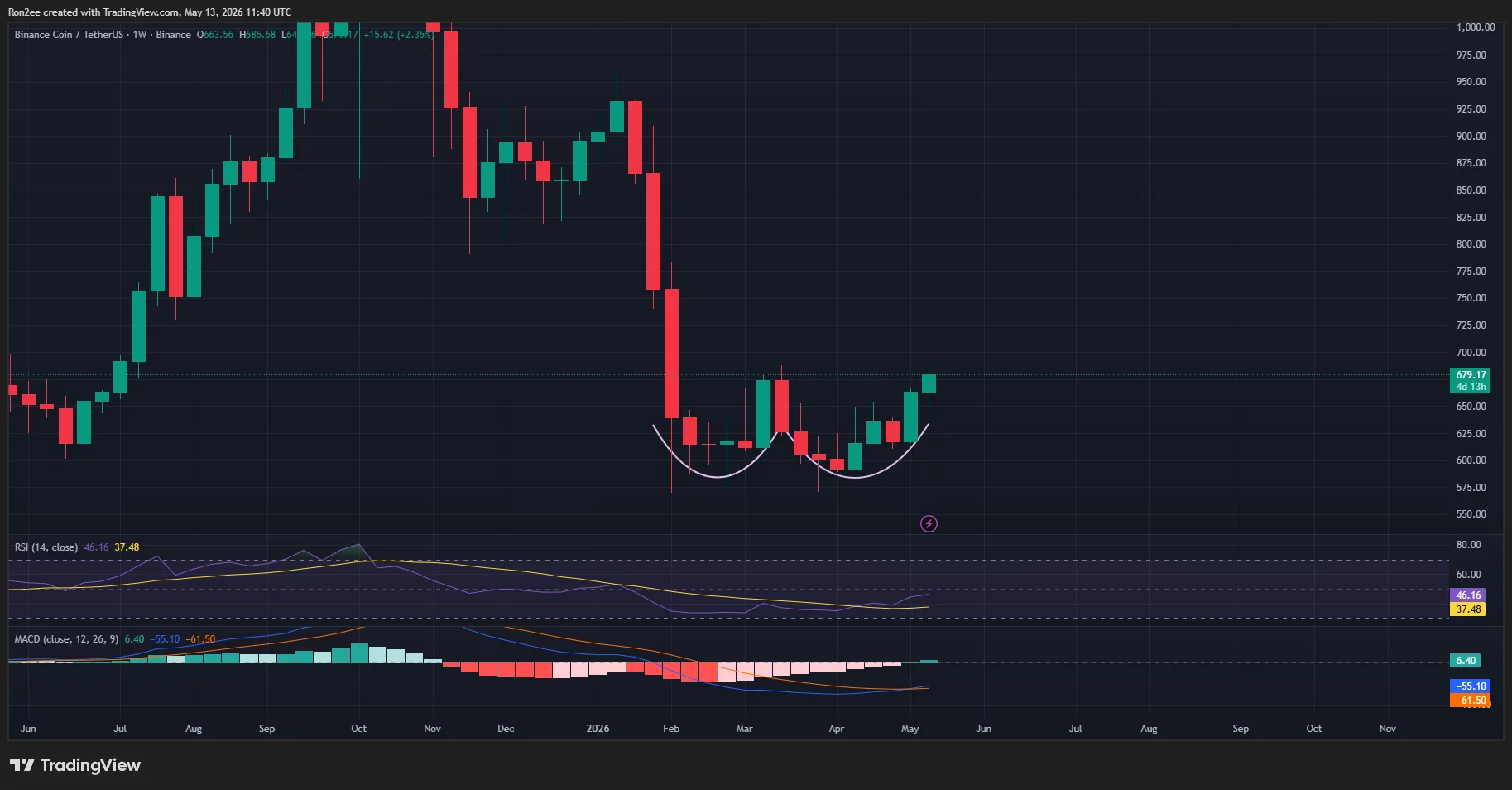
BNB price climbed higher this week as bulls attempted to confirm a breakout from a bullish double bottom pattern forming on the weekly chart.
Summary
- BNB price climbed toward the $680 neckline of a bullish double bottom pattern, with a breakout potentially opening the door for a rally toward $800.
- Market sentiment improved amid speculation surrounding spot BNB ETF applications from Grayscale and VanEck, alongside growing institutional access through Teucrium’s XBNB ETF.
- Expanding Real-World Asset integrations on BNB Chain, including BlackRock’s BUIDL and Franklin Templeton’s BENJI via Securitize, strengthened the network’s long-term utility narrative.
According to data from crypto.news, BNB (BNB) price rose over 2% over the past week to trade near $679 at press time, pushing its market capitalization above $96 billion. The token has now recovered sharply from its April lows near $580 as investor sentiment around the Binance ecosystem improved.
BNB’s latest rally appears to have been driven by a combination of institutional and ecosystem-related catalysts unique to the token. Market speculation surrounding pending spot BNB ETF applications from major asset managers such as Grayscale and VanEck has fueled optimism that the token could attract broader institutional participation if approved.
Investor sentiment also strengthened following the successful tracking performance of the recently launched Teucrium 2x Long Daily BNB ETF (XBNB), which expanded institutional wrapper access to BNB and increased exposure opportunities for traditional market participants.
At the same time, growing RWA adoption on the BNB Chain has further reinforced the network’s long-term utility narrative. Recent integrations involving BlackRock’s BUIDL and Franklin Templeton’s BENJI through Securitize have strengthened expectations that the chain could play a larger role in tokenized finance infrastructure.
On the weekly chart, BNB appears to have formed a bullish double bottom pattern over the past several months, with two major lows established around the $580 region. The neckline of the pattern sits near the $680 resistance zone, which the token is currently attempting to reclaim.
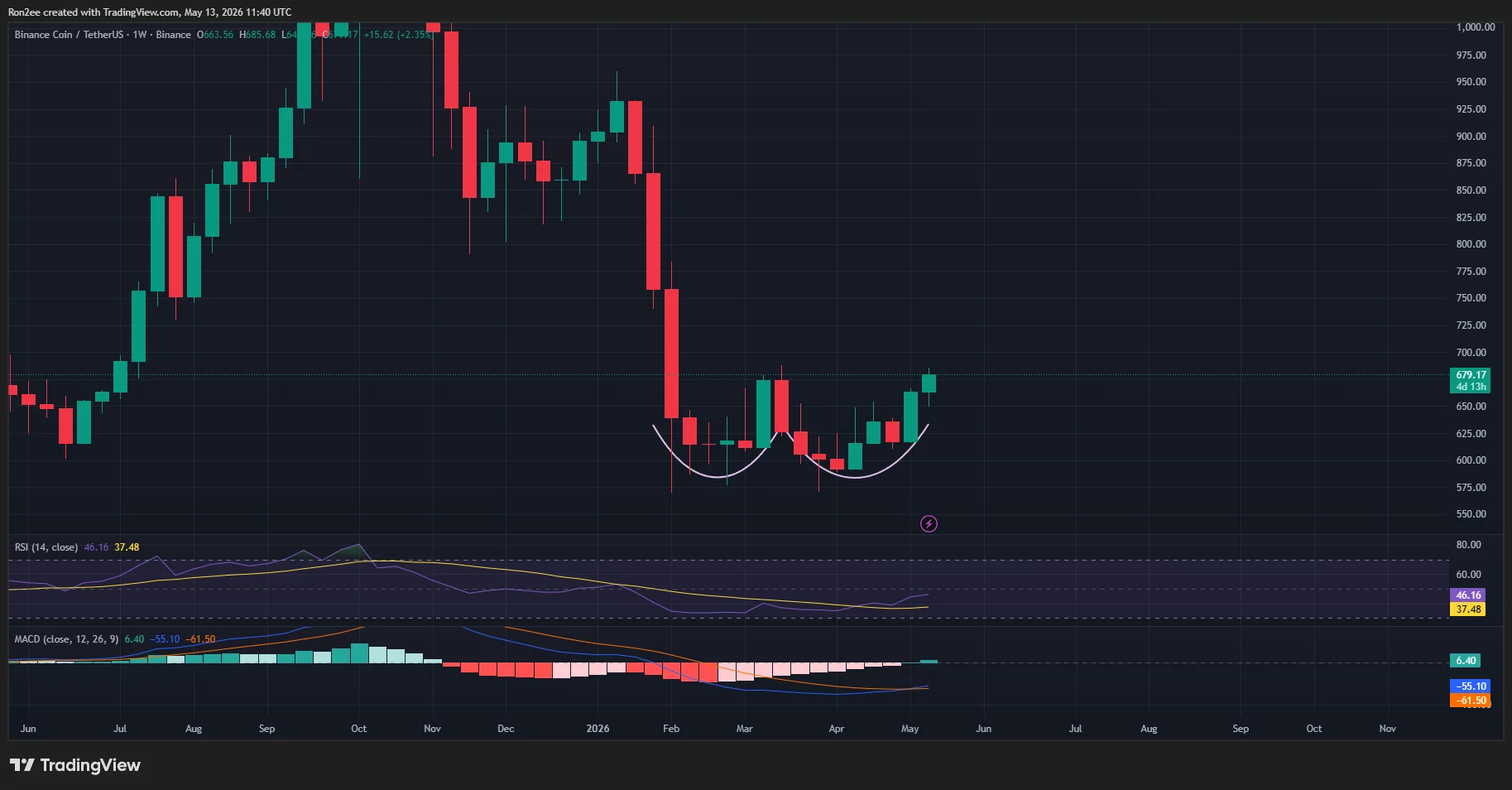
Typically, a confirmed breakout above the neckline of a double bottom pattern signals a potential trend reversal and often opens the door for a rally equal to the height of the formation. Based on the current structure, a successful breakout above $680 could position BNB for a move toward the $780–$800 region in the coming months.
A look at other technical indicators also supports the improving bullish outlook. The MACD histogram has started turning positive after weeks of fading bearish momentum, while the MACD line appears to be curling upward toward a bullish crossover. This suggests that buying momentum may gradually be returning.
Meanwhile, the RSI has also rebounded from oversold territory and currently sits near the neutral 46 level, indicating that BNB still has room for additional upside before entering overbought conditions.
The recent recovery is also notable because BNB had been under pressure in recent months amid renewed scrutiny surrounding Binance’s compliance operations in the U.S. That uncertainty contributed to weaker sentiment earlier this year, though price action now suggests sellers may be losing control near the $580 support zone.
For now, the key resistance level remains near $680, which serves as the neckline of the double bottom formation. A decisive weekly close above that area could strengthen the bullish case and increase the chances of a move past the key $700 psychological level.
On the downside, the $650 and $600 regions remain important support zones that bulls will likely need to defend to maintain the current recovery structure.
Disclosure: This article does not represent investment advice. The content and materials featured on this page are for educational purposes only.
David Schwartz, Ripple’s chief technology officer emeritus, urged the crypto industry to revisit a Stanford lecture explaining why block production rewards undermine blockchain networks like Bitcoin instead of securing them.
Schwartz shared the recording on X, saying it was the one video he wished every crypto participant would watch. The talk, originally delivered at Stanford, lays out the rationale behind the XRP Ledger’s original design choices.
Bitcoin Mining Rewards Force a Race to the Bottom
In the lecture, the architect behind the XRP Ledger argues that proof of work mining demands honest participants spend more than attackers are willing to pay. He calls this possibly the worst imaginable security model.
According to Schwartz, competitive mining pushes operators to cut every cost and exploit every available revenue stream. He cited Ethereum validators who game decentralized finance (DeFi) protocols by testing and reordering transactions for profit before sealing blocks.
“You have to be evil or you lose.”
That dynamic, Schwartz argues, leaves natural stakeholders, meaning the people who actually use the network, paying for security through fees while operators extract additional value during block production.
He says Bitcoin (BTC) miners and Ethereum stakers both fit this pattern. Both groups exist because the protocol pays them, he contends, not because they share users’ interests in keeping fees low or transactions fair.
Ripple CTO: The Best Incentive Is No Incentive
Schwartz summed up the thesis as “the best incentive is no incentive,” meaning a system works better when validators are not paid to participate. He designed the ledger in 2012 without block production rewards, relying on participants who already benefit from reliable consensus rather than on operators paid to validate transactions.
Validators on the XRPL only choose between equally valid ways to order transactions. Because there is nothing material to extract from the system, Schwartz argues there is no financial incentive to attack the network or collude against good actors.
He claims the result is lower fees, faster confirmations, and resistance to the value extraction that has plagued Ethereum’s decentralized exchanges. XRP currently trades around $1.47 while Bitcoin holds near $81,220, according to BeInCrypto data.
The argument lands as Ethereum sinks deeper into proof of stake and Bitcoin approaches a future where transaction fees must replace block subsidies. Whether Schwartz’s framework gains traction may depend on how DeFi protocols handle persistent miner extractable value losses across major networks in 2026.
The post Bitcoin vs XRP: Ripple CTO Reveals the Fatal Incentive Flaw in BTC appeared first on BeInCrypto.


Key takeaways
- Pi Network (PI) is currently consolidating within a descending wedge pattern on the 4-hour chart.
- The deployment of cross-chain contracts on the BSC and OP testnets is part of the ongoing mainnet upgrades, expanding Pi Network’s capabilities.
PI extends consolidation within descending wedge pattern
Pi Network (PI) is trading in the red on Wednesday, down 1%, continuing its consolidation within a descending wedge pattern on the 4-hour chart.
Despite the current bearish price action, the technical outlook remains mildly bullish. PiChain Global, a key player within the Pi Network ecosystem, has recently deployed cross-chain contracts on the BSC and OP testnets, signaling that ongoing upgrades are bringing new capabilities to the Pi Network ecosystem.
In an update posted on X, PiChain Global announced the successful deployment of cross-chain smart contracts on two blockchain testnets: BSC (Binance Smart Chain) and Optimism’s OP testnet, built on Ethereum.
The move highlights the growing cross-chain functionality within Pi Network, expanding its capabilities. PiChain also plans to integrate this functionality into its PCM wallet, while temporarily pausing its Meeta social app due to resource limitations.
This new development is part of the Pi Core Team’s ongoing push for the mainnet upgrade, which has now reached Stellar Protocol v23 on Pi Network’s testnet.
The mainnet nodes must complete this upgrade by Friday to remain connected to the network, and if successful, the upgrade will unlock similar cross-chain functionality on the mainnet, broadening the utility of the PI token.
PI price forecast: potential bullish breakout from descending wedge
The PI/USD 4-hour chart is bearish and efficient. At press time, Pi Network is consolidating between the $0.1700 mark and the May 9 high of $0.1766 on the 4-hour chart.
This consolidation is bounded by two key trendlines—an overhead trendline from April 29 and May 6 highs, and a support trendline from April 30 and May 8 lows.
Short-term momentum is recovering on the 4-hour chart. The Moving Average Convergence Divergence (MACD) remains above its signal line, with positive histogram bars contracting toward the zero line.
The Relative Strength Index (RSI) is showing a steady rise in the mid-range at 46, while the price holds above the key $0.1700 level, signaling a positive divergence.
If the bulls regain control, immediate resistance is found at the short-term descending trendline around $0.1766.
A sustained break above this resistance level would help lift the current cap and pave the way for a potential move toward the May 6 high at $0.1881.

However, if the market undergoes a correction, initial support is at the psychological $0.1700 level, followed by the active descending support trendline near $0.1670.
If the price breaks below this support level, it could trigger a deeper pullback, potentially weakening the broader consolidation structure.
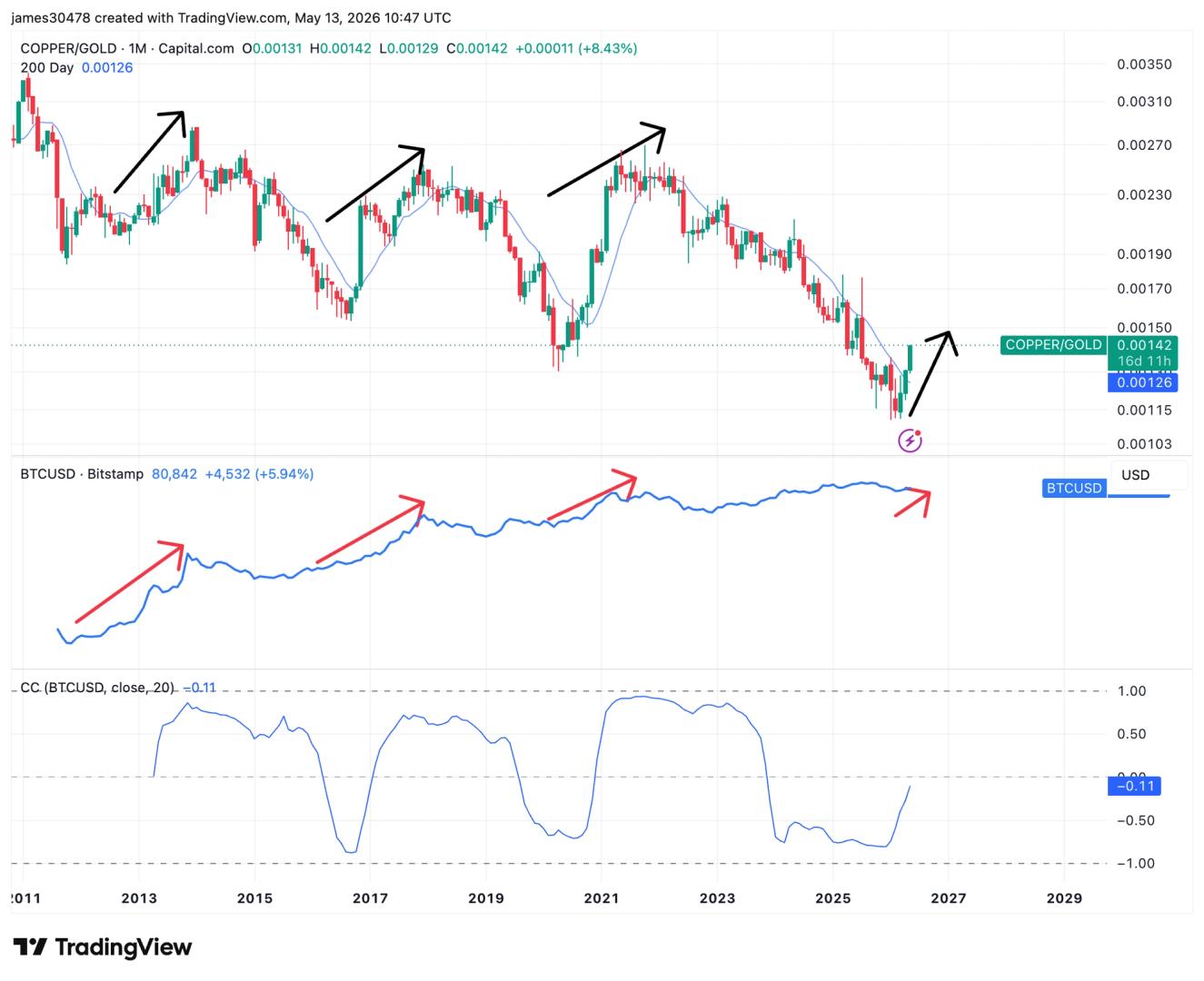
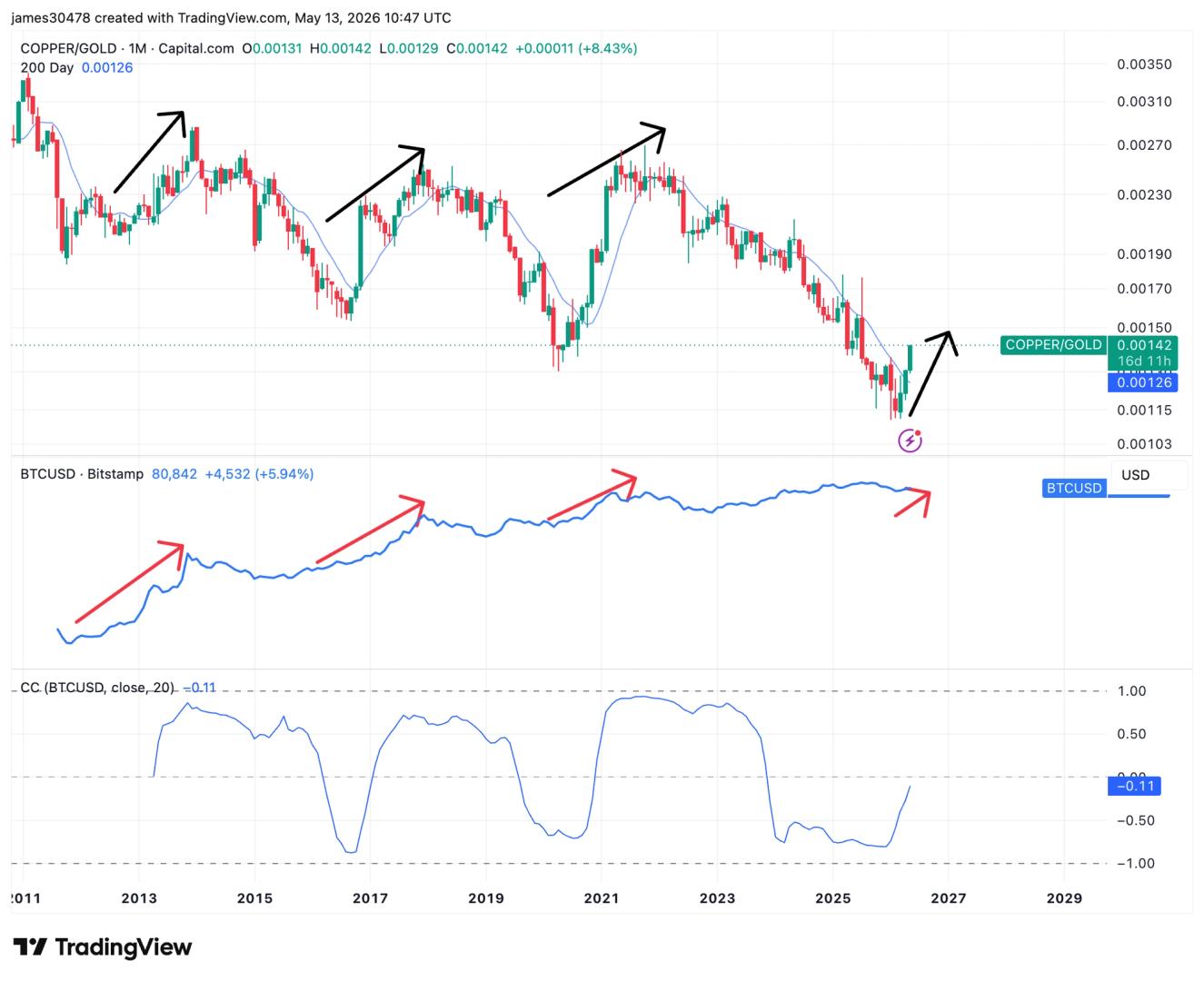
The copper-to-gold ratio has broken above its 200-day moving average for the first meaningful time since September 2020, a development that has historically coincided with the early stages of bitcoin bull markets.
The ratio currently stands at 0.00142, with copper trading at $6.65 per pound and gold near $4,700 per ounce. Previous surges in the ratio during 2013, 2017, and 2021 aligned with major gains in bitcoin prices.
The correlation coefficient between bitcoin and the copper-to-gold ratio currently sits at -0.11, though it has rebounded sharply from -1.00. This suggests the two assets are not yet positively correlated, but the relationship is beginning to strengthen. Historically, during bitcoin’s strongest bull runs, the correlation has moved toward or above 1.0.
The current negative reading largely reflects the earlier divergence phase, when the ratio was falling and bitcoin typically declined faster than copper. As the ratio recovers, that relationship has historically converged alongside improving market conditions.
Historically, the copper-to-gold ratio has led bitcoin by several weeks to months, suggesting the current move may still be in its early stages.
The copper-to-gold ratio is widely viewed as a gauge of economic momentum and investor risk appetite. Copper is closely tied to industrial demand and tends to outperform during periods of economic expansion, while gold is traditionally associated with defensive positioning. A rising ratio therefore signals a more risk-on macro environment.

Coinbase-backed x402 has added batch settlement, a feature designed to reduce the cost of high-frequency AI agent payments by allowing many small transactions to settle later in bulk.
Base creator Jesse Pollak said Wednesday that x402 now supports batched settlement, enabling very small payments below $0.0001 for on-demand resources such as compute and inference.
The feature lets buyers deposit ERC-20 funds into onchain escrow and sign offchain vouchers for each paid request. Sellers can verify those vouchers quickly, serve the request and later redeem many payments together in batched onchain transactions, according to x402’s documentation.
The development adds another layer to the emerging market for agent payments. It comes a week after Amazon Web Services (AWS) integrated Coinbase’s x402 payment protocol and wallet infrastructure to allow AI agents to make USDC (USDC) payments on Base and Solana without direct access to private keys.
Days earlier, Coinbase CEO Brian Armstrong announced cutting 14% of the company’s workforce to restructure around smaller AI-focused teams using more automation tools, Cointelegraph reported on May 5.

Coinbase introduces x402 batch settlement. Source: x402.org
X402 is an open protocol based on the HTTP 402 “Payment Required” status code to support machine-to-machine payments. Coinbase said the protocol processed over 169 million payments across 590,000 buyers and over 100,000 sellers in its first year.
Related: Polygon reduces block time to 1.75 seconds as payments push accelerates
Batch settlements enable gasless transactions for AI agents
Batch settlements look to allow sellers to offer agents a cheaper and faster experience where deposits, batched settlements and refunds are all sponsored by the transaction’s facilitator, said Coinbase Developer Platform product lead Joshua Nickerson, in a Wednesday X post.
AI agents using batch settlement will be able to accept any Ethereum-native ERC-20 tokens, not just stablecoins. The feature is currently available in TypeScript and Go, with a Python implementation coming soon.
In the documented flow, the buyer opens or tops up a channel by depositing ERC-20 tokens into escrow. Each paid request includes a signed cumulative voucher, and the seller’s channel manager later claims vouchers from many channels in a single transaction before sweeping funds to the receiver.

Source: Jnix
Crypto companies build agent rails
Other large cryptocurrency companies have also been building AI infrastructure.
On Monday, stablecoin issuer Circle launched a suite of tools enabling AI agents to use wallets, discover services and make programmable payments with USDC, Cointelegraph reported.
On Friday, Aptos Foundation and Aptos Labs committed $50 million to Aptos development, with a particular focus on AI agent infrastructure and research, including AI-powered onchain order book and perpetual exchange Decibel and decentralized storage protocol Shelby.
Magazine: AI-driven hacks could kill DeFi — unless projects act now
Crypto World
Bitcoin and Ethereum Arrive on Wall Street Giant Charles Schwab for Selected Retail Clients

Charles Schwab has started rolling out its new Schwab Crypto accounts to retail clients, allowing users to trade Bitcoin and Ethereum directly through the platform alongside traditional investments, starting Tuesday.
The offering is currently available to most residents in the United States, although residents of New York, Louisiana, and US territories are excluded at this stage. Schwab Crypto accounts are also not yet available to international users.
Schwab Crypto Rollout
According to the announcement, the first group of eligible clients can begin accessing crypto trading. To open a Schwab Crypto account, users must already have an eligible brokerage account with the company. Supported account types include individual and joint brokerage accounts, while additional requirements such as jurisdiction-based eligibility also apply.
Schwab Premier Bank serves as the custodian for the latest offering, while Paxos will manage trade execution and sub-custody services. As per the FAQs page, Schwab Crypto plans to charge a 75-basis-point trading fee.
The rollout comes as the brokerage and banking firm continues expanding its presence in the crypto market. Last month, Charles Schwab introduced a dedicated crypto-focused page on its website under the “Schwab Crypto” branding, in a bid to expand its offerings for retail investors seeking direct exposure to digital assets.
Founded in 1971, Charles Schwab manages roughly $12 trillion in assets and is considered one of the largest banking and financial services organizations in the United States. But despite the major TradFi expansion into crypto, there have been no visible changes in the price of the two top assets as Bitcoin remained near $80,000, while Ethereum traded around $2,300.
Schwab 1Q Results
Charles Schwab posted a net income of $2.5 billion in the first quarter of 2026. After excluding certain transaction-related expenses, adjusted profit rose to $2.6 billion, while adjusted earnings per share increased 38% year-over-year to $1.43.
Meanwhile, quarterly revenue was up 16% to $6.48 billion. Client assets reached $11.77 trillion by the end of March, up 19% from a year earlier. Additionally, the company recorded $140 billion in core net new assets during the quarter and opened 1.3 million new brokerage accounts, which pushed total client accounts to 47.2 million.
The post Bitcoin and Ethereum Arrive on Wall Street Giant Charles Schwab for Selected Retail Clients appeared first on CryptoPotato.


- Tron (TRX) price is trading above $0.35 as the latest upward move adds to recent gains.
- The altcoin’s higher price action and network activity show marked divergence.
- Can TRX continue the uptick, or are bulls set for trouble amid a sharp reversal?
TRON (TRX) is among the stronger-performing altcoins on the day, posting modest gains as the token retests the key $0.35 resistance level amid a broader recovery across the crypto market.
Intraday data shows TRX trading volume declining 13% to about $639 million, suggesting softer market participation despite the price uptick.
The token’s ability to hold near current levels mirrors broader sentiment across major cryptocurrencies, with Bitcoin and Ethereum also maintaining important support zones.
However, analysts note that TRX’s price advance contrasts with weakening network activity metrics, a divergence that could point to potential downside risks if momentum fades.
TRX price outlook – overbought danger?
TRON is up about 23% year-to-date, making it one of the stronger-performing major altcoins over that period.
The token has continued to climb since rebounding from lows near $0.26 in early February.
Bulls are now testing resistance around $0.35, with traders watching for a possible move toward highs last seen in 2024.
Despite the strong performance, short-term technical indicators are beginning to show signs of caution.
The Relative Strength Index (RSI) has moved into overbought territory, a condition often associated with slowing momentum or potential reversals in momentum-driven markets.
Meanwhile, the MACD remains in bullish territory, although the indicator is beginning to show signs of weakening momentum.

CryptoQuant’s latest analysis highlighted this vulnerability, pointing to the stark divergence between price action and network activity.
According to the analysts, the TRX price surges in the past weeks have not aligned with on-chain activity.
For instance, the “Tokens Transferred (Total)” metric shrank from 17.3 billion to 12.2 billion, indicating reduced network utility. Prices bounced higher during this period.
“Typically, a healthy and sustainable price rally is validated by increasing network activity and utility. This glaring divergence suggests that the current upward momentum to $0.35 is not supported by actual on-chain usage. It implies that the recent price action might be driven more by speculation or hoarding rather than organic network activity,” CryptoQuant noted.
TRON experienced an 11% decline in the TRX burn ratio during Q1 2026, as users shifted toward staking rather than burning tokens for transaction fee discounts.
External factors, including ongoing scrutiny of founder Justin Sun, may further embolden bears if sentiment sours.
In the short term, key support levels cluster around $0.32-$0.29, which is where the 100-day and 200-day exponential moving averages currently hover.
A decisive break above $0.36 could validate the rally toward $0.40. Tron hit its all-time high price above $0.44 in December 2024.


Xandeum today launched Oxorro, a storage platform built so that the data stored on it remains accessible even if Oxorro itself disappears.
The premise is unusual. Most storage products are designed around the assumption that the provider will still be there when the customer needs the data. Oxorro is designed around the assumption that the provider might not be, and that the customer should not have to care.
In May 2024, Google Cloud accidentally deleted UniSuper’s private cloud subscription, cutting off access for more than 620,000 pension fund members. Recovery depended on backups that happened to exist elsewhere. Most organizations do not have that kind of fallback. Oxorro is built so they do not need one.
“Every storage vendor in the world will tell you their service is reliable, and most of them are right, most of the time,” said Bernie Blume, founder and CEO of Xandeum. “We are not in that business. We are in the business of making sure that when something does go wrong, whether it is a vendor failure, a policy change, or a jurisdiction shift, the data is still there, still accessible, and still under the customer’s control. We call it Unstoppable Operational Data, and we built Oxorro to deliver it.”
Oxorro presents to users as a familiar file system, with directories, files, permissions, and real-time read and write access. It is designed to work alongside existing infrastructure rather than replace it, so organizations can route the operational data that matters most through Oxorro while leaving the rest of their stack untouched.
Additional information is available at website
About Xandeum
Xandeum is building scalable, smart contract-native storage infrastructure designed to support decentralized applications with large-scale, flexible, and programmable data. Its technology enables a new category of storage-enabled applications intended for real-world operational use.
The post A Storage Layer Designed to Survive Its Own Provider, Now Live appeared first on BeInCrypto.

Marriott House and Lodge celebrates the 81st anniversary of VE Day

Hotter-than-expected inflation data knocks BTC below $80,000
Wings Over Scotland | The Broken Rainbow

Manchester United reach agreement with Casemiro over contract clause amid transfer speculation

US brings back mandatory military draft registration

Steven Gerrard disagrees with Gary Neville over ‘shock’ Chelsea and Arsenal claim | Football


-
 Crypto World5 days ago
HarrisX Poll Found 52% of Registered Voters Support the CLARITY Act
-

 Fashion5 days ago
Weekend Open Thread: Marianne Dress
-

 Crypto World6 days ago
Upbit adds B3 Korean won pair as Base token gains Korea access
-
 NewsBeat6 days ago
NCP car park operator enters administration putting 340 UK sites at risk of closure
-

 Fashion2 days ago
Coffee Break: Travel Steam Iron
-

 Fashion2 days ago
What to Know Before Buying a Curling Wand or Curling Iron
-

 Tech3 days ago
Auto Enthusiast Carves Functional Two-Stroke Engine from Solid Metal
-

 Politics2 days ago
What to expect when you’re expecting a budget
-
 Business4 days ago
Ignore market noise, India’s long-term story intact, say D-Street bulls Ramesh Damani and Sunil Singhania
-

 Politics4 days ago
Politics Home Article | Starmer Enters The Danger Zone
-

 Crypto World7 days ago
BlackRock CEO Larry Fink Discusses a New Asset Class
-

 Tech2 days ago
GM Agrees To Pay $12.75 Million To Settle California Lawsuit Over Misuse Of Customers’ Driving Data
-

 Entertainment6 days ago
Sarah Paulson Called Out For Met Gala ‘Hypocrisy’
-

 Politics6 days ago
Simon Cowell Says He Was ‘Horrible’ To Susan Boyle During BGT Audition
-

 Entertainment6 days ago
General Hospital: Ric & Ava Bombshell – Ric’s Massive Secret Exposed!
-

 Crypto World6 days ago
Robinhood says Wall Street is building onchain
-

 Sports6 days ago
UEFA Champions League final schedule, teams, venue, live time and streaming | Football News
-

 Entertainment7 days ago
Bold and Beautiful Early Spoilers May 11-15: Steffy Revolted & Liam Overjoyed!
-

 Entertainment6 days ago
Why David Letterman Called CBS ‘Lying Weasels’
-

 Entertainment7 days ago
Sister Wives: Tony Flings Shade at Robyn in New Post
You must be logged in to post a comment Login