

Crypto World
Aave Partially Unfreezes WETH After Kelp Bridge Exploit



After attackers deposited rsETH from an exploited Kelp bridge and borrowed Wrapped ETH, Aave had frozen WETH across multiple markets.
Aave announced earlier today, April 21, that it has unfrozen wrapped ETH (WETH) reserves on its Ethereum Core V3 market, just over 24 hours after locking down WETH across multiple markets in response to the $290 million Kelp bridge exploit.
“WETH reserves on the Ethereum Core V3 market have been unfrozen and users can supply WETH to Ethereum Core V3 again,” Aave wrote on X this morning. WETH is a tokenized version of ETH compatible with decentralized finance smart contracts.
Late evening ET on April 19, Aave had frozen WETH reservers across its Core, Prime, Arbitrum, Base, Mantle, and Linea markets. “This action prevented new borrows against WETH collateral and contained the risk of stress spreading to other reserves, including stablecoins,” and April 20 incident report co-authored by Aae and LlamaRisk explained.
As The Defiant has reported, this year’s largest DeFi exploit so far happened on April 18, when a hacker exploited a vulnerability in liquid restaking protocol Kelp’s LayerZero bridge to forge a cross-chain message, releasing 116,500 KelpDAO Restaked ETH (rsETH), worth over $290 million, without any real tokens being sent.
The attacker deposited most of the rsETH as collateral on Aave and borrowed roughly $190 million in WETH across Ethereum and Arbitrum.
Aave’s risk team froze rsETH across all its markets within hours, then froze WETH itself on April 20 to stop the crisis from spreading further. Users had been unable to withdraw WETH or supply new deposits since.
As of April 21, WETH supply on Ethereum Core V3 is open again, though WETH’s loan-to-value ratio remains at zero, meaning it cannot be used as collateral for new borrowing. WETH on Ethereum Prime, Arbitrum, Base, Mantle, and Linea remains frozen, Aave noted on X.
The decision drew criticism from Spark’s head of strategy, who argued on X that the current interest rate configuration turns the unfreeze into a near-risk-free looping opportunity for holders of liquid staking and restaking tokens (LSTs and LRTs, which represent staked or restaked ETH positions) — keeping WETH locked up and making withdrawals even harder for ordinary depositors.
Depending on how Kelp ultimately allocates losses from the exploit, Aave faces between $124 million and $230 million in bad debt, per the protocol’s April 20 incident report. The Aave DAO holds $181 million in its treasury as of April 20, and says it has already received indicative commitments from ecosystem participants to help cover potential shortfalls.
Kelp is the second-largest liquid restaking protocol in DeFi per DefiLlama data, with $1.55 billion in total value locked across sixteen chains.
This article was written with the assistance of AI workflows. All our stories are curated, edited and fact-checked by a human.

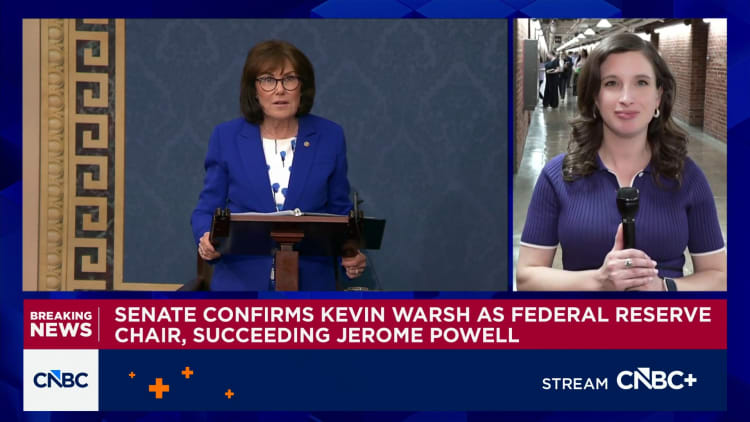

Kevin Warsh was confirmed Wednesday as the next Federal Reserve chair, taking over the central bank at a time when President Donald Trump is pushing for lower interest rates even as fresh inflation data complicates the case for cuts.
In the most divisive vote ever for a Fed chair, Warsh, 56, won confirmation to take over for Jerome Powell, who has served in the top leadership position since 2018 and whose term will expire Friday.
The Senate voted 54-45 to confirm Warsh, ending a monthslong saga that began in the summer of 2025 and included an extensive search for Powell’s successor. The vote was almost completely along party lines, with only Pennsylvania Democrat Sen. John Fetterman crossing over to vote for Warsh, who becomes the 11th Fed chair of the modern banking era.
Powell will stay on at the Fed as he has two years left in his term as governor. He said last month that he will remain at least until an investigation renovation at the Fed’s headquarters is complete. No other Fed chair has returned to the board in nearly 80 years.
Trump has made no secret that he expects Warsh to lower rates after having lashed out repeatedly at Powell for monetary policy the president has felt was too restrictive. Warsh was part of a derby that included nearly a dozen candidates at one point, including current Governors Christopher Waller and Michelle Bowman.
The confirmation comes, however, following separate reports this week showing inflation well above the Fed’s 2% target and pipeline pressures accelerating at their highest levels in more than three years. Markets have been scaling back expectations for rate cuts are even pricing in a chance of an increase later this year.
Rep. French Hill, R-Ark., praised the Fed’s decision and Warsh’s inflation-fighting credentials.
“Chairman Warsh has repeatedly emphasized the importance of placing affordability and price stability at the center of our economic agenda,” Hill said in a statement. “His commitment to disciplined monetary policy will help restore confidence in our economy and support long-term prosperity.”
Warsh could not be reached for comment.
This will be Warsh’s second stint at the Fed.
During his first run, he served from 2006-11, a time during which Fed officials initially dismissed dangers from the subprime mortgage meltdown that led to the global financial crisis, then implemented a historic set of policies aimed at rescuing the economy. Part of those rescue endeavors included an unprecedented expansion of asset purchases that sent the Fed’s balance sheet past $4 trillion, a program known as quantitative easing that Warsh argued then had gone too far.
Since leaving the Fed, Warsh has been a consistent critic of monetary policy and last year, in a CNBC interview, called for “regime change” at the central bank. During the period, he’s been a lecturer at the Stanford School of Business and has served on various boards of directors.
Warsh takes the place of Stephen Miran on the Fed board, who was appointed to governor in September 2025 to fill the few months left on the unexpired term of Adriana Kugler, who resigned unexpectedly in August.
Miran has dissented from each of the Federal Open Market Committee’s votes since taking the seat. When the committee voted to cut by a quarter percentage point at each of last three meetings in 2025, Miran voiced support for a larger half-point cut. This year, he’s opposed votes to keep the federal funds rate steady, arguing for quarter-point reductions.
Warsh’s first meeting as chair of the FOMC is scheduled for June 16-17.
He also will be the wealthiest Fed chair ever, with holdings well north of $100 million. As Fed chair, he’ll have to divest himself many of his investments under a strict new policy implemented since disclosures of questionable trading practices among top officials.
—Rep. French Hill is from Arkansas. An earlier version misstated the state.
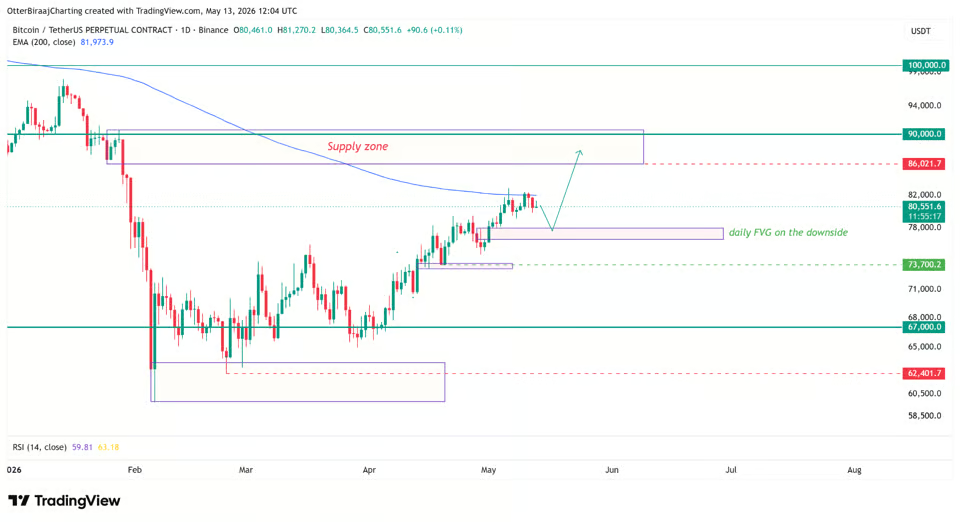
Bitcoin (BTC) traders expected a quick move toward $90,000 after the upcoming CLARITY Act vote on Thursday, as improving market conditions and easing short-term sell pressure support an upside move.
Bitcoin market signals potential breakout above $80,000
Bitcoin has traded around the $80,000 level over the past week, while the 200-day exponential moving average (EMA) remains key overhead resistance. More than $3 billion in leveraged long positions are clustered between $79,000 and $78,000, suggesting BTC could briefly retest that range before attempting another breakout above the 200-day EMA.

BTC/USDT, one-day chart. Source: Cointelegraph/TradingView
MN Capital founder Michaël van de Poppe remained bullish and said,
“If this continues to grind upwards, with the upcoming CLARITY Act tomorrow, I would assume we might see a fast move to $90K in a matter of days for Bitcoin.”
Onchain data also points to improving market conditions. Bitcoin researcher Axel Adler Jr. said short-term holder loss pressure has remained at zero percent for five straight days. This metric measures whether recent Bitcoin buyers are holding BTC below their purchase price.
Adler Jr. also noted that the share of Bitcoin supply held by short-term traders dropped to 22.2%, its lowest level in 90 days. This suggests that less recently bought BTC is being sold, which could boost the chances of a breakout.

Bitcoin STH loss pressure (%). Source: Axel Adler Jr.
However, crypto trader Zord warns that Bitcoin could face resistance between $83,400 and $84,600 after reclaiming the 50% Fibonacci retracement level near $78,983.
According to the chart, the $83,400–$84,600 range is the next Fibonacci resistance zone of 0.618-0.65, where traders may begin taking profits and slow Bitcoin’s rebound.

BTC/USD one-day chart analysis by Zord. Source: X
Related: Bitcoin to $100K in Q2? Strategy’s STRC unlocks potential to buy 3K BTC in two days
CLARITY ACT vote draws market attention
The CLARITY Act is a proposed US bill that would set clearer rules for how regulators oversee the crypto market and stablecoins.
As Cointelegraph reported, members of the US Senate Banking Committee submitted more than 100 amendments to the bill ahead of Thursday’s discussion. Most of the proposed changes focus on stablecoins, crypto developers, and ethics-related concerns.
A version of the bill leaked on Monday suggests that crypto exchanges and other platforms may no longer be allowed to offer stablecoin rewards that work like interest from a traditional savings account.
Crypto research firm XWIN Japan said the proposal appears aimed at separating stablecoins used for payments from products that behave more like bank deposits.

Stablecoin ERC20 active addresses. Source: CryptoQuant
Meanwhile, stablecoin activity and adoption have continued to rise across crypto networks. For example, ERC-20 stablecoin active addresses have been seeing parabolic growth in recent years.
XWIN Japan added that stablecoins remain the main source of money moving through crypto markets, and wider adoption of stablecoins and blockchain-based financial products could support more long-term investment in Bitcoin.


Strategy’s perpetual preferred stock STRC may be playing an increasingly important role in shaping Bitcoin’s mid-month liquidity dynamics, according to K33 Research director Vetle Lunde
Summary
- K33 Research suggests Strategy’s STRC preferred stock structure may be contributing to recurring mid-month Bitcoin buying pressure.
- Strategy’s BTC holdings have reached 818,869 BTC, valued at roughly $6.57 billion, according to the report cited by The Block.
- Recent data shows STRC-driven Bitcoin accumulation surged to ~46,872 BTC in April but may now be slowing as demand plateaus.
According to reports, STRC’s structure creates predictable capital flow behavior, with dividends paid at the end of each month and an ex-dividend date around the 15th. This timing, combined with Strategy’s at-the-market (ATM) issuance mechanism, may indirectly generate recurring Bitcoin buying pressure during mid-month periods.
When STRC trades above its $100 par value, Strategy can issue additional shares through ATM offerings and deploy the proceeds into Bitcoin purchases. This creates a feedback loop where STRC demand can translate into BTC accumulation.
Structured equity flows increasingly tied to Bitcoin demand cycles
According to the data cited, Strategy’s STRC-linked Bitcoin purchases have grown significantly in scale throughout 2026, rising from 4,467 BTC in January to approximately 46,872 BTC in April.
Over the same period, Strategy’s total Bitcoin holdings have climbed to 818,869 BTC, worth about $6.57 billion at current valuations referenced in the report.
The implication is that Bitcoin demand is no longer purely spot- or ETF-driven, but also partially influenced by structured equity products that convert investor demand in traditional markets into direct BTC purchases.
This creates a hybrid liquidity channel where traditional financial instruments indirectly influence crypto market flows through corporate treasury accumulation strategies.
However, K33 also noted that STRC momentum may be cooling. The speed at which the instrument has returned to par value this month has slowed, with only about 1 BTC added through the mechanism recently, suggesting weakening demand and a possible plateau in this specific flow-driven buying pressure.
Bitcoin liquidity increasingly shaped by institutional mechanisms
The STRC dynamic highlights how Bitcoin’s market structure has evolved beyond retail speculation and spot ETF flows into more complex institutional feedback systems.
Corporate accumulation strategies, particularly those pioneered by Strategy, now act as periodic demand engines that can reinforce price stability during specific calendar windows. This introduces a level of predictability into BTC flows that previously did not exist in earlier market cycles.
At the same time, broader macro conditions continue to influence whether these flows translate into sustained upside. Inflation expectations, liquidity conditions and risk sentiment across equities remain key drivers of whether institutional BTC accumulation is amplified or offset.
In a previous crypto.news story, large-scale deleveraging events showed how quickly macro shocks can disrupt structured crypto flows, even when underlying accumulation mechanisms remain active.
Mentions of Bitcoin continue to reflect a growing intersection between traditional capital markets and digital asset supply dynamics, where instruments like STRC, ETFs and corporate balance sheet strategies increasingly shape intramonth volatility patterns.
If STRC-driven demand continues to slow as K33 suggests, Bitcoin may become more sensitive again to spot-driven liquidity and macro catalysts rather than structured institutional purchase cycles — potentially reducing the predictability of mid-month strength observed earlier this year.


Consensys, the Ethereum development firm led by Joe Lubin, has pushed back its potential U.S. public offering until fall at the earliest due to poor market conditions, according to two people familiar with the situation.
The MetaMask wallet builder had reportedly engaged bankers from JPMorgan and Goldman Sachs last year to lead the process.
Consensys had been aiming to file a draft S-1 registration statement with the Securities and Exchange Commission (SEC) around the end of February this year, according to a third person. A confidential filing is typically the first formal step in the IPO process.
Crypto markets turned sharply lower in February 2026 as investors pulled back from risk assets amid macroeconomic uncertainty, tariff concerns, slowing expectations for interest-rate cuts and heavy outflows from bitcoin exchange-traded funds (ETFs), triggering a wave of leveraged liquidations across digital assets. Against that backdrop, Consensys’ decision to delay its IPO plans was hardly surprising.
A spokeswoman for Consensys said: “As a matter of policy, we don’t comment on market speculation.”
Improved regulatory clarity in the U.S. prompted several crypto firms to outline plans for going public this year. But a prolonged market downturn has seen large companies such as exchange giant Kraken and crypto wallet maker Ledger pause their IPO plans.
BitGo (BTGO), the only crypto-native company to go public in 2026, raised about $213 million in its January IPO, pricing shares above the marketed range at $18 and jumping more than 20% in its New York Stock Exchange (NYSE) debut.
But the rally quickly faded, highlighting volatile investor sentiment toward crypto listings, with the stock now trading about 36% below its IPO price.
In early 2022, Consensys raised a hefty $450 million Series D round, valuing the company at $7 billion.
Read more: Crypto wallet provider Ledger puts U.S. IPO plans on hold due to market conditions

Fidelity International is expanding the tokenization frontier in public markets with the launch of the Fidelity USD Digital Liquidity Fund (FILQ). The fund, described as a tokenized liquidity vehicle, has been rated AAA-mf by Moody’s Ratings—a designation that signals high credit quality and robust liquidity for money-market-like assets. FILQ is issued on blockchain infrastructure connected to Chainlink and rolled out via Sygnum Bank’s tokenization platform, illustrating how traditional cash-equivalent instruments can move on-chain within a regulated framework.
According to Sygnum, the fund’s AAA-mf rating from Moody’s Ratings marks an important milestone for the on-chain money-market space. The rating distinguishes FILQ as a highly liquid, credit-worthy option suitable for institutional investors seeking yield-bearing liquidity while maintaining risk controls associated with regulated money-market products. Fatmire Bekiri, Sygnum’s head of tokenization, described the development as a meaningful step in bringing regulated, high-quality liquidity onto the blockchain.)
Fidelity International did not immediately respond to requests for comment at publication, while Fidelity Investments and Fidelity International operate as separate entities in different jurisdictions. The move sits within a broader push by large asset managers to tokenize cash and near-cash products, offering traditional yields with on-chain settlement and visibility.
Chainlink expands role in tokenized real-world assets
FILQ’s architecture relies on Chainlink’s data network to deliver on-chain net asset value (NAV) and distribution metrics. By providing verifiable, real-time NAV and payout data on-chain, the fund aims to give international investors a transparent, auditable view of value and income—addressing one of the core challenges in tokenized real-world assets: ensuring data integrity and timely information for fund investors. Fernando Vazquez, president of capital markets at Chainlink Labs, framed the approach as a crucial bridge between traditional finance and the on-chain economy, emphasizing tamper-proof transparency as a foundation for digital liquidity products.
In addition to Chainlink’s data feeds, JPMorgan is slated to contribute approved daily NAV data for FILQ, reinforcing the model of established market players supplying regulated inputs to a tokenized funds structure. The collaboration between Fidelity International, Sygnum, and Chainlink builds on prior production use cases that align NAV and distribution data with on-chain fund representations, including earlier deployments involving Fidelity International and Sygnum for NAV data integration in 2024.
Chainlink’s involvement underscores a broader industry trend: real-world assets are increasingly being connected to blockchains through standardized data feeds and governance models that aim to preserve regulatory compliance while enabling on-chain liquidity and settlement. This approach addresses one of the most persistent barriers to mainstream adoption of tokenized funds: ensuring data verifiability, accuracy, and timeliness in a decentralized environment.
Tokenized funds: a broader industry shift
The FILQ launch adds momentum to a wave of tokenized money-market and liquidity products emerging from major asset managers. In recent years, venerable players such as BlackRock and Franklin Templeton have introduced tokenized money-market offerings aimed at converting cash-like assets into on-chain formats that still route through traditional risk controls and counterparties. The trend is driven by the desire to provide stable yields with greater liquidity, while leveraging blockchain rails for settlement efficiency and transparency.
Industry watchers note that the growing interest in tokenized liquidity comes with a set of practical considerations. For one, real-time NAV data and transparent payout scheduling can improve governance and investor confidence, but participants must navigate custodial arrangements, regulated disclosure requirements, and the interplay between on-chain activity and existing financial-market infrastructure. The involvement of Moody’s Ratings, Chainlink, and JPMorgan signals a collective effort to embed credible, regulated data streams into tokenized funds, rather than relying on unvetted on-chain information alone.
Within Fidelity’s broader ecosystem, the firm has previously explored tokenized money-market constructs, including Fidelity Digital Interest Token (FDIT) and related initiatives anchored by traditional cash-management strategies. The on-chain fund model seeks to keep reserves aligned with fiat currency exposure while offering near real-time visibility to investors and managers. As the market tests these approaches, observers will be watching how regulators respond to tokenized money-market products, particularly with respect to liquidity buffers, reserve backing, and disclosure standards.
What this means for investors and the on-chain promise
For investors, FILQ represents a concrete instance of how regulated, high-quality liquidity can be tokenized without sacrificing the governance and credit safeguards associated with traditional money-market funds. The AAA-mf rating provides a signal of credit quality and liquidity that may appeal to institutions exploring on-chain cash equivalents as part of liquidity management, treasury operations, or cross-border funding programs.
For builders and developers in the on-chain finance space, the FILQ case highlights two enduring requirements: robust data integrity and interoperable market infrastructure. On-chain NAV data, verified by established market participants, helps reduce information asymmetry between on-chain and off-chain counterparts. At the same time, the collaboration among Fidelity International, Sygnum, Chainlink, and JPMorgan demonstrates a practical model for multi-party governance around tokenized assets—one that leverages regulated involvement to raise on-chain legitimacy and scalability.
Still, the emergence of tokenized liquidity products also invites scrutiny of regulatory boundaries and operational risk. While the involvement of Moody’s, a trusted rating agency, and JPMorgan’s data inputs provides guardrails, the on-chain settlement of money-market instruments must align with applicable securities, banking, and cross-border rules. Market participants will likely watch how supervisory approaches evolve as more large asset managers bring tokenized liquidity funds to market, and how custody, settlement, and disclosure standards adapt to a hybrid asset class that sits between traditional finance and blockchain networks.
Closing perspective
FILQ marks a notable inflection point in the ongoing experiment of tokenized liquidity. As more traditional managers pilot on-chain cash products with formal ratings, standardized data feeds, and reputable custodial partners, the industry gains a clearer template for combining regulatory discipline with the efficiency and transparency of blockchain rails. The coming months will reveal how scalable this model proves to be, how regulators respond to broader adoption, and which other fund families may follow suit into tokenized money-market instruments.
Watch for further details on how FILQ performs relative to its on-chain NAV feeds, and for additional updates on how JPMorgan’s daily NAV inputs integrate with the fund’s distribution schedule. The collaboration among Fidelity International, Sygnum, Chainlink, and JPMorgan may well set a precedent for next-generation tokenized liquidity offerings across the sector.

TLDR
- Grayscale filed a Form S-3 with the SEC to convert its Zcash Trust into a spot ETF.
- The proposed Zcash ETF would trade on NYSE Arca under the ticker ZCSH.
- The fund plans to hold actual ZEC tokens and track the CoinDesk Zcash Price Index.
- Grayscale appointed Coinbase Custody as custodian and prime broker for the proposed ETF.
- Bank of New York Mellon would serve as the administrator for the fund.
Grayscale Investments has filed a Form S-3 with the US Securities and Exchange Commission to convert its Zcash Trust into a spot exchange-traded fund. The proposed product would list on NYSE Arca under the ticker ZCSH. The filing positions the fund as the first US spot ETF tied to a privacy-focused cryptocurrency.
Grayscale Advances Plan for Zcash ETF Conversion
Grayscale seeks to transform its closed-end Zcash Trust into an open-ended ETF structure. The existing trust manages more than $200 million in assets. The firm stated that the ETF would hold actual ZEC tokens.
The proposed Zcash ETF would track the CoinDesk Zcash Price Index. Therefore, the fund would reflect the market price of ZEC. Investors would gain regulated exposure without managing wallets or private keys.
Grayscale appointed Coinbase Custody as custodian and prime broker for the fund. The Bank of New York Mellon would act as administrator. These arrangements outline the operational framework described in the filing.
Closed-end trusts often trade at discounts or premiums to net asset value. However, an ETF allows authorized participants to create and redeem shares. This mechanism keeps the share price aligned with the underlying asset.
Regulatory Context and Market Response to Zcash ETF Proposal
The SEC recently ended a review related to privacy coins. The agency did not announce enforcement actions or issue public warnings. This development forms part of the backdrop to the filing.
Zcash differs from other privacy coins in its design. It allows both transparent and shielded transactions. In contrast, some privacy coins enforce privacy for every transfer.
Zcash uses zk-SNARKs technology to validate transactions. The term stands for zero-knowledge succinct non-interactive arguments of knowledge. This method proves validity without revealing the sender, receiver, or transaction amount.
Following the filing, ZEC traded above $550. Market data showed Bitcoin trading above $80,800 during the same period. Traders linked broader crypto strength to price momentum in altcoins.
The filing states that the SEC may approve or reject the proposal. It also outlines that regulators could impose conditions on the product. The review process will determine whether the Zcash ETF can proceed to listing on NYSE Arca.



- Ethena’s native token, ENA, saw its price decline as Bitcoin slid below $79,000
- The slight dip happened despite ENA notching a 5-week high in whale activity.
- Prices could fall further, but a rebound for BTC could boost ENA.
Ethena (ENA) price faced downward pressure today, dropping nearly 4% to intraday lows of $0.11 as Bitcoin grappled with renewed selling amid macroeconomic headwinds.
This decline unfolded even as on-chain metrics signaled robust interest from large holders.
Analysts say the move highlights a disconnect between whale behavior and short-term price action.
Ethena hits 5-week high in whale activity
On-chain data shows Ethena’s ecosystem has managed notable momentum.
For one, the network just hit its largest daily network growth in over three months.
The platform did not just see a surge in new wallet creations, but had ENA whale activity surging to a five-week peak, with this aligning with heightened interest bolstered by several bullish catalysts.
📈 Ethena has just seen its largest day of network growth (new wallets created) in over 3 months. Additionally, $ENA whale activity has just hit a 5-week high. Why? There has been a series of high-impact events that converged in the days leading up to May 12th:
🎯 Grayscale… pic.twitter.com/ZMZf0BZgkN
— Santiment Intelligence (@SantimentData) May 13, 2026
According to Santiment, one of the key drivers was Grayscale’s decision on May 7 to incorporate ENA into its DeFi Fund.
Ethena also recently saw a massive $310 million USDC transfer, a transaction that injected fresh liquidity and drew widespread attention.
Santiment has also highlighted that the spotlight on ENA increased further when LayerZero announced a temporary bridge suspension on May 9, keeping Ethena at the forefront of DeFi discussions.
Adding to the optimism, the Ethena Foundation recently affirmed that all conditions outlined by its Risk Committee for activating the “fee switch” have been satisfied.
This mechanism, designed to distribute protocol fees to stakers, awaits a governance vote from ENA holders in the coming days.
The whale positioning ahead of the pivotal vote helped ENA price pump to highs of $0.14 on May 10.
Why’s ENA price down?
Despite the positive catalysts, ENA’s price succumbed to broader market dynamics.
Both RSI and MACD on the 4-hour chart suggest prices could fall further.

On May 13, crypto sentiment soured following the release of U.S. Producer Price Index (PPI) data.
This came in hotter-than-expected and exacerbated fears of persistent inflation and delayed rate cuts.
US stocks slid, and Bitcoin, the crypto sector’s bellwether, tumbled below $79,000 during intraday trading.
Declines meant bulls retreated to levels seen following Tuesday’s Consumer Price Index (CPI) report.
BTC prices had earlier bounced to above $81,000.
This macro-driven risk-off mood rippled across altcoins, with Ethereum down near $2,250, Solana slipping to $90, and XRP capped under $1.50.
Many DeFi tokens mirrored the weakness, including ENA, which traded from intraday highs of $0.12.
The profit-taking could extend losses to support at $0.10.
While the dip impacts ENA’s short-term outlook, network fundamentals and overall market outlook could position the token for potential recovery.
Bitcoin edges higher as altcoins rally and 21Shares debuts Canton Network ETF
Bitcoin briefly traded above $82,800 last week before a modest pullback, while a number of alternative tokens posted outsized gains as investors sought broader exposure to the crypto market. The price action coincided with the Nasdaq listing of the TCAN 21Shares Canton Network ETF, the first US-listed fund to track Canton Coin, the native token of the Canton Network.
The market moves were highlighted in commentary dated 11 May 2026 from eToro’s crypto analyst Simon Peters, who noted resilience in bitcoin amid macro uncertainty and renewed momentum across altcoins as investors diversify within digital assets.
Market snapshot and altcoin leadership
Bitcoin’s short-lived advance above $82,800 reflects continued interest at higher price levels, but the weekend pullback underlines persistent volatility. Measured by market share, bitcoin dominance dipped about 1 percentage point to 60.60 percent, indicating the recent leadership came from alternative coins rather than bitcoin itself.
Among the most notable moves, TON jumped roughly 67 percent following remarks from Telegram founder Pavel Durov that Telegram would assume development responsibilities for the TON blockchain and roll out a new roadmap. Jupiter (JUP) and Internet Computer (ICP) each rose more than 40 percent over the week, while Solana showed renewed strength as well. Such concentrated rallies are typical in risk-on stretches and can weigh on bitcoin’s share of total market capitalization as traders rotate into higher-beta tokens.
Macro and regulatory catalysts to watch
Traders are entering a week with potentially market-moving US macro data, including the Consumer Price Index and Producer Price Index releases. These inflation prints could influence expectations for Federal Reserve policy and, by extension, risk appetite for crypto assets. Elevated inflation or surprising readings could increase volatility across both bitcoin and altcoins.
At the same time, the crypto sector remains focused on US regulatory developments, particularly the proposed CLARITY Act and the possibility of a Senate Banking Committee markup. Any substantive legislative or regulatory action could reshape market access and the institutional case for digital assets, affecting both spot prices and demand for regulated investment products such as ETFs.
What the TCAN ETF signifies for institutional demand
21Shares’ TCAN ETF offers US-listed investors direct exposure to Canton Coin and represents a shift in ETF product strategy away from bitcoin-only offerings toward blockchain infrastructure plays. Canton markets itself as a privacy-enabled network geared to regulated financial institutions, enabling compliant data sharing and private transactions between counterparties.
From an institutional perspective, ETFs tied to infrastructure-layer tokens can serve several functions: they provide a familiar wrapper for access, create clearer channels for capital allocation, and enable portfolio managers to express views on blockchain utility rather than store-of-value narratives. For issuers and investors, the presence of a regulated ETF can also reduce some operational and custody frictions associated with direct token holdings, though important considerations remain.
Operational, compliance and market-structure considerations
While an ETF listing expands distribution, it does not eliminate underlying risks. Institutional adoption depends on custody solutions, compliance with anti-money-laundering and know-your-customer rules, liquidity of the underlying token, and how exchanges and market makers handle the asset. Canton’s focus on institutional-grade privacy and compliance could make it more attractive to certain regulated investors, but the token will still be subject to market liquidity and on-chain risks.
Regulators will also scrutinize whether utility tokens tied to specific networks meet securities law standards in various jurisdictions. The regulatory backdrop in the US remains a top-line concern for asset managers and allocators contemplating crypto exposure, and potential legislative action tied to the CLARITY Act could alter how products are structured or approved going forward.
Implications for investors and market participants
For portfolio managers and institutional allocators, the key takeaway is that product innovation is broadening the investment toolkit beyond bitcoin. That creates opportunities to express differentiated views on blockchain infrastructure and application-layer development. However, buyers and allocators should assess ETFs and token exposures with the same discipline applied to other niche or thematic allocations, including due diligence on token economics, custody arrangements, and the regulatory roadmap.
For traders, the current environment underscores the influence of macro prints and regulatory headlines on short-term price dynamics. The CPI and PPI releases, together with any Senate action on crypto legislation, could act as short-term catalysts, shifting flows between bitcoin, altcoins and newly listed infrastructure ETFs.
Conclusion
Last week’s price action and product launches signal that institutional appetite for crypto is evolving beyond bitcoin, with ETFs now targeting blockchain networks and infrastructure tokens. That trend could widen investor participation but will also bring increased scrutiny from regulators and market operators. In the near term, macro data and legislative developments are likely to remain the main drivers of volatility across crypto markets.


In a significant shift in bitcoin’s market structure the amount of supply held by “conviction buyers” has surged to nearly 4 million BTC, according to BitGo data cited by Bitfinex on Wednesday.
Bitcoin in long-term buyers’ hands currently represents a 300% increase since the end of 2025, signaling a massive migration of the crypto’s realized value into large, low-activity entities, according to Bitfinex.
The massive “conviction” capital is valued at just over $320 billion, based on bitcoin’s current price of roughly $80,000.
“While the exact methodology behind BitGo’s ‘conviction buyers’ metric isn’t immediately clear, the broader signal is notable,” said Mati Greenspan, a market analyst and founder of Quantum Economics. “Historically, periods of tightening liquid supply combined with renewed demand have created the conditions for bitcoin’s most aggressive upside expansions.”
The current accumulation trend marks the largest two-quarter surge in high-conviction buying since the 2020 COVID-19 crash, Bitfinex said. Conviction buyers are long-term investors, whether they be individuals or institutional.
Long-term buyers holdings are not part of the estimated 5.6 million BTC that has been inactive for over a decade, according to Jameson Lopp, a core bitcoin developer. The total amount of bitcoin in circulation is 20.03 million currently, according to CoinDesk data.
Bitfinex analysts noted that a growing share of bitcoin’s realized value is no longer circulating on crypto exchanges, but is instead moving into the hands of entities that rarely transact, regardless of price volatility.
This structural shift suggests that long-term holders, ranging from institutional “whales” to corporate treasures, are aggressively absorbing the available bitcoin supply, most notably Strategy (MSTR), the largest publicly traded corporate holder of bitcoin. This company, which is currently sitting on $4.6 billion in unrealized gains, recently increased its total holdings to 818,869 BTC, which it acquired for nearly $62 billion. When supply moves into these low-activity entities, it effectively reduces the liquid supply available on the open market, creating a potential “supply shock” dynamic.
Supporting this narrative of strengthening the market floor, CEX.IO research . Their analysis reveals that nearly 70% of recent buyers’ supply is now in profit, a metric that often serves as a psychological buffer against sell-offs, according to CEX.IO research.
CEX.IO also suggests that as most new bitcoin investors move into the “green,” their urgency to exit positions during minor pullbacks decreases, which helps stabilize the price of BTC.
“People who actually get bitcoin always want to accumulate as much as possible and never want to sell, particularly now with all the new existing ways to borrow against BTC holdings,” Ran Hammer, vice president of Business Development at Orbs, told CoinDesk. “That changes the supply equation entirely, with more BTC structurally removed from the market.”
In a separate email comment to CoinDesk, Connor Howe, CEO and co-founder at Enso, said he believes BTC’s long-term scarcity narrative is maturing from theory into market structure.
“With ETF flows and institutional accumulation becoming more structural than speculative, a larger share of supply is moving into conviction hands,” he said, adding that “this could make future scarcity far more visible when demand accelerates.”
Societe Generale said its digital assets subsidiary Societe Generale-FORGE will deploy EUR and USD CoinVertible stablecoins on the Canton Network and support tokenized collateral and repo financing activity on the network.
The Paris-based bank said it plans to use the network for collateral management and short-term financing transactions tied to tokenized assets. It added that Canton’s infrastructure could be used for collateral mobility, margin management and risk management workflows tied to tokenized assets.
SG-FORGE said its EURCV and USDCV stablecoins will be used for settlement, financing and cash management activity on the network in permitted jurisdictions. The stablecoins are restricted to non-US permitted participants and are not registered under the US Securities Act, according to the announcement.
Societe Generale will also participate in the network as a strategic partner and validator. The bank previously issued a tokenized green bond on the Canton Network in November 2025 through SG-FORGE.
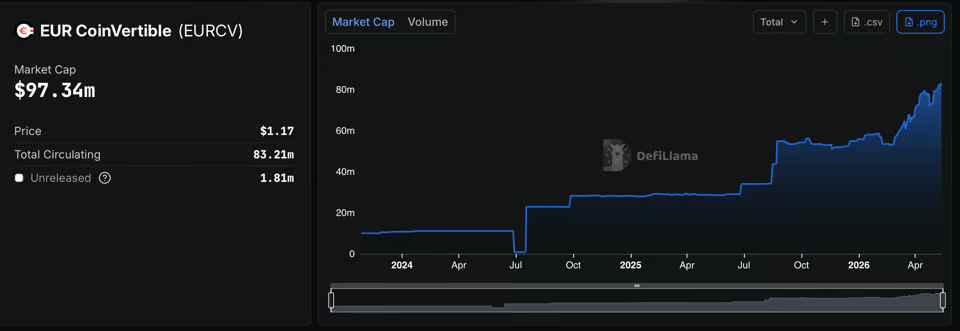
SG-FORGE launched its euro-denominated EURCV stablecoin in 2023 and introduced the US dollar-denominated USDCV stablecoin in 2025. Data from DeFiLlama shows EURCV has a market capitalization of about $97 million, while USDCV has roughly $20 million in circulation.
Last month, the bank integrated USDCV into the MetaMask wallet through a partnership with Consensys.

Source: DefiLlama
Related: Stablecoins won’t strengthen global role of euro, ECB’s Lagarde says
Financial institutions expand tokenized collateral infrastructure
The announcement comes as banks and financial institutions are expanding their use of blockchain-based systems for collateral management, repo financing and stablecoin settlement.
This week, JPMorgan filed to launch a tokenized money market fund on Ethereum through its Kinexys Digital Assets unit. The fund will invest in Treasury bills and overnight repurchase agreements collateralized by Treasurys or cash.
On Tuesday, The Depository Trust & Clearing Corporation said it will integrate infrastructure from Chainlink into its collateral management platform ahead of a planned 2026 launch to support tokenized collateral movement, valuation and settlement workflows. DTCC’s subsidiaries processed $4.7 quadrillion in securities transactions in 2025.
Separately, Broadridge Financial Solutions yesterday announced it expanded its infrastructure to support tokenized stocks, funds and money market instruments across trading and post-trade operations. The company said its distributed ledger repo platform tokenizes more than $365 billion in assets daily.
RWA.xyz data shows more than $31.6 billion worth of real-world assets, excluding stablecoins, are currently tokenized on blockchain networks. Tokenized US Treasury products account for the largest share of the market at more than $15.3 billion, followed by commodities at about $5.1 billion.

Snapshot of tokenized real-world assets. Source: RWA.xyz
Magazine: eToro founder timed Bitcoin top perfectly due to belief in 4 year cycles

Kalau Bukan untuk Kebutuhan Primer, Sebaiknya Jangan Pay Later #podcastruangtunggu #financial

Netanyahu secretly visited UAE during war with Iran

VNET Stock Explodes 30% on Major Strategic Investor Deal Fueling AI Data Center Expansion

Manchester United reach agreement with Casemiro over contract clause amid transfer speculation

US brings back mandatory military draft registration

Steven Gerrard disagrees with Gary Neville over ‘shock’ Chelsea and Arsenal claim | Football
Kalau Bukan untuk Kebutuhan Primer, Sebaiknya Jangan Pay Later #podcastruangtunggu #financial

Mat Armstrong Exposes Truth on Bugatti Controversy & Restoring WRECKED Supercars

How To Start Trading Crypto As A Beginner In 2026
-
 Crypto World5 days ago
HarrisX Poll Found 52% of Registered Voters Support the CLARITY Act
-

 Fashion5 days ago
Weekend Open Thread: Marianne Dress
-

 Crypto World6 days ago
Upbit adds B3 Korean won pair as Base token gains Korea access
-
 NewsBeat7 days ago
NCP car park operator enters administration putting 340 UK sites at risk of closure
-

 Fashion2 days ago
Coffee Break: Travel Steam Iron
-

 Fashion3 days ago
What to Know Before Buying a Curling Wand or Curling Iron
-

 Tech4 days ago
Auto Enthusiast Carves Functional Two-Stroke Engine from Solid Metal
-

 Politics2 days ago
What to expect when you’re expecting a budget
-
 Business4 days ago
Ignore market noise, India’s long-term story intact, say D-Street bulls Ramesh Damani and Sunil Singhania
-

 Politics5 days ago
Politics Home Article | Starmer Enters The Danger Zone
-

 Tech3 days ago
GM Agrees To Pay $12.75 Million To Settle California Lawsuit Over Misuse Of Customers’ Driving Data
-

 Politics6 days ago
Simon Cowell Says He Was ‘Horrible’ To Susan Boyle During BGT Audition
-

 Entertainment7 days ago
Sarah Paulson Called Out For Met Gala ‘Hypocrisy’
-

 Entertainment6 days ago
General Hospital: Ric & Ava Bombshell – Ric’s Massive Secret Exposed!
-

 Crypto World7 days ago
Robinhood says Wall Street is building onchain
-

 Sports7 days ago
UEFA Champions League final schedule, teams, venue, live time and streaming | Football News
-

 Entertainment6 days ago
Why David Letterman Called CBS ‘Lying Weasels’
-

 Fashion7 days ago
The Best Work Pants for Women in 2026
-
 Sports7 days ago
Mike Tyson speaks out on status of Floyd Mayweather fight
-
Entertainment6 days ago
Hayden Panettiere reveals she's estranged from mom, addresses brother Jansen's sudden death: 'I was floored'
You must be logged in to post a comment Login