

Crypto World
Revolut to Delist USDT in Europe as Tether Skipped MiCA License

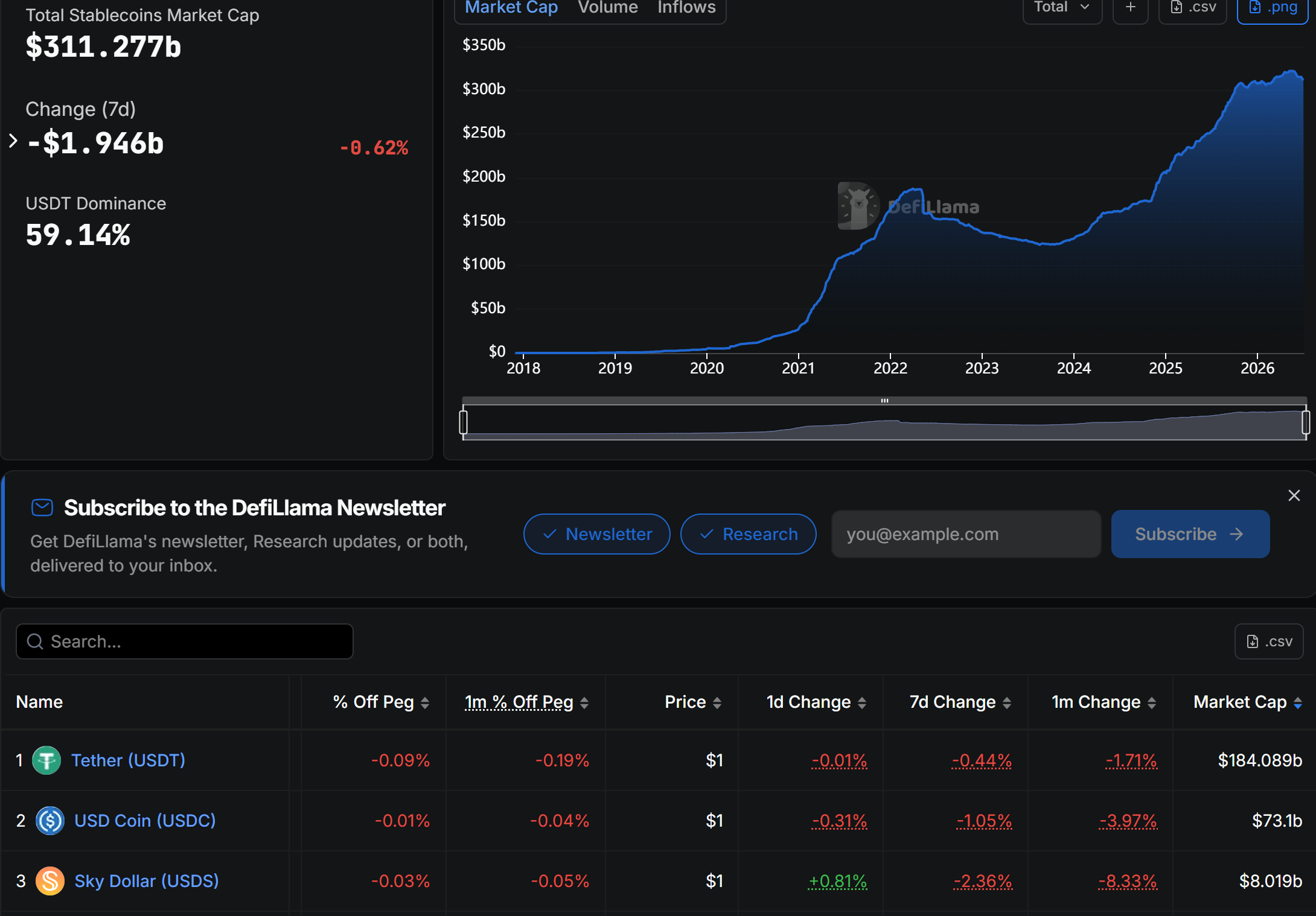
Revolut will delist Tether (USDT) for European Union users on August 31. The USDT delisting stems from Tether’s decision not to seek authorization under the EU’s Markets in Crypto-Assets (MiCA) regulation.
Customers can buy USDT until July 6. A staged wind-down then runs through late August, when leftover balances convert to fiat.
Revolut USDT Delisting Runs on a Staged Timeline
Revolut confirmed the change in a July 3 post on X, pointing users to a DefiLlama dashboard of licensed options. The fintech built a $75 billion valuation serving more than 75 million customers.
Follow us on X to get the latest news as it happens
New USDT deposits stop on July 30. Customers can sell or withdraw the token to external wallets until August 31. After that date, remaining balances convert automatically to fiat at prevailing exchange rates.
MiCA moved into full enforcement on July 1, and regulators have expanded the register of licensed providers to 280 firms. Tether stayed out, echoing its absence from earlier approval rounds under the framework.
The rules require significant stablecoin issuers to hold at least 60% of reserves as bank deposits. CEO Paolo Ardoino has argued that structure creates liquidity risks. Tether already retired its euro stablecoin, EURT, in November 2024 rather than adapting it.
Audit Questions Cloud Tether’s Regulatory Standing
For Tether, missing the EU’s licensed lists is unsurprising given its long-running audit controversy. Consumers’ Research recently criticized Tether’s audit record, faulting the issuer for failing to provide an independent review of its reserves.
The group raised the concern in a letter to US governors.
“Tether’s continual failure to undergo an independent audit raises a distressing red flag for the company and its USDT product. Tether has promised that it would conduct a full audit since at least 2017 but has still failed to do so. … Years later, there is still no audit.”
Tether has long relied on quarterly attestations instead of full audits. In an April 2025 interview, Ardoino said the firm was still seeking a top-tier audit partner. He argued that major accounting firms remain cautious about stablecoin clients after crypto’s exchange failures and hacks.
The audit gap could remain a key barrier to any future MiCA authorization.
USDC Extends Its Lead in Europe
The move strengthens Circle’s USDC, which holds MiCA authorization and keeps its listings on licensed venues. Circle has emerged as MiCA’s quiet winner while USDT exits regulated European platforms.
Despite the retreat, USDT remains the largest stablecoin worldwide and the third-largest crypto asset. It trades near $1.00 with a $184 billion market cap and $41 billion in daily volume as of July 4.

USDC’s market cap stands near $73 billion, less than half of USDT’s. The gap suggests that Tether is trading regulated European access for scale elsewhere.
Early Revolut investor Max Karpis said the delisting reverses the fintech’s recent expansion of its stablecoin features.
“Revolut is delisting USDT on 31 Aug 2026 (regulatory/risk reasons). Not long ago, they expanded support to include zero-fee transfers and 1:1 USDT/USDC swaps. Now a reversal. Compliance hits again.”
The coming weeks will show whether Revolut users rotate into USDC or move USDT to self-custody before the cutoff.
The post Revolut to Delist USDT in Europe as Tether Skipped MiCA License appeared first on BeInCrypto.

France will stop certifying security products that lack quantum-resistant encryption from 2027. The decision hands fresh urgency to Algorand’s (ALGO) pledge to deliver broad quantum security across its blockchain by the end of that same year.
The French cybersecurity agency ANSSI announced the cutoff at the France Quantum conference in Paris. Meanwhile, Washington is accelerating post-quantum cryptography across federal and national security systems.
Quantum Security Becomes a Procurement Requirement
Samih Souissi, ANSSI’s chief of staff, said the agency will certify only quantum-resistant security products from 2027, Reuters reported on June 16.
He added that businesses should buy only quantum-safe products by 2030. ANSSI certification is a gateway for sales into French government agencies and critical infrastructure. The qualification process typically takes 12 to 18 months, so vendors starting now barely fit the window.
Souissi framed the policy as reaching well beyond technology.
“It’s not only a technical issue. It’s a matter of governance, industrial planning, regulation, and sovereignty.”
The fear driving these deadlines is the harvest now, decrypt later attack. Adversaries can store encrypted data today and read it once quantum computers mature. Certification, therefore, cannot wait for that moment to arrive.
The US is moving on a parallel track. President Trump signed quantum executive orders on June 22. The order requires federal agencies to adopt approved post-quantum standards by the end of 2031.
Separately, the National Security Agency (NSA) requires new national security acquisitions to support quantum-resistant algorithms from January 2027.
Algorand Races Its Own End-2027 Deadline
The Algorand Foundation published its post-quantum roadmap in June, targeting quantum resilience across every network layer by the end of 2027. The plan covers user wallets, developer tooling, and consensus.
Native post-quantum accounts arrive in Q3 2026, built on the lattice-based Falcon signature scheme. Algorand has used Falcon for State Proofs since 2022. Multi-signature support and a foundation treasury migration will follow before year-end, according to the roadmap.
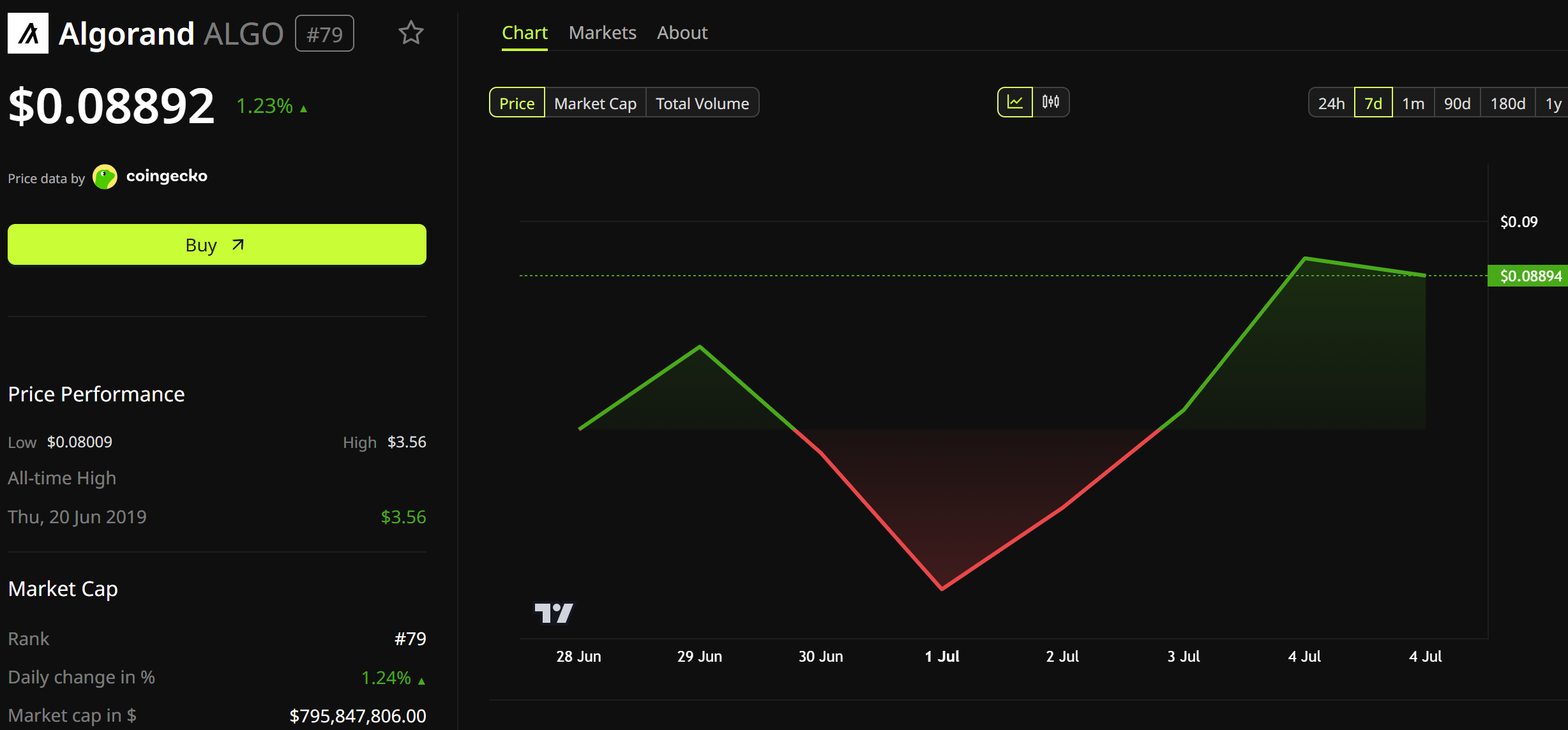
Markets are already pricing the theme. ALGO trades near $0.089, up 1.2% in 24 hours, with a market cap of roughly $796 million.

In contrast, quantum-resistant tokens outpaced Bitcoin (BTC) by 59.3% during May’s selloff, per Binance Research.
The pressure is not limited to one chain. Google Quantum AI research recently cut the estimated hardware needed to break Ethereum’s account security by 20 times.
France and the US have converged on 2027 as the year quantum readiness becomes a pass-fail procurement test. Whether rival chains can match Algorand’s schedule may determine which networks institutions trust with decades’ worth of data.
The post France’s New Quantum Rule Could Put Algorand Ahead of Blockchain Rivals appeared first on BeInCrypto.

As the world’s most powerful economy and the widely regarded leader of the free world celebrates its 250th Independence Day, various initiatives are emerging to contribute in some way, including one from Ripple.
The company behind the popular XRP altcoin announced that it has joined a nonprofit helping unemployed veterans to get high-quality jobs after their military service.
The organization, called Call of Duty Endowment, said it has already funded over 165,000 veterans, but explained that there’s still a high unemployment rate among the younger generation, which means that there’s “still more work to do.”
It wants to find jobs for 200,000 veterans by 2030, and Ripple has joined the special initiative for the 250th birthday of the US, called Giving4th.
The idea is to make Independence Day a national day of charitable giving. The company said it will match donations made to the Call of Duty Endowment of up to $10,000.
People who want to participate can use cash, stock, or cryptocurrencies, including Ripple’s two native tokens, XRP and RLUSD.
Ripple is joining #Giving4th — @America250‘s new movement to make Independence Day a national day of charitable giving.
We’re matching donations to @CODE4Vets up to $10K. CODE funds the most effective organizations helping veterans get back to work, preparing them for the job…
— Ripple (@Ripple) July 4, 2026
The Fourth of July is known as the United States’ Independence Day and serves as a federal holiday that commemorates the adoption of the Declaration of Independence on July 4, 1776.
The post Important Ripple (XRP) Announcement for July 4: Details appeared first on CryptoPotato.

Bitcoin might still enter another major bull cycle, but the amount of money needed to fuel it has grown dramatically compared to previous bull markets, according to the CEO of CryptoQuant, Ki Young Ju.
In a recent thread, he argued that the cryptocurrency’s capital efficiency has declined considerably as the asset has matured.
In 2011, he said, roughly $2.7 billion in net capital inflows was enough to drive a rally of more than 55,000%. In the current cycle, however, around $697 billion in inflows produced a return of slightly less than 700%.
The main takeaway is quite simple: Bitcoin is much larger now compared to before, and moving its price requires far more capital.
Bitcoin’s Next Parabolic Move May Need Trillions
Market cycles are interesting, and all of them, despite some similarities, are quite different.
According to Ju, in 2011, only $5 million in net inflows was enough to double BTC’s price. In this cycle, that figure increased to roughly $101 billion. He believes that the next parabolic run would likely require trillions of dollars in net capital inflows.
Of course, this doesn’t mean that upside is impossible; it just suggests that the asset may need a deeper institutional bid than in the previous cycle.
The analyst also framed the issue in terms of Bitcoin’s realized capitalization. This is a metric that values each coin based on the price at which it last moved on-chain rather than simply mutliplying the current spot price by its circulating supply.
Ju said that if Bitcoin can absorb upwards of $1 trillion in realized cap, another parabolic rally remains possible. In practical terms, though, this would require the cryptocurrency to move beyond a retail-led ETF trade and become an established macro allocation for funds, corporations, institutions, and possibly even sovereign entities.
He noted that this shift is still early and hasn’t been invalidated yet.
Gold Comparisons: The Size of the Opportunity?
The comparison with gold remains central to Bitcoin’s long-term investment thesis. The current market cap of the precious metal, according to popular estimates, is $29 trillion, although keep in mind that this figure can vary depending on the assumed above-ground supply.
By contrast, Bitcoin’s market cap is $1.25 trillion, at the time of this writing.
This gap remains the reason some analysts still see significant room for Bitcoin to grow as institutional adoption expands. Of course, it also highlights the challenge – every new cycle will likely require considerably larger pools of capital than the last.
The post How Much New Money Does Bitcoin Need to Start a Fresh Bull Run? (It’s a Lot) appeared first on CryptoPotato.
Crypto World
A massive EU regulatory crackdown is threatening the explosive boom of multibillion-dollar prediction markets


The European Securities and Markets Authority (ESMA) said some prediction-market contracts may be covered by the European Union’s binary options ban, warning firms that yes-or-no event contracts cannot be marketed, distributed or sold to retail clients when they qualify as financial instruments.
“This means that the marketing, distribution or sale to retail clients of event contracts that meet the definition of financial instruments is prohibited,” ESMA said in a statement.
The regulator targeted contracts whose payout is binary, usually a fixed amount or nothing, and depends on the outcome of a future event.
ESMA said the product label is irrelevant, as a contract sold as an “event contract” can still be a MiFID II financial instrument if its underlying falls within the derivatives categories.
Event contracts that qualify as financial instruments are derivatives, ESMA said. That puts them within the scope of national product intervention measures for binary options.
The warning comes as prediction markets expand across crypto and traditional finance. Kalshi and Polymarket have been discussed as potential M&A targets as operational lines blur between exchanges, brokerages and sportsbooks.

Key Takeaways
- ORCL shares have declined nine trading sessions in a row, shedding 24% in what marks the company’s most extended losing period since late 2021
- Shares have lost 28% in 2026 so far and are trading 57% below the September 2025 peak of $248.15
- Wall Street remains optimistic with 84% of analysts maintaining Buy recommendations and a consensus target near $263.86
- Retail traders are accumulating shares — ORCL ranked first among major tech stocks for retail purchases over the last 30 days, surpassing Nvidia, Meta, Amazon, Microsoft, and Alphabet
- Market anxiety stems from Oracle’s aggressive capital spending strategy and expanding debt obligations
Oracle delivered impressive fourth-quarter fiscal 2026 earnings on June 10, posting $19.2 billion in sales—a 21% jump from the previous year—while surpassing analyst projections for both revenue and earnings. Management also upgraded its profitability forecast. Markets responded with indifference.
From its 2026 peak of $248.15 reached on June 1, shares have declined on 18 of the following 22 trading sessions. The current nine-day consecutive decline of 24% represents the most prolonged downturn since December 2021. ORCL now trades approximately 57% beneath its all-time closing record established on September 10, 2025.
The timing adds to the puzzle. While Oracle continues sliding, the wider software industry has been rebounding. The iShares Expanded Tech-Software Sector ETF (IGV) has climbed for five straight sessions, gaining over 10% during that period. Oracle charts the opposite course.
Most market observers point to financial strategy concerns—particularly Oracle’s spending velocity and how the company funds its operations. The enterprise has accumulated substantial debt to bankroll its artificial intelligence infrastructure expansion, and shareholders seem increasingly anxious about the capital deployment pace.
Analyst Community Maintains Conviction
The recent selloff hasn’t shaken Wall Street confidence. Among analysts tracking the stock, 84% assign Buy ratings—a percentage exceeded only once during the past two decades, briefly during May 2011.
The consensus price objective hovers around $263.86, suggesting approximately 88% appreciation potential from present levels. Mizuho’s Siti Panigrahi maintains one of the Street’s most aggressive targets at $320, designating Oracle as a premier recommendation while highlighting its “end to end AI stack across database, infrastructure, and applications.” Panigrahi acknowledges financing obstacles as a material concern, observing that Oracle will probably require external capital to support its spending blueprint.
KeyBanc researchers elevated their projections recently, expressing growing confidence that operating expense expansion will remain subdued. They preserved an Overweight stance with a $300 target, emphasizing that disciplined operating costs represent “where future upside will come from.”
Individual Investors Accumulate Shares
While institutional capital observes cautiously, individual investors are taking the opposite approach. Information from TipRanks’ Crowd Wisdom platform, monitoring over 868,000 retail portfolios, reveals ORCL experienced more purchasing volume during the past 30 days than comparable technology giants.
During the previous month, 3.8% of monitored portfolios initiated or expanded ORCL positions. This exceeds the 3.6% for Microsoft, 3.5% for Nvidia, 2.9% for both Amazon and Alphabet, and 2.2% for Meta.
Among the 32 analysts providing coverage during the past quarter, 28 issued Buy recommendations with just four Hold ratings—creating a Strong Buy consensus without a single Sell rating.
Oracle hasn’t announced its next quarterly reporting date, though the Q4 results that preceded the selloff featured $19.2 billion in revenue alongside an improved profitability outlook.

Europe has done something important. With MiCA, the EU created the world’s first comprehensive regulatory framework for crypto-assets. That is a significant achievement, not only for the digital asset industry, but for Europe’s wider ambition to lead in responsible financial innovation.
MiCA’s promise was clear: a harmonised single-market framework for crypto-asset services across the EU, greater clarity for users, more certainty for firms, and a level playing field for responsible operators willing to meet high standards.
Binance has supported that objective from the beginning, and we continue to support it today. But frameworks are only as strong as their implementation.
As MiCA moves from legislation to implementation, an important question is emerging: is the harmonised framework being implemented as intended?
That question matters far beyond Binance. Europe’s digital asset market is large, sophisticated and growing. Across the continent, millions of people use digital assets, innovative Web3 businesses are being built, and institutional participation continues to expand.
This ecosystem is part of Europe’s future competitiveness. Digital assets are about far more than trading. They represent new financial infrastructure: faster settlement, lower-cost payments, programmable products, digital ownership and more transparent markets.

Bitcoin appears to be nearing a potential technical turning point as analyst John Bollinger points to a “W”-shaped double-bottom pattern forming on the daily chart. In a fresh set of posts on X, Bollinger argued that the setup is “perfectly fractal,” suggesting the market could be moving into the final phase of a longer bearish cycle.
The technical discussion is landing alongside evidence that institutional demand may be cautiously reappearing. Data shared by market participants indicated that US spot Bitcoin ETFs recorded their first net inflows in ten days, while traders noted that BTC’s ability to hold near the $60,000 area despite broader outflows may signal absorption of selling pressure.
Key takeaways
- John Bollinger highlighted a daily “W” double-bottom structure on BTC/USD, framing it as a candidate to break the prevailing downtrend.
- Bollinger described the pattern as “perfectly fractal,” including smaller “w” formations near prior lows and a corresponding “m” at the rebound apex.
- US spot Bitcoin ETFs saw their first net inflows in ten days, signaling easing pressure in the ETF channel.
- Traders said BTC’s stability around the ~$60,000 region—despite ETF outflows earlier—could matter if price continues holding into the next week.
Bollinger’s “perfectly fractal” double bottom
Bollinger, known for creating the Bollinger Bands volatility indicator, used X to examine the current BTC/USD structure. He pointed to a “W”-shaped reversal pattern—typically defined by two swing lows with a rebound in between—arguing that such formations become bullish once price clears the level of resistance created at the rebound.
In his posts, Bollinger noted that prior bullish patterns had been broken, reinforcing his view that the downtrend has been dominant. He then asked whether the present “W” could be the one that “breaks” the trend.
Bollinger also shared a chart aligning the setup with the lower Bollinger Band on daily time frames. He emphasized the fractal nature of the structure, stating that smaller “w” shapes appear at the nadirs and a smaller “m” forms near the apex of the bounce. He further referenced a similar “W” on the weekly chart, implying the idea is not only limited to the daily timeframe.
For traders, the practical question is what counts as confirmation. In classical pattern terms, the bullish outcome hinges on BTC pushing through the rejection level between the two lows. Until that occurs, the pattern remains a hypothesis rather than a verified reversal.
Why the ETF channel is drawing attention
While Bollinger’s analysis is technical, the accompanying focus on ETFs reflects how institutional flows are often used as a real-time indicator of demand. According to market participants on X, US spot Bitcoin exchange-traded funds recorded their first net inflows in ten days on Friday.
Analyst Axel Adler Jr., a contributor to onchain analytics platform CryptoQuant, characterized the move as meaningful for gauging whether ETF-related pressure is easing. In his summary, Adler Jr. said that Bitcoin may be in the late stage of the bear cycle, but the ETF segment had, for the first time, signaled reduced pressure.
Another trader, Daan Crypto Trades, responded by cautioning that the inflow amount—reported as $220 million—was “not massive.” Still, he suggested the context matters: BTC had been holding roughly the $60,000 region even while there were many outflows. In his view, the area becomes more relevant if price continues to bounce further into the next week, since that would imply a larger amount of “absorption” has taken place.
This is an important distinction. In bearish phases, inflows can be sporadic and not necessarily change the broader trend. The market impact tends to be clearer when price holds and demand persists rather than appearing briefly.
Signals vs. expectations for a macro bottom
Even with renewed interest in ETF flows, the broader market narrative still points to uncertainty about when the macro bottom will arrive. Earlier coverage cited by the same discussion noted that multiple price indicators have been flashing signals not seen since the 2022 bear market. However, many participants continue to believe the next macro bottom is still ahead, with timing expectations pointing to Q3 or later.
Bollinger’s framing fits into that wider tension between “early signals” and “final bottoms.” A W-shaped reversal, if it plays out as expected, would suggest momentum could shift sooner than the macro timetable implies. But without confirmation—especially a breakout through the pattern’s rejection level—the setup could also end up failing or only triggering a temporary bounce within a longer downtrend.
From an investor perspective, that makes the coming price action particularly consequential. If BTC can hold near the reclaimed levels mentioned in the ETF discussion and then follow through on a breakout, the technical pattern could align with improving demand. If not, it may reinforce the view that market participants have not yet reached the stage where bearish pressure fully dissipates.
What to watch next
The next phase will likely depend on whether BTC can translate ETF inflows and near-$60,000 stability into sustained upside, particularly through the key resistance level implied by Bollinger’s “W” structure. Readers should watch for actual confirmation of the pattern—rather than relying only on improving signals—and track whether institutional demand remains supportive beyond this first inflow after a ten-day stretch.

Key Takeaways
- Bloom Energy shares have climbed approximately 194% in 2026 and more than 1,100% over the trailing 12 months, currently trading near $271
- First-quarter 2026 earnings per share reached $0.44, significantly exceeding the $0.12 analyst consensus; revenue totaled $751M, reflecting 130.4% year-over-year expansion
- The company and Brookfield Asset Management quintupled their AI infrastructure financing arrangement to $25 billion
- Full-year 2026 EPS outlook was upgraded to a range of $1.85–$2.25; institutional holders control 77% of shares outstanding
- Wall Street maintains a consensus “Hold” recommendation with a mean price objective of $236.14, trailing the current market price
Bloom Energy (BE) stock is hovering around $271, marking an approximate 194% gain year-to-date and a staggering 1,100%-plus advance from the same period last year. The solid oxide fuel cell manufacturer has emerged as one of 2026’s most explosive equities, propelled by accelerating demand for distributed power solutions serving AI-driven data facilities.
Shares began Friday’s session at $271.13. The 52-week trading range spans from $22.81 to $351.28, with the 50-day simple moving average positioned at $280.49 and the 200-day at $190.83. The company’s market capitalization currently stands at approximately $77 billion.
Bloom’s solid oxide technology transforms natural gas into electricity through an electrochemical process that bypasses traditional combustion. These systems can be installed and operational within a three-month window — a compelling advantage over conventional grid infrastructure, which often requires multi-year development timelines.
Hewlett Packard Enterprise CEO Antonio Neri has projected that the United States may confront a 19-gigawatt electricity supply deficit by 2028. Data centers are anticipated to drive nearly half of all incremental U.S. power demand through the end of the decade. This emerging supply-demand imbalance represents a structural growth driver for Bloom.
First Quarter Delivers Blowout Performance
Product revenue in Q1 — predominantly energy server shipments — tripled compared to the prior-year period. Consolidated revenue reached $751 million versus the Street’s $539.94 million estimate. Earnings per share landed at $0.44, crushing the consensus forecast of $0.12. Net profit margin registered at 0.25% while return on equity measured 21.05%.
On the strength of these results, Bloom management elevated full-year 2026 EPS guidance to a band of $1.85–$2.25. The current analyst consensus for the fiscal year sits at $1.34 per share.
In a move that attracted considerable attention, Bloom and Brookfield Asset Management expanded their collaborative AI power financing framework from $5 billion to $25 billion. This fivefold expansion underscores strong visibility into the fuel cell deployment pipeline at hyperscale computing facilities.
Institutional shareholders now account for 77% of outstanding shares. Leonteq Securities AG boosted its stake by 396.3% during the first quarter, acquiring an additional 89,185 shares to reach a total position of 111,687 shares valued at approximately $15.1 million.
Executive Selling and Wall Street Skepticism
Despite the rally, corporate insiders have been reducing holdings. Chief Commercial Officer Aman Joshi offloaded 8,343 shares on July 1 at a price of $300.37, generating proceeds of roughly $2.5 million. Director John T. Chambers divested 55,000 shares in late May at $297.69 per share, totaling more than $16.3 million. Across the past 90 days, insider dispositions have exceeded $59.8 million in aggregate value.
Wall Street opinion remains divided. Roth MKM maintains a “neutral” stance with a $285 price target. Barclays assigns an “equal weight” rating at $276. TD Cowen holds at $235. BMO Capital Markets offers one of the more constructive views with an “outperform” designation. Zacks Investment Research recently lowered its recommendation from “strong-buy” to “hold.”
The Street consensus settles at “Hold” with an average twelve-month target of $236.14 — approximately 13% beneath current trading levels.
Bloom carries a debt-to-equity ratio of 2.90 and a negative trailing price-to-earnings multiple, reflecting that profitability remains inconsistent despite robust top-line momentum.
BMO Capital Markets reiterated its “outperform” view on June 9, positioning itself among the minority of firms expressing bullish conviction at prevailing valuations.

Key Takeaways
- Wolfe Research raised CVX to Outperform, establishing a $210 price target based on underappreciated long-term cash generation
- Current market assumptions imply Brent crude under $60/barrel, while normalized futures suggest closer to $70/barrel
- The Uaru development in Guyana is projected to reach a critical free cash flow milestone during late 2026
- CVX surpassed Q1 expectations with $1.41 earnings per share versus $1.00 consensus, offering a 4.2% dividend
- Several major institutional holders expanded their CVX stakes throughout Q1 and Q2 2026
Chevron (CVX) advanced 1.6% Thursday following Wolfe Research’s decision to elevate the energy stock to Outperform from Peer Perform, accompanied by a $210 valuation target. Shares began Friday’s session at $169.06, remaining considerably beneath the $214.71 52-week peak.
According to Wolfe analyst Doug Leggate, fluctuating commodity prices have obscured meaningful enhancements to Chevron’s sustainable cash generation capabilities. He contends the market currently assumes long-term Brent pricing beneath $60 per barrel — significantly lower than the approximately $70 normalized forward pricing curve.
This valuation disconnect, Leggate maintains, presents a compelling entry point.
RBC Capital likewise maintained its Buy stance on CVX this week, contributing to the predominantly optimistic analyst sentiment. The equity currently carries a consensus Moderate Buy recommendation with a mean price objective of $205.71 spanning 26 analysts — comprising 19 Buy, 6 Hold, and 1 Sell ratings.
Mizuho elevated its target from $225 to $230 in late May. Goldman Sachs and UBS both maintain Buy recommendations with targets of $216 and above.
Guyana Represents the Primary Catalyst
Leggate identifies Guyana as the most significant near-term growth driver. The Uaru development is anticipated to commence operations and achieve a free cash flow turning point during the latter half of 2026, which should bolster CVX’s financial stability even if crude prices remain subdued.
Guyana is also projected to generate sufficient cash to offset the dividend obligations tied to the Hess acquisition — and eventually, Leggate anticipates it becoming Chevron’s largest single source of free cash flow.
This becomes particularly relevant approaching 2033, when the Tengiz partnership in Kazakhstan reaches its contractual conclusion.
Beyond Guyana, Chevron has obtained fresh development rights this year across Venezuela, Libya, and Iraq, with a possible ninth Guyana development phase under consideration. According to Wolfe, these initiatives could sustain production expansion well past 2030.
Institutional activity has intensified concurrent with analyst upgrades. Peregrine Asset Advisers more than doubled its CVX holdings during Q1, expanding its position by 118.7% to 20,344 shares valued at approximately $4.21 million.
Financial Results and Shareholder Returns
CVX most recently disclosed earnings on May 1st, delivering $1.41 earnings per share compared to consensus expectations of $1.00 — exceeding forecasts by $0.41. Revenue totaled $47.56 billion, representing 2.1% year-over-year growth, though modestly trailing the $51.86 billion analyst projection.
The corporation distributed a quarterly dividend of $1.78 per share in June, translating to a $7.12 annualized payout and a 4.2% yield. The current payout ratio stands at 123.4%.
CVX’s Q2 2026 earnings announcement is slated for later this month, with analysts already identifying it as the next potential stock catalyst.
The 50-day moving average rests at $183.31 while the 200-day sits at $180.40, with CVX’s present price of $169.06 positioned below both technical indicators.

TLDR;
- Bhutan Bitcoin Transfer activity moved 700 BTC worth about $43.75 million to Binance, drawing attention as Bitcoin traded above $62,000.
- Bhutan-linked wallets still reportedly hold around 1,750 BTC after the latest transfer, keeping the country among watched sovereign crypto holders.
- A Binance deposit does not always confirm a sale, as large holders may use exchanges for OTC deals, liquidity, or treasury operations.
- Bitcoin’s move above $62,000 followed renewed buyer interest near $58,000, with traders watching whether support holds again.
The Bhutan Bitcoin tansfer has drawn fresh market attention after government-linked wallets reportedly moved 700 BTC to Binance. The transfer was worth about $43.75 million, based on Bitcoin’s price near $62,500.
The move came as BTC reclaimed the $62,000 zone after defending support near $58,000. Traders often watch large exchange deposits closely, as they can signal possible selling.
Still, a transfer to Binance does not always mean immediate liquidation. Large holders may also use exchanges for OTC trading, liquidity planning, or internal treasury movements. Bitcoin traded near $62,500 on Saturday.
Bhutan Bitcoin Transfer Puts Binance Flows Under Watch
The Bhutan Bitcoin transfer involved two separate transactions to the same Binance deposit wallet. The larger transfer moved 634 BTC, valued near $39.6 million. A second transaction moved 66 BTC, worth about $4.12 million.
Together, the transfers brought the total to 700 BTC. That made the activity one of the latest major Bhutan-linked movements tracked by market watchers. Earlier transfers by Bhutan-related wallets also moved large BTC amounts this year.
The wallets are tied to the Royal Government of Bhutan through Arkham Intelligence labels. As reported previously, Bhutan’s Bitcoin holdings came from government-backed mining operations, rather than criminal seizures.
After the latest movement, the wallets reportedly still hold about 1,750 BTC. A prior report in June also showed Bhutan-linked wallets holding nearly 1,749.96 BTC after a Binance transfer. That earlier transfer moved 533 BTC, worth about $34.5 million at the time.
BTC Selloff Risk Rises as Bitcoin Reclaims $62K
Bitcoin is recovering from recent pressure trading near $62,555, with daily volume above $21 billion. The price rebound followed two defenses of the $58,000 area. That level has turned into a key short-term support zone for traders. Buyers stepped in near that range, while short liquidations helped fuel the recovery.
Meanwhile, macro data added another layer to the move. Softer U.S. labor figures supported expectations that the Federal Reserve may stay less aggressive. Risk assets often respond to that shift, especially when liquidity hopes improve.
Still, large BTC exchange deposits can unsettle traders. A government-linked transfer may raise concerns about supply hitting the market. At the same time, exchange movement alone does not prove a sale.
For now, traders are watching Binance flows, BTC volume, and the $58,000 support zone. A clean hold above $62,000 could keep buyers active. A sharp reversal may bring attention back to the latest Bhutan-linked wallet activity
Canada v Morocco LIVE: Latest team news and updates from World Cup last-16

Hilary Duff Responds After Fan Sparks Onstage Boundary Debate

This would’ve been crazy! #kaicenat #ishowspeed #ishowspeedshorts #money #subscribe #comment #fyp

No Jackpot Winner as $257 Million Prize Rolls Over to $269 Million Monday Draw

Renter of Home in Anne Heche Crash Denies Settlement With Son

Weekend Open Thread: Staud – Corporette.com
This would’ve been crazy! #kaicenat #ishowspeed #ishowspeedshorts #money #subscribe #comment #fyp
![Money isn't everything [YANNA] #Yanna #Short #Confidence #Strongwoman #Motivation #fyp](https://wordupnews.com/wp-content/uploads/2026/07/1783176729_maxresdefault-80x80.jpg)
Money isn’t everything [YANNA] #Yanna #Short #Confidence #Strongwoman #Motivation #fyp

This is What Philippine Money is Actually Made From?!
-

 Fashion21 hours ago
Weekend Open Thread: High Hopes
-

 Tech7 days ago
Bluekit phishing kit adopts browser-in-the-middle for login theft
-

 Tech7 days ago
Claude Code turned every engineer into three. Now companies need more product thinkers
-

 Crypto World5 days ago
Strategy authorizes up to $1.25B in Bitcoin sales under new capital plan
-

 Politics1 day ago
The House | “Reframing the debate from a binary discussion of winners and losers”: Yuan Yang reviews ‘We Are Not Machines’
-

 News Videos6 days ago
MAJOR BITCOIN & MARKET UPDATE!!!! (MUST WATCH ASAP!!!)
-

 Tech5 days ago
Anonymous researcher drops 0-day ‘exploitarium’ repo
-

 Crypto World7 days ago
Coinbase, Circle Deepen Crypto Stock Losses Despite Resilient S&P 500
-

 Business4 days ago
Australia treasurer says alleged access of prime minister’s bank data ’incredibly concerning’
-
 Business5 days ago
The AI boom won’t burst all at once. It will pop in ‘rolling bubbles’: Macquarie
-

 Sports3 days ago
Broncos roster: OL Ben Powers (No. 74) entering final year of contract
-

 NewsBeat4 days ago
Presenter Caroline Flack’s brother Paul Flack dies aged 55
-

 Crypto World2 days ago
Binance stock trading tops $1B in first month after launch
-

 Tech7 days ago
Silicon Valley paid to kill AI regulation, now it wants the rules back
-
 NewsBeat2 days ago
New exhibition reflects five decades of movement between island of Ireland and GB
-

 News Videos4 days ago
How to Build INSANE Live Financial Dashboards With Claude
-

 Crypto World3 days ago
Alibaba-affiliate Ant Group enters the humanoid robot market with 12 deals
-

 Business3 days ago
Meta Platforms Stock Jumps 7% Today as Bloomberg Reports Company Plans to Enter the Cloud Business
-

 Business1 day ago
What a 10 Percent Drop Means for Buyers, Sellers and Renters
-

 Crypto World2 days ago
Binance Re-Enters Philippines As EU MiCA Rules Restrict Access
You must be logged in to post a comment Login