

Crypto World
Ripple Co-Founder Backs Venture by US Senator’s Son, Report Says


Ripple executive chair Chris Larsen has been reported as one of the backers of a financial venture launched by Theodore Gillibrand, the son of US Senator Kirsten Gillibrand, according to a Politico report dated Thursday. The development lands in parallel with ongoing Senate negotiations over the Digital Asset Market Clarity (CLARITY) Act—US crypto market-structure legislation that lawmakers say could reshape how digital-asset businesses operate.
Politico reports that American Perpetuals Exchange Corp. (APEC), founded by Theodore Gillibrand, raised $30 million, with most investors contributing between $5,000 and $10,000 apiece. Larsen’s reported involvement was noted by Politico, though the report did not specify Larsen’s exact contribution.
Key takeaways
- Politico reports Chris Larsen was among investors backing APEC, Theodore Gillibrand’s derivatives-focused venture.
- APEC’s funding is described as totaling $30 million, with typical contributions reportedly in the $5,000–$10,000 range.
- The investment is unfolding while Senator Kirsten Gillibrand negotiates ethics provisions in the CLARITY Act.
- Democratic lawmakers are pressing Republicans to include ethics language, with questions framed around conflicts involving lawmakers and government officials.
- The Senate schedule—returning July 13 and then breaking again for an extended state work period—narrows the time left for CLARITY to advance.
APEC funding and the Larsen connection
In its Thursday coverage, Politico said Larsen was one of a small set of investors supporting APEC, the company created by Theodore Gillibrand. The report emphasizes that while APEC attracted a broader group of investors, individual stakes cited in the coverage were relatively modest, with “the majority” contributing between $5,000 and $10,000.
However, Politico did not publish Larsen’s exact amount. For readers tracking the intersection of finance and policy, the more relevant takeaway is not the dollar figure itself, but the timing: the reported investment is occurring while Gillibrand’s office and other lawmakers work to finalize provisions of a bill widely expected to influence the regulatory environment for crypto exchanges, issuers, and derivatives markets.
Ethics provisions in the CLARITY Act are front and center
The reported APEC backers’ list is becoming part of a broader political debate because the CLARITY Act is in active negotiation, and Gillibrand has publicly tied her support to ethics reforms.
As Cointelegraph previously reported, Gillibrand said in May that lawmakers would not be voting for the bill unless ethics concerns were addressed—specifically, the risk that members of Congress or senior administration figures could benefit financially from the crypto industry due to their government roles. In that context, she characterized such outcomes as an unacceptable form of “pay for play.”
“[T]he truth is, is that we cannot allow members of Congress, senior administration officials, presidents or vice presidents, to get rich off of these industries because of their insider status. It is the worst form of pay for play.”
A spokesperson for Gillibrand told Cointelegraph that her son was “a grown adult starting his own independent business” and that the senator had “no involvement in it whatsoever.” Politico’s report does not resolve the underlying political dispute, but it intensifies scrutiny of how lawmakers’ personal or family-adjacent business ties are perceived while ethics language is being negotiated for a major policy package.
Cointelegraph also reported that it reached out to APEC for comment but did not receive an immediate response.
Republicans expect movement—Democrats push harder on ethics
CoinShares data is not referenced in the reporting provided here; instead, the key developments revolve around how Congress plans to handle CLARITY’s legislative path. Democratic lawmakers have been urging Republicans, who hold a majority in Congress, to adopt ethics language in the act. Their calls cite concerns that involve the current administration’s ties to the crypto industry.
On the Republican side, leaders have signaled they expect the bill to move through the Senate in July. Senator Cynthia Lummis, according to Cointelegraph reporting from June, said lawmakers were “working a little bit on ethics,” along with other topics raised in negotiations, including decentralized finance and illicit transactions.
That mix matters because CLARITY is not just a single-issue bill—it is positioned as market-structure legislation. If ethics provisions end up changing the compliance burdens, definitions, or governance expectations for firms operating in the US, those downstream impacts could affect everything from how trading and derivatives products are offered to what internal controls businesses must maintain.
At the procedural level, the Senate’s thin margin means Republicans will need at least some Democratic support to reach the 60-vote threshold for CLARITY to pass.
The legislative timetable is tightening
Even as the debate continues, lawmakers’ calendars are becoming an additional constraint. The Senate is currently in its Independence Day holiday period. Per the schedule described in Cointelegraph’s reporting, the chamber is set to return to session on July 13 and then head into another month-long state work period in August.
That means the practical window for crypto market-structure action is shrinking well before the US election season—an environment that often leads to renewed legislative delay and reprioritization. For crypto firms and investors, the key watch item is whether negotiations on ethics provisions keep the bill on track through July, or whether the calendar effectively pushes momentum into a later legislative session.
While the APEC funding story may appear at first glance to be separate from CLARITY policy talks, it is the simultaneous timing that’s likely to influence political attention. As ethics language becomes part of the bill’s final shape, stakeholders will want to monitor not only the bill’s progress, but also how the Senate frames conflicts-of-interest concerns and whether those discussions drive any substantive changes to the bill text.
What to watch next is the Senate’s ability to reconcile ethics negotiations with broader market-structure provisions before the July vote window narrows—alongside any further disclosure or clarification about the reported involvement of industry figures in private-sector activity during an election-adjacent legislative crunch.

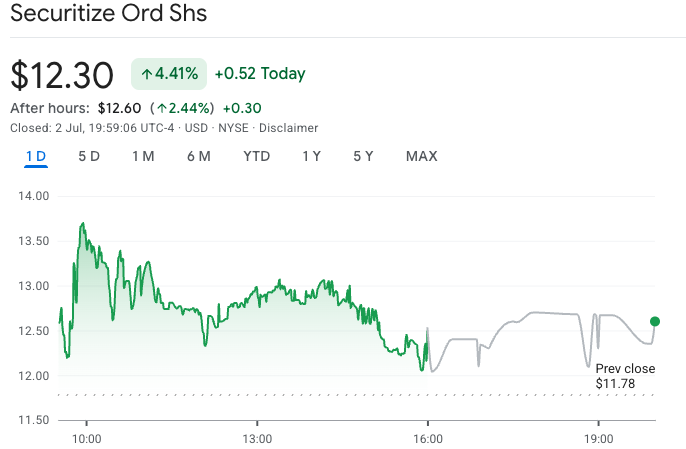
Tokenization platform Securitize rallied on its New York Stock Exchange debut on Thursday, as it brought tokenized versions of its shares to two blockchains.
The company, which is backed by BlackRock and Morgan Stanley, began trading on the NYSE under the ticker SECZ on Thursday after merging with a Cantor Fitzgerald-backed special-purpose acquisition company to take it public.
Securitize said Thursday that it simultaneously launched tokenized versions of its shares on the Avalanche and Solana blockchains, which will be available to eligible US investors on its platform.
It marks the first time a newly public company has also offered tokenized stocks, an area of crypto technology that has quickly gained attention among major institutions drawn to the idea that it can bring deeper liquidity and longer trading hours.
Securitize has carved out a lead in the tokenization space for institutions. It partnered with the NYSE in March to create tokenized assets for the exchange’s upcoming tokenized securities platform.
US laws allow for tokenized stocks, Securitize says
Securitize said that tokenizing its stock demonstrates that tokenized securities “can be issued and accessed in the US under existing securities laws and market structure,” adding that access will be subject to onboarding, eligibility, and customer ID and money-laundering checks.
“We have long said that public equities are moving on-chain, and there is no stronger validation of that belief than tokenizing our own public stock on Day 1,” said Securitize co-founder and CEO Carlos Domingo.
“SECZ is not a synthetic token or offshore wrapper. It is issuer-sponsored tokenization of the same common stock trading on the NYSE, made available through regulated infrastructure,” he added. “This is how tokenization should scale: with real ownership, regulatory clarity and the issuer at the center.”
The US Securities and Exchange Commission clarified in January that issuer-sponsored tokenized securities are still subject to US securities laws.
In mid-May, the SEC was reportedly ready to announce an exemption for the trading of tokenized stocks, but delayed the plan later that month after stock exchange officials raised concerns over how it would be implemented.
Securitize shares rise on debut
Shares in Securitize (SECZ) hit a high of $13.70 in trading Thursday but retracted slightly and ended the day at $12.30, a gain of 4.4%. The share price continued to climb 2.4% after-hours to $12.60.
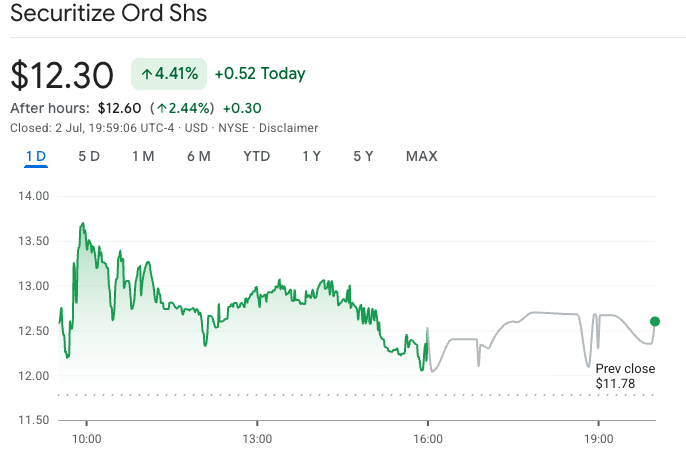
Securitize ended its debut trading day on Thursday at a gain of nearly 4.5%. Source: Google Finance
Securitize raised $400 million from its public offering at a valuation of more than $1 billion.
The market for tokenized real-world assets currently exceeds $43 billion, the majority of which is tokenized money market funds, while tokenized commodities account for nearly $7 billion and tokenized stocks account for $1.6 billion, according to Token Terminal.
Analysts expect the tokenization market to grow quickly in the coming years, with Citigroup predicting last month that it could grow to between $5.5 trillion and $8.2 trillion by 2030.
Big Questions: Do we really only need 2–5 cryptocurrencies?
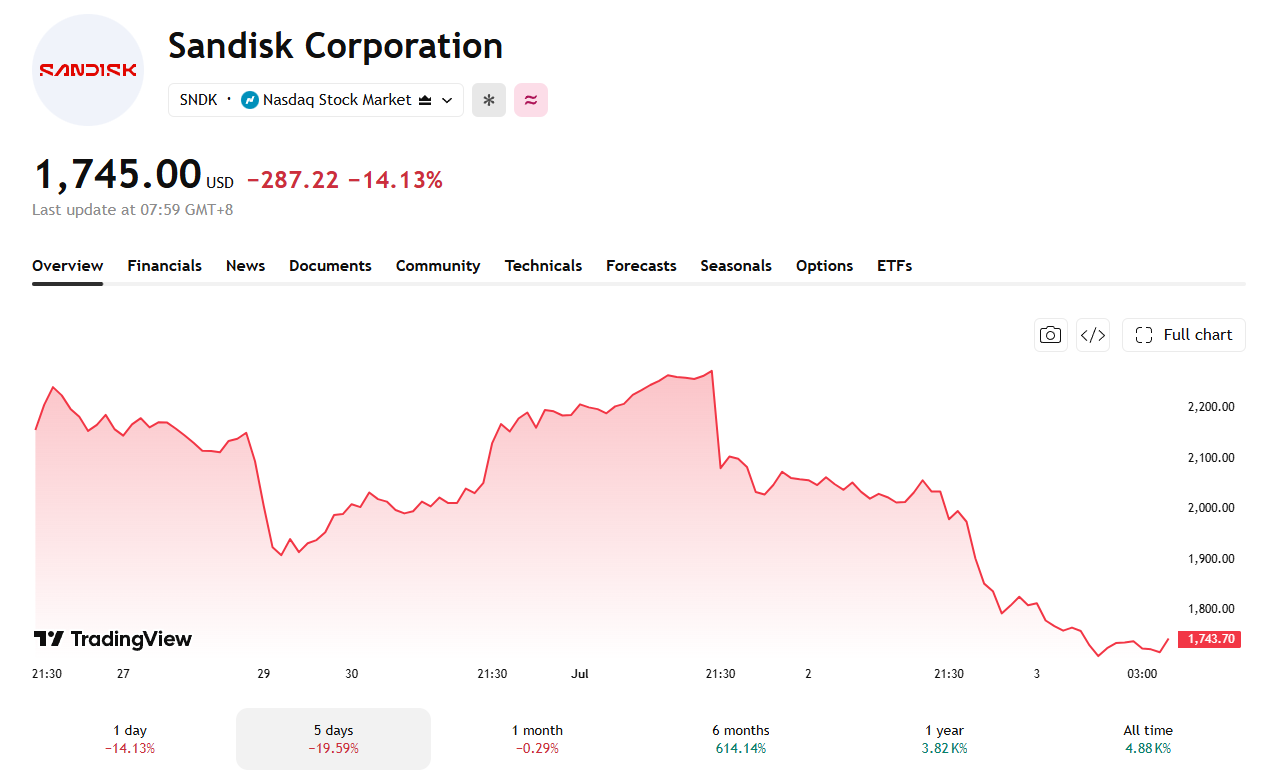
Over the last 24 hours, SanDisk shares sank 14.13%, Seagate dropped 10.38%, and Micron fell 5.49% as investors priced in a looming memory supply glut.
The three names have now lost 19.59%, 17.54%, and 14.36% over the past five sessions, respectively. That drop erases a chunk of 2026’s extraordinary rally.
A Glut Narrative Takes Hold
Morningstar’s director of research, Lorraine Tan, told Bloomberg TV that AI-linked stocks could fall 20% to 30% before becoming buyable again. She pointed to new supply coming from Samsung and SK Hynix and a potential plateau in AI capital spending.

Traders have turned that warning into this week’s working thesis. They are now questioning whether the pricing power behind the sector’s margin expansion can survive once fresh capacity lands.
A separate catalyst sharpened that realization. It was announced that Meta Platforms is building a cloud service to sell its own excess AI computing power. Investors took the plan as evidence that hyperscaler capex, and the chip demand tied to it, may be nearing a ceiling.

The news triggered a broad AI stock selloff that dragged memory and storage names down alongside chip equipment suppliers. A separate antitrust suit accusing Samsung, SK Hynix, and Micron of inflating DRAM prices has added to the scrutiny.

Bulls Push Back
Not every desk agrees with the glut thesis. Bank of America raised its SanDisk price target to $2,500 with a Buy rating. Citi made a similar call days earlier, lifting its own SanDisk target to the same level. Micron’s market capitalization surpassed Meta’s last month.
Micron reported fiscal third-quarter revenue of $41.46 billion, up 346% year over year, and guided fourth-quarter revenue to $50 billion. Micron stock still trades near seven times forward earnings even after the pullback.
Meta’s cloud ambitions could signal a genuine capex slowdown. They could also mark a new revenue stream layered onto continued AI spending. Either way, that question will likely shape the memory trade into next week.
The post AI Memory Supply Glut Fears Loom as SanDisk, Micron, Seagate All Plunge appeared first on BeInCrypto.


Bitcoin was sold as digital gold, an uncorrelated hedge that would hold up when markets broke. In 2026 it fell roughly 50% alongside the Nasdaq while gold hit record highs. So what is Bitcoin now, and did the hedge thesis ever survive contact with Wall Street?
Summary
- Bitcoin has spent 2026 moving with the Nasdaq rather than against it, with rolling correlations to U.S. tech indices reaching as high as 0.80 early in the year while its link to gold fell toward zero.
- The change traces to the spot ETF era: once institutions could hold Bitcoin inside the same portfolios as tech stocks, the same capital flows began driving both, tying Bitcoin to equity risk appetite.
- Analysts describe the current setup as the worst of both worlds, with Bitcoin taking the downside when stocks fall but not the full upside when they rally, behaving as a high-beta tail of macro risk instead of a standalone store of value.
- The counter-case is that Bitcoin is not a clean tech proxy either, since it fell on crypto-specific shocks even when tech rose, and that long-term holders kept accumulating, pointing toward an independent asset class instead of a tech clone.
- Whether the correlation is structural or a feature of the current tight-liquidity regime is the open question, and it decides whether the digital gold thesis is dead or merely dormant.
Bitcoin was supposed to be the asset that zigged when everything else zagged. For years it was sold as digital gold, an uncorrelated hedge that would protect a portfolio when stocks fell and uncertainty rose. In 2026, it has done close to the opposite. Bitcoin is down roughly 50% from its October 2025 record near $126,200, and it fell in near lockstep with technology stocks while gold climbed to record highs above $5,000 an ounce.
The asset marketed as a crisis hedge behaved like a leveraged bet on the same risk appetite that drives the Nasdaq. This piece works through the evidence that Bitcoin now trades like a tech stock, why that happened, and the serious counter-argument that the story is more complicated than a simple correlation chart suggests. The answer matters because it changes how investors should size Bitcoin, how they should compare it with gold, and whether the ETF era strengthened the asset or quietly rewired it into the same macro trade it was supposed to diversify away from.
The evidence: Bitcoin moves with the Nasdaq now
The correlation data is the starting point, and it is stark. Rolling 30-day correlations between Bitcoin and the Nasdaq 100 reached about 0.80 early in 2026, the highest level in close to four years, and Bitcoin’s longer-run five-year correlation with the tech-heavy index sits near 0.54. Standard Chartered analysts have pegged the Bitcoin-Nasdaq correlation around 0.5 with peaks near 0.8, while short-term readings against U.S. tech indices have ranged between roughly 0.55 and 0.68 through the year. However you measure it, Bitcoin and the Nasdaq have been moving together.
The relationship with gold has gone the other way. As Bitcoin’s tie to tech strengthened, its correlation with gold fell toward zero, at points reaching just 0.2. And the price paths made the divergence impossible to ignore. While Bitcoin dropped through 2026, gold surged to record highs above $5,000 and briefly toward $5,600 an ounce, outperforming Bitcoin by a wide margin over the same stretch.
The clearest test came under real stress. When conflict in the Middle East pushed oil higher and rattled markets, gold did what a safe haven does and climbed, while Bitcoin fell alongside risk assets. A hedge is supposed to prove itself precisely in those moments, and Bitcoin did not. The pattern that defined 2026 is simple to state: when the tech trade got hit, Bitcoin got hit, and when investors fled to safety, they chose gold.
Why the digital gold thesis mattered
To understand what has been lost, it helps to recall what the digital gold pitch actually claimed. Bitcoin’s founding appeal to institutions was not only its potential for gains but its supposed independence from everything else. It had a fixed supply capped at 21 million coins, no central issuer, and no cash flows tied to the economy, which in theory made it a store of value that would not move with stocks, bonds, or the business cycle. In its early years, Bitcoin was not just uncorrelated with equities; it was uncorrelated with nearly every major asset class, which made it look like the ultimate portfolio diversifier.
That property was the entire institutional case. A diversifier that zigs when the rest of a portfolio zags reduces overall risk, and that is worth paying for. Wall Street bought into the idea that Bitcoin could serve as a hedge against monetary debasement, market volatility, and economic uncertainty, a role gold has played for centuries. The digital gold narrative underpinned much of the adoption story, from corporate treasuries to the campaign for spot ETFs, because it promised something distinct from a simple speculative growth bet.
The trouble is that an asset’s identity depends not only on its design but on who owns it and how it is traded. Bitcoin’s code did not change in 2026. What changed is the profile of the people holding it and the machinery through which they buy and sell. That shift, more than anything about the protocol, is what turned the hedge into a high-beta risk asset.
What changed: the ETF made Bitcoin a portfolio asset
The pivotal event was the arrival of spot Bitcoin ETFs in January 2024, and the irony is sharp. The ETFs were celebrated as the moment Bitcoin was legitimized, folded into the regulated financial system at last. That same integration is what tied it to the equity market. Research published in late 2025 found robust evidence that ETF approval structurally altered Bitcoin’s role, marking a shift from an independent, idiosyncratic asset toward a conventional risk asset whose correlation with the S&P 500 rose sharply after the launch.
The mechanism is straightforward once you follow the money. Before ETFs, much of Bitcoin sat with crypto-native holders who traded it on its own logic. After ETFs, large institutions could hold Bitcoin exposure inside the same portfolios as their technology stocks, managed by the same risk desks using the same tools. When those desks adjust risk, they buy or sell Bitcoin and tech at the same time, for the same reasons, which welds the two together.
The marginal dollar in Bitcoin became, increasingly, the same dollar chasing artificial intelligence and growth equities, so when that dollar turned cautious, it sold both at once. This is the deeper story behind capital rotating into AI stocks that has drained crypto momentum all year. It is not only that money left Bitcoin for semiconductors; it is that the money still in Bitcoin now behaves like the money in tech, responding to the same Federal Reserve signals, the same liquidity conditions, and the same growth expectations. Bitcoin did not choose to become a tech stock. Its new owners made it one.
The worst of both worlds: downside without the upside
If Bitcoin simply tracked the Nasdaq one for one, that would be a clean story. The reality analysts have flagged is worse for holders. Trading firm Wintermute has argued that while Bitcoin’s directional correlation with the Nasdaq stayed high, the quality of that correlation deteriorated into what it called a bearish skew. In plain terms, Bitcoin has kept the downside beta, falling hard when equities fall, while losing much of the upside participation, failing to rally proportionally when equities recover.
Wintermute’s Jasper De Maere tied this to a shift in investor attention. As mindshare and risk-on capital crowded into mega-cap tech, Bitcoin remained correlated when global sentiment turned negative but stopped benefiting fully when optimism returned. He described Bitcoin as reacting like a high-beta tail of macro risk rather than a standalone narrative, keeping the downside beta while shedding the upside premium. The Kobeissi Letter put the same idea more bluntly, noting that Bitcoin was increasingly behaving like a leveraged technology stock.
That combination, all of the downside and only part of the upside, is the least attractive profile an asset can have. It means Bitcoin has been amplifying the pain of equity selloffs without delivering the diversification that justified holding it, and without matching the gains of the tech names it now mirrors. For a portfolio manager, an asset that adds volatility without adding either diversification or reliable upside is hard to defend, which is part of why some funds have re-labeled Bitcoin from a long-term hedge to a tactical growth position sized like any other speculative bet.
The counter-case: Bitcoin is decoupling, just not how bulls hoped
Here the story turns, because the simple tech-proxy narrative has a serious flaw. If Bitcoin were purely a leveraged Nasdaq, it would have risen when tech rose. Instead, for stretches since the October 2025 peak, Bitcoin fell while the Nasdaq strengthened, a divergence that some analysts said had rarely been so wide. Tech stocks climbed on strong earnings while Bitcoin dropped more than 30% from its high, driven by forces that had nothing to do with corporate profits.
Those forces were crypto-specific. The October 10 flash crash triggered a cascade of leveraged liquidations that hit Bitcoin while barely touching equities. Spot ETF outflows accelerated, pulling out the marginal buyer. The reflexive feedback loop around Bitcoin treasury companies like Strategy, most visibly Strategy, threatened to reverse from a buyer of last resort into a source of supply. And post-halving mining economics added their own pressure through miner selling pressure. None of that is in a Nasdaq chart.
So the honest reading is that Bitcoin is not a clean tech proxy: it takes the downside when tech falls, but it also falls on its own crypto-native shocks when tech rises. That is a worse outcome than pure correlation, but it also means Bitcoin is not simply a technology stock in disguise. The distinction matters for anyone trying to model the asset. A pure tech proxy would at least be predictable, rising and falling with the Nasdaq. What Bitcoin actually did in 2026 was absorb equity-market downside through the ETF-era ownership channel while simultaneously generating its own downside through leverage unwinds, ETF redemptions, treasury-company stress, and miner selling. It behaved less like gold, less like a clean tech stock, and more like a uniquely fragile hybrid during a bad year.
The maturation argument: a third asset class
There is a more optimistic frame that some analysts and long-term holders favor, which is that Bitcoin is becoming its own asset class instead of a copy of gold or tech. On this view, the correlation to equities is a phase driven by who happens to hold the marginal coin today, not a permanent identity. Bitcoin still has properties neither gold nor a tech stock shares: a hard-capped supply that cannot be expanded by decision, no cash flows or earnings to miss, and no management team or governance structure that can fail. Those features do not disappear because a correlation chart spikes.
The behavior of long-term holders supports the maturation read. During the same 2026 window when the ETF complex bled, the supply held by long-term holders moved in the opposite direction, with those flows running far larger in magnitude than ETF flows and skewing toward net accumulation. In other words, the traders treating Bitcoin as a high-beta risk asset were selling through ETFs, while conviction holders who treat it as a long-term store of value were buying. Two different populations, two different theses, playing out in the same asset at the same time.
Which group defines Bitcoin’s identity depends on which one is setting the marginal price, and that can change. Standard Chartered, for its part, has kept multiyear price targets well above current levels even while acknowledging the rotation into AI, framing the moment as a question of timing and competition for capital rather than a verdict on what Bitcoin fundamentally is. The maturation argument does not deny that Bitcoin trades like a risk asset right now. It argues that the current correlation is a snapshot of a particular ownership mix and liquidity regime, not the final word on an asset that is still only in its second decade.
Is this structural or cyclical?
The whole debate reduces to one question: is Bitcoin’s correlation with tech a permanent feature of the ETF era, or a temporary product of the current environment? The case for structural is that the ownership change is not reversing. ETFs are here to stay, institutions will keep managing Bitcoin alongside equities, and as long as they do, the flows that link the two assets will persist. If that is right, the digital gold thesis is effectively dead for as long as this ownership base dominates, and Bitcoin is a growth allocation that happens to be more volatile than most.
The case for cyclical rests on how correlations behave over time. Cross-asset correlations tend to spike during tight-liquidity, risk-off regimes and to loosen when liquidity returns and assets trade more on their own fundamentals. Bitcoin’s correlation with the Nasdaq has swung dramatically before, from deeply negative to strongly positive within weeks, which is not the signature of a fixed relationship. A shift in Federal Reserve policy, a change in the liquidity backdrop, or a rotation of capital away from the crowded AI trade could all loosen the tie and give Bitcoin room to trade on its own narrative again.
Some analysts even argue the correlation has already begun to break, though so far in the unhelpful direction of falling while tech rose. What would restore the digital gold thesis is a period where Bitcoin holds up while equities fall, proving the hedge in the only way that counts. That has not happened in 2026, which is why the thesis is on the ropes. But a single bad year in which a leverage-driven crypto drawdown collided with an AI-fueled equity rally is not a controlled experiment, and reading a permanent identity change off it may be as premature as the original digital gold claim was.
What it means for how to hold Bitcoin
For anyone actually holding Bitcoin, the practical takeaway is to match the thesis to the timeframe. Over the horizon that matters in 2026, Bitcoin has behaved as a high-beta risk asset, so treating it as a crisis hedge or a portfolio insulator has not worked and is not supported by the data. An allocation sized as if Bitcoin will hold up when stocks crash is mis-sized, because this year it fell harder than the stocks it was meant to hedge. The more defensible approach in the current regime is to treat Bitcoin as a volatile growth position, size it to risk tolerance, and watch the Nasdaq and AI-stock sentiment as closely as the crypto charts, because that is where much of the near-term direction is being set.
Over a longer horizon, the store-of-value case does not depend on short-term correlation. The fixed supply, the absence of governance and cash-flow risk, and the accumulation behavior of long-term holders are the pillars of that argument, and they survive a year of trading like a tech stock. The honest conclusion is that Bitcoin is currently being priced as a leveraged expression of risk appetite, not as digital gold, and that this reflects who owns it in the ETF era more than any change in what it is. Whether it grows into the independent, hedge-like asset its supporters imagine, or stays a high-beta satellite of the tech trade, will be settled by the next regime, not this one.
For now, the market has given its answer, and it is not gold. The strongest near-term read is not ideological; it is practical. In a world of a hawkish Fed and tight liquidity, Bitcoin behaves like a risk asset, and risk-off market sentiment matters as much as on-chain conviction. The digital gold thesis is not dead by definition, but in 2026 it has not been the trade.
Frequently asked questions
Is Bitcoin still considered digital gold?
Less and less in practice. Through 2026, Bitcoin behaved like a high-beta risk asset instead of a safe haven, falling alongside technology stocks while gold climbed to record highs. Its correlation with the Nasdaq reached as high as 0.80 while its link to gold fell toward zero. The digital gold label describes Bitcoin’s design and long-term thesis, but its 2026 trading behavior did not match it.
Why does Bitcoin move with tech stocks now?
The main driver is the spot ETF era that began in January 2024. Once institutions could hold Bitcoin inside the same portfolios as technology stocks, managed by the same risk desks, the same capital flows started moving both. When those desks adjust risk exposure, they buy or sell Bitcoin and tech together, which ties Bitcoin to equity market sentiment and Federal Reserve policy the same way growth stocks are.
How correlated is Bitcoin with the Nasdaq?
Correlation varies with the time window, but it has been high in 2026. Rolling 30-day correlations with the Nasdaq 100 reached about 0.80 early in the year, the highest in nearly four years, and the five-year correlation sits near 0.54. Short-term readings against U.S. tech indices have ranged roughly between 0.55 and 0.68. Correlations shift over time and have swung from negative to strongly positive within weeks.
Did the Bitcoin ETFs cause this?
They appear to be the central cause. Research from late 2025 found that spot ETF approval structurally raised Bitcoin’s correlation with the S&P 500, marking a shift from an independent asset to a conventional risk asset. The ETFs legitimized Bitcoin by integrating it into traditional finance, and that same integration tied its price to equity flows and institutional risk management.
What is the bearish skew analysts mention?
It refers to Bitcoin keeping the downside of its tech correlation while losing much of the upside. Trading firm Wintermute described Bitcoin as falling hard when equities fall but failing to rally proportionally when they recover, behaving as a high-beta tail of macro risk. That combination, full downside and partial upside, is a poor profile because it adds volatility without reliable gains or diversification.
Is Bitcoin just a leveraged tech stock then?
Not cleanly. If Bitcoin were purely a leveraged Nasdaq, it would have risen when tech rose, but for stretches in 2026 it fell while tech strengthened, driven by crypto-specific shocks: the October flash crash, ETF outflows, treasury-company stress, and miner selling. So Bitcoin took equity downside while also generating its own downside, which is a fragile hybrid instead of a simple tech proxy.
Could Bitcoin become a hedge again?
It is possible, and it hinges on whether the correlation is structural or cyclical. Cross-asset correlations tend to spike in tight-liquidity, risk-off regimes and loosen when liquidity returns. A shift in Federal Reserve policy or a rotation away from the crowded AI trade could let Bitcoin trade on its own narrative again. Restoring the hedge thesis would require Bitcoin to hold up while equities fall, which has not happened in 2026.
How should investors treat Bitcoin given this?
Match the thesis to the timeframe. In the current regime, Bitcoin trades as a volatile growth asset, so sizing it as a crisis hedge is not supported by the data, and investors may watch the Nasdaq and AI sentiment as closely as crypto charts. Over a longer horizon, the store-of-value case rests on fixed supply, no governance risk, and long-term holder accumulation, which do not depend on short-term correlation.
Disclaimer: This article is for information and educational purposes only and does not constitute financial, investment, or trading advice. Cryptocurrency prices are highly volatile, and correlations between assets change over time and may not persist. Nothing here is a recommendation to buy or sell any asset. Always do your own research and consider consulting a licensed financial professional before making investment decisions. Information is accurate as of July 2, 2026, and may change.


Cross-margining lets your whole account balance backstop every open trade, so a winning position can keep a losing one alive. It is more capital-efficient than isolated margin, and it can also wipe out your entire account in one bad move. Here is how it works.
Summary
- Cross-margining is a margin mode in which all the funds in your account act as shared collateral for all your open positions, so gains and spare equity in one position can support a losing one.
- It contrasts with isolated margin, where a fixed amount of collateral is locked to each position and losses are capped to that amount.
- Cross margin is more capital-efficient and can delay liquidation, but it puts your entire account at risk, because a large enough loss can be covered from the whole balance and trigger a portfolio-wide liquidation.
- Traders generally use cross margin for hedged, offsetting, or core positions, and isolated margin for speculative, high-risk, or single bets where they want a hard loss cap.
- The same principle scales to institutions, where prime brokers cross-margin positions across entire asset classes, using assets like stablecoins as shared collateral.
Cross-margining is a way of managing collateral in leveraged trading where your entire account balance backs all of your open positions at once, instead of each trade standing on its own. In practice, that means the profit or spare equity in one position can be used to support another that is losing, which can keep trades alive through volatility. The trade-off is that your whole account is exposed: a large enough loss draws on the entire balance and can liquidate everything. Cross margin is one of the two main margin modes offered on crypto trading platforms, the other being isolated margin, and understanding the difference is essential to managing risk. This explainer covers how margin trading works, how cross and isolated margin differ, a worked example, the pros and cons, and how the same idea operates at the institutional level.
Margin trading basics: leverage, collateral, liquidation
Cross-margining only makes sense once the basics of margin trading are clear. Margin trading means borrowing funds to open a position larger than your own cash balance would allow. The money you put up is the margin, and it serves as collateral for the borrowed funds. Leverage describes how much larger your position is than your own capital: at five-to-one leverage, a trader controls a position five times the size of their margin. Leverage amplifies everything, so both gains and losses grow in proportion to the position size instead of the smaller amount of capital actually committed.
Two thresholds govern a margin position. The initial margin is the collateral required to open the position. The maintenance margin is the minimum equity that must be kept to hold it open. As long as the position’s equity stays above the maintenance margin, the trade continues. If the market moves against the position enough that equity falls below the maintenance margin, the platform issues a margin call or, more commonly in crypto, moves straight to liquidation.
Liquidation is the forced closure of a position when its equity drops below the maintenance requirement. The platform’s liquidation engine closes the position at market prices, sometimes in partial steps, to prevent the account from going negative. Because leverage magnifies losses, liquidation can happen fast: at high leverage, a small adverse price move can wipe out the margin buffer entirely. This is the central risk of all margin trading, and the choice between cross and isolated margin is fundamentally a choice about how liquidation is calculated and how much of your account is exposed to it.
Cross margin versus isolated margin: the core difference
The two margin modes differ in one crucial respect: what pool of collateral backs each position. In cross margin, all the funds in your account form a single shared pool that backs every open position together. Unrealized profits and spare equity from one position can flow to support another that is drawing down, which can delay or prevent the liquidation of the losing trade. The account is managed as one book, and liquidation becomes a portfolio-level event that depends on the combined equity of everything you hold.
In isolated margin, collateral is ring-fenced to each position individually. You decide how much of your funds to assign to a specific trade, and that amount is the maximum you can lose on it. If the position is liquidated, only its allocated collateral is lost, and the rest of your account, including your other positions, is untouched. Isolated margin gives you a predictable, per-trade liquidation price and a hard cap on the damage any single idea can do, at the cost of not being able to draw on the rest of your balance to save a position.
The consequence is a clear trade-off between capital efficiency and risk containment. Cross margin uses your capital more efficiently, because idle equity and winning positions automatically backstop losing ones, and it tends to produce fewer forced liquidations on individual legs. But it places your entire account on the line, since a bad enough move can consume the whole balance. Isolated margin sacrifices efficiency for control: each position is walled off, so a single blow-up cannot spread, but you must actively manage collateral and accept more frequent single-position liquidations. Neither is inherently better; the right mode depends on the strategy.
A worked example
A concrete example makes the difference tangible. Imagine a trader with a $15,000 account who wants to open a leveraged long position on Bitcoin with an initial margin requirement of $5,000. Under cross margin, the entire $15,000 backs the position, giving a $10,000 buffer above the initial requirement. That large cushion makes liquidation far less likely on a normal pullback, because the whole account absorbs the drawdown. If the trader also holds other positions, profits on those can further support the Bitcoin trade. The catch is that if the combined account equity falls below the maintenance level, the liquidation engine can close positions and consume the full $15,000, not just a slice of it.
Now run the same trade under isolated margin. The trader allocates exactly $5,000 to the Bitcoin position and no more. If Bitcoin falls and the position is liquidated, the maximum loss is that $5,000, and the remaining $10,000 in the account is safe, available for other trades or simply preserved. The liquidation price is predictable and tied only to that position’s collateral. The downside is that the position has a much thinner buffer, so it will be liquidated sooner than the cross-margined version, since it cannot draw on the rest of the account to survive a dip.
The example shows the core tension. Cross margin gave the Bitcoin trade a bigger cushion and a better chance of surviving volatility, but it risked the entire $15,000. Isolated margin capped the loss at $5,000 but liquidated the position more readily. A trader who is confident and wants staying power, and who is comfortable risking the whole account, leans cross. A trader who wants a firm loss limit on a specific, uncertain bet leans isolated. The same $15,000 produces very different risk profiles depending on the mode chosen.
The pros and cons of cross-margining
Cross-margining has real advantages that explain its popularity among active and professional traders. Its main strength is capital efficiency: because all equity backs all positions, none of your capital sits idle behind a single trade, and winning positions automatically support losing ones. This produces a smoother equity curve and fewer forced exits on individual legs, which is especially valuable for hedged or offsetting strategies where one position is meant to counterbalance another. It is also simpler to monitor in one sense, since you watch a single account-level margin level instead of tracking collateral on many separate positions.
The disadvantages are equally real and more dangerous if ignored. The defining risk is that your entire account is exposed: once combined equity falls below the maintenance margin, liquidation can consume the whole balance, not a contained portion. This becomes acute when positions are correlated, which is common in crypto, where many assets move together. In a sharp, broad sell-off, several cross-margined positions can lose at once, draining account equity rapidly and triggering a cascade of liquidations across the book. A single violent move can therefore wipe out everything, where isolated margin would have contained the damage.
Cross margin also carries a psychological hazard. Because the shared pool makes positions feel more resilient, it can tempt traders to over-leverage, opening larger positions than they should because the buffer looks generous. That temptation, combined with the whole-account exposure, is how traders turn a manageable loss into a total one. The mode rewards discipline and punishes its absence. Used carefully within a hedged framework, cross margin is efficient and forgiving of ordinary volatility; used carelessly with correlated, over-leveraged bets, it is the fastest route to a blown-up account.
When to use cross versus isolated
The choice between the modes should follow the strategy rather than habit. Cross margin fits situations where positions offset or support one another. Hedging programs, basis trades, pairs trades, and market-making all benefit from a shared collateral pool, because a gain on one leg naturally cushions a loss on another, and pooling the collateral reduces the chance of an unnecessary single-leg liquidation. Core positions that a trader intends to hold through volatility also suit cross margin, since the deeper buffer provides staying power. In these cases, the whole-account exposure is an acceptable trade for the efficiency and resilience gained.
Isolated margin fits the opposite situations. Speculative, event-driven, or high-volatility bets, and single-ticket trades where the outcome is uncertain, are better ring-fenced, so that if the idea fails it cannot damage the rest of the account. A trader taking a focused shot on a volatile small-cap token, for instance, can cap the loss at a fixed amount and sleep easily knowing the rest of the balance is safe. Isolated margin also suits newer traders building discipline, because it enforces a hard maximum loss per trade and makes the risk of each position explicit.
Many experienced traders combine both in a core-satellite structure. They run cross margin on a core book of hedged or offsetting positions that benefit from pooled equity, while keeping speculative satellite trades in isolated buckets with fixed loss caps. This keeps the core capital-efficient without letting a single high-risk bet sink the whole account. The practical rule is to match the mode to the intent of each trade: shared exposure for positions designed to work together, walled-off exposure for standalone bets you want to contain. Some platforms even offer a smart cross margin that nets opposite-direction positions across products, further improving efficiency for hedged books.
Cross-margining at the institutional level
The same principle that governs a retail trader’s account scales all the way up to the largest institutions, and it is worth seeing the connection. When a hedge fund or trading firm operates through a prime broker, the broker cross-margins the firm’s positions across entire asset classes, netting exposures in digital assets, foreign exchange, derivatives, and fixed income so the firm posts collateral against the combined risk of its whole book rather than each position separately. This is cross-margining as a foundation of professional trading, and it is a major reason institutions value prime brokers: it frees up enormous amounts of capital that would otherwise sit idle.
Crypto has begun importing this institutional version. Prime brokers serving digital assets now let clients cross-margin crypto positions against traditional exposures, and stablecoins have started to play the role of shared collateral in that system. Ripple’s RLUSD, for example, has been positioned as a stablecoin that enables cross-margining between digital assets and traditional markets through institutional prime brokerage, letting a firm post the token as collateral recognized across both worlds. That is the same idea a retail trader meets in a cross-margin account, applied at the scale of institutional portfolios spanning many markets.
Seeing the two levels together clarifies what cross-margining really is: a method for treating a collection of positions as a single risk pool to use capital more efficiently. For a retail trader, the pool is the account balance backing a handful of trades. For an institution, it is a multi-asset book backed by cash and collateral like stablecoins across a prime broker. The mechanics and the stakes differ by orders of magnitude, but the core logic, and the core trade-off between efficiency and concentrated risk is identical.
The risks you must respect
Whatever the level, cross-margining demands respect for a specific set of risks, and ignoring them is how accounts are lost. The first is correlation risk. Crypto assets frequently move together, so a broad sell-off can push multiple cross-margined positions into loss simultaneously, draining shared equity far faster than a single position would. The very diversification that looks like safety can become a synchronized drawdown when markets turn risk-off together, and the shared pool that was meant to cushion individual losses instead absorbs many at once.
The second is liquidation and leverage risk. Because cross margin can make positions feel durable, it invites higher leverage, and higher leverage means a smaller adverse move can breach the maintenance margin. When that happens in cross mode, the liquidation is a portfolio-level event that can close multiple positions and consume the whole account. Flash crashes and liquidation cascades, where forced selling drives prices lower and triggers still more liquidations, are especially dangerous, and thin order books during such events can cause execution at prices far worse than expected. The market has seen sharp, leverage-driven cascades wipe out over-extended traders in minutes.
The disciplined response is to size positions conservatively, avoid over-leverage, and match the margin mode to the trade. Use cross margin for genuinely hedged or core positions where offsetting exposure justifies the shared pool, and isolate speculative or high-beta bets so a single failure cannot spread. Set alerts and plan collateral top-ups in advance instead of reacting during a crash. Cross-margining is a powerful tool for capital efficiency, but it concentrates risk at the account level, and the traders who use it well are the ones who never forget that the whole balance is on the line.
Frequently Asked Questions
What is cross-margining in simple terms?
Cross-margining is a margin mode where all the funds in your trading account act as shared collateral for all your open positions at once. Profits and spare equity from one position can support another that is losing, which can delay liquidation. The trade-off is that your entire account is exposed, so a large enough loss can be covered from the whole balance and liquidate everything.
How is cross margin different from isolated margin?
In cross margin, your whole account balance backs every position, so gains on one can cushion losses on another, but your entire account is at risk. In isolated margin, a fixed amount of collateral is locked to each position, capping the loss on that trade to the allocated amount and protecting the rest of your account. Cross is more efficient; isolated is more contained.
Which is better, cross or isolated margin?
Neither is universally better; it depends on the trade. Cross margin suits hedged, offsetting, or core positions that benefit from a shared collateral pool and staying power. Isolated margin suits speculative, event-driven, or single high-risk bets where you want a hard loss cap. Many traders use both, running cross margin on a core book and isolating speculative satellite trades.
What is the main risk of cross-margining?
The main risk is that your entire account is exposed. Once combined equity falls below the maintenance margin, liquidation can consume the whole balance rather than a contained amount. This is especially dangerous with correlated crypto assets, where a broad sell-off can push several positions into loss at once, draining shared equity quickly and triggering a portfolio-wide liquidation.
Can cross-margining cause bigger losses?
It can, because it puts the full account balance behind your positions. In a sharp, correlated downturn or a flash crash, multiple cross-margined positions can lose simultaneously and a portfolio-level liquidation can wipe out the entire account. Cross margin can also tempt traders to over-leverage because the shared buffer feels generous, which magnifies losses when the market turns.
What is a maintenance margin?
The maintenance margin is the minimum equity you must keep to hold a leveraged position open. As long as equity stays above it, the position continues. If the market moves against you and equity falls below the maintenance margin, the platform liquidates the position. In cross margin, this is calculated at the account level; in isolated margin, it is calculated for each position separately.
Do institutions use cross-margining?
Yes, at large scale. When institutions trade through a prime broker, the broker cross-margins their positions across entire asset classes, netting exposures in digital assets, foreign exchange, derivatives, and fixed income so the firm posts collateral against the combined risk of its whole book. Stablecoins such as RLUSD have started to serve as shared collateral in this institutional cross-margining system.
How can I use cross-margining safely?
Match the mode to the trade: use cross margin for hedged or core positions where offsetting exposure justifies the shared pool, and isolate speculative or high-volatility bets. Size positions conservatively, avoid over-leverage, set liquidation alerts, and plan collateral top-ups in advance. Always remember that in cross mode, your entire account is on the line, so discipline about leverage and position size is essential.
Disclaimer: This article is for information and educational purposes only and does not constitute financial, investment, or trading advice. Margin trading involves a high risk of loss, including the potential loss of your entire account, and is not suitable for all investors. Nothing here is a recommendation to trade or use any strategy. Always do your own research and consider consulting a qualified professional before trading on margin. Information is accurate as of July 2, 2026, and may change.
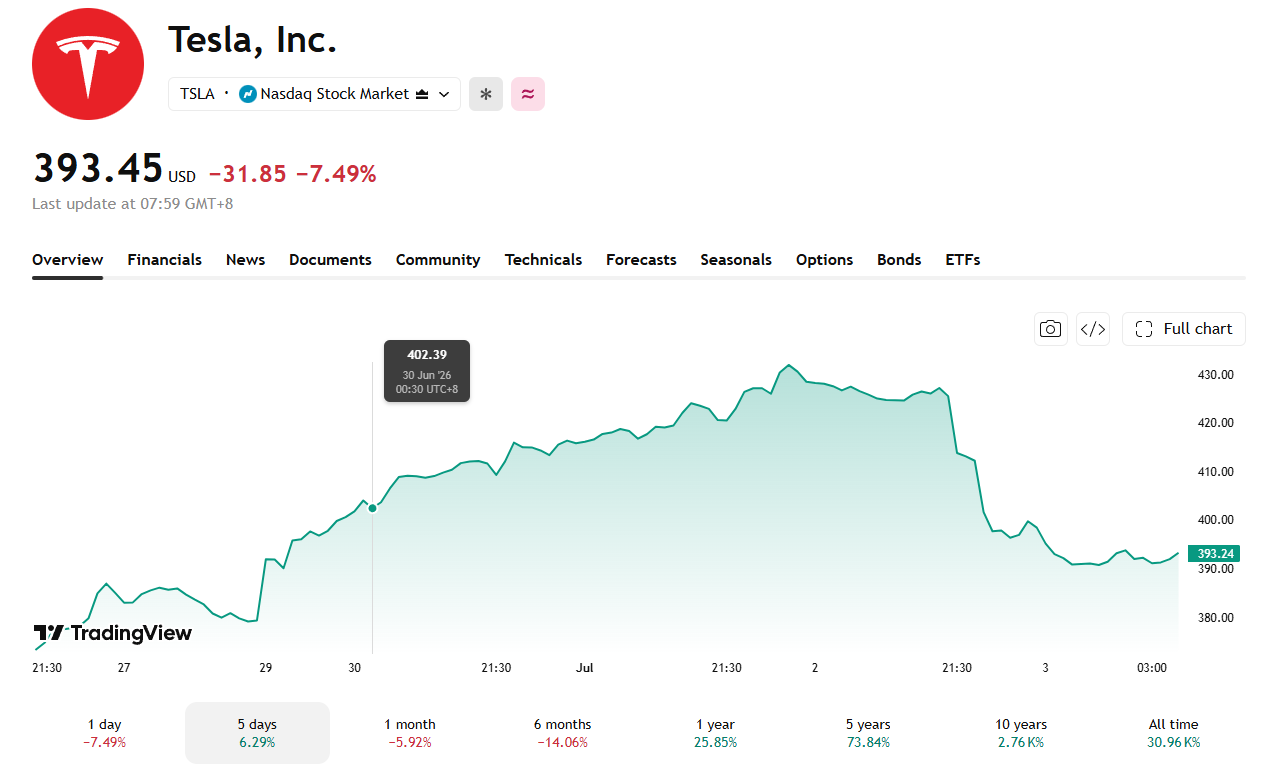
Tesla shares sank about 7.5% on July 2, their worst single-day decline in nearly a year. The drop came even after the company reported second-quarter deliveries far above Wall Street’s expectations.
The selloff came just three trading days after Tesla stock jumped more than 8% on optimism around a new self-driving software rollout.
Deliveries Crushed Estimates, But the Rally Came Early
Tesla reported 480,126 vehicle deliveries for the second quarter, against a company-compiled consensus of 406,024 and a StreetAccount estimate of 406,600. Production came in at 451,758 units.
The result marked a 25% jump from the same period last year. It also represented a 34% increase over the first quarter’s 358,023 deliveries. Tesla also shipped more cars than it built, drawing down inventory that had ballooned earlier in the year.

Much of the setup traces back to June 29. Tesla shares posted their biggest single-day gain in over a year after the FSD v14 Lite update rolled out. The update reached older Hardware 3 vehicles for the first time in more than a year. That rally already reflected rising expectations for the delivery report itself.
Why a Beat Still Sank the Stock
CNBC’s Phil LeBeau called the numbers a clear beat on air Thursday morning.
“The consensus estimate going into today was 406.6 thousand vehicles. They beat it by 74,000 vehicles. So just a massive beat from Tesla for the second quarter.”
Attribution: CNBC
Yet the stock fell anyway. Fund manager Gary Black noted that Tesla and Rivian shares had both climbed heading into their delivery reports. That timing undercuts the idea that new autonomy enthusiasm drove the earlier run-up.
Higher European gasoline prices from the Iran conflict likely pulled some demand forward. Tesla’s cheaper Model 3 and Model Y variants added to that effect. China-made EV sales rose 24.4% year over year in June, while Norway registrations fell 43%.
Valuation Still Hinges on Autonomy, Not Cars
Tesla’s roughly $1.6 trillion valuation now rests largely on its robotaxi and Full Self-Driving story rather than car sales. That mirrors the doubts investors raised during Tesla’s volatile 2010 IPO period.
A National Highway Traffic Safety Administration probe remains open into a fatal June 19 crash involving Tesla’s driver-assistance software. That probe keeps safety scrutiny on the same technology stack Tesla is now rolling out on robotaxis.
Tesla reports full second-quarter financial results on July 22. That release will show whether the delivery beat came with pricing discipline or with margin-eating incentives.
The post Why Did Tesla’s Stock Drop 7% Despite a Record Delivery Quarter? appeared first on BeInCrypto.
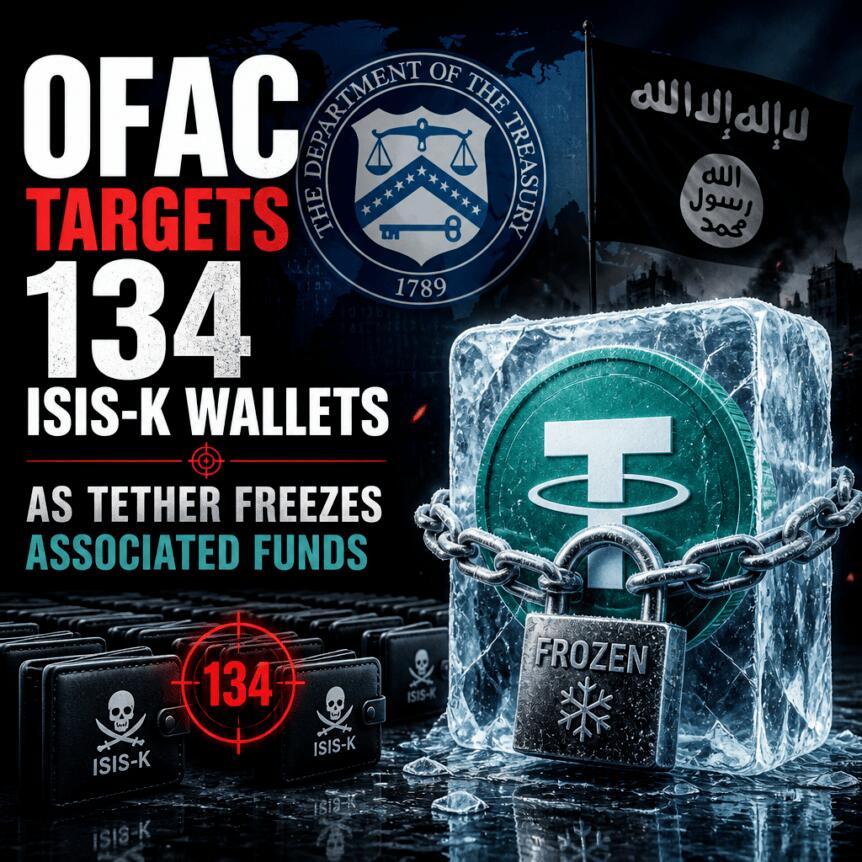
The U.S. Treasury’s Office of Foreign Assets Control (OFAC) has expanded its sanctions targeting ISIS-Khorasan (ISIS-K), sanctioning 134 cryptocurrency wallet addresses tied to the group. ISIS-K has been designated as a Specially Designated Global Terrorist since September 2015.
OFAC added the addresses to its Specially Designated Nationals (SDN) list on Wednesday. The SDN designation covers individuals, entities, and digital asset addresses linked to terrorism and other illicit activity, bringing more crypto-linked points of contact into the U.S. enforcement framework. OFAC’s recent action outlines the update.
Key takeaways
- OFAC sanctioned 134 cryptocurrency wallet addresses associated with ISIS-Khorasan, adding them to the SDN list.
- Blockchain analysis by Chainalysis says 131 of the sanctioned addresses were on Tron and were frozen by Tether; three were on Monero.
- Chainalysis reports the Tron addresses received more than $1.4 million in crypto donations since 2023 and sent over $880,000.
- The new action follows OFAC’s prior ISIS-support financier sanctions issued on June 22.
OFAC adds 134 crypto addresses to the SDN list
The latest OFAC update is part of an ongoing effort to disrupt terrorist financing conducted through digital assets. By designating specific wallet addresses, OFAC places them within the SDN framework—aimed at preventing U.S. persons and covered businesses from dealing with the sanctioned parties or facilitating transactions tied to them.
According to OFAC’s description of the measure, earlier rounds focused on “key facilitators who enable ISIS to move funds among its regional affiliates.” The new tranche expands the net further by targeting additional wallet infrastructure associated with ISIS-K’s illicit financial activity. OFAC’s SDN list update records the addresses added this week.
Tether freezes Tron holdings; Chainalysis flags Monero addresses
Industry blockchain forensics firm Chainalysis, in a report released alongside the sanctions news, attributed the breakdown of wallets by network: 131 Tron addresses and three Monero addresses were identified in the OFAC action. Chainalysis said Tether froze balances tied to the 131 Tron addresses, while the remaining addresses were on the Monero network.
The freezing step matters operationally. Sanctions can create legal and compliance barriers, but the immediate restriction of balances by major stablecoin infrastructure can reduce the near-term ability of sanctioned actors to access funds—even before prosecutions or extended enforcement follow.
Chainalysis’ analysis of the specific wallets and their network exposure was published in its report on the July 2026 sanctions round: “ISIS Designation of Crypto Addresses — July 2026”.
Where the money flowed: donations and transfers traced on-chain
Chainalysis also described what it found when mapping the sanctioned wallets’ activity. The report says the 131 Tron addresses received more than $1.4 million in cryptocurrency donations since 2023 and sent over $880,000. The group has reportedly sought crypto donations historically through campaigns using websites and messaging platforms.
Beyond aggregate totals, Chainalysis says it identified donation-related addresses used across multiple networks—including Tron, Monero, and Bitcoin—and noted what it characterized as “significant exposure to mainstream services.” The firm also found wallets that routed funds to cryptocurrency exchanges based in Syria.
That mix—terror-linked wallets interacting with larger crypto services—highlights a key enforcement challenge. Even when an illicit actor uses anonymity-oriented networks (such as Monero), their broader financial graph can intersect with centralized or regulated endpoints through exchange flows, custody, or liquidity routes. For compliance teams, that intersection is often where disruptions become most practical.
Sanctions momentum builds after June 22 enforcement
This week’s OFAC action arrives a little more than a week after the agency sanctioned additional individuals and entities connected to ISIS-related financing. On June 22, OFAC sanctioned three individuals and six entities across Europe, the Middle East, and West Africa, including MSB Bitcoin Xchange (Syria) and MSB Spider (Turkey). OFAC’s June 22 press release describes that previous round and the agency’s rationale.
Comparing the two actions, the pattern appears to be widening from alleged facilitators toward the transactional endpoints used to receive or move funds. By adding wallet addresses to the SDN list, OFAC reduces flexibility for sanctioned networks and increases compliance pressure across exchanges, custodians, and stablecoin-related entities that manage address-based monitoring and balance controls.
It also reinforces the role of blockchain analytics in sanctions design. Chainalysis’ ability to identify donation flows and network-specific wallets helped connect the sanctions process to on-chain behavior, enabling a targeted approach rather than a broad, non-specific sweep.
Why blockchain intelligence is becoming central to enforcement
Across counter-terrorism and financial-crime policy, blockchain intelligence tools are moving from “supporting evidence” to operational components in enforcement. Earlier this year, TRM Labs said onchain evidence was key to securing convictions of three individuals for terrorism financing in Indonesia in 2024 and 2025. TRM Labs argued that courts have treated cryptocurrency evidence—such as wallet addresses, transaction histories, and on-chain flows—as admissible and capable of anchoring prosecution. The company described this in a statement on its site: TRM Labs: on-chain intelligence and terrorism financing prosecutions.
The broader implication for market participants is straightforward: sanctions enforcement increasingly depends on traceable, address-level data. That trend tends to raise the importance of robust address-screening and transaction monitoring, especially for companies that deal with stablecoin liquidity, exchange withdrawals, or custody services across multiple networks.
For readers following this area closely, the next question is how quickly more connected wallets and counterparties are identified—and whether additional enforcement actions will target exchange routes, intermediary services, or other infrastructure tied to the newly sanctioned addresses. Chainalysis’ reporting suggests ISIS-K’s crypto activity has been persistent, but OFAC’s approach is shifting toward more granular, address-specific disruption that can constrain access to funds in real time.

SBI Crypto, the cryptocurrency-focused unit of Japan’s SBI financial group, will shut down its Bitcoin mining pool after five years of operations. The company says it will end mining pool services on July 31 and will stop accepting mining shares at the same time, while asking miners to keep directing hashrate to the pool through the cutoff so final payouts can be calculated correctly.
Beyond the operational details, the closure underlines a shift in how SBI wants to position itself in crypto. Instead of concentrating on mining infrastructure, SBI has been expanding its broader strategy across exchanges and stablecoins—an approach that appears to be moving resources away from pool-based services.
Key takeaways
- SBI Crypto will stop accepting Bitcoin mining shares and close its mining pool on July 31.
- Miners are being told to maintain hashrate on SBI Crypto until the cutoff to ensure accurate final payouts.
- SimpleMining data places SBI Crypto’s pool among the largest globally—currently around the 12th position by hashrate.
- SBI Crypto has pointed customers toward alternative pools, including Braiins, Luxor, and NeoPool.
- The shutdown aligns with SBI’s wider push into trading and stablecoin-related initiatives rather than mining.
End of SBI Crypto’s Bitcoin pool service
In an announcement posted on its site, SBI Crypto confirmed it will terminate its mining pool operations on July 31 and end share submissions at the same time. The company did not cite a specific reason for closing the pool.
In the same update, SBI Crypto emphasized operational continuity for miners. It asked customers to keep submitting hashrate to the pool until the final day so the platform can complete its payout calculations based on end-of-period share data. “We would sincerely appreciate your continued support by mining with us until the final day of operation,” the company wrote.
Where SBI Crypto sits in global pool rankings
SBI Crypto launched its Bitcoin mining pool in March 2021, entering a competitive segment that, at the time, already included major pool operators such as Poolin, F2Pool, and Binance Pool.
According to data tracked by SimpleMining, SBI Crypto currently ranks as the 12th largest Bitcoin mining pool worldwide. The dataset attributes roughly 21.46 exahashes per second (EH/s) of hashrate to SBI Crypto, representing about 2.24% of the network’s total share.
That position is significantly behind the very top pools. SimpleMining data shows Foundry USA controls about 24.49% of total network share, while AntPool sits around 19.05%. Mid-tier and lower-tier pools such as ViaBTC and MARA Pool account for approximately 8.55% and 5.15% of global Bitcoin mining hashrate, respectively.
For miners and operators monitoring pool reliability, rankings like these matter because they can influence factors such as the consistency of payouts and the pool’s overall draw of hashpower. Even without SBI Crypto’s exact rationale, the size of its current share means the migration away from its pool is likely to be watched closely by miners looking to avoid disruptions around the end date.
Hashrate migration options SBI Crypto recommends
With the July 31 shutdown approaching, SBI Crypto encouraged miners to redirect their hashing power to other Bitcoin pool operators. In its announcement, the company named several alternatives, including Braiins, Luxor, and NeoPool.
SimpleMining’s ranking data suggests that Braiins and Luxor each account for roughly 2% to 3% of global Bitcoin hashrate—placing them in the mid-tier portion of the pool market. NeoPool, meanwhile, is not included among the top-ranked pools by hashrate in the SimpleMining dataset.
SBI Crypto also indicated that some operators may run special programs or offer preferential conditions for clients transitioning from its platform. It advised customers to contact each pool directly to understand any available terms.
That guidance is likely important for both large mining operators and smaller participants. When a pool shuts down, miners typically face a tradeoff between operational convenience and the economics of switching—such as how quickly a new pool can reflect incoming hashpower and what payout structures apply after migration. SBI Crypto’s note that customers should check directly with alternative providers suggests these details may vary case by case.
SBI’s broader crypto direction: trading and stablecoins
The closure of SBI Crypto’s mining pool follows a broader pattern in SBI’s crypto strategy: shifting emphasis from mining toward expanding its financial-market role in digital assets.
Earlier, SBI Holdings agreed to acquire full control of the crypto exchange Bitbank in a deal valued at 46.7 billion Japanese yen (about $289 million), with the stated goal of building what it describes as Japan’s largest cryptocurrency exchange. SBI has also increased its focus on stablecoins—backing JPYSC, a new trust bank-backed Japanese yen stablecoin, and supporting Ripple’s rollout of its Ripple USD (RLUSD) stablecoin in Japan.
While the mining pool is closing due to SBI Crypto’s operational decision, these adjacent initiatives suggest where management believes growth is likely to be concentrated: in regulated exchange infrastructure and stablecoin rails rather than in running a corporate mining service.
For miners, the next question is less about long-term corporate strategy and more about execution: how smoothly hashrate transitions occur across pools and whether payout conditions remain stable around the July 31 cutoff. Watch SBI Crypto’s communications for any final operational clarifications, and track how major pools absorb redistributed hashpower as the shutdown date approaches.
Ripple’s cross-border token has enjoyed robust institutional demand, standing in stark contrast to spot BTC and ETH ETFs, which have been suffering heavy outflows lately.
However, that trend appears to have reversed over the past few days, putting XRP at risk of falling below the psychological $1 barrier.
First Time Since March
It was last November that Canary Capital launched the first spot XRP ETF in the US, with 100% exposure to the asset. Bitwise, Franklin Templeton, 21Shares, and Grayscale then followed suit, and since day 1, these products have generated a cumulative total net inflow of almost $1.5 billion.
Interest in the ETFs has remained solid even during the bear market that ultimately impacted Ripple’s native token. In the past two days, though, outflows have exceeded inflows, marking the first pair of consecutive days since March.
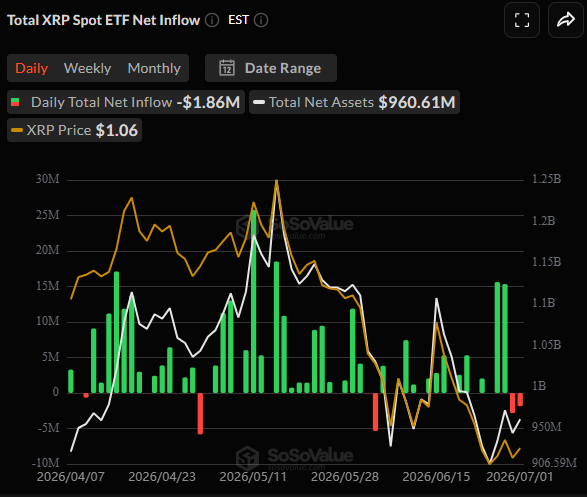
This development suggests that pension funds, hedge funds, and other conservative investors have reduced their exposure to XRP, prompting issuers of these products to sell holdings and further putting downward pressure on the token.
A few days ago, the asset’s price fell to nearly $1, and many feared that the bears would gain full control and suppress it below that crucial zone for the first time since late 2024. The bulls, though, stepped in and reclaimed some of the lost ground, and currently XRP trades at around $1.11 (per CoinGecko).
X user Diana remains cautious and predicted a potential downfall to as low as $0.87 if the asset breaks under $1.08 again. On the other hand, staying above that zone could pave the way for an increase to $1,30, she added.
The Bullish Signals
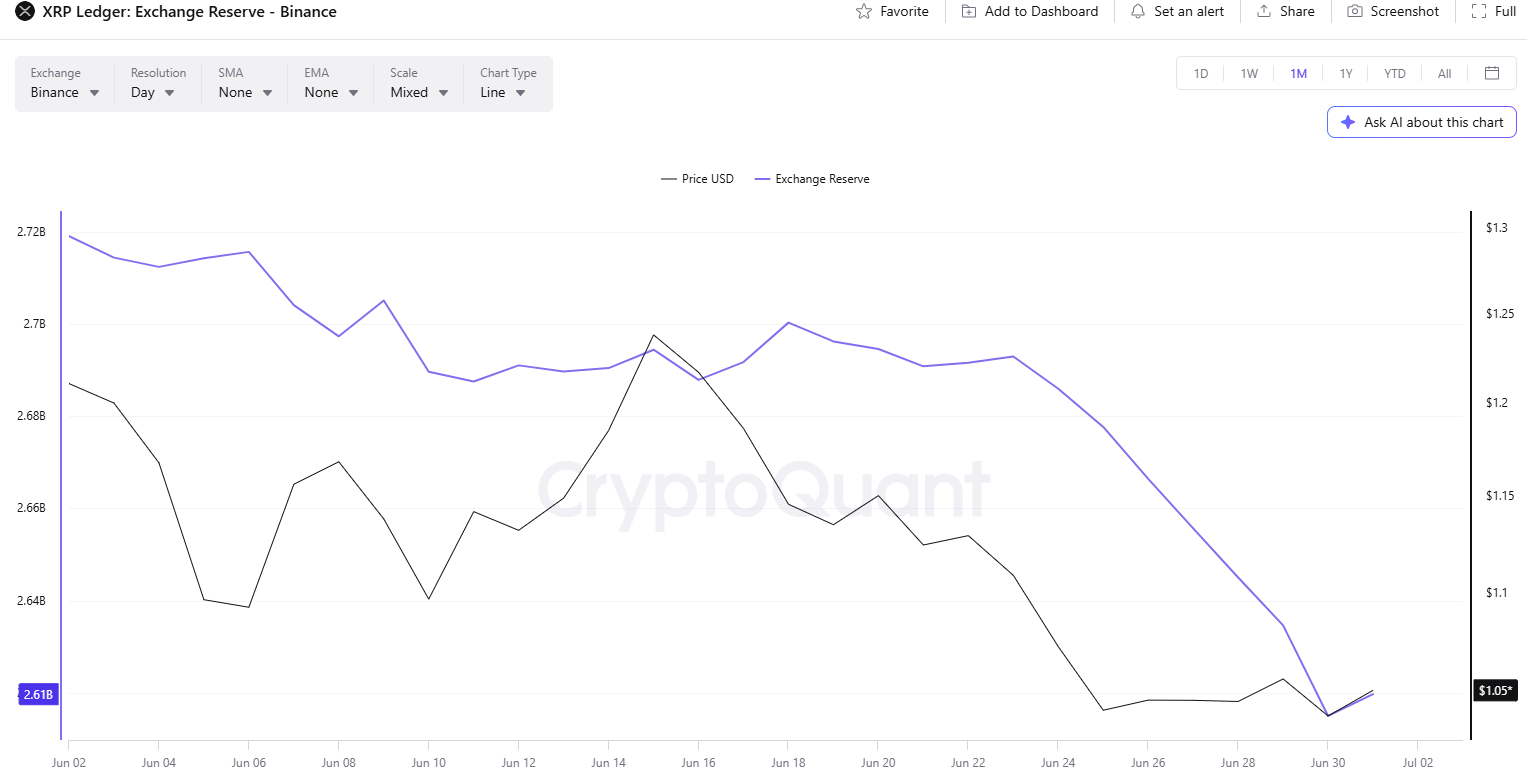
Despite recent ETF outflows, some factors suggest an upcoming upswing is more likely. The amount of XRP stored on Binance, for instance, recently dropped to a four-month low, resulting in reduced selling pressure.
Meanwhile, the popular analyst Ali Martinez revealed that the Tom DeMark (TD) Sequential Indicator (on a monthly scale) has flashed a buy signal on XRP (as well as other cryptocurrencies, including BTC, ETH, and SOL).
“On high-timeframe charts like the monthly, these trend-exhaustion setups carry significant weight. Historically, when multiple assets lock in concurrent monthly buy signals, it indicates seller fatigue and a high probability of a long-term market bottom,” he explained.
The post Ripple (XRP) Repeats a March Move: Could the $1 Floor Finally Crack? appeared first on CryptoPotato.

TLDR
- Ondo Finance launched tokenized versions of BlackRock’s IVV ETF and Micron stock in the U.S.
- The products use a third-party custodial model outlined by the SEC in January.
- Oasis Pro TA mints the tokens with 1:1 backing from the underlying securities.
- The tokenized IVV and Micron products are issued on Ethereum and held by regulated custodians.
- Token holders receive shareholder rights, issuer communications, and onchain proxy voting access.
Ondo Finance launched tokenized versions of BlackRock’s IVV ETF and Micron stock in the U.S. on Thursday. The products use a custodial model outlined by the SEC in January. The launch expands Ondo Finance’s regulated tokenized securities push.
Ondo Finance Uses SEC Custodial Framework
Ondo Finance said the products mark a new step for tokenized U.S.-listed securities. The firm tokenized BlackRock’s iShares Core S&P 500 ETF and Micron shares. Both products trade as blockchain-based representations of traditional securities.
The SEC described this structure in January guidance on tokenized securities. Under that model, a third party holds the underlying securities. It then issues crypto assets that represent investor entitlement to those holdings.
Ondo Finance said its IVV and MU tokens follow that structure. The underlying shares remain inside the normal U.S. custody chain. Oasis Pro TA mints tokens backed 1:1 by those securities.
BlackRock IVV ETF Enters Ondo Tokenized Offering
Ondo Finance issued the tokenized IVV product on Ethereum. Regulated custodians hold the related tokens for eligible users. The company said this structure keeps the product inside existing market systems.
The IVV ETF tracks the S&P 500 and remains a major U.S. equity fund. Ondo Finance now offers blockchain access to that exposure through tokenized ownership. However, the product still depends on traditional custody links.
Ondo Finance CEO Ian De Bode called the launch a regulatory and market milestone. “Today’s milestone shows we can tokenize securities in ways that meet both market and regulatory requirements,” he said.
He added that it supports broader onchain investment access.
Micron Stock Gets Tokenized Under Same Model
Ondo Finance also tokenized Micron shares under the same U.S. custodial setup. The MU-backed token gives eligible holders exposure to the chipmaker’s stock. The token uses the same 1:1 backing process.
Token holders receive shareholder rights linked to traditional brokerage accounts. These rights include issuer communications and proxy voting. Ondo Finance said Broadridge’s ProxyVote.com supports onchain proxy voting for the products.
Transfer limits also apply through broker-dealers, transfer agents, and custodians. These controls align the tokens with current regulatory requirements. Ondo Finance said the framework supports U.S. and global access.
Ondo Finance Expands Tokenized Securities Market
Ondo Finance focuses on tokenized real-world assets and institutional financial products. Its Global Markets platform outside the U.S. supports more than $1 billion in tokenized securities. The platform covers more than 430 stocks and ETFs.
The firm also expanded through a June partnership with Exodus. That deal launched Exodus Markets for eligible users through the Exodus app. The platform offers more than 200 tokenized stocks, ETFs, and real-world assets.
The tokenized equities sector reached a $5.5 billion market cap on June 8. That marked a 147% rise from $2.23 billion at year-start. Ondo Finance now adds U.S.-structured IVV and MU products to that market.


Crypto traders may still measure progress in candles, but the calendar for 2026 is increasingly being set by protocol teams rather than price action. Ethereum, Solana, Avalanche, and Coinbase’s Base network are all moving toward major infrastructure upgrades—while Bitcoin remains largely stuck in debate, with no clear activation path for the most contentious proposals.
According to Tim Sun, a senior researcher at Hong Kong asset manager HashKey Group, earlier rounds of blockchain development tended to prioritize features, speed, and throughput. In 2026, he argues the emphasis is shifting toward reliability, more predictable governance, and the kind of “institutional-grade” infrastructure that can support large-scale financial use cases.
Key takeaways
- Ethereum’s “Glamsterdam” is targeting better scalability and usability, with changes aimed at improving performance while reducing operational friction on the network.
- Solana’s “Alpenglow” focuses on faster finality through a redesigned consensus component, with an explicit goal of reducing confirmation times and simplifying validator activity.
- Base’s “Beryl” hard fork went live after a brief sequencer-related halt, adding a native token standard and shortening withdrawal finality.
- Avalanche’s next push is less about a single branded hard fork and more about performance improvements plus expanded appeal to institutional and tokenized-asset issuers.
- Bitcoin remains the outlier, with covenant and quantum-resistance proposals still lacking an agreed route to activation.
Ethereum’s Glamsterdam: scalability plus governance design
Ethereum’s Glamsterdam is positioned as the most consequential upgrade on the near-term horizon. Ethereum’s public roadmap says the upgrade is intended to improve scalability, harden the layer-1, and make the network easier to use, with a mainnet launch expected in the second half of 2026. (Ethereum upgrade milestone details are linked by Cointelegraph to Ethereum’s own roadmap updates.)
HashKey’s Tim Sun said Glamsterdam should increase throughput by enabling more transactions to be processed simultaneously and by improving capacity so Ethereum can handle more data at higher rates. He also highlighted an effort to reduce database bloat—changes he expects to make the chain better suited to stablecoin settlement and real-world asset workflows that demand steadier performance.
Holly Atkinson, chief product and technology officer at 1inch, described Glamsterdam as Ethereum’s most significant upgrade since The Merge in September 2022, which moved the network from proof-of-work to proof-of-stake. For Atkinson, a central element is enshrined proposer-builder separation (ePBS). She said the current ecosystem still relies heavily on specialized builders and relays, which can concentrate control over transaction ordering and, in turn, amplify risks tied to maximal extractable value (MEV), censorship, and centralization.
ePBS is meant to shift block building and proposing back into the protocol and make the process more transparent and accountable. However, Solana Foundation judge Pavan Kaur—who also runs a compliance engine for digital asset marketing—cautioned that ePBS should be viewed as one step in a larger roadmap rather than a complete solution. In her view, it does not eliminate MEV or fully resolve builder centralization concerns, meaning some behaviors (such as sandwich attacks) could potentially migrate rather than disappear entirely.
Solana’s Alpenglow: accelerating finality and reworking consensus mechanics
Solana’s headline change for 2026 is Alpenglow, a consensus upgrade aimed at reshaping the network’s core agreement process. After an overwhelming governance approval in September 2025, Alpenglow remains under development, with expectations tied to the later 2026 delivery of the Agave 4.1 validator client release.
At the heart of Alpenglow is a redesign intended to speed up how quickly the network reaches finality. Rather than relying on Solana’s existing TowerBFT-based consensus mechanism, the upgrade introduces a new voting component called Votor. The practical implication, as described in coverage of the upgrade, is a major drop in confirmation times—finality targeted at roughly 100–150 milliseconds in optimal conditions, compared with around 12.8 seconds today.
In addition to speed, Alpenglow removes onchain vote transactions, which currently contribute meaningfully to network activity. By streamlining how validators communicate and coordinate on the chain state, the upgrade is intended to make Solana lighter and more efficient when demand rises.
Hadley Stern, board director at DeFi Development Corp, framed the removal of onchain vote transactions as especially important for institutional allocators, saying it can “clean up validator economics” and produce “honest telemetry” that matters when underwriting SOL as a treasury asset. The broader institutional thesis, he implied, is tied to whether Solana’s governance and consensus changes can be integrated with the level of rigor demanded by regulated capital.
Base’s Beryl: post-outage hard fork adds a token standard and shorter exits
Coinbase’s Base network completed its Beryl hard fork on Friday, following a short sequencer-related outage. In that incident, block production stalled for about two hours after an invalid block triggered a temporary consensus failure. Base co-founder Jesse Pollak said user funds were unaffected, while also emphasizing that “a halt is not okay” and that lessons from the episode will be used to further strengthen Base for “global, 24/7 finance.”
Base’s documentation for Beryl says the upgrade introduces a set of changes intended to tighten network performance and reduce friction at the edges. The listed items include a B20 native token standard, a reduction in withdrawal finality from seven days to five, and integration with Reth V2—expected to lower node storage requirements while improving execution efficiency.
Sun characterized Base’s longer-term technical strategy as moving toward a more unified “stack” approach, giving the network more control over how it is built and upgraded. He said this can allow changes to ship more quickly than the earlier Optimism Superchain model. The trade-off, in his view, is the possibility of more fragmented liquidity—since capital that previously moved more easily across a broader ecosystem may become more constrained even as Base deepens integration with Coinbase’s wider user base.
Avalanche and the push for institutional-grade environments
Avalanche’s roadmap direction for 2026 is framed less around a single branded fork and more around broader performance upgrades while courting institutional participants and tokenized asset issuers. Sun pointed to the recent Etna hard fork as a major step: it replaced the earlier subnet model with sovereign Avalanche L1s, cutting the cost of launching a dedicated blockchain by more than 99% and making it easier for institutions to justify their own deployments.
To support that claim, Sun referenced activity he said demonstrates institutional demand. One example cited was Progmat, described as accounting for around 63% of Japan’s national security token market, which migrated more than $2 billion in tokenized assets to a dedicated Avalanche L1. Another example was the Avalanche Payments Collective supported by firms including Franklin Templeton, VanEck, and WisdomTree.
Meanwhile, Atkinson said Avalanche is pursuing two upgrades aimed at making its C-Chain one of the fastest EVM environments. She highlighted “Streaming Asynchronous Execution,” which separates transaction execution from consensus so the chain can run more continuously and scale capacity closer to normal demand. For users, the expected outcome is higher throughput and lower, steadier fees during high-activity periods.
Bitcoin: no scheduled breakthrough, as covenants and quantum-hardening remain unresolved
Bitcoin stands apart from the rest of the field because 2026’s biggest developments are not tied to a clear upgrade timetable. Instead, the focus remains on unresolved disagreements over how programmable Bitcoin should become—and how urgently it should harden against quantum threats.
Bitcoin hasn’t activated a major soft fork since Taproot in 2020, which expanded scripting flexibility and improved privacy. Since then, debate around covenant-related proposals such as OP_CAT, CheckTemplateVerify (CTV), and Lightning-focused ideas like LNHANCE has intensified, but none has an agreed activation route. Researchers are also discussing proposals such as BIP-360 and related ideas meant to ease migration of coins into quantum-resistant spending paths if the quantum threat becomes practical.
Atkinson described Bitcoin as the group’s wildcard: covenant proposals could unlock safer storage and richer scripting, but they remain divisive. Sun said they could improve aspects of self-custody security, fee management, and protocols like Lightning and Ark, potentially allowing institutions to implement programmable custody logic directly at the L1.
On consensus reality, there is broad agreement—according to the linked comparison coverage—that no covenant opcode is on track for activation this year, and that reaching consensus on proposals like OP_CAT or CTV is still some distance away. On the quantum-resistance track, BIP-360’s authors estimate that moving to quantum-resistant addresses and signatures would take years even under optimistic assumptions, making it unlikely that a quantum-resistance upgrade would be implemented before the end of 2026.
Looking ahead, the clearest near-term signal investors and builders should track is not debate, but delivery: Ethereum’s Glamsterdam mainnet timeline, Solana’s Alpenglow readiness alongside Agave 4.1, and whether Base’s post-Beryl stability improvements hold under sustained load. For Bitcoin, the key question is whether any covenant or quantum-hardening proposals can shift from discussion to an actual, shared activation path.

Dwayne Johnson Labeled A ‘Coward’ For Political Silence

The big Cristiano Ronaldo calls Portugal boss Roberto Martinez got RIGHT in chaotic Croatia win, why the VAR drama will be talked about for decades to come and the forgotten Man City star who shone in defeat

Securitize Debuts on NYSE, Issues Tokenized Stocks

No Jackpot Winner as $257 Million Prize Rolls Over to $269 Million Monday Draw

Renter of Home in Anne Heche Crash Denies Settlement With Son

Weekend Open Thread: Staud – Corporette.com

A 2026 Quarter Sold For $2500! #coin #rich #money #coincollecting #coinrollhunting

Daily Challenger #13- Financial Literacy

Toy Story 5 #colacao #toystory5 #baticao #disney #cute #barbie #emojicat #money #toystory #toy #lego
-
 Fashion6 days ago
Weekend Open Thread: Staud – Corporette.com
-

 Politics7 days ago
The House | Manchesterism won’t survive the painful trade-offs unless it gets citizens on board
-

 Crypto World3 days ago
Strategy authorizes up to $1.25B in Bitcoin sales under new capital plan
-

 Business7 days ago
Asia stock markets slide as tech shares slump
-

 News Videos4 days ago
MAJOR BITCOIN & MARKET UPDATE!!!! (MUST WATCH ASAP!!!)
-

 Tech3 days ago
Anonymous researcher drops 0-day ‘exploitarium’ repo
-

 Crypto World5 days ago
Coinbase, Circle Deepen Crypto Stock Losses Despite Resilient S&P 500
-

 Business3 days ago
Australia treasurer says alleged access of prime minister’s bank data ’incredibly concerning’
-

 Crypto World6 days ago
Kraken's xStocks Opens Bending Spoons IPO Registration to EEA Retail
-

 Sports6 days ago
FIH Pro League: India defeat Pakistan 7-1, register biggest win of campaign | Other Sports News
-

 Tech5 days ago
Bluekit phishing kit adopts browser-in-the-middle for login theft
-

 Crypto World7 days ago
Tether (USDT) Passes Ether in Market Cap as ETH Drops Toward $1.5K
-
Crypto World7 days ago
Hyperliquid Named on Singapore MAS Investor Alert Register
-

 Tech6 days ago
Russian hackers now target Signal backup recovery keys
-

 Crypto World6 days ago
RTX holders must register wallets before token distribution begins
-

 Sports2 days ago
Broncos roster: OL Ben Powers (No. 74) entering final year of contract
-
 Business3 days ago
The AI boom won’t burst all at once. It will pop in ‘rolling bubbles’: Macquarie
-

 Tech5 days ago
Claude Code turned every engineer into three. Now companies need more product thinkers
-
 Crypto World7 days ago
SpaceX Called a Market Top Signal Just 2 Weeks After Its $86 Billion IPO
-

 Tech5 days ago
Silicon Valley paid to kill AI regulation, now it wants the rules back
You must be logged in to post a comment Login