

Crypto World
Ripple ETFs Bleed Out Weekly as XRP Was Rejected at $1.45



Friday was the worst day in terms of daily outflows for the XRP ETFs in over a month.
Although the week began on a more positive note for the spot Ripple (XRP) ETFs in the US, it ended with more significant outflows, making it a red one – the first since late January.
At the same time, the underlying asset’s attempted breakout was short-lived, as it was stopped at $1.45 and now sits below a crucial support level.
XRP ETFs Bleed
The financial products tracking the performance of the fifth-largest cryptocurrency have not fared well in the past few weeks. Recall that they even had some days of minimal activity, where SoSoValue saw no measurable inflows worth reporting. Nevertheless, they managed to end all four weeks of February in the green, albeit in a more modest manner at the end of the month.
March also started more favorably. It began with a $7 million net inflow on Monday, followed by $7.53 million on Tuesday, and a more modest $4.19 million on Wednesday. However, investors broke their streak on Thursday, with $6.15 million in net outflows.
Friday was the worst day in this manner, as $16.62 million left the funds. This was the highest single-day net outflow since January 29, when investors pulled out a whopping $92.92 million.
Consequently, the first trading week of March ended with a $4.09 loss for the XRP exchange-traded funds. The total net inflows have declined to $1.24 billion from the $1.26 billion mid-week peak.
Meanwhile, Canary Capital’s XRPC remains the largest XRP-focused ETF, but Bitwise’s XRP has narrowed the gap to under $1 million – $266.11 million against $265.42 million, respectively.
You may also like:
XRP Price Progress Halted
Perhaps driven by the positive inflows at the start of the week and the overall market-wide resurgence, XRP jumped from its Saturday low at $1.27 to $1.47 by Wednesday. However, as the tides turned, BTC was rejected at $74,000, and the ETF flows turned negative, Ripple’s cross-border token slipped to under $1.40 as of now.
Popular analyst CryptoWZRD noted that the asset closed indecisively, but believes the XRP/BTC trading pair “should play a major role soon.” Ripple’s asset needs to hold above the $1.3820 resistance to remain long, but it’s currently trading just below that level.
XRP Daily Technical Outlook:$XRP closed indecisively. XRPBTC should play a major role soon. My focus will remain on the lower time frame. Holding above the $1.3820 resistance for a while could trigger a long. Below we’ll see more sideways movement 😈 pic.twitter.com/4b0uZndh2m
— CRYPTOWZRD (@cryptoWZRD_) March 7, 2026
In the meantime, some of the most vocal XRP bulls on X continue to outline highly speculative and big price predictions. Cobb, for example, said a $4.00 price target for XRP doesn’t sound crazy.
Binance Free $600 (CryptoPotato Exclusive): Use this link to register a new account and receive $600 exclusive welcome offer on Binance (full details).
LIMITED OFFER for CryptoPotato readers at Bybit: Use this link to register and open a $500 FREE position on any coin!


Key Takeaways
- Launch costs need to plummet to under $300/kg from current rates of $1,500–$3,600/kg before space-based data centers become economically feasible
- Building a 1-GW orbital facility would exceed $100B at today’s prices, compared to $35B–$50B for terrestrial alternatives
- BNP Paribas predicts Google, Amazon, and Meta will conduct initial pilot programs once economic barriers decrease
- Elon Musk projects space will become the “most economically compelling” location for AI infrastructure in 30–36 months
- Starcloud, backed by Nvidia, successfully deployed the first Nvidia H100 GPU to orbit in November 2025
Orbital data centers are transitioning from speculative concept to serious strategic consideration. A recent analysis from investment bank BNP Paribas explores this emerging possibility, though the firm concludes current economics remain prohibitive.
With present-day launch expenses ranging from $1,500 to $3,600 per kilogram, constructing a 1-gigawatt space-based data center would exceed $100 billion in total costs. By comparison, an equivalent terrestrial installation runs between $35 billion and $50 billion.
According to BNP analyst Nick Jones, the bank considers orbital data centers unfeasible as a “viable near- to medium-term solution.” Jones pointed to prohibitive launch expenses, costly space-rated components, and complex challenges surrounding thermal management and power systems in the vacuum of space.
BNP’s analysis indicates that launch costs must decrease below $300 per kilogram for the concept to achieve economic feasibility. This represents a substantial reduction from current market rates.
Should costs reach that threshold, BNP anticipates Google, Amazon, and Meta will be positioned as frontrunners to conduct preliminary proof-of-concept trials with orbital computing platforms. The bank’s report did not specify a projected timeframe for this development.
The Energy Challenge Driving Space Solutions
The motivation for orbital infrastructure stems largely from AI’s escalating power requirements. Terrestrial data centers are consuming electricity at unprecedented levels. According to Department of Energy figures, US data centers represented approximately 4.4% of the nation’s total electricity usage as of 2023.
McKinsey projects that satisfying global data center demand through 2030 will necessitate $6.7 trillion in infrastructure investment. Technology sector capital expenditures are forecast to reach $600 billion in 2026, with Amazon alone committing $200 billion to expansion.
Elon Musk has positioned space-based computing as central to SpaceX’s long-term vision. He’s projected that within 30 to 36 months, orbital environments will become the “most economically compelling place” for AI computing infrastructure. SpaceX aims to deploy a constellation comprising one million satellites functioning as orbital data centers, each producing approximately 100 kilowatts of computational capacity per ton.
Musk’s rationale centers less on operational cost savings and more on energy accessibility. He’s highlighted that electrical generation outside China has remained essentially stagnant, creating uncertainty about power sourcing for new terrestrial data center development.
SpaceX Advances Beyond Planning Phase
SpaceX has progressed from conceptual discussions to active recruitment. Michael Nicolls, who serves as vice president of Starlink Engineering, announced via X that the company is filling “many critical engineering roles” supporting space-based data center initiatives, including a Space Lasers Engineer position located in Redmond, Washington.
The company revealed plans to acquire Musk’s AI venture xAI, emphasizing orbital AI infrastructure as a strategic long-term objective.
Proof-of-Concept Missions Underway
In November 2025, Nvidia-supported startup Starcloud achieved a milestone by deploying the first Nvidia H100 GPU to orbit aboard a SpaceX Falcon 9 launch vehicle. The Starcloud-1 satellite weighed approximately 60 kilograms — comparable to a compact refrigerator.
Starcloud’s ultimate vision encompasses a 5-gigawatt orbital data center spanning roughly 4 kilometers, equipped with extensive solar arrays and thermal management panels.
BNP acknowledged that long-term technological improvements in satellite communications, cooling architectures, and photovoltaic systems could eventually narrow the operational cost gap between orbital and ground-based data center facilities.

TLDR
- Warren Lau from Aletheia Capital increased Micron’s price target dramatically from $315 to $650 — marking a 106% boost and establishing a new high on Wall Street
- The optimistic outlook centers on robust AI-fueled demand for high-bandwidth memory (HBM) combined with constrained supply lasting through 2026–2027
- The analyst doubled earnings projections for FY26 and tripled estimates for FY27
- The semiconductor company will unveil Q2 FY26 results on March 18, with analysts anticipating $8.52 EPS on $18.85 billion revenue
- Early HBM4 shipments have commenced ahead of expectations, with volume production planned for 2026 to coincide with upcoming NVIDIA and AMD GPU releases
Micron Technology (MU) stock has captured significant attention from market watchers recently. Warren Lau, an analyst at Aletheia Capital, has established a $650 price objective for MU — representing the most aggressive target on Wall Street — elevated from his prior $315 forecast. This 106% increase in target price suggests approximately 75.5% potential upside from present trading levels.
Lau revised his projections upward after determining that artificial intelligence-related demand for memory semiconductors demonstrates greater strength and sustainability than initially anticipated. His FY26 earnings estimates were doubled, while his FY27 outlook was tripled — representing an unusually bold adjustment.
The foundation of this optimistic thesis rests on high-bandwidth memory dynamics. HBM inventory is reportedly fully allocated through 2026, and company leadership has indicated robust margin expectations for upcoming quarters. Lau interprets this supply shortage as a catalyst for sustained elevated pricing extending into 2027.
The analyst also highlighted the emergence of agentic AI — autonomous action-taking systems — as an additional demand catalyst. These use cases necessitate not only HBM, but also server DRAM, SRAM, and CXL-based memory architectures, expanding the revenue landscape for Micron.
From a supply perspective, the outlook appears constrained for the foreseeable future. Additional DRAM and NAND production capacity is anticipated to remain restricted through 2026 and 2027, with fresh NAND cleanroom facilities unlikely before 2028. Limited supply combined with increasing demand creates a clear formula for enhanced pricing leverage.
Lau also identified Micron’s automotive business as a significant growth catalyst. Average memory content per vehicle is forecasted to nearly triple by 2026, propelled by generative AI implementations in self-driving vehicles.
HBM4 Ahead of Schedule
Micron has commenced HBM4 deliveries earlier than anticipated, with large-scale manufacturing scheduled for 2026. This timeline synchronizes with NVIDIA and AMD’s forthcoming GPU product cycles, enabling Micron to secure premium pricing during that period.
Lau anticipates Micron could emerge as among the world’s premier chip manufacturers in the years ahead. His projections indicate the company may generate between $150 billion and $200 billion in combined cash flow during FY26 and FY27.
Micron currently maintains a P/E ratio of 37.9, with revenue expanding 45.4% over the trailing twelve months and an operating margin standing at 32.5%.
Risks Still on the Table
The outlook isn’t without challenges. Lau identified potential risks including demand volatility, operational execution hurdles, and geopolitical complications. Micron has experienced severe historical downturns — declining 82% during the Dot-Com bubble burst and plummeting 88% throughout the Global Financial Crisis.
Contemporary concerns encompass peak cycle valuation questions, leadership transitions, and pending securities fraud legal proceedings.
The overall Wall Street consensus on MU remains positive. Among 28 analysts tracking the stock, 27 assign it a Buy rating while one maintains a Hold recommendation. The consensus price target stands at $426.41, suggesting approximately 15% upside — substantially below Lau’s industry-leading $650 projection.
Micron will announce Q2 FY26 financial results on March 18. The Street consensus calls for EPS of $8.52 alongside revenue of $18.85 billion.

Key Highlights
- Shares of Palantir finished the week at $157.16, marking a 15% weekly gain—the strongest performance since August
- U.S. military operations in Iran increased investor appetite for defense technology companies, with Palantir positioned as a primary beneficiary
- Approximately 60% of Palantir’s total revenue comes from government contracts, and its systems were deployed during Iran missions
- Rosenblatt Securities lifted its price target to $200; Piper Sandler maintains a $230 objective
- Pentagon’s blacklisting of Anthropic created uncertainty around Palantir’s AI collaboration, though analysts believe substitutes are available
Shares of Palantir ($PLTR) delivered exceptional returns this week even as broader markets faced headwinds. The stock ended Friday’s session at $157.16, climbing roughly 2.9% for the day and posting a remarkable 15% weekly advance—marking its most impressive week since August.
Palantir Technologies Inc., PLTR
Meanwhile, the wider market trended downward. The Nasdaq composite declined 1.2% over the same period, pressured by weakness in Apple, Google, and Micron. Crude oil prices jumped, while February’s employment data revealed an unexpected contraction in U.S. payrolls.
Palantir shares rallied as market participants responded to U.S. military strikes against Iranian targets. Government-related business represents approximately 60% of the company’s total revenue stream, and Palantir has been expanding its relationships with defense and intelligence organizations.
The company’s Maven Smart System delivers artificial intelligence functionality including targeting assistance for weapons systems to American armed forces, and these platforms were reportedly utilized throughout the Iran operations. In 2024, Palantir secured a $10 billion agreement with the U.S. Army.
President Trump has offered no signals that the confrontation will conclude soon, which maintained buying pressure among defense-oriented investors throughout the week.
Wall Street Increases Price Forecasts
Rosenblatt Securities maintained its buy recommendation on PLTR while elevating its price objective to $200 from $150. The firm stated that escalating Middle East tensions “bodes well” for Palantir’s government contract pipeline and suggested additional large-scale Army contracts may materialize.
Piper Sandler confirmed its overweight stance and kept its $230 price forecast unchanged. Citigroup holds a $260 target alongside a buy rating. The analyst consensus tracked by MarketBeat registers as “Moderate Buy” with a mean price target of $192.68.
UBS elevated PLTR from neutral to buy during the week, although it reduced its target to $150.
The company’s latest quarterly results, released February 2, exceeded Wall Street estimates. Palantir delivered $0.25 earnings per share against the $0.23 consensus forecast and reported $1.41 billion in sales, representing 70% year-over-year growth. Net profit margin reached 36.31%.
Pentagon Blacklists Anthropic, Creating Uncertainty
One challenge emerging this week involved the Pentagon’s decision to blacklist Anthropic as an approved government vendor. The parties were unable to negotiate terms regarding AI model deployment for autonomous weapons systems and domestic monitoring activities.
Palantir, Amazon Web Services, and Anthropic had announced a collaboration in November 2024 to deliver Claude AI models to military and intelligence organizations. Anthropic had also obtained a $200 million Defense Department award and became the first AI company to integrate its models within classified government networks.
Palantir has not issued public commentary regarding its plans for the Anthropic collaboration. Rosenblatt Securities observed that “adequate alternatives” to Claude models exist. Piper Sandler adopted a more measured view, noting that substituting Anthropic will require time that could otherwise be devoted to expansion initiatives.
Anthropic CEO Dario Amodei stated in a Thursday blog post that he has “no choice” but to pursue legal action challenging the blacklisting decision.
The stock received additional momentum from a wider software sector recovery. The iShares Expanded Tech-Software Sector ETF jumped nearly 8% during the week. CrowdStrike, ServiceNow, and AppLovin each recorded gains exceeding 15%.
The company’s 50-day moving average currently sits at $156.11. Palantir’s market capitalization stands at approximately $375.9 billion, with a price-to-earnings ratio of 249.
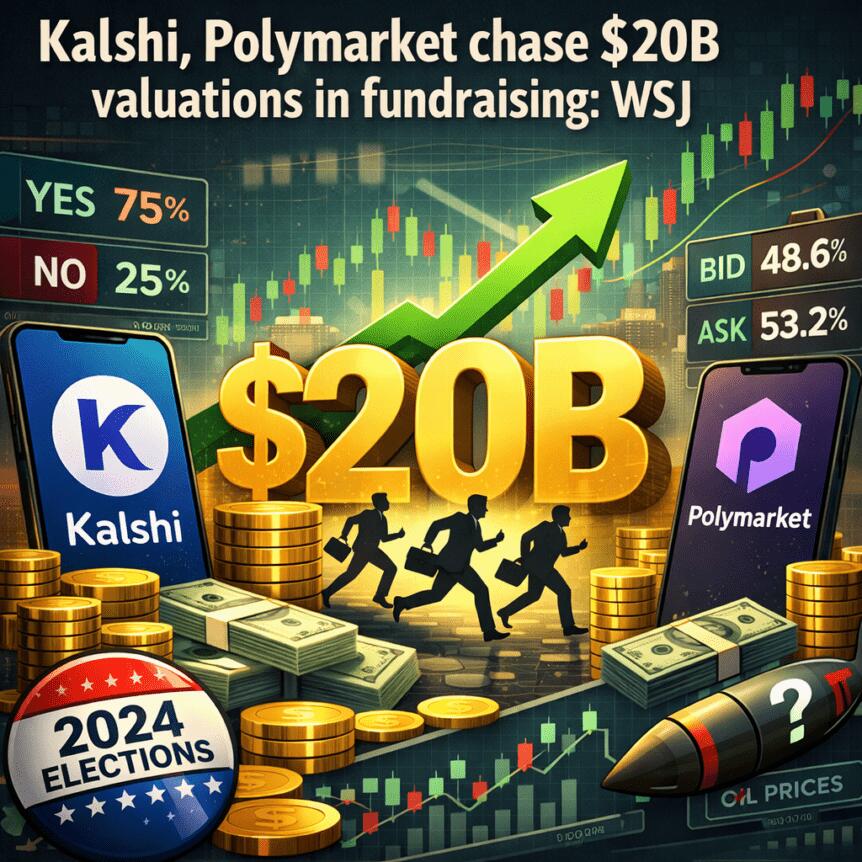
Two prediction-market platforms are pursuing high-value fundraising rounds that could place Kalshi and Polymarket at roughly $20 billion each, according to people familiar with the matter cited by the Wall Street Journal. The discussions, still in their early stages, may not culminate in a deal or reach that lofty valuation. Kalshi operates as a US-regulated exchange offering markets tied to sports, politics, the economy, and cultural events. The company was valued at about $11 billion after a $1 billion funding round in December, with investors including Paradigm and Sequoia Capital. Polymarket, founded in 2020, aims to roll out a regulated domestic version of its platform later this year, after a reported valuation around $9 billion in October following an investment of up to $2 billion by Intercontinental Exchange, the owner of the New York Stock Exchange. The discussions come as lawmakers and regulators scrutinize prediction markets amid a surge of interest in crypto-adjacent financial instruments and the broader push for regulatory clarity in digital markets.
Key takeaways
- Kalshi and Polymarket are reportedly pursuing new fundraising rounds with a target valuation near $20 billion apiece, though the talks are preliminary and could fall short of the mark.
- Kalshi’s growth has been rapid since a $1 billion funding round late last year, and it has surpassed a $1 billion revenue run rate, with estimates climbing toward $1.5 billion in annual revenue.
- Polymarket plans a regulated US version of its platform later this year, following an around $9 billion valuation after ICE’s investment of up to $2 billion.
- Regulatory attention is intensifying as US lawmakers consider legislation to regulate prediction markets in response to concerns about insider trading and the potential for unfair advantages.
- Past incidents involving Polymarket traders—allegedly profiting from advance information on geopolitical events—have heightened calls for safeguards and regulatory guardrails.
Sentiment: Neutral
Market context: The fundraising chatter underscores a broader push for regulated, institutionally backed prediction markets as mainstream financial participants weigh the benefits and risks of event-based wagering within a legal framework.
Why it matters
Prediction markets sit at the nexus of finance, technology, and regulation. Kalshi’s path to a multi-billion fundraising round signals growing institutional interest in platforms that promise regulated exposure to real-world outcomes. The company’s CFTC approval in 2020 paved the way for a regulated exchange, and its recent revenue trajectory—moving beyond the $1 billion mark—illustrates a scale that could attract heavyweight investors if the market can sustain it. Yet this growth sits alongside regulatory scrutiny, as lawmakers seek to align prediction markets with existing securities and gambling rules while guarding against illicit activity.
Polymarket’s strategy to launch a regulated US version later this year reflects a dual aim: capitalize on a potentially sizable domestic market and address friction stemming from access restrictions that have limited user participation in the past. The firm’s October valuation of around $9 billion, reinforced by ICE’s investment, underscores a belief that a compliant, domestically accessible platform could tap into a broader mainstream audience. Still, the company has faced repeated questions about insider trading and the potential for information advantages, issues that have shaped the regulatory dialogue around this sector. These concerns are not merely theoretical; cases and investigations surrounding market manipulation and timed bets have sharpened lawmakers’ sense of urgency to formalize oversight.
The regulatory dimension cannot be understated. US Democratic lawmakers have floated bills to govern prediction markets, especially after instances where bets appeared to reflect insider information during inflammatory events. The evolving policy landscape could either unlock a steady stream of institutional capital or impose tighter constraints that slow growth. In parallel, Nevada and other jurisdictions have tested the limits of these platforms, with court rulings and state actions sometimes halting trading activity. The dialogue around safety, compliance, and consumer protection is shaping a new phase for prediction-market operators who aspire to scale responsibly while navigating a patchwork of regulations.
Beyond regulation, investors will be watching how Kalshi and Polymarket translate growth into durable profitability. Kalshi’s revenue momentum, along with its industry-leading regulatory status, could provide a blueprint for how event-based markets scale under compliant models. Polymarket’s willingness to pursue a domestic rollout signals that the industry believes there is a legitimate, long-term market for transparent, outcome-based betting in the United States—so long as safeguards keep pace with innovation. The broader crypto-adjacent ecosystem is contending with questions about transparency, governance, and user protections, and the performance of these platforms could influence subsequent capital flows into related ventures and potential regulatory frameworks.
What to watch next
- Public confirmation or adjustment of the valuation and terms of any fundraising rounds, including which investors participate and any conditions tied to regulatory compliance.
- Regulatory developments in the United States, including any introduced bills that would specifically govern prediction markets and insider-trading rules for event-based platforms.
- Polymarket’s progress toward launching a regulated US version of its platform, including state approvals, licensing steps, and user-access policies.
- Ongoing or new investigations and enforcement actions related to insider trading or market manipulation on prediction-market venues, and how these shape platform governance.
- Judicial or regulatory decisions from jurisdictions where Kalshi or Polymarket operate, including any Nevada rulings or related enforcement actions that affect trading activity.
Sources & verification
- Wall Street Journal report on Kalshi and Polymarket evaluating roughly $20 billion valuations (early-stage discussions).
- Kalshi’s December funding round and its stated valuation around $11 billion, with $1 billion raised from Paradigm and Sequoia Capital.
- Intercontinental Exchange’s involvement with Polymarket, including a potential up-to-$2 billion investment and the October $9 billion valuation.
- Regulatory developments and proposed legislation in the United States aimed at prediction markets and insider-trading controls.
- Reported insider-trading concerns surrounding Polymarket bets tied to geopolitical events, including Iran-related timing and Maduro-related developments.
Prediction markets in focus as Kalshi and Polymarket pursue multi-billion rounds amid regulatory heat
Two veteran players in the prediction-market space appear poised to push into the next phase of capital formation, while a watchful regulatory eye ensures that the race toward scale does not outpace safeguards. Kalshi, which operates a US-regulated event-market trading platform, and Polymarket, known for its event-based bets, have both attracted attention from investors seeking exposure to a market that blends finance, tokenized risk, and real-world outcomes. The Wall Street Journal’s reporting that both companies are eyeing rounds around $20 billion suggests a belief among some participants that the value proposition can be realized at scale, provided the regulatory framework remains navigable.
Kalshi’s journey underscores how a traditional financial-regulatory boundary can be crossed with a model designed to align incentives with compliance. Since gaining approval from the US Commodity Futures Trading Commission in 2020 to operate an event-based exchange, Kalshi has grown rapidly. The company’s recent publicity around surpassing a $1 billion revenue run rate—and estimates pushing toward $1.5 billion—highlights the potential for a regulated, market-based product to reach significant revenue milestones even as it faces the friction of regulatory scrutiny. The company’s December fundraising, which reportedly valued it at about $11 billion, marks a high-water mark that could be revisited in a new funding round if investors are convinced by growth metrics and governance standards. The prior financing, with investors including Paradigm and Sequoia Capital, signals that the platform remains attractive to venture capital and crypto-focused funds that seek regulated exposure to event outcomes.
Polymarket’s path toward a regulated US version later this year reflects a different but complementary strategy. The firm’s $9 billion valuation in October—supported by ICE’s $2 billion investment—indicates confidence in a domestic, compliant model that could unlock broader user access. Yet Polymarket has repeatedly confronted questions about insider trading and the potential for information asymmetries to drive outcomes. High-profile episodes, including investigations and public commentary on profitable bets tied to geopolitical events, have sharpened regulators’ focus on market structure, disclosures, and governance. The push for clearer rules is not merely academic: it has the potential to restructure how prediction markets operate in the US and influence global best practices for risk-based platforms that sit at the intersection of crypto, fintech, and traditional financial markets.
As lawmakers consider new frameworks to govern these venues, the industry will need to demonstrate that it can balance innovation with integrity. The conversation is unlikely to slow the appetite for capital—especially from institutions seeking regulated exposure to event-driven outcomes—but it may determine the speed at which these platforms can expand beyond niche communities to mainstream audiences. The coming months will likely feature a flurry of regulatory filings, licensing steps, and potential court or administrative actions that could redefine the permissible scope of prediction-market activity in key US markets. For participants, the messages are clear: scale is possible, but governance, transparency, and user protection will be the decisive factors in whether multi-billion valuations translate into durable, compliant businesses.
Crypto World
ARK Invest’s Latest Moves: Wood Increases Joby Aviation and Robinhood (HOOD) Stakes, Exits Roku (ROKU)

TLDR
- On March 6, ARK Invest liquidated 32,304 Roku shares valued at $3.17 million, extending its recent pattern of position reduction
- The investment firm acquired 289,417 Joby Aviation shares totaling $2.78 million following the electric air mobility company’s improved Q4 financial results
- ARK purchased 19,206 Robinhood Markets shares for $1.55 million, capitalizing on a 4% decline in the trading platform’s stock price
- JD Logistics received $1.48 million in new investment from ARK as the logistics stock experienced approximately 22% gains on Friday
- Portfolio reductions included Iridium Communications ($2.08 million) and 10x Genomics ($1.62 million) divestments
Cathie Wood’s ARK Invest executed multiple portfolio adjustments on Friday, March 6, 2026, as financial markets wrapped up a volatile trading week. Investor sentiment remained guarded amid escalating U.S.–Iran geopolitical tensions and fresh employment data.
The firm’s daily trading disclosures revealed strategic position changes spanning fintech, technology, and aerospace sectors.
The day’s most significant transaction involved a divestment. ARK liquidated 32,304 Roku shares distributed across several funds, generating approximately $3.17 million in proceeds. This represents a continuation of Roku sales executed earlier in the week, indicating a strategic downsizing of the streaming platform position.
Additionally, ARK divested 86,890 Iridium Communications shares for approximately $2.08 million. Despite the satellite communications provider’s presence in ARK’s investment portfolio, Friday’s transaction signals a strategic retreat from the position.
The asset manager also decreased its 10x Genomics exposure, offloading 75,007 shares worth roughly $1.62 million.
ARK Boosts Aviation and Financial Technology Holdings
Among acquisitions, Joby Aviation emerged as the headline purchase. ARK secured 289,417 shares valued at approximately $2.78 million across its ARKQ and ARKX investment vehicles. The vertical takeoff and landing aircraft developer recently unveiled Q4 2025 financial performance, reporting a per-share loss of $0.14. This represented meaningful improvement from the previous year’s $0.23 loss.
Wood has consistently accumulated Joby shares in the aftermath of these earnings disclosures.
ARK expanded its Robinhood Markets holdings through the acquisition of 19,206 shares totaling approximately $1.55 million. This strategic purchase coincided with a roughly 4% decrease in Robinhood’s share price on Friday. The transactions were distributed among ARK’s ARKK, ARKW, and ARKF investment funds.
Additional March 6 Acquisitions
JD Logistics represented another notable purchase. ARK accumulated 1,129,547 shares for approximately $1.48 million via its ARKX fund. The Chinese logistics provider’s equity surged roughly 22% during Friday’s trading session.
ARK also secured 10,600 DraftKings shares valued at around $269,876.
Supplementary acquisitions encompassed Cerus Corp, Canton Strategic Holdings, and GeneDx Holdings positions.
The firm purchased 84,004 Cerus shares for $170,948, acquired 42,500 Canton Strategic shares for $191,250, and bought 9,113 GeneDx shares for $747,266.
Standard BioTools represented another complete exit, with ARK selling 397,382 shares generating $405,329 in proceeds. ARK additionally reduced its Nextdoor Holdings stake, disposing of 23,100 shares for $38,577.
These portfolio modifications were published through ARK’s routine daily disclosure filing on March 6, 2026.
Crypto World
Bloom Energy (BE) Stock Plunges 15% as Oracle-OpenAI Texas Data Center Project Gets Scrapped

Key Takeaways
- Bloom Energy (BE) shares plummeted 15.5% following the cancellation of Oracle and OpenAI’s Texas AI data center project
- The sharp decline erased gains from the previous month, where BE had risen 11.83%
- The selloff intensified during afternoon trading after Bloomberg broke the story
- BE’s valuation metrics remain elevated with a Forward P/E of 119.41 compared to the industry’s 18.47
- Wall Street maintains a Hold rating on BE, while Q1 earnings are projected to surge 200% year-over-year
Shares of Bloom Energy experienced a dramatic selloff on March 6, 2026, tumbling 15.5% after Bloomberg published a report revealing that Oracle and OpenAI have abandoned their proposed AI data center expansion project in Texas. The announcement caught investors off guard, as many had viewed data center infrastructure growth as a critical catalyst for the fuel cell manufacturer.
The steep decline wiped out recent gains for the stock. Over the preceding month, BE had advanced 11.83%, significantly outperforming the Oils-Energy sector’s 7.17% increase and contrasting sharply with the S&P 500’s modest 0.15% decline.
Market observers noted that the bulk of selling pressure materialized during afternoon trading, indicating that Bloomberg’s report hit the wires mid-session and sparked immediate investor flight.
Prior to this development, Bloom Energy had benefited from growing enthusiasm around AI infrastructure buildout. Given the substantial power requirements of data centers, many investors viewed fuel cell technology providers like BE as prime beneficiaries of this secular trend.
The cancellation of Oracle and OpenAI’s Texas facility stripped away a significant element of this investment thesis, at least for now.
Fundamental Outlook Still Promising
Despite Thursday’s sharp price action, Bloom Energy’s near-term earnings outlook remains robust. Wall Street analysts project Q1 earnings of $0.09 per share, representing a substantial 200% increase compared to the year-ago period.
Revenue forecasts for the quarter stand at $498.11 million, reflecting 52.79% year-over-year growth. Looking at the full fiscal year, consensus estimates call for earnings of $1.38 per share on top-line revenue of $3.25 billion.
The Zacks Consensus EPS estimate has been revised 106.32% higher during the past month, signaling growing analyst confidence. Bloom Energy maintains a Zacks Rank of #3, corresponding to a Hold recommendation.
Valuation Multiples Remain Extended
Even following Thursday’s correction, Bloom Energy’s valuation remains rich by traditional metrics. The stock commands a Forward P/E multiple of 119.41, substantially above the industry benchmark of 18.47. Its PEG ratio stands at 4.78, well above the Alternative Energy sector average of 1.97.
The company’s P/S ratio of 17.12 hovers near its 10-year peak. According to GF Value analysis, fair value sits at $23.95, suggesting significant overvaluation at prevailing price levels.
Institutional investors control 84.63% of outstanding shares, while company insiders have reduced positions, offloading 268,788 shares during the past three months.
From a balance sheet perspective, the company demonstrates strong liquidity with a current ratio of 5.98 and a quick ratio of 4.95. While the debt-to-equity ratio of 3.89 indicates meaningful leverage, the Altman Z-Score of 6.88 points to financial stability.
BE’s beta coefficient of 5.34 underscores the stock’s volatile nature — Thursday’s double-digit percentage decline aligns with this high-volatility profile.
Shares closed the previous session at $159.99 before succumbing to selling pressure following the data center news on March 6.
TLDR
- February nonfarm payrolls dropped by 92,000, significantly worse than the anticipated 58,000-job increase
- The unemployment rate increased to 4.4%, exceeding the 4.3% projection
- Market expectations for Federal Reserve rate cuts increased following the release, with traders pricing in several potential 2026 reductions
- Escalating Middle East tensions are driving oil prices higher, compounding inflation worries
- Federal Reserve policymakers acknowledge the challenging data while urging restraint in drawing conclusions from a single report
February’s employment report delivered a significant blow to expectations, with the Bureau of Labor Statistics revealing that 92,000 positions were eliminated across the U.S. economy. This figure stands in stark contrast to analyst predictions, which had called for approximately 58,000 new jobs to be added.
The jobless rate climbed to 4.4%, surpassing both the prior month’s 4.3% reading and Wall Street forecasts. This marks just the second time monthly employment has contracted since the pandemic-driven collapse of 2020.
Harsh winter conditions significantly impacted construction sector hiring throughout February. Additionally, a labor action involving Kaiser healthcare employees resulted in approximately 28,000 healthcare positions being subtracted from the monthly tally.
Previous employment data also underwent downward adjustments. December 2025’s initially reported 48,000-job gain was revised to show a 17,000-job loss instead. January’s numbers dropped from 130,000 to 126,000 new positions, erasing roughly 69,000 jobs from earlier estimates.
Financial markets responded swiftly to the disappointing figures. CME FedWatch data indicates March rate cut probability jumped from 2% to 4.7% following the announcement.
Prediction platforms also registered notable movement. Kalshi data reveals traders currently assign a 26% probability to exactly one rate reduction in 2026, 22% odds for two cuts, and 17% likelihood of maintaining current rates throughout the year.
Fed Officials Weigh In
Mary Daly, President of the San Francisco Federal Reserve, indicated the employment figures introduce additional challenges for upcoming policy determinations. While recognizing labor market softness, she cautioned against overinterpreting data from any single reporting period.
Daly emphasized that inflation continues running above the Fed’s 2% objective, necessitating careful policy considerations. She referenced the three rate reductions implemented in late 2025, totaling 75 basis points, as measures intended to support employment.
Neel Kashkari, Minneapolis Fed President, suggested one or two rate reductions could be warranted this year should inflation moderate. He characterized employment conditions as “steady to soft” while noting Middle East developments might warrant holding rates steady.
Retail spending figures reinforced concerns about economic momentum. Commerce Department data showed January retail sales declined 0.2%, with seven of thirteen tracked categories posting decreases.
Oil Prices Add to Inflation Pressure
Tensions between the United States and Iran have disrupted commercial shipping through the Strait of Hormuz. Extended transit routes and elevated insurance premiums are driving freight costs upward.
Brent crude oil prices pushed beyond $80 per barrel. West Texas Intermediate experienced similar increases. Qatar halted LNG shipments for the first time in three decades, potentially creating opportunities for American energy producers.
BitMEX co-founder Arthur Hayes contended that sustained Middle East instability could compel the Fed toward accommodative monetary policy, pointing to past examples.
The Federal Reserve now confronts the challenge of addressing employment weakness while inflation persists above target levels, complicated by energy price pressures stemming from geopolitical instability.
Crypto World
Ripple (XRP) Unveils Ambitious Digital Prime Broker Strategy for Institutional Adoption
TLDR
- Ripple unveiled a comprehensive whitepaper detailing its “Digital Prime Broker” framework designed for institutional and banking clients
- XRP and the XRP Ledger facilitate early settlement mechanisms through on-chain credit infrastructure
- Clients of Ripple Prime can now trade CFTC-regulated futures for Bitcoin, Ethereum, XRP, and Solana via Coinbase Derivatives with Nodal Clear settlement
- XRP Ledger’s Permissioned DEX enables institutional participation within a KYC/AML-compliant regulatory framework
- XRP currently hovers around $1.40, experiencing decline over the past 24-hour period
Ripple has introduced a comprehensive whitepaper detailing its strategy to streamline institutional access to cryptocurrency markets. At the heart of this initiative is a “Digital Prime Broker” framework, with XRP serving as a fundamental component of the system’s functionality.
Have you read Ripple’s new whitepaper in full?$XRP isn’t just payments now. They’re expanding into institutional trading infrastructure
Onchain credit lines. Prime brokerage netting Transparent funding costs
Payments was the start. This is the next layer
NEW DEMAND FOR $XRP! pic.twitter.com/S9tWuKMasz— X Finance Bull (@Xfinancebull) March 2, 2026
The primary objective addresses the currently disjointed approach institutions face when accessing digital asset markets. Presently, major financial entities navigate multiple trading partnerships, disparate credit arrangements, and substantial regulatory compliance burdens. Ripple’s proposed framework consolidates these elements into a unified access layer.
Within this architecture, a prime broker would provide on-chain credit facilities to brokers and market makers. This structure enables participants to tap into liquidity prior to standard settlement completion, accelerating transactions while improving capital efficiency.
The XRP Ledger manages settlement operations. According to Ripple, the platform supports accelerated settlement by facilitating on-chain credit lines that finance transactions before the conventional net settlement timeline concludes. Associated funding expenses are disclosed with complete transparency.
Ripple possesses existing infrastructure to support this vision. The firm’s acquisition of Hidden Road last year—now rebranded as Ripple Prime—provides an operational prime brokerage platform rather than merely a conceptual framework.
Permissioned DEX Opens Door for Regulated Institutional Trading
A recently activated Permissioned DEX on the XRP Ledger represents a crucial element of this strategic initiative. This feature enables institutional trading on-chain while maintaining control over counterparty interactions through credential-based access restrictions.
This architecture embeds KYC and AML protocols directly into the trading infrastructure. For institutions operating under stringent regulatory mandates, this integrated compliance framework proves essential.
The Permissioned DEX effectively establishes a regulated pathway within a decentralized framework, addressing what has traditionally been a significant barrier to institutional cryptocurrency adoption.
Ripple Prime Now Offers Crypto Futures on Coinbase
Ripple has further announced that Ripple Prime users can now access cryptocurrency derivatives through Coinbase Derivatives. Available products include futures contracts for Bitcoin, Ethereum, XRP, and Solana.
These contracts operate under CFTC regulation and trade continuously around the clock. Nodal Clear provides clearing services. With Ripple Prime maintaining a Futures Commission Merchant license, the platform delivers these products directly without intermediary involvement.
Coinbase additionally provides U.S. perpetual-style futures contracts, broadening the available product suite. In the previous month, Ripple Prime integrated Hyperliquid support, enabling client access to on-chain derivative products.
XRP trades near $1.40 currently, showing decline over the recent 24-hour window based on CoinMarketCap reporting.
Iran also rejected Trump’s demand for unconditional surrender but apologized to its neighbors.
The war that started last Saturday between Iran on one side and the US and Israel on the other doesn’t seem to be stopping anytime soon, despite Trump’s demands for unconditional surrender.
The POTUS has made a new set of threats after Iran’s president called Trump’s request for the country’s unconditional surrender a “dream.” Nevertheless, Iran’s authorities issued a rare apology to its neighbors for its strikes against numerous sites.
The US President continued the intense topic by warning that Iran will be hit very hard today. He also threatened that areas and groups of people that were not targeted before might be “under serious consideration for complete destruction and certain death.”
TRUMP SAYS UNDER SERIOUS CONSIDERATION FOR COMPLETE DESTRUCTION AND CERTAIN DEATH, BECAUSE OF IRAN’S BAD BEHAVIOR, ARE AREAS AND GROUPS OF PEOPLE THAT WERE NOT CONSIDERED FOR TARGETING UP UNTIL THIS MOMENT IN TIME
— *Walter Bloomberg (@DeItaone) March 7, 2026
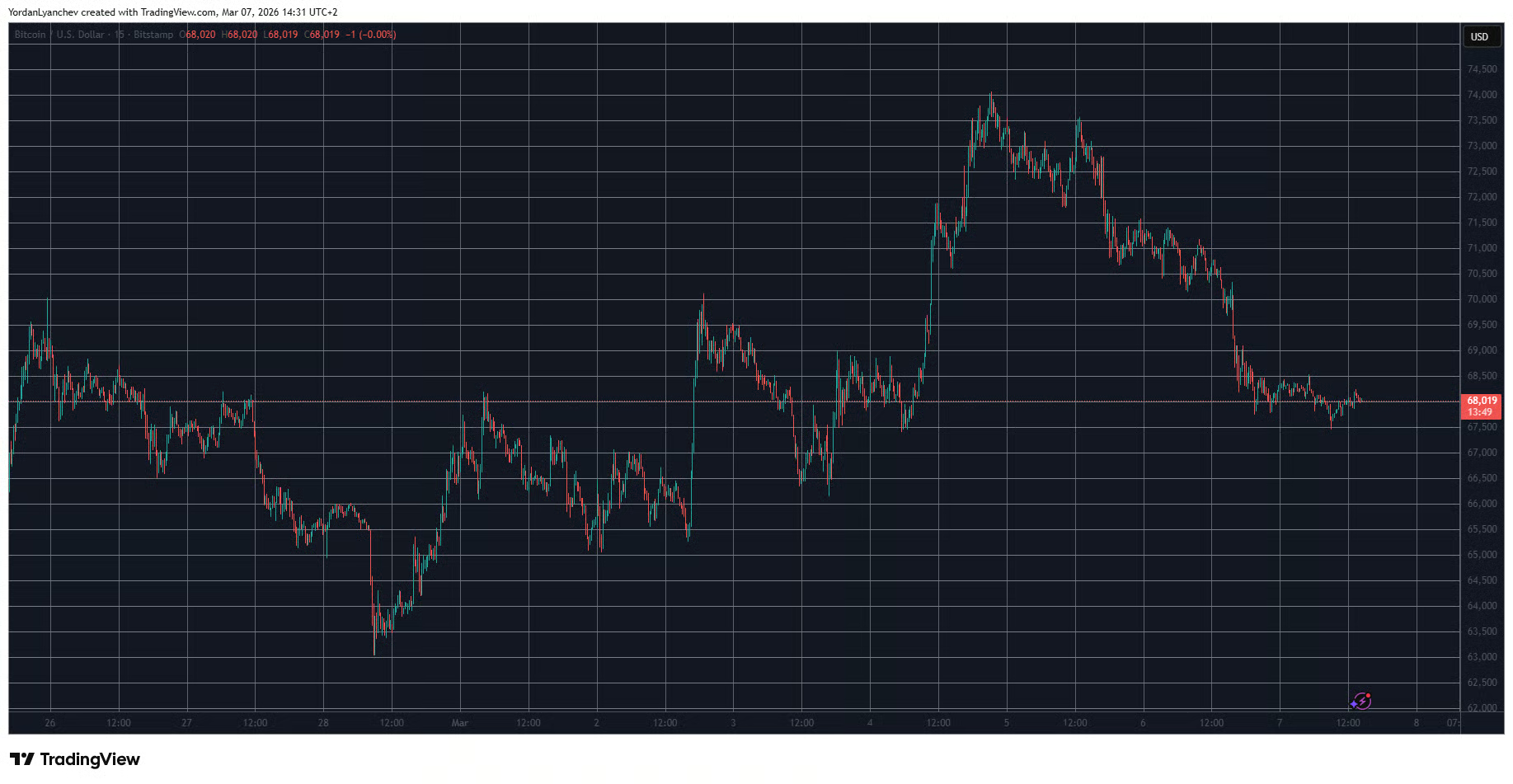
Recall that once the first strikes hit their targets last week, BTC’s price tumbled immediately from $67,000 to $63,000. However, it rebounded to $68,000 during the same day, especially after reports emerged that Iran’s Supreme Leader had been killed during the attacks.
It kept climbing mid-week as the tension grew and hit a monthly high at $74,000 on Wednesday. Nevertheless, it was rejected there, and the weak US jobs report from Friday, as well as Trump’s latest remarks on Iran and Cuba, sent it south to $68,000.
Today’s developments have left BTC unfazed as it continues to trade at around $68,000. However, more volatility might ensue if Trump’s threats become reality, especially since the crypto market is the only financial industry available for trading during the weekends.
You may also like:
Binance Free $600 (CryptoPotato Exclusive): Use this link to register a new account and receive $600 exclusive welcome offer on Binance (full details).
LIMITED OFFER for CryptoPotato readers at Bybit: Use this link to register and open a $500 FREE position on any coin!
TLDR:
- OmniPact raised $50M from anonymous institutional investors and family offices to advance its trust protocol.
- The funding will cover mainnet development, security audits, and a Q1 2026 testnet launch on schedule.
- Smart contracts serve as on-chain guarantors, removing all intermediaries from peer-to-peer transactions.
- OmniPact’s roadmap includes RWA integration and AI agent transaction capabilities across multiple chains.
OmniPact has secured $50 million in a private funding round to advance its decentralized trust infrastructure. The New York-based protocol is building a trust layer for peer-to-peer transactions involving both physical and digital assets.
A consortium of institutional investors and family offices backed the round, requesting anonymity. The capital will speed up mainnet development, cross-chain integration, and the launch of a decentralized arbitration module, bringing the project closer to full global deployment.
Funds to Drive Mainnet Development and Technical Expansion
A large share of the proceeds will fund the final development of OmniPact’s core contracts. Security audits of the multi-chain infrastructure are also scheduled as part of this phase.
Both steps must be completed before the protocol can advance into public deployment. This work is set to run alongside active engineering efforts on the mainnet.
OmniPact also confirmed that its testnet launch remains on schedule for Q1 2026. This milestone gives the protocol a clear timeline as it moves toward full market entry. Reaching this target would place OmniPact ahead of many competitors in the decentralized commerce sector.
Part of the capital will also go toward expanding OmniPact’s engineering team. More developers are expected to speed up real-world asset (RWA) integration across the platform. AI agent transaction capabilities are also being developed as part of this funding cycle.
Co-founder and CEO Alex Johnson commented on the raise, stating: “The funding validates our thesis that the future of commerce requires a neutral, transparent, and trustless foundation.”
Johnson added that the infrastructure “eliminates intermediaries entirely, returning power to users.” He further noted that investor confidence would allow the team to bring secure, decentralized custody to a global audience.
Smart Contracts and Decentralized Arbitration as the Trust Layer
OmniPact’s protocol is built to solve the trust problem that persists in peer-to-peer transactions. The platform deploys smart contracts as on-chain guarantors, removing reliance on any centralized platform. Two parties can therefore transact directly, with no third-party intermediary required.
Furthermore, the protocol pairs algorithmic custody with a built-in decentralized arbitration module. A reputation system operates alongside both tools, reinforcing accountability across all user activity.
Together, these mechanisms support secure and verifiable peer-to-peer asset exchange. The model also removes single points of failure common in traditional escrow services.
Cross-chain integration forms another technical pillar of OmniPact’s core architecture. The protocol is engineered to function across multiple blockchain networks at the same time. This gives the platform access to users operating across different digital asset ecosystems.
Institutional backers expressed confidence in OmniPact’s roadmap at the time of the announcement. They cited the protocol’s capacity to set new standards across both Web4 and traditional commerce.
Johnson concluded that the round gives the team the resources to “execute our roadmap” and deliver a live, fully operational protocol to a global audience.

Why Kandi Burruss Still Supports ‘RHOA’ After Her Surprising 2024 Departure

Morrisons confirms significant change to UK store checkouts

Pentagon taps former DOGE official to lead its AI efforts


-

 Politics4 days ago
Alan Cumming Brands Baftas Ceremony A ‘Triggering S**tshow’
-
Business24 hours ago
Form 8K Entergy Mississippi LLC For: 6 March
-

 Tech6 days ago
Unihertz’s Titan 2 Elite Arrives Just as Physical Keyboards Refuse to Fade Away
-

 NewsBeat7 days ago
Abusive parents will now be treated like sex offenders and placed on a ‘child cruelty register’ | News UK
-

 Fashion20 hours ago
Weekend Open Thread: Ann Taylor
-
 NewsBeat7 days ago
Dubai flights cancelled as Brit told airspace closed ’10 minutes after boarding’
-

 NewsBeat6 days ago
‘Significant’ damage to boarded-up Horden house after fire
-

 Tech2 days ago
Bitwarden adds support for passkey login on Windows 11
-

 Entertainment5 days ago
Baby Gear Guide: Strollers, Car Seats
-
 Sports2 days ago
499 runs and 34 sixes later, India beat England to enter T20 World Cup final | Cricket News
-
 NewsBeat6 days ago
Emirates confirms when flights will resume amid Dubai airport chaos
-
Politics7 days ago
FIFA hypocrisy after Israel murder over 400 Palestinian footballers
-

 NewsBeat5 days ago
Is it acceptable to comment on the appearance of strangers in public? Readers discuss
-

 Tech6 days ago
Viral ad shows aged Musk, Altman, and Bezos using jobless humans to power AI
-

 Video5 days ago
How to Build Finance Dashboards With AI in Minutes
-

 Fashion6 days ago
On the Scene at the 57th Annual NAACP Image Awards: Teyana Taylor in Black Ashi Studio, Colman Domingo in Yellow Sergio Hudson, Chloe Bailey in Christian Siriano, and More!
-

 Business4 days ago
Guthrie Disappearance Enters Fifth Week as Family Visits Memorial
-
 NewsBeat5 days ago
Ukraine-Russia war latest: Belgium releases video showing forces boarding Russian shadow fleet oil tanker
-
 Crypto World6 days ago
US Judge Lets Binance Unregistered Token Class Action Proceed
-

 Crypto World5 days ago
Why Nexo Is Reentering the US After the 2023 Crypto Lending Crackdown