
Crypto World
Ripple News and XRP Price Update Today: June 4

Ripple’s native token has plunged alongside the rest of the crypto market, recording a steep drop in recent days.
This comes even as the company continues to expand globally and institutional interest in the asset remains solid.
Partnerships and More
Ripple has been inking strategic deals lately, and many have focused on its USD-pegged stablecoin, RLUSD. Earlier this week, the firm shook hands with the Turkish crypto platforms BiLira, Bitexen, and Bitlo, aiming to boost adoption and usage of the product.
Moreover, it partnered with Istanbul Technical University (ITU) through RLUSD funding to support research initiatives and graduate fellowships, and establish an on-campus XRPL validator.
Most recently, the global payments giant Mastercard enhanced its infrastructure to enable merchants and partners to settle transactions using various digital assets, including RLUSD.
Besides the collaborations related to the stablecoin, Ripple strengthened its presence in its homeland by opening an expanded office in Washington, D.C., thus reinforcing its “long-term commitment to constructive engagement with policymakers, regulators, and industry partners in the nation’s capital.” Speaking on the matter was Stuart Alderoty:
“Expanding our Washington, D.C. presence reflects our long-term commitment to constructive engagement, regulatory clarity, and U.S. leadership in financial innovation. As blockchain and digital assets become more integrated into the financial system, Ripple is committed to helping shape policy that protects consumers, supports responsible innovation, and keeps America competitive.”
The ETF Front
Unlike spot BTC and ETH exchange-traded funds, those with XRP as the underlying asset have attracted substantial capital lately. Data show that inflows have outpaced outflows over the past several weeks, indicating that institutional investors have increased their exposure to the token, thereby requiring the products’ issuers, including Bitwise, Canary Capital, Franklin Templeton, 21Shares, and Grayscale, to purchase real XRP.
However, June 3 finally ended the positive streak, as spot ETFs posted a daily net flow of -$5.34 million. Since their launch, these financial vehicles have generated a cumulative total net inflow of more than $1.42 billion.

XRP Price Outlook
Ripple’s cross-border token is down 10% for the week, and that shouldn’t come as a surprise. After all, the entire crypto market has been bleeding heavily, with Bitcoin (BTC) dropping to nearly $61,000 and Ethereum (ETH) tumbling to roughly $1,700.
Recent whale activity suggests the XRP bulls may suffer further pain in the near future. As CryptoPotato reported, these big investors have sold or redistributed 60 million tokens over the last seven days. Such an exodus could spark panic across the community and cause smaller players to cash out, too. Meanwhile, some analysts believe the price could slip under $1 in the short term.
The post Ripple News and XRP Price Update Today: June 4 appeared first on CryptoPotato.


Telegram is facing a fresh legal fight in Australia after the country’s online safety regulator moved to seek civil penalties, alleging the messaging service did not adequately address terrorism-linked content.
According to a statement from Australia’s eSafety Commissioner, the regulator filed civil penalty proceedings against Telegram in the Federal Court on Thursday, accusing the platform of failing to meet obligations under the nation’s Online Safety Act.
Key takeaways
- Australia’s eSafety Commissioner has launched civil penalty proceedings against Telegram in Federal Court over alleged failures to tackle pro-terror content.
- The regulator alleges Telegram did not respond sufficiently to multiple user complaints and that some reported material remained visible for as long as three weeks.
- eSafety claims Telegram failed to take adequate preventive steps, including actions to remove or disrupt repeat violators such as channels and groups.
- The case forms part of broader, escalating scrutiny of Telegram’s moderation practices in multiple countries.
- eSafety says penalties could reach up to 54.6 million Australian dollars (about $35.8 million) for violations of the Online Safety Act.
Australia’s allegations focus on delayed takedowns and repeat violations
In its filing, eSafety says it conducted a year-long investigation and concluded that Telegram did not remove certain unlawful material after it became aware of it. The regulator alleges that, in some instances, reported content continued to be visible for up to three weeks.
eSafety further argues that Telegram’s approach was not only reactive but insufficiently protective against repeat behavior. The regulator alleges Telegram did not take adequate steps to prevent renewed violations, including removing accounts and groups used to distribute pro-terror material.
The regulator also contends Telegram failed to detect known extremist content in advance. eSafety cites examples that later were removed, including footage from the 2019 Christchurch mosque shootings and the 2022 Buffalo mass shooting.
What the regulator is asking the court to decide
eSafety is seeking financial penalties, reflecting the seriousness of its claimed breaches of Australia’s online safety framework. Under the Online Safety Act, eSafety notes that violations can carry penalties up to 54.6 million Australian dollars (about $35.8 million).
Telegram has not publicly issued an official statement addressing the Australian proceedings. However, its official X account posted a video captioned “freedom of expression.”
Telegram did not immediately respond to a request for comment regarding the case.
Telegram’s moderation scrutiny extends beyond Australia
Australia’s action arrives amid intensifying pressure on Telegram’s leadership and the platform’s content-handling practices internationally.
Earlier coverage from Cointelegraph noted that Russia’s Federal Security Service (FSB) announced it had charged Telegram founder Pavel Durov with facilitating terrorist activity and initiated steps to place him on an international wanted list. The Russian authorities alleged Telegram failed to remove channels, chats and bots that they say were used by Ukrainian intelligence services, terrorist groups and extremist organizations to coordinate attacks, recruit operatives and conduct cyber fraud.
Telegram has not issued an official response to the latest legal developments in Russia, though it has posted content related to Durov on its social channels.
Broader legal pressure on Durov in Europe
Durov also remains under investigation in France following his arrest in August 2024 at Le Bourget Airport, as previously reported by Cointelegraph. French prosecutors have charged him with offenses including complicity in the distribution of illegal content, including material connected to organized crime, through Telegram.
Durov has in the past criticized what he described as increasing threats to online privacy, warning that governments were rolling back protections for a free internet.
In an October 2025 post on X, Durov wrote that “What was once the promise of the free exchange of information is being turned into the ultimate tool of control.”
Why this matters for investors and platform users
Even beyond the immediate legal stakes, regulators targeting moderation and takedown performance could reshape how Telegram handles harmful content at scale—especially if courts accept eSafety’s allegations about delayed removal and insufficient preventive measures. Readers should watch for the court’s findings and any changes Telegram makes to notice-and-action processes, repeat-violation handling, and detection workflows.
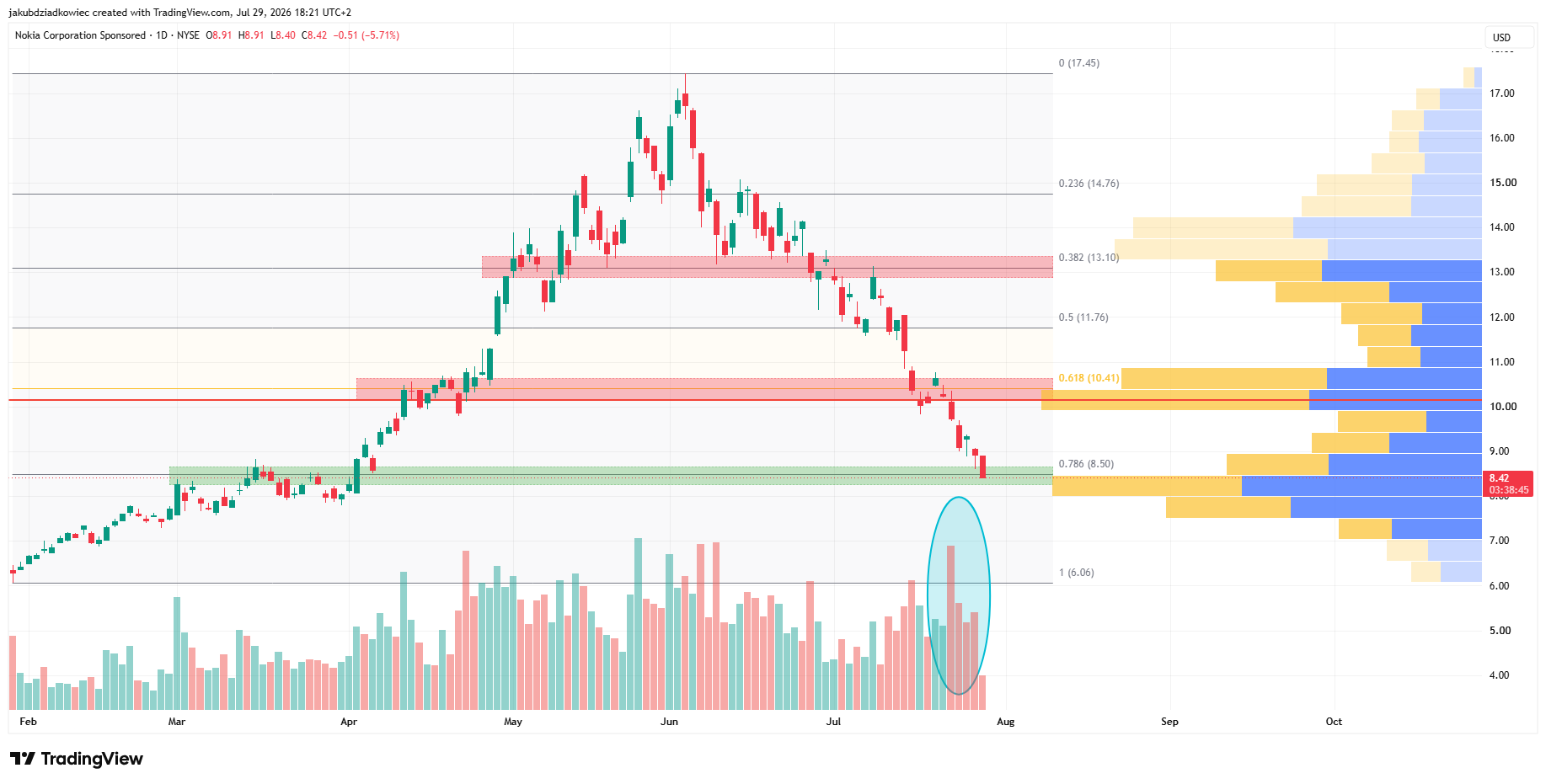
Nokia (NOK) stock traded at $8.44 on Wednesday, down 5.54% intraday, after sellers pushed the price to the 0.786 Fibonacci retracement at $8.50. It is the last major support above the January low of $6.06.
The drop extends Tuesday’s 5.6% slide and deepens a decline that started at the June peak of $17.45. NOK has lost roughly 52% of its value in less than two months.
Why Nokia Stock Is Falling Again This Week
Part of this week’s weakness was mechanical. Tuesday, July 28, was the ex-dividend date for Nokia’s quarterly dividend of 0.04 euros per share, which will be paid on August 6.
However, the adjustment explains only about 0.5% of the move. The rest reflects profit-taking that has continued since last week’s post-earnings breakdown, when investors sold the memory shortage outlook rather than the strong quarter.
Analysts have also started trimming expectations. On July 27, Deutsche Bank lowered its Nokia price target to 11.50 euros from 13.50 euros, while keeping a Buy rating on the shares.
Meanwhile, the sector backdrop remains heavy. Intel dropped 11% after an earnings beat, and profit-taking spread across AI hardware names. Nokia now falls with the sector rather than on company-specific news alone.
NOK Price Analysis Shows Bulls Defending the $8.50 Level
On the daily chart, the Fibonacci retracement drawn from the January low of $6.06 to the June top of $17.45 still maps the decline. The June peak ended a months-long rally fueled by AI and cloud demand.
NOK lost the 0.618 golden pocket at $10.41 last week, and a large spike in volume accompanied the breakdown. Such volume signals conviction among sellers, which favors trend continuation.

The slide has now reached the 0.786 retracement at exactly $8.50. This is the bulls’ final line of defense, and they must step in immediately to hold it.
The Visible Range Volume Profile (VRVP) adds weight to both levels. Its two largest volume nodes sit near $10.41 and $8.50, so these zones will likely act as resistance and support over the coming days or weeks.
Nokia RSI at 27 Gives Bulls No Divergence to Lean On
The daily Relative Strength Index (RSI) reads 27, below the oversold threshold at 30. Historically, such depressed readings can produce short-term bounces, as other beaten-down names showed during this earnings week.
However, there is no sign of a bullish divergence yet. The indicator keeps printing lower lows together with the price, so momentum still favors the sellers.

If NOK loses $8.50 on a daily close, the next support zone sits at the $6.06 anchor low, roughly 28% below Wednesday’s price. In contrast, a daily close back above $10.41 would invalidate the bearish outlook.
Until then, the market decides between a defended floor at $8.50 and a full retest of $6.06.
To read the latest stock market analysis from BeInCrypto, click here.
The post Nokia Bulls Have One Level Left to Defend After 52% Crash From June Peak appeared first on BeInCrypto.
Veteran macro investor Jordi Visser says the easy money in artificial intelligence (AI) is gone. He thinks Bitcoin (BTC) is where the next big gains turn up.
New company filings help explain why. The biggest AI spenders are now burning cash faster than they bring it in.
Big Tech Is Burning Cash to Build AI
Google spent more cash last quarter than it collected. That has never happened since the company listed in 2004.
The measure that matters here is free cash flow. It is simply the money left over after a company pays for the data centers it is building.
All three of the biggest AI spenders saw that cushion shrink.
Company
Cash left over, April to June
Same quarter last year
Microsoft
$19.6 billion
$25.6 billion
Meta
$784 million
$8.5 billion
Alphabet
Negative $5.9 billion
Positive $5.3 billion
Meta’s drop is the eye-catching one. A year ago it kept $8.5 billion. This time it kept $784 million.
Its own release shows why. Sales rose 28%. Costs rose 55%. Meta then borrowed $24.91 billion to keep building. It spent $31.08 billion on new capacity in three months.
One fair caveat. Some of those costs were legal bills and layoff payments, not AI. Together they came to $3.58 billion.
Microsoft looks the healthiest of the three. Its filing shows sales up 18% and its Azure cloud business up 43%.
Even so, its spare cash fell 23%. Nobody escaped the squeeze. Only the size of it changed.
Why Jordi Visser Says the AI Trade Is Over
Visser has worked in markets for more than 30 years. He runs AI research at 22V Research and founded Visser-Labs. He used to be chief investment officer at hedge fund Weiss Multi-Strategy Advisers.
“The AI trade’s over. The ability of getting seven, eight times your money in that is over,” Jordi Visser, on a podcast.
Follow us on X to get the latest news as it happens
He does not think AI is finished. He thinks the returns are shrinking.
Investors used to hope for seven or eight times their money. He now expects closer to 30% a year. That is still good. It is just no longer a windfall.
The reason is competition. Cheap open-source models keep catching up, so no company stays ahead for long. Wall Street is already split on AI chips as a result.
Goldman Says US Stocks Have No Fuel Left
Big investors have little spare money to put to work. Goldman Sachs told clients that leaves stocks stuck.
Hedge funds have already borrowed heavily to buy shares. Their borrowing sits near the top of the past five years.
“There are limited sources of ‘juice’ for rallies in the immediate term. We still need to get through rubble of the past couple weeks before we can start the conversation for any meaningful re-risking,” Bloomberg reported, citing Goldman Sachs trading desk.
Regular investors are pulling back too. Trading activity this month is more than 3% below the five-year average.
Computer-driven funds are the bigger worry. They hold about $196 billion in US shares. A further slide could force them to sell $15.7 billion inside a week.
The wider mood is nervous. The Federal Reserve held rates steady in a 9 to 3 vote. The Dow then fell 1,153 points, its worst day since April 2025.
Long-term borrowing costs jumped as well. The 30-year Treasury closed at 5.20%, its highest level since 2007.
Why Bitcoin and Ethereum Could Benefit
Visser expects AI programs to start moving money on their own. Blockchains are where that would happen.
He does not think Bitcoin leads the way, though. He expects Ethereum to do better, because investors now prefer networks that earn fees.
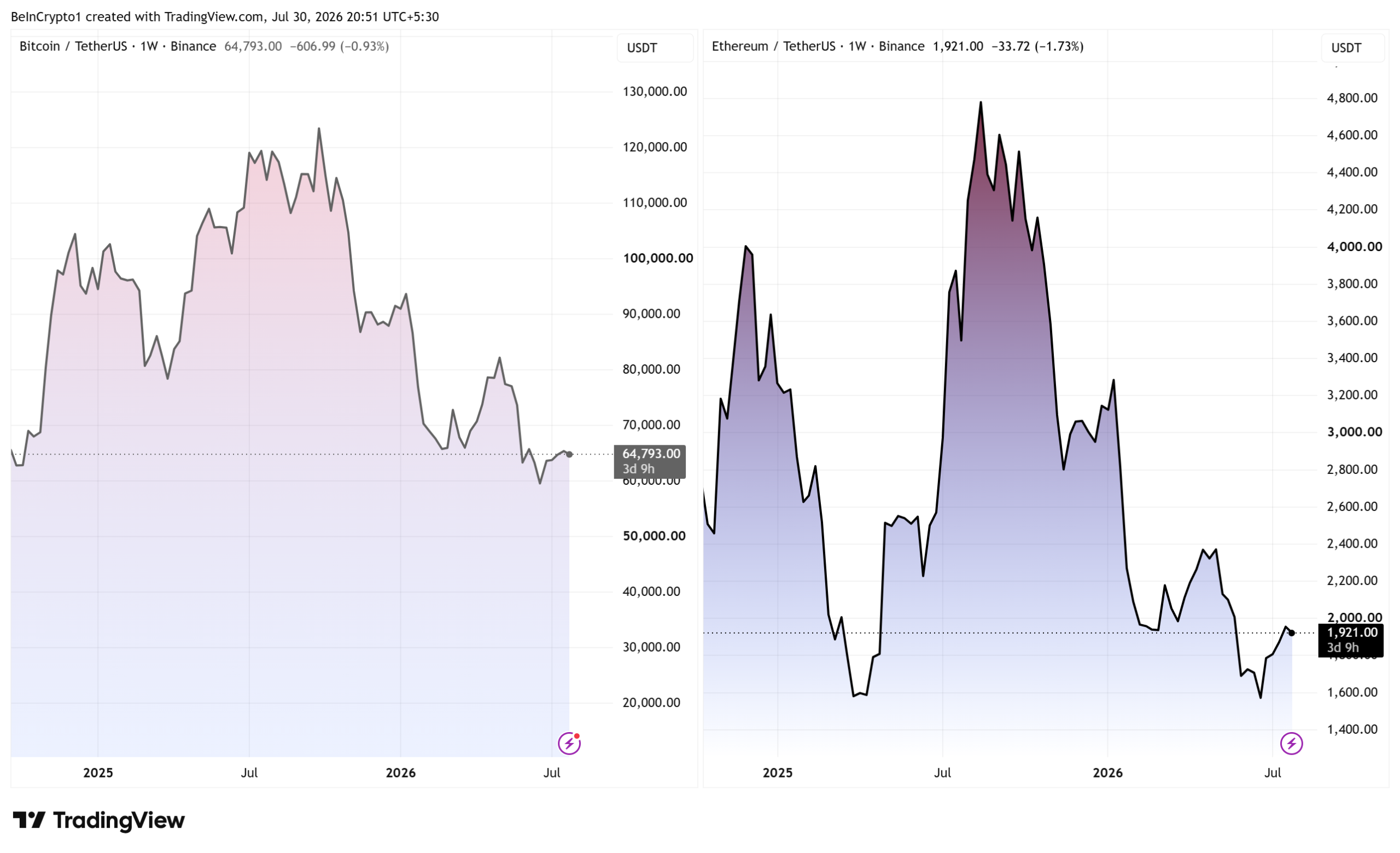
The past month backs him up. Ethereum (ETH) trades near $1,921 and is up 23.3% in 30 days. Bitcoin trades near $64,793 and is up 10.9%.

Zoom out and the picture flips. Over a year, Bitcoin is down 45% and Ethereum 49%.ETH also sits 61% below its 2025 peak. Bitcoin’s current price is 49% below its own record.
So this is a one-month shift, not proof of a new cycle. It matches three bullish Ethereum signals spotted this week, and not much more.
What to Watch Over the Next 30 Days
Visser is waiting on one law. The CLARITY Act would finally decide which US regulator watches which crypto asset.
Traders doubt it passes. Polymarket puts the odds near 30%, and seven roadblocks remain in the Senate.
Rates are the other question. Morgan Stanley economist Mike Gapen expects inflation to ease to about 3.3% by December. That would keep the Fed still. Three officials already wanted a rise.
Then there are buybacks. Goldman expects 90% of big US companies to be free to buy their own shares by mid-August.
Visser needs a law and a buyer. Whichever shows up first will tell us more than any earnings call did.
The post Veteran Macro Investor Says AI’s Easy Money Is Over and Bitcoin Is Next appeared first on BeInCrypto.
Japan slashed its growth forecast for the current fiscal year to 0.9% on Thursday, blaming surging crude oil prices and a weaker yen for squeezing the import-dependent economy.
The downgrade exposes how quickly Middle East tensions can reshape the outlook for an advanced economy.
The Oil and Currency Assumptions Behind the Downgrade
Fiscal year 2026 in Japan runs from April 2026 through March 2027, the standard period governments use for budgeting and forecasting. The Cabinet Office presented the revision alongside updated fiscal projections.
The new figure marks a sharp cut from January. Officials had projected 1.3% growth just six months ago, before global energy markets turned against the country.
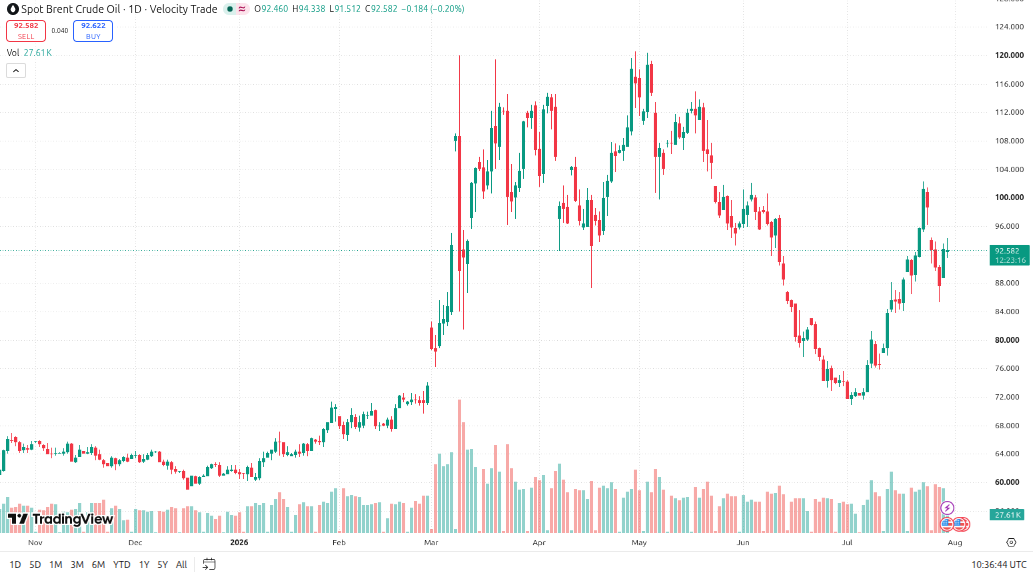
Two assumptions drive the revision. The government now models crude oil at $92.5 per barrel, well above its earlier estimate of $68.
Currency expectations shifted just as dramatically. Officials assume the yen is trading at 161.4 per dollar, compared with 155.2 in the previous forecast.
Follow us on X to get the latest news as it happens.

Both changes hit the same pressure point. Resource-poor Japan imports nearly all of its energy, so higher prices and a weaker currency inflate costs across the entire economy. Household spending absorbs much of that initial shock. Private consumption, which drives more than half of Japanese output, is now forecast to grow just 0.9% instead of 1.3%.
Business investment faces similar pressure. Capital expenditure should rise just 2.3% this year, down from the 2.8% that officials projected back in January.
Inflation moves in the opposite direction. Consumer prices are now expected to climb 2.2%, up from the earlier 1.9% estimate, further testing household purchasing power.
Can Japan Recover Growth in Fiscal Year 2027
Prime Minister Sanae Takaichi’s administration paired the downgrade with a more optimistic medium-term view. Growth should recover to 1.1% in fiscal 2027, according to the same projections.
That rebound depends on policy execution. The government is promoting investment in crisis management, strategic sectors, and public-private partnerships, while new budget guidelines give ministries greater flexibility for growth-oriented projects.
The fiscal arithmetic tells a mixed story. The primary balance, which excludes debt interest, should post a wider deficit of 1.2 trillion yen ($7.4 billion) this year because of supplementary budgets.
Next year looks considerably better on paper. Officials expect a surplus of 1.4 trillion yen ($8.7 billion) in fiscal 2027, driven largely by higher tax revenues.
Subscribe to our YouTube channel to watch leaders and journalists provide expert insights.
That projected swing carries genuine political significance. Japan holds one of the heaviest public debt burdens among developed nations, making credibility with bond markets essential.
Oil markets still remain the central variable. Brent crude has traded around the $80 range recently, while the Bank of Japan points to underlying resilience in exports and specific industrial sectors.
The post Japan Cuts Fiscal 2026 Growth Forecast to 0.9% on Oil and Weaker Yen appeared first on BeInCrypto.
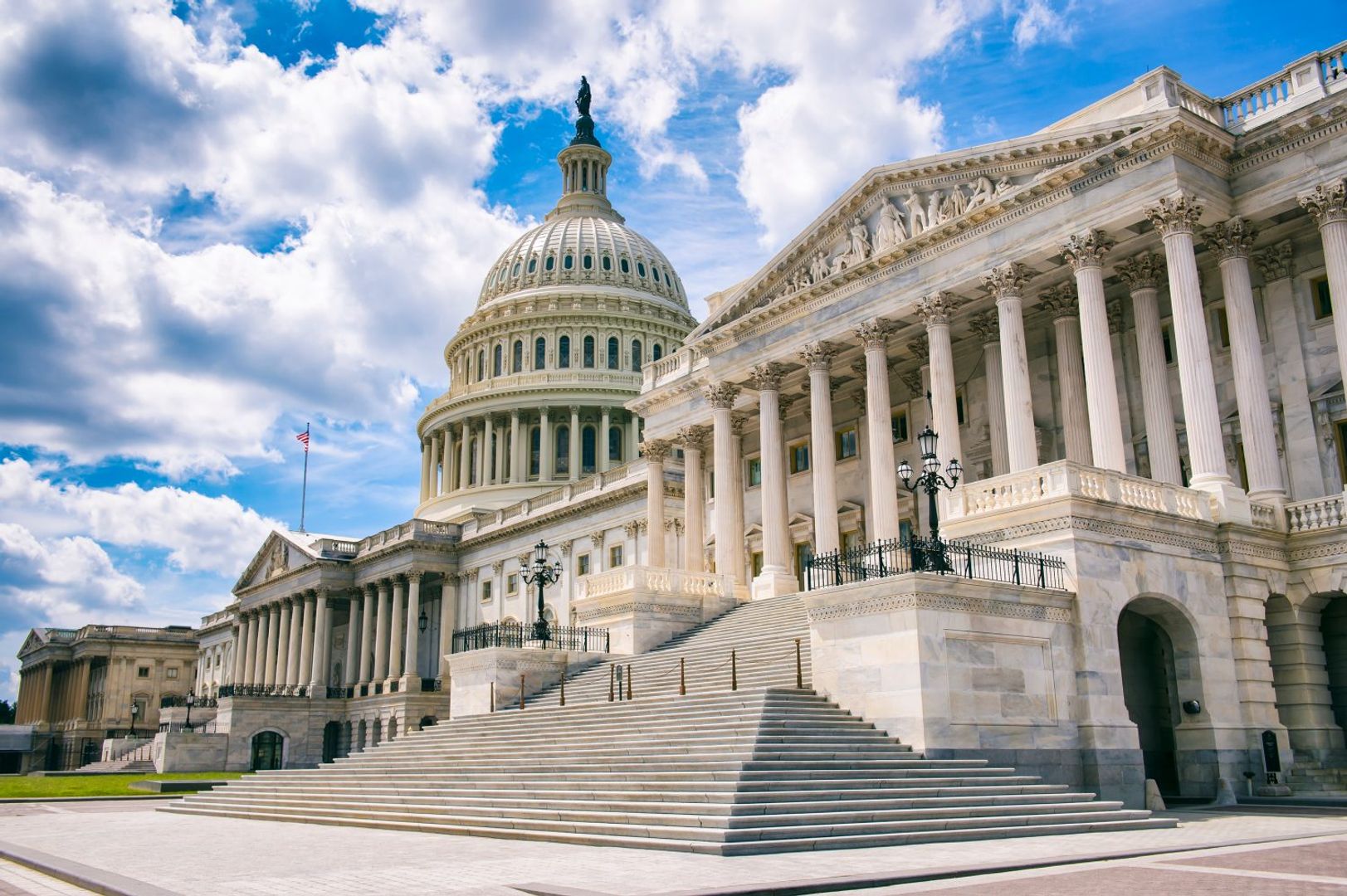
The proposed act is widely viewed as a cornerstone for the next phase of institutional crypto adoption. By establishing clear rules for digital assets, the legislation could give banks, brokers, exchanges and asset managers greater confidence to invest, launch products and build market infrastructure, accelerating the migration of trading and liquidity to regulated U.S. venues.
JPMorgan analysts said the legislation would encourage institutional investment, boost U.S.-regulated trading and lower barriers for banks, exchanges, custodians and market makers.
Some of those trends are already emerging, the bank said, citing Citadel Securities’ $400 million investment in Crypto.com and the CFTC’s approval of the first U.S.-regulated perpetual crypto futures contracts.
The report cautioned, however, that parts of the current draft could deter institutional participation by allowing some tokenized securities and derivatives trading outside SEC or CFTC oversight and imposing lighter anti-money laundering requirements than those faced by traditional financial firms.
Investment bank Jefferies warned that the Clarity Act still faces significant hurdles despite clearing the Senate Banking Committee, according to a report last month.
Read more: Jefferies warns of crypto market volatility as Clarity Act faces Senate test


Aave, the largest decentralized lending protocol, is considering a proposal to abandon six of the blockchains it had expanded onto, in a cleanup affecting about $98 million in deposits. The proposal would see Aave retire “low-adoption” asset markets and 21 expired Pendle principal tokens across 11 Aave deployments, while shutting down its presence on Sonic, Scroll, zkSync, Metis, Soneium and Aptos entirely.
The arguments is based on economics. Each of the six deployments now generate less than $5,000 a quarter. Metis, Soneium and Aptos bring in under $1,000 each, according to the proposal. That does not cover the cost of running them, which includes maintaining price feeds, liquidation systems and monitoring for each market.
For context, Aave’s Ethereum mainnet deployment generates more than $142 million a year and Base about $4.7 million, while Metis produces roughly $3,000.
Deposits have collapsed across all six over six months. Soneium fell 95%, available liquidity on Aptos dropped 94%, zkSync declined 88% to about $844,000, Scroll fell 86% to roughly $2 million, Metis dropped 79%, and Sonic, the largest of the group, fell 74% to just under $8 million.
Ethereum continues to trade within a critical technical area after recovering sharply from its June lows. While the broader rebound remains intact, the latest price action suggests momentum is fading as buyers and sellers battle for control beneath major resistance.
Ethereum Price Analysis: The Daily Chart
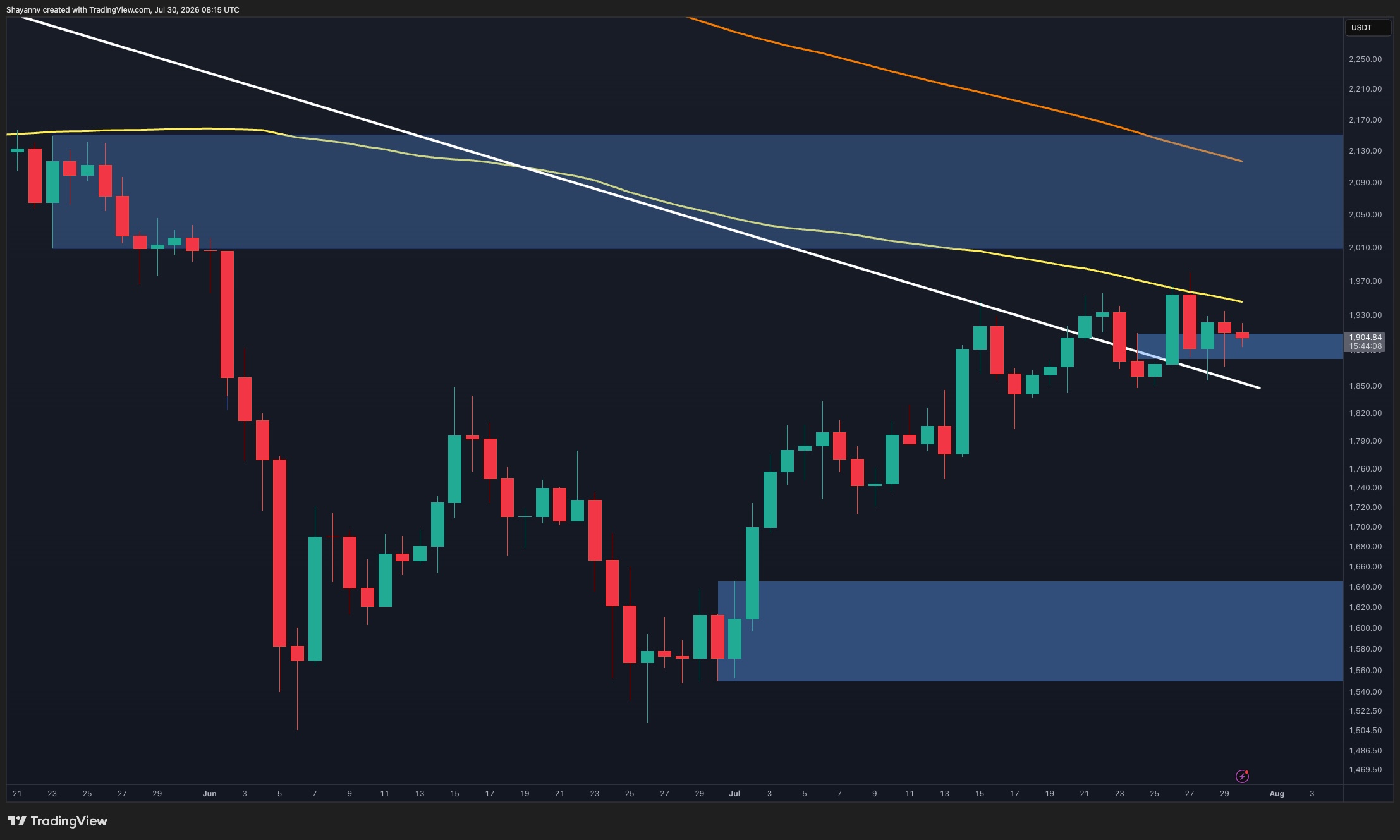
On the daily timeframe, Ethereum remains below both the 100-day and 200-day moving averages, keeping the broader trend cautious despite the recovery from the June bottom. The recent rally stalled just below the 100-day MA near the $1.95K region, where sellers quickly stepped in and pushed the price back toward the $1.88K to $1.91K supply zone.
This area is now acting as immediate resistance. A successful breakout above it would improve the medium-term outlook and expose the confluence of the 100-day and 200-day moving averages inside the $2.02K to $2.15K resistance zone. Until then, ETH remains vulnerable to another rejection.
On the downside, the $1.75K to $1.79K demand zone remains the first important support. Losing this area would likely trigger a deeper correction toward the major demand region around $1.56K to $1.64K.
ETH/USDT 4-Hour Chart
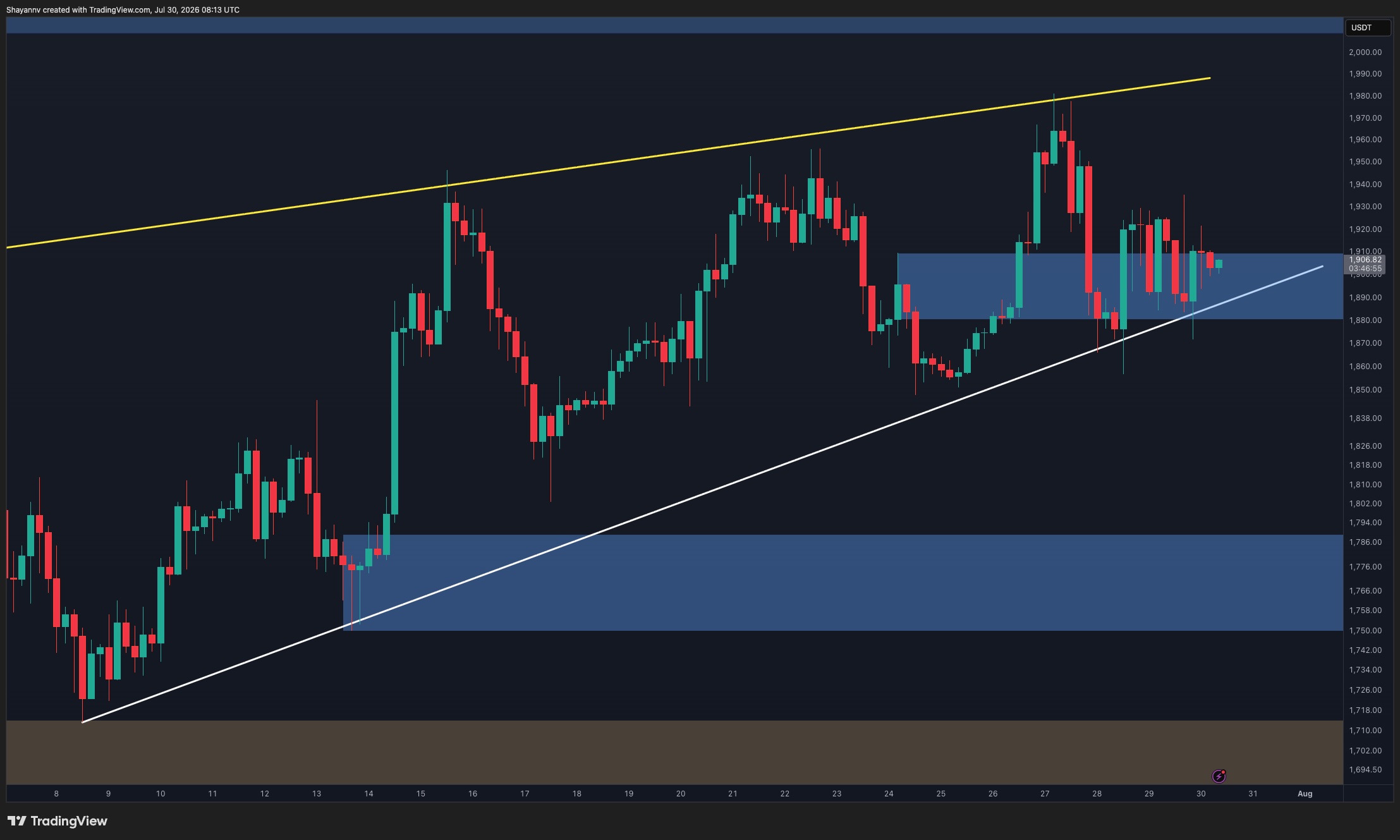
The 4-hour chart shows Ethereum trading inside a compression pattern, with price action confined between the rising white trendline and the descending yellow trendline. This narrowing range reflects increasing indecision as neither buyers nor sellers have been able to establish a decisive directional move.
Ethereum is currently consolidating around the $1.88K to $1.91K resistance zone while continuing to respect the ascending support trendline. A breakout above both the resistance zone and the descending trendline would likely strengthen bullish momentum and pave the way for another attempt at the recent highs.
However, a breakdown below the white ascending trendline would invalidate the current sequence of higher lows and could accelerate a correction toward the $1.75K to $1.79K demand zone, where buyers would be expected to defend the broader recovery structure.
Sentiment Analysis
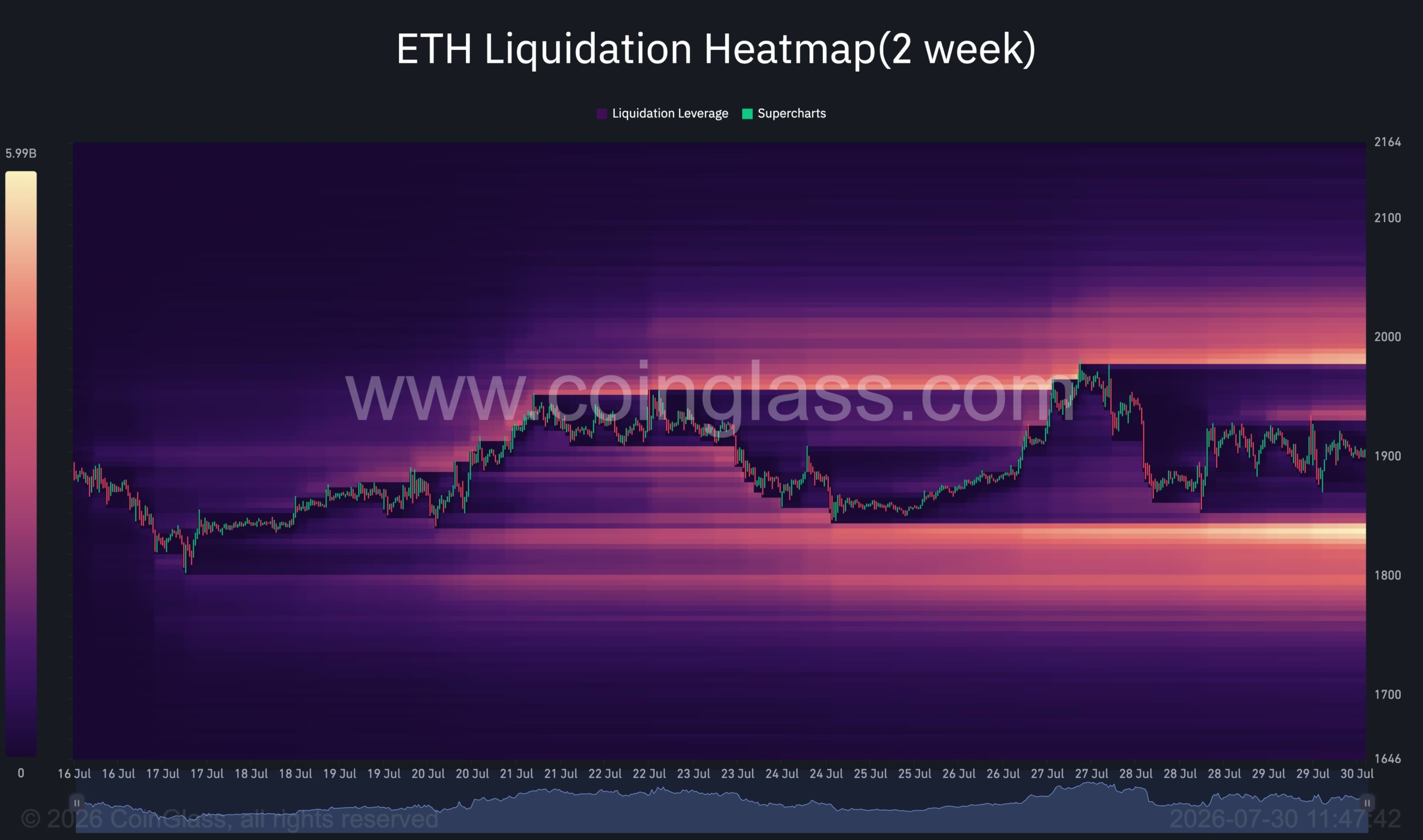
The two-week Binance liquidation heatmap highlights a notable concentration of liquidity above the current price around the $2K level, making it the primary upside liquidity target if buyers regain momentum.
At the same time, a significant liquidation cluster has formed around the $1.82K region beneath the market. Since price is currently trading between these two liquidity pools, Ethereum may continue to experience choppy and range-bound price action before making a decisive move toward one of these high-liquidity areas. A sweep of either cluster could trigger increased volatility as leveraged positions are liquidated.
The post Ethereum Price Analysis: ETH Holds Key Support but Bullish Momentum Fades appeared first on CryptoPotato.

Yet rather than add nurses, many hospitals are paring back, sometimes turning to apps where they can hire nurses as gig workers. Such apps often allow hospitals to avoid paying for benefits for these workers, says Katie Wells, a senior fellow at the AI Now Institute, which has studied gig apps for nursing. “Lean staffing has just become the norm,” Wells says.
The American Hospital Association argues that the issue is not lean staffing but that instead there are workforce shortages that are projected to continue for more than a decade.
“The growing complexity and intensity of patient care, along with overly burdensome regulatory requirements and increased administrative demands from corporate insurers, continue to place significant demands on nurses,” the association said in a statement provided to TIME.
Hospitals are also facing increased costs of caring for patients, according to a March 2026 post by Rick Pollack, AHA’s president and CEO. In 2025, he writes, hospital expenses grew 7.5%, more than twice the rate of growth in hospital prices. Hospitals are also caring for patients who are sicker and whose care is more complex than it used to be, he points out.


The US Treasury’s Office of Foreign Assets Control (OFAC) sanctioned two firms accused of supporting an IRGC-backed scheme that allegedly extorted commercial vessels transiting the Strait of Hormuz by requiring them to purchase maritime insurance.
Wednesday’s designations hit the Persian Gulf Marine Insurance Company and HormuzSafe Marine Services Authority, known as Hormuz Safe. Treasury says the policies extract revenue while covering risks that Iran itself creates.
Follow us on X to get the latest news as it happens
How Iran’s Hormuz Insurance Scheme Drew US Sanctions
The IRGC reportedly began collecting transit fees from tankers passing through the Strait of Hormuz in April, with charges starting at approximately $1 per barrel.
The Treasury said the insurance scheme was created to offset revenue lost following Operation Epic Fury. Treasury Secretary Scott Bessent linked the initiative to Iran’s worsening economic conditions.
“With its economy in freefall and inflation in the triple digits, the regime is desperate for cash,” he said.
According to the department, Iran established the “illegitimate schemes” through the Persian Gulf Marine Insurance Company (PGMIC) and HormuzSafe Marine Services Authority.
It said Iran’s Ministry of Economy developed HormuzSafe. It offers insurance, traffic control, security, and emergency response services to vessels transiting the strait.
The firm accepts payments in Bitcoin (BTC) and other digital assets as part of Iran’s efforts to circumvent Western sanctions.
The Treasury also noted that Iran’s insurance regulator created the Persian Gulf Marine Insurance Company, which issues policies approved by the Persian Gulf Strait Authority.
OFAC sanctioned the IRGC-backed authority on May 27. It has now designated both the Persian Gulf Marine Insurance Company and HormuzSafe Marine Services Authority under Executive Order 13902 for operating in Iran’s financial sector.
In addition, OFAC sanctioned eight shipping companies and identified eight oil tankers as blocked property. The operators are registered in Hong Kong, the Marshall Islands, and China. According to the Treasury, the vessels transported Iranian crude oil and petroleum products.
The agency has now sanctioned more than 100 shadow fleet vessels since January. The latest measure is part of a broader US enforcement action against Iran.
In mid-July, the Treasury sanctioned four cryptocurrency wallets linked to Iran’s central bank. At the same time, Tether froze approximately $131 million in USDT held in those addresses.
Subscribe to our YouTube channel to watch leaders and journalists provide expert insights
The post OFAC Targets Iran’s Crypto-Funded Toll Scheme in Strait of Hormuz appeared first on BeInCrypto.


Pi Network paid more than a million people to verify eighteen million identities across half a billion discrete tasks, then published the exact formula for what it paid them. Every outlet reproduced the formula. Not one converted it to dollars. Here is the number, and what it says about crypto’s largest experiment in distributed human labour.
Summary
- Pi Network distributed its first round of KYC validator rewards to 1,094,680 people who completed 526,970,631 verification tasks, confirming roughly 18 million identities.
- The formula is published by Pi itself: a pool of 16,568,774 Pi contributed by migrating users, plus 10 million Pi from the Pi Foundation, divided by the task count, giving 0.0504179 Pi per validation.
- Converted at Pi’s current price near $0.077, the entire distribution is worth approximately $2 million, and a single validation pays roughly four tenths of one cent.
- The average validator completed around 481 tasks and received about 24 Pi, worth under two dollars at current prices and roughly four dollars at the price when rewards landed.
- Pi describes the rate as 21 times the base mining rate, which is accurate and means the base mining rate is worth approximately two hundredths of a cent per unit.
There is a specific kind of number that gets repeated across dozens of articles without anyone stopping to convert it, and Pi Network produced a textbook example this year. The project announced that more than a million verified users had completed over 526 million identity-validation tasks, confirming eighteen million people across two hundred countries, and that all of those validators had now been paid. It is a remarkable operational achievement, arguably the largest distributed human-labour experiment ever run on a blockchain, and Pi has since positioned that workforce as infrastructure available to artificial intelligence companies that need verified humans in the loop. The coverage was extensive and uniformly impressed.
Pi published the exact reward formula on its own blog. Eight or more outlets reproduced it faithfully, quoting 0.0504179 Pi per validation and noting that this represents 21 times the base mining rate. One publication’s page carries the sentence “arriving at a price per validation of approximately” followed by nothing at all, the figure simply missing. Nobody multiplied by the token price. This piece does, and the resulting number reframes both the achievement and the business built on top of it.
The formula, and the number it produces
Start with Pi’s own arithmetic, because the project publishes it in full and there is no dispute about the inputs.
Every Pioneer who completed identity verification and migrated to the Mainnet contributed 1 Pi into a shared reward pool. By the snapshot date of March 5, 2026, that produced a pool of 16,568,774 Pi, corresponding to the same number of migrated users. The Pi Foundation added a further 10 million Pi, acknowledging that much of the earliest validation work had served to train the validator workforce instead of processing final applications. Total pool: 26,568,774 Pi.
That pool was divided by 526,970,631 successful validations, producing a price per validation of 0.0504179 Pi. Validators needed at least 50 qualifying validations reaching majority agreement to receive a payout, and rewards were transferred directly to Mainnet wallets.
Now the conversion nobody performed.
At Pi’s current price of approximately $0.077, the entire distribution is worth roughly $2.05 million. A single validation pays about $0.0039, four tenths of one cent. The minimum qualifying threshold of 50 validations pays approximately $0.19.
Divide the task count by the validator count and the average participant completed around 481 validations, earning roughly 24.3 Pi. At current prices that is about $1.87. At the price when the rewards were distributed in early April, when Pi traded near $0.176, it was closer to $4.27.
So the headline reads: more than a million people completed half a billion tasks and received, on average, somewhere between two and four dollars each.
What the multiple actually means
The most-repeated framing in the coverage is that the rate represents 21 or 22 times the base mining rate, and Pi states this directly. It is accurate, and it is worth thinking about what it implies instead of accepting it as the reassurance it is presented as.
If 0.0504179 Pi is 21 times the base mining rate, the base mining rate is approximately 0.0024 Pi. At current prices that is roughly two hundredths of one cent.
A multiple is only informative relative to its base. Twenty-one times a very small number is a slightly less small number, and describing the validator rate as 21x invites the reader to conclude that validation is well compensated, when what it actually shows is that mining rewards are worth almost nothing and validation is worth somewhat more than almost nothing.
This is the same pattern this publication has documented elsewhere in crypto metrics. A network celebrating 1.4 million agent transactions turned out, on the arithmetic, to have generated roughly $280 in total fees, because transactions on that chain cost two hundredths of a cent. In both cases the underlying activity is real, the technology works, and the number that gets promoted measures volume while the number that would measure value goes unpublished. Our guide to why transaction counts mislead covers the general form of the error; this is the labour-market version of it.
Why the task count is so large
One structural point deserves explanation, because it is the reason 18 million identities required 527 million validations and it is to Pi’s credit.
Pi’s verification system is built for privacy preservation. Rather than handing a complete application to one reviewer, the system splits each application into discrete tasks: a liveness video check, a document review, a photo match, a data-consistency check, a name verification, each assigned to a different validator, and each requiring at least two independent validators to agree before the step passes.
Applications with complications, such as name-change requests or repeat submissions, generate additional checks on top of that baseline.
The result is that no single validator ever sees a complete picture of an applicant’s personal data. Pi states that an average application requires roughly 20 validations, and the arithmetic across the full dataset works out closer to 29 checks per identity confirmed.
That design choice is defensible and unusual. Most identity-verification providers hand a complete file to one reviewer or to an automated system, which is faster and cheaper and considerably worse for privacy. Pi chose to multiply the task count in exchange for compartmentalising the data, and it paid for that choice in validator hours.
It also means the per-task figure understates what a validator is compensated for a complete identity. Twenty-nine tasks at 0.0504179 Pi is roughly 1.46 Pi per identity confirmed, worth about eleven cents at current prices, distributed across the twenty-nine different people who touched it.
The AI business built on this number
The reason the arithmetic matters is that Pi is now marketing this workforce commercially, and the economics of that offer depend entirely on what the workforce costs.
Pi has formally articulated a strategy positioning its verified user base as infrastructure for artificial intelligence companies, targeting data labelling, reinforcement learning from human feedback, and model evaluation. The pitch is specific and, on its own terms, strong: more than 18 million identity-verified humans across 200-plus countries, each already holding a functioning wallet, with a proven production-scale precedent of half a billion completed tasks. Both co-founders took that pitch to a major industry conference this year.
The strategic logic is real. Verified-human labour is genuinely scarce and getting scarcer as generated content and automated accounts contaminate every open data source, and the AI industry does need what Pi has built. Existing distributed-work platforms struggle with exactly the problems Pi has solved: onboarding friction, payment rails across jurisdictions, and confidence that the worker is a person.
The uncomfortable half is the price. A workforce that accepted four tenths of a cent per task, denominated in a token trading near its all-time low, is either an extraordinary cost advantage or an unsustainable one, and which it is depends on why people participated. If validators were working for the token’s future value and not its present value, the labour supply is contingent on price expectations that the chart has been steadily contradicting. If they were working because the task volume was low and the marginal effort trivial, the supply may not scale to commercial data-labelling workloads that require sustained attention.
Pi has acknowledged part of this. It says future distribution rounds should produce higher per-validation rates as automation handles more routine checks, leaving fewer human validations per application and a pool divided among fewer tasks. That is a sensible design response, and it also means the commercial pitch is being made on economics the project itself expects to change.
The gap in the user base
One further figure deserves the same treatment, because it sits alongside the task count in every Pi announcement and receives even less scrutiny.
Pi describes an engaged user base in the tens of millions, with figures above 60 million appearing routinely in its communications and in coverage. The KYC programme this piece examines verified approximately 18 million identities. Of those, 16,568,774 had migrated to the Mainnet by the March snapshot, which is the figure the reward pool was built from, since each migrated Pioneer contributed exactly 1 Pi.
Set those numbers against each other and the funnel is stark. Something on the order of 60 million people engaged with the application. Roughly 18 million completed identity verification. Roughly 16.6 million completed migration to the Mainnet. The gap between the top and bottom of that funnel is larger than the entire verified user base of most cryptocurrencies.
The attrition is not necessarily damning, and the reasons are mundane, not sinister. Verification requires documents many users do not have or will not submit. Migration requires deliberate action from people who joined a free mobile application years ago and may have forgotten it. Some accounts were duplicates or automated, which the verification process exists to catch, and catching them is a success, not a loss.
But it matters for the commercial pitch, because the number Pi markets to potential AI customers is the verified figure and the number that appears in most public discussion is the engagement figure. Those are different populations by a factor of more than three, and the addressable workforce is the smaller one. Of that smaller one, roughly a million people, about six percent of verified users, actually performed validation work in the first round.
A workforce of a million active participants is substantial and unusual for a blockchain project. It is also considerably smaller than the headline suggests, and any assessment of what Pi can deliver commercially should start from the million who worked, not the sixty million who once downloaded something.
What the number does not prove
An honest treatment names what the arithmetic cannot settle, and there are three things.
It does not prove exploitation. Validators opted in voluntarily, the work was intermittent and required no commitment, most participants were already mining Pi on their phones for years at rates the validation payout exceeded twenty-fold, and nobody was induced to leave other employment. Comparing four tenths of a cent per task to a minimum wage assumes an employment relationship that did not exist.
It does not prove the workforce is worthless. Half a billion completed tasks with majority-agreement thresholds is a real operational output, and the fact that it was cheap says as much about Pi’s ability to mobilise its community as about the rate. Any conventional provider attempting the same verification volume with the same privacy compartmentalisation would have paid enormously more.
And it does not settle the token question. The value of these rewards is a function of Pi’s price, which sits near its all-time low after a long decline. The same 24 Pi that is worth under two dollars today was worth more than four dollars in April and would be worth considerably more if the token recovered. Validators paid in an asset instead of cash hold a claim whose value is undetermined, which is the oldest arrangement in crypto and cuts both ways.
What the number settles is the framing. An achievement described in hundreds of millions of tasks is, in dollar terms, a two-million-dollar programme, and any assessment of Pi’s commercial AI ambitions should start from that figure rather than from the task count.
The comparison the pitch invites
If Pi is selling a verified-human workforce to artificial intelligence companies, the honest exercise is to price it against what those companies currently pay, because that comparison is the entire commercial case and nobody has run it.
The established distributed-labour platforms operate on per-task pricing that varies enormously by complexity, from fractions of a cent for the simplest classification work to several dollars for tasks requiring judgment, domain knowledge, or sustained attention. Reinforcement learning from human feedback, the category Pi names explicitly, sits toward the expensive end, because it requires annotators who can evaluate model outputs coherently and consistently, and the labs buying it have historically paid accordingly.
Pi’s demonstrated rate is four tenths of a cent per task. That is competitive at the very bottom of the market and nowhere near the categories Pi is targeting in its pitch.
Two readings follow, and they point in opposite directions. The optimistic one is that the rate reflects what Pi chose to pay for internal work using a token it issues, not what it would charge a commercial client, and that a paying customer’s budget would flow to validators at market rates with Pi taking a spread. On that reading the 526 million tasks prove capability and mobilisation, not price, and the low figure is irrelevant to the commercial offer.
The sceptical reading is that the participation itself was a function of the rate being incidental. People completed validations in spare moments, on phones, for a token they were already accumulating, with no expectation that the payout would matter. Asking the same population to perform sustained, quality-controlled annotation work for real money is asking for a different behaviour from a different worker, and the fact that a million people tapped through simple checks says relatively little about whether fifty thousand of them will label training data to a standard a laboratory accepts.
Both readings are consistent with the evidence, and the distinguishing test is straightforward: a named commercial client, a task type, and a rate. Until one of those exists, the 526 million figure proves that Pi can mobilise its community for near-free work, which is a genuine and unusual asset, and does not yet prove that the community will work for customers.
What Pi built that others could not
Setting the arithmetic aside for a moment, an honest assessment has to credit what this programme accomplished, because the achievement is real and the criticism above does not touch it.
Verifying eighteen million identities across more than two hundred countries is a task that established identity providers charge substantial sums for and frequently perform badly. The industry standard is either full automation, which fails on document variety and produces false rejections at scale in exactly the countries with the least standardised paperwork, or outsourced human review, which concentrates sensitive personal data in a small number of processing centres and has produced repeated breaches. Pi did neither. It built a system that splits each application across many reviewers so that no individual sees a complete file, requires independent agreement at each step, and pays participants in the network’s own asset through infrastructure it also built.
That combination has not been achieved elsewhere at this scale, and the privacy property in particular is a genuine engineering accomplishment, not a marketing claim. Compartmentalised review is harder, slower, and more expensive in labour terms than the alternatives, which is precisely why nobody does it, and Pi absorbed that cost by having a community willing to work for a token.
The payment rail matters too and receives even less attention than the verification design. Distributing rewards to more than a million people across two hundred countries, in amounts averaging a couple of dollars, is operationally impossible through conventional financial infrastructure. Payment processors will not handle it, the fees would exceed the payments, and the compliance burden of onboarding a million micro-payees in that many jurisdictions would swamp any project attempting it. A blockchain with pre-verified wallet holders solves that specific problem completely, and it is the clearest instance in this whole story of crypto doing something the existing system genuinely cannot.
So the fair summary holds two things at once. The economics are far smaller than the headline numbers imply, and the infrastructure that produced them does something no conventional provider could. Whether the second fact can be sold to customers at a price that makes the first fact irrelevant is the entire question hanging over Pi’s commercial strategy, and it will be answered by a contract rather than by a milestone announcement.
What to watch
The second distribution round. Pi says it is refining the validator performance algorithm before the next round and expects higher per-validation rates. Whether that materialises, and at what dollar value, is the single most informative upcoming data point.
Whether any AI customer signs. The commercial pitch has been made publicly. A named client, a contract value, or a disclosed pilot would convert the strategy from a positioning statement into a business. Its absence over the coming quarters would be equally informative.
Task volume after automation. Pi expects automation to reduce human validations per application. That improves per-task pay and shrinks the total workforce opportunity simultaneously, and the two effects pull in opposite directions for anyone valuing the labour network.
The token price against participation. If validator participation holds while the price falls, the labour supply is not primarily price-motivated, which strengthens the commercial case considerably. If it falls with the price, the workforce is a function of speculation rather than of wage.
Open Mainnet. The transition remains pending with no announced date, and the terms of it determine whether validators can convert rewards freely, which is what makes any of these numbers real for the people who earned them.
A closing note on why this conversion was worth doing at all, since the arithmetic is trivial and the inputs were public the whole time.
Crypto produces an unusual density of figures that are technically accurate and practically uninformative, and they share a shape. A count, a multiple, or a cumulative total, quoted without the unit that would let a reader size it. Half a billion tasks. Twenty-one times the base rate. Sixteen and a half million Pi plus ten million more. Every one of those statements is true, verifiable, and published by the project itself in good faith. Together they produce an impression of scale that a single multiplication dissolves.
The reason the multiplication does not get done is not conspiracy. It is that the party with the strongest incentive to publish the number is the party with the least reason to, and the outlets covering the announcement work from the press release under time pressure, reproducing the figures they are given. One of them, working from Pi’s own blog post, left the per-validation figure out of the sentence entirely and published anyway. That is what a supply chain of unconverted numbers looks like in practice.
The correction is available to any reader with a calculator, and the habit generalises well beyond this project. When a crypto announcement leads with a count, find the price and multiply. When it leads with a multiple, find the base. When it leads with a cumulative figure, find the period. The result is frequently smaller than the headline suggests, occasionally larger, and always more useful than the number you were handed.
Frequently Asked Questions
How much did Pi validators actually earn?
Approximately 0.0504179 Pi per validation, which at Pi’s current price near $0.077 is about four tenths of one cent per task. The average validator completed roughly 481 tasks and received around 24 Pi, worth under two dollars at current prices and roughly four dollars at the price when the rewards were distributed in early April.
How was the reward pool calculated?
Pi publishes the formula. Every Pioneer who completed KYC and migrated to the Mainnet contributed 1 Pi, producing a pool of 16,568,774 Pi by the March 5, 2026 snapshot. The Pi Foundation added 10 million Pi, and the combined 26,568,774 Pi was divided by 526,970,631 successful validations to give 0.0504179 Pi per validation.
What does “21 times the base mining rate” mean?
That the base mining rate is approximately 0.0024 Pi, worth around two hundredths of one cent at current prices. The multiple is accurate, and it is informative only relative to its base: 21 times a very small number is a slightly less small number, which is a different statement from the one the framing invites.
Why did 18 million identities need 527 million tasks?
Privacy design. Pi splits each application into discrete tasks, a liveness check, a document review, a photo match, a data-consistency check, a name verification, each handled by a different validator, with at least two independent validators required to agree per step. No single validator sees a complete file. That works out to roughly 29 checks per identity confirmed.
Is this exploitation?
The arithmetic does not support that framing on its own. Participation was voluntary and intermittent, required no commitment, and paid more than twenty times what the same users were already earning from mobile mining. Comparing the per-task rate to a wage assumes an employment relationship that did not exist. What the arithmetic does show is the programme’s true scale in dollars.
What is Pi doing with this workforce commercially?
Positioning it as infrastructure for artificial intelligence companies, targeting data labelling, reinforcement learning from human feedback, and model evaluation, on the basis of 18 million verified humans across 200-plus countries with existing wallets and a demonstrated production precedent. Both co-founders presented the strategy at a major industry conference this year. No named customer has been disclosed.
Will future rounds pay more?
Pi says yes, on the reasoning that automation will handle more routine checks, reducing human validations per application and dividing the pool among fewer tasks. That would raise per-validation pay while shrinking total workforce opportunity, and it means the current commercial pitch rests on economics the project itself expects to change.
What should observers actually track?
The second distribution round’s per-validation rate in dollars, whether any AI customer is named with a contract value, whether validator participation holds as the token price falls, and the terms of the pending Open Mainnet transition, which determines whether rewards are freely convertible for the people who earned them. This is educational analysis, not investment advice.
Disclaimer: This article is for information and educational purposes only and does not constitute financial or investment advice. Token prices change continuously and all dollar conversions reflect prices at the time of writing. Nothing here is a recommendation to buy, sell, or hold any asset, or to participate in any programme. Always do your own research. Information is accurate as of July 30, 2026.

Mum who murdered toddler daughter filmed smoking cigarette as tot lay dying

Luke Littler’s dominance sparks GOAT debate

Cowboys RB Jaydon Blue makes massive claim while showing off speed at training camp


-

 Fashion6 days ago
Weekend Open Thread: Brooks Brothers
-
 Sports4 days ago
Commonwealth Games boxing: Jadumani Singh seals dominant 5-0 win over Pakistan’s Sumama Rehman to enter quarter-finals | Commonwealth Games News
-

 Business20 hours ago
Why Trees Belong on the Risk Register
-

 Tech4 days ago
Intel is reversing course and bringing hyper-threading back to its server chips
-

 Crypto World5 days ago
Ripple bought a bank in pieces. The $4 billion audit
-

 Politics3 days ago
Luke Littler dismantles Gerwyn Price to retain title in Blackpool
-

 Politics2 days ago
The Part of the Electric Transition Nobody Wants to Discuss
-
 Entertainment6 days ago
A New Post-Apocalyptic Gundam Anime Series Blasts Into SDCC
-

 News Videos4 days ago
BITCOIN JUST ENTERED THIS CRITICAL ZONE…
-

 Fashion7 days ago
16 Dresses for the High Summer Event
-

 Sports7 days ago
2026 3M Open leaderboard: Scottie Scheffler finds putter in Round 1, sits three back
-

 News Videos7 days ago
The Peugeot Family: How 200 Years of an “Old Money” Dynasty Died in A Boardroom
-

 Business1 day ago
Major shareholder moves on Canyon
-

 Crypto World4 days ago
XRP Ledger adds $2.6B as RWA inflows rank second
-

 Politics4 days ago
Spain sweeps the board at 2026 World Cup with individual awards
-

 News Videos5 hours ago
Bitcoin Enters the 3rd Stage of the Bear Market
-
 Entertainment2 days ago
‘Stargate’ Creator’s New Sci-Fi Series Returns for Season 3 Tomorrow
-

 Tech5 days ago
Anthropic launches Claude Opus 5, a cheaper AI model for coding, agents and enterprise workflows
-

 Crypto World2 days ago
Kraken Enables Retail Access to Jersey Mike’s IPO via Tokenized Shares
-

 Entertainment5 days ago
Sara Gilson Killed By Husband After Viral “Pedophile” TikTok Video
You must be logged in to post a comment Login