

Crypto World
Ripple Price Analysis: Where’s XRP Going Next After Latest Rejection at the 100-Day MA?

XRP is trading at $1.37 as May draws toward its final week, having erased every gain from what briefly looked like the most promising technical setup of the corrective cycle. The breakout above the 100-day MA on the USDT chart has failed to hold, and a lower high has formed on the BTC pair. The levels that looked like support last week are now the targets that bulls need to reclaim just to get back to where they started.
Ripple Price Analysis: The USDT Pair
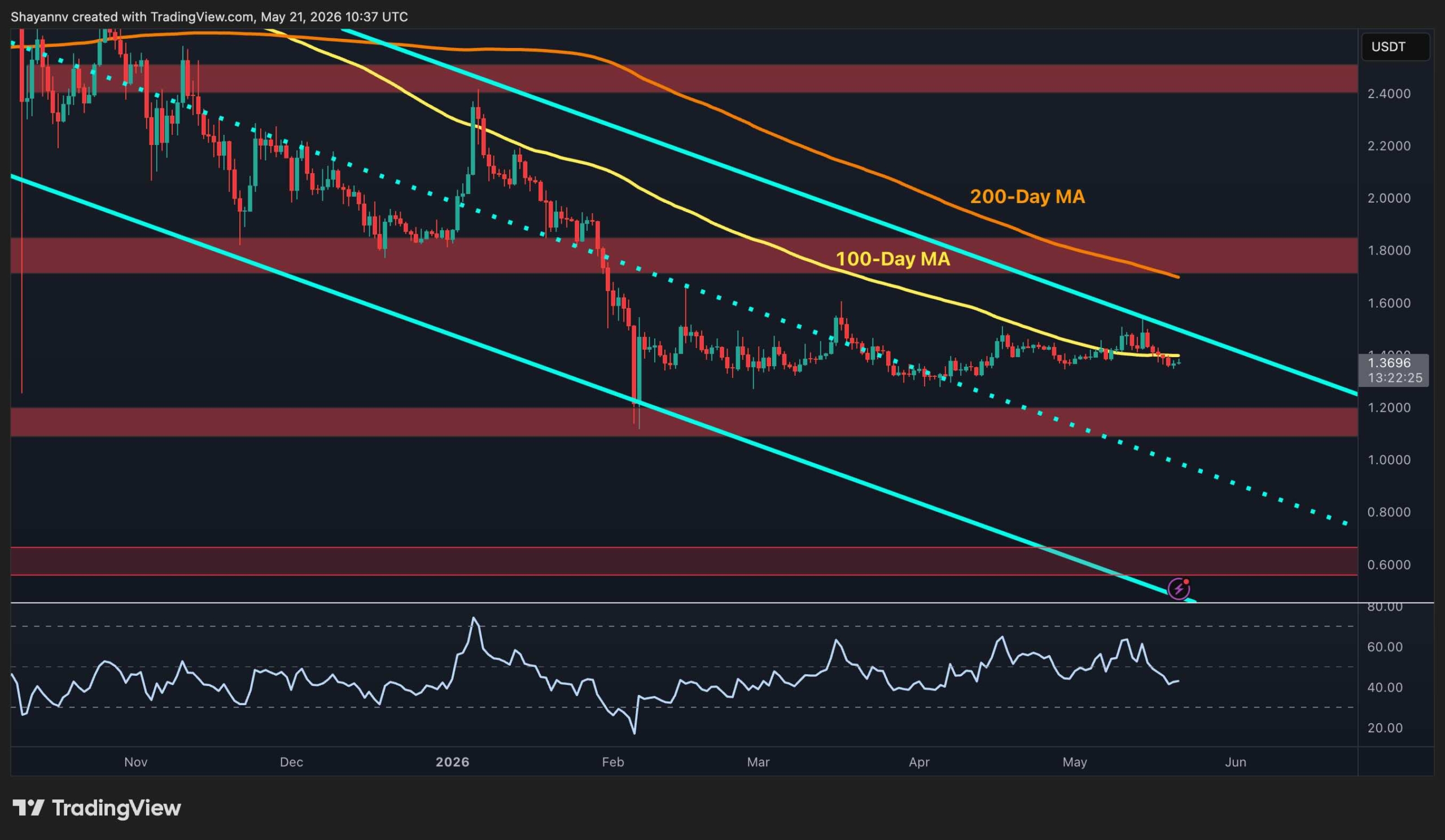
The USDT pair’s daily timeframe setup looked compelling last week. The asset was pressing the upper boundary of the long-term descending channel and holding above the 100-day moving average at around $1.45, with an RSI climbing toward 65.
Yet, this move has played out as a textbook rejection. XRP failed to post a single candle close above the channel, and the subsequent sell-off has brought the price back to $1.37. The 100-day MA, which was seen as dynamic support just days ago, is now the nearby overhead resistance at $1.40, sitting just below the descending channel ceiling.
The RSI has faded from 65 back to the 40s, wiping out the momentum that made the setup optimistic. The $1.20 demand zone below should now be watched as the potential floor, while a recovery back above $1.45 and the 100-day MA remains the minimum requirement to rebuild any constructive case. Yet, with the broader altcoin market breaking down, the path of least resistance points toward another test of support rather than another attempt at resistance.
The BTC Pair
The brief breakout above 1,800 sats that appeared on the BTC pair last week has proven to be a fakeout. XRP/BTC has slipped back to around 1,770 sats, creating a lower high at around 1,800-1,900 sats. The RSI, which had recovered from the extreme low of ~25 all the way to above 50 while demonstrating a bullish divergence, has also faded back toward 40. The relief bounce is losing energy before it accomplishes anything structurally meaningful.
The failed reclaim of 1,800 sats is the defining development on this pair. It confirms that the oversold bounce was corrective rather than structural, and that the broader downtrend in the ratio remains intact. The 100-day moving average at ~1,900 sats and the 200-day moving average at ~2,100 sats continue to decline well above, offering no nearby reference for a recovery.
Below, the lower channel boundary near 1,550 sats and the 1,500 sat horizontal support band remain the next downside targets if the current level gives way. With altcoin sentiment deteriorating across the board, there is little in the near-term macro picture to suggest that pressure is about to ease.

The post Ripple Price Analysis: Where’s XRP Going Next After Latest Rejection at the 100-Day MA? appeared first on CryptoPotato.



Latest developments: Emmer joined CoinDesk’s The Policy Protocol and said the Senate’s bipartisan movement on the Clarity Act shows crypto legislation still has momentum despite growing uncertainty in Washington.
- Emmer pointed to the Senate Banking Committee’s 15-9 vote advancing the bill, arguing support extended beyond Republicans.
- He said the House has spent years refining crypto market structure legislation and described CLARITY as the fifth or sixth iteration of the effort.
- Emmer said lawmakers are trying to create clear distinctions between digital assets regulated as securities, commodities or cash equivalents.
- He predicted Congress would ultimately send the legislation to President Trump’s desk.
The debate: Emmer forcefully defended the Blockchain Regulatory Certainty Act (BRCA), which would shield some noncustodial software developers from money transmitter rules.
- Law enforcement groups have raised concerns that the provision could weaken oversight or hamper investigations involving decentralized finance tools.
- Emmer called those objections a “red herring” aimed at slowing the broader Clarity Act.
- He argued developers who do not custody customer funds should not be treated as money transmitters.
- Emmer said inconsistent state-by-state treatment of blockchain software developers is creating legal uncertainty for innovators.
What this means: Emmer argued the U.S. needs clearer crypto rules to remain competitive globally.
- He said companies want to innovate in the U.S. but need to understand “the rules of the road.”
- Emmer criticized former SEC Chair Gary Gensler’s enforcement approach under the Biden administration.
- He said the Clarity Act is designed to establish clearer distinctions between assets regulated by the SEC and the CFTC.
- Emmer argued the legislation would encourage more companies to operate inside the U.S. regulatory framework.
Reading between the lines: Emmer sought to frame crypto policy as a bipartisan issue rather than a partisan fight.
- He said “Republicans and Democrats agree on this stuff” despite ongoing Senate negotiations.
- Emmer argued some senators are using negotiations around the bill to gain leverage on unrelated issues.
- He said the crypto industry supports candidates based on policy positions rather than party affiliation.
- Emmer described crypto and digital assets as part of the future of “21st century finance.”
Worth watching: Emmer said Congress is still debating how much authority regulators like the SEC and CFTC should have over crypto markets.
- Renato Mariotti raised questions about whether the CFTC would need additional funding or staffing under a new regulatory framework.
- Emmer said he favors “light touch regulation” and less authority for federal agencies.
- He said Congress should focus on consumer protections and preventing fraud.
- Emmer argued digital assets can provide more transparency than cash-based transactions.

The most crypto-friendly Federal Reserve chair in history is being sworn in today, and markets are waiting for this weekend’s catalyst. Kevin Warsh, the pro-crypto guy, backed by Trump, confirmed by the Senate 54-45 on May 13, officially replaces Jerome Powell at the world’s most powerful central bank.
Warsh’s swearing-in ceremony is being hosted by President Trump at the White House today, capping a nomination process that began in January 2026. The incoming chair holds more than $100 million in personal crypto investments spanning over 30 digital asset projects from Bitcoin to decentralized exchange dYdX, among them.
Warsh has also publicly stated that Bitcoin “does not make him nervous” and has pushed for treating digital assets as legitimate financial infrastructure. For an institution that spent years treating crypto like contraband, this is a regime change.
People are now waiting for Warsh’s first post-swearing-in statement on rate policy and balance-sheet direction. That single signal could determine how this weekend goes for the crypto market
Discover: The Best Crypto to Diversify Your Portfolio
Will Crypto Move on Kevin Warsh Catalyst?
Crypto markets are pricing in a risk-on interpretation of the Warsh appointment before he’s delivered a single policy statement.
Warsh is widely characterized as an inflation hawk who favors a narrower Fed mandate, which cuts against the narrative of an easy-money pivot. His criticism of aggressive balance-sheet expansion suggests he won’t simply open the liquidity taps.
Markets, however, are weighing his crypto-native perspective and his reformist track record against his hawkish reputation on rates.
On the technical side, Bitcoin and large-cap altcoins have been building on momentum established through May. Any definitive dovish signal from Warsh, even a nuanced comment on financial stability, would likely trigger an upside momentum heading into low-liquidity weekend trading.
Check the latest Bitcoin price prediction analysis for updated technical levels as the swearing-in develops.
Discover: The Best Token Presales
LiquidChain Positioning Early as Macro Shift Reframes the Crypto Infrastructure Thesis
A pro-crypto Fed chair changes the institutional risk calculus. But for traders who missed Bitcoin’s run from four digits to six, the asymmetric opportunity isn’t at the top of the cap table; it’s in what gets built underneath it. Infrastructure plays at early-stage pricing tend to capture the next wave, not the current one.
LiquidChain ($LIQUID) is a Layer 3 infrastructure project that fuses Bitcoin, Ethereum, and Solana liquidity into a single execution environment, effectively collapsing three fragmented ecosystems into one unified settlement layer.
Built differently. Moving accordingly — LiquidChain (@getliquidchain) May 21, 2026
 ⟁https://t.co/vqvBcdSQYC pic.twitter.com/Ij2V9s94Pz
The architecture includes a Unified Liquidity Layer, Single-Step Execution, Verifiable Settlement, and a Deploy-Once model that lets developers access all three networks without rebuilding across chains. The presale is currently priced at $0.01462 with almost $800K raised to date.
The Warsh appointment, and the broader regulatory shift it signals, alongside ongoing changes at the SEC, create a macro environment where crypto infrastructure investment carries less institutional headwind than at any prior point in the asset class’s history.
Research LiquidChain here before the next price increase.
The post Pro-Crypto Kevin Warsh Set for Trump Appointment Today: Big Weekend Rally? appeared first on Cryptonews.

Although it continues to have its fair share of non-believers, doubters, and critics, many of whom are within the broader Pi Network ecosystem, the team behind the project insists that it does certain aspects better than (almost) all other digital asset protocols.
In the latest post on X on the matter, the Core Team highlighted one of the key components of their infrastructure that is a better version of their counterparts.
Pi Says it Again
The problem itself was also targeted by Pi Network’s co-founder, Dr. Chengdiao Fan, at the 2026 Consensus conference in Miami. During her speech, she doubled down:
“Tokens issued advanced financial mechanisms running, but there is a lack of underlying utility and substance. There are tokens used mostly to raise capital without actually [providing] product innovation. People have too easy and immediate access to capital without actually doing the hard work to finish the building. There’s too much value extraction without equivalent value creation in the crypto space.”
Instead, she and the team claim that Pi Network has undertaken a contrasting approach as its own token can be “treated as tools that can support user acquisition, product engagement, and long-term utility.”
She added that Pi uses crypto tools, including payment ability to issue tokens and smart contracts, and aligns them to address and fix the ‘quick exits’ problems.
As mentioned above, the team made a similar claim last month, highlighting the issue while simultaneously indicating that 1 million verified users on Pi is not the same as 1 million users on other networks, since they have a more thorough verification process.
Enter Pi Launchpad
All of the above led to one of Pi’s solutions to this problem: the Pi Launchpad. The team described it as their design for “ecosystem tokens and launch mechanisms that aim to help products acquire real users who engage, provide feedback, and use those tokens within actual product experiences.”
As with a few other of the broader Pi Network products in recent months, Pi Launchpad will have a touch of artificial intelligence in it, as “AI makes it easier to build applications,” and the limiting factor “is no longer creation.”
However, it added that it operates as a combination of AI, blockchain infrastructure, innovative token and launch mechanisms, identity verification, and a large, engaged network of “real users” to directly address the gap in distribution and usage.
The post Pi Network Says It Has Solved One of Crypto’s Biggest Problems appeared first on CryptoPotato.
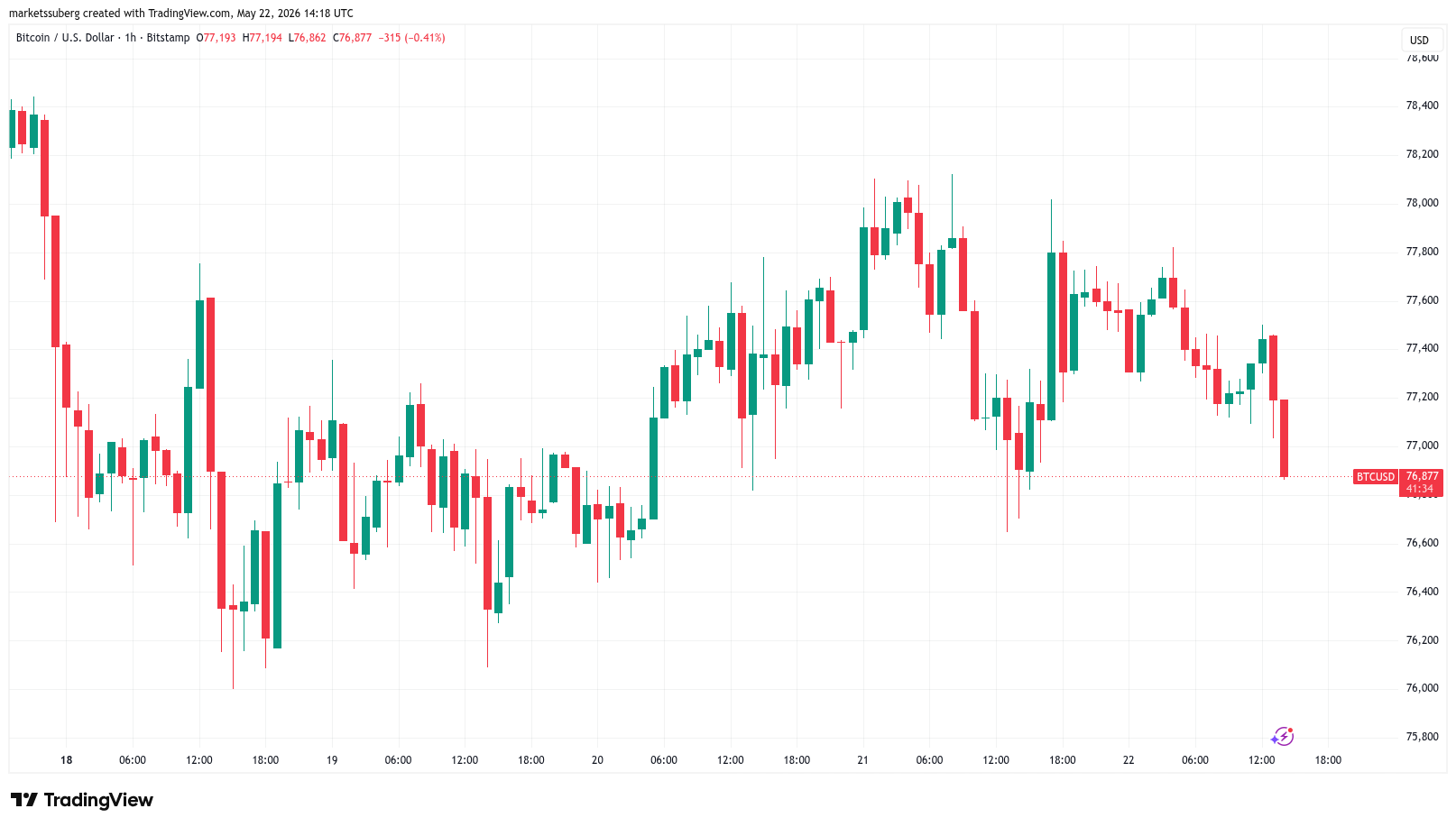
Bitcoin (BTC) faced familiar selling pressure on Friday as US stock markets began setting fresh record highs.
Key points:
- Bitcoin and crypto markets diverge from US stocks, with the Dow Jones pushing into price discovery at the Wall Street open.
- Analysis sees further potential upside for stocks coming next, including S&P 500 participants.
- BTC price action battles weak US demand as Binance buyers take the lead.
Bitcoin slumps at US open while Dow Jones beats records
Data from TradingView showed BTC/USD retreating below $77,000 at the Wall Street open, down nearly 1.2% on the day.
BTC/USD one-hour chart. Source: Cointelegraph/TradingView
The move continued a trend seen throughout the week where the start of US trading pressured crypto markets.
BTC price action thus diverged from stocks, which began the day with the Dow Jones Industrial Average hitting fresh all-time highs — a move noticed by US president Donald Trump.
The S&P 500 and Nasdaq 100 also coiled below new record high levels.
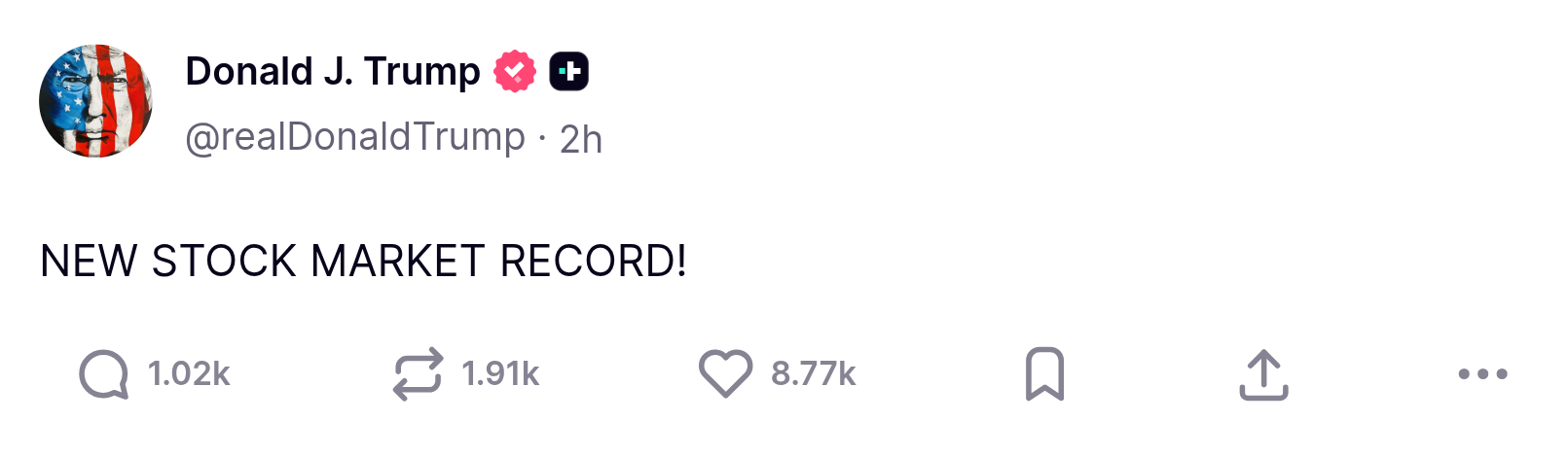
Source: Truth Social
In its latest market commentary, trading resource Mosaic Asset Company argued that conditions could soon favor a broader stock-market push higher.
“The average stock has been diverging negatively to the major indexes, which has been limiting breakout trading opportunities,” it wrote.
“But an oversold breadth condition is already forming, which is also being confirmed by the MACD applied to the stocks trading above their 20-day MA. That could help spark a rally at least in the near-term and see the average stock catch up.”
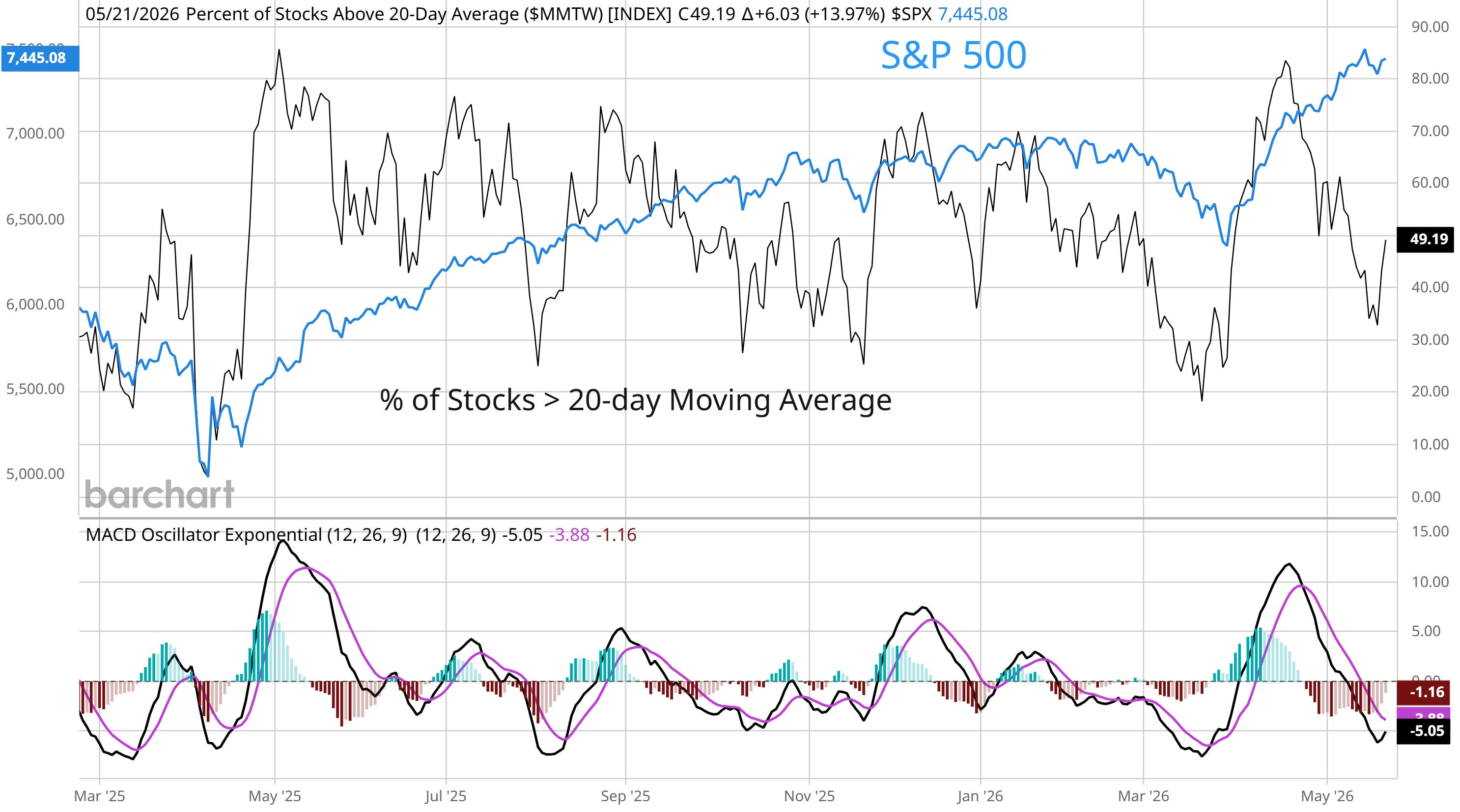
S&P 500 data with MACD. Source: Mosaic Asset Company
Mosaic referred to the moving average convergence/divergence indicator and stocks’ 20-day simple moving average.
US Bitcoin buyers “unable to keep up” with Binance
Meanwhile, Bitcoin’s Coinbase Premium Index continued to circle monthly lows in a sign of weak US demand.
Related: Bitcoin price record 90-day uptrend ‘resembles bull market rally:’ New analysis

Source: Cointelegraph/X
Commenting, pseudonymous commentator Exitpump noted that unlike those on Coinbase, Binance traders were “stepping in” as buyers.
“The negative value of the $BTC Coinbase Premium is growing larger,” trader CW wrote on X the day prior alongside data from onchain analytics platform CryptoQuant.
“US investors are unable to keep up with Binance’s buying power.”
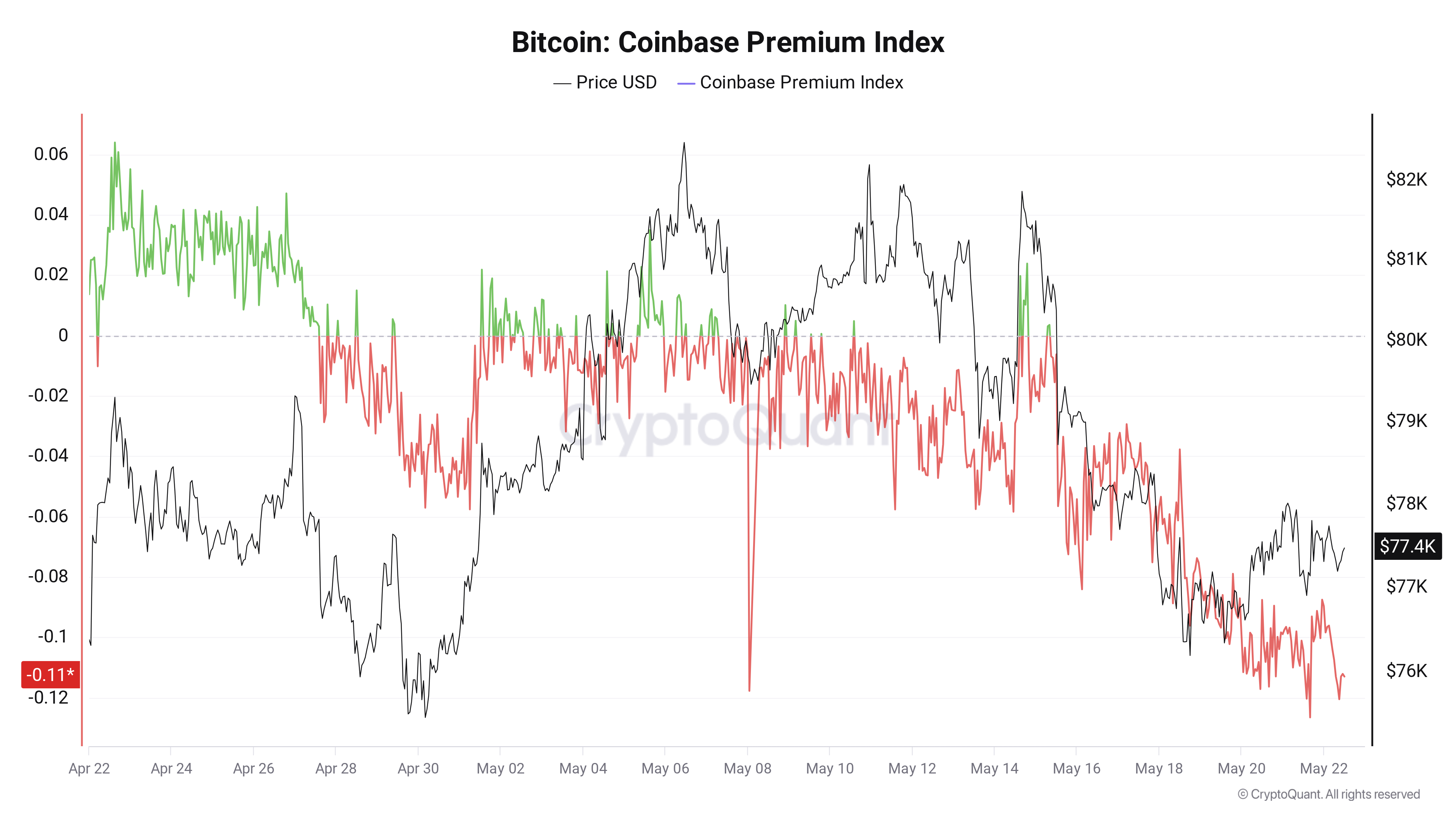
Bitcoin Coinbase Premium Index. Source: CryptoQuant
CW suggested that the actions of Bitcoin whales may mean that current prices become a “buying opportunity.
“Generally, whales utilize negative premiums to accumulate at relatively lower prices. This means that Coinbase whales are in a situation where they can accumulate at slightly lower prices,” they added.

TLDR
- A top Cardano DRep warned he may sell his ADA and leave the ecosystem if the proposal fails.
- The warning followed disagreement over a $33 million treasury funding proposal submitted by IOG.
- Chris O criticized another DRep for abstaining and urged a reconsideration of the vote.
- He said those opposing the proposal could be blamed for harming Cardano’s progress.
- The proposal includes funding for Leios development and quantum resistance research.
A leading Cardano DRep has warned he may sell his ADA holdings and leave the network. The statement follows growing opposition to a $33 million research funding proposal submitted by Input Output Global. The proposal has triggered debate across the Cardano governance community as voting continues.
Cardano DRep Clash Intensifies Over Research Proposal
Cardano DRep Chris O issued the warning in response to a voting decision by fellow delegate YUTA. He said he has prepared to exit the ecosystem if the proposal fails.
Chris O criticized YUTA’s abstention vote in a public post on X. He described the reasoning behind abstaining as “ridiculous” and called for reconsideration.
YUTA explained that parts of the proposal lacked efficient use of treasury funds. He also suggested splitting the proposal into smaller submissions for separate evaluation.
Chris O rejected that suggestion and argued it could harm progress. He warned that those opposing the proposal could be blamed for “killing Cardano.”
The proposal seeks nearly 33 million ADA from the treasury. It aims to fund Leios-related development and research on quantum resistance.
Several DReps have already voted against the proposal. Current figures show 13.28% support and over 86% opposition among votes cast.
Voting remains open until June 8. The final outcome will depend on the remaining DRep votes.
Cardano Founder Signals Consequences if Proposal Fails
Cardano founder Charles Hoskinson addressed the situation in recent comments. He confirmed that IOG will not resubmit the proposal if it fails.
Hoskinson said rejection could lead to the closure of some research labs. He also warned that engineers may leave the project.
He added that the network’s research-driven model could face disruption. This could impact ongoing blockchain development efforts.
The proposal includes multiple initiatives tied to Cardano’s future upgrades. These include scaling improvements and security research.
The debate reflects broader governance tensions within the Cardano ecosystem. DReps continue to weigh cost concerns against long-term development goals.
Chris O’s statement has added urgency to the ongoing vote. His position highlights divisions among key governance participants. As of now, opposition remains dominant in the vote count. DReps have until June 8 to determine the proposal’s fate.

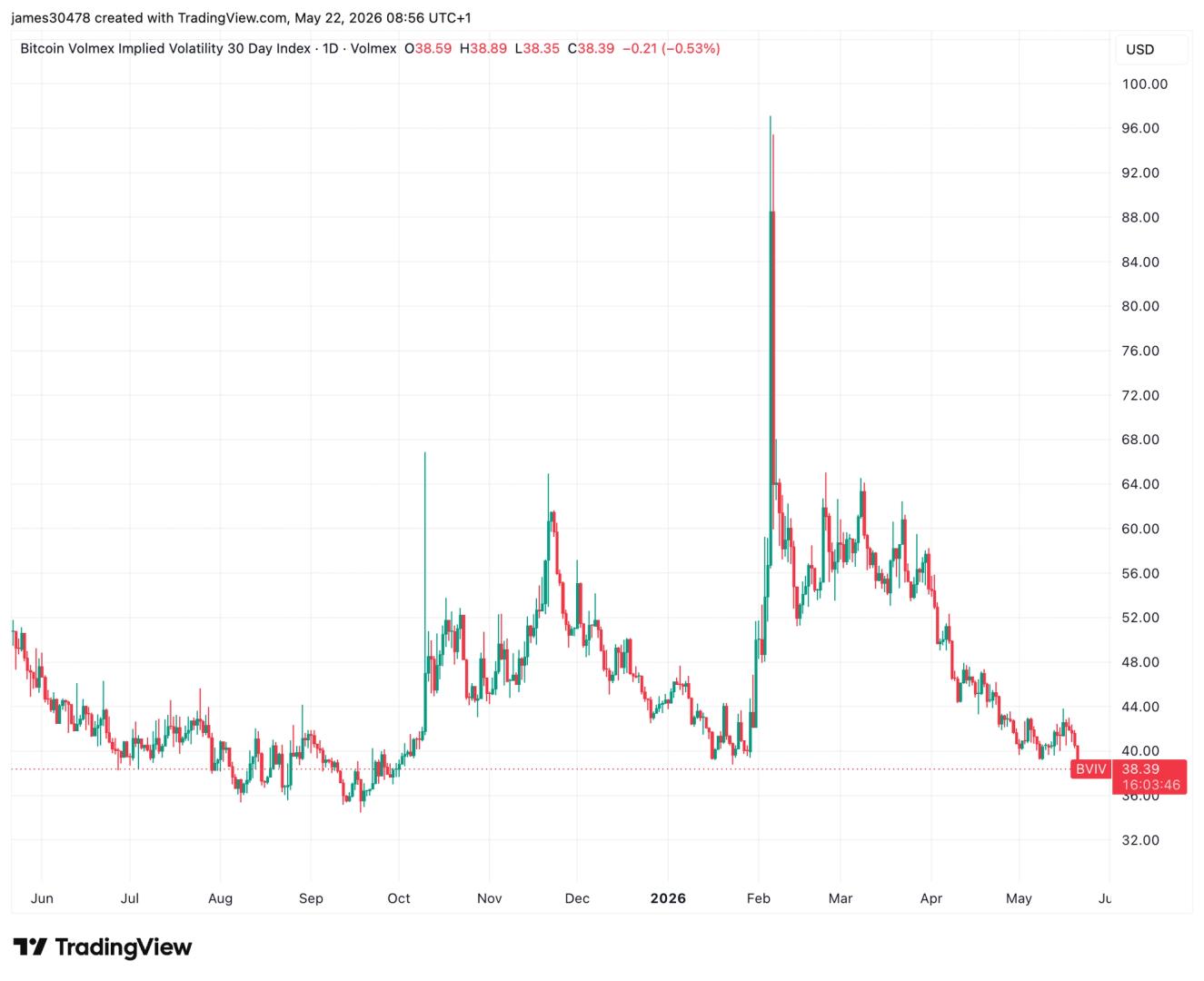
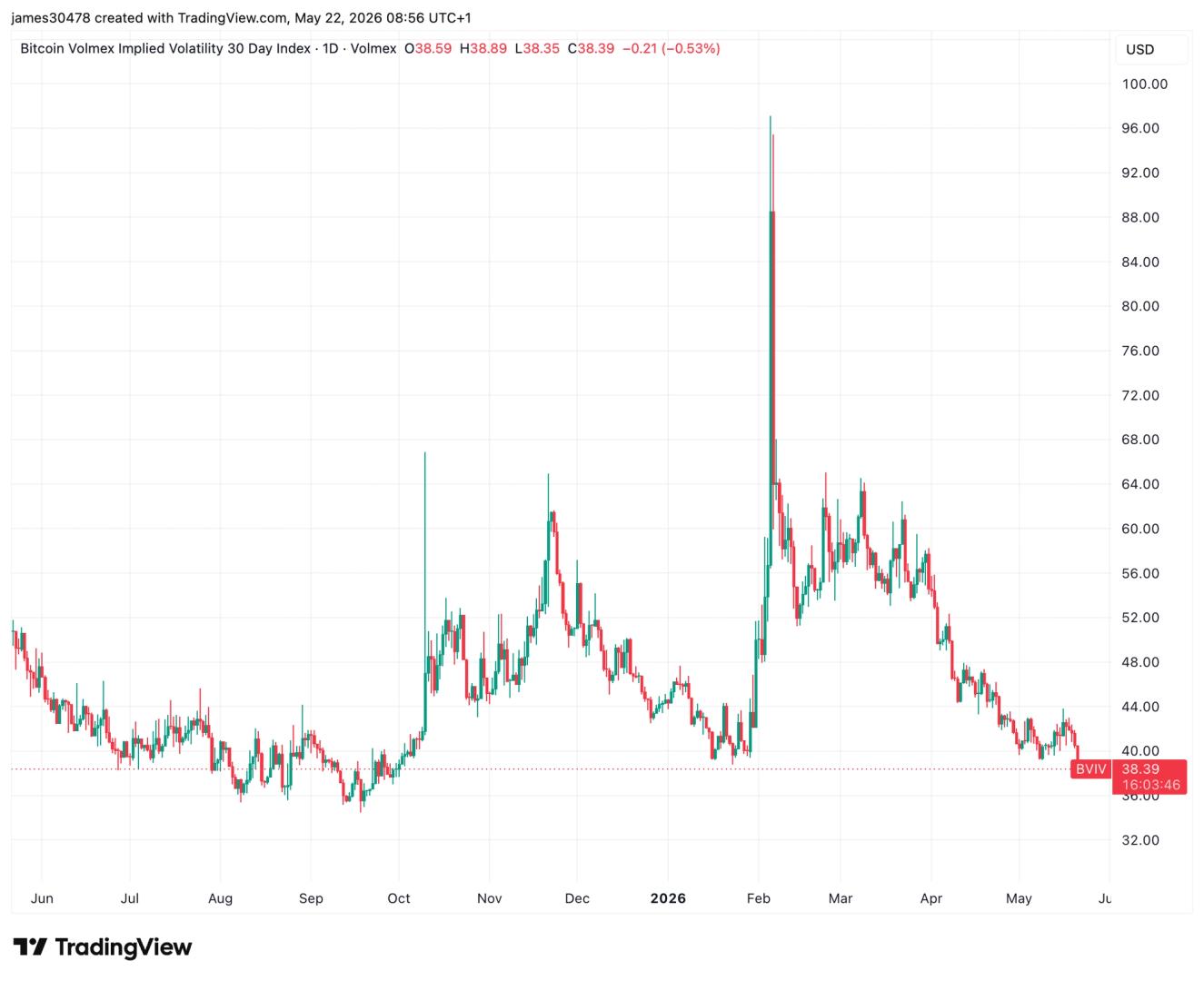
Financial headlines continue to warn of macro risks, yet bitcoin’s volatility metric seems to think it’s all noise.
The cryptocurrency’s annualized 30-day implied volatility index, BVIV, continues to slide, hitting 38%, its lowest reading since October 2025, according to data source Volmex. When implied volatility falls, it signals that traders expect calmer price action and fewer large moves ahead.
“Bitcoin volatility has collapsed, and you can see it clearly in the BVIV levels, which we track closely to monitor market complacency,” said Shiliang Tang, Managing Partner at Monarq Asset Management.
“First, the geopolitical risk from the Iran conflict is finally moving into the later stages. Second, the continued BTC buying from Strategy (MSTR) and its perpetual preferred STRC complex is dampening downside BTC volatility by acting as a structural floor,” Tang added.
He also blamed systematic “call overwriters” for driving the yield lower. Overwriting involves selling a higher strike out-of-the-money call option to earn an additional yield on top of the spot market holding. BTC is currently trading near $77,300, so anyone holding BTC and selling calls above that price is a call overwriter.
Systematic overwriters, typically institutional funds running yield-enhancement strategies, continuously sell bitcoin options to collect premium income. This steady supply of options suppresses implied volatility and dampens expectations for large price swings.
“Finally, because Bitcoin has underperformed other risk assets to the upside, systematic overwriters are aggressively selling options for yield, keeping a heavy lid on the entire volatility complex,” Tang noted.
Bitcoin is currently trading around $77,000, while oil markets, often used as a proxy for geopolitical risk, remain relatively contained, with WTI crude trading below $100 per barrel.
Meanwhile, Strategy has purchased 171,238 BTC in 2026, significantly outpacing the roughly 63,450 BTC mined during the same period. That imbalance reinforces persistent institutional demand and reduces market supply.
Bitcoin’s declining volatility also reflects its maturation as an institutional asset. As adoption expands across ETFs, asset managers, corporates, and treasury allocators, liquidity deepens, and ownership becomes more diversified, naturally reducing the extreme volatility that characterized bitcoin’s earlier years.
Institutional adoption continued to reshape the digital asset market this week, even as geopolitical tensions reminded investors that crypto remains sensitive to broader macro conditions.
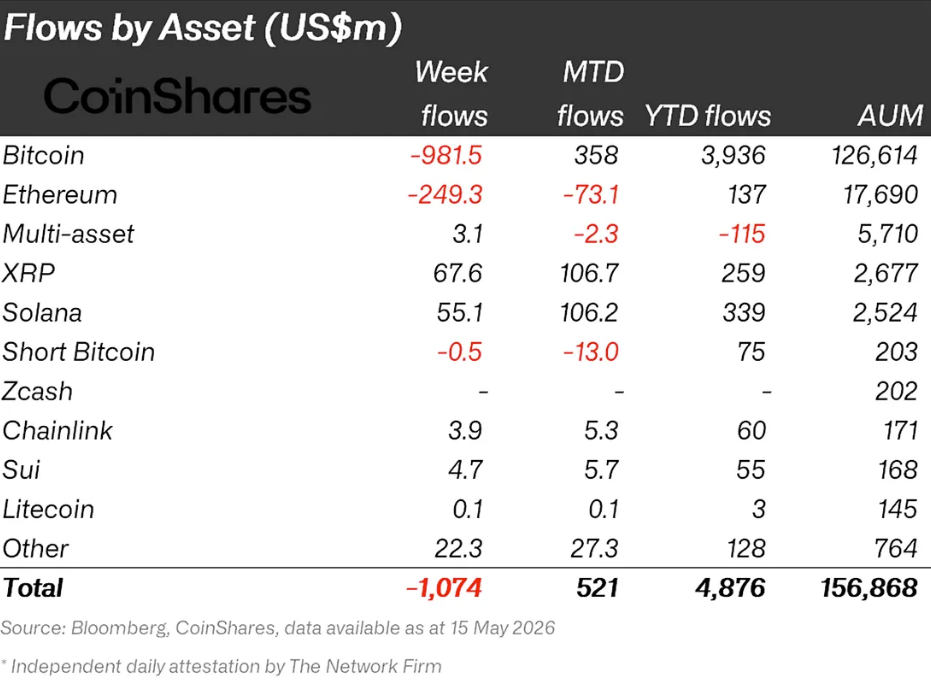
Digital asset funds suffered more than $1 billion in outflows as traders reduced risk exposure amid fading hopes for a durable ceasefire between the United States and Iran. At the same time, Tether tightened its grip on Twenty One Capital, Bernstein argued that Bitcoin miners are carving out a strategic role in the race to build artificial intelligence infrastructure, and Polymarket teamed up with Nasdaq to launch prediction markets tied to private companies.
This week’s Crypto Biz underscores how institutions continue to influence the digital asset ecosystem.
Crypto funds bleed $1 billion as geopolitical tensions trigger risk-off move
Digital asset investment products posted more than $1 billion in outflows last week as escalating tensions in the Middle East sent investors to the sidelines.
According to CoinShares data, the withdrawals marked one of the largest weekly reversals so far this year, with Bitcoin and Ether products accounting for the bulk of the redemptions. The sell-off came as markets dialed back hopes for a durable ceasefire between the US and Iran, prompting a broader flight from risk assets despite Bitcoin’s reputation as a macro hedge.
The pullback underscores how quickly sentiment can shift when geopolitical shocks hit global markets. Institutional demand for crypto remains structurally stronger than in prior market cycles, but the latest outflows suggest allocators are still treating digital assets as part of the broader risk-on complex during periods of heightened volatility.
Despite last week’s outflows, crypto exchange-traded products have recorded nearly $4.9 billion in year-to-date inflows. Source: CoinShares
Tether deepens its Bitcoin treasury bet with SoftBank-backed Twenty One
Tether has acquired SoftBank’s stake in Twenty One Capital, tightening its grip over one of the crypto industry’s largest corporate Bitcoin vehicles.
The stablecoin issuer purchased the Japanese conglomerate’s roughly 26% stake in the company for an undisclosed amount as Twenty One Capital prepares to broaden its business beyond Bitcoin accumulation into Bitcoin-related financial services. Led by Strike founder Jack Mallers, Twenty One launched with backing from Tether, Bitfinex, Cantor Fitzgerald and SoftBank, and has accumulated more than 42,000 BTC on its balance sheet.
The transaction further consolidates Tether’s influence over the company as institutional demand for Bitcoin treasury exposure expands.
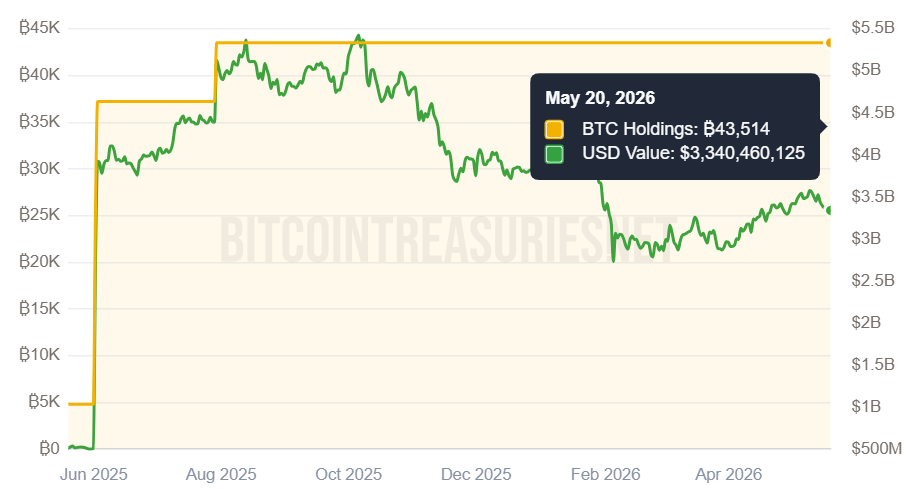
Twenty One Capital has amassed a $3.34 billion Bitcoin position. Source: BitcoinTreasuries.NET
Bernstein says Bitcoin miners are becoming strategic assets in the AI race
Bitcoin miners are emerging as valuable infrastructure partners for artificial intelligence developers, giving these companies a longer runway to diversify into data centers and high-performance computing, according to Bernstein research.
Bernstein’s analysts said miners possess two resources that are increasingly scarce amid the AI boom: large-scale power access and data center capacity. Companies that built their operations around energy-intensive Bitcoin mining are now repurposing portions of that infrastructure to host high-performance computing workloads for AI customers.
Bernstein argued that the shift could unlock new revenue streams and higher valuations for miners, particularly as block rewards become less lucrative following each Bitcoin halving cycle. The convergence of crypto and AI is transforming what were once cyclical commodity businesses into strategic infrastructure plays tied to two of the market’s most capital-intensive industries.
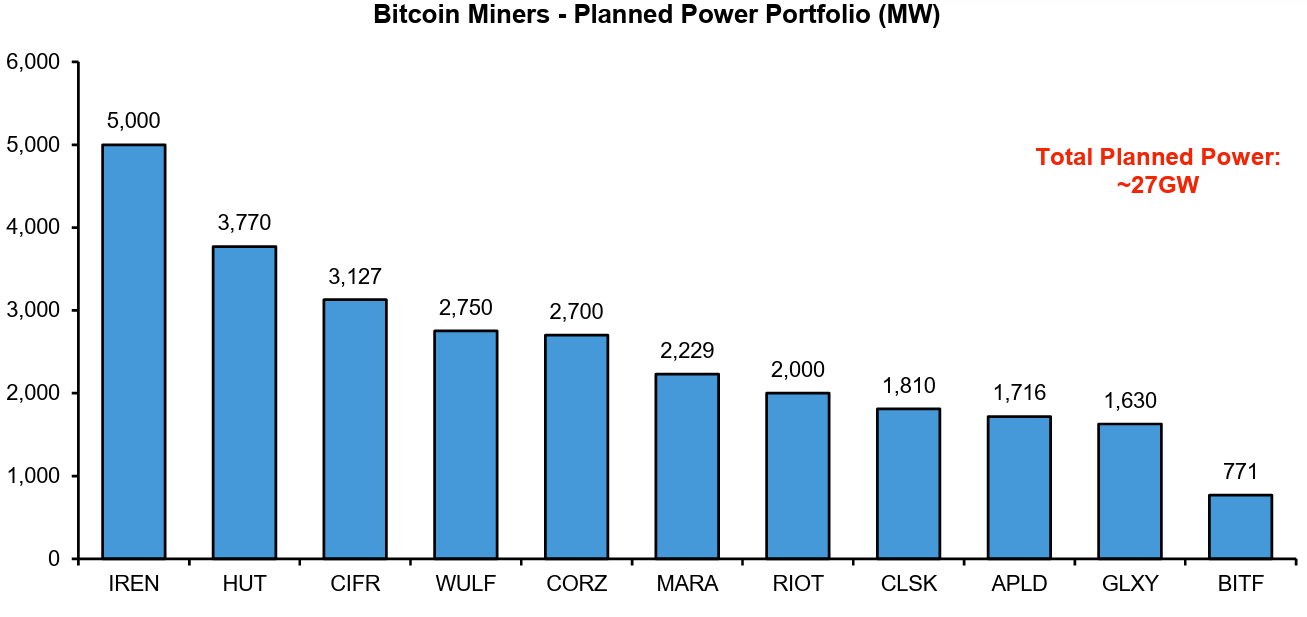
11 publicly traded crypto miners have expanded their planned power portfolios. Source: Bernstein
Polymarket partners with Nasdaq to bring prediction markets to private companies
Polymarket has partnered with Nasdaq to launch a category of prediction markets that lets users forecast the future valuations of private, pre-IPO companies.
The initiative will allow participants to trade on private-company milestones, including valuation targets, IPO timing and secondary market activity. By expanding beyond elections and macro events, the partnership pushes prediction markets deeper into the world of venture capital and startup investing.
The collaboration also highlights how institutions are warming to event-based forecasting. For crypto-native platforms like Polymarket, alliances with established financial infrastructure providers could help legitimize prediction markets as an alternative tool for price discovery and investor sentiment.

Source: Cointelegraph
Crypto Biz is your weekly pulse on the business behind blockchain and crypto, delivered directly to your inbox every Thursday.

TLDR
- Strategy insiders, including CFO Andrew Kang and director Jarrod Patten, sold MSTR shares according to recent SEC filings.
- Andrew Kang sold 5,597 shares worth about $927,866 after receiving stock through vested restricted stock units.
- Jarrod Patten sold 5,250 shares valued at roughly $875,087 after exercising stock options at a lower price.
- Both insiders stated that the sales were made to cover tax withholding obligations tied to stock compensation.
- MSTR shares have declined nearly 10% over the past month alongside ongoing Bitcoin price volatility.
Strategy insiders have sold MSTR shares as Bitcoin prices remain volatile. Recent SEC filings show executives and directors reducing holdings while the stock declines. The transactions come as the company maintains strong ties to Bitcoin accumulation.
Insider Sales Add Pressure on MSTR Shares
Strategy CFO Andrew Kang sold 5,597 MSTR shares between $163.98 and $166, according to May 19 filings. The total transaction reached about $927,866.
Kang received 12,500 shares through vested restricted stock units before the sale. He still holds about 33,675 company shares after the transaction.
Director Jarrod M. Patten also sold 5,250 MSTR shares in recent days. His sales totaled roughly $875,087 based on disclosed filings.
Patten sold shares at prices between $165.87 and $167 per share. These levels were slightly above the current trading price of $163.
The director exercised stock options worth $97,933 before selling shares. The options were executed at $18.654 per share.
After the transactions, Patten retains 28,000 Class A shares. He also holds several classes of preferred stock issued by the company.
Filings indicate that both insiders sold shares to cover tax obligations. Such transactions often follow stock compensation events.
Strategy stock has declined nearly 10% over the past month. The decline aligns with ongoing weakness in the Bitcoin market.
Bitcoin Outlook Remains Central to Strategy
Former CEO Michael Saylor addressed Bitcoin’s outlook in a recent CNBC interview. He said, “I think we’ll rally from here.”
Saylor added that the company plans to continue acquiring Bitcoin. He stated Strategy could buy Bitcoin produced by miners through 2140.
Strategy has built its corporate strategy around Bitcoin accumulation. The company holds large reserves of the digital asset.
Bitcoin price movements often influence MSTR shares’ performance. This relationship has remained consistent during recent market swings.
Crypto markets have faced volatility in recent weeks. Bitcoin has traded within a fluctuating range during this period. MSTR shares traded at $163 at the time of writing. The stock fell about 1% during the latest trading session.
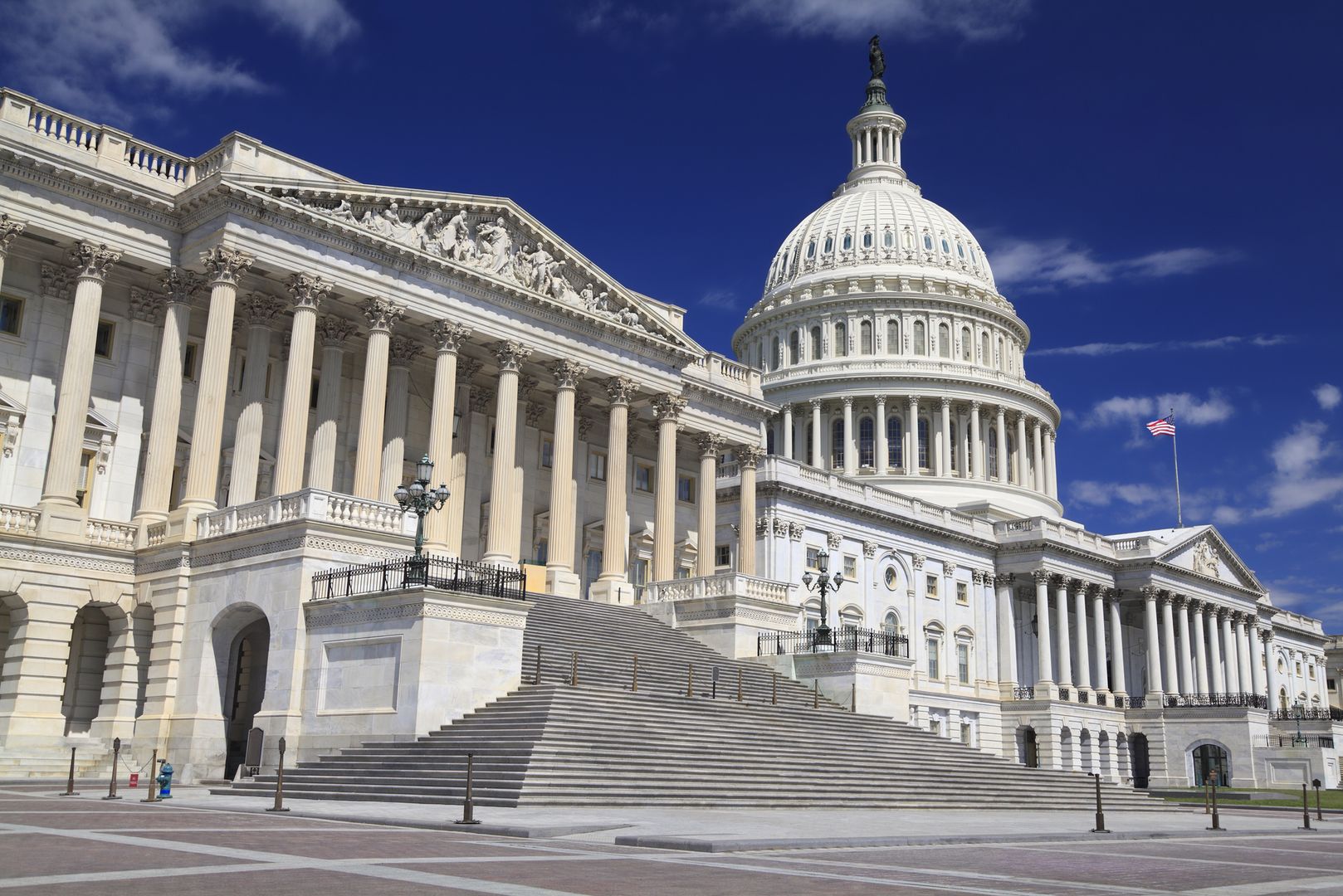
The U.S. House Oversight Committee plans a probe into the largest prediction market platforms over suspicions that government employees could be exploiting classified information for personal gain.
Rep. James Comer, R-Ky., chair of the House Oversight and Government Reform Committee, is seeding the internal records from the CEOs of Polymarket and Kalshi to determine if government employees are using insider knowledge to profit from policy and geopolitical and military operations, he said on CNBC’s Squawk Box on Friday.
“There’s a concern now that members of Congress, members of the president’s administration, any type of government employee, can use basic insider knowledge and make huge profits on anything government-related,” Comer told CNBC.
“So we want to not only launch an investigation to see how widespread this has been thus far, but also to prove a case that we’ve got to pass some type of legislation,” Comer added. “And I think it wouldn’t be too much to ask to say members of Congress can’t participate in the predictions market, nor can government employees or people in the president’s administration.”
Comer’s probe is the most recent in a series of attempts by Congress to investigate prediction markets and bring insider trading under control.
In letters sent Friday to Polymarket’s Shayne Coplan and Kalshi’s Tarek Mansour, Comer demanded clarity on how the platforms handle identity verification, enforce geographic restrictions and flag anomalous trading activity.
Prediction markets, which surged in popularity in recent years, have drawn scrutiny from federal and state lawmakers and regulators, who worry the platforms are ripe for exploitation by bad actors with national security clearances.
Prediction market volumes could peak to roughly $1 trillion by 2030, as the sector evolves from niche wagering into broad-based “information markets” spanning sports, crypto, politics and the economy, according to a Wall Street broker Bernstein report in April. Volumes hit $51 billion last year and could reach about $240 billion in 2026.
The House probe follows a heated U.S. Senate Commerce Committee hearing on Wednesday, where lawmakers from both parties heavily scrutinized prediction market platforms like Kalshi and Crypto.com. Senate Commerce Chair Ted Cruz (R-Texas) blasted the industry for enabling cheating scandals across major sports leagues, warning that the opportunity to profit on event contracts tempts athletes and officials to manipulate outcomes. Meanwhile, Senator John Hickenlooper (D-Colo.) accused the firms’ aggressive social media marketing of “preying on our young people” and fostering problem gambling.
Nicolas Vaiman, co-founder and CEO of onchain intelligence layer Bubblemaps, expressed deep concern over the national security implications of a new wave of insider trading in an interview with CoinDesk.
He warned that if those observing the predictions markets can spot irregular trades, so can enemies of the United States. He and his team found 80 bets on Polymarket with a 98% win rate, which he said is statistically impossible to achieve. “Not even luck can explain those wins.”
- Trump Media sold $205 million worth of Bitcoin amid rising losses
- The firm’s remaining BTC holdings are down nearly $455 million
- Institutional Bitcoin selling continues to pressure the crypto market
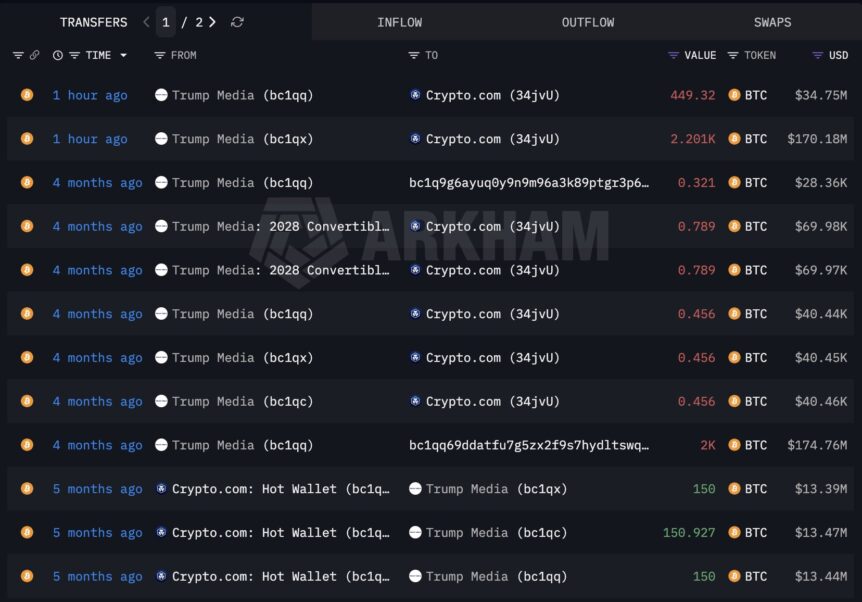
Trump Media and Technology Group has reportedly sold a significant portion of its Bitcoin holdings amid deepening losses across the cryptocurrency market, underscoring growing pressure on institutional investors exposed to digital assets.
As Bitcoin continues to trade well below the 2025 highs, blockchain tracking platform Lookonchain reported that it sold 2,650 BTC worth about $205 million.
Trump Media’s Bitcoin Holdings Face Massive Losses
According to available on-chain data, Trump Media initially acquired 11,542 BTC for roughly $1.37 billion at an average purchase price of $118,522 per coin. Four months ago, the company shifted 2,000 BTC valued at approximately $175 million, the same period in which Bitcoin was trading at $87,000.
The remaining crypto holdings are now estimated to be down by almost $455 million with Bitcoin trading at around $77,000.
The Bitcoin price drop joins a swirl of other financial difficulties that have plagued Trump Media. Earlier this month, in its Q1 earnings report, the company announced losses of more than $402 million, with around $244 million attributable to digital asset exposure. The losses have taken a toll on investors’ confidence, and the company’s stock performance has been suffering.
Institutional Bitcoin Buyers Begin Reducing Crypto Exposure
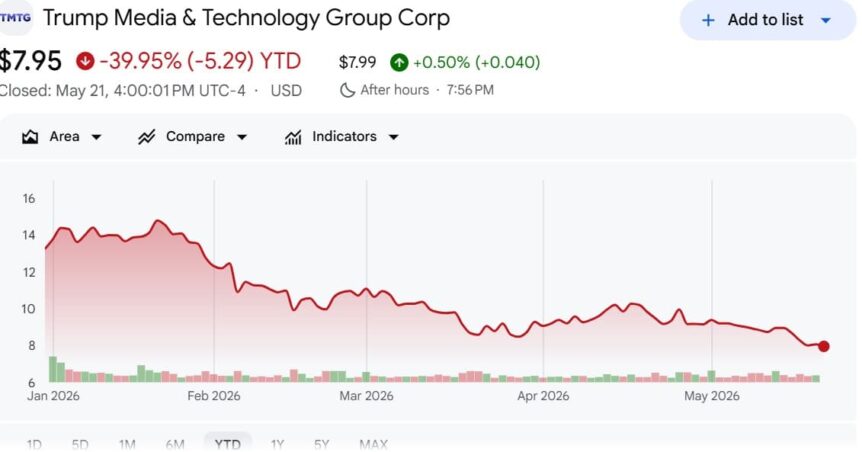
Trump Media and Technology Group’s stock prices have dropped by approximately 40% year to date and nearly 67% in the last 12 months, a stark contrast from the bull market of the last few months in which investors had been bullish on the company’s treasury solution for cryptocurrencies.
But the company is not the only one cutting its exposure to Bitcoin. These are a few institutions that have been aggressively buying BTC during the rally, but are now taking a second look at their holdings as the market conditions worsen.
Technology company Kulr Technology Group was said to have sold 300 BTC earlier this year for $23.3 million to stave off losses. The moves are symptomatic of a broader trend among investors based in the U.S. who, in recent years, have been selling more BTC than they are buying, according to analysts.
Market Sentiment Around Bitcoin Remains Deeply Negative
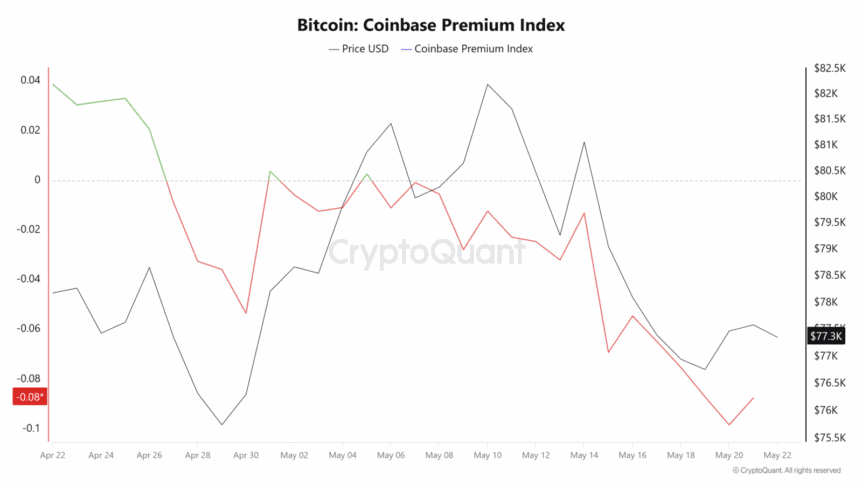
The sentiment in the markets is also down. The Coinbase Premium Index, which serves as an indicator of investor interest in Bitcoin by U.S. investors over the last month, has stayed mostly negative. It has only recorded positive readings a few times during the past 30 days, indicating that there is less activity by the institutions buying it and continuing sell-side pressure.
Corporate Bitcoin heavyweight MicroStrategy has even signaled a potential change in strategy, instead of its “never sell” philosophy. The company recently agreed to purchase back $1.5 billion in its 2029 convertible notes, and hinted that it would look towards sales of bitcoins to raise the funds for this purchase.
As more institutions sell their Bitcoin, analysts are predicting further downward pressure on the cryptocurrency’s price, and increased volatility in the wider market. Further liquidations could further shake investor confidence in the sector’s sustainability with businesses facing margin pressures and balance sheet pressures.

SEND- York council unveils reforms amid national changes

Brami raises $33 million in Series B round

Tom Emmer brushes off law enforcement concerns over Clarity Act


-

 Crypto World7 days ago
BloFin War of Whales 2026 Grand Prix opens registration for $5M trading championship
-

 Fashion7 days ago
Weekend Open Thread: Theory – Corporette.com
-

 Crypto World7 days ago
E-Estate Announces 1 Year Live: Washington DC Summit as Real Estate Tokenization Enters Its Next Phase
-

 Tech7 days ago
Google reimburses Register sources who were victims of API fraud
-

 Sports7 days ago
Napoleonic enters 2026 Doomben 10,000 field via Abounding withdrawal
-

 Crypto World7 days ago
BeInCrypto 100 Institutional Awards Nomination: KAST for Best Digital Assets Neobank and Best Digital Assets Fintech
-
 Crypto World7 days ago
Bitcoin Battles US Bond Nerves With BTC Price Dip Toward New May Lows
-

 Crypto World7 days ago
ICE and CME urge US regulators to curb Hyperliquid energy trading
-

 Fashion6 days ago
On the Scene at Gucci’s Cruise Show in New York City: Mariah Carey, Kim Kardashian, Lindsay Lohan, Iman, and More!
-
 Crypto World7 days ago
Wall Street’s Boldest Gold Prediction Has Russians Rushing to Buy
-

 Crypto World7 days ago
IREN closes $3 billion convertible notes deal amid AI infrastructure expansion
-

 Fashion6 days ago
Trending Western Style Vests Perfect for Summer
-

 Politics6 days ago
Watch: far-right flag-fanatics run over victim, attack locals – Setup By the Left wing for your entertainment
-

 Crypto World23 hours ago
Blockchain.com files with SEC for U.S. IPO
-

 Fashion6 days ago
Amazon Sundays: Memorial Day Hosting
-

 Crypto World7 days ago
Crypto Market Structure Bill Clears Committee; Senate Vote in Focus
-

 Entertainment5 days ago
Off Campus Easter Eggs Explained: Characters, Stories, More
-

 Crypto World7 days ago
BeInCrypto 100 Institutional Awards Nomination: KuCoin for Leader in Digital Asset Adoption and Best Trading Infrastructure
-

 Politics7 days ago
UK’s top intelligence body warns Mandelson files being withheld by government
-
 Crypto World7 days ago
Enphase Energy (ENPH) Stock Rockets 32% This Week: What’s Fueling the Rally?
You must be logged in to post a comment Login