

Crypto World
Ripple XRP Pinned as Massive Options Trade Bets Sideways Through June

A single block trade on Deribit just sold 1.5 million Ripple XRP call and put contracts at the $1.40 strike, collecting $224,500 in premium and effectively declaring that XRP goes nowhere through June 26. The trade is structured as a short strangle bet on no volatility. Whether it is a correct bet or not, it would create a mechanical gravitational pull on the spot price.
XRP has already been pinned under $1.40 while derivatives activity explodes, and this trade adds structural weight to that ceiling.
DISCOVER: 15+ Upcoming Listings to Watch in 2025
Delta Hedging Mechanism to Pin Ripple
As XRP drifts above $1.40, market makers who are long calls accumulate positive delta and sell spot or perpetuals to neutralize it. As XRP dips below $1.40, its long puts generate negative delta, and they buy spot to rebalance. Both actions push the price back toward $1.40. The strike with the highest open interest concentration becomes the path of least resistance.

Selling 1.5 million contracts on each side creates a delta hedging overhang large enough to mechanically suppress volatility for weeks. XRP’s 30-day realized volatility has been printing in the mid-20% to low-30% annualized range since March 2026, while at-the-money implied volatility for one- to two-month maturities has stayed closer to the mid- to high-30s.
This structural IV premium is exactly the inefficiency this trade is harvesting, and the reason short-volatility strategies like strangles and straddles have attracted institutional trading interest in XRP options this year.
Discover: The best crypto to diversify your portfolio with
Institutional Behavior, the Clarity Act, and the Manipulation Question
Trades of this scale, single-block, OTC-negotiated, executed to avoid moving the tape, are institutional trading signatures. The structure implies a whale or a systematic volatility desk with enough conviction in XRP’s range to absorb unlimited downside risk in exchange for $224,500 in premium.
The tight reward-to-risk ratio only makes sense if the trader has high conviction that macro and regulatory noise won’t produce a decisive move.
However, the conviction could be tested. The Senate Banking Committee advanced the Clarity Act bill has now heads to a full Senate vote. Ripple’s chief legal officer Stuart Alderoty called the committee’s decision a “monumental outcome,” citing protection for 67 million American crypto holders.
— Money Ape (@TheMoneyApe) May 21, 2026
 SENATOR McCORMICK ON CLARITY ACT
SENATOR McCORMICK SAYS THE CLARITY ACT COULD REACH THE PRESIDENT’S DESK THIS SUMMER AS U.S. CRYPTO LEGISLATION MOVES FAST.
THE BIG QUESTION NOW IS, WHAT HAPPENS TO THE MARKET ONCE TRUMP PASSES THIS LAW? pic.twitter.com/JwEPwkT9LH
Ripple also received conditional OCC approval to establish the Ripple National Trust Bank, a development that makes XRP increasingly a U.S.-regulated institutional asset. Any of these catalysts, if they land with force, could break the $1.50 level and detonate the strangle.
The resolution window is defined: June 26. If the Clarity Act advances, if OCC approvals accelerate, or if macro volatility spikes before that date, we would likely see the pin break violently, and the trader who collected $224,500 in premium would face losses with no structural ceiling.
DISCOVER: 15+ Upcoming Listings to Watch in 2025
The post Ripple XRP Pinned as Massive Options Trade Bets Sideways Through June appeared first on Cryptonews.


Intercontinental Exchange (ICE), the owner of the New York Stock Exchange (NYSE), is working with crypto exchange OKX to launch trading of oil-linked perpetual futures.
OKX said Friday it plans to introduce perpetual futures based on ICE’s Brent crude and West Texas Intermediate (WTI) crude benchmarks, two of the world’s most widely used oil price indicators, according to a release shared with Cointelegraph.
“These new OKX perpetual contracts, based on ICE’s deep, liquid, transparent, and global oil markets, allow OKX’s customer base […] to access energy benchmark products,” said Trabue Bland, ICE’s senior vice president of futures exchanges.
An OKX spokesperson told Cointelegraph the contracts represent the exchange’s first product collaboration with ICE and will settle against ICE’s Brent and WTI benchmark prices, which are widely used across traditional energy markets.
The collaboration is the first product announced under a broader partnership with ICE and OKX unveiled in March when ICE invested in the crypto exchange at a $25 billion valuation.
Availability limited to licensed jurisdictions
The oil-linked perpetual futures will only be available in jurisdictions where OKX is licensed to offer perpetual futures trading, the announcement said.
OKX global managing partner Haider Rafique said the products will be aimed at retail traders, giving them access to energy benchmarks in a regulated and transparent environment.

Source: OKX
Oil trading moves into crypto perps
Perpetual futures, often called “perps,” let traders bet on whether the price of an asset will go up or down without actually buying it. Unlike traditional futures, these contracts do not have an expiration date, allowing traders to keep positions open continuously.
Some centralized exchanges (CEXs) have expanded into oil-linked derivatives in recent months. Binance launched perpetual futures tied to WTI crude, Brent crude and natural gas in April, while Bybit also introduced oil perpetual contracts alongside other commodity-linked products for round-the-clock trading.
Related: Surging oil prices have been driving Ether selling pressure: Tom Lee
Activity has been particularly strong during periods of rising oil volatility linked to geopolitical tensions in the Strait of Hormuz.
ICE presses regulators to clamp down on oil trading on Hyperliquid
Decentralized derivatives exchange Hyperliquid has emerged as a notable venue for oil-linked perpetual trading amid the rapid growth of decentralized derivatives trading.
In the first quarter of 2026, Hyperliquid entered the top 10 derivatives exchanges by trading volume, recording roughly $500 billion in activity and ranking alongside major venues such as Binance and OKX.
According to Hyperliquid data, Brent crude oil contracts rank among the platform’s top five most traded markets over the past 24 hours, with about $352 million in daily volume at the time of publication.
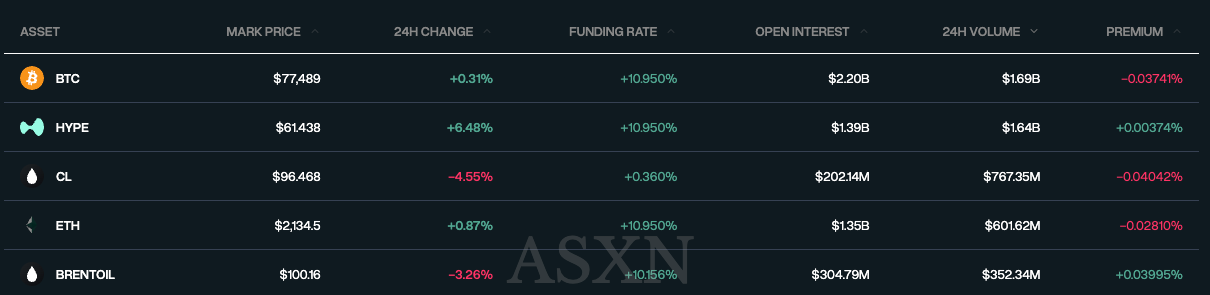
Top five most traded markets on Hyperliquid. Source: Hyperliquid
As the platform’s perpetual futures activity has expanded, ICE and the Chicago Mercantile Exchange (CME) have reportedly urged US regulators to take action against Hyperliquid over its expansion into commodity trading in mid-May.
The companies reportedly cited the platform’s “anonymous” and “unregulated” structure as a risk to critical energy markets such as oil and gas, warning it could potentially be used by state actors to bypass sanctions.
Magazine: 5 tech predictions the mainstream media got horribly wrong


The next wave of financial disruption is not arriving as a better app or a cheaper brokerage built on decades-old infrastructure. It is a complete overhaul of the legacy system of rent-seeking middlemen and inefficient rails, ushered in by three forces converging at once: stablecoins as always-on digital cash, the tokenization of real-world assets from stocks to bonds to real estate, and autonomous AI agents capable of managing money. Together, they are about to put a turbo-charged CFO in every investor’s pocket.
For generations, sophisticated treasury management has been the exclusive province of institutions and the ultra-wealthy. Large asset managers employ teams whose sole function is to ensure that not a single dollar sits idle, that every security generates income, and that every vote reflects their values. Retail investors have never had access to anything comparable. That is about to change.
Think of it as your own digital treasury agent: always on, never sleeping, executing your preferences with perfect fidelity. Your agent monitors your real-time cash flows and sweeps idle balances into yield-bearing instruments that reflect actual market rates. It manages your stablecoins and tokenized securities, lending them out to generate passive income, as institutions have for years. It votes your shares across thousands of positions without requiring a single stamp, guided by the values you set. The two sides of a balance sheet, spending and investing, finally work as one coordinated system rather than two separate domains.
The dollars at stake are substantial. American households hold an estimated $6 trillion in checking accounts, jumping up to nearly $15 trillion if you count savings and low-level time deposits, much of it earning a fraction of prevailing money-market rates. That structural drag costs U.S. retail savers at least $180 billion in foregone interest annually. Securities lending, a multibillion-dollar revenue stream, accrues predominantly to institutions rather than to retail investors who collectively own trillions in equities. And retail shareholders vote less than a third of their shares, compared with roughly 90 percent for institutions, leaving enormous influence over corporate governance unexercised.
For agents to close this gap, they need infrastructure that matches the way they operate: instant, programmable, continuous and available around the clock. Three converging technologies now provide it. Stablecoins provide the cash layer: digitally native dollars that settle in seconds rather than days, with no banking hours and no intermediaries required to move money across borders. Tokenization provides the asset format, converting stocks, bonds, funds and real estate into programmable units with fractional ownership and instant settlement. Decentralized finance provides the execution layer: lending, borrowing, market making and yield generation available to any agent, at any hour, without a human gatekeeper between the order and the outcome. This stands in sharp contrast to the current market structure, where trades settle in days, money moves only during banking hours, and portfolio optimization happens quarterly at best. Autonomous agents do not operate on that schedule. They transact continuously, at machine speed, across time zones and asset classes.
The legitimacy of these primitives is no longer confined to crypto circles. In December 2025, BlackRock’s Larry Fink and Rob Goldstein argued in The Economist that tokenization is the next major evolution in market infrastructure, comparing the moment to the internet in 1996, when Amazon had sold just $16 million worth of books. Treasury Secretary Scott Bessent has projected the stablecoin market will grow from roughly $330 billion today to $3 trillion by 2030. TD Cowen projects the tokenized asset industry could reach $100 trillion by the end of the decade.
These agents are about to have serious resources to manage. An estimated $80 to $100 trillion in wealth is expected to pass from Baby Boomers to their heirs over the next two decades in the Great Wealth Transfer, the largest intergenerational movement of capital in recorded history. The recipients are crypto and AI-native. They trust code over traditional institutions, and they are skeptical of intermediaries who charge fees to perform periodically what software now performs in real time at near-zero cost. Whoever provides the rails beneath these agents stands to support the largest pool of capital in history, controlling the fees, the recommendations and the view into every dollar that moves. That is precisely why the largest incumbents are racing to own it before it can be deployed on a credibly neutral platform.
Stripe, which processed $1.9 trillion in payment volume last year, has launched a stablecoin-focused blockchain and a protocol for machine-to-machine payments. Visa, Mastercard and Google have each released competing agent payment standards within the past twelve months. These are not isolated product announcements. They are opening moves in a contest to own the rails on which autonomous agents will move money for hundreds of millions of households. The platform that wins controls fees on every transaction, gains visibility into agent decision flows and retains the ability to steer which products agents recommend and which yield instruments they sweep your cash into.
The history of transformative infrastructure teaches a consistent lesson. The Industrial Revolution produced Standard Oil and Carnegie Steel. Web 1 and Web 2 produced Google and Meta. In each case, whoever owned the infrastructure extracted the majority of the value it created. The agentic economy presents the same risk on a greater scale, because the infrastructure in question will not move goods or information. It will move money and invest capital, autonomously, on behalf of billions of people. If those rails are proprietary, the agent in your pocket answers to the company that built them rather than to you.
One architecture cannot be owned or improperly influenced by any single company: Ethereum, with more than a decade of continuous uptime and the institutional trust to match. The standards governing machine-to-machine commerce there are already written. X402, an open source payments protocol, lets agents settle stablecoin micropayments without the interchange constraints of card rails. Over 167 million agent-to-agent X402 transactions have already taken place this year. ERC-8004 establishes a verifiable identity framework that enables agents from different organizations to transact without prior bilateral trust, enabling open agent economies governed by common rules rather than by a single platform operator. Together, they let autonomous finance run on neutral, decentralized rails.
The institutions that recognize this shift early and build on decentralized infrastructure will not merely survive the transition. They will define what finance looks like for the generation inheriting the world. To some this may seem like a threat to the existing financial order, and that may be true, but it also promises to be the best opportunity individual retail investors have seen in many generations.


Key takeaways
- Celestia (TIA) climbed above $0.4400 on Friday, marking its third consecutive day of gains this week.
- The coin could extend its rally towards the $0.50 psychological level.
Celestia (TIA) climbed above $0.4400 on Friday, marking its third consecutive day of gains this week. The rally appears to be driven largely by growing retail interest and rising social media attention rather than a major fundamental catalyst.
With momentum indicators strengthening and price approaching a key resistance zone, traders are now watching whether TIA can sustain its rebound and push toward the $0.50 level.
Retail demand and social buzz boost TIA
TIA is up10% in the last 24 hours and is now trading above $0.4400 per coin. Retail participation in Celestia has surged as the token emerges as one of the stronger performers in the broader crypto market.
According to CoinGlass data, TIA’s Open Interest (OI) climbed to $68.17 million, rising more than 10% in the past 24 hours. The increase suggests growing leveraged trading activity and heightened speculative interest.
At the same time, TIA’s funding rate stands at 0.0042%, indicating traders are paying a premium to maintain long positions — a sign of bullish market sentiment.
Santiment data also highlights a sharp increase in social engagement surrounding Celestia.
The token’s social dominance rose to 0.024% of all crypto-related discussions, signaling growing attention from retail traders and online communities.
The combination of rising Open Interest and increased social buzz suggests speculative momentum is currently driving the rally.
Celestia technical outlook: Bulls regain control
The TIA/USD 4-hour chart has flipped bullish as Celestia has surged by more than 15% in the last seven days.
The rally began with a strong 6% rebound on Wednesday and has since pushed TIA above several important technical levels, including the 100-day EMA at $0.4015 and the 50% Fibonacci retracement level at $0.4104
These levels are measured from the January 13 high of $0.6257 to the February 6 low of $0.2693.
If the rally persists, the next major resistance lies between $0.4596 and $0.4722, a supply zone that previously rejected bullish attempts earlier this month.
A daily candle break above these levels could pave the way for TIA to extend its rally towards the $0.5224 resistance zone.
Technical indicators continue to favor bullish momentum. The Relative Strength Index (RSI) sits at 67, suggesting buying pressure remains healthy without entering overbought territory.
The MACD indicator is moving toward a bullish crossover as negative histogram bars continue to shrink, signaling weakening bearish momentum.
Together, these signals suggest the current recovery still has room to extend higher if buyers maintain control.

However, if TIA loses momentum near resistance, traders will likely focus on several key support zones. The first major support zone is the $0.4104 level, which served as a previous demand region.
Failure to defend this support could expose lower demand zones like the 100-day EMA at $0.4015 and the 50-day EMA at $0.3844. Holding above these levels would help preserve the token’s short-term bullish structure.

SpaceX, Elon Musk’s aerospace and satellite company, is targeting a $75 billion IPO in June that could propel the private firm into the Nasdaq 100 on a fast-track admission. The move would not only redefine SpaceX’s market visibility but also place a much larger Bitcoin treasury inside one of the world’s most-watched tech indices, potentially reshaping the relationship between crypto assets and mega-cap equities.
In its recent S-1 filing, SpaceX disclosed a holding of 18,712 BTC, valued at roughly $1.45 billion at current prices. That makes SpaceX the largest known Bitcoin holder among companies preparing for or recently filing for a public listing, underscoring a degree of crypto exposure that could follow the IPO into the Nasdaq 100 if the listing advances as planned.
Under Nasdaq’s fast-entry rules, blockbuster IPOs can join the Nasdaq 100 within about 15 trading days, provided the company’s valuation lands in the $1.75 trillion to $2 trillion range after the IPO. A SpaceX listing in that ballpark could thus bring the rocket-and-satellite firm into the index quickly, potentially expanding Bitcoin exposure within the Nasdaq 100 beyond its existing tie to Tesla.
Key takeaways
- SpaceX’s Bitcoin stake: The S-1 shows 18,712 BTC on SpaceX’s balance sheet, a roughly $1.45 billion position that would position the company as the largest known Bitcoin holder among forthcoming or recent listings.
- Fast-entry dynamics: If SpaceX’s valuation lands near $1.75–$2 trillion, the company could be added to the Nasdaq 100 within 15 trading days, accelerating its inclusion into the index and its crypto footprint.
- Tentative expansion of Nasdaq Bitcoin exposure: SpaceX, alongside Tesla, would broaden the index’s direct Bitcoin exposure, potentially reshaping how investors view the tech megacaps’ crypto bets.
- Mag 8 and Bitcoin on balance sheets: The broader implication, as noted by market observers, is a shift in the set of mega-cap names with material Bitcoin holdings, moving from the current “Mag 7” to a larger group.
- Near-term market pressure from rebalancing: JPMorgan projections cited by Financial Times suggest passive funds could rebalance into SpaceX, potentially at the expense of other large tech weights, with outsized effects on Nvidia, Apple and others depending on the specific flows.
SpaceX’s Bitcoin footprint and the Nasdaq 100 calculus
The disclosure of 18,712 BTC places SpaceX among the most crypto-exposed large-cap builders, at a time when investors are watching how crypto holdings align with corporate balance sheets and public market profiles. If SpaceX enters the Nasdaq 100, it would join an elite club of mega-cap tech names that are often treated by funds as asymmetric risk-takers with multi-asset sensitivity. The potential addition of SpaceX would compound the Bitcoin story already tied to Tesla, the other high-profile Elon Musk-linked stock with Bitcoin on its balance sheet.
Market observers have noted that the combined Bitcoin exposure of the Nasdaq 100 could shift notably if SpaceX trades into the index. The inclusion would be driven by a valuation impulse: the IPO size and the post-IPO market cap would determine the timing and weight of the stock within the benchmark. In practice, a rapid entry could mean that Bitcoin exposure within the broader index would extend beyond Tesla, reshaping how crypto assets are reflected in passive allocations to mega-cap tech.
“With the SpaceX IPO, the Mag 7 will become the Mag 8.”
That framing comes from a market strategist who emphasized that SpaceX’s placement would push Bitcoin-bearing megacaps into a larger cluster. The remark also alludes to a practical consequence: as more of the Mag 8—an informal shorthand for the expanded set of cash-rich, highly valued tech leaders—carry Bitcoin on their balance sheets, the liquidity and price dynamics of Bitcoin may become more entwined with the fate of these stocks.
Bitcoin, tech stocks and rebalancing pressures
Analysts caution that SpaceX’s public debut could be “bad news for tech stocks” in the near term if passive funds must reallocate toward SpaceX and away from other Nasdaq constituents. A scenario outlined by Nic Puckrin centers on a rebalancing dynamic: as SpaceX enters the index, passive funds would need to buy SpaceX while selling other holdings to maintain index weights. The effect could resemble a capital vacuum for several large names, especially if the new entrant commands a sizable market cap and rapid adoption by index funds.
JPMorgan has projected that the mass rebalancing could be sizable. In a commentary summarized by media outlets, the bank estimated that Nvidia could face more than $20 billion in passive outflows if SpaceX is added to the Nasdaq 100, with Apple potentially facing around $16 billion. Other blue-chip names—such as Microsoft, Amazon, Alphabet, Broadcom, Meta and Tesla—could also participate as funding sources for the SpaceX rebalance. While the exact flows depend on the mutual fund and ETF exposure to each stock, the headline takeaway is that SpaceX could act as a reshuffling catalyst for the largest tech weights and, by extension, their crypto affiliations.
From a market-side perspective, Bitcoin has shown a notable correlation with mega-cap tech for much of 2026. A recent read on price action tracked the 30-day rolling correlation between BTC and the Roundhill Magnificent Seven ETF (MAGS) at around +0.81, underscoring how Bitcoin’s price movement has often mirrored the broader risk-on mood tied to the tech giants. If the SpaceX rebalancing pressure extends to Nvidia, Apple and other heavyweights, Bitcoin could face near-term downside as investors recalibrate exposure away from high-beta tech in favor of SpaceX’s new profile.
On-chain demand and the technical backdrop for Bitcoin
Beyond corporate balance sheets, on-chain metrics have signaled a softer demand backdrop for Bitcoin recently. Data points tracking on-chain activity relative to price have shown demand cooling to levels not seen in roughly four months, a condition that could support a more prolonged period of consolidation for BTC. In parallel, Bitcoin’s chart has been described as trading inside an upward-sloping bear flag since February—a pattern often associated with a pause before a broader downtrend resumes.
From a price perspective, the immediate downside target has been cited around the $73,000 to $74,000 area, near the lower boundary of the bear-flag formation. A bounce from that level could re-energize the upper end of the flag near $85,000, while a decisive close below the lower trend line could open the door to deeper declines, potentially toward $56,000, depending on how the pattern plays out. The market will be watching both the macro environment shaped by SpaceX’s IPO and the evolving demand signals on-chain to gauge whether BTC can sustain any late-cycle rally or remains at risk of a renewed drawdown tied to tech sector rebalancing.
What to watch next
The SpaceX IPO trajectory and its acceptance into the Nasdaq 100 will be a critical driver for Bitcoin exposure in one of the market’s most influential clusters. Investors should monitor: the pace of SpaceX’s valuation post-IPO, how quickly it enters the Nasdaq 100 under fast-entry rules, and whether the rebalancing flows drawn by such a landmark event actually materialize as modeled by JPMorgan. In parallel, on-chain activity and liquidity dynamics will continue to shape BTC’s price path as market participants weigh the asset’s role within corporate treasuries and the broader risk-on/digital-asset cycle.
As SpaceX’s public listing moves forward, readers should watch for any updates on the IPO timetable, valuation, and the exact composition of holdings SpaceX plans to carry into a potential public market broader. The convergence of a sizable Bitcoin treasury with a flagship mega-cap IPO could redefine how crypto assets intersect with traditional equity benchmarks in the quarters ahead.
In short, while the SpaceX IPO sets the stage for a potentially meaningful shift in Nasdaq 100 exposure to Bitcoin, the ultimate outcome will hinge on the IPO’s final dynamics, the speed of index admission, and how passive funds reallocate in response to a new, crypto-tied heavyweight in one of the market’s most influential indices.

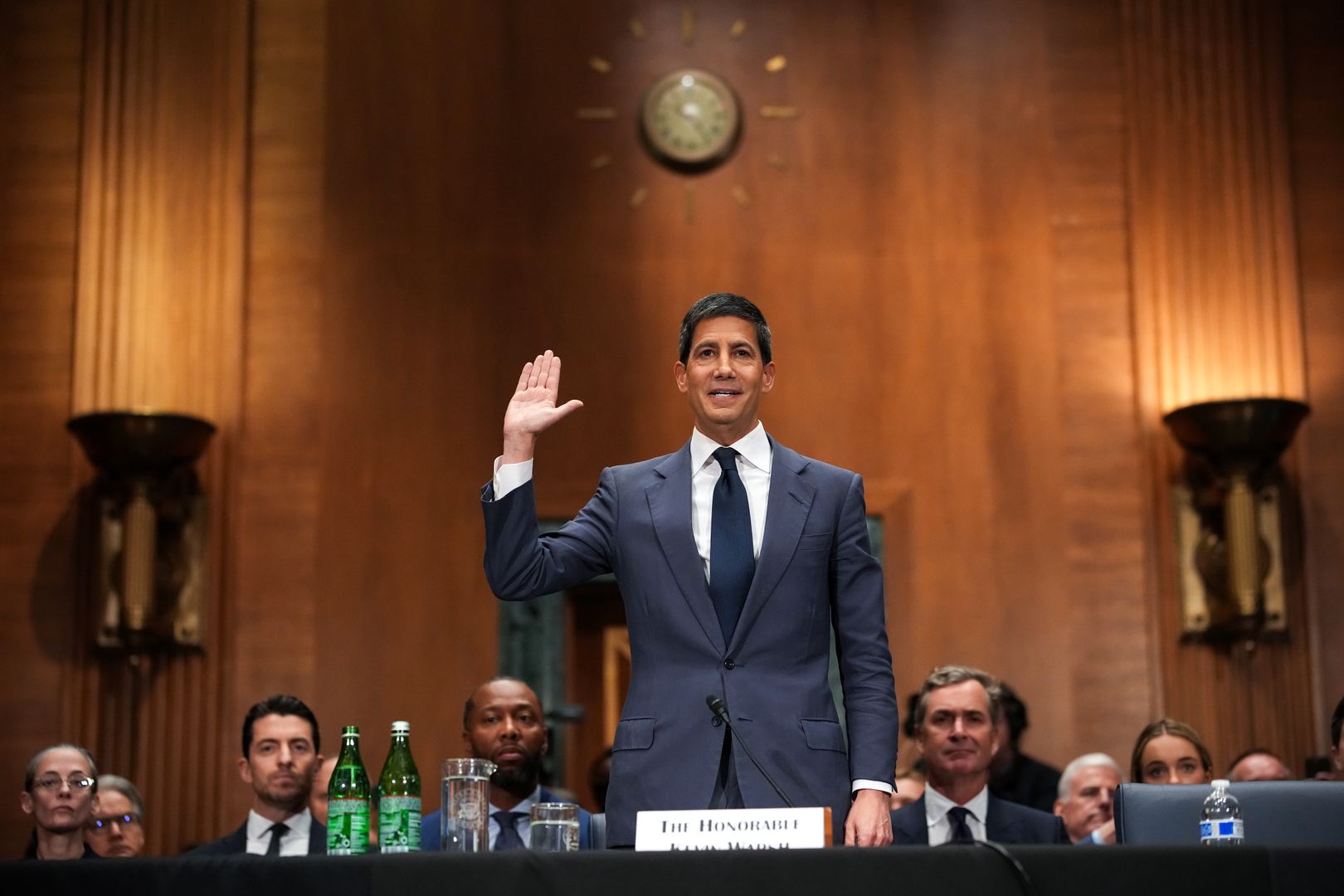
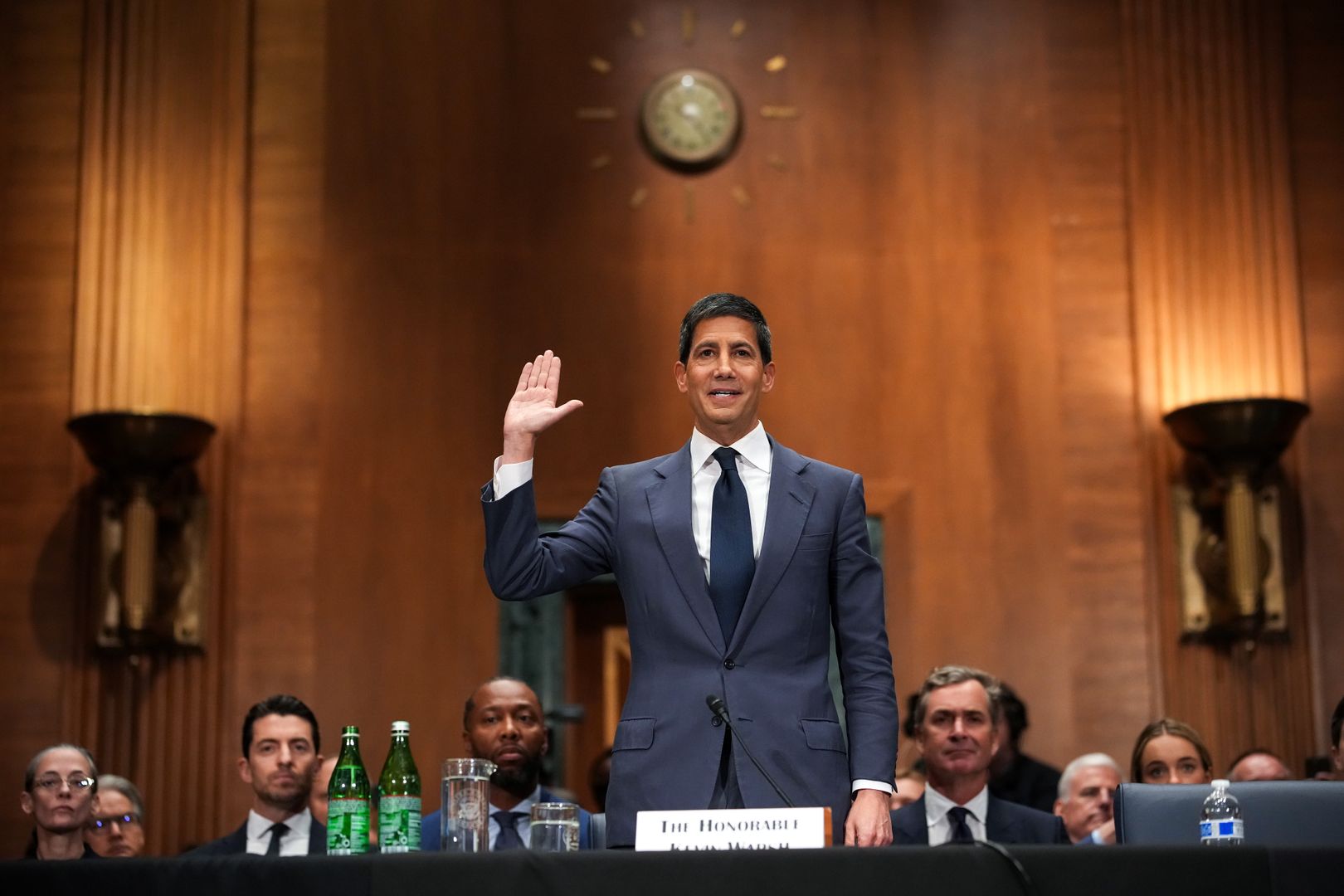
Kevin Warsh is set to be sworn in as the seventeenth Federal Reserve Chair at the White House on Friday, May 22, with President Trump administering the oath.
Analysis published by XWIN Research Japan identifies the specific on-chain signals most likely to move first as markets begin pricing in what a Warsh-led Fed actually means for Bitcoin.
Coinbase Premium and Exchange Netflows Are the Ones to Watch
XWIN’s analysis, published on May 22, centers on a specific risk that most crypto commentary has missed. The concern is not whether Warsh cuts rates or holds them, but rather what he intends to do with the Fed’s balance sheet.
During his Senate Banking Committee testimony, Warsh said the Fed’s balance sheet is too large, should shrink, and that the central bank has no business holding long-term Treasuries.
That is quantitative tightening, and XWIN argued that it works differently from rate policy. This is because rather than adjusting the price of money, it reduces the quantity of liquidity in the system directly.
The scenario XWIN flagged as uncomfortable is one where short-term rates fall while long-term yields rise at the same time. That combination has historically had a strong negative impact on risk assets.
And it matters for BTC because the asset is no longer behaving like a crypto-native instrument, considering that ETF adoption, institutional participation, and derivatives market growth have made it sensitive to global liquidity conditions in a way previous cycles were not.
For the flagship cryptocurrency, the first place that stress would likely show up is the Coinbase Premium, which tracks US institutional spot demand.
According to XWIN, if expectations for prolonged quantitative tightening build, institutional buying appetite may soften before anything registers in price, and a Coinbase Premium turning negative would be the earliest readable sign of that change.
The second indicator the analysts urged traders to monitor is Bitcoin exchange netflows. Rising inflows to exchanges tend to signal defensive repositioning, with holders moving assets onto platforms where they are easier to sell. A risk-off environment under the new Fed regime, XWIN argues, could trigger exactly that pattern among short-term holders.
What If BTC Draws Capital Under Tight Conditions?
According to XWIN, BTC’s recent structure has been driven mostly by leveraged positions rather than by any real buying. That is something investors should watch out for, too, considering that when such happens, it means that rallies only reflect short-covering rather than new capital coming in.
However, the research firm also allowed for a different outcome. According to them, if ETF inflows recover, exchange reserves keep falling, and Coinbase Premium turns positive again, it would suggest that Bitcoin is drawing capital even under structurally tighter conditions. This would be because the cryptocurrency sits outside the fiat system, being reined in.
At the time of writing, the asset was trading just above $77,000, having earlier dumped to a three-week low near $76,000, with attempts at recovery stopped at $78,000.
The post Warsh Era Begins at Fed: Two On-Chain Signals Bitcoin Traders Must Watch appeared first on CryptoPotato.


The U.S. House Committee on Oversight and Government Reform has opened an investigation into Polymarket and Kalshi over concerns tied to insider trading and wagers allegedly linked to classified information.
Summary
- James Comer launched a congressional probe into Polymarket and Kalshi over suspected insider trading and classified-information betting activity.
- Lawmakers cited reports of suspicious Iran-related wagers and a federal case involving a U.S. Army sergeant accused of using classified information to make over $409,000 in prediction market profits.
- The investigation comes as Polymarket faces mounting pressure from regulators and a recent suspected exploit tied to its UMA CTF Adapter contract on Polygon.
According to a statement released by the committee, Chair James Comer sent formal letters to Polymarket CEO Shayne Coplan and Kalshi CEO Tarek Mansour requesting internal records and compliance details related to user activity on their platforms.
The committee said it wants to assess how the companies detect suspicious trading, verify customer identities, and enforce geographic restrictions designed to comply with U.S. regulations.
In the letters, Comer said prediction market operators hold the internal data needed to identify whether users are trading with access to non-public information. He also raised concerns that offshore platforms may be allowing users to bypass federal compliance rules.
Congressional scrutiny intensified after a New York Times investigation cited more than 80 Polymarket users who allegedly placed unusually timed bets ahead of undisclosed U.S. and Israeli military operations involving Iran. Committee documents said those trades have raised questions about whether safeguards on prediction market platforms are sufficient to stop insider activity.
Federal prosecutors have already filed charges in one case highlighted by lawmakers. According to the committee, U.S. Army Master Sergeant Gannon Ken Van Dyke allegedly used classified information tied to “Operation Absolute Resolve,” an operation connected to Venezuelan President Nicolás Maduro, to place prediction market wagers that generated more than $409,000 in profits.
Why are lawmakers focusing on prediction markets now?
The House investigation arrives as prediction markets face pressure from regulators in multiple countries. Earlier this year, Minnesota became the first U.S. state to ban prediction markets after lawmakers classified them as illegal gambling operations.
Outside the United States, authorities in South Korea have also examined Polymarket over concerns tied to gambling-related content.
In India, the Ministry of Electronics and Information Technology ordered internet providers to block access to Polymarket after categorizing prediction markets as prohibited online money gaming platforms under the country’s Promotion and Regulation of Online Gaming Act 2025.
Indian regulators have argued that platforms allowing users to speculate on uncertain outcomes with real money expose younger users to gambling-related risks. Government policy discussions have also linked crypto-based prediction markets to concerns over stablecoin flows and unmonitored capital movement outside the banking system.
At the same time, Argentina, Colombia, and Romania have all restricted access to Polymarket after local authorities concluded that the platform operated outside domestic gambling frameworks.
How does the latest probe add pressure on Polymarket?
The congressional investigation comes only days after on-chain analysts flagged a suspected exploit involving Polymarket’s UMA CTF Adapter contract on Polygon. Blockchain investigator ZachXBT warned users after suspicious activity drained more than $520,000 from addresses tied to the contract.
Security firm PeckShield later said part of the stolen funds had already been moved through ChangeNOW. Blockchain analytics platform Bubblemaps separately reported that attackers were removing 5,000 POL tokens roughly every 30 seconds during the incident.
Polymarket contributor Shantikiran Chanal said the incident appeared linked to a compromised private key used for internal operations rather than a failure in the platform’s core contracts or market resolution systems. Chanal added that user funds and active markets remained safe during the incident.
The latest events have added technical security concerns to ongoing debates surrounding market integrity, oracle voting power, and the legal status of crypto-based prediction platforms.
Crypto World
Bitcoin Loses Key Support Levels, HYPE Sets New ATH, Markets Brace for New Fed Chair: Weekly Recap
Perhaps the most anticipated financial and economic event is just hours away, as the US Federal Reserve will have a new Chairman after more than eight years under Jerome Powell.
But, before we explore the seventeenth chair of the financial institution, let’s rewind the clock for a week and review what happened in the last seven days through the eyes of bitcoin (and a few alts). The primary cryptocurrency jumped past $82,000 at the end of the previous business week after the CLARITY Act made progress in the US Senate, but it was quickly rejected and had lost the $80,000 support by Friday evening.
It dipped further on Saturday to under $78,000 before it calmed at around that level on Sunday. Another couple of leg downs followed at the beginning of the business week, driving the asset south to its lowest price level since early May at $76,000.
This meant that the cryptocurrency had lost over $6,000 in 4-5 days. After this substantial retracement, bitcoin rebounded slightly and tapped $78,000 on Thursday. However, the predominantly bearish market structure and sentiment were too strong, and BTC was halted there, currently struggling to remain above $77,000.
A major market shift is expected to unfold soon, as the financial industry has braced for a change in Fed leadership. As reported earlier, the Kevin Warsh era begins today, but analysts from XWIN Research Japan outlined certain risks and on-chain signals that could be more important to BTC’s short-term price moves than the new Fed chair stepping in.
Consequently, BTC ends the week in the red, similar to most larger-cap alts. However, HYPE has stolen the show as it painted a new all-time high above $62 following a mind-blowing 43% weekly surge. ZEC, NEAR, ONDO, and VVV complete the double-digit price gainers club.
Market Data
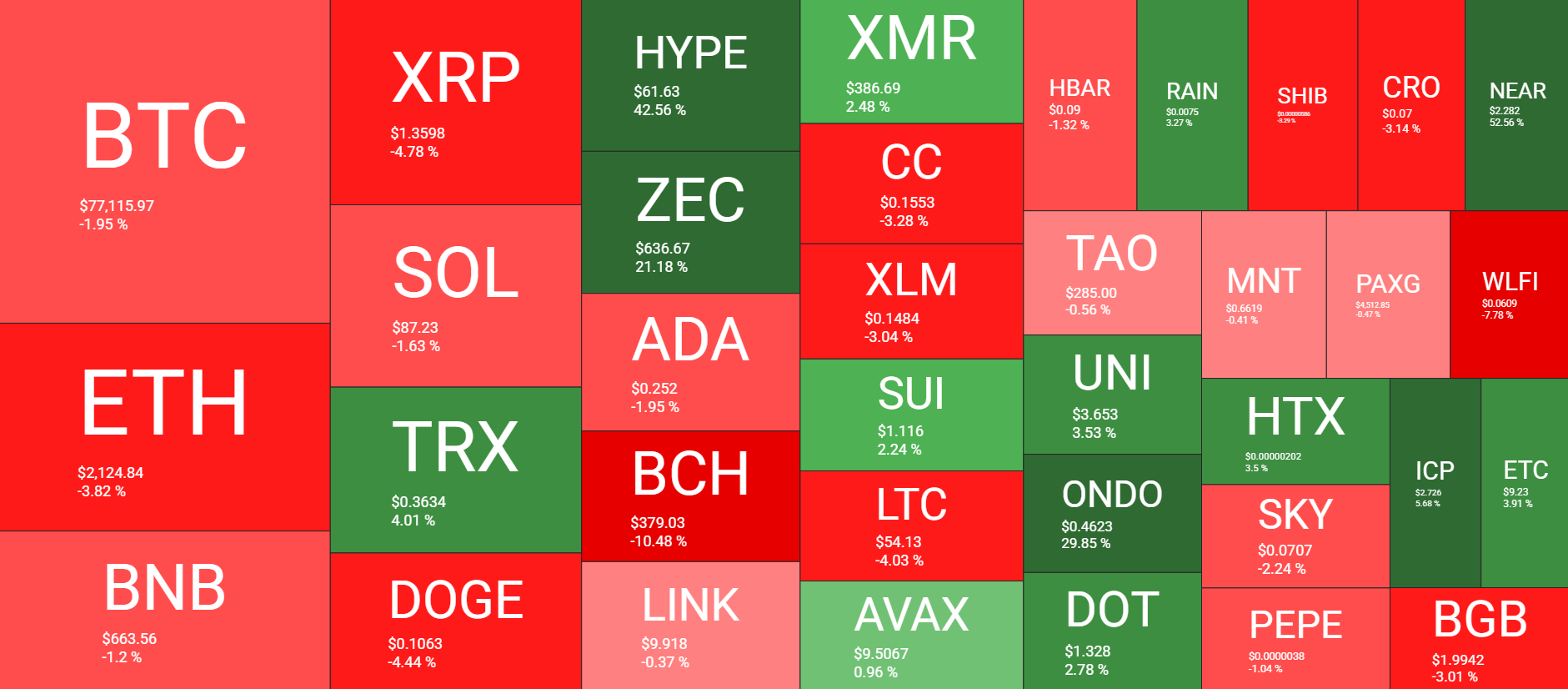
Market Cap: $2.666T | 24H Vol: $76B | BTC Dominance: 58%
BTC: $77,100 (-2%) | ETH: $2,125 (-3.8%) | XRP: $1.36 (-4.8%)
This Week’s Crypto Headlines You Can’t Miss
Bitcoin Pizza Day 2026: Commemorating Crypto’s First Real-World Transaction. It wouldn’t be May 22 without celebrating what became known as the International Bitcoin Pizza Day. On this date 16 years ago, Floridian programmer and early BTC adopter Laszlo Hanyecz ordered two pizzas from Papa John’s and paid with 10,000 BTC. This was one of the first (if not the very first) documented Bitcoin transactions, and the rest is history, as they say.
Bitcoin’s Biggest Holders Are Accumulating Again: What Are Whales Preparing For? Bitcoin wallets holding at least 100 units continue to accumulate, as new data from Santiment Intelligence explained that this cohort of investors has grown to 20,229. This is an 11.2% increase since the 18,191 wallets recorded this time last year.
XRP Futures on CME One Year Later: $63B in Trading Volume and Counting. This week marked the first anniversary of XRP futures going live on the Chicago Mercantile Exchange (CME). The veteran platform celebrated the event by highlighting impressive figures, including trading volume and the number of contracts bought and sold.
Trump-Linked Truth Social Suddenly Pulls Crypto ETF, Analyst Doubts Reasoning Behind Exit. The media conglomerate linked to the First Family pulled out of the crypto ETF race, arguing that it had filed under the Securities Act of 1933 instead of the Investment Company Act of 1940. However, analysts were not convinced that was the real reason the entity exited the ETF space.
Saylor’s Strategy Reloads With a New Multi-Billion-Dollar Bitcoin Purchase. Following a couple of more modest BTC purchases, the Saylor-founded bitcoin accumulator announced its most significant buy in a long time. It splashed over $2 billion to acquire 24,869 BTC and increased its stash to a whopping 843,738 units.
Iran Reportedly Launches Bitcoin-Based Shipping Insurance for Hormuz Passage. Reports emerged earlier this week indicating that Iran had launched a Bitcoin-based shipping insurance for vessels passing through the Strait of Hormuz. This was a different initiative than the one outlined last month, which asked passing ships to pay up to $2 million in BTC.
Charts
This week, we have a chart analysis of Ethereum, Ripple, Cardano, Binance Coin, and Hyperliquid – click here for the complete price analysis.
The post Bitcoin Loses Key Support Levels, HYPE Sets New ATH, Markets Brace for New Fed Chair: Weekly Recap appeared first on CryptoPotato.
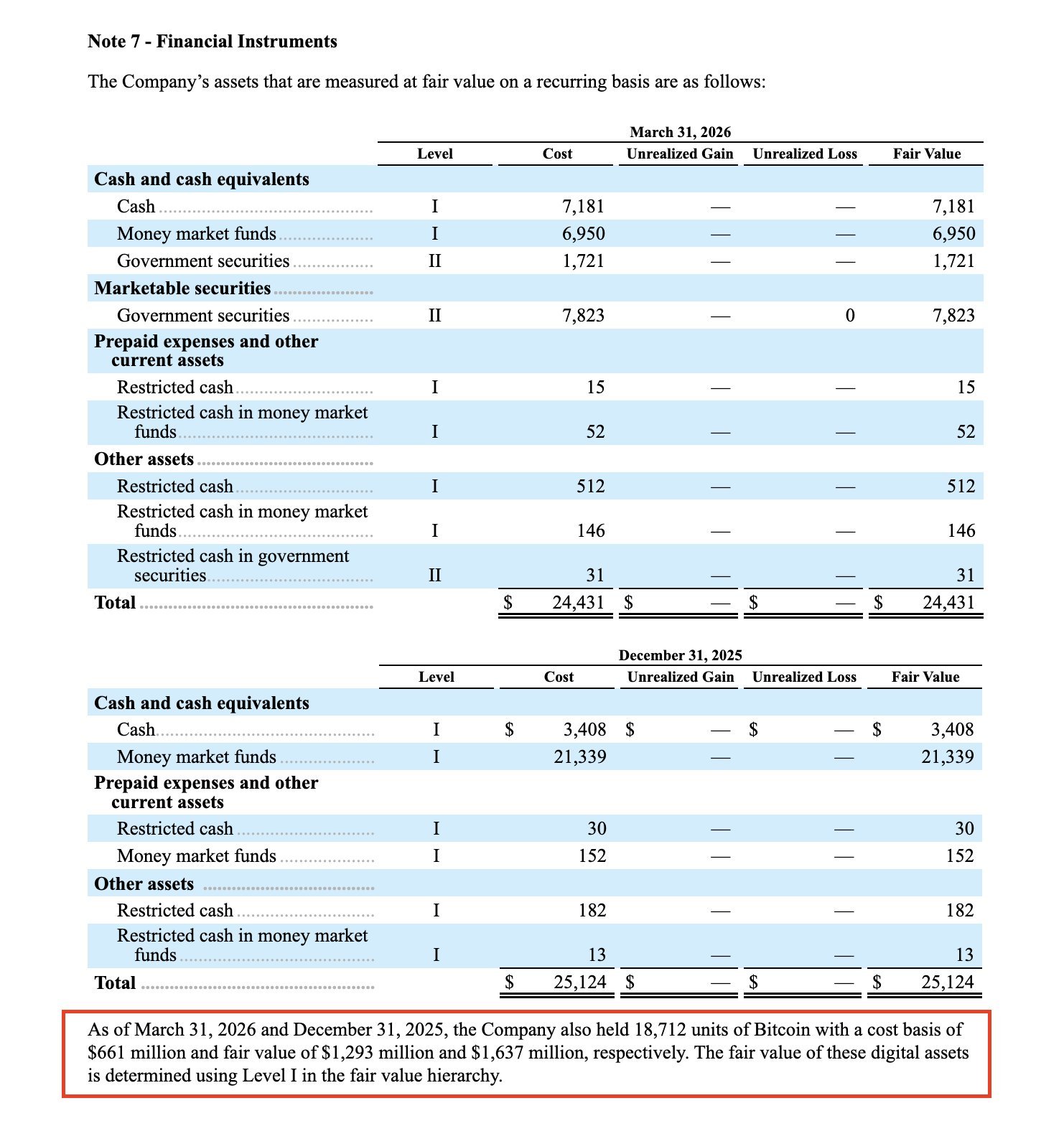
Elon Musk’s rocket and satellite company SpaceX is planning a $75 billion IPO in June, which could make it the largest near-term public listing with a major Bitcoin treasury.
Key takeaways:
- A Nasdaq 100 fast entry could expand Bitcoin exposure among the top mega-cap stocks, including Tesla.
- The IPO may pressure tech stocks as passive funds sell existing Nasdaq names to buy SpaceX, which may prove bearish for Bitcoin.
SpaceX IPO set to increase Nasdaq’s exposure to Bitcoin
SpaceX disclosed 18,712 BTC in its recent S-1 filing, worth roughly $1.45 billion, making it the largest known Bitcoin holder among companies preparing for, or recently filing for, a public listing.
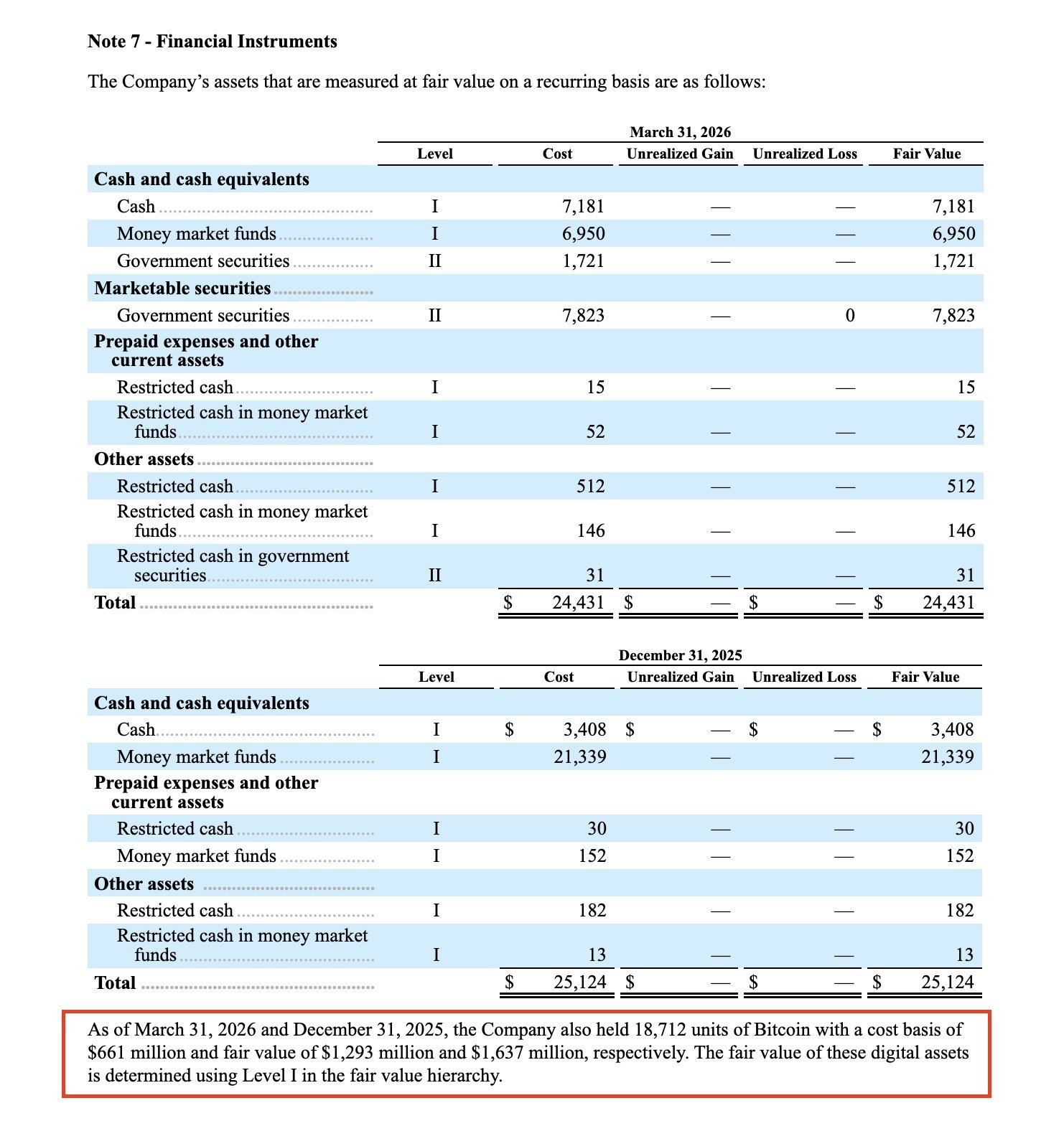
Source: SpaceX’s S1 Filing
Under Nasdaq’s newer “fast entry” rules, mega-cap IPOs can enter the Nasdaq 100 within 15 trading days, meaning SpaceX could quickly become one of the index’s largest constituents if its valuation lands near the $1.75 trillion–$2 trillion range after the $75 billion IPO.
As a result, Bitcoin exposure inside the Nasdaq 100 may expand beyond Tesla.
The electric carmaker already holds 11,509 BTC on its balance sheet. SpaceX, with 18,712 BTC, would give the Nasdaq 100 a second Elon Musk-linked mega-cap company with direct Bitcoin exposure.
“With the SpaceX IPO, the Mag 7 will become the Mag 8,” said Phong Le, CEO of Strategy, while referring to the elite group of mega-cap tech stocks, namely Apple, Microsoft, Nvidia, Amazon, Alphabet, Meta and Tesla.
He added:
“25% of the Mag 8 will have Bitcoin on their balance sheet.”
Bitcoin still faces downside risks
SpaceX IPO may be “bad news for tech stocks,” according to analyst Nic Puckrin.
“If it’s added to the Nasdaq 100 in a ‘fast entry’, passive funds have to buy it & sell other stock,” Puckrin said in a Friday post, adding:
“The higher SpaceX goes, the more they buy of it and sell of others. It’s going to act like a massive capital vacuum.”
Puckrin based his outlook on JPMorgan estimates showing that Nvidia could face more than $20 billion in passive outflows if SpaceX enters the Nasdaq 100.
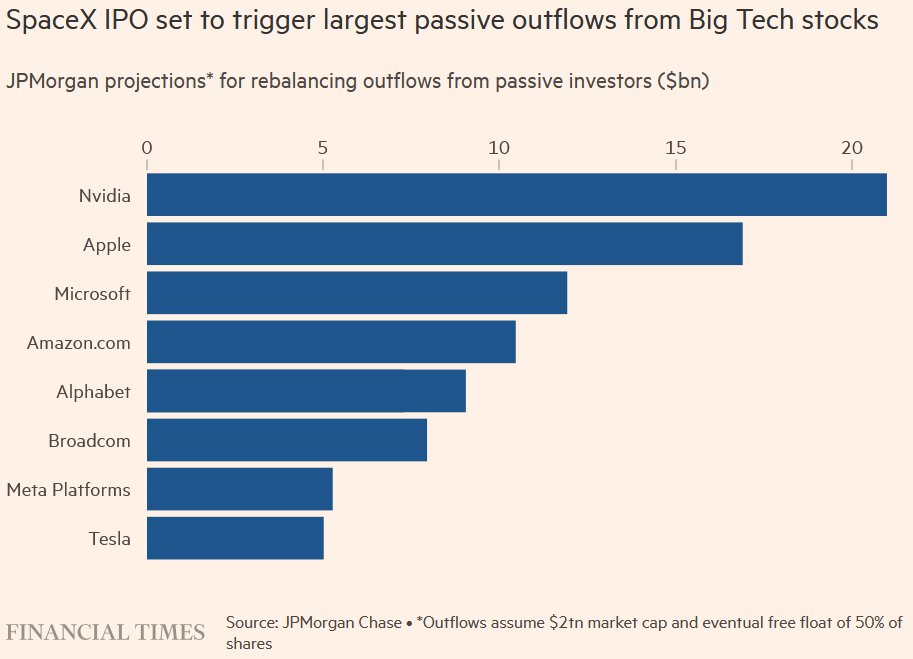
JPMorgan projections for rebalancing outflows from passive investors. Source: Financial Times/Nic Puckrin
Apple could face roughly $16 billion in estimated passive outflows, with Microsoft, Amazon, Alphabet, Broadcom, Meta and Tesla also likely to serve as funding sources for the SpaceX rebalance.
Bitcoin has traded closely with mega-cap tech for most of 2026.
As of Friday, BTC’s 30-day rolling correlation with the Roundhill Magnificent Seven ETF (MAGS), which tracks the Mag 7 stocks, stood near +0.81.
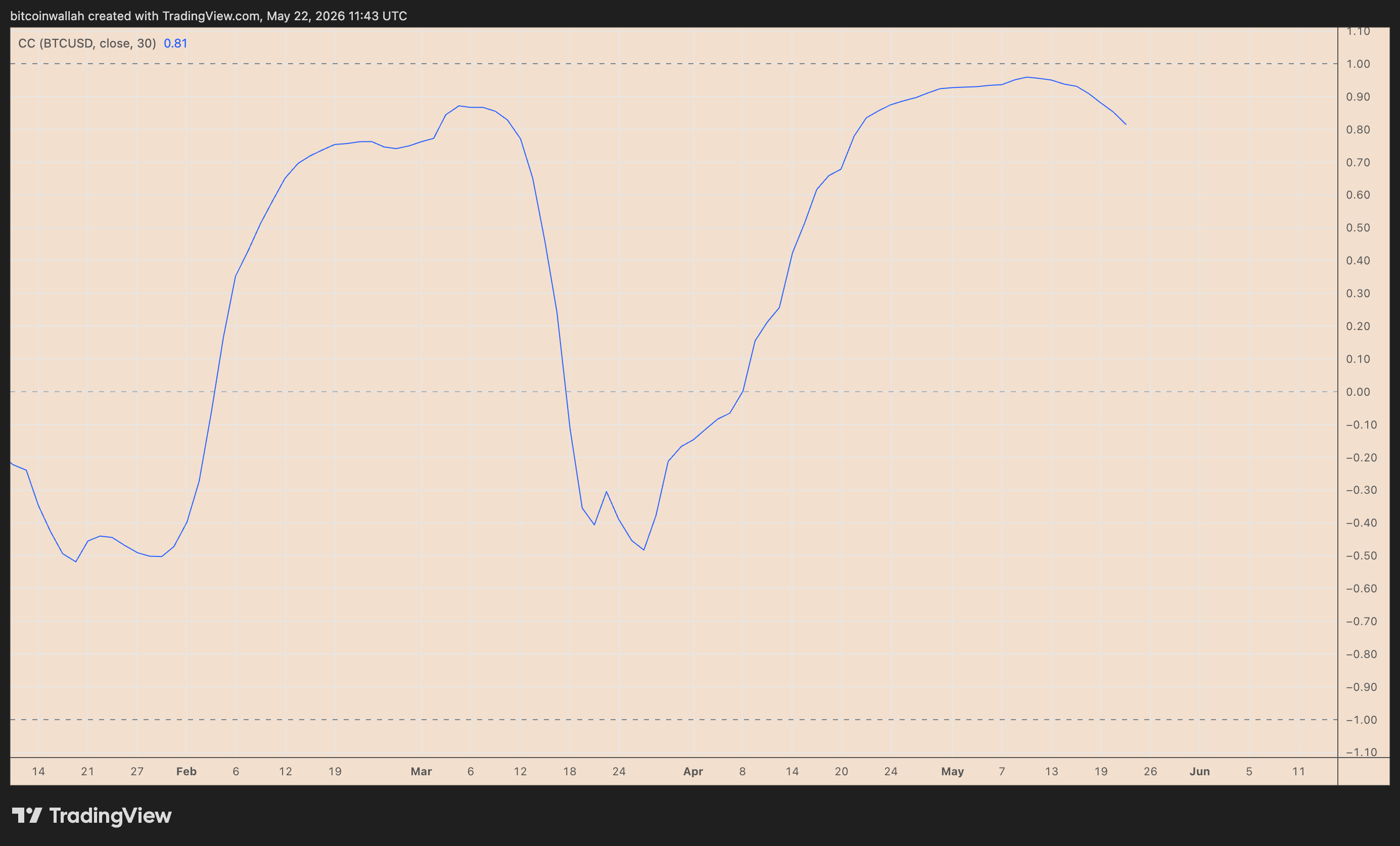
BTC/USD vs. MAGS correlation coefficient. Source: TradingView
For traders, that means BTC has recently moved in the same direction as major tech stocks more often than not.
So, if the SpaceX rebalance pressures Nvidia, Apple, Tesla and other large tech names, Bitcoin may also face short-term downside risk as investors reduce exposure to the broader risk-on trade.
How low can BTC price go?
On-chain metrics show Bitcoin’s apparent demand has dropped to its lowest in four months, which may lead to months of consolidation.
That weak demand backdrop also lines up with BTC’s current technical structure. Since February, Bitcoin has been moving inside an upward-sloping bear flag, a pattern that often forms during a pause in a broader downtrend.
For now, BTC’s immediate downside target sits around the $73,000–$74,000 range, near the flag’s lower trendline. A rebound from that area could send the price back toward the flag’s upper boundary near $85,000.
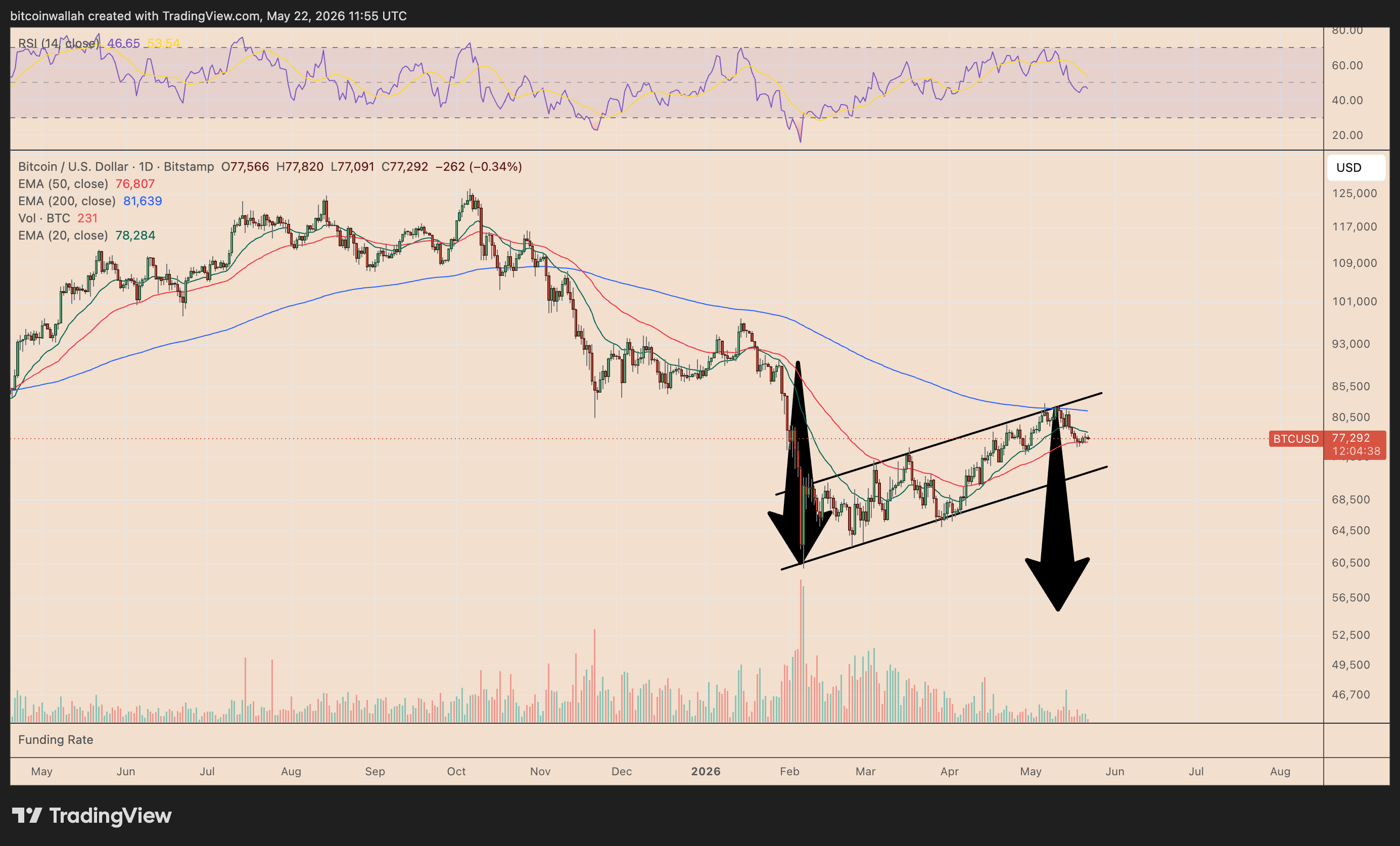
BTC/USD daily chart. Source: TradingView
Related: Bitcoin liquidity balance hints at developing rally toward $80K
The flag setup could open the door to a deeper decline toward $56,000, based on the pattern’s measured move, if BTC closes decisively under the lower trend line.
As has been the case all week, bitcoin (BTC) is trading in a tight range around the $77,000 level in U.S. morning action.
There was some economic news on Friday morning, and it wasn’t pretty. The University of Michigan Consumer Sentiment Index for May fell to a record low 44.8 from 48.2 previously and versus economist forecasts for 48.2. The Expectations Index also fell to a record low of 44.1.
The UMich 1-year Consumer Inflation Expectations Index rose to 4.8% from 4.5% previously. The 5-year Inflation Index rose to 3.9% from 3.4%.
It’s yet another disturbing stagflationary data point confronting Kevin Warsh as he’s set to take over as chairman of the Federal Reserve. President Trump appointed Warsh in the hope that he would lead the central bank to cut interest rates, but the Iran war has sent oil prices soaring and re-ignited what had been cooling inflation.
Rate traders are now pricing in more than a 70% chance of one or more rate hikes by the end of 2026.
Warsh’s official swearing-in is set for 11 am ET.
U.S. stocks, meanwhile, are posting modest gains ahead of the three-day weekend. The Nasdaq is higher by 0.3% and the S&P 500 by 0.4%.

XRP Ledger has recorded a notable spike in new addresses over the past 24 hours, suggesting renewed on-chain activity even as XRP’s price remains constrained by overhead resistance around the $1.40 region.
Santiment highlighted the latest burst in network growth, noting 4,300 wallets were created in a 24-hour window—the year’s fourth-largest spike so far in 2026. Daily active addresses also climbed to 43,520 from roughly 32,000 in the same period. The analytics firm underscored that “network growth is among the top leading signals to identify reversals.”
Key takeaways
- XRP Ledger added 4,300 new wallets in 24 hours, marking a substantial growth spike in 2026.
- On-chain activity accompanied a rise in daily active addresses, signaling renewed participation on the Ripple-backed network.
- US spot XRP ETFs continue to attract inflows, with May flows supporting liquidity and demand through institutional channels.
- Investor cost basis around $1.37–$1.45 may create a nearby resistance band for XRP as short-term buyers confront profit-taking risk.
- A potential breakout remains contingent on clearing a resistance zone around $1.40–$1.55 and navigating higher-timeframe chart patterns, including a falling wedge that analysts see as a setup for possible upside.
Surge in XRP Ledger activity signals growing participation
The latest data from Santiment indicates the XRP Ledger’s wallet activity is experiencing a meaningful uptick. The firm reported 4,300 newly created wallets on May 20, lifting the daily wallet increase to one of the year’s strongest spikes. Alongside the wallet growth, daily active addresses rose to about 43,520—an uptick that traders watch as a potential precursor to price moves.
Santiment summarized the dynamic by stressing that “network growth is among the top leading signals to identify reversals.” In other words, a surge in fresh participation can precede a shift in sentiment and buying pressure, even when price action is temporarily stalled.
Analysts have noted that rising wallet creation often foreshadows a broader move as new participants enter the ecosystem. Amonyx, an independent observer, commented that the observed wallet growth could attract attention from “smart money,” potentially signaling fresh participation in XRP markets. Niroshan682 added that new wallet creation is frequently an early signal of renewed network activity, particularly when paired with signs of growing institutional adoption.
ETF flows lend support to XRP’s institutional backdrop
Despite the on-chain growth signals, XRP’s price action has been modest, with the pair sliding about 1.5% over the last 24 hours and sitting roughly 62% below the July 2025 high of $3.66. The liquidity backdrop, however, is being bolstered by exchange-traded product inflows. In May, XRP spot ETFs have continued to accumulate, with inflows totaling around $107.3 million so far this month and marking the 12th straight day of positive flow. Measured across the month, total inflows push the year-to-date figure toward the $1.4 billion mark, while assets under management sit near $1.15 billion.
Spot XRP ETF activity provides a useful counterweight to price volatility, giving market participants a liquid channel for exposure and a signal of sustained demand from institutional-grade investors. SoSoValue’s data visualization of ETF flows has become a reference point for watching how official investment vehicles are shaping XRP’s utility and accessibility.
Price action in context: resistance zones and potential breakouts
From a technical perspective, XRP staged a 21% rebound off a local low around $1.27 on April 5, advancing to roughly $1.55 before encountering resistance. The current price action has stalled within a broader range, with $1.40 to $1.55 forming a notable consolidation ceiling. This zone aligns with several moving averages—the 50-day simple moving average (SMA), the 100-day SMA, and the 100-day exponential moving average—creating a confluence of resistance that buyers must overcome to sustain a rally.
Cost-basis data from Glassnode provides another lens on potential price pressure. About 3.75 billion XRP are held at an average cost of roughly $1.37–$1.45, creating a concentration of cost-basis that could act as a liquidity anchor—meaning a sizable portion of holders may be inclined to sell if the price tests break-even zones, potentially stalling upside momentum.
Higher up, there’s a supply concentration around $1.68–$1.70, where an estimated 3.8 billion XRP sits in hands. This zone coincides with the upper boundary of a forming falling wedge pattern, a setup some analysts view as a precursor to a breakout. If XRP can clear the wedge’s upper trend line, a measured target around $3.52—roughly 50% above the current level—appears plausible, contingent on sustained buying interest.
Analysts have flagged that a decisive push above the $1.40 barrier is a prerequisite for any meaningful reversal. In prior coverage, Cointelegraph noted that a close above $1.61 could confirm a trend change, underscoring that the path to a longer-term advance depends on breaking through this consolidation zone.
In sum, XRP’s near-term trajectory hinges on a blend of on-chain activity, ETF-driven liquidity, and the ability to pierce the current resistance cluster. While wallet growth signals a renewed interest in the network, price players are awaiting a clear breakout signal that could unlock a more confident move toward the higher targets indicated by chart patterns and supply analytics.
What to watch next: traders and investors should keep an eye on whether XRP can sustain the recent wallet growth alongside continued ETF inflows, and whether it can push decisively through the $1.40–$1.55 zone to validate a potential breakout. Ongoing on-chain metrics and the evolving ETF landscape will shape whether the current consolidation gives way to a new leg higher or a renewed phase of range-bound activity.
Variable Aperture Camera, Larger Battery and New Colors Expected in September

ICE to Launch Oil Perpetual Futures With OKX

Harrison Ford’s Greatest Sci-Fi Adventure Movie Officially Returns 46 Years Later


-

 Crypto World7 days ago
BloFin War of Whales 2026 Grand Prix opens registration for $5M trading championship
-

 Fashion7 days ago
Weekend Open Thread: Theory – Corporette.com
-

 Crypto World7 days ago
E-Estate Announces 1 Year Live: Washington DC Summit as Real Estate Tokenization Enters Its Next Phase
-

 Tech7 days ago
Google reimburses Register sources who were victims of API fraud
-

 Business7 days ago
H&R Real Estate Investment Trust (HR.UN:CA) Q1 2026 Earnings Call Transcript
-

 Sports7 days ago
Napoleonic enters 2026 Doomben 10,000 field via Abounding withdrawal
-

 Crypto World7 days ago
BeInCrypto 100 Institutional Awards Nomination: KAST for Best Digital Assets Neobank and Best Digital Assets Fintech
-
 Crypto World7 days ago
Bitcoin Battles US Bond Nerves With BTC Price Dip Toward New May Lows
-

 Crypto World7 days ago
ICE and CME urge US regulators to curb Hyperliquid energy trading
-

 Fashion6 days ago
On the Scene at Gucci’s Cruise Show in New York City: Mariah Carey, Kim Kardashian, Lindsay Lohan, Iman, and More!
-
 Crypto World7 days ago
Wall Street’s Boldest Gold Prediction Has Russians Rushing to Buy
-

 Crypto World7 days ago
IREN closes $3 billion convertible notes deal amid AI infrastructure expansion
-

 Fashion6 days ago
Trending Western Style Vests Perfect for Summer
-

 Politics6 days ago
Watch: far-right flag-fanatics run over victim, attack locals – Setup By the Left wing for your entertainment
-

 Crypto World21 hours ago
Blockchain.com files with SEC for U.S. IPO
-

 Fashion5 days ago
Amazon Sundays: Memorial Day Hosting
-

 Crypto World7 days ago
Crypto Market Structure Bill Clears Committee; Senate Vote in Focus
-

 Entertainment5 days ago
Off Campus Easter Eggs Explained: Characters, Stories, More
-

 Crypto World7 days ago
BeInCrypto 100 Institutional Awards Nomination: KuCoin for Leader in Digital Asset Adoption and Best Trading Infrastructure
-

 Politics7 days ago
UK’s top intelligence body warns Mandelson files being withheld by government
You must be logged in to post a comment Login