

Crypto World
Ripple (XRP) Repeats a March Move: Could the $1 Floor Finally Crack?

Ripple’s cross-border token has enjoyed robust institutional demand, standing in stark contrast to spot BTC and ETH ETFs, which have been suffering heavy outflows lately.
However, that trend appears to have reversed over the past few days, putting XRP at risk of falling below the psychological $1 barrier.
First Time Since March
It was last November that Canary Capital launched the first spot XRP ETF in the US, with 100% exposure to the asset. Bitwise, Franklin Templeton, 21Shares, and Grayscale then followed suit, and since day 1, these products have generated a cumulative total net inflow of almost $1.5 billion.
Interest in the ETFs has remained solid even during the bear market that ultimately impacted Ripple’s native token. In the past two days, though, outflows have exceeded inflows, marking the first pair of consecutive days since March.
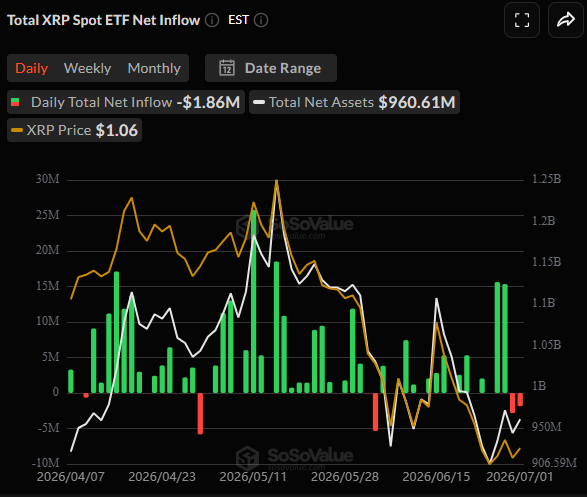
This development suggests that pension funds, hedge funds, and other conservative investors have reduced their exposure to XRP, prompting issuers of these products to sell holdings and further putting downward pressure on the token.
A few days ago, the asset’s price fell to nearly $1, and many feared that the bears would gain full control and suppress it below that crucial zone for the first time since late 2024. The bulls, though, stepped in and reclaimed some of the lost ground, and currently XRP trades at around $1.11 (per CoinGecko).
X user Diana remains cautious and predicted a potential downfall to as low as $0.87 if the asset breaks under $1.08 again. On the other hand, staying above that zone could pave the way for an increase to $1,30, she added.
The Bullish Signals
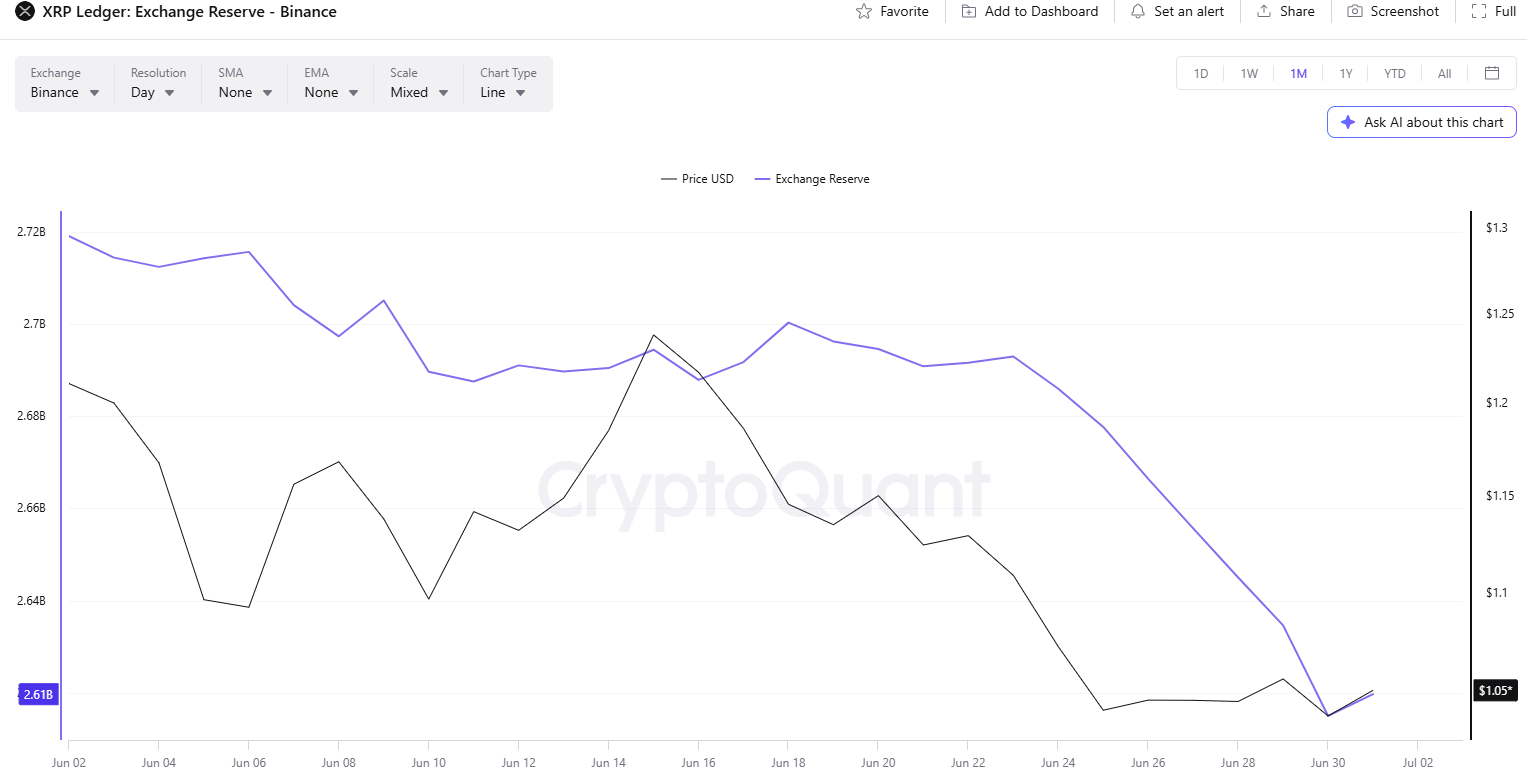
Despite recent ETF outflows, some factors suggest an upcoming upswing is more likely. The amount of XRP stored on Binance, for instance, recently dropped to a four-month low, resulting in reduced selling pressure.
Meanwhile, the popular analyst Ali Martinez revealed that the Tom DeMark (TD) Sequential Indicator (on a monthly scale) has flashed a buy signal on XRP (as well as other cryptocurrencies, including BTC, ETH, and SOL).
“On high-timeframe charts like the monthly, these trend-exhaustion setups carry significant weight. Historically, when multiple assets lock in concurrent monthly buy signals, it indicates seller fatigue and a high probability of a long-term market bottom,” he explained.
The post Ripple (XRP) Repeats a March Move: Could the $1 Floor Finally Crack? appeared first on CryptoPotato.


Japanese investment firm Metaplanet continued its corporate Bitcoin buildout in the second quarter, adding 2,823 BTC at an average price of about 12.71 million yen (roughly $78,850 at current exchange rates). The purchase pushed the company’s total holdings above 43,000 Bitcoin, while slightly lowering its average acquisition cost.
Separately, the story also highlights a contrasting trend among some smaller treasury-focused companies. South Korean firm K Wave Media exited its Bitcoin treasury strategy after selling its remaining BTC to address debt, while France-based Sequans Communications previously said it would monetize its remaining holdings over time.
Key takeaways
- Metaplanet bought 2,823 BTC in Q2, bringing its total to more than 43,000 BTC and reducing its average cost per coin.
- The latest tranche was acquired at an average price of about 12.71 million yen per BTC, lowering Metaplanet’s average acquisition cost to roughly $95,117.
- Metaplanet reported about $10.95 million in quarterly revenue linked to Bitcoin income-generation strategies involving options premiums and related yield methods.
- K Wave Media sold its last 88 BTC to repay debt, ending its Bitcoin treasury approach after earlier plans to expand holdings.
- Not every corporate treasury is expanding: Sequans Communications previously signaled that it would monetize its remaining Bitcoin holdings over time.
Metaplanet expands holdings and refines its cost base
According to a Thursday announcement from Metaplanet, the company acquired 2,823 Bitcoin during the second quarter at an average price of about 12.71 million yen per BTC. That figure matters because it was below Metaplanet’s prior average purchase price, enabling the firm to reduce its blended cost basis.
The acquisition lowered Metaplanet’s average acquisition cost to about $95,117 per BTC, down from approximately $96,258 previously. Metaplanet’s total Bitcoin holdings now stand at 43,000 BTC acquired for an aggregate value of about $4.1 billion, based on the figures in the company’s announcement.
Beyond accumulation, Metaplanet also disclosed quarterly performance tied to its Bitcoin income strategy. The company reported around $10.95 million in revenue from Bitcoin-related activities during the quarter. The approach, as described in the announcement, centers on earning premiums by selling cash-secured options and deploying other Bitcoin yield tactics.
For investors, the combination of spot purchases and options-based income generation is a key part of how treasury-style Bitcoin companies attempt to justify their equity valuations. When Bitcoin’s price is volatile, these revenue mechanisms can, in theory, partially offset drawdowns—though the net effect depends on execution, market conditions, and counterparty or strategy risks (none of which are detailed in this particular excerpt).
Shares move, but the broader performance picture remains uneven
Metaplanet’s equity performance reflected modest market optimism around the filing. The company’s shares closed Thursday up 3.5%, though the stock remains down about 48% year-to-date, according to the linked market page cited in the source text.
That underperformance also stands out against Bitcoin itself, which the source notes fell 31% over the same year-to-date period. The contrast underscores a persistent reality for corporate Bitcoin holders: even when a company keeps buying and building a large BTC position, investors may still reprice the stock due to factors like equity dilution risk, funding costs, valuation assumptions, or the market’s perception of how sustainable treasury income is.
The Metaplanet update comes during an ongoing push by several corporate buyers—yet the story is not purely one-directional, as other firms are trimming exposure.
Treasury strategies: K Wave Media exits after selling remaining BTC
While Metaplanet added Bitcoin, K Wave Media—an Nasdaq-listed company in South Korea—went in the opposite direction. The company sold its remaining 88 BTC to repay $6 million in debt, exiting its Bitcoin treasury strategy, according to a Tuesday filing with the U.S. Securities and Exchange Commission.
The SEC filing indicates a sharper reversal than what the company had previously communicated. Earlier coverage referenced in the source text describes K Wave Media’s July 2025 announcement that it secured $1 billion in capital capacity to drive its Bitcoin treasury strategy and aimed to expand holdings to 10,000 BTC. Exiting after holding only 88 BTC suggests the original plan ran into constraints—whether financial, operational, or strategic—though the excerpted material does not specify the reasons.
This kind of turnaround is important for readers because it highlights a mismatch risk that can exist in treasury models: plans premised on sustained capital access, favorable volatility, and consistent BTC purchase economics may not survive changing market conditions or debt obligations.
Other companies continue to monetize rather than accumulate
The source also points to Sequans Communications, a France-based semiconductor company that said in May it would monetize its remaining Bitcoin holdings over time. At the time of that announcement, Sequans reported holding 658 BTC, and its shares reportedly rose about 14.5% after the disclosure.
Taken together with K Wave Media’s decision to exit, the broader takeaway is that corporate Bitcoin strategies are diverging. Some companies are doubling down through additional spot buying and structured income strategies, while others are winding down exposure, using Bitcoin holdings to address liabilities, or planning to gradually convert BTC into cash.
Even within the same sector, these choices can produce very different investor outcomes depending on each firm’s balance sheet, debt profile, and how its equity market values the “BTC treasury” thesis.
Looking ahead, investors should watch whether Metaplanet can sustain its Bitcoin income-generation revenue while continuing to manage its cost basis, and whether other treasury-focused firms follow K Wave Media and Sequans toward monetization or debt reduction. The key uncertainty across all these cases remains whether corporate models that rely on both holding BTC and generating yield can hold up as market conditions and financing access evolve.


The National Organization of Black Law Enforcement Executives (NOBLE) endorsed the Digital Asset Market Clarity Act (CLARITY Act) in a letter to Senate leaders John Thune and Chuck Schumer.
Notably, NOBLE has become the first major law enforcement group to formally back the bill. The endorsement lands as the bill faces hurdles over ethics and illicit finance concerns.
NOBLE Endorses CLARITY Act
The letter was signed by NOBLE National President Reneé Hall. Hall, a former Dallas police chief, said the bill gives law enforcement new capabilities while preserving longstanding criminal enforcement authorities.
In its letter, the group pointed to expanded regulatory obligations across the digital asset industry, stronger forfeiture authorities, new compliance expectations, and added oversight of crypto kiosks.
“Collectively, these provisions have the potential to improve investigative visibility and provide law enforcement with additional tools to combat financial crime,” the letter reads.
The group also emphasized that the bill does not modify existing federal criminal authorities used to prosecute offenses such as money laundering, unlicensed money transmission, conspiracy, sanctions violations, and related crimes.
Follow us on X to get the latest news as it happens
A Break From Other Law Enforcement Groups
The position sets NOBLE apart from other police and prosecutor organizations. The National District Attorneys Association, the National Association of Assistant US Attorneys, the International Association of Chiefs of Police, and the National Sheriffs’ Association previously raised concerns regarding the bill.
Their objections center on Section 604. A coalition of Catholic sisters also asked Senate leadership to reexamine the lack of provisions on illicit finance, anti-money laundering, and accountability.
Despite the opposition, industry advocates keep pressing for floor time. Stand With Crypto urged supporters this week to lobby their senators.
The bill still needs 60 votes on the Senate floor, meaning seven Democrats must cross over. Whether a law enforcement endorsement softens resistance to Section 604 may become clearer once senators return.
Subscribe to our YouTube channel to watch leaders and journalists provide expert insights
The post First Major Law Enforcement Group Endorses CLARITY Act in Letter to Senate appeared first on BeInCrypto.


The HCMC did not immediately respond to a CoinDesk request for comment regarding Binance’s MiCA licensing process.
“As the person who led the license application, there’s nothing that I have been made aware of that there was any issue with the application,” Lynch added. “In fact, I was told the complete opposite.”
Lynch also argued that Europe’s crypto market loses more than just its largest exchange if Binance remains outside the MiCA framework. She said Binance provides liquidity and market infrastructure that benefit the wider crypto ecosystem, adding that regulation should strengthen the industry rather than exclude companies that have invested heavily to meet its standards.
Lynch declined to speculate on reports that political intervention played a role in the delays. Instead, she said the focus is now on helping users through the transition period while preparing a new licensing strategy.
“We’re very committed to being in Europe and very committed to being regulated,” she said.
Despite Binance’s experience, Lynch described MiCA as a positive step for the industry. She said the regulation has helped bring crypto into the financial services system by providing firms with clear rules and consumers with greater protection.
“I fundamentally believe the crypto industry is maturing. Regulation brings maturity,” she said. “The industry is here to stay, and it’s part of the financial services ecosystem.”
Crypto World
Franklin Templeton Executes Tokenized U.S. Treasury Trade With Stablecoins on Canton Network

TLDR:
- Franklin Templeton exchanged a tokenized Treasury security for tokenized cash using on-chain settlement.
- The transaction paired a tokenized U.S. Treasury with USDCx and settled through Canton Network infrastructure.
- Tradeweb executed and priced the trade while several financial firms participated in the transaction.
- The deal occurred after market hours and was later reported to TRACE, according to Christopher Perkins.
Franklin Templeton has completed a tokenized U.S. Treasury transaction using stablecoins and on-chain settlement infrastructure. The trade involved the exchange of a tokenized Treasury security for tokenized cash on the Canton Network.
Tradeweb facilitated execution and price discovery while several financial firms supported the transaction. The deal adds to institutional efforts to move real-world assets onto blockchain-based financial rails.
Tokenized U.S. Treasury Trade Executes on Canton Network
Tradeweb announced the completion of the real-time transaction on July 1. The trade paired an on-chain U.S. Treasury with tokenized cash known as USDCx.
According to the announcement, Franklin Templeton transferred a tokenized Treasury security to Virtu Financial. In return, Virtu delivered USDCx through synchronized settlement on the Canton Network.
Tradeweb supplied the execution venue and pricing services for the transaction. The Canton Network coordinated the simultaneous movement of both assets on-chain.
Participants included Blockdaemon, Digital Asset, Franklin Templeton, Societe Generale, Tradeweb, and Virtu Financial. The transaction was also reported to TRACE after execution.
Christopher Perkins, president of CoinFund and former Coinbase executive, said on X that the trade took place after normal market hours. He noted that the transaction settled nearly instantly and represented another step toward continuous on-chain markets.
Tokenized Real-World Assets Gain Institutional Momentum
Tradeweb said the transaction demonstrates how tokenized U.S. Treasuries and tokenized cash can settle in real time. The company noted that traditional timing and settlement limitations did not apply to the process.
The transaction also arrives as the Canton Network prepares for the launch of DTCC’s Tokenization Services later this year. According to the announcement, the initiative aims to support broader access to high-quality liquid assets beyond traditional market hours.
Digital Asset said the transaction marked another milestone in developing always-on and interoperable capital markets infrastructure. The company added that continuous market making can increase asset utility and improve market accessibility.
Franklin Templeton described each tokenized transaction as another step toward a round-the-clock liquidity layer. The asset manager stated that on-chain capabilities can allow high-quality assets to move without the restrictions of standard market schedules.
Virtu Financial said the trade expands its market-making capabilities into tokenized U.S. Treasuries. The company added that blockchain-based settlement can support liquidity provision without conventional settlement constraints.
The Canton Network said active participation from firms including Franklin Templeton, Tradeweb, and Virtu Financial contributes to a unified framework for moving real-world assets across digital financial systems.

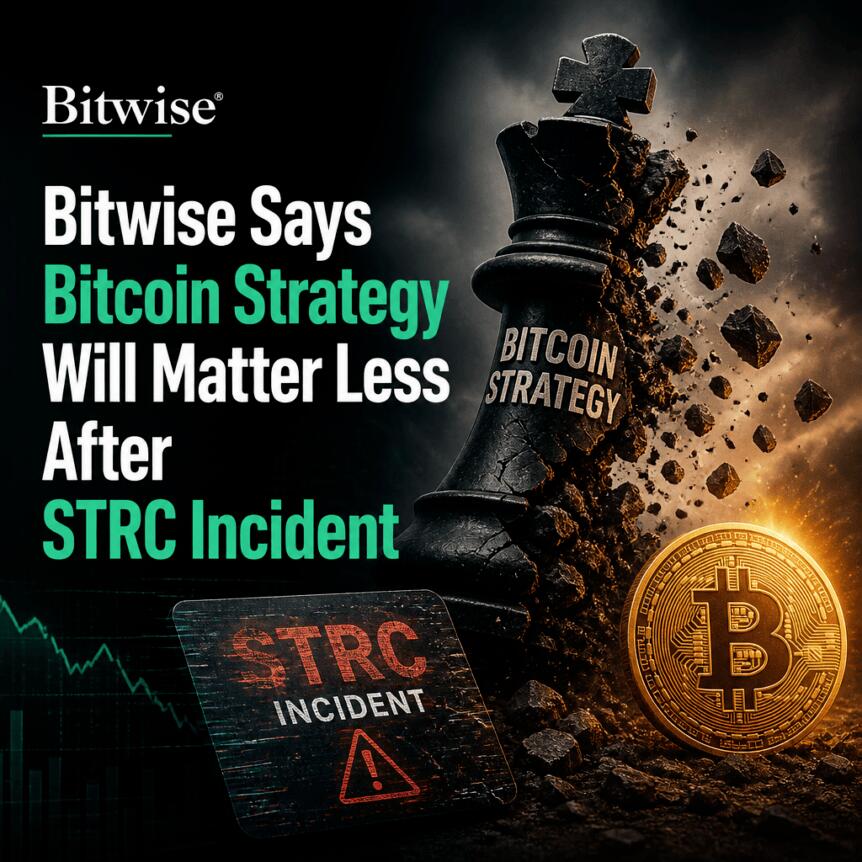
Strategy’s long streak as one of Bitcoin’s most consistent institutional buyers may be ending, according to Bitwise chief investment officer Matt Hougan. Speaking Thursday, Hougan suggested the company’s dominance as a “one-way” source of demand is likely to shrink in the next market cycle, after volatility around Strategy’s principal perpetual preferred stock product, Stretch (STRC).
The reassessment comes after STRC broke sharply from its $100 par value to below $75 late last month, a move that undermined investor confidence in the sustainability of Strategy’s dividend-style model. The timing also overlapped with broader market stress, when Bitcoin fell to a 21-month low of $58,190 on June 25.
Key takeaways
- Bitwise CIO Matt Hougan said Strategy’s era as Bitcoin’s dominant buyer may be over, with other institutional allocators expected to play a larger role next cycle.
- STRC’s move away from $100 par value below $75 fueled concerns about whether Strategy’s yield structure can hold up through “end-of-cycle” dynamics.
- Despite the STRC shock, Hougan argued Strategy is not facing near-term liquidity risk based on liquid asset coverage.
- Strive CEO Matt Cole pushed back, calling the STRC episode overblown and noting Strategy’s Bitcoin holdings are about 4% of total supply.
Strategy’s buyer dominance questioned after STRC turmoil
For years, Strategy has been widely viewed as a steady, high-conviction buyer of Bitcoin—helping provide consistent demand even when broader sentiment weakened. Hougan framed Thursday’s comments around a shift in what investors should expect from that demand profile.
“For years, Strategy has been the most dominant Bitcoin buyer in the world and a one-way source of Bitcoin demand. Those days are likely over,” Hougan said in a CIO memo, adding that he expects the company to be “less important” than it was in the previous cycle. In his view, banks, asset managers, pensions, endowments, and sovereign wealth funds may replace Strategy as Bitcoin’s primary demand engine as the next upcycle develops.
Hougan’s concern centers on how STRC behaved during a period when markets were already under pressure. The STRC incident raised fears that the structure underpinning dividend payments could be strained when conditions tighten—particularly in late-cycle environments where risk appetite falls and funding costs rise.
Why Hougan sees STRC as “end-of-cycle dynamics”
Hougan characterized the STRC drop as a pattern he associates with late-cycle stress. He compared the situation to a prior example in 2021: the collapse of Grayscale’s GBTC premium.
His argument is essentially about fit. According to Hougan, “money searching for high yields and low volatility was used to buy Bitcoin, which offers neither.” In that framing, the market eventually needs to “clear out” capital that was attracted by yield characteristics that Bitcoin itself does not reliably provide, before a more durable bottom can form.
This perspective matters for traders and longer-term investors because it reframes Strategy’s recent volatility away from a single-company solvency story and toward a broader liquidity-and-demand composition story—one where the source of marginal demand changes as the cycle matures.
Strategy responds: funding dividends and increasing reserves
In the aftermath of the STRC disruption, Strategy said it would sell Bitcoin when necessary to fund dividends, according to coverage earlier published by Cointelegraph. The company also expanded its US dollar reserve to $2.55 billion, easing some immediate concerns about operational coverage.
Even with those steps, Hougan said Strategy’s role as an aggressive buyer has weakened. The implication for market participants is that reserve moves and occasional Bitcoin sales can stabilize the dividend narrative in the short term, but may also reduce the consistency of net buying during turbulent periods.
Hougan nonetheless said he still expects Strategy to be a “net buyer” in the next bull run—suggesting the firm’s long-term posture may persist, even if its influence on price dynamics is likely to be less dominant than in the last cycle.
Debate over materiality and liquidity risk
While STRC became the focal point, Strategy leadership pushed back on how much attention the incident deserves. Strive CEO Matt Cole argued that the episode has been overemphasized by media and that Bitcoin’s selloff may have been driven more by the broader market than by any single factor.
Speaking with NovaDius Wealth Management president Nate Geraci, Cole noted that Strategy’s 847,363 Bitcoin represents about 4% of total supply. He also referenced US Securities and Exchange Commission standards for materiality, stating that a 4% stake would not be considered material under SEC thresholds, which he described as starting at 5%.
“If one person owned 4%, you don’t even have to report that publicly to the SEC because the SEC deems 4% to be immaterial. They start to view a position to be material at 5%.”
Hougan, meanwhile, addressed liquidity in a more quantitative way. He said Strategy has $52 billion worth of liquid assets marked against $7 billion of debt. In his assessment, Bitcoin would need to fall another 70%—to roughly $18,500—for Strategy to face risk. He also added that if the company began selling Bitcoin immediately, it could cover dividends from STRC and other perpetual preferred stock offerings for the next 28 years.
Taken together, the two positions highlight a tension that investors should watch: one view suggests the STRC mechanism is a late-cycle stress test that affects demand composition and price, while the other emphasizes reserve coverage and argues that the company’s balance sheet prevents an immediate liquidity threat.
For now, the key question is not whether Strategy can operate through the current strain, but whether the market’s next wave of Bitcoin buying will be driven by the same yield-seeking, vehicle-based demand—or by a broader set of long-term allocators that Hougan expects to take a bigger share.
As conditions evolve, investors should monitor whether STRC stabilizes relative to par and whether Strategy’s net buying pace remains consistent enough to reassert influence—while also tracking if incremental demand truly shifts from Strategy-style products to the wider institutional categories Hougan cited.


Riot Platforms transferred another 500 BTC to NYDIG Custody, according to Arkham data cited by onchain trackers.
Summary
- Riot Platforms moved another 500 BTC to NYDIG Custody, raising fresh sale speculation among traders.
- The miner already sold 3,778 BTC in Q1 while producing only 1,473 BTC total.
- Public Bitcoin miners continue selling reserves as mining costs rise and margins remain under pressure.
The transfer was worth about $30.72 million at the time of the report and was shared through an Onchain Lens post.
The move may signal that Riot is preparing to sell part of its Bitcoin holdings. Transfers to custody or execution partners do not always confirm a sale, but similar Riot transfers this year have often come before reported selling activity.
Another move in a longer sale pattern
The latest transfer follows earlier Riot activity involving NYDIG. As crypto.news reported in April, Riot sent 500 BTC to an NYDIG deposit address in a move worth about $39 million at the time. That report said the transfer added to a series of Bitcoin moves from Riot over the same period.
Riot had also disclosed large Bitcoin sales in its first-quarter 2026 operations update. The company sold 3,778 BTC in Q1 for about $289.5 million. It sold those coins at an average net price of $76,626 per BTC.
Riot produced 1,473 BTC in the first quarter, down 4% from 1,530 BTC in the same period a year earlier. Its BTC holdings fell to 15,680 at quarter-end, down 18% from 19,223 in Q1 2025. The company said 5,802 BTC were restricted at the end of the quarter.
Riot’s Q1 results also showed pressure in its mining business. Bitcoin mining revenue fell to $111.9 million from $142.9 million a year earlier. Riot linked the decline to lower average Bitcoin prices and higher network hash rate.
Miner selling pressure continues
Riot’s latest BTC movement comes as public miners face tighter economics after the Bitcoin halving. Higher mining difficulty, lower hashprice, energy costs, and capital needs have pushed several listed miners to sell reserves.
As crypto.news reported, publicly traded Bitcoin miners sold more than 32,000 BTC in the first quarter of 2026. That was a record quarterly figure and topped the amount sold by the same firms across all of 2025. Riot, MARA, CleanSpark, Cango, Core Scientific, and Bitdeer were among the miners named in that wider trend.
Riot also continues to expand beyond Bitcoin mining. The company has been building a data center business while using its power assets and infrastructure to serve high-performance computing customers. That shift gives the miner another capital need at a time when mining margins remain tight.
The 500 BTC transfer does not confirm an immediate sale on its own. Still, the timing adds to the market’s focus on Riot’s treasury strategy.


Ether and solana led crypto higher on Friday as a squeeze on bearish traders pushed bitcoin toward $62,000, capping the market’s first genuinely strong week since mid June.
Bitcoin traded around $61,360, up 2.5% over seven days, per CoinDesk data. Ether rose 4.2% in 24 hours to about $1,702 and is up 9.7% on the week, while solana held near $80 with a weekly gain of 18.6%, the strongest among the majors. XRP added 5.7% over the week to $1.09 and Hyperliquid’s HYPE rose 5.1% on the day.
Traders betting against crypto lost $281 million to liquidations over the past 24 hours, against $159 million in longs, out of $440 million in total forced closures across 95,690 traders, according to Coinglass data.
When shorts are forced to close, they buy back the asset, and that buying pushes prices into the next tranche of shorts, the loop that turns a modest bounce into a squeeze.
The largest single liquidation was an $18.2 million ether position on Hyperliquid, fitting a day when ether led the damage to bears at $157 million in wiped positions against bitcoin’s $103 million in an unusual flip.


The U.S.-listed bitcoin ETFs pulled in $221.7 million on Thursday, their largest inflow in two months, according to SoSoValue.
Fidelity’s FBTC led the charge with a hefty $165.96 million inflow, followed by ARKB at $91.84 million and HODL at $4.35 million. BlackRock’s IBIT, the world’s largest Bitcoin ETF, was the outlier with a $40.43 million outflow.
The cumulative inflow ends a painful 10-day outflow streak that saw investors pull $2.73 billion from the funds. Even so, the year-to-date picture remains ugly, with net outflows still sitting at a hefty $5.4 billion.
Thursday’s bounce is therefore a drop in the ocean compared to the selling we’ve seen this year. Still, it’s a welcome sigh of relief for the bulls. At the very least, it helps validate bitcoin’s rebound to around $61,700 after hitting 21-month lows under $58,000 earlier this week.
For a real recovery, though, these inflows need to turn into a consistent trend. Historically, steady money flowing into Bitcoin ETFs has been a hallmark of bull runs.


Binance is reportedly set to lead a new funding round for Mesh, a crypto payments and settlement company, at a valuation of up to $2 billion.
Summary
- Binance’s planned lead role could double Mesh’s valuation from $1B to as much as $2B.
- Mesh’s payments network targets digital asset transfers across wallets, exchanges, stablecoins, and fiat rails globally.
- Growing stablecoin rules and tokenization demand are pushing investors toward crypto settlement infrastructure providers.
The deal was reported by Axios, citing people familiar with the matter. The report said demand for digital asset-to-fiat transfer tools, payment systems, and settlement infrastructure is rising.
Meanwhile, that demand comes as stablecoin rules become clearer and tokenization moves deeper into financial markets. The round has not been formally announced by Binance or Mesh.
Mesh valuation could double
The reported round would mark a sharp rise in Mesh’s valuation. As crypto.news reported, Mesh raised a $75 million Series C in January at a $1 billion valuation. That round was led by Dragonfly Capital, with backing from Paradigm, Moderne Ventures, Coinbase Ventures, SBI Investment, and Liberty City Ventures.
Mesh was formerly known as Front Finance. The company builds payment infrastructure that connects wallets, exchanges, digital assets, and fiat rails. It aims to make crypto payments easier for users while letting merchants receive stablecoins or fiat without handling complex blockchain steps.
Stablecoin rules lift demand
Stablecoins have become a major focus for payment companies, exchanges, and banks. Banking Circle launched regulated stablecoin settlement services after receiving approval in Luxembourg. The bank now supports USDC, USDG, and its own EURI for institutional fiat and crypto conversion.
The market is also moving toward tokenized bank deposits. As crypto.news reported, major U.S. banks are backing a tokenized deposit network through the Clearing House, with a launch targeted for early 2027. That system would let banks settle tokenized deposits around the clock while keeping customer deposits inside regulated banking channels.
Funding race turns to settlement
Mesh sits in the middle of this shift because it focuses on the movement of value between assets, wallets, and payment systems. Its model addresses a common issue in crypto payments: users may hold one asset, while merchants or platforms may want settlement in another asset or in fiat currency.
The company has also worked to expand access through partnerships. Moreover, Mesh partnered with Italy’s crypto wallet Conio in 2024, giving Conio users access to several crypto exchanges and withdrawal options through Mesh’s connection layer.
A Binance-led round would show that large exchanges still see payment and settlement infrastructure as a core growth area. It would also place Mesh closer to the center of the stablecoin and tokenization race, where firms are trying to connect crypto rails with everyday payments, institutional transfers, and fiat settlement.
The reported valuation also reflects a wider shift in crypto funding. Investors have moved beyond trading apps and tokens toward systems that can support regulated payments, cross-border transfers, and asset settlement.
If the round closes near the reported level, Mesh would have doubled its valuation in about six months, showing continued demand for infrastructure that links digital assets with traditional money.
TLDR:
- Ironwood testnet activates with two independent consensus implementations built by separate teams.
- Zcash reduced ten-note wallet migration times from around 15 minutes to about 2.5 minutes.
- Multi-transaction signing now supports more than 11 transactions through a single QR code.
- Mainnet activation could occur around July 21 as audits and ZIP specifications near completion.
Zcash is moving forward with its Ironwood network upgrade after confirming a scheduled testnet activation. The update introduces new consensus changes and major wallet performance improvements ahead of a planned mainnet deployment.
Development teams have also completed two independent consensus implementations for the upgrade. The work marks one of the most advanced testnet preparations recorded for a Zcash network upgrade.
Zcash Ironwood Testnet Upgrade Brings Dual Consensus Implementations
Zcash developer Dev announced that the Ironwood testnet upgrade would activate on July 4. The release includes two independently developed consensus implementations.
One implementation came from Valar Group, while the other was built by the Zcash Foundation. According to Dev, the Valar Group version has already entered the audit process.
The teams also released a desktop wallet fork that supports migration testing on the testnet. Users with Keystone development devices can update firmware and test migration functions before the mainnet launch.
The upgrade introduces multi-transaction signing through a single QR code. Dev said the feature required extensive work behind the scenes and represented a major technical milestone for the testnet.
Contributors from zodl also participated in the process. The group worked on technical specifications, wallet libraries, circuit updates, and application programming interfaces supporting Ironwood.
Zcash Wallet Performance Improves Ahead of Mainnet Activation
Development updates shared by Dev showed major gains in wallet migration performance. The time needed to complete a ten-note migration fell from around 15 minutes to approximately two and a half minutes.
Inbound QR scanning dropped from three minutes to one minute. Loading and transaction review declined from two minutes to 45 seconds.
The signing process posted the largest improvement. Signing time fell from roughly nine minutes to about 37 seconds.
Outbound QR scanning also became faster. The process now takes about 10 seconds compared with roughly one minute previously.
In a separate update, Zcash developer Sean Bowe said all Ironwood consensus rule changes had been implemented and were undergoing audits.
He added that the specifications and Zcash Improvement Proposals, known as ZIPs, were approaching their final state.
Bowe also said developers expected readiness for a mainnet activation around July 21. He confirmed that the official testnet activation was scheduled for the following day and noted that the Zebra release supporting Ironwood should become available around the same time.
According to Bowe, sufficient mining hash rate already signals technical readiness for the mainnet upgrade. He noted that some wallets may not support Ironwood immediately, although alternative options and testnet preparation time remain available before activation.

Politics Home Article | The Lords should not be able to block legislation backed by MPs

Switzerland End 88-Year Wait With Historic World Cup Knockout Victory Over Algeria

Today’s NYT Mini Crossword Answers for July 3


-

 Fashion7 days ago
Weekend Open Thread: Staud – Corporette.com
-

 Crypto World3 days ago
Strategy authorizes up to $1.25B in Bitcoin sales under new capital plan
-

 Business7 days ago
Asia stock markets slide as tech shares slump
-

 News Videos4 days ago
MAJOR BITCOIN & MARKET UPDATE!!!! (MUST WATCH ASAP!!!)
-

 Tech3 days ago
Anonymous researcher drops 0-day ‘exploitarium’ repo
-

 Crypto World6 days ago
Coinbase, Circle Deepen Crypto Stock Losses Despite Resilient S&P 500
-

 Business3 days ago
Australia treasurer says alleged access of prime minister’s bank data ’incredibly concerning’
-

 Crypto World6 days ago
Kraken's xStocks Opens Bending Spoons IPO Registration to EEA Retail
-

 Sports6 days ago
FIH Pro League: India defeat Pakistan 7-1, register biggest win of campaign | Other Sports News
-

 Tech5 days ago
Bluekit phishing kit adopts browser-in-the-middle for login theft
-

 Tech6 days ago
Russian hackers now target Signal backup recovery keys
-

 Crypto World7 days ago
Tether (USDT) Passes Ether in Market Cap as ETH Drops Toward $1.5K
-
Crypto World7 days ago
Hyperliquid Named on Singapore MAS Investor Alert Register
-

 Crypto World7 days ago
RTX holders must register wallets before token distribution begins
-

 Sports2 days ago
Broncos roster: OL Ben Powers (No. 74) entering final year of contract
-
 Business4 days ago
The AI boom won’t burst all at once. It will pop in ‘rolling bubbles’: Macquarie
-

 Tech5 days ago
Claude Code turned every engineer into three. Now companies need more product thinkers
-
 Crypto World7 days ago
SpaceX Called a Market Top Signal Just 2 Weeks After Its $86 Billion IPO
-

 Tech6 days ago
Silicon Valley paid to kill AI regulation, now it wants the rules back
-

 NewsBeat2 days ago
Presenter Caroline Flack’s brother Paul Flack dies aged 55
You must be logged in to post a comment Login