
Crypto World
Ripple’s (XRP) $1 Breakdown Could Get Worse Before It Gets Better


XRP has struggled to hold its ground in August and is facing renewed downside risk after slipping below the psychologically important $1 level.
Analysts are now warning that the crypto asset could have further room to fall before establishing a durable market bottom.
Battle Around $1 Intensifies
Crypto analyst Patel expects XRP to potentially decline another 20%-40%, which puts the projected macro accumulation zone between $0.85 and $0.65. The outlook comes after the token suffered a steep decline from its cycle peak. In fact, XRP is down by over 70% since July 2025.
Rather than viewing the current weakness as an immediate buying opportunity, Crypto Patel’s analysis points to the range as an area where macro accumulation could become more attractive if selling pressure intensifies.
Zooming in, however, one momentum indicator is beginning to stabilize. On the 4-hour RSI, another market watcher, Diana, noted that the indicator is holding around 42 and has moved slightly above its signal line near 41.8, while price remains largely flat and recent candles are becoming tighter rather than extending aggressively lower.
According to her, bulls would need XRP to move through $1.015, $1.05, and $1.081. A break above $1.081 would bring $1.145 and $1.20 into focus. On the downside, Diana said a decisive break below $1 with follow-through would put $0.906 and $0.861 back on the radar.
“If this is ACCUMULATION, XRP doesn’t need to explode immediately. It needs to keep absorbing the selling around $1 until buyers finally force a breakout.”
Wall Street’s Growing XRP Exposure
Despite the choppy price action, Wall Street is quietly loading up on XRP exchange-traded funds. CryptoPotato recently reported that several major financial firms reported exposure to these funds at the end of the second quarter.
For instance, Jane Street Group stood out with more than 1.2 million shares of the Bitwise XRP ETF, compared with just 20,605 shares at the end of the first quarter. The trading firm also held positions in XRP ETFs from Franklin Templeton, Grayscale, Canary Capital, and 21Shares.
Meanwhile, Bank of America reported 13,260 shares of the Volatility Shares XRP ETF, which is worth around $76,000. Morgan Stanley also disclosed holdings in three funds, including Franklin, REX-Osprey, and Bitwise products.
Other reported holders included Wolverine Asset Management, which has nearly 200,000 Bitwise shares, and Gallacher Capital Management, with 86,744 Capital XRP ETF shares. Main Street Group and National Bank of Canada also reported smaller positions related to the asset.
The post Ripple’s (XRP) $1 Breakdown Could Get Worse Before It Gets Better appeared first on CryptoPotato.

Crypto World
Search Interest in Prediction Markets Falls 83% From Its World Cup Peak as Kalshi Pulls Away


Worldwide search interest in prediction markets has returned to roughly where it sat before the 2026 World Cup, and the two venues that take almost all the category's trading volume are moving apart as it does. Both peaks in Google's data land on tournament dates. The decline since is a return to… Read the full story at The Defiant
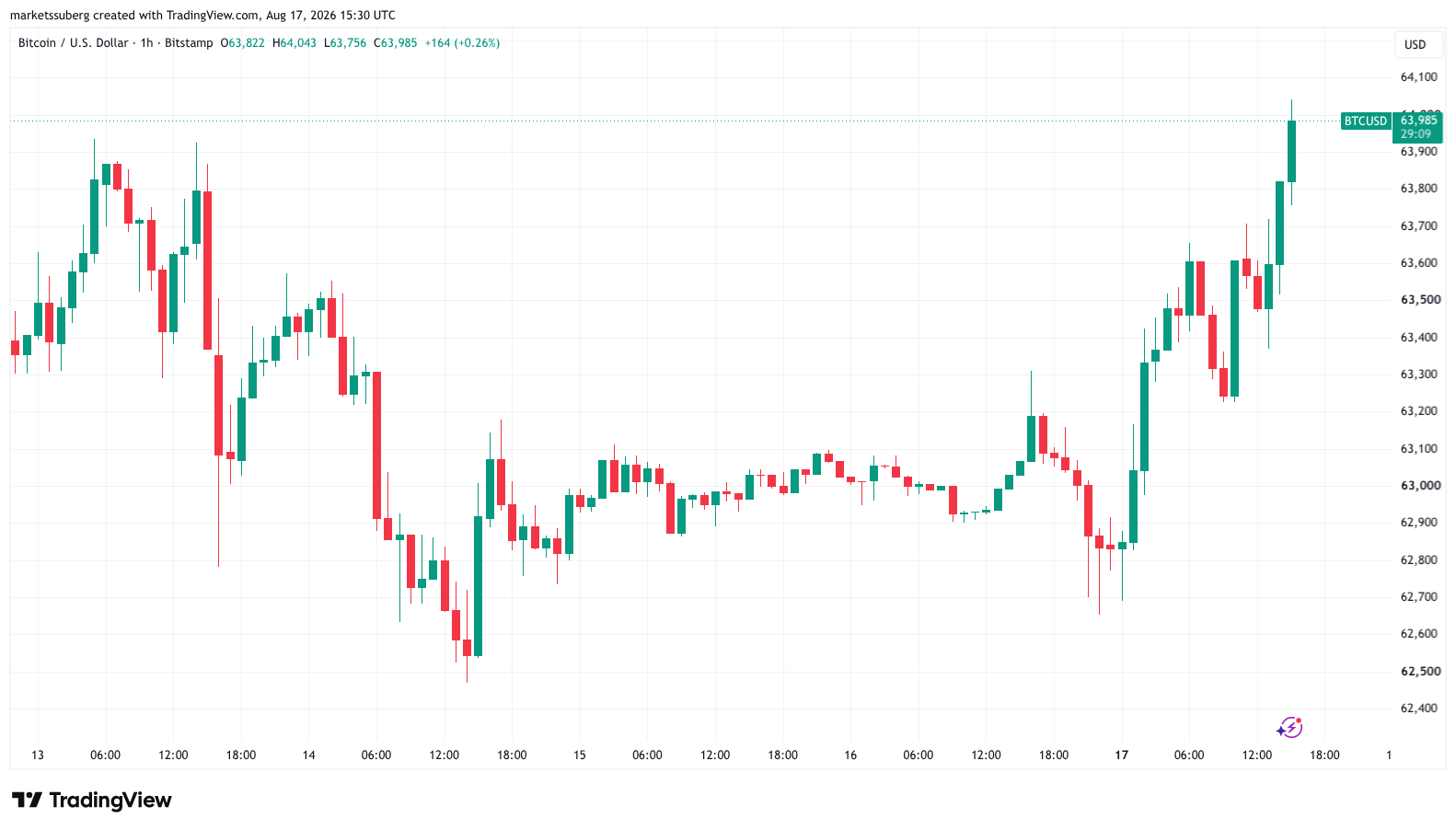
Bitcoin (BTC) returned to $64,000 after Monday’s Wall Street open as US stocks gave way to gold.
Key points:
- Bitcoin continues a rebound from Sunday’s weekly close, gaining 2% on Monday.
- Oil stays steady after US president Donald Trump threatens to bomb Oman over the Strait of Hormuz.
- Bitcoin funding rates hit 20-month highs of 0.022 last week, data reveals.
Bitcoin inches up as US-Iran rhetoric spreads to Oman
Data from TradingView showed BTC/USD up by more than 2% on the day, rebounding from Sunday’s weekly close.
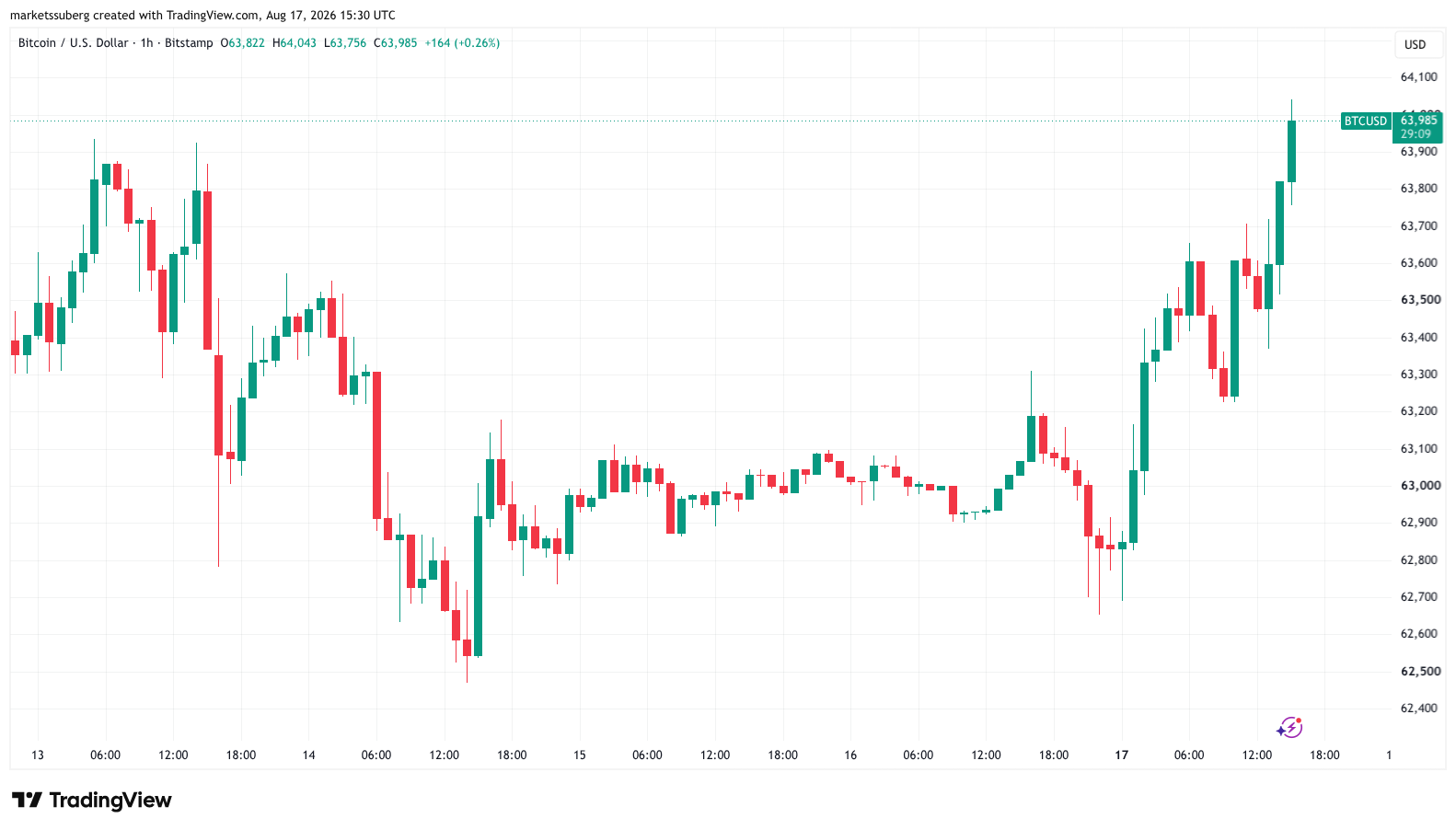
BTC/USD one-hour chart. Source: Cointelegraph/TradingView
US equities turned lower as an agreed 60-day ceasefire between the US and Iran was set to expire, with the S&P 500 index down 0.5% from Thursday’s all-time highs.
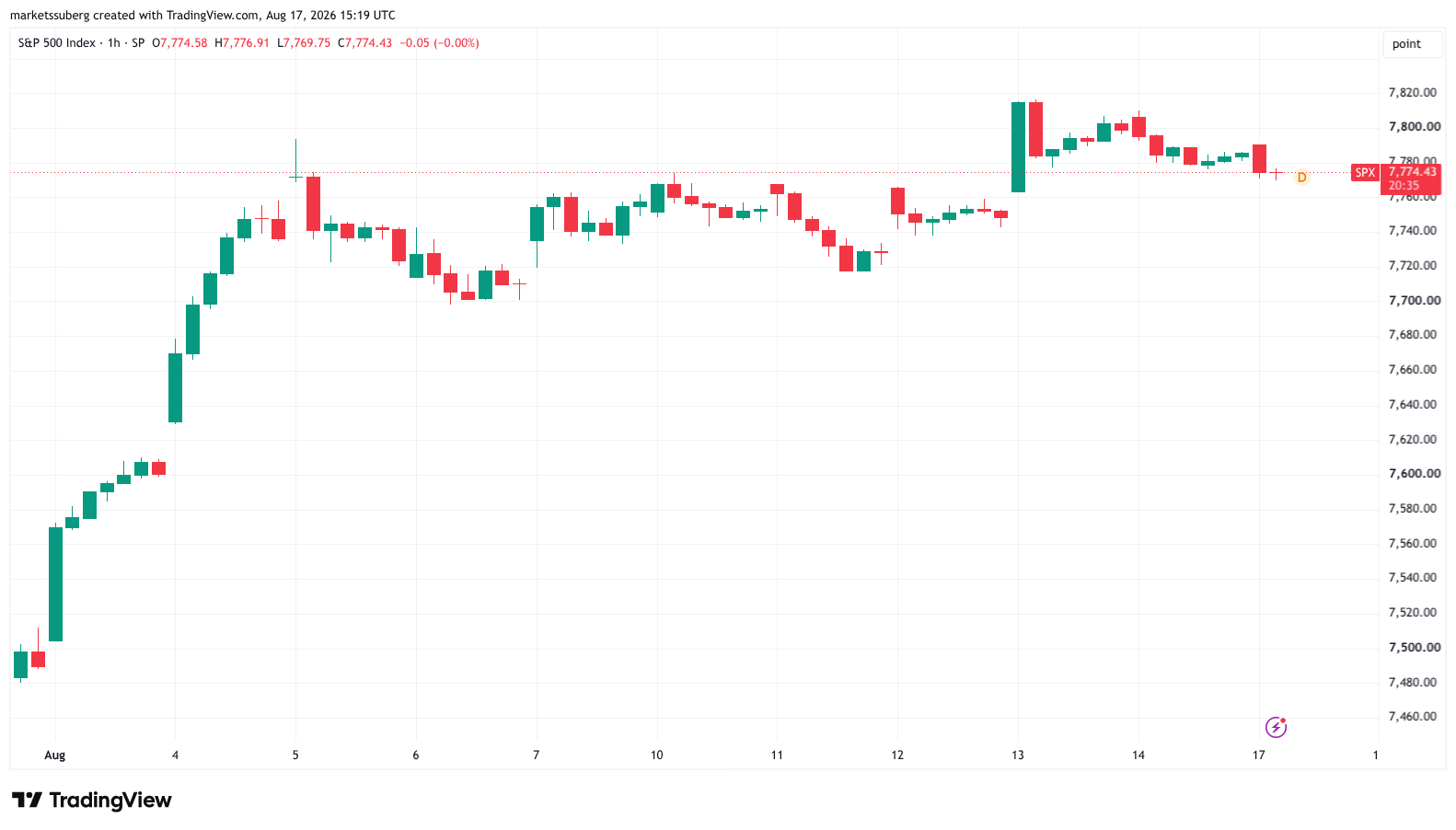
S&P 500 one-hour chart. Source: Cointelegraph/TradingView
Speaking to Fox News, Trump threatened Oman with military action amid an ongoing dispute over the reopening of the Strait of Hormuz oil route.
“If Oman gets in the way, we’ll bomb the s*** out of them,” he told the network.
Oil markets appeared unfazed by the tensions, with WTI crude flat at $82.35 per barrel at the time of writing.
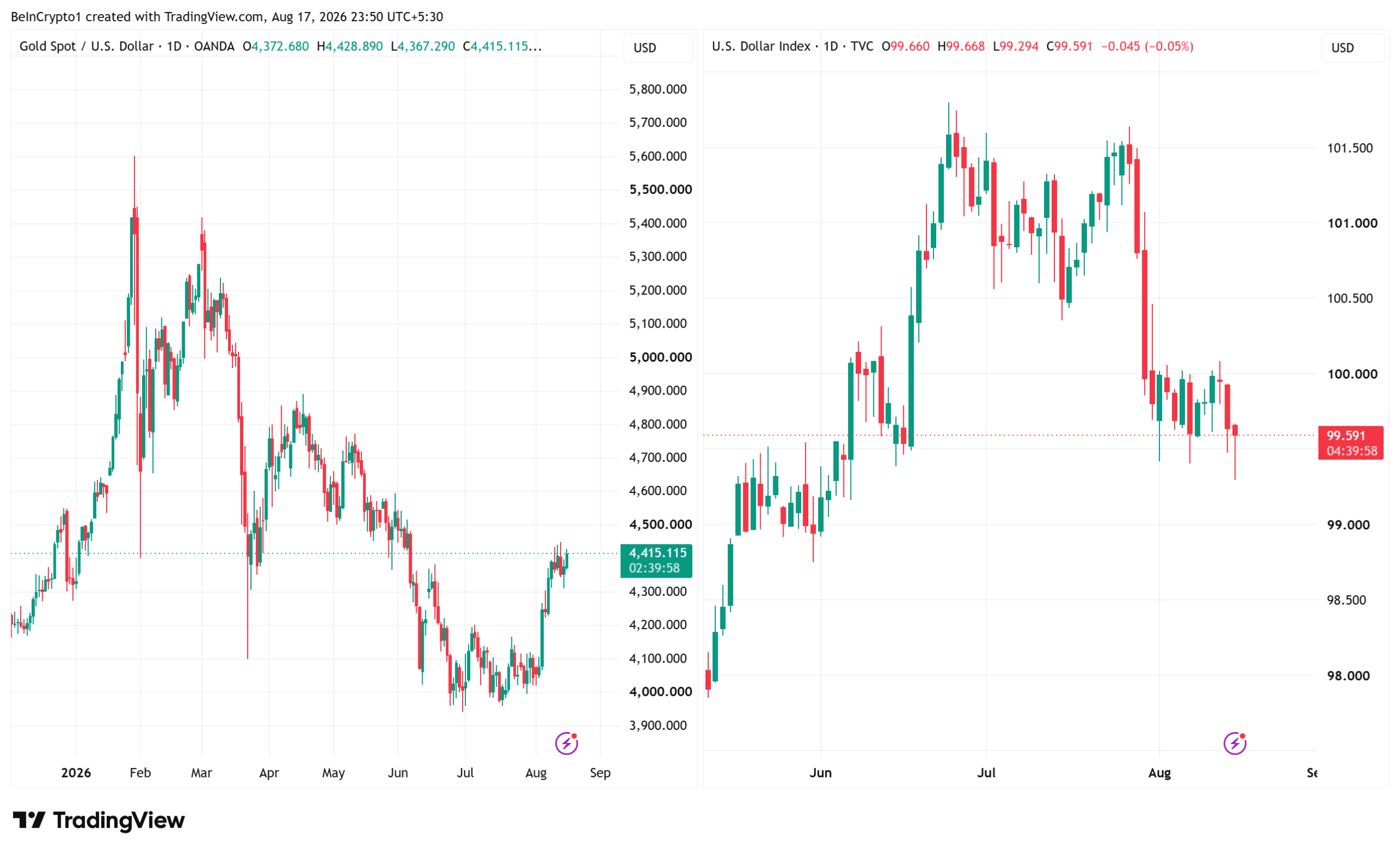
Safe haven gold was more volatile, gaining just over 1% to start the week to reach a daily high of $4,427 per ounce. Earlier, Cointelegraph reported on a combination of retail and government interest fueling gold’s multiweek highs.
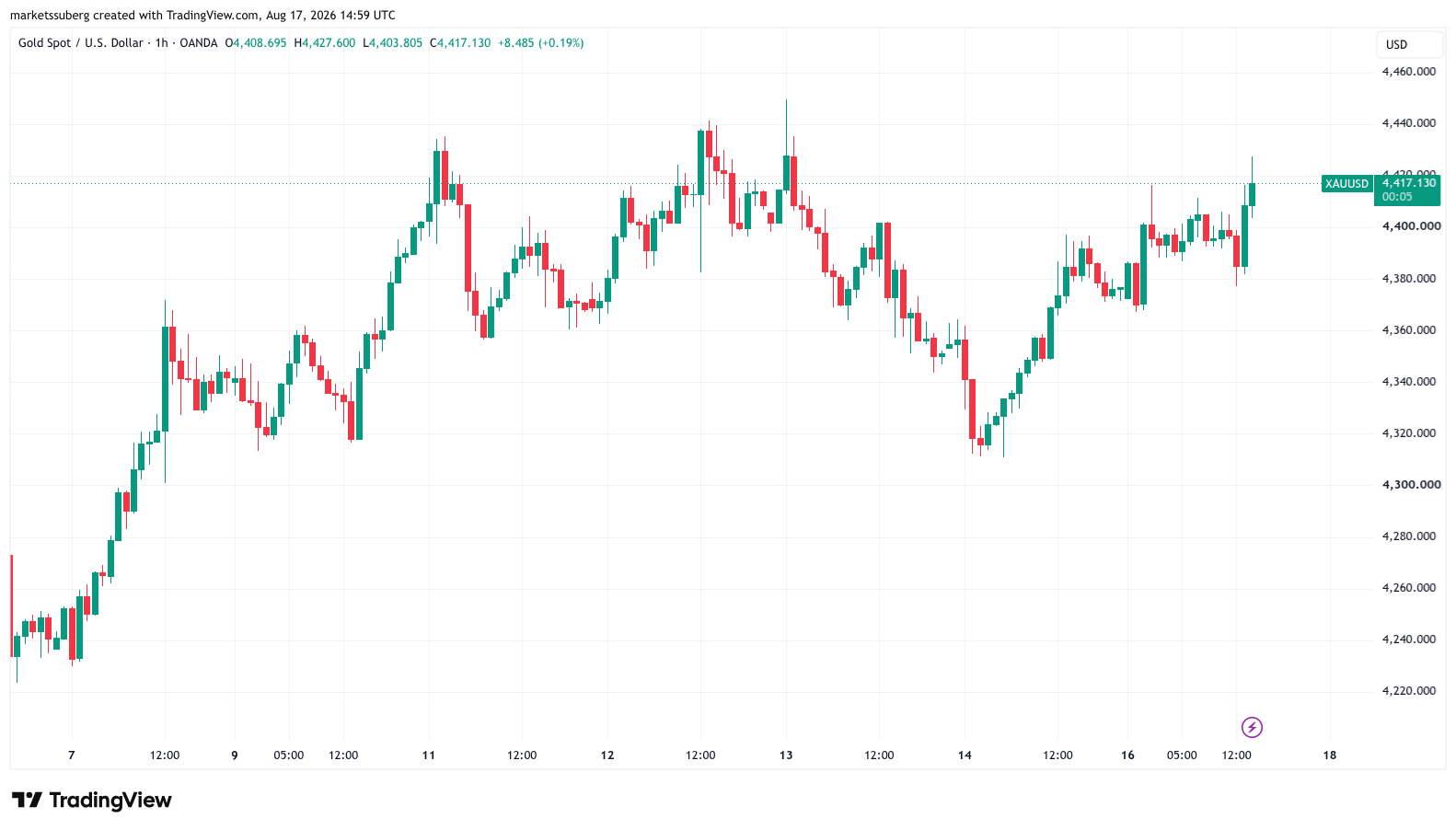
XAU/USD one-hour chart. Source: Cointelegraph/TradingView
Data from investment research platform Bytetree tracking the 30-day change in inflows to gold-backed exchange-traded funds (ETFs) put the figure at nearly $12 billion through Aug. 13.
In a note on Monday quoted by Investing.com, Bank of America strategist Michael Hartnett wrote that long gold remained the trade, describing it as “still [sic] best hedge against dollar debasement, bond collapse, asset inflation, capitalist populism vs socialist populism politics of 2020s.”
Related: BTC price loses 200-week trend line as 2022 repeats: Five things to know in Bitcoin this week
Funding rates hit levels not seen since late 2024
In its latest Market Color bulletin published on Monday, trading company QCP Capital noted Bitcoin’s continued ability to weather macro tailwinds without a major breakdown from its current range.
“Rather than treating individual price levels as directional signals, the more useful observation is that BTC remains close to the lower end of its recent range. A sustained move outside that range would provide more information about market positioning than the relatively contained moves seen within it,” it wrote.
Earlier, Cointelegraph reported on expectations that a return to $61,000 would trigger an unwinding of BTC long positions, adding to downside BTC price momentum.
The latest data from CoinGlass showed liquidations remaining muted as BTC/USD returned toward $64,000, with 24-hour cross-crypto liquidations at $180 million.
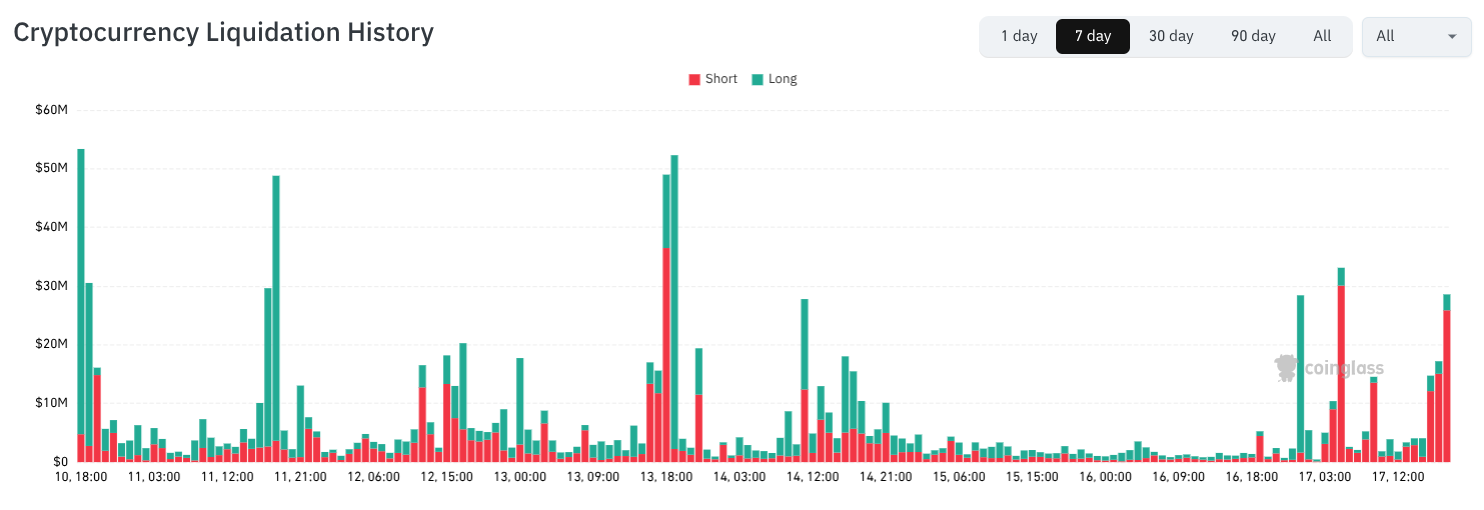
Crypto liquidation history (screenshot). Source: CoinGlass
In a sign of long BTC becoming an increasingly crowded trade, derivatives market funding rates hit 20-month highs of 0.022 on Aug. 14, per data from onchain analytics platform CryptoQuant.
“The derivatives market sentiment is positive within the current BTC price range, indicating that most traders are taking long positions,” it commented on the readings.
CryptoQuant previously noted that futures trading volume on Binance was outweighing spot markets by almost eight times.
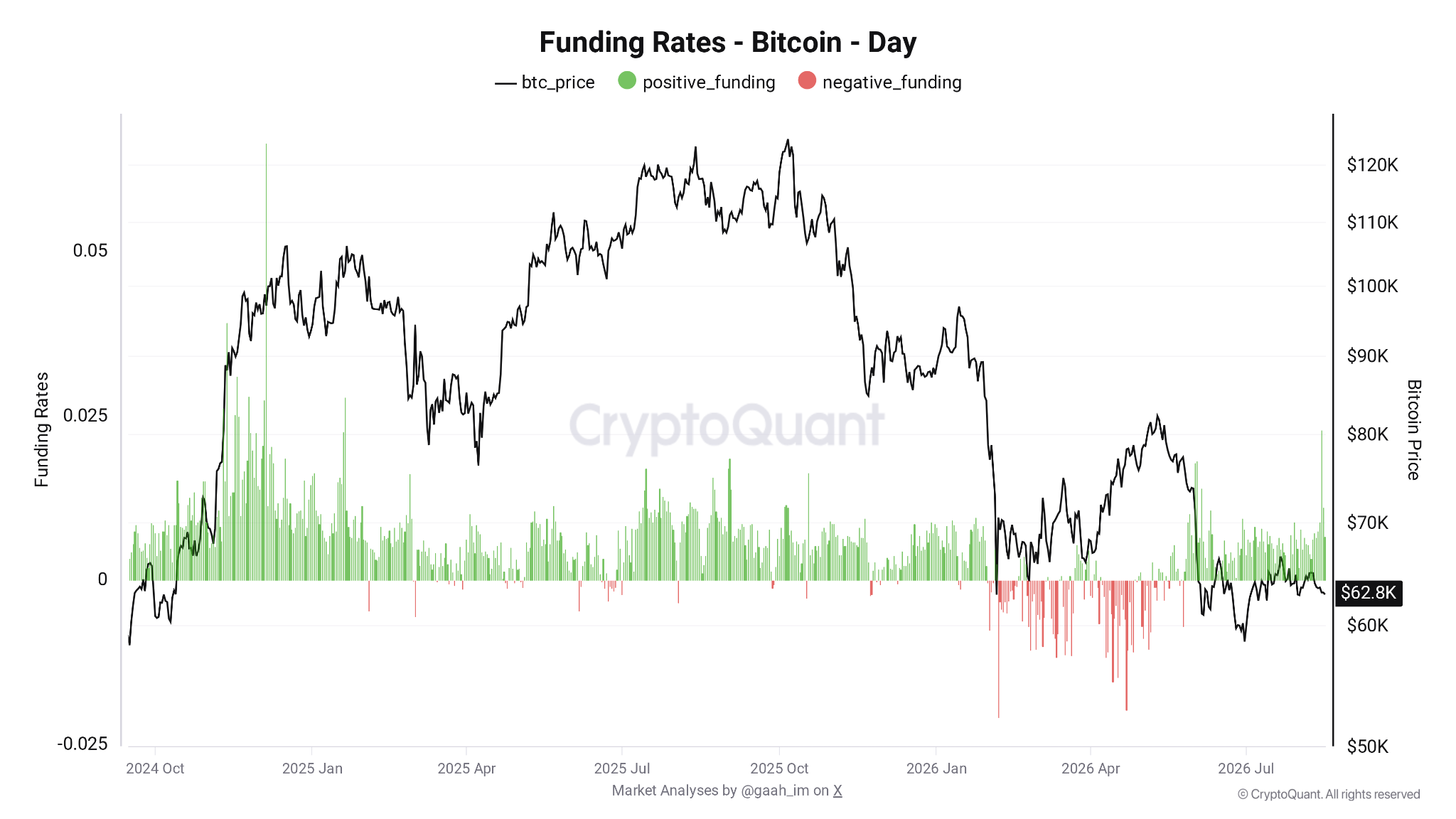
Bitcoin funding rates chart. Source: CryptoQuant


The US Department of the Treasury issued a notice of proposed rulemaking related to the implementation of the Guiding and Establishing National Innovation for US Stablecoins (GENIUS) Act, a bill to establish a framework for payment stablecoins signed into law last year.
In a Monday notice, the Treasury Department said that it was opening a proposed rule up to public comment ahead of the January 2027 implementation of the GENIUS Act. Under the terms of the bill, the stablecoin law had been scheduled to go into effect 120 days after agencies finalize rules, or 18 months after it was passed in July 2025, making its effective date Jan. 18, 2027.
Treasury Secretary Scott Bessent said that the department “welcomes input from stakeholders as [it works] to provide the regulatory certainty businesses need to innovate and grow in America.”
Together with the Treasury Department, other US government agencies including the Office of the Comptroller of the Currency (OCC), the Federal Deposit Insurance Corporation (FDIC) and the Federal Reserve Board have issued notices of proposed rules in 2026 related to the implementation of GENIUS. However, all departments reportedly missed the 120-day deadline in July to finalize regulations before January, signaling that GENIUS could go into effect without clear guidance.
Related: Wise to resubmit US bank charter application under GENIUS Act
According to Treasury, once the GENIUS Act goes into effect, an entity generally may not “issue a payment stablecoin” in the US without a related federal or state license. Public comment on the department’s proposed rules is open for 60 days following publication in the Federal Register.
US-UK regulators discuss GENIUS progress
In July, the UK-US Financial Regulatory Working Group met in London to discuss cooperation between the two country’s financial agencies, including implementation of the GENIUS Act.
Although UK authorities have taken steps to address stablecoin regulation, the pending implementation of GENIUS has some crypto industry insiders arguing the country is falling behind the US.
Magazine: Data of 54,000 wallet users leaked, CLARITY odds just 10%: Hodler’s Digest


The regulatory review could shape an emerging market that lets companies and investors trade and hedge the cost of increasingly scarce AI computing power.
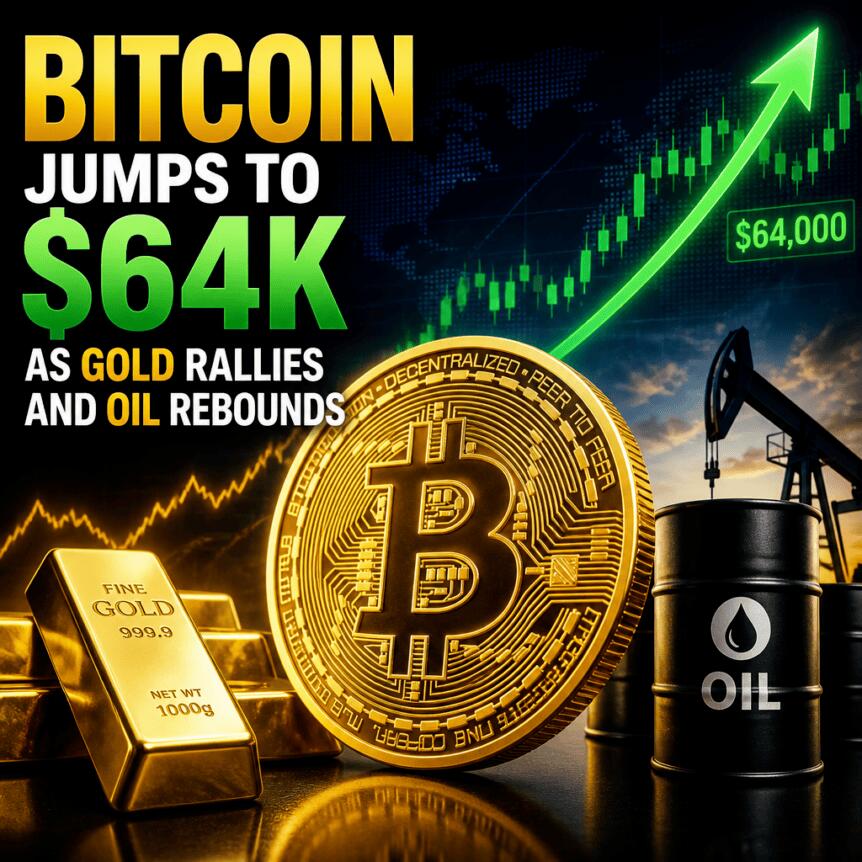
Bitcoin rebounded after Monday’s Wall Street open, returning to the $64,000 area as traditional markets rotated away from equities and toward commodities. The move followed a weekly close earlier in the weekend session, with BTC/USD recovering more than 2% on the day according to TradingView.
At the same time, geopolitical noise around the US–Iran standoff spilled toward Oman, raising renewed questions about the Strait of Hormuz shipping route—though oil prices appeared largely unmoved in early trading. Derivatives data also pointed to a crowded long trade, with Bitcoin funding rates reaching levels not seen since late 2024.
Key takeaways
- BTC/USD climbed more than 2% on Monday after rebounding from Sunday’s weekly close, with price returning to roughly $64,000.
- US–Iran ceasefire concerns and Trump’s comments related to Oman fed risk headlines, but WTI crude stayed near $82.35 per barrel.
- CryptoQuant data shows Bitcoin funding rates hitting 20-month highs of 0.022 as long positions build within the current range.
- QCP Capital said BTC remains near the lower end of its recent range, warning that sustained moves beyond the range would carry more signal than day-to-day fluctuations.
BTC tracks a shift from equities to commodities
TradingView data showed Bitcoin up over 2% on Monday, rebounding from the prior weekly close. The move coincided with softer US equity sentiment: the S&P 500 was down about 0.5% from its Thursday all-time high around the time of writing, as stocks gave way to gold as investors searched for alternative havens.
Geopolitical headlines added volatility to the broader macro picture. With an agreed 60-day ceasefire between the US and Iran set to expire, Trump told Fox News he would consider military action if Oman “gets in the way” amid a dispute linked to reopening the Strait of Hormuz oil route. Despite the rhetoric, oil markets appeared calm, with WTI crude trading flat around $82.35 per barrel at the time.
Gold showed more movement than oil at the start of the week. Safe-haven demand lifted XAU/USD by just over 1%, reaching a daily high of $4,427 per ounce. Cointelegraph previously reported that a mix of retail participation and government interest helped push gold to multiweek highs.
Data tracked by Bytetree, which monitors the 30-day change in inflows to gold-backed exchange-traded funds (ETFs), placed 30-day inflows at nearly $12 billion through Aug. 13. In an Investing.com piece that quoted a Bank of America strategist, Michael Hartnett argued that “long gold remained the trade,” framing it as a hedge amid concerns around currency debasement, bond stress, and inflationary pressures.
Investors keep BTC near a familiar range—until positioning shifts
In a Monday bulletin, QCP Capital said Bitcoin’s ability to withstand macro pressures without a major breakdown suggested the market is not yet signaling a decisive trend change. The firm emphasized that focusing on single price levels may miss the bigger picture.
Instead, QCP Capital pointed to range behavior: it described BTC as still sitting close to the lower end of its recent trading band and argued that a sustained move outside the range would reveal more meaningful information about market positioning than relatively contained intraday moves.
This framing matters for traders because it implies that catalysts may be more important than incremental price changes. Earlier coverage referenced expectations that a return to the $61,000 area could prompt an unwinding of BTC long positions—an observation tied to how leverage can amplify downside when levels break.
On Monday, liquidation activity appeared contained as BTC moved back toward the $64,000 region. CoinGlass data cited in the report put 24-hour cross-crypto liquidations at approximately $180 million, suggesting that the rebound occurred without a large liquidation-driven panic on the day.
Funding rates surge: long exposure is getting crowded
Beyond spot price, derivatives positioning offered a more pointed signal. CryptoQuant data showed Bitcoin funding rates reaching 20-month highs of 0.022 on Aug. 14. The analytics firm characterized derivatives sentiment within the current BTC price range as positive, adding that most traders were taking long positions.
When funding rates rise while price holds relatively stable, it can indicate that market participants are piling into the same side of the trade. That can be constructive if momentum extends—but it also increases the risk that a reversal could trigger crowded unwinds, depending on how price reacts at the edges of the prevailing range.
The report also cited CryptoQuant’s earlier observation that futures activity on Binance was outweighing spot markets by nearly eight times. While this metric alone doesn’t predict direction, it supports the broader theme: derivatives are playing a large role in how leverage and sentiment develop around Bitcoin’s current trading boundaries.
What to watch next amid macro and leverage signals
For now, Bitcoin is rebounding, but the underlying positioning looks increasingly one-sided as funding rates climb and longs become more crowded. Investors and traders should watch whether BTC can sustain moves beyond its recent range—since QCP Capital suggested that only a sustained breakout would meaningfully clarify market positioning—while keeping an eye on funding rate changes and liquidation levels for signs that leverage is either being rewarded or set up for a sharper unwind.
Peter Schiff picked the 55th anniversary of America’s break with gold to make a blunt case. The 1971 decision, he argues, is why the dollar is in trouble today.
Schiff is a founding member of Euro Pacific Asset Management. He made the argument on his weekend podcast. Washington defaulted on gold back then, he says, and the world is now leaving the dollar.
Why 1971 Still Shapes the Dollar Debate
President Richard Nixon closed the gold window on August 15, 1971. Foreign governments could no longer swap dollars for metal. The rate had been $35 an ounce.
“I have directed Secretary Connally to suspend temporarily the convertibility of the dollar into gold or other reserve assets… your dollar will be worth just as much tomorrow as it is today,” Richard Nixon, in his August 15, 1971 address.
Nixon called the move temporary. It has now lasted 55 years.
The promise about value aged worse. Federal price data shows a 1971 dollar buys roughly 12 cents of goods today. Consumer prices have climbed 718% since that August.
Schiff calls the move a default, not a technical fix. Federal Reserve notes promised gold, he says. Washington simply stopped paying.
Gold tells its own story. The metal closed Monday at $4,418, up 0.94%. That is about 126 times the 1971 price. The dollar looks soft rather than broken. It slipped to a three-month low against peers on Monday.

“We left gold in 1971. Now the world is leaving the dollar,” said Schiff.
Follow us on X to get the latest news as it happens
The Federal Reserve’s broad dollar index has lost only 1.8% in a year.
De-Dollarization Becomes the Next Test
Schiff’s bigger claim is that 1971 only finished half the job. The dollar lost value through the 1970s. Yet the world kept holding it anyway.
That habit paid for a lot. It let America buy more than it made. It let Washington borrow without a hard limit.
Federal debt reached $39.93 trillion on August 13. Roughly $65 billion now stands between the country and $40 trillion.

“The world is de-dollarizing. The world is going off of the dollar standard. It’s a process. It started. It hasn’t finished, but I think the economic consequences are going to be profound,” Schiff added.
He expects households to feel it first. Imports get pricier once trade deficits close. Living standards fall when a country can only spend what it earns.
BeInCrypto research ran a 55-year currency savings test on that question. Gold worked best as long-term insurance. The dollar still won on liquidity.
The Gold Bid Is Now a Central Bank Question
Schiff’s thesis has a testable part. If the world is really leaving the dollar, central banks should show it.
The gold half checks out. Central banks bought 289 tonnes in the second quarter, according to World Gold Council figures. That is 62% more than a year earlier.
The first quarter looked very different. Buying collapsed to 56.5 tonnes. Some governments sold metal to raise cash during the energy crunch.
Veteran strategist Jeff Currie built a framework around that swing. Currie once ran commodities research at Goldman Sachs and now advises Carlyle Group. Gold loses its biggest bid, he argues, when central banks turn into forced sellers. His long-run target is $10,000 an ounce.
The dollar half does not check out yet. The greenback’s share of world reserves rose to 57.13% in the first quarter, IMF figures show. It sat at 56.42% three months earlier.
The euro holds 20.03% of reserves. China’s renminbi holds under 2%. Earlier BeInCrypto analysis of dollar reserve share data found currency swings, not selling, drove most of a previous decline.
Bitcoin has not stepped into the gap either. Bitcoin price near $63,517 leaves it roughly flat over the past month. Gold climbed while it stalled.
So central banks are buying gold hard. They are not dropping dollars yet. Schiff’s 55-year argument now rests on whether those two lines finally cross.
The post Peter Schiff Links 1971 Gold Decision to Today’s Dollar Crisis: Will XAU Hit $5,000? appeared first on BeInCrypto.
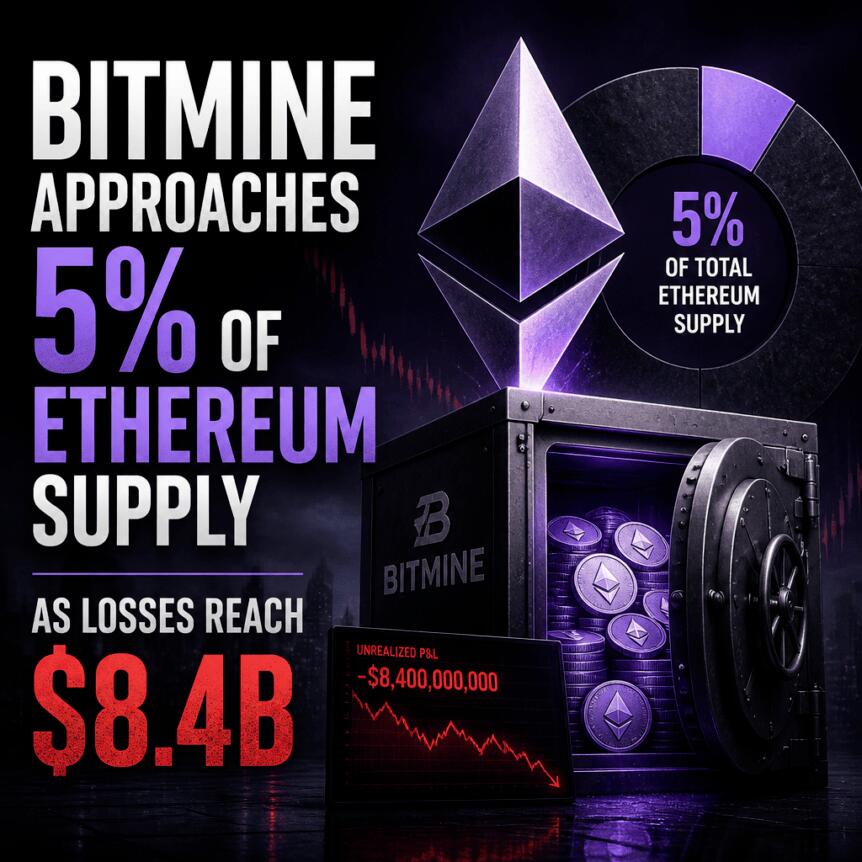
Tom Lee’s Bitmine Immersion Technologies has restarted a steady program of Ethereum treasury buying, adding 9,926 ETH during the week ending Aug. 16. The company says the purchase brings its Ether holdings to roughly 5.82 million ETH—about 4.8% of Ethereum’s circulating supply—putting it close to its long-term goal of owning 5% of the asset’s total supply.
In its disclosure, Bitmine also provided valuation context: at an ETH reference price of $1,893, the latest portfolio total is worth about $11 billion. But the company notes that many of its ETH were acquired at significantly higher prices, underscoring how difficult the prolonged bear market has been for Ethereum treasury strategies.
Key takeaways
- Bitmine bought 9,926 ETH for the week ending Aug. 16, lifting holdings to about 5.82 million ETH (around 4.8% of circulating supply).
- At a reference price of $1,893, Bitmine’s Ether stake is valued near $11 billion, though acquisition costs are substantially higher for a large portion of the position.
- Industry data cited by DropsTab estimates unrealized losses of more than $8.4 billion on the current ETH treasury.
- Despite the drawdown, Bitmine continues to stake more than 5 million ETH, which it says is generating protocol rewards.
- Bitmine’s staking yield was reported at 2.61% over seven days, implying roughly $287 million in annualized staking rewards, according to Tom Lee.
Restarting the “Alchemy of 5%” push
Bitmine’s strategy is built around scale and patience. After resuming purchases last week, the company is now within reach of its “Alchemy of 5%” target: holding 5% of Ethereum’s total supply. That target matters because it signals a treasury model designed to treat Ether as a long-duration bet rather than a tactical trading position.
According to Bitmine’s disclosure, the latest weekly buy also helps explain why the company continues to frame its program as a process rather than a series of opportunistic trades. The reported accumulation keeps the company moving toward a specific ownership threshold—one that would materially increase its influence and relevance as an institutional holder in Ethereum’s expanding ecosystem.
Unrealized losses remain a pressure point
The renewed buying comes even as Ether’s market environment has tested Bitmine’s conviction. The company is reported to be sitting on more than $8.4 billion in unrealized losses on its ETH holdings, based on industry data cited by DropsTab. DropsTab’s estimate places Bitmine’s unrealized losses at around 43% relative to the company’s reported acquisition costs, despite the current portfolio value being above $11 billion.
That mismatch—between the size of the position and the magnitude of drawdowns—highlights a key risk for any “buy-and-hold” treasury plan executed through a full market cycle. Even when a strategy is long-term, the path matters: buying during a downtrend can create large paper losses that only reverse if market prices recover meaningfully.
Staking helps fund the wait
What differentiates Bitmine’s approach from a simple spot accumulation strategy is its ongoing staking operation. The company said it is staking more than 5 million ETH, which it values at roughly $9.6 billion at current prices. By staking, Bitmine earns protocol rewards for helping secure the network—providing a source of yield that can partially offset the emotional and financial pressure of unrealized drawdowns.
Bitmine’s filing also links its staking activity to a measurable performance indicator. Based on a seven-day staking yield of 2.61%, Tom Lee projects annualized staking rewards of roughly $287 million. While annualized estimates can fluctuate—since staking yields depend on network conditions and how rewards are distributed—the point for investors is clear: Bitmine’s treasury is not entirely exposed to price movement. A portion of its return profile is tied to staking economics rather than only to Ether’s market direction.
Still, staking does not remove the core uncertainty. If Ether’s price does not recover, unrealized losses can remain large even while protocol rewards accrue. Conversely, if Ether rebounds, staking rewards can accelerate the path toward a healthier overall position—both in absolute returns and relative to acquisition costs.
Why steady accumulation is notable now
Bitmine’s restart of weekly Ether purchases suggests the company is treating the current phase of the market as compatible with its long-term ownership targets. Earlier coverage noted that Bitmine has continued accumulating Ether through weekly buys since launching its ETH treasury strategy in June 2025. In that context, the latest addition looks less like a reaction to short-term price action and more like execution of a defined roadmap.
For market observers, that matters because large treasury actions can act as a counterpoint to narratives that institutional interest fades during downturns. Even when unrealized losses mount, Bitmine appears willing to keep buying as it approaches its 5% target—while using staking yield to keep the strategy funded.
There is, however, an important asymmetry to watch. As Bitmine nears the 5% level, further buying can become harder depending on remaining supply dynamics and how the company structures future deployment. The company’s near-term challenge may shift from “can it keep accumulating?” to “how does it manage valuation risk and portfolio efficiency as its position grows?”
Next, investors and traders will likely focus on whether Bitmine can sustain weekly accumulation while Ethereum staking yields remain stable enough to support the projected reward rate. Just as importantly, readers should watch how fast the market price of Ether moves relative to Bitmine’s acquisition costs—because staking can soften the drawdown, but only a meaningful price recovery can fully relieve the unrealized loss picture.


Cointelegraph is committed to providing independent, high-quality journalism across the crypto, blockchain, AI, and fintech industries.
All news, reviews, and analyses are produced with full journalistic independence and integrity. For more details on our standards and processes, please read our Editorial Policy.


Ethereum researchers have proposed prioritizing two transaction changes for the 2027 Hegotá upgrade that could let privacy pools pay network fees without third-party intermediaries.
Summary
- Frame Transactions would give wallets more control over transaction validation, execution, and fee payment.
- FOCIL would make it harder for block builders to exclude eligible privacy transactions.
- 66 proposals remain under consideration, while FOCIL is the only confirmed Hegotá feature.
- Ethereum developers are targeting 2027 for Hegotá after the Glamsterdam upgrade ships in 2026.
Ethereum Foundation researcher Toni Wahrstätter said in an Aug. 17 X post that the Protocol Architecture team wants developers to prioritize Frame Transactions, listed as EIP-8141, and Fork-Choice Enforced Inclusion Lists, known as FOCIL or EIP-7805.
Ethereum privacy pools could pay their own fees
Frame Transactions would introduce a programmable transaction format that gives wallets more control over validation, execution, and gas payments. Wahrstätter described frames as a “much more expressive transaction format” and a key part of Ethereum’s planned transaction experience.
Under the proposal, transaction logic would be divided into programmable frames instead of relying on Ethereum’s current fixed transaction structure. Wallets and applications could use the format for gas sponsorship, alternative signature systems, key rotation, and other forms of account abstraction.
For privacy pools, the fee-payment feature could remove the need for a separate relayer to submit a transaction and pay its gas. Relayers can create another point where transaction details, wallet behavior, or network information may become visible to an outside service.
“Together with Frames, these enable privacy pools where the pool itself can pay fees, removing the need for intermediaries,” Wahrstätter said. “Add FOCIL support, and privacy transactions also gain protocol-level inclusion guarantees.”
Frame Transactions would work with Keyed Nonces and Recent Roots, listed as EIP-8272. Keyed Nonces would let an account maintain separate transaction sequences, while Recent Roots would allow a transaction to refer to a recent Ethereum state without relying on one fixed block reference.
The proposed package also includes Transaction Assertions, or EIP-7906. According to Wahrstätter, assertions would let wallets define conditions that must remain true when a transaction is processed, giving users a way to limit what can happen after they sign and submit it.
Earlier crypto.news coverage found that EIP-8141 remains under consideration rather than scheduled for Hegotá. Ethereum client teams are also comparing it with EIP-8130, another account-abstraction proposal, before deciding which design should move into implementation and testing.
FOCIL would protect eligible transactions from censorship
FOCIL is the only Ethereum Improvement Proposal currently scheduled for Hegotá. The design would allow a committee of validators to publish lists of transactions that block builders are expected to include.
Attesters could reject a proposed block if its builder improperly left out eligible transactions from an inclusion list. Ethereum developers have presented the system as a way to protect transaction access as block production becomes more specialized and concentrated among large builders.
Privacy transactions could benefit because users would not have to depend entirely on a block builder’s willingness to include them. FOCIL would not make transactions private on its own, but it would add a protocol process for resisting selective exclusion.
Wahrstätter has argued that combining FOCIL with Frame Transactions, Keyed Nonces, and Recent Roots would give privacy pools both independent fee payment and stronger inclusion protection. His proposal represents a researcher’s preferred package, not a final decision by Ethereum’s core developers.
Hegotá currently has 66 proposals under discussion, covering account abstraction, censorship resistance, transaction pricing, state growth, validator economics, and network scaling. The number does not mean all 66 features will ship, as most have not entered implementation, development networks, or public testnets.
“A fork can’t be a wishlist by the community or core devs jamming on what Ethereum should eventually become,” Wahrstätter wrote in an earlier post. Developers instead need to decide which changes Ethereum should adopt next and which ones require more time, he added.
US scrutiny has kept crypto privacy tools in focus
For US users, the proposals concern how Ethereum processes private transactions rather than changing federal rules governing money transmission, sanctions, or illicit finance. American treatment of crypto privacy software has remained contested across Treasury actions and criminal cases involving mixing services.
The US Treasury removed economic sanctions against Tornado Cash in March 2025 after reviewing the legal and policy questions raised by applying sanctions to technology-based financial activity. Treasury said at the time that it remained concerned about North Korean hackers and other illicit actors using digital assets.
In a separate criminal case, a Manhattan jury convicted Tornado Cash co-founder Roman Storm in August 2025 of conspiring to operate an unlicensed money-transmitting business. Jurors did not reach verdicts on the money-laundering and sanctions charges, according to the reported split verdict.
The US Justice Department said Tornado Cash had transmitted more than $1 billion in criminal proceeds, including funds connected to North Korea’s Lazarus Group. Storm’s defense maintained that the protocol operated through autonomous open-source software and that its developers did not control individual transactions.
Ethereum’s proposed privacy pool design differs at the protocol level because Wahrstätter’s post deals with fee payment and transaction inclusion, not the legal structure or compliance systems of a specific application. Neither EIP-8141 nor EIP-7805 defines how privacy applications would handle US sanctions screening, money-transmission rules, or other compliance requirements.
Hegotá follows Ethereum’s 2026 Glamsterdam upgrade
Hegotá is scheduled to follow Glamsterdam, the Ethereum upgrade developers want to release before the end of 2026. A June upgrade report said Glamsterdam centers on Enshrined Proposer-Builder Separation and Block-Level Access Lists, alongside changes to the way Ethereum prices network resources.
Enshrined Proposer-Builder Separation would bring the division between block proposers and builders into Ethereum’s protocol. Block-Level Access Lists would show which accounts and contract data a block needs, allowing clients to prepare data before execution and process some transactions in parallel.
Hegotá candidates extend that work into privacy, censorship resistance, account abstraction, and state management. Scaling proposals under review include EIP-8368, which would adjust state-creation costs if Ethereum raises its gas limit beyond the level used for Glamsterdam.
Developers are also studying separate access-list data, higher gas limits approaching 500 million to 600 million, and optional zero-knowledge Ethereum Virtual Machine proofs on the main network. Each proposal must compete for engineering resources, client support, testing time, and space within the 2027 release schedule.
Privacy and quantum resistance also sit inside Ethereum’s multi-year technical plans. A July roadmap analysis reported that Vitalik Buterin’s Lean Ethereum plan calls for new cryptography, proof-based verification, redesigned storage, and native protocol privacy over the next three to four years.
Execution client teams are due to submit their Hegotá preference lists by Sept. 10. Before then, developers plan to compare EIP-8141 with EIP-8130 during an Aug. 25 breakout meeting, with a decision on the competing account-abstraction designs targeted for the Aug. 27 All Core Developers Execution call.

And it’s projected to become more prevalent in the near future, says Dr. Kenneth Rockwood, a professor of medicine at Dalhousie University in Canada who developed one of the scales for diagnosing frailty. “It’s the demographic imperative,” he says. “In 2021 the leading edge of the baby boom generation turned 75 years old, and 75 is the age at which most of the diseases of aging take off. So now frailty is not some mystical, mythical far-off thing.”
However, frailty is not inevitable—and to some extent, it’s possible to undo some of the damage. Here’s what to know.
How can you tell if you’re frail?
One of the best ways to identify frailty is a comprehensive geriatric assessment, in which a team of health care professionals look at many different aspects of an aging person’s health to get a sense of the bigger picture. But some potential tell-tale signs doctors might check for, and that you might notice on your own, include walking slowly—less than approximately 2.6 ft. (or 0.8 meters) a second, one study suggests—and taking more than 10 seconds in what’s called a “timed up and go test,” in which a person is timed getting up from a chair, walking for almost 10 ft. (3 meters), turning around, walking back, and sitting down. With frailty, “you can’t tell at a glance, but it doesn’t take that long [to detect] if you know what questions to ask…if you can see the person move,” says Rockwood.

Luigi Mangione’s state murder trial postponed after federal guilty plea

Disney parks boss outlines investment strategy, with superfans at fore

Search Interest in Prediction Markets Falls 83% From Its World Cup Peak as Kalshi Pulls Away


-

 Fashion3 days ago
Weekend Open Thread: Ann Taylor
-
 NewsBeat6 days ago
Communication cards help banking customers access services or report scams
-
 Business7 days ago
Oil Price Today (August 11): Crude oil rises to $88 after Trump’s compensation demand dents Hormuz opening. Here’s why
-

 Crypto World7 days ago
Revolut wins French banking licence, creates second EU banking hub
-
 Sports4 days ago
This U.S. Amateur is a glimpse into golf’s future in more ways than you think
-
 Crypto World7 days ago
Why Did Nvidia Stock Fall on Monday Despite a $500 Billion Wall Street AI Deal?
-

 Sports3 days ago
Birmingham 2026: Day 6 Timetable for Irish Athletes
-
 NewsBeat3 days ago
Myanmar says over 300,000 Rohingya refugees verified for repatriation as exodus enters ninth year
-

 Politics2 days ago
SEQ Code: The Three Letter Boarding Pass Code That Could Give You The Worst Seat
-
 Entertainment5 days ago
Keke Palmer Subtly Hints At Sean Evans Drama With Cryptic Post
-
 Entertainment7 days ago
57 Years Later, the Best Sitcom Ever Made Still Deserves a Reboot
-

 Fashion6 days ago
Coffee Break: The Fonteyn Jane Flat
-

 Tech6 days ago
Zoom Screen-Sharing Bug Let People Fully Take Over Other Devices On A Call
-

 Crypto World7 days ago
Bitcoin's BIP Editors Remove Luke Dashjr Two Days After BIP-110 Fork Stalled
-

 Fashion6 days ago
Should you refinance your debt? Pros, cons, and real numbers
-

 Fashion6 days ago
Claire Life: Kicking Off MVAAFF With the C Suite Luncheon Featuring Phylicia Rashad, Letoya Luckett, and More!
-
 Crypto World6 days ago
XRP bridge drained after software mistook fake deposits for real ones
-

 Sports5 days ago
DeQuan Jones in ‘high spirits’ after successful leg surgery
-
 Tech7 days ago
Zuck rekindles open weights Llama drama with Muse Glimmer
-

 Business7 days ago
(VIDEO) Emirates Unveils 2.4-Meter Arsenal Crest Sculpture Built From Recycled A380 And Boeing 777 Jet Parts
You must be logged in to post a comment Login