
Crypto World
Rumble begins merging with Northern Data



Two Tether-related entities, German former crypto miner Northern Data and US-based video streaming service Rumble, are set to begin the merger process, with Rumble offering equity for shares of Northern Data.
The merger, which was announced in November of last year, will end with Rumble taking over data center sites and receiving thousands of GPU servers. Tether owns a majority of Northern Data and 30% of Rumble.
Shareholders in Northern Data will receive 2.0281 shares of Rumble stock for each share they hold. Northern Data is currently trading at $13 a share and Rumble is trading at $6.41 a share.
A strange merger that’s good for Tether
From an outside perspective, a defunct mining company and a video streaming service merging doesn’t make a lot of sense. However, in November Christ Pavlovski, the CEO of Rumble, said, “Northern Data. Tether. Rumble. This is how we build the AI ecosystem for the future, from the ground up.”
It’s unclear what Tether or Rumble have to do with AI.
What’s more clear is that the merger will ultimately benefit Tether, which has already committed to purchasing $150 million in compute from Rumble over the next two years and will have a $610 million unsecured debt financing facility provided to Northern Data now reassessed and altered.
Financial Shenanigans
The merger of the two Tether-related companies required little agreement from minority shareholders due to Tether’s strong influence, Rumble’s executive equity structure, and Northern Data’s financial struggles over the past several years.
Both Northern Data and Rumble have seen the price of their stocks slide post-Tether investment, with Rumble trading near all-time lows as of recent.
Since the merger has begun the stock has rallied 20%.
The financial shenanigans involved in the Tether-related deal is nothing new for the company, which has been dogged by a long list of controversies around audits, hacks, and scams.
Read more: Tether-owned Northern Data considers ditching bitcoin mining
Since the collapse of FTX and the election of Donald Trump, Tether has attempted to present itself as transparent and safe, and has made a massive push into the US market. This includes lobbying efforts that saw CEO Paulo Ardoino visit the White House multiple times.
US Secretary of Commerce, Howard Lutnick, used to run Cantor Fitzgerald, which purchased US treasury notes for the company and previously said he was “a big fan of the company.”
Got a tip? Send us an email securely via Protos Leaks. For more informed news and investigations, follow us on X, Bluesky, and Google News, or subscribe to our YouTube channel.



An ICE agent charged 2026 with two counts of felony second-degree assault faces a nationwide arrest warrant after allegedly pointing his duty weapon at the heads of two civilians in a moving vehicle during the Trump administration’s Operation Metro Surge, Hennepin County Attorney Mary Moriarty announced Thursday.
Summary
- Gregory Donnell Morgan Jr., 35, a Maryland resident and ICE Enforcement and Removal officer, allegedly pulled alongside a civilian vehicle on a Minneapolis highway shoulder on February 5 and pointed his weapon directly at the driver and passenger.
- This is the first criminal case against a federal immigration officer stemming from Operation Metro Surge, which deployed approximately 3,000 federal agents to the Minneapolis-St. Paul area and was linked to the fatal shootings of two US citizens.
- Moriarty said Morgan acted “well beyond the scope” of federal authority and that “there is no such thing as absolute immunity for federal agents who violate the law in the state of Minnesota.”
An ICE agent charged 2026 with felony assault in Minnesota marks the first criminal case against a federal officer from Operation Metro Surge, the Trump administration’s largest immigration enforcement operation, which deployed about 3,000 agents to the Minneapolis-St. Paul area between December and February and left two US citizens dead.
Gregory Donnell Morgan Jr. allegedly drove an unmarked SUV on a highway shoulder on February 5 past slower traffic, then pulled alongside a civilian vehicle and pointed his duty weapon directly at both occupants while continuing to drive. The victims called 911 and filmed the Utah license plate on the SUV, which investigators traced to a rental linked to Morgan’s ICE partner.
Morgan gave a voluntary interview to Minnesota State Patrol after the incident, telling investigators he feared for his safety when the victims’ car pulled in front of him. He said he drew his weapon and yelled “Police! Stop!” Investigators noted the victims could not hear him because their windows were up and had no way to identify him as a law enforcement officer.
“For a federal agent, our opinion is that illegally driving on a shoulder, pulling up to a car and pointing a gun at the heads of two community members who are not doing anything at the time is well beyond the scope of their authority,” Moriarty said. The charges carry a maximum sentence of up to seven years in prison per count under Minnesota law.
Federal Response and What This Means for Operation Metro Surge
The Department of Homeland Security did not respond to requests for comment. Acting Attorney General Todd Blanche has previously warned that the DOJ could investigate and prosecute state and local officials who arrest federal agents for performing official duties. Moriarty said Thursday that she is “not concerned about blowback” and that her office would hold people accountable under Minnesota law regardless.
Operation Metro Surge was described by DHS as its largest immigration enforcement operation ever. The surge led to thousands of arrests and drew mass protests across the Twin Cities. Two US citizens, Alex Pretti and Renee Macklin Good, were shot and killed by federal officers during the operation. Trump fired Noem in March shortly after the surge ended, and Border Patrol sector chief Gregory Bovino announced his retirement the same month. Minnesota is separately suing the federal government for access to evidence in the three shooting cases.
The Morgan case moved faster than the shooting investigations because, Moriarty said, “virtually none of the obstacles around evidence collection that exist for the January shootings exist in this case.” A video and a license plate produced a clear evidentiary path. The shooting cases involving Pretti and Good remain under investigation.
The charges arrive at a moment when the administration’s immigration enforcement record is becoming a central midterm issue, with Democrats using controversies like this to keep pressure on vulnerable House Republicans whose votes will determine whether the CLARITY Act and other reform legislation can pass before the November election.
For most of 2025, altcoin holders were waiting. Watching Bitcoin climb to a new all-time high near $126,000, they expected what had always followed — the familiar rotation, the altcoin surge, the season that rewards patience with explosive gains. It never came.
Benjamin Cowen, founder of IntoTheCryptoverse, wasn’t surprised. He had a name for what was happening, and it changed everything.
“This is a cycle where Bitcoin topped on apathy rather than euphoria.”
That single phrase explains more about the 2025 cycle than any price target or on-chain metric. And to understand why, you need to follow the data across four charts — from social sentiment, through market structure, all the way to the deepest layers of the global macro economy.
The Top That Looked Normal, But Wasn’t
Bitcoin did exactly what it always does. It peaked in Q4 of the post-halving year, right on schedule, consistent with every prior four-year cycle. On the surface, nothing was broken. Look closer, however, and something was fundamentally different.
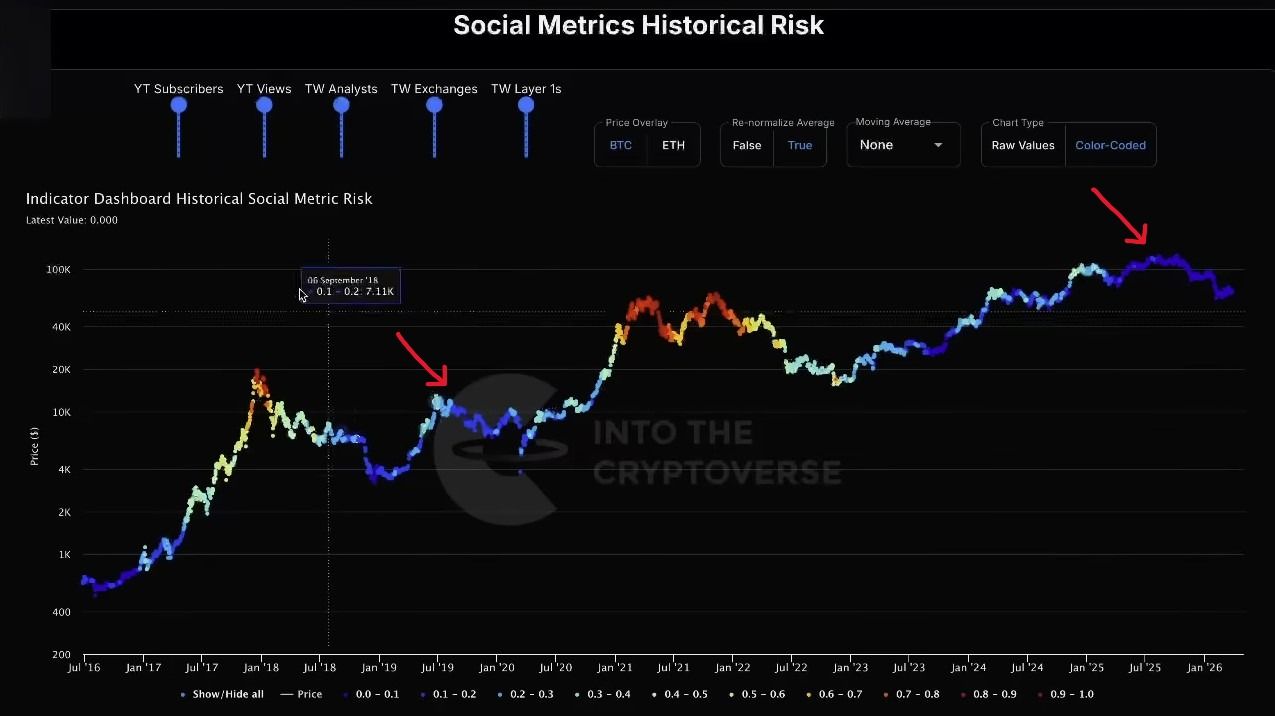
Cowen’s Social Metrics Historical Risk chart tells the story visually. The chart color-codes Bitcoin’s price history by the level of social engagement at each point in time — warm colors (red, orange) for high engagement, cool colors (blue) for low.
In 2017 and 2021, Bitcoin topped in a blaze of red and orange. Social interest was at peak levels. Retail was flooding in. Everyone was talking about crypto.
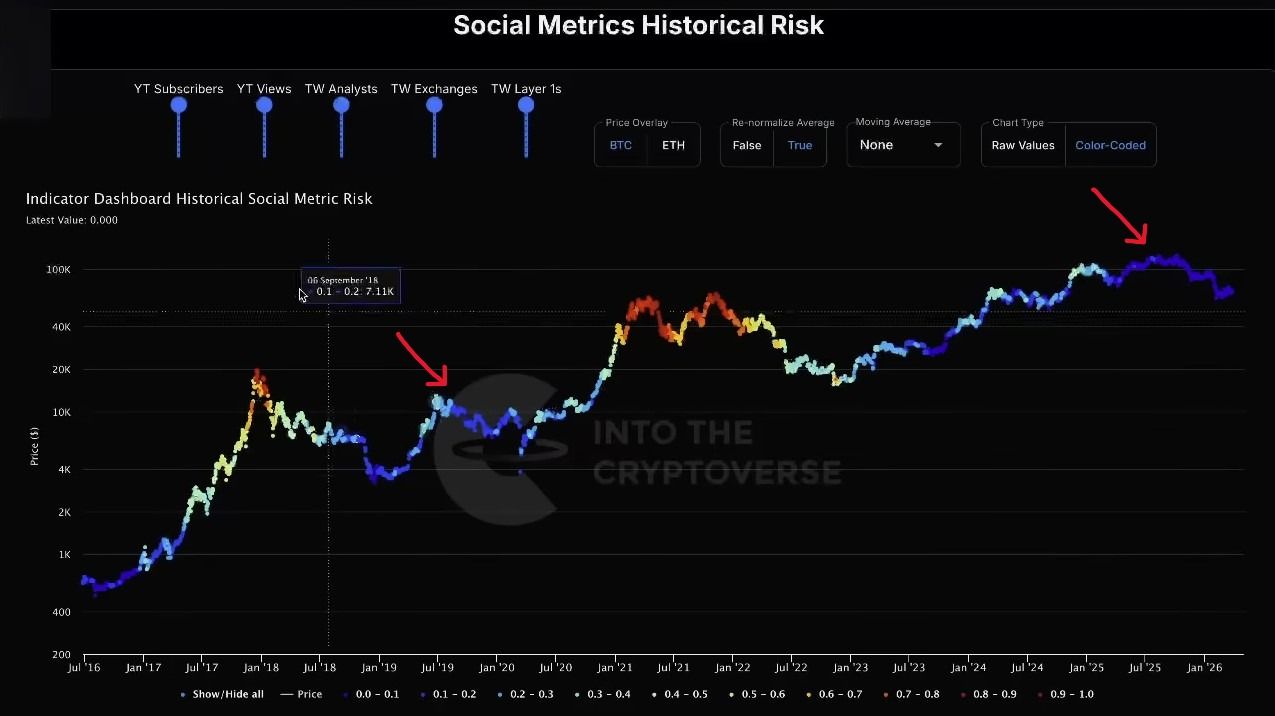
In 2025, Bitcoin printed its all-time high in cold blue. Social engagement was near-historic lows at the exact moment the market reached its peak.
No retail frenzy or mainstream headlines are driving fresh money in. Just a quiet, almost invisible top — what Benjamin Cowen defines as apathy.
“In 2017 and 2021 we topped on euphoria and because we topped on euphoria there was a rotation into the higher risk assets — altcoins. But when you top on apathy you don’t get that same rotation.”
The only other time this happened was in 2019. That observation is where everything begins.
Benjamin Cowen: Why Apathy Kills the Altcoin Season
In a euphoric cycle, the sequence is predictable. Bitcoin tops, early investors take profits, and that capital rotates into higher-risk assets — altcoins. The crowd, still buzzing with excitement, chases the next opportunity. Alt season follows almost mechanically.
Apathy breaks that sequence entirely. When Bitcoin tops on indifference rather than excitement, there is no crowd waiting to rotate.
The retail wave that normally fuels altcoin rallies simply never arrived. And without new buyers entering the market, altcoins have nowhere to go but down.
Cowen puts it with characteristic bluntness:
“But when you top on apathy, like in 2019, you don’t get that rotation. And the reason you don’t get that rotation is that there’s just no one left to sell the altcoins to.”
The consequence is visible in the altcoin total market cap chart. Rather than the sharp post-Bitcoin rotation that altcoin holders were expecting, the chart shows something more painful — a slow, relentless bleed. Altcoins losing ground to Bitcoin not just in the bear market, but throughout the entire cycle, both during the bull run and after it ended.
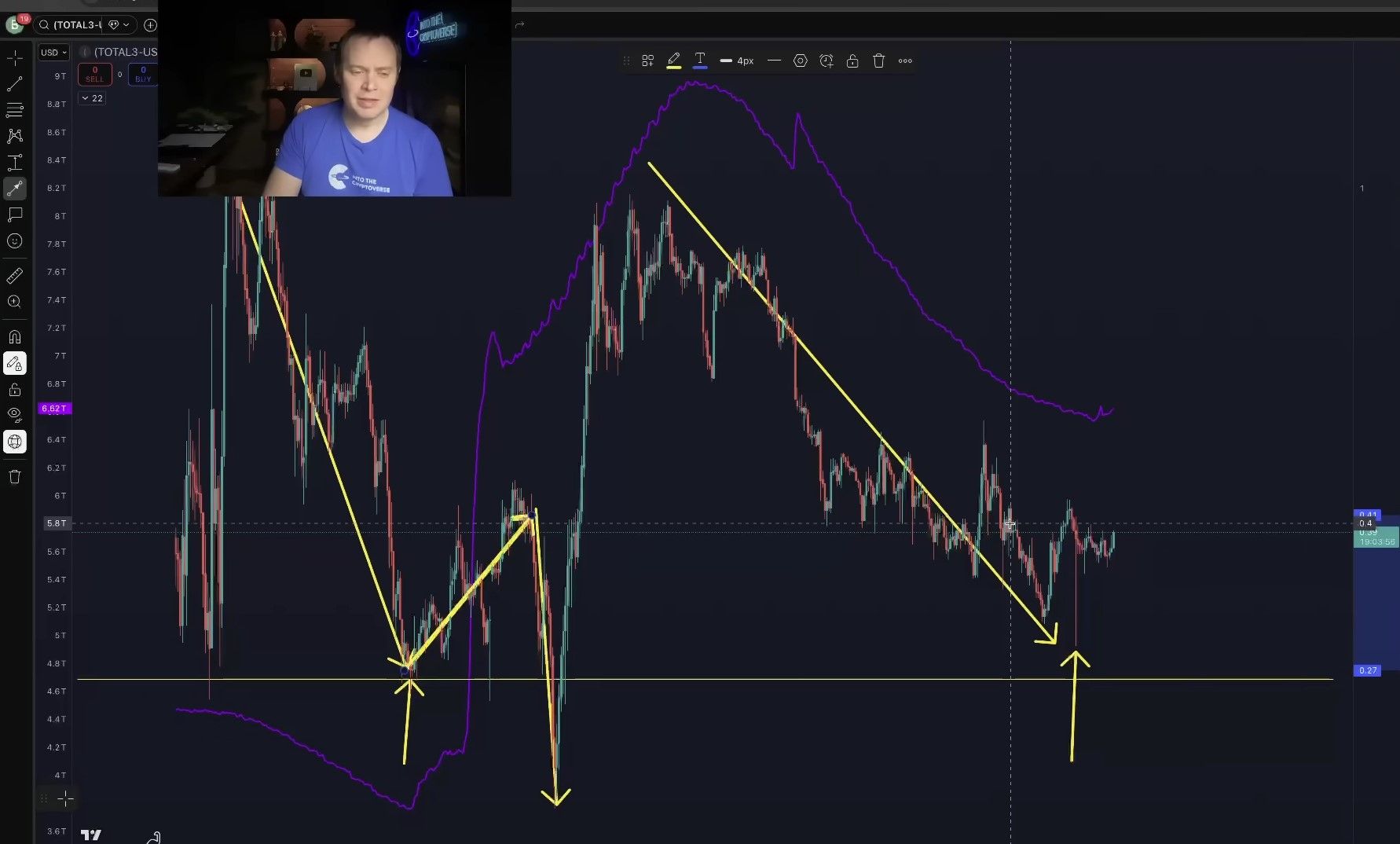
This is not a coincidence or bad luck. It is a direct consequence of the macro environment in which this cycle occurred.
The Macro Context: 2019 and 2025 Show the Same Story
Most crypto analysts treat Bitcoin as its own ecosystem, governed purely by halving cycles and on-chain mechanics. Benjamin Cowen argues that it is only half the picture.
The global business cycle — the broader rhythm of economic expansion, late-cycle stress, and recession — shapes not when Bitcoin tops, but how investors behave when it does.
His Business Cycles chart, built by normalizing a composite of S&P 500 performance, unemployment, interest rates, inflation, and M2 money supply, makes the argument visually.
From Bitcoin’s earliest days through approximately 2019, the macro environment was in an early business cycle phase — the long recovery following the 2008 financial crisis. Risk appetite was structurally high. Investors were willing to climb the risk ladder, moving from equities to Bitcoin to altcoins.
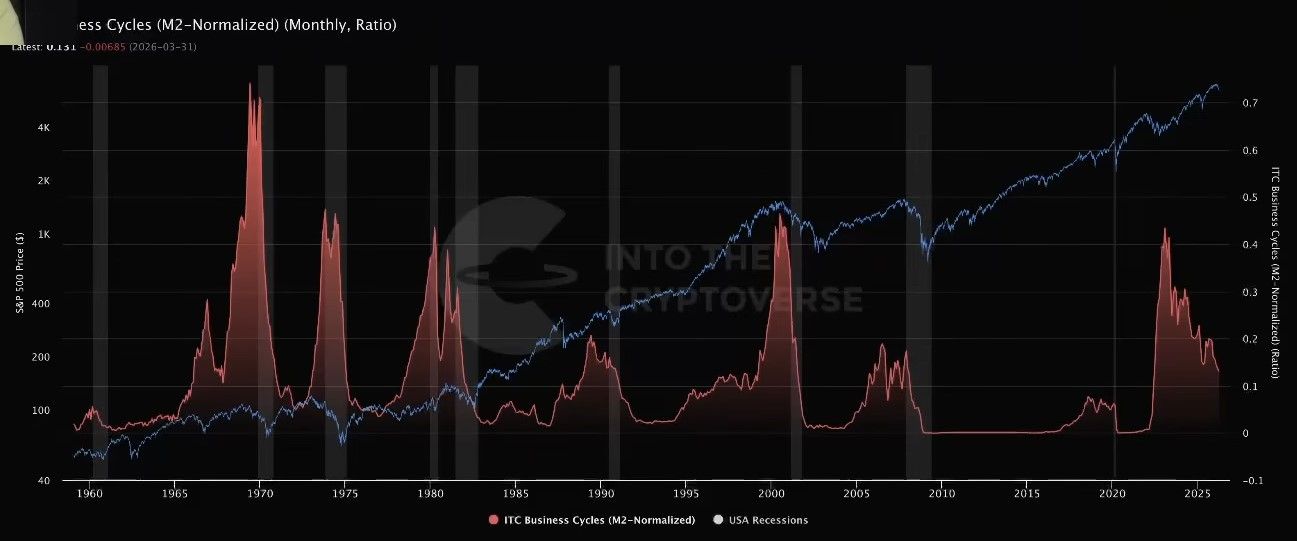
In a late business cycle environment, that risk appetite reverses. Investors don’t reach for more risk — they pull back from it. They consolidate into quality. In crypto terms, that means Bitcoin, not altcoins. It explains why, in both 2019 and 2025, altcoins bled to Bitcoin even as Bitcoin itself was still rising. The macro environment was actively working against the rotation altcoin holders had been counting on.
“The reason why this cycle feels different is because this is a late business cycle environment. And the only other time we had a late business cycle environment where altcoins bled out to Bitcoin even after Bitcoin topped without a rotation was actually in that 2019 phase.”
The Liquidity Risk chart adds a second layer of confirmation. With liquidity risk currently sitting at 0.789 — firmly in the “Very Tight” zone — the conditions mirror those of the 2008 financial crisis and the 2018-2019 period almost precisely. Tight liquidity environments are not environments where investors chase speculative assets. They are environments where capital retreats to safety.
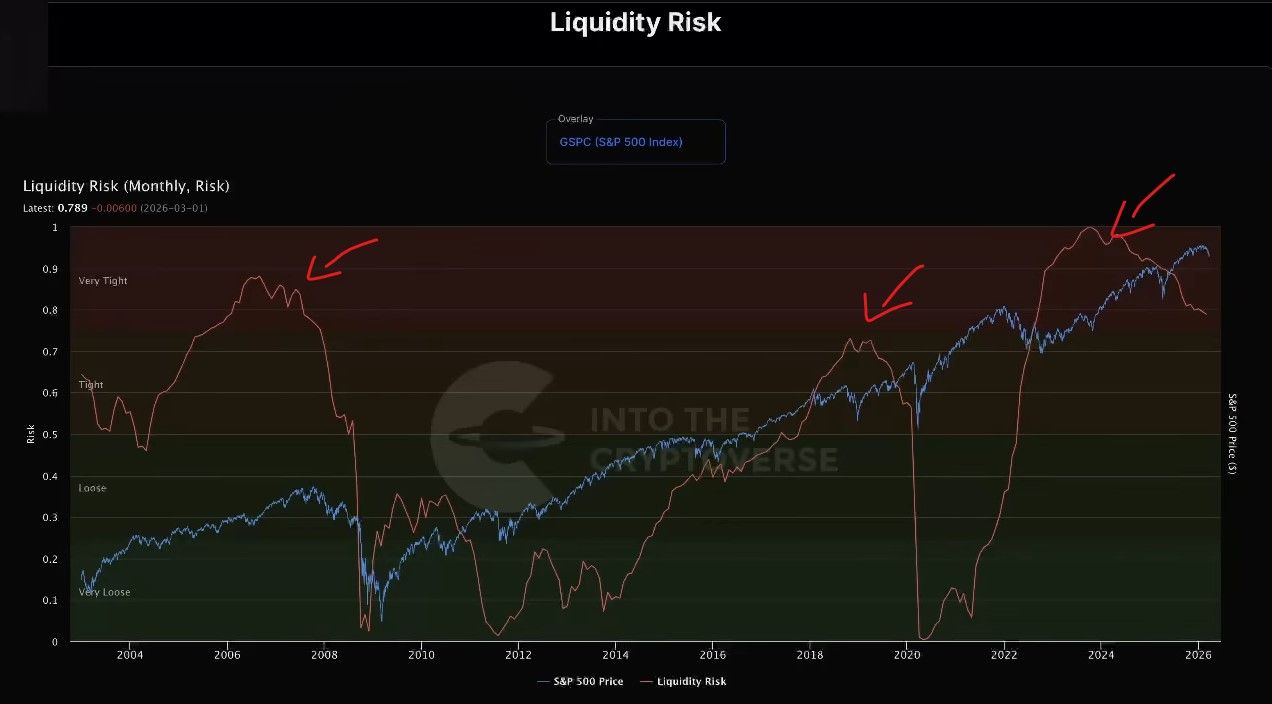
The symmetry between 2019 and 2025 goes deeper still. In 2019, Bitcoin topped in June — two months before quantitative tightening ended in August. In 2025, Bitcoin topped in October — two months before quantitative tightening ended in December. Same pattern, same spacing, larger scale.
“What’s happening now is just a larger version of what happened in 2019. It just happens to all line up.”
What Comes Next for Benjamin Cowen
The 2019 parallel is not a perfect map, but it is the most honest one available. The four-year cycle remains intact — Bitcoin tops when it always tops, and it will bottom when it historically bottoms, approximately one year after the peak. That places the base case for a cycle low in October 2026.
What this cycle has revealed, more clearly than any before it, is that the crypto market does not exist in isolation. The business cycle, liquidity conditions, and investor risk appetite are not background noise — they are the environment in which every crypto decision plays out. In an early cycle, rising risk appetite carries altcoins higher.
In a late cycle, retreating risk appetite leaves them behind.
Benjamin Cowen’s thesis is not a bearish call for its own sake. It is a framework for understanding why this cycle felt different — and why, for those who understood the macro context, it was never really a surprise.
The altcoin season didn’t fail. It was never going to arrive. Not in this environment. Not in this cycle.
The post Benjamin Cowen Reveals Why The Altcoin Season Never Came appeared first on BeInCrypto.
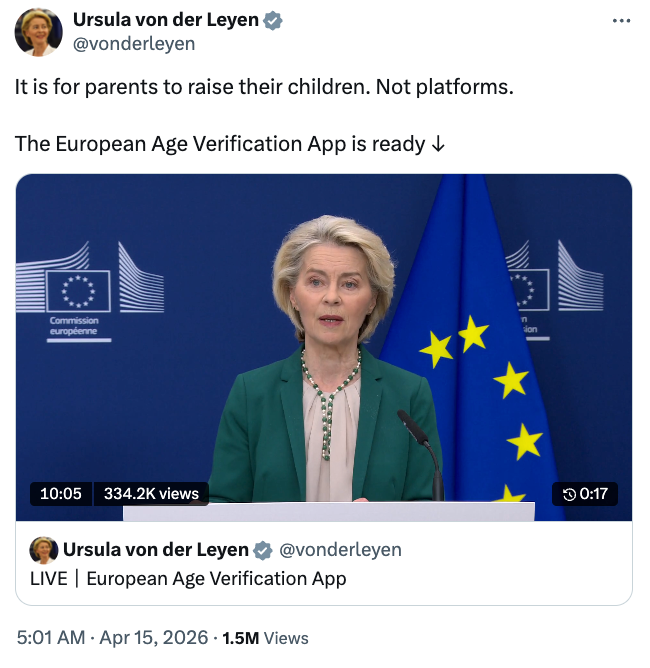
Telegram CEO Pavel Durov warned Friday that the European Union’s new age-verification app could become a stepping stone toward broader online identity tracking, days after the European Commission said the system was technically ready for rollout.
In a Telegram post on Friday, Durov cited analysis from security consultant Paul Moore, who said the app is hackable in “under two minutes” after examining its technical design.
“This product will be the catalyst for an enormous breach at some point,” Moore said in an X post on Thursday, adding that the system could be tricked so the age check isn’t properly tied to the actual user or their device.
Durov argued that the security concerns went beyond age checks and could, over time, be used to justify broader identity verification across online services in Europe.
The criticism reflects a wider debate over how age verification is being built into online platforms, as regulators in multiple regions push similar systems, raising concerns over security and digital identity infrastructure.
System promoted as being “completely anonymous”
The European Commission released the first version of its age-verification blueprint in July 2025, with the aim of letting users prove they are over 18 without disclosing other personal information.
The age verification framework was developed as an open-source project designed to preserve privacy and support future interoperability with European Digital Identity Wallets.

In a statement on Tuesday, EC President Ursula von der Leyen said the EU’s age verification app is “technically ready,” describing the tool as “completely anonymous” and claiming users can prove their age without revealing personal data or being tracked.
However, after researchers said the system can be bypassed in minutes, it’s unclear whether its privacy and security promises will hold up in real use.
Related: Signal push notifications could present privacy vulnerability, says Durov
According to Durov, the app is “hackable by design,” suggesting it was built in a way that makes it easy to break in practice, which he argues could later be used to justify stronger identity checks.

“The EU bureaucrats needed an excuse to silently start turning their ‘privacy-respecting’ age verification app into a surveillance mechanism over all Europeans using social media,” the Telegram CEO said.
Durov has emerged as a major advocate of free speech and digital privacy. He remains under judicial investigation in France over allegations tied to illegal activity facilitated through Telegram, including organized crime, fraud and the platform’s alleged failure to cooperate with authorities.
Magazine: How crypto laws changed in 2025 — and how they’ll change in 2026


President Trump said Thursday the White House is investigating the deaths and disappearances of 10 scientists with ties to classified US defense, nuclear, and aerospace research, calling the pattern “pretty serious stuff” after leaving a meeting on the topic — as a lawmaker called for a formal FBI probe into what investigators have not yet confirmed is anything other than coincidence.
Summary
- Trump told reporters on the White House lawn: “I hope it’s random, but we’re going to know in the next week and a half. Some of them were very important people.”
- White House Press Secretary Karoline Leavitt said the Trump administration would “deem worth looking into” a cluster of cases involving scientists with access to classified nuclear and space material that has drawn growing public scrutiny since late 2024.
- Investigators have found no evidence of a common thread linking the cases, and Harvard physicist Avi Loeb said the cases are probably unrelated because the individuals worked in different specialty areas.
The White House scientist investigation officially entered public view Thursday when President Trump acknowledged he had just left a meeting on the topic of 10 scientists who have died or disappeared since mid-2024, all of them tied to classified US defense, nuclear, or aerospace research.
“Pretty serious stuff,” Trump told reporters before boarding Marine One. “I hope it’s random, but we’re going to know in the next week and a half.” White House Press Secretary Karoline Leavitt this week called it “definitely something I think this government and administration would deem worth looking into,” according to Newsweek reporting. A lawmaker has separately called for the FBI to open a formal investigation.
Five of the ten have died; five remain missing. Among the most prominent: retired Air Force Maj. Gen. William “Neil” McCasland, 68, who previously oversaw some of the military’s most advanced and highly classified research programs, disappeared from his Albuquerque home on February 27, 2026, leaving his phone and prescription glasses behind. Authorities have found no trace of him.
Caltech astrophysicist Carl Grillmair, 67, who worked on the Hubble and Spitzer space telescopes, was shot and killed outside his California home on February 16, 2026. A 29-year-old suspect was arrested and charged with murder. MIT plasma physicist Nuno Loureiro, 47, director of the university’s Plasma Science and Fusion Center, was shot at his Brookline, Massachusetts home in December 2025 and died from his injuries. Jason Thomas, 45, a Novartis pharmaceutical researcher, went missing in December 2025 and was found dead in a Massachusetts lake in March 2026 after investigators said no foul play was suspected.
Monica Reza, 60, a director at NASA’s Jet Propulsion Laboratory, has been missing since June 2025 after vanishing on a well-traveled California hiking trail.
What Authorities Have Found and Have Not Found
No federal agency has publicly confirmed an active investigation linking the cases. Former FBI Assistant Director Chris Swecker told NewsNation he believed the bureau was probably reviewing the cases, adding: “These are classified matters. We shouldn’t be hearing about them if they are investigating.”
Authorities have noted that each case is distinct: some are confirmed homicides with unrelated suspects, some are disappearances with no established cause, and some appear accidental. Avi Loeb of Harvard said he does not believe the cases are related because the individuals worked in different scientific disciplines and there is no established technical link.
The overlap in timing and profession, however, and the access these individuals had to nuclear weapons programs, advanced aerospace systems, and other sensitive areas, has fueled questions across government and intelligence circles that the White House cannot credibly ignore in public.
For the crypto sector, the pattern has a specific relevance: researchers at Lawrence Berkeley National Laboratory, one of the institutions named in connection with these cases, are early adopters of NVIDIA Ising, the new quantum AI toolkit launched this week. Advances in quantum computing research — and the security of the people advancing it — directly intersect with the quantum threat timeline that determines when cryptographic systems securing Bitcoin and other blockchain infrastructure become vulnerable.
Update (4.17.26 6:43 PM UTC): This article has been updated to reflect updated BTC prices and rally data.
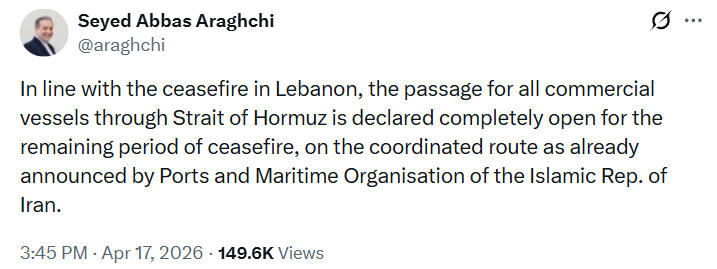
Iran’s foreign minister said Friday that the Strait of Hormuz is open to commercial vessel traffic for the remainder of the current ceasefire, prompting quick market reactions.
“In line with the ceasefire in Lebanon, the passage for all commercial vessels through Strait of Hormuz is declared completely open for the remaining period of ceasefire,” said Iranian Foreign Minister Seyed Abbas Araghchi in a Friday X post.

US President Donald Trump confirmed the opening of the passage in a Friday post on Truth Social.
Bitcoin (BTC) surged past $77,000 on Friday following the news, rising by over 3.7% in 24 hours and a weekly recovery of about 5%, according to data from CoinMarketCap and TradingView.
Brent crude oil futures sank to around $85 per barrel, falling 10% on the news, according to Tradingeconomics data.
Easing geopolitical tensions may bring more risk appetite among crypto investors. However, the two-week ceasefire between the US, Israel and Iran is set to expire on April 22, with the threat of renewed escalation continuing to weigh on market sentiment.
Investors who sold assets in March are now “rushing back into the market” while risk appetite is returning amid the signs of geopolitical deescalation, according to a Friday X post from The Kobeissi Letter, adding that the S&P 500 index added $7 trillion over the past three weeks.
Related: Tom Lee says ‘mini crypto winter’ is over, sees Ether above $60K
Axios says US weighs broader Iran deal
Adding to the positive news, Axios reported Friday that US officials were discussing a proposal to release as much as $20 billion in frozen Iranian funds in exchange for Iran giving up its stockpile of enriched uranium.
Axios said the proposal was part of a three-page framework being discussed as part of efforts to end the war.

Still, the US naval blockade will remain in “full force and effect” until the US’ transaction with Iran is “100% complete,” wrote President Trump in a Friday Truth Social post, adding that “most of the points are already negotiated.”
Magazine: Bitcoin may take 7 years to upgrade to post-quantum — BIP-360 co-author
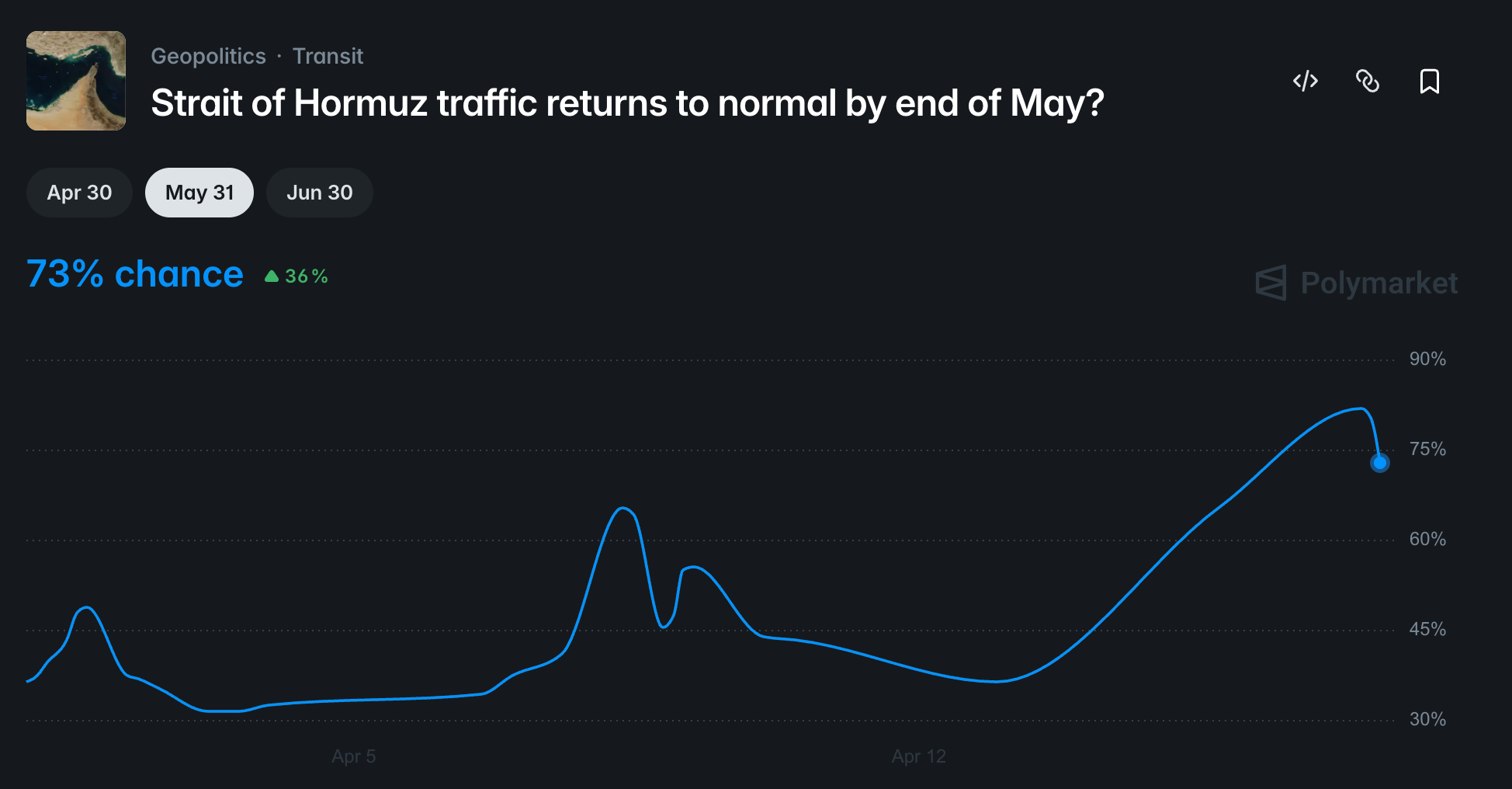
Polymarket prediction market odds of the Strait of Hormuz “returning to normal” by the end of May spiked to 73% on Friday, following news that Iranian officials have temporarily opened up the Strait of Hormuz as part of a ceasefire deal.
The odds climbed to a high of 82% on Friday, after Iranian Foreign Minister Seyed Abbas Araghchi announced that the Strait of Hormuz is open. Since that time, the odds have fallen back down to 73%. He said in an X post:
“The passage for all commercial vessels through the Strait of Hormuz is declared completely open for the remaining period of the ceasefire, on the coordinated route as already announced by the Ports and Maritime Organization of the Islamic Republic of Iran.”

However, traders on the platform placed the odds of the Strait returning to normal activity by the end of April at just 40%.
The war in Iran sent shockwaves through financial markets, impacting crypto and energy prices, as investors and financial analysts react to political developments in the ongoing conflict.
Related: Iran conflict hints Bitcoin’s addressable market could exceed gold: Bitwise
Bitcoin rises on the ceasefire news, but the truce is “fragile”
The price of Bitcoin (BTC) surged on Friday in response to the temporary reopening of the Strait under the ceasefire, briefly tapping $78,000 before climbing down to about $77,358, the price at the time of publication.

Crypto market analyst Nic Puckrin told Cointelegraph that the ceasefire between the US and Iran announced in April is “fragile” and that core issues remain unresolved.
The fallout from the conflict will likely cast a shadow over financial markets for most of 2026, pushing back any interest rate cuts to Q3 2026 at the earliest, if rate cuts materialize at all this year, Puckrin said.
“A ceasefire that results in the end of geopolitical tensions, a sustained drop in oil prices toward $80, and ideally also softer-than-expected economic data that calms stagflation fears” are all needed for BTC to reclaim the $90,000 level, he said.
US President Donald Trump said on Friday that the US naval blockade on Iran would “remain in full force and effect” until the “transaction with Iran is 100% complete.”
Magazine: Should users be allowed to bet on war and death in prediction markets?


Stanford’s 2026 AI Index shows the performance gap between US and Chinese AI models has compressed to just 2.7%, down from a double-digit lead as recently as 2023, as Anthropic’s Claude Opus 4.6 holds a 39-point Elo lead over ByteDance’s best-performing model on the benchmarks Stanford tracks.
Summary
- The 423-page report, released April 14, finds that the US and Chinese models have traded first place multiple times since early 2025, with DeepSeek-R1 briefly matching the top US model in February 2025 before being surpassed.
- The US leads China in private AI investment ($285.9 billion vs $12.4 billion) and notable model production (50 vs 30 in 2025), while China leads in AI publication volume, patent output, and industrial robot installations.
- The number of AI researchers entering the US has dropped 89% over seven years and 80% in the past year alone, a trend the report attributes in part to H-1B restrictions under the Trump administration.
Stanford’s 2026 AI Index, released April 14, documents the near-disappearance of the US performance advantage in artificial intelligence, with the top American model leading the best Chinese model by just 2.7% on the Arena Leaderboard benchmarks Stanford tracks as of March 2026.
The 423-page report from Stanford’s Institute for Human-Centered AI puts the specific figures starkly: in 2023, performance gaps between leading US and Chinese models ranged from 17.5 to 31.6 percentage points on major benchmarks including MMLU, MATH, and HumanEval. By the end of 2024, those gaps had collapsed to 0.3, 1.6, and 3.7 percentage points respectively. The current 2.7% Elo lead between Anthropic’s Claude Opus 4.6 and ByteDance’s Dola-Seed-2.0 Preview is narrow enough to flip on the next major release from either side.
The US advantage remains substantial in investment, infrastructure, and model production. American companies poured $285.9 billion into AI in 2025, 23.1 times China’s $12.4 billion private investment. The US produced 50 notable AI models in 2025 against China’s 30. The US hosts 5,427 data centers, more than ten times any other country.
High-impact patents, where quality of innovation matters more than volume, also favor the US. China leads globally in total patent output, filing 69.7% of all AI patents worldwide. But Stanford’s analysis distinguishes between patent volume and patent impact, and American researchers still produce more commercially influential intellectual property.
Where China Has Surged
China now produces 23.2% of all global AI publications and receives 20.6% of all global AI research citations, compared to 12.6% for the US. Chinese organizations installed 295,000 industrial robots in 2024, versus 34,200 in the United States, with China accounting for 51.1% of global industrial robot installations. The report notes that Chinese government guidance funds, estimated at $912 billion deployed across industries since 2000, mean that private investment figures substantially understate China’s total AI resource commitment.
South Korea has emerged as the world leader in innovation density, filing more AI patents per capita than any other country, introducing a third significant competitor into a rivalry previously framed as bilateral.
The Talent Warning
The report’s most alarming finding for US policymakers may be the talent data. The number of AI researchers entering the United States has dropped 89% over the past seven years, with an 80% decline in the past year alone. New H-1B visa restrictions that include a $100,000 employer fee per hire are cited as a contributing factor.
The Stanford data landed directly in the context of the ongoing US-China AI race that has driven the most significant infrastructure and semiconductor investments in the country’s history, including the NVIDIA Ising quantum AI models launched this week and the Terafab chip project. For AI tokens and the broader crypto-AI intersection, the convergence of the two countries’ capabilities matters: it removes the assumption that US systems have a durable lead and raises the competitive stakes on each new model release.


CFTC AI news came directly from Capitol Hill Thursday as Chairman Mike Selig told the House Agriculture Committee that artificial intelligence tools, specifically Microsoft’s Copilot, are filling surveillance and investigation gaps at an agency that has lost roughly 25% of its workforce since 2025, even as Congress prepares to hand it primary oversight of the US crypto market.
Summary
- Tools such as AI are going to be very helpful in surveilling and bringing the investigations, and we’re incorporating that into various workflows,” Selig told lawmakers, citing Copilot as one productivity tool across the agency.
- The CFTC currently operates with only Selig as its single sitting commissioner out of five required by law, with four seats vacant including both minority-party positions.
- Selig confirmed “numerous investigations ongoing” in prediction markets, where platforms like Polymarket and Kalshi have drawn scrutiny for well-timed trades tied to US military actions and government announcements.
CFTC AI news emerged from Thursday’s House Agriculture Committee oversight hearing as Chairman Mike Selig defended his agency’s shrinking headcount by pointing to productivity gains from AI tools, even as lawmakers pressed him on whether the CFTC has the resources to oversee both a rapidly growing crypto market and a prediction market sector that has ballooned into the billions of dollars in annual volume.
The agency has lost approximately 25% of its staff since 2025 under President Trump’s federal workforce reduction drive. Enforcement division staffing, at roughly 108 positions after a recent budget request for three new hires, is still 23% below the 140 enforcement employees on record in 2025. The CFTC currently operates with Selig as the sole sitting commissioner, with four of five legally required positions unfilled including both minority-party seats.
“Tools such as AI are going to be very helpful in surveilling and bringing the investigations, and we’re incorporating that into various workflows,” Selig told lawmakers. He specifically cited Microsoft’s Copilot as one productivity tool woven into agency workflows. When asked directly about the staff declines, Selig replied: “We are running more efficiently and effectively.”
The CFTC is simultaneously pursuing two expansions that would dramatically increase its regulatory footprint. First, the CLARITY Act, which is moving toward a Senate Banking Committee markup in late April, would designate the CFTC as the primary regulator of non-securities crypto trading, giving it oversight of Bitcoin, Ethereum, and every digital commodity that doesn’t meet the SEC’s securities definition. Second, the CFTC is asserting exclusive federal jurisdiction over prediction markets, a claim currently being contested in courts by multiple states.
Committee Chairman Glenn “GT” Thompson noted the contradiction. “We’re putting a lot on your plate with digital assets, and we’re obviously going down this path with prediction markets,” he told Selig, then asked him to request more staff if operational needs required it. Selig said “Absolutely” and reiterated that enforcement remains a “top priority.”
Prediction Market Investigations and Insider Trading
The prediction market scrutiny has been intense. Multiple members questioned Selig about trades on Polymarket, Kalshi, and other platforms in which small numbers of anonymous accounts appear to have made significant profits on bets tied to US military actions and government announcements, suggesting potential access to non-public information. Reports have identified roughly six Polymarket accounts that earned $1.2 million on correct bets about US Iran strikes placed hours before the February 28 action became public.
Selig said the agency has “numerous investigations ongoing” in prediction markets but declined to quantify or describe them, saying doing so could compromise active work. He described the regulated platforms as the “first line of defense” before the CFTC acts.
Ranking Member Angie Craig of Minnesota said flatly that the CFTC “cannot adequately oversee digital commodity trading and prediction markets” with current resources. She and Thompson announced plans to write to the White House urging bipartisan commissioner nominations. The single-commissioner structure has broader implications for the CLARITY Act rulemaking process: Selig indicated he would not wait for a full commission. “We cannot for the sake of the American people slow down our rulemaking,” he said, signaling he would advance major regulations alone if necessary, a position that could invite legal challenges to any rules adopted without bipartisan deliberation.
As the CFTC’s crypto role expands, Selig’s claim that AI can offset a quarter of the workforce will face a direct test once the CLARITY Act passes and the full weight of digital asset oversight lands on an agency that, by its own data, has 23% fewer enforcement officers than it needs.
Crypto World
Ton Price Prediction: TON Targets $1.51 While Pepeto 300x Heats Up After CoinMarketCap Listing
The ton price prediction for April 2026 covers TON technical levels, Rakuten Wallet’s launch of TON spot trading on April 15, and how the Pepeto presale compares for traders watching the meme coin and exchange token space.
Toncoin (TON) gained 12% over the past seven days after Rakuten Wallet opened spot trading for the token on April 15 and the Catchain 2.0 upgrade cut block times to 400 milliseconds, per Blockonomi. Trading volume jumped 148% in 24 hours while the top 100 whale wallets added 189,730 TON during the same stretch. The ton price prediction at a $1.51 breakout looks solid, but the tools that help retail traders catch the next wave before the crowd still do not exist for most buyers.
Pepeto was built to close that gap with a live exchange that spots early entries before the wider market picks up on them. More than $8,940,333 raised and a verified CoinMarketCap page put Pepeto days from its Binance listing. The window to lock in presale price is shutting fast.
Ton Price Prediction: TON Holds $1.41 With a $1.51 Breakout in Sight
TON trades at $1.41 today, sitting roughly 83% below its $8.25 all time high, and the $1.51 resistance level will shape where it heads next this month. Blockchain News projects the ton price prediction for late April between $1.35 and $1.51, with an average target near $1.42.
Changelly reported that TON is building inside a range between $1.35 and $1.51 with RSI near 51 in neutral ground, and a clean break above $1.51 could push the next leg toward $1.60 on rising volume.
Tokens built to catch the move before it starts
Pepeto: If you missed last cycle’s best entries, this is the one staring you in the face right now
When whale wallets add nearly 190,000 TON in a single week and a major Japanese exchange opens the trading pair, capital is clearly lining up. Most retail wallets only notice the flow once the move already happened. Pepeto just landed on CoinMarketCap, and the Binance listing is days away. The exchange closes that timing gap with tools that flag early entries before the broader market catches on.
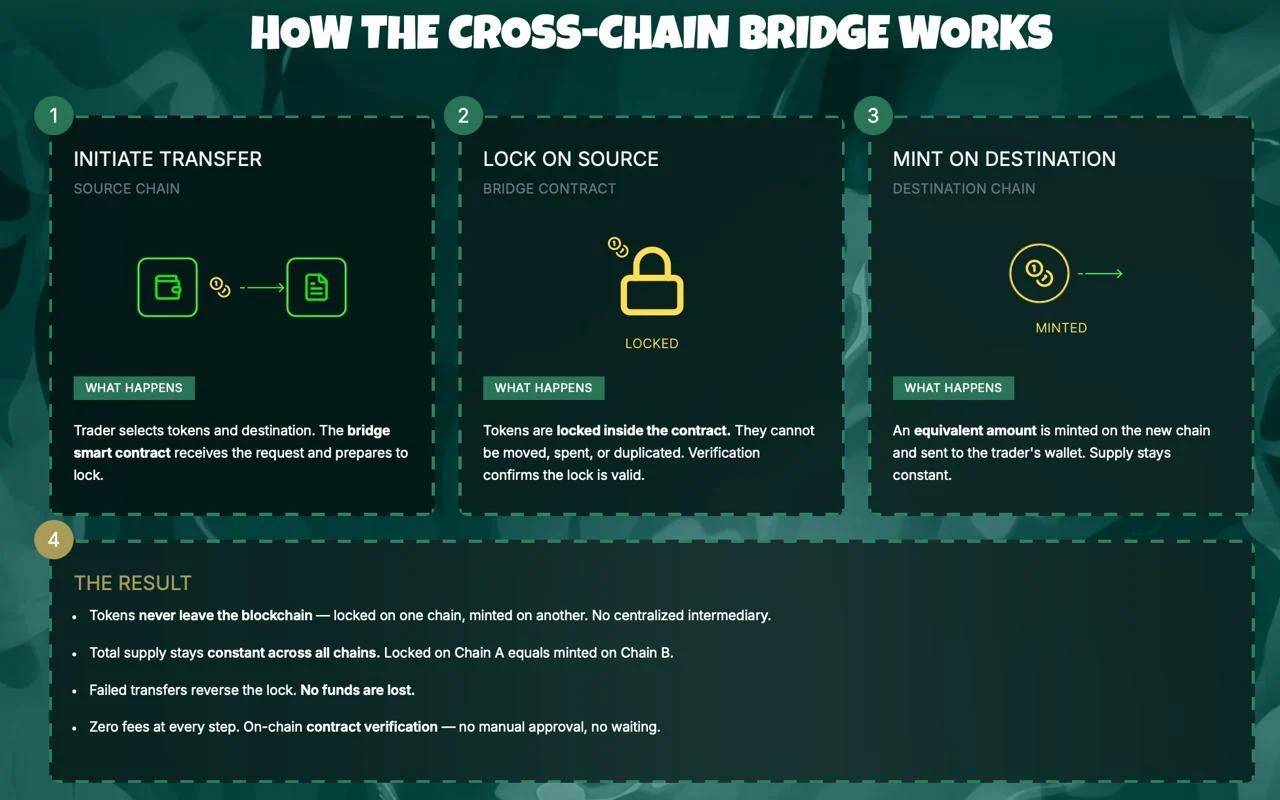
The cross chain bridge pushes meme tokens between networks in seconds, and the scanning engine spots new projects at their cheapest price point.
Behind this entry sits a finished SolidProof audit protecting the contract, the same founder who built the original Pepe to an $11 billion market cap with zero products, and a team member who previously worked inside Binance running the listing rollout.
At $0.0000001863 per token, more than $8,940,333 has flowed into the presale across 420 trillion tokens, with staking running at 185% APY. Once Binance trading goes live, the analyst target sits between 300x and 1000x from this floor. Last cycle rewarded the earliest wallets with life changing gains, and Pepeto carries the same setup now, a confirmed listing closing in while presale buyers hold the lowest entry that vanishes the moment public trading opens.
Ton Price Prediction: TON Targets $1.51 in April and $5.03 by Year End From $1.42
Toncoin (TON) Price at $1.42 as Rakuten Wallet Opens Spot Trading
Toncoin (TON) trades at $1.42 according to CoinMarketCap, ranked number 33 with a $3.45 billion cap per CoinMarketCap. Blockchain News targets a $1.42 average for April with a peak near $1.51. Changelly’s bull case hits $5.03 by mid autumn 2026, roughly 256% from current levels.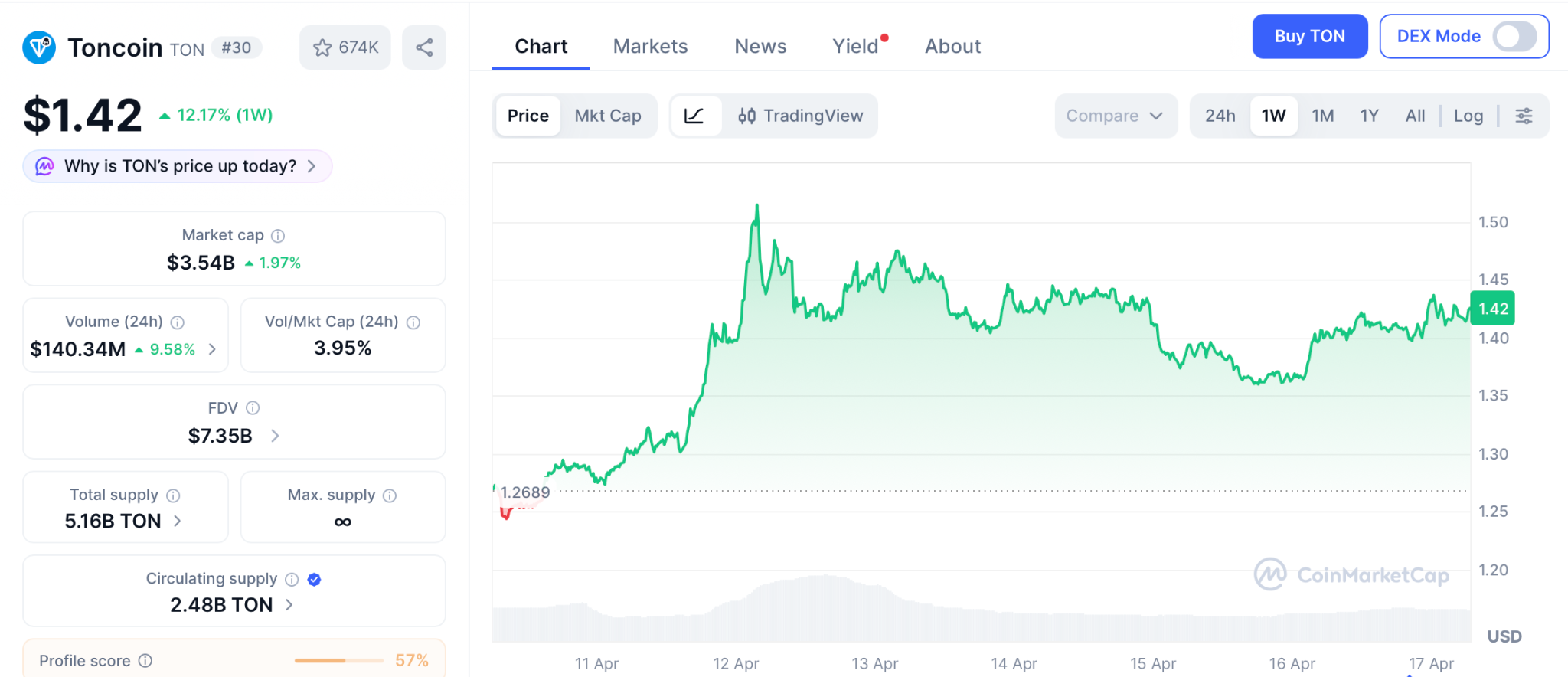
The network just processed Catchain 2.0 and volume jumped 148% in a day, but even the bullish TON forecast delivers gains that take months. A presale backed by a confirmed Binance listing hands you the ground floor now, with weeks to listing day instead of months of waiting.
Conclusion
The ton price prediction targets 256% at best over months while the network absorbs Catchain 2.0 and capital keeps flowing in, but last cycle the wallets that hit the biggest returns entered the strongest setups while fear was still running. That missed window is what Pepeto was built for, with a working exchange, a finished SolidProof audit, a Pepe cofounder driving the build, and the Binance listing locked in.
Getting in at presale price while TON keeps you waiting months for smaller gains is where real crypto wealth gets built. Click below to enter the Pepeto presale before the Binance listing hits.
Click To Visit Pepeto Website To Enter The Presale

FAQs
What does the ton price prediction look like for April 2026?
Toncoin (TON) targets a range of $1.35 to $1.51 for April with a breakout level at $1.51 after Catchain 2.0 cut block times to 400ms. Pepeto at presale price with a confirmed Binance listing offers returns that TON cannot match from $1.41.
How does Toncoin’s Rakuten Wallet listing change the outlook for TON holders watching Pepeto?
Rakuten Wallet added TON spot trading on April 15, boosting volume 148% in a single day. Pepeto at $0.0000001863 with $8,940,333 raised and a Binance listing days away gives traders a presale floor that turns into 300x to 1000x when volume opens.
Disclaimer: This is a Press Release provided by a third party who is responsible for the content. Please conduct your own research before taking any action based on the content.



Summary
- Polish Prime Minister Donald Tusk has accused crypto exchange Zondacrypto of using “Russian funds linked to organized crime” and “Russian security services” to finance opposition politicians and block a MiCA‑style crypto bill.
- Tusk told parliament that some lawmakers fighting his government’s crypto‑asset legislation were “serving the interests” of Zondacrypto, which he said sponsored a CPAC event in Poland where former U.S. Homeland Security Secretary Kristi Noem endorsed nationalist Karol Nawrocki’s presidential bid.
- President Nawrocki, elected in June 2025 with backing from former U.S. President Donald Trump, has twice vetoed MiCA‑aligned regulation, leaving Polish exchanges in legal limbo and deepening a national‑security‑tinged standoff over how to police digital assets.
Speaking in the Sejm on Friday ahead of a vote on overturning his rival’s veto, Tusk claimed that “Russian money was behind the Zondacrypto cryptocurrency platform,” which he alleged has “supported political and social initiatives” aligned with right‑wing groups in Poland. He told lawmakers that the firm’s backing was tied “not only to Russian capital” but also to “groups connected to the so‑called bratva, a term for Russian mafia organizations, as well as Russian security services.”
Tusk links Zondacrypto to Russian ‘Bratva’ and intelligence
According to Tusk, internal security agency findings show that Zondacrypto “sponsors political and social gatherings in Poland and champions very particular political factions,” including politicians from the former ruling Law and Justice party and the far‑right Confederation. He highlighted the exchange’s role as a “significant sponsor” of a Conservative Political Action Conference event in Rzeszów in March 2025, where Kristi Noem publicly backed Karol Nawrocki’s presidential campaign.
Tusk framed the latest vote as a security test, telling parliament there is “no doubt that this market is extremely vulnerable to manipulation by foreign services, intelligence organizations, and criminal enterprises.” In a post on X, he cast the regulatory fight as a straight choice between “Russian money and services versus the security of the state and citizens.”
The political clash comes after President Nawrocki twice blocked government efforts to align Poland with the EU’s Markets in Crypto‑Assets framework. In February, he vetoed a second crypto‑asset bill he described as “practically identical” to legislation he had already rejected in December 2025, arguing that the government’s model was “flawed” and would hurt consumers and smaller firms.
That stance has left Warsaw as a MiCA outlier. Without enabling legislation, Polish exchanges and wallet providers have no domestic route to start the licensing process required under EU rules, putting them at a disadvantage to peers in countries that are already issuing MiCA authorizations. A previous attempt to overturn an earlier veto also failed in December 2025, when parliament upheld Nawrocki’s decision despite Tusk warning that unregulated platforms were “particularly vulnerable to manipulation by foreign intelligence services, organized crime, and mafias.”
For now, Zondacrypto has not publicly commented in detail on the latest accusations, while the president’s office insists it does not oppose crypto regulation per se but rejects the government’s approach. As other EU members move ahead with MiCA licensing and enforcement, Poland’s fight over whether its crypto market is a vector for Russian “Bratva” money or a sector strangled by political point‑scoring is turning into a wider test of how national security, party financing and digital‑asset rules intersect in Europe.
Related crypto.news coverage on regulation and security risks in digital assets includes an explainer on why the U.S. is pushing tokenization‑friendly accounting, an analysis of how Trump‑era regulatory pullbacks reshaped the SEC’s crypto unit, and a report on MiCA‑aligned stablecoin rules emerging in other jurisdictions.

26 Years Later, the Best Historical Epic Is Still a Masterpiece From Start to Finish

Live Crypto And Gold Scalping Trading | 16 April 2026 #cryptoscalping #xauusdlive
Federal judge blocks Nexstar-Tegna TV station merger until antitrust lawsuit is settled

Why Israel is blocking foreign journalists from entering

Bitcoin: We’re Entering The Most Dangerous Phase

Alan Cumming Brands Baftas Ceremony A ‘Triggering S**tshow’
Live Crypto And Gold Scalping Trading | 16 April 2026 #cryptoscalping #xauusdlive

Miami King HATES Financial Freedom?! | ‘Take It Personal’ OUT NOW

Money Personality Tipe Kedua? #fyp #viral #viralvideo #shortsvideo #shorts #financial #keuangan
-
 NewsBeat5 days ago
Pep Guardiola and Gary Neville agree over Arsenal title problem that benefits Man City
-

 Crypto World4 days ago
The SEC Conditionalises DeFi Platforms to Be Avoided for Broker Registration
-

 Politics5 days ago
World Cup exit makes Italy enter crisis mode
-

 Crypto World4 days ago
SEC Signals Exemption for Crypto Interfaces From Broker Registration
-

 News Videos3 days ago
Secure crypto trading starts with an FIU-registered
-

 Sports16 hours ago
NWFL Suspends Two Players Over Post-Match Clash in Ado-Ekiti
-

 Crypto World4 days ago
SEC Proposes Certain Crypto Interfaces Don’t Need to Register as Brokers
-

 Business6 days ago
Ireland Fuel Protests Enter Day 5 as Blockades Spark Shortages and Government Prepares Support Package
-

 NewsBeat4 days ago
Trump and Pope Leo: Behind their disagreement over Iran war
-
 NewsBeat6 days ago
JD Vance announces ‘no agreement’ with Iran over nuclear weapons fear
-
Sports6 days ago
Dexter Lawrence, Stefon Diggs, Trading for De’Von Achane
-

 Crypto World5 days ago
Trump whales load up ahead of Mar-a-Lago luncheon.
-
 Crypto World5 days ago
Sei Network Enters Quiet Reset Phase as On-Chain Metrics Signal a Slowdown in 2026
-
Business7 days ago
Coreweave CSO Venturo sells $5.5m in class a common stock
-

 Fashion7 hours ago
Weekend Open Thread: Theodora Dress
-
Sports7 days ago
1st-Round WR Enters Vikings Mock Draft Orbit
-
Business5 days ago
Kering slides after Morgan Stanley downgrade, Gucci woes loom
-
 Entertainment4 days ago
Karol G’s ‘Ultra Raunchy’ Coachella Set Gave ‘Satanic Vibes’
-
 Business1 day ago
Creo Medical agree sale of its manufacturing operation
-

 Crypto World2 hours ago
Russia Pushes Bill to Criminalize Unregistered Crypto Services
You must be logged in to post a comment Login