
Crypto World
Russia Targets 50,000 Miners as Crypto Mining Banned in 13 Regions


Russia has moved to shut down crypto mining operations across 13 regions, targeting an estimated 50,000 miners in what amounts to the most sweeping enforcement action since the country legalized the activity in August 2024.
The bans, extending through 2031 during peak autumn-winter seasons, signal that Moscow’s tolerance for grid-straining mining has hit a structural limit, not just a seasonal one.
The immediate pressure is energy: affected Siberian regions are reporting shortfalls of nearly 3,000 MW on the Unified Energy System grid, driven largely by miners exploiting cheap, heavily subsidized local electricity. That’s not a rounding error – it’s a grid crisis, and Russian officials are treating it as one.
Key Takeaways:
- Ban Scope: Mining restrictions now cover 10 active regions – including Irkutsk Oblast, parts of Buryatia and Zabaikalsky Krai, six North Caucasus republics, and Russian-occupied Ukrainian territories – with seasonal bans running through 2031.
- Affected Miners: An estimated 50,000 operators face enforcement, with major firm BitRiver among the hardest hit due to its reliance on Irkutsk’s low-cost power infrastructure.
- Energy Context: Power shortfalls in Siberian regions have reached nearly 3,000 MW, with miners blamed for exploiting subsidized electricity at grid-destabilizing scale.
- Escalation Path: Year-round bans in southern Buryatia and Zabaikalsky Krai take effect January 1, 2026, moving beyond seasonal restrictions into permanent operational prohibition.
- What to Watch: A government commission on the electric power sector is expected to convene soon to finalize expanded year-round bans; potential amnesty programs in the North Caucasus could redirect illegal miners toward licensed operations.
Discover: Top Crypto Presales to Watch Before They Launch
What the Russia Crypto Mining Ban Actually Does – and Why the Regional Selection Matters
The mechanics are straightforward: registered and unregistered miners in covered regions are prohibited from operating during designated periods, with enforcement escalating to include FSB agents, drones, and surveillance technology in areas like Kabardino-Balkaria, where illegal operations hidden in abandoned buildings caused over 1 billion rubles ($13 million) in utility damages in 2025 alone.
The regional selection isn’t arbitrary. Irkutsk Oblast faces a full-year ban – its southern areas were already restricted earlier in 2025, freeing up 320 MW – because it anchors the cheap-power arbitrage that made Siberia a global mining hub in the first place.
The North Caucasus republics (Dagestan, North Ossetia-Alania, Ingushetia, Chechnya, Kabardino-Balkaria, and Karachay-Cherkessia) are included because illegal mining there has metastasized beyond regulatory reach.

The inclusion of occupied Ukrainian territories – Donetsk, Luhansk, Zaporizhzhia, and Kherson – reflects Moscow’s intent to consolidate energy control in those regions rather than tolerate gray-market extraction.
Power officials in Buryatia welcomed the year-round bans, with TASS and Kommersant reporting officials cited relief from “serious” shortages. The Industrial Mining Association took the opposite view, stating the restrictions “reduce [Southern Siberia’s] attractiveness to investors” and leave miners “vulnerable.” Both reactions are accurate – which is precisely what makes this ban structurally significant rather than cosmetic.
50,000 Miners Offline – What That Means for Global Hash Rate
Russia currently accounts for roughly 5% of global Bitcoin hash rate, according to Cambridge Centre for Alternative Finance data – a share built almost entirely on the cheap, subsidized electricity now being clawed back.
Displacing 50,000 operators from that base doesn’t evaporate hash rate; it redistributes it, and the redistribution logic points toward the United States, Kazakhstan, and parts of Central Asia as the most likely beneficiaries.
That matters because hash rate geography isn’t just a mining industry statistic – it shapes where block rewards flow, which jurisdictions capture mining revenue, and how resilient the network is to coordinated regulatory pressure.
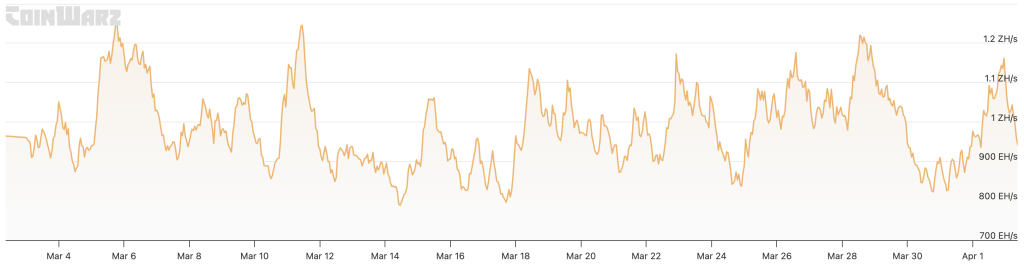
A meaningful contraction in Russian hash rate tightens the global difficulty adjustment modestly in the short term, briefly improving margins for miners elsewhere before difficulty recalibrates. Bitcoin’s broader market performance adds another variable: compressed miner margins in a sideways or declining price environment accelerate the exit of marginal operators, potentially amplifying the hash rate shift beyond what the Russian ban alone would produce.
BitRiver – the largest industrial mining operator in Russia, anchored to Irkutsk’s power infrastructure – faces the most acute operational exposure. Its model was built on energy-cost arbitrage that the Russian state is now explicitly dismantling.
Explore: Best Crypto Projects With High Growth Potential in 2026
The post Russia Targets 50,000 Miners as Crypto Mining Banned in 13 Regions appeared first on Cryptonews.

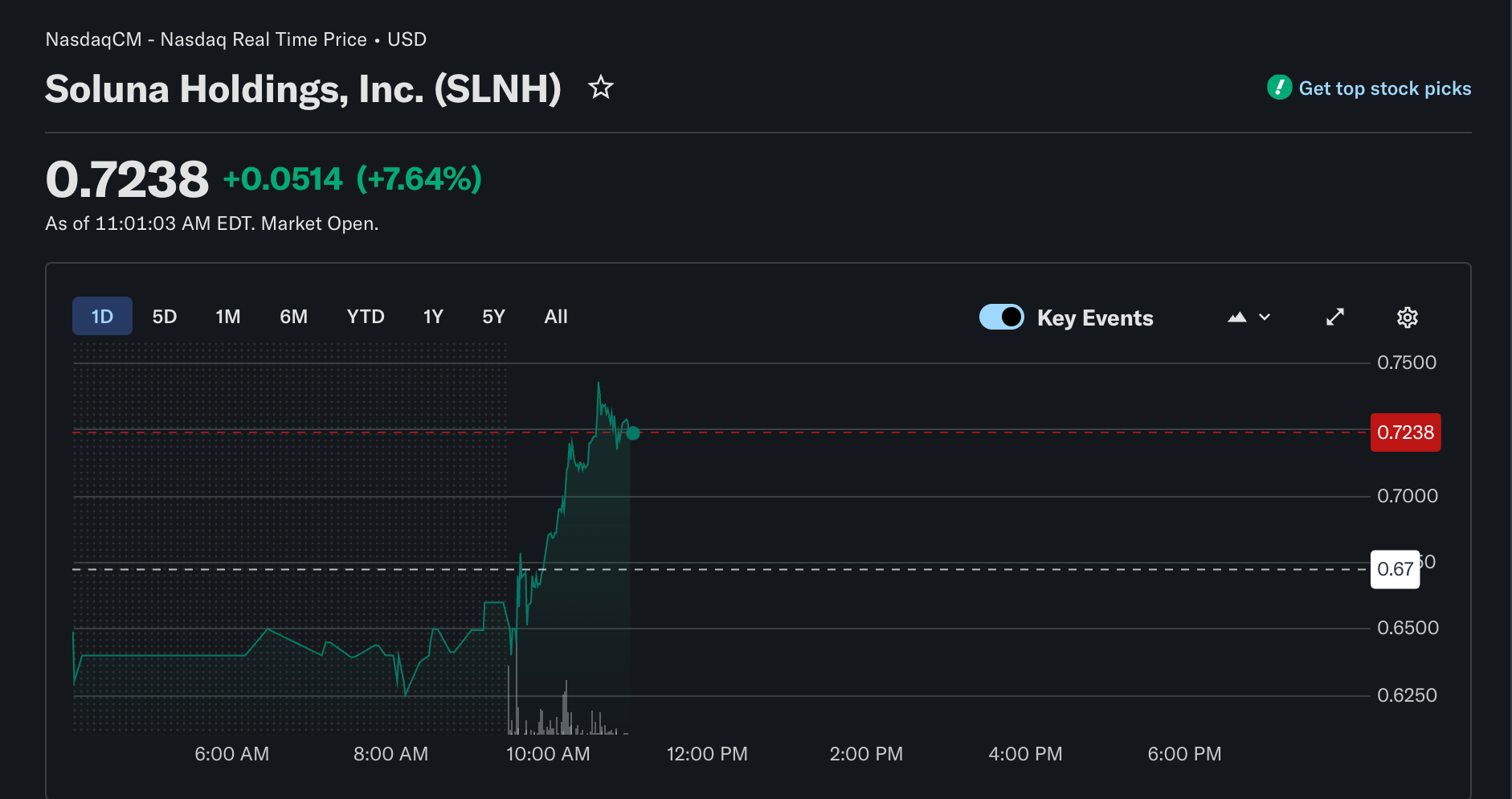
Soluna Holdings, a publicly traded Bitcoin (BTC) mining and AI infrastructure company focused on renewable energy, announced on Thursday that it closed a $53 million deal to acquire a wind farm to power its upcoming Project Dorothy 3 AI data center campus.
The Briscoe Wind Farm, located in Briscoe County, Texas, has a potential capacity of up to 300 megawatts (MW), according to the company’s announcement.
The company forecasts that the facility will generate annualized revenue between $20 million and $24.4 million.
Shares of Soluna are up by about 7.6% following the news, and are trading at about $0.76 at the time of writing.

Soluna expanded into AI data center infrastructure in February 2024, amid an industry-wide pivot toward AI and high-performance computing infrastructure to shore up declining revenues from the crypto mining business.
Related: AI data center gold rush sparks debate over impact on Bitcoin mining
Miners adopt renewable energy solutions amid profit squeeze
The Bitcoin mining industry faces several economic headwinds, including declining block rewards, rising energy costs and compressing profit margins, with many companies operating near or below breakeven levels.
Up to 20% of mining companies aren’t profitable, according to a March 2026 report from asset manager CoinShares.
The average cost to mine a single Bitcoin rose to nearly $80,000 in the fourth quarter of 2025, CoinShares said. Bitcoin is currently trading well below that level.

“Q4 2025 marked the most challenging quarter for Bitcoin miners since the April 2024 halving,” the report said.
The October 2025 market crash, which caused Bitcoin to plummet from an all-time high around the $125,000 level to a low of about $60,000, and rising network hashrate have placed even more pressure on the industry, CoinShares said.

Bitcoin mining companies sold over 15,000 BTC between October and early March to cover operating expenses, and the pace of selling has continued in recent weeks.
Several Bitcoin mining companies, including The Pheonix Group and Sangha Renewables, have adopted renewable energy solutions to power their operations and remain competitive amid a challenging business environment.
Canaan, a mining hardware manufacturer and mining company, partnered with Soluna in September to deploy a wind-powered BTC mining facility at the Briscoe, Texas site.
Related: AI may already use more power than Bitcoin — and it threatens Bitcoin mining


Polymarket traders now put a 65% chance on WTI crude hitting $120 at some point in 2026, as Middle East tensions and supply fears drive a rapid repricing of oil risk.
Summary
- The Polymarket market on WTI crude reaching $120 in 2026 has seen its implied probability jump to 65%, up 25 percentage points over 24 hour.
- The contract resolves “yes” if any one-minute candle high of the active WTI futures month in 2026 trades at or above $120; a prior market used CME’s year-end settlement price instead.
- ChainCatcher reports that Polymarket will keep monitoring flows in the oil markets and updating pricing as conditions change.
Prediction platform Polymarket is currently assigning a 65% chance that WTI crude oil futures will trade at $120 per barrel at some point in 2026, with the market’s probability having climbed 25 percentage points in the past 24 hours and 10 points in the last hour. That repricing comes against a backdrop of WTI futures trading around $106 per barrel after a more than 6% daily move, as escalating Middle East tensions and fears of supply disruption outweigh the impact of scheduled OPEC+ production increases.
The specific market — “What will WTI Crude Oil (WTI) hit in April 2026?” — resolves on an intraday high rather than a closing level, using one-minute candles for the active month WTI futures contract. Under the rules, the market will resolve to “yes” if, at any point during the 2026 period, any one-minute candle for the active WTI month prints a high at or above $120; otherwise, it resolves “no,” with fallback to official daily highs from CME if oracle data is unavailable.
Polymarket’s earlier WTI contracts, including a “Will Crude Oil (CL) hit by end of March?” market, were tied to the official settlement price of the near-month futures on the last trading day of the period. In those structures, a “yes” outcome required the CME settlement price to be at or above the strike level on expiry, a stricter condition than a single intraday spike.
By contrast, the new $120 market pays out if WTI touches the threshold at any moment in the year, making it more sensitive to short-lived volatility and headline-driven spikes. That shift aligns the oil market with other Polymarket structures that key off one-minute candles, reflecting the platform’s move toward higher-frequency oracle data for commodities and macro assets.
The jump to a 65% implied probability that WTI will hit $120 mirrors a broader repricing of oil risk across prediction venues and derivatives. Analysis of crude oil markets shows that traders now see elevated odds of WTI breaking into triple digits and sustaining high volatility, with probabilities for $95 and $100 per barrel also rising alongside volume and open interest at higher strikes.
ChainCatcher reported that Polymarket plans to continue monitoring flows and adjusting odds as new information on supply, geopolitics, and demand comes in, underscoring how quickly real‑money prediction markets can react to macro shocks. For macro traders, the contract offers a clean way to express views on whether war risk and supply constraints will push WTI from today’s ~$106 area to $120 or beyond before 2026 is over.

Key Highlights
- SoFi unveiled Big Business Banking, an all-hours platform enabling enterprises to handle both traditional currency and stablecoins through a regulated banking institution.
- The offering provides continuous deposits, transfers, and settlements — a stark departure from conventional banks’ limited business hours.
- Central to the platform is SoFiUSD, a stablecoin with reserves maintained directly in SoFi’s federally chartered banking entity.
- Launch partners include major industry players: Bullish, BitGo, Galaxy Digital, Mastercard, Cumberland, and Wintermute.
- Year-to-date 2026, SOFI shares have declined approximately 40%, pressured by fintech sector headwinds and accusations from short-seller Muddy Waters Research.
SoFi Technologies has progressively expanded far beyond its original student loan business model — branching into credit products, consumer banking, investment services, and small business financing. Thursday’s announcement marks another strategic shift: corporate banking solutions designed for enterprises requiring continuous financial operations.
The newly introduced service, SoFi Big Business Banking, enables business customers to maintain traditional U.S. currency holdings, transform them into digital stablecoins, and execute transfers continuously — all through SoFi’s federally chartered banking institution.
Currently, enterprises involved in cryptocurrency operations typically navigate a fragmented ecosystem of service providers. One institution handles cash holdings, another manages stablecoins, while yet another provides custody solutions. Transferring capital between these entities often requires hours or even days. SoFi aims to unify these functions under a single infrastructure.
Chief Executive Anthony Noto articulated the rationale clearly in Thursday’s announcement: “To be competitive, businesses today must operate in a global, always-on environment 24 hours a day, 7 days a week, while legacy banks typically still operate 9 to 5, Monday to Friday.”
SoFiUSD Stablecoin Serves as Platform Foundation
The platform’s core component is SoFiUSD, a dollar-backed stablecoin that customers can mint and redeem directly within the banking environment. Distinguishing itself from numerous stablecoins issued beyond U.S. regulatory frameworks, SoFi’s offering connects directly to a supervised institutional balance sheet, maintaining backing reserves internally.
The infrastructure also leverages distributed ledger technology, including Solana, for transaction processing. Practically speaking, a financial services firm could deposit traditional currency, transform it into SoFiUSD, and allocate that capital to markets immediately — eliminating wire transfer settlement delays. The conversion reverses with equal efficiency.
Multiple prominent cryptocurrency enterprises have joined as initial partners. Bullish, BitGo, Galaxy Digital (GLXY), Mastercard (MA), Cumberland, and Wintermute are anticipated to utilize the infrastructure for transaction movement and settlement. These organizations specialize in trading operations, liquidity provision, and asset safekeeping — precisely the type of enterprises requiring rapid, continuous capital movement.
This introduction follows several cryptocurrency-focused initiatives from SoFi. The organization revealed blockchain-enabled remittance services in August 2025 and introduced SoFiUSD in December 2025. It also established a small business financing marketplace in 2024.
SOFI Shares Continue 2026 Decline
Despite Thursday’s announcement, market response proved subdued — and unfavorable. SOFI shares decreased approximately 2.4% during early market activity, having already weakened throughout pre-market hours.
Heading into Thursday, the equity had already depreciated roughly 40% year-to-date. Two primary factors have driven the decline: challenging market conditions affecting fintech companies generally, and a continuing controversy with short-seller Muddy Waters Research, which released allegations regarding accounting practices earlier in 2026.
SoFi dismissed those assertions as “factually inaccurate and misleading” and indicated it was evaluating potential legal recourse against Muddy Waters.
As of Thursday’s early trading activity, SOFI was trading near price levels reached following the Muddy Waters publication — with the Big Business Banking debut failing to arrest the downward momentum thus far.

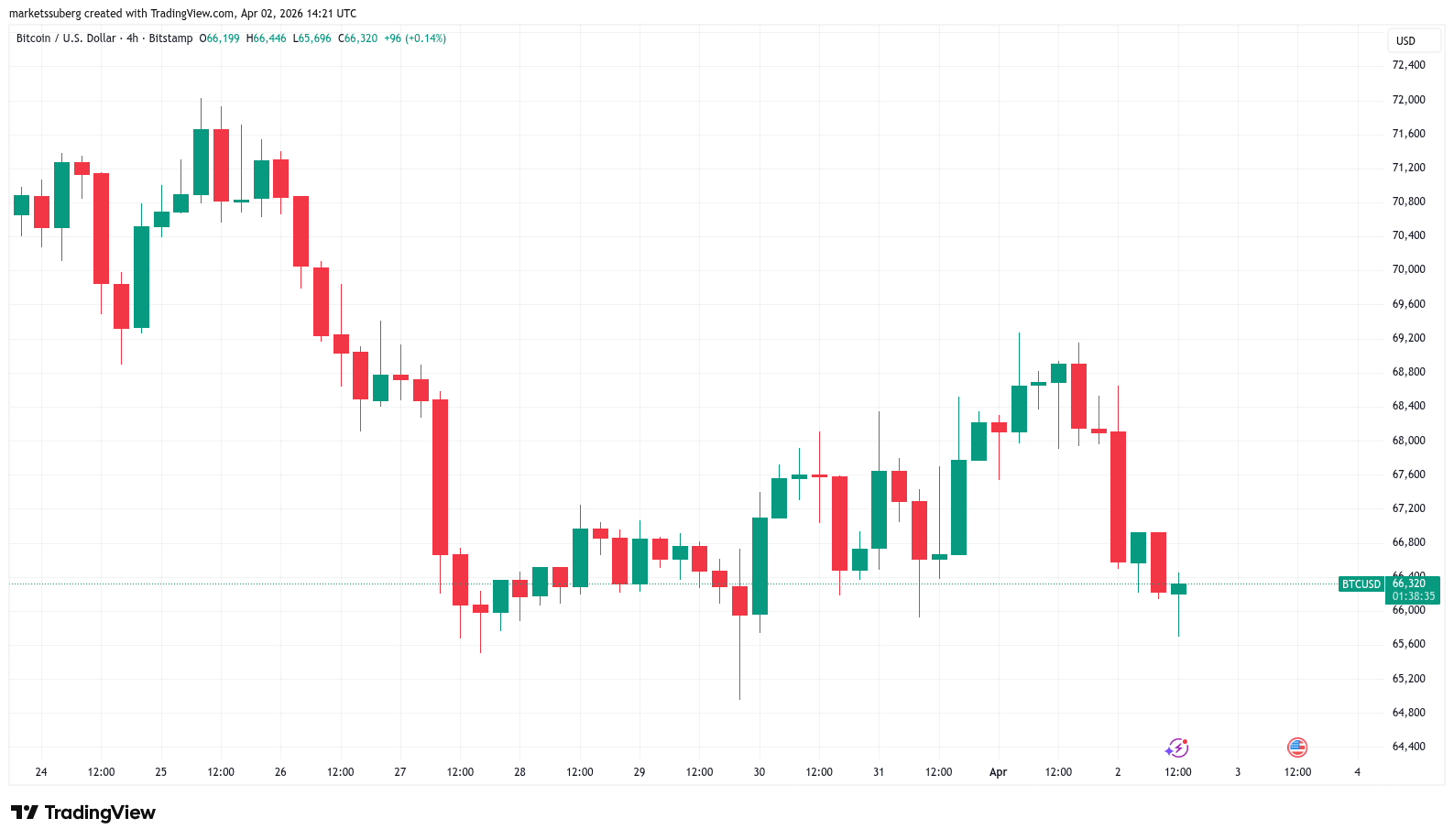
Bitcoin (BTC) gained a $10,000 price warning as stocks took a fresh hit over oil-supply fears at Thursday’s Wall Street open.
Key points:
-
$10,000 BTC prices may return as the market struggles to hold ground, says new analysis.
-
Bitcoin and US stocks take a further beating as markets discount the odds of the Strait of Hormuz returning to “normal.”
-
Oil spikes to $114 per barrel in a volatile Wall Street open.
BTC price “may be reverting” to $10,000
Data from TradingView tracked BTC price action as it dipped below $66,000 to reach week-to-date lows.

Bitcoin continued to field warnings from market participants over short-term and long-term price performance.
In his latest analysis, Mike McGlone, senior commodity strategist at Bloomberg Intelligence, even saw $10,000 coming back into play for BTC/USD.
“Before the biggest money pump in history in 2020-21, Bitcoin hovered around $10,000, and it may be reverting,” he wrote in a summary on X.
McGlone argued that $10,000 had particular importance as the point at which Bitcoin futures markets first began trading almost a decade ago.

Data from CoinGlass meanwhile put 24-hour crypto liquidations at over $400 million on Thursday.

Oil surges over supply woes as Bitcoin falls
US equities came under considerable pressure at the open, with the Nasdaq Composite Index down by more than 2% at the time of writing.
Related: US recession odds near 50%: Can Bitcoin copy 2020 comeback gains?
Gold found cause for a modest rebound after its own comedown earlier, with oil supplies through the Strait of Hormuz in the spotlight. WTI crude spiked to $114 per barrel as the US session began.

Reacting, trading resource The Kobeissi Letter said that US inflation could hit 3.6% if prices sustained for two months.
“This would put US inflation at its highest level since September 2023,” it wrote on X.
Prediction platform Kalshi showed declining odds of oil traffic reverting to “normal” levels this year.

The volatility came as markets returned following an address to the nation by US President Donald Trump. As Cointelegraph reported, markets were disappointed by the event as Trump avoided key deescalation promises.
Kobeissi founder Adam Kobeissi called the address the “most puzzling part of the Iran War yet.”
“It began with Iran’s President stating they have “no enmity” towards Americans and ended with President Trump escalating the Iran War, the exact opposite of what we have seen over the last 2 weeks from both sides,” he told X followers.
“It simply does not add up.”
This article is produced in accordance with Cointelegraph’s Editorial Policy and is intended for informational purposes only. It does not constitute investment advice or recommendations. All investments and trades carry risk; readers are encouraged to conduct independent research before making any decisions. Cointelegraph makes no guarantees regarding the accuracy or completeness of the information presented, including forward-looking statements, and will not be liable for any loss or damage arising from reliance on this content.
Crypto World
Mobix Labs (MOBX) Stock: 1-for-10 Reverse Stock Split Approved to Meet Nasdaq Requirements

Key Highlights
-
Mobix Labs approves 1-for-10 reverse stock consolidation to satisfy Nasdaq standards
-
Stock experiences 3.81% decline as reverse split announcement proceeds
-
Share consolidation scheduled for implementation on April 6, 2026
-
Total outstanding shares to be reduced approximately tenfold post-consolidation
-
Company takes action to maintain exchange listing and market credibility
Shares of Mobix Labs (MOBX) traded down to $0.2690, representing a 3.81% decline during fluctuating morning market activity. The stock experienced downward pressure and partial rebound within the trading session. The technology firm announced its decision to execute a reverse stock consolidation designed to meet Nasdaq exchange listing standards.
Company Moves Forward with Share Consolidation Strategy
Mobix Labs, Inc. officially announced a 1-for-10 reverse stock consolidation following shareholder authorization obtained in March 2026. The semiconductor company will execute this structural change following the closing bell on April 6, 2026. This strategic decision serves to elevate the trading price per share and satisfy Nasdaq’s minimum bid price criteria.
The consolidation will merge each group of ten existing shares into a single share, affecting both Class A and Class B common stock equally. Outstanding share quantities will experience substantial reduction following this structural modification. The corporation will maintain its current authorized share capital despite the consolidation.
Related equity instruments including employee stock options, outstanding warrants, and convertible debt securities will undergo corresponding proportional modifications. These adjustments ensure all derivative instruments remain aligned with the restructured share base. As a result, the company maintains internal consistency throughout its entire equity capital structure.
Implementation Mechanics and Shareholder Impact
Mobix Labs will consolidate Class A common shares from approximately 103 million down to roughly 10.3 million shares outstanding. Simultaneously, Class B common shares will contract from around two million to approximately 200,000 shares. This contraction directly results from applying the ten-to-one consolidation ratio.
The company will not issue any fractional shares following completion of the consolidation procedure. Shareholders whose holdings would result in fractional entitlements will instead receive cash compensation calculated using adjusted market closing prices. This methodology streamlines record-keeping while ensuring equitable treatment.
Investors maintaining positions through brokerage accounts or electronic book-entry systems face no required actions. Share balances will update automatically when the reverse consolidation takes effect. This automated process minimizes administrative burden and potential confusion for current equity holders.
Business Model and Market Positioning Context
Mobix Labs functions as a fabless semiconductor enterprise focused on defense and aerospace industry applications. The organization engineers radio frequency and interconnect technologies tailored for high-reliability mission environments. These specialized markets require exceptional performance consistency and adherence to rigorous technical specifications.
The reverse consolidation represents part of comprehensive initiatives to preserve Nasdaq compliance status and sustain institutional credibility. Maintaining continued exchange listing facilitates capital raising opportunities and strengthens corporate market presence. The maneuver therefore constitutes a structural recalibration rather than fundamental business strategy modification.
Notwithstanding recent trading price challenges, the organization remains committed to advanced semiconductor and connectivity solution development. Its product offerings address mission-critical infrastructure where dependability proves paramount. Accordingly, Mobix Labs maintains focus on specialized yet high-value technology market segments.
The consolidation disclosure establishes definitive timelines and procedural clarity for all interested parties. It further demonstrates management’s methodical approach to regulatory compliance without disrupting underlying operational activities. In summary, this development represents a technical capital structure refinement within an otherwise consistent strategic framework.
Rakebit just dropped what might be its most significant update ever, and it fundamentally changes the math for anyone stepping into the crypto casino for the first time.
The Loyalty Leveling System v2 is now live, bringing with it an expanded progression structure, accelerated rewards, and a welcome offer that sounds too generous to be real. Every new player can now wager their first $1,000 with complete rakeback, meaning the house takes absolutely nothing during that initial stretch.
What Zero House Edge Actually Looks Like
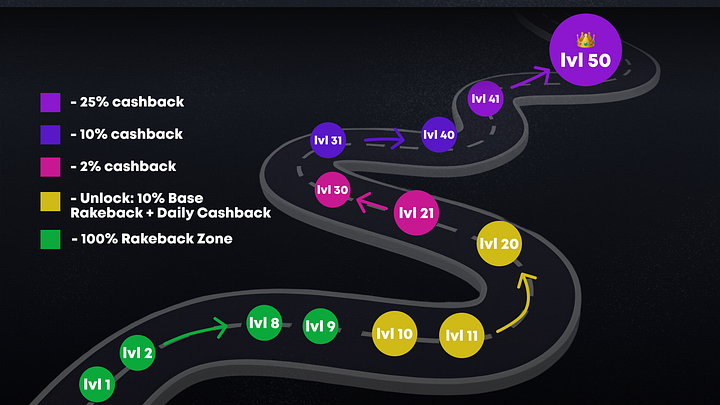
Here’s the deal: new Rakebit players receive 100% rakeback across their first nine levels, covering up to $1,000 in total wagers. Every dollar the casino would typically pocket from your bets gets returned directly to you.
This isn’t a bonus that comes with strings attached. It’s straightforward elimination of the house advantage during your opening run.
Breaking Down the Numbers
To be clear, this isn’t free money appearing in your account. The mechanics work like this: every bet carries a house edge, which is normally how casinos turn a profit. With full rakeback, that entire edge comes back to you.
Consider a practical example. If you’re spinning slots with 96% RTP, that means there’s a 4% house edge. For every dollar wagered, four cents returns to you as rakeback, win or lose on that individual spin.
Wager the full $1,000? You’re looking at roughly $40 in accumulated rakeback. The casino’s expected take from your first thousand in action? Absolutely zero. They eat that cost entirely.
Your individual bets still play out normally. You’ll win some and lose some based on chance. But that invisible cut every other casino quietly collects? It doesn’t exist here for your first thousand wagered.
Fifty Levels Replace the Old Twenty
The previous system capped out at 20 levels. Players were hitting the ceiling too quickly, and the early grind felt painfully slow.
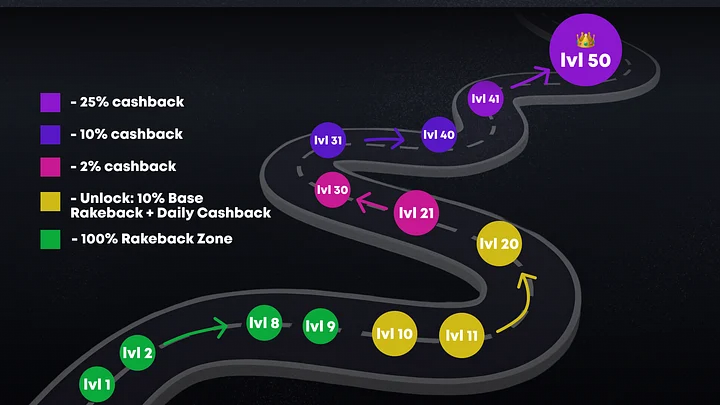
Version 2 expands this to 50 levels with a progression curve that actually rewards consistent play.
Levels 1 through 9 represent the risk-free zone. Full rakeback applies here, covering your first $1,000 with no house advantage. This is your window to experiment, test different games, and figure out what works for you while the house literally cannot profit from your action.
Level 10 marks the transition point. You lock in 10% base rakeback permanently, and daily cashback activates at 2%. That 10% becomes your floor going forward.
Levels 10 through 50 watch your daily cashback climb steadily from 2% all the way up to 25%. Stack that on top of your permanent base rakeback and every session starts paying you back more aggressively as you progress.
Everything Else Stays the Same
The loyalty revamp sits on top of the core Rakebit experience that players already know.
No identity verification required. Sign up through Google, Telegram, X, or email. Your documents stay in the drawer.
VPN usage is welcome. Geographic restrictions don’t apply here.
The game library exceeds 7,000 titles from providers like Pragmatic, Hacksaw, NetEnt, Spribe, and Red Tiger. Sixteen provably fair Rakebit Originals offer RTP up to 99%.
Crypto cashouts remain flexible across BTC, ETH, USDT, USDC, SOL, TON, DOGE, XRP, and dozens more.
Getting Started Takes Seconds
Registration at Rakebit requires about ten seconds and zero documentation. Deposit using any of 30+ supported cryptocurrencies. Start playing whatever catches your interest and the full rakeback kicks in automatically on your first $1,000 wagered. Hit level 10 and daily cashback begins stacking on top of your permanent 10% base.
The Short Version
Fifty levels replace twenty, with smoother progression and faster early rewards. Full rakeback covers levels one through nine, eliminating house edge on your first thousand wagered. Level 10 locks in permanent 10% rakeback for life. Daily cashback ranges from 2% to 25% based on your level, starting at ten. No KYC and VPN-friendly policies remain unchanged.
The house edge disappears completely for your opening $1,000. Beyond that, the returns still beat anything else in the space.
Links: Website | Bonuses | Earn with RakeBit | Discord | Support | X (Twitter) | Kick
Disclaimer: This is a Press Release provided by a third party who is responsible for the content. Please conduct your own research before taking any action based on the content.


The Nasdaq mostly erased an early 2% loss Thursday after reports that Iran is drafting a protocol with Oman to manage traffic through the Strait of Hormuz, easing concerns about disruptions to a key global oil route.
WTI crude oil — which had surged to nearly $115 per barrel as President Trump vowed to continue the war against Iran — fell about $5 on the news.
Crypto prices trimmed losses alongside, but remained sharply lower over the past 24 hours. Bitcoin at $66,700 is down by 3%, and ether (ETH) at $2,060 is down by the same amount.
Iranian officials framed the move as a matter of coordination rather than control. The country’s deputy foreign minister for legal and international affairs, Kazem Gharibabadi, said that even under normal conditions, ship traffic through the strait should be monitored and coordinated with coastal states like Iran and Oman to ensure safety. He added that the proposed measures are not intended to restrict passage, but to “facilitate and ensure safe passage” and improve services for vessels moving through the route.
The remarks come after U.S. President Trump on Wednesday night vowed to hit Iran “extremely hard” in the coming weeks and that the Strait of Hormuz would “open naturally” once the war ends.
Bitcoin fell after Trump’s remarks and continues to trade about 2% lower over the past 24 hours, in line with crypto stocks, including Coinbase (COIN) and Robinhood (HOOD).


Opinion by: João Garcia, DevReal lead at Cartesi.
Decentralized finance presents itself as a transparent alternative to Wall Street. Yet, what it has largely reconstructed is a simplified version of finance, engineered less around market resilience than around the constraints of gas fees. That trade-off, once treated as a technical footnote, is increasingly shaping the limits of what DeFi can become.
So long as computational minimalism remains the overriding priority, financial robustness will remain secondary, and periods of market stress will continue to expose that imbalance.
When markets move faster than the virtual machine
DeFi has rebuilt the familiar architecture of finance, including exchanges, lending markets, derivatives and stablecoins. However, the way these systems function reveals how tightly they are bound by their execution environments.
Risk parameters tend to remain static, and although collateral thresholds can adjust, they typically do so slowly, through governance processes rather than automatic recalibration. Liquidation engines currently rely on fixed formulas rather than adaptive portfolio models that account for shifting volatility or correlations. What appears as a design preference is often a concession to computational limits.
On Ethereum and similar chains, floating-point arithmetic is absent or emulated, iterative simulations are expensive, and continuously recomputing cross-asset exposure can quickly become impractical. The outcome is that financial logic is compressed into forms that are deterministic and affordable to execute, even if that compression strips away nuance.
This architecture performs adequately in stable conditions, but volatility has a way of testing its edges. During MakerDAO’s “Black Thursday” event in March 2020, vaults were liquidated at effectively zero bids, as auction mechanics struggled under collapsing prices and network congestion.
In later downturns, protocols such as Aave and Compound leaned on mass liquidations triggered by fixed collateral ratios, rather than dynamic portfolio recalculations. When Curve’s pools were destabilized in 2023 following a smart contract exploit, the stress radiated outward into lending protocols that treated LP tokens as static collateral, compounding systemic risk.
In each instance, decentralization itself was not the breaking point. Rather, rigid financial logic operated inside an execution layer that could not continuously recompute risk as conditions deteriorated.
Traditional markets evolved in the opposite direction. Banks and clearinghouses simulate thousands of stress scenarios, recalculating exposure as correlations shift and volatility regimes change. Margin requirements respond dynamically to market conditions, and the response is led by substantial computational infrastructure and mature numerical tooling. Public blockchains, by contrast, were not designed with that degree of iterative financial processing in mind.
The illusion of simplicity
Constraining computational complexity reduces certain attack surfaces. Simplicity at the protocol layer, however, does not dissolve complexity in the financial system. It merely pushes it elsewhere.
When risk cannot be modeled and recomputed transparently on-chain, it migrates off-chain into dashboards, analytics teams, discretionary parameter adjustments and emergency governance coordination. The blockchain may remain the settlement layer, but the adaptive intelligence that stabilizes the system increasingly operates outside it. During volatility spikes, protocols often depend on rapid human coordination to adjust parameters, while oracles and large token holders acquire disproportionate influence over outcomes.
The system retains its decentralized base, yet its capacity to respond flexibly depends on actors operating beyond deterministic execution. What appears structurally simple at the smart contract level can conceal a more complex and less transparent operational reality.
DeFi did not converge on simplified finance because static ratios and deterministic curves were proven superior. It converged there because richer computational models were prohibitively expensive to run. As markets deepen, leverage increases, and instruments grow more interdependent, that compromise becomes harder to ignore. Fixed thresholds and blunt liquidation engines, initially safeguards, can begin to function as amplifiers of stress.
Computation as a missing primitive
The deeper constraint, more than decentralization, is execution design.
If verifiable execution environments begin to approximate general-purpose computing systems, the financial design space expands. Native floating-point assistance, iterative algorithms and access to established numerical libraries would allow models to be expressed directly rather than translated into simplified approximations.
Related: Wall Street will eventually submit to the rules of DeFi
This change would allow lending protocols to incorporate scenario-based stress testing instead of relying primarily on fixed collateral ratios. Margin requirements may also adjust in response to observed volatility rather than governance cadence. It could also see credit systems recompute multivariable risk scores transparently, replacing binary heuristics with more granular assessments.
The aim is not to introduce complexity for its own sake. It is to keep financial intelligence inside the protocol, where it remains visible and enforceable, rather than externalizing it into operational layers that users cannot easily audit. This underscores the broader point that the limitations confronting DeFi are largely architectural choices, not inevitabilities of decentralization.
A credibility ceiling
DeFi now stands at a structural crossroads. One direction preserves gas-optimized minimalism, keeping base-layer execution clean while allowing increasingly sophisticated financial logic to migrate off-chain. That path may maintain clarity at the smart contract level, but it constrains how far decentralized finance can responsibly scale.
The alternative is to treat computation itself as a first-class primitive and to accept more capable execution environments in exchange for systems that can adapt, recompute and stress-test transparently. If complex risk logic cannot live on-chain, DeFi will continue to project simplicity in code while relying on discretion in practice.
Markets will not moderate their complexity to accommodate virtual machine constraints. If decentralized finance intends to operate at a meaningful scale, its computational foundations will have to evolve alongside the financial ambitions built on top of them.
Opinion by: João Garcia, DevReal lead at Cartesi.
This opinion article presents the author’s expert view, and it may not reflect the views of Cointelegraph.com. This content has undergone editorial review to ensure clarity and relevance. Cointelegraph remains committed to transparent reporting and upholding the highest standards of journalism. Readers are encouraged to conduct their own research before taking any actions related to the company.
Crypto World
Here is how Drift attackers drained more than $270 million using a Solana feature designed for convenience
The attack on Drift Protocol was not a hack in the traditional sense.
Nobody found a bug or cracked a private key. There wasn’t a flash loan exploit or manipulated oracle either.
Instead, an attacker used a legitimate Solana feature, ‘durable nonces,’ to trick Drift’s security council into pre-approving transactions that would be executed weeks later, at a time and in a context the signers never intended.
The result was a drain of at least $270 million that took less than a minute to execute but more than a week to set up.
What durable nonces are and why they exist
On Solana, every transaction includes a ‘recent blockhash,’ essentially a timestamp that proves the transaction was created recently. That blockhash expires after about 60 to 90 seconds. If the transaction is not submitted to the network within that window, it becomes invalid. This is a safety feature and helps prevent old, stale transactions from being replayed later.
Durable nonces override that safety feature. They replace the expiring blockhash with a fixed ‘nonce,’ a one-time code stored in a special onchain account, that keeps the transaction valid indefinitely until someone chooses to submit it.
The feature exists for legitimate reasons. Hardware wallets, offline signing setups, and institutional custody solutions all need the ability to prepare and approve transactions without being forced to submit them within 90 seconds.
But indefinitely valid transactions create a problem. If one can get someone to sign a transaction today, it can be executed next week or next month, per the system’s hardcoded rules. The signer has no way to revoke their approval once it is given, unless the nonce account is manually advanced, which most users do not monitor.
How the attacker used them
Drift’s protocol was governed by a ‘Security Council multisig,’ a system in which multiple people (in this case, five) share control, and any action requires at least two of them to approve. Multisigs are a standard security practice in DeFi, where the idea is that compromising a single person is not enough to steal funds.
But the attacker did not need to compromise anyone’s keys. All they needed were two signatures, and they appear to have obtained them through what Drift describes as “unauthorized or misrepresented transaction approvals,” meaning the signers likely thought they were approving a routine transaction.
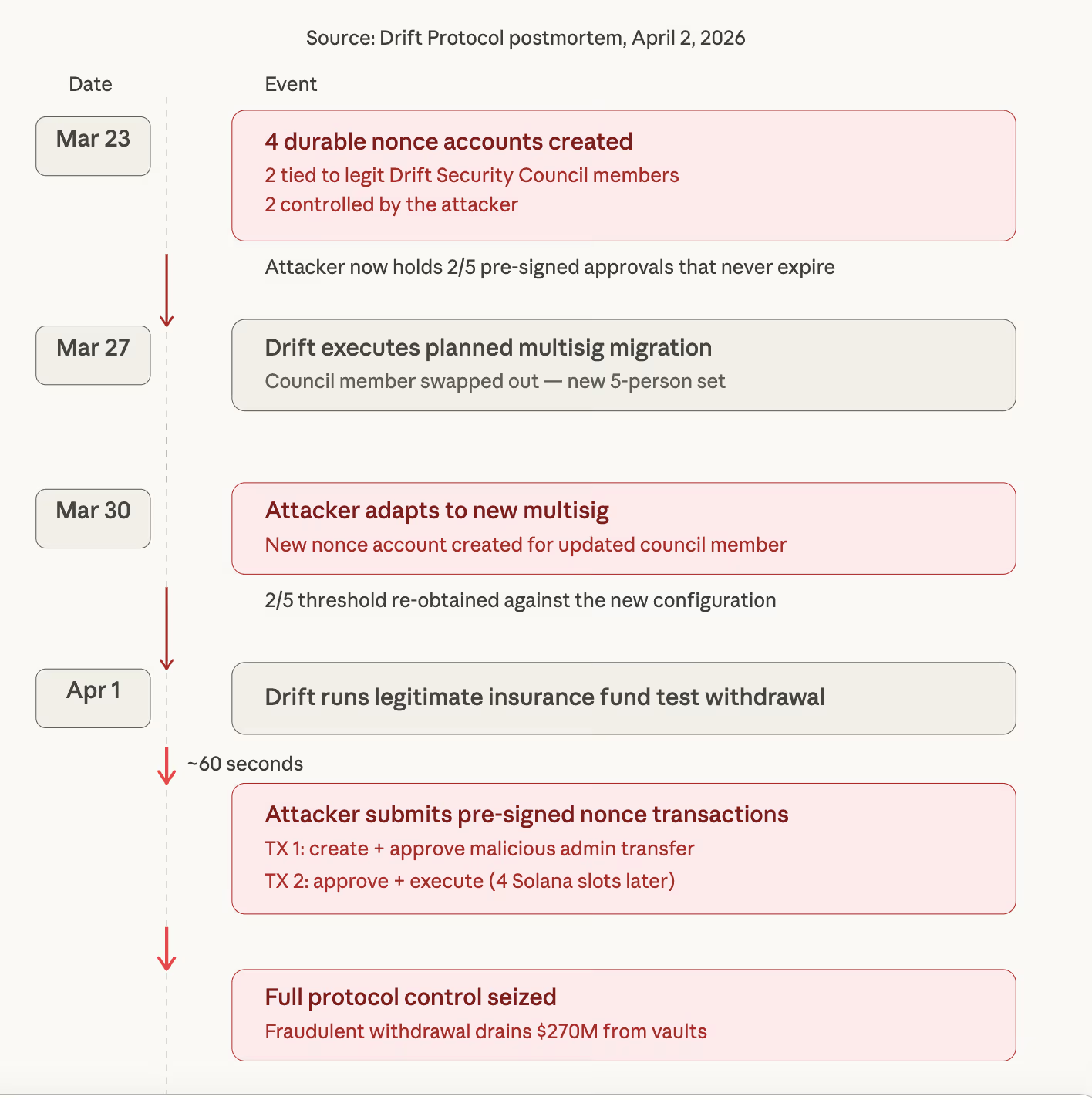
Here is the timeline Drift published in a Thursday X post.
On March 23, four durable nonce accounts were created. Two were associated with legitimate Drift Security Council members. Two were controlled by the attacker. This means the attacker had already obtained valid signatures from two of the five council members, locked into durable nonce transactions that would not expire.
On March 27, Drift executed a planned Security Council migration to swap out a council member. The attacker adapted. By March 30, a new durable nonce account appeared, tied to a member of the updated multisig, indicating the attacker had re-obtained the required two-of-five approval threshold under the new configuration.
On April 1, the attacker executed.
First, Drift ran a legitimate test withdrawal from its insurance fund. Approximately one minute later, the attacker submitted the pre-signed durable nonce transactions. Two transactions, four slots apart on the Solana blockchain, were enough to create and approve a malicious admin transfer, then approve and execute it.
Within minutes, the attacker had full control of Drift’s protocol-level permissions. They used that control to introduce a fraudulent withdrawal mechanism and drain the vaults.

What was taken and where it went
Onchain researchers tracked the fund flows in real time. The breakdown of stolen assets, compiled by security researcher Vladimir S., totaled roughly $270 million across dozens of tokens.
The largest single category was $155.6 million in JPL tokens, followed by $60.4 million in USDC, $11.3 million in CBBTC (Coinbase wrapped bitcoin), $5.65 million in USDT, $4.7 million in wrapped ether, $4.5 million in DSOL, $4.4 million in WBTC, $4.1 million in FARTCOIN, and smaller amounts across JUP, JITOSOL, MSOL, BSOL, EURC, and others.

The primary drainer wallet was funded eight days before the attack via NEAR Protocol intents but remained inactive until execution day. Stolen funds were transferred to intermediary wallets that were funded just the day before via Backpack, a decentralized crypto exchange that requires identity verification, potentially giving investigators a lead.
From there, funds moved to Ethereum addresses via Wormhole, a cross-chain bridge. Those Ethereum addresses had been pre-funded using Tornado Cash, the sanctioned privacy mixer.
ZachXBT, a prominent onchain investigator, noted that over $230 million in USDC was bridged from Solana to Ethereum via Circle’s CCTP (Cross-Chain Transfer Protocol) across more than 100 transactions.
He criticized Circle, the centralized issuer of USDC, for not freezing the stolen funds during a six-hour window after the attack began around noon Eastern time.
The attack was also reminiscent of recent social engineering attempts, using tactics similar to those seen before, according to a social media post by a user who goes by ‘Temmy.’ “we’ve seen this before. we’ve seen this so many times,” the user said.
“bybit. $1.4 billion. the attacker compromised the signing infrastructure and tricked signers into authorizing malicious transactions. same concept. social engineering. not code. ronin bridge. $625 million. compromised validator keys. same story. cetus protocol. $223 million. different method but same result. hundreds of millions gone.” the post said.
What was not compromised
What failed was the human layer around the multisig. Durable nonces allowed the attacker to separate the moment of approval from the moment of execution by more than a week, creating a gap in which the context of the signed document no longer matched the context in which it was used.
All deposits into Drift’s borrow-and-lend products, vault deposits, and trading funds are affected. DSOL tokens not deposited in Drift, including assets staked to the Drift validator, are unaffected. Insurance fund assets are being withdrawn and safeguarded. The protocol has been frozen, and the compromised wallet has been removed from the multisig.
As such, this is the third major exploit in recent months that did not involve a code vulnerability. Social engineering and operational security failures, rather than smart contract bugs, are increasingly how money leaves DeFi protocols.
The durable nonce vector is particularly dangerous because it exploits a feature that exists for good reason and is difficult to defend against without fundamentally changing how multisig approvals work on Solana.
The open question, which Drift’s forthcoming detailed postmortem will need to answer, is how two separate multisig members approved transactions they did not understand, and whether any tooling or interface changes could have flagged durable nonce transactions as requiring additional scrutiny.
Read more: North Koreans hackers likely behind $286 million Drift Protocol exploit

The US dollar has been firm, but the drivers behind the move may be more complex than they first appear.
While geopolitical tension and shifts in risk sentiment play a role, current price behaviour seems increasingly influenced by inflation expectations and yields. As oil prices move higher, markets reassess the outlook for inflation and interest rates, which continues to support the dollar.
This video explores the underlying macro dynamics and why the current environment may be more conditional than it seems.
Watch it now and stay updated with FXOpen.
💬 Don’t forget to like, comment, and subscribe for more professional market insights every week.
This article represents the opinion of the Companies operating under the FXOpen brand only. It is not to be construed as an offer, solicitation, or recommendation with respect to products and services provided by the Companies operating under the FXOpen brand, nor is it to be considered financial advice.

Soluna Announces $53M Acquisition of Wind Farm for AI Facility

Vince Vaughn’s Ambitious Performance in This 90% RT Prison Thriller Made Him an Unlikely Action Star

Tottenham: Roberto De Zerbi apologises for Mason Greenwood defence after fan backlash


-

 Business7 days ago
Instagram, YouTube Found Responsible for Teen’s Mental Health Struggle in Historic Ruling
-

 NewsBeat6 days ago
The Story hosts event on Durham’s historic registers
-

 Sports6 days ago
Sweet Sixteen Game Thread: Tide vs Michigan
-
Entertainment3 days ago
Fans slam 'heartbreaking' Barbie Dream Fest convention debacle with 'cardboard cutout' experience
-
 Entertainment5 days ago
Lana Del Rey Celebrates Her Husband’s 51st Birthday In New Post
-
Crypto World2 days ago
Dems press CFTC, ethics board on prediction-market insider trades
-

 Crypto World20 hours ago
Gold Price Prediction: Worst Month in 17 Years fo Save Haven Rock
-

 Tech4 days ago
The Pixel 10a doesn’t have a camera bump, and it’s great
-

 Sports2 days ago
Tallest college basketball player ever, standing at 7-foot-9, entering transfer portal
-

 Tech2 days ago
EE TV is using AI to help you find something to watch
-

 Fashion5 days ago
Amazon Sundays: Soft Spring Layers
-

 Tech3 days ago
Apple will hide your email address from apps and websites, but not cops
-

 Politics3 days ago
Should Trump Be Scared Strait?
-

 Tech3 days ago
Flipsnack and the shift toward motion-first business content with living visuals
-

 Tech2 days ago
How to back up your iPhone & iPad to your Mac before something goes wrong
-

 Crypto World3 days ago
U.S. rule change may open trillions in 401(k) funds to crypto
-

 Business6 days ago
Chinese universities with military links bought Super Micro servers with restricted AI chips
-

 Fashion6 days ago
Weekly News Update, 3.27.26 – Corporette.com
-

 Tech4 days ago
Elon Musk’s last co-founder reportedly leaves xAI
-
Crypto World4 days ago
Bitcoin’s Six-Month Losing Streak: What On-Chain Data Says About the Market’s Next Move
You must be logged in to post a comment Login