

Crypto World
Russia’s Dual-War Windfall: How Two Conflicts Are Driving Oil Toward $150 Per Barrel


TLDR:
- Russia’s monthly oil revenue doubled to $24 billion as Brent crude surpassed $100 per barrel.
- Ukraine’s drone strikes have taken roughly 40 percent of Russian export refining capacity offline.
- Iran’s attack on Ras Laffan removed 17 percent of global LNG and 33 percent of helium supply.
- Western sanctions capped Russian oil at $60 per barrel, but the dual-war supply shock made it void.
Russia’s oil revenue has surged sharply as two concurrent conflicts disrupt global energy supply chains. Ukrainian drone strikes have degraded roughly 40 percent of Russian export refining capacity in recent weeks.
At the same time, Iran’s strikes on Gulf infrastructure pushed Brent crude above $100 per barrel. Russia’s Foreign Minister Lavrov and President Putin have both publicly forecast oil reaching $150 per barrel. Russia appears financially positioned to benefit from both conflicts running simultaneously.
Russia Benefits as Iran’s Gulf Strikes Push Oil Above $100
Russia supplied Shahed drone technology and design upgrades to Iran’s Islamic Revolutionary Guard Corps over recent years. Those drones, combined with Chinese BeiDou-guided ballistic missiles, struck the Ras Laffan complex in Qatar.
The attack removed 17 percent of global LNG export capacity and 33 percent of global helium supply. The energy shock from those strikes quickly pushed Brent crude above $100 per barrel.
Russia’s monthly oil revenue consequently doubled to $24 billion as crude prices climbed. The Western sanctions price cap of $60 per barrel has since become functionally irrelevant at current market levels.
Sanctions were designed to target Russian oil pricing, but both conflicts have instead targeted global supply directly. Supply disruptions have overpowered the sanctions framework that was originally built to limit Russian earnings.
On March 27, Lavrov publicly warned of what he called “the most severe energy crisis in human history.” Putin followed by openly forecasting oil at $150 per barrel shortly after.
Both leaders are stating a price target that enriches Russia with every dollar crude rises above current levels. Social media analyst Shanaka Anslem Perera described it as a self-amplifying feedback loop that continuously benefits Russia.
Perera wrote: “Russia arms Iran. Iran closes Hormuz. Hormuz closure spikes oil. Oil spike enriches Russia.” He further noted that Russia needs neither Hormuz reopened nor its own refineries fully operational.
Russia needs both disruptions to persist so their combined effect drives oil toward $150. The compound supply shock, as a result, overwhelms a sanctions architecture never designed for this dual-war scenario.
Ukraine Retaliates Against Russian Refineries and Builds New Alliances
Ukraine struck the Tuapse refinery complex, one of Russia’s largest, setting it ablaze with precision drones. Combined with weather damage and maintenance backlogs, approximately 40 percent of Russian export refining capacity is now offline.
Each barrel of Russian refined product removed from markets tightens global supply further. Every tightening, in turn, pushes oil closer to the $150 target Russia has publicly forecast.
That same week, Ukrainian President Zelensky traveled to Saudi Arabia for high-level diplomatic engagements. Ukraine offered its battle-tested anti-drone expertise to protect Gulf LNG and helium infrastructure directly.
Ukrainian technology has already proven effective against the same Shahed variants Iran deploys in the broader region. This opened an unexpected military technology export market for Ukraine among the world’s wealthiest nations.
The OECD revised US inflation projections upward to 4.2 percent, directly linking the change to the Iran-driven energy shock. BlackRock CEO Larry Fink stated publicly that $150 oil would likely trigger a global recession.
Ukraine’s strikes on Russian refineries and Iran’s pressure on Gulf supplies are tightening markets from opposite directions.
Russia, however, continues collecting elevated revenue from price premiums generated by both disruptions running at once.
Perera closed his widely shared analysis with a sharp observation: “Two wars. One price. One beneficiary. The arsonist is selling fire insurance.”
The feedback loop connecting both conflicts shows no sign of breaking under current conditions. Russia’s oil earnings continue to grow beyond what any sanctions cap was structured to contain.
As long as both wars persist, Russia’s financial position remains stronger than at any prior point since invading Ukraine.



Putting real-world investments onchain, a process called tokenization, is moving out of the testing phase and into everyday business.
Citi’s new report Tokenization 2030: Wall Street On-Chain shared with CoinDesk ahead of Proof of Talk in Paris, shows that the global market for thse digital investments sits at just $17 billion today.
However, Citi expects this market to increase to $5.5 trillion by 2030 in its base forecast. Depending on how fast adoption take place, that could land anywhere from a low end estimate of $2.7 trillion to a bullish forecast of $8.2 trillion, Citi said.
As the report points out, this is a major turning point: “You’re seeing the full weight of American financial power and the global reserve currency moving on change at scale,” Citi says in the report. “When DTCC and the NYSE embed tokenization into capital markets, this marks a tipping point.”
According to Citi, three big shifts are driving this trillions of dollars move.
First, the traditional companies that run the world’s stock markets are building this technology directly into their regular trading systems.
In early May, Wall Street giant Depository Trust & Clearing Corporation (DTCC) announced it would start limited production trades of tokenized securities in July, with a broader launch of its platform set for October. Nasdaq is working on a framework for companies to issue blockchain-based shares with a potential launch as early as 2027. Intercontinental Exchange, which owns the New York Stock Exchange, also has plans for tokenized stocks.
Nasdaq also received regulatory approval to allow certain stocks to be issued and traded in this digital onchain form.
Second, the rise of trusted digital cash is providing the missing piece to make thse trades settle instantly. Standard stablecoins are expected to grow to $1.9 trillion market by 2030, working alongside digital bank deposits to allow assets and cash to swap at the exact same moment. The report expects that the growth of stablecoins alone could create about $1 trillion in new demand for U.S. government bonds, because the companies issuing stablecoins back their digital cash with these real bonds.
Third, the government rules are getting clearer, with a key piece of U.S. digital asset legislation moving forward to a full U.S. Senate vote. On May 14, the Senate Banking Committee managed to end a four-month stall with a 15-9 bipartisan approval by the committee, which advanced the Clarity Act to its next step.
The Citi report notes that the growth they forecast will happen in mainstream public markets, such as U.S. stocks and government bonds, rather than private markets, which are harder to trade and change slowly.
Citi assumes that 10% of the U.S. Treasury bill market and 3% of the U.S. public stock market will be tokenized by 2030. If just 10% of everyday U.S. investors switch to these new digital trading platforms, it would create $2.6 trillion in demand for digital stocks.
On the other side, complex areas like private credit and private equity are each expected to reach a much smaller $100 billion globally by 2030.
The shift will not happen overnight, Citi noted, saying that instead, old and new financial systems will have to run side by side for a while.
The report compares this to how highways adopted electronic toll tags like E-ZPass. Toll roads did not become fully automated in one day. Instead, states built wider roads with parallel lanes for both cash and automated drivers, which added extra cost and confusion before everyone eventually switched over to the fully automated system.
Ultimately, this new setup will give a major advantage to “Structural Orchestrators”. These are the specific big banks and investment firms that control both the real assets and the digital cash rails used to pay for them, allowing them to handle the entire trade inside their own network.
Fundamental Backdrop
The Swiss franc remains influenced by two opposing forces. On the one hand, there is steady demand for safe-haven assets amid tariff-related risks stemming from the United States. On the other, the policy stance of the Swiss National Bank (SNB) continues to play a role: in March, the central bank kept its policy rate at zero and reaffirmed its readiness to intervene in the foreign exchange market to prevent excessive franc appreciation.
The Federal Reserve, for its part, is also taking a cautious approach to policy easing. In January, the Fed paused its rate-cutting cycle, citing persistent inflationary pressures. The divergence in the rhetoric of the two central banks has so far failed to provide either side with a sustained advantage.
Technical Picture
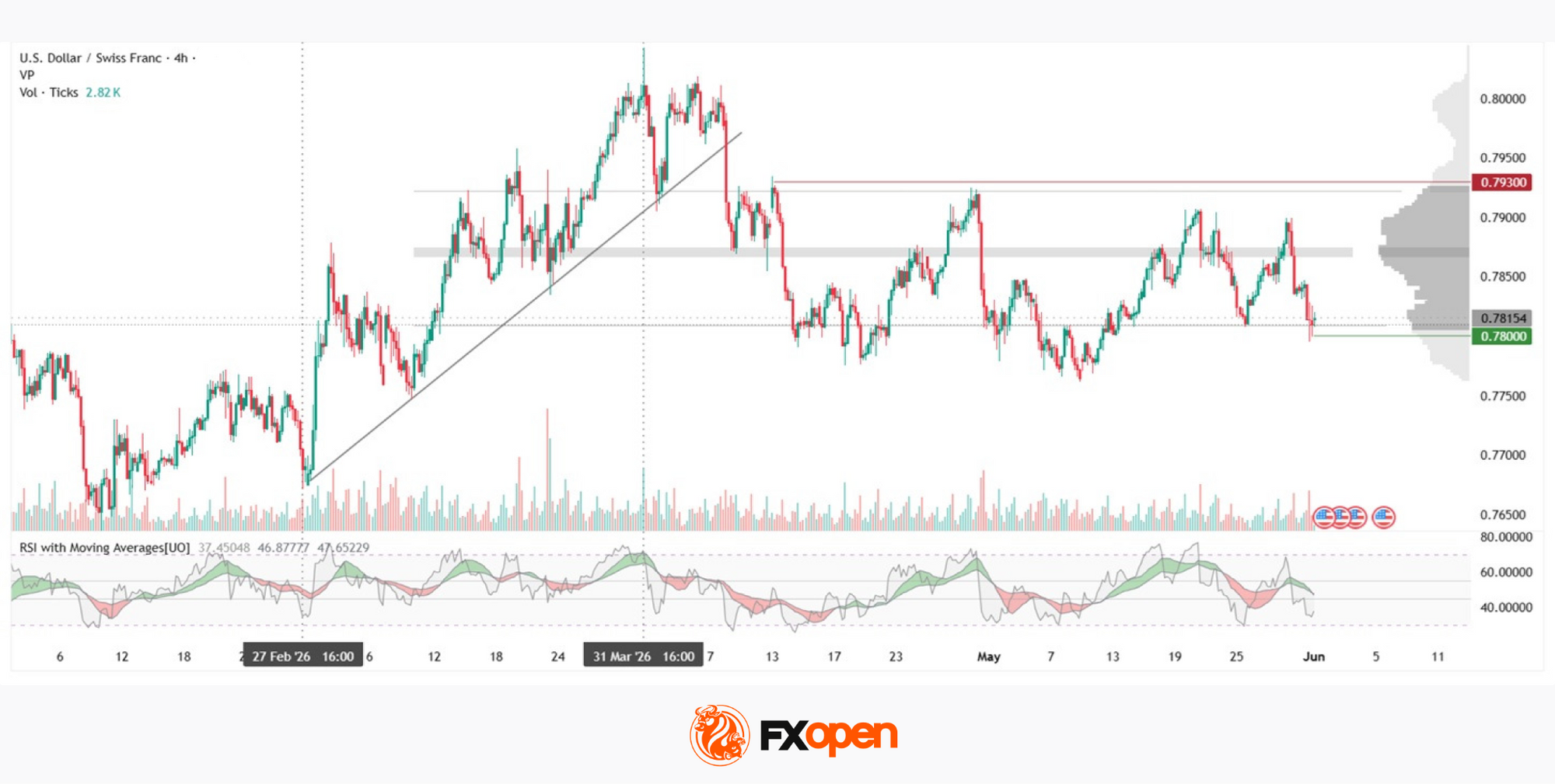
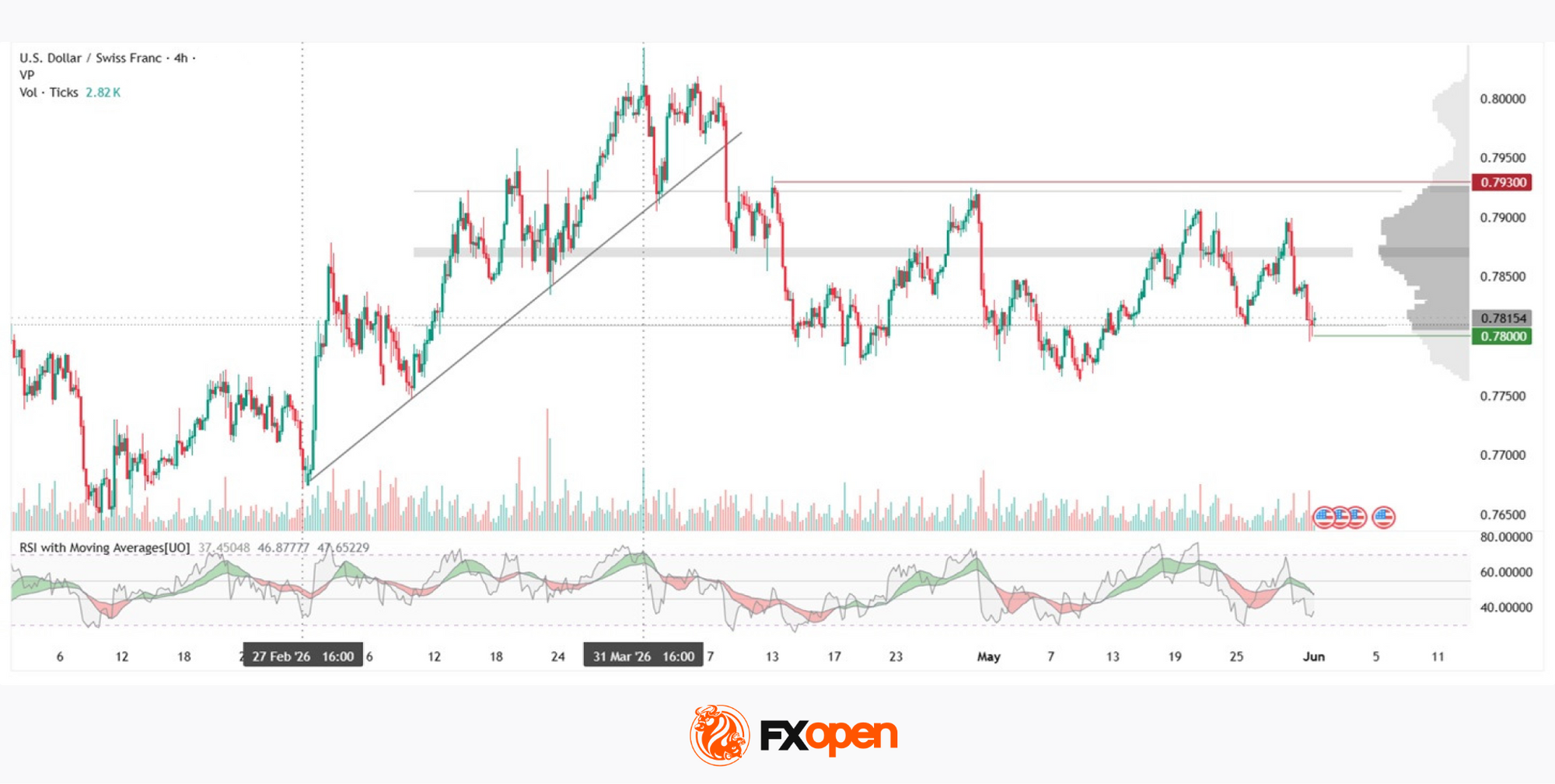
The starting point of the current structure was the 0.7600 area, where USD/CHF formed a local bottom in late January. From 27 February to 31 March, an ascending trendline developed, accompanying the pair’s rise towards the 0.8050 area. In April, the trendline was broken, after which the pair transitioned into a sideways trading phase that remains in place today. The horizontal volume profile formed during this period identifies a point of control in the 0.7865–0.7875 range, where the market spent the greatest amount of time during the period under review.
At present, the price is positioned above the lower boundary of the profile and is testing it from above. The 0.7930 area could attract market participants’ attention should the pair continue to move higher. The 0.7800 region remains a potential reference point if a bearish move develops, as it represents the nearest support zone.
The RSI oscillator and its moving averages currently show readings of 37/46/47. The indicator remains below both moving averages; however, the averages themselves are still positioned in neutral territory, which should also be taken into account.
Key Takeaways
The pair has completed its upward trend and entered a consolidation phase, while price is currently testing the lower boundary of the existing profile. The RSI and its moving averages stand at 37/46/47: the indicator remains below both moving averages, although the averages themselves are still located in neutral territory.
Trade over 50 forex markets 24 hours a day with FXOpen. Take advantage of low commissions, deep liquidity, and spreads from 0.0 pips (additional fees may apply). Open your FXOpen account now or learn more about trading forex with FXOpen.
This article represents the opinion of the Companies operating under the FXOpen brand only. It is not to be construed as an offer, solicitation, or recommendation with respect to products and services provided by the Companies operating under the FXOpen brand, nor is it to be considered financial advice.
Key Takeaways
- The Sui blockchain experienced three critical failures between Thursday and Friday, all stemming from issues in the v1.72 software update.
- Initial outages resulted from a gas fee calculation error related to a newly implemented “address balances” functionality.
- Sui Foundation acknowledged deploying a temporary patch despite knowing it could trigger additional network failures — which subsequently occurred.
- An unrelated malfunction in the blockchain’s randomness generation mechanism caused a third stoppage lasting approximately six hours.
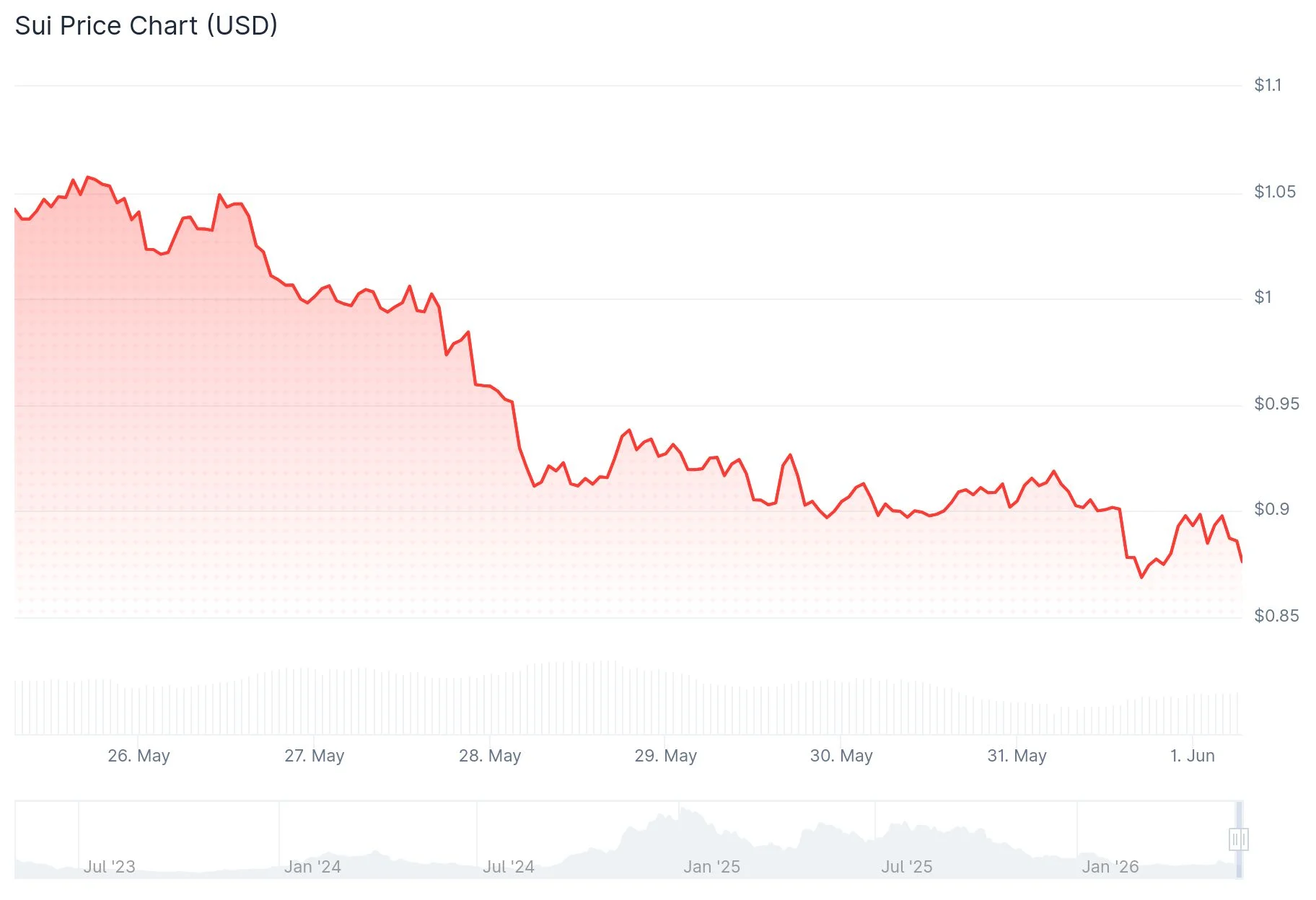
- The SUI token has declined to approximately $0.87, representing a roughly 13% decrease from its $1.04 price point seven days prior.
The Sui blockchain encountered an unprecedented series of network failures last week, experiencing three complete shutdowns within a 48-hour window. This Layer 1 protocol, developed by Mysten Labs, remained non-operational for a cumulative period exceeding 18 hours throughout May 28 and May 29. Each incident traced back to complications arising from the v1.72 software deployment.
The initial network disruption commenced at approximately 10 a.m. Eastern Time on Thursday, persisting until roughly 4:30 p.m. that afternoon. Investigators identified the root cause as a defect in the protocol’s gas fee processing mechanism connected to a recently introduced “address balances” feature. When transactions failed due to insufficient account balances, the system attempted to deduct gas charges from those same depleted funds, creating negative balance entries that ultimately caused validator settlement operations to fail catastrophically.
By early Thursday afternoon, the Sui Foundation had implemented a corrective measure. However, according to their official incident analysis released Sunday, engineering teams were fully aware the emergency patch contained inherent risks that could potentially cause subsequent network instability. They made the calculated decision to proceed with deployment to expedite service restoration.
Conscious Risk Leads to Secondary Network Failure
That strategic choice directly precipitated the second outage. Early Friday morning, around 5 a.m. Eastern Time, the blockchain halted once more when the specific vulnerability engineers had previously identified actually materialized. The identical balance underflow crash occurred because a different error classification had obscured the specific condition the initial patch was engineered to prevent. A comprehensive solution was successfully implemented by approximately 8:30 a.m. Eastern Time.
A third distinct failure struck later that same Friday afternoon, originating from an entirely separate technical issue. As validators rebooted their systems to implement the Friday morning correction, an insufficient number achieved readiness for the distributed key generation protocol that powers the network’s random number generation system. This DKG process automatically disabled itself according to design specifications, but a separate bug prevented the failure state from being properly written to persistent storage. Validators continued cycling through restart procedures without awareness that DKG had already terminated, causing transactions dependent on randomness functionality to accumulate indefinitely while the current epoch remained frozen. The network stayed offline from approximately 4:30 p.m. until 10:20 p.m. Eastern Time.
According to the Sui Foundation, artificial intelligence agents with direct access to validator logging data significantly accelerated diagnostic procedures across all three separate incidents.
Token Value Declines Amid Consecutive Outages
SUI was valued at approximately $0.87 during publication, reflecting about a 13% decline from the $1.04 level recorded seven days earlier. The cryptocurrency’s total market capitalization currently stands at roughly $3.49 billion. The asset reached its historical peak of $5.35 on January 6, 2025, indicating current pricing represents approximately an 84% reduction from that maximum. Throughout the three network stoppages, approximately $1.88 million in SUI leveraged positions faced liquidation, with traders holding long positions absorbing the majority of financial losses.
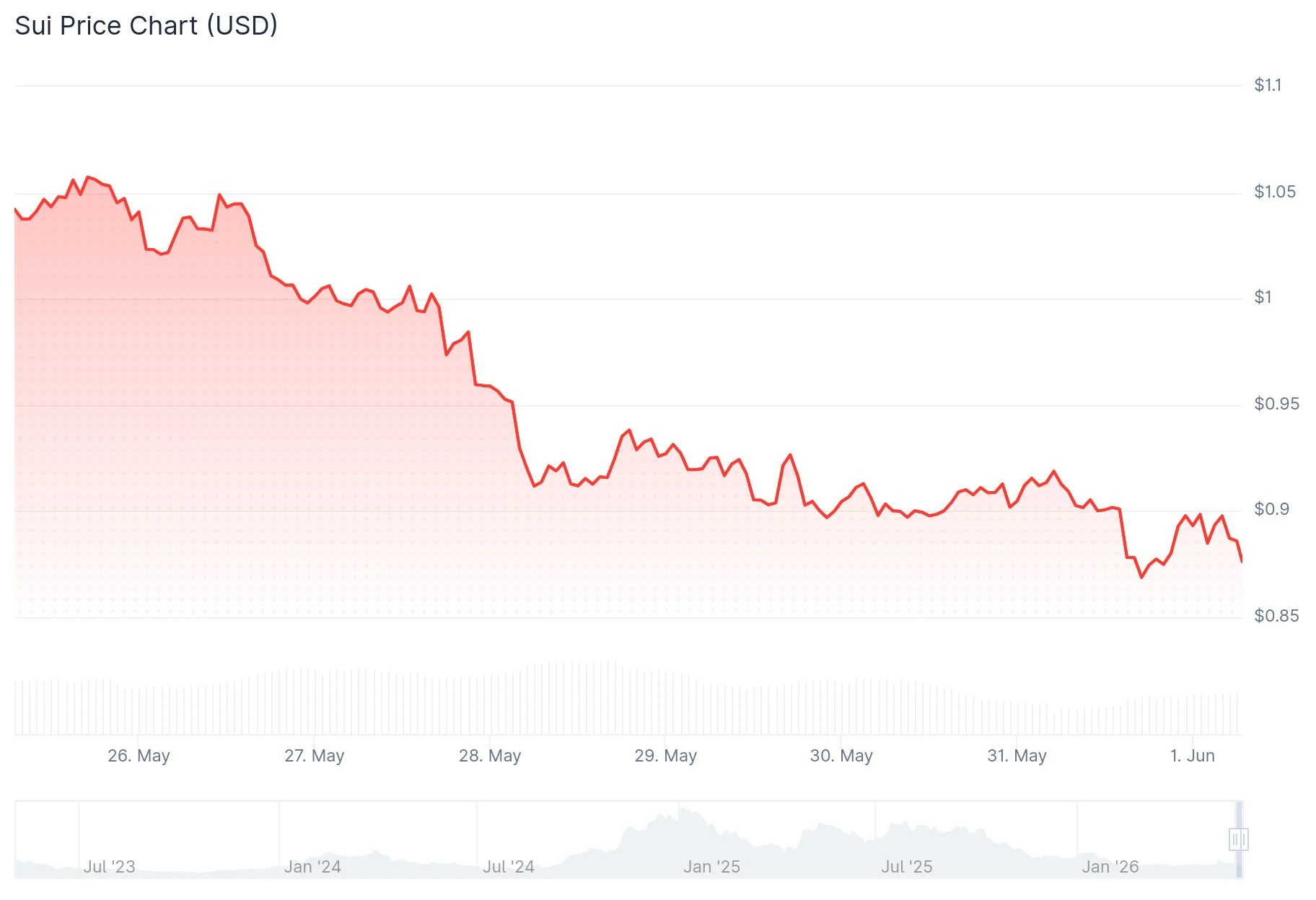
Cryptocurrency market analyst Crypto Patel observed on X that SUI appears to be exhibiting a stealth accumulation formation with minimal retail participant engagement, implying institutional players may be establishing positions within the $0.60–$0.90 price corridor. The Relative Strength Index currently registers at 34.51, approaching technically oversold conditions. Open interest contracted by 4.17% to $705 million, while trading volume expanded 28% to reach $740 million.
These incidents represent a continuation of Sui’s operational challenges. The blockchain previously experienced a six-hour interruption in January 2026 and suffered a validator malfunction in November 2024. Foundation representatives indicated plans to enhance fault isolation mechanisms so that future software defects affect individual transaction processing rather than triggering complete network-wide halts.
Key Points
- Security expert “0xflorent” successfully freed approximately 1,003 ETH (valued at roughly $2 million) from a 2016 HongCoin ICO smart contract after nine years
- An error in the contract’s refund mechanism prevented investors from withdrawing their ETH when the ICO failed to meet its fundraising target
- The researcher collaborated with HongCoin’s team to leverage an integer overflow flaw in an administrative function to release the locked assets
- 48 initial investors are now able to retrieve their ETH; two participants have already withdrawn 96.5 ETH (approximately $193,000)
- The researcher accepted no compensation — only voluntary “whitehat rewards” from grateful investors
A cybersecurity expert has successfully released approximately 1,003 Ether valued at around $2 million that remained trapped in a 2016 ICO smart contract for almost ten years.
The cryptocurrency belonged to participants in HongCoin, an Ethereum-based token offering marketed as a community-driven investment vehicle. The ICO operated from August 29 through October 28, 2016, but ultimately fell short of its fundraising target.
Following the unsuccessful sale, the smart contract should have automatically returned funds to investors. However, a coding error in the refund mechanism silently prevented this from occurring.
The cybersecurity professional, identified online as “0xflorent” or Florent, detailed the technical problem in a social media post on X. The refund mechanism would decline any token holder whose balance exceeded a global tracking variable. Through years of partial withdrawals, this counter had decreased to 356, effectively limiting total refunds to merely 3.56 ETH — significantly less than what most participants were entitled to receive.
The contract was developed using an outdated version of Solidity, the coding language for Ethereum smart contracts. It lacked safeguards against integer overflow vulnerabilities — a defect where numerical values increase beyond their maximum limit and reset to zero or one. The blockchain industry subsequently addressed this weakness through SafeMath, a protective library.
The Recovery Process
Florent discovered a solution by utilizing the HongCoin team’s administrative function. Executing it with a particular input value reset a participant’s token balance to one, enabling the refund verification to succeed and releasing the ETH.
This wasn’t an independent exploit. The administrative function required authorization from the HongCoin team’s multisignature wallet, necessitating team approval for each transaction. Florent contacted the team via email, validated the solution on a test network, and the team subsequently approved 41 transactions — one for each affected investor. The entire operation required approximately one week.
Among the 48 qualified investors, 41 required the balance adjustment. The remaining seven held sufficiently small amounts to receive direct refunds.
Two participants have already withdrawn a total of 96.5 ETH, worth approximately $193,000. Both voluntarily compensated Florent with whitehat rewards, though no payment was obligatory. “There were no fees, no cut, no commission,” Florent stated to The Block.
Ongoing Recovery Efforts
This isn’t Florent’s inaugural recovery operation. On May 24, he documented liberating 19.33 Ethereum from two different legacy contracts — a defunct 2018 ICO and a Liquality Wallet account whose assets were stuck in expired atomic swaps.
Florent explained that he recently deployed his own Ethereum node and developed a scanning tool to identify contracts holding over 100 ETH. He then systematically reviewed candidates searching for exploitable weaknesses.
He also utilized Claude Code to assist with sorting and categorizing contracts, though he acknowledged the AI platform has limitations when directly analyzing smart contract security flaws.
Florent expressed his hope to see more individuals working to safeguard funds rather than exploit them. “It’s more rewarding morally, and it can also pay well,” he remarked.
Crypto World
Ethereum (ETH) Price: Historical Trends Signal Potential Decline to $1,800 Before Recovery
Key Takeaways
- Ethereum has declined 12.5% over the last 30 days, underperforming the top 5 cryptocurrencies
- Historical data shows June has brought negative returns for ETH in 7 out of the past 10 years
- ETH faces difficulty maintaining the $2,000 level, with $1,800 identified as critical support
- Futures open interest reached an unprecedented peak of 15.98 million ETH on May 27
- Technical analyst Ali Charts identifies $1,825 as a strategic entry zone with targets at $2,073 and $2,360
Ethereum has experienced significant downward pressure recently. Over the past month, ETH has shed 12.5% of its value, positioning it as the weakest performer among the five largest cryptocurrencies by market capitalization.
As competing assets such as BNB and Hyperliquid capture market interest through fresh ETF product launches in the United States, Ethereum has found itself lagging behind.
Currently, the asset trades marginally under the $2,010 mark, positioned beneath the 100-hour Simple Moving Average. Technical charts reveal that a bullish trend line previously supporting the price at $2,015 has been compromised on the hourly timeframe.
A recent intraday low touched $1,965 before buyers attempted a modest bounce. Nevertheless, selling pressure reasserted itself above $2,020, keeping bearish momentum intact.
The Relative Strength Index on the daily chart has declined to 32, approaching oversold conditions without fully entering that territory. Should the price definitively breach $2,000, additional downside could materialize.
Historical Trends Suggest Further Weakness
Seasonal analysis presents a concerning outlook for Ethereum this month. Data from CoinGlass reveals that June has concluded negatively for ETH in 7 of the previous 10 years. These declines have varied between 1.5% and 45%.
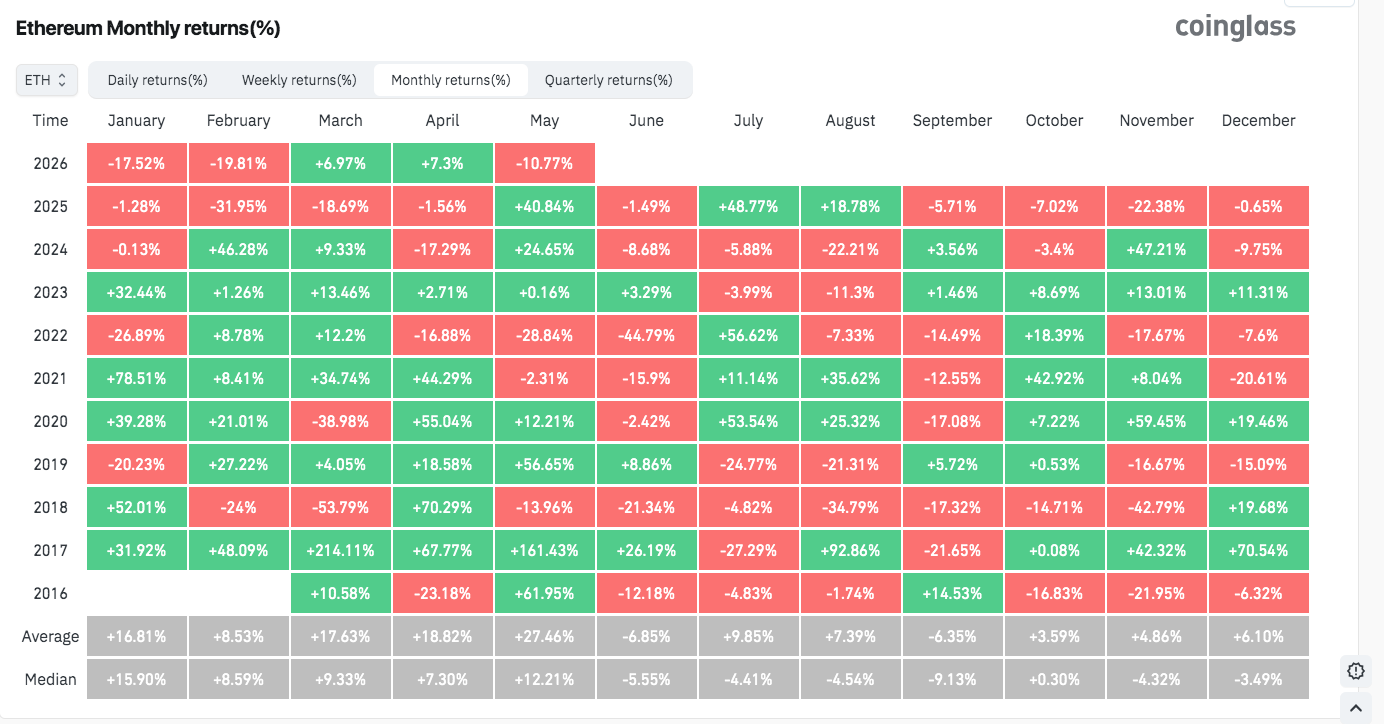
Given these historical precedents, a descent toward $1,800 appears increasingly plausible should the $2,000 support fail to hold.
Critical downside levels include $1,965 as the immediate support, followed by $1,920 and $1,850. The primary demand zone is located around $1,780.
On social platform X, analyst Ali Charts observed that ETH is nearing the lower boundary of its prevailing channel structure around $1,825. According to his assessment, this level presents an attractive risk-reward opportunity for entry, with projected upside targets at $2,073 and $2,360, contingent upon maintaining above $1,750 on daily closing basis.
Futures Activity Reaches Unprecedented Levels
Despite declining prices, activity in ETH futures markets surged to an all-time record. Open interest peaked at 15.98 million ETH on May 27, as reported by CoinGlass.
When calculated in ETH rather than dollar value, this metric eliminates price fluctuation distortions. The elevated reading indicates that market participants are actively establishing positions in anticipation of significant price movement.
Additionally, the weekly RSI has fallen beneath the 30 threshold. Historical analysis shows that the previous three occasions when this occurred preceded substantial price appreciation over the subsequent 6 to 12 months.
For bullish sentiment to regain dominance in the near term, Ethereum must reclaim the $2,050 resistance level. Successfully surpassing that barrier could trigger advances toward $2,085, followed by $2,120, and potentially extending to $2,150.
Presently, ETH continues trading beneath $2,010, with immediate focus centered on whether the $1,965 support level will hold against persistent selling pressure.
Key Points
- Cardano Foundation withdraws plans for 2026 summit following unsuccessful treasury funding vote that missed supermajority requirement
- Modified funding request for 7.8 million ADA (approximately $2 million) achieved 65.21% approval, falling 1.46% below the mandatory 66.67% threshold
- Initial funding proposal sought 14 million ADA (roughly $3.66 million) but faced rejection in May, prompting a reduced resubmission
- EMURGO’s independent TOKEN2049 Singapore conference proposal successfully passed, ensuring Cardano representation at the October gathering
- The outcome highlights growing resistance among Cardano’s delegated representatives toward treasury expenditures by founding entities
The Cardano Foundation has officially withdrawn its 2026 annual summit following a governance vote that came agonizingly close but ultimately failed to authorize necessary treasury funding.
Scheduled for October 5-6 in Singapore, the summit required 7.8 million Cardano tokens—valued at approximately $2 million—to proceed. The voting period concluded on Friday, May 29.
Approval Falls Fractionally Below Supermajority
Cardano’s governance framework mandates that treasury fund releases achieve a two-thirds supermajority from delegated representative (DRep) stake. The proposal garnered 65.21% backing—missing the mark by a mere 1.46 percentage points.
When examining individual votes, 135 delegates supported the measure, 61 opposed it, and 24 chose to abstain. Despite receiving Constitutional Committee endorsement, the proposal couldn’t overcome the network’s stringent voting requirements.
Following the vote’s conclusion, the Cardano Foundation shared on X: “Governance requires not only participation, but also a commitment to accept collective decisions. The Cardano community has spoken and we respect the outcome.”
The organization confirmed it would immediately begin discontinuing summit preparations.
Second Rejection Following Budget Reduction
This marked the proposal’s second unsuccessful attempt. The original May submission requested 14 million ADA—worth approximately $3.66 million—and combined summit funding with an EMURGO-led TOKEN2049 sponsorship. That consolidated proposal secured just 10% DRep backing.
Responding to the rejection, the foundation separated both events, reduced the budget by over 20%, and incorporated audited financial management, milestone-based payment releases, and an independent oversight committee.
Cardano creator Charles Hoskinson and foundation CEO Frederik Gregaard both publicly campaigned for DReps to support the modified proposal in the final hours before voting ended. Notably, the foundation refrained from casting votes on its own request, stating it wanted to avoid influencing the decision.
The separation strategy yielded one positive outcome. EMURGO’s standalone TOKEN2049 proposal received approval independently, guaranteeing Cardano participation at the Singapore cryptocurrency conference on October 7-8. The foundation supported EMURGO’s proposal.
Hoskinson has indicated he’s considering expanding the TOKEN2049 booth presence and potentially organizing a smaller embedded MiniSummit alongside it.
Escalating Treasury Spending Disputes Within Cardano Ecosystem
This unsuccessful vote represents a broader 2026 trend. Cardano’s delegated representatives have consistently rejected multiple treasury requests associated with Hoskinson, EMURGO, and Input Output Global, including reduced funding allocations connected to the Leios mainnet advancement.
Cardano’s token maintains an $8.8 billion market capitalization. The network currently holds under $129 million in total value locked, positioning it 28th among blockchain platforms.
Throughout 2026, the network has produced $356,400 in fees, compared with $8.35 million across the entire 2022 calendar year.
As of Sunday, Cardano’s token traded near $0.233, reflecting approximately 5% decline over the preceding month.
Key Takeaways
- Spot Bitcoin ETFs in the United States experienced $1.42 billion in net redemptions over the past week — marking the third-largest weekly outflow in history.
- BlackRock’s IBIT fund dominated the exodus with approximately $966 million in outflows, including a single-day withdrawal of $448 million.
- ETF issuers liquidated roughly 19,021 BTC within seven days — equivalent to 42 days’ worth of fresh mining production.
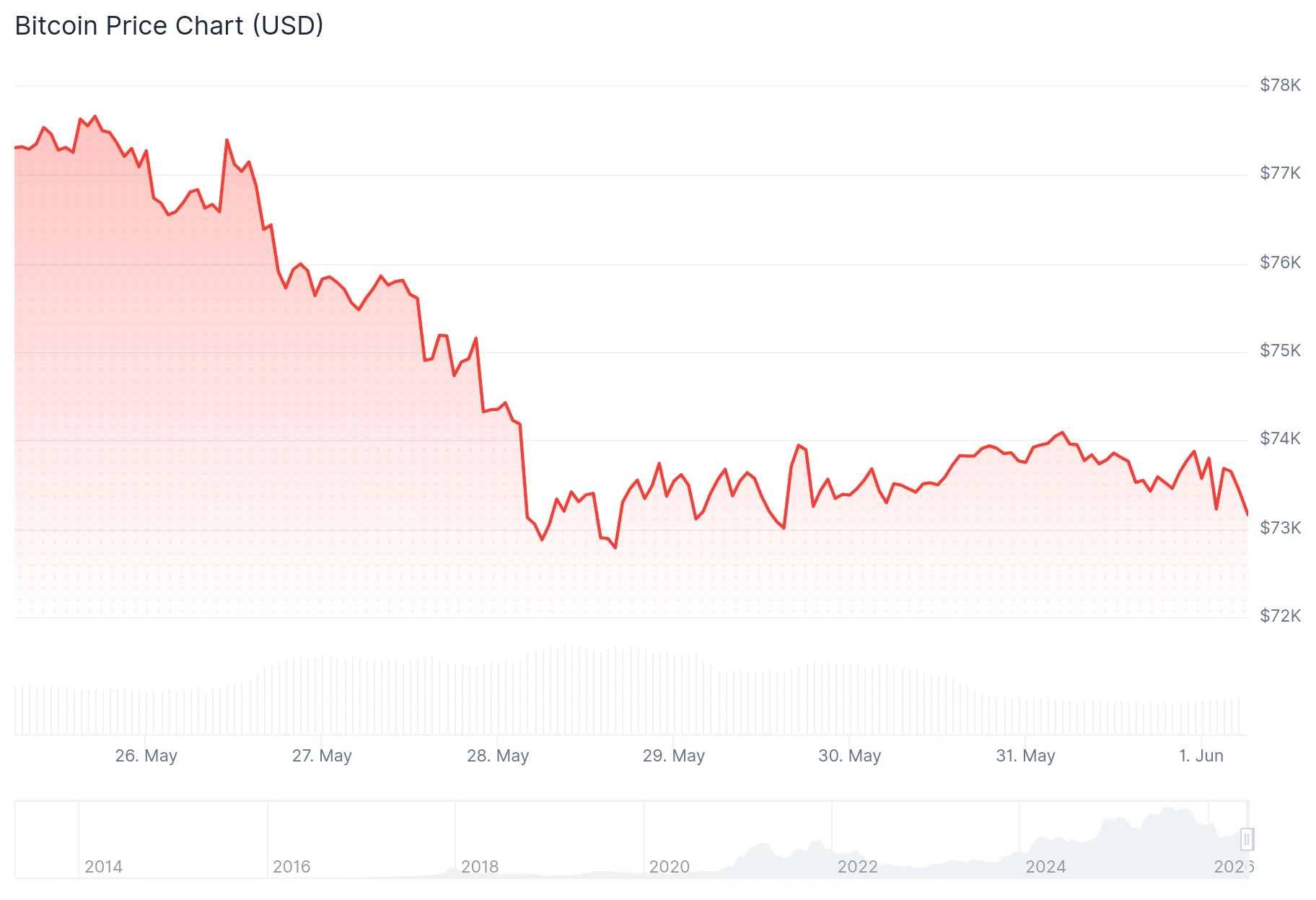
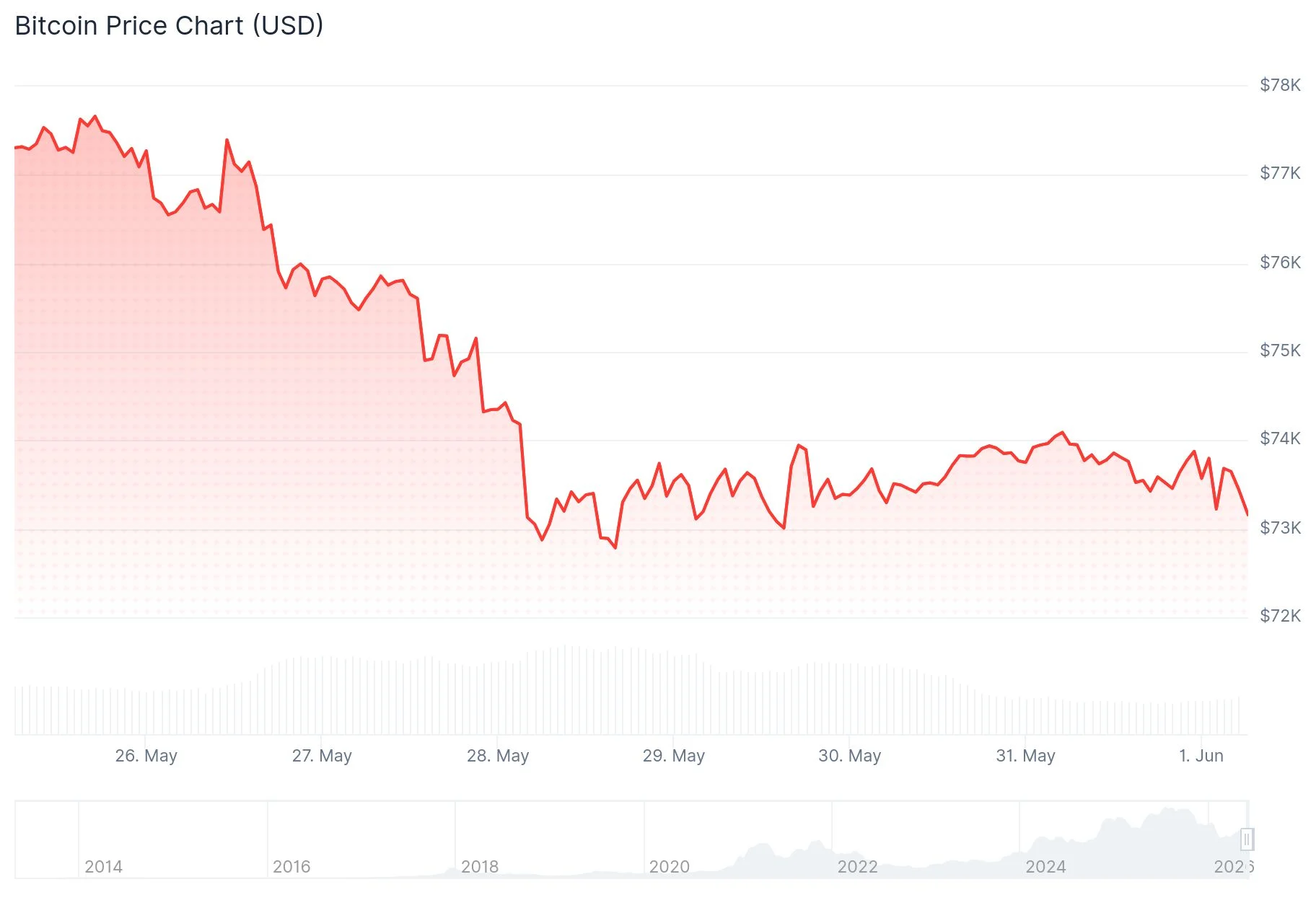
- Bitcoin’s value declined more than 4% over the week, settling near the $73,000 mark.
- Broader economic factors — persistent inflation data, climbing Treasury yields, and international tensions — continue fueling investor retreat.
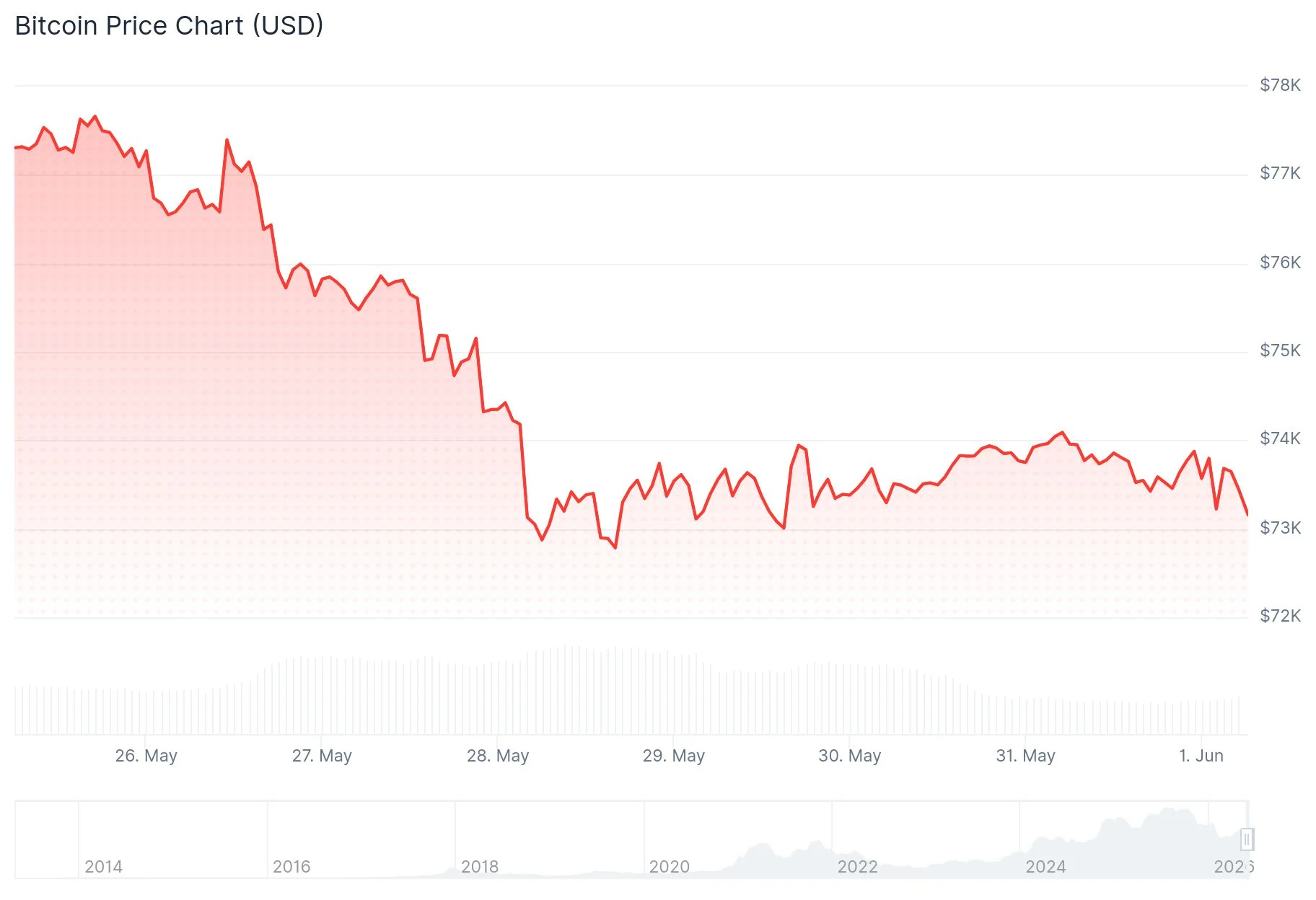
Bitcoin retreated more than 4% during the past week, settling around the $73,000 level after temporarily climbing back above $82,000 in May. This downturn coincided with substantial capital flight from US spot Bitcoin ETFs, which registered $1.42 billion in net redemptions — representing the third-heaviest weekly withdrawal since these investment vehicles debuted, based on current market data.
This marks the third consecutive week of significant investor withdrawals. Cumulative outflows across this three-week period have now surpassed $3.5 billion.
BlackRock’s IBIT Dominates Redemption Activity
BlackRock’s IBIT, which commands the largest asset base among spot Bitcoin ETFs, spearheaded the selloff. The fund recorded approximately $966 million in weekly exits. During its most severe single-day period, redemptions reached $448 million.
When investors redeem ETF shares, fund managers must liquidate equivalent Bitcoin holdings to fulfill those requests. Collectively, spot ETFs dumped approximately 19,021 BTC into the market last week — a volume matching 42 days of blockchain mining rewards.
Cryptocurrency analyst Ali Charts (@alicharts) identified a crucial price threshold, noting: “I’m monitoring $72,650 carefully on Bitcoin, as the MVRV Pricing Bands persistently flag it as a vital support threshold. Should this level break, the subsequent significant demand area spans between $54,300 and $51,000.” This price point hovers slightly beneath Bitcoin’s current valuation.
Root Causes Behind the Exodus
Macroeconomic conditions represent the primary catalyst. Recent inflation statistics published in May diminished market expectations for Federal Reserve interest rate reductions. Elevated rates enhance the attractiveness of risk-free instruments like Treasury securities, consequently diminishing investor appetite for volatile assets such as Bitcoin.
International instability — including possible renewed escalation in US-Iran relations — has intensified downward pressure. Petroleum price increases connected to these tensions threaten to elevate inflation further, making rate cuts increasingly improbable.
Analyst AlphaBTC (@mark_cullen) outlined a short-term projection, indicating he’s monitoring for a potential rebound toward $79,000 before an eventual decline to the lower $60,000 range during late summer.
The Crypto Fear & Greed Index maintained readings in “fear” territory throughout the entire week.
One encouraging signal: the market’s ability to absorb 19,021 BTC of selling pressure without triggering a steeper price collapse indicates residual demand exists at present valuation levels.
Bitcoin was changing hands near $73,000 according to the most recent market data, with the $72,650 MVRV support threshold under intense analyst scrutiny.


More than 1,003 Ether, worth roughly $2 million, have been recovered from a failed 2016 ICO dubbed Hong Coin after a white hat hacker found a way to unlock funds that had remained trapped in a faulty smart contract for nearly 10 years.
Summary
- A white hat hacker helped recover 1,003 ETH worth about $2 million from a failed 2016 Hong Coin ICO contract.
- The funds remained locked for nearly a decade after a bug prevented investors from receiving automatic refunds.
- Recovery became possible after the hacker identified an integer overflow flaw and worked with the project’s creators to unlock the refund mechanism.
According to a Sunday post on X by pseudonymous white hat hacker 0xflorent, the recovered ETH belonged to 48 investors who participated in the Hong Coin (HONG) token sale, a decentralized venture capital project that never launched after failing to meet its fundraising target.
As explained by 0xflorent, the ICO contract was designed to automatically return investors’ ETH if the funding goal was not reached. A flaw in the refund function prevented that process from working, leaving the funds permanently locked despite the sale ending without success.
Blockchain records from Etherscan show refunds have already started. One investor received 96 ETH, currently valued at about $192,500, while another wallet recovered 0.5 ETH.
Hong Coin was introduced in 2016 as a decentralized autonomous organization focused on venture capital investing. A promotional video published at the time described a structure where token holders would vote on projects that could receive funding from the community-managed pool.
The ICO opened on Aug. 29, 2016, and concluded on Oct. 28, 2016. Participants who contributed ETH were expected to receive a share of 250 million HONG tokens distributed across multiple funding stages. Because the project did not achieve its fundraising target, investors became eligible for refunds under the smart contract’s rules.
Integer overflow bug provided path to recovery
Detailing the recovery process, 0xflorent said the solution emerged from an overlooked administrative function that contained an integer overflow vulnerability.
According to the white hat, invoking the function with a specific input reset a token holder’s balance and allowed the contract’s refund conditions to execute correctly. Working alongside the original HONG creators, 0xflorent demonstrated how the flaw could be used to release the trapped ETH without moving funds outside the contract.
“The way out was an admin function with an integer overflow vulnerability,” 0xflorent wrote on X. “Calling it with a specific input resets a holder’s balance and unblocks the refund check.”
The recovery adds to a growing list of cases where white hat hackers have intervened to secure or return cryptocurrency funds after identifying vulnerabilities in smart contracts and protocol infrastructure.
Earlier in May, blockchain security firm Blockaid reported that a white hat attacker exploited a vulnerability in Renegade.fi’s Arbitrum-based dark pool, temporarily draining about $209,000 before returning more than 90% of the assets.
According to Blockaid, the issue stemmed from deployment and migration errors that allowed unauthorized modification of a smart contract connected to the protocol’s V1 dark pool.
In messages published on-chain following that incident, the Renegade exploiter argued that exposing the weakness was the safest way to protect user funds and pointed to the simplicity of the vulnerability as evidence that more malicious attackers could have caused far greater losses.
Separately, 0xflorent disclosed on May 24 that they had also recovered a combined 19.33 ETH, worth roughly $40,600 at the time, from a failed January 2018 ICO project and from a Liquality Wallet user whose funds became trapped in a cross-chain transfer protocol.


CertiK has reported that crypto losses from hacks and exploits have fallen to $68.3 million in May, nearly 90% lower than the roughly $650 million stolen in April.
Summary
- Crypto losses fell to $68.3 million in May, nearly 90% lower than the roughly $650 million recorded in April, according to CertiK.
- Verus Protocol and THORChain suffered the two largest exploits of the month, with combined losses exceeding $21 million.
- CertiK reported a rise in AI-assisted malware activity as attackers targeted code repositories and AI coding tools.
According to blockchain security firm CertiK, May became the third month of 2026 to record less than $100 million in crypto-related losses after attackers stole $68.3 million through exploits, scams, and security breaches.
The figure comes after a difficult April, when losses surged to around $650 million. CertiK noted that, excluding the $1.5 billion Bybit hack in February 2025, April recorded the highest monthly losses since March 2022. A $291 million exploit targeting Kelp DAO accounted for the largest incident that month.
While losses declined sharply in May, several major attacks still affected the sector. Data from CertiK shows that an exploit targeting Verus Protocol’s cross-chain bridge on May 18 resulted in $11.5 million in losses, making it the largest incident of the month. An attack on THORChain followed with roughly $10.1 million stolen from the protocol.
A breakdown of the data shows that code vulnerabilities remained the most expensive attack vector. CertiK reported that flaws in protocol code accounted for approximately $45 million in losses, representing about 66% of the month’s total. Wallet and private key compromises ranked second, with attackers stealing $13.7 million through those incidents.
Cross-chain infrastructure continued to attract significant attention from attackers. According to CertiK, cross-chain bridge exploits caused $28.6 million in losses during May, or roughly 42% of the monthly total, placing them ahead of decentralized finance protocols among the most targeted sectors.
Data from DeFiLlama recorded 29 security incidents during the month, including seven cases involving compromised private keys.
Among the most recent attacks were exploits affecting Alephium Bridge and Gravity Bridge on May 30. Data shows that the incidents led to losses of approximately $815,000 and $5.4 million, respectively, after attackers gained access to private keys.
AI-powered attacks add to security concerns
Even as total losses declined, security researchers continue to warn about changes in attacker tactics.
In April, CertiK senior blockchain investigator Natalie Newson warned that threat actors were increasingly combining social engineering, phishing campaigns, supply-chain compromises, and cross-chain vulnerabilities to execute large-scale attacks. Newson also warned that artificial intelligence tools were making cybercrime operations more sophisticated and easier to scale.
CertiK’s latest findings suggest that trend is continuing. The company reported that AI-assisted malware activity increased in May, with attackers targeting both crypto developers and AI developers by compromising code repositories and manipulating AI coding assistants.
Newson previously said that tools capable of creating realistic deepfakes, autonomous attack agents, and software that can identify vulnerabilities and generate exploit code are becoming more accessible.
According to CertiK, such capabilities are adding new risks at a time when attackers are already exploiting weaknesses in cross-chain systems and private key management.
In the meantime, CertiK has advised users to remain cautious of phishing attempts, verify the authenticity of websites and smart contracts, and consider using cold wallets to reduce exposure of private keys during everyday operations.

Artificial intelligence is rapidly changing the way music is created, produced and distributed. What once required a studio, a team of professionals and months of work can now be tested, refined and released in a much shorter time through AI-assisted creative tools.
A new example of this shift is Lunayah, a virtual music project that has released its second single, “New Beginning”, now available across major streaming platforms.
The track follows Lunayah’s first release, “Money Magnet,” but marks a more mature and emotional direction for the project. While the debut focused on abundance and affirmation-based music, “New Beginning” explores personal transformation, self-discipline, freedom and the process of becoming a stronger version of oneself.
A Virtual Artist Built Around AI, Music and Identity
Lunayah is not presented as a traditional artist, but as a virtual music identity created through a combination of human direction, digital storytelling and AI-assisted production. The project was developed by Vincenzo Stefanini, entrepreneur and founder of Web3 Digital, a Dubai-based digital agency focused on branding, online growth and emerging technologies.
The idea behind Lunayah is to explore how artificial intelligence can support the creation of a complete music project, from concept and lyrics to visual identity, storytelling and distribution.
“AI didn’t replace creativity. It amplified it,” Stefanini said. “New Beginning is not just a song. It represents a personal transformation.”
“New Beginning” and the Sound of Reinvention
“New Beginning” is built as an energetic pop-dance track with a motivational message. The song speaks about breaking old routines, rebuilding discipline, taking control and moving toward a new phase of life.
Rather than being a sad or nostalgic song, the track carries a sense of momentum. It is about leaving behind limiting patterns while keeping the lessons of the past and using them as fuel for growth.
The chorus is designed around a clear emotional message: the moment has arrived to stop playing small, take back control and build something bigger.
This makes the track especially relevant within the growing self-improvement and motivational music space, where listeners use songs not only for entertainment, but also for energy, focus and emotional reinforcement.
AI as a Creative Accelerator
The release highlights a broader trend: AI is lowering the barrier to entry for music production. Independent creators, entrepreneurs and digital brands can now test concepts that would previously have required significantly more time, budget and technical resources.
At the same time, the project keeps human input at the center. The concept, message, direction, final selection and branding decisions remain human-led, while AI tools help accelerate execution.
“Technology is changing music, but human emotion still remains at the center,” Stefanini added. “This project started as an experiment, but quickly evolved into something much bigger.”
Available Now
“New Beginning” is now available through the official Lunayah project page at lunayah.com.
Listeners can also access the release directly through:
As AI continues to reshape creative industries, projects like Lunayah show how virtual artists, digital storytelling and AI-assisted music production may become a growing part of the future music landscape.

Election 2026: Child poverty a 'huge red flag'

Citi predicts the tokenized securities market will grow to $5.5 trillion by 2030

Dua Lipa Marries Callum Turner Before Epic Sicily Bash


-

 NewsBeat5 days ago
Israel says it has killed new Hamas military leader in Gaza City airstrikes
-

 Tech5 days ago
NASA taps Blue Origin to deliver lunar rovers for Moon Base initiative
-

 Politics7 days ago
Bridgerton Season 5: Cast, Release Date And Everything We Know So Far
-

 Sports6 days ago
2026 NBA Finals schedule, odds: Knicks await Thunder or Spurs after winning East
-

 News Videos5 days ago
XRP *JUST* SUCCEEDED!!!! CLARITY ACT EXPOSED!!! (SHE EXPOSED IT)
-

 News Videos3 days ago
This is BROKEN! INSANE 5x MONEY CAR WASH WEEK! The NEW GTA Online UPDATE Today! (GTA5 New Update)
-
Crypto World5 days ago
Micron Crosses $1 Trillion Market Cap as AI Demand Reshapes Memory Sector
-

 Business5 days ago
Selena Gomez Reportedly Upset Over Benny Blanco’s Comments on Her ‘Terrible’ Diet
-
 NewsBeat7 days ago
Hottest May day ever as London hits 34.8C in 2C leap from previous records
-

 Business7 days ago
BTS Sells Out Four Las Vegas Shows at Allegiant Stadium for ARIRANG World Tour
-
 Tech6 days ago
China assigns ID codes to 28,000+ humanoid robots
-

 Business6 days ago
Nikkei 225 Surges Past 65,000 for First Time as Iran Peace Hopes Fuel Record Rally
-

 Tech7 days ago
Microsoft’s quiet Claude Code retreat and the real cost of enterprise AI
-

 Tech3 days ago
Waymo dominates autonomous vehicle registrations as Tesla trails behind
-
 Entertainment6 days ago
‘Breaking Bad’ Star’s Easy-to-Binge 6-Part Crime Series Spin-Off Is Finally Heading to Free Streaming
-

 NewsBeat7 days ago
Crowds find riverside shade in York as temperatures soar
-
Tech5 days ago
The Samsung pay deal is the moment Korean unions changed register
-

 Tech7 days ago
Westone Audio and Etymotic Acquired by Fidelity Collective in Major IEM Market Move
-

 Tech5 days ago
Millions of AI agents imperiled by critical vulnerability in open source package
-
Crypto World5 days ago
SpaceX’s $2 Trillion IPO: Why Tech Giants Nvidia (NVDA), Apple (AAPL), and Microsoft (MSFT) May Face Pressure
You must be logged in to post a comment Login