

Crypto World
Sam Altman-Backed Crypto Explodes 10% Today as Bitcoin Eyes $74K: Weekend Watch

The cryptocurrency market continues into the weekend on a calmer note following what was surely a rather volatile week of trading.
Bitcoin’s price is attempting to stabilize near an important short-term resistance area, while some altcoins are outperforming sharply, led by Worldcoin’s double-digit daily surge.
BTC Pushes Toward $74,000
Bitcoin has remained relatively calm during the weekend trading session after a volatile few days. The cryptocurrency is still fighting to press above an important short-term resistance level.
BTC’s price trades slightly below $74K at the time of this writing, gaining roughly 0.5% over the past 24 hours. It’s evident that buyers are trying to recover some ground following the market-wide pullback that took place last week.
The most recent price action comes as the broader cryptocurrency market stabilizes, with total capitalization hovering around $2.58 trillion, according to CoinGecko. Bitcoin’s dominance remains above 57%. However, the momentum remains fragile, as traders continue to watch macro headlines, with Trump saying they are under no deadline to strike a deal with Iran, meaning uncertainty is likely to continue for the time being.

Worldcoin (WLD) Leads Altcoin Gainers
The altcoin market saw mixed results over the past 24 hours, although several large-cap names posted strong daily moves.
Worldcoin (WLD), the Sam Altman-linked project, stole the show after increasing by about 11% to jump around $0.33. Other top gainers from the top 100 cryptocurrencies by total market cap include Venice Token (VVV), Humanity (H), and Midnight, all of which post notable advances.
BNB and TOn also sttod out among the larger-cap assets with gains of more than 7%.
On the flipside, Monero’s XMR was the weakest top-100 performer, dropping by roughly 8%, while most other major altcoins saw more modest moves.

The post Sam Altman-Backed Crypto Explodes 10% Today as Bitcoin Eyes $74K: Weekend Watch appeared first on CryptoPotato.


Bitcoin (BTC) is staging a technical rebound after testing a critical on-chain support zone tied to the realized price of coins held by short- to mid-term investors. The pop back toward the mid-$70,000s comes as the market eyes whether the 3–6 month realized price around $71,400 can act as a durable floor, potentially paving the way for a move back toward higher levels, including a suggested target near $78,200 and, in a more bullish scenario, a possible climb toward $100,000 by year-end.
Key takeaways:
- Bitcoin is eyeing a rebound toward $78,200, the realized price for BTC held 3–6 months, which could mark a pivotal turning point if breached.
- A sustained move above this cost basis could set the stage for a potential rally toward $100,000 by year-end, according to on-chain and technical readings.
- On-chain data place the 3–6 month realized price near $71,400, a level described by analysts as a strong near-term support that has historically underpinned medium-term conviction.
- Past breakouts above the 3–6 month cost basis have tended to precede stronger gains over longer horizons, though the near-term path remains constrained by a bear-flag pattern.
On-chain support under the microscope
Bitcoin’s weekend rebound was modest but notable, advancing roughly 2.5% to hover near the $74,000 mark after touching a local trough just above $72,500. The move reflects a familiar dynamic: a bounce from a price zone that coincides with the realized price of coins held for three to six months. This cohort is widely watched because it represents capital that has remained in the market long enough to reflect genuine medium-term conviction.
Glassnode’s analysis of realized prices across different aging cohorts shows that the 3–6 month group sits around $71,400. In a Sunday note, analyst Marcus Corvinus described this level as Bitcoin’s “strongest near-term support,” arguing that holders within this band may defend the area to avoid a broader pullback.
“This cohort is still holding profits, creating a strong incentive to defend the level,” Marcus Corvinus said in a Sunday post.
The near-term target around $78,200 aligns with the same 3–6 month realized price, a level sometimes invoked by traders as a gauge for the next phase of upside. The rationale is that regaining the cost basis of this cohort could restore confidence among holders who have been sitting on unrealized gains as BTC navigates a choppy macro environment. Analysts have pointed to the $78,200 mark as a potential hurdle that, once cleared, could reframe the path toward higher targets.
For perspective, this threshold sits not far from a historical point of reference: the time when BTC briefly cleared the 3–6 month realized price in previous cycles often preceded more extended periods of strength. A prior technical breakdown that saw BTC slice through the $78,000 area in October 2025 is cited in market commentary as a reminder that structure and price discipline often dictate the next leg of the journey.
In addition to the on-chain picture, recent coverage from Cointelegraph has highlighted the significance of this level within broader narratives around reclaiming psychological milestones, including the idea that BTC does not necessarily require a fresh narrative to retake $100,000, a view echoed by several analysts this year.
What the numbers imply for upside potential
Beyond the immediate price action, the signal from the 3–6 month realized-price breakouts has, historically, translated into meaningful upside over longer horizons. Data points compiled by Glassnode suggest a pattern: after similar breakouts, BTC has averaged a 2.3% gain over the next 30 days, a 21.9% gain after 90 days, and roughly a 36.6% gain after six months. While past performance does not guarantee future results, the sequence underscores how on-chain dynamics around holder cost bases can foreshadow multi-week to multi-month cycles of upside.
Applying this framework to Bitcoin’s current setup, the implication is that a sustained move above $71,400 and then $78,200 could imply a broader re-rating of prices over the coming months. With Bitcoin hovering near $74,000, even moderate alignment with these historical patterns would translate into notable upside over the next several weeks to months.
Yet the market is navigating a delicate balance. The analyst view is that the signal is strongest when the price sits above the 3–6 month realized price and remains above it for a meaningful period, confirming a shift in holder sentiment. In practice, that means watching not just the level itself but the price action around it—especially as a dynamic bear-flag pattern develops on the daily chart.
Bear flag reality checks: upside capped or vulnerable to a deeper decline?
On the technical side, Bitcoin’s rebound is taking place near the bear-flag’s lower boundary, a configuration that has become a point of cautious optimism for bulls but also a source of downside risk if the pattern fails.
The bear flag formed after BTC’s retreat from the late-2026 highs around $98,000. The price is now testing the rising support line associated with the flag, with the upper boundary near $90,000 serving as a nearby probe for bulls. If price can sustain a move toward that upper limit, the chart would align with a bullish reversion scenario in the months ahead.
Analysts point out that the $90,000 zone sits at a confluence of technical factors, including proximity to the 0.786 Fibonacci retracement level and the 3–6 month holder cost basis. A successful push past the flag’s upper boundary could renew momentum toward higher targets, while any daily close below the lower trend line would rekindle bearish pressure and leave a path toward a much deeper pullback—potentially into the $50,000–$60,000 range, depending on the exact breakdown point and the market’s reaction to it.
In this context, the balance of probabilities favors careful risk management. The scenario that holds the line at or above the lower boundary and pushes toward or through $90,000 would imply a meaningful shift in sentiment, especially if on-chain indicators confirm sustained demand among holders who benefited from the recent bounce. Conversely, a decisive break lower would reframe the narrative around the durability of on-chain support levels and could signal a renewed phase of volatility as traders reassess risk exposure.
Market observers are also watching how macro factors—rates, liquidity conditions, and risk appetite—interact with this on-chain signal. While the analytics point to a potentially constructive path if fundamentals align, the immediate horizon remains sensitive to trend-line dynamics and the price’s ability to defend the current support area.
For readers seeking a cross-check on the latest thinking, Cointelegraph’s coverage in related pieces has highlighted that patience and clarity around price action, rather than chasing a single target, may define the next phase for Bitcoin. In particular, analyses discussing whether a fresh narrative is necessary to reclaim $100,000 have noted that existing on-chain and technical signals can be sufficient to sustain a longer-term uptrend if they cohere with favorable market conditions.
What to watch next: the day-to-day price action around the $71,400–$78,200 zone will be telling. A clear close above $78,200 would strengthen the case for a continued rally toward the $90,000–$100,000 region, while a sustained break below the lower bear-flag line would raise the odds of a deeper retracement toward the $50,000–$60,000 area. Traders and investors should monitor on-chain metrics, especially the behavior of the 3–6 month cohort, and remain mindful of the broader macro backdrop that could amplify or dampen the next phase of BTC’s trajectory.
As outlined in recent market notes, the path forward remains nuanced. The indicator suite suggests a potential for upside, but the bear-flag framework keeps downside risk in play. The coming weeks should reveal whether on-chain support can translate into a durable uptrend or if the market will test lower levels before finding a more convincing leg higher.
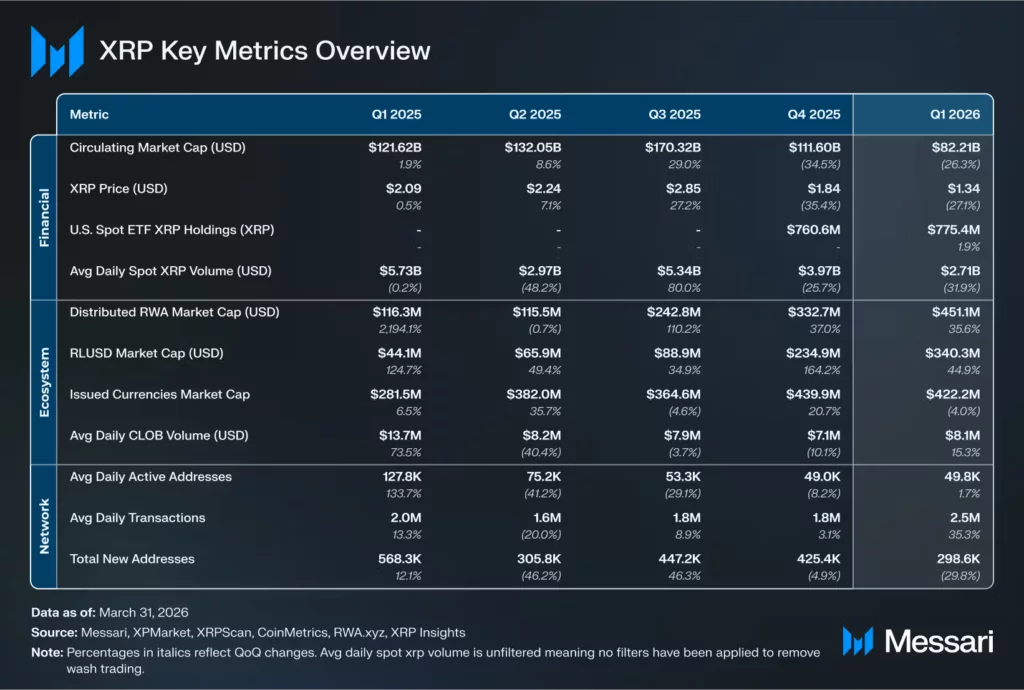
XRP had a weak start to 2026 from a market view, but activity on the XRP Ledger rose sharply during the same period, according to Messari’s State of XRP Q1 2026 report.
Summary
- XRP price fell 27% in Q1, but XRPL daily transactions rose 35.3% to 2.48 million.
- RLUSD reached $340.3 million on XRPL, making it the network’s largest stablecoin by quarter-end.
- XRPL’s RWA market cap jumped 124.1% QoQ to $2.25 billion, reaching a new quarterly high.
XRP price fell as trading cooled
Messari said XRP ended Q1 as the fourth-largest non-stablecoin crypto asset by market value, behind Bitcoin, Ethereum and BNB. Even so, the token followed the wider market lower during the quarter.
XRP’s market cap fell 26.3% quarter-over-quarter to $82.21 billion. Its price also dropped 27.1% to $1.34, while circulating supply rose 1.1% to 61.34 billion XRP.
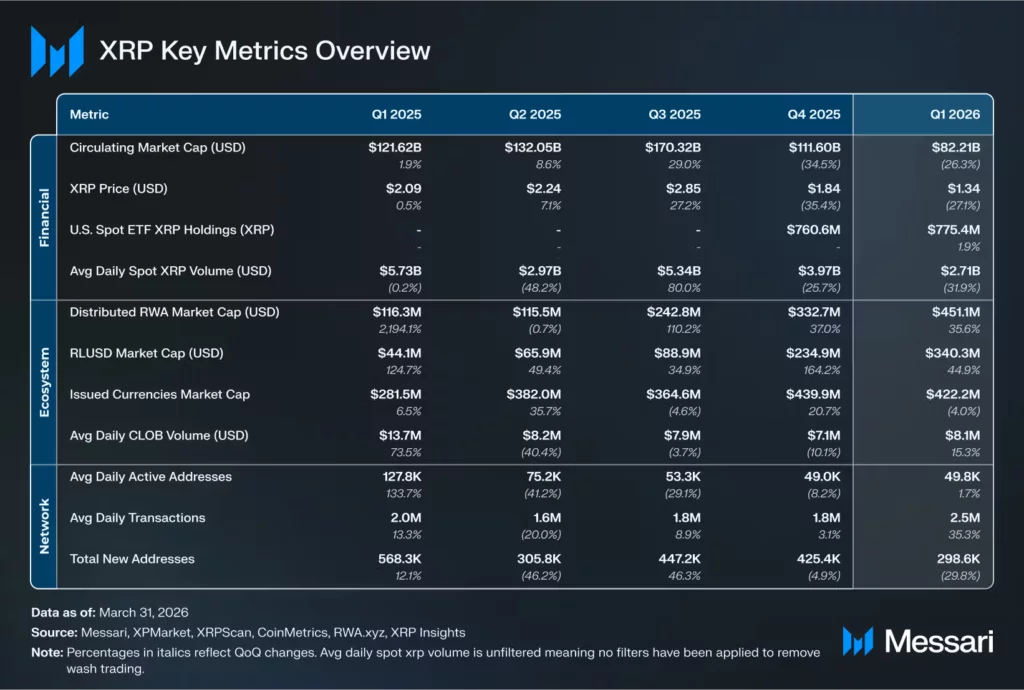
Trading activity also slowed. Messari said average daily spot volume fell 32%, while perpetual futures volume declined 28.6% during the quarter.
The report said U.S. spot XRP ETFs ended Q1 holding 775.4 million XRP. That represented 1.26% of circulating supply and was up 1.9% from the previous quarter.
XRPL transactions moved higher
While XRP price weakened, network activity moved in the opposite direction. Messari said average daily transactions on the XRP Ledger increased 35.3% quarter-over-quarter.
Daily transactions rose from 1.83 million to 2.48 million. The increase suggests that XRPL usage expanded even as token price and trading activity cooled.
The report tied that growth to the network’s wider feature set. XRPL continues to support payments, token issuance, decentralized liquidity, real-world assets and stablecoins.
Messari also noted that XRP remains tied to network use through transaction fees, account reserves, liquidity, asset ownership and bridging across currencies.
RLUSD and tokenized assets lead growth
Ripple’s RLUSD stablecoin grew during the quarter. Messari said RLUSD closed Q1 with a $340.3 million market cap on XRPL, up 44.9% quarter-over-quarter.
That made RLUSD the largest stablecoin on the XRP Ledger. The report also said RLUSD had more holders on XRPL than Ethereum by quarter-end, although Ethereum still handled larger transfer volume.
XRPL’s real-world asset market cap also rose sharply. Messari said RWA market cap on the network climbed 124.1% quarter-over-quarter to $2.25 billion.
The growth pushed XRPL into the top group of public blockchains for tokenized assets. The report said the network ranked seventh by RWA market cap at the end of Q1 and fourth by the time of publication.
Institutional finance tools expand
Messari said new institutional finance tools also moved forward during the quarter. Permissioned Domains, Permissioned DEX and Token Escrow went live on XRPL.
Native lending and asset vault features remained in voting. If approved, those tools could support lending, borrowing and more structured use of XRP and other assets on the network.
As previously reported by crypto.news, Morgan Stanley recently disclosed small positions in two XRP-focused ETFs. XRP funds also attracted $85.8 million in inflows over three weeks, showing continued demand through regulated products.
Separate coverage has also noted a key market tension. RLUSD can help grow XRPL usage, but stablecoin settlement does not always create the same direct demand for XRP as a bridge asset.
Messari said its report was commissioned by Ripple, while Messari retained editorial control. The report still shows a clear Q1 split: XRP price and trading activity fell, while XRPL transactions, RLUSD adoption and tokenized asset growth moved higher.
Crypto World
Three AI Powerhouses to Monitor: Nvidia (NVDA), Microsoft (MSFT), and AMD Stock Analysis

Quick Overview
- Nvidia commands the AI semiconductor sector with overwhelming analyst backing and price targets spanning $245–$300
- Microsoft’s comprehensive AI integration spans its entire ecosystem, fueled by Azure infrastructure and OpenAI collaboration
- AMD emerges as a formidable challenger in AI chips with increasing institutional confidence
- Analyst communities overwhelmingly rate all three as “Buy” opportunities
- Corporate AI infrastructure investments remain robust, sustaining demand for processors and cloud platforms
The artificial intelligence revolution continues reshaping equity markets. Corporate expenditure on AI infrastructure, cloud platforms, and specialized processors reaches unprecedented levels. Three companies consistently dominate analyst watchlists: Nvidia, Microsoft, and AMD.
Nvidia: Semiconductor Supremacy in AI Computing
Nvidia stands as the undisputed symbol of artificial intelligence expansion.
The company’s GPUs serve as the foundation for leading AI systems, deployed across hyperscale cloud environments, corporate data centers, and emerging AI ventures. Nvidia maintains unchallenged superiority in extreme-performance machine learning hardware.
Wall Street sentiment strongly validates this dominance. Leading financial institutions predominantly assign Buy recommendations, establishing price objectives between $245 and $300. Among 54 professional assessments, 51 recommend buying, 3 suggest holding, and zero advise selling.
Nvidia’s competitive moat extends beyond silicon. The CUDA programming ecosystem creates substantial switching costs that retain customers. Strategic expansion encompasses robotics applications, self-driving technology, networking infrastructure, and corporate AI solutions.
Microsoft: Comprehensive AI Platform Integration
Microsoft represents perhaps the most underestimated AI opportunity relative to market capitalization.
Artificial intelligence permeates the company’s portfolio across Microsoft 365, Azure cloud services, GitHub development tools, Teams collaboration, LinkedIn networking, and Dynamics business applications. Strategic alignment with OpenAI positions Microsoft centrally within corporate AI adoption patterns. Azure experiences accelerating consumption of AI-optimized cloud resources.
Microsoft’s financial foundation differentiates it from speculative AI investments. Substantial operating cash flow from established revenue streams enables sustained AI investment without operational compromise.
Among 46 professional ratings, 39 recommend buying, 7 advise holding, and none suggest selling.
The company controls extensive enterprise datasets through its software ecosystem, providing competitive advantages in developing and refining AI capabilities for business customers.
AMD: The Ascending Competitor
Advanced Micro Devices demonstrates accelerating momentum within Nvidia’s dominated territory.
The chipmaker continues capturing share across server processors and AI acceleration hardware. Multiple institutional analysts recently elevated price projections following impressive financial results and strengthening demand for AMD’s AI semiconductor portfolio.
Of 34 analyst evaluations, 28 are Buy, 6 are Hold, and zero are Sell.
AMD’s expansion narrative transcends AI chips alone. The company gains traction in server CPU markets as enterprises expand computational capacity. Customer strategies emphasizing vendor diversification naturally benefit AMD.
Analysts identify AMD as a primary beneficiary of expanding enterprise AI capital deployment through coming years.
Final Thoughts
Each company occupies advantageous positioning as artificial intelligence expenditure maintains upward trajectory. Nvidia commands hardware supremacy, Microsoft dominates software and cloud delivery, and AMD advances as a compelling alternative supplier.


TLDR:
- Binance recorded $1.2B in net stablecoin outflows in May, reversing two months of positive inflows.
- Bitcoin dropped 3.5% in May while the S&P 500 and Nasdaq posted gains of 5.15% and 10.5% respectively.
- Binance stablecoin reserves have fallen from $51B to $44B since November 2024, a decline of 13.7%.
- Analysts describe Bitcoin’s current rebound as technical, not backed by consistent liquidity-driven momentum.
Binance stablecoin outflows reached approximately $1.2 billion in May 2025, marking a sharp reversal from the two prior months of positive inflows.
This shift came even as traditional equity markets posted strong monthly gains. The S&P 500 rose 5.15%, while the Nasdaq climbed 10.5%.
Bitcoin, however, closed the month down 3.5%, reflecting a disconnect between crypto and equities. Liquidity is not flowing into the digital asset market at this time.
Crypto Liquidity Fails to Follow Equity Market Rally
May’s outflows broke a two-month streak of positive stablecoin inflows on Binance. The exchange had recorded net inflows of $2.5 billion and $870 million in the two preceding months. The reversal points to a broader pullback in retail and institutional appetite for crypto exposure.
On-chain analyst Darkfost noted the trend on X, stating that “liquidity is simply not flowing into the crypto market at the moment.”
The monthly net stablecoin flows on Binance served as a clear measure of this slowdown. The data painted a straightforward picture of fading market participation.
Binance still holds the largest share of stablecoin reserves among exchanges. Its estimated market dominance stands at nearly 68%.
Despite this dominant position, total stablecoin balances on the platform have been declining for several months.
Since November 2024, Binance’s stablecoin reserves have dropped from $51 billion to $44 billion. That represents a fall of 13.7% over the period. The trend shows users are consistently withdrawing funds rather than deploying them into crypto positions.
Bitcoin’s Recovery Looks Technical Rather Than Liquidity-Driven
Bitcoin’s rebound from its correction lows appears to lack the liquidity support seen in late 2024. At that time, consistent stablecoin inflows backed the rally and pushed prices higher with stronger momentum. The current move does not yet show similar characteristics.
The earlier correction pushed Bitcoin into heavily oversold conditions, which likely triggered a technical bounce. Darkfost described the move as “a rebalancing move rather than the beginning of a new liquidity-driven uptrend.” That framing aligns with what the stablecoin flow data currently shows.
Investor attention, for now, remains directed toward equities rather than digital assets. The easing of tensions around the Strait of Hormuz helped lift stock markets in May. Crypto markets, however, did not benefit from the same sentiment shift.
Periods of low market interest have historically offered opportunities to build positions gradually. Monitoring stablecoin inflows and outflows remains one of the most reliable tools for tracking liquidity rotation.
A sustained return of inflows to exchanges like Binance would signal renewed conviction in the crypto market.
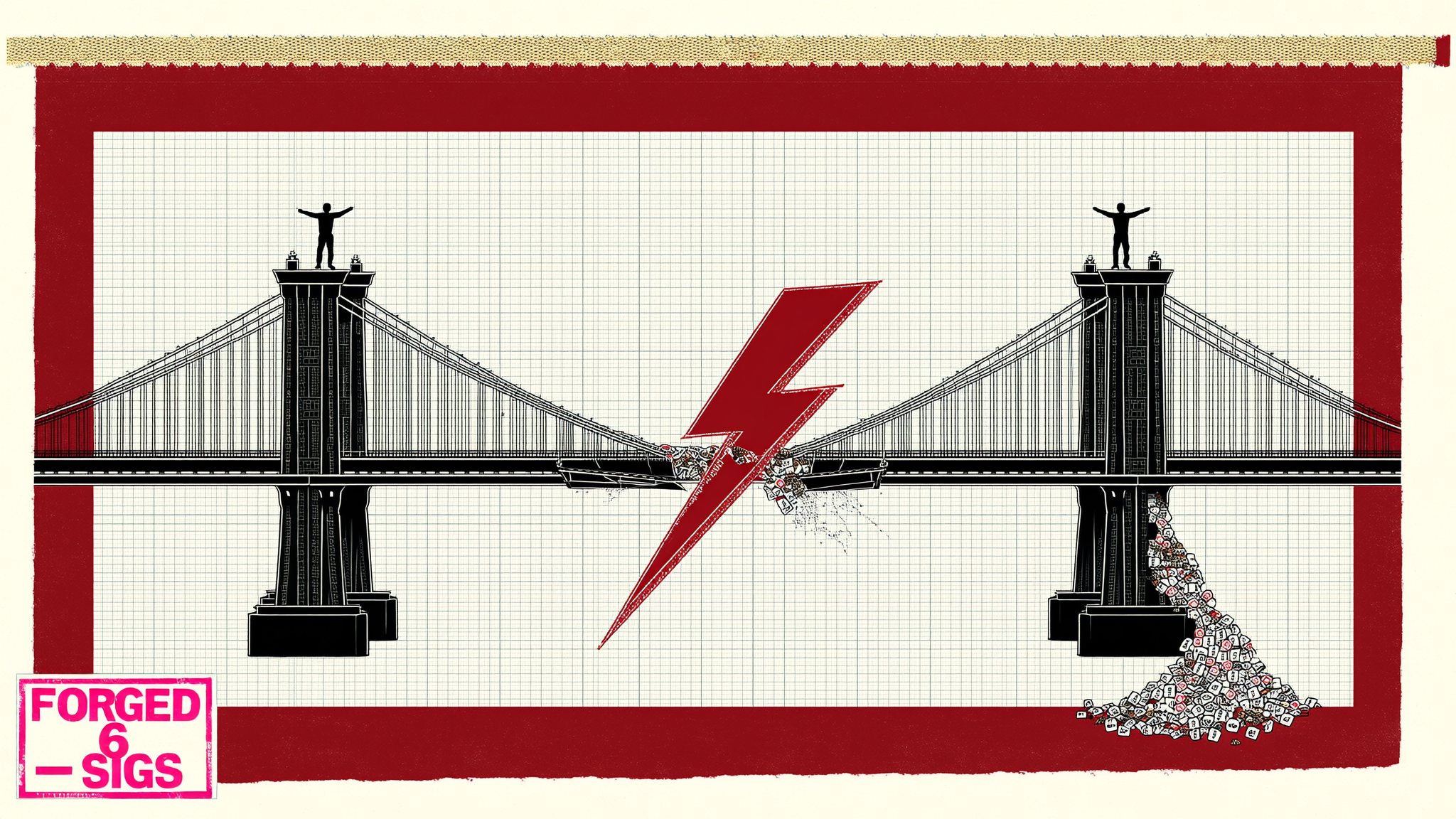
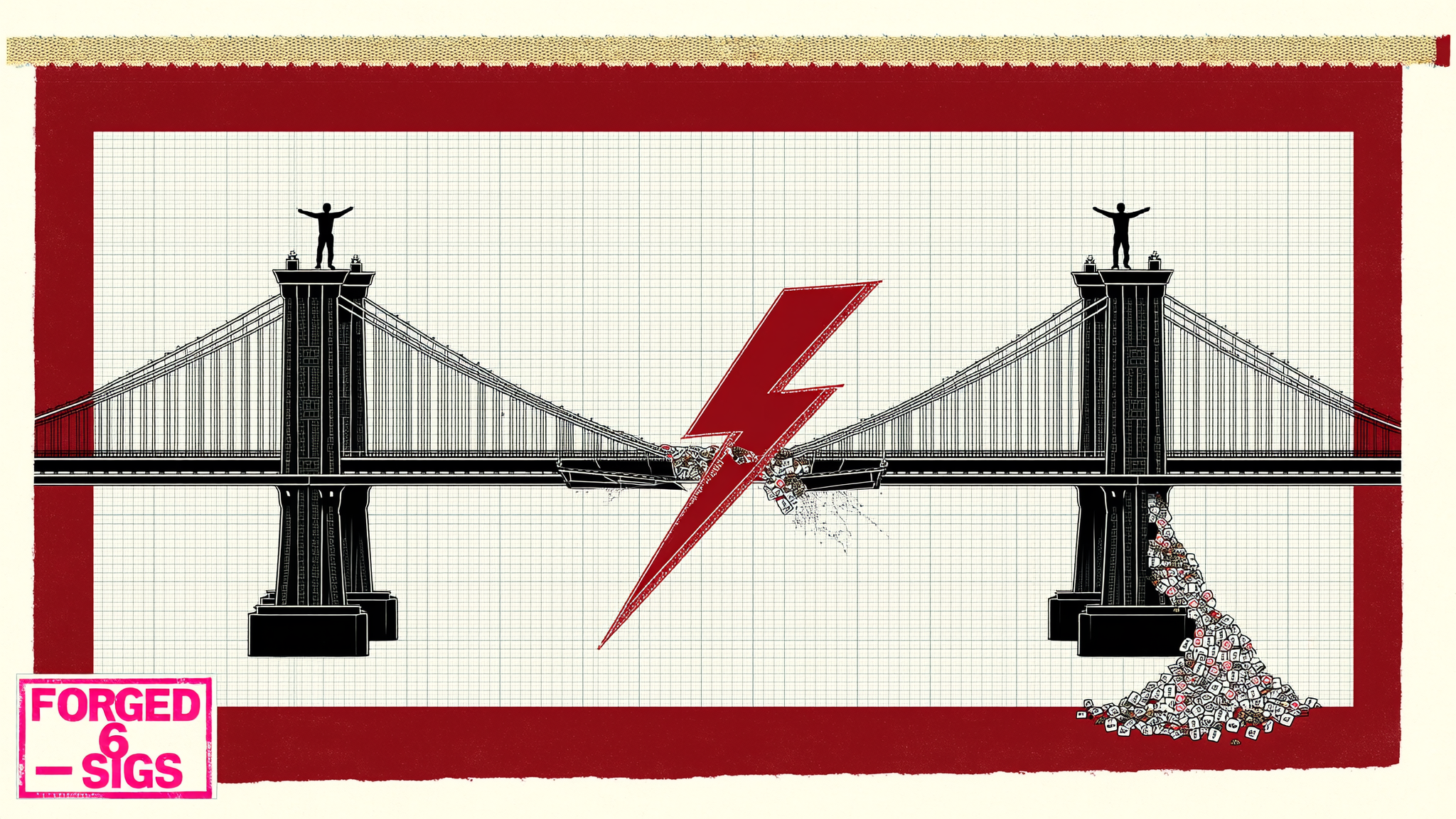
Alephium, a proof-of-work Layer 1 that runs a private fork of the Wormhole bridge, lost about $815,000 across Ethereum and BNB Chain on Friday after an attacker pushed forged messages through the bridge backend and out the other side as legitimate-looking transfers, according to the team. Alephium… Read the full story at The Defiant
Worldcoin rallied after World Network partnered with Thirty Seconds to Mars to offer human-only ticket access for selected concerts.
Summary
- WLD climbed after World ID partnered with Thirty Seconds to Mars for human-only ticket access.
- Price hit $0.3779 before cooling, leaving $0.30 to $0.32 as key support.
- MACD remains bullish, but RSI shows the rally has slowed after the latest rejection.
Worldcoin moved higher after the Sam Altman-linked identity project gained attention for a new ticketing use case. The partnership allows verified World ID users to access special Thirty Seconds to Mars tickets.
The offer gives verified fans 2-for-1 ticket access, with one free extra ticket excluding VIP packages. It also gives users limited-edition merchandise vouchers for selected shows.
The campaign targets a common live-event problem: bots buying tickets before real fans can access them. World Network says World ID can prove that a user is human without giving ticket sellers a normal account-based identity check.
That real-world use case helped WLD stand out in a mixed altcoin market. The token rose strongly earlier in the session before cooling from its intraday high.
Worldcoin Price cools after strong intraday move
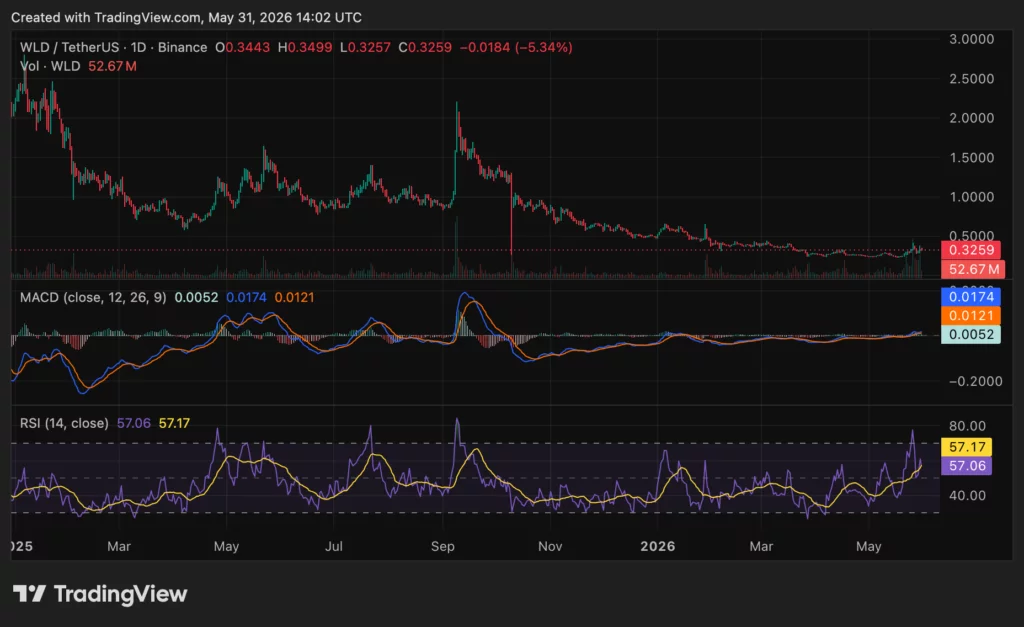
Worldcoin traded near $0.33 after earlier climbing as high as $0.38. The move followed a sharp daily rally, although the latest update showed the token had eased from its strongest level.
WLD’s 24-hour trading volume stood above $328 million, showing active market participation during the move. The token held a market cap of about $1.09 billion and ranked near the top 70 crypto assets by market value.
The price remains well below its all-time high of $11.74, reached in March 2024. It also remains down more than 70% over the past year, even after gaining more than 35% over the last 30 days.
That wider backdrop matters because the current move is still a recovery rally inside a larger downtrend. Buyers have returned in the short term, but WLD must hold key support to keep the rebound alive.
Indicators show buyers still have momentum
The latest chart shows WLD trying to hold above the $0.30 to $0.32 area after bouncing from the lower range. That zone now acts as the first support area for short-term traders.
Volume on the chart stood near 52.67 million WLD, showing that trading activity increased during the latest move. However, sellers stepped in after WLD approached the $0.40 to $0.45 zone.
That range now acts as near-term resistance. A stronger breakout would likely need WLD to reclaim $0.45 and then hold above $0.50.
The MACD remains bullish. The MACD line stands at 0.0174, above the signal line at 0.0121, while the histogram sits at 0.0052.
This shows that upside momentum remains active. However, the latest red candle shows that the rally has cooled after the recent surge.
Meanwhile, the RSI is at 57.06, close to its signal line at 57.17. That keeps WLD above the neutral 50 level, meaning buyers still have some control.
However, the RSI has pulled back from its recent high near overbought levels. This shows that the rally has slowed after strong early buying.
The World ID ticketing deal gives WLD a fresh real-world story. It also raises familiar questions around biometric identity, data safety and user trust.
Some traders asked whether this could be proof that crypto identity matters as bots take up more internet activity. Others focused on what could happen if biometric data or identity systems face security issues.
As previously reported by crypto.news, Worldcoin has already seen sharp narrative-driven rallies this year, including moves tied to AI, identity tools and broader interest in proof-of-human technology. Earlier reports also showed that WLD has faced criticism over token design and privacy concerns.
For now, the technical setup remains simple. WLD needs to defend $0.30 to $0.32 to keep the recovery intact. A move back above $0.40 would bring $0.45 into focus, while a clean break above $0.50 would show stronger buyer control.
XRP had a rather difficult start to 2026 from a price standpoint, but the underlying XRP Ledger showed notable signs of growth, according to the latest State of XRP report by Messari.
The analytics firm outlines a sharp contrast between the weaker market performance and strong network fundamentals, with stablecoin adoption, real-world asset tokenization, and transaction activity all increasing during the quarter.
XRP Price Falls as Trading Activity Cools
During the first quarter of the year, XRP was, for the most part, the fourth-largest non-stablecoin cryptocurrency by means of total market capitalization, trailing only Bitcoin, Ethereum, and Binance Coin.
However, the token wasn’t immune to the broader market downturn. Its market cap declined by 26% quarter-over-quarter to about $82 billion, while its price dropped by 27% to $1.34 at the time of this writing.
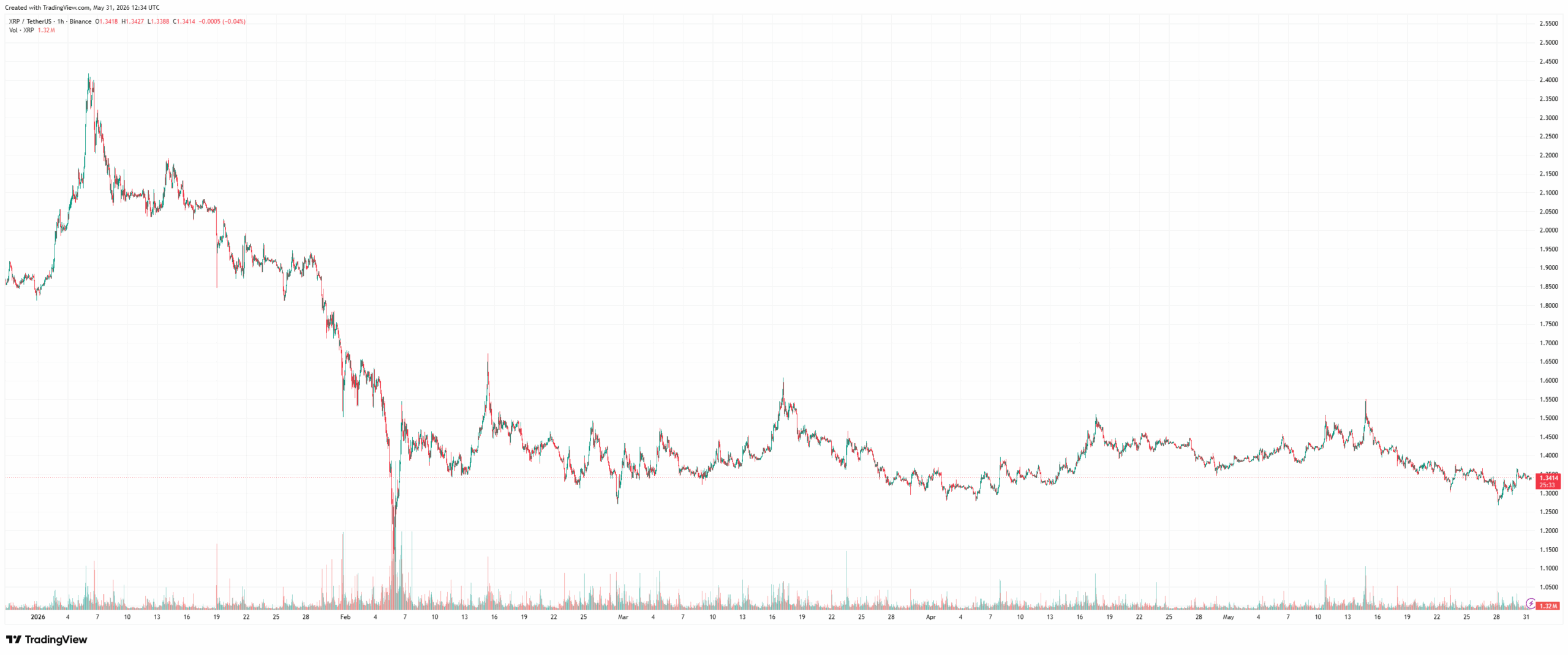
Per Messari’s report, trading activity also slowed down during the cited period. Average daily spot volume declined by 32%, while perpetual futures volume declined by 28.6%. That said, institutional exposure continued to build, as CryptoPotato covered recently. The quarter ended with ETFs holding about 775.4 million XRP, which is roughly 1.26% of the asset’s currently circulating supply.
XRPL Sees Growth in RWAs, Transactions, and Stablecoins
While XRP’s price struggled, XRPL activity moved in the opposite direction, supporting the case for strong fundamental support. Messari indicated that average daily transactions increased by 35% quarter-over-quarter, increasing from 1.83 million to 2.48 million.
The network also saw growing adoption across stablecoins and tokenized assets.
Ripple’s RLUSD stablecoin expanded to a market cap of $340.3 million on the XRPL by the end of the quarter, up 45% from the previous quarter. Meanwhile, XRPL’s real-world market cap soared by 124% QoQ to an all-time high of $2.25 billion.
Messari also reported that new infrastructure is being built in institutional-oriented decentralized finance. During the quarter, permissioned domains, permissioned DEX, and token escrow went live. Meanwhile, native lending protocols and asset vaults are still in voting.
All in all, these developments can be taken to suggest that XRPL’s institutional finance narratives continued to strengthen, despite the weakening price performance of XRP.
The post XRP Ledger Activity Soars in Q1 Despite XRP Price Slump: Messari appeared first on CryptoPotato.
TLDR:
- Bittensor runs 120+ live AI subnets processing hundreds of billions of inferences daily right now
- TAO mirrors Bitcoin’s 21M fixed supply with no premine, no ICO, and no team token allocation
- A single Bittensor subnet recently listed on the marketplace at a $970,000 standalone asking price
- Grayscale’s GTAO Trust creates institutional demand as post-halving supply tightening takes hold
Bittensor’s native token, TAO, is drawing renewed attention from analysts and institutional investors. The network operates over 120 active subnets processing hundreds of billions of AI inferences daily.
Unlike most crypto projects, Bittensor functions as a live, decentralized marketplace for machine intelligence. Its Bitcoin-style tokenomics and growing builder activity are reshaping how some market participants frame its valuation.
Bittensor’s Subnet Economy Drives Real AI Output
Bittensor runs through a system of specialized subnets, each serving as a competitive market for specific AI work. These include text generation, image recognition, code debugging, and financial prediction.
Miners produce AI outputs while validators assess and reward the best work. This creates a continuous, stake-weighted intelligence market operating block by block.
The network directs resources toward the most valuable AI work without any central authority. No board or committee controls funding decisions.
Validators with the most staked TAO carry the most influence over reward distribution. Miners who consistently underperform lose emissions and eventually exit the network.
As @2xnmore noted, “Bittensor is not a crypto project that does AI. It is an AI network that happens to use a token.” That distinction matters for how analysts apply valuation frameworks.
Most market participants are currently pricing TAO as a crypto asset rather than AI infrastructure. That gap between framework and reality is where some analysts see opportunity.
One subnet on the Bittensor marketplace recently listed at a $970,000 asking price. The buyer assessed emission rates, miner quality, and validator coverage before placing that value.
High-performing subnets generate continuous TAO emissions, functioning like yield-bearing assets with fixed-supply cash flows.
Supply Structure and Institutional Activity Support the Thesis
TAO has a maximum supply of 21 million tokens, mirroring Bitcoin’s model. There was no ICO, no premine, and no team allocation.
Every token in circulation was earned through mining or validation. The halving has already occurred, tightening daily supply entering the market.
Grayscale launched its GTAO Trust, creating programmatic institutional demand alongside tighter supply. Polychain Capital, Digital Currency Group, and Dao5 have all invested in the network.
These firms conduct deep technical due diligence before committing capital, lending credibility to the infrastructure thesis.
James Altucher built bluetao.ai, a TAO-powered ChatGPT alternative running on Bittensor subnets. He also launched the TAO Pod podcast targeting mainstream audiences outside crypto.
When builders outside the crypto-native world commit to a network, user adoption can grow through different channels.
Chutes AI, a leading subnet, currently processes over 150 billion tokens per day. TAO trades at roughly $313 with a $3.42 billion market cap.
Analysts circulating price targets between $1,000 and $2,000 tie those figures to an AI infrastructure repricing that has not yet occurred.
Quick Summary
- Friday brings the May employment report; April’s numbers showed 115,000 new positions and a 4.3% unemployment rate
- Major earnings releases include Dollar General, Five Below, Broadcom, Palo Alto Networks, and CrowdStrike
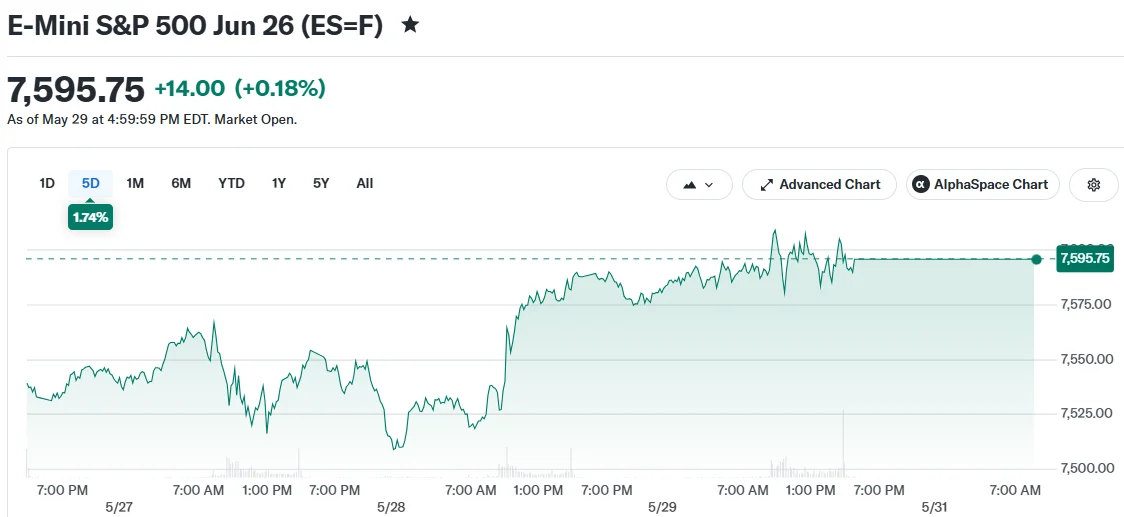
- May ended with markets at all-time peaks: S&P 500 reached 7,580 while the Dow hit 51,032
- Bitcoin declined 0.53% to $73,702, whereas gold advanced 1.28% to $4,575 per ounce
- Dell stock jumped over 32% on robust AI server sales; Anthropic secured $65 billion funding at $965 billion valuation
Investors enter the new trading week following record market performance, a full slate of corporate reports, and anticipation building around one of the year’s most significant employment releases. Here’s what market participants should monitor.
May Wraps With Markets at Peak Levels
Major equity benchmarks concluded May with solid gains. The Dow Jones Industrial Average climbed 0.72% to reach 51,032. The S&P 500 advanced 0.22% to 7,580, while the Nasdaq 100 rose 0.36% to settle at 30,333.
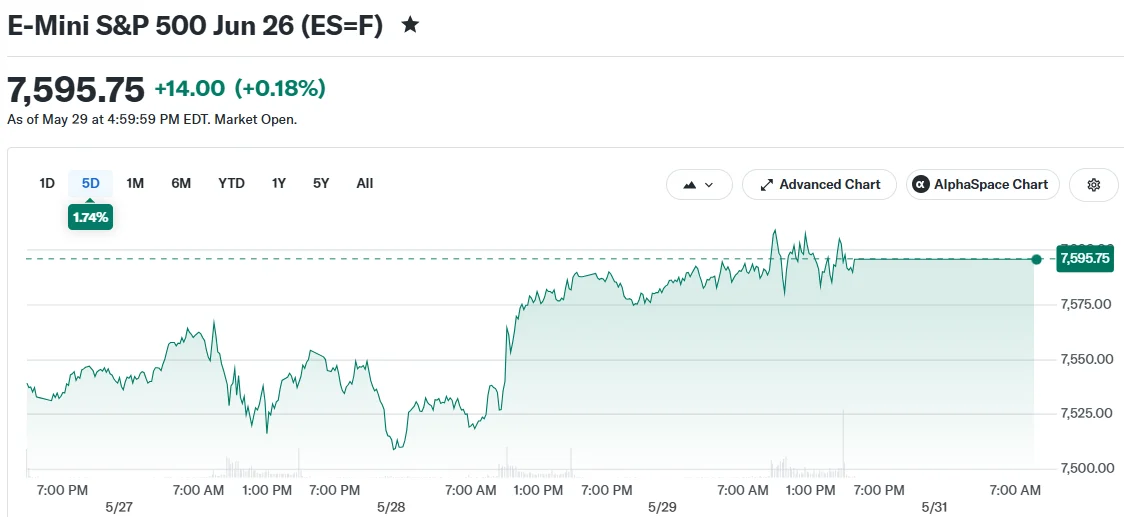
Technology shares provided significant momentum. Dell rocketed more than 32% following impressive quarterly results and upgraded forward guidance, with executives highlighting increased appetite for AI-powered servers. Broadcom stock has climbed over 25% year-to-date following partnership agreements with Meta, Google, and Anthropic.
The 10-year Treasury yield advanced to 4.44%. This uptick in fixed-income yields continues applying headwinds to rate-sensitive equities and remains a focal point for market observers.
Oil fell sharply. West Texas Intermediate crude closed the week approximately 9% lower at $87.98 per barrel. The decline signals reduced friction between the United States and Iran alongside prospects for a potential ceasefire agreement.
Cryptocurrency and Precious Metals Show Divergence
Bitcoin edged down 0.53% through the week, finishing at $73,702. Despite numerous headlines, digital asset markets maintained relative stability.
Gold appreciated, climbing 1.28% to reach $4,575 per ounce. Market participants seem to be gravitating toward gold as protective holdings amid rising bond yields and ongoing geopolitical tensions.
Key Events for the Coming Week
The most significant release arrives Friday with the May employment report, scheduled for 8:30 a.m. ET from the Bureau of Labor Statistics. April’s data revealed 115,000 jobs created, declining from March’s 178,000, while unemployment remained steady at 4.3%.
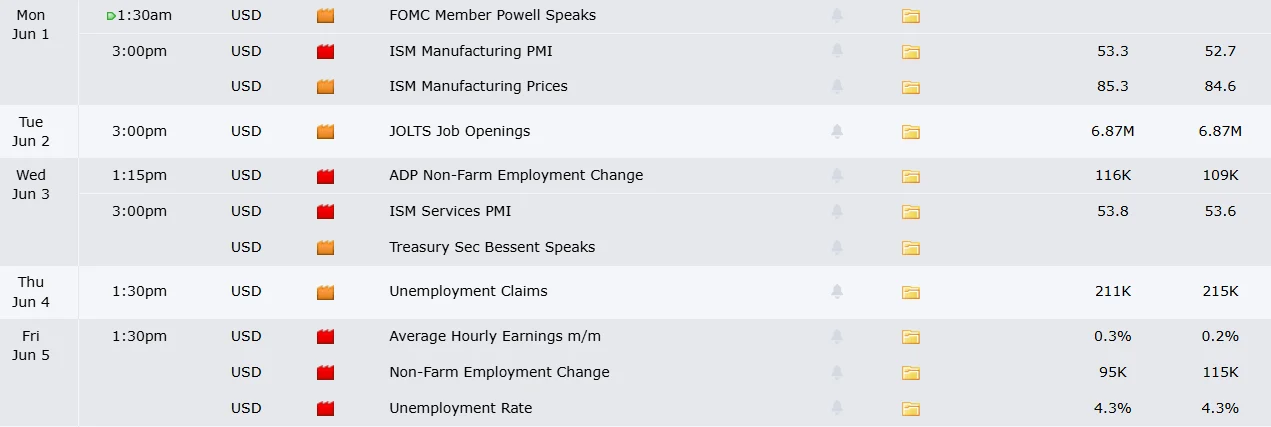
Analysts remain split on interpreting the figures. Some point to labor market resilience. Others argue the expansion primarily stems from healthcare sector hiring tied to demographic shifts rather than comprehensive economic vigor.
New Federal Reserve Chair Kevin Warsh approaches his inaugural policy meeting scheduled for mid-June. Warsh has signaled the Fed will adopt less transparency regarding interest rate deliberations, potentially forcing investors to lean more heavily on economic indicators like employment statistics.
Corporate Earnings Take Center Stage
Dollar General and Five Below deliver quarterly results Tuesday and Wednesday respectively. These retailers cater to budget-conscious consumers, making their performance a valuable gauge of lower-income spending patterns amid persistent inflation.
Within technology, Palo Alto Networks announces Tuesday after market close. The cybersecurity firm exceeded projections last quarter but reduced annual forecasts citing elevated acquisition-related expenses. CrowdStrike follows Wednesday. Broadcom closes out Wednesday’s session with its report.
Lululemon presents Thursday. The athletic apparel company has seen shares tumble roughly 60% over the past year and is currently transitioning to new chief executive leadership.
Artificial Intelligence Momentum Persists
Anthropic, creator of the Claude AI platform, completed a $65 billion funding round at a $965 billion valuation. This capital raise positions Anthropic on the cusp of becoming the first privately-held AI enterprise valued at one trillion dollars.
Microsoft is purportedly developing an integrated super application consolidating its Copilot AI capabilities into a unified platform spanning coding, communication, and productivity functions. Nvidia chief executive Jensen Huang delivers his keynote address at Computex Taipei Sunday evening, with expectations high for AI-related product announcements.

Key Takeaways
- NuScale holds the exclusive distinction of being the sole U.S. nuclear firm with NRC approval for its small modular reactor design, providing a crucial regulatory advantage.
- First quarter 2026 revenue totaled a mere $565,000—a staggering 95.8% decline from the previous year—falling far short of the $7 million analyst forecast.
- Shares currently hover between $12 and $13, representing a steep 65% drop from year-ago levels, with the 52-week peak reaching $57.42.
- Significant insider divestment occurred in recent months, notably Director Corp Fluor’s April sale of 13.5 million shares valued at more than $159 million.
- Analyst consensus stands at “Hold,” with a mean price target of $15.92, while institutional stakeholders control 78.37% of outstanding shares.
NuScale Power (SMR) has experienced a dramatic descent, with shares now changing hands below $13—a precipitous 65% decline from levels seen twelve months earlier. This substantial valuation contraction has captured investor attention, though the underlying fundamentals present a nuanced picture.
NuScale Power Corporation, SMR
Shares commenced Thursday’s session at $12.05, operating within a 52-week trading band spanning $8.85 to $57.42. The company’s market capitalization hovers around $4.4 to $4.5 billion—a remarkably large valuation for an enterprise that generated merely $565,000 in quarterly revenue.
That first-quarter performance wasn’t simply underwhelming—it represented a dramatic shortfall against Wall Street’s $7 million projection. The year-over-year revenue collapse of 95.8% accompanied an operating deficit of $57 million for the three-month period.
NuScale disclosed Q1 earnings per share of -$0.14, falling short of the -$0.11 consensus forecast. Full-year projections call for EPS of -$0.79.
Why Some Remain Bullish on NuScale
The optimistic perspective centers on regulatory positioning. NuScale stands alone among American nuclear reactor developers in possessing Nuclear Regulatory Commission certification for its small modular reactor architecture. Competitors including Oklo and Nano Nuclear Energy lack this critical approval and may require multiple years to obtain similar authorization.
NuScale maintains engagement in two significant projects. The company collaborates with a Romanian energy provider to construct a 462-megawatt facility at a decommissioned coal plant location. Domestically, through partnership with ENTRA1, it pursues 6 gigawatts of SMR deployment for the Tennessee Valley Authority.
Both initiatives anticipate completion timelines extending beyond 2030. Consequently, NuScale functions essentially as a pre-commercialization enterprise commanding a multi-billion dollar market valuation.
The organization does maintain substantial financial reserves—approximately $1 billion total, including $341 million in cash and cash equivalents. While this provides operational runway, it doesn’t yet translate to profitability.
Heavy Insider Divestment Amid Institutional Support
Recent insider transaction patterns warrant examination. Over the trailing 90-day period, company insiders divested more than 40 million shares representing nearly $475 million in aggregate value. The most substantial transaction involved Director Corp Fluor, which disposed of 13.5 million shares throughout April at a mean price of $11.81, totaling approximately $159 million.
Corporate insider ownership has contracted to just 1.28% of total shares outstanding.
Conversely, institutional investors maintain a commanding 78.37% ownership stake. Seven Grand Managers LLC established a fresh position valued at $1.77 million during Q4. Multiple additional investment firms—including MAI Capital Management and Harbour Investments—expanded their existing holdings.
Wall Street sentiment presents a mixed landscape. B. Riley reduced its price objective from $24 to $19 while maintaining a “Buy” recommendation. HSBC initiated coverage with a “Hold” rating and $13 target. Royal Bank of Canada lowered its projection from $21 to $14. TD Cowen downgraded the stock from “Buy” to “Hold” in February.
The aggregate view across 17 covering analysts settles at “Hold,” with a mean price target of $15.92—representing approximately 25% upside from current trading levels.
NuScale’s 50-day moving average stands at $11.41, while its 200-day moving average rests at $15.38, with the stock currently positioned between these technical indicators.

Calamos Aksia Alternative Credit & Income Fund Q1 2026 Commentary

Bitcoin Targets $78K as Holders Defend Strongest Near-Term Support

Jay-Z Finally Settles His Score With ‘Maniac’ Kanye West


-

 Business7 days ago
NYT Strands Answers May 24 2026 Revealed for Puzzle No. 812 Theme Summer Essentials
-

 NewsBeat4 days ago
Israel says it has killed new Hamas military leader in Gaza City airstrikes
-

 Tech4 days ago
NASA taps Blue Origin to deliver lunar rovers for Moon Base initiative
-

 Politics6 days ago
Bridgerton Season 5: Cast, Release Date And Everything We Know So Far
-

 News Videos4 days ago
XRP *JUST* SUCCEEDED!!!! CLARITY ACT EXPOSED!!! (SHE EXPOSED IT)
-

 Sports5 days ago
2026 NBA Finals schedule, odds: Knicks await Thunder or Spurs after winning East
-
Crypto World5 days ago
Micron Crosses $1 Trillion Market Cap as AI Demand Reshapes Memory Sector
-

 Business5 days ago
Selena Gomez Reportedly Upset Over Benny Blanco’s Comments on Her ‘Terrible’ Diet
-
Crypto World7 days ago
Brian Armstrong Outlines Crypto Vision for the Future Financial System
-

 News Videos2 days ago
This is BROKEN! INSANE 5x MONEY CAR WASH WEEK! The NEW GTA Online UPDATE Today! (GTA5 New Update)
-

 Business6 days ago
BTS Sells Out Four Las Vegas Shows at Allegiant Stadium for ARIRANG World Tour
-
 Tech5 days ago
China assigns ID codes to 28,000+ humanoid robots
-
 NewsBeat6 days ago
Hottest May day ever as London hits 34.8C in 2C leap from previous records
-

 Tech6 days ago
Microsoft’s quiet Claude Code retreat and the real cost of enterprise AI
-

 Tech2 days ago
Waymo dominates autonomous vehicle registrations as Tesla trails behind
-

 Business6 days ago
Nikkei 225 Surges Past 65,000 for First Time as Iran Peace Hopes Fuel Record Rally
-
Tech4 days ago
The Samsung pay deal is the moment Korean unions changed register
-

 Tech6 days ago
Westone Audio and Etymotic Acquired by Fidelity Collective in Major IEM Market Move
-
 Entertainment6 days ago
‘Breaking Bad’ Star’s Easy-to-Binge 6-Part Crime Series Spin-Off Is Finally Heading to Free Streaming
-

 NewsBeat6 days ago
Crowds find riverside shade in York as temperatures soar
You must be logged in to post a comment Login