
Crypto World
Sam Bankman-Fried needs favor from Trump after failed appeal



The last real shot FTX founder Sam Bankman-Fried had at undoing his fraud conviction just collapsed. A three-judge panel of the powerful, Second US Circuit Court of Appeals in Manhattan upheld his conviction and 25-year prison sentence on Friday.
The panel flatly rejected his claim that he never got a fair trial.
The evidence against him, the judges wrote in a 42-page opinion, was “conservatively stated” and “robust.”
Bankman-Fried’s only remaining possibility to escape prison before the 2040s has narrowed to a presidential pardon.
Judges Barrington Parker, Eunice Lee, and Maria Araújo Kahn heard oral arguments in November 2025. Bankman-Fried’s appellate lawyer, Alexandra Shapiro, argued that US District Judge Lewis Kaplan hamstrung Bankman-Fried’s defense.
The appeal failed to convince the panel.
Bankman-Fried’s convictions and prison sentence sustained
In November 2023, a Manhattan jury convicted Bankman-Fried on two counts of fraud and five counts of conspiracy.
Kaplan duly sentenced him to prison in March 2024, delivering a 25-year sentence and ordering an $11 billion forfeiture.
Read more: Sam Bankman-Fried begs Trump for pardon, gets bipartisan ‘No’
The court found that FTX customers lost more than $8 billion. Investors lost another $1.7 billion, and Alameda lenders lost $1.3 billion.
Three of his four closest deputies pleaded guilty and cooperated with the US government during his prosecution. They testified that Bankman-Fried directed them to drain customer deposits to plug holes at Alameda, his hedge fund.
Prosecutors called it a “fraud of epic proportions.”
Bankman-Fried has chased any possibility of a prison exit for over a year. As Protos has documented, he’s repeatedly asked Donald Trump for a pardon and launched a social media campaign to praise Trump’s policies.
Unfortunately, the White House and Trump have acknowledged his requests and publicly declined. His legal appeals are now exhausted, as well, unless he wants to appeal to the Supreme Court.
Bankman-Fried’s projected prison release date is 2044.
Got a tip? Send us an email securely via Protos Leaks. For more informed news and investigations, follow us on X, Bluesky, and Google News, or subscribe to our YouTube channel.


Ethereum price is trading near $1,900, but the market may be underestimating a major institutional development that could boost its prediction. A consortium of more than 140 organizations, including BlackRock, Visa, Mastercard, Stripe, and BNY, confirmed plans to launch a new Ethereum-based stablecoin.
The project, called Open USD (OUSD), is governed by Open Standard, an independent consortium. Instead of concentrating reserve income with one issuer, it distributes earnings across ecosystem partners. Fundstrat co-founder Tom Lee called the launch another sign of Ethereum’s growing role in global finance. OUSD also lets businesses mint and redeem without fees or volume caps.
The announcement builds on Ethereum’s expanding institutional presence. U.S. spot Ethereum ETFs have attracted about $11.2 billion in cumulative net inflows since launch. BlackRock’s ETHA remains the largest contributor, accounting for roughly $11.4 billion in cumulative inflows. These figures highlight sustained institutional demand beyond short-term market swings.
Rather than standing alone, the OUSD launch strengthens the case for Ethereum as a preferred settlement layer for tokenized dollars. If adoption gains momentum, institutional payment activity could increase on the network. That trend may support long-term demand for ETH while reinforcing its position in the digital asset economy.
Discover: The Best Crypto to Diversify Your Portfolio
Ethereum Price Prediction: Reclaim $2,200 on Institutional Momentum?
Ethereum is trading around $1,916, sitting near a technically sensitive area. Price remains below its 50-day simple moving average, keeping short-term momentum in check. Today’s range spans roughly $1,874 to $1,927, reflecting hesitation rather than strong buying or selling pressure.
Recent technical analysis continues to identify $2,200 to $2,300 as the key resistance zone. That leaves ETH about 15% to 20% below the next major breakout area. Until buyers reclaim that level, rallies may continue facing heavy selling pressure.

The bullish case hinges on the Open USD consortium strengthening Ethereum’s institutional narrative. A move above $2,000 could open the door toward $2,200, with $2,400 to $2,700 becoming the next upside targets. Several market analysts still expect stablecoin growth and tokenized real-world assets to support higher valuations over time.
The base case remains a consolidation between $1,850 and $2,100 as investors digest recent developments. Meanwhile, steady ETF inflows and Ethereum’s staking participation continue supporting long-term fundamentals. However, price may need another catalyst before momentum returns.
The bearish scenario begins with a decisive close below $1,750, which would weaken the current technical structure. A risk-off macro environment or tougher stablecoin regulation could trigger that move. Even so, Ethereum’s Layer 2 ecosystem and rising institutional adoption remain supportive over the long run.
Trade Ethereum on Bybit and Get a Chance to Win Our $1,000 USDT Airdrop
Bitcoin Hyper Targets Early Mover Upside as Ethereum Tests Key Levels
ETH at $1,900 is compelling for believers in the long-term thesis, but at a market cap already in the hundreds of billions, the asymmetric return window is limited compared to where it was 18 months ago. Traders rotating capital into earlier-stage infrastructure plays are increasingly looking at the Bitcoin ecosystem, where the build-out is arguably earlier in its curve.
Bitcoin Hyper ($HYPER) is positioning directly at that intersection. It is the first Bitcoin Layer 2 with Solana Virtual Machine integration, bringing sub-second smart contract execution to Bitcoin’s security layer without sacrificing BTC’s trust model.
The use of SVM is the differentiator: this delivers faster performance than Solana itself while anchoring settlement to Bitcoin. The presale has raised $32.9 million at a current price of $0.0136839, with staking already active at high APY. The project’s Decentralized Canonical Bridge handles native BTC transfers without wrapped token dependencies, a real infrastructure distinction, not a whitepaper feature.
Research Bitcoin Hyper and apply standard due diligence before sizing any position.
Discover: The Best Token Presales
The post Ethereum Price Prediction: Blackrock Backed Stablecoin to Launch on ETH appeared first on Cryptonews.
Crypto World
Bitcoin Price Prediction: $10 Billion of BTC and ETH Option Expiry Hitting the Market Today

The largest single-day options expiry in recent months is clearing today, and the market is already pricing in the friction. Bitcoin price sits at $63,800, hovering just below the $64,000 max pain level as dealers manage delta exposure into settlement in its current bullish prediction. Ethereum trades around $1,890, staying near its own max pain threshold with conviction still absent on both sides.
According to data reported on July 31, 149,000 BTC options expired with a put/call ratio of 0.28, max pain at $64,000, and a notional value of $9.6 billion. Meanwhile, 435,000 ETH options expired with a put/call ratio of 0.63, max pain at $1,850, and a notional value of $830 million. Together, more than $10.4 billion in crypto options were cleared during a single session.
The BTC put/call ratio of 0.28 remains heavily skewed toward calls. That reflects bullish positioning, although many upside bets still expired out of the money. As the expiry passes, attention shifts to whether fresh positioning replaces those contracts or traders remain cautious.
Next comes dealer rehedging and a reset in open interest. That can spark a fresh directional move or leave prices drifting in thin liquidity. Meanwhile, the previous FOMC session offered little clarity, and the macro backdrop still lacks a strong catalyst for crypto.
Catch Bitcoin and Ethereum’s Volatility on Bybit and Get a Chance to Win Our $1,000 USDT Airdrop
Bitcoin Price Prediction: Reclaim $66,000 After Today’s $9.6 Billion Expiry Clears?
Bitcoin trades at $63,800, remaining pinned near the $64,000 max pain level. That is less coincidence than options market mechanics. With a 0.28 put/call ratio, the market leaned heavily toward calls, making $64,000 the level where the greatest number of contracts expired with minimal payouts. Once the settlement clears, that influence fades.
Immediate resistance sits between $65,500 and $66,000. A decisive break could open the way toward $68,000, although stronger volume must confirm the move. Meanwhile, ETF flows have remained soft this week, and US equity volatility has yet to pull fresh capital into crypto. That divergence continues to limit bullish momentum.

The bullish case sees post-expiry dealer hedging unwind, allowing Bitcoin to reclaim $66,000 and challenge $68,000 to $70,000 over the coming sessions. The base case keeps price ranging between $62,000 and $66,000 as traders wait for a fresh catalyst. A daily close below $62,000 would put $60,000 support back into focus.
Ethereum trades around $1,891, leaving the $1,900 level as an important resistance zone. Its max pain level sits at $1,850, placing the price only modestly above that mark after expiry. A sustained move above $2,000 would improve Ethereum’s technical structure and strengthen the near term outlook.
Discover: The Best Token Presales
Bitcoin Hyper Targets Early Mover Upside as Bitcoin Tests Post-Expiry Footing
BTC at $63,800 with an 8-month bear market still unresolved presents a clear asymmetry problem: the upside to $70,000 from here is roughly 9.5%, but the downside to $60,000 is equally accessible and better supported by current macro conditions. Rotation into early-stage Bitcoin infrastructure with a different risk profile is exactly the trade that gains attention in these sideways regimes.
Bitcoin Hyper ($HYPER) is positioned as the first Bitcoin Layer 2 with Solana Virtual Machine (SVM) integration, meaning it targets sub-second finality and low-cost smart contract execution directly within the Bitcoin ecosystem, without sacrificing BTC’s base-layer security.
That’s a technically distinct proposition from existing L2 approaches, as presale has raised $32.9 million at a current price of $0.0136839, with staking available for holders during the raise period. The project includes a Decentralized Canonical Bridge for native BTC transfers and high-speed transaction execution that reportedly outperforms Solana itself on latency benchmarks.
Post-expiry BTC could grind sideways for sessions before resolving, the risk/reward math on early infrastructure plays looks different than chasing spot at current levels.
Research Bitcoin Hyper before the next presale stage closes.
Discover: The Best Crypto to Diversify Your Portfolio
The post Bitcoin Price Prediction: $10 Billion of BTC and ETH Option Expiry Hitting the Market Today appeared first on Cryptonews.


The 2026 FIFA World Cup generated a record $20 billion in prediction market volume, according to blockchain analysis firm Chainalysis.
The figure encompasses activity across nearly 400,000 wallets starting in January 2026 with $5.7 billion in volume generated during the tournament itself, Chainalysis said in a Thursday report.
Markets ranged from the simple question of who would win the international soccer tournament to whether Portugal legend Cristiano Ronaldo would cry when his team was eliminated (he did).
The World Cup, held in June and July, represented by far the biggest prediction market event in terms of volume, shattering the $3.6 billion traded during the 2024 U.S. Presidential Election. Other notable events were Super Bowl 60 in February and the NCAA’s basketball tournament known as March Madness, both of which eclipsed the $1 billion mark.
Prediction markets offer derivatives contracts on the outcome of future events, and settle when the relevant event takes place.
Market leader Polymarket runs on blockchain rails with trades and settlement in stablecoin USDC. As a result, the platforms have become one of the ways in which blockchain technology has gained significant mainstream attention.
Crypto World
Ripple Just Got Full MiCA Authorization in Europe But Fed’s Hawkish Tone Is Keeping XRP Capped at $1.10

In the latest XRP News, XRP price is trading at $1.07, down 0.57% in the last 24 hours, as the asset continues to wrestle with the $1.10 resistance that has capped three consecutive sessions of attempted recovery.
The setup looks deceptively calm on the surface, but the macro and on-chain picture underneath tells a more complicated story. Whether this range resolves with a clean break or a reversal depends on factors that are moving fast right now.
The Federal Reserve held rates steady in the 3.50%–3.75% range, but Fed Chair Kevin Warsh’s hawkish post-meeting tone, insisting the Fed “will deliver the 2% target”, reinforced a risk-off undertone across liquid assets.
Despite that headwind, on-chain data from Santiment shows mid-tier holders (10,000–100,000 XRP) lifting their cumulative share to 11.9% of total supply, up from 11.64% on July 1, while the 100,000–1M XRP cohort climbed to 11.75% over the same window.
Ripple also secured full MiCA Crypto-Asset Service Provider authorization in Europe this week, a regulatory milestone with direct implications for institutional XRP payments flowing across the EU. Perpetual futures open interest sits at 2.27 billion XRP, just below this week’s peak of 2.29 billion.
The combination of a hawkish Fed, a technically capped chart, and a meaningful regulatory unlock creates a binary setup worth examining closely.

Discover: What traders are pricing for the Fed’s next move on Kalshi
XRP News: Can XRP Price Break $1.10 Resistance This Week?
XRP is trading at $1.07, pinned below the Bollinger Band midline near $1.10 and every key exponential moving average.
The 50-day EMA at $1.13 converges with the upper Bollinger Band around $1.14, creating a dense overhead zone that has rejected every intraday push so far. The 100-day EMA at $1.21 and the 200-day EMA at $1.41 confirm the broader structural trend still leans lower. Those levels are not in play unless near-term momentum shifts materially.

Momentum reads soft. Daily RSI hovers near 45, technically neutral but drifting toward weak. MACD is fractionally negative, signaling fading bullish attempts rather than any fresh accumulation pulse. Trading volume and open interest below this week’s high both undermine the idea that a breakout is imminent.
$1.00 remains the primary support level traders are watching. A close below it invalidates the current recovery thesis outright.
MiCA follow-through driving institutional flow, open interest expanding above 2.29 billion, and XRP clearing $1.10 with volume opens a run toward $1.13 to $1.14.
Range-bound consolidation between $1.05 and $1.15 continues while the market waits on ETF flow headlines and any exchange listing catalysts, the more likely near-term path. A daily close below $1.00 signals distribution is winning and the mid-tier accumulation data becomes irrelevant.
Discover: Live odds on the Fed’s next rate decision
The post Ripple Just Got Full MiCA Authorization in Europe But Fed’s Hawkish Tone Is Keeping XRP Capped at $1.10 appeared first on Cryptonews.
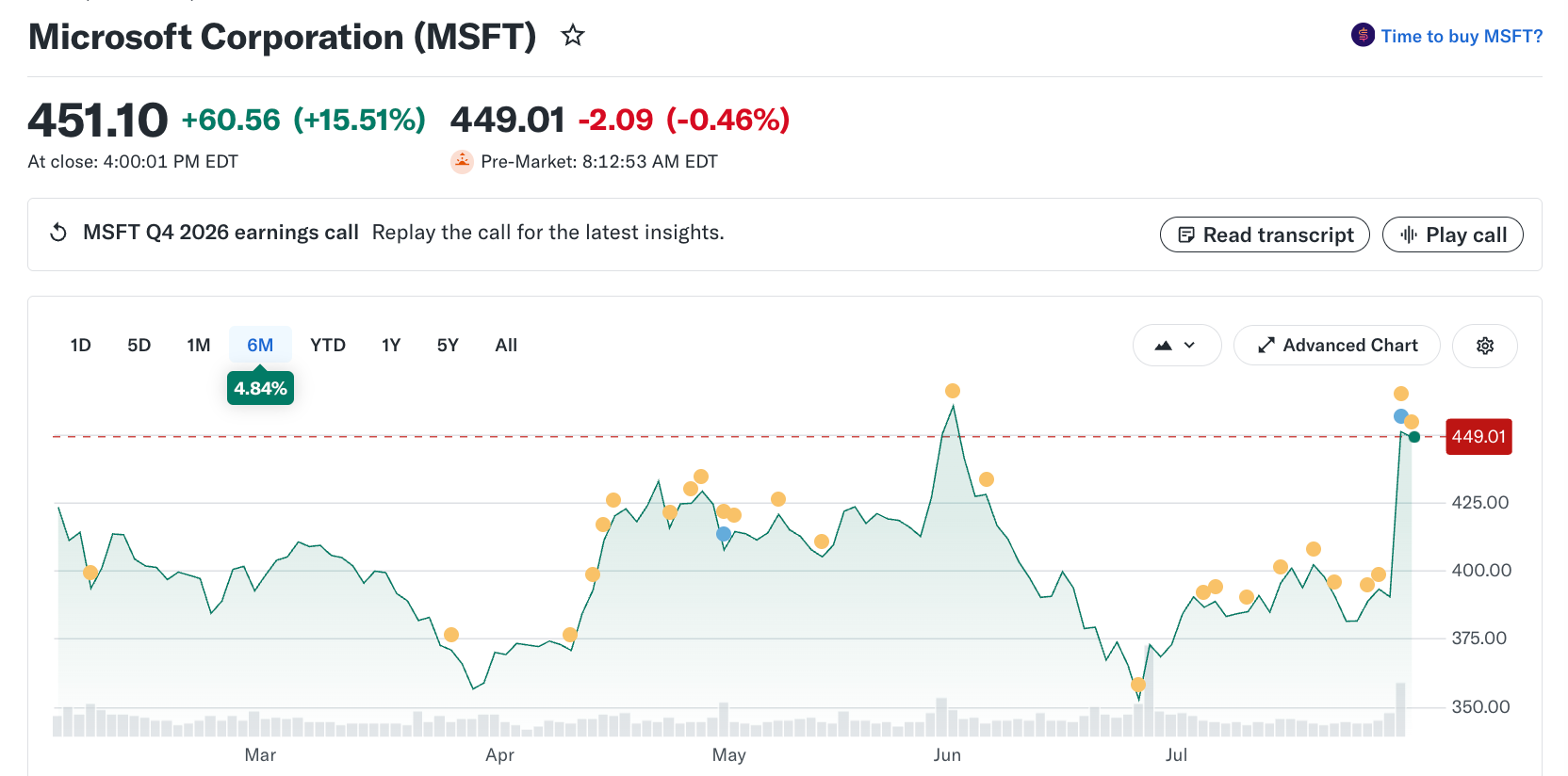
The latest earnings week has handed investors a clear shortlist of US stocks to watch in August. Three of the market’s largest companies just reported, and Wall Street split its verdict between reward and punishment.
The divide came down to one test, which AI spender could prove that customers are paying for the build. It left the winners with strong setups and one laggard facing a cautious road into August.
Microsoft (NASDAQ: MSFT)
Microsoft soared about 15% to near $451 after its July 29 results, its biggest jump in months. Trading volume, the number of shares changing hands, hit its highest since June 22, which shows strong conviction behind the buying.
Want more insights like this? Sign up for Editor Harsh Notariya’s Daily Newsletter here.
Yet the rally is not fully convincing. That volume still sits below the heavy selling of late June, so buyers have not fully overpowered sellers.

The Chaikin Money Flow (CMF), a gauge of whether institutional money is flowing into or out of a stock, shows the same doubt. It nearly turned negative before earnings, then rose to 0.04 as big investors reacted. It still sits below its July 24 peak, and it must reclaim that level to confirm institutions are truly buying.

The fundamentals explain the jump. Microsoft spent $41 billion on capital expenditure, the cost of building AI data centers, but backed it with a $678 billion book of signed customer contracts. That locked-in demand proves the spending is funded by real orders, which is the bullish case. It also guided Azure cloud growth toward 45%, and faster growth at that scale points to rising future revenue.
Wall Street agrees. The stock holds a Strong Buy rating, with 24 of 25 firms on Buy, signaling broad expectations of more upside.

Only Barclays trimmed its target, a lone caution that matches the soft volume.
Amazon (NASDAQ: AMZN)
Amazon carries the strongest analyst support of the three, making it one of the more bullish US stocks to watch into August. All 28 covering firms rate it Buy, with none on Hold or Sell, and every major desk raised its price target after earnings. That rare unanimity gives Amazon the cleanest bull case of the week.

Options positioning backs that optimism. The put-to-call volume ratio, which compares bearish bets against bullish ones, fell from 0.74 to 0.54 into the print, meaning traders bought far more calls and leaned bullish.

The open interest ratio, the standing option contracts already in place, held steady at 0.66. That shows longer-term money has not fully committed yet, which leaves room for new buyers to lift the stock in August.
The business explains the confidence. Amazon Web Services, its cloud arm, reaccelerated, and the company disclosed a $496 billion backlog of signed customer demand. When Alphabet and Meta raised their AI spending, investors sold both stocks, fearing spending with no proven payoff. Amazon raised spending too, but its backlog proved customers had already agreed to pay, so the stock rose instead.
There is a catch worth knowing. Amazon’s headline $5.75 per share reads like a huge beat, but most of it came from a one-time paper gain on its Anthropic stake, not from the core business. Strip that out, and profit still rose a healthy 43%, so the bull case holds. The real pressure is cash, because heavy AI spending has pushed free cash flow, the money a company keeps after building, into the red over the past year.
Meta Platforms (NASDAQ: META)
Meta is the outlier among the top US stocks to watch. The stock fell about 8% to near $539 and now sits roughly 23% below its mid-July high.

The problem is cash, not sales. Revenue grew 28%, but free cash flow collapsed to $784 million from $8.55 billion a year earlier. Capex nearly swallowed all the cash the business generated, so Meta leaned on about $25 billion of new debt to keep funding its dividend, which unsettles investors.
Unlike Microsoft and Amazon, the other two US stocks to watch, Meta disclosed no backlog of signed demand, so it cannot yet prove the AI build will pay off. Its core apps also earned less, as Family of Apps operating income, the profit from Facebook, Instagram and WhatsApp, slipped to $23.4 billion from $25 billion. The strongest ad engine on earth delivered a weaker bottom line.
The chart warns of more risk. Meta’s CMF trended lower even as the price climbed from early June to mid-July, and a deep correction followed. It still has not cleared the 0.05 line that would confirm buyers are back, so the same bearish drop could repeat.

Analysts stay loyal but nervous. Meta keeps a Strong Buy, yet at least ten firms cut price targets overnight, including Citi to $800 from $850.

That lower ceiling with unchanged ratings signals near-term caution even from believers.
The post 3 US Stocks To Watch In August 2026 After Big Earnings Week appeared first on BeInCrypto.
Fundstrat’s Tom Lee says the artificial intelligence (AI) trade is not finished. He argues the next leg runs through crypto payment rails built for software agents rather than people.
Veteran macro investor Jordi Visser argued the opposite this week. Lee also chairs the largest corporate holder of ether, which gives his version of the thesis a direct financial stake.
Why Lee Says Chips Were Only the First Leg
Lee, co-founder and head of research at Fundstrat, made the case on a panel hosted by the firm. He covered mobile phones as an analyst in the early 1990s.
Motorola and the infrastructure suppliers led that cycle early. The larger winners arrived later, namely the tower companies spun out of the carriers, and Apple.
Lee expects the same shape now, with financial services as the downstream market. He has already called AI capital spending fears a bullish market tell.
The Four Reasons Banks Cannot Bank Agents
Lee listed trust, proof of funds, lending, and tax collection as the reasons people built commerce around banks. Agents need none of those, he argued.
“It’s a mistake to think that this is going to be built on traditional financial rails,” Lee said.
Bank ledgers must settle in a single national currency. Money is becoming code, according to Lee, so equities, gold, and tokens could all clear as payment.
Part of that rail already exists on paper. ERC-8183, a proposed Ethereum standard filed on Feb. 25, locks an agent’s payment in escrow until a designated evaluator signs off.
Ethereum Foundation researcher Davide Crapis co-authored it with three Virtuals Protocol engineers. It carries Draft status, so nothing about it is final.
Where Tom Lee and Visser Split on the AI Trade
Visser leads AI research at 22V Research and spent two decades at Weiss Multi-Strategy Advisers, latterly as chief investment officer. He says AI’s easy money is over.
He now expects roughly 30% a year instead of the seven or eight times investors once chased. Lee reads the same compression as rotation.
The two converge on the destination. Both expect fee-earning networks to absorb the flow, and both name Ethereum.

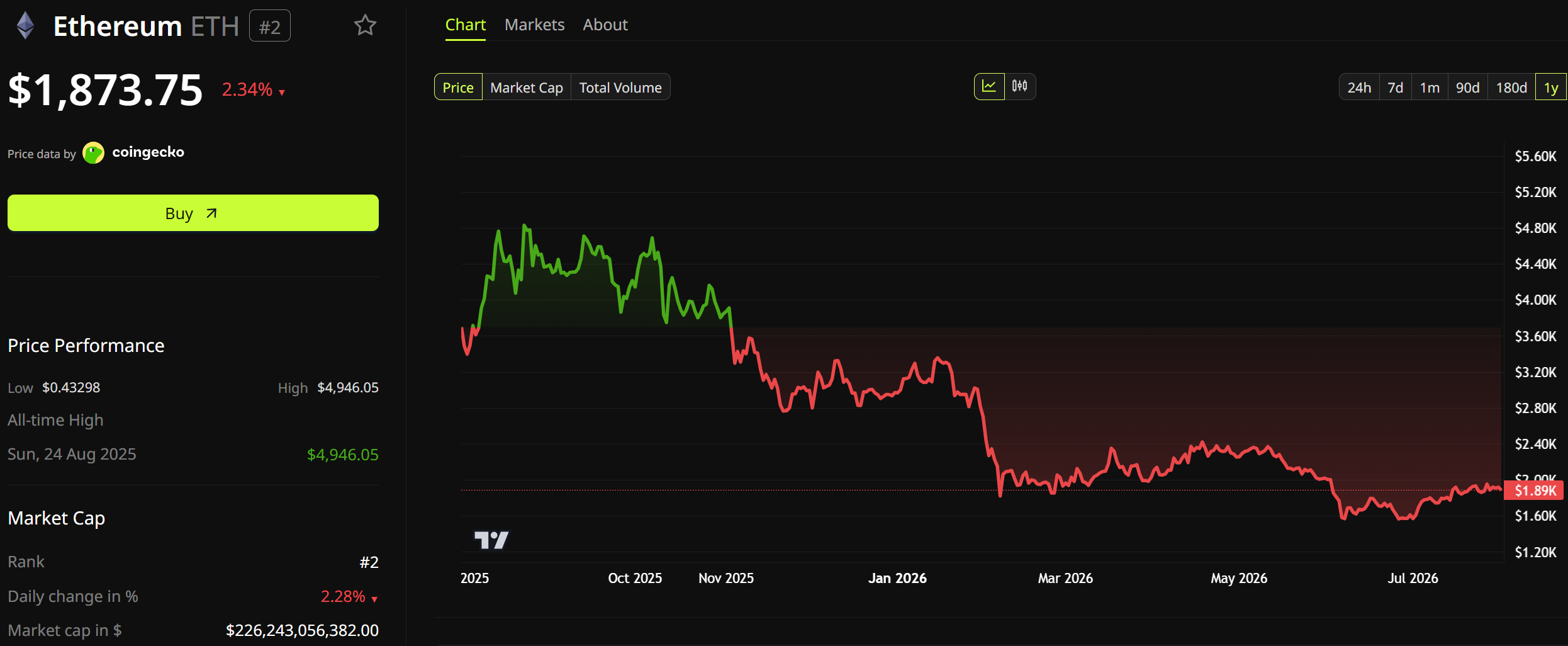
Ethereum trades near $1,873 after gaining 19.7% over 30 days. It still sits 51% lower across 12 months, and just over 2% below its trading price the previous day.
Follow us on X to get the latest news as it happens
Lee’s $11.8 Billion Reason to Prefer Ethereum
Lee chairs BitMine Immersion Technologies, the largest corporate holder of ether. The company disclosed 5.79 million ETH on July 27, close to 4.8% of circulating supply.
Crypto and cash holdings reached $11.8 billion. BitMine states the dependency plainly in its own investor materials.
“So our future price for Bitmine stock is heavily dependent on the future price of Ethereum,” Lee said in the July chairman’s message.
Lee puts the correlation between BitMine shares and ether at 90%. Anyone weighing his agent thesis is also weighing that balance sheet, which rallied this month on its ETH treasury bet.
The Numbers Do Not Match the Story Yet
Jansen Teng, co-founder and chief executive of Virtuals Protocol, shared the panel with Lee. His platform lets agents hold wallets and pay each other onchain, and his figures undercut the timeline.
Teng said the launchpad for agent tokens has cleared about $15 billion in trading volume. Agent-to-agent commerce has settled roughly $500 million in a year.
Speculating on agents is therefore some 30 times larger than agents transacting. Both figures are company-reported and have not been independently verified.
Teng said the agents kept $2.5 million in profit, and that the product has not reached product-market fit (PMF). Virtuals commissioned the Fundstrat research and is a client of the firm.
Its VIRTUAL token trades near $0.56, down 89% from a January 2025 peak, even after agents started trading tokenized stocks onchain.

So the question is not whether the AI trade ended. It is whether machine payments arrive before the balance sheets betting on them need the story to work.
The post Tom Lee vs Jordi Visser on the AI Trade: Both End Up at Ethereum appeared first on BeInCrypto.
Coinbase said it captured a record 10.3% share of global crypto trading volume during the quarter, its third consecutive quarterly gain. Analysts at Benchmark, Oppenheimer, Clear Street and Cantor all highlighted the figure as evidence that trading activity is consolidating onto larger regulated exchanges during periods of market stress.
Several also pointed to derivatives, where Coinbase reported flat trading volumes despite management saying the broader derivatives market declined by double digits.
Diversification shows progress, but isn’t enough
Analysts viewed Coinbase’s push beyond spot trading as encouraging, even though the newer businesses remain too small to offset weakness in core trading revenue.
The company is trying to diversify through prediction markets, derivatives, subscriptions, stablecoins and its Base blockchain. Prediction markets surpassed a $100 million annualized revenue run rate, while Coinbase One topped one million paid subscribers. Its Circle partnership for USDC also renewed on existing terms, removing a key concern for investors.
Still, there was broad agreement that diversification has not yet become large enough to replace lost trading revenue.
Clear Street noted new businesses continue gaining traction but remain “optionality” rather than meaningful earnings contributors. Barclays was more critical, arguing prediction markets and retail derivatives “did not” provide the boost they offered last quarter. Compass Point similarly said emerging businesses “barely moved the needle.”


“This is by far the biggest Iranian illegal gambling network ever discovered and one of the biggest in the world,” said John Wojcik, a former researcher at Infoblox and now senior analyst at TRM Labs, who spent seven years investigating illegal gambling for the United Nations Office on Drugs and Crime.
It is also one of the largest Iranian sanctions-evasion networks discovered since 2016, when the U.S. broke up a roughly $20 billion IRGC gold-for-oil operation based in Turkey. Separately, the U.S. seized $1 billion in crypto from Iran in May.
“It’s an IRGC operation, and that’s plain as day,” Rich Sanders, an independent blockchain researcher and investigator focused on Iran, said of Shelbit. Reuters said it could not determine whether the IRGC directly controlled Shelbit or the gambling network.
The IRGC, founded in 1979, is the country’s most powerful and influential military, political and economic institution that answers directly to the country’s supreme leader, Mojtaba Hosseini Khamenei.
Shelbit also interacts directly with Iran’s central bank, wallets linked to the IRGC by the Israeli government, and Nobitex, an Iranian exchange that the U.S. government sanctioned earlier this year after a Reuters investigation revealed its ties to the government. Some of the crypto flowing to Shelbit came from what the two investigative firms described as an Iranian bitcoin mining operation that creates new digital coins.

European support for Ukraine remains strong, and governments suffering from higher prices are more likely to blame Moscow than Kyiv. But Putin is now so anxious for battlefield wins that he will stay the course even without a clear-cut victory. Nor should we expect a revival of the agreement brokered by the United Nations in July 2022 that restored safe maritime traffic to and from Ukrainian ports.
Just as the standoff in the Strait of Hormuz has sent neighboring countries scrambling for new ways to move oil out of the Persian Gulf, Ukraine may be able to move grain through the Danube, via Romanian ports, and by rail, as it did in the war’s early days. But as before, diversions are costly and logistically complicated.
For all these reasons, the shape of Russia’s war on Ukraine will continue to shift as each side searches for new ways to break the battlefield stalemate in its favor. And the economic damage, felt well beyond Ukraine and Russia, will continue.


Traders have no way to react to events after markets close on TradFi venues. Perps on the other hand run 24/7. The Iran conflict was reflected in oil perps on Hyperliquid before CME reopened. Perps offer a continuously running, efficient market in a simple interface. Futures and options come with expiry dates, complicated greeks and interfaces. Perps remove all of that while keeping the speculative upside potential intact.
Martin Lee is Market Insights Lead of DWF Labs, one of the most active market makers and investors in digital assets.
Derivatives always outgrow spot
Derivatives volumes always outgrow their underlying spot market. It’s what we see in equities, commodities and crypto. RWAs are following the same trend. Equity perp volume on Hyperliquid ran 13-20x tokenized equity spot volume between March and May 2026.
You could argue that the number of traders matter more, a metric that spot usually wins out across most markets (except commodities). Looking into the numbers, tokenized equities have the bigger base: 180,845 wallets against 24,378 for equity perps. But perp holders are compounding at roughly 33% a month against spot’s 17%. Even in the domain where spot dominates, perps are rapidly closing the gap.
Perps innovate faster
The biggest factor driving the acceleration is the rapid rate of experimentation that RWA perps are able to have. Launching tokenized assets takes much longer and is more legally complex than launching a new perp market. The ease of launching perp markets creates opportunities for novel synthetic markets to be spun up. Markets that unlock fresh opportunities that didn’t exist before. A true 0 to 1 moment.

How Has Horse Racing Changed in the Digital Age?

Rising Crypto Crimes | Insights from DIG Dan Bahadur Karki | Watch Full Podcast for Insights! #GIBL

Millionaire’s stunning Welsh island home hidden behind high walls

Renter of Home in Anne Heche Crash Denies Settlement With Son

No Jackpot Winner as $257 Million Prize Rolls Over to $269 Million Monday Draw

Weekend Open Thread: Staud – Corporette.com
Rising Crypto Crimes | Insights from DIG Dan Bahadur Karki | Watch Full Podcast for Insights! #GIBL

Financial Planning | Watch Full Video On Our YouTube Channel #shorts

factory me 50 rupay ka note kese banta hai #money #moneysavingidea #machine #shorts#money #mindset
-

 Fashion7 days ago
Weekend Open Thread: Brooks Brothers
-
 Sports5 days ago
Commonwealth Games boxing: Jadumani Singh seals dominant 5-0 win over Pakistan’s Sumama Rehman to enter quarter-finals | Commonwealth Games News
-

 Business2 days ago
Why Trees Belong on the Risk Register
-

 Tech5 days ago
Intel is reversing course and bringing hyper-threading back to its server chips
-

 Crypto World6 days ago
Ripple bought a bank in pieces. The $4 billion audit
-

 Politics4 days ago
Luke Littler dismantles Gerwyn Price to retain title in Blackpool
-

 Politics3 days ago
The Part of the Electric Transition Nobody Wants to Discuss
-

 News Videos5 days ago
BITCOIN JUST ENTERED THIS CRITICAL ZONE…
-

 Business2 days ago
Major shareholder moves on Canyon
-

 Crypto World5 days ago
XRP Ledger adds $2.6B as RWA inflows rank second
-

 News Videos1 day ago
Bitcoin Enters the 3rd Stage of the Bear Market
-

 Politics5 days ago
Spain sweeps the board at 2026 World Cup with individual awards
-
 Entertainment3 days ago
‘Stargate’ Creator’s New Sci-Fi Series Returns for Season 3 Tomorrow
-

 Entertainment6 days ago
Sara Gilson Killed By Husband After Viral “Pedophile” TikTok Video
-

 Crypto World3 days ago
Kraken Enables Retail Access to Jersey Mike’s IPO via Tokenized Shares
-

 Tech6 days ago
Anthropic launches Claude Opus 5, a cheaper AI model for coding, agents and enterprise workflows
-

 News Videos3 days ago
Claude: Build Financial Dashboards in Minutes (2026)
-

 Tech4 days ago
New macOS Sequoia & Sonoma security updates for older Macs
-

 Politics22 hours ago
Luke Littler’s dominance sparks GOAT debate
-

 Sports14 hours ago
Seema Kaliramna Wins Discus Throw Bronze, Takes India’s CWG Medals Tally To 17
You must be logged in to post a comment Login