

Crypto World
SBI, Rakuten and Nomura prepare crypto investment trusts in Japan



Japan’s major brokerage groups are preparing crypto investment trust products as regulators work toward allowing funds to hold digital assets by 2028.
Summary
- SBI and Rakuten are preparing in-house crypto investment trusts for Japanese retail investors.
- Nomura, Daiwa, SMBC and Mizuho-linked firms are studying crypto fund products as rules evolve.
- Japan’s 2028 roadmap could allow investment trusts and ETFs to hold Bitcoin and Ether.
SBI Securities and Rakuten Securities are already developing products inside their own groups, according to a Nikkei report.
The planned products could give retail investors crypto exposure through regular securities accounts. Today, many Japanese users still need exchange accounts or wallets to buy crypto directly. Investment trusts would reduce that barrier and place Bitcoin and Ethereum exposure inside a familiar fund structure.
SBI and Rakuten build in-house products
SBI Securities plans to sell products developed by SBI Global Asset Management. The funds are expected to focus on highly liquid assets such as Bitcoin and Ethereum, with both exchange-traded funds and investment trusts under review.
Rakuten Securities is also preparing crypto investment trust products through Rakuten Investment Management and other group firms. The company wants users to trade the products directly through smartphone apps, according to the report.
Moreover, Nomura and Daiwa have also announced plans to develop crypto investment trusts once the regulatory framework becomes clear. SMBC Group, including SMBC Nikko, has formed a task force to study possible products, while Asset Management One under Mizuho Financial Group has started early research.
A survey cited in market updates said 11 of 18 major Japanese brokerage firms may offer crypto investment trust products after approval. That shows broad interest from traditional finance, even before the rules are complete.
Japan’s crypto fund roadmap advances
Japan’s Financial Services Agency is expected to revise rules under the Investment Trust Act by 2028. The change would add crypto assets to the list of assets that investment trusts can hold.
Crypto.news reported that Japan recently reclassified crypto as a financial instrument under the Financial Instruments and Exchange Act. The change adds stronger market rules, including annual disclosure requirements and insider trading restrictions.
The same policy shift supports Japan’s plan to approve spot crypto ETFs by 2028. Crypto.news reported earlier that Nomura Holdings and SBI Holdings are expected to be among the first major firms to develop crypto-linked ETF products.
SBI’s broader crypto activity also continues. Market updates from crypto.news said the group has pursued Bitbank subsidiary talks and launched a Visa card offering Bitcoin, Ethereum and XRP rewards. Those moves show how Japan’s brokerage groups are building retail crypto access across funds, exchanges and payment products.


Taylor Hornby, a security researcher who works with Shielded Labs, discovered a bug on May 29, 2026 – just one day after Anthropic released Opus 4.8- that resulted in billions of dollars removed from the project’s market capitalization.
The flaw affected a shielded pool within the protocol’s design that powered private Zcash transactions, and was serious enough to trigger an emergency response across the entire ecosystem. It resulted in a sudden sell-off that saw ZEC’s price crash by roughly 60%, thereby erasing more than $4 billion in market cap.
The short version of the story is relatively simple: a missing constraint in Zcash’s Orchard circuit could have allowed a malicious prover to spend the same shielded note many times over while producing different nullifiers. In practice, this means an attacker could have inflated ZEC within the Orchard pool without leaving an on-chain fingerprint.
The scary part is that this bug has existed since Orchard went live, and this happened in May 2022. Therefore, the total exposure window lasted for around four years, before it was ultimately patched shortly after Hornby discovered it.
AI Helped Find The Critical Vulnerability
This story isn’t just about the flaw, but the way it was found.
Hornby said he used a custom “zcash-full-stack-auditor” agent framework with Claude Opus 4.8. It was designed to work at maximum effort and was pointed at the halo2 implementation, including the Orchard circuit. The AI was searching for soundness and zero-knowledge security issues.
The researcher reported that around 6 p.m. on May 29, one of the audit agents flagged a vulnerability that it believed could be used to double-spend Orchard notes. Hornby then used Claude to help write proof-of-concept code against a similar circuit, before testing the issue against the real Orchard circuit.
Testing the Exploit with Claude
Hornby later built a full test in Zcash’s local regtest mode, where the exploit doubled the value of an Orchard note until the test wallet balance exceeded 10 million ZEC. These transactions were never broadcast to mainnet or testnet, of course, but the test itself was significant because regtest applies the exact same validation rules, meaning that it could have been done on mainnet with the same degree of success.
Per the official disclosure, the full PoC took roughly six hours to develop using Claude Code’s help. Hornby said the model needed relatively little guidance beyond a few hints.
Of course, it’s important to understand that this doesn’t mean that AI independently “hacked Zcash.”
Taylor Hornby is a renowned specialist security researcher. That audit was targeted, and the tools were custom-built.
Still, the case shows how some frontier AI models are beginning to significantly reduce the time required to investigate highly complex, technical systems.
The post How One Guy Used Claude Code to Discover a Billion-Dollar Bug appeared first on CryptoPotato.
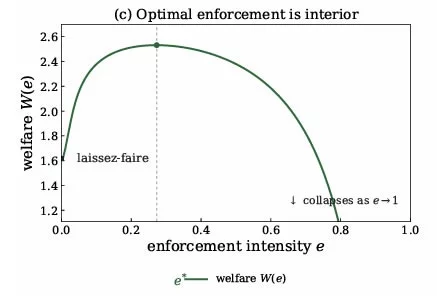
Prediction market accuracy has suffered under both weak and excessive insider trading enforcement, according to a new academic study that argued a complete ban could leave markets less informative.
Summary
- A new academic study says a blanket insider trading ban could make prediction market prices less accurate by removing valuable information.
- The research argues that enforcement should vary based on how information is obtained, with the toughest penalties reserved for traders who can influence outcomes.
- Kalshi has introduced new compliance measures as regulators and lawmakers increase scrutiny of insider trading risks across prediction markets.
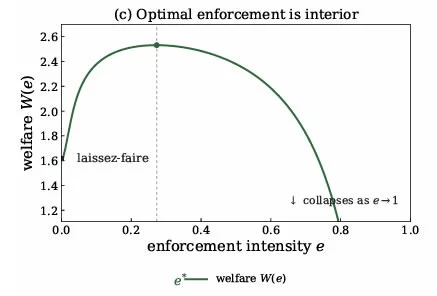
According to a June 2 research paper by Balbinder Singh Gill, assistant professor of finance at Stevens Institute of Technology, prediction markets work best under a middle-ground enforcement model rather than a zero-tolerance approach. The study developed an economic framework to examine how insider trading rules affect market participation and price accuracy.
Gill found that stricter enforcement can encourage more traders to participate by limiting insider advantages, but removing insiders entirely can also strip markets of valuable information. As a result, prediction market accuracy follows what the paper described as a “hump-shaped” pattern, improving as enforcement increases up to a point before declining when restrictions become too severe.
Source: Balbinder Singh Gill
The research arrives as regulators and lawmakers have intensified scrutiny of insider trading across prediction markets. In April, the Commodity Futures Trading Commission’s enforcement division warned that traders using non-public information could face enforcement action. A month later, U.S. House lawmakers opened an investigation into Kalshi and Polymarket over insider trading concerns.
Study argues for targeted enforcement
Rather than treating all insider activity the same way, the paper proposed different levels of enforcement based on the source of information.
Under the framework, traders who gain an informational edge through independent research should face little or no enforcement because punishing such activity could discourage information gathering that helps markets produce accurate prices.
A different standard should apply when information is obtained through leaks, stolen documents, classified material, or other forms of misappropriation, the study argued. In those situations, stronger enforcement is warranted because the informational advantage comes from unauthorized access rather than analysis.
At the highest end of the spectrum are participants who can directly influence an outcome they are betting on. According to the paper, those cases carry the highest manipulation risk and justify the toughest enforcement measures.
Recent investigations have highlighted those concerns. Federal authorities opened a probe into former U.S. Representative George Santos after Kalshi reported unusual trading activity linked to a market on whether he would attend the State of the Union address. Authorities alleged Santos publicly stated he would attend, placed a wager that he would not appear, and later skipped the event.
Following similar concerns, Kalshi imposed trading suspensions and financial penalties on local political candidates, including Virginia candidate Mark Moran and Minnesota candidate Matt Klein, after they placed bets on races in which they were competing. Such cases have drawn attention because the trader is not simply forecasting an event but may have the ability to influence the result itself.
Government agencies have also expanded enforcement against traders accused of using classified information. In April, the CFTC and the Department of Justice charged U.S. Army Master Sergeant Gannon Ken Van Dyke with using classified intelligence about a planned military operation targeting Venezuelan President Nicolás Maduro to trade on Polymarket.
According to enforcement filings, authorities relied on Section 746 of the Dodd-Frank Act, often referred to as the “Eddie Murphy Rule,” a provision originally designed to stop government employees from profiting from non-public government reports in commodity markets. The Van Dyke case represented the first known application of that authority to a prediction market platform.
Platforms and companies tighten controls
Even as researchers debate the appropriate level of enforcement, prediction market operators have begun introducing new safeguards.
As previously covered on crypto.news, Kalshi recently announced that users trading in certain sensitive markets, including those tied to corporate performance and national security events, may be required to disclose employment information. The company has also created a market-specific risk scoring system designed to identify contracts with elevated insider trading or manipulation risks.
Those changes followed recommendations from an internal audit committee and growing pressure from regulators and lawmakers.
Two recent cases cited in the study involved traders accused of profiting from privileged information on Polymarket. One involved a Google employee charged with using internal search trend information to earn approximately $1.2 million, while another involved a U.S. soldier accused of trading on classified military knowledge.
Outside the prediction market industry, legal advisers have warned corporations that event contracts are creating new risks around material nonpublic information.
Corporate law firms have advised companies to update compliance policies and employee handbooks, while some multinational firms are revising insider trading rules and non-disclosure agreements to explicitly cover prediction market activity.
As prediction markets continue to expand, with some financial firms projecting industry volumes could reach $1 trillion by 2030, the debate has increasingly centered on where regulators should draw the line between valuable information discovery and illicit use of privileged information.
Gill’s research suggests that eliminating insider participation entirely may come with costs of its own, potentially reducing the very price accuracy that prediction markets are designed to provide.
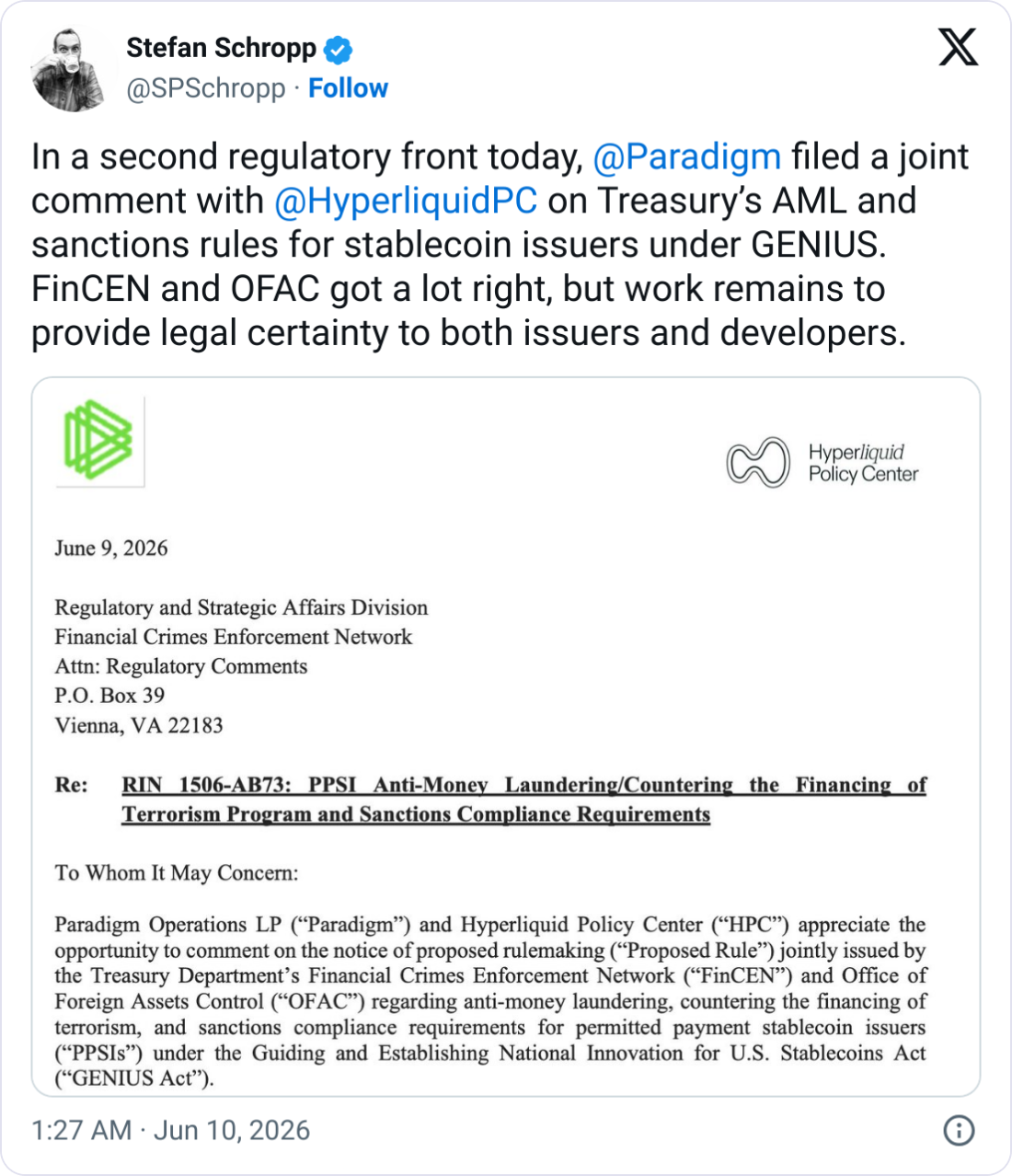
The lobbying arm of crypto futures exchange Hyperliquid and venture capital firm Paradigm has urged the US Treasury to revise a proposed anti-money laundering and sanctions rule for stablecoin issuers.
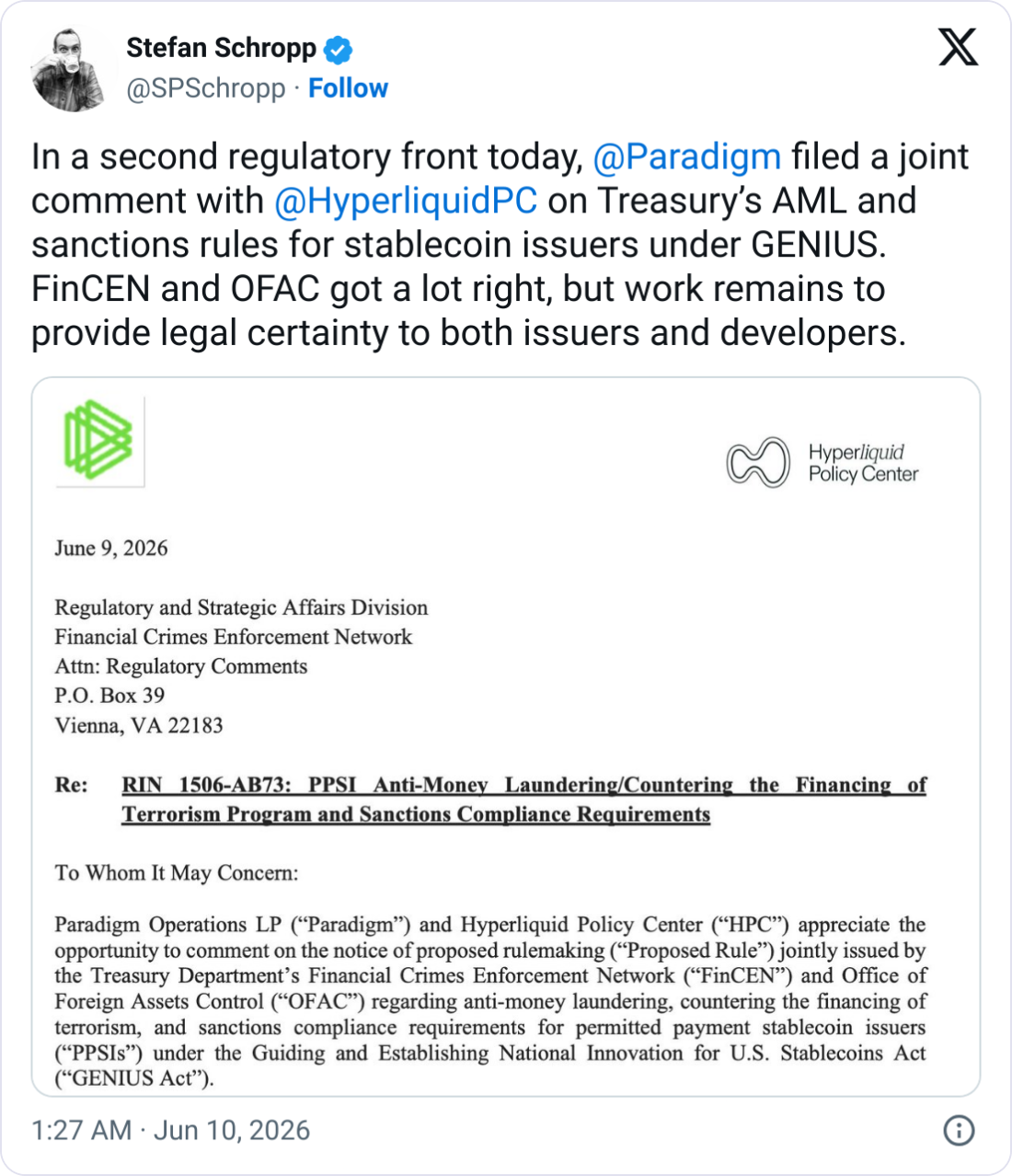
The Hyperliquid Policy Center and Paradigm said in a letter on Tuesday that some secondary market obligations should be clarified or narrowed “to avoid unintended consequences for permissionless blockchain infrastructure and the DeFi ecosystem.”
The pair said they endorse the Financial Crimes Enforcement Network’s (FinCEN) approach of putting compliance obligations on the “primary market,” such as issuers who have customer information, and taking a “limited approach” to the secondary market, where issuers only see wallets and transactions.
“The same principle should guide the agencies’ implementation of AML and sanctions requirements for stablecoins deployed to permissionless environments,” they argued.
The letter was in response to a rule the Treasury proposed in April to implement GENIUS Act provisions relating to stablecoin issuers, requiring stablecoin issuers to have the capability to block, freeze or reject transactions that violate US law or sanctions on both the primary and secondary markets.
Source: Stefan Schropp
Hyperliquid and Paradigm said the proposal sweeps secondary market activity into an issuer’s compliance perimeter that they “cannot meaningfully police.”
They argued it also treats smart contract interactions as an activity that carries sanctions liability “regardless of whether the issuer has any relationship with, or visibility into, the transacting parties.”
The pair said an issuer who is facing the obligations proposed would be incentivized to only deploy into a permissioned environment, which they argued would see US-regulated stablecoins pulled out of decentralized finance to create “a void filled by unregulated, offshore, non-dollar alternatives.”
Related: Solana Institute CEO says CLARITY Act must shield open-source developers
US President Donald Trump signed the GENIUS Act into law last year, which outlined how stablecoins and their issuers are to be regulated. Federal agencies are currently looking at how to implement the law, which is set to go into effect in January 2027 at the latest.
The Senate is currently debating a crypto bill that could include further rules for stablecoin issuers and remove liability for developers of crypto platforms regarding money laundering and sanctions compliance.
Provisions for the legislation, dubbed the CLARITY Act, are still under discussion, and some lawmakers are pushing for a full Senate vote on the bill before the November elections.
Magazine: The legal battle over who can claim DeFi’s stolen millions


SpaceX’s planned public offering has attracted more than $250 billion in orders, nearly four times the $75 billion it aims to raise.
Summary
- SpaceX has attracted over $250 billion in orders for its planned $75 billion public offering.
- Crypto’s recent selloff offers early evidence of capital rotation, though other market pressures remain active.
- Nasdaq rules could admit SpaceX after 15 trading days, creating another potential demand wave later.
The scale has renewed questions about whether the June 12 listing will pull capital from crypto markets.
The IPO is expected to price Thursday at about $135 per share. Orders can still change before final allocations, but early demand shows how much cash investors are preparing to move.
Crypto shows early signs of a liquidity squeeze
As crypto.news reported, the digital asset market lost about $250 billion during the June selloff, while Bitcoin briefly fell below $62,000. The timing supports claims that some investors are rotating toward major technology listings.
SpaceX is not the only pressure. Geopolitical tension, weaker rate-cut hopes and leveraged liquidations have also weighed on Bitcoin and altcoins. The IPO may add strain without being the sole cause.
“That combined selling is what you are seeing right now,” market commentator Bull Theory said.
The statement remains an interpretation because public data does not show how much crypto was sold specifically to fund SpaceX orders.
SpaceX trading may keep capital tied up
SpaceX plans to sell $75 billion of stock at a valuation near $1.8 trillion. Reuters reported that retail investors may receive up to 30% of the offering, far above normal IPO allocations.
The demand has reached currency markets. South Korean investors reportedly generated about $1.5 billion in dollar purchases linked to the IPO, adding pressure to the won before those orders cleared.
A strong opening could encourage investors who missed allocations to sell other assets and buy SPCX. A weak debut could ease that pressure, though the stock may remain volatile because only a small portion of SpaceX will trade publicly.
Crypto derivatives signal demand and volatility
Binance, Coinbase, Bybit and Bitget launched SpaceX pre-IPO perpetuals, while Kraken offered tokenized IPO access in more than 110 markets. The products give traders exposure before the stock begins trading.
Hyperliquid’s synthetic SpaceX contract climbed above $200 before retreating toward $165. An earlier SpaceX-linked contract also fell 45% within 30 minutes, liquidating about $1.5 million as thin liquidity worsened the move.
These products do not represent SpaceX shares. Their leverage and limited depth can produce prices that differ sharply from the stock after listing.
Nasdaq entry could extend the liquidity contest
Nasdaq’s updated rules let a large new listing qualify for fast entry into the Nasdaq-100. An eligible company is assessed after seven trading days and can normally enter after 15.
Some analysts estimate that inclusion could trigger $22 billion to $27 billion in passive buying. Nasdaq has not confirmed that figure. Its rules also say fast entry does not require removing another company.
Crypto’s main risk is therefore continued competition for speculative capital. Bitcoin ETF flows, stablecoin reserves and SPCX’s opening performance will show whether pressure continues after the debut.

Blockchain security firm Chainalysis is strengthening its collaboration with South Korea’s national police to crack down on crypto crimes, including those involving North Korea.
Chainalysis said on Wednesday that it signed a memorandum of understanding with the Korean National Police Agency (KNPA), aimed at building investigative capability within South Korea’s law enforcement.
Chainalysis said one of the driving factors behind the agreement is to better combat North Korea-linked crypto attacks, with South Korea’s police “at the forefront” of tackling these threats. However, Chainalysis’s country director Ryan Kwon said agreement aims to tackle all threats.
“While North Korean-driven attacks are understandably a national security focus, this partnership isn’t designed around a single threat. It’s fundamentally about building institutional capability,” Kwon told Cointelegraph.

Signing ceremony of the MoU between Chainalysis and the Korean National Police Agency. Source: Chainalysis
In April, crypto theft linked to North Korea topped $578 million, largely from attacks targeting Kelp DAO and the Drift Protocol. Research from CrowdStrike found that North Korea-affiliated hackers were responsible for $2 billion in crypto losses in 2025, up 51% from the year before.
Related: South Korea police raid Bithumb over lawmaker hiring favoritism probe: Report
The agreement will give the KNPA access to personalized training content by Chainalysis, along with professional certification programs and practical training.
“To investigate these cases effectively, Korean investigators need global visibility into illicit fund flows,” Chainalysis said.
Chainalysis has aided South Korean investigators for years. In September, police in Seoul dismantled an international hacking organization that had stolen approximately $30 million. The investigation began in South Korea but eventually saw investigators track the target to Thailand.
The MoU comes weeks after South Korean police launched a special multi-agency task force to tackle crypto-based money laundering, called the Money Laundering Eradication Task Force, which is led by the Economic Crime Investigation Division.
Magazine: North Korea denies crypto hacks, Upbit’s bank tests Ripple: Asia Express
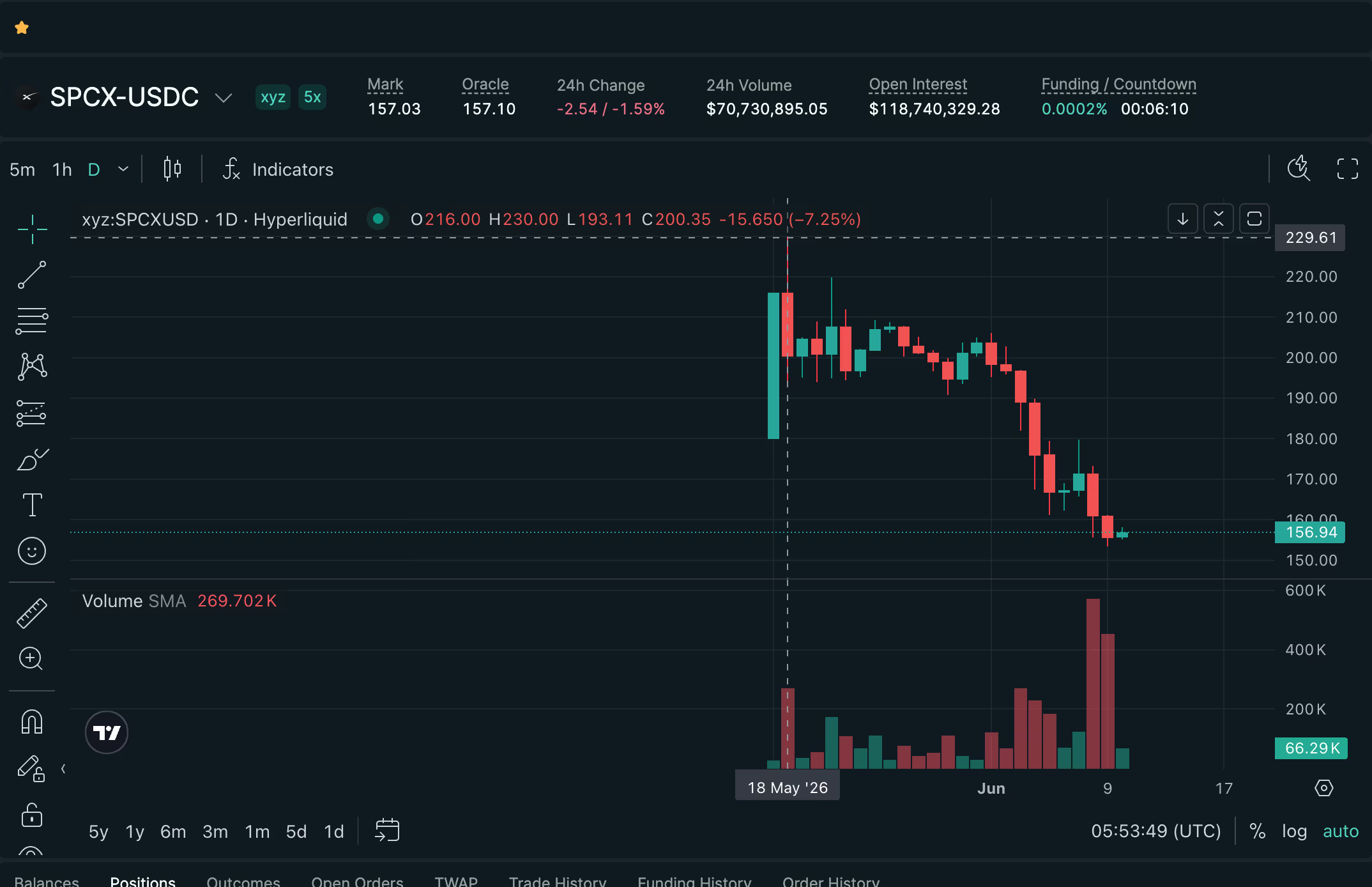
A widely-tracked 5x-leverage perpetual on Hyperliquid tied to SpaceX’s impending IPO, expected to be the largest in history, has declined for three consecutive weeks.
The product, tickered as SPCX, traded near $157 on Wednesday, down about 27% from its mid-May launch price of around $216, after briefly touching $230.
That does not mean traders are betting against SpaceX, as SPCX still trades above the $135 IPO price. But the implied first-day premium has been cut hard. In May, the contract priced SpaceX roughly 60% above the offer, and it stood closer to 16% as of Wednesday.

The company set the offer price at $135 per share, with no price range for investors to push it higher or lower during the bookbuild. In most IPOs, bankers collect orders and move the price based on demand. But SpaceX has taken a fixed-price route where investors either take the price or do not.
That leaves the SPCX perp as one of the few places where a SpaceX-linked price is actually moving before the stock opens.
The contract does not give holders shares, allocation rights or any claim on SpaceX. It is a cash-settled derivative that lets traders bet on where the company’s equity value should trade. Unlike an IPO indication of interest, traders in the perp have money at risk and can lose it before the first share changes hands.
The official book still looks huge. Reuters reported that SpaceX has drawn more than $250 billion in investor interest for a $75 billion raise, making the deal several times oversubscribed. Large investors often ask for more stock than they expect to receive, especially in hot deals.
SPCX’s prices suggest traders still expect a premium to the $135 offer.
That may partly reflect broader market pressure. Crypto has weakened into the IPO, and bitcoin remains well below its January high. Some investors may also be raising cash to fund SpaceX allocations, adding pressure to the same risk market where SPCX trades.


Tim Draper says quantum computing will crack banks before it touches Bitcoin. But the reason has nothing to do with Bitcoin’s encryption strength.
In a post on X, Draper pointed to banks’ legacy infrastructure and Bitcoin’s network recovery mechanism as the reasons the blockchain outlasts the dollar in a quantum future. Both arguments have merit. But Bitcoin’s most criticized flaw, its complete and permanent transparency, turns out to be its most current quantum shield.
Why Banks Face the Greater Bitcoin Quantum Threat
The real quantum attack on banks is already underway. Security researchers call it “harvest now, decrypt later” (HNDL): adversaries today capture and store encrypted bank transactions, customer data, and institutional communications.
Those files sit in storage waiting for quantum computers powerful enough to break the encryption protecting them. When that moment arrives, decades of confidential financial history become readable. Banks cannot undo what has already been collected.
Bitcoin carries no equivalent vulnerability to this specific attack. Every transaction, address, and balance on the blockchain is already public. There is no encrypted archive of private financial activity to harvest.
Still, Quantum-resistant cryptos were the standout performers of May, outpacing Bitcoin by nearly 60% for the month, even as the broader market sold off.
Bitcoin’s Real Vulnerability, and the Fix
Bitcoin does carry one genuine quantum risk: its ECDSA signature algorithm (the system that authorizes transactions). Any address that has ever sent Bitcoin permanently exposes its public key on-chain.
A quantum computer running Shor’s algorithm could theoretically derive a private key from an exposed public key, targeting any used address. S
HA-256, which secures Bitcoin’s mining network, is effectively untouchable for decades; breaking it would require hardware with an energy output approaching that of a star.
The ECDSA problem already has a community-developed solution: BIP-360, which introduces ML-DSA post-quantum signatures approved by the US National Institute of Standards and Technology (NIST). Working BIP-360 transactions have been demonstrated on testnet. Bitcoin’s node operators can vote to upgrade the protocol when the threat demands it.
Banks have no equivalent self-governance mechanism. They operate under government mandate: the NSA’s Commercial National Security Algorithm Suite 2.0 requires all national security systems to be quantum-safe by January 2027.
Draper is right that banks face the greater quantum threat. He just left out the most interesting part of why.
The post Tim Draper Says Bitcoin is Safer from Quantum than Banks appeared first on BeInCrypto.


Prediction market Kalshi launched 3 market integrity measures: risk scoring for new listings, employment verification for markets with manipulation risk, and enhanced whistleblower reporting tools across the platform.
The measures take effect immediately and follow the first report from Kalshi’s independent Surveillance Audit Committee.
How Kalshi’s New Measures Work
According to the announcement, every proposed market now receives a risk score before listing. The system weighs six factors. These include corporate KPI risk, outcome concentration, market importance, regulatory fit, non-traditional insider risk, and national security risk.
Markets with high insider or manipulation risk now require traders to provide employment information. This lets Kalshi identify presumptive insiders and screen them out before any trade executes.
Finally, the whistleblower upgrade adds reporting tools to every market on the exchange. Tips route directly to a surveillance team that monitors the feed around the clock.
“By implementing these new integrity measures, we continue to lead the industry on the issue of market integrity amongst federally regulated prediction markets,” Kalshi Head of Enforcement Robert DeNault said.
The prediction market platform also revealed that the enforcement record in Q1 included 150+ investigations, 20+ referrals to law enforcement, and 5 disciplinary actions. Kalshi said that its screening tools blocked more than 100 potential insider trades in the first quarter.
The Surveillance Audit Committee will deliver quarterly reports going forward. Its next review may show whether these measures curb insider trading on Kalshi.
Follow us on X to get the latest news as it happens
Why Prediction Markets Face Insider Trading Pressure
Insider trading has become a key integrity problem for prediction markets as trading volumes grow. Rival platform Polymarket partnered with Chainalysis to monitor trading activity.
Suspicious activity has surfaced, particularly in geopolitical markets. Both major platforms have since tightened their rules, and Kalshi’s update marks the latest effort to win back trader confidence.
Subscribe to our YouTube channel to watch leaders and journalists provide expert insights
The post Kalshi Launches 3 Market Integrity Measures to Block Prediction Market Insiders appeared first on BeInCrypto.

The “crowd has written off Ethereum,” reported Santiment on Tuesday. However, this makes the probability of a rebound “substantially higher,” it added.
The onchain analytics platform said that Ethereum’s social sentiment has fallen into an “extreme fear zone” as traders react to months of underperformance relative to Bitcoin and many other altcoins.
The recent selloff has been amplified by ongoing debate surrounding the Ethereum Foundation, criticism of its leadership and priorities, and controversial comments from Vitalik Buterin that have “fueled further uncertainty.”
Is a Rebound Likely?
Positive-to-negative commentary has dropped to one of its lowest levels of the year, indicating that bearish narratives are now dominating social media, said Santiment.
The same situation unfolded when ETH prices tanked to similar prices in April 2025. The FUD hit record levels, and everyone cried, “Ethereum is dead.”
Four months later, it had tripled in price to an all-time high.
“Historically, Ethereum has tended to rebound when social sentiment reaches extreme FUD levels because prices frequently move opposite to the crowd’s expectations.”
When traders become overwhelmingly convinced that an asset will continue falling, much of the selling pressure has already been exhausted, it added.
TL;DR: Crowd has written off Ethereum, making the probability of a rebound substantially higher
Metrics Used: Positive vs. Negative Commentary Ratio
Link: https://t.co/vCjlfHHuGE
Ethereum’s social sentiment has fallen into an extreme “fear zone” as traders react to… pic.twitter.com/XHAf2KglbR
— Santiment Intelligence (@SantimentData) June 9, 2026
According to Glassnode, the share of ETH supply held at more than 3x profit has dropped to just 11%, its lowest level since 2017. Ether’s profitability profile has “fundamentally compressed” relative to prior cycles, it added.
To add balance, Bitcoin’s supply in loss has hit a new yearly high of 50%, so the bear market is battering all crypto assets.
ETH Price Outlook
Ether price continues to weaken in the short-term, with it tapping an intraday low of $1,620 twice over the past 24 hours.
With no current drivers or momentum, a fall back towards $1,500 is looking highly likely. This level serves as a major support zone, as it did 14 months ago, when Ether was going through the same pain.
The post Retail Writes Off Ethereum, Making Recovery More Likely: Santiment appeared first on CryptoPotato.
SpaceX is listed on Nasdaq on Thursday, June 11, at $135 a share, the largest IPO in history. Elon Musk cannot sell a single share for a year, but the investors his team personally selected to participate in the offering can sell immediately.
SpaceX reserved 5 per cent of the offering for a direct share program (DSP), with participants chosen “at the discretion of executive officers,” who carry no lockup restrictions whatsoever.
Why the Lockup Structure Is Unusual
Standard IPOs impose a 180-day lockup on all insiders. SpaceX’s structure does the opposite for a select group. The Australian Financial Review reported that a specific hedge fund is already preparing to sell its SpaceX stake as soon as it can.
Early investors who did not receive a DSP allocation face a staggered release, starting with 20% after the first earnings report, followed by 7% tranches at 70, 90, 105, 120, and 135 days. DSP participants face none of it.
As BeInCrypto reported in its analysis of the SpaceX-Anthropic IPO race, the concentration of early investor stakes and the unusual deal structure were already among the risks that set this IPO apart from anything Wall Street has seen before.
The SpaceX IPO Selling Pressure Ahead
Chad Anderson, founder of Space Capital and an early SpaceX investor, stated his intentions plainly: “We’ve been invested for almost ten years, it’s our business to return capital to investors.” That also appears to be a direct statement of intent to sell.
The 5 per cent DSP tranche adds a layer of selling that retail buyers on Robinhood, Fidelity, and Schwab will face from the opening bell.
Morningstar’s analysts put SpaceX’s fair value at roughly half its IPO price and advised investors to wait for the hype to pass.
Moreover, the same week that brings the world’s biggest IPO also brings CPI data and a market that has spent the month pricing in a Fed rate hike.
The founder cannot sell. His chosen investors can. Thursday will show which side of that equation sets the price.
The post Elon Musk Can’t Sell SpaceX Shares for a Year But Others Can Dump on Day 1 appeared first on BeInCrypto.

Macron to chair video call involving G7 and China over trade imbalances
How One Guy Used Claude Code to Discover a Billion-Dollar Bug

Burton, Valkyries hold off Mercury for win



-

 Fashion5 days ago
Weekend Open Thread: Evereve – Corporette.com
-
 Crypto World5 days ago
Jensen Huang Approves Samsung, SK Hynix, and Micron for NVIDIA (NVDA) HBM4 Memory Supply
-

 Crypto World2 days ago
Anatomy of the June crypto crash: Fed, Iran, Saylor
-
 Entertainment3 days ago
The Best Mystery Series of All Time Is Surging on Streaming 30 Years After It Ended
-

 NewsBeat2 days ago
Alexander Zverev wins the French Open to finally earn a 1st Grand Slam title
-

 Tech4 days ago
Suspicious Polyfill login prompts pop up on Toshiba, Muji websites
-
 Crypto World4 days ago
Senator Cynthia Lummis Calls CLARITY Act the Most Consequential Financial Legislation of This Generation
-

 Tech5 days ago
Microsoft launches MXC, an OS-level sandbox for AI agents, with OpenAI and Nvidia already on board
-
 Tech3 days ago
Microsoft unveils seven homegrown AI models in new bid for ‘long term self-sufficiency’
-
 Business3 days ago
The Pain Points Taking a Fragile Tech Rally Down a Notch
-
Crypto World5 days ago
LBank Surpasses 25 Million Users Worldwide as AFA Partnership Continues to Drive Global Growth
-

 Business5 days ago
(VIDEO) Justin Bieber Delivers Surprise Happy Birthday Serenade to Diners at Los Angeles Mexican Restaurant
-

 Crypto World3 days ago
Trump’s AI Ownership Plan Could Benefit Anthropic at OpenAI’s Expense
-
 Sports15 hours ago
Bangladesh beat Australia after 20 years in ODIs, register only their second win over six-time world champions | Cricket News
-

 Tech5 days ago
Meta steals a tactic from Tesla and builds data centers in tents
-

 Tech4 days ago
Von der Leyen’s AI envoy pick draws conflict-of-interest fire
-
 Crypto World2 days ago
Eli Lilly (LLY) Stock Surges 4% Following Breakthrough Sleep Apnea Trial Results
-

 Tech5 days ago
RCS Messages Between iPhone and Android Get End-to-End Encryption With iOS 26.5
-

 Tech4 days ago
Hackers now exploit SolarWinds Serv-U flaw to crash servers
-

 Tech2 days ago
Notion restores access to Anthropic after service disruption
You must be logged in to post a comment Login