
Crypto World
SEC proposes $75M crypto token sale rule that the market has outgrown



Eight years after the ICO boom, the regulator is offering a path that the market already abandoned. The capital it is trying to regulate now flows through channels the proposal does not touch.
Summary
- The SEC proposed a framework allowing crypto projects to raise up to $75 million annually through public token sales without full securities registration, using an expanded version of existing Regulation A+ exemptions.
- The proposal arrives roughly eight years after the 2017 to 2018 ICO wave that prompted it, during which projects raised over $20 billion through unregistered token sales before the SEC began systematic enforcement.
- In 2026, capital formation in crypto has shifted almost entirely to mechanisms the proposal does not cover: meme coin launchpads, airdrops, points programs, liquid token listings, and venture rounds with simple agreements for future tokens.
- Pump.fun posted its second highest revenue day in history during the same week the SEC published the proposal, generating more capital formation in 24 hours than most ICOs raised in their entire campaigns.
- The framework requires audited financials, ongoing reporting, and a two year pathway to full registration, requirements that would disqualify the vast majority of projects currently raising capital in the crypto market.
The SEC spent nearly a decade deciding how to let crypto projects raise money legally. By the time it published the answer, the industry had moved on without it. The proposal is technically sound, institutionally rational, and almost certainly irrelevant to the market it claims to serve.
What the proposal actually says
The framework extends Regulation A+, an existing exemption that lets small companies raise up to $75 million per year from the public with lighter disclosure requirements than a full S-1 registration. The SEC’s crypto specific version adds provisions for token specific risks, smart contract audits, and wallet custody disclosures.
Projects using the framework would file a Form 1-A offering circular with the SEC, provide audited financial statements, and submit to ongoing reporting requirements including semiannual updates and current event disclosures. After two years of compliant reporting, the project would transition to full registration under the Securities Exchange Act.
The $75 million ceiling is per issuer per year. Secondary trading would be permitted on registered alternative trading systems, though no major crypto exchange currently operates as one. The proposal explicitly excludes tokens that function solely as payment mechanisms or governance tokens with no expectation of profit, categories that encompass a significant portion of the tokens actually being traded.
The filing process itself is not trivial. Form 1-A requires detailed disclosure of the project’s business plan, the team’s background, use of proceeds, risk factors, and the specific rights the token confers. The SEC reviews each filing before qualification, a process that typically takes three to six months for traditional Reg A+ offerings. For a crypto project operating in a market where narratives shift weekly and opportunities close in days, a six month review period is effectively a death sentence.
Why the timing matters
The ICO boom peaked in January 2018, when projects were raising hundreds of millions through white papers and Ethereum smart contracts. EOS raised $4.1 billion. Telegram raised $1.7 billion. Filecoin raised $257 million in thirty minutes. The total exceeded $20 billion across 2017 and 2018, with virtually none of it passing through a regulatory framework.
The SEC responded with enforcement, not rulemaking. Between 2018 and 2025, the agency brought over 100 enforcement actions against token issuers, settlements that collectively extracted billions in penalties. EOS paid $24 million. Telegram returned $1.2 billion and paid an $18.5 million penalty. Block.one, Kik, LBRY, Ripple, and dozens of smaller projects went through multi year legal battles that established through litigation what the SEC could have established through clear rules at the outset.
The enforcement first approach created a regulatory desert. Projects that wanted to raise capital legally had no clear path. Projects that raised capital illegally faced enforcement risk years after the sale, when the money was already spent and the team had often dissolved. Neither outcome served investors.
The Clarity Act lost its legislative window in August 2026, with Polymarket odds on passage collapsing from 82% to 16%. The GENIUS Act missed its statutory deadline by four months. In the absence of legislation, the SEC is now writing the rules that Congress could not pass.
That sequence matters because it reveals the proposal’s actual function. This is not a growth initiative designed to encourage crypto capital formation. It is a regulatory land grab, an attempt to establish SEC jurisdiction over token issuance before another agency or legislative framework takes the territory.
How capital actually forms in crypto now
This is the section a competitor could not have written, because it requires mapping the full landscape of how projects raise money in 2026 and comparing it against what the SEC’s framework would cover.
Meme coin launchpads. Pump.fun on Solana generated its second highest revenue day in history during the same week the SEC published its proposal. The platform lets anyone create and launch a token in minutes, with capital flowing through bonding curves that price tokens algorithmically. No white paper, no team disclosure, no audited financials. The new Solana meme token $fone reached a $35 million market capitalization on its debut day. None of this activity would fit within the SEC’s framework because meme tokens explicitly disclaim any profit expectation tied to the efforts of the issuer.
The scale of launchpad activity dwarfs anything Reg A+ has produced. Pump.fun and competing platforms processed tens of thousands of token launches per month through 2025 and 2026. Four.Meme on BNB Chain briefly flipped Pump.fun in daily revenue, demonstrating that the model replicates across chains. The total capital flowing through these platforms on a monthly basis exceeds what Regulation A+ has facilitated in its entire eleven year history across all asset classes.
Airdrops and points programs. Projects like Hyperliquid, which hit an all time high above $86 this week, distributed tokens through activity based airdrops that reward users for trading on the platform. The user receives tokens for past behavior, not in exchange for capital. The SEC’s framework governs sales, not distributions, leaving the fastest growing capital formation mechanism untouched.
The airdrop model has become the dominant go to market strategy for new protocols. Blur, Eigen, Ethena, Jupiter, and dozens of other projects used points programs that converted to token distributions. The total value distributed through airdrops in 2025 alone exceeded $10 billion, more than the annual Reg A+ ceiling of $75 million by a factor of 130.
Venture rounds with SAFTs. Serious infrastructure projects still raise through Simple Agreements for Future Tokens, private placement instruments sold to accredited investors under Regulation D. These rounds are already legal, already common, and do not need a new public offering framework. The $75 million Reg A+ path offers nothing that a $50 million Reg D round does not, except more paperwork, more SEC oversight, and a longer timeline.
Venture funding in crypto totaled approximately $13.7 billion in 2025 and is on pace for a similar number in 2026, according to Galaxy Research. Virtually all of it flows through Reg D exemptions or offshore structures. The projects that need capital have already found it. The SEC’s proposal offers a slower, more expensive alternative to channels that work perfectly well.
Liquid token listings. Many projects skip fundraising entirely and launch tokens directly on decentralized exchanges, establishing price discovery through liquidity pools on Uniswap, Raydium, or Orca. The listing is permissionless. The capital comes from traders, not investors, and the distinction matters legally even if it does not matter economically.
The compliance arithmetic
The proposal requires audited financial statements. For a crypto startup, an audit from a firm willing to opine on a token project costs between $150,000 and $500,000 annually. The major accounting firms, Deloitte, PwC, EY, and KPMG, have been selective about crypto audit engagements, leaving most projects reliant on smaller firms with limited blockchain expertise.
The Form 1-A filing itself requires legal counsel familiar with both securities law and token mechanics. Specialized crypto securities attorneys charge $500 to $1,200 per hour. A complete Reg A+ filing, including the offering circular, legal opinion, and SEC review process, costs between $200,000 and $500,000 in legal fees alone.
Add ongoing reporting requirements, including semiannual updates, current event disclosures, and eventually full Exchange Act reporting after two years, and a project using this framework would spend roughly $400,000 to $1,000,000 annually on compliance before writing a line of code.
For a project raising $75 million, those costs represent 0.5% to 1.3% of the raise, which is manageable. But the projects raising $75 million are already doing it through Reg D private placements that cost a fraction as much and impose fewer ongoing obligations. The projects that would benefit most from a public offering path, early stage teams with limited capital who want to sell tokens to retail investors, are precisely the ones that cannot afford the compliance burden.
The two year pathway to full registration creates an additional deterrent. A project that files under Reg A+ in 2027 would face full Exchange Act reporting requirements by 2029, including quarterly filings, annual reports, proxy statements, and insider trading restrictions. In an industry where the average project lifespan is measured in months and the median token loses 80% of its value within a year of launch, committing to four years of SEC oversight is a bet that few founders would take voluntarily.
Who actually benefits
The proposal serves three constituencies, none of which are the crypto native projects it appears to target.
First, traditional financial institutions that want to issue tokenized securities. Banks, asset managers, and broker dealers already have compliance infrastructure, audit relationships, and legal teams. For them, a Reg A+ token offering is a minor extension of existing operations. JPMorgan’s Kinexys platform, Goldman Sachs’ tokenized money market fund, and Franklin Templeton’s on chain treasury fund could all issue tokens under this framework without materially changing their cost structure. The proposal essentially codifies what they were already planning to do.
Second, the SEC itself. By establishing a regulatory pathway that requires filing, disclosure, and eventual full registration, the agency creates jurisdiction over a category of assets that courts have inconsistently classified. Every project that files under this framework validates the SEC’s authority over tokens, regardless of whether the framework generates meaningful adoption. Institutional turf in Washington is measured by the number of entities under your jurisdiction, and this proposal expands the SEC’s count.
Third, compliance service providers. Law firms, audit firms, and registered transfer agents would gain a new revenue stream from token issuers navigating the framework. The Revolut stablecoin launch and similar institutional entries into crypto have already expanded demand for crypto compliance services. The Reg A+ framework would extend that demand further, creating a recurring revenue base for firms that specialize in SEC filings.
The precedent problem
Regulation A+ has existed since 2015 under the JOBS Act Title IV. In its traditional form, it has been used by roughly 800 companies, raising a collective $8 billion over eleven years. The vast majority of those offerings were for small companies in real estate, cannabis, and consumer products. Very few raised the full $75 million, with the median raise closer to $5 million to $15 million.
By comparison, crypto projects raised $7.5 billion through token sales in 2024 alone, according to CoinGecko data, almost none of it through SEC regulated channels. The entire eleven year output of Reg A+ across all industries barely exceeds what crypto raised in a single year through unregulated mechanisms.
The adoption rate tells the story. Even in traditional capital markets, Reg A+ is a niche product used by companies that are too small for an IPO and too retail focused for pure Reg D. IPOs, Reg D private placements, direct listings, and SPACs handle the overwhelming majority of capital formation. There is no reason to expect crypto’s adoption rate to exceed the traditional market’s, and several reasons to expect it to be lower, including the availability of permissionless alternatives that do not exist in traditional finance.
The $TRUMP token comparison
The $TRUMP meme coin raised more capital through trading activity in its first week than most Reg A+ offerings raise in their entire campaign. It did so without an offering circular, without audited financials, and without any interaction with the SEC’s filing system.
The comparison is not entirely fair. The $TRUMP token and the thousands of meme coins launched daily on platforms like Pump.fun are overwhelmingly speculative, short lived, and carry no pretense of building anything. But that is precisely the point. The SEC’s proposal addresses a category of activity, legitimate projects seeking to raise capital from the public with proper disclosure, that has already been abandoned by the market in favor of mechanisms that operate entirely outside the regulatory perimeter.
The market has voted, and it voted for speed over safety, permissionlessness over process, and memes over fundamentals. Whether that is good for investors is debatable. Whether the SEC’s proposal changes it is not.
What would prove this analysis wrong
Two scenarios would make the SEC’s proposal relevant.
First, if a major crypto project, one with a recognized brand and significant user base, files under the framework and raises a full $75 million, it would validate the pathway as a real alternative to Reg D and offshore token sales. The first successful filing would create precedent and potentially attract followers who see regulatory clarity as a competitive advantage in serving institutional capital.
Second, if the SEC begins enforcing against airdrops, points programs, and launchpad mechanisms, projects currently using those channels would need a legal alternative. The Reg A+ framework would become relevant not because it is attractive, but because everything else is blocked. The SEC has shown willingness to expand its enforcement scope in the past, and a future where meme coin launchpads face enforcement risk is not implausible.
A third possibility is that foreign regulators adopt similar frameworks that require reciprocal compliance for U.S. market access. If the EU, UK, or Singapore require Reg A+ equivalent disclosures for tokens sold to their citizens, projects targeting global audiences would face compliance pressure from multiple jurisdictions simultaneously.
What to watch
Filing activity in the first 90 days. The comment period runs through November 2026. If no project files a Form 1-A within three months of the final rule, the framework is effectively dead on arrival. Watch for announcements from tokenized securities platforms or institutional issuers as the likely first movers.
SEC enforcement against airdrops and launchpads. Any enforcement action against a major airdrop campaign or meme coin launchpad would immediately change the calculus for projects choosing between regulated and unregulated capital formation. The proposal becomes important only if the alternatives become dangerous.
Congressional response. If the Clarity Act or a similar bill revives in the next session, it could preempt the SEC’s framework entirely. Legislative activity in the first quarter of 2027 will determine whether the Reg A+ pathway has a future or becomes another abandoned regulatory experiment.
Institutional adoption of tokenized securities. Banks and asset managers issuing tokenized bonds, funds, or equity under this framework would generate volume even if crypto native projects ignore it. Watch for filings from Goldman Sachs, JPMorgan, or BlackRock affiliates as the bellwether for institutional interest.
Pump.fun and launchpad revenue trends. If launchpad revenue declines due to market conditions or regulatory pressure, the pool of capital seeking a home grows, and regulated pathways become more attractive by default. Conversely, if launchpad volume keeps growing, the SEC’s framework becomes increasingly irrelevant.
What is the SEC’s new crypto token sale proposal?
The SEC proposed allowing crypto projects to raise up to $75 million annually through public token sales using an expanded Regulation A+ exemption. Projects would file disclosure documents, provide audited financials, and transition to full SEC registration after two years of compliant reporting.
How much can crypto projects raise under this framework?
The ceiling is $75 million per issuer per year. Secondary trading would be permitted on registered alternative trading systems. The filing and review process typically takes three to six months.
Why is the SEC proposing this now?
Congress failed to pass comprehensive crypto legislation. The Clarity Act lost its window and the GENIUS Act missed its deadline. The SEC is writing rules through its existing regulatory authority because the legislative path is blocked, establishing jurisdiction before another agency takes the territory.
How does this compare to how crypto projects actually raise money?
Most crypto capital formation in 2026 happens through meme coin launchpads, airdrops, points programs, and venture rounds using SAFTs under Regulation D. None of these mechanisms would be covered by the SEC’s proposal. Airdrops alone distributed more than $10 billion in 2025.
What does the proposal cost to comply with?
Audited financials, legal review, Form 1-A filing, and ongoing reporting cost an estimated $400,000 to $1,000,000 annually. Projects raising $75 million can absorb this. Early stage teams raising smaller amounts face compliance costs that consume a disproportionate share of their raise.
Will meme coin launchpads be affected?
Not directly. Meme tokens typically disclaim any profit expectation tied to the issuer’s efforts, placing them outside the securities framework. The proposal governs sales of tokens with investment characteristics, not speculative trading tokens launched on permissionless platforms.
Who would actually use this framework?
Traditional financial institutions issuing tokenized securities are the most likely adopters. Banks, asset managers, and broker dealers already have the compliance infrastructure, audit relationships, and legal teams to absorb the requirements. Crypto native projects have cheaper, faster, and less restrictive alternatives available.
Is this good or bad for the crypto market?
This is educational analysis, not investment advice. The framework provides a legal pathway that did not previously exist, which is structurally positive for projects that want regulatory certainty. Whether it generates meaningful adoption depends on enforcement activity against unregulated alternatives and the willingness of established institutions to issue tokens through SEC channels.
Disclosure: This content is provided by a third party. Neither crypto.news nor the author of this article endorses any product mentioned on this page. Users should conduct their own research before taking any action related to the company.



A regional UK police force has seized 20.21 Bitcoin and other assets valued at more than $1.4 million after tracing the funds to darknet marketplaces active between 2016 and 2019.
Summary
- Police recovered 20.21 BTC, other cryptoassets, and bank funds valued at £1.03 million.
- Investigators traced the holdings to unnamed darknet markets that operated from 2016 to 2019.
- A court forfeited the assets under the Proceeds of Crime Act earlier in 2026.
- The recovery is the force’s largest since new crypto freezing powers took effect in April 2024.
UK police recover 20.21 Bitcoin and other assets
Avon and Somerset Police said on Aug. 27 that its Financial Investigation Unit had recovered 20.21 BTC, other digital assets, and money held in a bank account.
The assets had a combined value of £1,032,487.86, or more than $1.4 million, when the police force valued them. Officials did not disclose the amount held in other cryptocurrencies or the bank account, nor did they identify the tokens involved.
Earlier in 2026, a court approved the forfeiture after accepting that the holdings represented proceeds from unlawful conduct. Police pursued the assets under the Proceeds of Crime Act, which allows authorities to recover property obtained through criminal activity.
The unnamed person at the center of the investigation had previously been convicted of money laundering and has since died, according to the statement. Officials did not disclose when the earlier conviction occurred, the offenses connected to it, or whether anyone else was investigated.
At Bitcoin’s current price of about $77,570, the 20.21 BTC alone would be worth approximately $1.57 million. The difference from the police valuation may come from the date on which officials calculated the total, as Bitcoin’s market price has changed since the assets were forfeited. The force did not provide a valuation date or state whether any of the Bitcoin had been converted into pounds.
Blockchain records exposed the darknet funds
Working with the force’s cyber team, financial investigators used specialist tracing methods to follow the assets to several darknet marketplaces operating from 2016 through 2019.
Police did not name the platforms but said law enforcement agencies have since closed all of them. According to the force, the marketplaces facilitated offenses ranging from drug distribution to human trafficking.
The period includes several major darknet enforcement operations. The U.S. Department of Justice closed the AlphaBay market in July 2017 after an international investigation involving authorities in the United States, Thailand, the Netherlands, Lithuania, Canada, the United Kingdom, and France.
Dutch police had secretly taken control of Hansa before closing it alongside AlphaBay. Europol said investigators operated Hansa for about one month, allowing them to collect information about vendors and customers who moved to the platform after the AlphaBay takedown.
Dream Market, another large platform from the period covered by the Avon and Somerset investigation, stopped operating in 2019. The police statement did not say whether the recovered Bitcoin passed through AlphaBay, Hansa, Dream Market, or other marketplaces.
Although darknet services can hide the people behind transactions, public blockchain records retain the movement of Bitcoin between addresses. Investigators can combine that transaction history with exchange records, seized devices, and other financial evidence to identify links between wallets and suspected criminal activity.
Detective Constable Anthony Davis of the Financial Investigation Unit said some people believe cryptocurrency can provide anonymity, conceal wealth, and keep assets outside the reach of police. In practice, he said, the blockchain stores a “permanent record of transactions” that can become “an invaluable source of evidence.”
Davis added that specialist financial investigation skills had become increasingly important for locating and recovering criminal assets held in cryptocurrencies.
UK crypto freezing powers support asset recovery
The operation is Avon and Somerset Police’s largest cryptocurrency seizure since crypto wallet freezing orders became available in April 2024.
The UK government introduced the new powers through changes to the Proceeds of Crime Act. Police can freeze cryptoassets when they have reasonable grounds to suspect a connection to illegal activity, even when authorities have not made an arrest.
Before the amendments, officers could face limits when trying to take control of digital assets during an investigation. The current rules allow authorities to transfer seized tokens into law enforcement-controlled wallets and recover items that could provide access to the funds, including written passwords and storage devices.
Officers may also destroy a cryptoasset when returning it to circulation would not serve the public interest. When the measures took effect, the UK Home Office identified privacy-focused cryptocurrencies as one type of asset that could require such treatment.
A freezing order does not itself establish that an asset is criminal property. In the Avon and Somerset case, the holdings were forfeited only after a court became satisfied that they came from unlawful conduct.
Money recovered under the Proceeds of Crime Act can be directed to policing and community programs. Avon and Somerset Police said the funds may support education, training, early intervention and crime-prevention work.
U.S. cases also rely on blockchain tracing
The British recovery follows several American cases in which investigators used transaction records to locate crypto connected to darknet services.
In January, crypto.news previously reported that the U.S. Department of Justice completed a $400 million forfeiture involving assets seized from Helix operator Larry Dean Harmon. The DOJ said Helix processed more than 354,000 BTC between 2014 and 2017 and helped customers conceal funds associated with darknet markets.
A federal court granted the U.S. government legal ownership of the Helix assets after Harmon pleaded guilty in 2021 to operating an unlicensed money-transmitting business and violating the Bank Secrecy Act. He received a three-year prison sentence in 2024.
In June, U.S. prosecutors charged two alleged operators of the AudiA6 laundering service, which authorities accused of handling more than $389 million in cryptocurrency. Blockchain analysis cited by prosecutors identified about 10,333 BTC deposited into wallets controlled by the service since 2021, including 393.39 BTC sent directly from known darknet markets, ransomware groups, and other illicit sources.
The UK has also handled much larger Bitcoin recoveries. In September 2025, Chinese national Zhimin Qian pleaded guilty after authorities recovered digital wallets containing 61,000 BTC connected to an investment fraud that targeted more than 128,000 people in China. Police discovered the wallets during a 2018 raid after receiving information about the transfer of criminal assets, according to earlier case coverage.
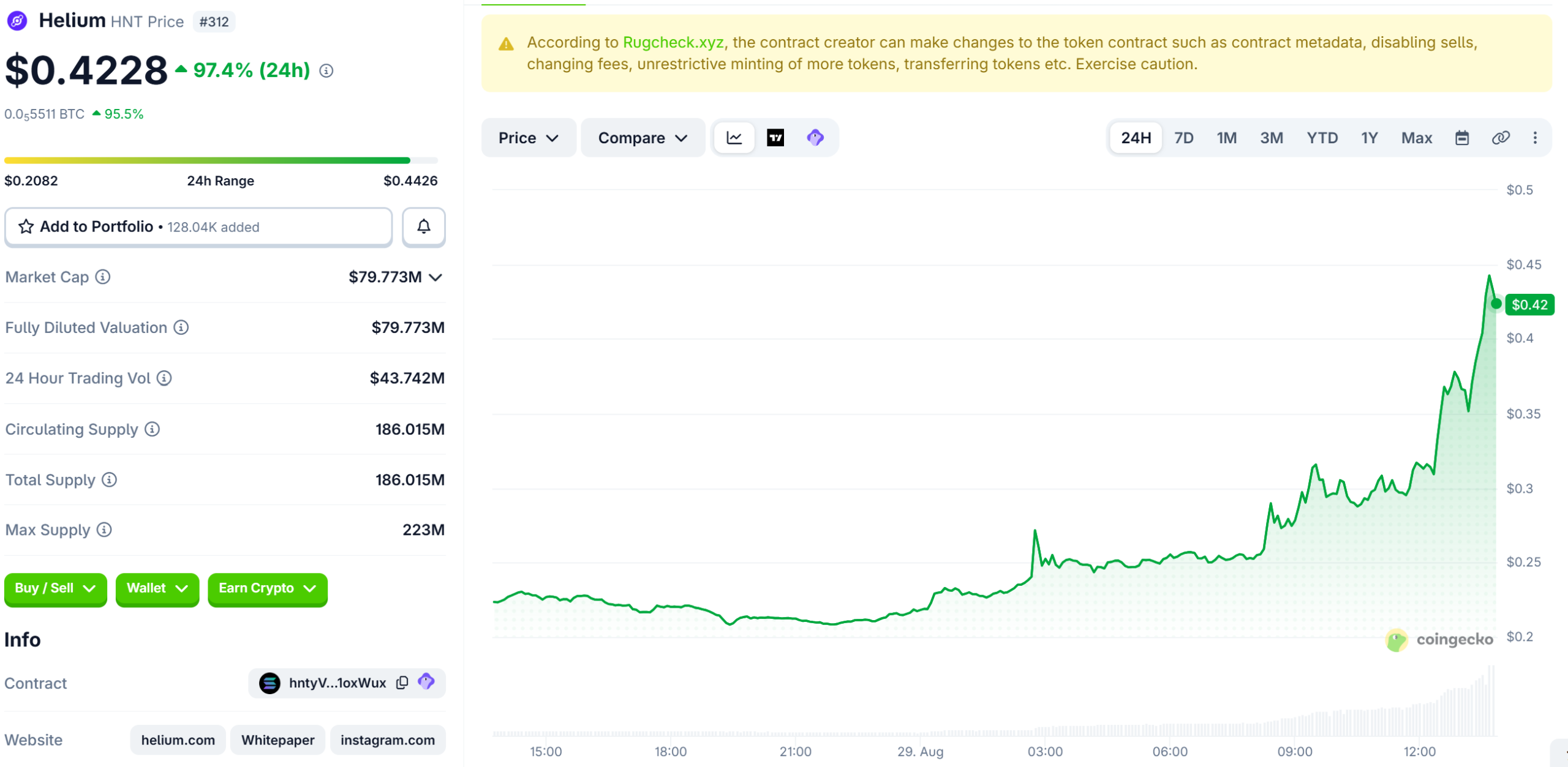
Helium (HNT) jumped almost 100% on Saturday. Behind the surge is a Texas town that stopped waiting for cell towers and switched on Wi-Fi it already owned.
Celina sits north of Dallas. It added 12,710 residents in a year and grew 24.6%, the fastest of any US city with more than 20,000 residents.
How Helium Turned Wi-Fi Into Cell Service
Helium announced the deployment on Friday. It covers the Celina Public Library, the Ralph O’Dell Senior Center, and some downtown shops.
The city built nothing new, since it already had Wi-Fi. Helium added a layer that lets phones treat those hotspots as cell coverage.
Phones sign in using credentials already stored on the SIM card. No app or password. Most people never notice the handoff.
The idea is not new either. AT&T signed on to the same Helium system in April 2025. That deal is what makes the automatic connection work.
“Helium let us turn Wi-Fi we already own into coverage our residents’ phones use automatically, without spending a dollar on new towers,” said Amy Alexander, director of information technology for the City of Celina.
Follow us on X to get the latest news as it happens
Why Helium Jumped Nearly 100%
The news broke Friday, yet HNT ran overnight and added roughly $37 million in market value. Those Celina sites carry about 100 GB a day. That is one library, one senior center, and a few shops.
So traders bought the idea, not the income. HNT gained 97.4% over 30 days, and almost all of it arrived in the final 24 hours.
Turnover says the same thing because close to $44 million changed hands in a day, more than half the token’s $79 million market value.

However, with HNT trading near $0.42, it remains down 85.6% over 12 months and far below its 2021 Helium price peak of $54.88.
The post Helium Token Skyrockets 100% After Texas Town Turns Wi-Fi Into Cell Coverage appeared first on BeInCrypto.
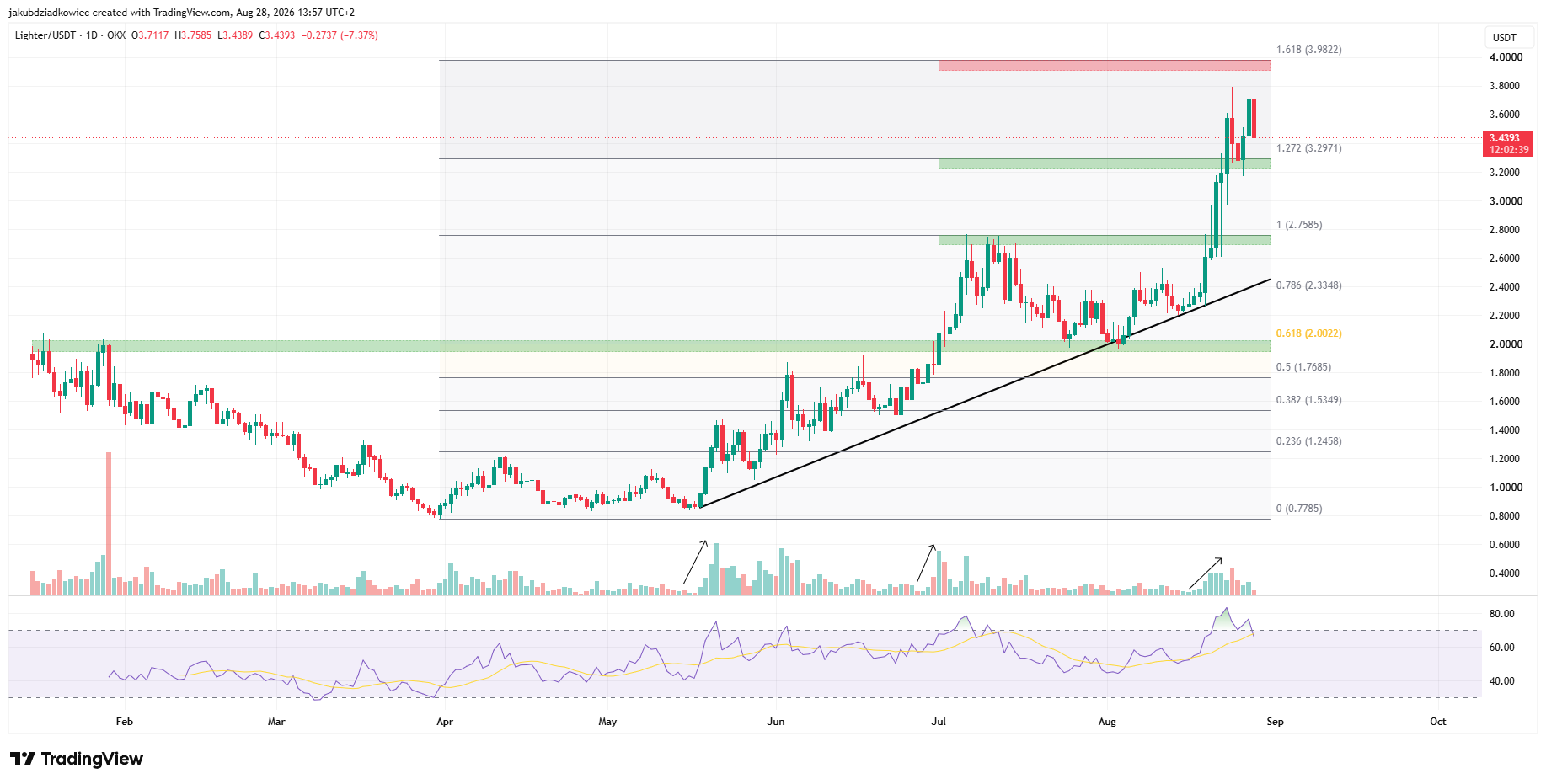
Three altcoins to watch this weekend share the same setup. Lighter (LIT), Zcash (ZEC), and Rain (RAIN) have each broken above multi-month highs and tagged their first Fibonacci extension target.
Each chart now asks the same question. The broken highs have flipped into support, while the 1.618 Fibonacci extension sits overhead as the next objective into the weekend.
Altcoin
Current Price
Next Resistance
Target if Cleared
Support if Price Falls
Lighter (LIT)
~$3.39
$3.79
$3.98
$3.30, then $2.76
Zcash (ZEC)
~$807
$903
$1,099
$749.65, then $628.63
Rain (RAIN)
~$0.01766
$0.01948
$0.02214
$0.01624, then $0.01420
Lighter Extends Its Breakout Toward $3.98
Lighter trades near $3.46 with a market capitalization of $865 million. The token has gained about 25% over the past week and roughly 57% over the past month.
The daily chart shows a clean breakout on Aug. 21 above $2.76, a level LIT had not traded through since January. That move followed a July tokenomics overhaul that introduced permanent supply reduction.
Price then cleared the 1.272 Fibonacci extension at $3.30 and now works toward the 1.618 extension at $3.98. That target sits about 15% above spot.

On a pullback, the broken $2.76 level becomes the first support. An ascending trendline drawn from the mid-May low is converging with the same price level, strengthening the zone.
Below it, the long-term 0.618 retracement at $2.00 remains the deeper floor.
Volume expanded higher on each leg, including the August advance that followed the first revenue-funded burn. RSI has cooled from an overbought reading near 85 to just under 70 without printing a bearish divergence.
Zcash Stalls Under $900
Zcash trades near $806 with a $13.6 billion market cap. ZEC has climbed roughly 75% in 30 days, extending a rally that began earlier this year.
The privacy coin broke above $749.65 and pushed into the 1.272 extension at $903.47 before sellers stepped in. Price has since settled back near $800, holding well above the breakout level.
The 1.618 extension at $1,099.14 marks the next upside objective, roughly 37% above current prices. ZEC still trades far below its record of $3,191.93, set in October 2016.

Support is stacked. The old $749.65 high sits first, followed by the 0.786 retracement at $628.63, which currently aligns with the 20-day moving average.
Bollinger Bands have expanded sharply, indicating a period of volatility rather than a range. Volume ticked higher on the breakout leg, and RSI holds near 70 with no bearish divergence. A newly listed Grayscale product tracking ZEC provides a fundamental backdrop for the move.
Rain Prints a Record High With Volume Behind It
Rain trades near $0.01763 with a $12.35 billion market cap. Market data places its record high at $0.019464, reached on Aug. 25.
The RAIN chart offers the cleanest structure of the three altcoins discussed here. Price built a tight accumulation base through early and mid-August, roughly between $0.0121 and $0.0130.
That base formed directly on the 0.618 retracement at $0.01259, and volume rose steadily inside the range before any breakout occurred. Accumulation therefore preceded the move rather than chasing it.

The Aug. 26 candle cleared $0.01624 and wicked into the 1.272 extension at $0.01884. The 1.618 extension at $0.02214 now stands about 27% higher.
Support levels sit at the broken $0.01624 high, then $0.01420, then the accumulation shelf at $0.01259. RSI trades above 70 with no bearish divergence, which suggests momentum remains intact.
One structural risk deserves attention. Circulating supply stands near 709 billion tokens against a maximum of 1.15 trillion, so further unlocks could weigh on price.
The post Top 3 Altcoins to Watch This Weekend After Record High Price Jump appeared first on BeInCrypto.
Crypto World
UAE “Spy Sheikh” Behind Trump Crypto Bank: 49% Ownership, $500M and Questions MAGA Can’t Avoid

Sheikh Tahnoon bin Zayed al Nahyan and co-investors are behind an entity that owns 49% of the holding company created for the planned Trump crypto World Liberty Financial’s US banking venture, according to people familiar with the matter, as cited by The Wall Street Journal.
The stake makes Tahnoon-linked investors the largest shareholders in the holding company behind a bank being prepared by the Trump family’s cryptocurrency venture.
The reported ownership arrangement follows a $500M investment in World Liberty Financial that Tahnoon backed last year in exchange for a 49% stake in the company, the Journal previously reported. The new venture expands the business relationship between the Trump-backed crypto company and a foreign government official.
Trump Crypto Bank Breakdown: Why the Initiative Matters Now
The Office of the Comptroller of the Currency earlier this month granted preliminary conditional approval for World Liberty Financial to launch a federally chartered national trust bank, according to the Journal’s Aug. 27 report. The proposed bank would issue, redeem and safeguard USD1, the dollar-backed stablecoin World Liberty launched last year.
The preliminary approval places the proposed bank at the center of World Liberty Financial’s stablecoin business. It also focuses on the ownership of the holding company created for the venture, in which Tahnoon and his co-investors are reported to hold the largest stake.
Make Your Prediction Count With $25 For Free on Kalshi
The Ownership Question
— Mario Nawfal (@MarioNawfal) August 28, 2026
 The “spy sheikh” is now a major backer of the Trump family’s new crypto bank.
Sheikh Tahnoon bin Zayed, UAE national security adviser and brother of the country’s president, sits behind a 49% stake in the holding company for World Liberty’s planned U.S. bank. A Trump-family… pic.twitter.com/wV4laIAK6f
The 49% holding-company stake follows the earlier 49% stake in World Liberty Financial itself. The Journal reported that Tahnoon-linked investors are behind the entity holding the largest stake in the holding company for the banking venture.
Tahnoon is the United Arab Emirates’ national security adviser and the brother of the country’s president. The Journal reported that he oversees an empire funded by his personal fortune and state money worth more than $1.3 trillion.
The report identifies the size of the stake and the investors behind it, but it does not detail the banking venture’s board composition, governance rights, or any veto arrangements associated with the ownership position. Those details would be important to assessing how the holding-company ownership is reflected in the venture’s operations.
Don’t Miss Out on Our $1,000 USDT Airdrop on ByBit
What the Reporting Establishes
The reporting establishes a significant financial relationship between World Liberty Financial and investors linked to a senior UAE official. It does not establish that Tahnoon personally directs the planned bank’s day-to-day management or sets its U.S. regulatory strategy.
Tahnoon has sometimes been referred to in coverage as the spy Sheikh. The Journal’s reporting on this banking venture identifies his role as the UAE’s national security adviser and describes the ownership stake, but does not connect the nickname to operational control of World Liberty Financial’s planned bank.
How USD1 Fits Into the Proposed Trump Crypto Bank

USD1 is World Liberty Financial’s dollar-backed stablecoin, launched last year. Under the OCC’s preliminary conditional approval, the federally chartered national trust bank would issue, redeem, and safeguard the token.
The report describes the proposed Trump crypto bank’s role in USD1 but does not provide further detail about the venture’s governance structure or how the holding company’s ownership would relate to specific banking functions. The preliminary approval is therefore a key development for the planned bank, while important operational details remain outside the reporting provided.
Never Miss a Swing Again: Use AI Copy Trading Bots From CryptoHopper
The post UAE “Spy Sheikh” Behind Trump Crypto Bank: 49% Ownership, $500M and Questions MAGA Can’t Avoid appeared first on Cryptonews.

Technology stocks are back, as Magnificent Seven member Microsoft (MSFT) extends a breakout. Palantir Technologies (PLTR), Workday (WDAY), JFrog (JFROG) and Shopify (SHOP) are other software stocks near buy points, too. After back-to-back losses, the S&P 500 Technology sector is up about 6% so far this month. The software segment is outperforming, with iShares Expanded Tech-Software Sector ETF (IGV) up…
Copyright ©2026 Investor’s Business Daily, LLC. All rights reserved. 87990cbe856818d5eddac44c7b1cdeb8
Trump Digital Gold has crashed 99% from its peak after wallets controlling 82.45% of the Solana token’s supply sold their holdings for about $1.01 million.
Summary
- Connected wallets sold 824.54 million GOLD tokens for 9,784.6 SOL, according to EmberCN.
- GOLD briefly reached a $66 million market cap after a Trump-affiliated merchandise account promoted it.
- The token’s market cap fell from $55 million to $1 million in about 30 seconds.
- U.S. regulators warn that social media promotions are frequently used in crypto pump-and-dump schemes.
GOLD wallets sold 82.45% of the token supply
On-chain analyst EmberCN reported on Aug. 29 that wallets linked to the Trump Digital Gold token had sold their entire holdings two hours before the post, receiving 9,784.6 Solana tokens worth approximately $1.01 million.
The wallets collectively controlled 824.54 million GOLD tokens, equal to 82.454% of the asset’s total supply, through a combination of pre-allocation and purchases made shortly after trading began. Such concentrated ownership allowed the connected addresses to sell most of the circulating supply once other traders entered the market.
EmberCN called the wallets the token’s “scammers,” although no law enforcement agency or U.S. regulator had publicly identified the people controlling the addresses at the time of writing. The on-chain analyst’s post also did not name GOLD’s developers or provide evidence linking its creators directly to President Donald Trump, his family, or the Trump Organization.
GOLD was created on Solana at 7:38 a.m., according to the timeline shared by EmberCN. Less than two hours later, an X account using the handle @realtrumpcoins1 posted the token’s contract address, giving traders a direct route to buy the new asset.
The account is associated with a Trump merchandise collaboration, but its connection to branded products does not by itself establish that GOLD was an official Trump project. TrumpStore.com identifies itself as the Trump Organization’s official retail website, while the organization’s website directs customers to TrumpStore.com for its official merchandise. Neither page identified GOLD as an authorized digital asset.
Trump-linked promotion sent GOLD to a $66M peak
At around 9 a.m., the contract-address post from @realtrumpcoins1 prompted a rapid increase in trading, EmberCN said. GOLD’s market capitalization briefly reached $66 million as buyers entered the newly created market.
The token remained volatile over the next several hours before the promotional post disappeared at 11:48 a.m. According to the analyst, the connected wallet cluster began selling at the same time the account deleted the message.
Heavy selling drove GOLD’s market cap from approximately $55 million to $1 million in about 30 seconds. The addresses continued exchanging their tokens for SOL until they had disposed of the full 824.54 million-token position by around 2 p.m.
By the time EmberCN published the findings, GOLD’s market cap had fallen to approximately $700,000, representing a decline of nearly 99% from its $66 million peak. The analyst estimated that the sellers had converted their position into $1.01 million of SOL based on the cryptocurrency’s value at the time.
A separate report citing Lookonchain described 15 wallets as linked to the team and said some of the addresses had bought GOLD before the promotional post appeared. Neither on-chain account identified the owners of the wallets, and the available blockchain records alone do not establish whether the same people controlled the token or the X account.
No public statement cited by EmberCN showed that Donald Trump promoted GOLD himself. The token is also separate from Official Trump (TRUMP), the Solana memecoin launched in January 2025 and publicly promoted through Trump’s verified social media accounts.
GOLD crash follows a familiar Solana token pattern
The concentration of GOLD’s supply left buyers exposed to sales from a small wallet group. Once the holders of more than four-fifths of the supply exited, the token had few buyers capable of absorbing the volume entering the market.
As crypto.news previously explained, Solana launch platforms can make token creation and early trading almost immediate. The same process lets automated buyers, bundled wallets, and insiders acquire large positions before most retail traders find the asset.
Traditional rug pulls involve developers removing liquidity from a decentralized exchange pool. A token can also collapse when connected wallets control most of its supply and sell into demand created by social media promotion, even when liquidity has not been directly withdrawn.
GOLD’s sequence closely resembles an earlier incident involving BARRON, an unofficial token named after Trump’s son. In January 2025, an insider wallet bought 136.35 million BARRON tokens for about $1,048 before exchanging the position for 4,405 SOL worth roughly $1.05 million after the token rallied, according to a report on the dump.
Another politically branded token drew scrutiny in May 2026 after Bubblemaps connected more than 200 newly funded wallets to nearly all of its initial supply. Wallets associated with the Ghanaian former president-themed CWU token sold about $600,000 while related addresses still controlled around 85%, according to the platform’s wallet-cluster findings.
Official Trump has faced separate questions in the United States. In August, U.S. senators called for the Securities and Exchange Commission to examine whether the official token had operated as a “soft rug pull” after falling about 98% from its peak. Nansen data cited by the lawmakers showed that 988,905 of the 1.48 million wallets that bought TRUMP held combined losses of approximately $3.81 billion, as detailed in the SEC probe request.
The lawmakers’ request did not establish that fraud occurred. Any enforcement decision would require regulators to examine the token’s structure, promotion, distribution, and the economic facts surrounding its sale.
U.S. rules leave meme coin buyers with limited protection
For U.S. traders, the SEC’s Division of Corporation Finance said in February 2025 that the offer and sale of meme coins fitting its description generally do not involve securities under federal law. The staff viewed such assets as collectibles purchased mainly for entertainment, social interaction, and cultural purposes rather than investments tied to a business operation.
The SEC staff statement also said holders of meme coins covered by its analysis do not receive the protections of federal securities laws. The assessment is not binding law, and the agency said it would examine the economic reality of any product that uses a meme coin label to avoid securities requirements.
Fraudulent conduct can still lead to action under other federal or state laws even when a token is not considered a security, according to the SEC. Its Office of Investor Education and Advocacy has separately warned that fraudsters may create culture-themed tokens, promote them on social media to raise the price, and then sell their holdings before the attention disappears.
Under the agency’s description of a crypto pump-and-dump, promoters profit from the inflated price while later buyers can suffer steep losses. The investor alert advises traders not to rely solely on social media posts or celebrity associations when deciding whether to buy a crypto asset.

Dow Jones futures will open Sunday evening, along with S&P 500 futures and Nasdaq futures. The stock market’s major indexes rose modestly for the week, despite Friday’s losses as Treasury yields jumped on Fed chief Kevin Warsh’s Jackson Hole speech. But the small-cap Russell 2000 fell below key support while many sectors retreated for the week often with downside reversals.…
Copyright ©2026 Investor’s Business Daily, LLC. All rights reserved. 87990cbe856818d5eddac44c7b1cdeb8


Hyperliquid has received its first reported builder-deployed HIP-4 outcome exchange after OUT completed deployment through the network’s permissionless market framework.
Summary
- OUT has become the first reported outcome DEX deployed through Hyperliquid’s HIP-4 framework.
- Deployers can create YES/NO markets using templates approved by Hyperliquid validators.
- HIP-4 contracts are fully collateralized and operate without leverage, funding payments or liquidations.
- Hyperliquid’s current developer documentation lists permissionless deployer actions as available on the testnet.
Hyperliquid’s block explorer shows that a successful on-chain transaction registered the Outcome DEX under the name OUT through the HIP-4 deployment framework.
The transaction confirms OUT’s deployment but does not show whether its markets have opened for live trading. No separate announcement or verifiable website detailing its markets, liquidity, or trading activity was available at the time of writing.
Hyperliquid’s HIP-4 framework lets builders create markets
According to Hyperliquid’s developer documentation, HIP-4 lets approved deployers create outcome markets without seeking validator approval for every individual contract. Each market must still follow a template that the validator set has previously approved.
Templates define the basic form of a contract, its available results, and how it settles. Once validators approve one, a deployer can use the same structure to create separate markets that meet its conditions.
A YES/NO template allows traders to choose between two possible results. Multi-result templates can cover questions with several possible answers, although Hyperliquid’s main HIP-4 documentation says multi-outcome support was not included in the initial mainnet release and would arrive in stages.
Hyperliquid’s deployer page, updated on Aug. 13, lists functions for activating a DEX, selecting templates, setting a deployer fee scale, and creating markets. The documentation currently labels its HIP-4 deployer actions as testnet-only, meaning OUT’s deployment should not yet be described as a confirmed permissionless mainnet launch without additional evidence.
As crypto.news previously reported in July, Hyperliquid’s permissionless deployment plan was scheduled to begin on testnet before reaching mainnet. The proposal required market operators to stake 500,000 HYPE and allowed validators to slash deployers for incorrect or delayed settlement, according to the July report.
Separate stakes are required for HIP-3 and HIP-4 operations because one HYPE allocation cannot support both deployments at the same time, according to Hyperliquid’s framework. At current prices, the requirement can create a high entry cost for independent teams seeking to operate both perpetual and outcome exchanges.
HIP-4 outcome contracts remove leverage and liquidations
Hyperliquid introduced HIP-4 on testnet in February before activating its first outcome contracts on mainnet on May 2. A July HIP-4 framework explainer described the products as fully collateralized contracts that settle within a fixed range at expiration.
Unlike perpetual futures, an outcome position does not rely on borrowed funds or recurring payments between long and short traders. HIP-4 has no funding rate, while fully funded positions remove the liquidation process used to close leveraged trades when collateral falls below maintenance requirements.
For a binary market, a YES token settles at 1 if the stated event occurs and at 0 if it does not. The NO side receives the opposite result. A trader buying YES at 0.60 can earn 0.40 per contract if the event happens, while the purchase price represents the maximum possible loss.
Hyperliquid’s documentation describes HIP-4 as a general-purpose tool rather than a system limited to conventional prediction questions. Its fixed-range structure can also support bounded options-style products whose maximum payout and loss are known when the position opens.
Trading takes place through HyperCore, the network’s on-chain order-book engine. HyperCore also runs Hyperliquid’s spot, perpetual, and HIP-3 builder-deployed markets, allowing HIP-4 products to use the same matching infrastructure and order types.
Fees are not charged when an outcome position opens, according to the protocol documentation. Charges can apply when a trader closes, burns, or settles a position, although Hyperliquid waived outcome-market fees during its initial testing period.
Bitcoin and CPI contracts tested HIP-4 settlement
Hyperliquid’s first mainnet HIP-4 product was a recurring Bitcoin binary contract. The market settled each day at 06:00 UTC against the BTC mark price published through HyperCore, providing an objective data point for deciding whether YES or NO tokens received the payout.
The network later expanded the product beyond crypto prices. In May, a U.S. CPI contract allowed traders to take positions on the annual inflation rate reported by the Bureau of Labor Statistics.
The CPI market offered three possible results: below 4.3%, exactly 4.3%, or above 4.3%. It used USDC as collateral and was scheduled to settle from the official BLS release, while early activity stood at about $3,000 in volume and $5,000 in open interest.
Validator-settled markets subsequently covered Federal Reserve decisions and sporting events, according to Galaxy Research. The research firm said validators could publish approved off-chain results through regular network operations, reducing reliance on a separate oracle provider.
Galaxy reported that HIP-4 recorded $2.38 million in 24-hour Bitcoin outcome volume by its 25th day. The total represented about 20% of the combined BTC prediction-market volume measured between Hyperliquid and Polymarket during that period, according to the firm’s June report.
Activity later declined after an early increase tied to World Cup markets. Blockworks data cited in a July market report placed HIP-4 open interest at about $182,000 and cumulative notional activity at approximately $881,000 at the time, though the figures covered a later snapshot and used a different measurement period.
U.S. access depends on event-contract regulation
For American traders, OUT does not carry the same regulatory status as Kalshi, which operates event contracts through a Commodity Futures Trading Commission-registered designated contract market. Hyperliquid has not announced that OUT is registered with the CFTC or available to U.S. users.
Hyperliquid Policy Center and Multicoin Capital addressed the regulatory divide in a July prediction-market rules filing. The groups asked the CFTC to publish clear federal standards for reviewing event contracts and explain publicly why specific contracts are approved or rejected.
Their submission said settlement terms should determine whether a contract falls into restricted categories involving gaming, war, assassination, or unlawful activity. The filing represented an industry policy request and did not give HIP-4 exchanges permission to serve U.S. traders.
State and federal regulators have also disputed whether some sports event contracts qualify as federally regulated derivatives or state-regulated wagers. Kalshi, Crypto.com and Robinhood have faced state challenges over sports-related products even when the contracts were offered through federally regulated market structures.
Hyperliquid users in the United States remain unable to access the protocol, according to an August filing cited by Hyperliquid Strategies. The company said it was unaware of a pending CFTC approval process for the network and warned that a route into the regulated U.S. market could not be assured.
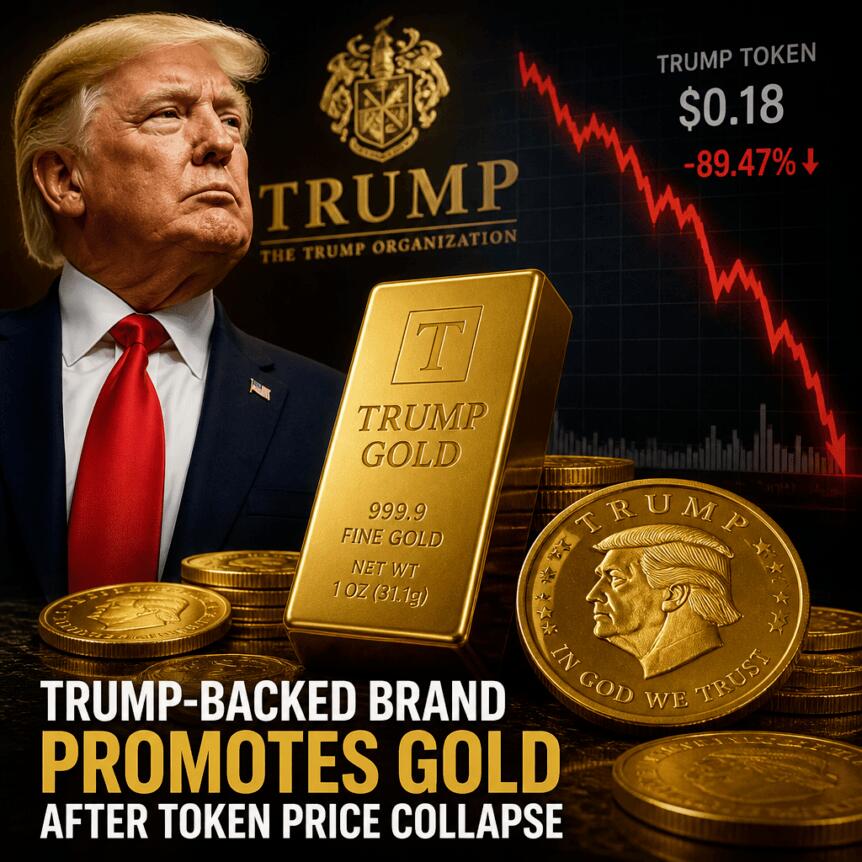
A Solana token promoted under the Real Trump Coins brand collapsed within hours of its launch, according to blockchain analytics and on-chain activity. The episode has quickly sparked scrutiny over the token’s legitimacy and raised questions about whether the brand’s social accounts or website were compromised.
Real Trump Coins—an outlet that US President Donald Trump publicly promoted in 2024—advertised a “Trump Digital GOLD” token on X before deleting related posts on Saturday. Blockchain analytics firm Lookonchain later flagged the launch, alleging that the team behind the token controlled a large portion of the supply and used newly created wallets to dump holdings shortly after launch, causing the token’s value to plunge.
Key takeaways
- Lookonchain says GOLD’s developer and associated wallets controlled about 82.45% of the token supply at the time of the analysis.
- After being acquired by 15 newly created wallets, 224.5 million GOLD was reportedly sold for 3,178 SOL (about $330,000 at the time), contributing to a rapid price collapse.
- DE X Screener data cited in the reports shows GOLD’s market capitalization dropped from roughly $50 million to about $500,000 within hours.
- Real Trump Coins’ website continued promoting the GOLD token after the X posts were deleted, leaving observers to question who initiated the launch and promotion.
- The incident adds to broader concerns around Trump-linked crypto brands as US policymakers debate a regulatory framework for digital assets.
GOLD launch on Solana ends in rapid sell-off
The token surfaced early Saturday after the Real Trump Coins X account—an account that Trump’s official profile follows—posted about the GOLD launch and directed users to RealTrumpCoins.com. Shortly after, Lookonchain flagged the activity, drawing attention to wallet distribution and the token’s early trading behavior.
In a thread referencing the on-chain setup, Lookonchain said the developer held 600 million GOLD while 15 newly created wallets spent $18,657 to buy an additional 224.5 million tokens. Lookonchain also warned that the team “currently controls 82.45% of the total supply,” advising traders to exercise caution.
Lookonchain later reported that those 15 wallets sold all 224.5 million GOLD for 3,178 SOL, describing it as an apparent rug-style extraction of value soon after acquisition. The same analysis estimated the wallets’ profit at roughly $312,000—about 17 times the initial amount invested.
As selling spread, the token’s valuation deteriorated quickly. According to DEX Screener data referenced in the reporting, GOLD’s market capitalization fell from about $50 million to around $500,000 at the time of publication.
For traders, the takeaway is not just that the token declined, but how quickly supply concentration and early transfers translated into market impact. Such a pattern—large holdings clustered near the deployer paired with rapid post-launch selling—often leaves retail buyers with limited exit liquidity.
Real Trump Coins keeps marketing GOLD after X deletion
Real Trump Coins’ connection to the episode matters because Trump has previously promoted the brand. The company’s site continued advertising GOLD at the time of publication, including a claim that it would charge a 4% trading fee and that it would use 99% of those fees to buy back the token in an attempt to push it toward a top-10 ranking by market capitalization.
However, observers noted a mismatch between marketing on the website and the behavior of the brand’s X account. Lookonchain reported that Real Trump Coins promoted GOLD on X and then deleted the related posts on Saturday.
That combination—public promotion followed by deletion, while the website remains active—has fueled speculation that either the token launch was mishandled, or that the brand’s online presence may have been compromised. Some crypto commentators went further, describing the setup as an apparent scam or rug pull, though the reports in circulation included claims that were not independently substantiated within the available facts.
The immediate practical concern for users is how to verify whether token promotions stem from legitimate operators or from unauthorized actors. In incidents like this, “official-looking” social posts may not be enough, and the contract’s distribution, liquidity conditions, and wallet behavior can become the more reliable indicators.
Why the Real Trump Coins tie is under scrutiny
Real Trump Coins was publicly promoted by Donald Trump in September 2024, when he highlighted RealTrumpCoins.com during announcements related to his silver medallions. The website’s terms state that its products are not manufactured, distributed, or sold by the Trump Organization.
Even with that disclaimer, the GOLD incident revived attention on the ecosystem of Trump-linked crypto activity and the potential governance and conflict-of-interest concerns that come with high-profile endorsements. The episode lands as Trump continues to press Congress on crypto oversight, including legislation aimed at establishing a regulatory framework and clarifying whether tokens should be treated as securities or commodities.
In the weeks and months preceding the broader regulatory debate, Trump and his family have backed or launched multiple crypto ventures, including the Official Trump memecoin and World Liberty Financial. The White House has denied impropriety in connection with these efforts, but incidents like the GOLD collapse inevitably intensify public scrutiny of how legitimacy is communicated to retail investors.
Earlier reporting on these policy efforts has emphasized that lawmakers’ decisions could shape how token issuers and promoters are regulated—especially when promotional reach overlaps with political visibility. In that context, the GOLD episode is less about one token’s fate and more about the recurring problem of investor harm when marketing appears to outpace verification.
What to watch next
For now, traders and observers will likely focus on whether the GOLD token’s contract and wallet flows show any further coordinated activity, and whether Real Trump Coins addresses the on-chain behavior that Lookonchain highlighted. More broadly, the incident underscores how quickly reputational risk can spread when high-profile branding intersects with on-chain launches—especially in the absence of clear, verifiable operator confirmation.


INTERPOL has reported 58 arrests, 263 identified suspects and $2.67 million seized after a 22-country operation targeted crypto investment scams, romance fraud and money laundering networks.
Summary
- Operation Jackal IV involved 22 countries across six continents between November 2025 and June 2026.
- Police arrested 58 people and identified 263 suspects linked to West African organized crime networks.
- South African authorities seized $2.67 million and blocked 257 bank accounts after raids in Johannesburg.
- Romanian police arrested 11 suspects in an investment scheme linked to an estimated €143 million.
According to an official INTERPOL release published on Aug. 25, Operation Jackal IV ran for eight months from November 2025 through June 2026 and focused on the financial systems used by West African organized crime groups.
Authorities from 22 countries across six continents took part in the operation, including the United States, the United Kingdom, Canada, the United Arab Emirates, South Africa, Argentina, Nigeria, Romania, and several European countries.
Investigators focused on groups such as Black Axe and similar criminal organizations accused of running romance scams, fake cryptocurrency investments, business email fraud, and other financial crimes. Police also tracked the shell companies, bank accounts, digital wallets, and outside service providers used to receive or conceal stolen money.
During the operation, INTERPOL helped participating agencies exchange intelligence across borders, analyze financial activity, and coordinate enforcement work. The organization also provided specialist training to investigators handling money laundering cases.
“By following illicit financial flows across borders, we are attacking the very lifeblood of organized crime and making it increasingly difficult for criminal networks to profit from their activities,” said Tomonobu Kaya, director of the INTERPOL Financial Crime and Anti-Corruption Centre.
Interpol crypto scam operation leads to 58 arrests
Operation Jackal IV resulted in 58 arrests and the identification of another 263 people suspected of links to the targeted criminal networks, according to INTERPOL.
In Argentina, federal police uncovered a Crime-as-a-Service network suspected of supplying website domains and money laundering support to West African crime groups. Investigators identified 196 people connected to the operation and arrested 17 suspects.
An INTERPOL Operational Support Team assisted Argentine authorities with the examination of seized information. The team analyzed the material for links among suspects, criminal groups, and overseas partners while helping local investigators develop additional leads.
South African authorities conducted the largest enforcement action reported in the operation, arresting 39 people during raids at seven locations in Johannesburg. Police linked the sites to a group accused of running romance and investment scams against retirees in English-speaking countries.
According to INTERPOL, members of the network handled different stages of the fraud, with some working as “conversion” agents and others serving as “retention” agents. Such roles involved turning initial contacts into paying victims and persuading existing victims to continue sending money.
Police seized $2.67 million, blocked 257 bank accounts, and collected evidence during the Johannesburg raids. An INTERPOL support team also worked in South Africa to help local investigators examine the network’s financial and international links.
The agency’s release lists 17 arrests in Argentina and 39 in South Africa, accounting for 56 of its stated 58 arrests. However, the same release separately reports 11 arrests in Romania, bringing the country-level figures mentioned in the statement to 67. INTERPOL did not explain whether the Romanian arrests were included in its headline total or treated as the result of a connected investigation.
Romanian investment scam allegedly moved €143 million
Romanian police dismantled a call center accused of offering investors large returns from stocks and cryptocurrencies. INTERPOL said the suspects redirected victims’ deposits to electronic wallets under their control rather than placing the money in genuine investments.
Investigators estimated that the group stole and laundered about €143 million worldwide. Police arrested 11 people and seized approximately €330,000 in cash and cryptocurrency, six properties and several luxury watches.
In Italy, investigators identified one person suspected of involvement in a money laundering network operating across Europe. According to INTERPOL, the network used shell companies, remittance services, and cash withdrawals to hide the source of funds.
A single bank account processed €845,000 across 560 transactions involving 20 financial instruments, the agency said. Investigators did not report an arrest in the Italian case, and the inquiry remained tied to the identification of one suspect.
Operation Jackal IV also found that some West African crime groups were buying Crime-as-a-Service tools from outside providers, often through dark web markets. INTERPOL said such arrangements allowed fraud groups to outsource website infrastructure, money laundering, and other technical work instead of managing every part of their operations internally.
In July, crypto.news reported another INTERPOL operation that produced 5,811 arrests and intercepted $293 million in illicit assets across 97 countries and territories. Operation First Light also identified more than 142,000 victims and blocked over 31,000 bank accounts while targeting romance scams, investment fraud and related money laundering.
Thai police uncovered a crypto laundering network during that earlier operation, with INTERPOL saying one wallet processed more than $122.5 million over 10 months. Investigators alleged that the network moved romance scam proceeds through several digital assets and used cross-chain swaps to make the money harder to trace.
U.S. authorities pursue overseas crypto scam proceeds
The United States was among the 22 countries participating in Operation Jackal IV, although INTERPOL’s release did not describe a specific U.S. arrest or asset seizure from the operation.
American authorities have separately pursued overseas networks accused of targeting U.S. residents with similar romance and crypto investment schemes. In July, the Department of Justice sought the forfeiture of $25 million in cryptocurrency recovered through five investigations involving suspected victims in the United States and Canada.
According to the U.S. Attorney’s Office for the District of Columbia, the five cases involved fake cryptocurrency platforms and laundering networks with links to China, Malaysia and Cambodia. Prosecutors said the DOJ’s Scam Center Strike Force had seized more than $800 million since its creation in November 2025.
One of the investigations involved more than 270 suspected victim transfers and approximately $10.4 million in cryptocurrency, while another covered over 200 romance scam victims and $12.1 million in assets. Under the civil forfeiture process, eligible victims may seek compensation if courts approve the government’s claims to the recovered funds.
During a separate June enforcement action, Coinbase froze over $3 million in cryptocurrency tied to alleged Southeast Asian scam networks. The exchange worked with the DOJ, Meta, Microsoft, Starlink and overseas law enforcement agencies to identify financial transfers and online infrastructure linked to romance and investment fraud.
Meta disabled more than 1.4 million accounts, pages and groups connected to suspected scams, while Microsoft suspended about 20,000 accounts. Starlink terminated service for thousands of internet kits associated with suspected unlawful activity, and the Royal Thai Police arrested 63 people linked to scam operations.

Baltimore Police Officer Allegedly Raped Woman at Apartment

BYD’s Overseas Push Drives Quarterly Profit Growth

UK police seize $1.4M tied to darknet market activity





-

 Crypto World4 days ago
SpaceX stock could rise 75% to $240, JPMorgan says
-

 Crypto World2 days ago
Bitcoin’s 22% rally now needs real demand to outlast Treasury liquidity boost
-

 Business7 days ago
Musk’s Tesla, SpaceX Confirm $16.8 Billion ‘Terafab’ Chip Plant as World’s Largest Building in Texas
-

 Fashion19 hours ago
Weekend Open Thread: Maeve – Corporette.com
-

 Crypto World5 days ago
A $30 Billion AI Fund Implodes, Now the SEC Is Investigating Wall Street’s Role
-

 Crypto World3 days ago
Warsh Jackson Hole keynote puts financial innovation first
-

 Business1 day ago
Salesforce Stock Soars 19% as Blowout Earnings and Agentforce AI Growth Silence Software Skeptics
-

 Crypto World3 days ago
Did Trump Just Move SpaceX Stock With One Truth Social Post?
-

 Business6 days ago
Mystery AI Model ‘Ox Alpha’ Draws Developers With Free Access as Chinese Lab Origins Remain Debated
-

 Business3 days ago
Walmart takes aim at younger shoppers with new fashion brand
-
 NewsBeat3 days ago
Lindsay Clancy jury braces for closing arguments as judge tells court: ‘You’ve heard all the evidence’ – Live updates
-

 Business5 days ago
Moderna CEO warns China is pouring state money into mRNA technology
-

 Crypto World3 days ago
Elon Musk Grok Bot Promise: We Will Make You Whole if AI Loses Your Money
-

 Business5 days ago
NVIDIA Stock Drops Nearly 2 Percent to $210 on Seventh Losing Day Ahead of Critical AI Earnings
-

 Crypto World2 days ago
NVIDIA revenue hits $96.2B as AI demand doubles
-

 Business21 hours ago
iPhone 18 Pro Pre-Orders Could Shift to Saturday as Apple Reportedly Avoids September 11 Anniversary
-

 Business4 days ago
Thailand’s Eastern Economic Corridor Capital City (EECiti): Key Developments and Investment Opportunities
-
 Crypto World5 days ago
$92 Billion Nvidia Earnings Could Make or Break the AI Trade
-

 Business6 days ago
Where Will Kevin Durant Play in 2027? Rockets Hold Player Option Key to His Future With Houston via Deal
-

 Sports6 days ago
Deshaun Watson fires back at Browns fans after being booed: ‘It’s a disrespectful thing’
You must be logged in to post a comment Login