
Crypto World
SEC's Peirce Says Onchain Vaults, Lending Can Trigger Securities Laws



SEC Commissioner Hester Peirce said crypto vaults and onchain lending strategies can fall under U.S. federal securities laws depending on how they are structured and managed, in a statement published July 22 titled "Headstands and Summervaults: A Statement on Crypto Vaults and Lending Strategies."… Read the full story at The Defiant

Plans to issue stablecoins denominated in local currencies to reduce reliance on dollar-linked tokens may unintentionally make it easier to move value into “digital dollars,” according to a senior International Monetary Fund (IMF) official.
Speaking on Friday, IMF First Deputy Managing Director Dan Katz said that once local- and dollar-denominated stablecoins run on the same underlying blockchain infrastructure, users could swap between them through decentralized exchanges, liquidity pools, or peer-to-peer mechanisms.
Key takeaways
- IMF First Deputy Managing Director Dan Katz warned that local-currency stablecoins could still funnel users into dollar stablecoins if both use the same blockchain rails.
- Katz said cross-stablecoin interoperability could shift foreign-exchange activity away from traditional intermediaries like banks and currency dealers.
- He suggested this dynamic could reduce friction in capital movement, affecting how authorities monitor and manage flows.
- Katz noted adoption outcomes may differ by country, with local tokens potentially replacing dollar holdings in highly dollarized economies.
- He urged regulators to enable compliant onramps, offramps, and onchain exchange points to manage risks.
How shared blockchain infrastructure could enable “digital dollar” access
Katz’s core point is about infrastructure. In his remarks—delivered in a speech at the University of Cape Town—he argued that if local-currency stablecoins and dollar-backed stablecoins are deployed on the same blockchain framework, the practical barriers to conversion could fall sharply.
That matters because, in decentralized finance environments, conversion does not require a single centralized issuer or intermediary to broker every transfer. Katz specifically referenced common DeFi routes: decentralized exchanges, liquidity pools, and peer-to-peer swaps. Under that model, users could move between token types directly, turning what begins as local-currency issuance into an easier path to dollar exposure.
Potential implications for FX monitoring and capital-flow tools
The IMF official linked interoperability to a broader policy concern: where foreign-exchange activity happens. Katz argued that moving FX-related activity away from banks and traditional currency dealers could reduce “friction” that authorities currently rely on to monitor and manage capital flows.
In other words, the issue is not only which stablecoin a user holds, but how quickly and through what channels they can reposition into a different currency exposure. If swaps become routine onchain, regulators may find it harder to observe the flow of currency demand through traditional institutional pathways.
At the same time, Katz framed the shift as potentially reinforcing the broader category of FX-focused stablecoins. He said that local-currency stablecoins “might even accelerate the adoption of FX stablecoins,” a statement that underscores the possibility that currency-linked token ecosystems could become more integrated over time rather than remaining siloed.
Adoption unevenness: South Africa as a case study
Katz pointed to South Africa to illustrate how adoption can diverge across token types. He said dollar-backed stablecoins have gained only limited traction there, while rand-linked tokens have attracted even less demand.
He cautioned that it is still too early to draw definitive lessons from any single country, but he offered an explanation for why users might still prefer dollar tokens. In his view, many participants may choose dollar stablecoins due to factors like liquidity, network effects, and cross-platform or cross-border acceptance.
Those characteristics can translate into more efficient trading and easier settlement—particularly in environments where the local currency faces volatility, lower market depth, or weaker confidence in local issuances. Even if a policy objective is to reduce dependence on the dollar, market structure and user preferences can pull activity back toward the most “usable” asset in practice.
Regulatory framing: country risk differences and compliant onchain rails
Katz said risks vary by country. He suggested that in highly dollarized economies, stablecoins may largely substitute for existing dollar holdings rather than creating incremental demand for dollars. But in countries where dollar access is restricted and the economic policy framework is weaker, stablecoins could instead increase foreign-currency demand.
This distinction is important for policymakers because it affects what “success” looks like. If stablecoins mainly repackage dollars already held domestically, the macro impact might differ from a scenario in which stablecoins provide a smoother mechanism to access additional dollar exposure.
To manage these trade-offs, Katz urged authorities to build regulatory frameworks around practical access points. Specifically, he called for authorities to bring onramps, offramps, and onchain exchange points within regulatory boundaries.
The policy takeaway is that banning activity is not the only route. Instead, the IMF official highlighted the need for rule-based access to onchain liquidity and conversion, so regulators can better understand flows and reduce the incentive for unregulated intermediaries.
Going forward, the key question for investors and builders is whether stablecoin issuers and blockchain platforms will prioritize interoperability across local- and dollar-denominated tokens—or isolate them through different infrastructure choices. Katz’s remarks imply that interoperability could materially change who ends up holding “digital dollars” and how quickly currency reshuffling occurs, so market participants should watch how regulators operationalize onramps, offramps, and onchain exchange controls in the jurisdictions most likely to experiment with local-currency stablecoin issuance.


Citadel21, the bitcoin publication run by pseudonymous commentator hodlonaut, also reported that its Lightning node had been swept, though it said little money was held there.
The vulnerability had already been reported to BTCPay by members of the Bitcoin Red Team — a group of developers that began pointing AI models at bitcoin codebases this week and has filed thousands of findings across hundreds of projects since.
Read More: Bitcoin developers flag 85 critical bugs in an “extremely bad” situation.
BTCPay credited Red Team members Craig Raw, Rob Hamilton, Calle and Evan Kaloudis with responsibly disclosing the issue and helping analyze it.
The group’s stated reason for publishing findings quickly was that people outside it would arrive at the same bugs, and by the time BTCPay’s public warning went out, attackers were already exploiting this one against live servers.
Meanwhile, BTCPay narrowed the scope after its initial alert, saying its standard on-chain wallets, including hot wallets generated inside BTCPay, are not affected by the credential flaw.
The exposure applies specifically to deployments using LND, and funds held inside LND’s own on-chain wallet can still be at risk because they sit under the compromised Lightning node.
BTCPay has not yet published technical details of the vulnerability, saying operators need time to patch. A full postmortem is due in the coming days.


Wyoming has disclosed an indirect investment in HYPE through Hyperliquid Strategies ($PURR) in its second-quarter 13F filing, adding another digital asset-linked position to the state’s crypto-related portfolio.
Summary
- Wyoming disclosed indirect exposure to HYPE through Hyperliquid Strategies in its second quarter 13F filing.
- The filing shows the state invested in Hyperliquid Strategies rather than purchasing HYPE tokens directly.
- The disclosure adds to Wyoming’s growing blockchain initiatives, including its state backed FRNT stablecoin and digital asset policies.
- Wyoming is set to host the Wyoming Blockchain Symposium later this month with senior policymakers and crypto industry leaders expected to attend.
According to Blockworks analyst Shaunda Devens, Wyoming’s second-quarter 13F filing shows the state gained indirect exposure to Hyperliquid’s HYPE token through an investment in Hyperliquid Strategies ($PURR). Devens shared the filing on X, describing it as Wyoming’s latest indirect crypto investment disclosed through its public securities holdings.
While the filing does not indicate that Wyoming purchased HYPE tokens directly, the disclosed position gives the state indirect exposure through Hyperliquid Strategies, a publicly traded vehicle linked to the Hyperliquid ecosystem. The filing also does not disclose any direct ownership of HYPE by the state itself.
Public pension funds, treasuries and other government entities routinely disclose their U.S. equity holdings through quarterly Form 13F filings. The latest disclosure places Wyoming among the public institutions with exposure to companies connected to the digital asset market rather than only traditional crypto-related stocks.
Wyoming’s HYPE exposure comes through Hyperliquid Strategies
Hyperliquid Strategies is the investment vehicle identified in the filing. By holding shares in the company, Wyoming receives indirect exposure to HYPE instead of holding the token on its balance sheet.
Devens’ post did not specify the size of the investment or when the position was established during the second quarter. The filing likewise does not state whether the investment forms part of a larger digital asset allocation strategy or a standalone portfolio holding.
Indirect exposure through listed securities has become a common route for institutional investors seeking participation in digital assets while remaining within existing investment frameworks. Such investments differ from purchasing cryptocurrencies directly because the underlying exposure is obtained through corporate securities.
Wyoming has continued expanding its blockchain strategy
The disclosure arrives as Wyoming continues to build one of the most active blockchain policy programs among U.S. states.
In January, Wyoming launched the Frontier Stable Token (FRNT), becoming the first U.S. state to issue a government-managed dollar-backed stablecoin. The token debuted on Solana before expanding to Ethereum, Arbitrum, Base, Optimism, Polygon and Avalanche through cross-chain infrastructure. State officials said the reserves are managed by Franklin Templeton, held in a Wyoming-chartered trust and backed by U.S. dollars together with short-term Treasury securities.
Interest generated from those reserves is directed to Wyoming public schools, while the stablecoin was designed to reduce payment costs for state services and demonstrate blockchain-based settlement under public oversight. The project followed years of legislation that included legal recognition of decentralized autonomous organizations, the creation of Special Purpose Depository Institution charters and passage of the Stable Token Act.
Wyoming selected Solana after evaluating multiple blockchain networks before launch, while Kraken became the first Wyoming-domiciled exchange to offer the token for public purchase.
State policies have extended beyond digital assets
Alongside blockchain initiatives, Wyoming has also moved to attract computing infrastructure tied to artificial intelligence.
Governor Mark Gordon signed Executive Order 2026-03, titled “Data Centers the Wyoming Way,” in June. The order instructs state agencies involved in permitting and supporting large data center developments to consider electricity demand, water usage, environmental factors, workforce planning and the effect on residential power prices while reviewing projects.
The executive order followed rising investment in AI infrastructure across the United States and also intersects with Wyoming’s established Bitcoin mining industry, where companies have increasingly explored artificial intelligence and high-performance computing alongside cryptocurrency mining.
Several publicly traded miners, including IREN, MARA Holdings, Cipher Digital, Hut 8, HIVE Digital and TeraWulf, have announced or evaluated AI and high-performance computing businesses as they diversify revenue following the 2024 Bitcoin halving.
Wyoming remains active in crypto policy discussions
The state’s investment disclosure also comes shortly before the Wyoming Blockchain Symposium, scheduled for Aug. 17-20 in Jackson Hole.
As previously reported by crypto.news, Ripple CEO Brad Garlinghouse will join the speaker lineup alongside policymakers including SEC Chair Paul Atkins, Sen. Cynthia Lummis, House Majority Whip Tom Emmer, Sen. Ruben Gallego and Comptroller of the Currency Jonathan Gould.
Industry participants expected at the event include Galaxy founder Michael Novogratz, Cardano founder Charles Hoskinson, Stellar Development Foundation CEO Denelle Dixon and Custodia Bank founder Caitlin Long.
Organizers have identified U.S. crypto regulation, Bitcoin, digital asset investment strategies, decentralized artificial intelligence and financial market structure among the planned discussion topics. Ripple also maintains academic ties with the University of Wyoming through the Ripple Blockchain Collaboratory and renewed funding under its University Blockchain Research Initiative.
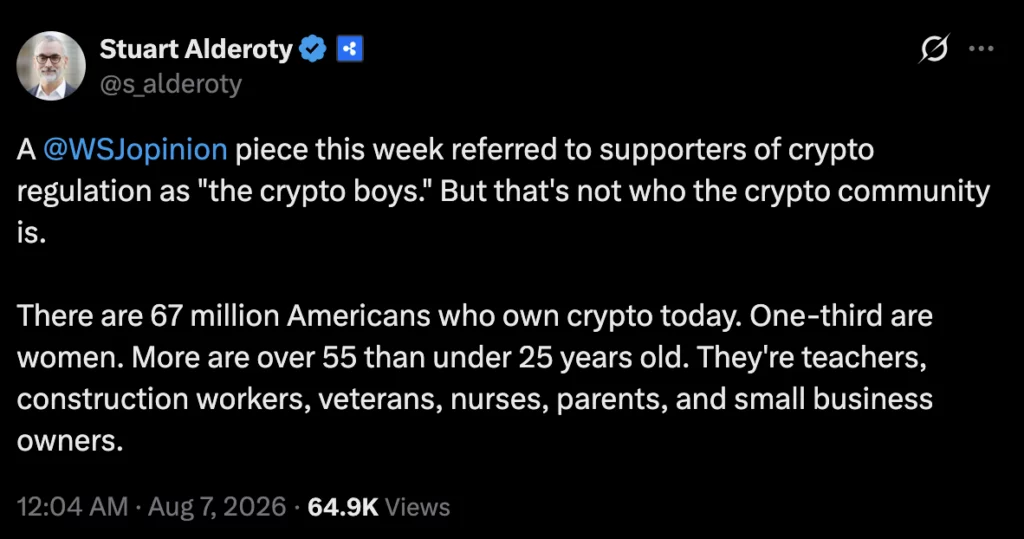
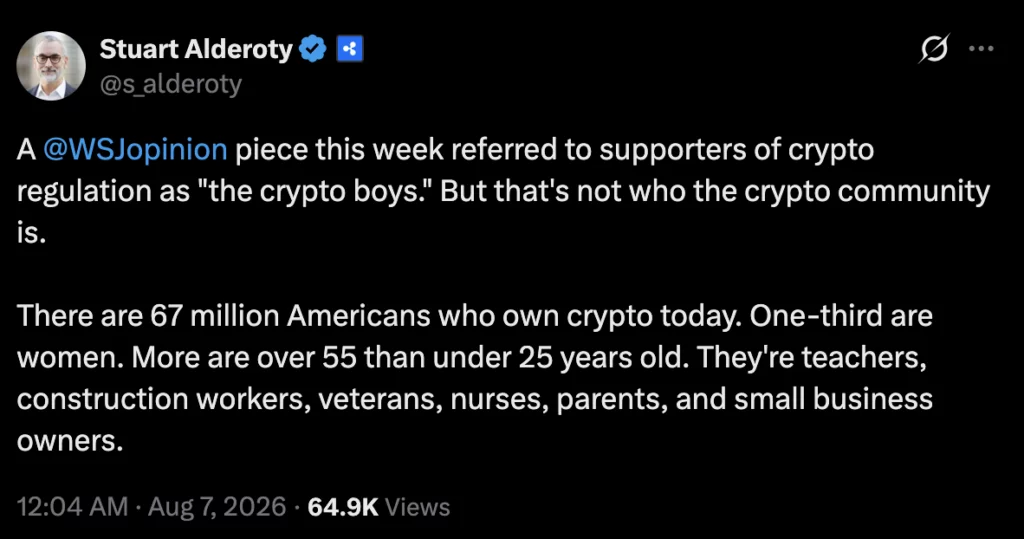
Ripple Chief Legal Officer Stuart Alderoty pushed back on the idea that cryptocurrency remains a niche dominated by young men, pointing to survey data showing 67 million Americans now hold digital assets.
Summary
- Alderoty says 67 million American crypto holders show digital assets have moved beyond niche stereotypes.
- NCA research found 42% of recent crypto purchasers were women, compared with 34% earlier adopters.
- 28% of recent holders were 55 or older, versus 18% aged between eighteen and twenty-four.
- The Senate delayed its CLARITY Act floor vote until September as bipartisan negotiations remain unresolved.
- Ripple funded the National Cryptocurrency Association with $50 million, while Alderoty serves as its president.
His Aug. 7 comments responded to a Wall Street Journal editorial that referred to supporters of crypto regulation as “the crypto boys.”
Alderoty argued that the label mischaracterizes a group of users. He cited Americans working in education, construction, health care and small business. His argument comes as Washington debates the CLARITY Act, giving the demographic question a dimension rather than leaving it as a dispute over industry image.
Survey data supports a broader crypto demographic
The 67 million estimate comes from the National Cryptocurrency Association’s 2026 State of Crypto Holders report, conducted with The Harris Poll. The research surveyed 10,000 U.S. crypto holders between Feb. 12 and March 3 and reported that roughly one in four American adults owns cryptocurrency, up from one in five a year earlier.
The demographic findings are nuanced than the shorthand used in Alderoty’s post. Among people who first bought crypto in 2025 or 2026, 42% identified as women, compared with 34% among earlier adopters. Meanwhile, 28% of recent purchasers were 55 or older, versus 18% who were between 18 and 24. The report found more than half of holders had household income below $150,000.
Those figures support Alderoty’s claim that crypto ownership is not confined to one age, gender or profession. However, the report measures people who already hold crypto, and its findings should not be treated as evidence that public opinion toward the industry is equally broad or favorable.
Ripple has a stake in the adoption debate
Alderoty occupies two roles relevant to the argument. He is Ripple’s chief legal officer and president of the National Cryptocurrency Association. The group launched in March 2025 with a $50 million grant from Ripple and says its mission is to improve crypto education and public understanding across the United States, as detailed in earlier coverage.
That relationship provides context for the survey’s use in Washington. The NCA says the 2026 study was conducted with The Harris Poll and carries a 95% confidence level with sampling precision of plus or minus 0.7 percentage points for the surveyed population. Still, the organization is backed by a major crypto company that has advocated for clearer federal rules.
As previously reported, Alderoty made a similar argument in July, saying 67 million holders meant Washington could no longer treat crypto users as a fringe constituency. Ripple has also joined an industry campaign urging Senate leaders to advance the CLARITY Act after months of negotiations.
CLARITY Act fight moves from demographics to policy
The legislation would create a federal digital-asset market structure and clarify how oversight is divided between the Securities and Exchange Commission and Commodity Futures Trading Commission. The Senate Banking Committee advanced the measure 15-9 in May, with two Democrats joining Republicans. Updated merged text was released July 22.
Yet support has become harder to secure. Democratic lawmakers have sought stronger ethics, consumer protection, illicit-finance and market-integrity provisions. Senate Banking Committee Democrats have separately argued in an advisory that parts of the proposal could leave national-security vulnerabilities. Those criticisms remain disputed by Republican sponsors and crypto industry supporters.
The Wall Street Journal editorial that prompted Alderoty’s response also questioned stablecoin reward provisions and exemptions involving decentralized networks. Blockchain Association CEO Ji Kim rejected parts of that criticism as containing “factual and legal inaccuracies.” The competing arguments show that ownership numbers do not resolve disagreements about how the industry should be regulated.
September becomes the next test for crypto legislation
The political timetable tightened on Aug. 6, when Senate Majority Leader John Thune confirmed that a pre-recess CLARITY Act vote would not happen. He said the measure would be queued when lawmakers return in September, while blaming Democratic resistance for the delay.
That postponement matters because the legislation generally needs 60 votes to invoke cloture and overcome a filibuster before final passage can become realistic. Republicans cannot reach that threshold alone, making Democratic support necessary unless the procedural landscape changes. Ethics provisions and other unresolved sections will therefore remain central during the recess.
For Ripple and Alderoty, the 67 million figure strengthens an advocacy argument that lawmakers are regulating a large and varied constituency. It does not prove that those holders share Ripple’s preferred policy approach. The next test will come in September, when senators must decide whether negotiations have produced enough bipartisan support to move the CLARITY Act toward a floor vote.


SkyBridge Capital founder Anthony Scaramucci said on Aug. 7 that crypto adoption may reach its most important stage when consumers use blockchain infrastructure without knowing it is there.
Summary
- Scaramucci says mainstream users will soon use crypto and blockchain technology without recognizing underlying infrastructure.
- Adjusted stablecoin transaction volume reached $10.2 trillion over twelve months, according to Visa-backed blockchain research.
- Federal Reserve researchers identified accelerating retail stablecoin adoption through digital wallet partnerships as 2025 developments.
- Tokenized stock transfers rose 105% monthly to $8.41 billion as blockchain-based equity infrastructure expanded rapidly.
- Scaramucci previously backed the CLARITY Act, calling compromise preferable to continued U.S. regulatory uncertainty overall.
Responding to an X user who argued ordinary people would never use crypto, Scaramucci wrote that they “will soon use crypto/blockchain without even realizing it.”
The claim is a forecast, not evidence that mass adoption has already arrived. Still, current payment and tokenization data provide examples of the model he describes: blockchain increasingly operates behind familiar interfaces while users interact with cards, wallets, brokerages and payment applications rather than raw addresses, gas fees or network settings.
Stablecoins already show how invisible crypto could work
Stablecoins provide the clearest existing test. Visa research using adjusted blockchain data estimated $10.2 trillion in stablecoin transaction volume over the previous 12 months, after filtering activity such as bots and internal exchange movements. Visa said adjusted volume was up 63% year over year, showing that blockchain settlement has expanded beyond speculative trading.
The Federal Reserve has also documented the trend. In an April note, researchers said stablecoin market capitalization grew about 50% during 2025, while transaction volume and decentralized finance use increased. They identified accelerating retail adoption through digital wallet partnerships as one development reshaping the sector, while warning that broader use could create new financial stability risks.
As crypto.news reported in its stablecoin payment expansion, Visa, Mastercard, Stripe, PayPal and other established firms are adding blockchain settlement without requiring customers to understand the underlying rails. That model closely matches Scaramucci’s argument: users may choose a card, app or dollar balance while blockchain infrastructure handles settlement behind the interface.
Tokenized assets are moving toward familiar interfaces
Tokenization offers another example. Rather than asking consumers to learn decentralized finance first, platforms are increasingly placing blockchain representations of traditional securities inside products that resemble brokerage or wallet applications. Tokenized stock transfers rose 105% over one month to $8.41 billion in July, according to RWA.xyz data cited in related tokenization coverage.
The shift is also reaching traditional market infrastructure. The Depository Trust & Clearing Corporation has been testing tokenized securities, while crypto platforms have expanded access to tokenized equities and exchange traded funds. In tokenized equities coverage, products tied to familiar stocks increasingly appear alongside conventional digital assets, reducing the distinction visible to users.
Scaramucci ties adoption to simpler user experiences
Scaramucci’s position reflects a longstanding technology pattern: infrastructure becomes more widely useful when consumers no longer need to understand its mechanics. Internet users routinely rely on protocols, cloud services and encrypted connections without choosing technical standards for each interaction. He expects blockchain systems to follow a similar path.
That view does not mean every crypto product will disappear from view. Bitcoin, self-custody wallets and decentralized applications can still require users to interact directly with digital assets. Instead, the “invisible” thesis applies most clearly to services where blockchain functions as settlement, recordkeeping or transfer infrastructure beneath a conventional customer experience.
Scaramucci has also linked adoption to clearer U.S. rules. In July, he described the CLARITY Act as imperfect but “ten times better” than the regulatory status quo and urged stakeholders to accept compromise. The Senate has since delayed a floor vote until September, leaving broader market structure legislation unresolved.
Regulation could decide how quickly adoption disappears backstage
The U.S. already has one major piece of federal crypto legislation in place. The GENIUS Act, signed in July 2025, created a regulatory framework for payment stablecoins. Federal Reserve research notes that agencies are still implementing core rules, including reserve transparency, redemption rights and customer identification requirements for eligible issuers.
Those rules matter to Scaramucci’s thesis because invisible infrastructure still requires visible accountability. If consumers do not know which blockchain settles a payment, responsibility shifts toward issuers, wallets, exchanges, banks and payment companies to manage custody, fraud, disclosures and compliance correctly.
There is also a scale gap between crypto infrastructure and everyday consumer finance. Federal Reserve payments data show U.S. consumers and businesses made 236.6 billion noncash payments in 2024, with cards representing more than three quarters by number. Stablecoins are growing quickly, but much blockchain volume still reflects trading, treasury movements and settlement rather than retail purchases.


Domestic-currency stablecoins intended to curb reliance on dollar-backed tokens could instead make it easier for users to move funds into digital dollars, according to a senior International Monetary Fund (IMF) official.
On Friday, IMF First Deputy Managing Director Dan Katz said that once local and dollar stablecoins operate on the same blockchain infrastructure, users can convert between them through decentralized exchanges, liquidity pools or peer-to-peer swaps.
In a speech at the University of Cape Town, Katz said the shift could move foreign exchange activity away from banks and currency dealers, reducing the friction that gives authorities tools to monitor and manage capital flows.
“In this way, local-currency stablecoins might even accelerate the adoption of FX stablecoins,” he said.
Katz pointed to South Africa, where dollar-backed stablecoins have gained limited traction but rand-linked tokens have attracted even less demand.
While it was too early to draw firm conclusions, he said many users may favor dollar tokens because of their liquidity, network effects and acceptance across platforms and borders.
Katz said the risks vary by country. Stablecoins may largely replace existing dollar holdings in highly dollarized economies but could increase foreign-currency demand in countries where access to dollars is restricted and economic frameworks are weak.
He urged authorities to bring onramps, offramps and onchain exchange points within regulatory frameworks.
Related: Dollar stablecoins could improve FX access but amplify currency runs: IMF
Efforts to promote stablecoins pegged to local currencies in order to reduce dependence on dollar-backed tokens may end up doing something quite different: making it easier for users to switch into “digital dollars,” according to a senior International Monetary Fund (IMF) official.
In remarks delivered at the University of Cape Town, IMF First Deputy Managing Director Dan Katz said that if local- and dollar-denominated stablecoins are deployed on the same blockchain infrastructure, conversion between the two could become routine through decentralized exchanges, liquidity pools, or peer-to-peer swaps. The implication, he suggested, is that stablecoin design aimed at curbing dollar exposure could inadvertently improve access to FX stablecoins.
Key takeaways
- IMF First Deputy Managing Director Dan Katz warned that local-coin stablecoins could also facilitate conversion into dollar-backed tokens if both run on shared blockchain infrastructure.
- Once interoperability is built, Katz said users may be able to exchange between stablecoin types via decentralized exchanges, liquidity pools, or P2P swaps.
- He argued that this could shift foreign-exchange activity away from traditional intermediaries such as banks and currency dealers.
- Katz highlighted that outcomes are likely to differ by country, depending on dollarization levels, market access, and economic institutions.
- He urged regulators to ensure onramps, offramps, and onchain exchange points are integrated within regulatory frameworks.
Why interoperability changes the stablecoin story
The IMF official’s central point is not merely about what stablecoins are pegged to, but about how easily they can be moved and swapped once they share technical rails. Katz argued that if local and dollar stablecoins “operate on the same blockchain infrastructure,” users would have multiple pathways to convert between them—effectively reducing the practical difference between holding a rand-linked or a dollar-linked token.
This matters because stablecoin adoption is often shaped by more than the peg. According to Katz, even when local-currency tokens are available, many users may still prefer dollar tokens due to factors like liquidity, network effects, and acceptance across platforms and borders. In other words, the attractiveness of dollar stablecoins may be structurally reinforced by where activity and market depth already exist.
When those advantages are paired with interoperability, the “local-currency” intention can be diluted: users may treat pegged tokens as interchangeable short cuts rather than as separate ecosystems.
Potential impact on FX markets and capital-flow monitoring
Katz also framed the issue from the perspective of how FX activity and capital flows are handled. He said that routing conversion and movement through decentralized venues could move foreign-exchange activity away from banks and currency dealers.
The policy consequence, in his view, is that the usual frictions—those gaps that authorities can sometimes leverage to observe, measure, and manage capital flows—may be reduced. If stablecoin trading and exchange become more direct and automated, regulators may find it harder to rely on the traditional chokepoints that exist in bank-led FX systems.
At the same time, Katz argued that the direction of travel could be consistent with broader adoption dynamics: “In this way, local-currency stablecoins might even accelerate the adoption of FX stablecoins.” That is a key tension running through his remarks—efforts meant to localize currency exposure could end up making FX stablecoins more accessible.
What the IMF official cited from South Africa
Katz pointed to South Africa as an example where dollar-backed stablecoins have seen limited traction, while rand-linked tokens have attracted even less demand. He noted that it was “too early” to draw firm conclusions, but the pattern underscores the possibility that local-pegged products have struggled to achieve the same pull as dollar-denominated alternatives.
For investors and market participants, the takeaway is straightforward: liquidity and ecosystem maturity can matter as much as the peg itself. If dollar stablecoins already circulate across a wider set of venues and users, interoperability could channel demand toward the assets that offer the easiest conversion and deepest markets.
Country-by-country risks: dollarization versus restricted access
While Katz did not present a one-size-fits-all forecast, he argued that the risks vary across countries. He suggested that stablecoins could largely replace existing dollar holdings in highly dollarized economies—meaning the shift would be more about substitution of what people already hold.
In contrast, he warned that in countries where access to dollars is restricted and economic frameworks are weaker, stablecoins could increase foreign-currency demand. In those settings, the accessibility gains from onchain conversion may become economically consequential, potentially shifting how households and businesses seek to hedge or transact.
That distinction is important for policymakers who might otherwise assume that “local-currency stablecoins” automatically reduce cross-border currency pressures. Katz’s framing implies that the broader macro effect depends on whether stablecoin adoption replaces existing behavior or changes the feasibility of accessing foreign currency in the first place.
Regulators may need onramps, offramps, and onchain exchange points
Rather than advocating for a simplistic approval or prohibition approach, Katz urged authorities to build regulatory coverage around the full stablecoin lifecycle—specifically onramps, offramps, and onchain exchange points. His comments imply that supervision cannot stop at issuing rules for pegged tokens; it also has to address where conversions happen and how users enter and exit stablecoin positions.
From a market-structure standpoint, this is a crucial policy challenge. If decentralized exchanges and liquidity pools become the primary route for swapping between stablecoin types, regulation that only targets centralized issuers may miss the most active venues for price discovery and asset conversion.
What to watch next is whether jurisdictions pursuing local-currency stablecoins also take interoperability and exchange routing seriously in their regulatory designs. If local and dollar stablecoins become technically unified, Katz’s warning suggests demand may flow toward the tokens with the deepest liquidity and widest acceptance—potentially changing both the mechanics of FX access and the practical tools available to monitor cross-border financial activity.


BitMEX will permanently shut down its exchange on Sept. 23, the crypto derivatives venue said on Thursday, telling users to close positions and withdraw funds before the deadline. Owner and operator HDR Global Trading Limited made the decision "following a strategic review of the business,"… Read the full story at The Defiant
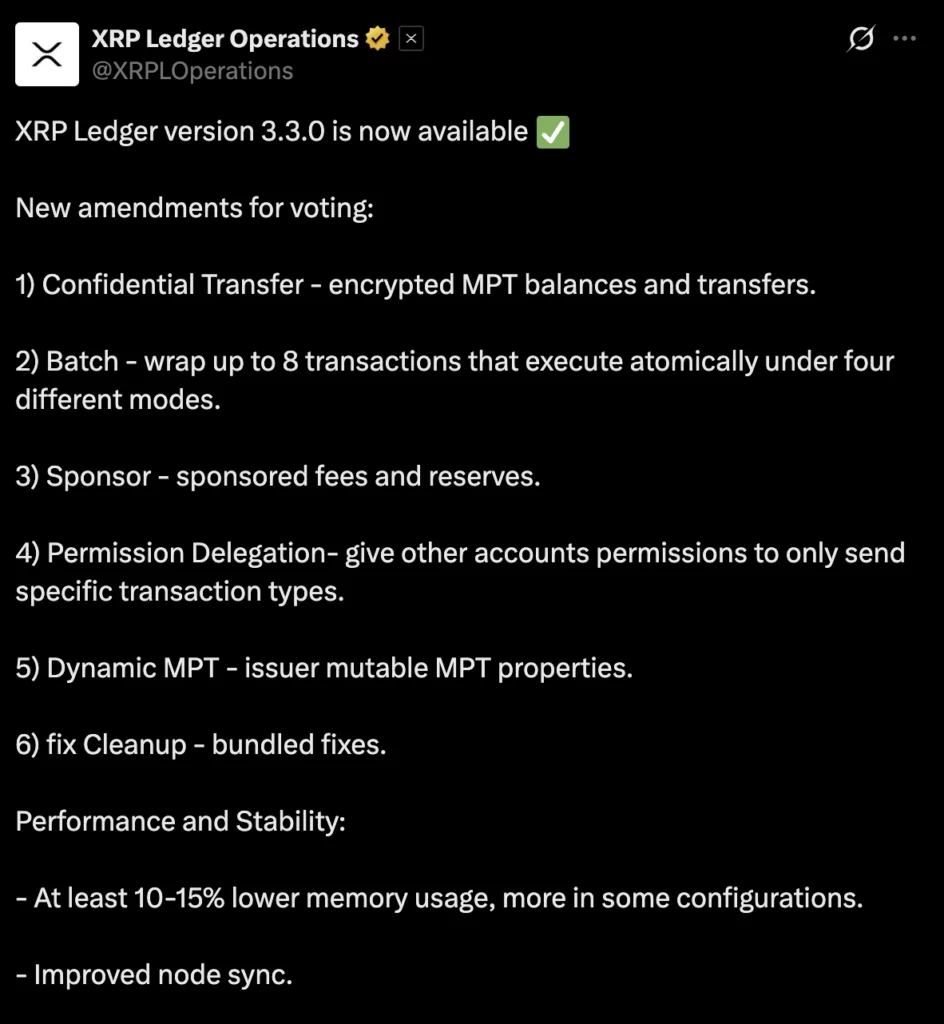
XRP Ledger developers released xrpld version 3.3.0 on Aug. 6, moving several protocol changes closer to possible mainnet activation.
Summary
- XRPL 3.3.0 introduces protocol code, but validator approval remains necessary before any mainnet activation occurs.
- ConfidentialTransfer would shield MPT balances and transfer amounts while preserving compliance access for authorized parties.
- BatchV1_1 restores atomic transaction functionality after an earlier version was halted over a security flaw.
- Sponsor would let third parties cover fees and reserves while users retain full account control.
- DynamicMPT would let issuers modify selected token properties later, supporting evolving business and compliance needs.
The official GitHub release confirms work on ConfidentialTransfer, BatchV1_1, Sponsor and DynamicMPT, alongside fixes and other protocol changes. The software release itself does not activate those features on the network.
The distinction matters because some reports describe six upgrades as already live. Under the XRP Ledger amendment process, new protocol features require validator support before activation. An amendment must maintain more than 80% support from trusted validators for two continuous weeks before taking effect.
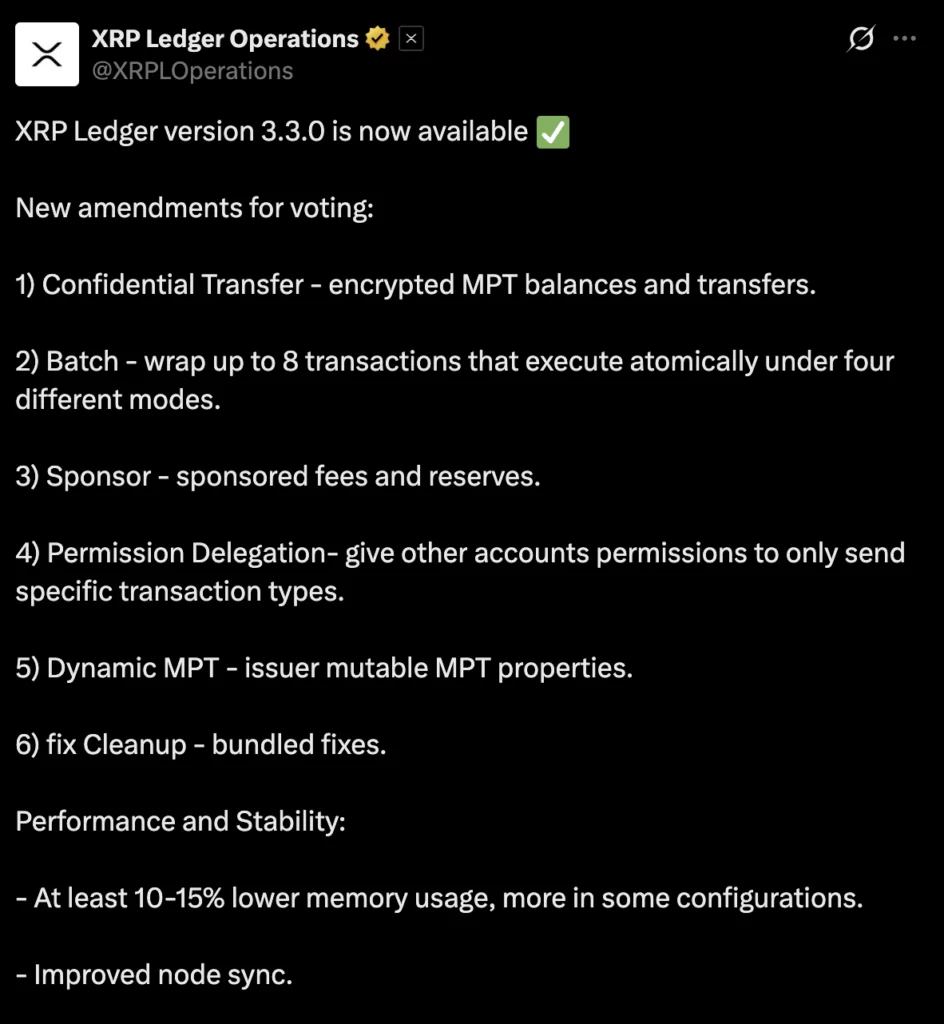
XRP Ledger 3.3.0 adds privacy and atomic transaction tools
ConfidentialTransfer is designed to add privacy for Multi-Purpose Tokens, or MPTs. XRPL documentation says the amendment uses cryptography to shield individual balances and transfer amounts while preserving mechanisms that let authorized parties, including issuers or auditors, verify information needed for compliance.
The feature remains subject to amendment activation, so private MPT transfers should not yet be described as active on XRPL mainnet.
BatchV1_1 is another major component. The XLS-56 standard allows multiple transactions to be packaged and processed together, including transactions involving different accounts. Atomic execution can help settlement workflows where several actions must succeed together rather than leaving one leg completed while another fails.
Revised features follow earlier security findings
Batch has an important history. An earlier version was disabled before mainnet activation after a security issue was discovered in transaction-signing logic. The XRPL Foundation later moved toward BatchV1_1 as the corrected replacement. As previously reported in XRPL security coverage, developers have increased formal review around recent upgrades.
Permission Delegation followed a similar path. XRPL disclosed in September 2025 that a bug in the earlier amendment could have allowed an unauthorized transaction to charge fees to another account under specific conditions. Validators were advised to vote no, and the vulnerable feature never activated. PermissionDelegationV1_1 was developed as its replacement.
The revised concept lets an account grant defined transaction permissions without handing over its main private key, supporting operational wallets with limited authority.
Sponsor and DynamicMPT target institutional onboarding
Sponsor, based on XLS-68, is designed to let another account cover transaction fees or reserve requirements while the user keeps control of the account and keys. The feature could let applications onboard users without requiring them to acquire XRP solely to meet network costs. The XLS-68 proposal explicitly supports fee and reserve sponsorship while preserving user key control.
DynamicMPT targets token issuers. The XLS-94 proposal lets issuers designate selected MPT properties as mutable when creating a token, then update those permitted fields later. The standard is intended to accommodate changing business or compliance requirements without making every token property freely editable.
Together, these features fit XRPL’s growing focus on tokenized finance. In related tokenization coverage, crypto.news reported that JPMorgan, Mastercard, Ondo Finance and Ripple tested a tokenized Treasury redemption using XRPL.
Not every cited upgrade belongs to version 3.3.0
One correction is necessary around the widely circulated “six upgrades” framing. fixCleanup3_2_0 belongs to the earlier xrpld 3.2.0 cycle, not the newly released 3.3.0 feature package. The 3.3.0 GitHub changelog instead shows work around LendingProtocolV1_1 and a separate fixCleanup3_3_0 track alongside the headline features.
The release therefore should not be read as six finished capabilities becoming available simultaneously. It is a server-software milestone that gives validators and operators code needed for amendment decisions. Individual amendments can have different voting timelines and may fail to activate if support falls below the required threshold.
This governance process has mattered before. The original Batch and Permission Delegation amendments were stopped after bugs were identified before mainnet activation, showing that inclusion in software or validator voting is not the same as production deployment.
What happens next for XRPL validators
Node operators now need to assess version 3.3.0 and decide whether to upgrade and support individual amendments. Exact activation dates depend on validator voting, rather than the Aug. 6 software release. XRPL’s amendment rules require the supermajority to persist continuously for two weeks.
For XRP holders, the immediate change is technical rather than monetary. Version 3.3.0 expands the network’s potential toolkit for privacy, multi-step settlement, delegated authority, sponsored onboarding and configurable token issuance, but none guarantees higher XRP demand or price appreciation.
The next verifiable milestones will be validator adoption of 3.3.0, amendment support levels and scheduled activation dates. Until those thresholds are met, the new capabilities should be described as released in node software and moving through governance, not as fully active XRP Ledger mainnet features.
Validator decisions, rather than release marketing, will determine when each feature becomes usable on mainnet.


The Senate will not vote on crypto market structure before August 7. Prediction markets price passage at 16 percent. The math for September is worse than it looks.
Summary
- The U.S. Senate confirmed on August 6 that it will not vote on the CLARITY Act before the August 7 recess, pushing the 309 page market structure bill to a September 14 return window with only 14 working days before midterm politics consume the floor.
- Polymarket odds for the CLARITY Act becoming law in 2026 collapsed from a February peak of 82 percent to 16 percent after Senate Majority Leader John Thune acknowledged the chamber lacks time for debate, amendments, and a 60 vote cloture threshold.
- The bill cleared the House 294 to 134 in July 2025 and the Senate Banking Committee 15 to 9 in May 2026, but a bipartisan ethics provision targeting government officials with crypto holdings above one million dollars remains unresolved after Democrats rejected a White House backed compromise.
- Seven Democratic senators who must cross the aisle for the bill to reach the 60 vote threshold have publicly cited insufficient consumer protections, illicit finance safeguards, and the scope of ethics restrictions as conditions for their support.
- Nearly five million dollars has traded on the Polymarket contract tracking whether H.R. 3633 becomes law before January 1, 2027, making it one of the most liquid regulatory prediction markets in crypto history and an increasingly accurate proxy for legislative sentiment.
The most bipartisan digital asset bill ever to clear a chamber of Congress is now four days from a procedural death that prediction markets already priced in weeks ago. On August 6, 2026, Senate Majority Leader John Thune told reporters the chamber will not hold a floor vote on the Digital Asset Market CLARITY Act before lawmakers leave Washington for the August recess. The Senate holds its last scheduled votes on Friday morning, August 7. It does not return until September 14.
The announcement converted what lobbyists had called a “tight but possible” window into a confirmed miss. On Polymarket, the contract asking whether H.R. 3633 will be signed into law before 2027 trades at 16 cents on the dollar, down from 82 cents in February. The collapse is not a prediction of permanent failure. It is a repricing of the calendar, and the calendar is brutal.
What the CLARITY Act actually does
The Digital Asset Market CLARITY Act is a 309 page bill that divides oversight of digital assets between two federal regulators. Tokens whose value derives primarily from an open, decentralized network would fall under the Commodity Futures Trading Commission. Tokens still tied to the commercial efforts of a founding team or company would be classified as securities under the Securities and Exchange Commission.
The classification matters because it determines which rulebook applies. A digital commodity under CFTC oversight would face disclosure and market integrity requirements modeled on existing futures regulation. A digital asset security under the SEC would face the full weight of securities law, including registration, reporting, and the antifraud provisions that have driven most of the agency’s crypto enforcement actions since 2023. The bill creates a process for tokens to transition from security to commodity status as their networks decentralize, a mechanism the industry has wanted since the SEC first applied the Howey test to token sales.
Beyond classification, the bill sets rules for exchanges, stablecoin yield, DeFi protocols, developer protections, and customer property treatment in bankruptcy. It also grants the CFTC new statutory authority over spot digital commodity markets, a power the agency currently lacks and has requested repeatedly since 2022.
The House passed it on July 17, 2025 with a vote of 294 to 134. More than 70 Democrats crossed the aisle, making it the most bipartisan crypto vote in congressional history. The Senate Banking Committee advanced it on May 14, 2026 by a vote of 15 to 9, with two Democrats joining the Republican majority. At that point, the industry expected a floor vote by the July 4 recess. That deadline came and went.
The stablecoin yield compromise nobody noticed
Buried in the bill’s 309 pages is a provision that could reshape the competitive landscape between banks and crypto firms. The Senate Banking Committee version prohibits interest or yield on idle stablecoin balances, protecting the bank deposit franchise from a product that could siphon savings accounts. But it permits activity based rewards, meaning stablecoin issuers can compensate users for lending, staking, or other on chain actions that generate real economic return.
The distinction is narrow but consequential. A stablecoin that pays 4 percent for sitting in a wallet would compete directly with savings accounts and money market funds. A stablecoin that pays 4 percent for providing liquidity to a DeFi protocol occupies a different regulatory category. The first looks like a deposit. The second looks like a return on productive capital.
Banking industry lobbyists fought for this distinction throughout the markup process. Crypto firms initially opposed it, arguing that any yield restriction would handicap stablecoin adoption. The compromise language reflects months of negotiation between the American Bankers Association and the Blockchain Association, brokered in part by the White House. Both sides have publicly accepted the current text, making stablecoin yield one of the few resolved issues in the bill.
The resolution matters for passage because it removed the banking industry as an active opponent. Banks will not lobby against a bill that protects their deposit base. That leaves the ethics provision as the primary obstacle, which is a political problem rather than an industry one.
The ethics provision that broke the timeline
The single largest obstacle to passage is a proposed ethics provision governing government officials with crypto holdings. Under the current bipartisan draft, federal officials, including the president, would need to divest any crypto holdings worth more than one million dollars that also represent at least 10 percent of a company’s value. Officials with smaller stakes above 15,000 dollars would be required to place holdings in a blind trust or divest outright.
The provision exists because of one person. President Trump disclosed more than one billion dollars in crypto earnings, and Democrats argued that signing a bill governing the industry he profits from requires unprecedented restrictions. The White House initially accepted a version of the ethics language, and Polymarket odds jumped 11 points to 43 percent on July 21 when reports surfaced that Trump had agreed to the deal. But Democrats countered that the restrictions did not go far enough.
Senators Thom Tillis and Ruben Gallego drafted alternative ethics language and sent it to the White House for review. The proposal would also give state attorneys general the power to sue the Justice Department over lax enforcement or to sue exchanges listing assets that violate the ethics rules. Republicans resisted that provision over fears of partisan misuse. A July 22 revision made the ethics rule temporary, with an expiration tied to the end of the current presidential term, but that concession did not satisfy the Democratic caucus either.
The negotiations are ongoing, but as of August 6, no agreement exists. The ethics provision did not appear in the House version of the bill, which means any Senate text on the subject will need to survive conference committee as well. That creates a second layer of political risk. Even if Democrats accept a version of the ethics language strong enough to secure their floor votes, House Republicans who passed a clean bill without ethics provisions may resist adding them in conference. The provision that was designed to unlock Senate votes could become the provision that kills the bill in reconciliation.
How prediction markets became the bill’s unofficial whip count
Polymarket did not wait for Thune’s confirmation. The contract asking whether the CLARITY Act will become law in 2026 began its descent in mid July, falling from 43 percent after the ethics deal reports to 24 percent by late July, then to 14 percent when Thune floated a last minute vote that never materialized. The current price of 16 cents reflects a modest bounce after Thune promised September priority, but the market is telling a clear story: bettors do not believe the calendar supports passage this year.
Nearly five million dollars in total volume has traded on the main contract. A secondary Polymarket market asking whether the Senate would vote before the August recess resolved to “No” with overwhelming liquidity on that side. The accuracy of prediction markets on congressional timing has improved markedly since 2024, when Polymarket correctly called several procedural outcomes on the GENIUS Act weeks before traditional political analysts.
The 82 to 16 percent decline is the steepest odds collapse for any major crypto regulatory contract on Polymarket. It exceeds the drop in GENIUS Act passage odds during the 2025 stablecoin negotiations and approaches the speed of the 2024 Bitcoin ETF approval contract’s final week repricing, though in the opposite direction.
What makes this market particularly informative is who trades it. Polymarket’s regulatory contracts attract a mix of crypto industry insiders, political consultants, and Hill staffers who cannot legally trade traditional political prediction markets but face no such restriction on crypto native platforms. The information density of the order book arguably exceeds that of any single news source, because traders with private knowledge have financial incentives to act on it immediately. When the price moved from 43 to 24 percent in the last week of July, the market was pricing in what CoinDesk reported three days later: that Senate leadership had effectively abandoned the August timeline.
The September math
Thune told reporters the bill will be “queued up first thing” when the Senate returns on September 14. The procedural path requires filing for cloture, waiting two days under Senate rules, and then holding a 60 vote procedural vote before debate can even begin. If Thune files cloture before the recess, the first vote could occur as early as Tuesday, September 15. If he waits until September 14 to file, the first vote would fall on Wednesday, September 16 at the earliest.
From September 14 through the pre election recess in mid October, the Senate has roughly 14 working days. In that window, it must also address government funding legislation, potential continuing resolutions, and any executive nominations the White House pushes. Crypto market structure will compete for floor time with every other priority that a chamber facing midterm elections needs to clear.
A legislative staffer told CoinDesk that the bill “would easily have a chance at passage in September” if the outstanding issues are resolved. That conditional is doing all the work. The outstanding issues are the ethics provision, illicit finance safeguards, Agriculture Committee provisions on commodity oversight, and stablecoin yield treatment. None of these are new objections. They have been under negotiation since May. The recess does not resolve them. It suspends them. Staff level negotiations can continue during August, but no senator is going to make a public concession on ethics language while campaigning in their home state. The political dynamics of the recess favor inertia, not resolution.
The September window also coincides with the fiscal year deadline on September 30. If Congress faces a government shutdown fight, the CLARITY Act will be the first item pushed off the calendar. Crypto market structure is important to the industry but it is not must pass legislation, and leadership will always prioritize keeping the government open over advancing any single policy bill.
The 60 vote problem
The CLARITY Act needs 60 votes to clear cloture. Republicans hold 53 seats. That means at least seven Democrats must cross the aisle, and that count assumes every Republican votes yes. Multiple Republican senators have publicly announced opposition or expressed concerns about stablecoin yield language and the ethics provision’s scope.
The seven Democratic crossovers are not hypothetical. Specific senators have tied their votes to specific conditions. Consumer protection language must be strengthened. Illicit finance provisions must be tightened. The ethics provision must restrict presidential crypto involvement more aggressively than the current draft. Each of these demands requires text changes that could lose Republican votes on the other side.
The bill passed the Senate Banking Committee 15 to 9, not 15 to 0. Even in committee, the margin reflected the partisan difficulty of the exercise. On the floor, with midterm campaign pressures and a president whose personal wealth is intertwined with the bill’s subject matter, the vote counting becomes significantly harder. Every amendment that wins a Democratic vote risks losing a Republican one, and the margin for error is zero. The vote counting exercise is further complicated by the midterm calendar. Senators in competitive races have little incentive to take a difficult vote on crypto regulation months before an election. A vote for the bill invites attack ads about enabling presidential self dealing. A vote against it invites attack ads about blocking innovation. The safest move for a vulnerable senator is to not vote at all, which is precisely what the recess delay accomplishes.
What happens if September fails
If the CLARITY Act does not pass the Senate before the mid October recess, it enters a lame duck session compressed by midterm elections, repeating a pattern that has stalled crypto legislation before. The composition of the next Congress depends on November results, and any significant change in chamber control would reset the legislative process entirely.
The bill would not die in a formal sense. It could carry over to a lame duck session after November. But lame duck crypto legislation has never passed, and the political incentive to vote on a complex regulatory framework after elections, when members are either leaving or repositioning, is close to zero. The GENIUS Act stablecoin bill faced a similar dynamic in late 2025 and was ultimately folded into the CLARITY Act rather than passed independently.
Industry lobbyists have begun contingency planning for 2027. A senior policy advisor at the Blockchain Association told reporters that the organization is “preparing for both timelines” but acknowledged that starting over in a new Congress would delay comprehensive market structure regulation by at least 18 months. The SEC would continue operating under its current enforcement first approach, and the CFTC would lack the statutory authority the bill would grant it over spot digital commodity markets.
The gap between votes and law
Even if the Senate passes the CLARITY Act in September, the bill must go to conference committee to reconcile differences with the House version. The House passed its version in July 2025. The Senate version, after committee markup and potential floor amendments, will differ in several material ways, particularly on ethics provisions that did not exist in the House text.
Conference committees on financial regulation historically take weeks to months. The Dodd Frank Act’s conference process took three weeks, and that was considered fast. The CLARITY Act’s conference would need to resolve ethics language, stablecoin yield treatment, CFTC funding mechanisms, and Agriculture Committee provisions that the House and Senate handle differently.
The path from a September Senate vote to a presidential signature before January 2027 requires the conference to finish before the lame duck session ends, both chambers to approve the conference report, and the president to sign a bill containing restrictions on his own financial activities. Polymarket’s 16 percent price reflects the compound probability of all these steps occurring in sequence. The market is not saying the CLARITY Act is dead. It is saying that the chain of events required for it to become law in 2026 is long enough that each link compounds the risk of failure.
What to watch
Cloture filing before August 7. If Thune files cloture on the CLARITY Act before the Senate leaves, it signals genuine intent to hold a procedural vote on September 15. If he does not, the earliest possible vote shifts to September 17 or later, consuming more of the limited floor time.
Ethics language from the White House. The Tillis and Gallego proposal is sitting with the White House for review. A formal response before or during recess would indicate whether the divestiture thresholds and state attorney general enforcement mechanism are acceptable. Silence through recess means September negotiations start from scratch.
Polymarket price above 25 cents. A sustained move above 25 percent on the main contract would indicate that new information, likely a bipartisan agreement on ethics, has shifted market consensus. The current 16 percent price already embeds a September vote attempt and assigns it low probability of success.
Democratic senator public statements during recess. The seven crossover votes needed are identifiable. If any of them publicly endorse the current ethics language or announce conditions that have been met, the vote count math changes. If they use recess town halls to criticize the bill, September passage becomes effectively impossible.
Government funding calendar conflicts. If a continuing resolution debate consumes the first week of the September session, the CLARITY Act loses floor time it cannot afford. Watch for appropriations committee scheduling in late August.
Disclaimer: This article is for informational purposes only and does not constitute financial, legal, or investment advice. Cryptocurrency markets and regulatory outcomes are inherently uncertain. Prediction market prices reflect crowd sentiment, not guaranteed outcomes. Always conduct your own research before making financial decisions. Published August 6, 2026.

IMF Says Domestic Stablecoins Could Lift Demand for Dollar Tokens

Man City agree deal for transfer replacement ahead of Arsenal game

How to grow your money without paying taxes on it #shorts #finance


-

 Politics6 days ago
Zack Polanski: an incitement to murder Nigel Farage?
-

 Crypto World7 days ago
MicroStrategy Post-Earnings CLARITY Act Push Could Add New Catalyst for Its Stock
-

 Crypto World6 days ago
Crypto PAC spending tops $2M in Michigan House race
-

 Business5 days ago
DTCR: Deleveraging And A Hedge Fund Collapse Point To A Possible AI Bottom
-

 Tech6 days ago
ESET tracks rise in malicious AI skills and adaptable malware
-

 Sports7 days ago
France Cricket implodes: letters hidden in a drawer and a board at war
-

 Crypto World6 days ago
XRP Ledger urges node upgrade after manifest flood
-

 Fashion19 hours ago
Frugal Friday’s Workwear Report: Cap-Sleeve Pointelle Crewneck Sweater
-

 News Videos6 days ago
Financial Crash Expert: The 90-Day Collapse Timeline They Are Desperately Hiding.
-

 Sports2 days ago
Jordan Coyle & Cordiamo take Laya Arena Stakes at RDS
-
 Crypto World4 days ago
US Tech Stocks See Largest 5-Week Inflow in History: Can Nasdaq Break Its Downtrend?
-

 Fashion14 hours ago
Weekend Open Thread: Mattifying Sunscreen
-
 NewsBeat6 days ago
Tourist plane on sightseeing flight in Peru crashes into a field, killing all 13 people on board
-
 Business2 days ago
US stocks: Dow closes at record on Mideast optimism; SpaceX, AMD drag Nasdaq
-

 NewsBeat7 days ago
Arsenal reach full agreement with Newcastle over Bruno Guimaraes transfer | Football
-

 Tech6 days ago
Page Not Found | WIRED
-
 NewsBeat6 days ago
Bikini-clad Jennifer Aniston, 57, kisses hypnotist boyfriend Jim Curtis as they enjoy a romantic getaway aboard a luxury yacht in Spain
-

 Politics2 days ago
Reform UK And Greens Sink To Lowest Favourability Ratings To Date
-

 Crypto World4 days ago
Polymarket targets $20 billion valuation as competition heats up in prediction market sector
-

 Business3 days ago
Nvidia Stock Climbs 2.5% as Chip Sector Rally Builds Ahead of AMD Earnings, Nvidia’s Own Report Looms
You must be logged in to post a comment Login