






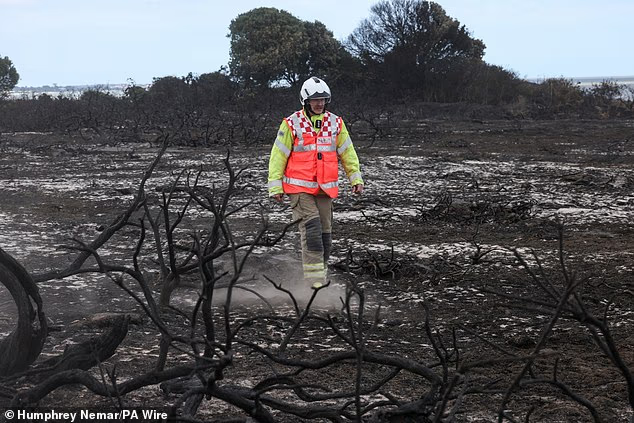
While the old adage of ‘no smoke without fire’ may be true, the reverse is not. From Suffolk to the Peak District to the Cairngorms, pockets of fires are still furtively flickering away, smokeless, unseen and underfoot, in roots, animal burrows or a seam of peat. Sharp-eyed fire crews remain on standby, ready to pounce on the next flame to pop up from the underworld.
The worst may be over – for now, although a new heatwave is on the way – after the spate of wildfires breaking out across Britain in recent days. But the damage – not just to the landscape but the wider tourist industry – reflects a disturbing reality: These things now spread further, faster and deeper than they used to.
And it’s certainly not just down to climate change.
The rise of the fashionable new doctrine that nature is ‘best left to itself’ is leaving mountains of flame-ready brushwood waiting for a spark.
And where, in the past, a live-in gamekeeper might have been on the spot in a trice to swat a wildfire before it got going, much of the countryside is now administered by a nine-to-five lanyard class who are expressly forbidden from tackling anything riskier than a bin fire in the office waste paper basket.
In Suffolk, much of Dunwich Heath and Minsmere, a great sprawl of ancient wood, heather and grassland, resembles a First World War-style wastescape of ash and the odd gnarled tree.
Two nature reserves – one run by the Royal Society for the Protection of Birds and the other by the National Trust – have been wiped out.
The disaster zone equates to 210 football pitches, so we are told by the local authorities who think that the public find a sporting analogy easier to digest than ‘371 acres’. Or, to put it another way, that equates to seeing London’s Hyde Park or three-quarters of Monaco go up in smoke.
Emergency services inspect the scene of the wildfire at Dunwich Heath, on the Suffolk coast on July 31, 2026

A firefighting helicopter scoops up seawater in attempt to control the Dunwich Heath wildfire
The destruction further north has been much worse. The losses at Tintwistle Moor and Dove Stone in the Peak District have been officially rated as 1,250 football pitches, while the destruction in the Cairngorms stands at 3,500 pitches (ten square miles in old money). In each area, the fire crews have performed heroically, assisted by quick-thinking local farmers, gamekeepers and volunteers.
In Suffolk, for example, families had to be plucked from caravans in the dead of night as the flames were heading to a holiday park and, for a while, towards nearby homes.
Ultimately, not a single shed or mobile home, let alone a human life or residence, was lost. The sense of relief round here is palpable.
But now that these wildfires have been largely stamped out, a similarly incendiary debate has already started over the best way to minimise the damage in future.
In very broad terms, it boils down to those, on one side, who think our countryside should be proactively managed the way it has been for generations by people living and working on the land.
Then there are those, on the other, who want it to revert to a more ‘natural’, less human-centric state, a doctrine usually described as ‘rewilding’.
It is a quarrel variously painted as tweedy traditionalists versus dreamy idealists; horny-handed countryfolk versus eco-zealots. Scratch a little deeper and you are soon into culture war/class war/political territory, too.
All can happily agree on a few things. First, idiots will always be with us, dropping fag ends and glass or lighting camp fires in hot weather.
Second, climate change, scorching temperatures and dry, tinderbox summers are now set to be the norm. Views then differ radically on what can be done to make the countryside less flammable.
It is clear that the more we leave woods, grass, heather and gorse untouched by human hand, the more an area accumulates what the authorities call ‘fuel load’ – and what the rest of us call ‘kindling’.
Yet the rewilding lobby argues passionately that rewilding leads to ‘rewetting’ – the benefits of dam-building beavers are often cited – and, thus, a wetter countryside is less likely to burn.
‘This cult has grown up saying, “Man bad, nature good”; that any human intervention is a bad thing,’ says Tim Bonner, chief executive of the Countryside Alliance. ‘At a time when the environmental movement could not be more right about the challenges of climate change and dry summers, it is exactly the time when more management is needed.
‘But the environmental movement and government agencies like Natural England have increasingly moved towards this sort of hands-off, happy-clappy, rewilding idea that if we just let nature go, it’ll all be fine.’
Almost every wildfire turns out to be the fault of a human (though the odd lightning strike can be to blame). Last month’s blaze above Dove Stone reservoir in the Peaks followed the drowning of a teenager whose friends had returned to honour him with fireworks. One of those set off the heather on the moor above.
However, it has not gone unnoticed that some of the worst wildfires have occurred in places with higher fuel loads – i.e. those where the orthodoxy of rewilding is embraced.
Every wildfire is different but the hottest topic in the rewilding debate concerns the management of our moorland. For this fight spills over into class, politics and animal rights.
An estimated one million acres of British moorland is dedicated to grouse shooting. Most of that land sits inside our national parks, says the pressure group Rewilding Britain, a staunch foe of ‘intensively-managed grouse moors which leave nature impoverished and contribute to climate breakdown’.
They argue that the traditional maintenance of grouse moors, which involves burning patches of heather in rotation during winter to promote heather regeneration, causes lasting damage to the peat beneath it.
Much better, say the rewilders, to leave nature well alone, let the peat soak up more moisture and, over time, see the heather give way to moss. They also want to block up moorland drains or ‘grips’ (historically created to promote sheep farming) that take water off the hills.
Though moorland is not prime beaver territory, the aim is rewetting as well as rewilding. Underpinning this, though, in many cases, is a simple dislike of wealthy people shooting small birds. With the grouse-shooting season almost upon us – Wednesday is the ‘Glorious Twelfth’ – the issue is a live one right now.
The shooters, estate owners and gamekeepers, however, point out that a grouse moor is not only much more eco-friendly than a hands-off hillside but it is far less likely to suffer a wildfire precisely because it is actively managed. By burning selected or ‘prescribed’ areas each winter, the moor becomes a ‘mosaic’ of heathers of different ages, each of which will promote different species of wildlife at different stages in the plant’s growth.
Overall, the whole patchwork is less susceptible to a fast-moving blaze because the newly-burned parts of the ‘mosaic’ serve as fire breaks. Furthermore, say the grouse lobby, winter burning or ‘muirburn’ does no damage to the peat.
With 30 years of gamekeeping behind him, moorlands expert Richard Bailey points to an online video showing a keeper placing a Mars bar underneath a patch of moorland heather.

Smoke rises in the distance over Dunwich Heath

Evacuated residents gather at Westleton Village Hall
Join the discussion
What’s the best way to protect Britain’s countryside from wildfires?
This then gets a full winter torching. The top of the heather is frazzled but the Mars bar underneath is unscathed in its wrapper, thus proving that the peat below is unharmed. A wildfire, on the other hand, burns down to the roots and would have incinerated both the Mars bar and the peat, too.
Peak District-based Mr Bailey, who was invited to address a parliamentary committee on the subject, has spent recent weeks helping out round the clock to put out the blazes in his area.
It is no coincidence, he points out, that these have occurred on non-grouse-shooting land run by the RSPB. He does not deny that wildfires can sometimes start on a grouse moor – and it does happen – but he argues that it is much less likely to take off at speed because the ‘fuel load’ is greatly depleted.
As for the rewilders’ plans to rewet peat bogs, typically over a 50-year period, he says that it is a nice idea but self-defeating if wildfires are going to incinerate the land in the meantime.
Mr Bonner points out that where locals burn heather in non‑grouse-shooting areas – such as Dartmoor – there is no vocal opposition because the beneficiaries there are animals, not gun-toting toffs in plus fours.
Mr Bailey says that Greater Manchester fire brigade regularly seeks training and advice on moorland fires from estate gamekeepers because they have been managing moors for generations. He also notes that the brigade were very grateful for the help of 20 gamekeepers who worked round the clock on the Tintwistle fire for ten days – equating to 2,289 man-hours at no public cost.
He states that charity staff and civil servants, through no fault of their own, are told not to tackle any fire greater than one square metre and must dial 999 instead. ‘By the time the crews get there, the fire is going to be well under way,’ he says.
Down in Suffolk, I check out the impact on the local economy. It’s lunchtime in the enchanting village of Dunwich in what should be one of the busiest weeks of the year – and the place is ghostly.
The authorities have been telling everyone to ‘avoid the area’, even though Dunwich is perfectly safe – and well worth a visit. So, too, is neighbouring Westleton which responded magnificently when the fire broke out. Barbara Buckley, chair of Westleton village hall, and her neighbours were up all night finding accommodation for the refugees from the holiday park near the burning heath.
People here want to get on with their lives, not debate the merits of rewilding. However, one local farmer points out that the RSPB’s Minsmere reserve hardly needs rewetting since much of it is marshland, while its fire breaks were ‘woeful’.
The village hall remains the local information hub. One of those dropping in is the gardener for film star Ralph Fiennes who has a house inside the sealed-off security zone. Like all the others, it is fine thanks to the swift response of the fire brigade.
I talk to the actor’s brother, Jake Fiennes, a prominent countryside expert who runs the award-winning operation at Holkham Hall, the Earl of Leicester’s 25,000-acre estate in neighbouring Norfolk.
He has friends on both sides of the rewilding debate but wants to see us move on from its divisive tone. ‘We are on a small island on the edge of the Atlantic that has been managed by Man for millennia.
‘I get frustrated by the ecological language which alienates those who have historically managed land through different processes. There has to be compromise, partnership and understanding. I prefer to talk about restorative agriculture.’
Having grown up near Dunwich, he is very familiar with the burned-out area. He reflects that some of the heathland there had been left untouched for too long and had become, as he puts it, ‘rank’.
The RSPB also questions the language of the debate.
‘Rewilding means different things to different people but restoring and protecting natural processes in the right places can have real conservation benefits,’ a spokesman tells me.
‘That said, the heathland at RSPB Minsmere and our other lowland heathland sites is the very antithesis of what many consider to be “rewilding”. These landscapes are actively, carefully and continuously managed.’
He adds that the RSPB does provide firebreaks: ‘We take the risk of wildfire exceptionally seriously across all our reserves.’
The National Trust says it is equally committed to safety but that its eight-metre firebreaks at Dunwich were overwhelmed by 40-metre flames. It adds: ‘There is no rewilding policy at Dunwich Heath or anywhere at the National Trust. Our decisions are guided by science.’
It rejects the use of selected winter burning to reduce fuel load, saying there is ‘limited evidence’, adding: ‘We prioritise nature restoration over routine burning because healthier, wetter landscapes are more resilient to wildfire’.
Judging by recent events, those beavers have a great deal left to do.





















































You must be logged in to post a comment Login