

Crypto World
Senate Calendar Crunch Forces Galaxy to Cut Clarity Act Odds by 15%

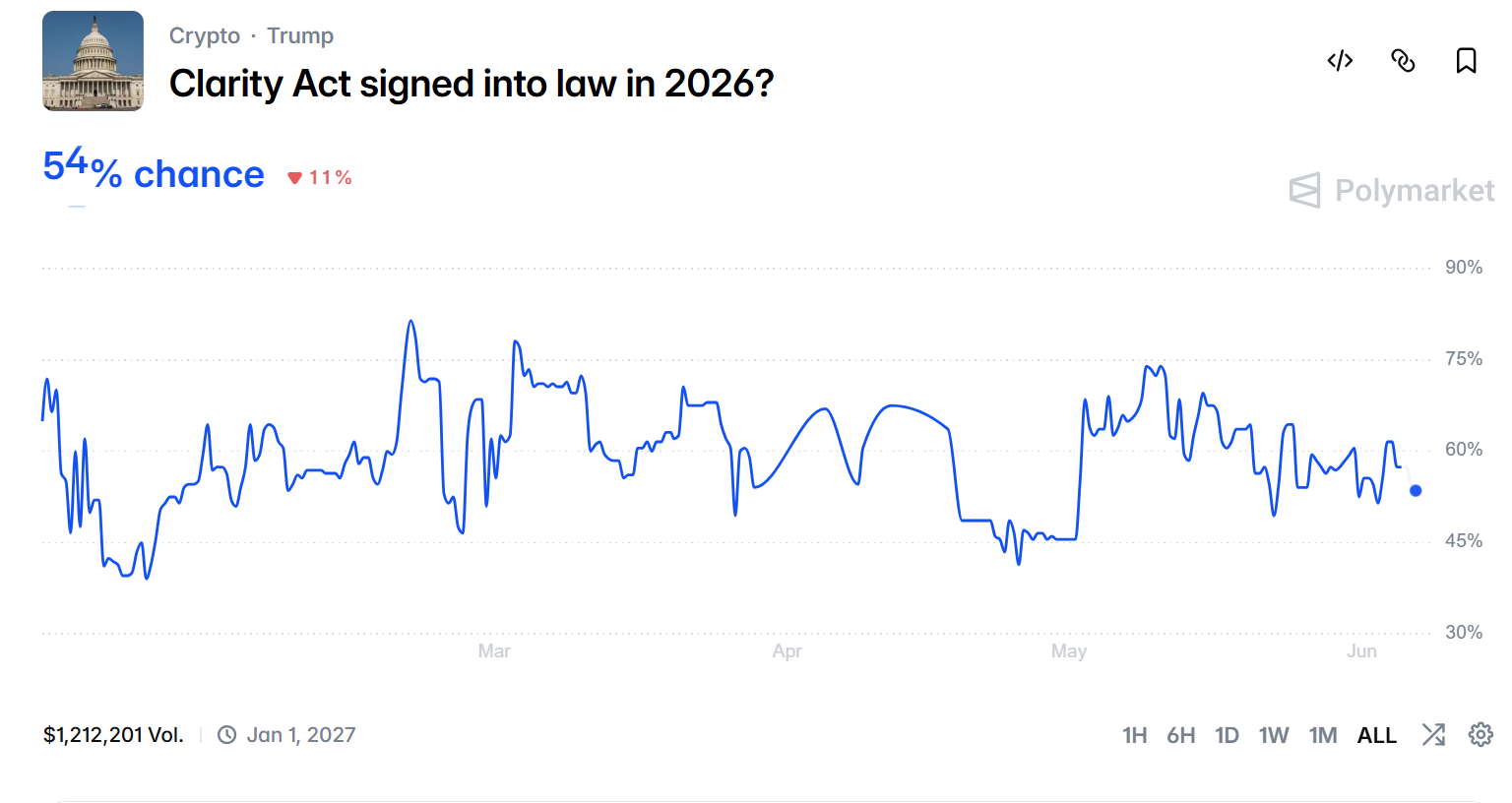
Galaxy Digital research head Alex Thorn lowered his odds of the Clarity Act becoming law in 2026 from 75% to 60%. The cut reflects a tightening Senate calendar rather than any weakness in the bill.
The crypto market structure bill cleared the Senate Banking Committee with bipartisan support and reached the floor calendar on June 1. What it lacks is a scheduled floor vote before the August recess.
Timing, Not Substance, Drives the Downgrade
Thorn framed the move as mechanical. The committee approved the bill 15 to 9, and it now sits on the Senate calendar as Calendar No. 423.
His concern is the number of usable days left. The bill must clear the Senate, and likely the House again, before lawmakers leave for the August recess at the end of July.
After that, midterm campaigning drains floor time for major legislation. That dynamic has shaped the bill’s passage hurdles ahead since it cleared Senate Banking last month.
“…lowering my odds of 2026 clarity act passage from 75% immediately post-markup to 60% today i said in may that the senate calendar was one of the biggest hurdles, and that picture has worsened,” wrote Thorn.
Thorn’s odds stand slightly higher than those on Polymarket, where bettors see only a 54% chance the Clarity Act will pass in 2026. This represents an 11% drop from the odds recorded the previous day.

Follow us on X to get the latest news as it happens
Floor Time Keeps Slipping Away
Indeed, the runway has shrunk in recent weeks. The Senate lost days to a fight over the administration’s anti-weaponization fund.
A procedural vote to renew Section 702 of the surveillance law then failed 47 to 52 on June 5. The authority expires June 12, so much of next week’s floor time points toward reauthorizing it.
The squeeze echoes the bill’s earlier scheduling delays, when the Senate ran short of time after its bipartisan committee vote.
The Math Still Needs Democrats
A floor vote would need roughly 60 votes to clear cloture. Thorn expects Republicans Josh Hawley and Rand Paul to vote no.
Both also opposed the failed FISA extension. That leaves leadership needing at least nine Democrats to carry the market structure bill across the floor.
Ethics provisions and illicit finance rules remain open, and Democrats have tied their support to the ethics language. No public deal has emerged on either issue.
“I’m still optimistic but the timing matters a lot now and odds could shift wildly as the calendar progresses,” Thorn added.
A credible commitment from Majority Leader John Thune to schedule July floor time would likely push the odds back up.
Absent that, the path narrows to a riskier September attempt.
The post Senate Calendar Crunch Forces Galaxy to Cut Clarity Act Odds by 15% appeared first on BeInCrypto.

In March, when Meta announced plans to begin paying creators in USDC across Colombia and the Philippines, with expansion to more than 160 countries expected by the end of the year, the move was widely interpreted as another milestone for stablecoins entering the financial mainstream. A company responsible for nearly $3 billion in annual creator payouts choosing onchain settlement over traditional banking rails is unquestionably significant. What Meta introduced, however, was not a complete payments experience. It was a faster way to move money between accounts.
For many users, particularly in emerging markets, the difficult part begins only after the payment arrives. Stablecoins have largely solved cross-border digital settlement, but integration into local consumer financial systems remains uneven. That is precisely where the next phase of payments competition will be decided.
The real friction starts after settlement
Creators receiving USDC payouts from Meta must connect external wallets, choose a supported network such as Solana or Polygon and manage their own custody. Meta warns that funds sent to the wrong address or an unsupported chain cannot be recovered. From that point onward, the platform steps out of the transaction entirely.
The transfer itself is efficient. Settlement is near-instant, costs are negligible and cross-border movement is effectively frictionless compared to traditional banking rails. But a creator in Manila or Bogotá will often still need to convert USDC into local currency to participate fully in the local consumer economy. That means sending funds to an exchange or liquidity provider, passing compliance checks, selling into fiat and withdrawing through domestic banking infrastructure. Each step introduces fees, delays and operational friction that sit entirely outside Meta’s ecosystem. For a creator whose expertise is content, not crypto, that is a significant amount of complexity to navigate just to access their own earnings.
And this is where stablecoin payments reveal their structural limitations. The infrastructure optimizes settlement, while usability still varies significantly by market.
The choice of the Philippines and Colombia as pilot markets makes this tension even more apparent. Both countries combine strong creator economies with costly cross-border payment systems, where conversion and transfer fees can consume a meaningful share of smaller payouts. In the Philippines in particular, mobile wallet adoption is already deeply embedded in everyday commerce, supported by platforms such as GCash and Maya and reinforced by the arrival of tokenized payment services from global technology companies. These are precisely the kinds of markets where stablecoin payouts should have a compelling advantage. Yet the off-ramp infrastructure remains fragmented, with uneven liquidity, compliance requirements, fees and user experience across providers and jurisdictions.
Card rails are starting from the other end
Card networks have taken a different approach. Instead of starting with blockchain settlement and leaving conversion to the user, they have focused on embedding stablecoins into existing financial infrastructure.
Mastercard’s $1.8 billion acquisition of BVNK expands its stablecoin settlement capabilities across more than 130 jurisdictions, integrated into established reporting and compliance systems. Visa’s partnership with Bridge enables stablecoin-linked cards that allow users to spend digital dollar balances at any merchant that accepts Visa, with conversion handled in the background.
The distinction reflects a deeper architectural choice about where complexity should sit. In Meta’s model, a payout requires a multi-step journey through wallets, exchanges and withdrawal queues before it becomes spendable. While this lighter-touch approach may also reflect the regulatory and operational burden of directly offering fiat conversion and custody services across dozens of jurisdictions, the user is ultimately responsible for navigating the crypto layer. In the card network model, stablecoins exist entirely behind the scenes. Users never see USDC balances or manage blockchain networks. Fiat enters and exits the system as normal, while stablecoins handle settlement invisibly.
Both models use stablecoins in the settlement layer, but they differ significantly in how user-facing complexity is handled.
Where stablecoin adoption actually scales
Stablecoin transaction volumes reached $33 trillion in 2025, up 72 percent on the previous year, with institutional adoption continuing to accelerate. At this point, the question for the payments industry is no longer whether stablecoins will become part of global financial infrastructure – that shift is effectively underway – but whether the off-ramp layer can scale at the same pace as onchain settlement.
The systems that will ultimately scale are those that make blockchain infrastructure invisible to the end user. Stablecoins may sit in the middle of the stack, but the user experience will be defined entirely in fiat terms: pesos in a wallet, a card balance, or a payment accepted at checkout, with no awareness of the underlying rails.
This is where current implementations, including Meta’s, expose the industry’s remaining friction. By surfacing wallets, networks, and conversion steps directly to creators, they reveal the operational complexity that still sits beneath what is marketed as instant global payments. The infrastructure is efficient at settlement but fragmented at integration, reflecting an industry that has progressed faster in building onchain systems than at embedding them cleanly into existing financial workflows.
Meta has helped push the conversation forward, but the next phase of adoption will be defined less by transaction speed or blockchain throughput and more by seamless integration into the financial stack: card networks, banking apps and merchant terminals. In that end state, stablecoins will be present in the system but largely invisible to users. That work is already underway across the card networks; the platforms handling payouts will need to keep pace.


SpaceX is set to price the largest IPO in history next week, at a valuation near $1.77 trillion. Its own filings show a company that was profitable until the xAI merger turned it into a loss-making company.
The roadshow leans on artificial intelligence. The financial statements tell a more complicated story about what investors are actually buying.
The Valuation Rests on a Market that Barely Exists Yet
At $135 per share, the offering values SpaceX at roughly 94 times its 2025 revenue of $18.7 billion. Research firm Morningstar has called that close to twice fair value.
The filing pins most of the case on a $28.5 trillion total addressable market (TAM). AI accounts for $26.5 trillion of that figure, including $22.7 trillion in enterprise applications.
SpaceX describes the opportunity in unusually bold terms.
“We believe we have identified the largest actionable TAM in human history.”
What the document does not detail is how the company captures that market against Google, OpenAI, and Microsoft. Some analysts argue SpaceX is worth far less on current earnings.
The xAI Merger Flipped Profit into Deepening Losses
In 2024, before the deal, SpaceX earned $791 million in net income. After the all-stock xAI merger closed in February, the 2025 result swung to a $4.94 billion net loss.
The company then posted a $4.28 billion first quarter loss in 2026. Its accumulated deficit has reached $41.3 billion, and the AI unit alone lost $6.36 billion from operations last year.
Profitable launch services and Starlink are funding that buildout. The recent Anthropic compute deal and the new Google contract may ease the strain, though either party can cancel both on 90 days’ notice.
Supporters counter that Starlink remains highly profitable on its own and that the compute contracts add tens of billions in visible revenue.
They also point to the reusable-rocket record as evidence Musk delivers on hard targets.
Follow us on X to get the latest news as it happens
Strong Headline Numbers Hide Softer Trends
Starlink looks like the safest part of the story. Subscribers more than doubled to 10.3 million in the year to March 2026.
Per-user economics moved the other way. Average revenue per user fell about 23%, from $99 a month in 2023 to $66, as Starlink expanded into cheaper markets.
Governance adds another wrinkle. Musk holds about 42% of the equity but 85.1% of the voting power, and SpaceX will claim controlled-company status after listing.
The offering also reserves up to 30% for retail buyers, roughly triple a typical mega-IPO. That structure has raised investor questions before IPO about who absorbs shares from early backers.
None of this is hidden. The risks sit in the filing, alongside profitability rules that have already prompted index exclusion concerns.
The open question is whether $1.77 trillion is the right price for a company still proving its biggest segment.
The post What SpaceX Downplays in Its $1.77 Trillion IPO Filing appeared first on BeInCrypto.


America’s largest banks are preparing a direct response to one of crypto’s fastest-growing products: stablecoins.
JPMorgan Chase, Bank of America, Citigroup and other major lenders said Friday that they plan to launch a shared tokenized deposit network through The Clearing House by the first half of 2027. The project would allow bank deposits to move across blockchain infrastructure with round-the-clock settlement, giving traditional bank money some of the same capabilities that have helped stablecoins gain traction.
The move highlights the growing competition to become the preferred form of cash on blockchain networks.
“Following the GENIUS Act, a competition seems to be emerging between stablecoins, tokenized deposits and tokenized money market funds to become the preferred onchain cash instrument,” said Reid Noch, vice president of U.S. equity market structure at TD Securities.
Stablecoins, specifically Circle’s (CRCL) USDC and Tether’s USDT, currently dominate that market. The dollar-pegged tokens are widely used for crypto trading, cross-border payments and increasingly for savings products. But banks are concerned that if stablecoins become mainstream, deposits could migrate from traditional accounts into crypto wallets.
Tokenized deposits allow banks to bring customers onchain without losing control of their deposits. A customer’s bank deposit would be represented as a digital token that can move across blockchain rails. Unlike stablecoins, the funds would remain inside the banking system.
Noch said tokenized deposits address long-standing inefficiencies in global payments.
“Anyone who has ever wired money, especially internationally, knows the process can be expensive and often takes one or two business days to complete,” said Noch. By using blockchain infrastructure, tokenized deposits could allow near-instant transfers around the clock while reducing costs and settlement frictions, he said.
The initiative also signals how far blockchain technology has moved into the financial mainstream.
“The biggest banks in America are voluntarily coming onchain,” said Digital Chamber CEO Cody Carbone. “When the country’s largest institutions decide the future of finance runs on blockchain, they’re proving exactly what our industry has been building toward all along.”
Significant competition
Still, the banking industry’s approach differs sharply from crypto’s vision of open networks.
Noelle Acheson, author of “Crypto is Macro Now,” noted that banks have spent years experimenting with private blockchain systems that move money internally while maintaining strict control over users and transactions. The planned Clearing House network expands that model across multiple banks but remains far removed from public blockchain ecosystems where stablecoins circulate freely.
Acheson argued that the project demonstrates that banks are taking stablecoins seriously despite public comments from some executives, including JPM CEO Jamie Dimon, who downplayed the threat. While stablecoins offer greater liquidity and flexibility, she said many corporate customers may prefer a bank-backed system that fits within existing compliance frameworks.
In a report in March, Jeffries said it estimates that stablecoins could drive a 3% to 5% runoff in core deposits over the next five years and shrink average bank earnings by about 3%.
The outcome could reshape how money moves on blockchain networks.
If successful, the Clearing House initiative could emerge as a significant competitor to stablecoins for corporate payments and treasury operations. At the same time, it underscores a broader trend: traditional finance is increasingly adopting blockchain technology, even as it competes with crypto-native alternatives built on the same infrastructure.
TLDR:
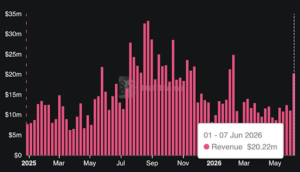
- Hyperliquid weekly revenue returns above $20.22M after months of $8M–$15M consolidation range phase shift.
- Open interest share climbs to 7.9%, marking record gain against centralized derivatives exchange competitors.
- Platform maintains $5.9B TVL with $222B monthly volume and strong perpetual futures trading activity levels.
- Annualized fees exceed $1.05B while revenue reaches $881M, driven by sustained derivatives market usage.
Hyperliquid shows renewed momentum across revenue, liquidity, and derivatives positioning as weekly earnings return above $20 million in June 2026.
The protocol also records rising open interest share and sustained capital inflows, signaling continued activity across its trading ecosystem platform.
Revenue Recovery Signals Trading Cycle Reset
Hyperliquid recorded a return above $20.22 million in weekly revenue during the June 1–7, 2026 period. This marked the first break above the $20 million level since February 2026, ending a multi-month range of lower activity across the platform’s derivatives markets.
Source: Degen News(X)
Earlier in the cycle, Hyperliquid revenue fluctuated between $8 million and $15 million weekly, reflecting subdued volatility conditions after the 2025 expansion phase. Activity remained consistent, though far below the highs recorded during the previous market surge.
During August and September 2025, Hyperliquid reached weekly revenue peaks above $30 million, driven by elevated trading activity and increased participation across perpetual futures markets. Those conditions represented a volatility-heavy environment compared with 2026 trading behavior.
Market structure data shows Hyperliquid maintaining a stable revenue floor even during contraction phases. This indicates persistent engagement from core users, supported by continued derivatives trading activity across the ecosystem.
Open Interest and Capital Flows Point to Structural Shift
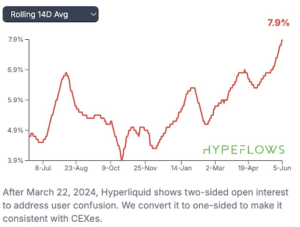
Hyperliquid’s share of aggregate perpetual futures open interest reached 7.9%, marking a record level against centralized exchange competitors.
The metric reflects increasing capital commitment, as traders allocate larger positions to decentralized infrastructure for derivatives execution.
Source: Degen News(X)
Total value locked on Hyperliquid stands near $5.9 billion, supported by consistent inflows across market cycles. Annualized fees exceed $1.05 billion, while revenue approaches $881 million, driven primarily by perpetual futures trading volume and sustained position activity.
Trading volume data shows $222 billion processed over a 30-day window, with open interest at $9.15 billion, indicating sustained positioning rather than short-term speculative turnover.
Liquidity conditions have remained stable across volatility shifts, supporting continuous derivatives activity on the platform.
Capital allocation trends suggest users are increasingly treating decentralized venues as primary execution layers rather than alternative markets.
The progression of market share in perpetual futures trading continues to expand, supported by improved execution efficiency and deeper order book participation.
Hyperliquid continues to operate within a competitive landscape dominated by centralized exchanges, yet its share of activity has increased steadily across 2026.
The platform’s ability to maintain liquidity during both expansion and contraction phases reflects persistent usage across diverse trader segments.


TLDR:
- PYUSD supply shrinks 31% from $4.2B ATH, dropping to $2.92B amid shifting liquidity flows in 2026
- Over $1B wiped from circulation as market volatility reduces stablecoin minting and exchange inflows
- PayPal expands PYUSD across 70 markets, boosting wallet usage and cross-border payment access globally
- Stablecoin remains mid-tier as USDT and USDC dominate broader crypto liquidity and settlement flows
PYUSD supply contraction has drawn attention across stablecoin markets as PayPal’s dollar-backed asset retraces from its $4.2 billion March peak to around $2.92 billion.
The movement reflects shifting liquidity conditions, softer market participation, and evolving usage patterns even as PayPal continues scaling PYUSD access across 70 global markets in 2026.
Supply Compression From Peak Levels Across Crypto Markets
PayPal’s $PYUSD stablecoin supply has shrunk 31% as circulating tokens fall sharply from the March 2026 peak of $4.2 billion to around $2.92 billion. The contraction removes over $1 billion in market value within a short trading window.
Issuance trends show reduced inflows across exchange wallets and payment channels during heightened volatility conditions across digital asset markets.
The decline aligns with broader pressure across crypto assets as Bitcoin retraced toward key technical zones near $60,000 during the same period.
Market participants shifted liquidity into stable holdings while reducing exposure to risk assets. PYUSD flows reflected similar behavior, with lower minting activity observed across regulated issuance channels and custodial reserves linked to PayPal’s stablecoin infrastructure operations globally.
Corporate and macro factors also influenced the contraction phase. PayPal faced earnings pressure and a leadership transition earlier in 2026, which impacted sentiment across its digital asset initiatives.
Regulatory uncertainty across payment corridors added further caution among institutional participants. Despite these conditions, PYUSD continued operating within PayPal’s payment ecosystem, maintaining utility across wallet transfers and merchant settlement layers.
Expansion Strategy Across Global Payment Infrastructure
PayPal’s $PYUSD stablecoin continues scaling access across 70 global markets. Users in Asia-Pacific, Europe, and Latin America can now hold, send, and receive PYUSD directly through PayPal accounts.
The rollout extends stablecoin functionality beyond the United States, integrating it into cross-border digital payment flows across retail and merchant ecosystems.
Merchant settlement remains a key focus of the expansion strategy. PYUSD enables payment proceeds to be accessed within minutes compared to traditional banking delays. This shift improves liquidity cycles for businesses operating across international markets.
PayPal’s blockchain-based settlement framework supports faster value transfer while reducing friction in cross-border commerce environments and digital transaction processing systems globally.
Within the broader stablecoin ecosystem, USDT and USDC continue to dominate circulation volumes, while PYUSD maintains a mid-tier position despite recent contraction.
The token remains backed by dollar deposits and short-term Treasury instruments through regulated issuance structures.
Continued integration into PayPal’s global infrastructure signals sustained operational use cases even as supply adjusts to changing market conditions.
TLDR:
- ETH near $216.03B faced pressure as price volatility narrowed the gap with USDT at $ 187.35 B
- Stablecoin inflows lifted USDT dominance as traders rotated capital during risk-off market phases
- Liquidity shifts intensified as ETH derivatives liquidations accelerated downside capitalization impact
- Ranking compression emerged as valuation gap shrank to roughly $28.68B between ETH and USDT
Ethereum has lost its long-held market capitalization lead as Tether moves ahead during volatile trading conditions.
ETH stands near $186.263B, while USDT rises to about $187.05B, marking a rare reversal driven by liquidity shifts and stablecoin demand across markets.
Market Rotation and Capital Pressure
A notable shift has emerged in crypto rankings as Ethereum vs Tether market cap flippening takes shape across global exchanges.
Ethereum currently holds a valuation of approximately $186.263 billion, while Tether has moved slightly ahead at around $187.05 billion.
The difference between both assets now stands at less than $1 billion, making the gap extremely tight. As ETH faced renewed selling pressure, its market capitalization declined rapidly, with price volatility across major trading pairs and derivatives markets.
At the same time, traders increased allocation into USDT during risk-off conditions. This shift strengthened stablecoin liquidity across exchanges.
Consequently, Tether’s circulating supply expansion supported its rise above Ethereum in total market capitalization rankings.
Derivatives liquidations added further pressure on ETH valuation. As leveraged positions unwound, downward momentum intensified.
Meanwhile, USDT remained stable due to its peg structure, allowing it to maintain consistent valuation growth through demand-driven issuance.
Stablecoin Strength and Ethereum Valuation Compression
The Ethereum vs Tether market cap flippening reflects a structural contrast between volatile asset pricing and stablecoin mechanics.
Ethereum’s market cap is directly influenced by price movements, while Tether’s valuation is driven by supply expansion, now near $187.05 billion.
As Ethereum declined toward $186.263 billion, its ranking position weakened. This movement was not linked to network activity loss but rather short-term market pricing pressure and liquidity repositioning across exchanges during volatile sessions.
Meanwhile, stablecoin demand continued to rise across trading platforms and settlement channels. USDT became a preferred asset for capital preservation, especially during periods of uncertainty where traders reduced exposure to directional crypto assets.
Despite the temporary ranking shift, Ethereum remains a dominant smart contract platform. However, current market conditions allowed Tether’s stable valuation model to surpass ETH briefly, highlighting how liquidity flows can reshape capitalization rankings in compressed market environments.


James Wo, the founder and chief executive of crypto investment firm DFG, says bitcoin remains the dominant institutional asset in crypto — and ether is unlikely to reach the same status anytime soon.
Speaking to CoinDesk at the Proof of Talk conference in Paris, Wo rejected Bitmine Immersion Technologies Chairman Tom Lee’s big prediction that ether would hit $250,000, arguing that Ethereum lacks the same consensus and institutional recognition that have formed around bitcoin.
“I totally disagree with him,” Wo said.
“Bitcoin has a very strong consensus. If you talk to everyone who is an early backer… they believe in bitcoin. Now, beyond the early backing of bitcoin, all the people in crypto, and also traditional finance people, are trying to recognize bitcoin as a safe haven or asset class. I don’t think Ethereum is there yet.”
Ether was trading around $1,775 as of time of writing, while bitcoin was near $63,000.
Wo argued that ether’s fundamental valuation remains heavily dependent on the localized application layer running directly on top of the network to capture fee value. With modern Layer-2 networks now diverting transactional volume and capturing fee utility independently, Wo explains that the network’s value accrual has been structurally different.
“The value of ether has been more diversified or decentralized,” Wo noted.
“The Ethereum token as a whole is not going to capture a lot of value. Onchain activity is not as big as people expected… I don’t think Ethereum will even hit an all-time high. I think bitcoin will perform well, but not Ethereum,” he claimed.
Not everyone agrees that Ethereum’s value accrual problem is permanent, however.
In February, Ethereum co-founder Vitalik Buterin reignited debate within the community after suggesting that Layer-2 networks, which have long been seen as the primary scaling solution, may “no longer make sense” as Ethereum becomes faster and cheaper. The discussion reflects broader questions about whether future upgrades could allow more economic activity to accrue directly to the Ethereum base layer.
‘What is bitcoin?’
Wo’s view, however, reflects the perspective of an investor who has spent more than a decade deploying capital across digital assets, that started with bitcoin.
After studying mathematics at university, Wo began watching classmates trade bitcoin during the 2014 bear market. He later entered the sector with $20 million in initial capital from his mother, who, at the time, managed an established enterprise and private equity firm in China.
“At the beginning, I don’t think she trusted me,” Wo recalled. “What is bitcoin? She has no idea.” But she gave him the money regardless and said, “Okay, so I’m going to support you anyway.”
He deployed that initial capital into bitcoin during the market lows of late 2014 and 2015. As the 2016 bull market developed, he diversified DFG’s balance sheet into alternative layer-1 protocols, becoming an early venture participant in ecosystems including Solana, Polkadot and Near.
He also directed early-stage corporate investments into consumer applications and Web3 infrastructure, including an early $10 million allocation into Circle’s USDC stablecoin project in January 2018.
Those investments helped transform DFG from a bitcoin-focused investment vehicle into one of crypto’s larger venture investors. Today, the firm manages more than 100 portfolio entities with over $1 billion in total assets under management.
Bitcoin’s new all-time high
While Wo remains cautious on ether, his multi-year outlook for bitcoin is constructive. He frames the asset as a superior liquid investment compared with regional real estate and traditional equity markets.
“I firmly believe this is going to outperform the Chinese stock market and also the U.S. stock market,” Wo stated. “Bitcoin in any aspect you can think of from the investment angle—liquidity is the best in the world.”
Wo expects bitcoin could undergo a near-term correction before reaching new highs later in the cycle.
“If it goes down 50% as a correction… the bottom should be around $60,000 to $62,000,” Wo calculated, adding that only an extreme geopolitical black swan event would push the asset lower.
Looking further out, he expects bitcoin to reach new records in the coming years.
“At the peak, we have somehow like $125,000… I believe we will see an all-time high in 2027 or 2028.”

Travala, the Singapore-based crypto travel platform, unveiled what it describes as the first agent-enabled AI travel protocol on Base, enabling artificial intelligence agents to search, reserve, and pay for hotels using USDC. The Travala Travel MCP (Multi-Channel Protocol) is live via Claude Desktop and opens to external developers who want to integrate their own travel agents with Travala’s hotel inventory.
The company says the system links Travala’s hotel inventory to AI agents through the Model Context Protocol, an open standard for connecting AI apps to external tools. Payments flow over Coinbase’s x402 protocol on Base, delivering gasless USDC transactions, near-instant settlement, and projected transaction costs around $0.01 per booking. Final payment authorization, however, still requires manual approval from the traveler, so the workflow remains semi-autonomous rather than fully automated.
Key takeaways
- The world’s first agentic AI travel protocol on Base enables AI-driven hotel bookings using USDC via the x402 framework, with gasless transactions and sub-cent costs per booking.
- Ultimate payment approval stays in the traveler’s hands, making the system more a guided automation than a full-autonomy checkout.
- Travala’s protocol provides access to more than 2.2 million hotel listings, including properties from Marriott, Hilton and IHG, and supports integration with third-party travel agents.
- Beyond hotels, Travala plans to extend the protocol to other travel products such as flights, with its AVA loyalty token poised to enable future MCP use cases.
How the AI-enabled travel protocol works and why it matters
At the core, Travala’s Travel MCP connects its hotel inventory to AI agents using the Model Context Protocol, a framework designed to let AI applications interact with real-world tools and data. This setup is paired with ERC-7715 session keys, allowing an AI agent to request a payment while preserving final signing authority within the traveler’s own wallet. In practice, a user can initiate a search and booking flow with an AI agent, and the agent will trigger a payment request that the traveler can approve, all within a single, continuous chat thread that preserves context across searches, bookings, and cancellations.
Travala emphasizes that the payment layer operates on Base via Coinbase’s x402 protocol, which enables gasless USDC transactions and faster settlement without the typical on-chain fee burden. The company estimates booking costs around $0.01 in transaction fees, a tiny fraction by crypto standards, though the exact figures can vary with network conditions and off-chain processing. In a nod to real-world practicality, the protocol does not eliminate human oversight—travelers must authorize every payment, ensuring consumer protection and control remain central to the experience.
Branding the move as a step toward a more autonomous travel economy, Travala’s leadership frames it as a shift away from the traditional checkout button. Chief Executive Juan Otero described the launch as “the death of the checkout button” and framed it as the opening salvo in a broader transition toward AI-driven bookings—while still keeping the traveler in the loop for final decisions.
The protocol’s architecture is designed to maintain continuity across the entire trip lifecycle. From a user’s initial search to a potential cancellation, the AI agent can operate within a single conversation, pulling in live inventory, rates, and terms without forcing the user to repeatedly re-enter information or re-approve steps in separate flows. The design aims to streamline user experiences and reduce friction in AI-assisted travel planning.
As part of the rollout, Travala is offering developers a 10% Coinbase Wrapped BTC (cbBTC) rebate on completed stays booked through its AI agents, providing a tangible incentive for integrating with the protocol and building out new use cases for AI-driven payments in travel.
A broader context: a wave of AI-agent payment infrastructure
The Travala announcement sits within a growing wave of crypto infrastructure aimed at enabling AI agents to transact. Cointelegraph reports that x402-linked wallets on Base have surpassed 100 million transactions, underscoring the momentum behind agentic payment rails on Layer 2. The ecosystem has seen a string of product launches from notable names, including Fireblocks, MoonPay, Exodus and Oobit, all pursuing AI-centric stablecoin payment capabilities to power autonomous or semi-autonomous workflows for users and businesses alike.
Travala also notes that its protocol taps into a broad pool of hotel inventory, with listings drawn from major brands via aggregator partners. In total, the platform’s catalog covers more than 2.2 million hotels, including properties from Marriott, Hilton and IHG. Beyond hotels, the company intends to extend the MCP to other travel components, notably flights, while the AVA loyalty token could underpin future MCP use cases as adoption grows.
From a competitive standpoint, Travala’s move shifts the frame from traditional crypto-enabled checkouts to AI-agent-enabled booking infrastructure. The company previously positioned itself as part of a competitive ecosystem that includes Sleap.io and Alternative Airlines, but the current announcement emphasizes infrastructure for AI agents, with a focus on seamless, agent-mediated payments rather than purely crypto-only checkout experiences.
What to watch next for AI travel and payments
Travala’s foray into agentic travel payments raises several questions for stakeholders: How will final-approval controls evolve as AI agents learn to anticipate user needs? Will more airlines and hotel chains join the Model Context Protocol ecosystem, and how will loyalty programs like AVA adapt to machine-to-machine or agent-mediated bookings? Regulators may also scrutinize semi-autonomous payment flows to ensure consumer protections keep pace with technology.
For developers and investors, the key signals will be how quickly the MCP gains traction across the travel vertical, how easily third-party agents can integrate, and whether cost savings from gasless Base transactions translate into measurable efficiency gains or improved customer experiences. Observers will also be watching how the wider crypto payments landscape adapts to growing AI usage, including the balance between automation and human oversight in financial transactions.
As the technology matures, travel participants—consumers, developers, and hospitality partners—will need to assess how far AI-driven, semi-autonomous bookings can improve convenience without sacrificing control or safety. The coming months should clarify how broadly the Model Context Protocol-based integrations will expand, which travel segments will follow hotels into automation, and what policy guardrails will shape the adoption of agent-based payments on Layer 2 networks.
TLDR:
- Crypto liquidation heatmap recorded $1.28 billion in losses as market leverage rapidly unwound.
- Long positions suffered nearly $996 million in liquidations, far exceeding short-side losses.
- Bitcoin and Ethereum accounted for over $830 million of total liquidations during the selloff.
- More than 264,000 traders were liquidated as cascading margin calls accelerated declines.
Crypto liquidation heatmap data revealed one of the largest leverage flushes seen in recent weeks, with more than $1.28 billion erased from crypto derivatives markets in a single day.
The event exposed excessive bullish positioning as traders faced a rapid wave of forced liquidations across major digital assets.
Long Traders Bore the Brunt of the Market Unwind
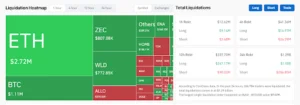
The crypto liquidation heatmap showed a clear imbalance between bullish and bearish positions. Of the $1.28 billion liquidated during the period, nearly $996 million came from long positions, while short liquidations totaled about $289 million.
The figures suggest traders entered the session with strong expectations of further upside. However, once prices started weakening, leveraged positions quickly became vulnerable.
As margin levels deteriorated, exchanges automatically closed positions to limit losses, accelerating selling pressure throughout the market.
Data from liquidation trackers showed how quickly conditions worsened. What started as modest liquidations during the early hours evolved into a broad market deleveraging event.
The process created a chain reaction where each forced sale contributed to further downside pressure, triggering additional liquidations.
More than 264,000 traders were reportedly liquidated during the move. The scale of participation indicates that both retail and larger market participants were caught in the downturn. One of the largest reported liquidations involved a BTCUSD position valued at approximately $9.02 million.
Bitcoin and Ethereum Dominate Liquidation Activity
Bitcoin and Ethereum accounted for the majority of losses displayed on the crypto liquidation heatmap. Bitcoin registered approximately $476.53 million in liquidations, while Ethereum followed with around $354.02 million.
Source: CoinGlass
Combined, the two largest cryptocurrencies represented more than $830 million of the total liquidations. Such concentration reflects the amount of leveraged capital typically deployed in major digital assets, particularly during periods of strong market optimism.
Separate heatmap snapshots also placed Ethereum at the top of liquidation rankings in certain intervals. This trend is often observed when traders seek higher returns through ETH exposure during bullish phases. As sentiment shifted, those positions faced heavier pressure.
The timeline of liquidations further demonstrated the speed of the move. Losses climbed from roughly $7.82 million in the first hour to $40.76 million within four hours. By the 12-hour mark, liquidations had surpassed $336 million before ultimately reaching $1.28 billion.
While the selloff caused substantial losses, the event also removed a significant amount of leverage from the market.
The crypto liquidation heatmap captured a rapid transition from aggressive risk-taking to defensive positioning, illustrating how quickly sentiment can change within the digital asset sector.

As bitcoin (BTC) continues to weather the storms of the bear market, the asset’s OG holders are waking up. A few days ago, an anonymous holder redeemed a physical bitcoin 15 years after it was created, receiving 25 BTC from the redemption.
According to a tweet from Galaxy Research, the physical coin redeemed is an S1-COIN-25, part of the Casascius coins created between 2011 and 2013. The redemption netted over $1.78 million in bitcoin, calculated at current prices.
OG Holder Redeems 25 BTC
A Casascius coin is a physical token created by the early Bitcoin adopter and software engineer Mike Caldwell. The tokens were created with denominations of 0.5, 1, 5, 10, 25, 100, and 1,000 BTC, meaning they held real digital bitcoins. With receiving bitcoin addresses printed on the outside, each coin has a tamper-evident hologram concealing the matching private key at the back.
Caldwell created brass, fine silver, gold-plated coins, and gold-plated bars, with their sizes ranging from 25.4 mm to 30 mm in diameter. The bars would weigh about 12 ounces if they were solid gold, but since they are metal alloys with gold plating, they weigh 4.2 ounces instead. They were all available as pre-loaded BTC coins and bars and are currently available on secondary markets like eBay, even though Caldwell stopped production in 2013 because he was operating as a money transmitter without a license.
To redeem the coins, one has to peel the hologram at the back of the token to retrieve the private keys. The coin’s balance can be verified on platforms like Block Explorer by inputting the eight-character code seen on the outside of the coin.
From Conversation Pieces to Storage Vessels
Over the last 15 years, Casascius coin holders have redeemed their tokens for BTC, netting millions of dollars in profits. Some of the coins were worth less than $100 dollars at creation, but bitcoin’s rally over the years has increased their value significantly. These coins were created as conversation pieces to help talk to people about BTC; however, they ended up as forms of storing the asset long after their production.
The Casascius coin that was redeemed within the week was created in December 2011 alongside thousands of other coins. In fact, data from the Casascius tracker shows that there are 27,916 coins and bars in existence, 10,479 of those having been opened. The collective value of the coins and bars created now stands above $6.2 billion, given bitcoin’s latest price.
Meanwhile, the latest redemption comes as other OG holders wake up to move long-dormant assets.
The post OG Bitcoin Holder Wakes Up, Redeems Casascius Coin For 25 BTC After 15 Years appeared first on CryptoPotato.

Moment ‘dangerous’ motorist caught on camera as he drove at police
Elon Musk to attend ASML tech conference to talk Terafab – Bloomberg

Meta is paying creators in Stablecoins. Spending them is someone else’s problem



-

 Business5 days ago
Jade Biosciences, Inc. (JBIO) Discusses Positive Interim Results From JADE101 Phase I Healthy Volunteer Study and Development Plans Transcript
-

 Sports4 days ago
French Open 2026 results: Alexander Zverev beats Rafael Jodar and will play Jakub Mensik in semi-finals
-

 Fashion23 hours ago
Weekend Open Thread: Evereve – Corporette.com
-
 Crypto World1 day ago
Jensen Huang Approves Samsung, SK Hynix, and Micron for NVIDIA (NVDA) HBM4 Memory Supply
-

 Tech4 days ago
CryZENx Releases Fresh Playable Content Deep Inside Jabu-Jabu for His Ocarina of Time Remake
-

 Business4 days ago
Trump Taps Housing Chief Bill Pulte as Acting Intelligence Director After Gabbard Exit
-
Crypto World1 day ago
LBank Surpasses 25 Million Users Worldwide as AFA Partnership Continues to Drive Global Growth
-
 Crypto World4 days ago
Seagate (STX) Stock Surges to Record High on AI Boom and Legal Settlement
-
 NewsBeat4 days ago
Republicans balk at Trump’s attempt to appoint a MAGA enforcer to lead National Intelligence
-
Crypto World3 days ago
EU AI Data Center Project Faces Delays as Funding Gaps Grow
-

 Entertainment4 days ago
Did The Mandalorian And Grogu Already Ruin The Next Star Wars Movie?
-

 Business4 days ago
Aehr Test Systems Stock Soars 17% Amid Surging AI Demand and Conference Spotlight
-

 Tech1 day ago
RCS Messages Between iPhone and Android Get End-to-End Encryption With iOS 26.5
-

 Business4 days ago
Relay Therapeutics Shares Surge 20% on ASCO Momentum for Zovegalisib Breast Cancer Program
-
 Business4 days ago
Claude AI Down Today Reason: Why Anthropic’s AI is not working today? What’s the latest quota update
-

 Tech4 days ago
Instagram will stop bombarding teens with the same kind of obsessively unhealthy content
-
 Crypto World1 day ago
Merlin (MRLN) Stock Soars 32% on Major USSOCOM Autonomy Milestone
-
Crypto World5 days ago
Tether Brings Google’s TurboQuant to Production, Unlocking Long-Context AI on Everyday Devices
-

 Business4 days ago
Dow Jones Climbs Near Record Highs as AI Optimism Offsets Geopolitical Risks
-
 Entertainment4 days ago
‘Aliens’ Star Reveals How the US Military Co-Opted James Cameron’s Sci-Fi Tech [Exclusive]
You must be logged in to post a comment Login