
Crypto World
Silver prices recover quickly, hitting weekly high today


Silver (SI=F) December futures opened at $65.76 per ounce on Friday, September 18, 2026, down 0.5% from Thursday’s close but more than $2 higher than yesterday’s opening price. Silver prices surged this morning, reaching $67.47 as of 7:05 a.m. ET.
Until today, silver prices bounced around the $63 to $64 range, but broke out of those bookends by a wide margin this morning. Today’s opening price set the highest opening price of the week, and silver is surging this morning, hitting a high of $67.89.
The Fed’s decision to raise rates for the first time in three years, combined with the ongoing restoration of Saudi Arabia’s key East-West pipeline, has prompted inflation concerns to fade among investors.
And oil prices are responding as well. Wednesday morning, Brent crude (BZ=F) prices were over $107 a barrel. Yesterday at this time, prices were at over $99 a barrel, and this morning, they’re $98.51 as of 7:05 a.m. ET.
Current price of silver
The opening price of silver futures on Friday, September 18, 2026, was 0.5% lower compared to Thursday’s closing price. Here’s how today’s opening silver price has changed versus last week, month, and year:
-
One week ago: +3.9%
-
One month ago: -0.8%
-
One year ago: +57.7%
For context, silver’s year-over-year growth was 173.3% on May 14.
24/7 silver price tracking: Don’t forget you can monitor the current price of silver on Yahoo Finance 24 hours a day, seven days a week.
Want to learn more about the current top-performing companies in the silver industry? Explore a list of the top-performing companies using the Yahoo Finance Screener. You can create your own screeners with over 150 different screening criteria.
Investing in silver? Here’s how to avoid taxes.
Do you have to pay taxes on silver? Yes. Silver is a capital asset, so when you sell it for more than you paid, the gain is taxable and reported on Schedule D of your federal return.
Many investors assume holding silver for more than a year qualifies them for the same long-term capital gains rates as stocks (0%, 15% or 20%).
Spoiler: It doesn’t.
The 28% collectible tax trap
The IRS classifies physical precious metals — including bars, rounds, and coins — as collectibles. That classification changes the tax math in a big way.
Short-term gains
If you hold silver for one year or less, your profit is taxed as ordinary income. Depending on your tax bracket, that could go as high as 37%.
Long-term gains
If you hold silver for more than one year, your gain is taxed at your ordinary income rate — but no more than 28%.
Here’s what that looks like in real life:
-
If you’re in the 10%, 12%, 22% or 24% bracket, your silver gain is taxed at that same rate.
-
If you’re in the 32%, 35% or 37% bracket, you’re capped at 28%.
So if you’re a middle-income earner accustomed to paying 15% on stock gains, silver can cost you more, maybe 22% or 24%, depending on your adjusted gross income.
If you’re in the top brackets, the 28% cap is technically a discount versus 35% or 37% — but it’s still higher than the 20% max long-term capital gains rate on stocks.
That difference adds up quickly when you’re talking five- or six-figure gains.
Learn more: How to avoid taxes when investing in silver
Price of silver chart
Whether you’re tracking the price of silver since last month or last year, the price-of-silver chart below shows the precious metal’s value journey so far this year.
More silver coverage from the Yahoo Finance team:



In an early scene of the exquisitely devastating miniseries Trespasses, two strangers in a pub ruminate on the relationship between art and pain. Cushla (Lola Petticrew), a schoolteacher taking a shift behind her family’s bar, admits she couldn’t finish reading A Clockwork Orange; the knowledge that the novel’s author, Anthony Burgess, was inspired by soldiers’ savage attack on his wife disturbed her too much. “He turned his suffering into art,” protests her customer, Michael (Tom Cullen). “I’d rather have the art without the suffering,” she retorts. “I’m sure his wife would, too.” Michael isn’t quite swayed. “Can you have one without the other?” he wonders.
Such beer-in-hand debates are as old as public drunkenness, but the conversation takes on new layers as the Troubles rage and Cushla and Michael’s romance blossoms in mid-1970s Belfast. She’s an empathetic Catholic, caring for a hypercritical mom (Gillian Anderson’s Gina) who has been lost in alcoholism since the death of her saintly husband and trying to help a young student who’s being bullied by the religious school’s leaders as well as his peers about his own parents’ “mixed” marriage. A Protestant barrister who speaks out against brutality by loyalist police, Michael has made fierce enemies on both sides of the conflict. All around the nascent couple is evidence that their love is doomed. Yet, like so many star-crossed lovers of fiction, they are drawn together by a force stronger than the ones pushing them apart. Whether you see their story, which debuted on Channel 4 in the UK and will premiere Sept. 20 on PBS, as a triumph or as a tragedy will depend on whose view of suffering you find most convincing.

Adapted by Ailbhe Keogan (Bad Sisters) from Louise Kennedy’s celebrated 2022 novel, Trespasses defies Romeo and Juliet cliché through specificity. It is a profound geopolitical injustice that the past few generations of Westerners mostly know war, even when it’s initiated by our own governments, as a misfortune that befalls people thousands of miles away, in dusty deserts and steaming jungles. Keogan subverts that notion, depicting Belfast as a war zone with violence at every doorstep and hatred festering on every corner. Everyone knows which side their neighbors are on—and surveils them, consciously or not, to make sure they stay on it.
The characters are no mere victims of circumstance. Petticrew, fresh off a thrillingly dark turn in Furious and returning to the place and era of her breakthrough role in the IRA drama Say Nothing, gives us a protagonist who is as bright and stubborn as she is compassionate. You can see why she’d fall for an older, more mature man over the boyish types who clumsily court her. Cullen makes his character irresistible—a crusader who voices unpopular truths, warning law enforcement that their cruelty only mints new IRA recruits. He’s not a pure hero, though. He faces his minefield of a life by compartmentalizing; Cushla knows he’s married, but his infidelity is not up for discussion. The slumped and slurring Gina seems, at first, to be the kind of messy grande dame Anderson has taken to playing in recent years, with mixed results. But even this broad matriarch deepens, and the performance hits subtler notes, in later episodes.
Just about every character surprises us, at least once, for good or ill. That complexity serves a thematic purpose as well as a narrative one. War flattens the enemy to slurs and stereotypes. Fighting for humanity means insisting upon individual identity; it means believing a Catholic and a Protestant in ’70s Belfast might belong together. “We must find the bravery to choose freedom over fear,” Michael proclaims in one of his righteous moments. “We cannot let the old bigots and the boys with guns tell us how to live.” For a couple on opposite sides of a war that allows for no gray area, this may be a suicidal ideology. But even if art is possible in the absence of suffering, love never comes without the risk of heartbreak. Whether it justifies that pain, Trespasses suggests, is a question too fraught and personal to be resolved by any glib barroom debate.


Katie Price told Good Morning Britain she has ended her marriage after checking her husband’s crypto wallet and finding roughly $3 where Lee Andrews had promised $50 million.
Andrews, held in a civil jail in the United Arab Emirates over unpaid debts, sent the programme a voicenote from detention. He said she opened the wrong wallet and that the money is real.
What Katie Price Found in the Crypto Wallet
Price said a friend who trades crypto opened the wallet on her phone while she was abroad. The balance came to about £2.22, close to $3. She checked again minutes before going on air and said nothing had moved.
Andrews did not dispute that figure. He said the balance sits in a different wallet, offered to send a presenter £10,000 to show he can move funds, and offered to take a lie detector test once released.
“I hope it actually shows by Wednesday that there is 50 million USDT there, which has been legitimately made,” Andrews said that in the voicenote.
USDT is Tether, a stablecoin built to trade near one dollar. It is the third largest crypto asset by market value, so 50 million units would be worth about $50 million.
Other claims have already come apart. Price said Andrews valued a ring he gave her at £72,000. A jeweller told her the stones were lab grown and put the ring at about £5,000.
Why a Wallet Balance Does Not Prove Ownership
Anyone with the address can read a blockchain wallet. That is what let Price test the claim herself, without a bank, a lawyer or his permission.
It stops there. An address reveals what sits inside it, not who holds the private key that moves the money. Sending a payment out proves access in that moment, not ownership of the account.
Courts are working through the same gray area. Tether faces a lawsuit over frozen wallets holding $42.4 million, a case that turns on who controls an address and who may act on it.
“I feel embarrassed because I feel he’s scammed my heart and stole my trust,” Price said in the interview.
She has filed for divorce. Andrews remains detained over debts he says he has already cleared, and he expects release soon. He has not made the wallet address public, so there is still no way to check whether the $50 million was ever there.
The post Katie Price Checks Husband's Crypto Wallet and Finds $3 Instead of $50 Million appeared first on BeInCrypto.
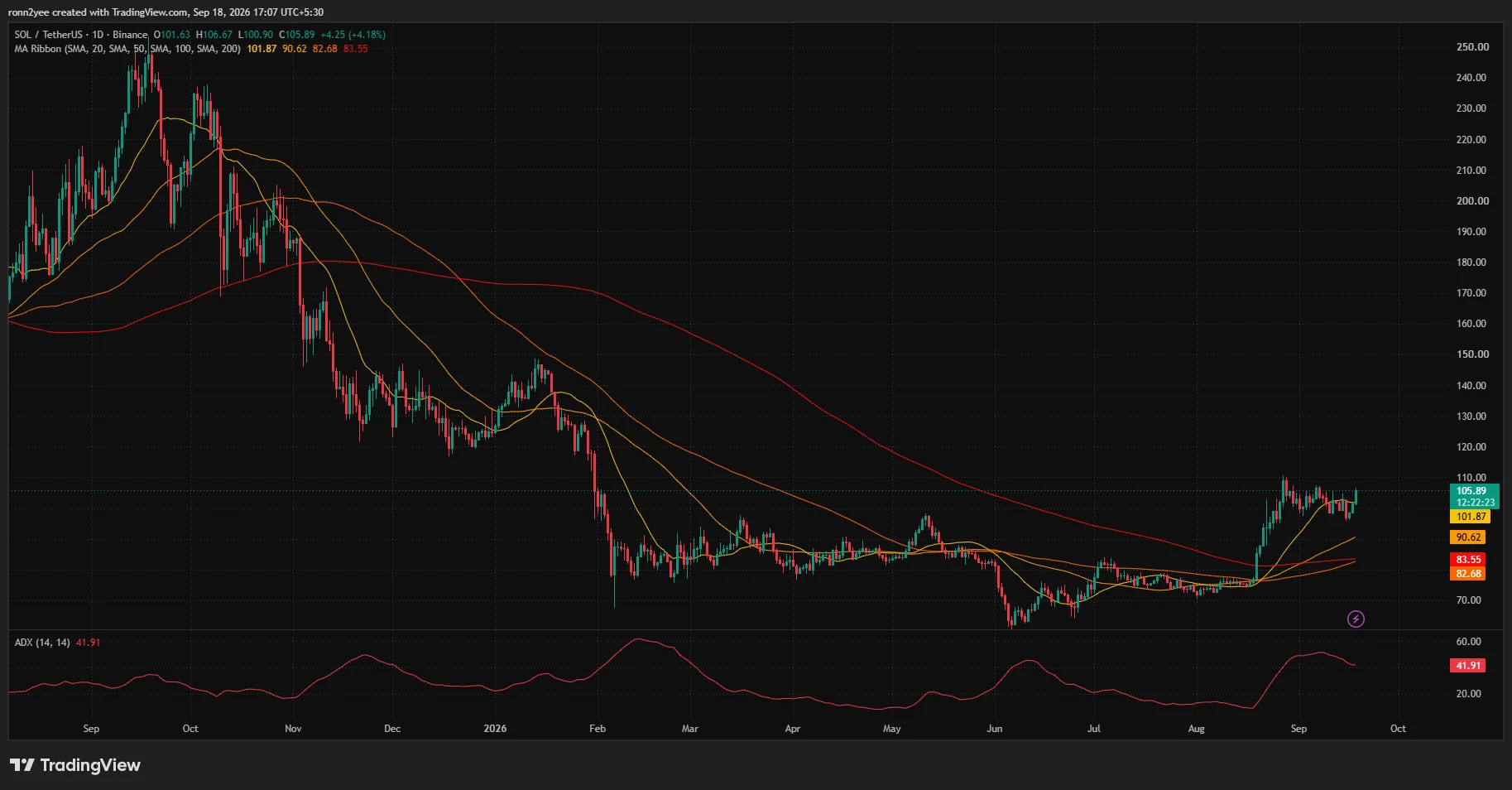
Solana price rose more than 4% on Sep. 18, reclaiming $105 in a derivatives-driven rebound, and a move above short-term resistance strengthened bullish momentum.
Summary
- Solana price traded near $105.89 after rising 4.18% during the daily session.
- SOL moved above its 20-day average, while the daily ADX remained strong at 41.91.
- 4-hour RSI reached 71.37, placing the token in overbought territory.
- Liquidation clusters near $107–$108 could attract price, while $103–$105 forms initial support.
Solana price action today
According to data from crypto.news, Solana (SOL) price climbed from a daily opening price of $101.63 to about $105.89 at the time of writing, representing a gain of 4.18%. The token traded between an intraday low of $100.90 and a high of $106.67.
The recovery extended a rebound from below $97 earlier in the week and returned SOL to the upper end of its September trading range. Buyers defended the $100 psychological level before pushing the price through the $103–$105 area.
SOL also gained alongside a wider crypto-market rebound following the Federal Reserve’s latest policy decision. Short liquidations added buying pressure as traders who had positioned for further losses were forced to close bearish positions.
The advance offered some relief after regulatory uncertainty weighed on digital assets following the U.S. Senate’s failure to advance the CLARITY Act. However, the charts suggest SOL’s next move will depend on whether buyers can hold the breakout rather than the size of the initial rebound alone.
Technical indicators favor buyers above $100
Solana’s daily chart shows the price trading above all four major moving averages. The 20-day simple moving average stood at $101.87, providing the nearest dynamic support.
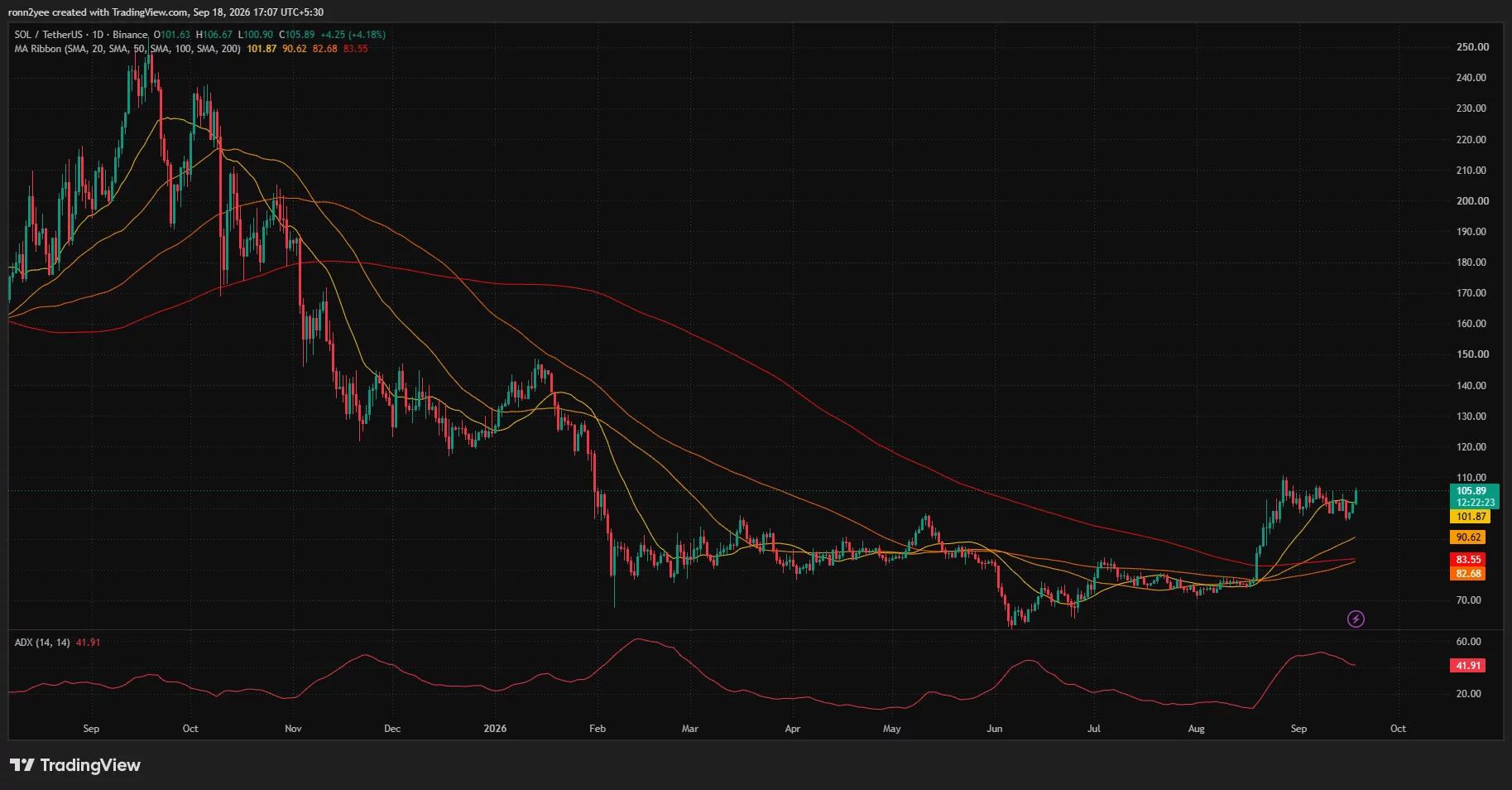
Longer-term averages remained farther below the market. The 50-day SMA was near $90.62, while the 100-day and 200-day averages were clustered around $83.55 and $82.68, respectively.
SOL’s position above those averages keeps its broader recovery structure intact. The 20-day line has also turned upward, while the shorter averages remain above the longer-term indicators.
The average directional index registered 41.91 on the daily chart. An ADX reading above 25 typically points to a strong trend, although it does not determine whether that trend will move higher or lower. In SOL’s case, the price structure and moving-average alignment currently favor buyers.
The 4-hour chart presents a more cautious short-term picture. SOL traded above the Bollinger Bands’ middle line at $100.09 and briefly exceeded the upper band near $105.47. A move outside the upper band can signal strong momentum, but it may also precede a pause as volatility expands.
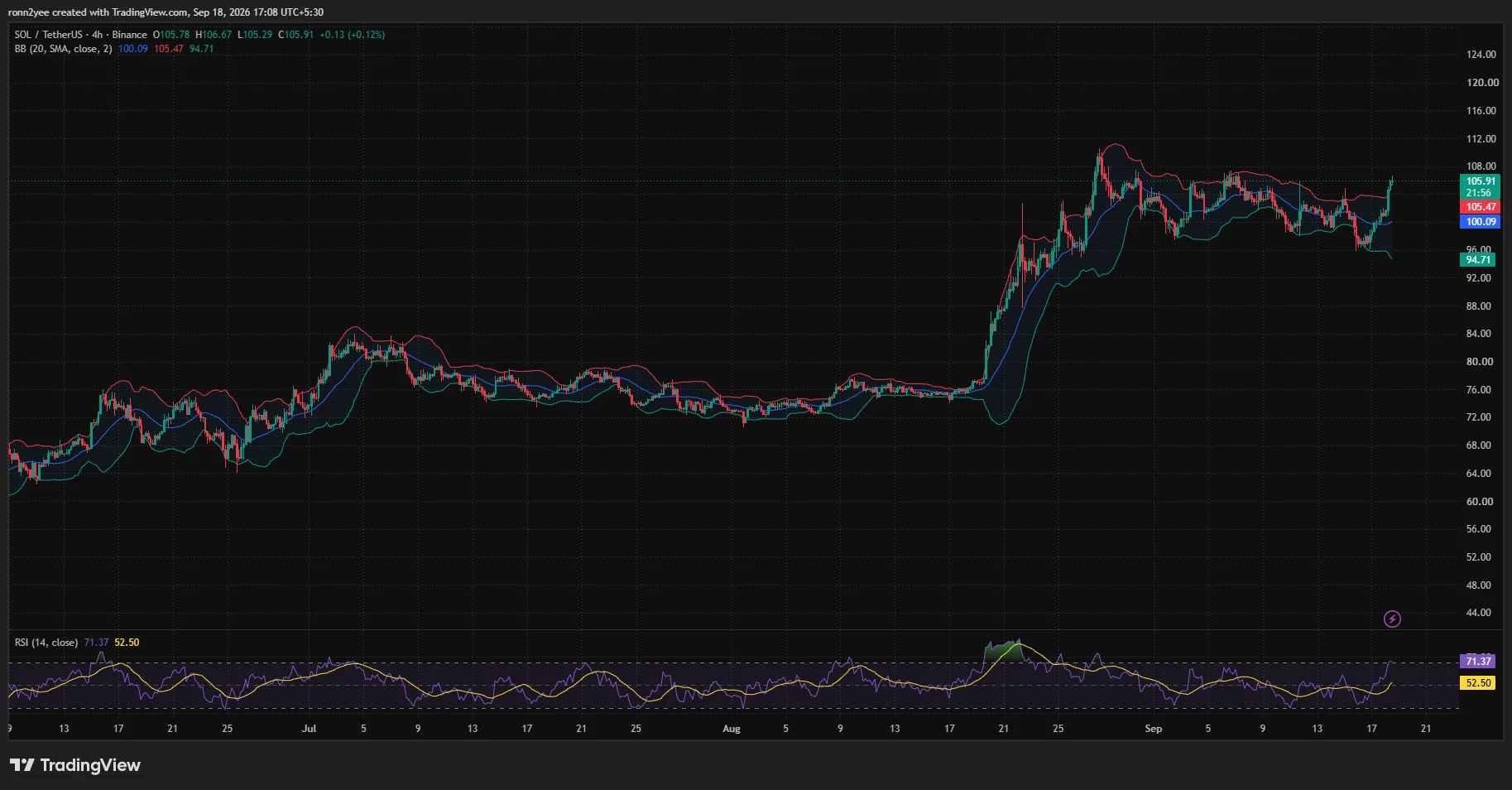
4-hour relative strength index reached 71.37, above the commonly watched overbought threshold of 70. The reading does not confirm an immediate reversal, though it shows that the rally has become stretched and could face profit-taking.
SOL liquidation map points to $107–$108
CoinGlass’ 24-hour liquidation heatmap shows SOL advancing from below $100 to above $105 as the price moved through several leverage clusters.
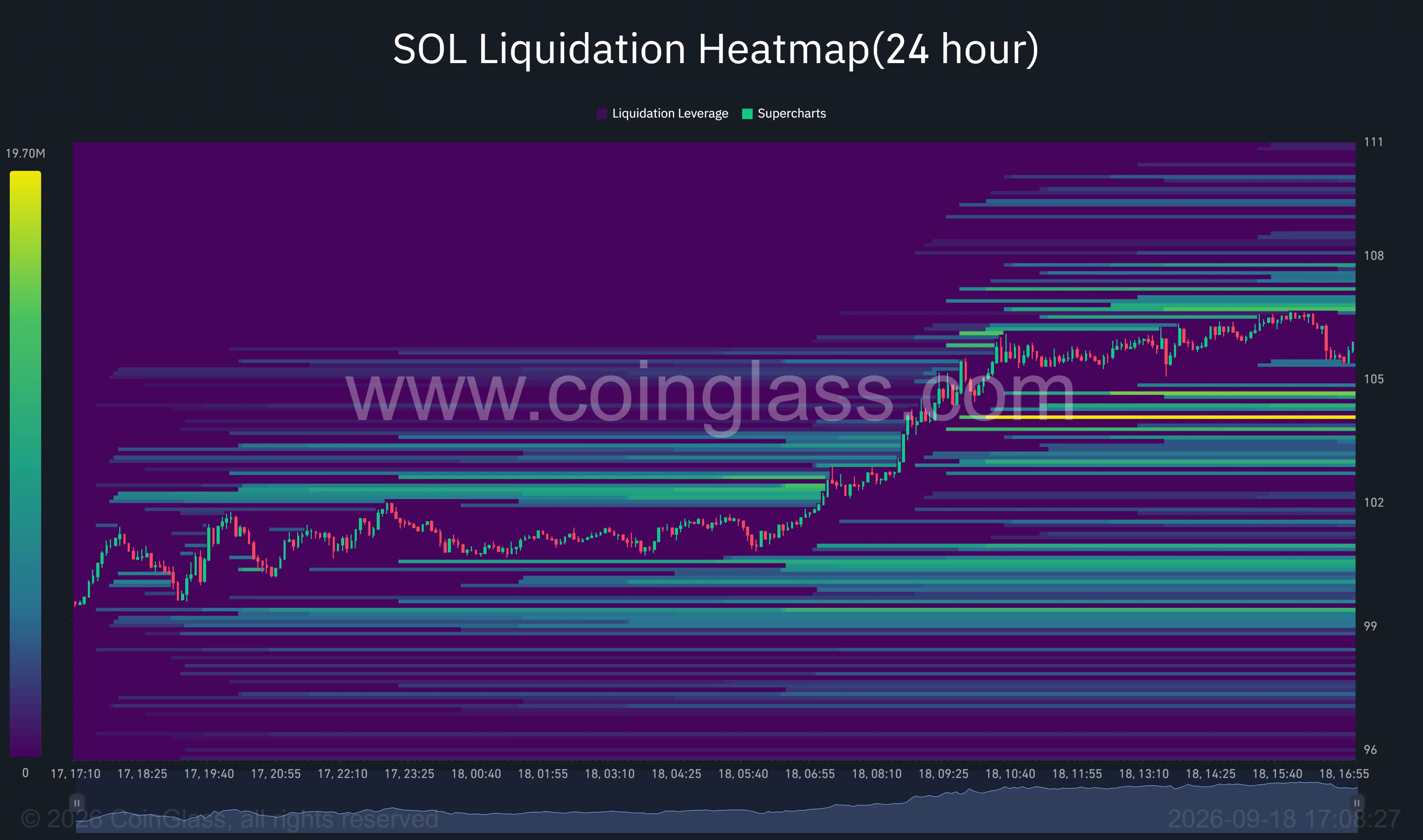
The nearest concentration of overhead liquidity appears between approximately $106.50 and $108. Bright bands in that region indicate leveraged positions that could be liquidated if SOL continues higher. Price often moves toward concentrated liquidity, although a heatmap cannot predict whether the market will reach those levels.
A break above $106.67, the session high, could expose $107–$108 as the next immediate target. Clearing that range would place the late-August and early-September highs around $110–$112 back in focus.
Liquidity is also building below the current price. The strongest nearby bands appear between $103 and $105, followed by clusters near $100–$101. The structure makes $103 the first area buyers need to defend if the rally loses momentum.
A drop below $100 would weaken the breakout and could send SOL toward the 4-hour lower Bollinger Band near $94.71. On the daily chart, the 50-day average near $90.62 would form the next broader support zone.
Analysts see $100 as a major support floor
Crypto analyst Ali Martinez said on-chain data showed more than 40 million SOL had traded around $100, creating what he described as a major support floor.
Martinez also pointed to a possible cup-and-handle pattern on Solana’s weekly chart, with a neckline near $360. He said a confirmed breakout above that level could open a longer-term path toward $1,300.
The projection remains far above SOL’s current market price and depends on a confirmed weekly breakout that has not occurred. SOL would first need to clear several closer resistance areas, including $108, $112 and $130.
Pseudonymous analyst Scient offered a nearer-term target, saying SOL could extend toward $130 following the daily support-and-resistance flip. The trader said he planned to reduce half of his spot position around that level and look for a possible re-entry near $90.
Both outlooks treat the $100 area as a key dividing line. The current daily chart supports that view because SOL’s 20-day average sits just above $101, while the liquidation map shows several leveraged clusters around the same region.
What comes next for Solana price
Solana’s short-term setup favors buyers while the token holds above $103 and the 20-day average near $101.87. A decisive close above $106.67 could allow SOL to target the $107–$108 liquidation zone, followed by the previous local highs near $110–$112.
Momentum risk has increased, however, because the 4-hour RSI has entered overbought territory and price has moved above the upper Bollinger Band. Failure to hold $103 could trigger a retest of $100, where both technical support and a large on-chain cost basis are concentrated.
For U.S. investors, the Federal Reserve’s policy outlook and congressional progress on crypto market-structure legislation remain external risks. SOL’s technical breakout may hold while risk appetite remains firm, but renewed pressure across U.S. equities and crypto derivatives could expose the liquidity clusters below $100.
Disclosure: This article does not represent investment advice. The content and materials featured on this page are for educational purposes only.
UNI is the best-performing cryptocurrency (from the top 100 list) today (September 18), posting a whopping increase of 30% and reaching a 10-month high of nearly $9.20.
Here’s what fueled the rally and what the next potential targets are.
The Catalysts
Perhaps the main driver of the move is the US Securities and Exchange Commission. The regulator issued its Innovation Exemption, which gives temporary relief for on-chain trading of certain tokenized stocks. Hayden Adams (inventor of the Uniswap Protocol and CEO at Uniswap Labs) said the most bullish news is not the official statement, but the comment letter from SEC Commissioner Hester Peirce, which reads:
“Truly decentralized systems that are driven by autonomous software… do not need an exemption.”
Adams said this sort of immunity applies to permissioned pools on Uniswap v4, creating a pathway for compliant trading in the US for assets and users where that is necessary.
Another catalyst is the broader recovery of the cryptocurrency market, which, despite the CLARITY Act’s failure and the interest rate hike in the United States, is in green territory today. Bitcoin (BTC) surpassed $78,000, Ethereum (ETH) reclaimed $2,500, while popular altcoins like NEAR, WLD, DOT, and HYPE have jumped by double digits over the last 24 hours.
What’s Next?
According to multiple analysts, UNI has much more fuel left to post additional gains. X user Altcoin Sherpa believes the next area is around $11 if BTC remains steady.
CW anticipates the asset’s upward trajectory to proceed “smoothly” up to $12.75, where the long-term trend line and a sell wall exist. “It will encounter strong resistance thereafter,” they added.
For his part, Crypto With Gopal noted that UNI is pushing toward the $10 resistance after a long consolidation inside a rectangle structure. He thinks a clean breakout above this level could signal a major momentum expansion to the $20 target.
Meanwhile, the token’s Relative Strength Index (RSI) suggests a short-term pullback may be coming. The ratio has increased to 88, signaling that UNI has entered an extreme overbought zone and could be due for a correction. Conversely, readings below 30 are typically seen as buying opportunities.

The post Why Is Uniswap (UNI) Up 30% Today? appeared first on CryptoPotato.
XRP whale activity on Binance has increased sharply. In fact, large XRP holders have moved around 1.6 billion tokens to Binance over the past 30 days.
According to CryptoQuant, this is the highest level seen in roughly six months.
Whales On The Move
The rise indicates that more XRP is being transferred by large wallets compared with previous months. Whale inflows had been falling steadily after March. The metric also reached low levels in May, June, and July. However, the trend started to change in August. In recent weeks, whale inflows have gained momentum.
The movement is important because XRP sent to an exchange becomes easier to trade. This can increase the amount of the crypto asset available in the market in the short term.
However, large transfers to Binance do not automatically mean whales are preparing to sell. This cohort of investors may move tokens to exchanges for several reasons. They could be preparing for trades, or they may also be managing liquidity or moving funds between wallets and exchanges.
XRP had a strong run last month. The token gained around 70% during its August 17-21 rally. The move came as large wallets increased in number. Santiment found 85 new wallets holding at least 1 million XRP just two days before the sharp move, which suggested stronger demand and reduced available supply. But the rally came to an end after the US Senate failed to advance the CLARITY Act. It was among the biggest losers this week after an 8% plunge on September 15th.
The token briefly neared $1.25 before stabilizing near $1.33.
Opportunity?
CasiTrades said XRP’s recent move below the 0.5 Fibonacci retracement invalidated the wave structure she was tracking. The setup had pointed to a possible final move toward $1.78. The asset now needs to reclaim and hold the macro 0.618 level at $1.65 to improve the outlook.
Until then, lower Fibonacci levels remain in play. The macro 0.786 level near $1.10 remains a significant area. The analyst said the level could act as a potential C-wave target. However, she also warned that XRP could fall toward $0.87 if selling pressure continues.
Even ChartNerd speculated that another drop remains on the cards. While short-term traders lose patience during this weakness, long-term holders may see the current price as an “opportunity.” Along similar lines, EGRAG CRYPTO said that XRP trading below $2 could be a “life-changing opportunity” for investors.
The post 1.6 Billion XRP Sent to Binance as Whale Activity Explodes to a Six-Month High appeared first on CryptoPotato.
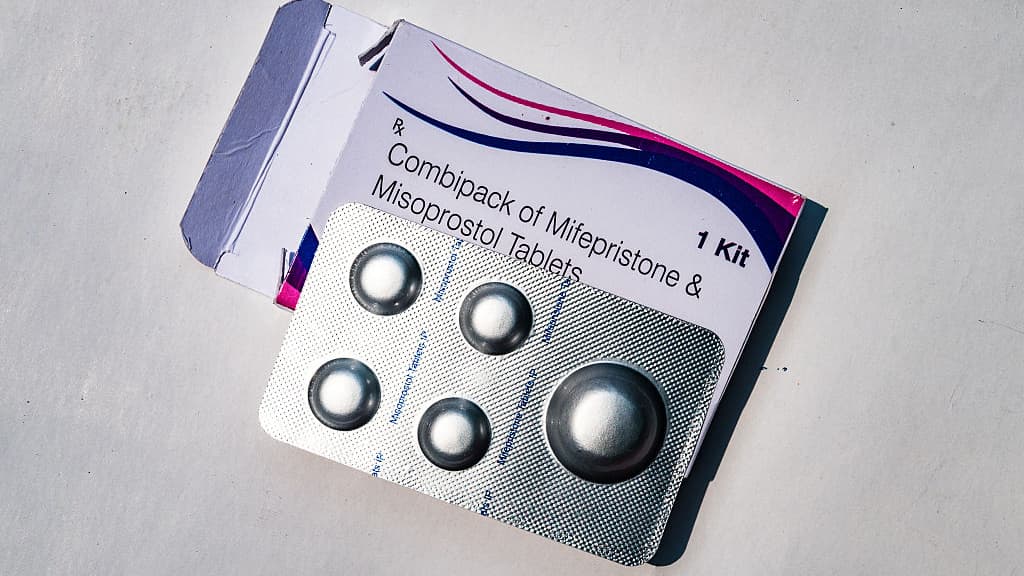
“We expect this to serve as an opportunity to strengthen the policy foundation for overall women’s health, including pregnancy, childbirth, and contraception,” Won said.
Before the 2019 ruling, abortion was strictly banned save for a few exceptions, including for pregnancies resulting from rape or incest. Estimates from South Korea’s Institute for Health and Social Affairs suggest that the number of abortions in the country had fallen from an estimated 241,411 in 2008 to just 32,063 in 2020, the last year for which statistics are available. In 2011, the health ministry director at the time attributed the downward trend to “a combination of factors including easier accessibility and use of contraceptives, broadening anti-abortion campaigns, and an improved social environment for childbirth and childcare.”
Prime Minister Han Seong-sook responded to critics and conservatives who are against the abortion medication plan, saying the government is also taking “concerns regarding the value of life” seriously. “This measure is aimed at protecting the people’s health rather than encouraging abortion,” Han said.


Ethereum Institutional signaled support for Ethlabs’ motion to reduce block times and create a faster Ethereum to address increasing competition from other networks.
“Make Ethereum faster,” wrote the non-profit organization in a Friday X post, arguing that reducing block times is needed as “more institutional activity moves onchain.”
On Thursday, Ethlabs published an article quoting 20 decentralized finance (DeFi) founders showing broad support for EIP-8198, also known as “Quick Slots,” which seeks to initially reduce Ethereum block times to 10 seconds from 12 seconds.
Other blockchain networks are also working on similar block time reduction initiatives. On Monday, the majority of Zcash token holders backed cutting the network’s target block time to 25 seconds, down from 75 seconds.
In August, Solana reduced its slot time from 400 milliseconds to 350ms. In June, the Solana Foundation shared plans to reduce slot times from 400ms to 200ms, arguing that it would improve latency and accelerate confirmations on the blockchain network.
EIP-8198 was authored in March and was proposed for inclusion in the Hegotá upgrade at the Ethereum core developers meeting on Aug. 6. Ethlabs said it was merging the proposal’s specifications with the main codebase and investigating potential downstream dependencies to help it “meaningfully enter Hegotá’s scope.”
Ethereum developers could begin implementing Hegotá in late 2026 following Glamsterdam, arguably one of the most consequential upgrades of the year, designed to improve scalability and harden the mainnet.
Related: Dragonfly’s Qureshi calls for end to Zcash dev fund after 2028
Real world asset futures have reached $107.6 billion in monthly trading volume, putting contracts tied to equities, commodities and private companies roughly level with crypto futures after a 142 fold increase in nine months.
Summary
- RWA futures volume surged 142 fold in nine months to $107.6 billion in July, roughly matching crypto futures at $105.7 billion.
- Open interest in RWA contracts climbed 167 fold to $1.72 billion, while crypto futures open interest fell to $7.1 billion.
- Equity contracts accounted for 83% of RWA open interest, while commodity trading responded sharply to moves in oil and silver.
- Pre IPO contracts for companies including SpaceX and Cerebras drew substantial trading activity around their public listings.
According to a joint report from OKX and Token Terminal shared with crypto.news, RWA futures generated $107.6 billion in trading volume in July 2026, up from $760 million in October 2025, while crypto futures recorded $105.7 billion during the same month.
The expansion came even as overall onchain derivatives activity cooled sharply. Quarterly derivatives volume fell by more than half from its peak, while open interest dropped to a one year low of $8.76 billion, according to the report.
RWA contracts moved in the opposite direction. Open interest across the category rose 167 fold in nine months to $1.72 billion, leaving the contracts with a growing share of an otherwise weaker derivatives market.
RWA futures have caught up with crypto contracts
OKX and Token Terminal traced the change in trading behavior to the crypto market selloff on Oct. 10, 2025, when more than $19 billion in leveraged positions were liquidated.
Before the event, crypto futures accounted for nearly all onchain derivatives volume. Trading in contracts linked to real world assets remained limited, with the category generating $760 million in monthly volume.
By July, the composition had changed. RWA contracts reached $107.6 billion in monthly trading volume, roughly matching the $105.7 billion recorded by crypto contracts.
Open interest showed a similar divergence. Crypto futures open interest fell from $9.1 billion to $7.1 billion over the nine month period, while RWA open interest climbed from $10.3 million to $1.72 billion.
The report said commodities accounted for 14% of RWA open interest by July, with equities representing 83% and pre IPO contracts making up most of the remaining share.
Activity in related markets has been growing outside the futures segment as well. crypto.news previously reported that the tokenized RWA market had expanded 589% since early 2025, with tokenized stocks recording some of the fastest growth.
Tokenized equity activity accelerated again in August. Monthly transfer volume reached $29.5 billion during the 30 days ending Aug. 29, an increase of more than 415%, while monthly active addresses climbed 209% to 1.3 million.
Commodity trading responds to events outside crypto
The report found that RWA futures activity was increasingly tied to developments in the markets represented by the contracts instead of movements in cryptocurrencies.
Oil provided one example. Following strikes on Iran on Feb. 28, trading volume in an onchain West Texas Intermediate contract increased 149 fold within nine days to $1.69 billion.
Bitcoin volume remained broadly flat during the same period, even as oil trading accelerated. The report linked the difference to traders responding directly to events affecting crude prices.
Silver showed another pattern. Onchain silver trading reached a record $17.3 billion in February as the metal hit a record price, before volume declined during the following months as the price eased.
Equity contracts responded to scheduled market events. Trading in an onchain S&P 500 contract peaked at $735 million on July 29, the day of the Federal Reserve’s interest rate decision, before reaching $751 million the following day.
Liquidity in some tokenized stock markets has already moved closer to levels found in established crypto markets. A June analysis found that Nvidia linked perpetuals on Bitget had reached around $4.1 million in liquidity depth, equivalent to roughly 75% of the exchange’s Bitcoin spot market.
Pre IPO contracts have created another RWA trading market
Contracts tracking private companies have developed alongside commodities and public equities, with traders using them to gain price exposure before a company reaches the public market.
The report highlighted SpaceX and Cerebras as examples.
Open interest in a pre IPO SpaceX contract peaked at $976 million on June 11, one day before its June 12 listing. Monthly volume reached $10.9 billion within three months of the contract’s introduction.
Trading continued after the listing. The SpaceX contract traded around 28% above its offer price before the event and remained roughly 16% below that level seven weeks later, according to the report.
Cerebras contracts recorded a different pattern. Open interest more than tripled to $28.5 million around the company’s May 14 listing, while its contract traded at $289 before listing against a $185 offer price. Cerebras stock opened at $350.
OKX and Token Terminal said pre IPO contracts can establish a market price for a company before its shares begin public trading, with the contracts incorporating expectations around the eventual listing price.
Tokenized securities infrastructure has continued to develop alongside these derivative products. Ondo Finance, for example, has been exploring an acquisition valued between $250 million and $500 million after its broker dealer subsidiary received additional FINRA authorizations covering tokenized corporate equities, exchange traded funds and other investment products.
Retail and institutional traders use RWA markets differently
Trading patterns in the report varied depending on the underlying asset and type of participant.
Retail traders were more active in highly volatile markets. Short positions in the silver contract reached an average of 4.3 times the size of long positions when silver peaked in February, while retail activity declined as volatility fell.
Pre IPO SpaceX contracts produced the opposite positioning around the June listing. Short side traders roughly tripled afterward, taking the long to short ratio to 4.2 times.
Institutional accounts generally held larger positions for longer periods. Before the SpaceX listing, their average short position was around $1.1 million, compared with roughly $1,000 for retail traders, while institutional accounts recorded average holding periods of 12,046 minutes against 60 minutes for retail participants.
The report found that market structure varied across asset classes as well. Equity contracts accounted for 83% of RWA open interest in July, yet generated 72% of single name equity trading volume. Commodities represented a smaller share of open interest but reacted more sharply to changes in the prices of the assets they tracked.
A separate gap remains between RWA issuance and use inside decentralized finance. Data published in September showed that only $3.79 billion of the $34.6 billion tokenized RWA market had been deployed in protocols, leaving roughly 89% of issued value outside DeFi applications.
Binance has kept its European licensing plans open after declining to address a report that European Central Bank President Christine Lagarde intervened in its failed Greek MiCA application.
Summary
- Binance declined to comment on a report that Christine Lagarde intervened in its Greek MiCA application.
- Greek officials reportedly told ESMA in early June that the HCMC intended to approve the Binance license.
- Binance withdrew its Greek application on June 24 and said it would pursue authorization in another EU jurisdiction.
- The exchange remains without MiCA authorization after missing the July 1 licensing deadline.
According to a Sept. 18 Wall Street Journal report, a vice chair of Greece’s Hellenic Capital Market Commission told Binance that Lagarde had asked Greek Prime Minister Kyriakos Mitsotakis not to approve the exchange’s application. The account has not been publicly confirmed by Lagarde, the ECB or the Greek regulator.
“We will not comment on speculation,” a Binance spokesperson said in response to the report. The exchange maintained that it remains committed to securing authorization under the European Union’s Markets in Crypto Assets Regulation, or MiCA.
“In Europe, Binance remains committed to operating on a long-term, compliant basis under the EU’s Markets in Crypto-Assets Regulation,” the spokesperson said.
Binance Greek MiCA bid was reportedly close to approval
Greek officials had informed the European Securities and Markets Authority in early June that the HCMC intended to approve Binance’s application, according to the Wall Street Journal. The exchange had been preparing for approval weeks earlier and drafted an announcement describing the expected authorization as a major milestone.
Binance co-CEO Richard Teng was expected to travel to Athens for a meeting and photograph with Mitsotakis as part of the planned announcement, the newspaper reported. Approval from Greece would have given the exchange a regulatory route to provide covered crypto services across the EU through MiCA’s passporting system.
The process changed course before the authorization was issued. The Wall Street Journal reported that Lagarde raised concerns about Binance’s compliance history, including the exchange’s 2023 guilty plea in the United States over anti-money laundering and sanctions violations. Binance agreed to pay roughly $4.3 billion as part of its settlement with U.S. authorities.
Concerns around stablecoins were part of the discussions as well, according to the newspaper. Lagarde has pushed for a stronger European payments system as the ECB develops the digital euro, while dollar denominated stablecoins remain dominant in global crypto markets.
The reported intervention came despite licensing authority under the existing MiCA framework resting with national regulators. Once a crypto asset service provider receives authorization from a competent authority in one member state, the license can be used to provide covered services elsewhere in the bloc.
Binance withdrew its Greek application before the MiCA deadline
Questions around the application had surfaced publicly by mid-June. As crypto.news reported at the time, Binance faced a potential rejection of its Greek application even as the exchange maintained that it had received no formal indication from the HCMC that approval would be denied.
Binance said at the time that it had worked with regulators for around 18 months and submitted what it considered a complete application. Its understanding was that the HCMC had completed its review and considered the filing compliant with MiCA requirements, while the application had undergone review at the ESMA level.
Reports of Lagarde’s involvement emerged soon afterward. The exchange’s Greek licensing route stalled as the July 1 deadline approached, leaving little time to obtain authorization before national transition arrangements expired.
Binance formally withdrew the application on June 24. The company said the decision followed a review of the status and timing of the Greek process and confirmed that it would pursue authorization in another EU member state. It did not identify the jurisdiction.
The exchange told users that their assets would remain safe and accessible while warning that services available to some customers could change depending on their country and account status. Binance continued to say that its long term plan was to secure a MiCA license and maintain operations in Europe.
The withdrawal came days before the July 1 deadline, when crypto firms that had relied on national registrations during MiCA’s transition period needed authorization to continue providing regulated services under the new framework. Binance subsequently suspended several EU services after failing to secure a license in time.
Binance remains without MiCA authorization
The licensing issue has continued beyond the July deadline. Binance was still opening and verifying some European customer accounts more than seven weeks later despite remaining absent from ESMA’s register of authorized crypto providers, according to tests conducted in August.
Some restrictions remained in place during those tests. One account opened through Austria using a Spanish identity document could not deposit euros through bank transfer after a third party provider flagged an address mismatch, although cryptocurrency deposits remained available.
By early September, Binance was continuing to serve some EU customers through regulatory provisions including reverse solicitation, which can permit services when customers approach an overseas provider on their own initiative. Some activity was being routed through an Abu Dhabi entity while the exchange continued seeking European authorization. Binance’s EU operations remained under regulatory attention, with ESMA seeking confirmation that the company was properly winding down activities requiring MiCA authorization.
Binance has not announced a new MiCA authorization since withdrawing its Greek application. Its June 24 update said another member state would be named when the company was ready to disclose its next licensing route.
Police in the United Arab Emirates and Sweden have arrested seven people after investigators traced cryptocurrency transactions through an international money laundering network that allegedly handled 70 million Swedish krona ($7.1 million) and had financial links to organized crime and contract killings.
Summary
- UAE and Swedish police arrested seven suspects over a network accused of laundering roughly $7.1 million in 10 months.
- Crypto transaction tracing helped investigators uncover financial links to organized crime and contract killings.
- The alleged leader was detained in the UAE while six other suspects were arrested simultaneously in Sweden.
- Swedish authorities have been increasing efforts to seize cryptocurrency and other assets connected to criminal networks.
According to the UAE Ministry of Interior, the suspected leader was arrested in the Emirates while six other alleged members of the network were detained simultaneously in Sweden following coordinated investigations between authorities in both countries.
The suspected leader, a Swedish national, had fled Sweden and was wanted under an Interpol Red Notice. UAE authorities tracked his location after what the ministry described as extensive searches, investigations and monitoring carried out through intelligence sharing with Swedish police.
Investigators said the network moved roughly 70 million Swedish krona over a 10 month period. Cash generated from criminal activity was allegedly collected and redirected to other criminal groups, while cryptocurrencies were used to transfer and move the value of some of the funds.
Crypto transactions exposed links to other crimes
Tracing the network’s cryptocurrency transactions became part of the investigation into where the money was moving and who was connected to it.
The Ministry of Interior said analysis of the crypto transfers and other digital evidence helped investigators identify financial connections with other alleged criminal activity, including organized crime and contract killings. Authorities did not identify the cryptocurrencies involved or disclose the wallets, exchanges or transaction amounts traced during the investigation.
Blockchain transaction trails have increasingly been used in international investigations involving illicit financial networks. In July, crypto.news previously reported that an INTERPOL led operation spanning 97 countries and territories resulted in 5,811 arrests and the interception of $293 million in illicit assets.
Operation First Light, which ran from Jan. 15 through April 30, targeted social engineering scams and the laundering infrastructure supporting them. Authorities identified more than 142,000 victims, blocked over 31,000 bank accounts and used INTERPOL’s Global Rapid Intervention of Payments mechanism to freeze suspicious fiat and cryptocurrency transfers.
One investigation uncovered during the operation involved Thai police tracing a suspected cryptocurrency laundering network that allegedly moved romance scam proceeds through several digital assets and cross chain swaps. A wallet belonging to one suspect had processed more than $122.5 million during a 10 month period, according to INTERPOL.
Another international operation announced in August produced 58 arrests and identified 263 suspects after investigators examined the financial systems used by West African organized crime groups. The eight month operation involved authorities from 22 countries, including the UAE, and focused on bank accounts, digital wallets, shell companies and other infrastructure used to move proceeds from fraud.
Sweden has stepped up crypto seizures
Swedish authorities have already been increasing efforts to identify and seize digital assets linked to suspected criminal activity.
Justice Minister Gunnar Strömmer called for more aggressive enforcement against cryptocurrency connected to criminal networks in 2025, asking police, the Swedish Tax Agency and the Enforcement Authority to increase their use of asset seizure powers.
Sweden’s approach followed changes that allowed authorities to seize property when ownership cannot be reasonably explained, even without establishing a direct connection between the property and a specific offense. By mid 2025, authorities had seized 80 million Swedish krona, then worth around $8.4 million, under the rules.
Strömmer specifically called for agencies to improve coordination when targeting high value assets such as cryptocurrency and said it was “time to turn up the pressure.” A 2024 assessment by the Swedish Police Authority and Financial Intelligence Unit had identified some crypto exchanges as services used to move proceeds from drugs, fraud and other criminal activity. Sweden’s crypto crackdown followed recommendations for law enforcement to increase its presence on cryptocurrency trading platforms.
Swedish police have separately documented the use of young recruits in gang violence and contract killings. In May, police said 23 bystanders had been killed and another 30 wounded in gang related shootings over the previous three years, according to the information cited by the UAE ministry.
Criminal groups have used social media and encrypted messaging services to recruit paid killers, including teenagers below the age of criminal responsibility, Swedish authorities said.
UAE and Sweden coordinated simultaneous arrests
Authorities carried out the seven arrests at the same time after investigators established the suspected leader’s location in the UAE.
Brigadier Abdulaziz Al Ahmad, director general of the Federal Criminal Police at the UAE Ministry of Interior, said authorities would “continue to track criminal networks, disrupt their sources of financing, and take legal action against anyone seeking to exploit the country’s territory for criminal activities.”
Cross border cooperation has become a recurring part of investigations involving cryptocurrency and organized financial crime. In May, police from China, the United States and the UAE conducted their first joint crackdown against telecom and online fraud operations in Dubai.
Chinese authorities said the operation dismantled nine fraud sites and resulted in 276 arrests. Investigators said suspects had used social media to establish fake romantic relationships before directing victims toward purported high return cryptocurrency investments.
In the latest Sweden UAE investigation, Anders Wiberg, police commissioner and head of the Swedish Police Authority’s international division, described cooperation with the Emirates as “a key factor in achieving the successful outcome of this case.”
Legal proceedings have been opened against all seven suspects following the coordinated arrests. Authorities have not publicly named the alleged leader or the six people detained in Sweden, nor have they disclosed the specific charges each suspect faces.

Put your money where your mouth is!! #thewatchking #diamonddistrict #squidgame #mazal

Lucid: Implications Of The Bolt Deal

In PBS's Heartrending Trespasses, Love Defies War in '70s Belfast



-

 Fashion7 days ago
Weekend Open Thread – Corporette.com
-

 Tech5 days ago
The Latest Weird Thing to Play Doom Is the Mapped-Out Brain of a Fruit Fly
-

 Crypto World4 days ago
Kraken Lets xStocks Holders Earn Yield Through DeFi
-

 Crypto World2 days ago
US Charges Robinhood Engineers Over Crypto Listing Trades
-

 Entertainment7 days ago
News Specials, Movies, Shows, More
-

 Crypto World6 days ago
Can AI Build a Startup in 72 Hours? Elon Musk's Team Will Livestream the Test
-

 News Videos7 days ago
Facing Financial Fears
-

 Crypto World4 days ago
Elon Musk Drops a Bombshell: Grok 5 Could Be the AGI Breakthrough
-

 Business5 days ago
Rivals Sam Altman and Elon Musk Rally Behind Dario Amodei’s Call for a Slowdown in AI Development
-
 NewsBeat4 days ago
‘Sick conspiracy’: Trump says only guardrails AI needs is ‘a strong and smart (High IQ!) president’ in all-caps rant
-
 Crypto World5 days ago
New Tesla Roadster Uses SpaceX Tech. Will It Impact the Stock Price?
-

 Crypto World6 days ago
Robinhood Chain Never Stopped But its Blobs Did Stop Reaching Ethereum For 14 Minutes
-

 Crypto World2 days ago
What Is the Status of the U.S.-Iran Peace Talks? Here's What Both Sides Are Saying
-
 Entertainment7 days ago
New Horror Movie Officially Earns a Rare Stephen King Recommendation
-
 Crypto World3 days ago
NVIDIA Analysis: Attempted Rising Wedge Breakout Amid Pressure on the AI Sector
-

 Business6 days ago
Marvell: Most Potent Setup Of The AI Factory Decade
-
 Crypto World4 days ago
DOJ Seeks to Seize $61M in Iran Oil Funds From Binance Accounts It Vouched For
-

 Crypto World6 days ago
Bitcoin ETFs lose $462.7M as Ethereum funds gain $196.9M
-
 Crypto World4 days ago
3 Token Unlocks to Watch in the Third Week of September 2026
-

 Crypto World4 days ago
Revolut Attackers Warn of Ongoing Daily Customer Data Leaks
You must be logged in to post a comment Login