

Crypto World
Singapore charges former Hodlnaut CEO Zhu Juntao over Terra collapse claims



Singapore authorities have charged the former CEO of collapsed crypto lender Hodlnaut Zhu Juntao with fraud, nearly four years after the firm froze withdrawals during the collapse of the TerraUSD ecosystem.
The Singapore Police Force said that Zhu faces six charges of fraud by false representation in an announcement on Tuesday. Prosecutors allege Zhu directed employees in 2022 to publish false statements on Hodlnaut’s Telegram channels and in customer emails claiming the company had no direct exposure to TerraUSD’s collapse, and had not suffered losses as a result.
Authorities also alleged Zhu repeated similar claims on his personal X account, then known as Twitter, in three posts in June 2022. If convicted, Zhu could face up to 20 years in prison, fines, or both on each charge under Singapore law.
Zhu disputed all six charges in court and was given a pre-trial conference date in June 2026, according to local media reports.
Hodlnaut was one of several crypto lenders that failed after the implosion of Terraform Labs’ algorithmic stablecoin ecosystem in May 2022. The collapse erased about $40 billion from the crypto market and contributed to failures at firms including Three Arrows Capital, Celsius and Voyager.
Reports filed during Hodlnaut’s restructuring proceedings indicated the company had channelled roughly $317 million of user funds into Terra’s Anchor Protocol, which was offering around 19.5% in annualized yield on UST deposits before the collapse, which saw UST become almost worthless.
Court-appointed judicial managers later estimated Hodlnaut lost about $189.7 million from exposure to the Terra collapse. Reports reviewed during restructuring proceedings said the company had poor internal recordkeeping and that some executives did not fully cooperate with investigators.
Singapore-based Hodlnaut, which was founded in 2019, offered customers yield-bearing crypto accounts and served more than 30,000 users globally before halting withdrawals in August 2022.
The company later entered judicial management and was ordered into liquidation by the Singapore High Court.



The CFTC has moved a proposed rule on prediction-markets event contracts into White House review as federal and state officials fight over who should police the fast-growing sector.
Summary
- The CFTC’s proposed prediction-market rule is under White House review before it can be released for public comment.
- The rule could create the first comprehensive federal framework for event contracts and affect platforms such as Kalshi and Polymarket.
- Trump backed CFTC control over prediction markets, while Illinois Governor JB Pritzker defended state action against insider trading.
Bloomberg first reported that the proposal is now before the White House Office of Management and Budget, a step that precedes the Commodity Futures Trading Commission’s release of the plan for public comment. The details have not yet been published.
CFTC pushes toward event contract rules
The proposed rule is expected to draw from a CFTC consultation held in the spring, which attracted more than 3,000 public comments. Those responses covered insider trading, barred contracts, market safeguards, and the legal structure around event contracts.
If adopted, the rule would give the US its first full federal framework for prediction-market contracts. It could also affect how platforms such as Kalshi and Polymarket serve US users, especially as the industry faces rising legal pressure from state regulators.
At the center of the issue is whether contracts tied to elections, sports, and public events should be treated as federally regulated derivatives or as gambling products subject to state law.
States challenge federal control
Nevada, New Jersey, Maryland, Ohio, Montana, Illinois, and other states have taken action against prediction-market operators. State officials have argued that some contracts resemble sports betting or other gambling products and should follow local gaming, tax, and consumer-protection rules.
Kalshi and other operators have said their event contracts are allowed under the Commodity Exchange Act. State regulators have rejected that view in several disputes, saying federal approval should not block enforcement of state gambling laws.
The question is now moving through the courts, where judges have split on whether CFTC jurisdiction overrides state gaming authority. Those cases could shape how much room states have to regulate platforms that list event-based contracts.
Pritzker criticizes Trump over prediction markets
President Donald Trump entered the dispute on Tuesday, publicly supporting Brian Selig and arguing that the CFTC should have exclusive authority over prediction markets. Trump said the issue was “critically important” and framed federal control as necessary for clear national rules.
In his post, Trump also attacked former New Jersey Governor Chris Christie, New York Attorney General Letitia James, Minnesota Governor Tim Walz, and Illinois Governor JB Pritzker. Trump said his administration was setting “rules of the road” for states and used harsh language against the officials.
Illinois Governor JB Pritzker responded on X, saying that Illinois had taken action to stop and ban insider trading in online prediction markets. Pritzker accused Trump of trying to stop states from regulating the sector so people close to him could benefit.
Donald Trump Jr. has ties to the industry. He invested in Polymarket through venture capital firm 1789 Capital and also serves as a strategic adviser to Kalshi.
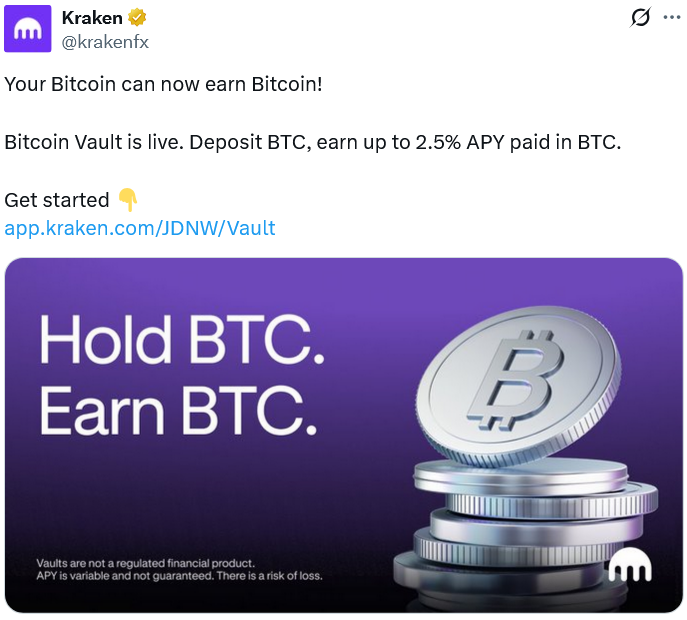
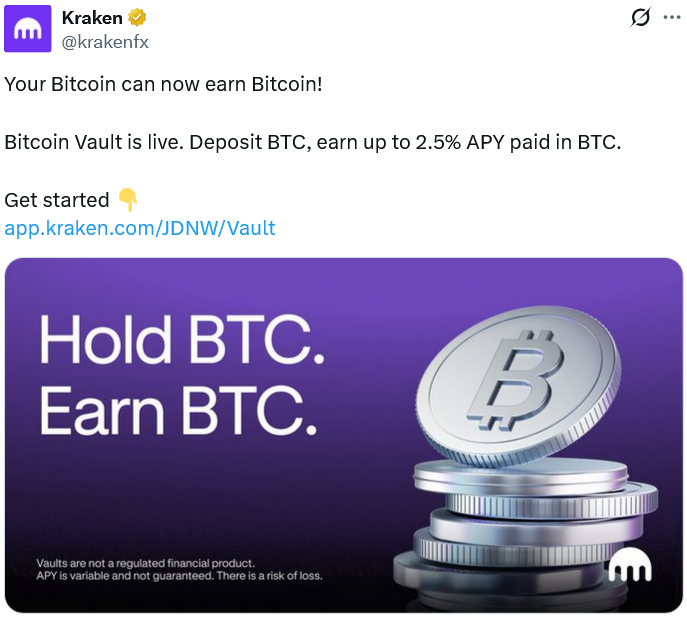
Crypto exchange Kraken has launched a non-custodial Bitcoin product, giving a 2.5% yearly yield, adding to the company’s yield product offerings amid a rising investor demand for crypto reward products.
Kraken unveiled the product on Wednesday with the support of crypto yield infrastructure provider Veda, which said the offering seeks to remove “the headaches that come with wrapping Bitcoin, moving assets, or managing a crypto wallet.”
Kraken’s offering comes as Bitcoin (BTC) holders’ demand for yield products has risen, but have seen limited development as the Bitcoin blockchain does not have mechanisms for users to generate yield compared to blockchains such as Ethereum and Solana.
“Many Bitcoin holders on Kraken have made it clear they want simple ways to earn on the Bitcoin they already plan to hold,” Kraken Earn product director John Zettler said in a statement.
Source: Kraken
About 10 hours after the launch, Veda said the Bitcoin yield product had passed $30 million worth of Bitcoin deposits from 4,000 unique wallets.
Kraken’s three stablecoin yield products that it launched in January have exceeded around $245 million in customer deposits and generated over $2.2 million in yield since launching on Jan. 26.
Related: Coinbase, Apex Group tokenize Bitcoin Yield Fund on Base
Kraken’s product generates yield from Bitcoin by swapping it to Kraken Wrapped Bitcoin (kBTC), a token replicating Bitcoin’s price, which crypto platform Sentora then allocates across crypto lending platforms such as Aave, Morpho and Tydro.
The product is non-custodial, meaning only depositors can withdraw or transfer their funds. Withdrawals are estimated to take five days to process, and the service providers take a 25% performance fee on rewards.
Magazine: Big Questions: Do we really only need 2–5 cryptocurrencies?


Strive, Inc. has used its SATA preferred stock program to buy an estimated 490 BTC in a single day, surpassing the Bitcoin network’s average daily issuance of roughly 450 BTC.
Summary
- Strive’s SATA preferred stock program bought an estimated 490 BTC in one day, above Bitcoin’s average daily issuance of about 450 BTC.
- SATA generated an estimated $35.3 million in ATM proceeds on Wednesday, based on tracker data showing $66.9 million in trading volume.
- Strive’s latest SEC filing confirmed the purchase of 1,109 BTC between May 19 and May 22, lifting total holdings to 16,500 BTC.
According to the Bitcoin for Corporations SATA Tracker dashboard, Wednesday’s activity showed about $66.9 million in total SATA volume, a 13% yield, and 95% of volume above the $100 par level set by Strive’s board for new issuance.
SATA absorbs more Bitcoin than daily mining supply
The tracker estimated a 58% capture rate from Wednesday’s trading, which placed at-the-market proceeds near $35.3 million while bitcoin traded around $74,956. Based on those figures, the SATA program was estimated to have acquired around 490 BTC during the session.
Bitcoin miners currently earn 3.125 BTC per block after the April 2024 halving, and the network normally produces about 144 blocks each day. Based on that block schedule, the network adds about 450 new Bitcoin to circulation every 24 hours.
Wednesday’s estimate means Strive’s preferred stock program bought more bitcoin in a single session than miners produced across the entire network in an average day.
Weekly Data Shows Heavy Treasury Buying
For the week ended May 24, SATA recorded about 794 BTC in purchases, according to the tracker data cited in the report. Wednesday’s revised estimate of 475 BTC was listed as the second confirmed daily supply absorption event by the instrument over the past eight days.
At the same time, Strive’s 8-K data, as shown through the tracker, covered the period from May 18 to May 26. During that filing window, SATA produced $50 million in total proceeds and added about 650 BTC to Strive’s treasury at a 48% capture rate.
Strive’s latest SEC filing also confirmed that the company purchased 1,109 bitcoin between May 19 and May 22. The filing placed the average purchase price at about $76,989 per bitcoin and brought the company’s total holdings to 16,500 BTC.
Strive uses preferred equity instead of debt
Strive describes itself as a Dallas-based corporate treasury and structured finance company focused on bitcoin accumulation. The company uses Variable Rate Series A Perpetual Preferred Stock, branded SATA, as one of its main funding tools.
The preferred stock is designed to pay cash dividends on each business day at a stated annual rate of 13%, with frequent distributions allowing the dividend structure to compound. Strive has said that the $100 per-share threshold serves as a floor below which management should not issue shares.
Rather than relying on traditional debt, Strive uses preferred equity to raise long-duration capital. The company has said this structure supports its bitcoin treasury strategy while reducing pressure tied to conventional loan maturities.
According to Strive’s disclosures, proceeds from SATA offerings are used for bitcoin purchases, the retirement of convertible notes connected to its Semler Scientific acquisition, and repayment of a Coinbase Credit loan.


Bitdeer names ex-Corsair finance chief Michael Potter as CFO, effective Tuesday, replacing Jianchun Liu.
Summary
- Michael Potter takes over as Bitdeer CFO effective Tuesday, with outgoing CFO Jianchun Liu staying through June 30.
- Potter led Corsair Gaming’s 2020 IPO and held earlier CFO roles at Canadian Solar, Lattice Semiconductor, and STATS ChipPAC.
- The appointment lands as Bitdeer scales AI cloud revenue and converts mining sites for high-performance computing workloads.
Bitdeer names ex-Corsair finance chief Michael Potter as CFO, effective Tuesday, replacing Jianchun Liu. Liu will remain through June 30.
The Nasdaq-listed Bitcoin miner disclosed the change in a Form 6-K filing. The board approved Potter’s appointment as the company pushes deeper into AI cloud and data center infrastructure.
Why the Bitdeer CFO change matters for the AI pivot
Potter served as CFO of Corsair Gaming from November 2019 through December 2025. He led the gaming hardware manufacturer’s September 2020 IPO and oversaw multiple capital markets transactions, according to the filing.
Before Corsair, Potter held CFO roles at a string of hardware-intensive public firms. Those included Canadian Solar, Lattice Semiconductor, NeoPhotonics, and STATS ChipPAC, giving him a track record across semiconductors and renewable energy.
The filing said Liu’s resignation was “due to personal reasons and was not the result of any dispute or disagreement with the Company on any matter relating to the Company’s operations, policies or practices.”
Liu will continue as a principal advisor after the transition. The overlap gives Bitdeer roughly five weeks with both finance executives in place before the handover.
How the appointment fits Bitdeer’s strategic mix
Bitdeer has spent the past year repositioning from pure Bitcoin mining toward AI infrastructure. The company self-mined 783 BTC in April 2026, a 372% year-over-year increase, while pushing its self-mining hash rate above 65 EH/s.
Its AI cloud annual recurring revenue grew roughly 60% month-over-month to about $69 million in the same period, according to company disclosures. The Tydal site in Norway remains in advanced negotiations as a colocation deal.
“April marked another month of disciplined execution across our integrated AI and Bitcoin mining platform,” Bitdeer CEO Linghui Kong said in the company’s most recent operations update.
Potter’s resume overlaps cleanly with each leg of that mix. Corsair Gaming dealt in hardware procurement and supply chain, Canadian Solar covered renewable power economics, and the semiconductor roles touched chip design cycles that mirror Bitdeer’s SEALMINER pipeline.
What the market reaction signals
Bitdeer shares fell about 3% in early trading after the announcement, though the stock remains near six-month highs. The dip suggested investors are reading the CFO change as a routine transition rather than a strategic break.
The miner has steadily scaled infrastructure across the US, Norway, Bhutan, and Ethiopia, with capacity targeting 3 GW. Several of those crypto sites are being reevaluated for AI cloud and colocation workloads, the company’s Q1 filing noted.
Potter also served as audit committee chair of Cordelio Power, a renewable energy platform backed by CPP Investments, from 2018 to March 2026.
That board seat aligns directly with the energy and capital structure questions Bitdeer’s expansion keeps raising for public-market investors.

New GENIUS-ready stablecoin targets institutional custody and reserve economics
Falcon Finance and Anchorage Digital Bank on Tuesday introduced fUSD, a U.S. dollar stablecoin designed explicitly for institutional counterparties operating under tight compliance constraints. The coin is issued by Anchorage Digital Bank, a federally chartered crypto bank, and is supported by Ceffu’s institutional custody and collateral infrastructure. Falcon Finance, which runs a top-ten synthetic dollar product, will operate a separate rewards program that shares a portion of reserve economics with qualifying institutional holders.
What fUSD is and how it works
fUSD is a regulated dollar payment stablecoin issued by Anchorage Digital Bank, N.A. The bank provides the issuance and reserve attestations, while custody and collateral management are handled through Ceffu, a platform used by many professional trading firms and liquidity providers. Falcon Finance will act as the commercial partner and will also be a launch holder, committing a portion of its corporate reserves to the new token.
Key distinguishing feature: qualifying institutional holders who enter bilateral agreements with Falcon Finance can receive rewards tied to the economics of the stablecoin’s reserves. Falcon has said it is targeting roughly 3% per year for eligible counterparties. Importantly, those rewards will be paid by Falcon under separate contractual arrangements, rather than by Anchorage or Ceffu.
Regulatory context: the GENIUS Act
fUSD is described as GENIUS-ready, referencing the federal framework for payment stablecoins enacted in July 2025. Under that framework, stablecoin issuers face limits on directly paying interest or yield to token holders. The structure behind fUSD appears designed to comply with those rules by separating issuance from the rewards program: Anchorage issues the coin and maintains reserves, while Falcon offers rewards through private contracts tied to the underlying collateral.
This separation aims to allow regulated desks and treasury functions to access a regulated stablecoin while recouping some of the yield that would otherwise accrue to issuers or sit idle on institutional balance sheets. The approach, however, depends on clear legal separation and may attract regulatory scrutiny if authorities view the arrangement as an attempt to circumvent the GENIUS Act provisions.
Market rationale and demand dynamics
The launch comes as the dollar stablecoin market tops several hundred billion dollars and short-dated Treasury yields sit near the 4% range. Many institutional desks and treasury operations currently hold large stablecoin balances that do not generate yield, creating a demand opportunity for products that can combine regulatory compliance with improved economics.
By issuing a bank-backed dollar and placing it on the custody and collateral rails used by professional players, Falcon and Anchorage are targeting custody-constrained participants such as treasury desks, high-frequency traders, and market makers who require regulated settlement and collateral replenishment workflows.
Operational and counterparty considerations
While fUSD aims to preserve regulatory compliance through issuance and custody choices, the rewards mechanism introduces operational and counterparty complexity. Payouts are contingent on contractual arrangements with Falcon, meaning qualifying entities will need to perform credit and counterparty assessment, negotiate terms, and reconcile the reward mechanics with their internal compliance and accounting rules.
Moreover, the rewards are described as tied to reserve assets such as Treasuries. That linkage creates exposure to the performance of those reserves and to the mechanics of how Falcon passes through or shares reserve yields, rather than a guaranteed deposit-like return from the issuer. For institutions weighing adoption, operational integration with Ceffu’s custody stack and legal clarity on the reward contracts will be key.
Implications for stablecoin market and competitors
fUSD’s model could prompt similar product experiments from other regulated issuers and commercial partners seeking to serve institutional clients. Firms that control both issuance and treasury functions might explore distinct commercial channels to share reserve economics without altering the issuer’s regulatory obligations. That could expand the variety of regulated dollar primitives available to professional market participants.
At the same time, the market will watch for regulatory responses. Agencies may scrutinize arrangements that shift yield from issuers to third parties to ensure they are not effectively recreating disallowed interest payments. Any enforcement action or regulatory guidance could materially affect the viability of such structures.
Bottom line
fUSD represents a calibrated attempt to marry bank-issued stablecoins with commercial reward programs aimed at institutional users. The product leverages Anchorage’s federal charter and Ceffu’s custody rails to address compliance needs, while Falcon’s rewards contracts seek to reclaim some reserve yield for holders. For treasury desks and professional trading firms, the offering could improve the economics of holding regulated dollars, but adoption will hinge on legal clarity, operational integration and regulatory reception.


Aztec Labs has acquired ZKPassport but will keep the privacy-focused passport-scanning app fully open source.
Summary
- Aztec Labs acquired ZKPassport but will keep the iOS app and Noir circuits open source.
- The privacy app proves identity attributes from government IDs without revealing personal data.
- ZKPassport already ran sanctions checks on Aztec’s December 2025 token sale, validating the tech in production.
Aztec Labs has acquired ZKPassport but will keep the privacy-focused passport-scanning app fully open source. The deal preserves the iOS NFC scanner and Noir circuits.
The Ethereum layer-2 privacy network confirmed the acquisition on Wednesday. ZKPassport, built on Aztec’s Noir programming language, lets users prove identity attributes from government-issued IDs without revealing the underlying personal data.
Why the Aztec Labs deal keeps ZKPassport public
ZKPassport works by scanning the NFC chip embedded in a passport or national ID, generating a zero-knowledge proof on the user’s phone, and disclosing only the specific attribute a service needs.
The app first gained traction on Aztec’s testnet, where it solved a Sybil-attack problem that was choking the validator set. Within weeks of integration, the network lifted its daily quota of new sequencers.
By keeping the codebase open source, Aztec Labs retains the public-good framing that grew the project. Michael Elliot’s ZKPassport had positioned itself as a non-profit identity solution before the deal.
“In the future, all crypto will be private,” Aztec Labs CEO Zac Williamson told crypto.news in a prior interview, framing ZKPassport-style verification as one path to compliant, privacy-preserving on-chain identity.
How the iOS app fits Aztec’s wider stack
ZKPassport’s iOS app already plugs into Ethereum, Base, Aztec, and other EVM chains through on-chain verifiers. The acquisition consolidates those rails under one product team while keeping integration permissionless for outside developers.
Aztec’s broader push has centred on programmable privacy. Its Ignition Chain went live in November 2025 as the first decentralised L2 on Ethereum, and the network entered alpha with a full execution environment for private smart contracts shortly after.
ZKPassport’s Noir circuits also underpinned Aztec’s recent $AZTEC token sale, where they ran compliant sanctions checks during the December 2025 continuous-clearing auction without leaking participant data.
That use case proved the tech in production. The acquisition formalises a relationship that had already passed multiple live audits, with Consensys Diligence and TU Vienna both contributing security reviews.
What the deal signals for ZK identity competition
The market for privacy-preserving identity has tightened in 2026. World, Self Protocol, Holonym, Rarimo, and zkEmail all run variations of the same playbook: client-side proofs, document scans, selective disclosure.
ZKPassport’s distinguishing feature was always its document-native approach, leaning on the cryptographic signature already baked into ePassports and government IDs.
By absorbing ZKPassport while keeping it open, Aztec Labs effectively claims that infrastructure tier without forcing competitors off the technology. The bet is that programmable privacy wins through composability rather than enclosure.
Aztec’s testnet attracted more than 24,000 validators through 2025, with ZKPassport-gated humanity checks playing a central role in the decentralisation push across rival privacy networks. The acquisition aligns the two roadmaps for the network’s full mainnet phase.
Bitcoin price just flashed the same warning that preceded its 35% January collapse, slipping below a cluster of critical technical lines on the daily chart.
A single wallet still withdrew 873 BTC worth $66 million from OKX, possibly betting the outcome this time will look nothing like January.
Bitcoin Price Cracks All Four EMAs as a $66 Million Whale Buy Hits
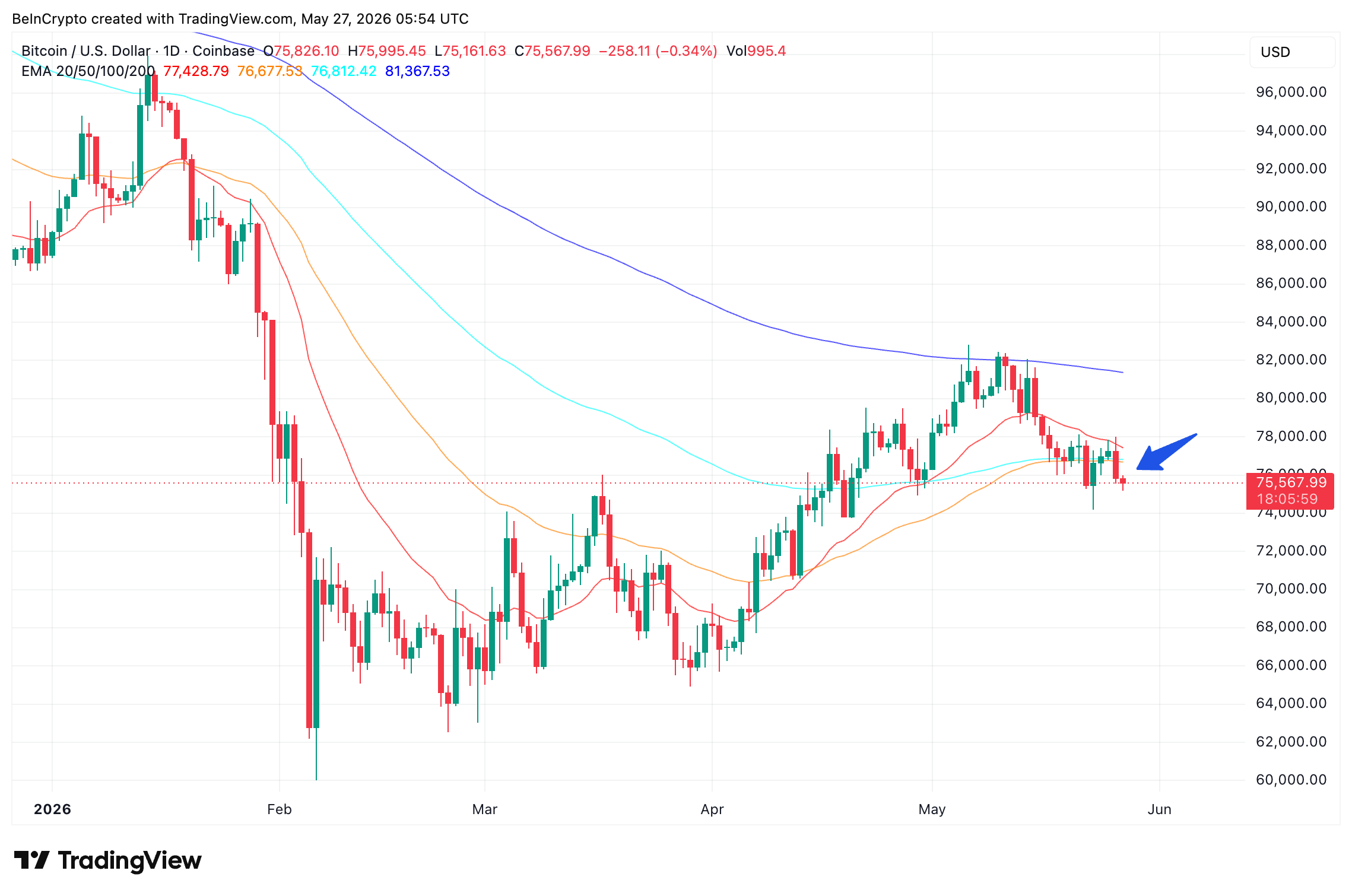
Bitcoin (BTC) is trading at $75,567, now below all four key Exponential Moving Averages (EMAs), trend indicators that smooth recent price action to flag the underlying direction. The 20-day EMA sits at $77,428, the 50-day at $76,677, the 100-day at $76,812, and the 200-day at $81,367.

Around the same time, an on-chain tracker flagged a wallet withdrawing 873.29 BTC worth $66.24 million from OKX early Wednesday. The wallet now holds 881 BTC worth roughly $66.73 million, with prior smaller withdrawals stretching back about a week.
The two signals point in opposite directions. A clean loss of every EMA is one of the most reliable bearish daily signals in 2026, while a fresh $66 million accumulation suggests at least one large operator sees a buy. The historical record explains why both sides have a case.
The Last Three EMA Breaches Show One Crash and Two Bargains
Bitcoin has fully lost all four EMAs three times in 2026. The outcomes split sharply.
Want more token insights like this? Sign up for Editor Harsh Notariya’s Daily Crypto Newsletter here.
The first event began in late January. Bitcoin closed below every EMA and triggered a 35.02% slide over the following two weeks. It was the deepest single drawdown of the year.
The next two events landed in completely different terrain. On March 26, Bitcoin lost the EMA cluster but the damage stopped at 7.36% before a recovery rally took over. On May 22, an even smaller 3.32% dip preceded a rebound back into the EMA zone.

The pattern shows declining severity, with the last two events behaving like brief consolidations rather than full breakdowns. The catastrophic January event remains the outlier. Whatever made January different from March and May is the only question that matters for this fourth breach.
The on-chain record points directly at the answer.
Long-Term Holder Behavior Explains the January Outlier
Glassnode’s Long-Term Holder Net Position Change, a metric that tracks whether wallets holding Bitcoin for more than 365 days are net accumulating or distributing, reveals a sharp regime shift in early March.
Note: Standard “Hodlers” are the ones holding for 155 days or more.
Through late 2025 and across the January 2026 breakdown, long-term holders were heavy net sellers. The red bars on the chart deepened toward roughly -200,000 BTC at peak distribution, exactly as Bitcoin was sliding. That coordinated long-term holder selling supplied the structural pressure that turned a routine EMA breach into a 35% rout.

Since early March 2026, the picture flipped. Long-term holders have stayed in net accumulation territory for roughly three months, with daily inflows often above 100,000 BTC. That backdrop coincided directly with the muted 7.36% and 3.32% drops in March and May.
The current EMA breach is happening into a long-term holder regime that is still green. The structural seller cohort that powered the January collapse is absent. This is the data point the whale appears to be reading, and it sets the downside math for what follows.
Bitcoin Price Levels Between the 3% Bargain and the January Repeat
Bitcoin price has already shed roughly 2% since losing the EMA cluster. If this breach mirrors the May 22 event, the drop stalls near $73,873, the 0.5 Fibonacci level of the late-March to mid-May rally. That zone aligns with the 3-to-4% magnitude of the May precedent.
If buyers fail to defend $73,873 and the breach scales closer to the March 26 episode, the next checkpoint is $71,773 (0.618 Fibonacci), marking a 6-to-7% total drop from the EMA loss.
The recovery path requires sequential daily closes back above resistance. The first step is reclaiming $75,973 (0.382 Fibonacci) on a daily close. The next is breaking above $78,572 (0.236 Fibonacci), which sits just over the key EMA cluster. A clean move above $82,772 would put Bitcoin price back above every moving average and resume the prior uptrend.

The January risk has not disappeared. If long-term holder net position flips negative on Glassnode during this drop, the comparison to March and May fails, and the path opens toward another deeper dip scenario back toward the mid-$60,000 range.
A daily close above $75,973 separates the 3-to-7% bargain scenario backed by the $66 million whale from a deeper unwind that would invalidate the long-term holder thesis.
The post Bitcoin’s 35% Crash Signal Just Returned But a Whale Bought $66 Million Anyway appeared first on BeInCrypto.


Prague, Czech Republic, May 18, 2026 – BTC Prague, Europe’s premier Bitcoin conference, returns to the PVA Expo Prague on June 11-13, 2026. Entering its fourth edition, BTC Prague welcomes 8,500 attendees, uniting entrepreneurs, developers, investors, educators, and newcomers in the industry. This year, BTC Prague adds its new Bitcoin Living Masterclass track, a dedicated stage for talks on health, biohacking, financial sovereignty, AI, parenting, and more, from renowned experts in their fields on top of its best-in-class Bitcoin program.
Without abandoning its Bitcoin-only philosophy, BTC Prague now broadens its appeal, including a wider range of topics very much in vogue among the Bitcoin community. The result is a three-day program of keynotes, panels, debates, and networking across four different stages surrounded by Europe’s largest Bitcoin expo.
Building Bitcoin bridges: from Europe to the rest of the world
BTC Prague is a meeting point for those building Bitcoin’s future. More than a conference, it’s a festival for everyone. From the newly curious to die-hard advocates, the event’s setup is meant to unite the vastly different ideological, technical, and business enclaves that exist in Bitcoin. A BTC Prague ticket ensures people can interact with experiences and content made for and by the Bitcoin community.
- Main Stage: Talks focused on the deeper societal implications emerging from Bitcoin adoption
- GART Stage (Expo): Everything needed to learn and master the Bitcoin basics
- Anycoin Stage (Czech-only): Czech language speakers curated for a local audience
- VIP Stage: Limited-access sessions for VIP ticket holders
The 250+ speaker lineup features major names in the industry and beyond, such as:
- Michael Saylor, Executive Chairman, Strategy
- Jack Mallers, Founder & CEO, Strike & Twenty One
- Natalie Brunell, Author, Bitcoin is for Everyone
- Peter McCormack, Podcaster, filmmaker, and football club chairman
- Dr. Adam Back, CEO & Co-founder, Blockstream
- Roman Reher, Founder & CEO, Blocktrainer
- BTC Sessions, YouTube Educator
- Jeff Booth, Founding Partner, Ego Death Capital | Author, The Price of Tomorrow
- Marc Friedrich, Friedrich Vermögenssicherung GmbH, and best-selling author
- Dr. Jack Kruse, Neurosurgeon at Kruse Longevity Center
- Julian Liniger, Co-founder & CEO, Relai
- Efrat Fenigson, Journalist and host of “You’re The Voice” podcast
- And many more leading experts, developers, investors, and entrepreneurs
An Entire Week Dedicated to Bitcoin
Besides the main 3-day conference, BTC Prague 2026’s spirit extends well past that onto separate meetups, events, and parties happening in Prague that same week.
Freedom Tech Summit – June 10, 2026
The next step for BTC Prague’s dev/hack/day. This is a one-day deep dive for developers, builders, hackers, or freedom and privacy enthusiasts. Freedom Tech Summit is where the bleeding-edge of open source development comes to meet for innovative workshops, dev sessions, and talks.
Bitcoin Corporate Day – June 10, 2026
An invite-only event for investors, entrepreneurs, bankers, and high-level decision makers. Bitcoin Corporate Day brings together top executives, institutional figureheads, and Bitcoin thought leaders, breaking new ground for institutional Bitcoin adoption, capital markets, corporate finance, and more. This exclusive gathering is held at the prestigious Lobkowicz Palace.
The Bitcoin Expo
This year, the BTC Prague Expo features 100+ companies and a renewed floor plan suitable for Europe’s largest Bitcoin exhibition. Attendees from any experience level are welcome to see, try, or purchase Bitcoin-related products: everything from wallets to mining hardware, security tools, financial services, educational platforms, games, and more for only a €75 admission fee.
Don’t miss BTC Prague’s side events
BTC Prague is all about celebrating the Bitcoin community and culture. A plethora of separate, fully community-backed events are expected. This includes meetups, parties, workshops, hackathons, and even sports activities meant to take advantage of Prague’s distinct identity. Every Bitcoiner is welcome to organize their own celebrations.
Bitcoin networking for everyone
BTC Prague 2026 prioritizes accessibility and an unforgettable experience for everybody. This year, it brings back all the features loved by past attendees:
- Dedicated event app for networking, scheduling, and customizing your program.
- Ticket options for every budget, starting from €75, with packages for newcomers, enthusiasts, professionals, and VIPs.
- On-site chill zones, food trucks, and the annual afterparty let attendees take a proper break and enjoy a casual community-building environment.
VIP attendees get to enjoy the “ultimate Bitcoin experience” with access to a concierge-hosted lounge, front-row seating, and Michelin-star level dining and drinks. The VIP pass unlocks elevated comfort and access throughout the entire event venue.
Prague: still the Bitcoin capital of the world
Held in a city synonymous with freedom, Prague also reflects the Czech capital’s deep ties to Bitcoin’s history, from pioneering mining operations and software, to hardware wallet innovation and finance. Centrally located in Europe, Prague offers excellent infrastructure, affordability, and a thriving local Bitcoin scene, making it an ideal setting for an event of this scale and ambition.
Key event details
- Dates: 11th – 13st June 2026
- Location: PVA Expo centre, Beranových 667, 199 00 Prague, Czech Republic
- Tickets: Four tiers available: Bitcoin Expo only, 2-Day All Access, 3-Day All Access (adds Bitcoin Living Masterclass), VIP (access to everything + hospitality perks)
Partners
- General: Relai
- Gold: Bitmain, DASE, Firefish, Fulgur Ventures, GART, The Bitcoin Way, Trezor
- Silver: AmityAge, Anycoin, AsicExchange, BitBox, Bitwise, Braiins, Brainmarket, BullBitcoin, Cake Wallet, Citadel Garden, Coinsnap, EMCD, FractalEncrypt, Frostsnap, Glimpse, Invity, Mitochondriak, OCEAN, Próspera, Rewallet, Rootstock, Silent.Link, Strive, Tangem, Terahash, The Block Live Studio, Travala, Vexl
- Bronze: 21energy, 2fiat.com, ArchLending, Bespoke, Bitchair, Bitcoin Beach, BitcoinMat, Bitcredit, Bitronics, Bitsurance, BTC Map, BTCPay Server, Capital B, Citadel Vault, CKMA, Coconut, Foundation, KeychainX, KvaPay, Liberation Travel, MIM, Minotaur, Nomium, OBM Foreman, One Miners, Portu, Satoshi Silver, Seedor, Stamp Seed, Strike, Sygnum, ThorSwap, Tropic Square, Uminers, Vnish, Volcminer, Xapo Bank, XCE
- Copper Partners: AnchorVerse, Bitcare, Crypto Goodies, Electrum, Ledn, LifPay, Saturday Block
- Product partners: Beer of Satoshi, BitKit, CzechCrunch, Jednadvacet, Mattoni, Mercedes Hoffmann & Žižák, Opago, Pilsner Urquell, Prima & La Panna, Red Bull, Refyzio, Yubico
About BTC Prague
Launched in 2023, BTC Prague is now the largest and most prominent Bitcoin-only conference in Europe. It was created by a team of European Bitcoiners to foster learning, innovation, and real-world connections in the global Bitcoin ecosystem. The event is fully independent and focused solely on the Bitcoin protocol, its adoption, culture, and its future.
For tickets, speaker updates, and more information, visit www.btcprague.com.
Media kit & Brand Manual: https://design.btcprague.com/btc-prague; photo 1; photo 2; photo 3.
Media Contact
Sponsorship & exhibition inquiries
BTC Prague offers a unique appeal and exposure for any Bitcoin brand to gain direct exposure to thousands of attendees, A-list speakers, and online audience through bespoke sponsorship, exhibition, or marketing opportunities. For more information and how to apply, please contact martin@btcprague.com.
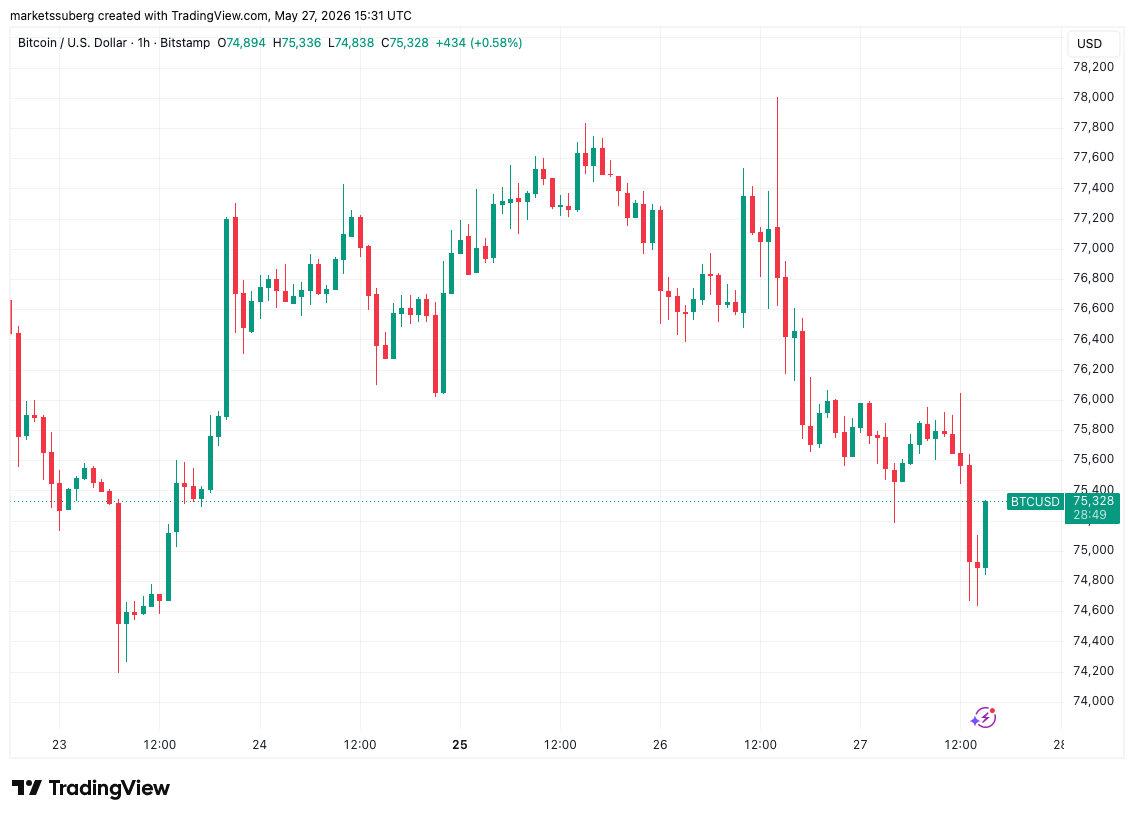
Bitcoin (BTC) fell back below $75,000 at Wednesday’s Wall Street open as relief over a US-Iran peace deal bypassed crypto.
Key points:
- Bitcoin continues to diverge from US stocks despite good news over the US-Iran war.
- BTC price action instead trends lower with oil amid improving odds of the Strait of Hormuz reopening.
- Bitcoin traders see little reason to avoid new local lows nearer $70,000 next.
BTC price falls with oil as Iran peace deal details emerge
Data from TradingView showed BTC/USD down by up to 1.2% on the day, targeting week-to-date lows.
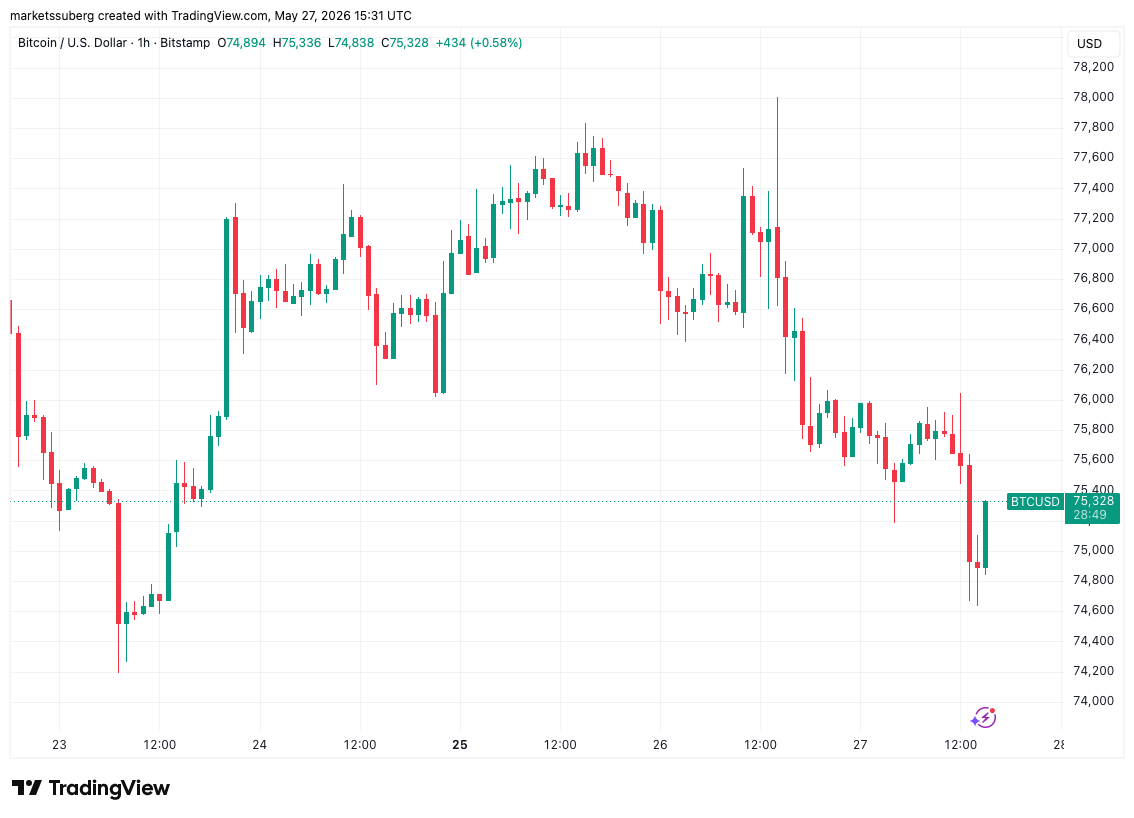
BTC/USD one-hour chart. Source: Cointelegraph/TradingView
News that the US and Iran had produced a memorandum of understanding aimed at securing an end to the conflict sent stocks soaring to new all-time highs while commodities and oil, in particular, fell immediately.
US WTI crude dropped to as low as $87.77 per barrel on the day, its lowest since April 22.
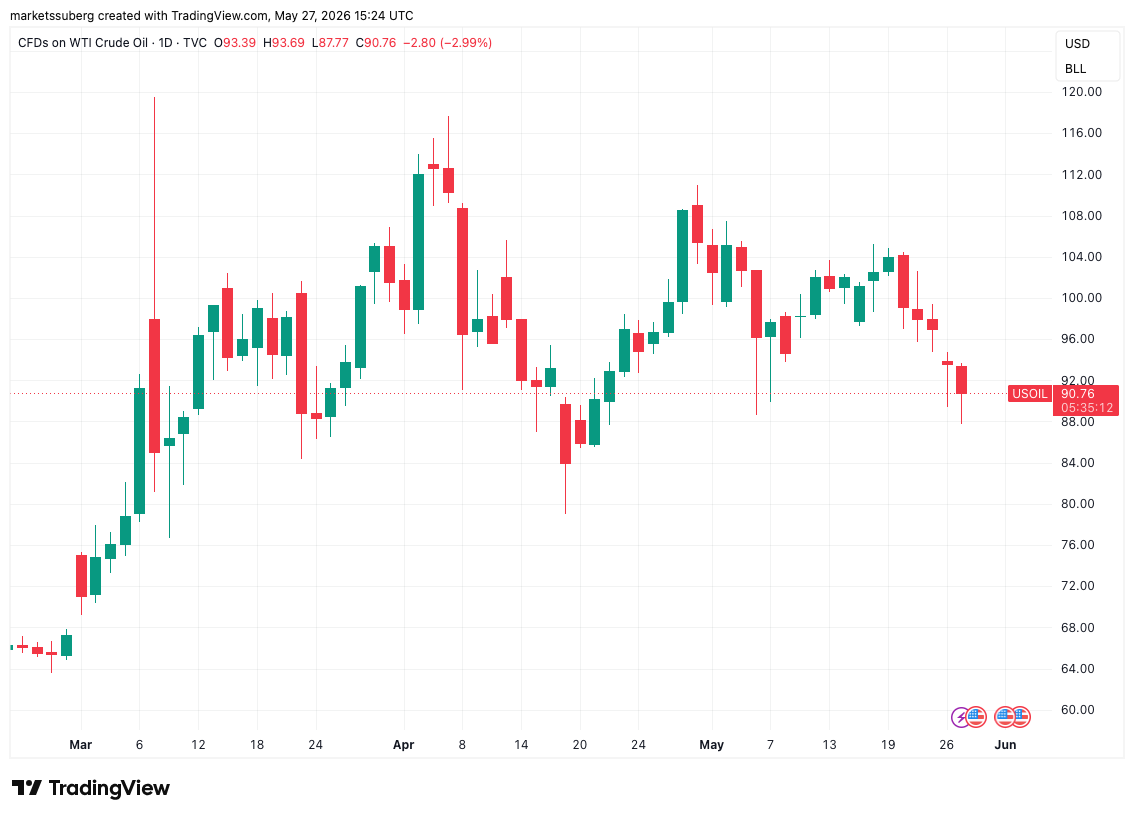
CFDs on WTI crude oil one-day chart. Source: Cointelegraph/TradingView
Part of the deal, which reportedly sets out a 60-day negotiation period for securing a lasting agreement, includes the reopening of the Strait of Hormuz — a key oil shipping route.
“If a final deal is reached within 60 days, this agreement will be approved in the form of a binding UN Security Council resolution,” an X post on the developments from trading resource The Kobeissi Letter stated.
Despite the implied tailwinds for risk assets, Bitcoin failed to join the upward momentum, instead continuing a trend from recent weeks where it moved in the opposite direction to US equities.
“$BTC Indecisive whether to join stocks or commodities today,” trader Daan Crypto Trades responded.
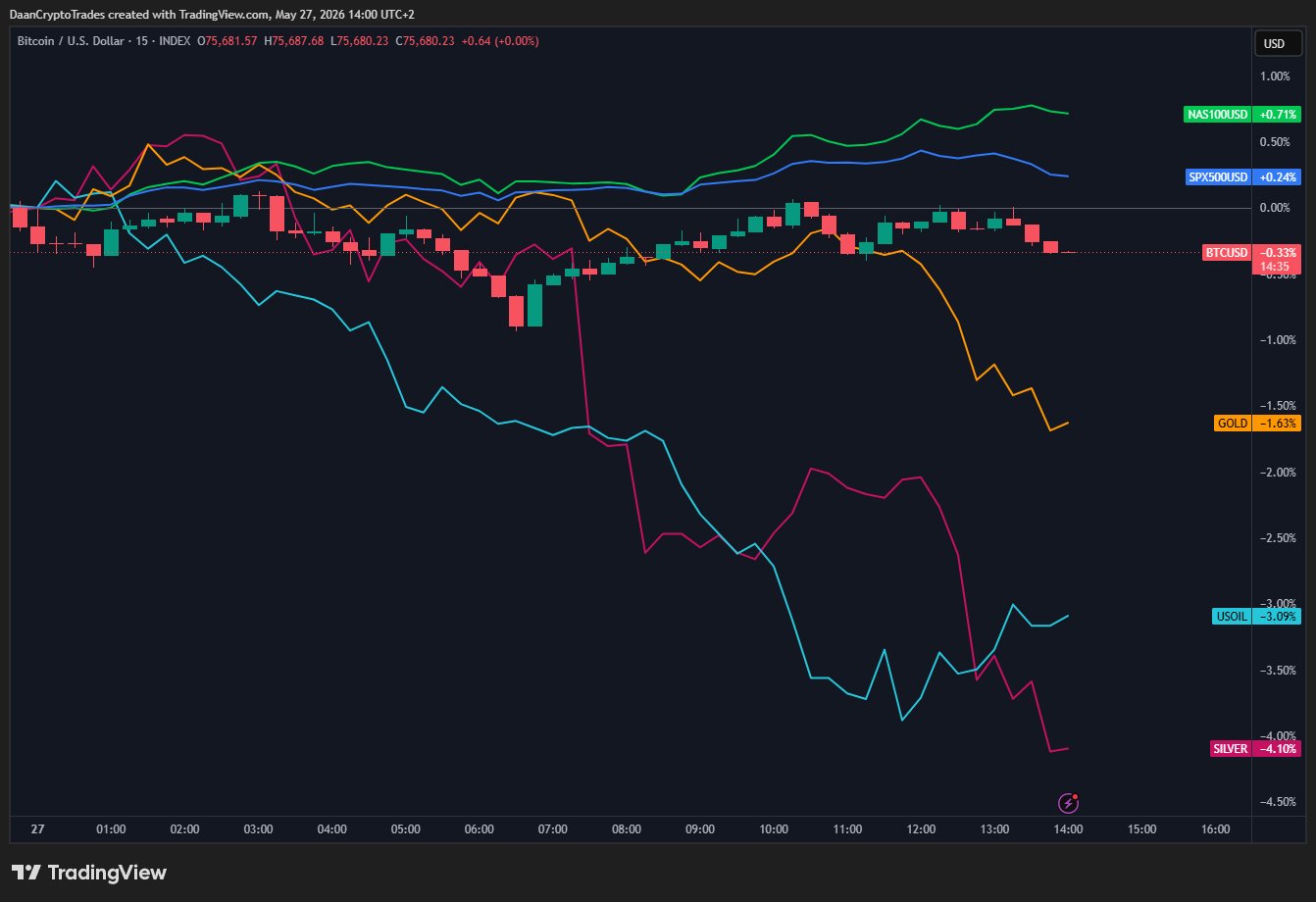
Macro asset comparison chart. Source: Daan Crypto Trades/X
Exchange order-book conditions set up potential liquidity grabs both above and below the price as positions increased on both sides.
“Although most of the liquidity is currently sitting above us, it’s spread out pretty evenly, which doesn’t give a clear target for an upside sweep. Meanwhile, below us there’s a large liquidation cluster around 74k that could pull price toward it,” trading and analytics account CGT Trader commented earlier.
“An upside sweep can’t be ruled out, but imo continuation to the downside is still more likely.”
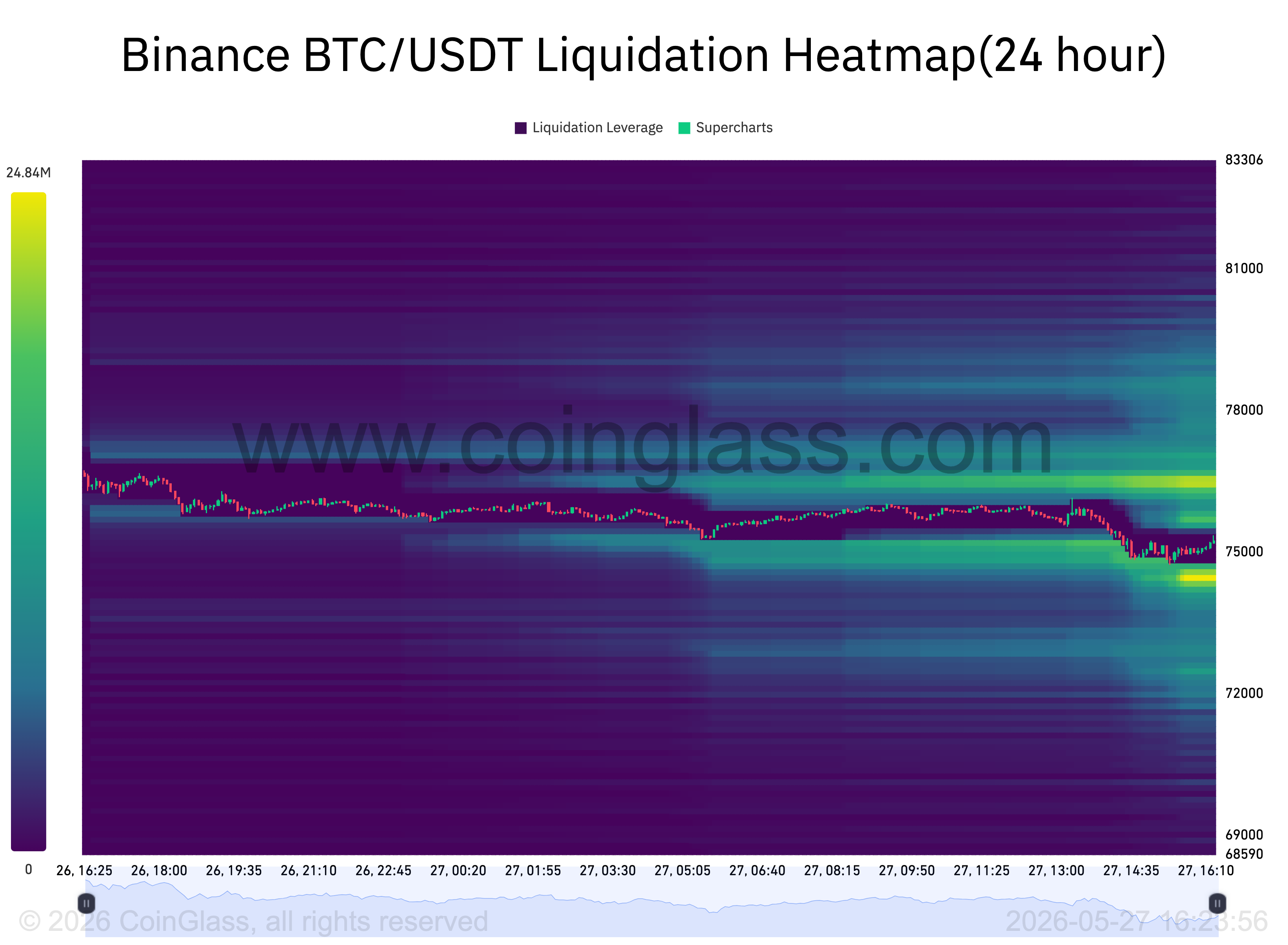
Binance BTC/USDT liquidation heatmap. Source: CoinGlass
Bitcoin stays “weak and bearish” despite macro tailwind
Other market participants continued the lack of optimism as Bitcoin headed lower.
Related: Bitcoin analysis eyes sharp rebound after BTC collapses below M2 supply ‘fair value’
Commentator Exitpump described BTC price action as “weak and bearish,” seeing a potential drop to near $72,000 next.
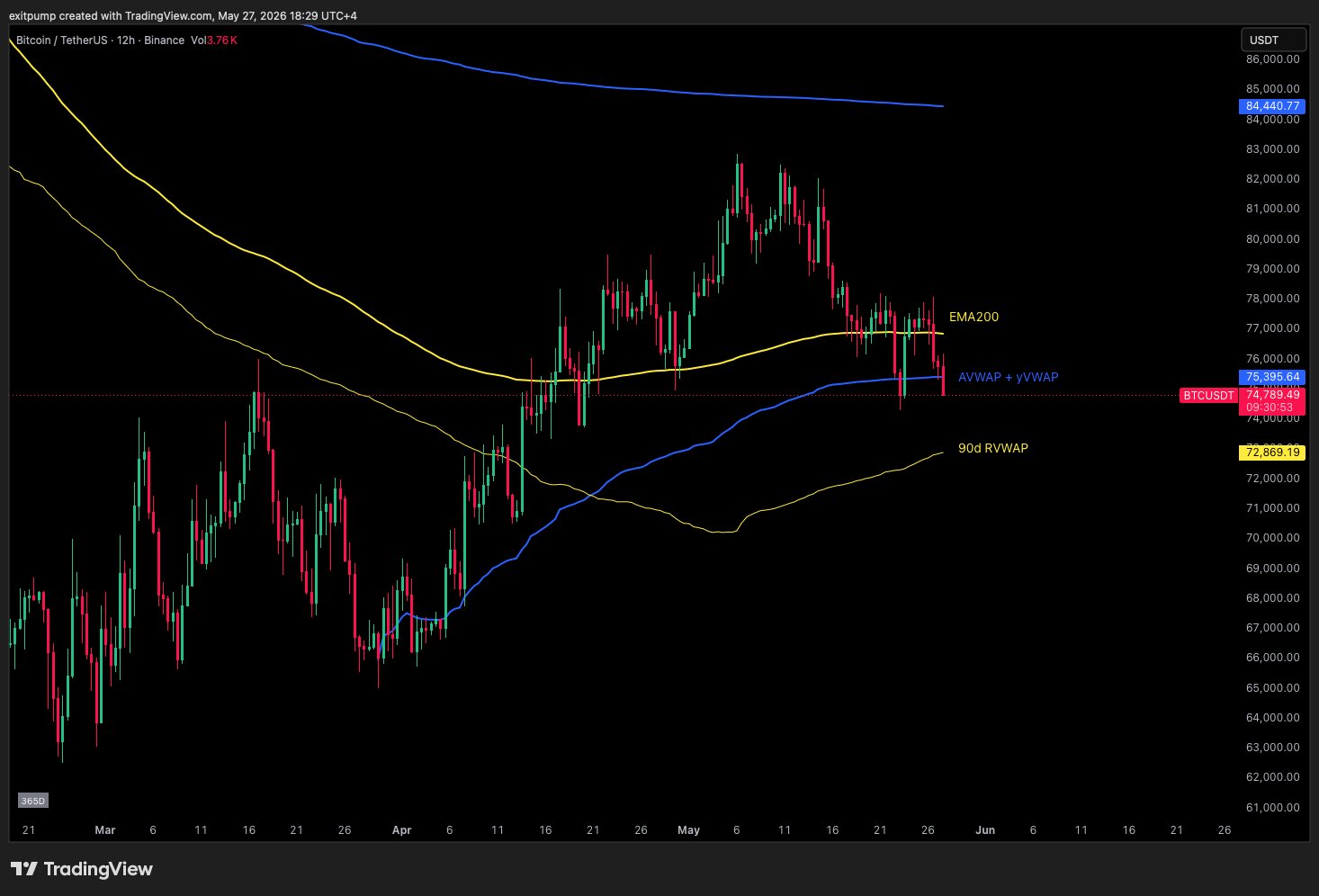
BTC/USDT 12-hour chart. Source: Exitpump/X
Trading resource Material Indicators added further hurdles, including a potential death cross involving the 21-day and 50-day simple moving averages (SMAs).
An accompanying chart showed up and down signals from one of Material Indicators’ proprietary trading tools, along with significant price points.
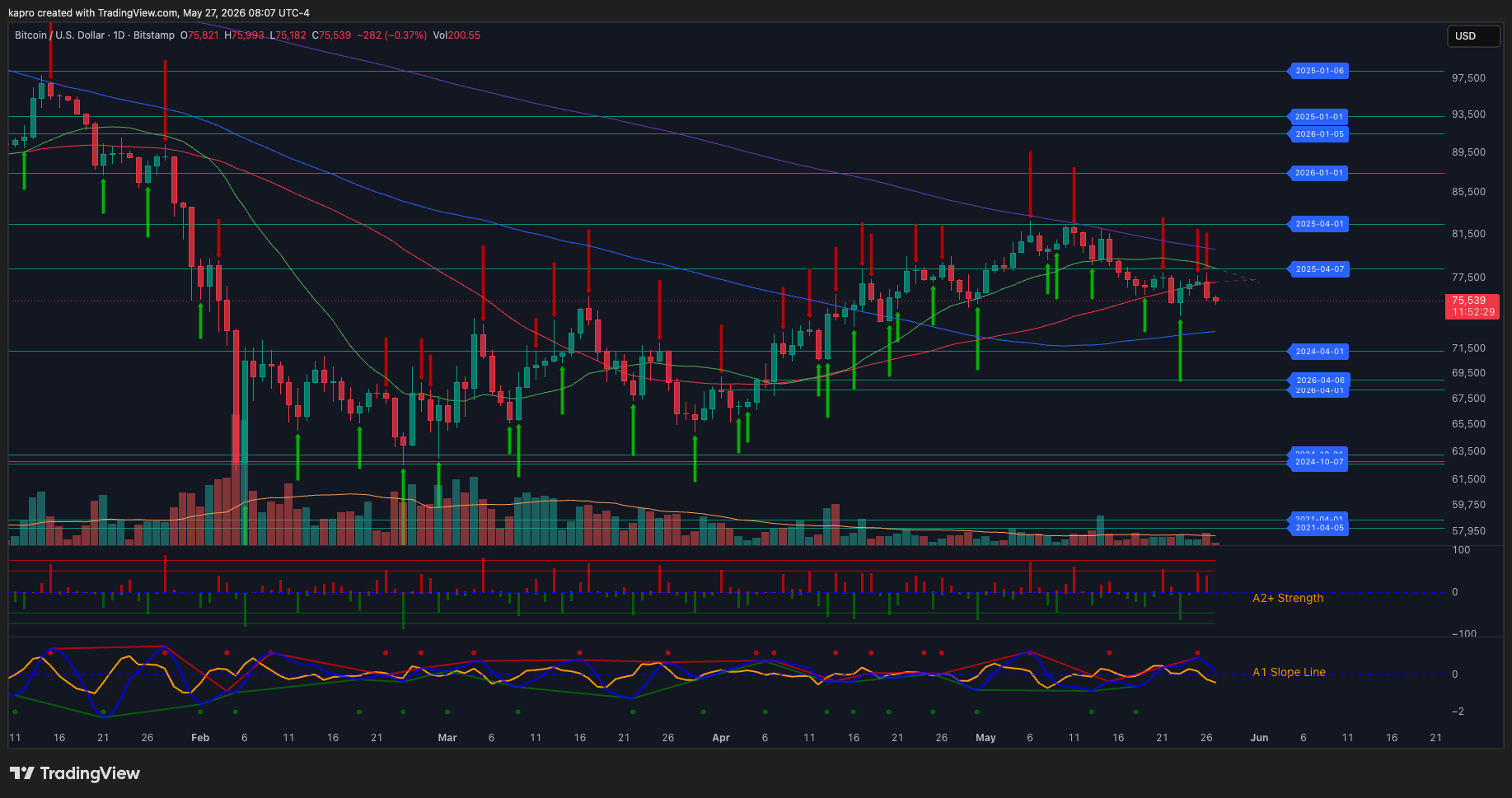
BTC/USD one-day chart. Source: Material Indicators/X
Among the decreasing bullish voices was analyst Eric Coleman, who saw current price action as retesting the top of an ascending triangle construction on daily time frames.
“As long as the price is above the horizontal and the trendline support, the trend remains bullish,” he concluded.
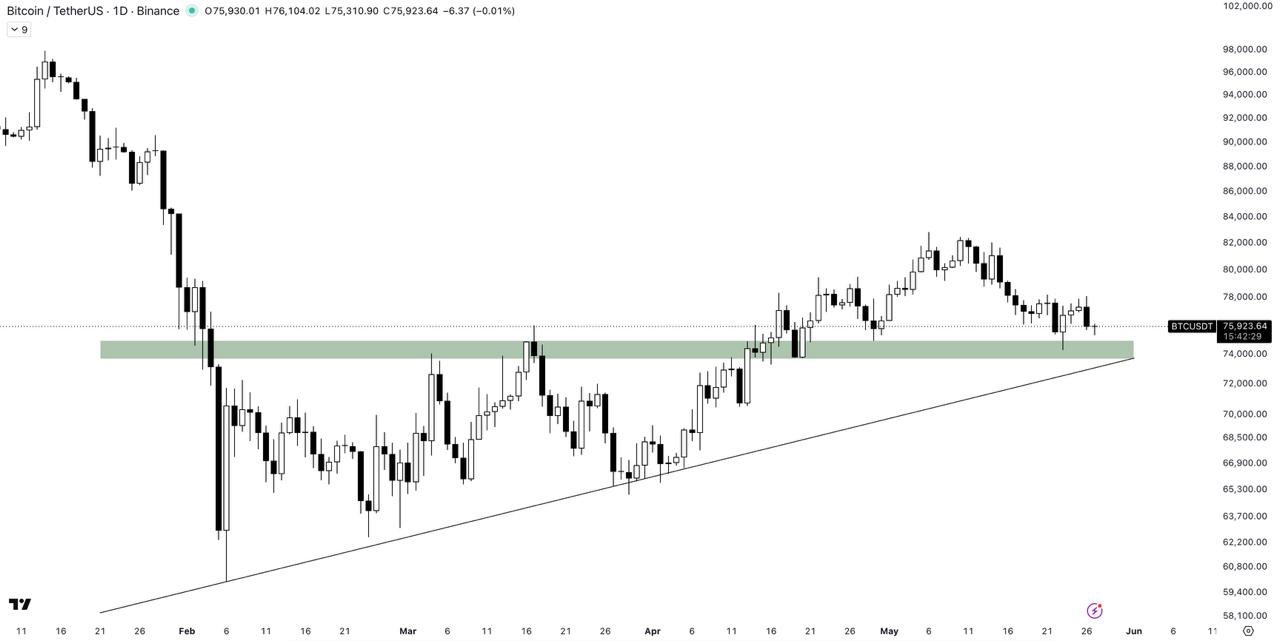
BTC/USDT one-day chart. Source: Eric Coleman/X

Robinhood shares rose more than 2% to around $76 after the brokerage outlined plans for agent-based stock trading. The company will let customers use automated agents for trades and credit card purchases. The move adds a new product push as HOOD tries to regain market strength.
Robinhood Builds New Agent Trading Feature
Robinhood plans to let customers deploy automated agents inside separate trading accounts. These accounts will sit apart from a customer’s main Robinhood account. Therefore, the company can test the product while limiting direct exposure to primary portfolios.
The feature will start with stock trading before Robinhood expands it to other markets. The company expects future support for derivatives, crypto, and prediction markets. This would place the tool across several major products on the platform.
Robinhood already offers crypto trading, stock trading, options, retirement products, and prediction markets. As a result, the new feature fits its broader push into multi-asset trading. The brokerage wants to keep users active across more financial products.
Credit Card Purchases Add Another Use Case
Robinhood also plans to connect automated agents to its Robinhood Gold credit card. Users will be able to allow the agents to make purchases on their behalf. The agents can also act when prices fall below a user-set level.
The company said users will control spending limits on these card accounts. They will also be able to require manual approval before purchases happen. Therefore, Robinhood aims to reduce the risk of unwanted activity.
The product still carries operational and user-control risks because agents can act automatically. However, Robinhood said it built controls for trade and purchase approval. The company wants early users to test the service under defined limits.
HOOD Stock Gains Despite Weak Crypto Market
HOOD stock rose more than 2% after the product update reached the market. The stock traded near $76, according to TradingView data. The move came even as crypto-linked stocks weakened with Bitcoin and the broader crypto market.
Robinhood shares have remained under pressure over the longer term. The stock has fallen more than 34% year-to-date. It has also dropped more than 37% over the last six months.
The decline followed a weaker crypto cycle after Bitcoin reached a high in October 2025. Robinhood’s business often reflects activity in retail trading and digital assets. Therefore, lower crypto activity has weighed on sentiment around the stock.
The company still has several possible growth drivers tied to product expansion. Its planned agent trading feature could increase platform use if customers adopt it. In addition, its prediction markets business gives Robinhood another growth channel.
Robinhood may also gain attention from the planned SpaceX public offering. Elon Musk’s company has selected Robinhood as one route for retail access to shares. That role could strengthen Robinhood’s profile before the offering.
The latest announcement shows Robinhood’s attempt to expand beyond simple trading access. The company now wants to combine brokerage tools, card spending, and automated execution. For HOOD stock, the update added near-term momentum during a weak crypto session.
Meet the “Little House on the Prairie” reboot's villainous Nellie Oleson: 'Bow down and tremble before her'

Stack venues across North East to screen World Cup games

Oil Price Today (May 28): Crude oil surges nearly 3% after Iran says it targeted US airbase in retaliation for fresh American strikes


-

 Crypto World6 days ago
Blockchain.com files with SEC for U.S. IPO
-

 Fashion5 days ago
Holiday Weekend Open Thread – Corporette.com
-

 Crypto World6 days ago
Bitcoin Accumulation Weakens as BTC Realized Losses Hit $600M
-

 Tech3 days ago
Microsoft’s quiet Claude Code retreat and the real cost of enterprise AI
-

 Business6 days ago
Dell Technologies DELL Stock Surges 15% on AI Server Momentum and Analyst Upgrades in 2026
-

 Crypto World5 days ago
Robinhood crypto COO Tanya Denisova exits
-

 Business3 days ago
NYT Strands Answers May 24 2026 Revealed for Puzzle No. 812 Theme Summer Essentials
-

 Politics5 days ago
Makerfield: a tale of two social-media histories
-

 Crypto World6 days ago
Space X IPO Is ‘Bad News’ for Tech Stocks: But What About Bitcoin?
-

 Business6 days ago
Trump Invests $1M-$5M in Kura Sushi USA Chain With 27 California Locations
-

 Crypto World6 days ago
MicroStrategy’s Saylor Says Miners No Longer Set Bitcoin Price, Another Force Has Taken Over
-

 Tech6 days ago
WhatsApp ads could make Irish debut after discussions with DPC
-
Tech16 hours ago
The Samsung pay deal is the moment Korean unions changed register
-
 NewsBeat7 days ago
Charity run by Reform leader Malcolm Offord accused of ‘law breaking’ over Scottish registration
-
 Tech6 days ago
A 0.12% parameter add-on gives AI agents the working memory RAG can’t
-

 Crypto World6 days ago
AI infrastructure race heats up as IREN pitches full-stack strategy, WhiteFiber lands $160M deal
-
 Crypto World3 days ago
Nvidia (NVDA) CEO Calls on Super Micro to Strengthen Export Controls Amid Smuggling Probe
-

 Tech6 days ago
You Can Now Add ChatGPT To PowerPoint
-

 Tech3 days ago
Westone Audio and Etymotic Acquired by Fidelity Collective in Major IEM Market Move
-

 Sports6 days ago
2026 CJ Cup Byron Nelson leaderboard: Brooks Koepka finds putting stroke in Round 1
You must be logged in to post a comment Login