
Crypto World
Situational Awareness meltdown was warning shot


Leopold Aschenbrenner (L) and Bank of America CEO Brian Moynihan.
Photo: Josh Edelson (L) | Oscar Molina (R)
Bank of America CEO Brian Moynihan on Wednesday called the recent near-collapse of high-flying AI hedge fund Situational Awareness a warning shot for financial markets that are being fueled by elevated valuations and borrowed money.
Last week, Situational Awareness, led by Leopold Aschenbrenner, was forced to offload most of its public equities to Citadel in a fire sale as its bets on artificial intelligence soured. Bank of America was among the firm’s prime brokers, executing trades and providing leverage to the fund, along with Goldman Sachs and JPMorgan Chase.
“These are all warning shots,” Moynihan told CNBC’s Andrew Ross Sorkin. “Valuations get out, leverage in the system gets there. You have to be careful.”
Moynihan’s comments suggest Wall Street’s largest prime brokers are reexamining exposure to highly leveraged investment firms after the AI trade has fueled surging markets over the last several years, even as they continue competing aggressively to finance hedge funds.
“You always look and say, ‘OK, what happened? Should we learn from it? Should it change?’” Moynihan said. “And so the tendency is to tighten the underwriting standards, just a hair, to adjust — especially with big run-ups in stocks.”
Still, Bank of America would have been “fine” even absent the Citadel deal, which provided capital for Situational Awareness to pay off its banks, Moynihan said.



Proof of Play, the studio behind the fully onchain game Pirate Nation, said on Tuesday that it is ceasing operations, telling players it "couldn't build a product and sustainable business that proved out this thesis at scale." The thesis, the studio said, was that "games using blockchain tech had… Read the full story at The Defiant
Crypto World
RippleX Is Bringing Back Two Features That Had Critical Security Flaws: Will Validators Trust Rewrite?

In the latest XRP news, RippleX expects to ship xrpld 3.3.0 the week of August 1, 2026, packaging five amendments for validator consideration, including rewritten versions of Batch and Permission Delegation, both of which were blocked before mainnet activation after security researchers discovered separate critical authorization flaws in their original implementations.
No funds were ever lost. The question now is whether the ecosystem extends enough trust for the rewrites to clear the 80% validator threshold.

Discover: Everyone’s Got a Take. Get Free $25 to Actually Trade Yours
XRP News: What Broke the First Time, and How
The original Batch amendment contained a signature-validation bug that allowed an attacker to execute inner transactions from arbitrary victim accounts without ever holding their private keys.
According to the official XRPL vulnerability disclosure, researcher Pranamya Keshkamat and Cantina AI’s autonomous audit tool Apex identified the flaw on February 19, 2026, while the amendment was still in its voting phase.
UNL validators were advised to vote against it the same evening; an emergency release, rippled 3.1.1, marked both Batch and the related fixBatchInnerSigs amendment as unsupported to prevent any activation path.
The root cause was a loop-exit error in the signer-validation logic: when the code encountered a new account whose signing key matched its own, it declared success and exited without checking the remaining signers, meaning a forged signer entry for any victim account would never be inspected.
The exploit path let an attacker drain a victim account down to its reserve through unauthorized Payment transactions. The replacement, BatchV1_1, redesigns that authorization logic and is now flagged in the 3.3 development registry as supported with a default No vote pending validator approval.
Permission Delegation exposed a different attack surface. A September 2025 disclosure documented how an invalid offline-signed transaction could still charge the delegated account a transaction fee before failing authorization, because the code checked permissions before verifying the signature, and tec-type errors carry a fee charge by design.
A malicious actor could repeatedly submit such transactions with elevated fees to silently bleed a victim account’s XRP balance. The fix reclassifies the relevant error from tec to ter and reorders checks so no fee can be deducted before signature verification.
The replacement, PermissionDelegationV1_1, carries the same default No designation in the 3.3.0 registry. This pattern of catching bugs before mainnet is consistent with the broader XRPL security maintenance cadence, which has seen multiple hotfix releases address protocol-level issues ahead of activation.
Discover: Your Market Calls Are Worth Something. Start With Free $25 on Kalshi
Three New Amendments Target Institutional Tokenization
The remaining three amendments are new additions aimed at the institutional tokenization market. Confidential MPT uses elliptic-curve cryptography and zero-knowledge proofs for Multi-Purpose Token balances and transfer amounts, keeping them opaque on the public ledger while remaining auditable by designated entities, such as regulators.
It addresses the most consistent objection from financial institutions evaluating public blockchain infrastructure: that counterparty exposure is visible to everyone.
The feature targets tokenized government bonds, real estate, equities, and private credit, asset classes where confidentiality is a baseline operational requirement, not a preference. The broader XRPL push into this space is already underway, with active infrastructure development for capital markets tokenization on the XRP Ledger.
Sponsored Fees and Reserves allow a bank, issuer, or platform to cover transaction fees and reserve requirements on behalf of its users, removing the requirement for end users to hold XRP before transacting.
This substantially lowers onboarding friction for institutional deployments, though it also reopens the structural debate: if end-users no longer need XRP to interact with the ledger, demand dynamics shift toward institutional settlement volume rather than retail token utility. That outcome is neither confirmed nor refuted until the amendment activates and institutions actually deploy it.
Dynamic MPT closes the third gap, allowing token issuers to modify specified properties, fees, metadata, and predefined parameters after issuance without migrating to a new token entirely.

Jazzi Cooper, RippleX’s head of product, announced the five amendments on X, describing XRPL as having already demonstrated its capacity to support tokenized assets at scale and framing the new features as the infrastructure layer for global transfers, trading, collateralization, and settlement.
Cooper confirmed that all five require validator voting before activation.
Discover: Get Paid to Be Right, $25 to Start on Kalshi
Don’t Miss Out on Our $1,000 USDT Airdrop on ByBit
The post RippleX Is Bringing Back Two Features That Had Critical Security Flaws: Will Validators Trust Rewrite? appeared first on Cryptonews.
Crypto World
Wall Street Meets Web3: BlackRock, Visa, and Mastercard Back Circle’s New Arc Blockchain

USDC stablecoin issuer Circle has announced the founding validator cohort for Arc, its open blockchain network. It is currently in private mainnet with more than 100 ecosystem and institutional builders.
Circle said the network is on track for a public mainnet launch on September 16, 2026.
Behind Circle’s New Blockchain
According to the official post, the founding validator group includes BlackRock, The Depository Trust & Clearing Corporation (DTCC), Galaxy, Global Payments, ICE, Mastercard, MoneyGram, SBI Group, Standard Chartered, Sumitomo Corporation and Visa. Circle said the group represents a model in which institutions building on the network also help secure it.
The aim is to create a foundation of trusted and globally distributed operators that can support secure and scalable on-chain financial applications. BlackRock is also expected to deploy BUIDL, the BlackRock USD Institutional Digital Liquidity Fund, on Arc through the network’s native USDC integration.
The setup is intended to let institutional investors subscribe to, redeem, and deploy fund assets within one on-chain environment.
Circle is also working with DTCC to enable the tokenization of assets custodied by The Depository Trust Company on Arc beginning in the second half of 2027. The main objective is to let market participants use third-party applications on the blockchain for stablecoin-native settlement outside DTC against DTC-tokenized assets. DTCC said the integration supports its multi-chain strategy.
DTC-tokenized assets will continue to carry the same protections, rights, and safeguards available to investors holding assets traditionally.
Commenting on the latest development, Mastercard Chief Product Officer Jorn Lambert said,
“As stablecoins and other digital assets move into real-world payments, settlement, and treasury flows, Mastercard is focused on helping customers operate across an increasingly diverse payments ecosystem. Our participation as a founding validator on Arc reflects that commitment — supporting trusted, interoperable infrastructure that can help connect emerging blockchain networks with the broader financial systems businesses rely on every day.”
Arc Product Suite
Arc is also expected to have a range of applications and services available from day one. DeFi protocols and capital allocators including Aave, Aerodrome, FalconX, Galaxy, GSR, Keyrock, Morpho, Nonco, Uniswap and XFX will support borrowing, trading and on-chain capital deployment.
Meanwhile, payment providers Rain, Thunes and Wirex have been tasked with routing stablecoin payment and settlement flows. Binance Wallet, Chainlink, Fireblocks, Kraken, Ledger, MetaMask, Uniswap Labs and Upbit, on the other hand, will enable access to USDC on Arc, custody and cross-chain asset movement.
At launch, Circle plans to introduce a product suite around Arc, which includes tools for common on-chain workflows, AI-powered applications and smart contract development, tokenized real-world asset management and interfaces for developers, users and agents.
The post Wall Street Meets Web3: BlackRock, Visa, and Mastercard Back Circle’s New Arc Blockchain appeared first on CryptoPotato.
Crypto World
Yellow Card announces $40 million funding round to expand its stablecoin infrastructure


Maurice, a former Pokémon card seller, told CoinDesk in a 2024 podcast interview that he and Justin Poiroux, the firm’s chief technology officer, founded Yellow Card to take on big banks and Swift, the interbank service that processes over 53 million secure messaging instructions a day for nearly 11,500 financial institutions. Swift facilitates trillions of dollars in global bank transactions and said last month it was testing its first blockchain ledger.
Yellow Card, which focuses mostly on emerging markets, will use the new capital to expand Global USD Accounts, its dollar account product for businesses, and add stablecoin and local payment mechanisms in Latin America and Asia-Pacific.
The accounts allow businesses to hold dollars, hold and swap stablecoins, manage treasury operations and collect or disburse local currencies through domestic payment rails in more than 50 countries, Yellow Card said.
Maurice said the company’s flows have historically been split roughly evenly between corporates and large financial institutions using its treasury-management and payments infrastructure. Bank volumes are now growing faster as large institutions adopt the company’s system, he said.
Yellow Card kicked off its operations in Africa, said Maurice, where it built operations across fragmented country-by-country regulatory jurisdictions. The firm said that since its founding in 2016, it has facilitated more than $10 billion in transactions and holds licenses, authorizations or registrations in 22 jurisdictions.


Ukraine hit at least two warehouses belonging to Russia’s e-commerce giant Wildberries in overnight strikes on Monday, adding to a series of drone attacks that have targeted the online retailer.
Ukrainian forces have repeatedly struck warehouses belonging to Russia’s largest online retailer as part of a broader campaign against logistics sites that Kyiv says support Moscow’s military.
Often described as Russia’s “Amazon,” Wildberries operates dozens of warehouses across the country and plays a core role in the Russian consumer economy.
Since July 18, Ukraine has targeted close to 20 of the retailer’s sites, referring to them as military-linked “logistic centers.”
Moscow and Wildberries have denied that the facilities supply the armed forces.
The strikes have drawn attention not only because of their reach inside Russia, but also because of Wildberries’ economic importance, its ties to the country’s financial sector, and the potential impact on ordinary Russian consumers.
”Ukraine’s Defense Forces struck the Wildberries logistics center in Krasny Bor near St. Petersburg. Burning again,” read an update from the Defense of Ukraine on Tuesday. “Russian logistics, dismantled one hub at a time.”
The social media statement was accompanied by a video showcasing a large, white-painted building engulfed in flames.
“Wildberries was used to distribute military and dual-use goods,” read the caption across the footage. “We will continue dismantling the enemy’s logistics.”
https://x.com/DefenceU/status/2084653333068055029
With the Russia-Ukraine war now in its fifth year, Kyiv has shifted its military strategy as it continues to come under heavy bombardment from Moscow. Ukraine has increasingly used long-range drone strikes to target infrastructure and supply networks deep inside Russia. Amid a broader government reshuffle near the end of July, Kyiv gained a new military chief, Mykhailo Drapatyi, who Ukrainian President Volodymyr Zelensky has tasked with leading the country’s precise defensive efforts.
With Kyiv vowing to maintain its focus on the retailer’s hubs, here’s what to know about Wildberries, its high-profile founder, and why it’s being targeted.
What is Wildberries—and who founded it?
The online retailer, which hosts third-party sellers, facilitates everything from household goods to air travel, and even has a financial arm, WB Bank.
In May, Wildberries announced a strategic partnership with VTB Bank, a Russian majority state-owned institution.
VTB Bank shares fell around 2.5% on July 28 amid ongoing strikes, according to Reuters.
Days after Ukraine’s July 18 strikes against the Wildberries sites, the European Commission included the WB Bank when E.U. member states adopted its 21st package of sanctions against Russia.
“Wildberries Bank LLC is involved in an economic sector providing a substantial source of revenue to the Government of the Russian Federation, which is responsible for the annexation of Crimea and the destabilisation of Ukraine,” declared the council of the European Union.
Wildberries was founded by Tatyana Kim, formerly Tatyana Bakalchuk, in 2004.
A former English teacher, Kim was 28-years-old and on maternity leave when she launched the initiative, and was later joined by her now ex-husband, Vladislav Bakalchuk.
As Wildberries grew, Kim’s fortune did too. Forbes estimates her net worth at $8.1 billion, making her Russia’s richest woman.
She was the only Russian entry on Forbes’ 2025 list of “The 50 Richest Self-Made Women On Earth.”
“Wildberries has grown from small origins to be one of two major internet marketplaces in Russia [alongside Ozon],” says Charles Hecker, an associate fellow in international security at the Royal United Services Institute think tank. “It’s an enormously prominent company and Kim is an incredibly prominent business person in Russia.”
Why is Ukraine targeting Russia’s ‘Amazon’?
Kyiv insists Wildberries is being used as a key supply chain for the Russian military.
“Ukraine’s official reason behind attacking Wildberries is that Ukraine believes the website is used as a channel for military components,” Hecker tells TIME.
After Wildberries sites were struck on July 18, Zelensky announced that “two major logistics facilities were hit—in the Moscow and Tambov regions” and said “the aggressor [Russia] used them to supply sanctioned components for drone production and navigation equipment.”
Kremlin spokesperson Dmitry Peskov has refuted accusations that Wildberries warehouses are used for Russian army supplies.
Kim has also rejected the allegations. In a July 31 video statement uploaded to Telegram, she argued Kyiv’s drone attacks on sites linked to Wildberries amount to “acts of terrorism” against civilians.
In response to accusations that Wildberries sells dual-use goods, items that can have both civilian and military uses, Kim said the company doesn’t offer anything that is not also available on major global e-commerce platforms such as Amazon or Alibaba.
After previous drone strikes on its facilities, the e-commerce giant issued statements pledging financial support for sellers whose goods were damaged.
The retailer’s ties to the country’s financial sector and the far-reaching economic impact of the strikes is a key factor to consider, experts say.
“Putin said at the beginning of the full-scale invasion of Ukraine that the war would not impact the way Russians lead their lives,” Hecker tells TIME. “But attacking Wildberries impacts the Russian consumer, and this comes on top of inflation, on top of periodic mobile internet outages across Russia.”
While inflation in Russia has climbed down from highs of 9.4% last year, it rose once again to 6% in June—its highest level since January.
Consumers in Russia are also tackling a summer fuel crisis after Ukraine stepped up its drone attacks on oil refineries.
“It’s difficult now for President Putin to say that the war on Ukraine is not impacting the way ordinary Russians live,” Hecker says, reflecting on the economic blows. “Ukraine has discovered how successfully it can penetrate airspace deep into Russian territory, and I think what it’s doing right now is exploiting that capability.”

They’re who the kids are stuck with, though, when a girl’s mangled body is found fastened to a tennis net and their classmates start disappearing. Bret is certain that the handsome new boy in school, Robert Mallory (Homer Gere), is the culprit. But his logic—that Robert must be a killer because he denies having been at the screening of The Shining where Bret first spotted him—is pretty flimsy. For some reason, Bret can’t get his friends to care about the murders. They’re too busy planning homecoming festivities and angling to get on dance-contest TV shows. Maybe their denial can be shrugged off as typical teen self-involvement, but it doesn’t explain why he seems more invested in the case than police and even some parents of the missing.
The Shards is dense with references. To make sense of the show beyond the plot’s generic teenage politicking and serial-killer thrills, you must know that The Shining is a horror story about a writer becoming violently unhinged; that its other Jack Nicholson footnote, Chinatown, is synonymous with systemic evil too entrenched to fight; that the financial disaster that was Michael Cimino’s 1980 feature Heaven’s Gate symbolizes the end of New Hollywood’s auteur-driven ’70s renaissance, leaving the industry to chase youthful faces and shiny trends. (Bret gives a Patrick-Bateman-esque monologue about how music videos are the future of art.) The casting piles new signifiers atop the source material. Gerber is the spookily identical daughter of Cindy Crawford, the ultimate Gen X beauty. Gere shares a square jaw with his father, Richard, whose breakthrough movie, American Gigolo—another tale of sex and murder in L.A., whose writer-director, Paul Schrader, worked with Ellis on The Canyons—was released just in time to be referenced by The Shards’ characters. Richard Gere was married to Crawford in the early ’90s. Gerber and Homer Gere don’t share any parents, but the connection adds a pseudo-incestuous twinge to their characters’ mutual attraction. Dig deeper, and you’ll find that Homer Gere’s mother, the actor Carrie Lowell, was once married to Griffin Dunne, the nephew of Joan Didion, whose work both Ellis and his Shards alter ego idolize.

“If you go in the water and 8 or 24 hours later, your leg hurts and feels hot, go to the doctor right away,” Harwood says.
How to prevent a Vibrio vulnificus infection
To avoid dangerous exposure to Vibrio vulnificus, Harwood recommends that people with open wounds on their body, including fresh tattoos and new piercings, stay away from warm salt and brackish coastal waters, such as the Gulf of Mexico, until the skin is healed. Harwood says she personally would even avoid wading in such waters a day or two after shaving her legs in case of micro-tears on the skin. “I’m not even a germophobe or anything,” she says. “I just don’t want to risk any exposure.”
Harwood also offers advice that shellfish-lovers may have a hard time swallowing: “Don’t eat raw oysters in the summer,” she says.
Vibrio vulnificus flourishes when waters are warm. (The bacteria also love the warmth of the human body.) They can also live in colder waters, but their populations shrink under those conditions, Harwood says. Eating raw oysters during cooler months or oysters that have been harvested in colder waters, such as on the western coast of the U.S., could be safer, Harwood says. She also recommends that people wear gloves when shucking oysters to avoid getting cut and risk being exposed to the bacteria.
Crypto World
Cardano (ADA) Grabs Traders’ Attention After a 20% Weekly Increase: Further Pump Incoming?

While the past week hasn’t been too successful for Bitcoin (BTC), Ethereum (ETH), and other well-known cryptocurrencies, Cardano’s ADA defied the ongoing trend by posting a double-digit price increase.
Market observers have shifted their focus toward it, with some projecting that the rally might be just starting.
The Next Potential Targets
ADA has been among the worst-affected digital assets by the prolonged bear market, and in June its price briefly collapsed under $0.14: the lowest level since 2020. Last weekend, though, brought a sudden and long-awaited resurgence, potentially propelled by the return of the whales who purchased more than 240 million tokens in less than a week.
The uptrend continued, and as of press time, Cardano’s native token trades at around $0.193, representing a 20% increase on a seven-day scale. X user JAVON MARKS recently found similarities between the asset’s latest performance and that of 2020-2021, which was followed by a price explosion, which is why they set a target of $2.90.
Sssebi and CW also weighed in. The former noted that ADA is close to crossing the 20-week Moving Average after being heavily oversold, reminding that historically this type of setup has triggered a “big pump.” The latter noticed that ADA is approaching a major resistance line at $0.2305, which, if broken successfully, could mark the end of its long downtrend.
The Traders are Back
Earlier this week, the analytics platform Santiment revealed that ADA’s rally comes at a moment when the number of non-empty Cardano wallets is actually declining. According to the firm, this suggests the price has recovered while many “sidelined” holders have yet to re-enter the ecosystem.
“Rising price with falling holders can mean stronger buyers are absorbing supply, and retail confidence has not fully followed the move yet,” it added.
In contrast, just a few hours ago Martinez disclosed that trader interest in ADA has increased substantially. He said futures volume has surged by 380% from $150 million to $650 million in a single week, a jump that typically signals a sharp rise in market participation and that could make the asset more volatile in the short term.
The post Cardano (ADA) Grabs Traders’ Attention After a 20% Weekly Increase: Further Pump Incoming? appeared first on CryptoPotato.
Crypto World
Eliza Labs' Shaw Walters Says ai16z Token Is 'Dead' After Settling Burwick Law Class Action


Eliza Labs founder Shaw Walters said the ai16z token is "dead. Completely." and that the foundation behind it is winding down, after his side settled a class action brought by Burwick Law by handing over "the rest of the treasury and all the money we had." "Burwick sued us and we settled with a… Read the full story at The Defiant


The exploit, which researchers say stemmed from a flaw in the wallet’s firmware, has resulted in at least 1,816 bitcoin, worth about $114 million, being drained from more than 5,200 addresses since July 30, underscoring the risks even self-custodied assets face when wallet security is compromised.
FRNT Financial echoed that view, saying the exploit exposed a key tradeoff in self-custody. While many bitcoin holders prefer to control their own assets, they still place their trust in the hardware and software used to generate private keys.
“The reaction within the BTC community to the exploit was one of heartbreak,” FRNT wrote in a Wednesday report, noting many affected users had followed long-standing best practices around self-custody.
The firm compared the incident to the 2023 “Milk Sad” exploit, in which flawed key generation led to the theft of roughly $900,000 in digital assets. Rather than undermining self-custody altogether, FRNT said it expects the latest breach to spur wallet providers to strengthen their products as users demand greater security assurances.
For investors unwilling to accept the operational risks of managing private keys, the growing availability of spot bitcoin ETFs provides an increasingly attractive alternative, FRNT said.
Read more: Coldcard hack sparks a self-custody security overhaul: Cory Klippsten

India Get Major Boost As Star Nears Return After Injury Scare Ahead Of Sri Lanka Tests

Jadi berapa angka untuk financial freedom versi kalian? #masterclasssaham #financialfreedom #saham

Bolton town centre traffic delayed after car and bus crash


-

 Business7 days ago
Why Trees Belong on the Risk Register
-

 Fashion5 days ago
Weekend Open Thread: Wit & Wisdom
-

 Politics5 days ago
Meta enters AI-training agreement with far-right ‘propaganda rag’ Newsmax
-

 Politics3 days ago
Zack Polanski: an incitement to murder Nigel Farage?
-

 Crypto World4 days ago
MicroStrategy Post-Earnings CLARITY Act Push Could Add New Catalyst for Its Stock
-

 Crypto World4 days ago
XRP Ledger v3.3.0 brings five institutional features
-

 News Videos6 days ago
Bitcoin Enters the 3rd Stage of the Bear Market
-

 Politics6 days ago
Luke Littler’s dominance sparks GOAT debate
-

 Sports6 days ago
Seema Kaliramna Wins Discus Throw Bronze, Takes India’s CWG Medals Tally To 17
-

 Crypto World5 days ago
New York sues Kalshi over prediction market gambling
-

 Crypto World3 days ago
Crypto PAC spending tops $2M in Michigan House race
-

 Business5 days ago
Trump Announces Hamas Disarmament Agreement as Iran Strikes Kuwait Air Base and US Attacks Pause Overnight
-

 Business3 days ago
DTCR: Deleveraging And A Hedge Fund Collapse Point To A Possible AI Bottom
-

 Tech3 days ago
ESET tracks rise in malicious AI skills and adaptable malware
-
 Crypto World5 days ago
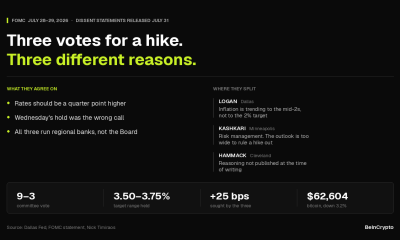
3 Fed Officials Just Explained Their Rate Hike Vote: Is Inflation Winning?
-

 Tech5 days ago
Gemini Spark can now use Chrome logins and saved passwords to run errands on your behalf
-

 Tech5 days ago
Building A Reproduction PlayStation Motherboard
-

 Sports4 days ago
France Cricket implodes: letters hidden in a drawer and a board at war
-

 NewsBeat6 days ago
Four people die trying to cross Channel in small boats
-

 Crypto World4 days ago
Moneyflip CEO charged in $40K murder-for-hire plot
You must be logged in to post a comment Login