
Crypto World
Small-cap stocks enjoy best first half since 1991 as AI trade expands


Traders work at the New York Stock Exchange on June 26, 2026.
NYSE
Small-cap U.S. stocks are capping off one of their strongest first halves in decades. But this is not your ordinary small-cap boom led by traditional businesses linked to the economic cycle.
This run, like the one going on with their larger-cap peers, has been driven by the rapid buildout of AI infrastructure, as spending spreads beyond the largest technology companies to a broader network of suppliers.
Investors believe the small-stock rally can broaden out beyond tech and continue, as long as interest rates stay in check.
The Russell 2000 Index has surged more than 21% this year, putting the benchmark on track for its best first-half performance since 1991. The advance marks a sharp turnaround after years of underperformance versus large-cap peers.
“It’s both a valuation catch-up story and a fundamental story,” said Amy Zhang, portfolio manager at Alger. “The valuation gap was so wide that a truck can drive through it. At the same time, fundamentals are improving in small caps and I think that’s why it’s causing the broadening trade.”
Semiconductor and semiconductor-equipment companies have been the biggest winners, underscoring how the AI investment boom is rippling through the broader market. Chip-related companies account for 16 of the Russell 2000’s 50 best-performing stocks this year, including Aehr Test Systems, Ichor Holdings and MaxLinear, which have all rallied more than 400%.
Rather than competing directly with industry leaders like Nvidia, many of these smaller companies are benefiting from rising demand across the AI supply chain. As chipmakers and cloud providers ramp up spending on AI infrastructure, suppliers of semiconductor equipment, components and connectivity solutions are seeing the gains trickle down, amplifying revenue and earnings growth for companies with much smaller market capitalizations.
“I think a significant part of the small cap story is tied to AI,” Zhang said. “The impact of AI investment trickles down from large-cap leaders to small-cap companies. The effect will be more amplified for small-cap companies, in terms of revenue and probability growth.”
More Than Just AI
While AI has been a key driver of the rally, strategists say the small-cap rebound has been supported by a broader set of fundamental tailwinds and can continue.
“Small-cap leadership has been notable amid the mega-cap-driven bull market, although small caps have meaningful exposure to semiconductors and technology hardware,” said Adam Turnquist, chief technical strategist at LPL Financial. “Building fundamental strength has also helped offset headwinds from higher rates.”
Consensus forecasts for Russell 2000 companies’ 2026 earnings growth have climbed to 38% from about 23% at the start of the year, according to LPL, reflecting growing optimism that profit growth is broadening beyond the largest technology companies.

Russell 2000 year to date
Turnquist also pointed to several other catalysts that could continue to support the asset class, including small caps’ greater exposure to the U.S. economy, expectations for increased merger-and-acquisition activity — particularly in the pharmaceutical and biotechnology industries — and tax incentives designed to encourage capital investment.
Higher rates a threat?
The biggest threat to the small-cap rally may be the same force that held the group back for years: higher interest rates.
The Federal Reserve next meets July 28-29, with traders pricing in about a 30% chance of a rate increase, according to CME Group’s FedWatch tool. By September, markets see more than a 60% probability of at least one quarter-point hike.
Higher borrowing costs pose a particular challenge for smaller companies, which generally carry more floating-rate debt and face greater refinancing needs than their large-cap peers. Bank of America estimates that every additional 25-basis-point hike would reduce Russell 2000 operating earnings by about 2%.
“This could challenge the expected 4Q profits acceleration (and sentiment) in small caps, which have the most refi risk,” Bank of America strategists said in a note.
Even so, many investors believe the worst of the tightening cycle is over. The Fed raised interest rates by a cumulative 500 basis points between March 2022 and mid-2023, one of the most aggressive hiking campaigns in decades.
“We’re probably close to peak inflation and peak rates,” Zhang said. “We had significant headwind the last five years, and I think the headwind is going to abate and turning into a tailwind.”
—With reporting by Deena Zaidi


UNI rose 13% over the past 24 hours and reached $4.54 – a level not seen since January this year. The latest rally has lifted the asset’s gains over the past month to 60%.
The move came as Uniswap announced Launches in beta, a new tab on its Web App for discovering top token offerings. For now, Robinhood Chain is the first network featured in the new tab, but more networks are expected to be included.
New Tab Debuts
Uniswap said launchpad builders such as Bankr, Pons, Long, and others are using the platform as their trading infrastructure. The company added that Launches will give these projects more distribution. The feature currently includes token releases on Robinhood Chain, with more to come.
According to the platform’s stats, more than 340,000 new tokens launched into Uniswap across Robinhood launchpads in July alone. These collectively generated $3.6 billion in trading volume.
The new Launches tab pulls tokens from top launchpads into a single feed. Users can filter these or sort by 24-hour volume, liquidity, recently debuted, or trending.
The burn was another notable development for UNI this week, as 106,000 units were destroyed on July 29. That comes as the protocol faces renewed debate over its v4 fee structure. Some community members raised concerns that protocol fees could reduce returns for liquidity providers and push liquidity toward competing exchanges.
Uniswap founder Hayden Adams pushed back against what he called the “FUD and misunderstanding: around the changes. He said the new protocol fees are additive, meaning liquidity providers would continue earning the same 30 basis points on a 30bp pool. He also rejected claims that the protocol would take 25% of LP profits, and explained that a 5bp protocol fee on a 30bp pool amounts to about 14% of total swap fees, not LP earnings that already existed.
Adams also argued that the 5bp fee is significantly lower than the 100-200bp fees charged by centralized exchanges.
Zooming Out
The protocol has also been caught up in a wider wave of crypto scams targeting users through fake websites. Earlier this year, a fake Uniswap website was draining funds from crypto wallets. Experts warned that scammers had stolen at least $400,000. Users were advised to use only official links and verify protocols through DeFiLlama.
The warning followed a broader report from security group SEAL, which found a sharp rise in malicious Google Ads targeting crypto users. SEAL blocked more than 356 malicious ad URLs tied to scams impersonating Uniswap and other major platforms.
Interestingly, Uniswap was the most impersonated, as it accounted for 41% of tracked malicious sites. Losses linked to the campaigns exceeded $1.27 million between March 13 and March 30.
The post UNI Just Hit a 6-Month High as Uniswap Rolls Out New Token Discovery Tab appeared first on CryptoPotato.
Key points:
- Bond yields have been going up since the beginning of the Iran war, widely attributed to inflation expectations due to energy prices
- However, the five-year inflation expectation priced into Treasury Inflation-Protected Securities is 2.2% and trending down since May
- The driver appears to be rising real yields with bearish implications for yield-free assets like Bitcoin
Continuation of Q2 bond selling
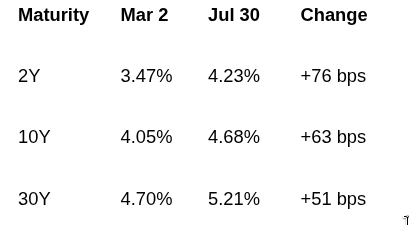
After yields reached local lows in early March, US government debt has been undergoing a multi-month sell-off. This week, after the most recent meeting of the Federal Open Market Committee (FOMC), 30-year Treasury yields made headlines by reaching the highest level since 2007.
In line with the two-year yield rising 76 basis points (bps) in this window, a September rate hike by the Federal Reserve is priced into the markets at 63%, according to CME FedWatch.
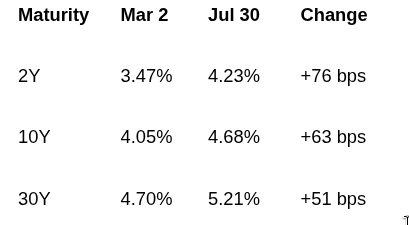
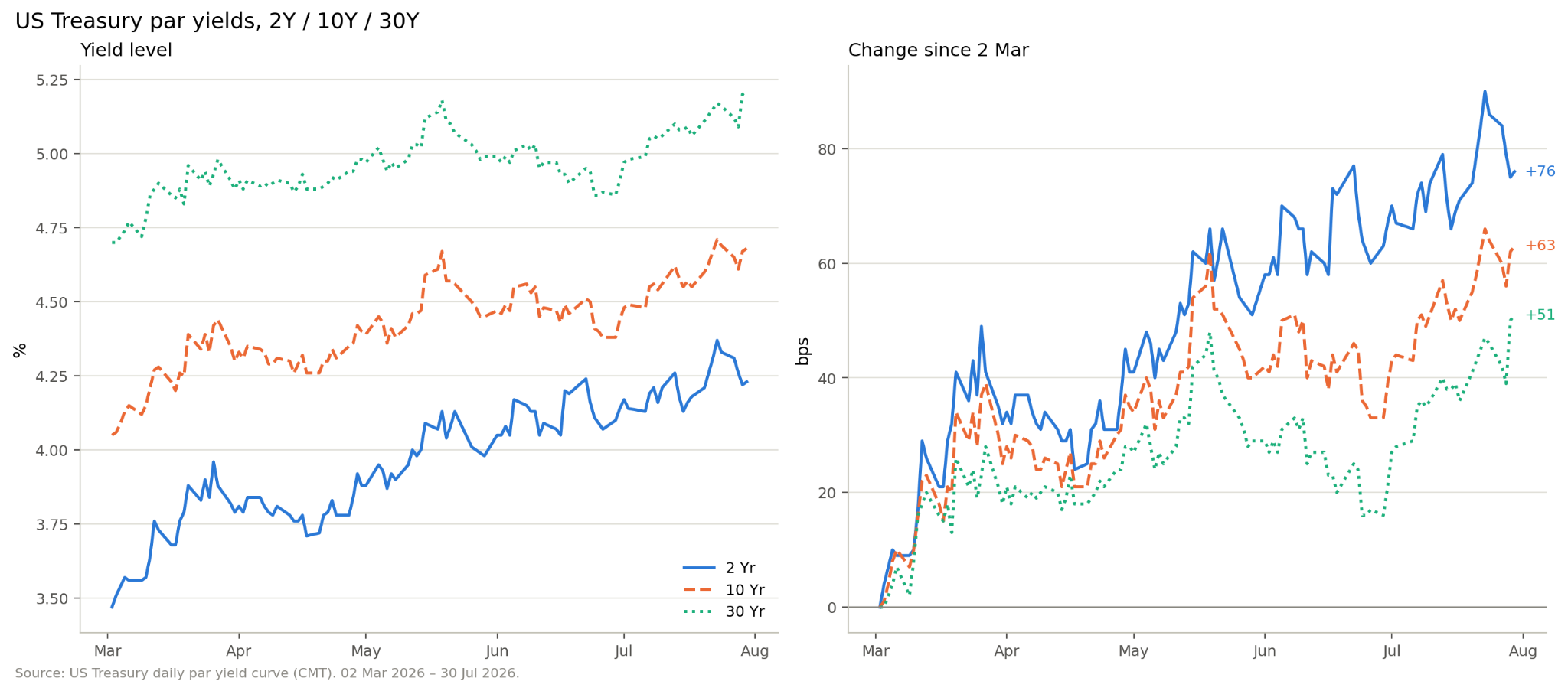
2Y, 10Y and 30Y US Treasury Yields. Data Source: Treasury.gov
With rates at these elevated levels, government bond investments are, for the first time since 2019, more profitable than cash-and-carry trades in the crypto markets, as per Glassnode’s latest research.
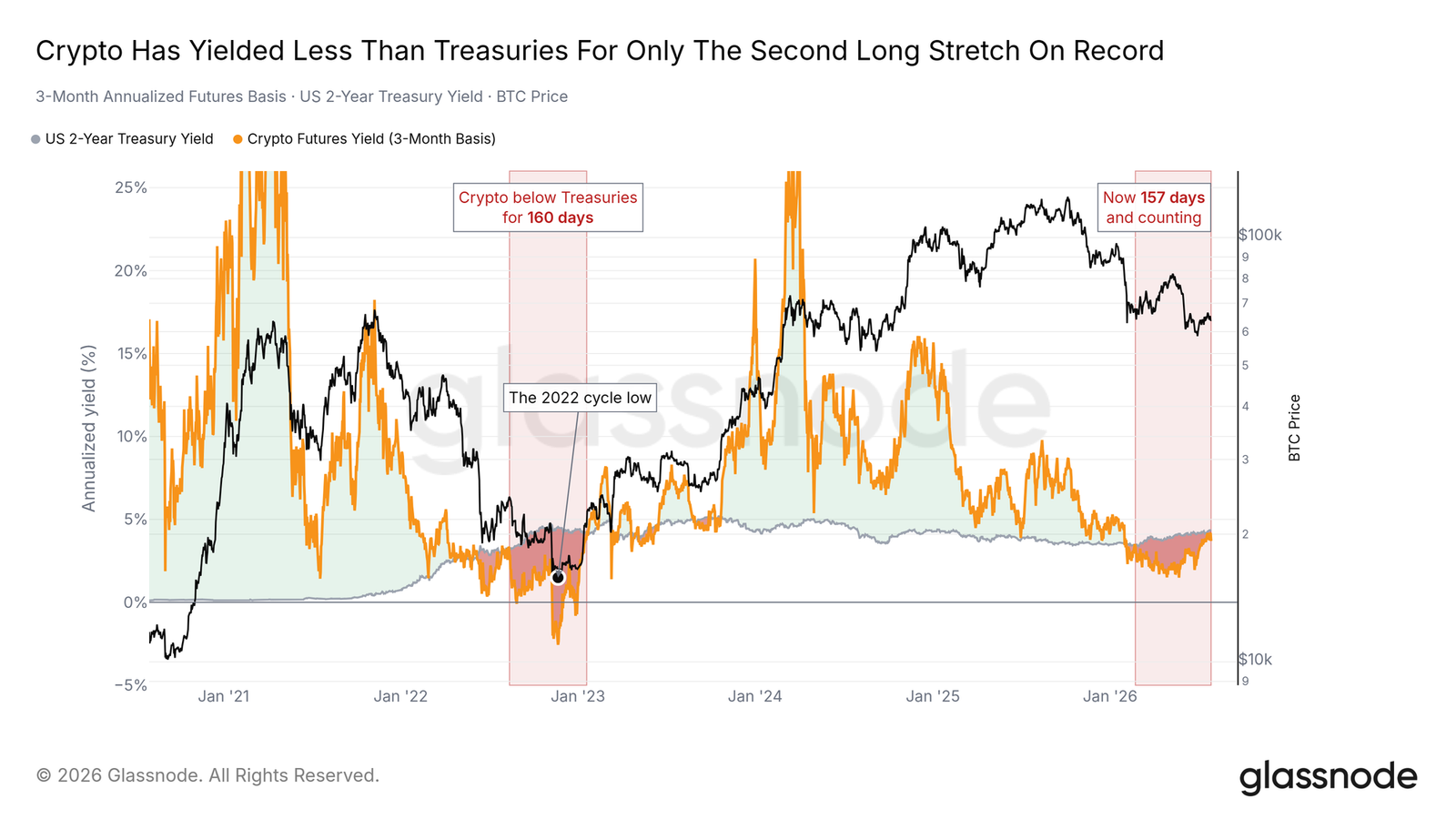
2Y US Treasury yield and crypto futures carry trade. Source: Glassnode
The mainstream inflation narrative
The reason for the bond sell-off is commonly taken to be the inflationary pressures from higher commodity and energy prices. The multi-month bond sell-off coincides with the start of the Iran war and resulting closure of the Strait of Hormuz. Furthermore, the daily closes of the two-year US government bond yield, West Texas Intermediate (WTI) and Brent Crude have correlated since March at a coefficient of r=0.44:
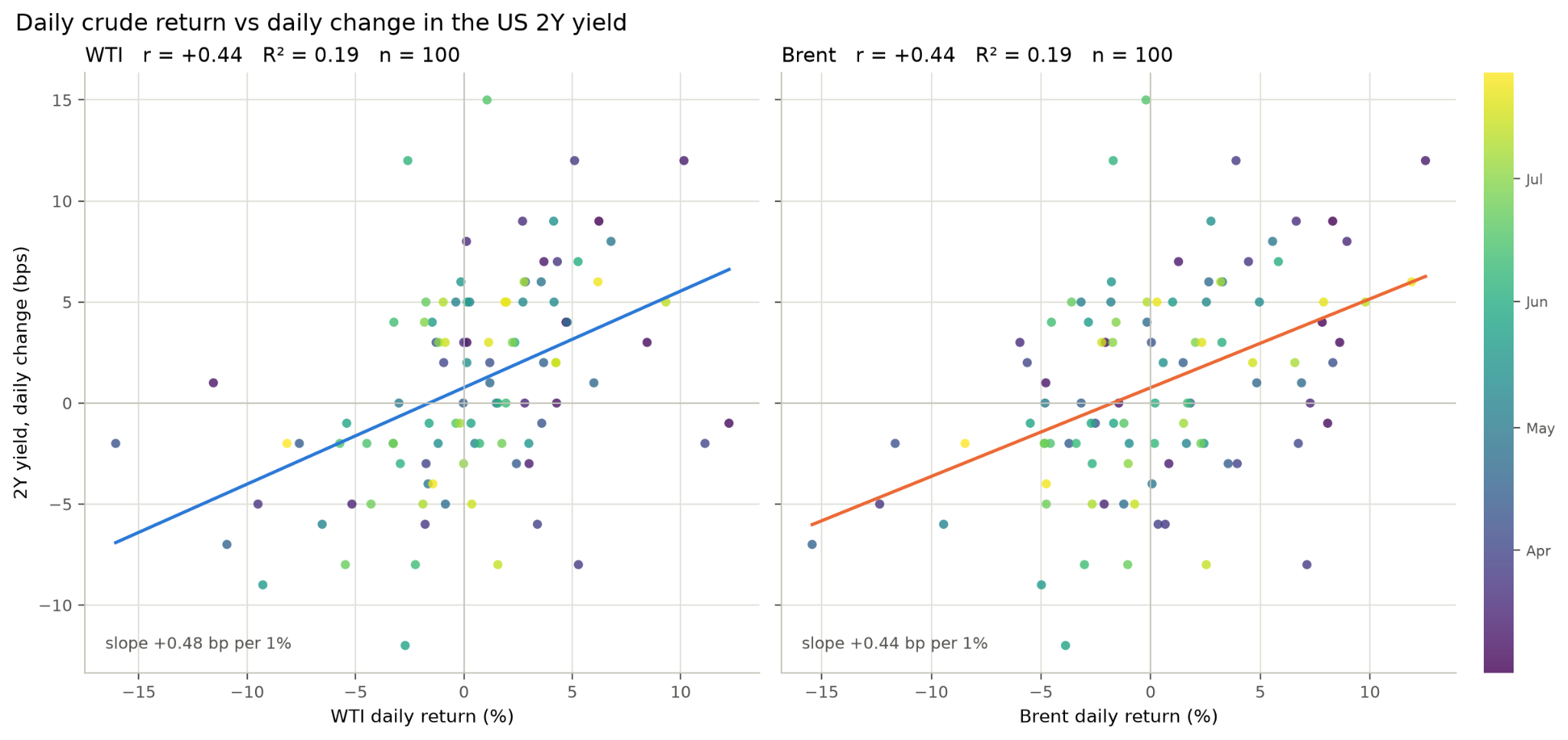
Daily closes of WTI and Brent Crude against 2Y Yield. Data Sources: fred.stlouisfed.org, EIA
WTI briefly rose once again above $85 a barrel on Thursday after President Donald Trump threatened Iran and bonds sold off leading into the FOMC. Nothing about the conflict suggests a near-term resolution, which has led some to argue that higher rates are being caused by inflation expectations.
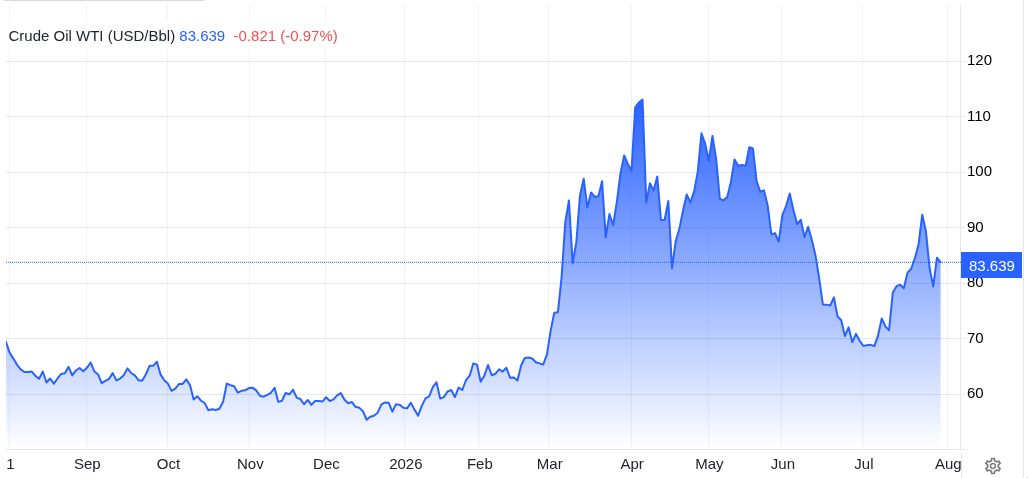
WTI (West Texas Intermediate) oil price chart. Source: Tradingeconomics.com
This has driven loud inflation scares through the mainstream financial press, with recent Bloomberg headlines, such as “Global Bonds Are Reeling as Oil Surge Rekindles Inflation Threat”, “US Yields Hit Two-Month High as Oil Sparks Inflation Risk” or “Global Bond Selloff Worsens as Rising Oil Prices Spook Investors”. Among the ever-inflation-aware crypto and precious metals audience, this narrative is popular, too:
Market commentator and Bitcoin influencer The Wolf of All Streets recently posted on X:
However, the way other Treasury securities trade does not support the inflation-driven narrative for bond yields.
TIPS say rate rises are ‘real’
While most analysts and commentators focus on regular Treasury yields for their analysis, Treasury Inflation-Protected Securities, or TIPS, have offered clear signs against the inflation narrative.
A Treasury Inflation-Protected Security (TIPS) is an ordinary treasury bond for which the principal payment is adjusted upward in line with the Consumer Price Index for All Urban Consumers (CPI-U). In addition to the inflation-protected principal, each TIPS carries a fixed coupon rate. Thus, unlike for a regular bond, both principal and interest payments are inflation-adjusted.
By comparing the yield of a TIPS with a regular, equally dated Treasury, the expectation of future CPI inflation can be estimated as the so-called breakeven rate. And although Treasury yields have been rising, the five-year breakeven rate has gone down sharply since May.
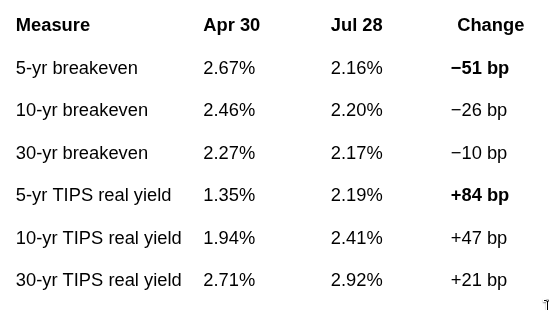
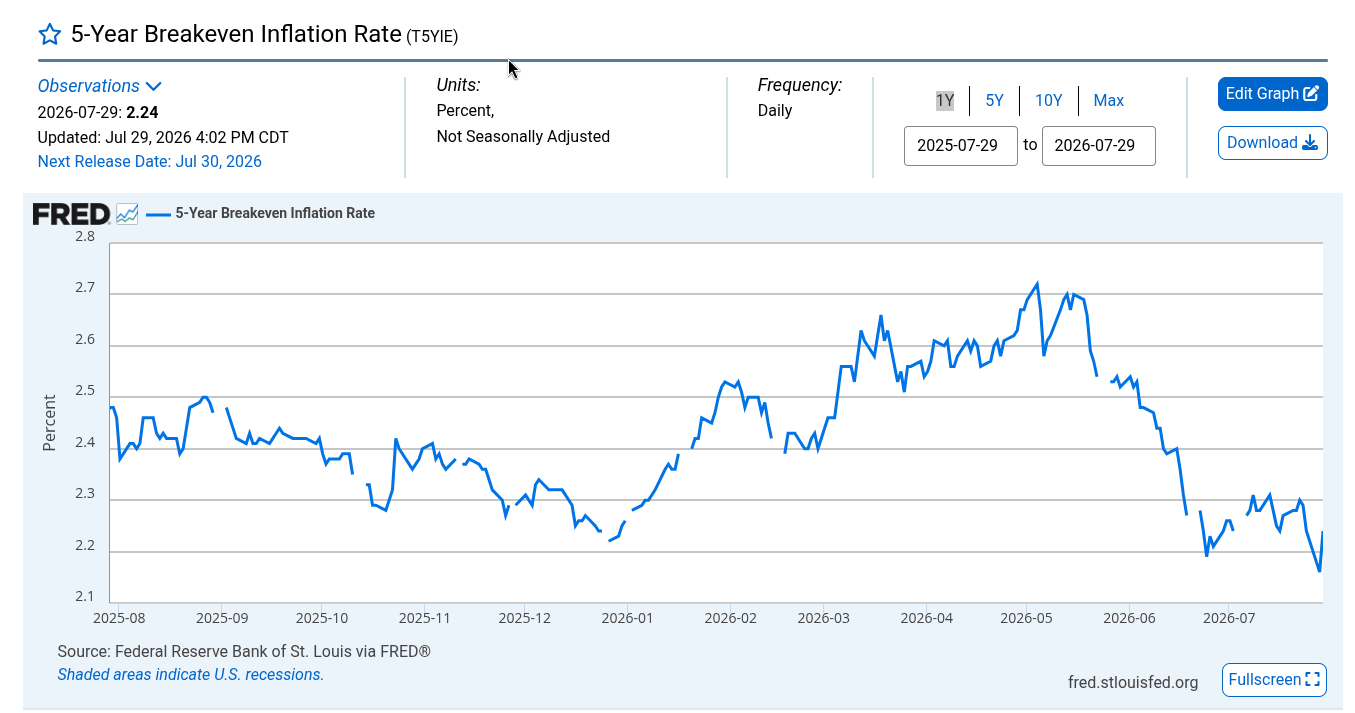
Five-year breakeven inflation rate. Source: fred.stlouisfed.org
At roughly 2.2%, the five-year breakeven expects the Fed to achieve its 2% target in the medium term. However, more telling is that the breakeven rate has been moving in the opposite direction to the nominal treasury yields.
While the five-year nominal yield rose 33 bps, TIPS data suggests this was the result of an 84 bps rise in the real yield, partially offset by a 51 bps decline in expected inflation. While the inflation narrative remains a compelling story, the marketplace says otherwise. The real story ought to be a rise in real yields.
What it may mean for crypto
Generally, rising “real” investment returns on bonds and stocks in terms of CPI make non-yielding assets such as Bitcoin relatively less attractive to certain investors. Beyond this, the impact on the crypto market depends on the explanation for higher real rates, of which several are available.
Reserve liquidation — No clear impact on Crypto. Higher oil prices widen trade deficits for Asian energy importers. As oil is generally priced and settled in US dollars, shortages in the local eurodollar markets in Asia have occurred, which has put their exchange rates under pressure. The Japanese yen (JPY), Philippine peso (PHP) and Indian rupee (RBI) have all required central bank intervention to defend their exchange rates. As these measures are funded by the sale of US Treasury reserves, this puts upward pressure on bond yields. HSBC’s Frederic Neumann is on record attributing the bond sell-off to FX pressure rather than a verdict on the dollar.
Demand destruction — Bearish for Crypto. An oil shock that persists long enough stops being inflationary and starts triggering a recession. Neuberger Berman argued in its second-quarter outlook that investors are underpricing the hit to output from sustained energy prices. The credit contraction that coincides with a recession would be bad for equities and Bitcoin by severely restricting liquidity. In a real sign of recessionary credit events, credit spreads are expected to widen. Cointelegraph reported on possible first signs of this on Wednesday.
Related: Cost to insure AI debt reaches record high amid Asian semiconductor tumble
Investment demand — Likely bearish for Crypto. Real rates may have also responded to expected growth and the demand for capital from the AI sector. Government bond issuance is increasingly competing with the record issuance of corporate bonds from AI hyperscalers. Goldman Sachs Research projects roughly $755 billion of AI capex in 2026 and about $920 billion in 2027. UBS has raised its 2026 investment-grade issuance forecast to $1.8 trillion, with technology supply lifted to $360 billion on hyperscaler guidance. As crypto is competing for a similar pool of capital and investor cohort, this is likely to suppress the sector.
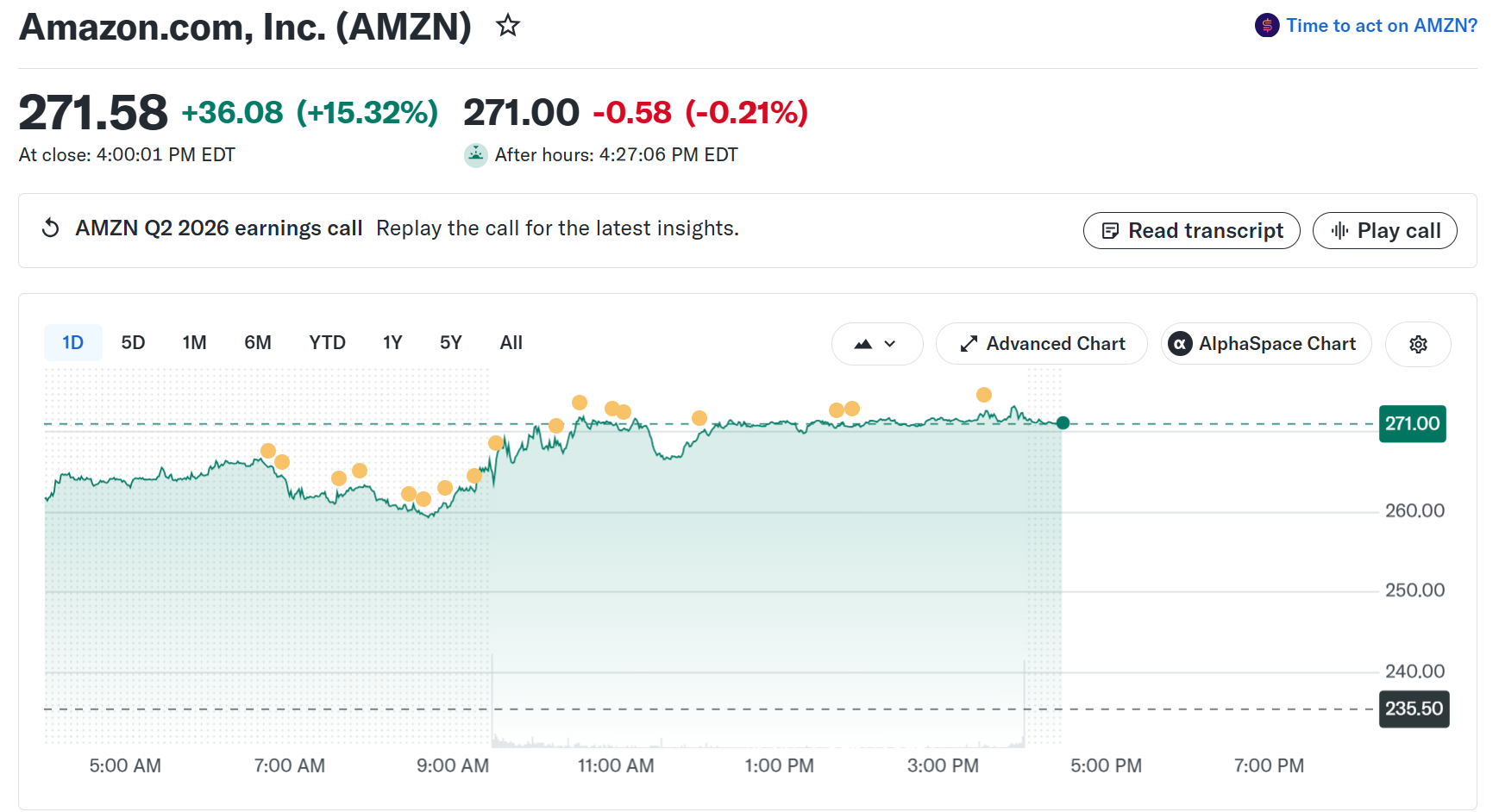
Amazon (AMZN) stock jumped 15.32% on Friday and closed at $271.58. Within hours, more than a dozen banks raised their price targets on it.
The trigger was Amazon’s second quarter report, published July 30. Its cloud business grew much faster than Wall Street expected.

What Set Off the Amazon Price Target Race
Amazon sold $200.6 billion of goods and services in the quarter. That is 19.6% more than a year ago. Analysts had expected $197.0 billion. Profit came in at $5.75 per share, against forecasts near $1.81.
One number mattered most. Amazon Web Services, the company’s cloud arm, grew 36.8% to $42.2 billion. That was its fastest growth in 18 quarters, or about four and a half years. The Q2 earnings beat had already lifted the stock 8.85% after hours.
Follow us on X to get the latest news as it happens
Benchmark Now Sees Amazon at $400
Benchmark analyst Daniel Kurnos raised his target to $400 from $370 and kept a Buy rating.
He called it one of Amazon’s best quarters in at least 10 years. He has followed the company for close to 20 years.
JPMorgan went to $365 from $330. It pointed to Amazon’s cloud backlog, meaning work customers have committed to but not yet used.
That backlog hit $496 billion. It is roughly 2.5 times the level of a year ago. Rosenblatt moved up to $345. TD Cowen, Truist and KeyBanc each landed on $350.
Telsey Advisory Group said $335. Mizuho and RBC Capital said $330. Wolfe Research and Citizens both stayed at $315.
The Cash Problem Nobody Solved
Benchmark attached a warning to its own upgrade. Amazon is burning cash, and it has not explained how it plans to fund everything.
Free cash flow is the money left over after a company pays its bills and builds its facilities. Over the past 12 months, Amazon spent $7.6 billion more than it brought in. A year earlier it had $18.2 billion to spare.
Chief Executive Andy Jassy now plans to spend about $220 billion this year on data centers and chips. Memory prices have climbed. Filings showed AI spending draining cash at every big cloud provider before this week.
Not Every Stock Got This Treatment
Goldman Sachs, Barclays and Jefferies cut Robinhood price targets a day earlier. Robinhood had also beaten forecasts.
Cantor Fitzgerald trimmed its Amazon target to $320. It changed how it values the stock but kept an Overweight rating.
Wolfe Research prices Amazon at 30 times its expected 2027 profit. The stock currently trades near 24.5 times.
Amazon expects sales of $197 billion to $202 billion next quarter. That hands the stocks to watch crowd a checkpoint in August.
The $400 call rests on one thing. Amazon has to turn that $220 billion of spending into cash.
The post Wall Street Rushes to Raise Amazon Targets After 15% Post-Earnings Stock Surge appeared first on BeInCrypto.

A Bank of Italy study found that stablecoin-based remittances did not offer a systematic cost or speed advantage over traditional payment channels, as fiat on- and off-ramp frictions accounted for most costs and transfer delays.
Researchers tested 200 USDC (USDC) remittances across 10 bidirectional payment corridors linking Italy with Brazil, Argentina, Japan, the United Arab Emirates and South Africa, comparing end-to-end costs and settlement times with traditional remittance services. They found that exchange fees and currency conversion made up most of the cost, while blockchain transaction fees represented only a small share.

Geographic design of the remittance experiment. Source: Bank of Italy
Across the stablecoin remittances examined, total costs ranged from 0.3% to nearly 9% depending on the payment corridor, while transfers settled in less than 20 minutes where instant payment systems were available and one to two business days where they were not.
Using the World Bank’s reported global average remittance cost of 6.65% as a benchmark, the study found stablecoin transfers were cheaper in most of the payment corridors examined. However, they were less expensive than Wise in only three of seven comparable corridors.
Related: Europe should weigh tokenized SEPA payments, Bank of Italy official says
Payment infrastructure remains critical
The study concluded that investment in domestic instant payment infrastructure could improve the competitiveness of stablecoin-based cross-border payments, finding that settlement times depended heavily on the quality of local payment rails.
The authors argued that the biggest gains may come when stablecoins no longer require conversion back into fiat currency, writing:
If stablecoins could be spent directly in the real economy, for goods and services, rents, or school fees, without reconversion into local fiat currency, the economic advantages of stablecoin-based transfers would be substantially higher.
Regulation shapes remittance efficiency
The study also found that regulatory design played a major role in determining transfer efficiency. The authors said prohibitionist regulatory regimes failed to fully suppress stablecoin demand and instead pushed users toward offshore platforms and other unregulated channels, while overly restrictive frameworks increased operational complexity for retail users.
The findings come as the European Union has implemented its Markets in Crypto-Assets (MiCA) framework and the United States has enacted the GENIUS Act, two regulatory regimes that govern crypto assets and payment stablecoins, respectively.
The stablecoin market has grown to about $307 billion, up roughly 16% over the past year, according to DefiLlama data.
Magazine: A quantum roadmap would push Bitcoin much higher: Charles Edwards

A proposed Aave governance initiative would wind down multiple Aave V3 lending deployments on six blockchains and retire a large set of low-usage token listings. The plan, advanced through the protocol’s ARFC process, targets a cleanup covering $98.1 million in supplied assets and $15.6 million in outstanding debt, based on balances recorded on July 28.
According to LlamaRisk, which worked with Aave service providers on the assessment, the proposal recommends offboarding 50 low-use reserves and retiring 21 matured Pendle principal token listings across 11 deployments. It also calls for retiring all 25 reserves on Sonic, Scroll, zkSync, Metis, Soneium, and Aptos.
Key takeaways
- The ARFC would deprecate Aave V3 markets on Sonic, Scroll, zkSync, Metis, Soneium, and Aptos, alongside removing 50 low-use reserves and 21 matured Pendle principal token listings.
- The scope is tied to on-chain balances measured July 28, with $98.1 million supplied and $15.6 million in debt included in the cleanup.
- Risk service provider LlamaRisk characterizes the action as part of Aave’s broader risk-governance frameworks rather than a reversal of its multichain growth thesis.
- Prior multichain “temp check” voting already shut down underperforming instances on zkSync, Metis, and Soneium and set a $2 million annual revenue floor for new deployments.
- Aave founder Stani Kulechov framed the move as reducing both economic and technical risk surface under updated listing and risk frameworks.
What the ARFC would change in Aave V3
An ARFC—an “Aave Request for Comment”—is presented as a detailed governance proposal and precursor to an Aave Improvement Proposal. It is not itself confirmation that final on-chain voting has been completed or that execution is already underway.
In this case, the recommendation focuses on reducing exposure to markets with limited usage or maturing positions. LlamaRisk’s work with other Aave service providers outlines multiple categories of deprecation: low-use reserves and certain Pendle principal token listings that have matured, alongside full reserve retirements on the six named chains.
Aptos exit arrives after a rapid liquidity decline
The inclusion of Aptos stands out because it follows relatively recent deployment activity. LlamaRisk’s materials indicate Aave launched its V3 market on Aptos about 11 months earlier. In that period, liquidity fell by 94% over six months, and quarterly revenue reportedly dropped below $1,000, according to LlamaRisk.
Under the proposal, not all chains are treated the same way. LlamaRisk states that every reserve on Scroll, zkSync, Metis, and Soneium was already frozen. By contrast, Sonic and Aptos remained active at the time of the snapshot, with the ARFC recommending that they be frozen as well.
This structure matters for how quickly deprecations could translate into actual risk reduction. Freezing already stops new activity, but full retirement would further narrow Aave’s operational footprint on those deployments.
How earlier “temp check” decisions set the stage
The ARFC is not the first governance signal that Aave would be willing to scale back underperforming V3 instances on certain chains. A prior “temp check” on Aave’s multichain strategy concluded on Dec. 5, 2025, according to the governance record referenced in the source materials. That vote reportedly returned 923,400 votes in favor and under 1% against changing reserve behavior for underperforming instances.
That earlier governance outcome included actions affecting zkSync, Metis, and Soneium—specifically shutting down instances—and introduced a $2 million annual revenue floor for new instance deployment. In other words, the latest ARFC reads less like a sudden pivot and more like an operational follow-through on criteria that were already accepted by the community.
Risk framework updates and protocol-wide cleanup logic
The proposal aligns with Aave’s evolving risk and listing governance. The source notes that Aave added Scroll to the affected set through an accelerated process in April, referencing a direct-to-AIP proposal. In that description, the measure was framed as completing Scroll’s deprecation after a rapid deterioration in network liquidity and Aave market activity.
Separately, Aave published an updated risk framework on June 9 covering asset, bridge, monitoring, and chain risk, along with criteria for winding down reserves or deployments. The current ARFC announcement, as described in the source materials, suggests “de facto” adoption of these rules for the present cleanup.
Aave founder Stani Kulechov also addressed the initiative in a Thursday social media post. He said the move would “reduce Aave’s economic and technical risk surface as part of the new Aave Risk Framework and Technical Asset Listing Framework.” He further emphasized that the action “is not a reversal” of the protocol’s multichain expansion strategy, and that Aave would continue continuous risk assessment across deployments.
That distinction is likely important for market participants. Aave’s multichain approach appears to remain intact conceptually, but the governance direction points toward tighter enforcement of performance and risk thresholds—essentially focusing capital and attention on deployments that meet criteria and exiting those that do not.
Why this matters for users and market participants
For users and liquidity providers, deprecations can change the path of capital: liquidity may diminish further as reserves are frozen or retired, and markets tied to low-use reserves can become less accessible over time. For borrowers and lenders, winding down V3 markets can also affect how easily positions can be adjusted, particularly if token listings tied to specific assets or principal tokens are retired after maturity.
For investors and governance observers, the bigger signal is how Aave is operationalizing its frameworks. By connecting deprecations to measurable liquidity and revenue outcomes—and by referencing an earlier temp check that set a revenue floor—the ARFC underscores a governance style that is increasingly rules-driven rather than ad hoc.
Readers should watch for the next procedural steps: whether the ARFC proceeds into an Aave Improvement Proposal for formal voting, and how execution is sequenced across the chains involved—especially where Sonic and Aptos were still active at the time of the July 28 snapshot.
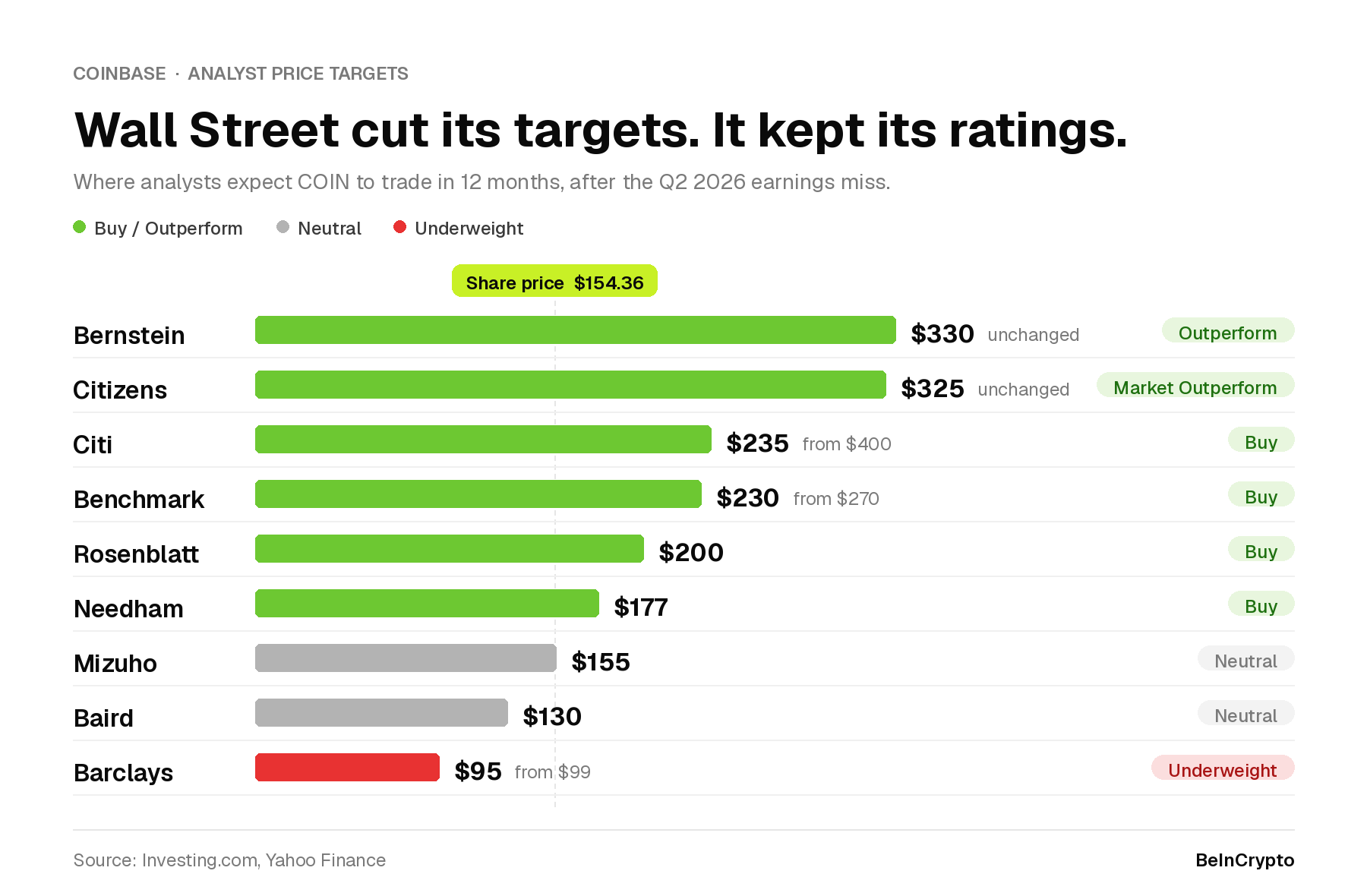
Wall Street just lowered its price forecasts for Coinbase stock. The exchange missed earnings expectations for the third quarter in a row. Almost no analyst changed their advice, though. Most still say buy.
A price target is where an analyst expects a stock to trade in 12 months. Several firms cut theirs this week. Their ratings stayed exactly where they were.
What Went Wrong in the Quarter
Coinbase lost $359.5 million in the three months to June 30. That works out to $1.36 per share. Analysts had penciled in a loss of just 17 cents. So the gap was wide. Revenue reached $1.22 billion. Analysts wanted about $1.29 billion. A year earlier the figure was $1.5 billion.
The damage started with trading. Customers traded 24% less than in the first quarter, Citizens said. Price swings were the smallest in years, so fewer people bought or sold. COIN shares then slid to a third straight quarterly loss.
Subscriptions did not rescue the quarter either. That unit brought in $555 million, below the $594 million analysts wanted.
Targets Dropped. Ratings Did Not.
Benchmark cut its target to $230 from $270. It kept a Buy rating anyway. Needham moved to $177. Rosenblatt moved to $200. Baird moved to $130. All three called the slump temporary rather than permanent.
Mizuho landed at $155 and stayed neutral. Barclays was the one loud bear. It rates the stock Underweight, which means sell, and set a $95 target.
Two firms did not flinch. Bernstein kept its $330 target. Citizens kept $325. Citizens gave a simple reason. Coinbase spent less than it had promised to spend. Job cuts made in May started to pay off.

The pattern began before the results landed. Citi slashed its target by 41% last week and still told clients to buy.
Why the Bulls are Still Buying
The bulls are not betting on trading fees. They are betting on everything else.
Coinbase handled a record 10.3% of all crypto trading. Its prediction market revenue doubled in three months. Paid Coinbase One memberships hit an all-time high.
The company now sells perpetual futures and stocks too. It calls the plan an “everything exchange.”
One piece is running late. Citizens said new USD Coin (USDC) features arrived later than planned. Banks have also flagged pressure on USDC economics.
Circle’s leadership argues that stablecoins outgrow crypto trading as payments spread. Coinbase needs that to happen quickly.

COIN traded near $151.24 on Friday, down 2.41%. The average analyst target sits near $229.74. That gap is a lot of faith.
The post 3 Earnings Misses Later, Wall Street Will Not Give Up on Coinbase Stock appeared first on BeInCrypto.


Eligible retail and institutional users can use tokenized shares of Nvidia, Apple, Tesla and three other US companies across Bybit’s trading and lending products.
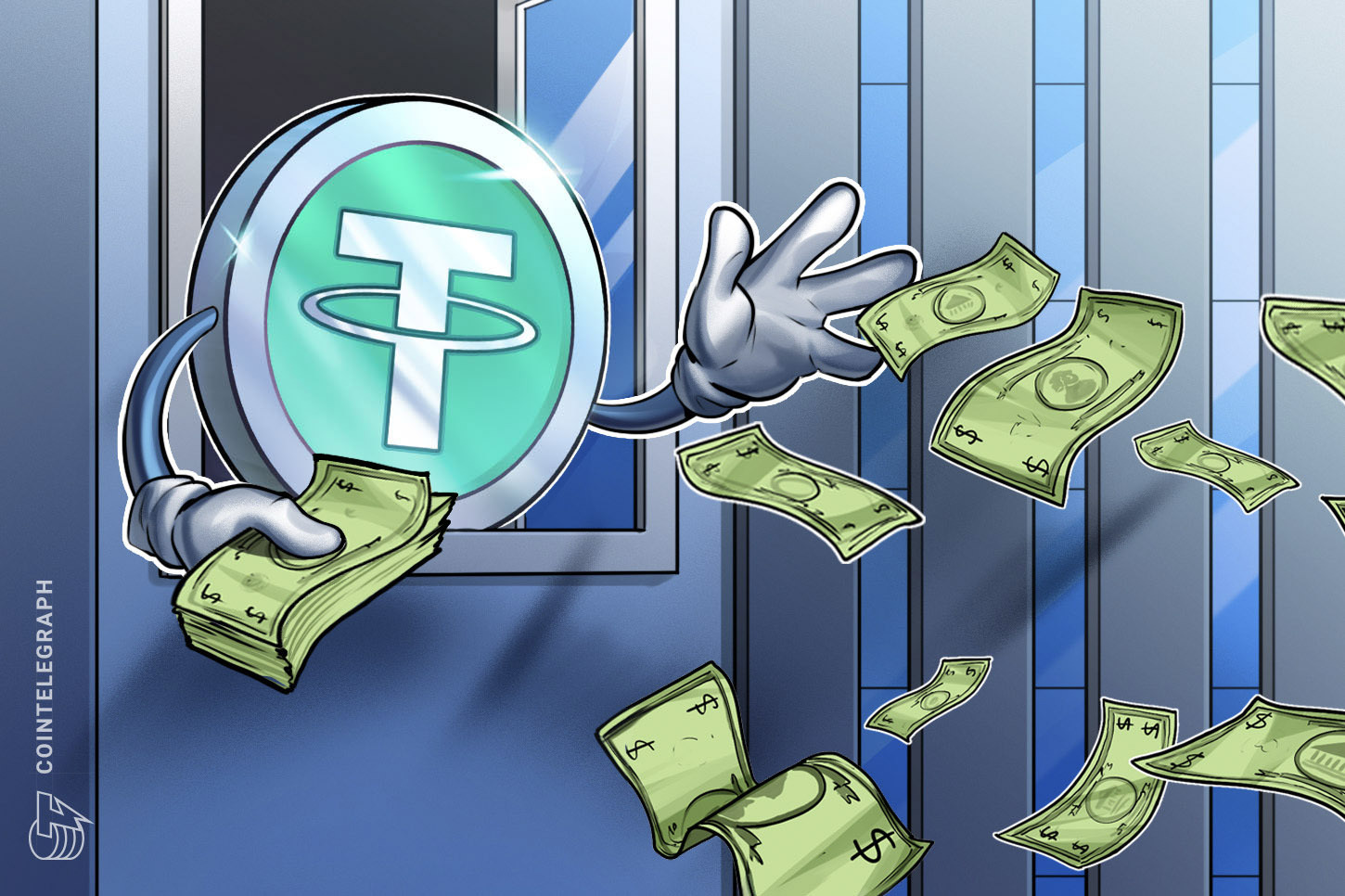
Tether’s reserve surplus grew to $4.11 billion in the second quarter as USDT supply rose despite a weaker stablecoin market and continued pressure across the crypto sector.


Most companies treat anxiety as a problem to solve. When employees feel stressed, they are offered meditation apps, mental-health days, and employee-assistance programs. These can be valuable resources. But they carry an underlying message: Anxiety is an obstacle to performance, and the goal is to make it disappear.
I saw this mindset clearly during a recent consultation with the CEO of a midsize company. I asked what comes to mind when an employee says they are experiencing anxiety. Her discomfort was immediate, as though merely hearing the word “anxiety” activated her own.
She then named three concerns: the employee might need accommodations, benefits costs may rise, and the company could face legal exposure. Her managers, she explained, were trained not to ask too many questions about anxiety. Instead, they were supposed to document the interaction, direct employees toward support, and avoid saying anything that could create additional risk.
That may be prudent from a legal perspective, but it also reveals a problem. Corporate America is getting anxiety all wrong.
I don’t fault the C-suite for thinking this way. For much of my career as a clinical psychologist, I made a similar mistake. I was trained to regard all anxiety as a symptom to reduce, manage, or eliminate.
In reality, the word “anxiety” is used to describe two very different experiences.
On the one hand, clinical anxiety is persistent, excessive, and disruptive. In professional nomenclature, these conditions are known as anxiety disorders. They interfere with work, sleep, relationships, and everyday functioning. Clinical anxiety typically requires professional treatment, workplace accommodations, or other meaningful support.
On the other hand, most anxiety is not a disorder at all. It is an ordinary and healthy human emotion involving apprehension we feel when an important matter is uncertain. The emotion of anxiety shows up before difficult conversations, major presentations, high-stakes decisions, and periods of change. Yes, it tends to be uncomfortable, but discomfort is not the same as a dysfunction or disorder. Fundamentally, anxiety is simply evidence that we care about what happens next.
We readily distinguish between depression, a clinical disorder, and sadness, which is a normal human emotion. Yet when it comes to anxiety, that nuance often disappears. We use the same word for everything from fleeting nerves to debilitating psychiatric conditions.
When companies pathologize ordinary anxiety, a self-reinforcing cycle develops. Employees become reluctant to admit they feel anxious because they fear being seen as unwell, unable to cope, or a professional liability. Managers, worried about saying the wrong thing, avoid honest conversations about emotions altogether. Leaders lose access to important information, psychological safety erodes, productivity suffers, and tensions tend to rise for all parties.
Companies have long treated emotional wellness and performance as separate agendas: one soft, the other serious. That is a false divide. When people know how to use anxious feelings well, they become both healthier and more productive.
Corporate America needs a different approach. Instead of trying to eliminate anxiety, business leaders and managers should help employees to use it constructively.
Here are four steps that can help.
First, identify anxiety as information. When anxiety occurs, resist the instinct to dismiss it or make it disappear. Get curious. What specifically feels concerning? Is there a risk being overlooked? What does anxiety suggest is at stake?
The emotion of anxiety is not always accurate, but it is often informative. It can sharpen attention, improve preparation, and expose blind spots. The most anxious person in a meeting is often voicing questions everyone else is avoiding.
Second, employees and leaders alike should feel freer to share their anxiety with others. Of course, work should not become group therapy, and thoughtful disclosure is not the same as oversharing. But work colleagues should be able to acknowledge pressure in a grounded, professional way.
When appropriate, managers should respond to anxiety with validation: “I’m concerned about this, too. Here is what we know, what we don’t know, and how I think we should proceed.” That kind of honesty does not weaken authority or credibility. It builds trust, invites candor, and allows anxiety to move from a private burden to shared experience.
Third, embrace anxiety instead of avoiding it. Many of the best employees are anxious. I’m not talking about clinical impairment or paralysis due to fear. I mean team members who care enough to worry about quality, consequences, deadlines, and the people affected by their work. Managers should view anxiety as evidence of investment, not inadequacy.
Human Resources teams should treat healthy anxiety as a positive criterion in hiring and promotion. Constructive anxiety often signals foresight, conscientiousness, and genuine commitment when outcomes are uncertain. Those are qualities companies claim to value, but tend to overlook when they favor polished confidence over thoughtful concern.
Finally, let go of the illusion of control. This is the most important step in the age of AI. Jobs will change. Industries will be disrupted. Employees and leaders alike will have to make decisions without complete information.
Leaders who pretend to know exactly what will happen may look confident at first, but this quickly becomes hubris. A healthier response is to acknowledge uncertainty, identify what can be controlled, and accept what cannot. Letting go is not resignation. It is doing our best without pretending that effort guarantees the outcome.
In a recent keynote for business managers and executives, I asked audience members to raise their hands if they had felt any anxiety during the previous two weeks. Nearly every hand went up. “Thank God,” I said, and the room burst out laughing.
The joke landed because the alternative was alarming. In this era of uncertainty, a room full of business leaders who felt no anxiety would not be a picture of perfect mental health or corporate excellence. It would have signaled disengagement, denial, or even worse, emotional numbness.
Anxiety means you are human. It means you care. And it means you are living and working in a world no one can fully predict or control.
The future of work will not belong to the people who feel no anxiety. It will belong to the people who know how to use it.


The exchange hit record market share and crossed $100 million in prediction market revenue, but a $1.36 per share loss and declining transaction fees show the Everything Exchange still runs on a shrinking engine.
Summary
- Coinbase reported a $359.5 million GAAP net loss in Q2 2026, missing consensus estimates by a wide margin with earnings per share of negative $1.36 versus expectations near breakeven.
- Total revenue fell 18.5% year over year to $1.22 billion, marking the third consecutive quarterly miss against Wall Street forecasts.
- Crypto trading volume market share hit an all time high of 10.3%, up from 9.1% in Q1, even as spot volumes across the industry declined 25% quarter over quarter.
- Subscription and services revenue reached a record 48% of net revenue, with average USDC held on the platform hitting an all time high of $20 billion.
- Prediction markets revenue grew 106% quarter over quarter, crossing $100 million in annualized run rate, while Coinbase ditched the traditional earnings call for a live AMA on X.
Coinbase delivered its third consecutive quarter of missed revenue estimates on July 30, posting a $359.5 million net loss that turned a year of strategic diversification into a question about whether any amount of product expansion can offset a sustained decline in trading fees.
The headline numbers were difficult to frame positively. Revenue of $1.22 billion missed consensus by roughly $80 million. Earnings per share came in at negative $1.36, far below estimates that ranged from negative $0.01 to positive $0.14 depending on the source. Adjusted EBITDA of $207.8 million missed by 31%. The stock dropped more than 5% in after hours trading before partially recovering the following day.
Yet beneath the miss, the structural story is changing. Bitcoin now accounts for just 12% of total revenue, down from more than 50% historically. Subscription and services revenue has grown from $6 million per quarter in 2020 to $555 million today. Prediction markets crossed $100 million in annualized revenue. The company Brian Armstrong calls the Everything Exchange is genuinely becoming one. The question is whether it is becoming one fast enough to survive the quarters when its original business contracts.
The revenue miss, decomposed
The $80 million revenue gap was not concentrated in a single segment. It was distributed across nearly every line item, suggesting the problem was market wide conditions, not a specific operational failure.
Transaction revenue came in at $599 million against an estimate of $640 million. Consumer trading, still the largest single revenue source at $452 million, missed by $40 million and declined 30.5% year over year. The total crypto market capitalization fell 11% during the quarter, and spot trading volumes dropped 25%. Coinbase was swimming against a current that pulled the entire industry down.
Institutional trading was the exception. Revenue of $100 million beat estimates of $116 million in absolute terms but represented a 64.6% year over year increase. Coinbase is gaining institutional share even in a declining volume environment, a pattern that suggests its expansion into tokenized stocks and international markets is generating durable demand instead of speculative volume.
Subscription and services revenue of $555 million missed its $601 million estimate by roughly $45 million. Within that category, stablecoin revenue of $292 million came in below the $339 million consensus, down 12.1% year over year. The $47 million stablecoin miss was the largest single line item shortfall in the subscription segment and represents the first time USDC revenue has disappointed at this scale since the revenue sharing arrangement with Circle began generating material income.
Blockchain revenue of $83 million missed by $13 million and declined 42.3% year over year, reflecting lower activity on Base chain during the broader market cooldown. Other transaction revenue of $47 million also came in light at $53 million estimated. Only interest and finance fees, at $66 million, beat estimates, rising 11.5% year over year. The interest income beat is a direct consequence of elevated USDC balances earning yield in a high rate environment, a tailwind that could reverse if the Federal Reserve begins cutting rates.
The market share paradox
The most striking number in the report was not the loss. It was the 10.3% crypto trading volume market share, an all time record and the third consecutive quarter of gains.
This creates a genuine paradox. Coinbase is winning a larger share of a shrinking market. In Q1, market share was 9.1% on roughly $1.93 billion in revenue. In Q2, market share rose to 10.3% on $1.22 billion. Revenue fell 36.8% quarter over quarter while market share increased by 1.2 percentage points. The math is stark. A rising share of a declining pie still means a smaller serving.
The paradox matters because it defines the investment thesis. If you believe crypto trading volumes are cyclical and will recover, Coinbase is building a dominant position that will compound on the upswing. If you believe the fee compression that characterizes mature markets has arrived permanently, the market share record is a consolation prize.
The competitive dynamics behind the market share gain deserve scrutiny. Coinbase achieved the record during a quarter when derivatives trading volumes hit an all time high for the third consecutive quarter. The exchange is no longer competing solely on spot trading, where fee pressure from zero commission competitors has been relentless. Derivatives, institutional prime brokerage, and international expansion are all contributing to the share number in ways that did not exist two years ago.
The evidence from Q2 favors the cyclical interpretation. Monthly transacting users of 7.6 million missed the 8.15 million estimate, but assets on platform of $245.9 billion, while below the $295 billion consensus, still represent an enormous custody position. Coinbase stores more cryptocurrency than any other company in the world. The $50 billion gap between actual and expected assets on platform reflects bitcoin price declines, not customer departures. When volumes return, it will capture them at a rate no competitor can match.
The stock price reflected Wall Street’s difficulty in reconciling these contradictions. Shares dropped from $160.09 to $155.16 in after hours trading, a 5.15% decline, before rebounding to $163.58 the following day. The 52 week range of $139.18 to $402.16 captures the full spectrum of market sentiment about Coinbase: from existential concern during drawdowns to euphoric conviction during rallies. At a market capitalization of roughly $42 billion, Coinbase trades at approximately 8.7 times trailing revenue, a premium that assumes the Everything Exchange thesis will eventually deliver.
The subscription pivot reaches 48%
The story Coinbase has been telling investors for two years is that it is evolving beyond a trading fee business. Q2 provided the strongest evidence yet that this transformation is real, even if it is not yet sufficient.
Subscription and services revenue represented 48% of net revenue, up from 29% just seven quarters earlier in Q4 2024. The shift is structural, not cosmetic. In Q2 2020, subscription and services generated $6 million per quarter. Six years later, it generates $555 million. That is a 92 fold increase in a business segment that barely existed when Coinbase went public.
The composition of that revenue is important. USDC related income remains the largest component at $292 million. Average USDC held on the platform reached an all time high of $20 billion, representing more than 30% of all USDC in circulation. Coinbase captures approximately 50% of all USDC economics through its relationship with Circle.
The stablecoin business is also gaining broader tailwinds. Market stablecoin transaction volume reached $37 trillion year to date, with 79% flowing through USDC and partner stablecoins, up from 51% in full year 2024. Base chain stablecoin volume rose 7x year over year. These are not Coinbase specific numbers. They are infrastructure adoption metrics that compound regardless of crypto price direction.
The significance of the USDC position becomes clearer when viewed through the lens of revenue durability. Unlike trading fees, which evaporate when volumes decline, stablecoin revenue is a function of USDC in circulation and the interest rate environment. As long as USDC balances remain elevated and interest rates stay above zero, Coinbase earns yield on reserves. The Fed’s sustained rate environment has made this revenue stream more valuable than Coinbase’s early projections anticipated.
But the stablecoin revenue miss of $47 million below consensus also reveals vulnerability. If interest rates decline or USDC loses market share to competing stablecoins, Coinbase’s highest margin business could contract. The entry of traditional financial players like Visa into the stablecoin infrastructure market introduces competitive pressure that did not exist twelve months ago. Coinbase’s bet is that its head start, its custody position, and its platform distribution will be sufficient to maintain USDC dominance.
Prediction markets and the new growth engine
The fastest growing segment in the quarter was also the newest. Prediction markets revenue grew 106% quarter over quarter, crossing $100 million in annualized run rate. The crypto binaries product, launched during the quarter, generated three times the daily traders and four times the daily revenue compared to its May average within weeks of launch.
This segment is worth watching for reasons beyond the topline number. Prediction markets operate on a fundamentally different cycle than crypto spot trading. They are event driven rather than price driven. A regulatory crackdown on competitors like Kalshi could accelerate the shift of prediction market volume toward regulated platforms like Coinbase. New York’s lawsuit seeking $36 billion in damages from Kalshi, combined with 38 state attorneys general aligned against prediction market operators, creates a regulatory moat that benefits companies already holding federal registrations and exchange licenses.
The fact that prediction markets generated $100 million in annualized revenue during a quarter when crypto spot volumes fell 25% suggests the business may be naturally counter cyclical. Political events, sports outcomes, and economic indicators create trading catalysts that are orthogonal to crypto price cycles. If Coinbase can sustain 100% quarter over quarter growth for even two more quarters, prediction markets would become a meaningful contributor to total revenue rather than a rounding error.
Coinbase One subscribers also crossed one million for the first time, another recurring revenue stream that is less sensitive to crypto price movements. The subscription product bundles zero fee trading, higher staking rewards, and priority support, essentially converting volatile transaction revenue into predictable subscription revenue. The one million subscriber milestone, combined with the $100 million prediction market run rate, suggests Coinbase is building multiple independent revenue engines that do not require crypto prices to rise for the company to grow.
The cost structure under pressure
The loss was not driven solely by declining revenue. Coinbase’s cost structure amplified the impact of the miss.
Operating margin deteriorated to negative 9.3%, down from negative 1.6% a year earlier. Transaction expenses consumed 16% of net revenue. Sales and marketing spending was dialed back in Q2 in response to market conditions, but the pullback was not sufficient to offset the revenue decline. The operating leverage that makes Coinbase profitable in strong markets works in reverse during weak ones. Fixed costs for compliance, engineering, and infrastructure do not scale down proportionally when trading volume falls 25%.
The balance sheet remains strong. Cash and equivalents of $8.6 billion, with total available resources of approximately $10 billion, provide a substantial buffer against an extended downturn. For context, the $10 billion in available resources exceeds one full year of total operating expenses at the current run rate. Coinbase could theoretically operate for more than twelve months with zero revenue before facing a liquidity constraint. No other publicly traded crypto company has a comparable cash position.
The company has maintained 14 consecutive quarters of positive adjusted EBITDA, a streak that survived even this quarter’s GAAP loss. The distinction matters. GAAP accounting includes non cash charges, particularly stock based compensation and unrealized losses on crypto holdings, that adjusted EBITDA excludes. The gap between reported profitability and cash generation is widening as Coinbase increases equity compensation to retain engineers during headcount reductions.
Free cash flow of $197.3 million at a 16.2% margin remained positive, down 5.8 percentage points year over year but still meaningfully above zero. Coinbase is not burning cash despite the macro pressure. It is generating less of it. The company’s ability to remain free cash flow positive during a quarter that produced a $359.5 million GAAP loss speaks to the underlying economics of the business model. Custody fees, staking revenue, and USDC economics generate cash regardless of whether Coinbase reports a profit or loss under GAAP rules.
The X AMA and what it signals
Coinbase replaced its traditional earnings call with a live AMA on X, the first major public company to do so for a quarterly earnings report. The format shift was not random. It was a statement about who Coinbase considers its primary audience.
Traditional earnings calls are designed for institutional analysts. They follow a scripted format: prepared remarks, then questions from buy side and sell side analysts who have been pre screened by investor relations. The X AMA inverted that hierarchy. Brian Armstrong took questions from anyone in the replies, including retail investors, crypto developers, and critics.
Armstrong used the format to deliver the quarter’s most quotable line: “Coinbase is no longer a bet just on the price of Bitcoin. All of financial services are getting updated by crypto technology, whether that is trading or payments or lending. And Coinbase is the best positioned company in the world to power this.”
He also emphasized the diversification narrative: “We are diversifying revenue both on the trading fee side and on subscription and services with non trading fees.” The framing was deliberate. In a quarter where every line item missed estimates, the message was that missing by less next time will require looking at a different set of numbers.
The claim is ambitious. But the numbers partially support it. With bitcoin at 12% of revenue, prediction markets at $100 million annualized, USDC generating $292 million per quarter, and institutional trading growing 64.6% year over year, the diversification strategy is producing measurable results. The problem is that all of these new revenue streams combined still could not offset a quarter of declining trading fees. The Everything Exchange is still powered primarily by the original engine, and that engine runs slower when crypto prices fall.
The engineering efficiency argument
Buried in the shareholder materials was a data point that received almost no analyst attention: pull requests per engineer increased 2.2 times year over year, and integration test coverage grew 2.5 times in six months.
These are operational metrics, not financial ones. But they matter for the long term thesis. Coinbase’s strategy requires it to ship products faster than market conditions can erode its core business. If the Everything Exchange needs prediction markets, tokenized stocks, agentic payments, and international expansion to work simultaneously, it needs an engineering organization that can execute on multiple fronts without proportional headcount growth.
The 14% workforce reduction announced earlier in the quarter makes the productivity data more significant. Coinbase is cutting headcount while increasing output per engineer. The new CTO appointment that accompanied the layoffs signals a deliberate shift toward smaller, more productive teams instead of the growth at all costs hiring pattern that characterized the 2021 bull market.
If the trend holds, it suggests the cost structure can improve even without revenue recovery. A company that ships twice as much code with 14% fewer engineers is building operating leverage that does not appear in quarterly revenue figures but compounds over time.
The Singapore expansion provides a concrete example of how engineering efficiency translates into market access. Coinbase announced plans to grow its Singapore workforce to 200 by year end 2026, focusing on compliance engineering and product localization. If a smaller but more productive engineering team can support simultaneous launches in Canada, Singapore, and other international markets, the per market cost of expansion falls materially. The Everything Exchange thesis depends on geographic reach as much as product breadth. Engineering efficiency is the prerequisite for both.
The question is whether engineering velocity translates into product market fit across enough segments to offset the structural decline in consumer trading fees. Shipping code faster does not help if the products do not find users. The prediction market and Coinbase One traction suggests at least some of the new products are finding demand. But the consumer trading segment, which still generates more revenue than any other single line, continues to shrink.
What to watch
- Q3 trading volumes and the ETF stabilization signal. Coinbase noted that Bitcoin ETF outflows, which hurt custody revenue in Q2, had already stabilized entering Q3. Positive custody inflows excluding ETFs continued. The question is whether spot volumes recover alongside stabilized custody.
- Prediction markets regulatory landscape. With Kalshi facing lawsuits in multiple states, Coinbase’s regulated prediction market offering could capture displaced volume. Watch for quarterly prediction market revenue to exceed $30 million, which would put it on track for a $120 million annualized rate.
- USDC market share trajectory. USDC’s rise from roughly one fifth to more than one quarter of the stablecoin market directly drives Coinbase’s highest margin revenue. If Base chain continues gaining stablecoin volume at the current 7x year over year rate, this line item could offset trading fee declines.
- The stock’s valuation versus fundamentals. At a forward price to earnings ratio of 117.65 and a beta of 3.35, Coinbase trades as a high volatility growth stock. The analyst consensus target of $214.94 implies roughly 32% upside from current levels. If the Everything Exchange thesis holds, the current price reflects the market’s skepticism about execution.
- Revenue growth deceleration. Analysts project only 5.1% revenue growth over the next 12 months, a sharp deceleration from the 15.4% annualized rate of the prior two years. Whether Coinbase can beat this projection will determine whether the stock recovers or continues trading at depressed multiples.
Frequently asked questions
How much revenue did Coinbase report in Q2 2026?
Coinbase reported total revenue of $1.22 billion, missing the consensus estimate of $1.30 billion by approximately $80 million. Revenue declined 18.5% year over year from roughly $1.50 billion in Q2 2025.
What was Coinbase’s earnings per share in Q2?
Coinbase reported GAAP earnings per share of negative $1.36, far below consensus estimates that ranged from negative $0.01 to positive $0.14. The total GAAP net loss was $359.5 million.
What is Coinbase’s crypto trading volume market share?
Coinbase achieved an all time high crypto trading volume market share of 10.3% in Q2 2026, up from 9.1% in Q1. This was the third consecutive quarter of record market share gains.
How much revenue do prediction markets generate for Coinbase?
Prediction markets revenue grew 106% quarter over quarter in Q2, crossing $100 million in annualized run rate. The newer crypto binaries product generated three times the daily traders compared to its May average.
How much USDC does Coinbase hold?
Average USDC held on the Coinbase platform reached an all time high of $20 billion in Q2, representing more than 30% of all USDC in circulation. Coinbase captures approximately 50% of all USDC economics.
Why did Coinbase replace its earnings call with an X AMA?
Coinbase became the first major public company to replace a traditional quarterly earnings call with a live AMA on X. The format shift signals a strategic pivot toward retail and crypto native audiences rather than the institutional analyst community.
Is Coinbase still profitable on an adjusted basis?
Yes. Despite the GAAP net loss, Coinbase maintained its 14th consecutive quarter of positive adjusted EBITDA at $207.8 million. Free cash flow was $197.3 million at a 16.2% margin. Cash and equivalents stood at $8.6 billion.
What is the analyst price target for Coinbase stock?
The analyst consensus price target is $214.94, implying approximately 32% upside from the post earnings trading price of roughly $163. The stock trades at a forward price to earnings ratio of 117.65 with a beta of 3.35.
Disclaimer: This article is for informational purposes only and does not constitute financial or investment advice. The information presented reflects publicly available data as of July 31, 2026. Readers should conduct their own research and consult qualified financial advisors before making investment decisions.
UNI Just Hit a 6-Month High as Uniswap Rolls Out New Token Discovery Tab

Alex Eala vs Elina Svitolina Mubadala DC Open quarterfinals

Seattle Tech Week notebook: AI, startups, and the best insights and takeaways we heard

Renter of Home in Anne Heche Crash Denies Settlement With Son

No Jackpot Winner as $257 Million Prize Rolls Over to $269 Million Monday Draw

Weekend Open Thread: Staud – Corporette.com

IF CLARITY DOESN’T PASS XRP CAN BE USED IN A CRISIS! – THIS IS ONLY 1 WAY XRP GETS TO $1000+

Vah Re Vah Video Song | Money Telugu Movie Songs | JD Chakravarthy | Brahmanandam | Mango Music

SURVIVNG LIKE WINTERS IN SUMMERS FOR 24 HOURS #shorts
-
 Sports5 days ago
Commonwealth Games boxing: Jadumani Singh seals dominant 5-0 win over Pakistan’s Sumama Rehman to enter quarter-finals | Commonwealth Games News
-

 Business2 days ago
Why Trees Belong on the Risk Register
-

 Tech5 days ago
Intel is reversing course and bringing hyper-threading back to its server chips
-

 Fashion3 hours ago
Weekend Open Thread: Wit & Wisdom
-

 Crypto World6 days ago
Ripple bought a bank in pieces. The $4 billion audit
-

 Politics4 days ago
Luke Littler dismantles Gerwyn Price to retain title in Blackpool
-

 Politics3 days ago
The Part of the Electric Transition Nobody Wants to Discuss
-

 News Videos5 days ago
BITCOIN JUST ENTERED THIS CRITICAL ZONE…
-
 Entertainment3 days ago
‘Stargate’ Creator’s New Sci-Fi Series Returns for Season 3 Tomorrow
-

 Crypto World6 days ago
XRP Ledger adds $2.6B as RWA inflows rank second
-

 Business3 days ago
Major shareholder moves on Canyon
-

 News Videos1 day ago
Bitcoin Enters the 3rd Stage of the Bear Market
-

 Politics5 days ago
Spain sweeps the board at 2026 World Cup with individual awards
-

 Entertainment6 days ago
Sara Gilson Killed By Husband After Viral “Pedophile” TikTok Video
-

 Crypto World3 days ago
Kraken Enables Retail Access to Jersey Mike’s IPO via Tokenized Shares
-

 Tech7 days ago
Anthropic launches Claude Opus 5, a cheaper AI model for coding, agents and enterprise workflows
-

 Tech4 days ago
New macOS Sequoia & Sonoma security updates for older Macs
-

 News Videos3 days ago
Claude: Build Financial Dashboards in Minutes (2026)
-

 Politics1 day ago
Luke Littler’s dominance sparks GOAT debate
-

 Crypto World6 days ago
Upbit expands KRW market with two major DeFi token listings
You must be logged in to post a comment Login