
Crypto World
Solana news: Solana Foundation hires Binance, Polygon veterans for tokenized finance push


The Solana Foundation has appointed former Binance executive Rachel Conlan as its new chief strategy officer, adding a high-profile crypto industry veteran as the Solana (SOL) blockchain makes a bigger push into institutional finance and tokenized assets.
Conlan will lead strategy across institutional partnerships, ecosystem growth and efforts to bring more companies onto Solana, the foundation said Thursday. She spent previously three years at Binance, most recently as global chief marketing officer, before leaving the crypto exchange in June.
The foundation also hired Jamal Raees as general manager for payments. Raees joins from Polygon Labs, the development organization behind the Polygon network (POL), and previously worked at stablecoin infrastructure firm Bridge (now part of Stripe) and crypto payments firm Wyre. He will focus on getting payments companies and other businesses to use Solana for moving money.
The appointments come as Solana increasingly courts traditional financial firms and positions its network as infrastructure for more than crypto trading. Stablecoin payments, tokenized funds and equities have become a bigger part of that pitch as financial institutions experiment with moving assets and settlement onto public blockchains.

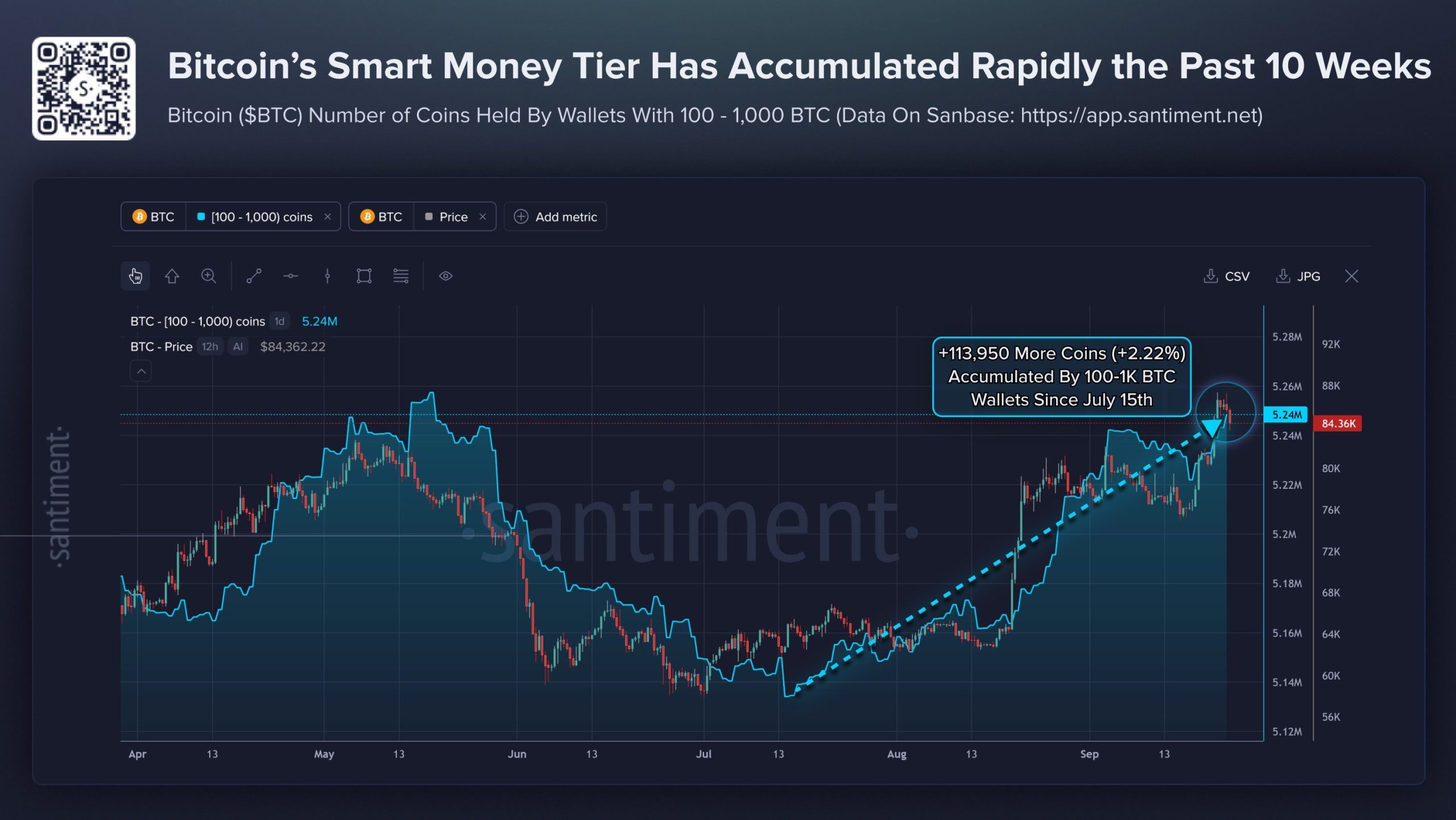
Bitcoin (BTC) wallets holding 100 to 1,000 BTC have added 113,950 BTC since July 15, Santiment data shows.
The purchases lifted the group’s combined balance by 2.22% to roughly 5.24 million BTC. Santiment shared the figures as the price slipped below $84,000 on Wednesday.
A 5-Year Track Record Behind the Bitcoin Smart Money Signal
But why does this accumulation matter? Santiment counts this cohort among the “most useful smart money groups to watch.” Its five-year study found that the wallets closely tracked the crypto market’s direction.
Historically, this cohort has tended to build positions ahead of, or during, Bitcoin’s stronger price stretches.

Follow us on X to get the latest news as it happens
The current run fits that record. The cohort kept adding coins as Bitcoin climbed from mid-August. According to Santiment, this suggests the rally drew support from well-capitalized holders as well as retail traders.
“Sustained buying from the 100-1,000 BTC group has historically been valuable alpha, especially when paired with retail fear, sentiment, and exchange-flow data,” the post read.
Treasury Yields Drag Bitcoin Under a Key Level
The accumulation arrives during a volatile week for Bitcoin, which has swung between sharp gains and losses since Monday. On September 21, Bitcoin crossed $84,000 for the first time since January 31.
That breakout liquidated $262.30 million in short positions within an hour, according to CoinGlass. The move also came after Bitcoin’s first weekly close above its 50-week moving average in 45 weeks.
However, macro conditions turned against the rally on Wednesday. A hot US PMI report pushed the 10-year Treasury yield above 5%, reviving fears of another Federal Reserve hike.
Bitcoin fell below $84,000. The same area also shows up in Glassnode’s on-chain data.
Glassnode Draws the Line at $84,000
Glassnode places the largest cluster of long-term holder supply between $84,000 and $85,000. Bitcoin briefly dipped to about $83,500 on Wednesday but closed the day near $84,400 on Binance.

On Thursday, the price slipped to roughly $83,800, just under the lower edge of that band. The daily session remains open, so the level has yet to produce a confirmed break.
Glassnode sees $95,000 to $97,000 as the next major test for Bitcoin. The mean Market Value-to-Realized Value (MVRV) price is $96,700, within that range.
“The next test is $95K-$97K, where options positioning and the mean MVRV price meet,” the firm said.
The firm added that holding above $84,000 keeps that path open. However, a drop below it would bring the $77,000 True Market Mean back into view.
Subscribe to our YouTube channel to watch leaders and journalists provide expert insights
The post Santiment Says Smart Money Is Buying Bitcoin. The 10-Year Yield Says Not So Fast appeared first on BeInCrypto.


The action filed by state lawmakers followed a similar lawsuit against prediction markets company Kalshi in July that alleged the platform was running an illegal gambling operation.

Solana Foundation has made two senior hires aimed at accelerating institutional and payments-focused adoption of the network. Rachel Conlan, a former Binance chief marketing officer, has been appointed chief strategy officer, while Jamal Raees—previously an executive at Polygon Labs—will serve as general manager of payments.
The moves signal a continued shift toward enterprise integration, particularly around stablecoins and tokenized financial services. The Foundation also pointed to recent ecosystem efforts, including the March launch of the Solana Developer Platform and new infrastructure support from major Web2 providers.
Key takeaways
- Rachel Conlan joins Solana Foundation as chief strategy officer to lead institutional partnerships, ecosystem growth, and business adoption efforts.
- Jamal Raees becomes general manager of payments, with a stated focus on increasing usage of stablecoins and tokenized deposits across global markets.
- The hires follow Solana’s March launch of the Solana Developer Platform, featuring Modern Treasury as a payments infrastructure partner.
- Solana is also being incorporated into AWS’s x402 feature, which enables USDC-based charging for AI agents accessing content.
- Solana’s roadmap includes the planned Alpenglow upgrade intended to reduce transaction finality time from about 12.8 seconds to roughly 150 milliseconds.
Solana Foundation brings in enterprise and payments leadership
According to Solana Foundation, Conlan will oversee strategy spanning institutional partnerships, ecosystem expansion, and initiatives designed to bring businesses onto Solana. The Foundation described her experience across major crypto venues and marketing-focused leadership roles.
Conlan spent three years at Binance and previously held senior positions at OKX, CAA Sports, and Havas, giving her a background that combines crypto-native experience with broader enterprise and communications expertise. For Solana, that mix may be especially relevant as it continues to court corporate developers, payment operators, and compliance-minded institutions that typically require clear go-to-market planning and partner coordination.
Raees, meanwhile, is stepping in as general manager of payments. In a statement provided by Solana Foundation, he said his role will deepen engagement with major payments companies and focus on the infrastructure used by teams building payment services on Solana. He also said his work will center on driving adoption and usage of stablecoins and tokenized deposits, with an emphasis on global markets.
Developer Platform and payments infrastructure gain new momentum
The Foundation’s staffing changes come after the March launch of the Solana Developer Platform. Solana Foundation said the platform includes Modern Treasury as a payments infrastructure partner, positioning it to help teams build payment-related services on the network more quickly.
Mastercard and Western Union were named as early users of the platform. While the details of how those partners use the platform were not expanded in the announcement, their presence underscores Solana’s ongoing effort to position itself as a rails layer for settlement and payments—rather than solely as an application platform.
For investors and builders, the practical value of such platform initiatives is that they can reduce integration friction. Instead of payment teams assembling fragmented components from scratch, a dedicated infrastructure offering can compress timelines—especially for use cases tied to stablecoin settlement and tokenized deposits.
AWS support highlights the path toward USDC-based AI access
Separately, Solana said Amazon Web Services included Solana among the networks supported by its x402 feature. The Foundation described x402 as enabling website owners to charge AI agents in USDC for access to content.
This matters for adoption because it connects crypto payments to a mainstream developer workflow—web hosting and content delivery—where new payment models may emerge. Rather than requiring every content provider to build bespoke payment systems, a network-supported feature like x402 can make it easier to standardize how value transfer and access control work for AI-driven services.
What remains to be seen is how widely the feature will be used and whether it becomes a template for other payment-enabled AI applications. Still, the inclusion of Solana in a major cloud provider’s capabilities reflects the broader industry trend of treating stablecoin payments as an integration-friendly primitive for digital services.
Alpenglow upgrade targets a step-change in transaction finality
Solana Foundation also referenced ongoing technical work. The network is preparing to deploy Alpenglow, a planned upgrade intended to reduce transaction finality from about 12.8 seconds to roughly 150 milliseconds. Solana Foundation emphasized that the faster finality remains a target for the upgrade.
Lower finality times can be a meaningful improvement for payments and interactive applications, where users expect rapid confirmation and where payment workflows can be sensitive to delays. Faster settlement is also often cited as a requirement for more advanced financial services, since it affects how quickly systems can treat transactions as reliably completed.
As Raees’s role centers on stablecoins and tokenized deposits, performance improvements from Alpenglow could further support the credibility of those services—provided the upgrade delivers on its targets when deployed.
Scale metrics point to continued stablecoin and tokenized assets activity
Solana Foundation reported that the network has processed more than $5 trillion in stablecoin volume so far in 2026. The Foundation also said the network has more than $4.5 billion in real-world assets and more than $620 million in tokenized equity supply.
These figures are directionally relevant to the payments narrative because stablecoin usage tends to correlate with settlement activity and real-world tokenization efforts depend on reliable throughput and infrastructure. However, readers should note that the announcement did not provide definitions for each metric or explain how they were calculated. Investors may want to monitor whether these totals increase in parallel with enterprise integrations and payment-focused developer tooling.
Overall, Solana Foundation’s leadership appointments, cloud integration, and technical roadmap appear to be converging around one theme: making it easier for businesses to deploy stablecoin and tokenized financial services, while improving the network characteristics that such products rely on.
Going forward, the key question is whether the new payments leadership can translate partnerships and platform availability into sustained usage growth—especially in stablecoin payments and tokenized deposits—while Alpenglow’s finality improvements move from target to confirmed delivery.

Before the ETFs, bitcoin ownership tilted more heavily toward retail investors, crypto-native funds and traders making tactical bets, Rasmussen said. ETFs gave financial advisers and other professional investors a familiar way to add bitcoin to traditional portfolios.
Those investors tend to approach bitcoin differently.
Rasmussen said a professional investor might allocate around 2% of a portfolio to bitcoin, while crypto-focused retail investors can have 20%, 30%, or more of their money tied to the asset. A crash, therefore, looks very different depending on who owns it.
“If it goes down 50%, my portfolio is only down 1%,” Rasmussen said in an interview, describing how an investor with a 2% allocation might view the decline.
There is also rebalancing. An adviser targeting a 2% bitcoin allocation may buy after a steep decline to bring the position back to its target weight. If bitcoin surges and reaches 5% of the portfolio, that same investor may sell some at the next rebalancing.
That could soften sell-offs, but also limit the size of rallies.
Mark Connors, chief investment officer at Risk Dimensions, expects growing institutional participation to contribute to smaller drawdowns than the 70-80% declines seen in previous cycles.
But investors shouldn’t expect to get something for nothing. Connors said bitcoin’s volatility has fallen over time, but its returns have moderated as well. More institutional investors could mean “smaller blow-off tops due to rebalancing,” he said.

As we prepare for another El Niño, our people know its rhythms well, but the severity with which these forces now arrive is worsening.
First, the rains come heavily. Then they stop. Water tanks empty, wells run dry, crops fail, and ocean conditions shift. We begin shipping water to communities with none.
These changes are the reality behind the historic diplomatic achievement taking place this week. The U.N. General Assembly will very likely adopt the first Sea-Level Rise Declaration by consensus. In a year of fractured diplomacy, that is worth celebrating.
The Republic of the Marshall Islands has never wavered in its position. Sea level rise will not alter the statehood, sovereignty, or maritime zones of any state. But while the legal status, rights, and maritime zones of my country and its people are now secure, our physical safety is not.
That distinction must guide what comes next. The world must respond to the impact of sea level rise on coastal communities, heritage, and cultures, and the lands that have nourished our ancestors for generations. We must start by preventing as much sea level rise as we can.
Crypto World
Cryptocurrency is entering a “new bull market”; BTC holders earn $7,770 in passive income through SHR Miner.

Disclosure: This content is provided by a third party. Neither crypto.news nor the author of this article endorses any product mentioned on this page. Users should conduct their own research before taking any action related to the company.
A pullback in oil prices and easing supply concerns drove U.S. stocks higher and boosted the cryptocurrency market.
Summary
- The report says Bitcoin reached $86,332 on Bitstamp, up 5.7% on the day.
- It links the broader market rally to falling oil prices and easing supply concerns.
- SHR Miner advertises remote Bitcoin mining contracts lasting 7 to 55 days.
- The listed daily rewards and contract returns are company estimates, not guaranteed income.
Bitcoin surpassed $86,000 for the first time since late January. According to TradingView data, Bitcoin hit $86,332 on the Bitstamp exchange, marking a 33-week high, with a daily gain of 5.7% at the time of writing.
This surge has further fueled market optimism regarding Bitcoin’s long-term prospects. Market analysts have even dubbed the current cryptocurrency market a “new bull market.”
As market attention heats up, some cryptocurrency users are starting to look for ways to generate income beyond simply holding their coins and are turning their attention to SHR Miner in search of passive BTC income opportunities.

As a leading global SHR Miner cloud mining platform, it enables users to enter the lucrative world of cryptocurrency mining by remotely renting ASIC mining hash power; simply purchasing a contract package allows you to start mining, regardless of your technical knowledge or experience level.
How to get started with BTC mining:
Starting your cloud mining journey with SHR Miner is very simple.
- Create an account to receive $15 worth of free mining power (generating $0.60 in daily earnings).
- Selecting a Contract: In the contract hashrate section, eligible users can select contract packages ranging from 7 to 55 days and earn daily variable BTC mining returns based on the purchased hashrate and applicable product rules.
Compared to probability-based individual mining, this pool-based mining model offers a more continuous and observable mining experience, while eliminating the cost of owning or operating mining equipment.
Examples of returns on popular mining contract packages:
Cloud mining contract
Contract price
Duration
Estimated daily reward
Estimated contract reward
Bitcoin Miner S21 XP Imm
$5,000
25 days
$70.50
$1,762.50
MICROBT WhatsMiner M73
$8,000
30 days
$116.80
$3,504
Bitcoin Miner S21e XP Hyd
$10,000
35 days
$151
$5,285
ANTSPACE HK3
$30,000
40 days
$513
$20,520
Click here to view more premium contract plans.
SHR Miner cloud mining employs a model based on leasing computing power from remote data centers. This reduces initial capital requirements and provides greater cash flow flexibility, while also lowering total mining costs.
David, COO of SHR Miner, stated: “Mining should be accessible to everyone who wishes to participate, rather than being limited to those with the means to purchase and operate professional equipment. By launching our cloud mining service, we are providing a more convenient pathway for a wider range of users to engage in professional Proof-of-Work mining, while simultaneously expanding SHR Miner’s multi-asset ecosystem. Our goal is to connect everyday users with professional-grade infrastructure through a transparent, integrated experience.”
Overview
As a leading cloud cryptocurrency mining platform, SHR Miner has attracted the attention of numerous investors thanks to its convenient investment approach and array of advantages. It offers a simple, secure, and stable investment method while allowing investors to choose from flexible investment options and earnings mechanisms tailored to their specific needs. If you are interested in mining investments, don’t miss out on the lucrative returns driven by the Bitcoin bull market!
Join SHR Miner today to start your mining journey with ease and confidence, and explore the limitless possibilities of cloud mining!
For more information, please visit its official website: https://shrminer.com/
Disclosure: This content is provided by a third party. Neither crypto.news nor the author of this article endorses any product mentioned on this page. Users should conduct their own research before taking any action related to the company.
In September 2026, the total crypto market cap increased nearly 7%. Several major assets hit multi-month highs. So are we in a definitive bull market? And which assets will win big?
The current cycle is important because a lot has happened against the market’s favor. US Fed increased interest rates, and the Senate failed to advance the CLARITY Act. And yet, Bitcoin price climbed to its highest level since January.
Analysts at BloFin Research argue the next bull market could look very different. In their view, a single category of tokens or applications won’t define the cycle.
Instead, it will be shaped by five distinct layers.
Next Bull Market Won’t Keep the Money Inside Crypto
Every crypto bull market so far has had a headline narrative. Those stories ranged from Bitcoin as digital money to smart-contract platforms, DeFi, and NFTs.
BloFin Research notes that most of the activity in those cycles stayed inside crypto. Fresh capital came in, moved from token to token, and created new ways to speculate. That held true even when the technology behind a trend aimed at something wider.
However, a different pattern could be taking shape now. Several of crypto’s quickest-growing sectors lean the same way. Together, they point toward crypto acting as a parallel market for the broader financial world.
- Stablecoins
- Tokenization
- RWA perps
- Prediction markets
- Token value accrual
These sectors are often discussed as separate narratives, but BloFin Research views them as layers of one stack.
1. Stablecoins
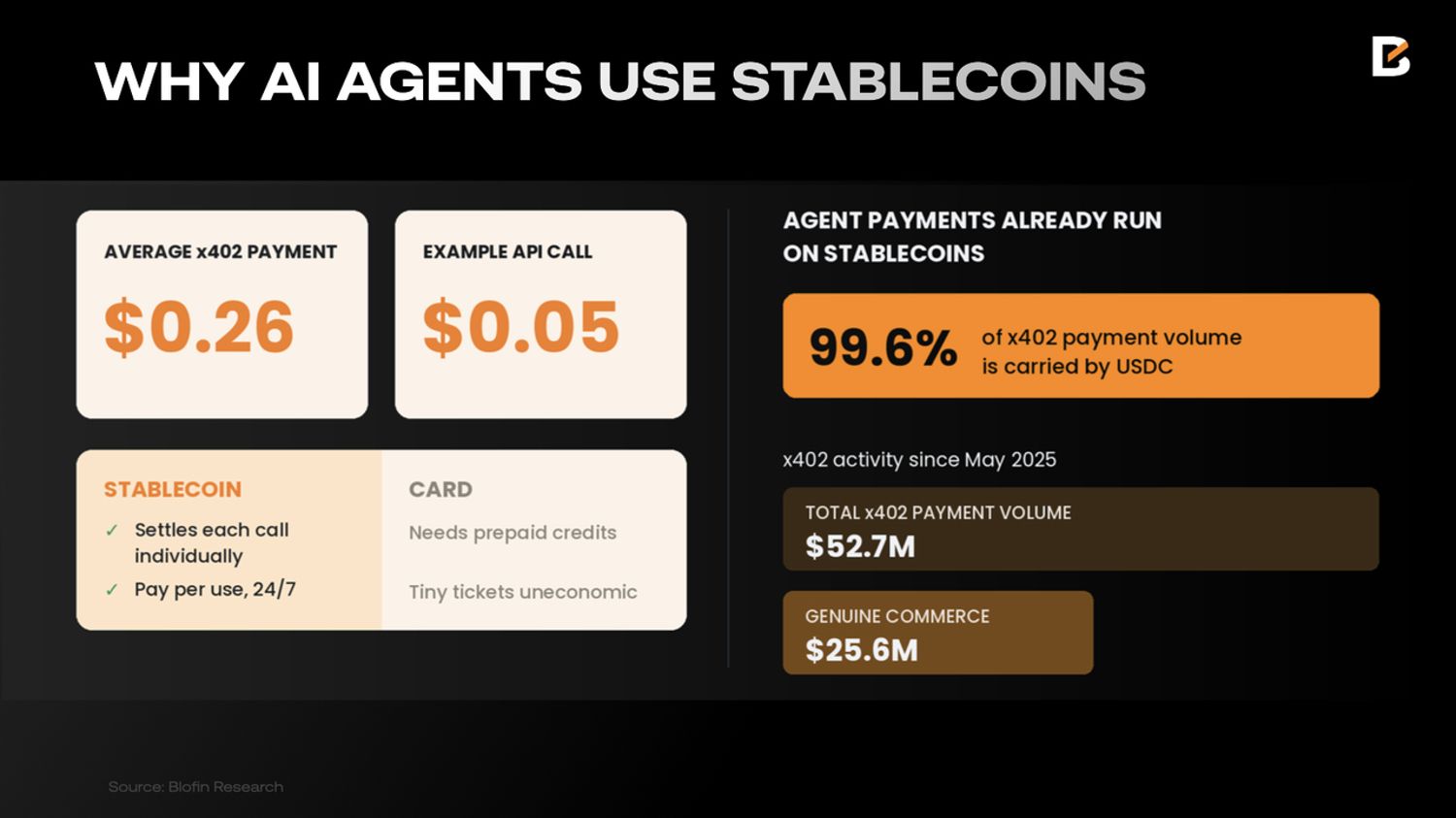
Stablecoins form the cash leg of the stack. BloFin Research says they are expanding from crypto trading into real-world payments.
This is visible in adoption. Visa’s stablecoin settlement volume passed a $20 billion annualized run rate. That is more than 15 times the level a year earlier.
The next step could likely be AI agents paying for data and computing power in stablecoins. BlackRock made a similar case in a recent paper, naming stablecoins a key candidate for “machine-native money.”

2. Tokenization
Tokenization supplies the asset leg by bringing real-world ownership on-chain. BloFin Research says commodities and stocks now rank among the quickest-growing tokenized assets.
Tokenized commodities reached $5.55 billion by the end of Q1, led mostly by gold. That marks a 289% rise since the start of 2025.

Tokenized equities grew even faster, up 390% this year to $4.43 billion by mid-September. Even so, only about 0.0029% of the $151.9 trillion global listed-equity market is tokenized. That leaves ample room for growth as access widens and on-chain use deepens.
3. RWA Perps
RWA perps make up the leverage leg. These contracts allow traders to take leveraged positions in stocks, commodities, or indices without owning the underlying assets.
An RWA perp mainly needs a reliable price feed, liquidity, collateral, and a liquidation system. Tokenizing an asset, by contrast, requires legal structuring, custody, and investor-eligibility rules.
Analysts at BloFin Research think the difference helps explain why synthetic exposure can scale faster than tokenized ownership.

DefiLlama data shows that RWA-perps volume rose from $122 billion in Q1 to $2.2 trillion in Q3. Open interest now tops $15.3 billion.
4. Prediction Markets
Prediction markets act as the information leg. They turn news and expectations into probabilities backed by traders’ money. That has made prediction markets one of crypto’s standout sectors this year.
On-chain prediction market volume reached about $5.24 billion so far in September, according to a Dune dashboard. That is more than triple the roughly $1.56 billion recorded in September 2025.
Ahead of the 2026 FOMC meetings, odds on Kalshi and Polymarket moved in response to incoming economic data. They then drifted toward CME FedWatch as each decision approached.
BloFin Research adds that these probability feeds are becoming machine-readable, so AI agents can use them as live signals.

5. Token Value Accrual
Value accrual is the final test of the bull market. In simple terms, value accrual means how a crypto protocol’s success translates into value for its token holders.
Analysts argue that usage requires a credible mechanism to convert it into value for token holders. That can take the form of buybacks, burns, distributions, or treasury growth.
For example, if a DEX does $10 billion in trading volume and earns $20 million in real fees, but none of that $20 million has any connection to its token, the token has weak value accrual.
The current token-emissions model has lost credibility. Traditional investors, focused on revenue and cash flow, also want a measurable link to token value, it adds.

BloFin Research points to three major DeFi protocols as examples, each using a different mechanism. Hyperliquid burns HYPE bought with trading fees, while Uniswap links protocol fees to UNI burns. Aave sends revenue to its DAO, which can fund AAVE buybacks.
Buyback spending has also hit a record this year. Crypto projects repurchased $638 million of their own tokens by late August, according to data from Allium Labs. Hyperliquid and Pump.fun accounted for nearly 90% of that total.
How the Layers Feed Each Other
These five layers reinforce each other. Stablecoins serve as collateral for perps and as the settlement asset for tokenized securities. Tokenized stocks and RWA perps both take their prices from traditional markets, but they serve different needs. Tokenization carries ownership, while perps carry leveraged price exposure.
Data from perps and prediction markets then becomes a signal for traders, models, and AI agents. Fees from all of this activity feed the value leg.
But there are two potential challenges. Infrastructure for AI agent payments is arriving before the volume does. The value of equity perps as a pricing signal also depends on liquidity, since thin markets can produce noisy or manipulated readings.
The post 5 Financial Layers Could Power the Next Crypto Bull Market appeared first on BeInCrypto.
Crypto World
Philadelphia Fed’s Anna Paulson says ‘modest’ rate moves likely ahead to tame inflation
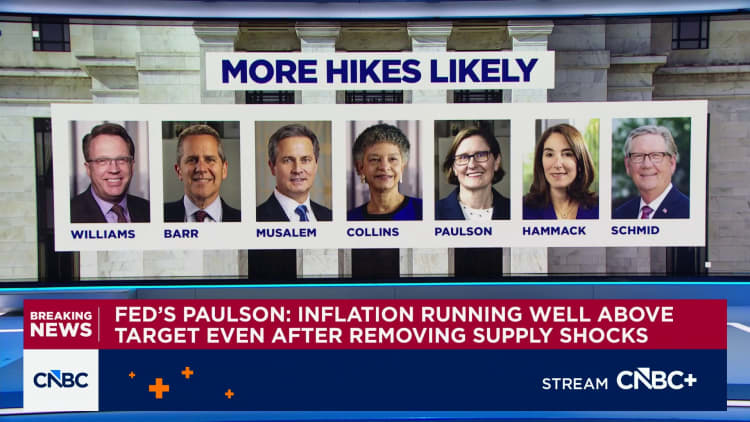

Philadelphia Federal Reserve President Anna Paulson said Thursday that she and her colleagues may need to raise interest rates further to bring inflation back to target.
Speaking a week after the Federal Open Market Committee raised benchmark borrowing rates by a quarter percentage point, Paulson said inflation trends are still worrying.
The rate hike, which took the key funds rate to a target range of 3.75%-4%, “brings policy closer to what I believe is needed to return inflation to 2% at a pace that balances inflation with risks to the labor market. Looking ahead, if conditions evolve as I expect, some modest further tightening may be warranted.”
Though the summer showed some moderating in price pressures, she said underlying inflation is still running around 2.5%-3%, “well above our 2% target, and the gap has shown little signs of closing.”
“The best I can say about underlying inflation this year is that it hasn’t gotten worse,” Paulson said in prepared remarks for a fintech conference in her home district. She noted that inflation has held higher even outside of the oil supply shocks from the Iran war and tariffs.
Outside of inflation, Paulson said economic output “has been solid” while the labor market is “holding steady.”
The comments come as markets have raised their expectations for Fed tightening dramatically.
Another leg up this week has taken longer-duration Treasury yields to highs not seen since 2004. Traders are now pricing in a 64% chance the FOMC hikes again in October, then expect another move in January, according to the CME Group’s FedWatch tool. Fed funds futures contracts are implying a rate of 4.8% by the end of 2027, which would indicate the expectation of as many as four quarter-point increases ahead.
New York Fed President John Williams said earlier Thursday that he thinks it’s “reasonable” to expect another hike before the end of the year

Solana Foundation has moved to strengthen its institutional and payments push with two senior hires, naming former Binance chief marketing officer Rachel Conlan as chief strategy officer and Polygon Labs executive Jamal Raees as general manager of payments.
The appointments come as Solana attempts to broaden its footprint beyond developers into mainstream business use cases, including stablecoin payments and tokenized deposits—areas the foundation says it plans to prioritize through partnerships and ecosystem growth.
Key takeaways
- Rachel Conlan joins Solana Foundation as chief strategy officer, overseeing institutional partnerships, ecosystem expansion, and business onboarding efforts.
- Jamal Raees becomes general manager of payments, with a mandate to deepen ties with payments companies and focus on infrastructure for payment-service builders.
- Solana’s hiring decisions follow the March launch of the Solana Developer Platform, which introduced Modern Treasury as a payments infrastructure partner.
- AWS has added Solana support to its x402 feature, designed to let website owners charge AI agents in USDC for access to content.
- Solana is also preparing the Alpenglow network upgrade, which is intended to reduce transaction finality time from about 12.8 seconds to roughly 150 milliseconds.
Conlan’s strategy role targets institutions and business adoption
In her new position, Conlan will lead Solana Foundation’s strategy work across multiple fronts, including institutional partnerships, ecosystem growth, and initiatives intended to bring businesses onto the Solana network.
Solana Foundation noted that Conlan spent three years at Binance, and previously held senior roles at OKX, CAA Sports, and Havas. The breadth of that background—spanning major exchange marketing leadership and broader corporate experience—signals that the foundation is aiming to close the gap between crypto-native infrastructure and the requirements of traditional business partners.
For investors and builders, the practical question is whether this strategy focus translates into more deployment-ready payment tools and repeatable enterprise onboarding. Conlan’s remit includes institutional partnerships, which typically require more than technical compatibility; they often depend on compliance readiness, commercial go-to-market support, and partnerships that can scale beyond pilots.
Raees to focus on payments infrastructure and stablecoin growth
Raees’ mandate is more narrowly centered on payments. Solana Foundation said he will deepen engagement with major payments companies and concentrate on the infrastructure that teams use to build payment services on Solana.
In a statement provided by Solana Foundation, Raees said his focus would be “driving greater adoption and usage of stablecoins and tokenized deposits,” with an emphasis on global markets.
That emphasis matters because stablecoins and tokenized deposits sit at the intersection of crypto and regulated finance: they are frequently the use cases that business partners ask for when evaluating whether to integrate with blockchain networks. By putting Raees in charge of the payments layer, Solana Foundation is effectively prioritizing the parts of its stack that help other companies launch compliant-looking payment products at scale.
Developer Platform and early partners widen the payments pathway
The hiring decisions follow Solana Foundation’s March launch of the Solana Developer Platform. The program includes Modern Treasury as a payments infrastructure partner, and early users cited by the foundation include Mastercard and Western Union.
While the announcement does not detail commercial outcomes, the pairing of high-profile payments ecosystem names with a dedicated developer platform is notable. It suggests Solana is trying to reduce friction for companies that want to build payment services without having to assemble every component themselves.
For traders and market participants, these kinds of platform moves can be important even when they don’t immediately show up in price headlines—because they can shape liquidity, transaction routing, and long-term user flows. The immediate impact may be hard to measure, but the direction of travel is clear: more institutional and payments integration pathways, supported by infrastructure partners.
AWS x402 expands a new USDC distribution route for content access
Separately, Amazon Web Services added Solana among the networks supported by its x402 feature, which lets website owners charge AI agents in USDC for access to content.
This development points to an increasingly common pattern in blockchain adoption: using stablecoins as a payment rail for specific application workflows rather than relying on general-purpose speculative activity. In this case, the integration is framed around access and usage billing for AI-related content delivery.
For builders, the value is practical—integrating a supported chain and stablecoin into a cloud product can lower deployment complexity. For Solana users, it may open additional demand channels for USDC in app environments that are not traditionally crypto-native.
Alpenglow upgrade aims to materially shorten finality
Solana is also preparing its Alpenglow network upgrade. The foundation says the planned change is intended to reduce transaction finality from about 12.8 seconds to roughly 150 milliseconds.
Finality improvements can matter for payment-related apps because faster confirmation reduces friction for interactive user experiences and can improve operational reliability for services that depend on timely settlement. While the announcement here is focused on the goal and not on delivery timelines, the magnitude of the proposed shift suggests Solana is actively targeting performance characteristics that are often central to enterprise evaluations.
It also provides an additional reason why payments-focused hires are arriving now: infrastructure improvements and commercial expansion efforts are being coordinated around the same core objective—making Solana more practical for real-world financial workflows.
Stablecoin and tokenized asset activity underscores the payments thesis
Solana Foundation said the network has processed more than $5 trillion in stablecoin volume so far in 2026. It also reported more than $4.5 billion in real-world assets on the network and more than $620 million in tokenized equity supply.
Those figures support the foundation’s broader narrative that stablecoins and tokenization are becoming more than isolated experiments. However, readers should still watch how activity translates into durable partnerships and product launches—particularly in environments where payments and tokenized deposits require robust operational controls, predictable settlement behavior, and clear integration paths.
With Conlan and Raees taking on strategy and payments leadership just as Solana’s Developer Platform and Alpenglow upgrade work are underway, the next signals to watch are whether early ecosystem users expand, whether stablecoin and tokenized deposit integrations move from pilots into ongoing deployments, and how the network’s performance targets line up with the demands of real payment services.
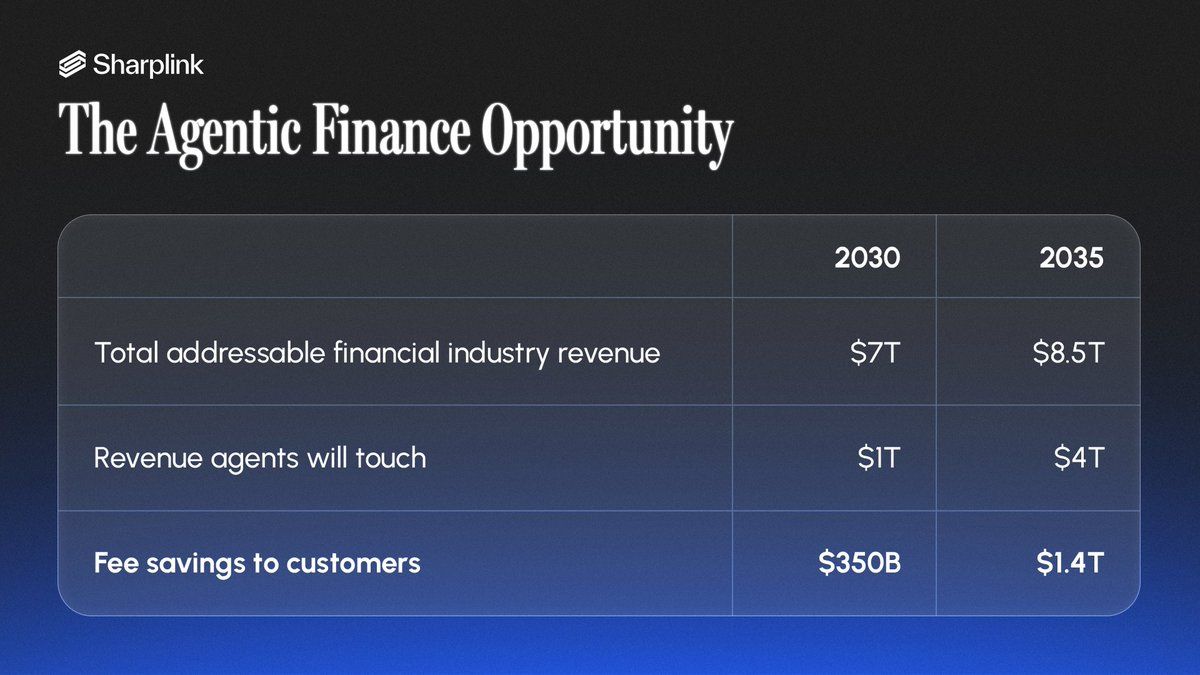
Sharplink CEO Joseph Chalom projects that AI agents will eliminate nearly a quarter of global finance fees by 2035.
His team’s model puts the resulting investor savings at $1.4 trillion a year. Chalom, a former BlackRock executive, set out the forecast in an X post on Wednesday.
A $4 Trillion Prize and a $180 Billion Blind Spot
Chalom’s team modeled 10 financial verticals through 2035. The model puts more than $1 trillion in annual financial services revenue up for grabs by 2030. Chalom expects that figure to reach $4 trillion a year by 2035.

The model assumes agents will make financial providers compete more aggressively on fees. Consumers would then keep an extra $350 billion a year by 2030, before the figure climbs to $1.4 trillion.
Chalom also points to roughly $15 trillion that US households hold in checking, savings, and short-term deposits. Much of it earns well below money-market rates, which he says costs savers at least $180 billion a year.
“Over $1 trillion of annual global financial services revenue is going to be up for grabs by 2030, growing to $4 trillion annually by 2035. Every major bank, broker, payments firm, and digital assets company is racing to capture a share in one of the most important battles over money and value we will see in our time,” he said.
Follow us on X to get the latest news as it happens
Visa, Coinbase, and Circle Race for the Agent’s Wallet
Chalom says the contest to control these agents has already begun. He names Visa, Mastercard, Stripe, PayPal, Circle, Tether, Robinhood, Coinbase, and Binance among the contenders.
In his view, the winner would also decide which products agents recommend and where idle cash gets swept.
“Whoever owns the infrastructure, owns the agent, and therefore the customer,” Chalom added.
BlackRock’s research paper this week made a related case, naming stablecoins as the leading candidate for agent payments.
Chalom argues that agentic transactions will predominantly occur where stablecoins, tokenized assets, and DeFi liquidity are concentrated, with much of that activity currently centered in the Ethereum (ETH) ecosystem. He points to Ethereum’s record of 3.6 million daily transactions in April as evidence of the network’s growing activity.
That outlook lines up with Sharplink’s balance sheet. The company held 891,714 ETH as of September 14, according to its dashboard.
Fidelity Digital Assets offered a more cautious read in August. Senior research analyst Max Wadington warned that closed systems run by tech and fintech firms could instead absorb agent activity.
Subscribe to our YouTube channel to watch leaders and journalists provide expert insights
The post AI Agents Could Wipe Out $1.4 Trillion in Wall Street Fees, Sharplink CEO Says appeared first on BeInCrypto.

Rihanna – Bitch Better Have My Money (Explicit)

Drivers who ignored M60 lane closures after crash ‘reported’

Dunkin’ Giving Away 1 Million Free Coffees Today as National Coffee Day Festivities Begin Early This Week




-

 Fashion6 days ago
Weekend Open Thread: Talbots – Corporette.com
-

 Tech4 days ago
Researchers escape OpenAI Codex sandbox to run commands on host
-

 Crypto World2 days ago
Goldman Sachs and Deutsche Bank Agree: The S&P 500 Rally Isn't Over
-

 Crypto World6 days ago
Circle launches Arc Studio AI agent for building onchain apps
-

 Crypto World4 days ago
Who Needs CLARITY Anyway? ARB Could See 70X Increase: Hodler’s Digest
-
 NewsBeat6 days ago
Trump says US has reached an agreement to take permanent control of Greenland’s security
-

 Crypto World6 days ago
Trading Bitcoin on Robinhood? Why 2% Spread Has Traders Worried
-

 Crypto World7 days ago
Mortgage and refinance interest rates today, Thursday, September 17, 2026
-

 Crypto World6 days ago
Bitcoin price breaks channel as RSI climbs to 63
-

 Tech3 days ago
Google’s $899 Googlebook is a bet that you’ll buy a new laptop for Gemini
-

 Business4 days ago
Analog Devices (ADI) Bets $1.35 Billion on Chips that Let Machines Think for Themselves
-

 Tech5 days ago
Trump suggests rebranding AI with a new name, says he’s also creating an AI Force
-

 Crypto World4 days ago
Coinbase, Robinhood, Circle Seen as Tokenized-Stock Winners
-

 Tech7 days ago
GPT-6 Astra Reached the Nether in Minecraft, Lost Its Stash to a Creeper, and Farmed Potatoes for Hours
-
 Business2 days ago
Oil Price Today (September 23): Crude oil below $100 on hopes of US-Iran talks. What did Trump say?
-

 Crypto World6 days ago
World Money launches in 150+ countries with Stripe
-

 Crypto World6 days ago
Silver prices recover quickly, hitting weekly high today
-

 Fashion4 hours ago
8 iPhone Accessories That Add Personality
-
 Crypto World2 days ago
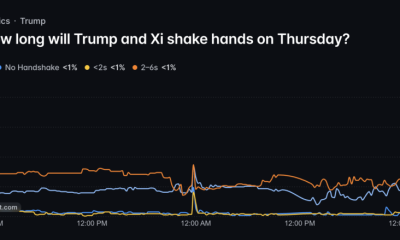
Trump-Xi Polymarket Odds for Handshake Hit 50%
-
 NewsBeat6 days ago
US was ‘on brink of war’ with China over false AI report of nukes moving in Middle East
You must be logged in to post a comment Login