
Crypto World
Solana’s faster supply cuts lead vote while $800,000 daily burn plan trails

All three proposals have cleared quorum, but a plan to slow new SOL creation is only narrowly passing while a separate vote to sharply increase token burns remains below the two-thirds support needed.


Dunamu, the parent entity of Upbit, has announced a strategic partnership with Visa. The partnership will explore stablecoin payments, AI-driven financial services, and international remittances.
Dunamu CEO Oh Kyung-seok and Visa Global President Oliver Jenkyn presented a roadmap for the partnership at Visa’s Global Market Support Center on August 26. However, they have not disclosed any product structure, launch date, blockchain, custody model, jurisdiction, or price details.
Dunamu and Visa Form Strategic Partnership
The partnership agreement was signed by Visa Worldwide Pte. Limited. Wu Blockchain elaborated on the partnership, saying the companies intend to combine Dunamu’s digital asset infrastructure with Visa’s global payments network. It will also explore stablecoin payments, global transfers, merchant settlements, AI-driven financial services, international remittances, and new user experiences.
“Dunamu, the operator of South Korea’s largest crypto exchange Upbit, has entered a strategic partnership with Visa to explore stablecoin payments, global remittances, and AI-driven financial services. The two sides are also considering business models based on the Open Standard dollar stablecoin OUSD. The specific service structure has not yet been determined.”
According to Dunamu and Visa, the partnership will consider applicable laws and regulatory requirements and develop services in a staggered manner. However, the announcement does not commit to a product launch or to offer stablecoin payments through Upbit. Dunamu added that the partnership will focus on regulatory compliance, transparency, interoperability, and stability. However, it did not elaborate on who would manage customer assets and compliance duties.
Meanwhile, Visa has expanded its stablecoin settlements and programmable payment work. It has also announced new infrastructure designed for AI-directed transactions, tokenized deposits, and stablecoins.
Will Open USD Be Part of the Arrangement
Dunamu and Visa also plan to evaluate business models involving the Open USD (OUSD). OUSD is a dollar-backed stablecoin developed using the Open Standard initiative. OUSD will support global payments and allows businesses to mint or redeem tokens without imposing any fee or volume limits. Open Standard lists Visa, Mastercard, BlackRock, Coinbase, and Dunamu among the organizations supporting the initiative.
However, Dunamu said in July that it did not agree to issue the OUSD stablecoin or participate in its launch and clarified it was still reviewing the proposal. The Visa partnership confirms that Dunamu will explore OUSD-based models. However, it does not clarify whether it will issue or operate the stablecoin.
Focus on Agentic Commerce
One of the partnership’s key focuses is payment infrastructure for agentic commerce. Agentic commerce is a digital shopping model in which AI models search, compare, select, and pay for products or services on behalf of users. Dunamu and Visa plan to explore the technology that supports the authorization, payment, and settlement for transactions completed by agentic commerce models. However, they have not disclosed how users will approve purchases, set spending limits, or dispute any transaction initiated and executed by AI agents.
AI purchases also raise several questions involving identity, consent, fraud, and liability. Additionally, stablecoin transactions are irreversible once completed on-chain. Visa has developed several tools to address these concerns, including AI agent verification and greater merchant control over automated transactions.
South Korean Legislation Could Affect Partnership
South Korea is yet to create a comprehensive regulatory framework for stablecoins, with lawmakers still debating who can issue won-based tokens and whether bank ownership should be mandatory. Additionally, dollar-based payment and remittance services could also be subject to the country’s anti-money laundering, foreign exchange, and virtual asset rules. Dunamu has acknowledged that regulatory developments in South Korea could affect its partnership with Visa. The company is also discussing stablecoin infrastructure with domestic technology and financial companies.
Visa and Shinhan Partnership
Visa’s partnership with Dunamu comes days after it announced a strategic agreement with the Shinhan Financial Group to test stablecoin issuance, remittance, and redemption on its payment platform. The agreement allows Shinhan to test stablecoin functions on Visa’s existing platform and create a business model that aligns with South Korea’s market. Shinhan also plans to connect Visa’s global payment network to its subsidiaries, including Shinhan Bank, Shinhan Card, and Jeju Bank. Jin Ok-dong, CEO of Shinhan Financial Group, stated that the agreement builds on its existing partnership with Visa and offers “differentiated financial experiences to customers.”
“Through this agreement, we have expanded our long-standing partnership with Visa to the broader digital finance sector.”
Disclaimer: This article is provided for informational purposes only. It is not offered or intended to be used as legal, tax, investment, financial, or other advice.

Bitcoin’s $80,000 level has emerged as a major threshold as the crypto asset attempts to break out of the current bear market. Several technical and on-chain measures are converging around this level.
At the same time, the traditional realized price has become less relevant because of the large amount of illiquid BTC supply, according to CryptoQuant analyst Darkfost.
$80K Breakout Test
In his latest post, Darkfost noted that Bitcoin’s market capitalization has been on the rise. At the cycle peak, the figure even reached $1.75 trillion. Because coins bought more than 10 years ago are now largely considered illiquid, they represent a much smaller share of the market capitalization than Bitcoin purchased more recently. This makes it necessary to adjust the realized price by weighting it according to the amount of capital invested.
Using this capital-weighted approach, the analyst calculated a Bitcoin cost basis of approximately $79,600. That figure places the average invested capital near the $80,000 mark, which makes the level a significant barrier for the crypto asset at present.
Darkfost explained that this area more clearly identifies where the average invested capital reaches neutrality. A daily close above $80,000, followed by a weekly close above the same level, would represent a strong signal. Such a move would also return a large portion of BTC’s invested capital to profit.
Next Buying Opportunity
Meanwhile, Ali Martinez said that the crypto asset could be heading toward another buying opportunity if its current market structure follows the pattern seen during the 2022-2023 bottom. The analyst stated that Bitcoin broke above a descending resistance trendline on Thursday, similar to the move seen in early 2023, which has brought back the May 2026 high near $83,000 into focus.
This level could lead to a retracement before Bitcoin makes another move higher. URPD data reveals a major resistance zone between $83,307 and $84,569, where nearly 975,000 BTC were previously acquired. This concentration of supply could make it difficult for Bitcoin to push through the zone on its first attempt.
Additionally, on-chain trader profit margins have climbed to 25%, a level that has often been followed by increased profit-taking and short-term corrections over the past year. Whales also appear to be taking profits, with roughly $88 million in gains already realized.
If selling pressure increases, he identified $76,996 to $78,258 as a crucial support range, where 843,000 BTC were previously traded. A break below that zone could shift attention to the next major demand area around $63,111, where roughly 925,000 BTC were traded.
Martinez said a pullback toward these support levels could present another opportunity before Bitcoin pushes towards $100,000.
The post Why $80,000 Could Be Bitcoin’s (BTC) Most Important Level Right Now appeared first on CryptoPotato.


OpenAI published an open letter signed by more than 100 companies. The letter warns that AI-enabled cyberattacks will become far more widespread and sophisticated in the coming months.
Signatories stretch across technology, banking, insurance, and semiconductors. Anthropic, Microsoft, Google, Amazon Web Services (AWS), CrowdStrike, Cloudflare, and Palo Alto Networks all added their names.
What the OpenAI Letter Asks For
The letter identifies four groups that need to act. Every organization should treat cyber defense as a leadership priority and fix its highest-risk weaknesses.
Cybersecurity vendors should make AI-powered defense deployable for critical infrastructure operators. Governments should coordinate response and support defense for hospitals, water utilities, and local authorities.
Frontier AI companies should provide model access, funding, and training to under-resourced defenders.
“Today’s AI advances are already giving defenders new ways to fix weaknesses that have accumulated for years. If we act decisively, we can use the defenders’ window to make our digital world much more secure,” the letter reads.
Follow us on X to get the latest news as it happens
What the Current Threat Landscape Looks Like
Evidence behind the tech giant’s forecast has already arrived this year. Taiwanese threat intelligence firm TeamT5 found Chinese state-affiliated groups doubled their attack volume after adopting DeepSeek and other open-source models.
Cost drove that choice rather than capability. Anthropic reached a broader conclusion in June. Its study of 832 banned accounts found the share of medium-risk or higher attackers rose from 33% to 56% within a year.
The firm also found that AI now handles privilege escalation and lateral movement, work that previously required technical skill. That erodes the link between an attacker’s expertise and the damage they can cause.
South Korean firm Genians found Kimsuky, a unit under North Korea’s Reconnaissance General Bureau, testing local AI tools.
TRM Labs scored criminal AI adoption at 54 out of 100 this year, up from 28 in 2024. The firm logged 201 crypto hacks in the first half of 2026, up from 83 a year earlier.
These are some of the many incidents researchers logged in 2026. The letter argues that today’s AI advances can still be turned into lasting security improvements that benefit everyone.
Subscribe to our YouTube channel to watch leaders and journalists provide expert insights
The post OpenAI, Anthropic and 100+ Companies Warn AI Cyberattacks Will Surge Within Months appeared first on BeInCrypto.

Evernorth said on August 27 that the US Securities and Exchange Commission (SEC) had declared its registration statement effective, moving its proposed merger with Armada Acquisition Corp. II closer to completion.
The development puts the XRP treasury company one step closer to a Nasdaq listing, although shareholders still need to approve the deal before it can close.
Evernorth Moves Closer to Nasdaq
The company announced that Armada Acquisition Corp. II shareholders will vote on the proposed business combination on September 30, 2026. Closing remains subject to that vote and other customary conditions.
Evernorth CEO Asheesh Birla said the company plans to enter public markets as blockchain utility grows, adding that it expects institutional finance to increasingly be built on-chain. “Evernorth is designed to accelerate XRP’s role in that work,” he noted in the announcement.
The effective registration statement follows a process that started publicly in March when Evernorth filed its Form S-4 in connection with its planned combination with Armada II, a special purpose acquisition company sponsored by Arrington Capital.
As CryptoPotato reported at the time, the filing provided the first detailed look at Evernorth’s plan to give public-market investors exposure to XRP through an actively managed treasury. The company said then that it had raised more than $1 billion in gross proceeds from institutional and strategic investors, including Ripple, SBI Holdings, Pantera Capital, Kraken, and Arrington Capital.
The latest filing moves the transaction beyond the SEC review stage, but it does not mean the merger has already closed. If shareholders approve the deal and the remaining conditions are satisfied, the combined firm is expected to become publicly traded on Nasdaq under the ticker XRPN, subject to exchange approval.
What the SEC Decision Changes
The registration statement becoming effective removes one major procedural hurdle, but as pointed out before, the shareholder vote remains ahead.
Evernorth’s March filing described the proposed transaction as a combination involving it, Armada II, and Ripple. Under the agreement, holders of company units and Armada stock would receive shares in the resulting public company, subject to the terms and limitations set out in the transaction document.
The proposed structure is also different from simply launching an XRP-focused fund. Evernorth is being organized as a public company whose strategy centers on holding and managing XRP. That gives investors exposure through corporate equity rather than direct ownership of the underlying token.
For XRP holders, the more interesting question may come after the merger. Evernorth, as said earlier, has raised more than $1 billion for its treasury strategy and has said it wants to build what it expects to be Nasdaq’s largest publicly traded XRP treasury company, and the community will be waiting to see whether that translates into sustained XRP demand or meaningful activity on the XRP Ledger.
At the time of writing, the fifth-largest cryptocurrency was trading just above $1.40, up almost 10% over one week and nearly 32% in the last 30 days.
The post XRP Treasury Giant Evernorth Moves Closer to Nasdaq Debut After SEC Milestone appeared first on CryptoPotato.

Trump-linked crypto venture company, World Liberty Financial, is preparing to launch a federally chartered national trust bank after the Office of the Comptroller of the Currency granted preliminary conditional approval earlier this month. An entity linked to Sheikh Tahnoon bin Zayed al Nahyan and co-investors reportedly owns 49% of the holding company, the largest stake in that structure.
The proposed bank is intended to issue, redeem, and safeguard USD1, the dollar-backed stablecoin World Liberty launched last year. The venture links World Liberty’s stablecoin business to a proposed federally chartered trust bank.
The OCC’s action is preliminary and conditional rather than a final banking charter. According to the Journal, the approval concerns World Liberty Financial’s plan to launch a federally chartered national trust bank.
The proposed bank’s stated functions are to issue, redeem, and safeguard USD1. The conditional approval does not amount to a final charter.
Discover: The Best Crypto to Diversify Your Portfolio
Trump Crypto Bank and The 49% Stake
Sheikh Tahnoon bin Zayed al Nahyan and co-investors are behind an entity that owns the largest stake, 49%, in World Liberty’s banking holding company, according to people familiar with the matter who spoke to the Journal. The Journal previously reported that Tahnoon backed a $500 million investment in World Liberty Financial last year in exchange for a 49% stake in the company.
The reported holding-company stake places an entity linked to Tahnoon and co-investors in the ownership structure of the proposed bank.

Tahnoon serves as the United Arab Emirates’ national security adviser and is the brother of the country’s president. He oversees a business empire valued at more than $1.3 trillion and funded by his personal fortune and state money, according to the Journal.
An Expanded Business Relationship
The new venture marks an expansion of the business relationship between the Trump-backed crypto company and a foreign government official, according to the Journal. World Liberty Financial is pursuing a proposed bank whose holding company ownership includes an entity linked to Tahnoon and co-investors.

The OCC’s preliminary conditional approval and the reported ownership structure are central elements of the proposed venture. The bank’s planned role is tied to USD1’s issuance, redemption, and safeguarding.
The approval remains preliminary and conditional. World Liberty Financial’s proposed bank has not yet received a final charter. For now, the proposed bank’s stated role is to issue, redeem, and safeguard USD1.
Discover: The Best Token Presales
The post Trump Crypto Empire Faces Scrutiny Over 49% Saudi Linked Stake in New Bank appeared first on Cryptonews.

Visa has teamed up with Dunamu, the parent company of South Korean crypto exchange Upbit, to explore how stablecoins could be used for payments, cross-border remittances and settlement—while also testing how artificial intelligence could enable more automated, commerce-oriented transactions.
In a partnership announcement issued Friday, Dunamu said the two firms will combine Dunamu’s digital asset technology with Visa’s global payments network to develop services for major markets, spanning payment flows, remittance rails, and settlement mechanisms.
Key takeaways
- Visa and Dunamu are collaborating on stablecoin-based payment, remittance, and settlement services.
- The partnership also targets “agentic commerce,” where AI agents may initiate shopping and payment actions on a user’s behalf.
- Dunamu said it is assessing multiple stablecoin projects rather than committing to a single token.
- The teams are considering payment models that could involve Open Standard’s proposed Open USD (OUSD), though the partnership isn’t limited to it.
Why Visa and Dunamu’s stablecoin push matters
Stablecoins have increasingly been positioned as a way to move value more efficiently across borders, particularly for remittances and settlement use cases. Visa’s involvement signals interest from a major legacy payments network in integrating digital-asset rails into broader payment infrastructure, rather than treating stablecoins as a standalone experiment.
For Dunamu, the partnership also represents an opportunity to connect its digital asset capabilities to a global network designed to reach consumers, merchants, and financial institutions at scale. The combination of Dunamu’s expertise and Visa’s established payments footprint is intended to support new business models across payment and settlement workflows.
Open USD is on the table, but not the only option
A key element of the announcement is that Dunamu and Visa are considering stablecoin structures tied to Open Standard’s proposed Open USD (OUSD), a dollar-backed stablecoin initiative unveiled in June.
According to Open Standard, more than 140 companies have signed up to use OUSD, with Open Standard citing Visa, Mastercard, Stripe, Coinbase and BlackRock among the listed participants. However, Dunamu’s Friday statement clarified that OUSD is only one of several stablecoin projects under review for the partnership. The company said it has not prioritized a specific stablecoin for the initiative.
This matters because it suggests the collaboration is still in a discovery and design phase—potentially focused on interoperability, settlement performance, regulatory fit, and integration pathways—rather than an immediate move toward a single token or issuance plan.
Upbit’s operator clarifies OUSD’s role
The partnership also lands amid ongoing scrutiny around who is actually involved in OUSD issuance. In July, Upbit said it was not participating in the issuance of OUSD after Dunamu, Upbit’s operator, was named among the businesses connected to the initiative.
That earlier clarification highlights a distinction that investors and market participants often look for in stablecoin partnerships: engagement on pilots, integrations, or infrastructure planning can differ significantly from taking part in issuance. With Dunamu now describing a broader evaluation of multiple stablecoin options, readers will likely watch for additional detail on whether the firms will narrow down to one model as testing progresses.
Agentic commerce: AI agents making payments
Beyond stablecoins, Dunamu and Visa said they will also explore “agentic commerce.” In this concept, AI agents can locate products and services, then perform purchasing and payments on a user’s behalf.
The announcement indicates the companies will look at how AI could be connected to stablecoin-based payment and settlement infrastructure—effectively combining automated decision-making with digital-asset rails. If executed, this could change how consumers experience online transactions by shifting certain steps of shopping and checkout into automated workflows.
Still, practical outcomes remain unclear. The partnership signals exploration of how AI and stablecoin payments might work together, but it does not outline specific pilots, product designs, or compliance frameworks for agent-driven transactions.
What to watch next
Visa and Dunamu’s collaboration raises expectations around stablecoin adoption at the payment-network level, but the next visible milestones will likely determine whether the partnership becomes a targeted pilot with a defined token and settlement model—or remains a broad feasibility effort across multiple stablecoins and AI-driven commerce scenarios.


CCC token on BSC has suffered an exploit that caused an estimated $117,000 loss after an attacker manipulated the token contract’s sell() function and burned tokens held in its liquidity pool.
Summary
- CCC suffered an estimated $117,000 exploit on BSC after an attacker targeted the token contract’s sell() function.
- TenArmorAlert said the function was used to burn CCC tokens held in the liquidity pool, causing abnormal price movement.
- The security firm has not disclosed the full attack sequence or explained how the attacker was able to trigger the affected function.
- No detailed post mortem, fund recovery plan or compensation proposal had been announced at the time of the alert.
According to blockchain security firm TenArmorAlert, its monitoring system detected suspicious activity involving CCC on BSC on Aug. 28 and traced the incident to the token contract’s sell() function. The firm said the function was used to burn CCC tokens directly from the liquidity provider pair, which was followed by abnormal movement in the token’s price.
TenArmorAlert estimated losses from the attack at roughly $117,000. The firm identified an attack transaction beginning with “0x89d805064” in its security alert but did not provide a full breakdown of the assets removed or the attacker’s final proceeds.
The available information does not identify how the attacker obtained the ability to trigger the affected function, whether access controls were bypassed, or whether another contract interaction was required before the tokens could be burned.
CCC exploit targeted tokens inside the liquidity pool
The reported attack centered on CCC tokens held by the LP pair instead of a direct withdrawal of assets from the pool.
TenArmorAlert said the contract’s sell() function burned CCC from the LP pair. Removing tokens from a trading pair in this manner can alter the token balances used by the pool, though the security firm has not yet published a detailed technical analysis explaining the complete sequence of transactions in the CCC incident.
The firm specifically linked the activity to abnormal CCC price movement after the burn. Independent reports published after the alert carried the same estimated $117,000 loss and sell() function explanation.
No information available at the time of writing showed whether the CCC team had paused the affected contract, changed its permissions, recovered funds, or announced compensation for affected liquidity providers.
Details about the CCC token itself remain limited in the security alert. TenArmorAlert identified the affected network as BSC, commonly known as BNB Smart Chain, but its initial post did not name the decentralized exchange hosting the LP pair.
The mechanics described by TenArmorAlert bear similarities to previous token exploits in which contract functions were manipulated to change the balances of tokens held by liquidity pools.
BNB Chain has seen other contract exploits in recent months
The CCC incident follows several attacks involving token contracts and liquidity infrastructure on BNB Chain this year.
In July, crypto.news previously reported that Swan Treasury lost $625,000 after attackers obtained an off-chain signer key used by its ZhaiquanBuy contract. The compromised key allowed the attackers to generate valid signatures and buy STY tokens at a steep discount before selling them through a STY-USDT liquidity pool.
Blockchain security firm Defimon Alerts found that the Swan Treasury incident involved the contract’s buy() function. The function calculated the amount of STY distributed based on a signed discount value, and the compromised signer allowed the attacker to generate signatures setting that parameter to one. The attacker could then obtain STY for about one-hundredth of its intended price.
Another BNB Chain-based token suffered a sharp price collapse in July after a separate exploit. Balance Coin fell more than 99% after security firms linked two suspicious transactions to an estimated $915,000 attack involving 42DAO.
TenArmor reported in that case that one transaction minted roughly 4.5 million unbacked BLC tokens before they were moved to PancakeSwap V2. The attacker reportedly exchanged the tokens for Binance-pegged USDT and BTCB, while BLC dropped from close to its intended $1 peg to an all-time low of $0.001209.
Liquidity pool attacks have used different contract weaknesses
Other attacks this year have reached liquidity pools through different contract-level weaknesses.
In June, Token of Power suffered a $1.58 million exploit involving its TOP/WETH Balancer V1 pool. Blockaid described the incident as a governance takeover attack, while Cyvers traced the loss to the affected Balancer pool.
The attacker drained 944.2 WETH from the pool, leaving it heavily diluted with TOP tokens. PeckShield later tracked 945.1 ETH sent to Tornado Cash. Security firms had not published a complete technical report on that attack at the time of the June report.
A May attack on DxSale involved another form of contract manipulation on BNB Chain. An attacker allegedly used a hidden contract backdoor to withdraw BNB locked by more than 1,400 liquidity providers, with losses estimated at $7.3 million. PeckShield later tracked about $1.87 million in BNB moving from an attacker-controlled address into two primary wallets before the assets were distributed to several Binance deposit addresses.
An older BNB Chain incident provides a closer technical comparison to the mechanism described in the CCC alert. SafeMoon lost about $8.9 million in March 2023 after an attacker exploited a public burn function that allowed tokens belonging to other addresses to be burned. The vulnerability had been introduced through a project upgrade and was used against the protocol’s liquidity pool.
TenArmorAlert has not said whether the CCC sell() function contained a comparable permission flaw or whether the attack required a different sequence of contract calls. Its Aug. 28 alert only identified the function, the burn of CCC tokens from the LP pair, the resulting abnormal price behavior and the estimated $117,000 loss.
At the time of the alert, no detailed post-mortem, recovery plan or further information about the attacker had been disclosed.
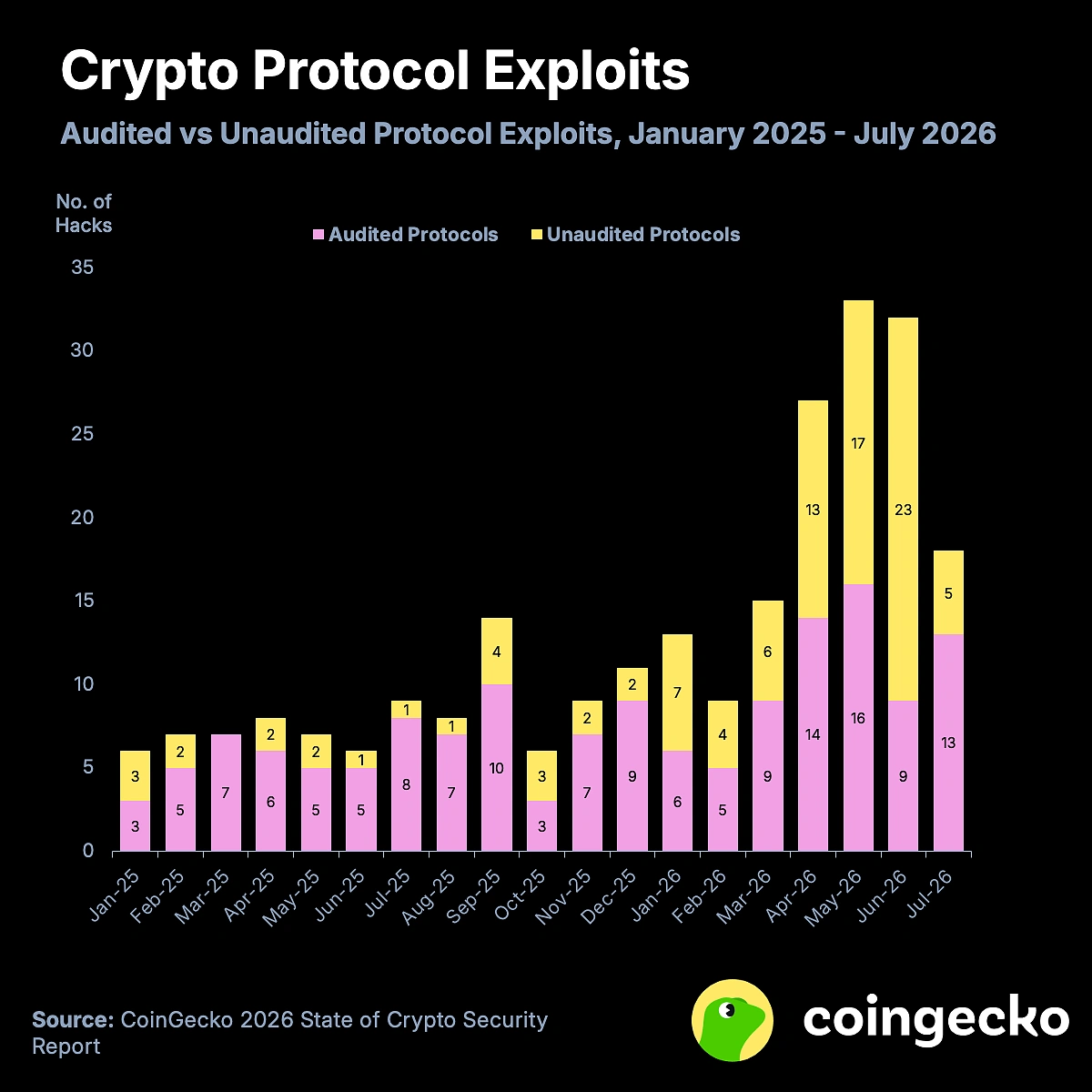
Crypto protocols that completed independent security audits accounted for 88.44% of all funds stolen since January 2025, according to CoinGecko’s 2026 state of crypto security report.
The study tracked 245 incidents and $3.63 billion in losses through July 2026. Independent auditors had cleared 147 of the breached platforms before attackers reached them.
Security Audits Did Not Stop 147 of 245 Crypto Hacks
CoinGecko said that only 11% of exploits involved in-scope smart contract flaws, though those cases still drained $396 million.
Follow us on X to get the latest news as it happens

The damage came from everywhere else. Attackers went after external infrastructure, code shipped after the audit closed, and systemic features that could be manipulated through governance.
Supply chain and infrastructure breaches took more than $1.8 billion, the largest single category in the report. Overall, smart contract exploit-driven losses across decentralized applications (dApps) reached $546 million.
May’s Stake DAO breach showed the limit. An attacker compromised a deployer key rather than exploiting contract logic. On centralized exchanges, stolen private keys remained the most common point of failure.
“Infrastructure and supply chain vulnerabilities have proven to be the most devastating for both CEXes and DEXes,” the report read.
The losses also cluster tightly. The 10 largest attacks alone produced 72.5% of everything taken across the 19-month window.
Cover against those losses is thinning too. Active on-chain insurance fell 20.2% to $130.2 million, and five of nine insurance protocols went inactive or changed direction.
2026 Brings More Hacks and Smaller Losses
Meanwhile, DefiLlama has logged 233 separate incidents so far in 2026, worth roughly $1.31 billion. The same stretch of 2025 saw 92 incidents and $2.37 billion in losses.
Incident volume more than doubled while total losses fell about 45%. Average loss per incident dropped from $25.8 million to $5.6 million. The $1.5 billion Bybit theft inflated the 2025 total.
Three cases carried most of this year’s total. Kelp DAO lost $292 million, and Drift Protocol lost $285 million in April 2026. These two also rank among the top three hacks since 2025, following Bybit
Smaller attacks now arrive pretty frequently, adding to the long list of 2026 crypto breaches. August alone brought an $8.5 million Term Labs governance exploit.
Overall, the pattern raises a scoping question rather than a competence one. Contract reviews remain narrow while deployment keys and governance parameters carry growing value.
Subscribe to our YouTube channel to watch leaders and journalists provide expert insights
The post Audited Protocols Account for 88% of Crypto Hack Losses Since 2025, Report Shows appeared first on BeInCrypto.
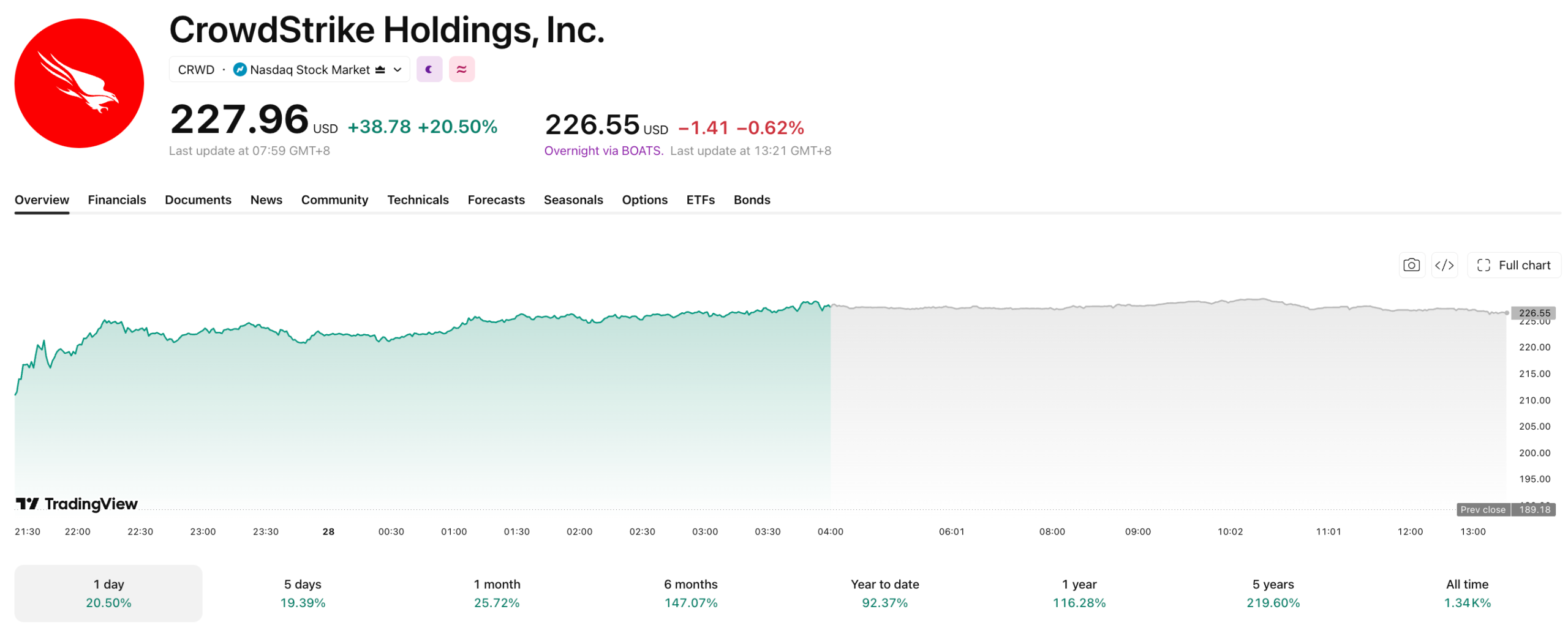
CrowdStrike Holdings (CRWD) stock jumped 20.5% after the cybersecurity firm posted record fiscal second-quarter results, with its CEO tying the surge in demand directly to rising artificial intelligence (AI) driven cyberattacks.
The company beat Wall Street’s revenue and profit targets and raised its full-year guidance following the report.
Record Quarter Driven by AI Threat Demand
CrowdStrike reported $1.47 billion in second-quarter revenue, up 26% year over year and above the $1.44 billion analysts expected. Adjusted earnings came in at $0.31 per share, topping the $0.29 consensus estimate.

Net new annual recurring revenue (ARR), a measure of new subscription commitments added during the quarter, hit a record $332.8 million, up 51% from a year earlier. Total ARR climbed 25% to $5.84 billion.
Founder and CEO George Kurtz tied the results to what he called the “Mythos moment.” This is a reference to Anthropic’s Mythos model launch. Reports say it is capable of exploiting previously unknown software flaws and has pushed AI security up enterprise priority lists.
“The Mythos moment translated into mass-market acceptance that AI adoption needs security, and that’s CrowdStrike. Every enterprise will run on AI, and securing it is the largest market opportunity in our history.”
George Kurtz, CrowdStrike Founder and CEO
On the earnings call, Kurtz described an “arms race” in which AI is simultaneously driving more attacks and more security spending.
CrowdStrike raised its full-year net new ARR growth forecast by 630 basis points to roughly 34% at the midpoint. It also lifted full-year revenue guidance to between $5.99 billion and $6.01 billion.
The results echo CrowdStrike’s own prior research flagging AI-driven threats, and follow Jim Cramer’s stock picks naming cybersecurity as a top 2026 theme.
The results position CrowdStrike as one of several cybersecurity vendors benefiting from mounting enterprise anxiety over AI-enabled threats, a trend likely to shape spending priorities into the next earnings cycle.
The post Rising AI Cyberattacks Fuel Demand for CrowdStrike, Sending Stock Up 20.5% appeared first on BeInCrypto.


Key takeaways
- Cardano slipped to around $0.210 after losing more than 7% this week.
- Whales holding between 10 million and 100 million ADA accumulated 160 million tokens since Sunday.
- ADA’s long-to-short ratio fell to 0.74, indicating that bearish positions dominate the derivatives market.
Cardano is trading at $0.210 on Friday after declining more than 7% since the beginning of the week.
Despite the pullback, on-chain data shows that some large investors are accumulating ADA.
However, conflicting derivatives and on-chain signals suggest traders remain uncertain about whether the cryptocurrency can recover or extend its decline.
Cardano whales accumulate 160 million ADA
Santiment’s Supply Distribution data shows that large Cardano holders have been buying ADA during the latest price correction.
Wallets holding between 10 million and 100 million ADA accumulated approximately 160 million tokens since Sunday. The purchases indicate that some whales continue to view the lower prices as a long-term buying opportunity.
However, the accumulation has yet to generate enough demand to reverse ADA’s short-term decline.
Whale buying during a pullback can support a positive longer-term outlook, but it does not guarantee an immediate recovery—particularly when broader market sentiment remains cautious.
Cardano’s derivatives indicators present a mixed outlook. CoinGlass data shows that ADA’s long-to-short ratio stood at 0.90 on Friday, approaching its lowest level in more than a month.
A ratio below one indicates that more traders hold short positions than long positions, reflecting expectations of further price declines.
The reading suggests that bearish traders continue to dominate the derivatives market despite the recent accumulation by whales.
ADA’s funding rate paints a slightly more optimistic picture. CoinGlass data shows that the token’s open interest-weighted funding rate turned positive on Thursday and reached 0.0013% on Friday.
A positive funding rate means traders holding long positions are paying those with short positions. This typically indicates that bullish positions are becoming more prominent, even though the long-to-short ratio continues to favor sellers.
The divergence between the two indicators highlights the uncertainty surrounding Cardano’s near-term direction.
CryptoQuant’s summary data supports this cautious view. Although the futures market has recorded large whale orders, selling activity remains dominant, while several other indicators are neutral.
Together, the metrics point to indecision rather than a clear bullish or bearish trend.
Cardano holds above key moving averages
ADA traded around $0.210 on Friday after losing more than 7% during the week. Despite the decline, Cardano remains above its 50-day and 100-day Exponential Moving Averages at $0.190 and $0.197, respectively.
Holding above these averages gives ADA a slightly bullish short-term bias, although the token continues to trade below significant overhead resistance.
Momentum indicators are also cooling. The Relative Strength Index has retreated toward the upper-50 region, while the Moving Average Convergence Divergence histogram is contracting.
These readings suggest that the buying momentum behind Cardano’s recent rebound is weakening.
Cardano’s first major resistance sits at $0.213, corresponding with the 50% Fibonacci retracement level of its latest decline.
A close above this level could allow ADA to target the 61.8% Fibonacci retracement at $0.231, followed by horizontal resistance at $0.236.
Beyond those levels, ADA faces a significant supply zone between the $0.245 horizontal resistance and the 200-day EMA at $0.246. A decisive break above this area would strengthen the bullish outlook and potentially clear the way for further gains.
On the downside, immediate support sits near the 38.2% Fibonacci retracement level at $0.195.

This region is reinforced by the 50-day and 100-day EMAs, making it an important support cluster for Cardano bulls. A sustained close below it could expose the 23.6% Fibonacci retracement level at $0.173.
If selling pressure intensifies and ADA loses $0.173, the token could retreat toward its stronger structural support around $0.150.
For now, whale accumulation offers some encouragement, but mixed derivatives data and weakening momentum leave Cardano’s short-term recovery uncertain.

Leeds Festival 2026 – Kasabian, Arkayla, The Lathums
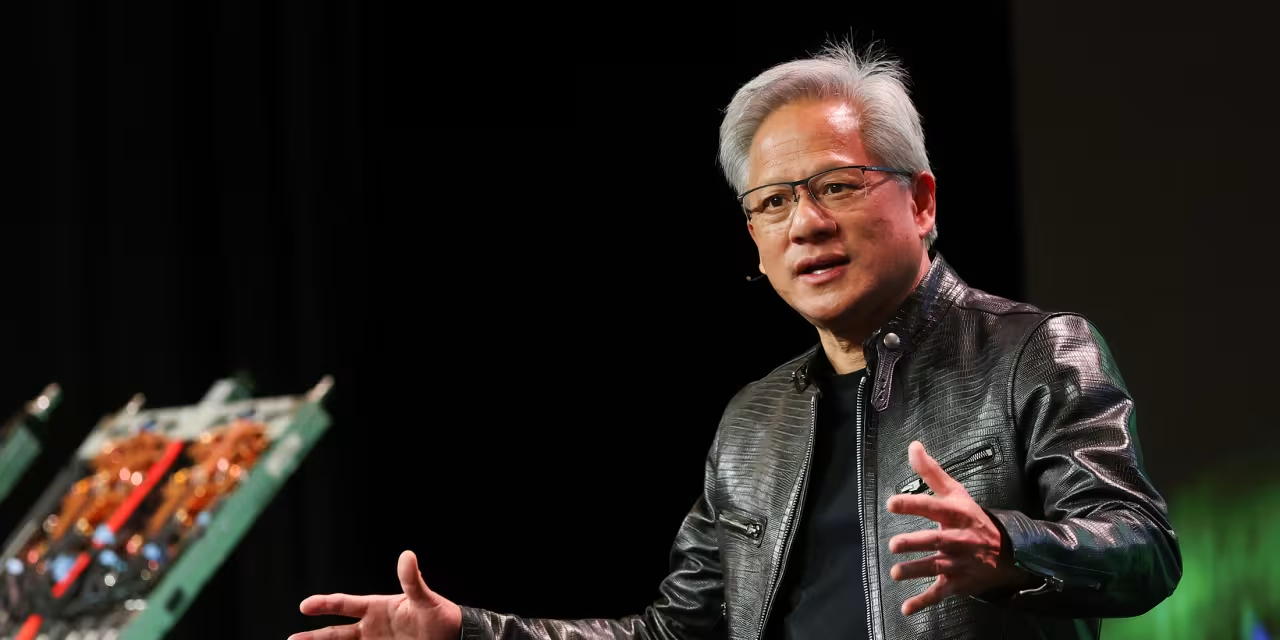
Nvidia’s Financial Commitments Surged in Latest Quarter

Dunamu and Visa Partner to Explore Stablecoin Payments, AI-Driven Financial Services





-

 Fashion7 days ago
Weekend Open Thread: Madewell – Corporette.com
-

 Crypto World2 days ago
SpaceX stock could rise 75% to $240, JPMorgan says
-

 Business6 days ago
Musk’s Tesla, SpaceX Confirm $16.8 Billion ‘Terafab’ Chip Plant as World’s Largest Building in Texas
-

 Crypto World6 days ago
anatomy of crypto’s biggest liquidation event since 2021
-

 Crypto World3 days ago
A $30 Billion AI Fund Implodes, Now the SEC Is Investigating Wall Street’s Role
-

 Politics6 days ago
6 months on, Irish renters crushed by effects of government housing bill
-

 Crypto World2 days ago
Did Trump Just Move SpaceX Stock With One Truth Social Post?
-

 Business5 days ago
Mystery AI Model ‘Ox Alpha’ Draws Developers With Free Access as Chinese Lab Origins Remain Debated
-

 Crypto World2 days ago
Warsh Jackson Hole keynote puts financial innovation first
-
 NewsBeat6 days ago
The ‘Lucky Dip Gang’ causing carnage for clicks: After five thugs were killed speeding in the wrong direction on a motorway, GUY ADAMS investigates a sick new trend… and why police aren’t even allowed to pursue them
-
 Crypto World6 days ago
Nvidia Stock Suffers Longest Losing Streak Since 2022: Will Q2 Earnings End It?
-

 Business4 days ago
Moderna CEO warns China is pouring state money into mRNA technology
-

 Business2 days ago
Walmart takes aim at younger shoppers with new fashion brand
-

 Business3 days ago
NVIDIA Stock Drops Nearly 2 Percent to $210 on Seventh Losing Day Ahead of Critical AI Earnings
-

 Tech6 days ago
Unitree’s New Superman Robot Claims to Outjump and Outrun Every Human, Usain Bolt Included
-

 Business6 days ago
Will Tesla Stock Be Higher or Lower a Year From Now? Here’s What Wall Street Analysts Are Saying
-

 Business7 days ago
UK firms in critical financial distress rise 9% to 53,756
-

 Sports5 days ago
Deshaun Watson fires back at Browns fans after being booed: ‘It’s a disrespectful thing’
-
 Crypto World5 days ago
Google Gemini AI Predicts Ethereum Could Become the Trade Retail Misses in 2026
-

 Tech7 days ago
Faster chip in a familiar form factor
You must be logged in to post a comment Login