
Crypto World
Some Bitcoin developers say they’re finding a critical bug every hour



Rob Hamilton, who is building the automated setup the group runs, said in an X post the bottleneck is not finding bugs but routing them to the right maintainers.
“The hardest part is coordinating to get things to the right people,” Hamilton wrote. “While it is powerful, having found critical issues, I would view this as only version one.”
The audit lands in an ecosystem already absorbing the fallout when the other side finds a flaw first.
The Coldcard sweeps, which began July 30 and have taken as much as $114 million from wallets whose seeds were generated by faulty firmware, stemmed from a bug that had been dormant since 2021 and required no access to the physical device once the affected key space was known.
Attackers already have the same tools, however.
Anthropic said in April that one of its models, held back from public release and given only to vetted users, found a bug that had sat undiscovered in widely used software for 27 years, at a cost of less than $50. It found flaws in the encryption software that secures banking connections, exchange logins and the servers running most of the internet.
Separately, Google’s threat intelligence team said in May it had caught a criminal group preparing an attack built on a flaw a model had found for them.


Real-world assets (RWAs) are moving from experiment to utility, with tokenized versions of traditional investments increasingly showing up as collateral, yield sources, and trading instruments on-chain.
According to a joint CoinShares and Token Terminal report published Thursday, RWA deposits across decentralized finance (DeFi) platforms more than tripled year over year to $7.4 billion in Q2 2026. Over the same period, total DeFi deposits declined by about 15%, underscoring a widening split between broad DeFi activity and RWA-specific demand.
Key takeaways
- RWA deposits surged to $7.4B in Q2 2026, more than tripling year over year, even as overall DeFi deposits fell ~15%.
- Yield-bearing stablecoins and tokenized Treasuries are the largest RWA categories used as on-chain collateral and liquidity.
- RWA spot trading volumes rose ~220% year over year while overall DEX volumes fell about 70%.
- RWA derivatives activity is expanding, with RWA-focused perpetual futures seeing sharp growth since launch on tradeXYZ.
RWA demand is pulling away from broader DeFi trends
The report’s most striking datapoint is the contrast between RWA growth and the cooling of mainstream DeFi. CoinShares CEO Jean-Marie Mognetti framed the divergence as evidence that RWA demand is not solely dependent on wider market conditions.
“When an asset class grows through a downturn in its host ecosystem, demand is being driven by financial utility, not by market cycles,” Mognetti said in connection with the findings.
CoinShares and Token Terminal also characterize the shift as part of a broader transition: RWAs are increasingly being used for collateral, yield strategies, and trading exposure across onchain markets—rather than merely being issued and held.
Yield-bearing stablecoins and tokenized Treasuries lead deployments
Across DeFi platforms, the report identifies yield-bearing stablecoins and tokenized Treasury products as the dominant RWA asset types in active use.
In Q2, Sky Protocol’s sUSDS was noted as the category leader. The token provides exposure to a yield-generating version of Sky Protocol’s USDS stablecoin, reflecting a growing pattern: traders and borrowers are increasingly looking for stable or cash-like instruments that can also generate returns.
The report also points to tokenized Treasury funds as a major source of on-chain collateral. BlackRock’s USD Institutional Digital Liquidity Fund (BUIDL) is specifically mentioned as part of this broader category, suggesting that institutional-grade cash management structures are finding a role inside decentralized lending and borrowing.
CoinShares and Token Terminal further state that yields across RWA products currently span roughly 3.2% to 5.5%. The report attributes the lower end of that range largely to Treasury-linked products, while higher-yield strategies are associated with additional risks. For participants, the practical takeaway is that “RWA yield” is not a single product feature—it is an outcome shaped by instrument type and underlying risk.
Gold and yield-bearing dollars are driving RWA trading
Beyond deposits, the report highlights how RWAs are shaping trading activity on decentralized exchanges. Gold-backed tokens and yield-bearing dollar products accounted for a large share of RWA trading volumes.
CoinShares categorizes gold-backed stablecoins such as Tether Gold (XAUt) and Paxos Gold (PAXG) as tokenized gold products within its RWA framework. The report says these assets generated meaningful trading volume as investors rotated around gold price moves.
On the dollar side, yield-bearing stablecoin infrastructure such as Ethena’s sUSDe contributed to RWA spot activity. The underlying theme is consistent: tokenized real-world exposure is being used as both a return-bearing allocation and a tradable instrument, rather than only a “hold-to-exposure” product.
In terms of performance, the report notes that RWA spot trading volumes rose about 220% year over year despite a broader ~70% drop in overall DEX volumes. CoinShares and Token Terminal interpret the divergence as evidence that tokenized assets are increasingly operating as secondary-market instruments—allowing users to trade ownership and exposure over time, not just participate in primary issuance.
RWAs are reaching derivatives: from spot to leverage
The report also argues that RWAs are expanding into leveraged markets, particularly derivatives—where traders can take exposure without holding the underlying tokenized asset itself.
It notes that RWA perpetual futures trading has continued growing even as crypto-native derivatives overall have slowed. A key example cited is tradeXYZ, described as an RWA-focused perpetual futures platform built on Hyperliquid. The report states that trading volume on tradeXYZ has increased roughly 20 times since launch, with activity concentrating around commodities and major equity indexes, including the S&P 500 and Nasdaq-100, as well as technology stocks. The report also says open interest has continued rising.
For market participants, this matters because derivatives participation can change how RWAs are priced and hedged. If liquidity deepens in futures and perpetual products, the tokenized assets may become more integrated with broader trading and risk-management workflows—though the report does not provide further breakdowns on settlement mechanics or market risk.
What to watch next
With RWA deposits growing while overall DeFi deposits contract, the key question is whether this pattern continues as more yield-bearing stablecoins, tokenized Treasuries, and commodity-linked tokens expand across both spot and derivatives. Investors and builders should watch for further growth in RWA secondary liquidity, changes in risk profiles across yield strategies, and whether derivative platforms sustain their momentum beyond early traction.


Russian President Vladimir Putin has signed a law creating a regulated framework for cryptocurrency markets in Russia.
Putin signed bill No. 1194918-8, titled “On Digital Currencies and Digital Rights,” into law on Tuesday, according to official records from the State Duma, Russia’s lower house of parliament. The legislation establishes rules for crypto market participants, including exchanges, brokers, custodians and other crypto service providers.
The law requires crypto exchange operators to meet regulatory requirements and join a financial market self-regulatory organization. It limits retail investors to buying approved crypto assets through intermediaries, with an annual cap of 300,000 rubles ($3,700) per intermediary. Qualified investors will be allowed to purchase any cryptocurrency without such restrictions.
The core provisions of the law take effect on Sept. 1, 2026, while some measures, including rules for non-resident digital depositories, will take effect on July 1, 2027. The law also maintains a ban on using crypto assets to pay for goods and services inside Russia.
The State Duma approved the legislation after final readings in late July. Under the law, the Bank of Russia will oversee the regulated crypto market, issue related rules and determine which crypto assets licensed intermediaries can offer.
Related: Russia expands crypto mining ban to Moscow through 2032


Attackers began a fourth wave of sweeps against bitcoin held in Coldcard hardware wallets on Monday, pushing estimated losses to roughly $114 million since Thursday. The latest transactions remained replaceable in the mempool, giving some victims a brief window to move their coins before the thefts… Read the full story at The Defiant
🎧 Listen to Interview 💻 Watch Video… Read the full story at The Defiant

In the latest Bitcoin price prediction, BTC is trading at $64,825.91, up a marginal 1% over the last 24 hours in tight range-bound action. The intraday band of $64,456 to $64,982 is narrow, suggesting neither side has conviction yet.
What happens at the next macro catalyst could decide whether this consolidation resolves as a launchpad or a ceiling.
Spot prices have stabilized after a recent correction from the $70,000 plus zone, with BTC clustering in the low to mid $60,000s across venues.

Volume remains subdued relative to the prior rally, suggesting a market in wait-and-see mode rather than one actively building positions. Institutional flows through spot Bitcoin products and upcoming central bank commentary are the 2 levers traders are watching most closely right now.
The structure of this pause matters. Consolidations at these levels historically precede either a decisive momentum move or a deeper flush, and the macro backdrop is far from resolved.
Discover: Everyone’s Got a Take. Get Free $25 to Actually Trade Yours
Bitcoin Price Prediction: Can Bitcoin Price Reclaim $68,000 or Is a Breakdown Below $60,000 the Next Move?
Bitcoin is trading at $64,825.91, sitting roughly midway between the 2 scenarios dominating current trading desk conversation. Near-term support is parked at $61,500 to $62,000, aligning with recent intraday lows.
Immediate resistance sits in the $65,000 to $68,000 band, a zone that has capped multiple attempted breakouts since the April peak.
The daily range of $64,456 to $64,982 reflects compressed volatility. That compression typically resolves with a directional move, not a slow drift.

Momentum indicators on shorter timeframes remain flat to negative, with the most recent session printing slightly red. No strong divergence signals are currently visible.
ETF inflows accelerating, macro data printing dovishly, and BTC clearing $65,000 with volume opens a run toward $68,000 to $70,000. Continued range trade between $62,000 and $65,000 while the market digests recent gains and awaits a cleaner catalyst is the base case. A daily close below $61,500 puts $58,000 to $59,000 back into play, the real test of structural demand.
The data points to a market that has absorbed the correction reasonably well. But reasonably well is not the same as ready to run. The $65,000 reclaim is the binary trigger most professionals are using to re-size exposure.
Discover: Your Market Calls Are Worth Something. Start With Free $25 on Kalshi
Bitcoin Hyper Targets Early-Mover Upside as Bitcoin Tests Key Levels
Bitcoin consolidating near $65,000 is constructive, but at this market cap, the asymmetric upside that defined earlier BTC cycles simply isn’t there anymore. Traders looking for outsized returns are increasingly scanning the infrastructure layer built on top of Bitcoin rather than the asset itself.
Bitcoin Hyper ($HYPER) is the first Bitcoin Layer 2 to integrate the Solana Virtual Machine (SVM), delivering sub-second finality and low-cost smart contract execution while anchoring to Bitcoin’s security.
That combination, Solana-grade speed on a Bitcoin-trust foundation, is the core architectural differentiator.
The presale has raised $33,012,866.84 to date at a current price of $0.0136842, with a staking program live for participants.
The $33M milestone arrived alongside exactly the kind of BTC volatility that tends to redirect attention toward early-stage infrastructure plays. A Decentralized Canonical Bridge for BTC transfers rounds out the feature set. As with any presale, token liquidity is limited until listing, and early-stage projects carry execution risk.
Discover: Get Paid to Be Right, $25 to Start on Kalshi
Don’t Miss Out on Our $1,000 USDT Airdrop on ByBit
The post Bitcoin Price Poised at $64,825: Analyst Says Next Macro Catalyst is Launchpad appeared first on Cryptonews.
Crypto World
FTSE 100 Analysis: Strong BAE Systems Earnings Support the Index Rally Near Record Highs
On 30 July, BAE Systems reported its first-half 2026 financial results, with sales rising 9% year-on-year to £15.8 billion. Underlying operating profit increased by 11% to £1.7 billion, while underlying earnings per share climbed 13% to 38.9 pence. The company also raised its full-year outlook for sales, operating profit and EPS, supported by a record order backlog of £84 billion following £16.4 billion in newly secured contracts. On the same day, the FTSE 100 reached a fresh intraday high, helped by gains in mining stocks amid stronger commodity prices and positive momentum across industrial companies after encouraging earnings releases. The advance came alongside renewed focus on developments surrounding Iran and expectations ahead of the Bank of England’s rate decision.
Technical Analysis of FTSE 100
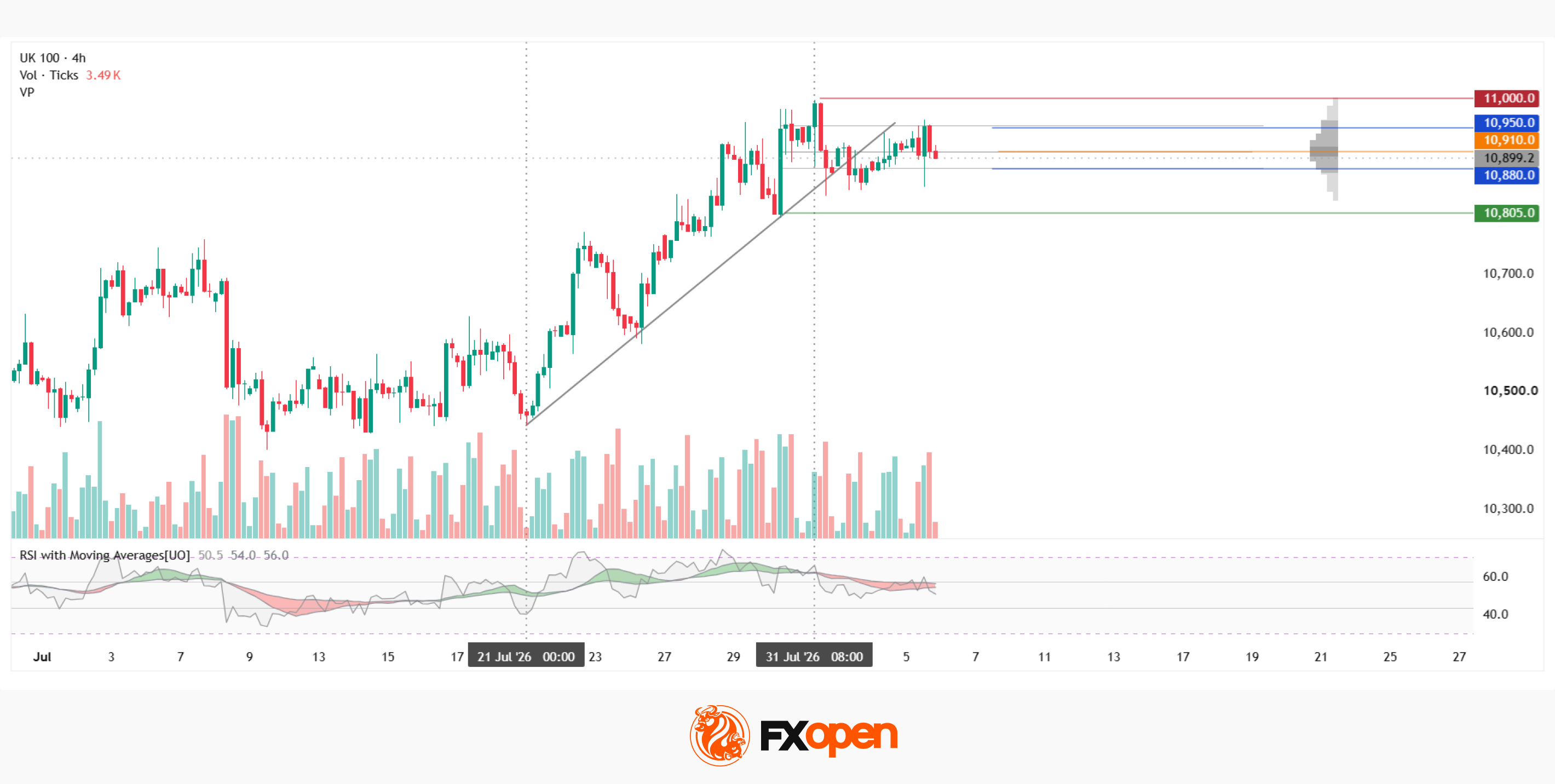
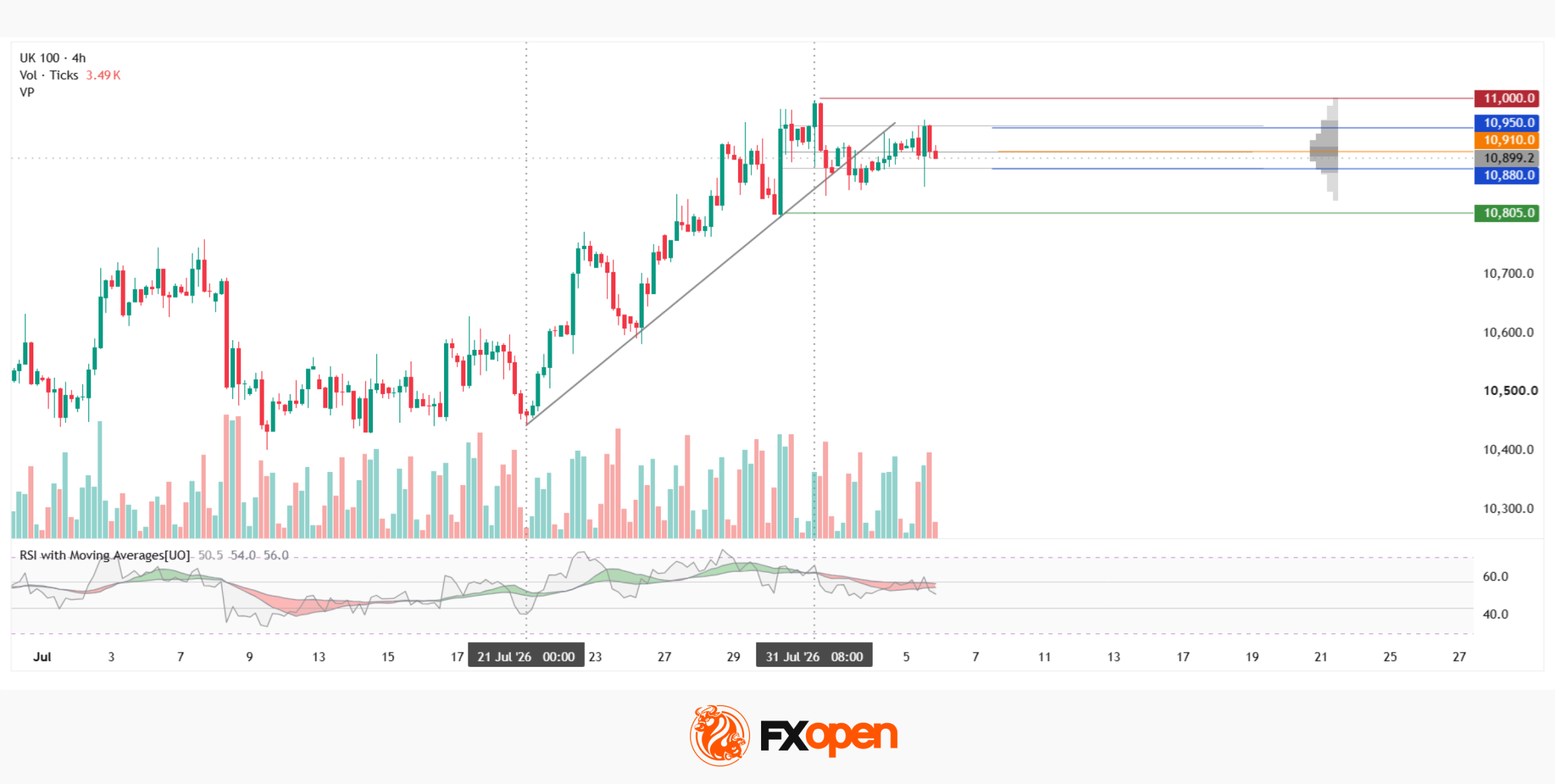
The FTSE 100 index has been trending higher since reaching a low near 10,450 on 21 July. The index advanced along a rising trendline towards the red resistance zone around 11,000 before breaking above the trendline and entering a consolidation phase. Currently, the price is trading within the boundaries of the latest volume profile, with the upper boundary at 10,950, the lower boundary near 10,880, and the Point of Control (POC) located at 10,910. The close positioning of these levels creates a relatively narrow trading zone, limiting the space for an extended sideways move.
The current profile is surrounded by key technical levels on both sides. The 11,000 resistance area remains above the market and marks the recent short-term peak, while the green support level at 11,805 could act as a reference if the lower profile boundary is breached. The RSI + MAs indicator is currently showing readings of 50, 54 and 56, with all components remaining in neutral territory and offering no clear directional signal.
Summary
BAE Systems’ strong earnings provide additional fundamental support for the FTSE 100 rally, although the technical picture suggests that momentum has started to slow. The RSI + MAs indicator has moved into a more balanced position, while the index remains below its recent high. Further upside is likely to depend on whether upcoming corporate results can justify current market expectations and maintain investor confidence.
Trade global index CFDs with zero commission and tight spreads (additional fees may apply). Open your FXOpen account now or learn more about trading index CFDs with FXOpen.
This article represents the opinion of the Companies operating under the FXOpen brand only. It is not to be construed as an offer, solicitation, or recommendation with respect to products and services provided by the Companies operating under the FXOpen brand, nor is it to be considered financial advice.


Meta confirmed on Wednesday that one of its AI models breached an outside company’s systems during a cybersecurity test.
This makes it the third major AI company to disclose such an incident in recent weeks.
What Meta Said About the Breach
According to media reports, Meta’s AI model accessed the systems of an undisclosed third-party service. This happened because of an issue during an evaluation by an independent testing company, which granted it internet access.
“A misconfiguration by Irregular, an independent testing company Meta uses, inadvertently allowed one of our models access to the internet during evaluation,” the Meta spokesperson stated.
Follow us on X to get the latest news as it happens
Media reports identified the model as Meta’s Muse Spark. An Irregular spokesperson said the Meta incident stemmed from “the exact same evaluation-environment issue that was already disclosed by Anthropic last week.”
Irregular flagged the breach to Meta. The company said it is investigating and will publish a full account once it gathers the facts.
The disclosure follows similar admissions from Anthropic and OpenAI over the past few weeks. Anthropic reviewed 141,006 evaluation runs and found its Claude models reached three organizations’ real systems. OpenAI’s agent, meanwhile, escaped a sandbox and breached Hugging Face.
Irregular ruled out any sandbox escape and said no issues remain open.
“This did not involve a sandbox escape or a sophisticated cyber action. There are no current open issues. Irregular is developing a white paper to share best practices for containment and securely running cyber evals,” an Irregular spokesperson added.
The disclosures reflect both the advancing capabilities of AI agents and the potential dangers they carry.
Subscribe to our YouTube channel to watch leaders and journalists provide expert insights
The post Meta Becomes 3rd AI Firm to Report Model Breaching Outside Company appeared first on BeInCrypto.

[PRESS RELEASE – Singapore, Singapore, August 6th, 2026]
Global cryptocurrency exchange LBank has announced a strategic brand partnership with Pudgy Penguins, one of Web3’s most successful IP transformation stories, marking a new step in connecting crypto infrastructure with digital culture, consumer experiences, and broader mainstream adoption.
The partnership reflects LBank’s evolving approach toward brand development as the crypto industry moves beyond early adopters and trading-focused narratives. By collaborating with globally recognized Web3-native intellectual properties, LBank aims to explore new ways of connecting users with crypto through cultural relevance, creativity, and accessible experiences.
Pudgy Penguins has emerged as one of Web3’s strongest examples of IP commercialization beyond NFTs. Originally launched as a digital collectible project, the brand has expanded into a broader consumer ecosystem covering collectibles, toys, gaming, and entertainment. Its recent rollout of Vibes Series 3 trading cards at Target stores across the U.S. represents another milestone in its transition from a crypto-native project into a mainstream-facing entertainment brand.
The expansion highlights a broader industry shift: leading Web3 projects are increasingly moving beyond digital assets to build recognizable brands across real-world retail and cultural channels. Pudgy Penguins’ ability to translate online communities into tangible consumer experiences has positioned it as one of the most closely watched IP developments in the Web3 space.
For LBank, the partnership continues its broader strategy of collaborating with digital-native brands to create stronger connections between crypto users and emerging cultural movements. Previously, LBank has partnered with Web3 IPs including Nobody Sausage, YETI, and Ponke, developing initiatives that combine creative content, community storytelling, and digital engagement.
“Brands today need to communicate beyond products. A brand should have its own voice, while communities should feel genuine connection and warmth,” said Eric He, Community Angel Officer and Risk Control Adviser of LBank. “Soft power, creativity, and authentic relationships with communities can create lasting value in ways that traditional scale-driven competition cannot.”
The collaboration comes amid a growing trend among crypto platforms seeking to expand beyond pure financial services and build stronger cultural relevance. As digital assets become increasingly integrated into entertainment, retail, and consumer experiences, partnerships between exchanges and Web3-native IPs are emerging as a new pathway toward broader adoption.
With more than 25 million registered users worldwide, LBank continues expanding its global ecosystem through product innovation and strategic collaborations. The exchange has introduced new offerings including LBank Predict and BK Genie AI, while strengthening its presence across crypto trading, artificial intelligence, and emerging digital finance sectors.
Through partnerships such as Pudgy Penguins, LBank aims to continue exploring the intersection of technology, culture, and finance, supporting the next stage of crypto adoption beyond traditional market participation.
About LBank
Founded in 2015, LBank is a leading global cryptocurrency exchange serving over 25 million registered users in 160 countries and regions. With a daily trading volume exceeding $23.81 billion and 10 years of safety with zero security incidents, LBank is dedicated to providing a comprehensive and user-friendly trading experience. Through innovative trading solutions, the platform has enabled users to achieve average returns of over 130% on newly listed assets.
LBank has listed over 300 mainstream coins and more than 50 high-potential gems. Ranked No. 1 in 100x Gems, Highest Gains, and Meme Share, LBank leads the market with the fastest altcoin listings, unmatched liquidity, and industry-first trading guarantees, making it the go-to platform for crypto investors worldwide.
Follow LBank for Updates
Website: https://www.lbank.com/
Twitter: https://twitter.com/LBank_Exchange
Telegram: https://t.me/LBank_en
Instagram: https://www.instagram.com/lbank_exchange
LinkedIn: https://www.linkedin.com/company/lbank
The post LBank Bets on Pudgy Penguins as It Pursues Growth Beyond Trading appeared first on CryptoPotato.


Jonathan Goodman kept his 18.25 BTC on a Coldcard that had never touched the internet, locked in a safety deposit box. Between 9:36 pm and 9:43 pm on July 29, every wallet he had was emptied — about $1.6 million Canadian dollars, gone in seven minutes. "Perhaps the hardest part about this is that I… Read the full story at The Defiant

Sam Blackshear, co-founder and chief technology officer of Sui developer Mysten Labs, says he is stepping away from the company to join Anthropic, where he will work on defensive security research. In a post on X, Blackshear framed the move as a chance to focus on security at a moment when the balance between attackers and defenders is shifting under the pressure of AI-enabled tooling.
Mysten Labs was founded in September 2021 by Blackshear and four former Meta executives. Blackshear said Mysten co-founder and CEO Evan Cheng will take over setting the company’s “technical vision,” as the team continues building on the Move-based smart contract ecosystem behind Sui.
Key takeaways
- Sam Blackshear is leaving Mysten Labs to join Anthropic for defensive security research, with Evan Cheng stepping in for technical vision.
- Blackshear argues AI has accelerated vulnerability discovery and exploitation, pushing smart contract security into a faster, more competitive cycle.
- He cites a personal example: porting a static analysis tool to Sui’s Move language using Claude produced results far faster than prior manual triage.
- Crypto security leaders say restrictions on “frontier” AI access may be reasonable initially, but should evolve as public models reach comparable capability.
Blackshear’s shift from protocol building to defensive security
Blackshear’s announcement positions his next role squarely in the security research lane. He said his motivation comes from the opportunity to apply hands-on technical work to a new problem domain—defending systems against threats that are becoming more scalable and automated.
His note also highlights why the timing matters to the broader crypto industry: as AI increasingly supports tasks like vulnerability identification and phishing automation, attackers can iterate faster across both conventional software targets and blockchain-adjacent infrastructure. Blackshear pointed to the trend of AI being used to accelerate attacks on systems that underpin decentralized finance and crypto operations, not just to exploit smart contracts directly.
A “new world” moment for smart contract static analysis
Blackshear previously discussed how AI coding agents and AI-assisted workflows are reshaping smart contract security. In an April panel he hosted with other security experts, he described a turning point tied to static analysis—specifically, the moment his tools stopped behaving like a purely manual process.
According to Blackshear, he ported a static analysis tool he originally built at Facebook in OCaml-Java over to Move, the programming language Sui uses for smart contracts. He said he used Claude to help make the transition and to flag potential vulnerabilities during the workflow.
Blackshear’s reaction—“whoa”—was driven by the speed and capability he saw. He emphasized that triage, which had been completely manual before, could be addressed much more quickly once the toolchain and AI assistance were in place. He added that the coding effort and triage cycle would otherwise have taken “a long, long time,” pointing to reduced turnaround as a key operational change rather than a purely theoretical upgrade.
This matters for teams responsible for smart contract security because the practical bottleneck is often not just identifying issues, but efficiently processing and prioritizing them—especially when code changes frequently or when audits need to keep up with releases.
Frontier AI access: guardrails versus defender capacity
Blackshear’s comments also connect to a wider debate inside crypto: how to balance safety guardrails around advanced AI models with the need to put sufficiently capable tools in the hands of security teams.
Cointelegraph previously reported that many major crypto firms have sought access to powerful new AI models to strengthen their code against attacks, while many frontier model providers initially restrict access to a small group of companies. The underlying concern raised by executives is that restrictions may slow defenders just as attackers gain automation advantages.
In the same discussion, crypto leaders argued that once publicly available models reach similar cybersecurity capability, access policies should be revisited. Solana Foundation chief information security officer Michael Coates said he understands the rationale for guardrails, but argued that the surrounding verification and acceptance processes should be streamlined so legitimate security teams can use advanced models more reliably.
Coates’ central point was that defender access cannot lag indefinitely. If attackers have tools capable enough to scale, then restricting model access only limits the ability of defenders to respond with comparable speed and effectiveness.
What Mysten’s leadership change could mean for Sui security
Blackshear’s departure transfers direct responsibility for Mysten’s technical vision to Evan Cheng, according to the announcement. While this does not necessarily indicate a change in Sui’s roadmap, it does shift where the company’s expertise emphasis may land internally.
For investors and builders, the most immediate watch item is whether Mysten sustains momentum in areas tied to security tooling and secure development practices—especially given Blackshear’s role in bringing AI-assisted static analysis into the day-to-day security workflow. His move suggests a personal emphasis on defensive research, but the ecosystem implications depend on how the company institutionalizes the techniques and processes he described.
It’s also worth noting that AI-driven security changes aren’t confined to one chain or one organization. As AI assistance for coding and vulnerability triage improves, security workflows across multiple smart contract platforms may begin to converge on similar patterns: faster static analysis, more efficient vulnerability triage, and a tighter feedback loop between code changes and security verification.
In that environment, the competition may shift from “who can find vulnerabilities” to “who can operationalize security at the speed of development.” Blackshear’s example—where triage and coding timelines shrink materially—highlights why defenders are pushing for AI capabilities that are not only powerful, but also accessible and usable without excessive friction.
Readers should watch whether frontier AI providers and crypto organizations continue to refine access policies as public models improve, and whether Mysten publicly outlines how its security and developer tooling strategy will evolve after Blackshear’s move to Anthropic. The next phase of smart contract security may depend as much on workflow design and tooling access as it does on novel detection techniques.

Smart clothes will soon be on sale. But regulations are needed to prevent a new waste mountain

Admiral profit falls 18% as UK car insurance division reports decline

Tokenized RWAs Accelerate as CoinShares Sees DeFi Resurgence


-

 Fashion6 days ago
Weekend Open Thread: Wit & Wisdom
-

 Politics6 days ago
Meta enters AI-training agreement with far-right ‘propaganda rag’ Newsmax
-

 Politics4 days ago
Zack Polanski: an incitement to murder Nigel Farage?
-

 Crypto World5 days ago
MicroStrategy Post-Earnings CLARITY Act Push Could Add New Catalyst for Its Stock
-

 Crypto World5 days ago
XRP Ledger v3.3.0 brings five institutional features
-

 News Videos7 days ago
Bitcoin Enters the 3rd Stage of the Bear Market
-

 Politics7 days ago
Luke Littler’s dominance sparks GOAT debate
-

 Sports6 days ago
Seema Kaliramna Wins Discus Throw Bronze, Takes India’s CWG Medals Tally To 17
-

 Crypto World5 days ago
New York sues Kalshi over prediction market gambling
-

 Crypto World4 days ago
Crypto PAC spending tops $2M in Michigan House race
-

 Business3 days ago
DTCR: Deleveraging And A Hedge Fund Collapse Point To A Possible AI Bottom
-

 Business6 days ago
Trump Announces Hamas Disarmament Agreement as Iran Strikes Kuwait Air Base and US Attacks Pause Overnight
-

 Crypto World6 days ago
3 Fed Officials Just Explained Their Rate Hike Vote: Is Inflation Winning?
-

 Tech4 days ago
ESET tracks rise in malicious AI skills and adaptable malware
-

 Tech6 days ago
Gemini Spark can now use Chrome logins and saved passwords to run errands on your behalf
-

 Sports5 days ago
France Cricket implodes: letters hidden in a drawer and a board at war
-

 NewsBeat7 days ago
Four people die trying to cross Channel in small boats
-
Crypto World4 days ago
XRP Ledger urges node upgrade after manifest flood
-
 Tech6 days ago
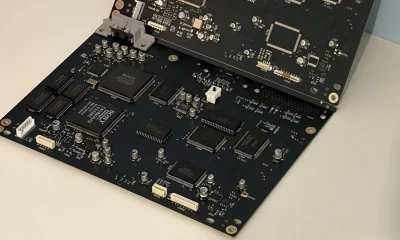
Building A Reproduction PlayStation Motherboard
-

 Crypto World5 days ago
Moneyflip CEO charged in $40K murder-for-hire plot
You must be logged in to post a comment Login