
Crypto World
SpaceX just posted a $540 million bitcoin loss and every corporate BTC holder felt it



The first public earnings from Elon Musk’s space company reveal the real cost of holding bitcoin on a balance sheet under the new accounting rules. The numbers tell a story that the “laser eyes” crowd would prefer to skip.
Summary
- SpaceX reported second quarter revenue of $7.8 billion, beating Wall Street expectations by $900 million, but its bitcoin holdings fell from $1.64 billion at the end of 2025 to $1.10 billion at the end of June 2026, a decline of $540 million that flowed directly through the income statement.
- The company disclosed it holds 18,712 BTC in its SEC filing, more than double the 8,285 coins that on-chain analytics firm Arkham Intelligence had tracked to SpaceX wallets as recently as May 2026, suggesting the company aggressively accumulated bitcoin in the weeks surrounding its $86 billion IPO.
- Under the FASB fair-value accounting standard (ASU 2023-08) that took effect for fiscal years beginning after December 15, 2024, companies must now report both gains and losses on crypto holdings through the income statement each quarter, replacing the old impairment-only model that could only write values down.
- SpaceX is the first major company to report its initial quarterly earnings as a public entity under the new rules during a significant bitcoin drawdown, making its filing a template for how markets will react to crypto volatility on corporate balance sheets.
- The timing is particularly exposed: on August 6, roughly 912 million shares held by employees and early backers become eligible for sale, and the bitcoin loss will factor into every analyst model used to price that unlock.
SpaceX topped every financial estimate Wall Street had for it. Revenue came in $900 million above consensus. Adjusted EBITDA nearly tripled year over year to $3.5 billion. The net loss narrowed from $1.0 billion to $541 million. By every operational measure, the company’s launch business, Starlink subscriber growth, and AI infrastructure expansion are performing ahead of schedule.
None of that made the stock go up after hours. SPCX fell six percent in extended trading on August 4, the same day the Nasdaq 100 gained 3.3 percent. The reason is not in the revenue line. It is in the balance sheet, where 18,712 bitcoin sat at the end of June worth $540 million less than they were worth six months earlier.
This is the first time a company of SpaceX’s size has published quarterly earnings as a newly public entity while holding a significant bitcoin position during a major drawdown. The filing is not just an earnings report. It is a live demonstration of what the new FASB fair-value accounting rules do to a corporate income statement when bitcoin drops 33 percent in six months.
What the filing actually shows
SpaceX’s SEC filing disclosed $1.10 billion in digital assets as of June 30, 2026, down from $1.64 billion at the end of 2025. The $540 million decline represents the mark-to-market impact of bitcoin’s price falling from roughly $87,600 at the end of December 2025 to approximately $58,800 at the end of June 2026, a 33 percent drop.
The 18,712 BTC position is itself a revelation. As recently as May 18, 2026, on-chain analytics from Arkham Intelligence showed SpaceX holding 8,285 BTC in Coinbase Prime custody, a position that had been unchanged since June 2022. The SEC filing showing 18,712 BTC means SpaceX acquired approximately 10,427 additional bitcoin in the weeks surrounding its June IPO.
That acquisition timing is significant. SpaceX was buying bitcoin while the price was falling, accumulating more than $600 million in additional exposure during a period when the asset was in a sustained downtrend. Whether this was a deliberate dollar-cost averaging strategy, part of the IPO capital allocation plan, or simply the transfer of previously untracked cold storage into the disclosed entity is not clear from the filing. What is clear is that the company’s bitcoin exposure is substantially larger than the market believed before these earnings.
The net loss of $541 million is almost exactly equal to the decline in bitcoin holdings. Strip out the crypto mark-to-market, and SpaceX’s core operations would have been approximately breakeven, a significant milestone for a company that has historically reinvested aggressively at the expense of profitability.
How the new accounting rules changed the math
Before FASB ASU 2023-08 took effect, companies that held bitcoin classified it as an indefinite-lived intangible asset. Under those rules, if bitcoin’s price fell below the carrying value at any point during a quarter, the company had to write the asset down to the lowest price reached. But if the price recovered, the company could not write the value back up. The accounting was one directional: losses were permanent on the books, gains were invisible until the company sold.
This created a perverse incentive structure. A company that bought bitcoin at $60,000 and watched it fall to $30,000 and then recover to $60,000 within the same quarter would still report a $30,000 per coin impairment loss. The balance sheet would show the asset at $30,000 even though it was trading at $60,000. The only way to recognize the recovery was to sell the bitcoin and realize the gain, which defeated the purpose of holding it as a long-term treasury asset.
Strategy, formerly MicroStrategy, reported a $670 million impairment loss in its fourth quarter 2024 earnings under the old rules. That loss appeared on the income statement despite bitcoin’s price being higher at the end of the quarter than at the beginning. The loss reflected intra-quarter price dips that triggered mandatory write-downs, not actual economic losses.
The new standard, which applies to fiscal years beginning after December 15, 2024, replaces this with fair-value measurement. Companies report bitcoin at its market price on the last day of the quarter. If the price goes up, that gain flows through the income statement. If it goes down, that loss flows through the income statement. The accounting now reflects economic reality in both directions.
For SpaceX, this means the $540 million loss is real in the accounting sense but potentially temporary in the economic sense. If bitcoin recovers to its year-end 2025 price, SpaceX would report a corresponding $540 million gain in a future quarter. Under the old rules, the $540 million loss would have been permanent on the books regardless of any price recovery.
The arithmetic of corporate bitcoin at $63,000
The current bitcoin price of approximately $63,000 creates a specific set of exposures for the major public company holders. The arithmetic illustrates why SpaceX’s earnings report sent a ripple through every corporate treasury that holds bitcoin.
SpaceX holds 18,712 BTC at a current market value of approximately $1.18 billion. Every one percent move in bitcoin’s price changes SpaceX’s reported earnings by roughly $11.8 million. A ten percent quarterly swing, which is historically common for bitcoin, would produce a $118 million line item on the income statement, positive or negative.
Strategy holds approximately 580,000 BTC, making it the largest corporate holder by a wide margin. At $63,000, that position is worth roughly $36.5 billion. A one percent bitcoin move changes Strategy’s reported earnings by $365 million. Strategy’s entire business model is now a leveraged bitcoin bet, so investors expect this volatility. But for companies where bitcoin is a treasury allocation alongside an operating business, like SpaceX, Tesla, and Block, the earnings volatility creates a communication problem.
Tesla sold roughly 75 percent of its bitcoin position in 2022, retaining a smaller allocation. Block holds bitcoin as both a treasury asset and a product feature through its Cash App. Neither company has the combination of a massive bitcoin position and a first-ever public earnings report that made SpaceX’s filing uniquely consequential.
The problem for CFOs considering a bitcoin treasury allocation is straightforward: under fair-value accounting, the bitcoin position will dominate the earnings narrative in any quarter where bitcoin moves significantly. SpaceX beat revenue estimates by 13 percent and tripled its EBITDA, and the post-earnings conversation is about bitcoin. That is the cost of holding a volatile asset on a public balance sheet under mark-to-market rules.
Why SpaceX bought more bitcoin into the decline
The increase from 8,285 to 18,712 BTC is the most under-discussed element of the filing. SpaceX more than doubled its bitcoin position during a period when the price was falling.
Several explanations are plausible. The most straightforward is that SpaceX used a portion of its IPO proceeds to purchase additional bitcoin as part of a predetermined treasury allocation strategy. The $86 billion IPO raised substantial capital, and allocating roughly $600 million to bitcoin would represent less than one percent of the company’s market capitalization.
Another possibility is that the Arkham Intelligence data was incomplete. On-chain analytics can only track wallets that have been identified and linked to a known entity. If SpaceX held bitcoin in wallets that Arkham had not attributed to the company, the “new” purchases may actually be the disclosure of a position that already existed but was not publicly known. The SEC filing requires disclosure of total holdings regardless of which wallets hold them.
A third explanation is that the increase reflects bitcoin received as payment for Starlink subscriptions or launch services. SpaceX began accepting bitcoin payments for certain services in 2022, and accumulated bitcoin from customer payments would appear in the total holdings disclosed in the SEC filing.
Whatever the reason, the decision to maintain or increase bitcoin exposure while the price was declining signals that SpaceX’s bitcoin position is strategic rather than opportunistic. Companies that view bitcoin as a short-term trade typically sell into weakness. Companies that view it as a long-term treasury allocation buy into weakness. SpaceX’s behavior matches the second pattern.
The August 6 share unlock and the bitcoin overhang
Two days after this earnings report, on August 6, approximately 912 million SpaceX shares held by employees and early backers become eligible for sale. This is the first major share unlock since the June IPO, and it will significantly increase the stock’s public float.
The bitcoin loss complicates the unlock pricing. Every analyst covering SPCX must now model the bitcoin position as a source of earnings volatility. A shareholder deciding whether to sell at unlock must factor in not just SpaceX’s launch revenue and Starlink growth but also their view on bitcoin’s price trajectory for the remainder of the year.
If bitcoin remains at $63,000 or falls further, the Q3 earnings report will show another markdown or a flat position at best. If bitcoin recovers to $80,000, SpaceX would report a gain of approximately $318 million, which would make Q3 earnings look dramatically better without any change in the underlying business.
This is the volatility import problem. By holding 18,712 BTC, SpaceX has imported the volatility of the bitcoin market into its equity. Shareholders who bought SPCX for exposure to the space economy and Starlink’s subscriber growth now also have exposure to bitcoin’s price, whether they wanted it or not. There is no way to separate the two exposures in the stock price.
The unlock timing creates a specific risk scenario. If bitcoin drops further between now and August 6, unlocking shareholders face the prospect of selling into a stock that carries both the dilution pressure of increased float and the uncertainty of a declining bitcoin position. Conversely, if bitcoin rallies before the unlock date, some shareholders may hold rather than sell, reducing the supply pressure. Bitcoin’s price has become a variable in SpaceX’s equity supply and demand dynamics, a relationship that did not exist before the company went public with a significant crypto position.
For institutional investors analyzing the unlock, the bitcoin position complicates standard models. A fund that typically evaluates aerospace companies based on launch cadence, satellite deployment, and government contract revenue must now incorporate a cryptocurrency price forecast into its SpaceX model. Many institutional investors lack the internal expertise or mandate to evaluate bitcoin as an asset class, which may lead them to apply a discount to SPCX shares simply because the bitcoin exposure introduces a risk factor they cannot model with confidence.
The earnings call problem: when bitcoin overshadows the business
SpaceX’s post-earnings price action illustrates a dynamic that every corporate bitcoin holder will face: the bitcoin line becomes the story, regardless of how the rest of the business performs.
Consider the information hierarchy that analysts process after an earnings release. Revenue beat by 13 percent. EBITDA tripled. The net loss narrowed by nearly half compared to the prior year. Under normal circumstances, these numbers would produce a positive after-hours reaction. Instead, SPCX fell six percent.
The bitcoin loss did not cause a financial crisis for SpaceX. The company has billions in cash and growing revenue streams. The $540 million decline is a paper loss that could reverse in any future quarter. But earnings reports are not evaluated in isolation. They are evaluated relative to expectations and narratives, and the narrative for SpaceX’s first public earnings was supposed to be about the launch business and Starlink momentum. Instead, the narrative became about bitcoin.
This is the communication tax that bitcoin imposes on any company that holds it. Investor relations teams must prepare for bitcoin questions on every earnings call. Analysts must build bitcoin price sensitivity tables into their models. Media coverage will lead with the bitcoin loss or gain rather than the operational metrics that management considers more relevant to the company’s value.
For a company like Strategy, which has explicitly positioned itself as a bitcoin investment vehicle, this is not a problem. Strategy’s investors bought the stock specifically for bitcoin exposure. But for SpaceX, Tesla, Block, or any operating company that holds bitcoin as a treasury allocation, the communication tax is real and recurring. Every quarter where bitcoin moves more than ten percent in either direction, the earnings narrative will be hijacked by the crypto position.
The CFOs at companies considering bitcoin allocations are watching SpaceX’s experience closely. The question is no longer whether bitcoin can appreciate over the long term. The question is whether the quarterly earnings disruption is worth the potential long-term return, and whether there are ways to gain bitcoin exposure without importing the volatility directly into the income statement.
What this means for the corporate bitcoin thesis
The corporate bitcoin treasury thesis, popularized by Michael Saylor at Strategy, rests on the argument that bitcoin is superior to cash or treasury bonds as a reserve asset because of its fixed supply and potential for long-term appreciation. Under the old accounting rules, this thesis was harder to evaluate because the impairment-only model obscured the true economic performance of the bitcoin position.
Under fair-value accounting, the thesis is fully exposed. Every quarter, the market gets to see exactly how much bitcoin helped or hurt the company’s earnings. SpaceX’s Q2 2026 filing is the first high-profile test case, and the result is a $540 million loss that turned what would have been a breakeven or profitable quarter into a half-billion-dollar loss.
This does not disprove the thesis. Bitcoin could recover and produce gains in future quarters that more than offset this loss. But it does reveal the cost of the thesis in practical terms. A CFO who allocates to bitcoin must be prepared to explain to analysts, board members, and shareholders why the company’s earnings swung by hundreds of millions of dollars because of an asset that has nothing to do with the company’s core business.
For companies already holding bitcoin, the SpaceX filing provides a preview of what their own earnings calls will look like in quarters where bitcoin moves significantly. For companies considering a bitcoin allocation, the filing is a case study in what they are signing up for.
The distinction between stablecoins and bitcoin as corporate treasury assets becomes sharper in this context. A company holding USDC does not face mark-to-market earnings volatility because the asset is pegged to the dollar. A company holding bitcoin does, and SpaceX’s filing quantifies exactly how much.
What to watch
SpaceX Q3 earnings and the bitcoin line. If bitcoin remains near $63,000, the Q3 filing will show a roughly flat or modestly positive bitcoin line. If bitcoin recovers to $80,000 or above, the reversal gain will show the upside of fair-value accounting as clearly as this quarter showed the downside.
Strategy’s next quarterly filing. Strategy holds roughly 31 times more bitcoin than SpaceX. Its earnings volatility under the new accounting rules will be correspondingly more extreme. How Strategy’s stock responds to fair-value reporting will signal whether the market values bitcoin treasury companies differently from operating companies that happen to hold bitcoin.
New corporate bitcoin buyers. Watch whether the SpaceX filing accelerates or decelerates corporate bitcoin adoption. If new companies see the earnings volatility and decide the communication cost is too high, the corporate adoption wave may have peaked. If they see SpaceX buying more bitcoin during the drawdown as a signal of conviction, more may follow.
Bitcoin ETF flows versus corporate treasury flows. The emergence of spot bitcoin ETFs in 2024 gave institutions a way to gain bitcoin exposure without the balance sheet volatility. Corporate treasuries that might have held bitcoin directly may increasingly prefer the ETF route, which does not create income statement effects for the holding company.
The share unlock aftermath. How SPCX trades after the August 6 unlock, and whether insider selling is concentrated or distributed, will reveal whether SpaceX’s own employees and investors are comfortable holding a stock with embedded bitcoin volatility or whether they prefer to reduce that exposure.
What is SpaceX’s bitcoin loss?
SpaceX reported that its bitcoin holdings declined in value by approximately $540 million during the first half of 2026, from $1.64 billion at the end of 2025 to $1.10 billion at the end of June 2026. This decline flowed through the income statement under the new FASB fair-value accounting rules, contributing to the company’s reported net loss of $541 million for the second quarter.
How much bitcoin does SpaceX hold?
SpaceX holds 18,712 BTC according to its SEC filing for the second quarter of 2026. This is significantly more than the 8,285 BTC that on-chain analytics firm Arkham Intelligence had tracked to SpaceX wallets as recently as May 2026, suggesting the company acquired additional bitcoin around the time of its IPO.
What are the FASB fair-value accounting rules for bitcoin?
FASB ASU 2023-08, which took effect for fiscal years beginning after December 15, 2024, requires companies to report crypto asset holdings at fair market value each quarter. Both gains and losses flow through the income statement. This replaced the previous impairment-only model, which required companies to write down bitcoin to its lowest price during the quarter but never allowed them to write the value back up, even if the price recovered.
Did SpaceX lose money on its core business?
No. SpaceX’s core business performed strongly, with revenue of $7.8 billion (beating the $6.9 billion consensus estimate) and adjusted EBITDA of $3.5 billion (nearly triple the prior year). The $541 million net loss was almost entirely attributable to the mark-to-market decline in bitcoin holdings. Without the bitcoin position, the company’s operations would have been approximately breakeven.
Why did SPCX stock fall after earnings?
SPCX fell six percent in after-hours trading despite beating revenue and EBITDA estimates because the bitcoin loss dominated the earnings narrative. The decline also came ahead of the August 6 share unlock, when approximately 912 million shares held by employees and early investors become eligible for sale, creating additional selling pressure concerns.
How does SpaceX’s bitcoin position compare to other companies?
SpaceX’s 18,712 BTC makes it one of the largest known corporate bitcoin holders. Strategy (formerly MicroStrategy) holds approximately 580,000 BTC, making it the largest by far. Tesla retains a smaller position after selling roughly 75 percent of its holdings in 2022. Block (formerly Square) holds bitcoin as both a treasury asset and a product feature.
What would happen if bitcoin recovers?
Under fair-value accounting, if bitcoin returns to its year-end 2025 price of approximately $87,600, SpaceX would report a gain of roughly $540 million in the quarter when that recovery occurs. This is a key advantage of the new accounting rules over the old impairment model, where such a recovery would not have been reflected in the financial statements unless the company sold its bitcoin.
Should companies hold bitcoin on their balance sheet?
The SpaceX filing illustrates the tradeoff clearly. Holding bitcoin provides potential long-term appreciation and diversification from dollar-denominated assets, but under fair-value accounting, it introduces quarterly earnings volatility that can overshadow the company’s operational performance. Companies considering a bitcoin allocation must weigh the strategic benefits against the communication cost of explaining crypto-driven earnings swings to analysts and shareholders.
Disclaimer: This article is for informational purposes only and does not constitute financial, investment, or legal advice. Cryptocurrency investments carry significant risks. Always conduct your own research before making any financial decisions. The information in this article is current as of August 4, 2026.

BNB price traded near $590 on Tuesday after holding a trendline breakout, but resistance at $592 and a large liquidation cluster above $605 could decide its next move.
Summary
- BNB price broke above a descending trendline and successfully retested the former resistance as support.
- The daily RSI has risen to 57.45, while the MACD remains in bullish territory.
- $592 to $600 is the immediate resistance zone separating BNB from a larger recovery.
- The liquidation heatmap shows concentrated short liquidity around $605 to $610.
BNB price holds breakout above $581
According to data from crypto.news, BNB (BNB) price was trading at $590.10 at press time after moving between $588 and $593.09 during the daily session. The token has gained roughly 4% over the past week, recovering from a recent low near $566.
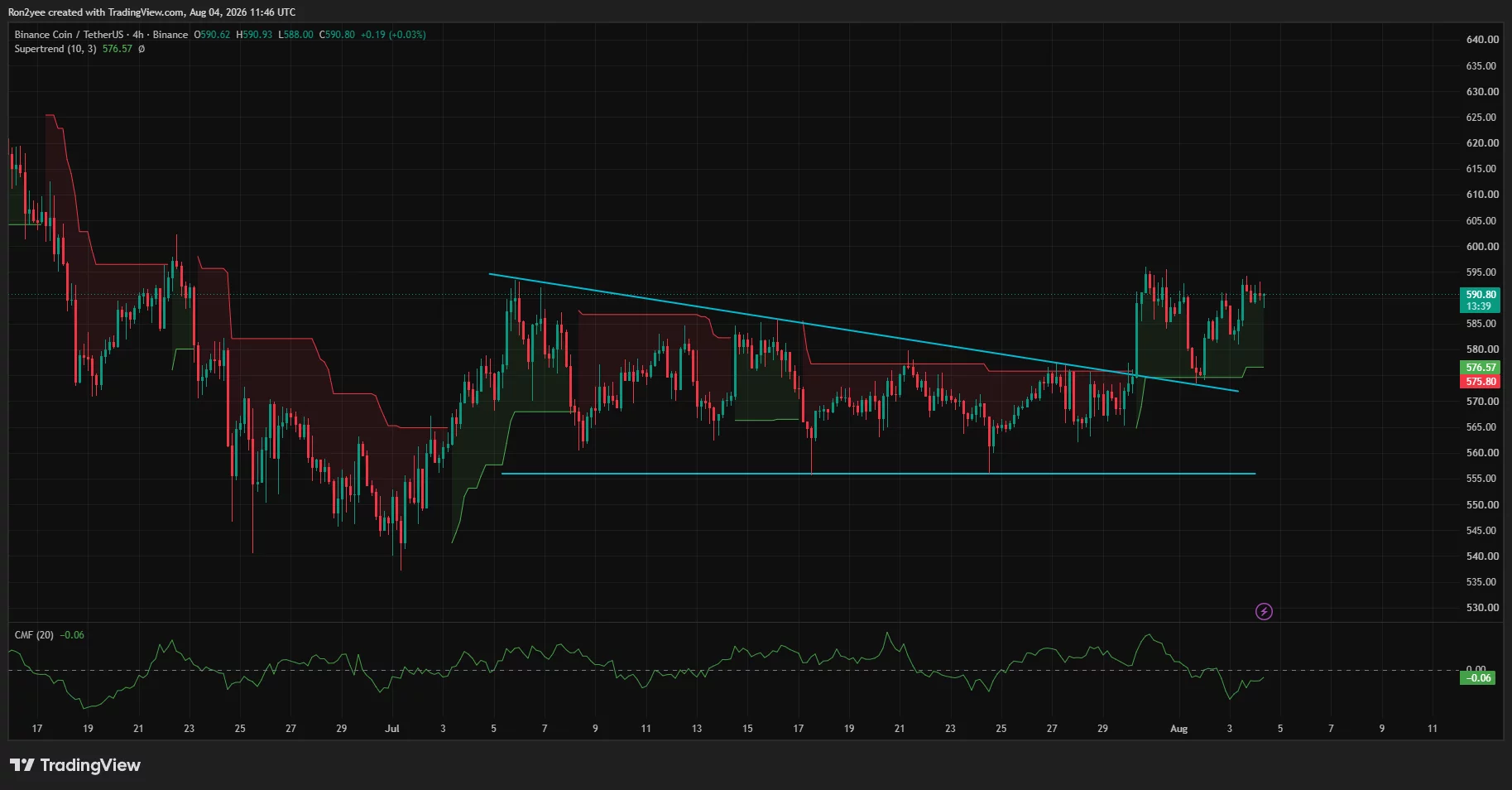
The 4-hour chart shows that BNB broke above a descending trendline that had capped its recovery since early July. Buyers then defended a retest near $576 before pushing the price back toward $590.
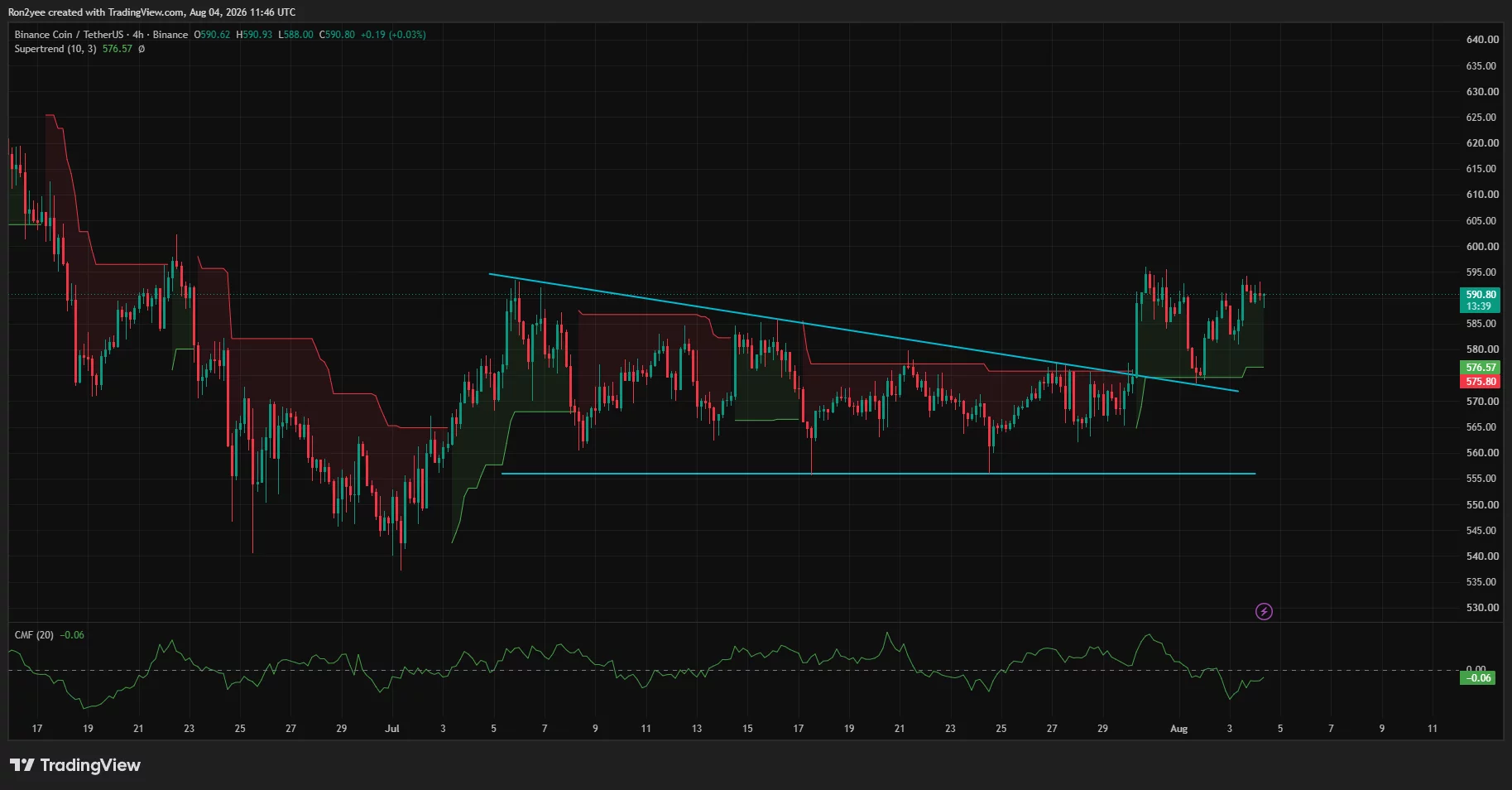
This sequence converted the former trendline resistance into short-term support. BNB also remains above the 4-hour Supertrend, currently positioned near $576.57, keeping the short-term structure bullish.
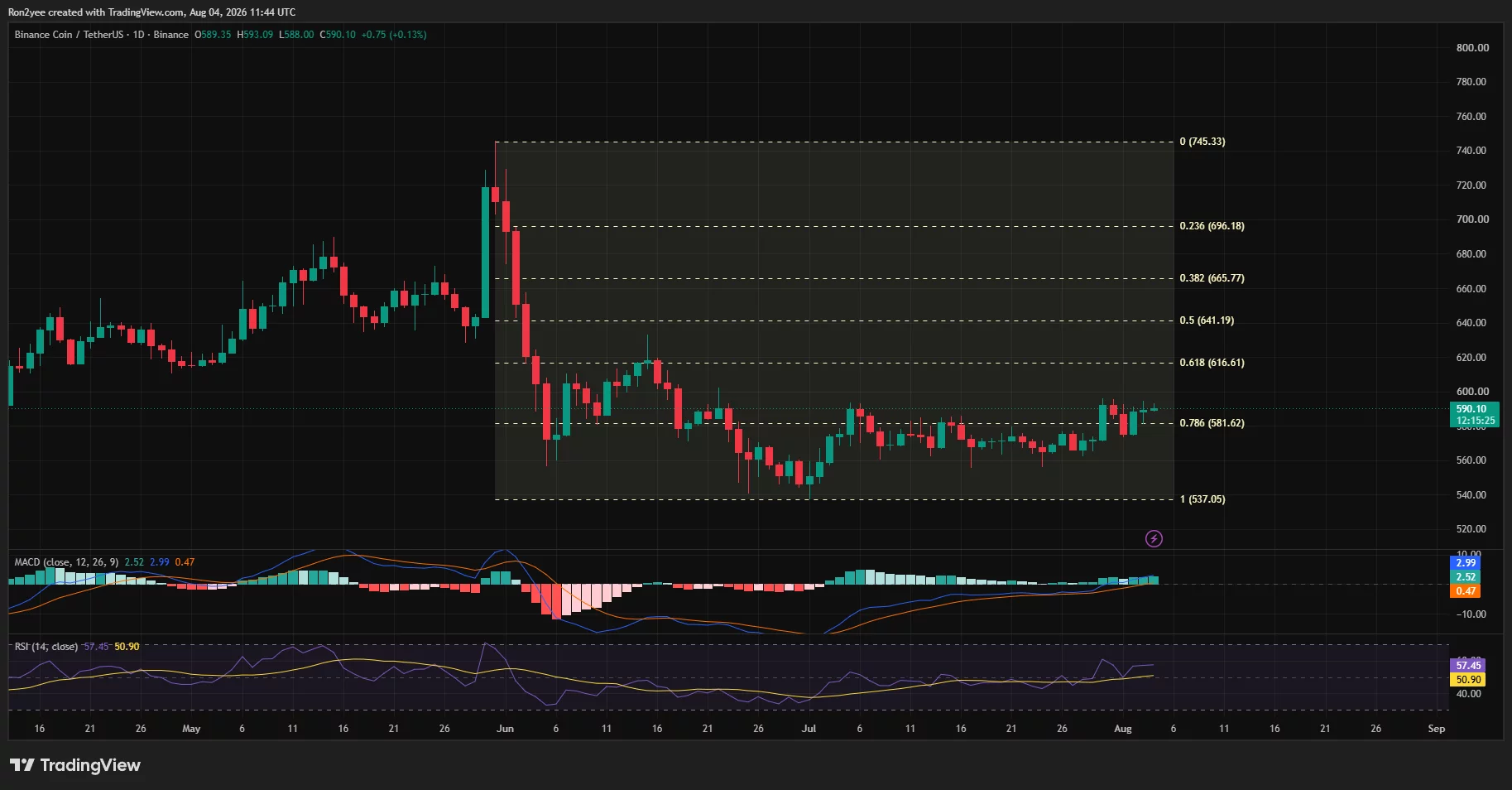
The daily chart provides another important level at $581.62. This marks the 78.6% Fibonacci retracement of BNB’s decline from $745.33 to $537.05. Holding above it strengthens the breakout, while a daily close below the level would weaken the current setup.
However, the Chaikin Money Flow reading on the 4-hour chart remains at -0.06. This shows that capital inflows have not fully confirmed the price recovery, leaving the move vulnerable if buying volume fades.
What is driving the BNB move?
Rising network activity has supported BNB’s recovery. BNB Chain recorded approximately $19 billion in weekly decentralized exchange volume, placing it ahead of Ethereum and Solana during the measured period.
Network utilization also increased from roughly 17% to almost 30%. Higher activity can support demand for BNB because the token is used to pay transaction fees and deploy contracts across the network.
The chain’s latest quarterly burn provides a longer-term supply tailwind. BNB Chain removed approximately 1.62 million BNB, worth about $932 million at the time, during its 36th quarterly burn in July. The reduction left the total supply near 133.17 million BNB.
These fundamentals have helped BNB outperform a largely range-bound altcoin market. Still, the immediate move appears primarily technical, following the confirmed breakout and retest visible on the 4-hour chart.
$592 could decide whether BNB reaches $616
BNB is now testing $592, a level that has repeatedly acted as resistance during 2026. The token briefly traded above this area but has yet to establish a decisive daily close beyond it.
A confirmed break above $592 would bring the $600 psychological barrier into focus. The one-week liquidation heatmap shows the largest nearby concentration of leveraged positions between $605 and $610.
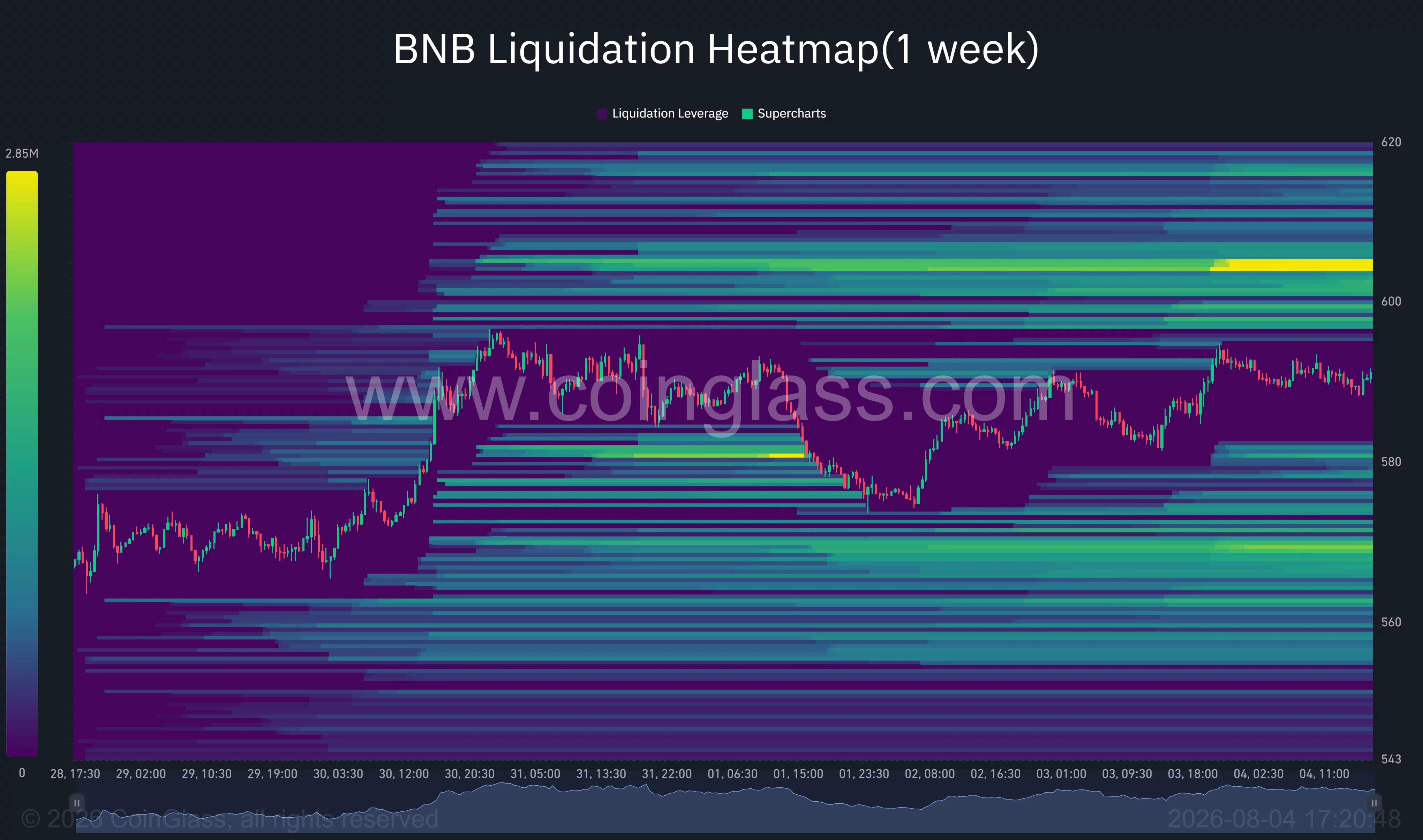
If BNB moves into that range, forced short liquidations could add buying pressure and accelerate the advance. The next chart-based target would then sit at $616.61, corresponding to the 61.8% Fibonacci retracement.
Beyond $616, the daily chart identifies additional resistance at $641.19 and $665.77. Those targets would require stronger spot demand because BNB would be moving into a broader supply zone created during its June decline.
The daily MACD supports the bullish case. The MACD line remains above its signal line, while the positive histogram stands near 0.47. RSI has climbed to 57.45, above its moving average of 50.90 but still below overbought territory.
Analysts see the retest as bullish confirmation
Crypto analyst Batman said BNB had reclaimed its 50-day moving average and successfully retested the breakout zone.
“This opens up a big move ahead,” the analyst wrote.
Satoshi Stacker also identified $592 as the key level separating a broader uptrend from a temporary recovery. The analyst said flipping that resistance into support would strengthen the case that BNB has moved beyond a relief bounce.
The bearish scenario begins if BNB fails at $592 and loses $581.62. In that case, the 4-hour Supertrend area between $575.80 and $576.57 would provide the next support.
Below that zone, the liquidation heatmap shows liquidity around $567, while the 4-hour chart places major horizontal support near $556. A break beneath $556 would invalidate the current higher-low structure and expose the daily range floor around $537.
US liquidity remains the main external risk
For US investors, BNB’s breakout remains sensitive to broader dollar liquidity and Federal Reserve expectations. Higher Treasury yields or a renewed risk-off move could limit demand for altcoins even if BNB Chain activity remains strong.
Geopolitical pressure and elevated oil prices add to that risk by keeping inflation concerns active. If those conditions push US rate expectations higher, BNB may struggle to attract enough capital for a sustained move through $600.
For now, the technical structure favors buyers while BNB remains above $581.62. A daily close above $592 would improve the probability of a move toward the $605–$616 region, while a loss of $576 would return the token to its previous consolidation range.
Disclosure: This article does not represent investment advice. The content and materials featured on this page are for educational purposes only.


Western Union and stablecoin payments company Rain launched Stablecard on Aug. 4, giving customers in 37 markets a way to receive, hold and spend Western Union’s USDPT stablecoin.
Summary
- 37 markets now offer Western Union Stablecard access, with expansion targeting more than 60 markets.
- USDPT remittances can fund a Visa card for spending online, in stores, or at ATMs.
- Anchorage Digital Bank issues USDPT on Solana and publishes monthly independent reserve attestation reports online.
- Western Union’s second quarter digital transactions rose 25%, supporting its wider shift toward digital services.
- Solana Explorer showed 5.92 million USDPT outstanding, above the amount covered by June’s attestation report.
The product combines a digital wallet with a Visa card and is available through dedicated applications on Apple’s App Store and Google Play.
USDPT is issued by Anchorage Digital Bank on Solana and is redeemable at a one to one rate for U.S. dollars. Customers can receive eligible Western Union transfers into the Stablecard wallet, transfer USDPT from compatible wallets or exchanges, and spend through Visa merchants or ATMs.
The companies did not identify every launch market in their announcements. Western Union said it is “targeting 60+ markets by the end of the year,” making that figure a planned expansion rather than current availability. Access, fees and individual features will depend on local rules and geographic requirements.
Western Union Stablecard connects USDPT to Visa spending
The official Western Union announcement describes Stablecard as a way to receive funds, retain their value in USDPT and spend through Visa without first moving the balance into a conventional bank account. Customers can also add the virtual card to Apple Pay or Google Pay.
The application gives users several funding routes. They can transfer USDPT from a supported crypto wallet or exchange, or use a “Cash Redirect” feature to move an eligible Western Union remittance into Stablecard. The store listings say users must complete identity verification, although they do not need a credit check or minimum balance.
Users can still access cash through ATMs or participating Western Union locations. However, the applications warn that ATM charges, foreign exchange costs and other fees may apply. The card is issued through a third party, Nimbus LLC, doing business as Third National, according to the store disclosures.
The consumer launch follows USDPT’s May introduction. As crypto.news reported, Western Union initially positioned the token as an always available settlement asset for agents, partners and future customer products. Stablecard now adds a direct spending function to that infrastructure.
Rain provides the wallet, card and compliance layer
Rain built the mobile application, embedded wallet and card infrastructure supporting the product. Its Stablecard case study says its Visa programs can operate at more than 175 million merchant locations across over 200 countries and territories.
Rain also argues that stablecoin settlement could reduce Western Union’s reliance on prefunded bank accounts. Remittance companies traditionally place money in local accounts before customers request payouts. Rain says USDPT could allow capital to move when demand arises rather than remaining idle for days. This is Rain’s assessment of the expected operating benefits. Western Union has not disclosed realized savings from Stablecard.
Rain’s social media statement that “$100B a year for 100M customers is moving onchain” needs context. Its longer case study uses those figures to describe Western Union’s existing annual network scale. It does not say that all $100 billion has already migrated to Solana or Stablecard. Neither company released transaction volume, active user numbers or revenue for the new product.
The launch arrives as Western Union’s digital channel grows faster than its retail operation. The company’s second quarter results showed branded digital revenue rising 7% and digital transactions increasing 25% from a year earlier. Digital activity represented 32% of consumer money transfer revenue and 43% of transactions.
Western Union’s total quarterly revenue nevertheless declined 1% to about $1 billion. Management cited weakness in the Americas retail business, lower margins and higher expenses. Stablecard therefore forms part of a broader effort to grow digital services while the legacy retail operation faces pressure.
U.S. oversight gives USDPT a regulated structure
Anchorage Digital Bank, a national trust bank overseen by the Office of the Comptroller of the Currency, issues and redeems USDPT. Western Union says reserves can include bank deposits, U.S. Treasury bills and similar cash equivalents. The official Solana contract address is published on the company’s USDPT information page.
Anchorage also publishes monthly reserve reports reviewed by an independent accounting firm. Its June 30 attestation recorded 21,581 redeemable USDPT and $122,245 of reserve assets. Those reserves consisted of $3,116 in cash and $119,129 in a money market fund.
Onchain supply has since grown. The official Solana Explorer displayed approximately 5.92 million USDPT at the time of reporting. That figure is not covered by the June 30 snapshot because the tokens were apparently minted after its reporting date. Anchorage’s reserve page listed only May and June reports as of Aug. 5, so the next attestation will provide a newer comparison between circulating tokens and reserve assets.
The federal banking structure does not make USDPT a government guaranteed asset. Western Union states that the token is not issued, approved or guaranteed by the U.S. government and is not protected by FDIC insurance. This distinction matters for consumers who may associate a federally supervised issuer with deposit insurance.
The next test is adoption across 60 markets
Western Union’s immediate target is to expand Stablecard from 37 markets to more than 60 before year end. The company has not provided a market by market timetable, expected card count or revenue forecast. Publishing the complete availability list would also clarify where remittance receipt, digital wallet transfers and cash withdrawal features are active.
Future reserve reports will show whether USDPT supply continues growing after the consumer launch. Usage data will be equally important because minted supply does not reveal how frequently customers receive remittances, use cards or retain balances in the application.
Exchange access could support that growth. As previously reported, Bybit added USDPT trading, transfers and custody in June, initially connecting the asset with fiat channels in Latin America. Western Union has also said wider exchange support and additional cash access services are planned.
Stablecard moves Western Union’s stablecoin strategy from settlement infrastructure into a consumer product. The next evidence will come from active users, payment volume, market expansion, fees and updated reserve disclosures rather than the size of Western Union’s existing remittance network.
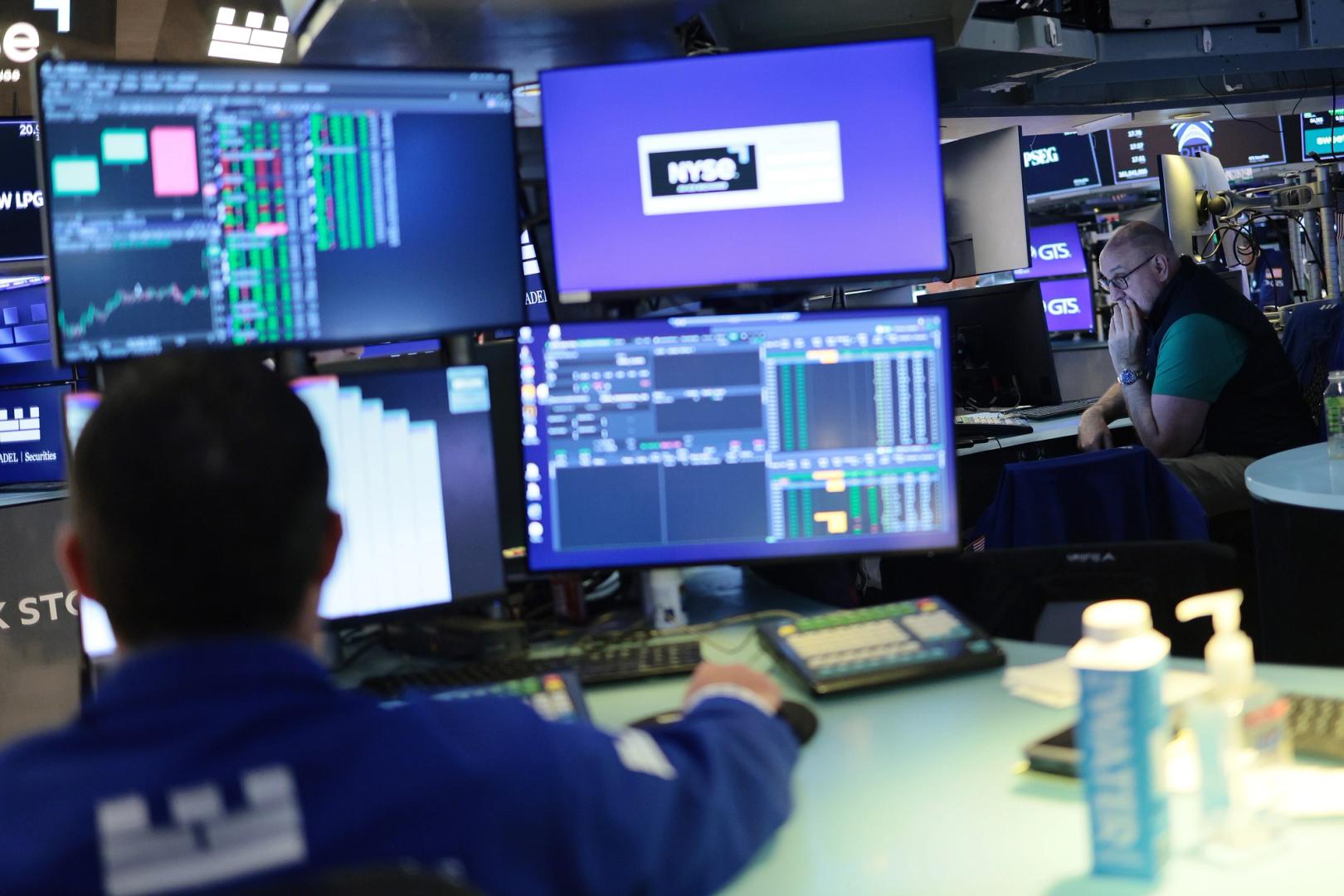
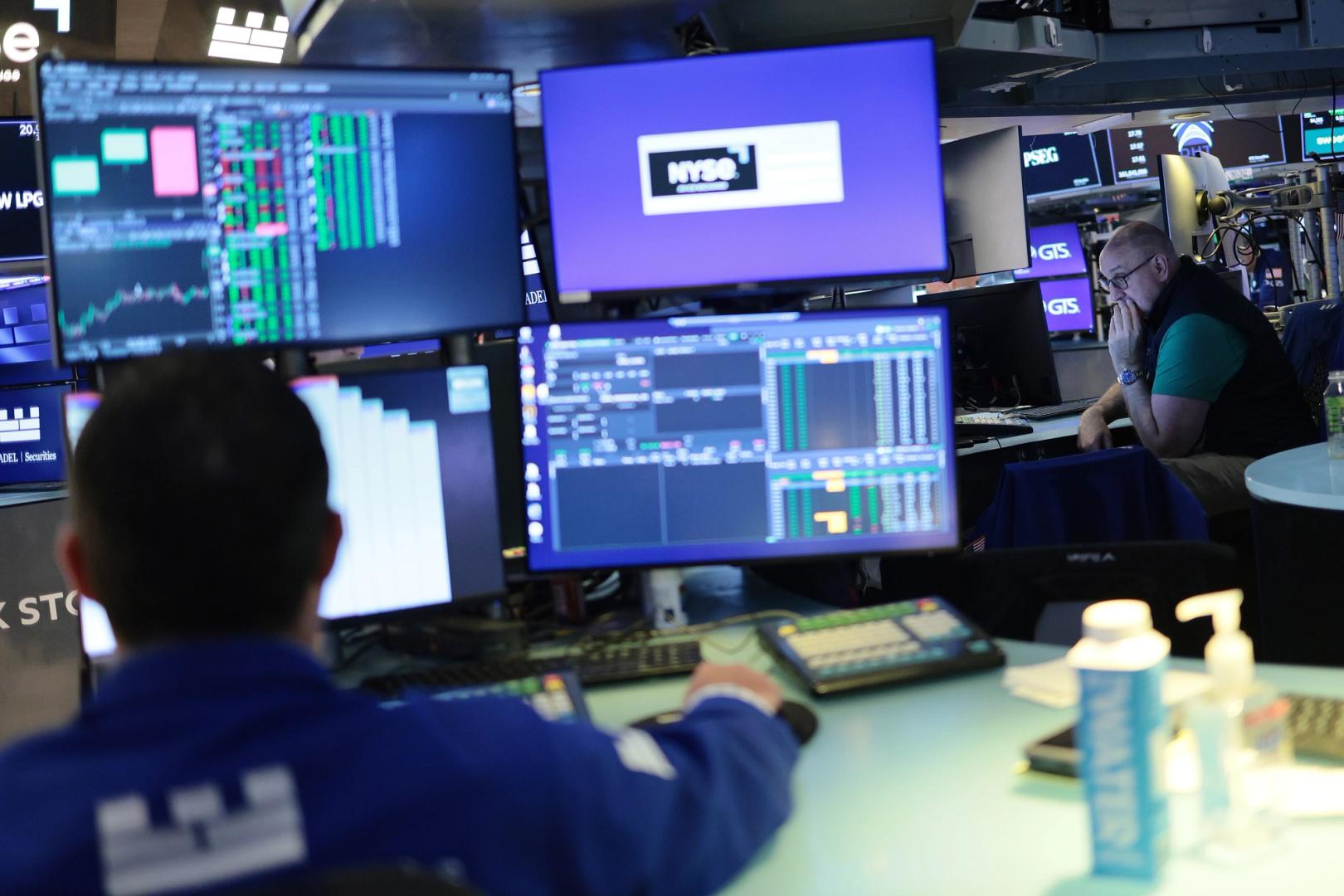
SK Hynix rose 6.4% after the Seoul open and Nvidia added over 2% after hours, though AMD dropped 9% on a soft sales outlook and SpaceX fell 7.5% on higher projected AI spending.
Brent crude fell 1.1% to about $78.50 a barrel after Axios reported Washington, Tehran and Oman were close to an agreement to reopen the Strait of Hormuz, with an announcement targeted for Wednesday. Treasuries and gold both advanced as traders trimmed bets on further rate hikes.
Equities are printing records while bitcoin sits roughly 49% below the $126,000 it reached last October, and the second-largest asset is falling on the week.
Cheaper oil, easing rate expectations and a risk-on equity bid have now failed to move crypto for three straight sessions, which points the drag inward rather than at the macro.
Watch what happens if the Hormuz announcement lands Wednesday as reported. That is the cleanest macro catalyst crypto will get this week, and a market that cannot rally on a confirmed deal after failing to rally on the prospect of one is telling you the buyers are elsewhere.
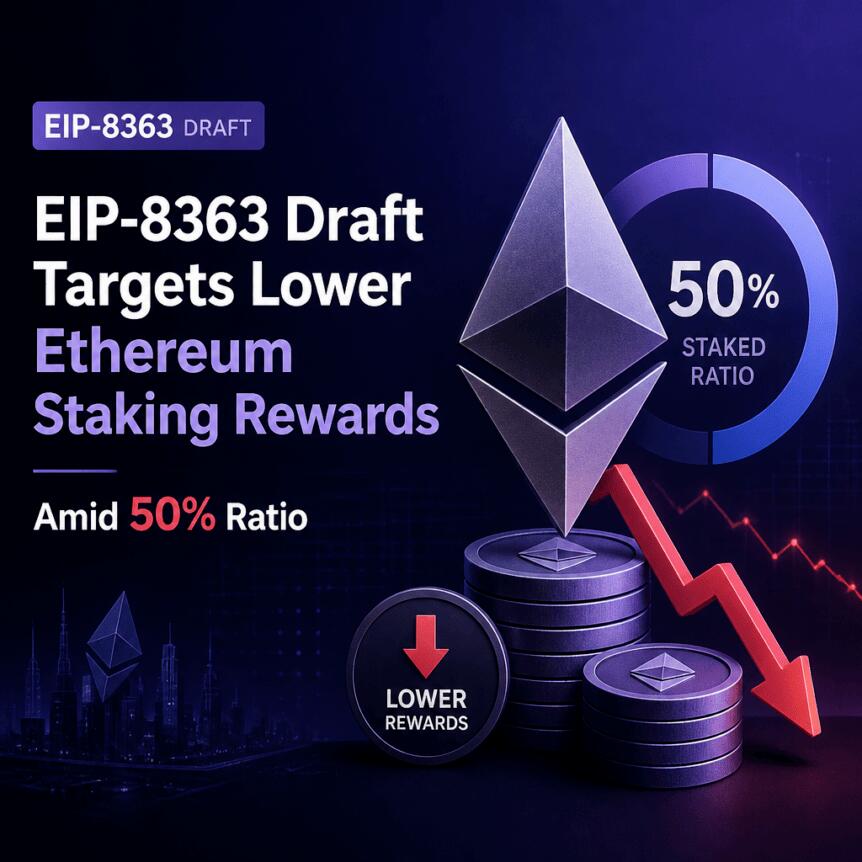
A draft Ethereum Improvement Proposal from a group of six researchers and developers—including Ethereum Foundation’s Justin Drake—would change how new ETH is issued to validators. The “Tapered Issuance Burn” proposal, provisionally numbered EIP-8363, aims to reduce validator rewards more aggressively as more ETH is staked, with an increasing portion of consensus rewards burned to curb long-term inflation.
The proposal targets a fixed staked-ETH threshold of 60.25 million ETH (about 50% of the current ETH supply). As the staking ratio approaches that level, the burn mechanism would intensify, reaching 100% deduction once the threshold is met. The changes are designed to phase in over roughly 18 months. The draft is published on GitHub as an EIP draft.
Key takeaways
- EIP-8363 would “taper” validator issuance by burning an increasing fraction of consensus rewards as staking grows.
- The mechanism is tied to a threshold of 60.25 million staked ETH, at which point the deduction would reach 100%.
- Critics argue the proposal could disadvantage solo validators and reduce DeFi borrowing and yield tied to staking rewards.
- Some developers and community members also question whether there is enough time for careful review, given its proximity to proposal deadlines around Ethereum’s Hegotá upgrade.
- The draft has not been approved or scheduled and is not currently included in Hegotá.
A proposed monetary lever tied to staking saturation
The authors’ central concern is the trajectory of staking. According to the draft’s advocates, under the current issuance and incentive curve, staking rewards would not meaningfully “turn off,” even if nearly all ETH were staked. One of the proposal’s authors, Jérôme de Tychey, argued that this creates a persistent incentive to stake, raising the question of what ultimately stops the process.
In the proposal discussion, de Tychey also highlighted the potential for growing concentration of ETH held through large custodians and staking derivatives. The thesis is not only about dilution from issuance, but about the role of ETH as “a neutral, trustless store of value.” He warned that unchecked issuance could increasingly shift the ecosystem’s “working money” from raw ETH to intermediated staking claims.
As described in the draft’s framing, EIP-8363 would bound and make issuance more predictable. The proposal sketches a scenario in which issuance would peak at roughly 0.5% of ETH supply per year at its highest point (with about 20% of ETH staked), then decline toward zero as the staking ratio reaches the 60.25 million ETH threshold.
Supporters also position the change as complementary to existing Ethereum supply-reduction mechanics, including EIP-1559 and the protocol’s Blob burn structure. De Tychey argued that, with these in place, Ethereum’s net supply trend could more often decrease, while the network maintains a “sustainable security budget.”
Why the timing is drawing fire
Even though EIP-8363 is still an early draft, its publication came shortly before a deadline being discussed in relation to Ethereum’s Hegotá upgrade. Some community members see the schedule pressure as a process risk, especially for a change that would affect monetary policy.
Community developer Greg Koumoutsos said the proposal “clearly doesn’t leave adequate time for community review” of a monetary-policy change of this magnitude. In response to some confusion around the timetable, the article’s reporting indicates that the relevant Aug. 6 deadline is for pull requests proposing additional EIPs for Hegotá, rather than a deadline for deciding which proposals will ultimately be included.
Ethereum community organizer Trent Van Epps indicated that the selection process could continue until Nov. 8. According to the reporting, Hegotá is likely to reach mainnet in the second quarter of 2027, based on the project schedule referenced in the coverage.
Developer and DeFi concerns: solo validators, institutions, and yield markets
While the proposal’s goals are framed as reducing dilution and strengthening neutrality, it has met backlash from parts of the Ethereum development ecosystem, including stakers and DeFi builders.
One line of criticism is that lowering staking rewards could reduce institutional demand for ETH. The article notes concerns about whether reward cuts could affect how institutions interpret yield and exposure, and it points to linked coverage about institutional staking interest.
Another major critique centers on validator structure. The argument from some quarters is that solo validators would be hit harder because they generally face higher relative costs than larger operators. According to the reporting, Mike Silagadze, CEO of Ether.Fi, said the mechanism would push out solo stakers not subsidized by entities such as the Ethereum Foundation. His view is that the staking landscape would become dominated by large centralized organizations, leaving users to hold ETH indirectly while those operators capture the remaining incentive structure.
De Tychey disputed the “guaranteed solo exit” framing. In a response on the Ethereum Magicians forum, he argued that users of large staking providers must pay fees, which could make such services less attractive as rewards fall. However, the reporting also emphasizes that related research is “contested,” leaving the economic second-order effects uncertain.
Beyond validator economics, critics warn that staking reward changes could ripple into DeFi markets that depend on staking yield. Stani Kulechov, founder of Aave, characterized the proposal as harmful—arguing it could weaken institutional demand for ETH and reduce borrowing activity across DeFi. His critique is that the proposal does not achieve its intended outcome and could negatively affect Ethereum’s broader ecosystem incentives.
Backers see bounded inflation and potentially long-run upside
Support for EIP-8363’s direction is not confined to the proposal’s authors. The coverage also points to Grayscale research leadership. In May, Grayscale head of research Zach Pandl said limiting staking incentives would be “positive for the price of Ether over time,” framing the idea as part of improving Ethereum’s long-run economic profile.
In the proposal’s own narrative, the change is designed to address a specific economic tension: a world where staking keeps expanding, issuance continues unabated, and more of the ecosystem’s exposure becomes mediated through staking derivatives. Supporters argue that burning an increasing share of rewards as staking rises can cap issuance growth and reduce dilution, while still maintaining security incentives early in the process.
Yet, with the draft at an early stage and schedule constraints under debate, the most immediate takeaway is that the proposal is not yet a policy. It is one part of a larger, contested set of considerations about Ethereum’s monetary future as staking participation rises and as staking derivatives evolve.
As Ethereum approaches the Hegotá selection window, readers should watch for how the community evaluates EIP-8363’s economic modeling—especially the projected impact on solo validators, liquid staking incentives, and DeFi borrowing flows—and whether the proposal is revised, delayed, or replaced by alternatives before any formal inclusion.

For years, decentralized finance (DeFi) has been marketed as an alternative financial system powered by blockchain technology. Early adopters embraced concepts like self-custody, liquidity pools, yield farming, decentralized exchanges, and governance tokens. While these innovations transformed the crypto landscape, they also created a steep learning curve that discouraged mainstream adoption.
Ironically, the future success of DeFi may depend on making it invisible.
The next billion users are unlikely to care whether an application is decentralized. They won’t ask which Layer 2 network it runs on, what consensus mechanism secures it, or whether the transaction passes through a smart contract. Instead, they’ll simply expect payments to be instant, investments to be accessible, savings to generate competitive returns, and financial services to work seamlessly.
Just as billions of people use the internet without understanding TCP/IP or cloud infrastructure, the next generation of financial users may rely on DeFi every day without realizing it.
The Evolution of Technology: Infrastructure Becomes Invisible
History shows that transformative technologies disappear into the background once they mature.
People don’t think about:
- DNS when visiting a website
- SSL certificates when shopping online
- Cloud servers when streaming movies
- Cellular protocols when sending messages
The same pattern is emerging for blockchain.
Early crypto products forced users to understand wallets, gas fees, bridges, private keys, seed phrases, and token standards before completing even simple transactions.
Future applications will hide all of that complexity.
Users will simply press “Send,” “Invest,” “Borrow,” or “Earn.”
Behind the scenes, decentralized infrastructure will handle everything automatically.
Better User Experience Wins Every Time
Most consumers prioritize convenience over technology.
When someone opens a banking app, they rarely ask:
- Is this database decentralized?
- Which consensus algorithm validates this transfer?
- Is this settlement happening on-chain?
They only ask:
- Is it fast?
- Is it secure?
- Does it work?
The winners in Web3 will be projects that abstract away blockchain complexity instead of highlighting it.
Invisible infrastructure creates visible value.
Smart Wallets Remove Friction
Traditional crypto wallets expect users to:
- Store seed phrases
- Manage gas tokens
- Sign complex transactions
- Switch networks manually
- Recover lost accounts independently
These requirements remain intimidating for newcomers.
Modern smart wallets are changing the experience through features such as:
- Social recovery
- Passkey authentication
- Biometric logins
- Sponsored gas fees
- Automatic network switching
- Session keys for trusted applications
The result feels much closer to using a modern fintech app than a traditional crypto wallet.
Users benefit from blockchain security without wrestling with blockchain complexity.
Stablecoins Will Lead the Way
Millions of people may first experience DeFi through stablecoins rather than cryptocurrencies.
Imagine opening a payment app that allows users to:
- Send money globally in seconds
- Receive salaries instantly
- Earn yield automatically
- Pay merchants internationally
- Save in digital dollars
The average user doesn’t need to know that:
- Liquidity pools process transactions
- Smart contracts generate yield
- On-chain protocols manage settlement
- Decentralized infrastructure secures transfers
To them, it’s simply a better financial application.
Embedded Finance Is Becoming Embedded DeFi
Traditional companies increasingly integrate financial services directly into their platforms.
The same trend is happening in Web3.
Soon, decentralized finance may power:
- Gaming economies
- Ride-sharing apps
- Freelance marketplaces
- Creator platforms
- E-commerce websites
- AI agent payments
- Social media rewards
Users may never download a separate DeFi app.
Instead, financial functionality becomes part of the products they already use every day.
AI Will Become the User’s Financial Interface
Artificial intelligence is making DeFi dramatically easier to navigate.
Rather than manually comparing protocols, users may simply ask:
“Find me the safest place to earn the highest yield.”
Or:
“Swap my assets using the cheapest route.”
Or:
“Move my savings into lower-risk opportunities.”
AI agents can analyze liquidity, optimize transactions, monitor risk, and execute strategies across multiple protocols—all without requiring users to understand the underlying mechanics.
Instead of learning DeFi, users interact with intelligent assistants.
Compliance Can Exist Without Sacrificing Decentralization
One of DeFi’s biggest challenges has been balancing openness with regulatory expectations.
Emerging technologies—including decentralized identity, zero-knowledge proofs, and selective disclosure—allow users to verify eligibility or compliance without exposing unnecessary personal information.
This enables financial applications that are both privacy-preserving and regulation-friendly.
For users, the process feels no different than signing into any trusted online service.
Cross-Chain Complexity Will Disappear
Today’s users often struggle with:
- Multiple wallets
- Token bridges
- Different gas assets
- Separate blockchain ecosystems
Future infrastructure will increasingly abstract these details.
Applications will automatically determine:
- The cheapest network
- The fastest settlement path
- The most liquid market
- The lowest transaction cost
Users simply initiate an action.
The protocol decides everything else.
Businesses Care About Results, Not Blockchains
Enterprises adopting blockchain rarely advertise which blockchain powers their operations.
Instead, they focus on outcomes like:
- Lower operating costs
- Faster settlement
- Greater transparency
- Reduced fraud
- Improved automation
As blockchain infrastructure matures, businesses will increasingly treat it as back-end technology rather than a customer-facing feature.
This shift mirrors how companies rely on cloud computing today without making it the centerpiece of their marketing.
The Real Competition Isn’t Other Blockchains
- Transaction speed
- TPS numbers
- Consensus models
- Layer architectures
But mainstream users compare products differently.
They compare DeFi against:
- Banking apps
- PayPal
- Venmo
- Cash App
- Revolut
- Apple Pay
If decentralized applications deliver a smoother experience with lower costs and greater accessibility, users won’t care what’s happening behind the interface.
Convenience beats complexity.
The Future Is Financial Infrastructure, Not Financial Identity
Many projects still compete over:
The first generation of crypto enthusiasts proudly identified as DeFi users.
The next generation probably won’t.
They’ll simply use applications that are:
- Faster
- Cheaper
- More secure
- Globally accessible
- Available 24/7
- More rewarding
Whether those applications rely on smart contracts, decentralized liquidity, or blockchain consensus will be largely irrelevant to them.
That is the ultimate sign of success.
When users stop noticing the technology and start focusing solely on the value it delivers, DeFi will have evolved from a niche innovation into a foundational layer of the global financial system.
Final Thought
The next billion DeFi users won’t be attracted by buzzwords like liquidity mining, staking, or decentralized exchanges. They’ll be drawn by intuitive apps that solve real financial problems with speed, affordability, and reliability. As wallets become smarter, stablecoins become more common, AI simplifies financial decisions, and blockchain infrastructure fades into the background, DeFi will increasingly function as an invisible engine powering everyday digital experiences.
The greatest achievement of decentralized finance may not be convincing the world to use DeFi—it may be reaching a point where people benefit from it every day without ever needing to know it’s there. In that future, DeFi won’t be a niche category of finance; it will simply be finance.
REQUEST AN ARTICLE


Bybit’s European payments subsidiary has secured an electronic money institution license in Austria, providing the exchange with a regulatory basis to add payment and e-money services to its regional platform.
On Tuesday, Bybit said Bybit Payments GmbH received the license from Austria’s Financial Market Authority. The authorization provides a legal basis for future payment capabilities, which may include person-to-person payments, merchant payment solutions, open banking features and card products.
The payment services will be offered through Bybit.eu alongside services provided by Bybit EU GmbH, a separate Austrian entity authorized under the European Union’s Markets in Crypto-Assets Regulation since May 2025. Bybit.eu serves users across the European Economic Area (EEA), with Malta excluded.
Bybit has not specified the reason why Malta was excluded, but said on its website that services are available only in jurisdictions where applicable MiCA passporting requirements have been met.
Bybit said the two entities will maintain distinct regulatory permissions and responsibilities. Bybit EU GmbH is authorized to provide crypto custody, exchange, placement and transfer services, while Bybit Payments GmbH will handle regulated electronic money and payment products as they are introduced.
The exchange said the new regulatory milestone could help strengthen its relationship with banks, payment providers and enterprises while reducing its reliance on third-party payment infrastructure.
Related: Crypto exchange Bybit launches in Indonesia after NOBI acquisition


Bitdeer Technologies Group said on Aug. 4 that its Tydal Data Center subsidiary signed a 16-year colocation and services agreement with Volta Tydal AS for an artificial intelligence and high-performance computing campus in Norway.
Summary
- Bitdeer signed a 16-year Norway colocation agreement expected to generate $4.7 billion in contracted revenue.
- The Tydal campus will deliver 121 megawatts of IT capacity using renewable Norwegian power sources.
- An eight-year extension could raise total contract value to approximately $8 billion across twenty-four years.
- Bitdeer retains full ownership of Tydal while Volta supplies customer, financing and technology relationships globally.
- Two construction phases target completion by December 2026 and March 2027, subject to execution risks.
The contract covers 121 megawatts of critical IT capacity, supported by about 133 MW of total power. Bitdeer expects approximately $4.7 billion in contracted payments during the initial term. A one-time eight-year renewal option could raise the potential contract value to about $8 billion over 24 years.
Bitdeer’s $4.7 billion deal contracts 121 MW
The agreement assigns the full 121 MW to Volta, which plans to support a leading AI laboratory using NVIDIA graphics processing units. Dell Technologies will act as technology provider, according to Bitdeer’s announcement. The parties did not name the end customer.
Bitdeer said the lease averages about $202 per kilowatt each month during the first 16 years. The tenant will reimburse electricity costs, while contract payments will rise 3% annually. Management estimates average annual revenue of $2.4 million per IT MW and a project net operating income margin of roughly 90%.
Those figures are company projections rather than GAAP revenue or operating profit. Bitdeer said total contract value assumes full performance of the agreement. The company’s estimated margin also excludes financing costs, depreciation, corporate expenses and other items that can affect consolidated earnings.
Tydal converts Bitcoin infrastructure into AI capacity
The deal advances Bitdeer’s plan to shift part of its power portfolio from Bitcoin mining toward AI colocation. In March, the company hired Data Center Installations AS to convert Tydal into a 180 MW gross facility built around NVIDIA reference designs. Bitdeer said the completed campus could become one of Norway’s largest AI data centers.
The Volta contract uses 133 MW of that planned gross capacity. Bitdeer is developing two additional halls totaling 47 MW for possible AI and HPC customers during the second half of 2027. The company will retain full ownership of the site, and it issued no shares or warrants in connection with the Volta transaction.
Bitdeer has been expanding AI infrastructure while retaining a large Bitcoin mining operation. Its June update showed 73 EH/s of self-mining capacity, 990 BTC produced during the month and about $76 million in AI cloud annualized run-rate revenue at 95% utilization.
Financing and termination terms temper the headline value
The project still requires about $500 million of capital expenditure, or approximately $4 million per contracted IT MW. Bitdeer plans to raise additional debt to finance construction and other infrastructure projects. Leading financial institutions have been engaged, but the company has not disclosed the expected borrowing cost, maturity or final structure.
Volta’s obligations are expected to receive about $1.3 billion in letters of credit arranged by affiliates of J.P. Morgan and another global financial institution. The support remains subject to customary conditions. Bitdeer may terminate the agreement if Volta misses specified milestones tied to that credit package.
The tenant also has a no-fee termination right after ten years, despite the stated 16-year base term. The optional eight-year extension is not guaranteed. Construction delays, financing costs, equipment availability and customer performance could therefore reduce the timing or value of the expected payment stream.
Bitdeer had disclosed the Tydal lease in June but said it remained subject to conditions outside its control. The Aug. 4 release supplies the commercial terms and identifies Volta as the counterparty, marking a step beyond the earlier conditional announcement.
BTDR rises before Bitdeer’s Aug. 10 earnings
Bitdeer shares rose after the announcement. The latest verified market quote placed BTDR near $11.37, about 7.8% above the previous close. Earlier reports described a larger intraday move, but the stock had given back part of that gain by the latest reading.
The rally reflects investor interest in long-duration AI infrastructure contracts, though the stock remains exposed to construction and financing risk. Bitdeer reported $188.9 million in first-quarter revenue, a $159.5 million net loss and $297.7 million in cash and restricted cash at March 31. Borrowings stood near $1.9 billion.
In related coverage, crypto.news examined how Bitcoin miners including Bitdeer, IREN and HIVE are repurposing power-rich facilities for AI workloads. The strategy can produce steadier contracted revenue than mining, but it also requires large upfront spending and dependable customers.
Bitdeer will report second-quarter results on Aug. 10 before an 8 a.m. Eastern Time conference call. Investors will be watching for financing details, construction progress, accounting treatment and any update on when the Tydal revenue can begin entering reported results


Polymarket is reportedly in preliminary talks with prospective investors about raising roughly $1 billion at a valuation above $20 billion.
Summary
- Polymarket is reportedly discussing a new $1 billion raise at a valuation exceeding $20 billion.
- April’s financing reportedly valued Polymarket at $15 billion and included D.E. Shaw and G Squared.
- ICE confirmed a $600 million March investment after making an earlier $1 billion Polymarket investment.
- July prediction market volume reached $50.6 billion, with Kalshi handling $37.7 billion across its platform.
- Polymarket US operates through QCX, a CFTC designated market, amid state challenges to federal authority.
Bloomberg reported the discussions on Aug. 4, citing people familiar with the private negotiations.
The company has not announced a deal. A Polymarket spokesperson declined to comment on the report. The fundraising amount, valuation and investor group should therefore be treated as “preliminary” rather than completed financing.
A successful round would place Polymarket near Kalshi, its largest prediction market rival, which secured a $22 billion valuation in May. It would also continue the rapid rise in private valuations across an industry expanding from election contracts into sports, economics, crypto and other real world events.
Polymarket funding talks remain unconfirmed
The reported transaction remains at an early stage. No term sheet, closing date or final investor list has been released. Private funding discussions can change before completion, including the capital raised and the valuation investors ultimately accept.
Comparisons with Polymarket’s October 2025 valuation also require care. Bloomberg referred to a valuation of about $9 billion. However, Intercontinental Exchange’s official announcement said its planned investment reflected an approximate $8 billion valuation before the new capital was added. The figures may use different valuation bases and are not necessarily contradictory.
The April financing also combines reported and confirmed information. Bloomberg said Polymarket completed roughly $1 billion in financing at a $15 billion valuation, with D.E. Shaw and G Squared joining the investor group.
ICE separately confirmed a further $600 million investment on March 27 as part of a Polymarket equity raise. The New York Stock Exchange owner had already invested $1 billion in October 2025. ICE did not disclose the valuation attached to its March investment.
A valuation above $20 billion would be at least 33% higher than the reported April figure. It would also represent more than twice the valuation Bloomberg assigned to Polymarket’s October round.
U.S. expansion supports Polymarket’s valuation case
Polymarket’s return to the U.S. gives the company a regulated growth channel alongside its international platform, which uses crypto settlement.
The CFTC’s official registry lists QCX LLC, doing business as Polymarket US, as a designated contract market. The regulator records its designation date as July 9, 2025. The exchange has since submitted rule changes covering fees, liquidity programs, surveillance and trading procedures.
Bloomberg reported that Polymarket had opened its U.S. exchange following its April financing. Meanwhile, the company’s U.S. access page states that its app is being rolled out to users from a waitlist. This indicates that access may still be expanding in stages rather than being uniformly available.
Revenue growth provides another part of the reported valuation case, although the numbers remain private company metrics. Bloomberg’s sources said Polymarket’s annualized revenue had more than tripled since April to above $1.2 billion.
Reuters reported in June that the platform’s annualized revenue had passed $1 billion. An annualized figure extrapolates recent performance and is not the same as audited revenue collected across a completed financial year.
Trading data also shows that the U.S. venue is gaining activity. As crypto.news reported, Polymarket, Polymarket US and Kalshi generated a combined record of $50.6 billion in July volume.
Kalshi led with $37.7 billion. Polymarket US increased its volume by 54% to $5 billion, while Polymarket’s international venue fell 26% to $7.9 billion. The figures show faster U.S. growth, but they also show that the wider Polymarket business did not expand evenly.
Kalshi’s lead creates a demanding benchmark
Kalshi officially announced a $1 billion Series F round at a $22 billion valuation on May 7. Coatue led the financing, with participation from Sequoia Capital, Andreessen Horowitz, IVP, Paradigm, Morgan Stanley and ARK Invest.
The company said institutional trading volume had risen 800% over six months. Kalshi also said its annualized trading volume increased from $52 billion to $178 billion. Those are company supplied trading figures and should not be confused with revenue.
In related coverage, crypto.news reported that Kalshi claimed more than 90% of U.S. prediction market activity when it announced the financing. Independent July data also showed Kalshi processing almost three times the combined volume of Polymarket’s international and U.S. venues.
Polymarket’s reported target would narrow the valuation gap despite Kalshi’s larger trading volume. Prospective investors may be assigning value to Polymarket’s international reach, crypto settlement infrastructure, brand recognition and relationship with ICE.
Volume alone cannot determine a private company’s worth. Fees, customer retention, compliance costs, market composition and activity after major sporting or political events can affect revenue quality. July open interest fell after the World Cup ended even as monthly trading reached a record.
Regulatory disputes could influence the funding round
Polymarket US holds a federal designation, but several states argue that sports event contracts amount to gambling and remain subject to state laws.
The Nevada Gaming Control Board filed a civil complaint against Polymarket and QCX in January. The regulator asked a state court to stop the companies from offering what it described as unlicensed wagering in Nevada.
As previously reported, Polymarket and Kalshi are involved in a broader dispute over whether the Commodity Exchange Act gives the CFTC exclusive authority over federally registered event contract platforms.
North Carolina has followed a different route. A law signed in July recognizes CFTC regulated prediction markets and establishes a 6% tax on their trading fee revenue beginning in 2027.
These disputes do not prevent Polymarket from discussing financing. However, they could affect market access, legal costs and how investors value the company’s U.S. growth plans.

Crypto trading activity has fallen to its lowest level of 2026.
This is according to data from Kaiko, which shows daily spot volumes across tracked exchanges dropping to around $15 billion last week.
Centralized Exchange Volumes Fall as Trading Activity Cools
According to the Kaiko numbers shared by The Kobeissi Letter, daily trading volumes across 44 spot crypto exchanges have dropped 70% from peak levels in January, with the average daily volume trend also falling 50% since December 2025 to about $20 billion. Furthermore, the six largest exchanges now account for more than 60% of total trading activity.
However, not everyone agrees that crypto liquidation is disappearing, with pseudonymous crypto researcher Emperor Osmo arguing that the drop in trading volume on CEXs mostly reflects changing exchange dynamics.
Data from The Block shows decentralized exchange volume has been climbing all year relative to centralized platforms, going from a ratio near 20% in April to about 24% in July and above 46% so far in August, although the figures from this month are still incomplete.
“Centralized exchanges are simply losing market share to DEXs,” the analyst wrote.
Trader Jeff made a related point from a different angle, noting that stablecoin volume and active addresses are both up from last month and that holders of tokenized real-world assets jumped 51% in 30 days to 1.57 million. “The traders left, but the users stayed,” he wrote, with Wintermute head of OTC Jake O calling the shakeout healthy and arguing that “volume consolidating on the stronger venues is a net positive for the industry.”
Where the Market Is At
That drop has come with major cryptocurrencies trading well below their highs. Bitcoin (BTC), for instance, is changing hands near $64,000, up by about 2% in 24 hours but nearly 50% lower than its October 2025 all-time high. Ethereum (ETH) was trading close to $1,900, down 62% from its peak. XRP and Solana (SOL) are faring even worse, having dropped 70% and 75% from their ATHs, respectively.
Some critics have taken the decline as evidence of a longer-term move away from crypto, with AI becoming a stronger competitor for investor attention and capital. But other participants, including Korean trader Frontier Bet, believe that regulatory development such as approval of the CLARITY Act could attract capital back into crypto markets.
The odds for the bill’s approval have continued to drop, especially after the White House failed to respond to a key counterproposal from Thom Tillis and Ruben Gallego, who are pushing for stronger ethics provisions.
The post Crypto Market Liquidity Dries Up as Daily Volumes Hit 2026 Lows appeared first on CryptoPotato.
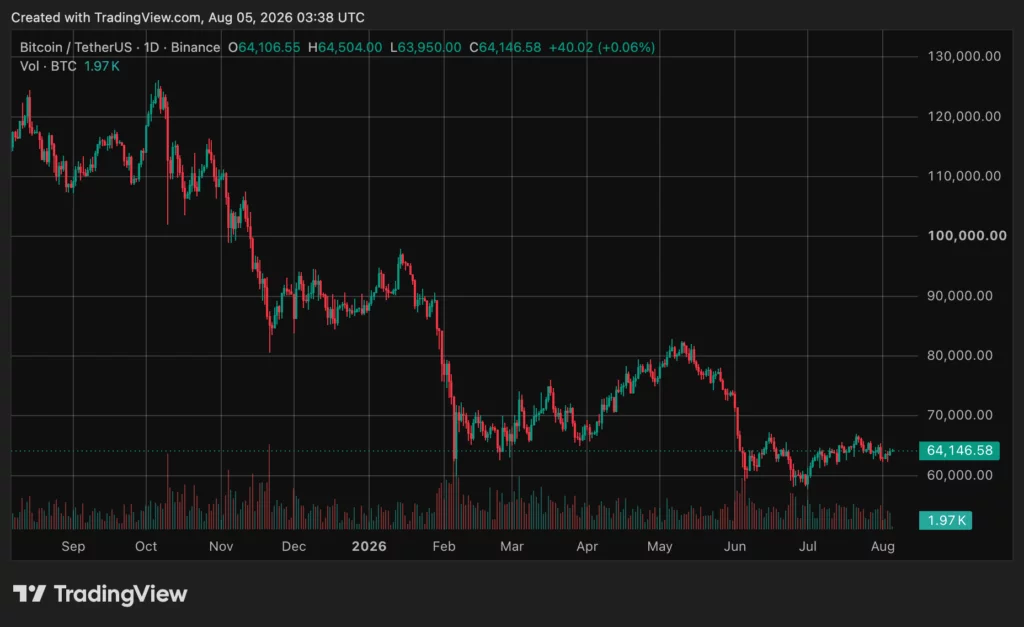
BitMEX cofounder Arthur Hayes published a new essay, “Situationship,” on Aug. 4, 2026, arguing that the artificial intelligence (AI) infrastructure boom could end as a credit crisis rather than a dot com style equity collapse.
Summary
- Hayes argues AI infrastructure resembles leveraged real estate, making a future downturn a credit crisis.
- U.S. hyperscalers continue raising capital spending as cloud demand and artificial intelligence workloads expand rapidly.
- Alphabet raised 2026 capital expenditure guidance to $195 billion to $205 billion amid demand growth.
- Federal Reserve officials held rates at 3.5% to 3.75%, while announcing no AI rescue program.
- Bitcoin traded near $64,337, but Hayes’s essay provided no verified immediate market catalyst for traders.
Hayes framed data centers as leveraged real estate containing computing equipment that can lose economic value as newer chips become more efficient.
Hayes said an eventual slowdown in data center construction could expose weak borrowers and financiers, prompting government intervention and broader monetary easing. He believes the resulting liquidity could support a renewed Bitcoin bull market. However, the scenario remains his personal forecast, not a confirmed crisis or an official policy outlook.
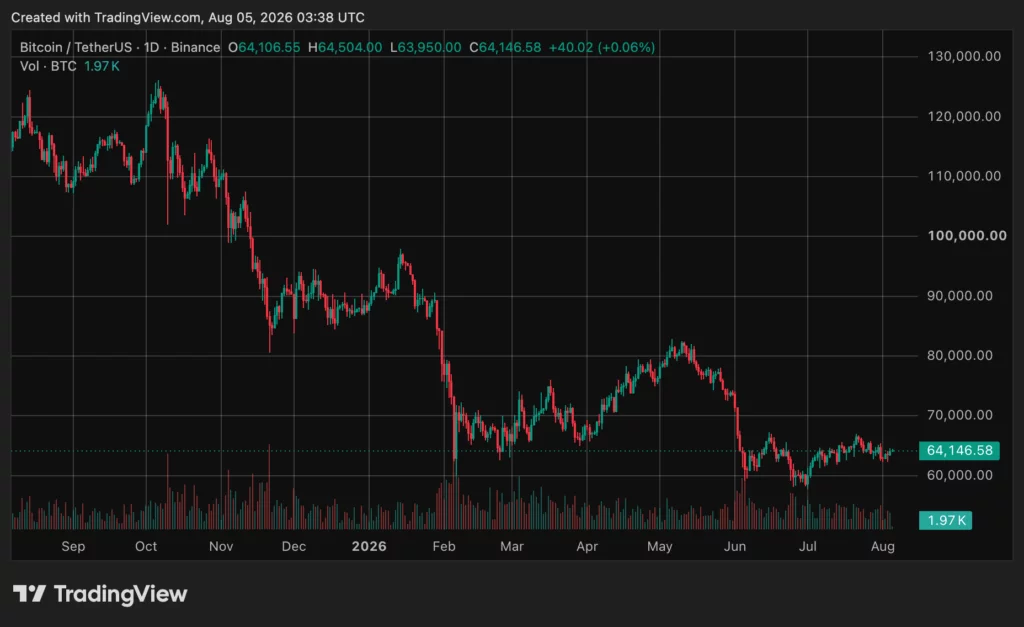
Bitcoin traded around $64,150 early on Aug. 5. No evidence reviewed for this report linked the immediate price move to Hayes’s essay. Hayes also acknowledged that he cannot identify the borrower that might trigger a crisis or determine Bitcoin’s precise bottom.
Arthur Hayes says AI spending is a real estate credit trade
Hayes’s central argument is that investors are treating AI capital expenditure as if every dollar supports a high margin technology business. He views much of the spending differently. Data center land, buildings, power connections and cooling systems resemble property development, while processors can become less valuable when newer equipment delivers more computing power at a lower cost.
This distinction leads to his comparison with the global financial crisis. Hayes described the AI boom as a “credit story like 2008 and not an earnings story like 2000.” In his scenario, banks, insurers, private credit funds and infrastructure investors continue financing construction after profitable demand begins slowing.
Losses would then emerge when weaker projects cannot generate enough cash to meet debt, lease or interest obligations. Financial stress could spread to lenders and investors holding AI infrastructure exposure, even if leading technology companies remain profitable.
Hayes expects announced AI capital spending growth to begin slowing during the second half of 2027 and become clearer in 2028. He also expects markets to eventually reward companies that reduce construction plans. Those dates are forecasts. No company filing reviewed for this report confirms that an industrywide contraction has begun.
His Bitcoin case follows from the expected policy response. Hayes argues that U.S. authorities would protect strategically important AI companies and their lenders because computing capacity has become part of the country’s economic competition with China.
He discussed a possible Bitcoin trading range between $60,000 and $70,000, with downside near $50,000, before an eventual rise toward $1 million. Those levels are not guaranteed targets and depend on monetary policy, credit creation and investor demand developing as Hayes expects.
The essay extends an earlier argument. As crypto.news previously reported, Hayes warned that major technology listings, including possible OpenAI, Anthropic and SpaceX offerings, could absorb liquidity that might otherwise enter crypto markets.
In related coverage, crypto.news examined the expanding bond and credit exposure behind AI infrastructure. That analysis noted that financial risks could spread beyond technology shares if data center construction relies more heavily on debt and private financing.
Official filings show AI spending is still accelerating
The latest company results do not show an AI capital spending collapse. Alphabet reported $44.9 billion of capital expenditure during the second quarter. About 60% of its technical infrastructure investment went toward servers, while 40% went toward data centers and networking equipment.
Alphabet raised its 2026 capital spending guidance to between $195 billion and $205 billion, up from its previous range of $180 billion to $190 billion. The company attributed the increase to faster capacity delivery required to meet demand.
Google Cloud revenue rose 82% from the previous year to $24.8 billion. Cloud operating income reached $8.8 billion, while backlog increased to $514 billion. Alphabet said it expects capital expenditure to increase again in 2027.
Microsoft also reported continued expansion. Its quarterly capital expenditure reached $41 billion, with roughly two thirds directed to CPUs and GPUs. Microsoft Cloud revenue increased 27% to $59.3 billion, while commercial remaining performance obligations reached $678 billion.
The company said it expects capital expenditure to grow during fiscal 2027. Microsoft also expects more than $50 billion of spending in its next quarter, although part of that figure reflects a change in how some data center leases will be classified.
Amazon reported a similar mix of rising investment and stronger cloud income. AWS revenue increased 37% to $42.2 billion in the second quarter, its fastest growth in 18 quarters. AWS operating income reached $16.6 billion.
However, Amazon’s trailing twelve month free cash flow moved to an outflow of $7.6 billion. The company attributed the change mainly to a $66.1 billion increase in property and equipment purchases, largely connected to AI investment.
These results cut both ways for Hayes’s thesis. Strong cloud growth and large customer backlogs weaken the argument that demand is already failing. At the same time, lower free cash flow, rising depreciation and growing contractual obligations show how the buildout can pressure finances even while revenue expands.
Heavy spending alone does not create a credit crisis. Such a crisis would require weaker cash generation, refinancing problems, defaults or impaired infrastructure assets across several companies and lenders.
U.S. financing exposure is growing, but 2008 is unproven
Regulatory filings support Hayes’s narrower claim that AI infrastructure increasingly involves leases, guarantees, joint ventures and outside capital.
Alphabet disclosed $85.2 billion of future payments for leases, mainly connected to data centers, that had not started as of June 30. These leases are scheduled to begin between 2026 and 2031, with contract terms reaching as long as 26 years.
Alphabet also reported $811 billion of purchase commitments and other contractual obligations. Most relate to technical infrastructure, inventory, energy agreements and other long term contracts. The company had $98.2 billion of long term debt and issued more than $51 billion of fixed rate notes during the first half of 2026.
Microsoft disclosed $62.9 billion of finance lease liabilities as of March 31. It also reported another $196.6 billion of leases, mainly for data centers, that had not yet commenced.
Meta reported approximately $182.88 billion of uncommenced lease obligations and $237.67 billion of noncancelable contractual commitments as of March 31. The company entered another $24 billion of infrastructure contracts during April.
Private financing is also becoming more visible in U.S. data center projects. Meta and BlackRock announced a venture for a one gigawatt campus in El Paso, Texas. Meta described the project as representing more than $10 billion of investment.
An earlier Meta venture with Blue Owl Capital covered an estimated $27 billion data center campus in Louisiana. Blue Owl funds received an 80% interest, while Meta retained 20%. Part of the outside funding came through debt sold privately to PIMCO and other bond investors.
Meta agreed to lease the Louisiana facilities and provided a capped residual value guarantee under certain conditions. Such arrangements show how data center exposure can be distributed among technology companies, insfrastructure funds, landlords and debt investors.
They do not prove that a 2008 style chain of insolvencies has started. Alphabet, Microsoft, Amazon and Meta remain profitable businesses with large operating cash flows and growing customer commitments. The reviewed filings did not report widespread defaults on AI infrastructure debt or an official government rescue program.
The 2008 comparison therefore remains a stress scenario rather than a present diagnosis. Mortgage losses became systemic because weak lending, securitization, leverage and opaque counterparty exposure spread through major financial institutions.
An AI infrastructure downturn could follow a different route involving unused capacity, falling rental values, obsolete equipment, tenant concentration and long power commitments. Whether those risks become systemic will depend on utilization, refinancing conditions and where losses ultimately settle.
Bitcoin’s outcome depends on policy, liquidity and timing
The Federal Reserve held its federal funds target range at 3.5% to 3.75% on July 29. The decision passed by a 9 to 3 vote. The central bank did not announce an AI rescue facility, emergency lending program or new asset purchase plan.
The Fed has conducted reserve management purchases of Treasury bills to maintain ample banking system reserves. Its July monetary policy report said Treasury bill purchases since early January totaled nearly $250 billion, including about $160 billion of reserve management purchases.
Those operations are not officially described as quantitative easing or an AI bailout. The Fed says they are intended to maintain an adequate level of reserves and support control over short term interest rates.
Hayes interprets balance sheet growth and stable policy rates as supportive for bank credit and future market liquidity. That interpretation remains open to debate because reserve management can expand the Fed’s assets without representing the broad crisis response assumed in his forecast.
Bitcoin could benefit if a future downturn produces rate cuts, emergency lending or larger asset purchases. However, the first stage of a credit shock could hurt Bitcoin as investors sell liquid assets, meet margin calls and reduce leverage.
As crypto.news reported in its examination of Bitcoin’s changing market cycle, Federal Reserve policy and global liquidity now compete with the halving cycle as major drivers of crypto prices.
The next evidence will come from company guidance and credit markets rather than from Hayes’s essay. Investors can watch 2027 spending plans, cloud backlog conversion, data center occupancy, lease commitments, private credit spreads and any defaults tied to AI infrastructure.
The Fed’s next scheduled meeting will take place on Sept. 15 and Sept. 16. Unless company demand weakens or financing stress begins appearing, Hayes’s argument remains a forward looking Bitcoin thesis built around a credit crisis that has not occurred.
FAQs
Is the AI bubble already bursting?
The latest filings do not show an industrywide contraction. Alphabet raised its spending guidance, Microsoft expects continued capital expenditure growth and AWS reported accelerating revenue. Financial pressure is visible in free cash flow and contractual commitments, but those conditions do not constitute a credit bust.
Why does Hayes compare AI with 2008 instead of 2000?
Hayes believes the main vulnerability lies in debt, leases and infrastructure financing rather than technology companies earning little or no revenue. The comparison depends on credit losses spreading through financial intermediaries, which has not been established.
Would an AI crash automatically raise Bitcoin’s price?
No. Bitcoin could decline during an initial liquidation period. A later recovery would depend on the scale, speed and form of monetary support, along with continuing demand for Bitcoin. Central bank easing would not guarantee any particular price.
What would weaken Hayes’s thesis?
Sustained cloud revenue, strong data center utilization, profitable AI services and stable credit performance would weaken the argument. The thesis would also lose force if companies fund construction without creating stressed borrowers or concentrated lender losses.

BSE shares fall 2% despite 62% jump in Q1 net profit to Rs 874 crore. Should you buy, sell or hold?

BNB price nears $600 with shorts at risk

Khloé Kardashian Leads Girl Group In New Reality Show

Renter of Home in Anne Heche Crash Denies Settlement With Son

No Jackpot Winner as $257 Million Prize Rolls Over to $269 Million Monday Draw

Weekend Open Thread: Staud – Corporette.com

TRAUMA FINANSIAL NGGAK MESTI KARENA PERNAH SUSAH #annisast #moneymarriageconflict #relationship

Banking on politics — Israel and the Palestinian financial crisis

The day the financial system disintegrates? Expect a sudden shock and a global attitude shift
-

 Business6 days ago
Why Trees Belong on the Risk Register
-

 Fashion4 days ago
Weekend Open Thread: Wit & Wisdom
-

 Politics4 days ago
Meta enters AI-training agreement with far-right ‘propaganda rag’ Newsmax
-

 Politics7 days ago
Reform UK betrays West Mids residents by running from party pledges
-

 Crypto World4 days ago
MicroStrategy Post-Earnings CLARITY Act Push Could Add New Catalyst for Its Stock
-

 Politics2 days ago
Zack Polanski: an incitement to murder Nigel Farage?
-

 Business7 days ago
Major shareholder moves on Canyon
-

 Crypto World4 days ago
XRP Ledger v3.3.0 brings five institutional features
-

 News Videos6 days ago
Bitcoin Enters the 3rd Stage of the Bear Market
-

 Politics6 days ago
Luke Littler’s dominance sparks GOAT debate
-

 Sports5 days ago
Seema Kaliramna Wins Discus Throw Bronze, Takes India’s CWG Medals Tally To 17
-

 Crypto World4 days ago
New York sues Kalshi over prediction market gambling
-

 Crypto World3 days ago
Crypto PAC spending tops $2M in Michigan House race
-

 Business5 days ago
Trump Announces Hamas Disarmament Agreement as Iran Strikes Kuwait Air Base and US Attacks Pause Overnight
-

 Tech7 days ago
Gemini can now summarize the messiest comment threads in Google Docs
-

 Tech3 days ago
ESET tracks rise in malicious AI skills and adaptable malware
-

 Business2 days ago
DTCR: Deleveraging And A Hedge Fund Collapse Point To A Possible AI Bottom
-

 Tech5 days ago
Building A Reproduction PlayStation Motherboard
-

 Tech5 days ago
Gemini Spark can now use Chrome logins and saved passwords to run errands on your behalf
-

 NewsBeat6 days ago
Four people die trying to cross Channel in small boats
You must be logged in to post a comment Login