
Crypto World
SpaceX Short Interest Falls to 11% From 34% Peak: Are Bears Capitulating?

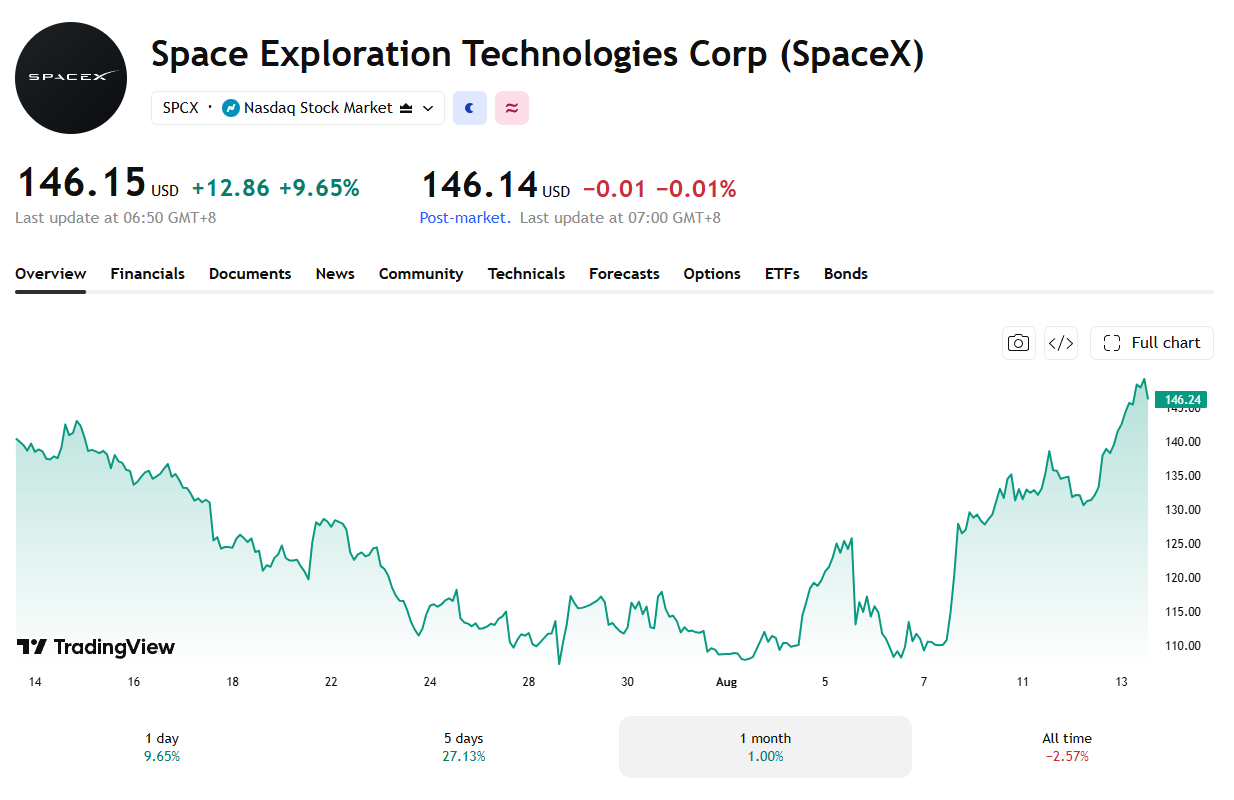
Short sellers are abandoning their bets against SpaceX (SPCX) just as the stock stages a sharp rebound.
Short interest in the company fell to roughly 11% of its tradable float this week. That is down from a peak of 34% just seven days earlier, according to S3 Partners.
SpaceX Heading Back to Opening Price
The unwind comes as SPCX shares climbed about 41% off their Aug. 3 low. That SpaceX stock rebound lifted the stock back above its $135 initial public offering (IPO) price and towards its open opening of $150. Short interest had already overtaken Tesla’s ahead of last week’s earnings report and a share lockup expiration.
Ihor Dusaniwsky, managing director of predictive analytics at S3 Partners, said bearish traders have little ammunition left.
“Shorts that wanted to short are out of bullets.”
— Ihor Dusaniwsky, CNBC

SpaceX can Determine the Market Direction
Bob Sloan, founder of S3 Partners, went further on CNBC. He argued SpaceX’s size and its role in “Delta 1” trading strategies make its positioning ripple through the market.
Delta 1 desks use derivatives to mirror a stock’s price moves without holding the shares directly. Musk’s companies have long been a core holding in these strategies, Sloan said.
“SpaceX is probably the frothiest trade ever.”
— Bob Sloan, CNBC
He noted the 911 million share unlock added fresh tradable float just as bears retreated.
Sloan drew a parallel to the memory chip sector, where he correctly flagged the trade’s peak on June 22. Names tied to the memory chip shortage gained again this week, with Micron up about 7%. Positioning data pointed to renewed momentum across the sector.
Sloan also said the short-covering rally is also splitting adjacent space and AI-infrastructure stocks into two camps. Stocks seen as aligned with SpaceX’s orbit, including Vast Space and Planet Labs, are attracting long interest, he said. Competitors such as Intuitive Machines and AST SpaceMobile are seeing more bearish bets, according to Sloan.
The reversal shows how the $148 support level that once threatened further downside has instead become a springboard. Traders will watch whether the short-covering rally has further room to run. Bears could rebuild positions once the stock’s momentum cools.
The post SpaceX Short Interest Falls to 11% From 34% Peak: Are Bears Capitulating? appeared first on BeInCrypto.



Metaplanet CEO Simon Gerovich said no Bitcoin was sold after the company moved 5,014 BTC between custodial addresses for about $8 in fees.
GSR, a crypto market maker, cut Bitcoin’s (BTC) weighting in its Core3 model portfolio to 16.9%, the lowest of the three assets it tracks. The firm raised Solana’s (SOL) weighting to 43.6%, making it the model’s largest position.
Core3 is GSR’s weekly rebalanced signal portfolio. It shows where the firm’s trading desk sees relative strength across Bitcoin, Ether (ETH) and Solana. The model does not hold client funds. Instead, it turns GSR’s short-term market view into a weighting readers can track.
Solana Overtakes Ether as the Top Weighting
Ether’s weighting fell to 39.5%, and Solana took the largest position, a spot Ether held in GSR’s prior rebalance on Aug. 5. The shift tracks short-term price action rather than longer-term returns. Solana gained 2.98% over the past week. Bitcoin fell 1.02% and Ether slipped 0.20% over the same stretch, based on the performance data behind the rebalance.
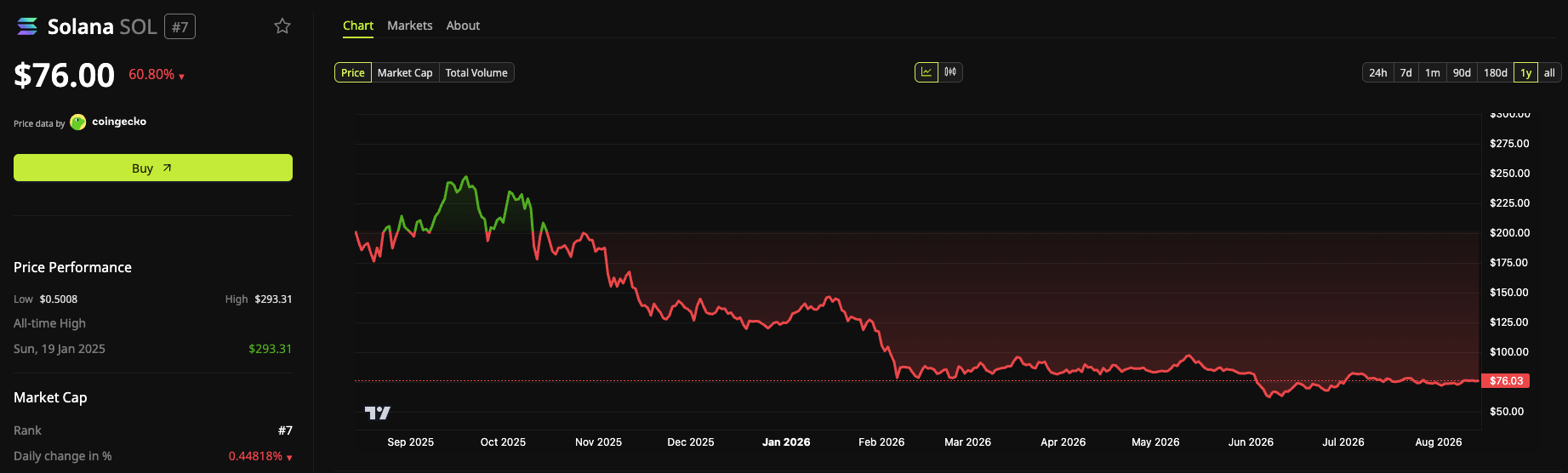
Solana remains the weakest performer of the three over a longer horizon. It is down roughly 36.69% year to date and 60.80% over the past year. That gap between short-term momentum and long-term losses reflects Core3’s design.
The model favors recent relative strength over trailing performance. That approach lets it raise exposure to the asset down the most for the year.

Bitcoin trades near $63,513, based on current pricing. Its 30-day volatility reading of 26.82% is the lowest of the three assets, a factor that usually favors a heavier Bitcoin weighting under a risk-adjusted model. GSR moved the opposite direction this week. The firm favored the asset with fresher upside momentum over the one with the calmer chart.
Solana trades near $76 on the Solana Markets page. Its 60-day volatility of 48.84% is the highest of the group, nearly nineteen points above Bitcoin’s 29.49%. That combination, the largest allocation paired with the highest volatility reading, makes Solana the swing factor in Core3’s near-term returns.
A Model That Trails Its Own Benchmark
The reweighting comes as Core3 trails a simple equal-weight approach to the same three assets. Core3 lost 70.28% over the past year, compared with a 63.44% loss for the equal-weight basket.
It is down 35.58% year to date versus 32.22% for the benchmark. GSR’s active tilts have added risk without adding return over that stretch. Whether the new Solana-heavy weighting closes that gap or widens it depends on whether this week’s momentum in SOL carries into the next rebalance.
The post Crypto Trading Model GSR Cuts Its Bitcoin Allocation to 17%, Bets Big on Solana appeared first on BeInCrypto.

Liquid cooled servers in an installation at the Global Switch Docklands data centre campus in London, UK, on Monday, June 16, 2025.
Bloomberg | Bloomberg | Getty Images
BEIJING — Yangtze Memory Technologies is rapidly gaining market share in a critical chip sector, according to Counterpoint Research.
The company, also known as YMTC, landed in third place by shipments globally in the second quarter, behind South Korea’s Samsung and SK hynix but beating out U.S. rival Micron and Japan’s Kioxia, Counterpoint data released Wednesday showed.
That’s when looking at the NAND memory segment, which contributes about one-fourth of Micron’s revenue. NAND chips retain data even when devices are powered off but are slower than DRAM memory chips, which operate more quickly — at a far higher cost, forming about three-fourths of Micron’s revenue.
YMTC reached third place with a 14% share, the report said. It narrowly beat Kioxia a year ago, but fell back behind in following months, Counterpoint Research Director MS Hwang said.
“YMTC is projected to pull further ahead in 2027 and 2028. From that perspective, YMTC achieving third place this quarter carries significant weight in the competitive landscape,” Hwang said.
He said a 15% market share is the minimum needed for a memory manufacturer to fund its own capital expenditures for future growth.
YMTC is preparing to go public in mainland China, following the blockbuster debut of DRAM-focused Chinese memory chip company CXMT last month.
CXMT held 7% of the DRAM market in the second quarter, in fourth place behind Micron, SK hynix and market leader Samsung, a separate Counterpoint report showed earlier this month.
Both DRAM and NAND memory chip markets have reached record sales, at nearly $100 billion and $46 billion, respectively, in the first quarter, according to Counterpoint.
Despite YMTC’s gains in shipments, the company still lagged behind Micron and Kioxia in terms of NAND chip revenue, the research firm said. It noted YMTC still sells more to consumer applications rather than data centers — a business expected to take half of all available NANDs by the end of 2026.
In order to ramp up NAND production, SK hynix is resuming investment at a facility in the Chinese coastal city of Dalian after a four-year pause, Korean media reported this week. SK hynix did not immediately respond to a CNBC request for comment.

Goliath Ventures and its CEO, Christopher Alexander Delgado, are facing action from two US financial regulators over the same alleged crypto Ponzi scheme.
The actions came two months after Delgado pleaded guilty to charges in the case.
Regulators Target Goliath
The Commodity Futures Trading Commission filed a complaint against the company and Delgado in the US District Court for the Middle District of Florida. The Securities and Exchange Commission filed separate charges on the same day.
The regulators allege that Goliath raised hundreds of millions of dollars from investors by promising to generate profits through crypto asset trading and liquidity pools. The CFTC said about 1,600 customers contributed at least $397 million, while the SEC put the amount raised at around $425 million from more than 1,300 investors.
According to the SEC, the company operated the scheme from at least January 2023 through January 2026 through an unregistered securities offering. Investors were told they could “partner” with Goliath to invest in crypto asset liquidity pools. They were promised monthly returns of 3% to 10% from fees paid by buyers and sellers trading crypto assets in those pools, in addition to the return of their principal.
The money, however, was not invested in the liquidity pools, the SEC claimed. Instead, funds from new and existing investors were allegedly used to pay promised returns to earlier investors. The CFTC also said customer funds were used to pay fictitious profits and support Delgado’s lifestyle.
The CEO took at least $51 million for personal use, including homes, luxury vehicles, a yacht, and travel, according to the filing. The company also hired sales agents to attract more investors and paid them commissions from investor funds. Account balances and investment performance figures were fabricated to make it appear that investors were earning profits and that their assets were invested in crypto pools, the SEC said.
Delgado Faces Permanent Bans
The defendants also issued false account statements and falsely guaranteed investment returns, according to the CFTC. By November 2025, Goliath could no longer bring in new money quickly enough to repay existing investors. It stopped monthly distributions, and the scheme collapsed.
The SEC charged Goliath and Delgado with violating several federal securities laws. Delgado has agreed to a bifurcated settlement, subject to court approval. He agreed to be permanently barred from violating the charged provisions, participating in certain securities transactions, and acting as or being associated with a broker or dealer.
The post $51M for Homes, Cars, and a Yacht: Regulators Target Goliath, CEO Delgado appeared first on CryptoPotato.


Futures positioning has rebuilt to levels last seen when dogecoin traded at three times today’s price, and more than three accounts are betting on a rebound for every one betting against.
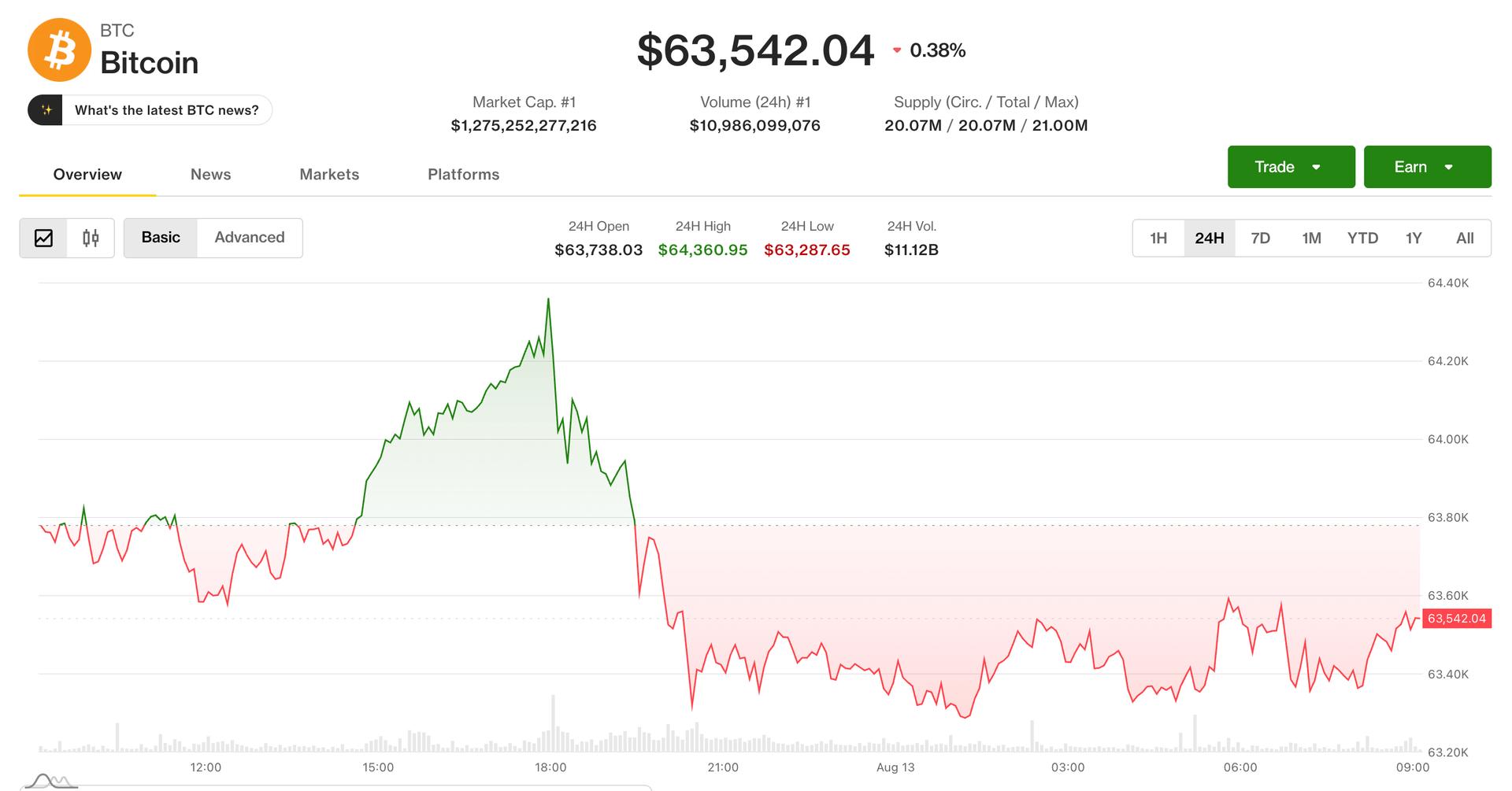
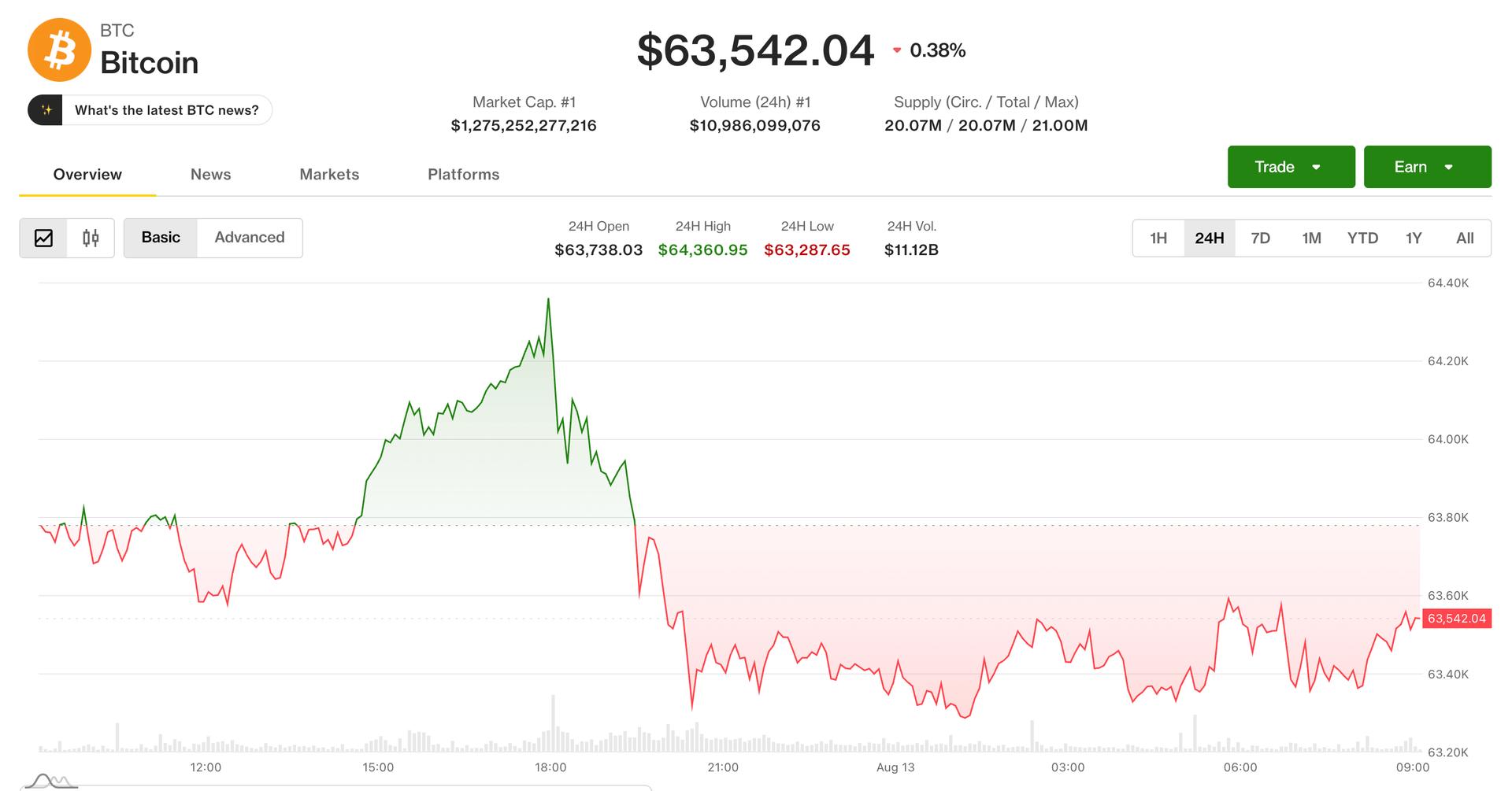
Bitcoin reclaimed $64,000 after U.S. inflation eased to 3.4% in July, while market leaders said the in-line reading left the Federal Reserve’s policy outlook largely unchanged.
Summary
- U.S. CPI rose 3.4% annually in July, easing from 3.5% in June.
- Bitcoin recovered from roughly $63,400 to $64,100 after the inflation report.
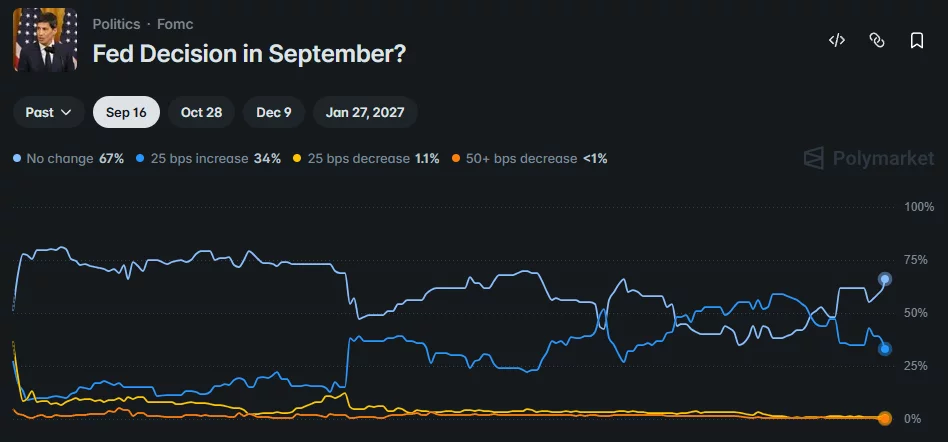
- Polymarket traders assigned a 67% probability to no rate change in September.
- Analysts said ETF flows, liquidity, and derivatives positioning may now regain influence.
The U.S. Bureau of Labor Statistics reported on Aug. 12 that the Consumer Price Index rose 0.1% month over month in July and 3.4% from a year earlier. Both readings matched market expectations.
Core CPI, which removes volatile food and energy prices, increased 0.2% during the month and 2.5% annually. The yearly core rate slowed from 2.6% in June, while headline inflation eased from 3.5%.
Bitcoin rebounds after in-line CPI report
Bitcoin (BTC) rose to around $64,100 following the release, recovering from an intraday low near $63,400, according to data from crypto.news.
The move offered some relief after uncertainty over the U.S.-Iran conflict and the Strait of Hormuz pressured crypto and other risk assets. Renewed disruption to energy supplies could lift oil prices and complicate the inflation outlook, limiting the market’s response to July’s softer figures.
Gadi Chait, investment manager at Xapo Bank, told crypto.news that Bitcoin’s reaction to inflation data largely depends on how the figures affect expected interest rates and financial conditions.
“Fundamentally, Bitcoin is a liquidity-sensitive asset. Historically, it has performed strongly when liquidity is abundant, and interest rates are low, while higher rates and tighter financial conditions have put it under pressure.”
Chait said long-term holders would focus more on the direction of monetary policy than on one inflation report. A path toward looser policy would support Bitcoin, while a higher-for-longer rate outlook would remain a headwind, he added.
Fed rate expectations remain broadly stable
The in-line report reduced the immediate prospect of an inflation-driven policy shift, but inflation remained above the Federal Reserve’s 2% target.
Polymarket data showed traders assigning a 67% probability to no change at the September meeting and a 34% chance of a 25-basis-point increase. A separate market placed the probability of at least one rate hike in 2026 near 55%.
Ryan Lee, chief analyst at Bitget Research, said the CPI reading did not provide a decisive signal in either direction after the softer July employment report.
“An in-line CPI reading neither forces a hawkish re-pricing nor delivers a clear dovish catalyst after Friday’s soft jobs data. It largely preserves current September expectations and leaves the focus on Jackson Hole and the next round of inflation numbers.”
Lee described the result as relatively constructive for Bitcoin because it removed the immediate threat of an inflation-led selloff. Without a stronger monetary-policy catalyst, he expects ETF flows, market liquidity, and derivatives positioning to play a larger role in crypto prices.
Fabian Dori, chief investment officer at Sygnum Bank, also said the figures left the medium-term liquidity outlook mostly unchanged. Dori identified Treasury cash balances, changes related to the enhanced supplementary leverage ratio, private credit creation, and stablecoin adoption as the structural factors to watch.
Bitcoin options retain defensive pricing
Derivatives traders continued to pay more for downside protection despite the CPI figures matching forecasts, according to Andrei Grachev, managing partner at DWF Labs.
“On the end-August expiry, downside strikes near $60,000 have been costing more than equivalent upside strikes near $70,000,” Grachev told crypto.news.
Grachev said the pricing gap suggested caution about the broader policy path rather than concern over one report. Demand for exposure around $70,000 had also recovered, creating a market that remained constructive in positioning while defensive in pricing.
Bitfinex analysts identified ETF flows as the first signal to monitor after the release, followed by holder behavior if Bitcoin revisits the $62,000–$63,000 area. Their pre-release assessment placed the first major upside barrier between $65,021 and $65,510 on a daily closing basis.
According to the analysts, two daily closes above $68,300 would invalidate the existing range structure. The level combines the short-term holder’s cost basis with April’s monthly opening price.
PPI becomes the next inflation test
Markets will turn to the July Producer Price Index on Aug. 13 for evidence of inflation developing earlier in the supply chain. A softer reading could reduce demand for options protection, while an upside surprise may revive concerns about another Fed rate increase.
Iggy Ioppe, chief investment officer at Theo, said the CPI result neither forced a hike nor gave markets a clear dovish catalyst. He expects short-term attention to remain on yield opportunities, with gold serving as a defensive asset while Bitcoin remains sensitive to institutional ETF flows.
Bitcoin must now hold above $64,000 and secure acceptance beyond the $65,021–$65,510 band to strengthen its rebound. Failure to do so would leave the $62,000–$63,000 area exposed as traders assess PPI, energy prices, and the next change in Fed expectations.
Gabe Selby, head of research at CF Benchmarks, told CoinDesk that bitcoin moves hardest when inflation data forces a rethink on rates, gaining an average 3.25% across the three occasions in the past nine releases when inflation came in below expectations.
A downside surprise on July 14 was followed by a 4.24% rally. “An in-line report can remove a tail risk,” Selby said. “It takes a genuine surprise to create a catalyst.” He further sees room for the Fed to wait, with shelter costs up just 0.1%, energy down 1.5% and gasoline down 2.9%, and some goods categories now lapping last year’s tariff-driven increases.
The next tests are the Jackson Hole gathering of central bankers later this month, the Sept. 4 jobs report and the Sept. 11 inflation release.
Equities took the news better. MSCI’s Asia Pacific index rose almost 1% with Samsung Electronics and SK Hynix the biggest contributors, and Korea’s Kospi rallied almost 4% into a technical bull market, up 22% in ten days.
The mood was not uniform, with Cisco falling over 4% after hours on underwhelming earnings and Cerebras Systems dropping 17% on declining hardware sales.
Brent crude snapped a six-day run of gains, easing after a stretch that had taken it to $90 a barrel. That came as an Islamic Revolutionary Guard Corps adviser, General Mohammad Reza Naqdi, said Iran was preparing to carry out operations on U.S. soil under a new military doctrine.
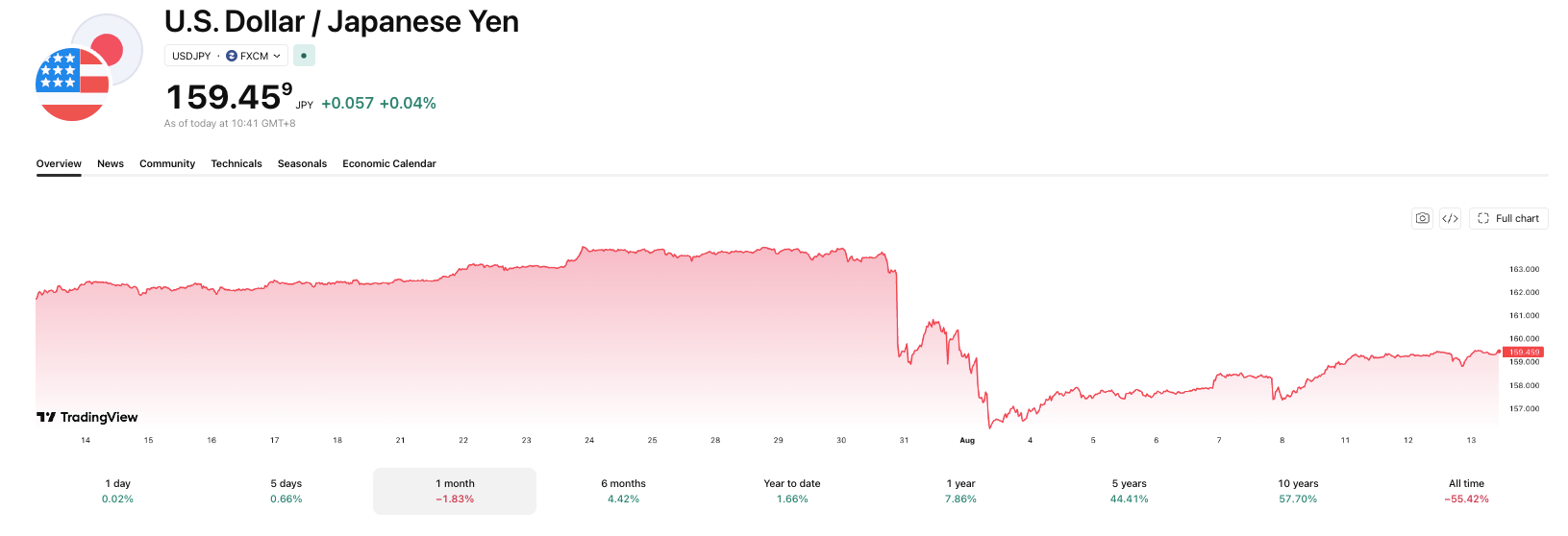
Japan has enough dollar reserves left to intervene in currency markets again, according to Goldman Sachs. The bank estimates Tokyo holds close to $1 trillion in reserves. About $200 billion of that sits in cash or cash equivalents.
That cushion matters because the yen has already given back much of last month’s gains. The currency slipped back toward 160 per dollar this week, erasing about half its post-intervention rebound.
Why Goldman Sees Room to Act Again
Goldman Sachs strategist Karen Fishman discussed this on the bank’s Exchanges podcast. She said Japan would not need most of that pool to match July’s operation.
She also pointed to the Federal Reserve‘s FIMA repo facility, which lets central banks borrow dollars against Treasury holdings. That access could make the full $1 trillion available and spare Japan from selling bonds on the open market.
That backstop already shifted trader sentiment last week. Once clients saw the facility could unlock the full reserve pool, they grew more confident on the yen. Praneet Shah, Goldman’s head of foreign exchange options trading, made the point on the podcast.
The Rate Gap Behind the Yen’s Slide
The real driver, according to Shah, is the gap between Japanese and U.S. borrowing costs. Ten-year Treasury yields sat near 4.69% this week. Ten-year Japanese government bonds yielded just 2.839%, keeping capital flowing toward U.S. debt.

Markets currently price a 65% chance the Bank of Japan raises rates by a quarter point in September. Fishman said a miss on that hike would renew pressure on the yen. A softer U.S. inflation or jobs print, however, could ease that pressure and revive bets on another intervention, Shah said.
“If they don’t deliver… that would put renewed downward pressure on the yen.”
Karen Fishman, Goldman Sachs Research
Tokyo and Washington split the July operation, marking the first joint U.S.-Japan yen defense since 1998. It followed the yen’s slide toward 164 per dollar, its weakest level in four decades.
Tokyo deployed roughly $85 billion in the operation’s first two days. Goldman calls that Japan’s largest two-day intervention outside the aftermath of the 2011 Fukushima disaster.
Fishman noted that after Japan acted alone in April and May, the yen still returned to 40-year lows within months. Options markets still price elevated premiums on short-dated yen calls. That signals investors remain wary of betting against a rebound, Shah said.
Tokyo’s next move now hinges less on the size of its reserves. Instead, it depends more on what the Fed and the Bank of Japan do next.
The post Goldman Sachs Says Japan Has $1 Trillion War Chest: More Yen Interventions Coming? appeared first on BeInCrypto.

An Australian Securities Exchange (ASX) shareholder has moved toward legal action against former ASX directors and officers, seeking court permission to pursue claims tied to the exchange’s failed blockchain-based clearing and settlement replacement project.
According to an ASX announcement on Wednesday, Rosherville Pty Ltd has informed the exchange that it intends to apply for leave to commence a statutory derivative action under sections 236 and 237 of Australia’s Corporations Act. If the Federal Court grants permission, Rosherville would bring the proceedings on ASX’s behalf—while the court would first need to assess whether the proposed case can proceed.
Key takeaways
- Rosherville Pty Ltd is seeking Federal Court leave to bring a statutory derivative action on ASX’s behalf related to the CHESS replacement project.
- ASX said there are no allegations against the exchange itself in the proposed proceeding, but it has not disclosed which former officers or directors are targeted.
- The push comes after ASIC took legal action over allegedly misleading market statements connected to the project and after ASX admitted misleading conduct.
- The dispute could clarify how far shareholders may hold former leaders accountable for oversight of high-profile fintech failures.
How the CHESS blockchain plan unraveled
ASX began investigating a replacement for CHESS—the Clearing House Electronic Subregister System—in 2016. The exchange selected a distributed-ledger approach developed with New York-based Digital Asset, with expectations at the time that ASX could become one of the first major securities markets to run core services on blockchain technology.
Those expectations ultimately did not materialize. The rollout was repeatedly delayed. In November 2022, ASX paused the project after an Accenture review identified significant issues, including problems with the design and with its ability to satisfy ASX requirements, according to reporting at the time from Cointelegraph.
By May 2023, ASX had formally abandoned the blockchain replacement plan and said it would shift to more conventional technology, another step covered in earlier reporting on the matter.
Regulator action over market statements
The Federal Court and ASIC’s involvement is central to the latest shareholder development. ASIC sued ASX in August 2024, alleging that ASX lacked a reasonable basis for statements made in February 2022 that the project was “progressing well” and on track for an April 2023 launch.
ASIC characterized the matter as a collective failure involving ASX’s board and senior executives, according to earlier coverage. The dispute culminated in a significant regulatory outcome for ASX: in June 2026, ASX admitted misleading conduct connected to the CHESS replacement project.
On July 3, the Federal Court ordered ASX to pay a $14.4 million penalty and $2.1 million toward ASIC’s costs, effectively closing the regulator’s case weeks before Rosherville notified ASX that it was preparing to seek leave for derivative proceedings against former officials.
Why a shareholder derivative action matters
ASX’s Wednesday statement underscored that the proposed lawsuit is aimed at individuals rather than the exchange itself. It also made clear that the matter is at an early stage: the exchange did not specify which former officers or directors Rosherville plans to target, and it did not outline the precise alleged breaches or the remedies the claimant wants. Importantly, the court had not yet considered whether the proposed action can proceed.
Even so, the direction of the case highlights a question that investors and corporate governance observers often consider after large-scale technology undertakings fail: when a company admits misconduct or faces penalties tied to project communications, can shareholders translate that outcome into claims against the decision-makers who oversaw the effort?
As framed in ASX’s disclosure, Rosherville’s plan is grounded in Australia’s Corporations Act mechanism for statutory derivative actions, which can allow shareholders to pursue claims on behalf of the company, subject to court approval. That “permission” step is critical—because it means the court will examine whether the case is procedurally and substantively viable before any allegations against individuals are litigated.
What to watch next in the Federal Court
For market participants, the immediate variables are straightforward. The court will determine whether Rosherville’s application meets the statutory threshold for leave and whether the claims can move forward. ASX’s statement indicates that the exchange itself is not accused in the proposed action, but it has declined to offer details about the individuals or the alleged duty breaches. That information, if provided later in the process, could determine how investors interpret the scope of accountability sought by shareholders.
Beyond the legal mechanics, the broader watch point is how the case interacts with the earlier ASIC matter. While ASX’s admission of misleading conduct and the Federal Court’s penalty are part of the background, the shareholder action—if permitted—would focus on the alleged actions or omissions of former officers and directors. Readers should monitor any court filings that clarify the specific duties in question and how the shareholder claim relates to, or differs from, the conduct ASIC pursued.


Slovenia entered the EU’s MiCA stablecoin register through electronic money institution Dinaro, as the update also added two new CASPs.

PSG Retain UEFA Super Cup After Narrow Win Over Aston Villa

How To Stop Twitch From Training AI On Your Streams

Aug 10 | Live Market Analysis for Gold and Crypto | US Session


-

 Fashion5 days ago
Weekend Open Thread: Mattifying Sunscreen
-

 Fashion6 days ago
Frugal Friday’s Workwear Report: Cap-Sleeve Pointelle Crewneck Sweater
-

 News Videos5 days ago
Can Astrology Help Find Gold and Silver Trends? A Financial Astrology Guide
-

 Politics7 days ago
Reform UK And Greens Sink To Lowest Favourability Ratings To Date
-

 Tech5 days ago
Rinn Pharma & Biopharma to join NordicPharmaTrain network
-

 Business4 days ago
How to Start a Cleaning Business: A Step-by-Step Guide
-

 Business4 days ago
Datadog: Best Of Breed For Multiple Reasons
-

 Business4 days ago
BDC Weekly Review: Private BDC Q2 Numbers Are Strong
-
 NewsBeat1 day ago
Communication cards help banking customers access services or report scams
-

 Business6 days ago
Brightwater secures funding for WA-first dementia projects
-
 Tech6 days ago
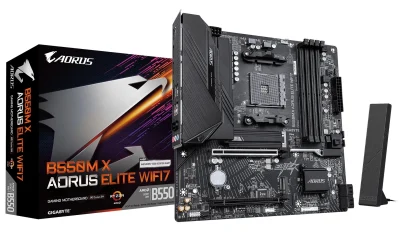
Price Hikes May Be Coming for PC Motherboards Next
-
 Crypto World7 days ago
Galaxy Digital Stock Slides 14% as Crypto Prices Hit Earnings
-
 Business2 days ago
Oil Price Today (August 11): Crude oil rises to $88 after Trump’s compensation demand dents Hormuz opening. Here’s why
-

 Business7 days ago
SpaceX Shares Plunge 13.6% After First Public Earnings as AI Capex Surge and Lockup Spark Selloff
-
 Tech7 days ago
How to Use Your Phone as a Webcam on PC and Mac (2026)
-

 Tech7 days ago
Hackers just broke into America’s tap water. How scared should you be?
-

 Fashion5 days ago
Weekly News Update, 8.6.26 – Corporette.com
-

 Entertainment7 days ago
This $29 One-Piece Looks Just Like Ashley Graham’s Swimsuit
-

 Fashion7 days ago
Thursday’s Workwear Report: The Everyday Linen Shirt
-

 Business6 days ago
Aussie shares lose steam to close record-breaking week
You must be logged in to post a comment Login