
Crypto World
Stablecoins can help businesses turn costs into revenue, but not everyone needs to issue a token:



Stablecoins, the $300 billion class of digital dollars, may have started as a faster way to move money across the globe, but companies are now asking a different question: what can they actually do with them?
That shift is driving a new phase of adoption, according to Chunda McCain, co-founder of Paxos Labs, who says the industry is moving beyond basic infrastructure toward real business use cases.
“The first step was getting a stablecoin,” McCain said in an interview with CoinDesk. “The next question is: what now?”
Last week, Paxos Labs underscored that direction by raising $12 million in a strategic funding round led by Blockchain Capital, with participation from Robot Ventures, Maelstrom and Uniswap. The lab unit was incubated under Paxos, the New York-based digital asset firm behind popular stablecoins such as PayPal’s PYUSD (PYUSD) and the Global Dollar (USDG). Paxos itself builds stablecoins and the immediate underlying infrastructure, while Paxos Labs intends to build tooling for further use of those stablecoins.
With the fresh funds, Paxos Labs is building what it calls a “financial utility stack” that lets companies turn digital assets into products through a single integration.
Its newly launched Amplify Suite bundles three core tools: Earn, which offers yield on digital assets; Borrow, which enables lending against them; and Mint, which supports branded stablecoin issuance. The idea behind that is to let firms integrate tokens into a business, then layer on capabilities over time.
Turning cost into revenue
For years, enterprise crypto adoption focused on “first-touch” capabilities like trading, custody or issuing a stablecoin. Those steps opened the door but rarely generated returns on their own, according to McCain
“Stablecoins [have been] loss leaders for years,” he said.
The opportunity lies in how those assets are used. Payments are a clear example: merchants typically give up 2% to 3% in fees, while stablecoin rails can reduce those costs and even generate yield on balances held onchain.
“You turn what has always been a cost into revenue,” he said.
Some of the more novel use cases sit at the intersection of payments and credit. Payment providers already track merchant revenues and cash flow, which puts them in a position to underwrite loans, McCain argued.
That could allow merchants to access financing based on real-time performance, while earning yield on incoming payments and settling instantly across borders. These models are still early, but the building blocks are starting to come together, he said.
Not every firm needs its own token
To capture these benefits, not every firm needs its own stablecoin.
While companies like PayPal have launched branded tokens to control payments and margins, issuing one requires significant investment in liquidity, compliance and distribution.
“If you just need the economics, you don’t need to build your own,” McCain said.
Many firms can instead integrate existing stablecoins and still benefit from lower costs and added yield.
The shift may lack the hype when big firms like Western Union announce their own token, but it carries tangible impact on how businesses operate.
Stablecoins are starting to reshape margins, unlock credit and change how money moves globally, especially where traditional systems remain costly or slow.
“It might sound boring, but this is the math,” McCain said.



Alibaba has rolled out a preview of its most advanced AI model yet, stepping up its push into the top tier of global AI development.
Summary
- Alibaba launched Qwen 3.6 Max Preview, its most advanced AI model, with top rankings across multiple coding and agent benchmarks.
- The model is offered as a proprietary hosted system, marking a move away from the company’s earlier open access approach.
According to an X post from Alibaba’s Qwen team, the new model, Qwen 3.6-Max-Preview, has taken the lead across several key benchmarks, particularly in coding and agent-based tasks. Internal testing placed it ahead on SWE-bench Pro for real-world software work, Terminal-Bench 2.0 for command-line execution, and SkillsBench for general problem-solving, alongside strong results in tool use and web interaction benchmarks.
Performance gains extend beyond coding. SuperGPQA scores rose by 2.3%, pointing to stronger reasoning ability, while QwenChineseBench improved by 5.3%, underlining better performance in Chinese language tasks. Instruction-following capability also ranked at the top in ToolcallFormatIFBench, where the model outperformed competing systems, including Claude.
The release is now live through Qwen Studio and Alibaba Cloud’s Model Studio API under the identifier qwen3.6-max-preview. Developers can integrate it without major changes, as the API supports both OpenAI and Anthropic formats.
Alibaba’s latest move signals a noticeable change in direction. Earlier versions of Qwen built momentum through open-source access, helping the model family gain widespread adoption. Max-Preview, however, is a hosted proprietary system with no open weights.
Lower-tier models remain open source, but the flagship tier is now positioned as a paid, controlled offering. The shift comes just days after Alibaba open-sourced Qwen 3.6-35B-A3B, a model designed to run efficiently by activating only 3 billion of its 35 billion parameters during inference, cutting compute costs while maintaining output quality.
Combined, the Qwen 3.6 lineup now spans multiple use cases. Max-Preview sits at the top for high-end workloads, while the Plus variant targets balanced tasks, Flash focuses on speed, and 35B-A3B supports local deployments.
A new feature introduced with Max-Preview, called preserve_thinking, allows the model to carry reasoning traces across multiple interactions. Alibaba recommends it for agent-driven workflows where maintaining context across long sessions is important.
Alibaba described the release as an ongoing project, noting the model is still under active development and likely to improve in future updates. Qwen 3.6-Max-Preview currently supports a 256k token context window and is limited to text input, with no image capabilities at launch.
Industry transition toward monetization
Alibaba recently shut down the free tier of Qwen Code, while MiniMax updated its open-source license to restrict commercial use without approval. Both actions point to a gradual move away from free access models that initially drove adoption.
Qwen’s growth has been notable. The model family overtook Meta’s Llama as the most widely deployed self-hosted system, with much of that traction built during its open-access phase. At the same time, Chinese open models expanded their share of global usage from 1.2% in late 2024 to around 30% by the end of 2025.
Max-Preview now sits at the center of Alibaba’s effort to compete directly with leading frontier models from OpenAI and Anthropic.
Independent analysis from Artificial Analysis ranks the model as the second-best performer behind Muse Spark, placing it well above the average for reasoning models in its pricing category.
One of Singapore’s largest banks just handed Ethereum a significant institutional vote of confidence. OCBC has launched GOLDX, a tokenized physical gold fund on Ethereum, a move that will reshape how Asian institutional capital flows into public blockchain infrastructure. Following this, our Ethereum price prediction model pops with the most bullish in months.
OCBC, in partnership with its asset management arm Lion Global Investors and digital asset exchange DigiFT, issued GOLDX, targeting institutional investors, hedge funds, and asset managers, with the underlying fund carrying roughly $525 million in assets under management as of April 16. Investors can subscribe using stablecoins or fiat, with tokens delivered directly to blockchain wallets.
“We believe digital assets will play an increasingly important role in financial services,” said Kenneth Lai, OCBC’s head of global markets.
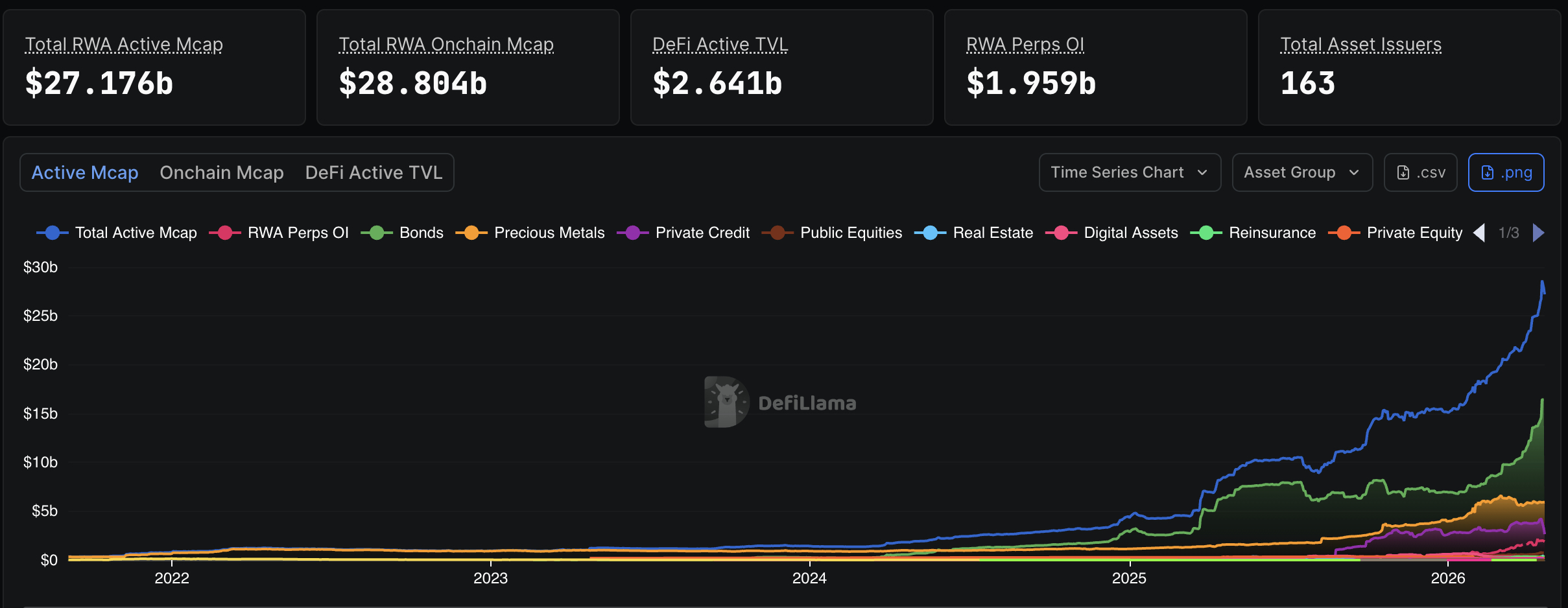
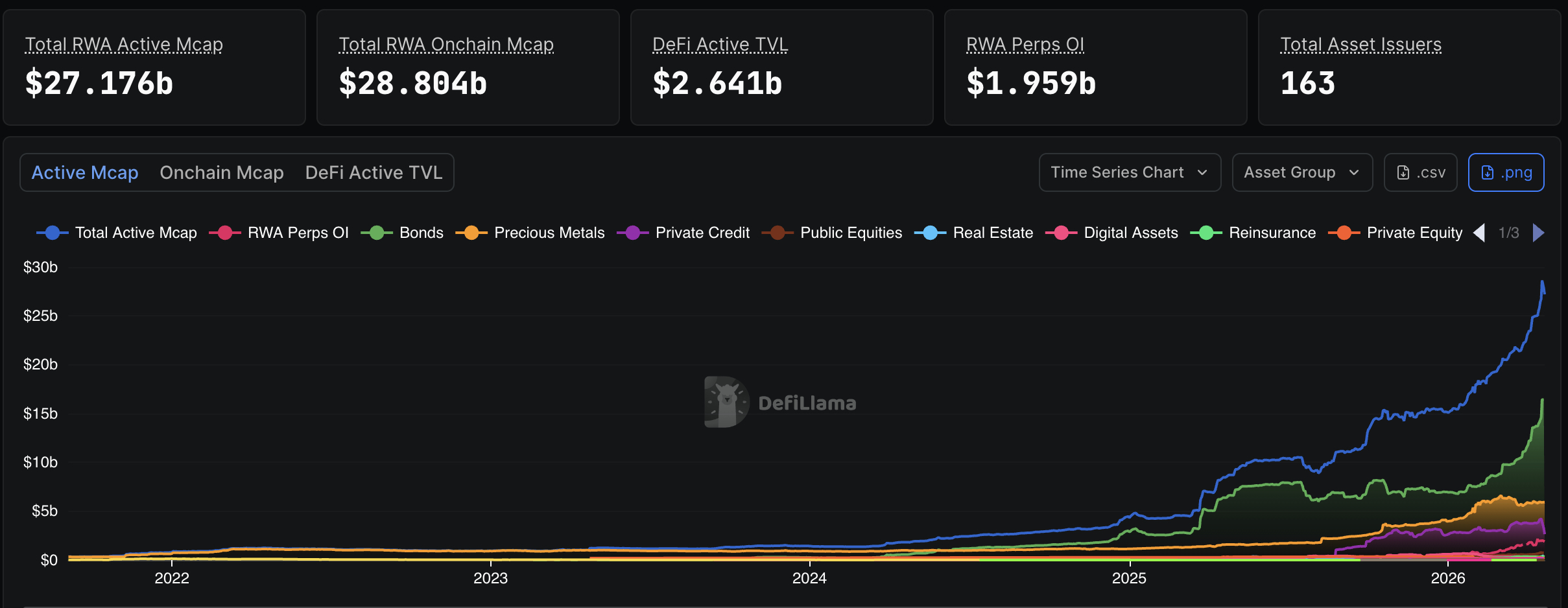
The broader tokenized real-world asset market now sits at over $29 billion on public blockchains, up more than 10% in the last 30 days, and grinding higher since it has been available.
This institutional momentum is building against a technically uncertain backdrop for ETH — and institutional inflows across crypto are accelerating sector-wide. The price setup deserves a closer look.
Discover: The best pre-launch token sales
Ethereum Price Prediction:$3,000 Soon with Singapore’s GOLDX Catalyst?
ETH has shed 2.11% over the past seven days, slipping from $2,450 to current levels, a psychological level that’s now flipped to resistance. The price is caught in a consolidation band that has been tightened.
The 200-day SMA rises to $2,642 sitting well above spot, confirming ETH remains in a recovery phase. Forecast models suggest a maximum 2026 upside of around $3,050, implying about 20% from current levels under normal conditions.
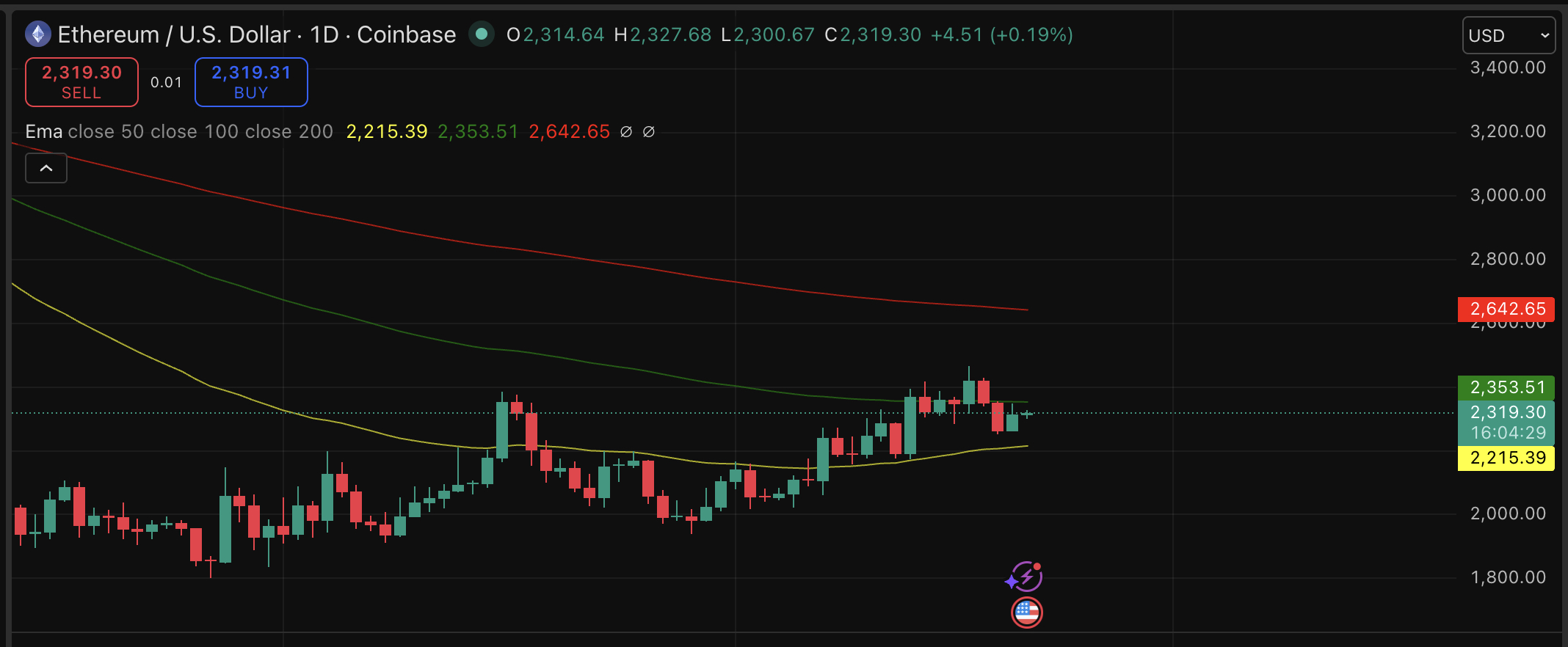
However, if OCBC’s GOLDX launch catalyzes fresh institutional demand on-chain, ETH might and could reclaim the $2,640 200-day SMA and test the resistance. Tom Lee’s TOKEN 2049 target of $22,000 remains a longer-duration thesis requiring BTC to hit $250,000 first.
The OCBC news is real and material, but ETH’s price history shows institutional announcements don’t always translate to immediate spot moves. For now, we wait.
Discover: The best crypto to diversify your portfolio with
LiquidChain Combines ETH, SOL, and Bitcoin
ETH’s 20% projected upside to $3,062 is real, but at a $280 billion market cap, the asymmetry is limited. That’s the structural reality of buying blue-chip crypto in consolidation. For traders willing to accept higher risk in exchange for earlier positioning, the calculus looks different at the infrastructure layer.
LiquidChain is an L3 infrastructure project with a proposition built directly around the OCBC moment: it fuses Bitcoin, Ethereum, and Solana liquidity into a single execution environment. The GOLDX launch, running on both ETH and Solana simultaneously, underscores the cross-chain complexity that LiquidChain’s Unified Liquidity Layer is designed to collapse.
A new layer emerges. Only a few see it first. — LiquidChain (@getliquidchain) March 24, 2026
The future is LiquidChain  ⟁https://t.co/vqvBcdSj94 pic.twitter.com/R7ZeZ0NPGl
Its Deploy-Once Architecture means developers access all three ecosystems without redeployment, with Single-Step Execution and Verifiable Settlement rounding out the stack.
The presale is currently priced at $0.01451, with $690,005.61 raised to date. As with any early-stage presale, capital is at risk and token liquidity is not guaranteed at launch.
Research LiquidChain before the current pricing tier closes.
The post Ethereum Price Prediction: Singapore Largest Bank Launches Gold on ETH appeared first on Cryptonews.


Artificial intelligence agents are becoming economic actors at a pace that outstrips the infrastructure around them, according to a16z crypto. In a recent post, the firm argued that the real bottleneck in the agent economy is no longer intelligence, but identity.
Today’s agents can execute tasks and move money, yet they still lack standardized ways to prove their identity, demonstrate what they’re authorized to do, and more. That missing layer, the firm suggests, is where blockchains can come in.
From KYC to KYA: a16z Makes the Case for Onchain Identity for AI Agents
In a recent blog post, a16z noted that non-human agents already outnumber human employees by roughly 100 to 1 in financial services. Yet the agents remain “effectively unbanked.”
“They can interact with financial systems, but not in ways that are portable, verifiable, or trusted by default. They lack standardized ways to prove their permissions, operate independently across platforms, or bear liability for the actions they take,” the authors wrote.
Subscribe to our YouTube channel to watch leaders and journalists provide expert insights
The missing piece, according to the post, is a shared identity layer for agents. This could essentially be an SSL equivalent that would standardize how they coordinate across platforms.
Today’s approaches, it noted, remain fragmented. According to a16z crypto,
“While there are prominent attempts to solve this today, those approaches are fragmented: vertically integrated, fiat-first stacks on one side; crypto-native, open standards (like x402 and emerging agent identity proposals) on the other; and extensions of developer frameworks like MCP (model context protocol) that attempt to bridge application-layer identity. There is still no broadly adopted, interoperable way for one agent to prove to another who it represents, what it’s allowed to do, and how it gets paid.”
The post outlined a key fix called “Know Your Agent” (KYA). The concept borrows from Know Your Customer (KYC). It calls for cryptographically signed credentials that link each agent to its principal, permissions, constraints, and reputation.
The firm added that blockchains can serve as a neutral coordination layer for agents. They offer portable identities, programmable wallets, and verifiable attestations that resolve across chat apps, APIs, and marketplaces. Without a common standard, a16z warns, merchants will keep blocking agents at the firewall.
Follow us on X to get the latest news as it happens
a16z also identified four additional gaps beyond identity: centralized control over AI governance, payment rails ill-suited to agent-to-agent commerce, the rising cost of verifying machine decisions at scale, and diminished user oversight as agents take on more autonomous workflows.
It argued that blockchain-based tools, onchain governance, programmable stablecoin payments, cryptographic audit trails, and smart-contract-enforced permissions, can close these gaps and support a more trustworthy agent economy.
The post The AI Agent Economy Has an Identity Bottleneck: Blockchain Rails Could Solve It appeared first on BeInCrypto.

JPMorgan Chase will extend a $1.5 trillion investment program designed to bolster U.S. economic resilience across Europe, the Wall Street giant said on Tuesday.
The 10-year Security and Resiliency Initiative (SRI) was launched in the U.S. last October with the aim of facilitating, financing and investing in industries deemed critical to American economic security and resilience.
It was announced in November that the U.K. would be brought into the plan, which is focused on several key areas, including supply chains and manufacturing, defense and aerospace, energy independence, healthcare, and strategic technologies like AI.
Jamie Dimon, CEO of JPMorgan Chase, said in a statement Tuesday that the U.S. and Europe have for too long relied on “unpredictable sources for things like critical minerals that are essential to collective security and prosperity.”
“Now, it is in our best interest to address these challenges together — because our security, freedom and economic growth depend on it,” he said.
The SRI’s key pillars are divided into around 30 subsectors, ranging from shipbuilding to spacecraft, nuclear energy, cybersecurity and the production of high-speed projectiles.
European aerospace and defense has seen an investment boom in recent years, with regional leaders and the NATO military alliance committing to ramping up spending on security.
The pledges are widely expected to boost European firms’ bottom lines, with regionally headquartered companies already reporting record order backlogs and huge upswings in income over the past year.
In 2025, the Stoxx Europe Aerospace and Defense index — home to the continent’s biggest defense companies, including Airbus, Rolls-Royce and Rheinmetall — surged 56.5%, with some regional defense players more than doubling in value.
So far this year, the index has gained 4.3%.
Chuka Umunna, a former British member of parliament who will be leading JPMorgan’s SRI initiative in the U.K., told CNBC’s “Squawk Box Europe” on Tuesday that the bank’s strength is “built on the strength of the U.S.”
“The strength of the U.S. has three pillars to it: military might, economic prowess and the strength of its alliances,” he said. “And one thing that has become very clear is that the U.S. and the West have become too reliant on unreliable and unpredictable supply chains and sources for those things that are critical to its national economic security and resilience.”
Umunna said in Europe, there will be five key countries that the SRI will focus on — the U.K., France, Germany, Poland and Italy. But, he added, all EU and NATO member states will be included in the strategy.
In his 2026 letter to JPMorgan Chase shareholders, sent earlier this month, Dimon said the U.S. had allowed itself to become too dependent on unreliable sources for materials essential to national security, such as critical minerals, semiconductors and advanced manufacturing output.
“This is us putting our money where our mouth is, so to speak,” Umunna said of the bank’s SRI plan. “Unless you start to invest and seek to develop our capabilities here in the West in these particular markets, we’re going to continue to have the exposure we have.”
He pointed to energy, where the U.K. imports more than 40% of its energy needs, and semiconductors, where Umunna said the West was too reliant on East Asian economies for procurement.
“These are all things we are going to need to scale up and build capacity in,” he told CNBC. “We’re delivering this through the usual global banking products that we would use, but where you’ve got an SRI-aligned company, we will seek to lean in more. For example, from a credit point of view, you will potentially see JPMorgan doing smaller size deals, if they are in this space, than you would otherwise expect.”


EMBARGO: APRIL 21, 2026 @ 9:00 AM BST (UK)
Cryptocurrency custody firm Fireblocks is handling the issuance and distribution of a euro-denominated stablecoin, backed by a group of twelve European banks, known as the Qivalis consortium.
The euro-backed token, scheduled for release in the second half of 2026, is regulated by the Dutch Central Bank through Amsterdam-based Qivalis and is compliant with the EU’s Markets in Crypto-Assets Regulation (MiCAR).
The Qivalis consortium is made up of: Banca Sella, BBVA, BNP Paribas, CaixaBank, Danske Bank, DekaBank, DZ BANK, ING, KBC, Raiffeisen Bank International, SEB, and UniCredit.
Stablecoins are cryptocurrencies with values pegged to an external reference such as the dollar, euro and other fiat currencies. The stablecoin market hit $305 billion in January 2026, but 99% of that volume remains dollar-denominated, with euro-pegged assets representing just $650 million.
The Qivalis consortium aims to challenge this dollar dominance with a regulated, MiCAR-compliant offering, according to a press release on Tuesday. The euro is the second-most traded currency in the world, accounting for a daily average volume of nearly $1.1 trillion.
“Qivalis demonstrates how major financial institutions can work together to plan a compliant euro-backed stablecoins at scale – with production-ready infrastructure that will meet MiCAR requirements, handle institutional volumes, and integrate seamlessly with existing banking systems,” said Michael Shaulov, Co-Founder and CEO of Fireblocks.
Key takeaways
-
Crypto security is expanding beyond digital threats, with criminals increasingly targeting individuals directly through physical coercion rather than trying to exploit blockchain vulnerabilities or hack wallets.
-
The French case illustrates how attackers used a fake police raid and violence to force a Bitcoin transfer worth $1 million, bypassing encryption entirely by compelling the victim to authorize the transaction.
-
Wrench attacks are rising, with criminals using threats or force instead of technical exploits. This highlights how human vulnerability can override even the most secure cryptographic systems.
-
Impersonating authority figures such as police is highly effective because it combines fear, urgency and social conditioning, making victims more likely to comply without questioning the situation.
Digital defenses are no longer the only front line in crypto security. While phishing and exchange hacks have long been major threats, a growing number of thefts now bypass code entirely and target crypto holders directly.
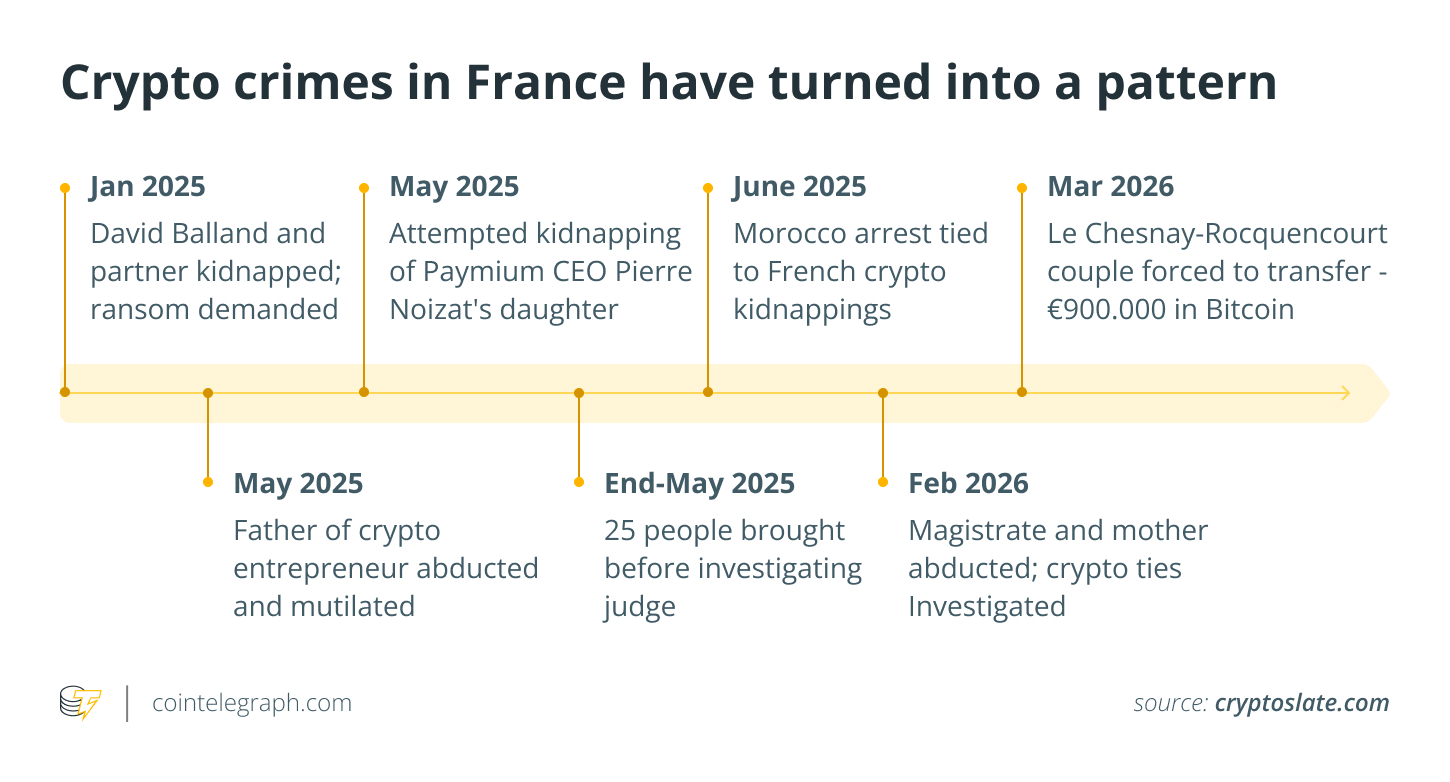
A recent case in France highlights this shift. Attackers posing as police staged a “raid” and physically coerced a couple into transferring nearly $1 million in Bitcoin (BTC). This was not a failure of software, but a high-stakes robbery carried out through physical force.
When the victim, not the wallet, becomes the target
The incident occurred in Le Chesnay-Rocquencourt, a town near Paris, where a couple in their late 50s was allegedly assaulted inside their residence.
Here is the chronology of the incident:
-
Three individuals disguised as police officers gained entry to the home.
-
The couple was threatened at knifepoint.
-
The husband was forced to send Bitcoin to the attackers.
-
Both victims sustained injuries, and the husband was physically restrained and tied up.
-
The assailants fled the scene in a vehicle.
French authorities are currently investigating the matter, with charges including armed robbery and organized criminal conspiracy.
What distinguishes this case is not only the use of violence, but the specific strategy employed.
Rather than attempting to crack encryption, the perpetrators bypassed it entirely by coercing the owner into authorizing the transfer.
Why impersonating police officers is so effective
Posing as law enforcement officials is often effective because it taps into several psychological triggers:
-
Authority: People are socially conditioned to obey police directives.
-
Urgency: The appearance of an official raid creates the impression that immediate compliance is necessary.
-
Fear: Any resistance can seem as though it may lead to criminal consequences.
When criminals present themselves as police, victims often fail to question:
-
The reason for their presence.
-
The legitimacy of their demands.
-
The authenticity of the entire situation.
Under stress, the impulse to obey tends to overpower the instinct to verify or question what is happening.
In crypto, this risk is even greater because a single approved transaction can move significant funds in seconds.
Did you know? The term “wrench attack” became popular in the crypto space after an online comic joked that threatening someone physically is easier than breaking encryption. It reflects a real-world shift in which attackers bypass complex systems by targeting people rather than technology.
From simulated police raid to coerced Bitcoin transfer
Unlike conventional robberies that target cash, jewelry or other tangible items, this assault specifically targeted digital cryptocurrency holdings.
The attackers’ objective was straightforward: force the victim to carry out an immediate crypto transfer.
This form of theft can be difficult to contain for several reasons:
-
Stolen funds can be transferred anywhere in the world within minutes.
-
Blockchain transactions are generally irreversible.
-
Once transferred, funds can be moved quickly, which can make tracing and recovery more difficult.
When the victim retains direct control over their wallet, criminals do not need to steal hardware or break through security. They only need to force the victim to approve and send the transaction personally.
Understanding wrench attacks in the cryptocurrency space
It is often far easier to threaten a person with a wrench than to try to crack their encryption.
Rather than attempting to hack a wallet, perpetrators may use:
-
Threats
-
Physical violence
-
Other forms of coercion
These methods are used to force victims to reveal private keys or authorize the transfer of funds. Such attacks bypass even the strongest technical protections.
No matter how strong the encryption is, human vulnerability can make that security irrelevant.
Did you know? Some high-net-worth crypto holders now use “decoy wallets” with small balances. In a coercive situation, they can reveal these wallets instead of their main holdings, adding an extra layer of psychological and financial protection.
Why these attacks are becoming more frequent
Several underlying factors are driving this increase:
-
Growth in self-custody: A rising number of users now hold their own private keys and manage their assets directly, making them more immediate and accessible targets.
-
Visibility of high-value targets: Many cryptocurrency investors, company founders and executives maintain public profiles that make their wealth and identity relatively easy to identify.
-
Advances in cybersecurity: As digital wallet security improves and remote hacking becomes more difficult, criminals are increasingly turning to the softer target, the human user.
-
Instant global liquidity: Cryptocurrency enables near-instant transfers of value anywhere in the world without banks or intermediaries acting as gatekeepers.
In 2025 alone, documented cases of verified wrench attacks reportedly rose sharply, increasing 75% from 2024. Europe, and France in particular, stood out as a growing hotspot for such incidents. Financial losses reached $40.9 million in 2025, marking a 44% annual increase. While kidnapping remained the primary threat vector, physical assaults surged by 250%.
Why France has experienced a surge
France has recently recorded multiple high-profile violent crimes linked to cryptocurrency:
-
Kidnappings carried out to extort cryptocurrency ransoms.
-
Home invasions specifically targeting high-profile figures in the crypto industry.
-
Coordinated operations by organized criminal groups aimed at stealing digital assets.
These recurring incidents point to a shift in criminal behavior:
-
More deliberate efforts to identify individuals who hold cryptocurrency.
-
Increased surveillance of their physical locations and daily routines.
-
A growing preference for direct physical targeting over purely digital methods.
As cryptocurrency adoption continues to expand, public awareness of who owns it is also growing. Unfortunately, the physical risks associated with that visibility are rising as well.

Why criminals increasingly choose coercion over hacking
Crypto security has become increasingly strong. Hardware wallets, multisignature setups and cold storage solutions make remote hacking far more difficult.
Coercion, however, changes the equation.
Even the strongest technical protections may fail if a victim is coerced into unlocking their hardware device, revealing their credentials or authorizing a transaction.
Coercive attacks bypass cryptographic defenses entirely, target points of human access and exploit natural human reactions.
For perpetrators, this approach is often faster and more reliable than trying to break through technical defenses.
Why Bitcoin remains particularly exposed in duress situations
Bitcoin’s core architecture gives it considerable strength, but it also creates significant vulnerability when the owner is under coercion.
Its key features include:
-
The ability to transfer value immediately
-
The absence of any central entity capable of reversing transactions
-
Permissionless, worldwide accessibility
In a situation where the holder is forced to transfer funds, these traits can result in:
-
Assets being moved almost instantly
-
Virtually no realistic chance of recovery
-
Attackers rapidly moving funds across multiple addresses
The same qualities that give Bitcoin its independence and value also make stolen funds extremely difficult to recover once they are transferred under duress.
Did you know? Private security firms have started offering specialized protection services for crypto investors, including travel risk assessments, home security audits and digital footprint reduction strategies aimed at preventing targeted attacks.
How French authorities are responding
French law enforcement agencies are actively investigating the incident, with specialized organized crime units leading the effort.
Potential criminal charges under review include:
Although authorities are increasing enforcement in response to such incidents, these cases continue to present serious challenges because of:
-
The rapid cross-border movement of stolen assets
-
The pseudonymous and irreversible nature of cryptocurrency transactions
-
The involvement of organized and professional criminal groups
Key security takeaways for cryptocurrency owners
This incident underscores a major shift in the nature of cryptocurrency security threats.
Protecting technical systems alone is no longer enough. Safeguarding wallets, private keys and physical devices must now be paired with strong personal security measures.
Essential protective steps include:
-
Never publicly reveal or discuss the extent of your cryptocurrency holdings.
-
Keep your real-world identity separate from your wallet addresses and ownership.
-
Use multisignature wallets so that no single individual or compromised key can authorize transfers.
-
Distribute signing authority and key control across different geographic locations or trusted parties.
Cointelegraph maintains full editorial independence. Guides are produced without influence from advertisers, partners or commercial relationships. Content published in Guides does not constitute financial, legal or investment advice. Readers should conduct their own research and consult qualified professionals where appropriate.

Singapore’s OCBC has rolled out GOLDX, a tokenized on-chain fund that provides exposure to the LionGlobal Singapore Physical Gold Fund. The token, issued on Ethereum and Solana, targets institutional investors, hedge funds and asset managers, and can be bought with stablecoins or fiat. After subscription, the fund’s shares are delivered directly to investors’ blockchain wallets. OCBC describes the move as a milestone in its blockchain-focused strategy and a step toward bridging traditional finance with decentralized finance.
Industry data tracked by rwa.xyz shows tokenized real-world assets on public blockchains reaching a value of more than $29 billion, having risen more than 10% in the past 30 days. The broader trend underscores growing interest in on-chain access to traditional assets such as gold, real estate, and commodities.
Key takeaways
- The GOLDX token provides on-chain exposure to the LionGlobal Singapore Physical Gold Fund and is issued on Ethereum and Solana, signaling a multi-chain approach to tokenized assets for institutions.
- Investors can acquire GOLDX using stablecoins or fiat, with on-chain delivery of the tokenized fund’s exposure to their wallets after subscription.
- OCBC notes the underlying fund had about US$525 million (S$669 million) in assets under management as of April 16, according to the bank’s disclosures, highlighting the scale of the tokenized fund itself.
- OCBC’s broader footprint includes total assets estimated at about US$526 billion as of December 2025, reflecting the bank’s ongoing experimentation with blockchain-enabled financial products since its 2023 tokenized equity-linked note for accredited investors.
- Tokenized real-world assets on public blockchains are valued at over US$29 billion, up more than 10% in the last month, according to rwa.xyz, signaling sustained demand for on-chain access to traditional assets.
GOLDX: On-chain exposure to a physical gold fund
The GOLDX token is tied to the LionGlobal Singapore Physical Gold Fund, which OCBC says launched in December and has attracted institutional interest as a way to gain on-chain exposure to physical gold without the friction of traditional custody arrangements. The underlying fund’s on-chain representation is designed to appeal to Web3 ecosystem participants and high-net-worth individuals who operate within blockchain and crypto markets, according to OCBC.
OCBC’s asset management arm collaborated with Lion Global Investors and digital-asset exchange DigiFT to bring GOLDX to market. The token’s utility lies in enabling institutions to access a tangible gold reserve via a blockchain-native instrument, while settlement and ownership records run on-chain. Kenneth Lai, head of global markets at OCBC, framed the move as part of a broader corporate strategy to integrate digital assets into mainstream financial services. He said, “We believe digital assets will play an increasingly important role in financial services and our focus is on bridging traditional finance with the emerging world of decentralized finance.”
As a sign of the fund’s scale, the LionGlobal Singapore Physical Gold Fund reportedly held around US$525 million in assets as of April 16, with OCBC citing an asset base of roughly US$526 billion for the bank group as a whole in its December 2025 disclosures. The GOLDX rollout follows OCBC’s earlier experiments with tokenized investment products, including a 2023 tokenized equity-linked note issued to accredited investors, showcasing a continuing push into tokenized finance.
A broader trend: tokenized assets expanding on public blockchains
The emergence of GOLDX sits within a wider market dynamic where tokenized real-world assets are increasingly being represented on public networks. rwa.xyz tracks the sector and notes the total value of tokenized assets on public blockchains has surpassed $29 billion, with gains of more than 10% over a 30-day window. For traditional banks and asset managers, this trend offers a pathway to new liquidity channels and broader investor access, albeit with ongoing questions about custody, settlement reliability, and regulatory alignment.
OCBC’s approach with GOLDX reflects a deliberate strategy to blend regulated, traditional assets with blockchain-enabled delivery and settlement. By tying a token to a regulated gold fund and enabling on-chain trading and settlement, OCBC signals a willingness to experiment with tokenized structures that could scale if liquidity and custody arrangements meet institutional standards. The bank’s leadership has repeatedly emphasized the potential for digital assets to complement conventional finance, rather than replace it, as part of a gradual, standards-driven evolution of the sector.
For investors and builders, the GOLDX launch highlights a practical pathway for on-chain access to regulated, physical assets. It also underscores the importance of cross-chain compatibility, given the token’s presence on both Ethereum and Solana, two ecosystems with distinct liquidity profiles and security models. If GOLDX and similar instruments can demonstrate robust on-chain settlement, low friction, and clear regulatory guardrails, they could become a template for broader institutional adoption of tokenized funds in Southeast Asia and beyond.
As the market monitors this development, questions remain about scale, long-term liquidity, and how regulatory regimes will shape tokenized product design. Observers will be watching for updates on the GOLDX program, potential expansions to other asset classes, and how OCBC continues to balance its traditional banking operations with a growing portfolio of blockchain-based offerings.
Looking ahead, the pace of adoption will hinge on how well tokenized funds deliver transparent on-chain custody, reliable settlement, and standardized disclosures that satisfy institutional due diligence. Regulatory clarity—particularly around tokenized securities and on-chain fund structures—will play a decisive role in shaping the trajectory of OCBC’s blockchain initiatives and the broader market for tokenized real-world assets.

Key Highlights
- Ripple has introduced a comprehensive four-stage strategy to fortify the XRP Ledger against quantum computing risks by 2028
- The initial stage features a contingency “Q-Day” protocol designed to mandate immediate transition to quantum-secure accounts
- The second stage is currently active, with comprehensive security evaluation scheduled for completion by mid-2026
- Strategic collaboration with quantum defense specialist Project Eleven is enhancing development speed
- XRP Ledger benefits from built-in capabilities like key rotation and deterministic key generation
Ripple has released a comprehensive blueprint designed to shield the XRP Ledger from emerging quantum computing vulnerabilities. The strategic initiative encompasses four distinct stages with a completion target of 2028.
This strategic disclosure follows Google’s recent alert that quantum systems might compromise Bitcoin security with considerably less computational capacity than earlier projections suggested. Industry experts are now identifying 2029 as the potential “Q-Day” — the critical moment when quantum technology could successfully break existing cryptographic safeguards.
XRP presently holds the position as the fourth-largest cryptocurrency based on total market capitalization. According to Ripple, while the quantum risk to XRPL is genuine, it remains addressable through proper advance planning.
Whenever an XRPL account executes a transaction, the corresponding public key gets recorded on the distributed ledger. A sufficiently powerful quantum system could potentially exploit this exposed information to derive the associated private key and compromise account holdings.
Long-established accounts with extensive transaction histories face the greatest vulnerability. The extended period a public key remains visible on-chain creates additional opportunities for future quantum-based exploitation.
Stage One: Crisis Response Protocol
The opening phase functions as a contingency mechanism. Should quantum computing capabilities emerge ahead of projections, Ripple would implement a mandatory network-wide transition — traditional public-key cryptographic signatures would cease to be validated.
Account holders would need to transfer their assets to quantum-protected accounts. Ripple is investigating zero-knowledge proof technologies that would enable users to authenticate ownership of current keys without revealing sensitive information.
This approach ensures that holders maintain access to their holdings even under emergency circumstances, preventing permanent account lockouts.
Development and System Integration
Stage two is presently underway with anticipated completion during early 2026. Ripple’s cryptographic engineering division is executing a thorough security audit throughout the entire network while evaluating protective measures endorsed by the National Institute of Standards and Technology.
Ripple has established a collaborative partnership with quantum security research organization Project Eleven for validator-level evaluations and preliminary custody wallet development.
Post-quantum cryptographic systems introduce certain challenges. Expanded key sizes and signature dimensions can create additional demands on ledger resources, requiring the team to evaluate necessary architectural modifications.
Stage three is scheduled for late 2026. Ripple will start deploying quantum-resistant cryptographic signatures in parallel with current implementations on its development testing environment, enabling developers to validate new cryptographic approaches without impacting the production network.
Stage four represents the complete ecosystem transformation, planned for 2028. Ripple will submit a formal amendment proposal to the XRP Ledger community for native post-quantum cryptographic integration and initiate comprehensive network migration to quantum-resistant signature protocols.
Ripple emphasizes that XRPL possesses certain inherent strategic advantages. The platform supports native key rotation functionality, allowing users to replace compromised private keys while preserving their account identity. Its seed-based key generation mechanism also facilitates deterministic creation of new cryptographic keys.
Ripple engineer Ayo Akinyele clarified that while these capabilities don’t constitute complete post-quantum solutions, they establish a robust framework for future development. Project Eleven is presently developing a proof-of-concept hybrid post-quantum signature system specifically designed for the XRP Ledger infrastructure.



OCBC has rolled out a tokenized physical gold fund, bringing real-world asset exposure on-chain for institutional investors.
Summary
- OCBC launched the GOLDX token on Ethereum and Solana, offering institutional investors access to a tokenized physical gold fund.
- The token provides exposure to the LionGlobal Singapore Physical Gold Fund, which held about $525 million in assets as of mid-April.
- The move comes as tokenized real-world assets on public blockchains cross $29 billion, with major banks expanding into blockchain-based financial products.
OCBC said the product was launched in partnership with Lion Global Investors and digital asset exchange DigiFT, with the GOLDX token issued on both the Ethereum and Solana blockchains. The bank stated that the token can be subscribed to using either fiat or stablecoins, with allocations delivered directly to investors’ blockchain wallets after purchase.
Institutional participation remains the core focus, with the offering designed for hedge funds, asset managers, and other large investors seeking exposure to gold through blockchain-based infrastructure. The move places OCBC among a growing list of global banks that are moving regulated financial products on-chain.
“We believe digital assets will play an increasingly important role in financial services and our focus is on bridging traditional finance with the emerging world of decentralized finance,” Kenneth Lai, head of global markets at OCBC, said in an accompanying statement.
GOLDX provides on-chain exposure to the LionGlobal Singapore Physical Gold Fund, a vehicle launched in December that held around $525 million in assets under management as of April 16. The structure allows investors to access physically backed gold without relying on traditional settlement systems, while still maintaining a link to real-world reserves.
Interest in tokenized real-world assets has accelerated through 2026, with total value on public blockchains rising above $29 billion, marking a gain of more than 10% over the past month, according to rwa.xyz data. Gold-linked products have emerged as one of the segments drawing institutional attention, particularly as geopolitical tensions and currency concerns sustain demand for safe-haven assets.
OCBC’s latest move builds on earlier blockchain experiments, including a tokenized equity-linked note introduced for accredited investors in 2023. The bank reported total assets of about $526 billion as of December 2025, positioning it among Southeast Asia’s largest financial institutions adopting tokenization.
Large banks have been moving in a similar direction. In December 2025, JPMorgan launched a $100 million tokenized money market fund on the Ethereum mainnet via its Kinexys platform, targeting institutional cash management with near-real-time settlement. The initiative marked a step away from permissioned systems toward public blockchain infrastructure for regulated products.
Tokenized gold has also taken different forms across the market. As covered on crypto.news before, Standard Chartered-backed Libeara introduced the MG 999 fund in Singapore, offering synthetic exposure to gold rather than holding physical bullion, while combining the structure with lending to jewelry retailers.
OCBC’s approach leans on physical backing, aligning more closely with traditional fund structures while using blockchain rails for distribution and settlement. The bank said that the product is intended to attract participants from both conventional finance and crypto-native environments, particularly high-net-worth individuals and firms already operating within digital asset ecosystems.
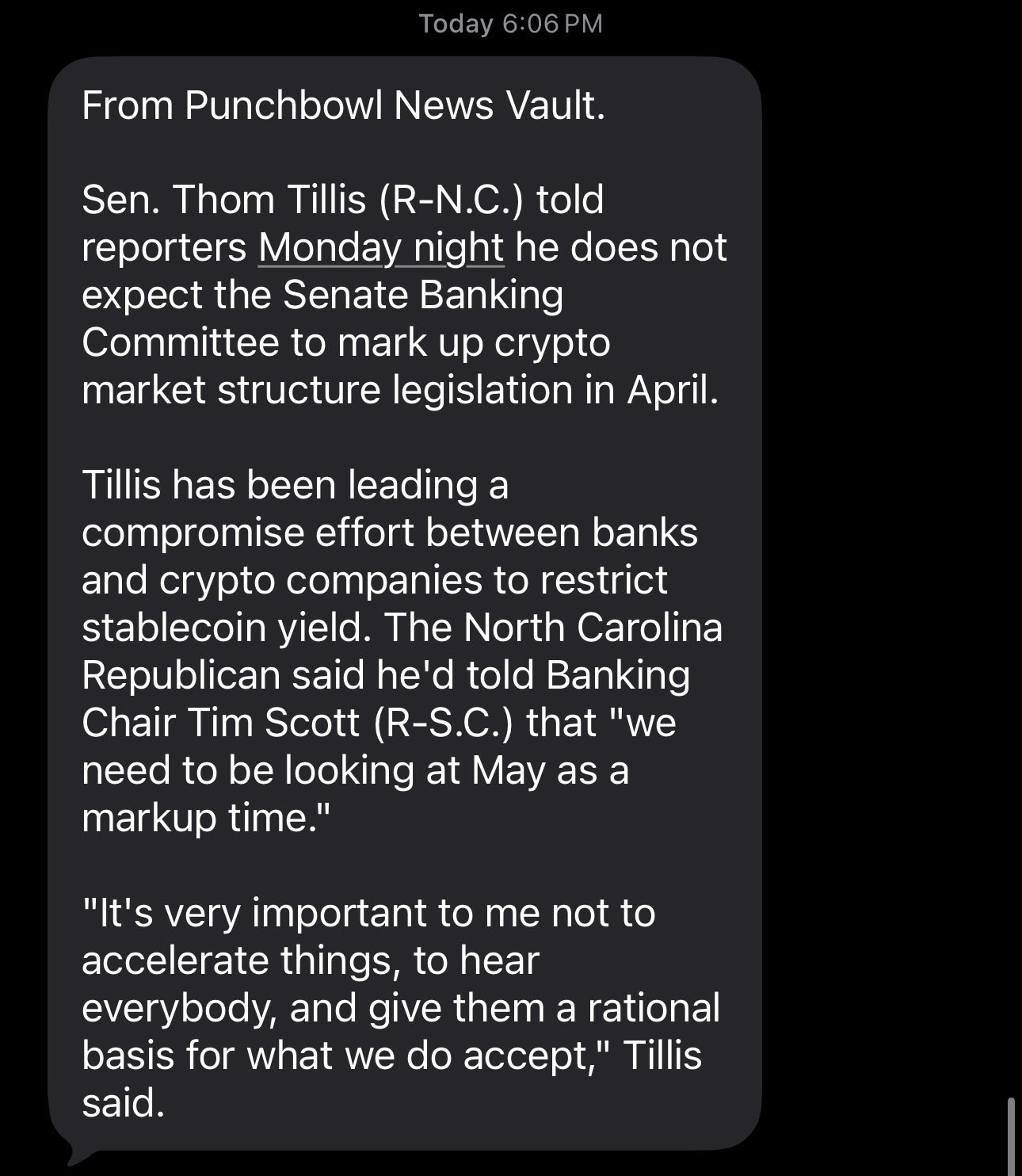
A US senator has reportedly urged Senate Banking Chair Tim Scott to delay the markup for the crypto market structure bill until May, as banking and crypto representatives need more time to resolve disagreements over stablecoin yield provisions.
US Republican Thom Tillis of North Carolina told reporters Monday that he does not expect the Senate Banking Committee to mark up the legislation, also known as the CLARITY Act, in April and has recommended that Scott schedule it for next month, according to Punchbowl News.
Tillis, who has been leading discussions between crypto and banking members, reportedly told Scott: “It’s very important to me not to accelerate things, to hear everybody, and give them a rational basis for what we do accept.”
Continued delays have sparked concern that the CLARITY Act may not pass before the US midterms in November, an event that US Treasury Secretary Scott Bessent said could reverse momentum of the bill.

“I think if the Democrats were to take the House, which is far from my best case, then the prospects of getting a deal done will just fall apart,” Bessent said in March.
CLARITY Act cannot wait any longer, crypto group says
It comes the same day crypto advocacy group The Digital Chamber sent a letter to the Senate Banking Committee asking it to move the crypto market structure legislation forward to a Senate markup “as soon as the calendar allows.”
Related: Bessent ramps up pressure on Congress to pass CLARITY Act
The banking industry has raised concerns that allowing stablecoin yield could trigger significant deposit outflows from the traditional banking system, particularly at community banks.
It argues that those banks may not have enough balance-sheet flexibility to absorb such outflows without relying on higher-cost wholesale funding.
Meanwhile, Coinbase CEO Brian Armstrong and others have pushed for more favorable stablecoin provisions.
Last month, members of the banking and crypto industries were reportedly close to agreeing on enabling stablecoin rewards tied to crypto activity on third-party crypto platforms, but not for passive balances.
The Digital Chamber noted that it has now been more than 270 days since the House passed the CLARITY Act with bipartisan support.
“Clarity cannot wait,” The Digital Chamber’s government affairs director, Taylor Barr, said, adding: “More than 70 million Americans who have embraced digital assets deserve the regulatory clarity they have waited far too long for.”

Other members of the crypto industry have argued that moving the bill forward is more important than holding out for perfect terms.

Pringles drops two new flavours and fans say ‘one is better than the other’

CLUMP Solves Puzzle 1767 for Players Worldwide

Alibaba introduces Qwen 3.6-Max-Preview as its most advanced AI model yet

Manchester United reach agreement with Casemiro over contract clause amid transfer speculation

Steven Gerrard disagrees with Gary Neville over ‘shock’ Chelsea and Arsenal claim | Football

US brings back mandatory military draft registration


-

 NewsBeat7 days ago
Trump and Pope Leo: Behind their disagreement over Iran war
-

 News Videos6 days ago
Secure crypto trading starts with an FIU-registered
-

 Fashion4 days ago
Weekend Open Thread: Theodora Dress
-

 Sports4 days ago
NWFL Suspends Two Players Over Post-Match Clash in Ado-Ekiti
-

 Politics3 days ago
Palestine barred from entering Canada for FIFA Congress
-

 Business2 days ago
Powerball Result April 18, 2026: No Jackpot Winner in Powerball Draw: $75 Million Rolls Over
-

 Crypto World3 days ago
Russia Pushes Bill to Criminalize Unregistered Crypto Services
-

 Politics11 hours ago
Gary Stevenson delivers timely reminder to register to vote as deadline TODAY
-
 Business4 days ago
Creo Medical agree sale of its manufacturing operation
-

 Politics2 days ago
Zack Polanski demands ‘council homes not luxury flats for foreign investors’
-

 Tech2 days ago
Auto Enthusiast Scores Running Tesla Model 3 for Two Grand and Turns It Into Bare-Bones Go-Kart
-

 Tech5 days ago
‘Avatar: Aang, The Last Airbender’ Leaked Online. Some Fans Say Paramount Deserves the Fallout
-

 Crypto World3 days ago
Russia Introduces Bill To Criminalize Unregistered Crypto Services
-

 Tech6 days ago
Microsoft adds Windows protections for malicious Remote Desktop files
-
 Entertainment6 days ago
Dave Portnoy Slams Dianna Russini: ‘Makes Zero Sense’
-

 Crypto World6 days ago
X Launches New Cashtag Feature for Stocks and Crypto: X
-

 Sports7 days ago
Younger Than Sachin Tendulkar: Vaibhav Sooryavanshi Set To Make Historic India Debut
-

 Entertainment6 days ago
Prince Carter Brings Fans Front Row and Backstage at Boys 4 Life Tour
-

 Sports5 days ago
British climbers complete new route in Swiss Alps
-
 Crypto World6 days ago
Paxos Labs Raises $12M to Launch Crypto Yield and Lending Platform
You must be logged in to post a comment Login