

Crypto World
Starbucks (SBUX) Stock Climbs on Reports of Potential Japan Business Sale


Key Takeaways
- Reports indicate Starbucks is considering strategic alternatives for its Japan operations, potentially including a partial sale
- The Japan business could be valued between ¥400–500 billion (approximately $2.5–3 billion)
- Potential buyers include both strategic industry partners and private equity investors
- This development comes months after Starbucks divested a majority stake in its China operations for $4 billion in April
- Shares of SBUX climbed 2.73% on Tuesday and are trading up 15.7% in 2025
The coffee retail giant Starbucks (SBUX) is reportedly evaluating various strategic alternatives for its Japanese operations, with a potential stake sale being among the options under consideration. Bloomberg broke the news Tuesday, citing sources with knowledge of the deliberations.
According to the report, the Japanese business unit could fetch a valuation ranging from ¥400 billion to ¥500 billion—equivalent to approximately $2.5 billion to $3 billion in U.S. dollars. Sources suggest that interest could emerge from both strategic industry participants and private equity investors.
Shares of SBUX advanced 2.73% following the news.
Starbucks has not issued a statement regarding the reports, and no definitive decisions have been made public at this time.
The Seattle-based coffee chain acquired complete control of its Japan subsidiary in 2014 after purchasing the remaining ownership interest from Sazaby League, its original Japanese partner. The partnership between the two companies had begun in 1995 and operated successfully as a joint venture for nearly two decades.
This potential restructuring echoes a recent strategic move by the company. Just this past April, Starbucks finalized an agreement with Boyu Capital to divest a controlling interest in its Chinese business operations at a $4 billion valuation.
The China transaction was largely motivated by persistent challenges including decelerating growth rates, COVID-19-related disruptions, and intensifying competitive pressure from domestic competitors such as Luckin Coffee.
Japan Strategy May Mirror China Approach
The rationale behind a potential Japan deal could follow similar reasoning. Partnering with a local strategic investor might help mitigate operational challenges while maintaining Starbucks’ market presence in the region.
Additionally, divesting a portion of the Japan business could generate capital during a critical period as CEO Brian Niccol implements his comprehensive turnaround initiative. Operating expenses have been escalating more rapidly than anticipated under the new strategy, making the timeline for margin improvement a focal point for investors.
Starbucks recently reported its most robust quarterly sales performance in over two years this April, suggesting that Niccol’s turnaround efforts are beginning to show positive results on the top line.
Analyst Perspective on SBUX
The investment community maintains a cautiously positive outlook on the stock. TipRanks data shows SBUX has a Moderate Buy consensus rating, derived from 17 Buy recommendations, 10 Hold ratings, and one Sell rating compiled over the last three months.
The consensus price target among analysts stands at $110.88, suggesting approximately 14% potential upside from current trading levels.
Year-to-date, SBUX shares have appreciated 15.7% as of this latest report.
Starbucks has maintained full ownership of its Japanese operations since completing the Sazaby League buyout in 2014. Prior to that acquisition, the two organizations had jointly managed the Japan market presence for almost 20 years.
Reuters has been unable to confirm the Bloomberg report independently, and Starbucks has not publicly acknowledged whether a formal sale process is currently in progress.




Fortitude Mining Holdings, the Zcash (ZEC) mining platform owned by Barry Silbert’s Digital Currency Group (DCG), has disclosed a set of disappointing financials that reveal tons of debt, years of losses, and ZEC as a minority of revenue.
The disclosure, which also reveals a highly adjusted EBITDA that disregards $32 million of depreciation, paints a very different picture to a pitch deck published by Fortitude last month.
The deck, which is listed on the company’s website, proudly claims that as of a conveniently selected period of the 2025 fiscal year, Fortitude was debt-free.
However, compelled by SEC rules to disclose more up-to-date financials pursuant to its all-stock merger with publicly-traded HeartSciences Inc., the company has admitted that it signed a $26 million credit facility on June 1 and drew over $8.3 million of actual debt from that facility before the deck was published on June 23.
The disappointment doesn’t end there.
The pitch deck also declared Fortitude Mining “a Zcash ecosystem leader.” However, filings show a $12.6 million net loss for 2025. That loss added to a $14.3 million in 2024.
Worse, net losses continued through March 2026, with Q1 draining another $4.6 million.
Even its self-characterization as a Zcash “leader” is questionable given its actual revenue split. Of the company’s $89 million in mining revenue for 2025, 65% or $58 million came not from mining ZEC but from mining BTC.
Indeed, only 28% of its 2025 revenue came from mining ZEC. BTC and other crypto assets generated 72%.
Read more: Arkham accused of misrepresenting Zcash data in viral post
Adjusted, very adjusted, EBITDA
Fortitude’s deck viewed its net losses through rose-tinted glasses, touting ~$20 million of “adjusted EBITDA.”
Its marketers produced that adjusted figure mainly by adding back approximately $32 million of depreciation onto its $12.6 million net loss for 2025.
Unfortunately, in the mining industry, depreciation invariably occurs as rigs physically wear out from heat, corrosion, grinding, and technological obsolescence.
Depreciation isn’t a mere footnote for a crypto mining company. It’s a true, inescapable cost of production.
Other disclosures brought no relief. Fortitude warned, “The Company depends on a single supplier of Zcash miners, any disruption, could adversely affect the company’s business.”
It also posted accelerating net losses and overhead expenses.
Zcash has been rallying while Fortitude added losses
ZEC has been one of crypto’s best-performing altcoins, surging 1,400% over the past three years, including 1,000% over the past 12 months.
Somehow, Fortitude has managed to lose money since 2024.
Annual statements caution that the indebted company “may not be able to timely secure additional debt or equity financings on favorable terms, if at all.” The same statements show Fortitude closed the year with less than $10 million of cash.
HeartSciences, a Texas seller of AI-powered heart testing software, saw its shares jump 57% on the June 23 merger news. However, pro forma disclosures admit that HeartSciences earned just $4,000 of revenue for the 12 months ending April 30, 2026 while carrying tens of millions of dollars in accumulated deficit.
HeartSciences ended after-hours trading yesterday at $2.45 per share, 34% below its June 23 high. It has traded steadily lower throughout July.
If the deal closes, the merged business will trade under a new ticker symbol, “TUDE,” and a new name, Fortitude Mining Group.
Silbert’s DCG is set to hold the vast majority of the company’s post-merger equity, with everyone else splitting the rest.
The morning the deck landed, Silbert posted, “Great day for Zcash.” He told followers the venture was just getting started.
Got a tip? Send us an email securely via Protos Leaks. For more informed news and investigations, follow us on X, Bluesky, and Google News, or subscribe to our YouTube channel.

Infamous crypto scammer Bastille has apparently been doxxed by a former partner who has accused him of rape, financial manipulation, and refusing to cover their medical bills after he crashed the car they were traveling in.
Anonymous X user “Slippage” shared the details of their relationship in a lengthy thread during which they claimed that Bastille’s real name is William Edmund Bateman.
Slippage claims they first came into contact with Bastille in July 2024 through a group chat and soon started launching cryptocurrencies together.
The pair formed a close relationship, but Slippage claims Bastille soon began to accuse them “of farming his coins,” and stealing $40,000. He allegedly found out later that it was one of his close “guys.”
They would go on to meet several times, with Slippage claiming that during one meet-up in Japan, Bastille got drunk and became “aggressive,” called them names, and eventually fell asleep on the floor.
At some point the pair also went to a casino where Slippage claims Bastille left them alone while “weird gross men” harassed them.
Bastille and Slippage cooked rugpulls together
Despite this, the pair continued to launch tokens together with Slippage describing the process as “cooks.” They claim that Bateman came up with the ideas, while they crafted “the art, design, content and videos, Twitter, dex and bundle.”
However, despite it being an apparent joint venture, Bastille would allegedly tell Slippage that they didn’t deserve the money. “On one coin we made some money and he kept about 85% of profits,” they said. “Even though I had no sleep for approximately 40 hours and was working while he was sleeping.”
“Sometimes he didn’t pay me at all,” they added, “so i was genuinely surprised when we split 50/50.”
Bastille’s alleged abuse
Slippage claims that bastille repeatedly lied about his financial affairs, and said that he would become incredibly angry when they launched coins with other people.
“When Bastille lost money on perps or slots he took his anger out on me. He shouted, threw things around and became very very aggressive. I had to hide in another room and cry.”
They also accuse Bastille of “pushing” them into having sex against their will, and allege that he’d perform certain sexual acts they didn’t like.
“My words, discomfort and boundaries were not enough for him to stop,” said Slippage. ”I couldn’t defend myself. I was scared he would leave.”
They added, “I had anxiety and panic attacks almost every day for about a year. I was always scared of him. I was scared to ask for anything, scared to talk about the things he did to me again, and scared to ask him to pay me for the projects we worked on together.”
Read more: ‘Crypto Robin Hood’ faked prison for clout, rugged memecoins for Palestine
Bastille allegedly kept their relationship hidden, wouldn’t go halves on rent, and would frequently make Slippage pay for stuff despite making “7 figs.” He would also allegedly lie about “normal everyday things,” and frequently made cruel comments about their appearance and lifestyle.
Eventually, Bastille allegedly had a major crashout after selling a coin from one of their launches too early.
Slippage discovered that he was talking negatively about them to other people, and that he’d shared “private photos” with other people and planned to share them via one of his social channels.
They eventually split, however, he reached out 10 days later asking for another chance. They decided to go to Norway where he allegedly crashed a BMW the two of them were traveling in.
Bastille allegedly won’t pay for medical bills
Slippage says the incident left them with six fractures in their spine, a ligament injury, a lung contusion, a disc protrusion, concussion, and resulted in them wearing a brace for three months.
The medical bills, according to Slippage, came to around €50,000 ($57,000). When they asked Bastille to pay €6,000 ($6,800) towards a Norwegian hospital bill, he allegedly agreed but never paid up.

Read more: Memecoin traders praying for global hantavirus pandemic
“He saw my pain, anxiety, sleep problems and physical limits. But instead of support I got anger, arguments about money, silence and more broken promises,” Slippage said. “He also was trading in my kitchen while I was crying in my bed alone for days.”
Despite their split, bastille allegedly continued to hound Slippage and found ways to work around the blocks they’d set up.
Slippage says leaving Bastille was hard
According to Slippage, they struggled to leave Bastille because they believed most of the promises and romantic gestures that would follow the abuse.
Not only that, they say, “We were also connected through projects, money and people in crypto. A large part of the money we made was under his control.
Read more: Crypto devs accused of rug pull blame Iran draft for abandoning project
“I stayed because I was emotionally attached, financially connected and scared.”
However, his alleged actions proved too much, and Slippage eventually decided to dox him. “Since he doesn’t give a single fuck about what he did, the only thing I could do is to bring some balance to the universe.
“Do with this information whatever you want.”
Got a tip? Send us an email securely via Protos Leaks. For more informed news and investigations, follow us on X, Bluesky, and Google News, or subscribe to our YouTube channel.


The Bank of Russia published its first draft rules as part of the introduction of cryptocurrency regulations in the country, including capital requirements for companies that hold and record digital assets.
The proposals would extend systems already used in Russia’s securities markets, including exchange trading, custody, record-keeping and disclosure rules, to digital assets.
The framework would create “digital depositories,” regulated companies that would record holdings of cryptocurrencies and other digital assets. They would need between 50 million ($570,000) and 250 million rubles ($2.8 million) in capital, depending on the services they provide.
Settlement depositories would require 250 million rubles ($2.8 million) in capital The requirement falls to 100 million rubles ($1.1 million) for firms that control crypto addresses or hold assets with foreign custodians, and 50 million rubles ($570,000) for other digital depositories.
Assets counted toward those capital requirements must be liquid, while eligible financial assets must meet the central bank’s credit-quality standards. The requirements would also apply to operators of electronic platforms that settle transactions involving digital financial assets.
The central bank will maintain registers of digital depositories, crypto exchange operators and companies that issue digital financial assets.
Crypto World
Warren Buffett Left Berkshire $397 Billion in Cash, Enough to Buy Almost Any S&P 500 Firm
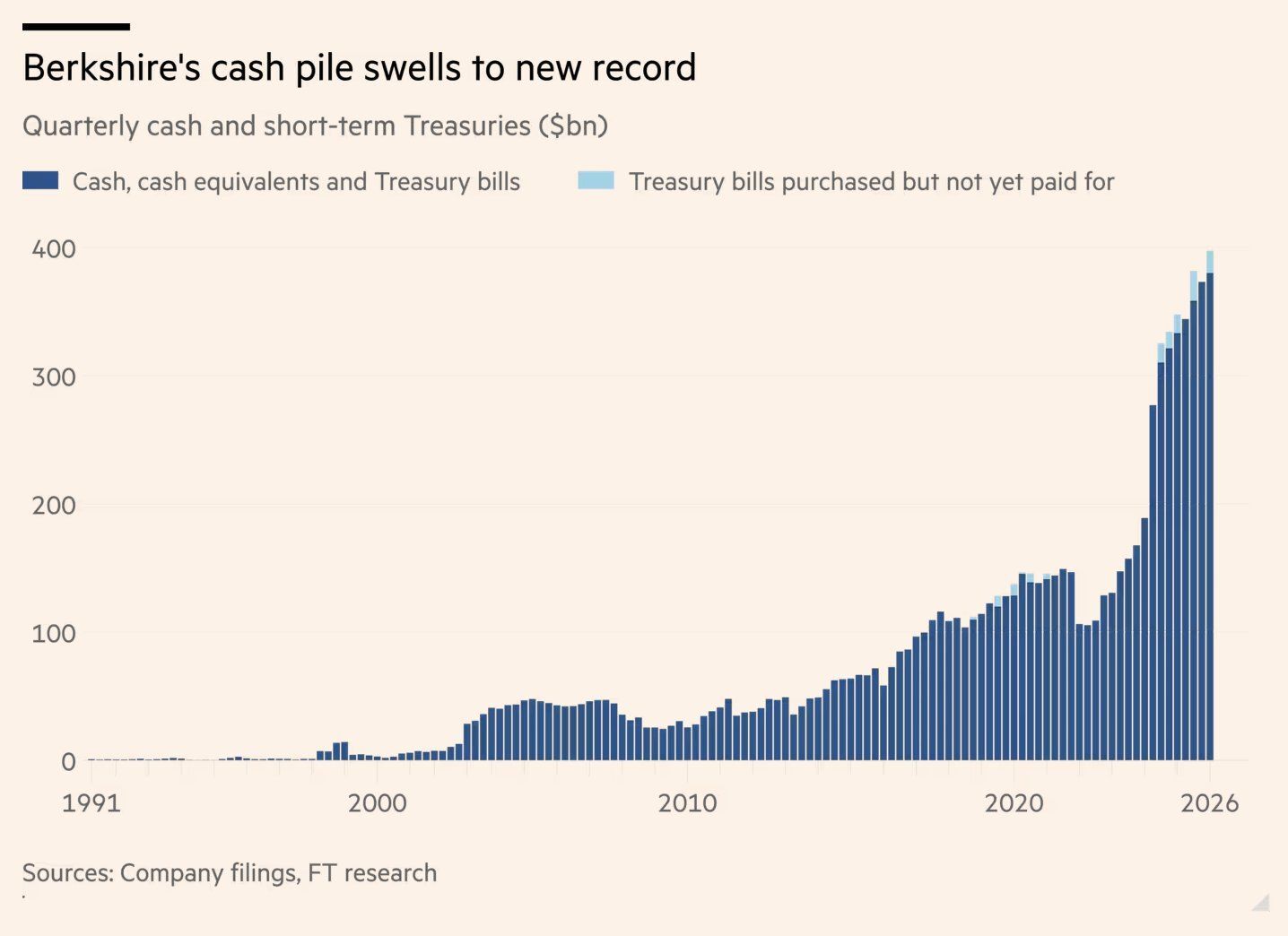
Berkshire Hathaway is sitting on an all-time high of $397.4 billion in cash and short-term Treasuries, according to its latest quarterly filing. The pile has grown so large that it could buy almost any single company in the S&P 500.
The figure covers the first quarter of 2026, Greg Abel’s first as CEO after Warren Buffett stepped back. Investors now watch whether Abel will spend it before the second-quarter results arrive in early August.
Berkshire’s Cash Record Could Buy Almost Any S&P 500 Company
Data shared by Barchart shows liquid reserves climbing from $373 billion at the end of 2025 to $397.4 billion in March. The platform noted the sum is enough to buy 476 companies in the S&P 500 outright.

The build-up is deliberate. Berkshire sold more stocks than it bought for 14 straight quarters, offloading $24.1 billion in equities against $16 billion in purchases last quarter. At current Treasury yields, the reserves earn roughly $20 billion a year.
Buffett defended that math in a recent interview.
“I can put huge amounts of money into government bonds that get 20 or 30 or 40 billion dollars a year… a good business is one that earns a lot more than the returns on essentially riskless investments, which you could define as Treasuries,” Warren Buffett, told CNBC.
Abel Starts Spending Carefully
Abel has begun deploying. Shareholders approved Berkshire’s $8.5 billion purchase of homebuilder Taylor Morrison last week, while buybacks run at their fastest pace since 2021. The firm also built a $31 billion Alphabet stake, including a $10 billion private purchase Buffett says he initiated.
Meanwhile, first-quarter operating earnings rose 18% to $11.35 billion, and net income more than doubled to about $10.1 billion. Results due around August 3 will show whether Berkshire’s record cash keeps compounding.
Buffett framed the choice ahead in simpler terms.
“The trick in… investing is to find businesses that are going to earn high returns on capital for an extended period of time,” Warren Buffet said.
Whether that points Abel toward stocks, acquisitions, or even a future in crypto, the August report offers the first real answer.
The post Warren Buffett Left Berkshire $397 Billion in Cash, Enough to Buy Almost Any S&P 500 Firm appeared first on BeInCrypto.
Flare has introduced Smart Accounts version 1.3 to simplify how XRP holders access decentralized finance (DeFi) without changing their existing wallet. The update also removes the need to create separate wallets, manually bridge assets, or manage gas tokens before using DeFi services.
According to a press release sent to CryptoPotato, users now need only a single wallet signature to access DeFi. Previously, the process required two separate approvals.
How Smart Accounts Version 1.3 Works
Under the new version, users approve a single transaction from their XRP Ledger wallet. The system then converts their XRP into FXRP and automatically deposits it into a selected yield vault.
The Flare Data Connector verifies the XRP Ledger transaction before a smart contract completes the remaining steps. Flare said the original XRP remains locked on the XRP Ledger at a one-to-one ratio throughout the process.
This setup allows users to retain control of their assets while removing the need for manual bridging or obtaining gas tokens on another blockchain. The simplified process comes as FXRP activity across decentralized finance platforms continues to expand.
Since February, the amount of FXRP deployed across DeFi applications has grown by nearly 75%, rising from 82 million to 144 million. Flare also reported that more than 40 million XRP is currently earning through Smart Accounts across nearly 24,000 accounts.
New Vaults and Broader Wallet Integration
Commenting on the update, Chief Product Officer Filip Koprivec said millions of XRP holders had wanted access to DeFi, but the experience had been too complex. He said version 1.3 lets users move from XRP to yield with a single wallet signature while remaining fully non-custodial.
The version also expands the available yield options with two vaults offering different approaches. Users can continue using the Monarq vault or choose the new Clearstar Flare XRP Yield Vault, which uses on-chain lending and liquidity strategies.
According to the company, the Clearstar vault distributes FXRP across protocols including Avant and Euler while keeping all positions publicly visible. Flare added that Clearstar has previously managed more than 33 million FXRP through earlier deployments.
The update also expands wallet support to Ledger, Xaman, Joey Wallet, WalletConnect, including Bifrost, and D’CENT. Joey Wallet has integrated the Smart Accounts interface directly into its application, allowing users to complete the process without leaving the wallet.
The post Flare Simplifies DeFi for XRP Holders With Smart Accounts Upgrade appeared first on CryptoPotato.

Ethereum price is trading at $1,880, down 3.3% on the day after slipping from recent highs. The market remains caught between steady institutional accumulation and weak short-term momentum. Even so, one buyer has become large enough to influence Ethereum’s circulating supply.
Crypto treasury firm BitMine Immersion Technologies said its Ethereum holdings have reached 5.79 million ETH, putting it close to its goal of owning 5% of the circulating supply. Combined crypto holdings, cash, marketable securities, and strategic investments now total $11.8 billion.
Chairman Tom Lee pointed to the ETH/BTC ratio reaching a three-month high as support for the firm’s strategy. He also highlighted $2,000 and $2,500 as the next key levels for Ethereum. Meanwhile, about 4.92 million ETH is staked through BitMine’s MAVAN platform, with projected annualized staking rewards of $299 million once fully deployed.
The supply absorption is real. Whether price follows remains another question. For now, Ethereum still faces technical resistance while macro conditions continue shaping the next major move. Large-scale accumulation may tighten supply, but buyers still need stronger momentum to confirm a sustained breakout.
Discover: The Best Token Presales
Can Ethereum Price Break $2,000 Before the Next Catalyst Arrives?
At $1,880, ETH is testing a key resistance area after slipping from recent price highs. Traders have watched the $1,800 to $1,850 zone, which has now turned into nearby support. However, the latest pullback shows buyers still lack the momentum needed for a convincing breakout.
Key support remains around $1,650 to $1,680. A close below that range on strong volume would weaken the structure and increase the risk of revisiting $1,600. Meanwhile, funding rates remain balanced, and leverage is relatively low. That leaves macro catalysts as the most likely driver of the next major move.

The bullish case remains straightforward. If Ethereum holds above $1,850 and reclaims the recent price high near $1,950, the path toward $2,000 becomes more realistic. Continued strength in the ETH to BTC ratio or fresh institutional demand could provide the needed push.
The base case is continued consolidation between $1,850 and $1,950 over the coming sessions. BitMine’s steady accumulation could provide support while overall market sentiment stays cautious. On the other hand, a clean break below $1,800, especially alongside rising Bitcoin dominance, would weaken the recovery outlook and shift attention back to $1,650.
ETH has still posted a solid weekly gain despite cooling on-chain activity. Unstaking queues and lower gas fees suggest network demand has eased after the latest rally. Ethereum’s market capitalization stands near $226.5 billion, while technical indicators remain cautious. A decisive breakout will likely require a fresh catalyst.
Trade Ethereum on Bybit and Get a Chance to Win Our $1,000 USDT Airdrop
LiquidChain Targets Early-Mover Upside as Ethereum Tests Key Resistance
ETH’s consolidation pattern highlights a structural problem: capital is rotating into newer narratives like RWA tokens, AI-linked altcoins. All while large-cap positioning waits on macro clearance. That rotation dynamic is exactly the window where early-stage infrastructure plays attract attention, particularly those solving for the fragmentation that makes cross-chain yield chasing inefficient in the first place.
The view is different from the third layer. — LiquidChain (@getliquidchain) July 27, 2026

You’ll understand soon. pic.twitter.com/P2WOELSTjI
LiquidChain is a Layer 3 infrastructure project positioning itself as the cross-chain liquidity layer, fusing Bitcoin, Ethereum, and Solana liquidity into a single execution environment under a unified stack. The architecture centers on four components: a Unified Liquidity Layer, Single-Step Execution, Verifiable Settlement, and a Deploy-Once Architecture that lets developers access all three ecosystems without redeploying contracts.
The broader institutional narrative around ETH, with BitMine absorbing nearly 6 million coins and institutional DeFi activity continuing to evolve, does give infrastructure plays in the Ethereum ecosystem a credible demand backdrop to reference.
The presale is currently priced at $0.01484 with $920K raised to date.
Discover: The Best Crypto to Diversify Your Portfolio
The post Ethereum Price in Limbo as Bitmine Inches Away From Its 5% Supply Target appeared first on Cryptonews.


PayPal highlighted growth of stablecoins and AI-driven payment tools in Q2 while reporting $8.68 billion in revenue and an $81 million crypto-related earnings adjustment.

Lido Crypto has launched its Core 2026 protocol upgrade, introducing native 0x02 validator support to its largest staking module, restructuring node operator economics around ETH-backed bonds, and setting in motion a validator consolidation that will reduce the total number of Ethereum validators by roughly one-third.
No action is required from stakers, the changes operate entirely at the protocol level.
The upgrade lands at a structurally important moment. Ethereum’s Pectra hard fork introduced EIP-7251, which raised the maximum effective validator balance from 32 ETH to 2,048 ETH via 0x02 withdrawal credentials, but adoption required coordinated infrastructure work at the protocol layer.
Lido’s Core upgrade is effectively the largest single deployment of that new validator architecture on the network.

Lido Crypto Curated Module v2: The Architecture Shift
The Curated Module has secured roughly 90% of all staked ETH in Lido Core since the protocol launched in 2020. Curated Module v2 (CMv2) now brings 0x02 native support to that module, enabling migration of more than 265,000 existing validators from legacy 0x01 withdrawal credentials through consolidation.
The result: the share of ETH secured by compounding validators rises from 32.06% to 52.21%, and the Ethereum validator set shrinks from approximately 880,000 to an estimated 628,000, a reduction of about 29% in attestation messages per epoch, according to the Lido protocol blog.
That attestation reduction matters beyond Lido. Consensus-layer overhead affects every validator on the network, and a 29% cut in per-epoch messages meaningfully reduces networking and processing load for all operators.
This is the clearest way in which Lido’s internal restructuring carries direct implications for Ethereum staking dynamics broadly, fewer validators means a leaner beacon chain, independent of any single protocol’s market share.
CMv2 rolls out in two phases. Phase 1, now live, covers 0x02 validator support, operator classification, bond-based security mechanisms, and streamlined governance. Phase 2, in development, introduces flexible stake distribution, custom operator fees, and a strike system, moving Lido’s curated set toward an explicit market-driven ranking model.
Operator Economics: From Reputation to Bonded Capital
The most significant structural change for node operators is the introduction of ETH-backed bonding and a formal penalty framework. The legacy Curated Module operated on reputation: operators were expected to perform and compensate stakers if losses arose, but there was no locked collateral enforcing that obligation.
CMv2 adds financial skin-in-the-game, covering underperformance, downtime, slashing events, and execution-layer rewards violations.
Alongside bonding, CMv2 introduces a Node Operator Type Framework that formally classifies operators by contribution profile: Decentralization Operators (geographic and client diversity), Extra Effort Operators (capital participation, oracle and deposit security committee roles, LDO governance activity), and Public Good Operators (Ethereum consensus and execution layer client developers).
Seven client teams have been onboarded as curated node operators; as of July 1, 2026, they had collectively received 8,710 stETH, approximately $21 million, in cumulative staking rewards, per the Lido blog.
Governance overhead also decreases under CMv2. Routine administrative updates, previously requiring on-chain DAO votes, are now permissioned to operators and the Curated Module Committee. The DAO retains authority over operator set composition and key parameters, with override and veto rights intact.
Trade Ripple XRP on Bybit and Get a Chance to Win Our $1,000 USDT Airdrop
The post Lido Crypto Validator Consolidation Will Cut Ethereum’s Beacon Chain by 29% appeared first on Cryptonews.
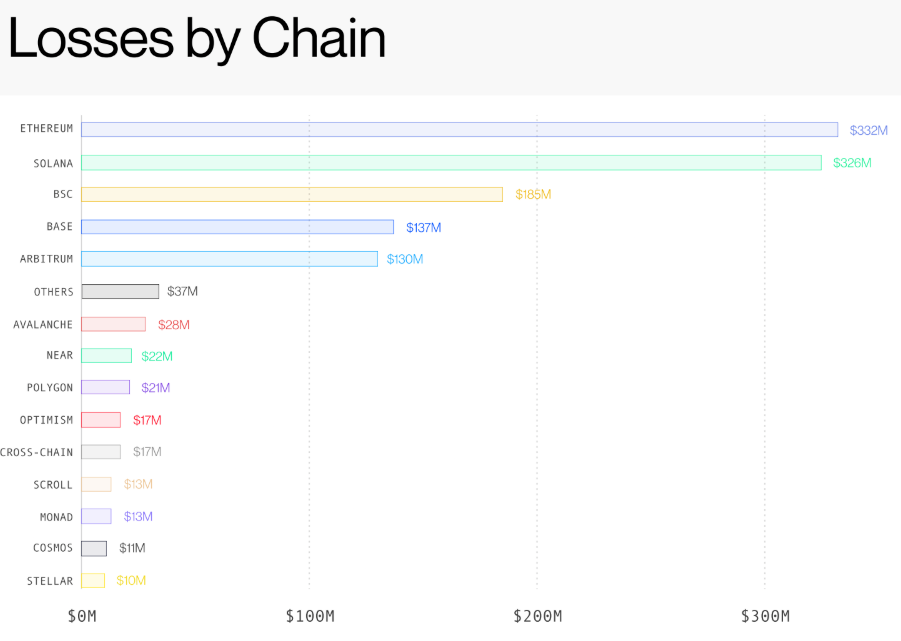
Crypto losses topped $1 billion in the first half of 2026 as the industry recorded its highest number of hacks in a six-month period, according to onchain security platform Blockaid.
Ethereum and Solana recorded the largest losses from incidents affecting their networks, with roughly $332 million and $326 million in stolen funds, respectively, Blockaid said in its H1 2026 security report published Tuesday.
Blockaid tracked 212 security incidents during the period, with the largest single exploit coming from KelpDAO at $292 million, while the platform verified 3.4 times as many high-threshold exploits in H1 2026 as across all of 2025.
Code exploits drove Ethereum incidents, while breaches of keys and signing infrastructure accounted for most Solana losses, according to the report.
Ethereum losses reflected the risks of high-value protocols
Ethereum incurred the highest losses from incidents in H1 2026, with attackers primarily targeting vulnerabilities in applications built on the network.
Blockaid said code exploits dominated Ethereum incidents by count, with major losses also linked to key compromises involving Humanity Protocol and StablR. CoWSwap, an Ethereum-based decentralized exchange, was the only major Ethereum incident in the report classified as a user mistake.
Blockchain losses by network in the first half of 2026. Source: Blockaid.
Blockaid identified several common attack methods targeting Ethereum, including bugs in bridges and smart contracts, unauthorized access to privileged accounts and market manipulation techniques.
The report said Ethereum remains a major target because it hosts many of the crypto industry’s most valuable applications, including restaking platforms, stablecoins and decentralized exchanges.
Solana losses surged as attackers shifted focus
Solana incurred nearly as much in losses as Ethereum during the first half of 2026, a sharp increase from the roughly $127 million in stolen funds the network recorded during 2025.
“2025 had $2.58 billion lost across 63 incidents, concentrated in Q1 by Bybit’s $1.5 billion, with Ethereum and Arbitrum the top chains by stolen-fund flow,” Blockaid CEO Ido Ben-Natan told Cointelegraph.
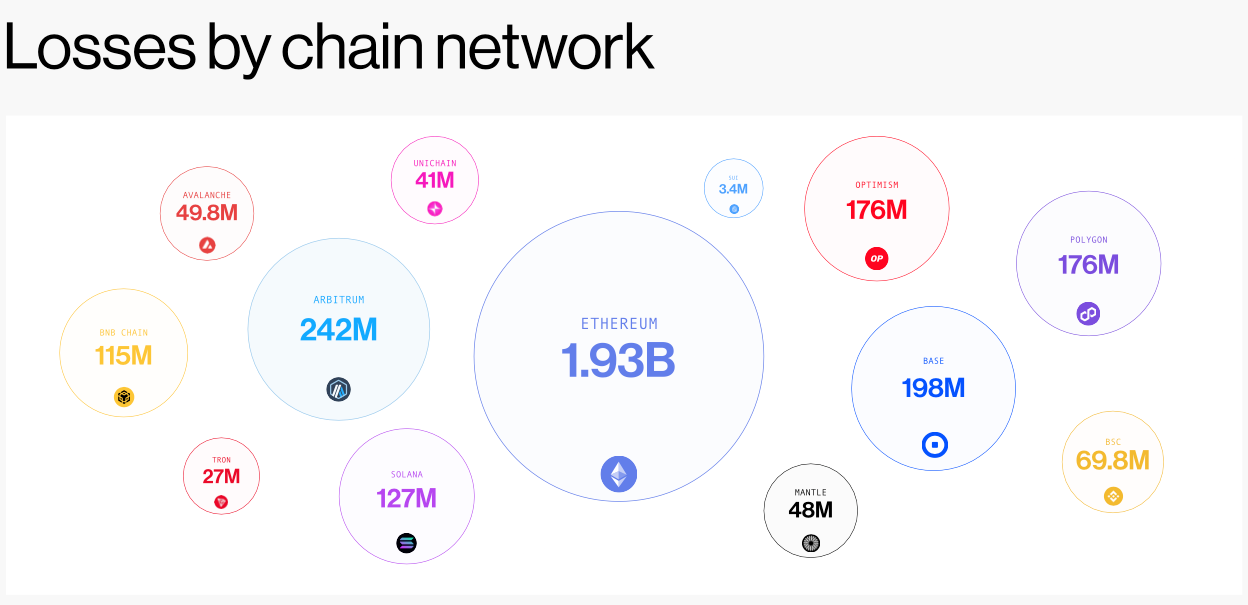
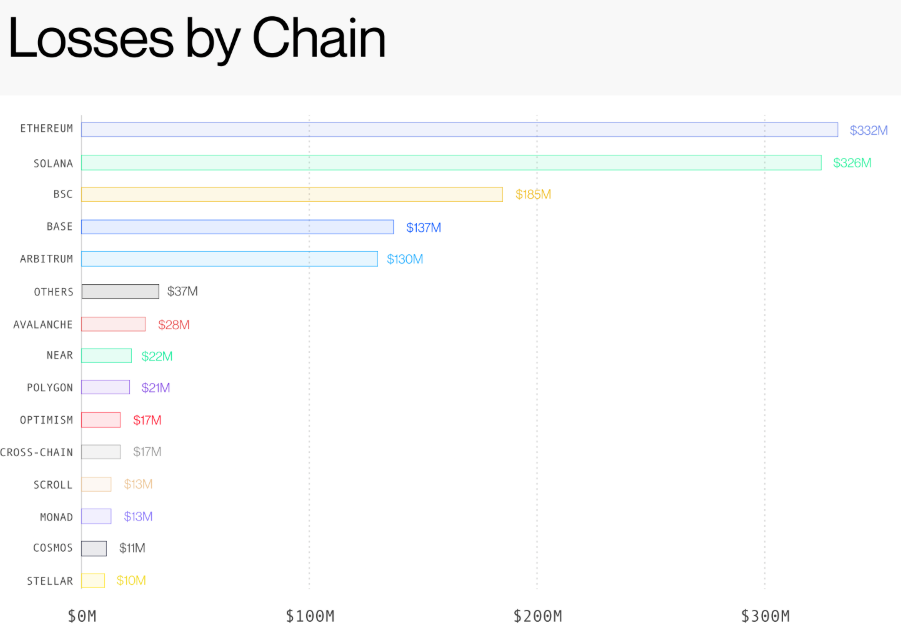
Blockchain losses by network in 2025. Source: Blockaid.
The change did not stem from a rise in smart contract exploits. Instead, compromised keys accounted for more than 98% of Solana’s losses, driven largely by incidents involving Drift Protocol and Step Finance, which Blockaid linked to North Korea-linked cyber groups.
Unlike Ethereum, where attackers primarily exploited vulnerabilities in protocol code, Solana incidents targeted signer infrastructure and organizational security, while a handful of code exploits involving Raydium and Volo accounted for the remaining losses.
Magazine: A quantum roadmap would push Bitcoin much higher: Charles Edwards
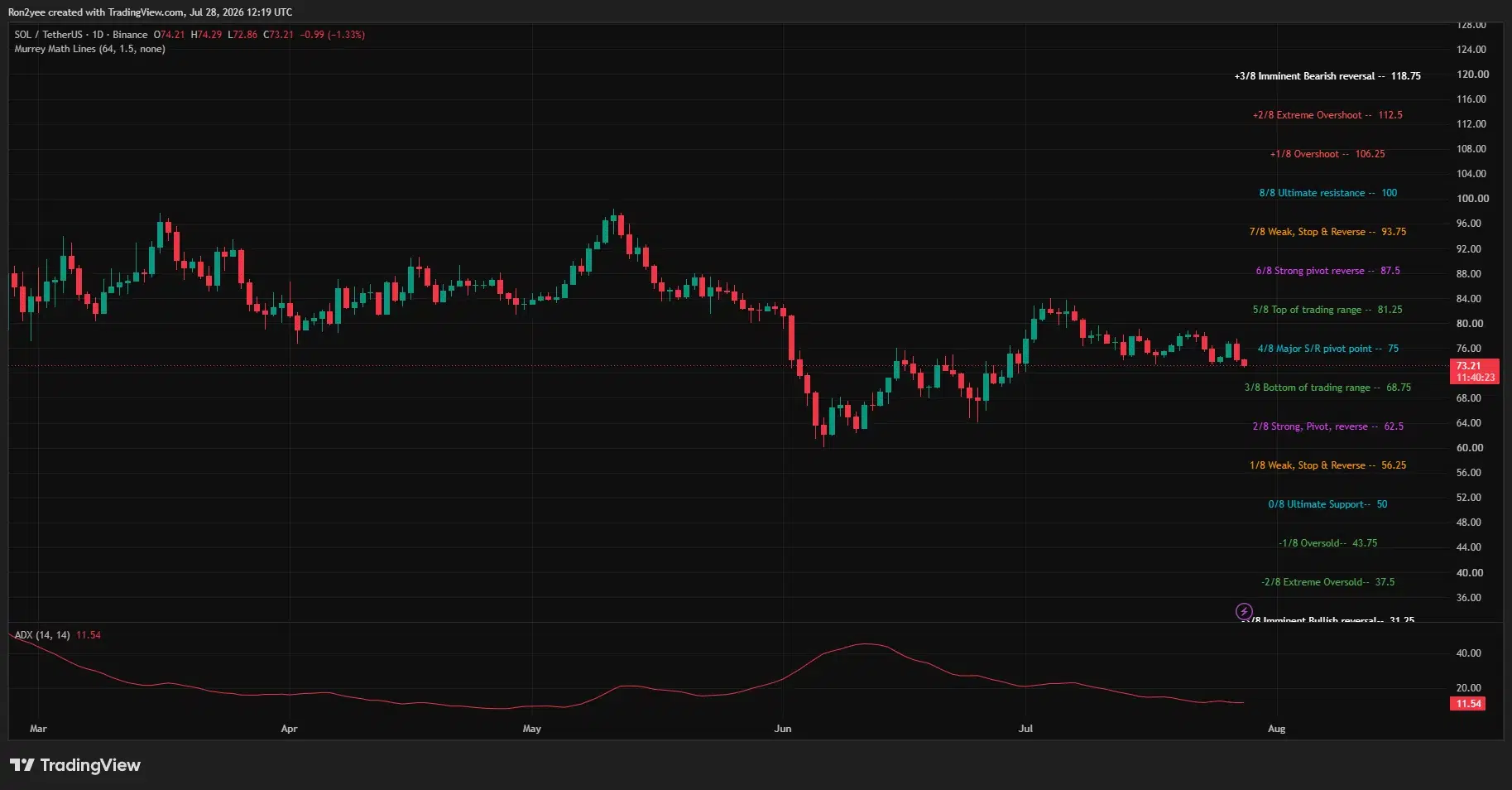
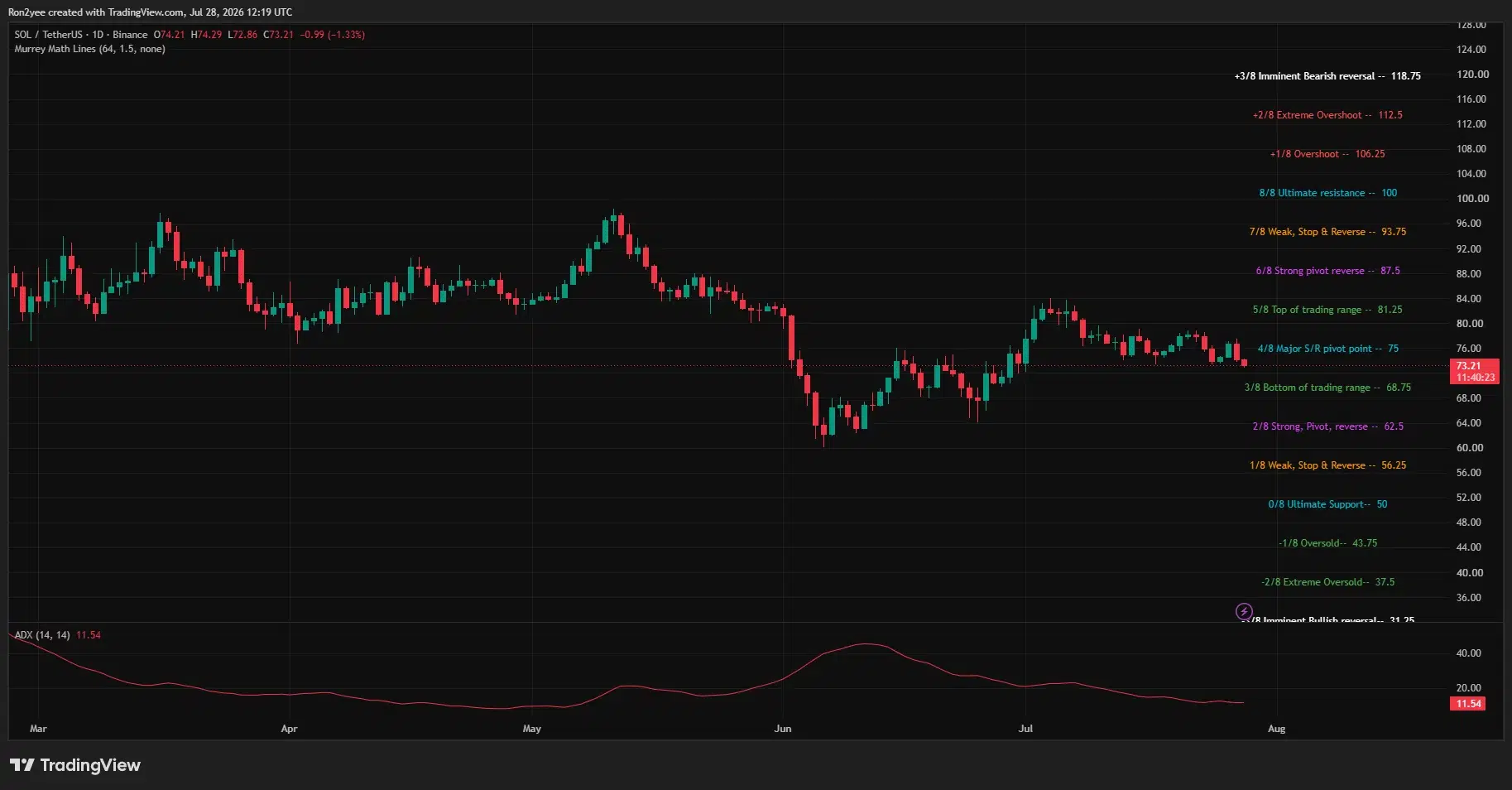
Solana price fell about 5% from its July 27 high near $77 to $73 on July 28 as a break below short-term support triggered long liquidations.
Summary
- SOL price dropped from roughly $77 to $73 after failing to sustain its latest recovery.
- Price has fallen below the $75 major pivot and remains inside a descending channel.
- The 4-hour RSI has declined to 35.57, showing weakening momentum without reaching oversold territory.
- Liquidation clusters near $72.50 and $74 could increase volatility around the current price.
Solana price drops back toward $73
According to data from crypto.news, Solana (SOL) price traded near $73.20 at the time of writing after falling from an intraday high around $77 during the previous session. The move represented a decline of about 5% from peak to trough.
The pullback followed SOL’s latest rejection from the upper half of a descending channel visible on the 4-hour chart. Buyers pushed the token toward $77 on July 27 but failed to challenge the channel’s upper boundary or the wider $78 resistance area.
Selling accelerated after SOL lost the $75 level, which had supported several earlier intraday rebounds. The token subsequently fell toward $73 before entering a narrow consolidation range.
The daily chart showed SOL trading below the Murrey Math major support-and-resistance pivot at $75. Its July 28 candle recorded a low of $72.86, although buyers prevented a sustained fall below $73.
SOL’s decline also came as capital showed a preference for Ethereum. ETH recently reclaimed $1,900, while SOL remained trapped below its July resistance range.
Crypto trader Daan Crypto Trades noted that the pair was beginning to lose its horizontal support area.
“[Solana] needs to break this local consolidation before we can start looking at the range high again.”
Daan added that Ethereum’s recent strength against Bitcoin had left Solana behind, making the ETH ecosystem more attractive while SOL remained weak.
Long liquidations accelerated the sell-off
The three-day CoinGlass liquidation heatmap shows that Solana’s slide cut through several leveraged trading zones between $75 and $73.
SOL first dropped sharply below $75 before falling through another band of liquidity around $73. The move likely forced leveraged long traders to close their positions, adding market sell orders to an already weak spot market.
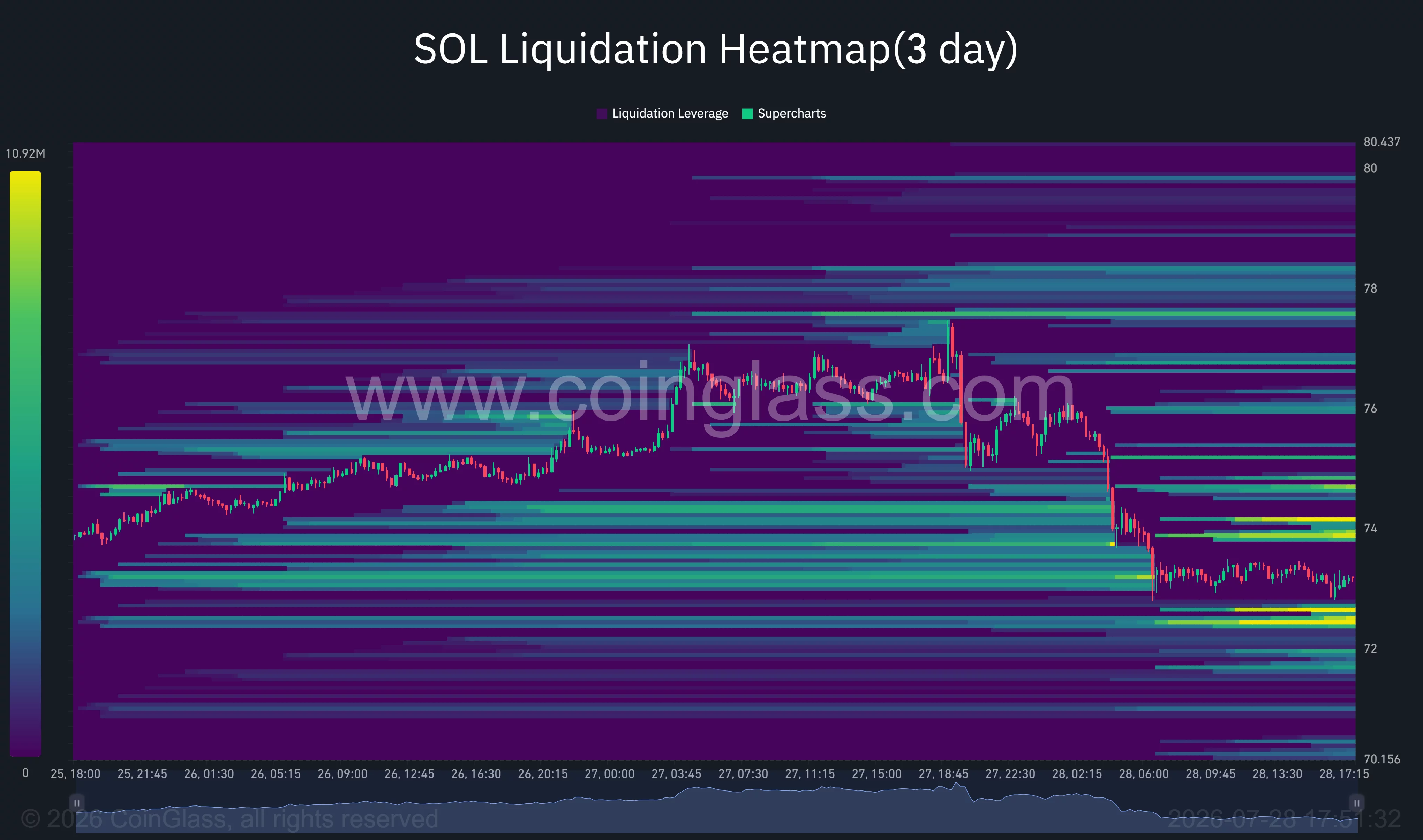
The heatmap shows that the largest nearby concentrations now sit on both sides of the current price. A bright liquidity band has formed around $72.40–$72.70, while additional clusters are visible near $73.80–$74.20.
This positioning could keep short-term price action unstable. A move below $73 may attract SOL toward the lower liquidity pool, while an initial rebound could target the accumulated positions around $74.
Further liquidation interest is visible near $75 and $76.50. Those levels could act as upside targets if buyers regain control, but they may also become resistance because traders caught in the decline could use a recovery to exit positions.
The liquidation data support the view that derivatives positioning magnified the decline. However, the charts alone do not establish that institutional sell blocks caused the move.
SOL indicators point to weak momentum
Solana remains inside a descending parallel channel that has guided its 4-hour price action since the early-July peak above $83. The channel has produced a sequence of lower highs, including rejections near $79 and $77.
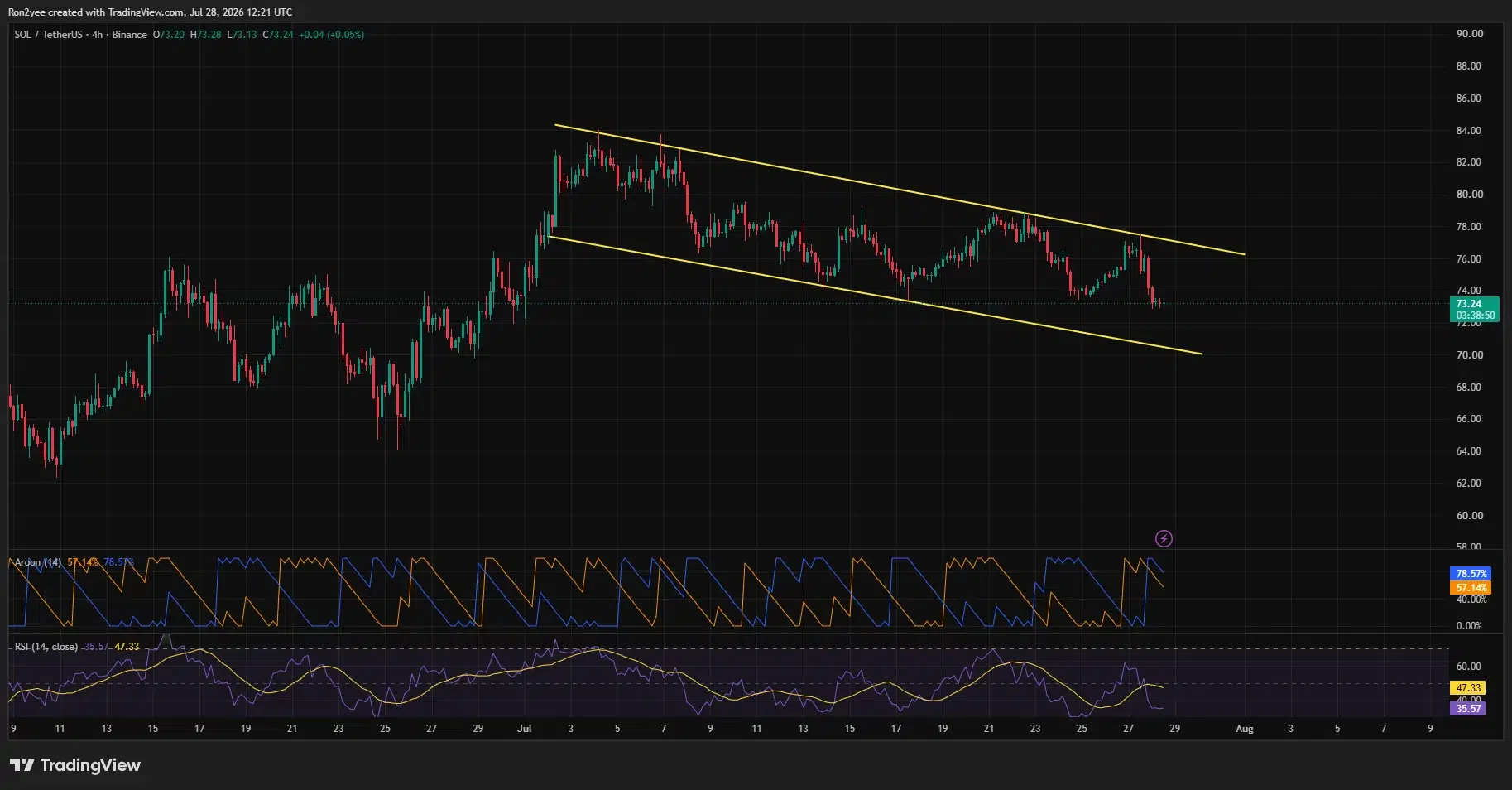
SOL is now approaching the channel’s lower half. The lower boundary sits close to $70, making that level the next broader technical support if $73 fails.
The 4-hour relative strength index has fallen to 35.57, below its signal average of 47.33. The reading shows that sellers control short-term momentum, although SOL has not yet entered the conventional oversold zone below 30.
Aroon readings also favor the downside, with the stronger line at 78.57% compared with 57.14% for the opposing measure. The indicator reflects the recency of price highs and lows rather than the size of a move, but its current configuration is consistent with SOL’s recent lower low.
On the daily chart, the average directional index stands at only 11.54. An ADX reading below 20 normally indicates a weak trend, suggesting SOL is still consolidating rather than entering a confirmed directional breakdown.
That weak reading leaves room for false moves around support. SOL could briefly sweep liquidity below $73 before recovering, particularly if selling pressure in the derivatives market eases.
Solana price levels to watch next
The first level buyers need to recover is $74. A move above that area would allow SOL to challenge the $75 pivot, which has changed from support into near-term resistance.
A daily close above $75 would weaken the immediate bearish case. Bulls would then need to clear $77–$78 and break above the descending channel to reopen a path toward the July high around $83.
Failure to reclaim $75 would leave SOL exposed to another test of the $72.50 liquidation cluster. Below that area, the channel boundary near $70 becomes the next likely target.
The daily Murrey Math chart places the bottom of the broader trading range at $68.75. That level may provide stronger support if a breakdown below $70 develops. A deeper correction could then extend toward the $62.50 pivot, although the current low ADX reading does not yet confirm such a move.
Fed decision adds risk for US traders
US investors are also awaiting the Federal Reserve’s next policy decision. Interest-rate expectations, movements in the dollar and Treasury yields can affect demand for high-risk assets such as SOL.
Treasury yields eased on July 28, while oil prices also fell as markets responded to renewed hopes for diplomacy in the Middle East. Brent traded below $87 and US crude near $81, reversing part of the inflation-driven pressure seen earlier in the week. The pullback reportedly followed a pause in attacks and renewed hopes for a US-Iran agreement.
That means SOL’s latest decline appears more closely linked to its technical breakdown and leveraged positioning than to a fresh rise in oil or Treasury yields. The Fed decision could still determine whether US liquidity conditions help SOL recover $75 or push it toward lower support.
Disclosure: This article does not represent investment advice. The content and materials featured on this page are for educational purposes only.

From Beauty to Biohacking: How Wellness Is Reshaping the Modern Self-Care Routine

The Best Kids’ Leather Shoe Companies (and What Makes Them Worth It)

24/7 florist concept allowing fresh flowers to be bought at any time lands in Glasgow

Renter of Home in Anne Heche Crash Denies Settlement With Son

No Jackpot Winner as $257 Million Prize Rolls Over to $269 Million Monday Draw

Weekend Open Thread: Staud – Corporette.com

10 or 500 Rupees ki Funny Bate #trending #comedy #funny #short #money #funnyaishorts #trendingshort

How Do Farmers Make Money From Water Hyacinths? #facts #trending #ytshorts

Why Learning to Earn Money Matters | Financial Wisdom | Sindhanai Bytes
-

 Fashion4 days ago
Weekend Open Thread: Brooks Brothers
-

 NewsBeat7 days ago
How a former Blue Peter presenter stunned America’s Got Talent judges
-
 Business6 days ago
New Jersey voter registration controversy explained: How 6,600 noncitizens got on the rolls, and what happens next
-

 Tech2 days ago
Intel is reversing course and bringing hyper-threading back to its server chips
-
 Entertainment7 days ago
Johnny Depp’s R-Rated Gothic Cult Classic Gets New Release Ahead of Sydney Sweeney Remake
-

 Crypto World6 days ago
Ethics, other provisions in crypto Clarity Act to be further discussed
-

 Politics1 day ago
Luke Littler dismantles Gerwyn Price to retain title in Blackpool
-
 Sports2 days ago
Commonwealth Games boxing: Jadumani Singh seals dominant 5-0 win over Pakistan’s Sumama Rehman to enter quarter-finals | Commonwealth Games News
-

 Sports5 days ago
2026 3M Open leaderboard: Scottie Scheffler finds putter in Round 1, sits three back
-

 Fashion4 days ago
16 Dresses for the High Summer Event
-

 Politics7 hours ago
The Part of the Electric Transition Nobody Wants to Discuss
-

 News Videos5 days ago
The Peugeot Family: How 200 Years of an “Old Money” Dynasty Died in A Boardroom
-

 Politics2 days ago
Spain sweeps the board at 2026 World Cup with individual awards
-
 Entertainment4 days ago
A New Post-Apocalyptic Gundam Anime Series Blasts Into SDCC
-

 News Videos2 days ago
BITCOIN JUST ENTERED THIS CRITICAL ZONE…
-

 Crypto World2 days ago
XRP Ledger adds $2.6B as RWA inflows rank second
-

 Crypto World3 days ago
Ripple bought a bank in pieces. The $4 billion audit
-

 Crypto World5 days ago
Uniswap (UNI) pushes deeper into tokenized RWAs with permissioned trading pools
-

 Tech3 days ago
Anthropic launches Claude Opus 5, a cheaper AI model for coding, agents and enterprise workflows
-

 Entertainment3 days ago
Sara Gilson Killed By Husband After Viral “Pedophile” TikTok Video
You must be logged in to post a comment Login