

Crypto World
Warren Buffett Left Berkshire $397 Billion in Cash, Enough to Buy Almost Any S&P 500 Firm

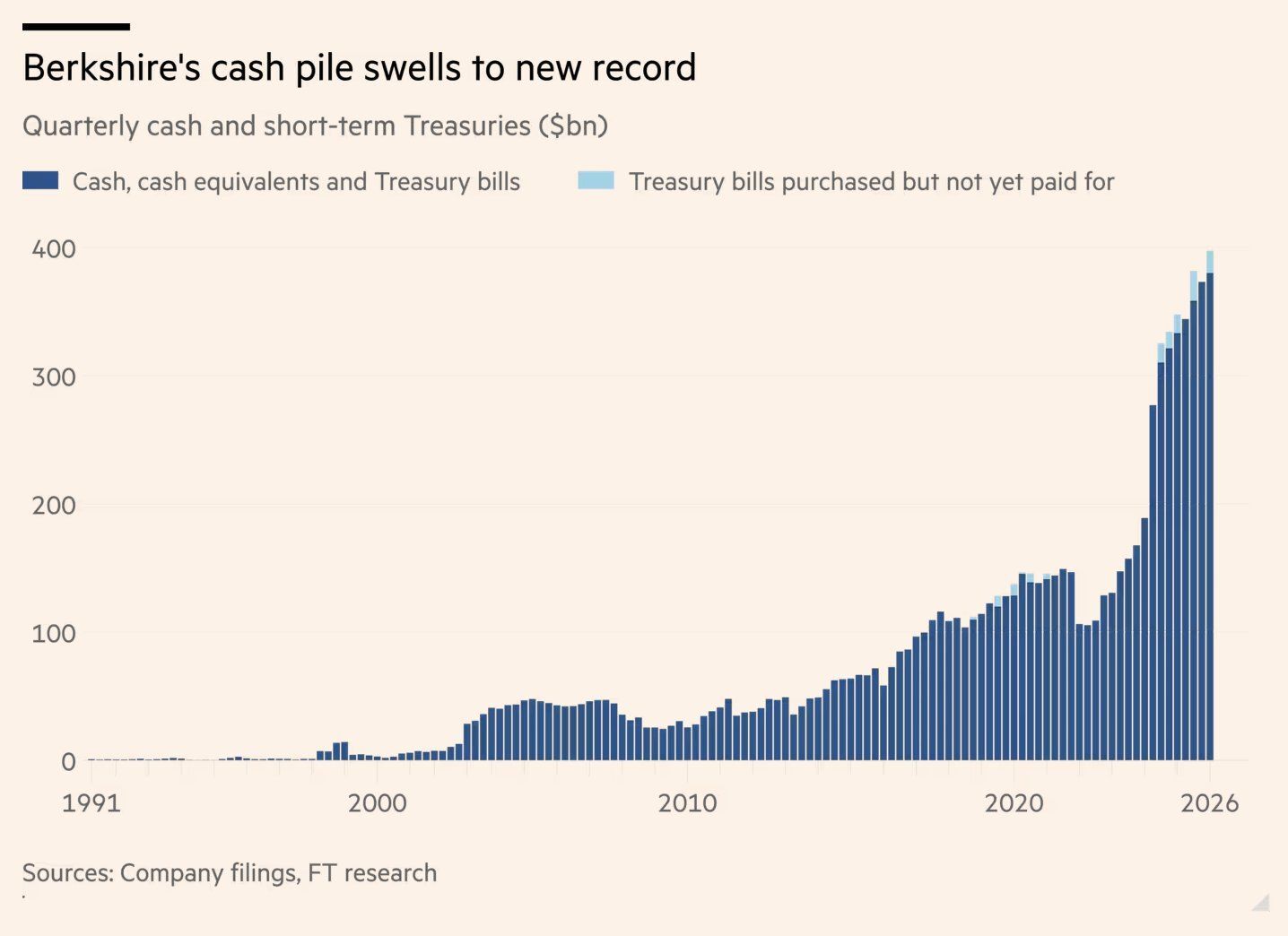
Berkshire Hathaway is sitting on an all-time high of $397.4 billion in cash and short-term Treasuries, according to its latest quarterly filing. The pile has grown so large that it could buy almost any single company in the S&P 500.
The figure covers the first quarter of 2026, Greg Abel’s first as CEO after Warren Buffett stepped back. Investors now watch whether Abel will spend it before the second-quarter results arrive in early August.
Berkshire’s Cash Record Could Buy Almost Any S&P 500 Company
Data shared by Barchart shows liquid reserves climbing from $373 billion at the end of 2025 to $397.4 billion in March. The platform noted the sum is enough to buy 476 companies in the S&P 500 outright.

The build-up is deliberate. Berkshire sold more stocks than it bought for 14 straight quarters, offloading $24.1 billion in equities against $16 billion in purchases last quarter. At current Treasury yields, the reserves earn roughly $20 billion a year.
Buffett defended that math in a recent interview.
“I can put huge amounts of money into government bonds that get 20 or 30 or 40 billion dollars a year… a good business is one that earns a lot more than the returns on essentially riskless investments, which you could define as Treasuries,” Warren Buffett, told CNBC.
Abel Starts Spending Carefully
Abel has begun deploying. Shareholders approved Berkshire’s $8.5 billion purchase of homebuilder Taylor Morrison last week, while buybacks run at their fastest pace since 2021. The firm also built a $31 billion Alphabet stake, including a $10 billion private purchase Buffett says he initiated.
Meanwhile, first-quarter operating earnings rose 18% to $11.35 billion, and net income more than doubled to about $10.1 billion. Results due around August 3 will show whether Berkshire’s record cash keeps compounding.
Buffett framed the choice ahead in simpler terms.
“The trick in… investing is to find businesses that are going to earn high returns on capital for an extended period of time,” Warren Buffet said.
Whether that points Abel toward stocks, acquisitions, or even a future in crypto, the August report offers the first real answer.
The post Warren Buffett Left Berkshire $397 Billion in Cash, Enough to Buy Almost Any S&P 500 Firm appeared first on BeInCrypto.


Decentralized finance (DeFi) has transformed how people trade, lend, borrow, and earn yield without relying on traditional financial intermediaries. However, as blockchain adoption accelerates, many decentralized applications (dApps) are spreading across multiple Layer 2 (L2) networks to achieve lower fees and higher transaction throughput. While this expansion improves scalability, it also introduces new challenges related to liquidity fragmentation, interoperability, and transaction coordination.
One emerging solution is shared sequencers—a new infrastructure layer designed to coordinate transaction ordering across multiple rollups. By enabling multiple Layer 2 networks to rely on a common sequencing mechanism, shared sequencers promise faster interoperability, improved security, and a better user experience. They could become one of the most important infrastructure upgrades for the next generation of DeFi.
Understanding Sequencers
To appreciate shared sequencers, it’s helpful to understand what a sequencer does.
In optimistic and zero-knowledge (ZK) rollups, a sequencer is responsible for:
- Receiving user transactions
- Ordering transactions into blocks
- Executing transactions
- Publishing data to the underlying Layer 1 blockchain
Today’s Layer 2 networks typically operate their own independent sequencers. This means each network determines transaction order independently.
While this model works well for individual rollups, it creates issues when DeFi protocols need to interact across multiple Layer 2 ecosystems.
The Problems with Independent Sequencers
As liquidity spreads across various rollups, users encounter several challenges.
Liquidity Fragmentation
A decentralized exchange may have liquidity on multiple Layer 2 networks, making it difficult to access the best pricing without bridging assets.
Cross-Chain Delays
Transactions moving between rollups often require bridges, introducing delays ranging from seconds to several minutes.
Increased MEV
Independent transaction ordering allows sophisticated traders to exploit arbitrage opportunities, increasing Maximum Extractable Value (MEV) and potentially harming regular users.
Poor User Experience
Users often need to switch networks, bridge tokens, and wait for confirmations before completing simple DeFi activities.
What Are Shared Sequencers?
Shared sequencers act as a common transaction ordering service for multiple rollups.
Instead of every Layer 2 network maintaining its own isolated sequencer, several rollups can submit transactions to a shared sequencing network that coordinates execution across all participating chains.
Think of it as multiple airports using the same air traffic control system instead of each operating independently.
The result is synchronized transaction ordering across ecosystems.
How Shared Sequencers Work
A simplified workflow looks like this:
- Users submit transactions.
- Transactions reach the shared sequencer network.
- The sequencer determines a global transaction order.
- Ordered transactions are distributed to participating rollups.
- Rollups execute transactions while maintaining synchronized ordering.
- Final settlement occurs on Ethereum.
This coordinated process dramatically simplifies cross-rollup interactions.
Benefits for DeFi
Seamless Cross-Rollup Trading
Shared sequencers make atomic cross-chain transactions possible.
For example:
- Swap ETH on one rollup
- Purchase another asset on a different rollup
- Complete both actions simultaneously
Either every step succeeds, or none do.
This eliminates partial execution risks.
Better Liquidity Efficiency
Rather than splitting liquidity across isolated ecosystems, protocols can coordinate liquidity more effectively.
Benefits include:
- Better capital utilization
- Reduced slippage
- Improved trading prices
- More efficient arbitrage
Liquidity effectively behaves as though networks are more closely connected.
Reduced MEV
Shared sequencing enables better management of transaction ordering.
Advanced sequencing mechanisms can:
- Reduce front-running
- Limit sandwich attacks
- Create fair ordering policies
- Enable encrypted transaction submission
This creates healthier markets for traders.
Faster Bridging
Cross-rollup communication becomes significantly faster because participating chains share transaction ordering.
Instead of waiting for independent confirmations, synchronized execution shortens settlement times.
Improved User Experience
Most users don’t care which Layer 2 they are using.
Shared sequencers move DeFi closer to an experience where:
- Networks become almost invisible
- Applications feel unified
- Cross-chain actions happen automatically
- Wallets manage complexity behind the scenes
This could greatly improve mainstream adoption.
Shared Sequencers and Cross-Chain DeFi
Imagine a lending protocol operating on four Layer 2 networks.
Today:
- Collateral remains isolated.
- Liquidity pools are fragmented.
- Arbitrage requires bridging.
- Borrowing may involve multiple manual steps.
With shared sequencers:
- Liquidity appears more unified.
- Cross-rollup collateral becomes easier to coordinate.
- Lending markets become more efficient.
- Interest rate imbalances can adjust faster.
The result is a smoother and more capital-efficient financial system.
Security Considerations
Although shared sequencers provide many advantages, they also introduce new design challenges.
Decentralization
If only one organization controls the sequencer, it becomes a central point of failure.
Many projects are therefore building decentralized sequencer networks with multiple independent operators.
Censorship Resistance
Sequencers must prevent malicious operators from censoring transactions.
Mechanisms under development include:
- Validator rotation
- Cryptographic commitments
- Permissionless participation
- Fallback sequencing mechanisms
Economic Incentives
Sequencer operators require incentives to remain honest.
Many designs incorporate:
- Staking
- Slashing penalties
- Shared transaction fees
- Consensus protocols
These mechanisms align operator behavior with network security.
Projects Building Shared Sequencer Infrastructure
Several blockchain infrastructure projects are actively exploring shared sequencing, including:
- Astria
- Espresso Systems
- Radius
- Rome Protocol
- Init4
Each project approaches decentralization, interoperability, and sequencing differently, but all share the goal of making rollups operate more like a unified ecosystem.
The Future of Shared Sequencers
As Ethereum continues scaling through rollups, interoperability becomes increasingly important.
Shared sequencers could eventually enable:
- Cross-rollup lending
- Unified decentralized exchanges
- Cross-chain liquidations
- Multi-rollup yield strategies
- Unified NFT marketplaces
- Interoperable gaming economies
- AI agents executing transactions across multiple chains simultaneously
Rather than treating each Layer 2 as a separate blockchain, shared sequencing allows them to function more like connected components of a larger decentralized financial network.
Challenges Ahead
Despite their promise, several hurdles remain:
- Standardizing communication between rollups
- Scaling decentralized sequencer networks
- Preventing centralization
- Balancing speed with security
- Developing sustainable economic models
Solving these issues will require collaboration across blockchain ecosystems.
Conclusion
Shared sequencers are among the most significant infrastructure innovations in the evolution of Ethereum’s Layer 2 ecosystem. By coordinating transaction ordering across multiple rollups, they address key challenges such as liquidity fragmentation, inefficient cross-chain interactions, and excessive MEV, while enabling smoother and more secure decentralized finance experiences.
As DeFi expands beyond isolated networks, the importance of seamless interoperability will only grow. Shared sequencers provide the foundation for a future where users can interact with decentralized applications across multiple rollups as effortlessly as using a single blockchain. If successful, they could become a core building block of the next generation of scalable, interconnected, and user-friendly DeFi.
REQUEST AN ARTICLE
After showing signs of strength earlier Monday, Bitcoin reversed course shortly after. The crypto asset fell by 3% in the last 24 hours and briefly touched the $63,000 mark.
Even as the price weakened, larger holders of the crypto asset have continued accumulating.
Supply Shift
Santiment found that wallets holding between 10 and 10,000 BTC have added a combined 19,696 units over the past eight days. On the other hand, wallets holding less than 0.01 BTC have shown weaker dip-buying activity during the same period, which indicates that retail demand is cooling.
This comes at a time when Bitcoin ETFs attracted a little over $222 million in inflows so far in July. The analytics firm said that these factors together point to a “constructive” market setup and demonstrate that the crypto asset’s supply is “shifting toward stronger hands.”
Zooming out, Swissblock said BTC remains in its consolidation, or “Bullish Transition,” phase, although the window for a recovery is gradually narrowing. During the previous bullish transition, the firm observed that Bitcoin consolidated for 40 days before moving into a recovery phase. The current cycle has lasted 30 days so far.
According to the analysis, the market now needs to sustain its bottom signal before it can advance into recovery. Swissblock added that such transition periods often test investors’ conviction and shake out impatient participants before a recovery begins.
Quiet Accumulation
While Bitcoin is trading roughly 50% below its October 2025 high of $126,200, on-chain data also shows that BTC held on exchanges has fallen by around 78,000 units over the past six months, dropping from 2.783 million to 2.705 million and nearing the lowest levels of the current cycle. CryptoQuant noted that during a typical capitulation, investors send BTC to exchanges to sell.
However, investors kept moving Bitcoin into self-custody throughout the current correction. This is a sign of long-term holding and not distribution. Lower exchange supply could amplify future price gains if demand strengthens. But a sustained rise in the netflow 7D MA would signal renewed distribution and intensify the risk of a retest of $58,000.
Additionally, BSCN reported that two newly identified institutional-scale wallets withdrew a total of 6,765 BTC, worth approximately $441.34 million, from Binance in a coordinated move on Monday. According to the update, both transactions took place within the same hour. These transfers, BSCN said, point to a migration of spot liquidity from Binance’s reserves into private cold storage.
The post Why Bitcoin’s Current Setup Looks ‘Constructive’ Despite the Pullback appeared first on CryptoPotato.
Crypto exchange Kraken is offering retail investors access to the planned Jersey Mike’s initial public offering, allowing eligible US customers to request allocations of the sandwich chain’s shares and users in more than 110 countries to request tokenized shares backed 1:1 by the underlying stock.
Eligible US customers can submit interest in book-entry Jersey Mike’s shares at the IPO price, while global customers can request JMKEx, a tokenized version of the stock with the backing shares held in regulated custody. Allocations are determined by the IPO underwriter and are not guaranteed.
JMKEx will begin trading 24 hours a day, five days a week on Kraken and participating xStocks Alliance platforms once the IPO closes, while the underlying Jersey Mike’s shares will trade during regular US market hours.
Kraken said tokenized shares can be transferred across participating xStocks Alliance platforms, moved onchain and integrated with compatible decentralized finance applications, extending access to public equities beyond traditional brokerage accounts.
Jersey Mike’s is a US sandwich chain with more than 3,300 locations. According to the company’s IPO announcement, it expects to price the offering between $21 and $25 per share and list its Class A shares on the New York Stock Exchange under the ticker JMKE.
Related: Kalshi in early IPO talks with investment banks: Report
SpaceX offering faced allocation shortfall
Jersey Mike’s is the latest company to be offered through Kraken’s tokenized IPO platform, following SpaceX’s public debut in June. Several other crypto platforms, including Binance, Bybit, Blockchain.com, Bitget Wallet and MEXC, also launched products tied to the SpaceX offering.
However, demand for the listing quickly outpaced supply. The SpaceX IPO was reportedly more than four times oversubscribed, leaving crypto platforms competing for a limited pool of underlying shares.
Several exchanges, including Binance, Bybit, Bitget Wallet and MEXC, ultimately canceled their tokenized IPO campaigns and refunded users after they were unable to secure enough underlying SpaceX shares to fulfill customer allocations.
Those Nasdaq traded shares have declined from their $135 IPO price, last trading at roughly $115 on Tuesday.
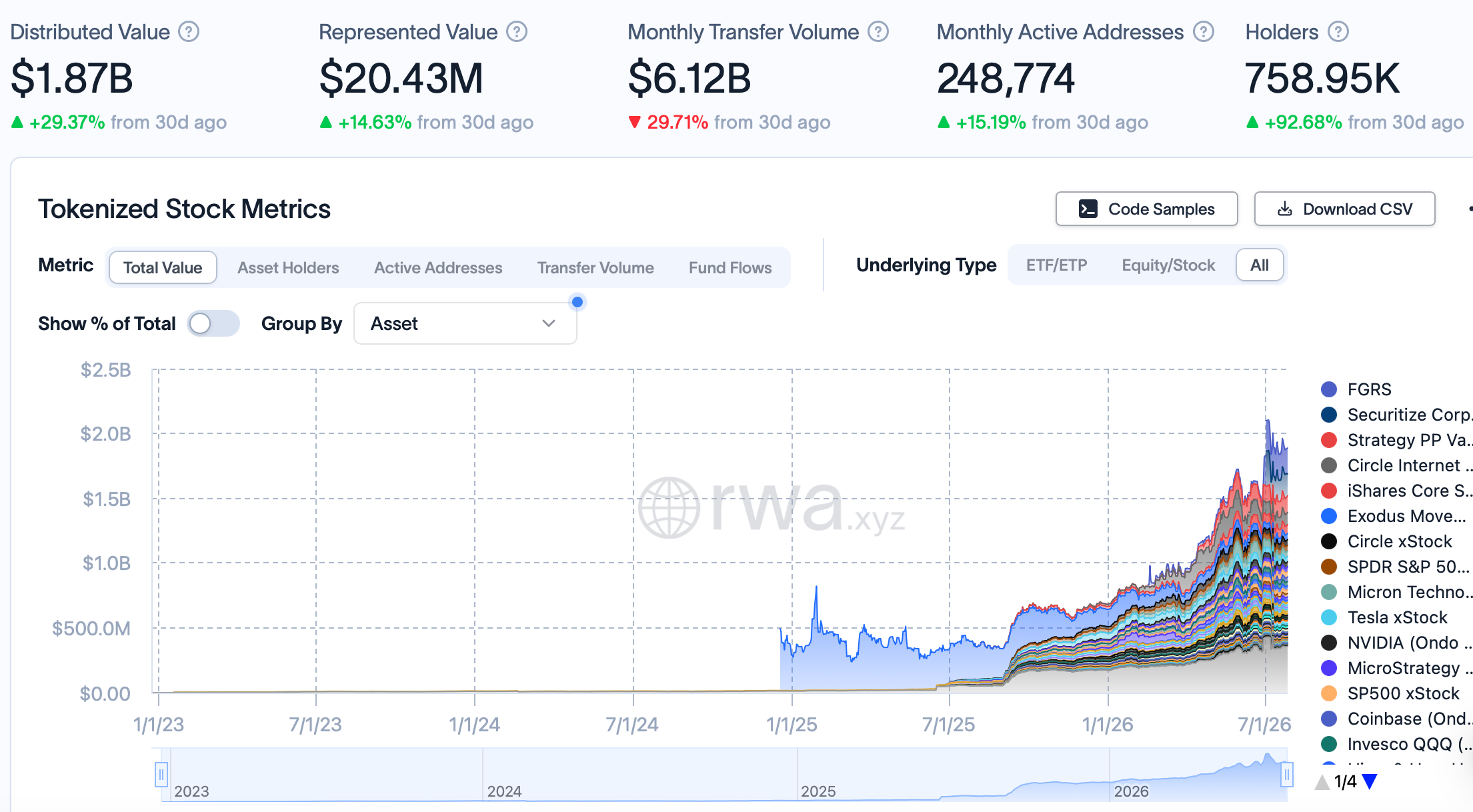
The difficulties surrounding the SpaceX rollout have not slowed growth in the broader tokenized equities market. RWA.xyz data shows the sector’s distributed value rising from well under $500 million in mid-2025 to about $1.87 billion, including a 29.4% increase over the past 30 days.
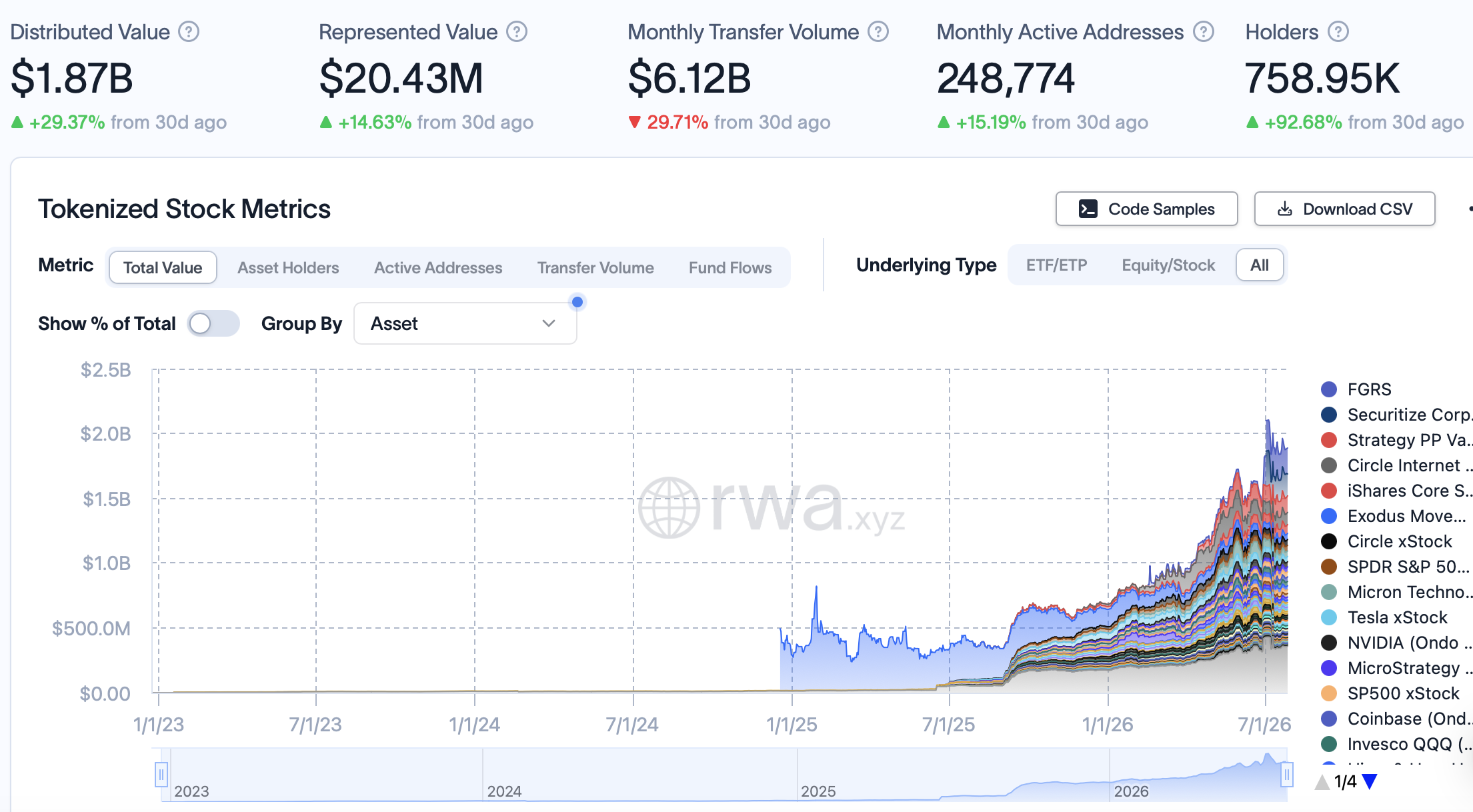
Tokenized equities. Source: RWA.xyz
Magazine: The real reason DeFi projects that survived 2022 crash are shutting down now
Decentralized finance is shedding projects again. DeFi dashboard Zapper announced it will shut down after nearly seven years, adding to a wave of closures and wind-downs that have marked 2026 across multiple segments of the industry.
Earlier this year, Bitcoin DeFi platform Botanix, Solana portfolio tracker Step Finance, DeFi analytics platform Parsec, and DEX aggregator Odos Protocol also moved toward shutdown or completion of operations. RootData has tracked 101 “dead” crypto projects in 2026 as of July 26, and observers say DeFi accounts for more than half of those failures.
Key takeaways
- DeFi closures in 2026 aren’t explained solely by “bear market blues.” Analysts argue capital has shifted to different parts of the ecosystem rather than disappearing.
- Concentration may be easing, not intensifying. Artemis data cited in the report suggests leading protocols hold smaller shares than they did two years ago.
- Fees and revenue matter more than TVL for diagnosing which DeFi models are economically viable today.
- Capital is reportedly more selective. Investors are less likely to chase short-term token incentives without a proven distribution or track record.
- Infrastructure is consolidating while experimentation moves upward. New products increasingly build on existing DeFi rails rather than recreating core protocols.
A “death list” trend that still raises strategic questions
The visible pattern—multiple DeFi products shutting their doors—naturally invites a simple narrative: the 2026 environment is harsher, and only the strongest teams survive. Zapper’s decision follows a broader sequence of winding downs that includes tools across trading, analytics, and Bitcoin-focused DeFi.
Botanix’s founders, in earlier coverage, pointed to weak demand as a key factor behind its closure. In June, they told Cointelegraph that onchain activity consolidating around a smaller set of venues—such as Hyperliquid and large centralized exchanges—helped hasten Botanix’s decline. That framing fits a common industry complaint: liquidity is concentrating into fewer places.
But Artemis Research’s Alex Weseley argues the “concentration is increasing” storyline doesn’t match DeFi data. In the report, Weseley states that the prevailing narrative suggests DeFi is becoming more centralized due to exploits and capital rotation into “Lindy” protocols—while his analysis says the opposite.
Artemis: concentration drifted lower, but economics rotated
According to the Artemis data cited, concentration across tracked DeFi protocols has drifted lower since 2024. Even though major categories retain dominant incumbents—Uniswap in decentralized exchanges, Aave in lending, and Jupiter in perpetuals by locked capital—each leader reportedly holds a smaller share of its sector than it did two years ago.
Weseley’s larger point is that capital and usage may be moving into adjacent parts of the crypto economy rather than leaving it entirely. The report quotes him saying the economics didn’t disappear; they “rotated to adjacent apps,” naming Hyperliquid, Polymarket, and pump.fun. The implication for traditional DeFi is that classic DeFi’s share of fee generation may shrink even while total fee activity remains robust elsewhere.
This is where the report’s methodological shift matters. Weseley argues that while TVL can answer the “liquidity” question, it can mislead when the issue is economic viability. In his view, fees and revenue provide a more direct measurement of whether DeFi models remain sustainable.
Artemis estimates that the number of DeFi applications generating at least $1 million in monthly fees rose to about 33 or 34 in mid-to-late 2025 before dropping back to roughly 25 or 26 during the first half of 2026. It also estimates that the number generating more than $10 million in monthly fees roughly halved over the same period.
Put differently: even if users and capital haven’t fully “exited” DeFi, the economic engine—measured through fees—has cooled for many protocols. For teams that depend on high-frequency demand or stable onchain activity, that can be the difference between operating profitably and winding down.
Gauntlet: demand is high, but incentives aren’t driving funds the way they used to
DeFi risk management firm Gauntlet takes a more optimistic view of underlying market health. Nicholas Cannon, chief business officer at Gauntlet, tells Magazine that demand is “the strongest it has ever been,” citing growing stablecoin supply and an apparent drift from traditional finance toward DeFi rather than away from it.
In the report, Gauntlet argues the key change since the previous downturn is how capital behaves. According to Cannon, investors are more selective than in past cycles—less easily pulled in by short-term token incentives designed to “bootstrap” user activity.
The quoted stance is blunt: in earlier cycles, liquidity followed incentives wherever they pointed. Now, capital reportedly follows “sustainable yield, track record, and curation.” Incentives can still help start traction, but the report suggests they no longer guarantee survival on their own.
Markus Levin, co-founder of infrastructure company XYO, reinforces this idea—especially for institutional capital. He says the institutional layer in 2026 is more selective, and the strongest survivors are likely those with meaningful existing user distribution or the ability to reach beyond the “traditional DeFi audience.” If that expectation holds, it means today’s bar for success may be higher than the bar set during earlier bear markets.
The report also points to where new experimentation is concentrating: tokenized assets, stablecoins, and emerging categories such as agentic DeFi. While these areas are not presented as cures for every DeFi challenge, they align with the thesis that the economics are shifting rather than disappearing.
Infrastructure consolidation and distribution-led growth
One consequence of DeFi maturation highlighted by the report is that fewer teams are attempting to build the next Aave or Uniswap from scratch. Instead, Cannon argues that startups increasingly use established infrastructure as a foundation.
The report links this shift to where funding is landing. It cites a June announcement from Morpho association about a $175 million raise to support institutional lending onchain. It also cites July coverage that agentic DeFi startup Alpaca raised $135 million to build infrastructure for AI-powered financial applications.
In that environment, the product competition changes. Rather than competing head-to-head with incumbents for liquidity, newer protocols may win by being embedded into platforms users already use. The report quotes Morpho Labs co-founder Merlin Egalite saying protocols that grow fastest will increasingly be those integrated into existing user surfaces—wallets, exchanges, and fintech platforms—rather than those trying to pull users away from their current workflows.
Egalite also argues future growth will come from making DeFi infrastructure easier for traditional financial firms to adopt without rebuilding core systems. For builders and investors, that reframes “innovation” as less about reinventing everything and more about reducing friction for integration and distribution.
What to watch as DeFi’s winners and losers sort out
As 2026 continues, the key question isn’t just which projects are shutting down, but whether surviving DeFi apps can maintain fee generation while distribution advantage shifts toward embedded infrastructure. Readers should watch fee-revenue trends, not just TVL, and track whether capital allocation favors products with durable users and integration pathways—or whether more mainstream DeFi tooling keeps getting crowded out by adjacent venues.


Imagine telling an AI agent how much risk you’re willing to take, your retirement goals and when your kids will start college — then letting it manage your portfolio while you sleep.
That vision of agentic trading, in which artificial intelligence doesn’t just recommend investments but carries them out, is moving from concept to reality. Brokerages, startups and even retail investors are building AI agents that can help oversee portfolios and automate investing tasks once handled by humans.
“Effectively everybody has their own family office that is working 24/7 for them while they’re awake or sleeping,” said Devin Ryan, head of financial technology research at Citizens. “This isn’t 10 years away. This is coming in the next few years.”
Ryan believes those agents will eventually do much more than buy and sell securities. He envisions AI continuously managing taxes, cash balances, borrowing, mortgages and investment portfolios — all tailored to an investor’s financial goals. Fully autonomous investing remains a work in progress, but the race to build it is already underway.
Building the future
Rather than trying to create fully autonomous trading systems overnight, many firms are taking a gradual approach.
Startup Podium Markets AI is among those building AI specifically for investing. Its assistant, Ivy, analyzes a customer’s portfolio across multiple brokerage accounts and generates recommendations based on the investor’s goals and risk tolerance.
But it stops short of acting on its own. Users still decide whether to follow the recommendation and execute the trade themselves.
“The AI informs, but the human decides,” said Dirk Mueller-Ingrand, co-founder and CEO of Podium Markets AI. “The average investor still should be very much in charge of the final decision. … We’re going down the path of a persistent AI finance or trading buddy who’s always with you.”
Larger brokerages are moving in the same direction. Robinhood in May introduced tools allowing third-party AI agents to connect with customer accounts. Brokerage firm Public, meanwhile, is developing AI agents in-house that can automate investing workflows within its platform.
“What this era of agentic is doing … it goes away from just being able to research something by yourself and then make up your own ideas and then trade the way you’ve traded where it’s now becoming automated and where AI agents can actually execute investment strategies on your behalf,” said Leif Abraham, Public’s co-founder and co-CEO.
Ryan estimated agentic finance could increase transaction volumes by at least tenfold. A retail investor who currently trades roughly twice a month could eventually trade 20 times a day under an agentic model, he said.
“By the end of next year, we think that on some of these platforms, the majority of transaction activity by number of trades will be done by agents, if you can believe that,” Ryan said.
From ChatGPT to investing agents
While Wall Street is building agentic investing tools, retail investors have spent the past three years testing what general purpose AI can do.
Since ChatGPT burst into the mainstream in late 2022, many investors have used AI tools such as ChatGPT and Anthropic’s Claude to summarize earnings reports, research companies and generate stock ideas. The results have been mixed, with some users treating AI as a research assistant while others have found it unreliable for making investment decisions.
Obioha Okereke, a 29-year-old technology consultant in Georgia and founder of the financial literacy platform College Money Habits, built an agent using Claude to search for undervalued stocks and options opportunities.
“It was essentially just asking Claude to act as a hedge fund analyst to find undervalued stocks,” he said, adding that he still reviewed every recommendation before placing a trade. “I will always stand by AI being a tool as opposed to a replacement.”
Thomas Schlossmacher, a 31-year-old retail investor and founder whose company Specialty Tokens builds AI systems for businesses, tested a trading agent after seeing claims online that AI could uncover profitable market patterns. Instead, he said he “was just losing money consistently.”
“I think if you’re using it for an automated system or relying on an agent to do it for you, you probably want a professional,” he said. “To blindly give an agent and say, ‘Hey, make me money,’ I think is kind of dumb.”
Building guardrails
The debate highlights one of the industry’s biggest challenges. Teaching an AI agent to buy or sell a stock is relatively straightforward. Teaching it what an investor actually means is much harder.
An investor might simply tell an agent to “grow my portfolio aggressively.” But does that mean taking on more volatility, concentrating holdings, using options or accepting a greater chance of loss? An AI agent can faithfully follow instructions and still produce an outcome the investor never intended.
That’s why many firms are building guardrails before giving AI greater authority. Public, for example, requires users to review and approve an agent’s workflow before it carries out any investing tasks.
“You still have the last word,” said Abraham. “The AI agent will not have its own mind. … It will only execute.”
The more responsibility AI agents assume, the more important it becomes for firms to ensure the technology behaves as intended.
“You have to make sure that the customer’s best interests are at the forefront,” said Citizen’s Ryan. “If the agent is not behaving as modeled or as you expect, that becomes a risk for the firm.”

Meta CEO Mark Zuckerberg arrives at Los Angeles Superior Court on Feb. 18, 2026.
Jill Connelly | Getty Images
Meta is set to report earnings after the market close Wednesday, and traders on prediction market platform Kalshi think the Instagram parent will use its conference call to highlight its Ray-Ban Meta smart glasses and push into the cloud market, while steering clear of social media policy debates.
In a “mentions market” — where speculators on Kalshi are asked to place trades on whether specific words will be used during a call or speech — for the Meta earnings call, traders place 90% odds that the hyperscaler’s management will say the word “cloud.”
Bloomberg reported earlier this month that Meta was developing a cloud infrastructure business to sell access to raw computing power.
Speculators are only a little less certain that Meta on the call will say “Ray-Ban,” its smart glass partner, giving it a 74% chance. Last month, Meta debuted a new smart glasses model at a lower price, developed with Ray-Ban parent EssilorLuxottica.
Traders are think there’s a 61% chance Meta will discuss its chips by using the word “silicon.”
Odds that Meta mentions “Hyperion,” the name of its data center project in rural Louisiana stand at just 27%.
And don’t expect Meta to discuss social media policy either.
While the U.K. is the latest country to pursue bans on children using social media, traders think there’s only a 15% chance Meta mentions “age verification.”
Traders think there’s just a 20% chance Meta uses the terms “prediction market” or “Kalshi.” Reports in June revealed Meta CEO Mark Zuckerberg directed staff to build a prediction market platform, and NPR reported later the same month that Meta at one point was in talks to acquire Kalshi.
Disclosure: CNBC and Kalshi have a commercial relationship that includes customer acquisition and a minority investment.


EthSystems, a startup spun out of the Ethereum Foundation earlier this month, is betting that privacy, not scalability, is the biggest obstacle preventing institutions from moving financial activity onto public blockchains.
The company, which emerged from the Ethereum Foundation’s Institutional Privacy Task Force, is building confidentiality infrastructure for banks, asset managers and governments looking to use Ethereum for tokenized assets, stablecoins and other financial applications.
Rather than creating an entirely new blockchain, EthSystems helps institutions deploy privacy technologies that allow sensitive transaction data to remain confidential while still settling on Ethereum.
“Almost every single financial institution requires some level of confidentiality,” co-founder Mo Jalil told CoinDesk in an interview. “Confidentiality doesn’t necessarily mean something has to be anonymous or hidden. There just needs to be controls over who sees what, when and how.”
EthSystems is far from the only company focused on institutional privacy. Projects such as Canton Network, which is backed by major financial institutions including Goldman Sachs, BNP Paribas and DTCC, as well as Ethereum-native privacy protocols like Aztec and Miden, are also developing infrastructure aimed at enabling confidential transactions for enterprises.
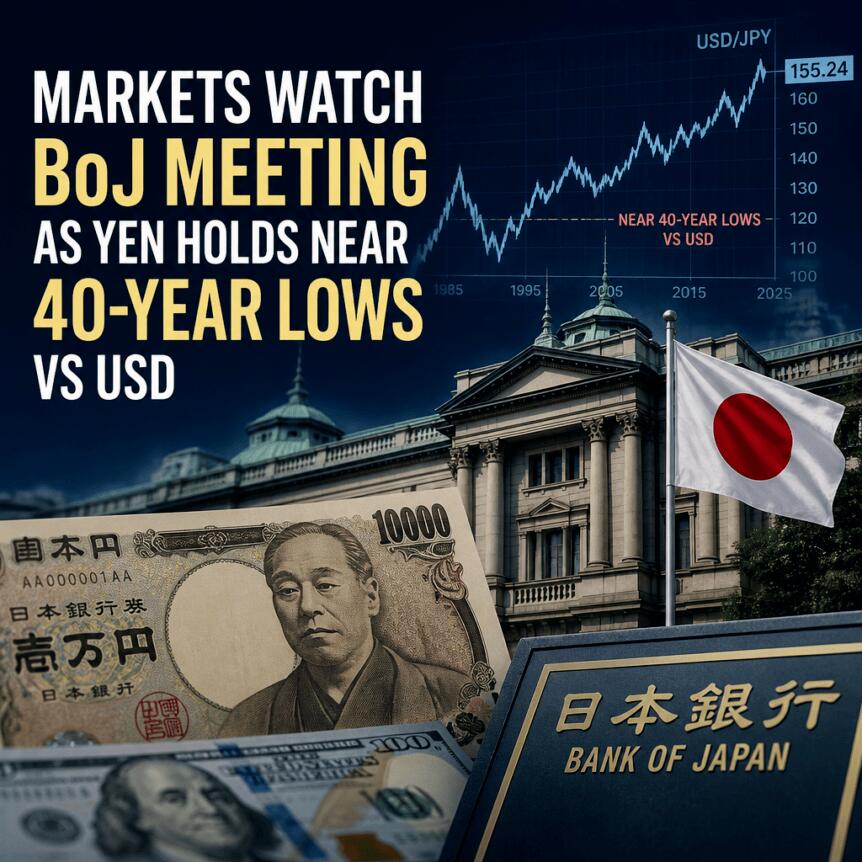
Japan’s next monetary policy decision is coming into sharper focus as the yen keeps sliding toward fresh 40-year lows against the US dollar. With the Bank of Japan (BoJ) scheduled to meet on July 31, markets are weighing whether policymakers will pause at current levels—or signal further tightening as the currency weakens.
The immediate question for global markets, and particularly for crypto traders, is how much pressure a yen slide can add through “carry trade” dynamics. When Japanese rates stay low and the yen depreciates, borrowing in yen to fund riskier assets can expand. But if conditions shift—especially if the yen moves abruptly—those positions can unwind quickly, tightening liquidity and often hitting highly leveraged markets.
Key takeaways
- USD/JPY is nearing new 40-year highs, edging toward the 164 area after last week’s record set, according to TradingView.
- The BoJ meets on July 31 with its policy rate currently at 1.0%, the highest since September 1995.
- Market pricing points to a hold decision, with prediction markets indicating very high odds of no change.
- Yen carry-trade unwinds remain a key risk for crypto liquidity, after the 2024 unwind episode was triggered by yen-related interventions.
Yen weakness puts the BoJ under a global spotlight
On Tuesday, data from TradingView showed USD/JPY approaching 164, just short of the new 40-year highs recorded last week. That level matters not only because it reflects yen depreciation, but because Japan’s currency policy affects far more than domestic pricing.
The yen is widely used as a funding currency. With relatively light capital controls and deep liquidity outside the dollar, a weakening yen can reinforce global carry strategies—positioning that depends on Japanese rates staying low and exchange rates remaining stable enough to avoid forced closures.
Japan’s backdrop has also supported that role for decades: earlier current account and trade surpluses helped underpin the currency’s liquidity profile while low interest rates kept yen funding attractive. However, since inflation picked up in 2022, the balance has been shifting toward the possibility of carry-trade stress—particularly if yen depreciation forces investors to exit leveraged trades faster than they expected.
The BoJ’s July 31 decision comes as the policy rate stands at 1.0%, its highest since September 1995. While most expectations currently point to no change, the forward guidance from earlier in the year has kept attention on the pace and timing of potential further hikes.
Markets expect a hold—BoJ’s guidance still leans toward tightening
On expectations for the upcoming meeting, markets appear aligned around the idea of a pause. The reporting around the decision notes that market-implied probabilities show a rate hold at roughly 98%, following the BoJ’s most recent increase in June.
Prediction service Polymarket similarly priced the odds of no change at 99% as of Tuesday, signaling that traders largely expect policymakers to keep the benchmark rate unchanged at the July meeting.
Still, the June meeting summary referenced conditions that could justify additional tightening later. In its published summary, the BoJ pointed to underlying inflation approaching 2%, accommodative financial conditions, and the appropriateness of continuing to raise the policy rate and adjust the degree of monetary accommodation in response to developments in activity, prices, and financial conditions.
The same BoJ materials also flagged how exchange rate moves can feed into CPI dynamics. According to the BoJ’s Outlook for Economic And Prices issued after its April meeting, firms’ pricing and wage behavior may make exchange rate developments more likely to affect prices than in past regimes—ultimately influencing underlying CPI inflation through changes in inflation expectations. The document explicitly notes that attention should be paid to this mechanism.
Since then, yen weakness has persisted, even after the June rate hike. As earlier coverage from Cointelegraph noted, the yen has remained above the key 160 level against the dollar despite a post-hike dip, with the broader trend still pointing toward yen depreciation.
Crypto traders watch carry trade risk as yen moves near highs
For crypto markets, the yen story is not just macro trivia—it is a liquidity channel. The yen carry trade can act as a source of risk capital for assets that trade with high leverage, including cryptocurrencies. But that linkage cuts both ways: if the yen strengthens or begins to move sharply, carry positions can unwind, often transmitting stress into trading venues quickly.
Cointelegraph previously reported that interventions in August 2024 triggered a snap “unwinding” of the carry trade, which was accompanied by a rapid negative impact on Bitcoin and altcoins. That episode matters because it illustrates how quickly a trade can reverse when currency moves overwhelm the assumptions that initially made it profitable.
With USD/JPY building on new 40-year highs, concerns about a repeat have resurfaced. Analyst Ricky Ho highlighted in an X post on Monday that the carry trade works only if two conditions remain intact: Japanese interest rates stay exceptionally low and the yen remains broadly stable or continues depreciating. Ho also argued that unwinds are rarely gradual, citing leverage levels that can force faster exits than markets may expect.
Ho went further, suggesting that investors may be focusing too narrowly on the specific months of future BoJ hikes. In his view, the more important issue is that the policy direction has already fundamentally changed—meaning that the risk is tied to the trajectory of policy rather than the calendar.
That framing is particularly relevant given the uncertainty around how much of the yen’s weakness the BoJ is willing to tolerate, and whether further tightening might be used to influence currency stabilization indirectly. If the BoJ’s stance shifts from slow, incremental normalization toward a more hawkish path, it could affect expectations around the yen—either helping prevent disorderly moves or raising the chance of abrupt repricing if markets believe the currency will recover too quickly.
What to monitor before and after July 31
With the BoJ meeting on July 31 and expectations currently centered on a hold, traders and investors will likely focus less on the decision itself and more on the details that follow: any changes in language about the yen’s impact on CPI, how the BoJ balances financial conditions with inflation and growth, and whether guidance implies additional hikes sooner than markets are currently pricing.
Even if the rate is left unchanged, the market’s sensitivity to the yen’s trajectory remains high. The question for the next phase of both macro and crypto liquidity is whether USD/JPY stabilizes—or whether yen moves accelerate in a way that forces leveraged positioning to adjust rapidly.


PayPal highlighted growth of stablecoins and AI-driven payment tools in Q2 while reporting $8.68 billion in revenue and an $81 million crypto-related earnings adjustment.
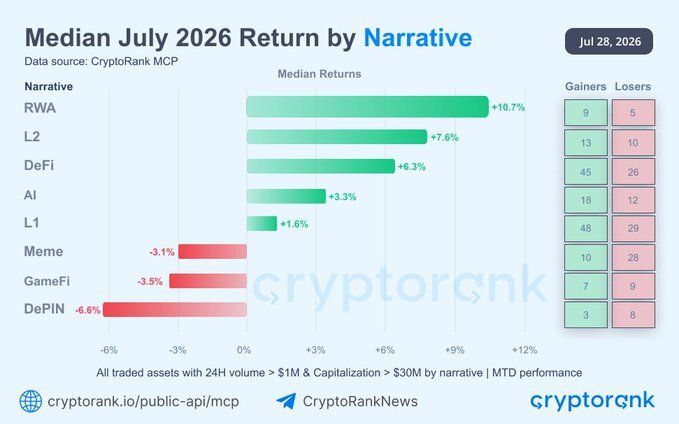
Real World Asset (RWA) tokens posted a median return of +10.7% in July 2026. That marked the best result among major crypto narratives, according to CryptoRank data.
Layer-2 (L2) networks and Decentralized Finance (DeFi) protocols also advanced, gaining 7.6% and 6.3% respectively. Meanwhile, Meme coins, GameFi tokens, and Decentralized Physical Infrastructure Networks (DePIN) closed July in the red.
RWA Extends Its Lead Over Rival Narratives
Artificial Intelligence (AI) tokens and Layer-1 (L1) networks also finished July in positive territory, but both trailed RWA by a wide margin. The spread between the month’s best and worst performers pointed to a market splitting cleanly between a handful of favored narratives and the rest.
L1 stood out for a different reason. The narrative posted the broadest rally of the month, with far more winners than losers among the tokens CryptoRank tracked, at 48 gainers against 29 losers. DeFi showed a similarly broad advance, with gains spread across most of its tracked tokens.
RWA’s rise rested on a narrower base by comparison. Its own tally showed just 9 gainers against 5 losers, a tighter ratio than L1’s or DeFi’s. That points to a rally leaning on a smaller group of standout tokens rather than a market-wide move. GameFi’s breadth landed close to even, splitting almost evenly between winners and losers.
The rally extends a shift already visible elsewhere in the market. RWA has become the top Web3 founder sector this year.
Furthermore, recent data shows on-chain markets rotating toward tokenized products at the expense of older narratives. L2 tokens, by contrast, still count among the top layer-2 projects investors watch, even after a rougher spring for the sector.

Tokenization Milestone Meets a Split Market
Total RWA on-chain capitalization reached $32.2 billion on July 24, according to CryptoRank. That figure stood 12.3% above the start of the month, and it also topped the previous high set in April.
The milestone arrives even as half the wider tokenization market shows little trading activity. That is a separate, broader measure than RWA’s own on-chain total, and it found 910 tokenized assets, together worth $32.9 billion, with no weekly transfers at all.
This gap between headline growth and actual usage has drawn analyst scrutiny for months. A rising capitalization figure does not by itself confirm broader adoption, since inactive holdings can inflate the headline number.
Therefore, RWA’s July strength looks more selective than uniform across the sector. Meme coins fell 3.1%, GameFi dropped 3.5% and DePIN lost 6.6%, the month’s three weakest narratives.
Meme also had the widest split between winners and losers of any narrative. It logged 28 losers against just 10 gainers, a pattern that echoed June’s broad pullback across most sectors.
Whether RWA can sustain its lead now depends largely on trading volume catching up with the sector’s rising capitalization. In contrast, L2 and DeFi, July’s next-best performers, still need to prove their gains can hold. Traders will likely watch both narratives closely in August for signs of a broader rotation beyond RWA alone.
The post RWA Tokens Post July 2026’s Strongest Crypto Narrative Return appeared first on BeInCrypto.
TikTok roasts Airbnb hosts over ‘obnoxious’ inspection videos

LGI: A Good Fund, But The Price Is Questionable

Shared Sequencers and Their Impact on DeFi

Renter of Home in Anne Heche Crash Denies Settlement With Son

No Jackpot Winner as $257 Million Prize Rolls Over to $269 Million Monday Draw

Weekend Open Thread: Staud – Corporette.com

Ronaldo Club Is in Financial Trouble?Al-Nassr’s Financial Crisis ExplainedThe Truth $1 BILLION DEBT

He staged a series of car accidents for financial gain.#edit#viral#groe#fyp#foryou#shorts#drama#usa

This Story Will Change the Way You Think About Money #youtubeshorts #shorts
-

 Fashion4 days ago
Weekend Open Thread: Brooks Brothers
-

 NewsBeat7 days ago
How a former Blue Peter presenter stunned America’s Got Talent judges
-
 Business7 days ago
New Jersey voter registration controversy explained: How 6,600 noncitizens got on the rolls, and what happens next
-

 Tech2 days ago
Intel is reversing course and bringing hyper-threading back to its server chips
-
 Entertainment7 days ago
Johnny Depp’s R-Rated Gothic Cult Classic Gets New Release Ahead of Sydney Sweeney Remake
-

 Crypto World6 days ago
Ethics, other provisions in crypto Clarity Act to be further discussed
-

 Politics1 day ago
Luke Littler dismantles Gerwyn Price to retain title in Blackpool
-
 Sports2 days ago
Commonwealth Games boxing: Jadumani Singh seals dominant 5-0 win over Pakistan’s Sumama Rehman to enter quarter-finals | Commonwealth Games News
-

 Sports5 days ago
2026 3M Open leaderboard: Scottie Scheffler finds putter in Round 1, sits three back
-

 Fashion5 days ago
16 Dresses for the High Summer Event
-

 Politics8 hours ago
The Part of the Electric Transition Nobody Wants to Discuss
-

 News Videos5 days ago
The Peugeot Family: How 200 Years of an “Old Money” Dynasty Died in A Boardroom
-

 Politics2 days ago
Spain sweeps the board at 2026 World Cup with individual awards
-
 Entertainment4 days ago
A New Post-Apocalyptic Gundam Anime Series Blasts Into SDCC
-

 News Videos2 days ago
BITCOIN JUST ENTERED THIS CRITICAL ZONE…
-

 Crypto World2 days ago
XRP Ledger adds $2.6B as RWA inflows rank second
-

 Crypto World3 days ago
Ripple bought a bank in pieces. The $4 billion audit
-

 Crypto World5 days ago
Uniswap (UNI) pushes deeper into tokenized RWAs with permissioned trading pools
-

 Tech4 days ago
Anthropic launches Claude Opus 5, a cheaper AI model for coding, agents and enterprise workflows
-

 Entertainment3 days ago
Sara Gilson Killed By Husband After Viral “Pedophile” TikTok Video
You must be logged in to post a comment Login