

Tech
What Makes Them So Different From Regular Headphones?


Why can’t I just wear my AirPods in the pool?

With so many headphones on the market, most of which claim some kind of unique features, it could be easy to dismiss ones marketed as “swimming headphones” as just another gimmick. However, there are actually important distinctions that set this type of headphones apart from other devices, both in how they access your music and transmit it to your ears. In essence, it all comes down to how the physics of water impact audio.
Some of the differences between swimming headphones and regular ones are obvious — it’s a given that they come with more waterproofing than a typical pair, for example. Other distinctions, like sound conduction and Bluetooth signals are less overt. Let’s dive into what makes underwater headphones special, and what you should look for when picking out a pair.
What makes swimming headphones different?
Ironically, a music-loving swimmer’s biggest enemy when it comes to listening to tunes is the water itself. For one, Bluetooth signals can’t transmit through the water, meaning that as soon as you dive under any connection to your phone is severed. Though they often also come with a Bluetooth mode, swimming headphones set themselves apart by coming with built-in storage, which is somewhat of a rarity for regular headphones.
Water also means that typical headphones, which conduct sound through vibrations in the air, can’t be heard nearly as well. Swimming headphones almost exclusively utilize bone conduction, which transmits via vibrations directly into your head. To do this, the headphones rest on your cheekbones instead of inside the ear canal, bypassing the eardrum and going straight to the cochlea in the inner ear. Though there are some swimming headphones outliers that don’t utilize bone conduction, a vast majority of them do.
What to look for in swimming headphones

It’s important to make sure your swimming headphones boast a robust enough IP rating — short for Ingress Protection — to stay protected in the water. These can be a bit confusing, as some manufacturers list two numbers while others list just one (e.g., IP56 versus IPX7). When shopping, you mostly need to pay attention to the second number in the rating, which reflects how well they’re equipped to handle water (the first number refers to dust, which isn’t as relevant; a rating with a X generally means manufacturers only tested for water resistance). Ratings of 6 and below can only handle things like sweat and rain, while IPX7 and IPX8 can handle different levels of actual submersion.
For audiophiles, the bone conduction itself as well as auxiliary features like adjustable EQs are also important to look at. As manufacturer Shockz points out, the water sealing your ear naturally causes an occlusion effect, amplifying lower frequency sounds in a way that can be overpowering, and headphones resting on your cheekbones instead of in your ears means outside noise is much more of an issue. To combat this, some swimming headphones offer special swimming EQs that naturally amplify harder-to-hear tones and help block other sounds.
Bone conduction’s reliance on vibration can also be the downfall of some swimming headphones, especially at higher volumes, which can mean intense amounts of buzzing. Different brands boast various strategies to combat this: some swimming headphones allow listeners to manually adjust the transducers, others claim to have transducers at angles optimized for buzz reduction. It’s definitely something that’s worth looking into when shopping around, especially if you like to blast your music. With the right research, you can enjoy the most tech-savvy swim of your life — maybe next you can pick up a pair of smart goggles.


Rideshare micromobility vehicles are a common sight in major cities around the world, whether that’s a bicycle program or electric scooters. Now, a company called Veo is introducing electric tricycles into the mix.
Announced Tuesday at an event in Denver, the company showed off the Rover, a three-wheeled, sit-down electric vehicle designed for anyone to ride on the streets. They are available in Denver for now, but Veo plans to expand the vehicle to cities across the US.
The Rover works like a shared bike or e-scooter. Sign up for the Veo app, pay a fee to unlock the trike, and then ride it around. It’s 2.5 feet wide, which means it can legally fit within bike lanes that are usually three feet wide. The trike has a max speed of 10 miles per hour. Cities tend to cap these kinds of rental bikes and scooters at 15 mph, but Veo chose to go with a slower speed for safety reasons. The Rover uses the same batteries as Veo’s other EV offerings, giving it a range of roughly 45 miles per charge; on the rear is a cargo basket that can hold up to 100 pounds of luggage or groceries.
Veo is a smaller player in the micromobility space, operating in about 60 smaller cities in the US. In May, the city of Denver signed an exclusive contract with Veo to replace the city’s scooters and ebikes made by rival companies Lime and Bird. Now the sole supplier of shared bikes and scooters in Denver, Veo wanted to use the city to show off the newest addition to its micromobility collection.

Courtesy of Veo
The Rover is primarily an accessibility play, as three-wheeled vehicles tend to stand on their own and self-balance better than two-wheeled bikes and scooters. City governments sometimes require micromobility companies to provide options for people who need more accessible vehicles. Lime has deployed a free accessible vehicle rental program called Lime Assist that lets users in need rent accessible vehicles for the day. Bird launched its own accessible rentals program in April. Veo offers similar options but wants to make those kinds of vehicles more widely available.
“The expectation is that your local bus or transit provider will offer accessible options for those who are in wheelchairs or can’t use certain products,” Alexander Keating, Veo’s vice president of policy and partnerships, tells WIRED. “There’s also an expectation for us, from the cities who permit our kinds of programs, to do everything they can to make them accessible.”
Veo says it worked with disability advocates, including the Disability Mobility Initiative, Parkinson’s Foundation, and Capitol Hill Village, to design the Rover, along with organizations like the AARP to make something that would appeal to older users, too. The trike’s three-wheeled design means it is self-balancing, so people can hop on without dealing with it falling over or fiddling with a kickstand.

You can now get the Ninja Luxe Premier espresso, cold brew, and filter machine and save £133.99 off its usual £549.99 price tag.
That works out to a 24% discount, dropping the machine to £416, and the listing’s countdown clock is currently ticking down from just over fourteen hours before that price disappears and reverts to full for good.
This Ninja 3-in-1 espresso and cold brew machine deal ends today — here’s how much you can save
This Ninja 3-in-1 espresso and cold brew machine deal ends today, so here’s exactly how much you can save before it disappears for good.
What makes that saving count for more is that the Luxe Premier replaces three separate machines, brewing espresso, cold brew and filter coffee from the same unit alongside a built-in burr grinder, milk frother and portafilter.
That frother does more of the work than most kitchen gadgets manage, since its automated wand steams and whisks dairy or plant-based milk into micro foam at the same time, with four presets covering steamed, thin, thick and cold froth.
Getting the grind right no longer means guesswork either, with 25 individual grind settings and a built-in scale that lets you weigh beans directly on the machine before an intuitive control panel walks you through the rest.
None of that requires buying extra kit afterwards, since the Luxe Premier arrives with a double basket, single basket and dedicated luxe basket, plus a funnel, assisted tamper, cleaning kit and even a water hardness test.

There’s a recipe guide included too, aimed squarely at anyone who wants to move beyond instant coffee without having to learn proper barista technique entirely from scratch through repeated trial and error on their own at home.
Build quality holds up its end of the bargain as well, with a metal and stainless steel body, dishwasher-safe removable parts, and a two-year guarantee once you register the machine directly with Ninja.
If that reputation has you weighing up whether it’s worth it, £416 down from the usual £549.99 makes a strong case, especially next to the picks in our Best Coffee Machine 2026 guide, before the countdown clock runs out for good.
SQUIRREL_PLAYLIST_10148964


Australian Prime Minister Anthony Albanese’s proposed national environmental and energy controls for the country’s A$150 billion data centre pipeline hit their first obstacle on Tuesday, when two jurisdictions declined to back them. Federal, state and territory energy ministers met virtually to discuss the plan, and Queensland and the Northern Territory opposed most of the measures, including the idea of a national rulebook at all.
The structural problem is that the policy requires unanimity. Every state and territory must support the federal framework for it to proceed, which gives any single jurisdiction an effective veto.
What the rules would require
New data centres would have to add at least as much electricity generation to the grid as they consume, a requirement Albanese set out in a policy speech earlier in July. He described bringing these issues into a single national framework as a global first.
Operators would also be expected to build renewable generation, minimise water use, maximise energy efficiency, and fund any additional water infrastructure they need. Albanese offered few details on how any of it would work in practice.
Why Queensland objects
Queensland Premier David Crisafulli had signalled his position before the announcement, saying the state does not support imposing renewable power requirements because it wants to stay attractive to investors. That is precisely the behaviour the national framework was designed to prevent.
“The policy the PM has announced doesn’t work unless there’s buy-in from all the states and territories,” said Rob Nicholls, a senior researcher at the University of Sydney’s Centre for AI, Trust and Governance. “Part of the reason you have a policy is to avoid a race to the bottom from the states.”
The industry is broadly onside, with conditions
Belinda Dennett, chief executive of industry group Data Centres Australia, whose members include Google, AirTrunk, and Microsoft, said the group supports the principle that new electricity demand should be backed by new supply. Many operators and customers already underwrite renewable energy, she noted.
The industry wants clarity on three points. Whether the compliance obligation sits with the operator or the tenant, when it takes effect, and whether the offset is measured against actual electricity consumption or nameplate capacity.
That third question is not a technicality. Nameplate capacity is typically far higher than real-world draw, so the answer could change the size of the obligation by a wide margin.
The public is well ahead of the politics
A YouGov survey commissioned by Australia’s Climate Council found 82% of respondents agreed that new data centres should pay for the extra renewable energy and storage infrastructure needed to meet their power demand. The measure is not short of popular support.
The economics also cut both ways. Data centre investment could reach A$150 billion by 2030 with six gigawatts of planned capacity, according to Commonwealth Bank associate economist Lucinda Jerogin, and the construction boom is helping prop up a slowing economy.
Why Australia is a target market
Australia was second only to the United States in dollars invested in data centres in 2024, according to Knight Frank. Bloomberg Intelligence analysts led by Matt Ingram flagged the country in June as one of Asia’s top build locations, citing renewable potential, political stability, and low-latency submarine cables to the rest of the region.
Demand is coming from hyperscalers including Microsoft and Meta, alongside opposition from community and environmental groups. Both pressures are intensifying at once.
Everyone is grappling with the same problem
Australia is not alone in trying to attach conditions to compute. Brussels has told Big Tech to align AI data centres with climate goals or stay away, insisting operators support clean power and recycle waste heat.
Where regulators hesitate, grids are imposing their own limits. Denmark paused all new grid connection agreements after a 60-gigawatt queue overwhelmed the cleanest power system in Europe, a physical constraint no policy framework can negotiate away.
Ambitious clean-power targets have proved hard to hit. China wants renewables to supply roughly four-fifths of its AI data centre power by 2030, up from about 11% in 2023, a target its own grid is struggling to accommodate.
The default alternative is worse. The AI buildout has triggered the largest construction boom in gas-fired power plants on record, which is the outcome Australia’s additionality rule is designed to avoid.
What happens next
The federal government will work with states, territories, and market bodies on detailed policy design, with the possibility of more stringent local requirements layered on top. Energy ministers meet again in September.
National Cabinet is expected to consider the approach in August, with legislation anticipated in early 2027. Whether it arrives intact depends on whether Queensland and the Northern Territory can be persuaded that a national floor beats competing on who asks the least.


Samsung’s midrange lineup has long delivered solid phones that handle daily tasks without forcing people into flagship prices. The Galaxy A57 5G (2026), priced at $425 (was $550), continues that approach while shrinking the body and sharpening a few key details that make the phone feel more refined in the hand.
This device measures 161.5 by 76.8 by 6.9 mm and weighs 179 grams, making it surprisingly lightweight and easy to fit into a pocket, even for those who have spent years carrying larger screens. Gorilla Glass Victus+ protects the front and rear of the phone, and the metal frame adds to its robustness. With an IP68 classification, you may be a little casual with it, since it will shrug off dust and even get wet for a while without complaining.
Sale

Samsung Galaxy A57 5G (2026), Unlocked Android Smartphone, 128GB, AMOLED Display, Triple Camera, IP…
- ELEVATED DESIGN. EVERYDAY EASE: Galaxy A57 5G features the best of A Series design that’s lighter, slimmer¹ and made to fit with your outfit
- A VIVID VIEWING EXPERIENCE: Dive deeper into your content with the Super AMOLED Plus display² on Galaxy A57 5G that features slimmer bezels for a…
- SNAP IT. LOVE IT. SHARE IT: The triple-lens camera on Galaxy A57 5G lets you capture everything from low-light videos with Nightography Video to…
A 6.7-inch Super AMOLED Plus screen dominates the front. It has a 1080 by 2340 pixel resolution and a refresh rate of 120 Hz, so everything on the screen feels silky smooth. You can increase the brightness to 1900 nits, which is ideal for keeping the screen visible even while you’re outside, and it also supports HDR10+, so you can watch all that rich color content you’ve grown accustomed to on larger monitors and TVs.
This phone is powered by the Exynos 1680 chip, which is manufactured on a 4-nanometer technology, which means it’s a high-performance chip that should keep it running smoothly. The octa-core configuration includes a 2.9 GHz core that serves as the operation’s brain, as well as a slew of other cores that help with day-to-day programs and light multitasking without slowing down. You can get this phone with 8 GB RAM and 128 GB of storage. It ships with Android 16 and One UI 8.5, and Samsung promises to keep it up to date with six major OS upgrades and frequent security fixes, making it about as good as it gets at this pricing point.

So that’s the camera system, which is the standard triple-camera configuration we’ve come to expect these days on flagships. This time around, you’ll receive a 50-megapixel main sensor with optical image stabilisation, as well as a 12-megapixel ultrawide and a 5-megapixel macro camera. The front camera features a 12-megapixel sensor. Daytime images from the main camera are crisp and clear, and when it goes dark, the processing does an excellent job of minimizing noise while maintaining vibrant colors. You can even capture 4K video on both the front and rear cameras. The camera app also has functions like Best Face, Object Eraser, and Instant Slow-Mo.

The 5000 mAh battery will power this device for a full day of normal use, with some users getting a second day if they reduce their usage to a minimum. When it runs low, you simply plug it into a 45-watt charger and it will be ready to go in approximately 30 minutes. A pair of good stereo speakers provide audio, and connection includes all of the usual modern features, such as 5G, Wi-Fi 6E, Bluetooth 6.0, and more.

from the ‘these-are-not-serious-people’ dept
Last year the Trump administration announced it would ban Chinese-made drones from the U.S. As I noted at the time, the plan had several problems, not least of which being the Trump administration is a racist, corrupt, dysfunctional mess filled with weirdos and lazy incompetents, primarily interested in assorted personal investment grifts and protecting less popular U.S. companies from having to compete.
Many of the banned drones from companies like DJI are better, cheaper, and more popular among consumers, resulting in a 70 percent market share. Given Trump’s sons are personally invested in drone manufacturing, this has less to do with national security and privacy than it does grift.
The Trump administration has made numerous claims of security risks related to products by companies like DJI, but offered absolutely no hard evidence at any point supporting the claims. We’ve repeatedly seen similar factually challenged policy rhetoric surrounding electric cars, AI, and telecom more broadly (remember how we had to do everything AT&T wanted or risk losing the “race to 5G?”).
As expected, the Trump admin’s plan to ban popular overseas drones isn’t going that well. Consumers are incredibly annoyed that they’ve been cut off from the best and cheapest products on the market. And numerous companies have just changed the labels on Chinese drones and cameras to sneak by the ban in a U.S. market absolutely swimming in Chinese tech imports of all kinds.
It’s created a complicated game of whac-a-mole at the FCC, who first tried to fine offenders, and is now eyeing a broader retroactive ban of these companies as well:
“Two Fridays ago, the FCC had already proposed a $25,000 fine on eight of those “front companies,” including the ones behind the Skyrover drones and Xtra cameras. But now, the FCC is proposing a lot more than a slap on the wrist — it’s planning to ban those same companies from continuing to import, distribute, market, and sell their existing drones and cameras.”
While folks like FCC boss Brendan Carr are saying they’re doing this to protect U.S. consumer privacy and national security (something often parroted by lazy press outlets), none of these folks have any credibility on these subjects, and have actively, repeatedly, made both issues indisputably worse.
The U.S. is too corrupt to pass a meaningful privacy law, which threatens both privacy and national security. I’d also argue that Trump administration corruption is every bit as bad, if not worse, than anything China could do to us at this point. And you’ve seen for yourself how most of the Trump administration’s cybersecurity policies are indistinguishable from a foreign attack.
There’s the added irony that the Trump admin likes to dismantle governance and lobotomize regulators, then try to impose massive new policy plans that require competent governance and regulatory oversight. The press generally adds to the dysfunction by lending the administration policy credibility it didn’t earn in policy areas it clearly doesn’t understand.
In this case, DJI urged lawmakers to conduct audits of its devices for years, and was ignored. The normal comment period for public input was ignored. Folks in the aerospace industry say they were neither consulted, nor given any advance notice of the quick ban. Drone and RC hobbyist organizations are annoyed and dismayed, and state the ban was shadow dropped last Christmas to lessen scrutiny.
I think there’s something to be said for allowing Chinese competitors (in EVs, drones, AI, and everything else) into the country, but also properly funding and staffing your regulators to police labor, competition, NatSec (when they actually arise), and consumer rights abuses.
Greedy zealots in corporate America and the Trump administration don’t want to do that, because it would result in competition and accountability, eroding precious quarterly returns.
So instead you get this sort of incoherent and xenophobic game of whac-a-mole, run by bad faith weirdos like Brendan Carr. Fully supported by many U.S. corporations — whose execs will talk your ear off over cocktails about their love of free market competition and competitive entrepreneurial innovation — right up until better overseas tech arrives and they’re forced to actually try.
Expect more and more of this dumb, xenophobic, pointless protectionist bullshit, especially in AI as the biggest U.S. tech companies, slowly drowning in debt and enshittification, begin to struggle with cheaper and better overseas alternatives in a country now waging open war on science and sound policy.
Filed Under: ban, brendan carr, china, drone ban, drones, fcc, incompetent, protectionism, xenophobia
Companies: dji

Copenhagen Loudspeaker Company is now shipping the CLC65 loudspeakers for €9,490 per pair, with the company’s U.S. storefront currently listing them at $10,853 per pair. Worldwide shipping, duties and taxes are included, along with a 30 day home trial. That is not inexpensive, but at least the price should not develop several mysterious growths while crossing the Atlantic.
The CLC65 made its U.S. debut at AXPONA 2026, where pricing had not yet been announced. The Danish company describes it as the first commercially available three way loudspeaker built exclusively with Purifi drivers. Plenty of manufacturers use Purifi woofers, but CLC has handed the tweeter, midrange, woofer and both passive radiators to the same Danish driver specialist.
Purifi Everywhere
The front baffle contains a 33mm Purifi PTT1.3 tweeter mounted within a substantial 147mm waveguide, a 6.5-inch PTT6.5M midrange driver and a 10-inch PTT10.0X long stroke woofer.
Around the back are two more 10-inch Purifi PTT10.0PR passive radiators. Those replace a conventional bass reflex port and are intended to extend low frequency output without introducing port noise. CLC rates the system from 28Hz to 20kHz, which would give the CLC65 genuine full range aspirations in most rooms.
The crossover is fundamentally a second order design with transition points at 250Hz and 2kHz. CLC uses air core inductors, ClarityCap ESA capacitors, copper foil bypass capacitors and a Jantzen C core inductor in the bass section. WBT Nextgen copper binding posts support banana plugs, spades, bare cable, biwiring and biamping.
That collection of components will appeal to listeners who spend their evenings studying crossover photographs. The rest of us are more interested in whether the drivers behave like one loudspeaker rather than five highly accomplished engineers talking over one another.

This Is Not a Bookshelf Speaker
The CLC65 measures 28.3 inches tall, 13 inches wide and 16 inches deep, with each cabinet weighing 88 pounds. Calling it a bookshelf loudspeaker would be technically convenient and structurally reckless.
Dedicated CLC65 stands cost €990 per pair, while the curved magnetic grilles add another €290. Without the grilles, the large exposed drivers give the speaker a distinctly retro studio monitor appearance. Add them and the design becomes more domestically acceptable, assuming nobody notices the pair of 88 pound Danish refrigerators sitting beside the equipment rack.
Satin black and satin white versions are available. The satin walnut finish is currently sold out, with additional inventory expected in December and a €500 preorder discount being offered for that version.
Your Amplifier Needs Some Muscle
Sensitivity is rated at 86dB, with a nominal impedance of 4 ohms and a minimum of 3 ohms. CLC recommends at least 100 watts of amplification.
That does not automatically rule out every tube amplifier, but this is clearly a loudspeaker designed for an amplifier with meaningful current delivery and control. A lightweight 25 watt integrated amplifier purchased because the faceplate looked charming on Instagram is probably not getting invited to this particular smørrebrød party.
The large woofer and two passive radiators also suggest that room placement will require some experimentation. CLC says the passive radiator design reduces sensitivity to placement compared with a traditional port, but two rear firing 10 inch surfaces still need room to interact with the wall behind them. Physics may not write marketing copy, but it remains annoyingly involved in the final result.
Key Specifications
- Design: 3-way passive stand-mount loudspeaker
- Tweeter: 33mm Purifi PTT1.3 with 147mm waveguide
- Midrange: 6.5-inch Purifi PTT6.5M
- Woofer: 10-inch Purifi PTT10.0X
- Passive Radiators: Two rear firing 10-inch Purifi PTT10.0PR
- Frequency Response: 28Hz to 20kHz
- Crossover Points: 250Hz and 2kHz
- Sensitivity: 86dB
- Nominal Impedance: 4 ohms (minimum 3 ohms)
- Recommended Amplifier Power: 100 watts or more
- Dimensions: 28.3 x 13 x 16 inches
- Weight: 88 lbs each
Who Is It For?
The CLC65 is aimed at listeners who want the low distortion and controlled behavior associated with Purifi technology but do not want another compact two-way monitor that requires subwoofer assistance.
Its closest conceptual rivals include the MoFi Sourcepoint 10, JBL L100 Classic MKII and considerably more expensive TAD CE1TX. All approach the large standmount category differently, but each attempts to deliver floorstanding scale without committing to a conventional tower cabinet.
Direct worldwide sales may also appeal to buyers who are comfortable auditioning at home. The included 30 day trial matters at this price, although returning 176 pounds of loudspeakers will provide a memorable test of both the policy and your relationship with the delivery driver.
Who Should Avoid It?
Anyone with a small room, limited amplifier power or furniture that already trembles when someone places a coffee mug on it should look elsewhere.
The CLC65 also makes less sense for listeners who prefer a forgiving, overtly warm loudspeaker. Purifi drivers have built their reputation around low distortion, linearity and revealing behavior. That does not guarantee a cold presentation, but poorly recorded albums are unlikely to receive a complimentary spa treatment.

The Bottom Line
Copenhagen Loudspeaker Company is entering a crowded premium category with a product that is genuinely different.
The CLC65 does not merely use a Purifi woofer as a line on the specification sheet. It builds the entire loudspeaker around Purifi technology, adds two enormous passive radiators and packages everything inside a cabinet that weighs more than many floorstanders.
At €9,490 or approximately $10,853 per pair, the CLC65 faces accomplished competition. But five Purifi drivers per cabinet, worldwide delivered pricing and a 30-day home trial give this new Danish heavyweight a legitimate reason to exist.
Just do not call it a bookshelf speaker unless your shelves were designed by the people who built the Øresund Bridge.
For more information: gato-audio.com
Related Reading


New research puts a hard number on something a lot of IT leaders already suspected. Most AI pilots never make it into production, and the spend behind them isn’t disappearing, it’s just sitting in limbo. Jon Bitz, chief relationship officer and co-founder at KloudStax, says that limbo isn’t the failure it looks like from the outside.
The numbers keep landing in the same neighborhood no matter who’s counting. Forrester’s latest research on agentic AI found that three-quarters of enterprise leaders say they’re adopting it, but only a small minority have it running in anything beyond limited pilots. Gartner predicts that through 2026, organizations will abandon 60 percent of AI projects that aren’t backed by AI-ready data and integration infrastructure. And Deloitte’s own enterprise survey found that more than a third of companies are still using AI at a surface level, with little real change to how they actually work day to day.
Put those together and a pattern starts to form. Enterprises are approving AI budgets faster than they’re converting that spend into anything resembling a repeatable, working system, and the gap between the two has become one of the more uncomfortable open questions in enterprise cloud right now.
The spend isn’t wasted, it’s parked
Jon Bitz, who spends most of his time inside these budget conversations as a Google Cloud partner, doesn’t think the story is as bleak as the abandonment numbers make it sound.
“A meaningful portion of AI cloud spend is still happening in pre-production, and that’s not a bad thing,” Bitz said. “Testing, experimentation, and validation are all critical parts of adopting AI correctly. You need that phase to understand what works and what doesn’t.”
Where he does see a real problem is how long that phase tends to drag on without anyone stepping in to move it along. “In some cases, a large amount of what’s being funded hasn’t made its way into a stable, repeatable production workflow yet,” he said.
His read on the fix isn’t to cut the experimentation budget, which is the instinct a lot of finance teams reach for once the pilot numbers get uncomfortable. It’s to get more deliberate about converting what the experimentation phase actually teaches an organization into something that ships. “Our goal isn’t necessarily to reduce experimentation, it’s to convert it,” Bitz said. “To take what’s being learned and turn it into production systems, so spend shifts from testing into workloads that are actually driving value inside the business.”
Where the money actually goes to work
Ask Bitz where cloud spend is already paying off and he points somewhere less flashy than most of the AI headlines from the last year. Not new model releases, not bigger context windows, just the unglamorous stuff that was already running a company before generative AI showed up.
“Real value is showing up in core workflow automation, taking manual, time-intensive processes and turning them into production-ready systems,” he said, pointing to support operations, engineering output, and AI embedded directly into revenue-generating workflows as the places where it’s landing.
The misallocation, in his experience, tends to follow a familiar script. Teams chase a better model or spin up more GPUs because that part is easy, while the harder work of structuring data and defining workflows gets skipped. “If the data isn’t structured and workflows aren’t clearly defined, it becomes very difficult to move anything into production,” Bitz said.
Hyperscaler bills are getting more scrutiny, not less trust
There’s also been a louder conversation lately about whether enterprises are starting to push back on hyperscaler pricing itself, especially as AI workloads make monthly bills harder to predict. Flexera’s 2026 State of the Cloud data backs that up from the finance side, with cost unpredictability tied to dynamic AI workloads showing up as one of the top hurdles enterprises report, and nearly half of large organizations now running a dedicated AI governance function to keep it in check. Bitz says that’s not quite adding up to pushback on the platforms themselves in what he’s hearing in practice.
“We’re starting to see more scrutiny, but not so much pushback on the hyperscalers themselves or the value of the solutions and platforms,” he said. “It’s more about how spend is structured and managed.” The questions companies are actually asking tend to be narrower than a referendum on cloud pricing: what’s actually driving the bill, what’s tied to production versus pilots and proofs of concept, and where there’s room to optimize.
That scrutiny is nudging companies toward more opinionated architecture choices, serverless and managed services and workloads sized to what they actually need, along with tighter governance over who can spin up what. Partners are picking up more of that optimization work too. “It’s less about challenging the price and more about asking how to use these platforms correctly,” Bitz said. “When the architecture, data, and usage patterns are right, the economics tend to follow.”
Inefficiency has a paper trail, and it rarely starts with compute
It’s tempting to treat runaway AI cloud bills as a compute problem, since that’s the line item everyone can see. Bitz says that’s almost never where the real story is.
“Compute is an easy thing to point to, but in most cases, inefficient spend is really a reflection of gaps in data, architecture, governance, and undefined workflows,” he said. Throwing a bigger model or more GPUs at a system that was never designed to support AI in the first place doesn’t fix the underlying mess, it just makes the same inconsistency more expensive to run. As Bitz put it, AI isn’t creating new problems inside an organization so much as it’s amplifying the ones that were already there.
The gap between big budgets and small ones isn’t really about budget
There’s a separate worry running through a lot of mid-market conversations right now, which is that cloud pricing and infrastructure complexity are quietly widening the gap between companies that can afford to experiment with AI and companies that can’t. Bitz thinks the gap is real but that people are pointing at the wrong cause.
“Complexity plays a bigger role than just a budget gap between SMB, mid-market, and enterprise, although the barrier to entry is real,” he said. Larger organizations have room to absorb a few expensive misses along the way. Smaller ones don’t get that same margin for error, so they end up needing to be more precise from the start rather than less ambitious. “The companies we see winning with AI aren’t necessarily the ones spending the most, they’re the ones implementing the cleanest systems around well-defined use cases,” Bitz said.
What happens over the next year and a half
Bitz doesn’t expect AI spend to slow down, but he does think the conversation inside enterprises is already shifting toward accountability rather than raw scale. He’s watching for organizations moving proof-of-concept work onto real production-level KPIs, more attention paid to unit economics like cost per output or per workflow, engineering teams getting measured on the AI-driven output they produce rather than how much of the tooling they’ve adopted, and more C-level visibility into what AI spend is actually buying.
“AI adoption is still early for a lot of organizations, and as teams get more comfortable, the focus naturally shifts from ‘are we using AI?’ to ‘is this actually working and driving value?‘” Bitz said. Over the next 12 to 18 months, he expects that shift to keep building, with spend continuing to grow but under a lot more pressure to show its work.


A full-size humanoid from the Chinese firm PNDbotics recently appeared in a tech demonstration holding a bow, drawing the string, and releasing an arrow. The moment lands as more than a stunt. It shows how far the company’s Adam platform has come in coordinating dozens of joints, sensing force, and keeping its balance while performing a precise, two-handed action that once belonged only to people.
Adam is a slender 1.67 meters tall and weighs between 60 and 63 kilograms, however this can fluctuate depending on what’s on board. When you factor in the typical human height, you get a number that is light enough for indoor use while remaining hefty enough to stay place when its center of mass fluctuates, which it does frequently. The higher-spec models include 41 to 43 degrees of freedom. Again, the legs have six joints to play with, each built around a really clever biomimetic hip joint that allows the pelvis to tilt and rotate in ways that earlier versions of this type of thing could only dream of matching, and to make things even more interesting, it’s all powered by quasi-direct-drive actuators that deliver a healthy 340 to 360 newton-meters of torque at the hips and knees. These are positioned close to the joints to keep the weight down, resulting in a very soft and compliant feel when Adam brushes up against something or someone.

Unitree R1 Humanoid Robot (White, R1)
- Three models, one lightweight platform R1 Air (20 DOF, monocular camera), R1 (26 DOF, binocular camera, head+waist joints), and R1 Edu (26 DOF…
- Easy setup – no coding required for basic use Unbox, power on, and start. Manual teaching feature: physically pose the robot, and it replays the…
- More DOF = more expressive movement 26‑DOF models (R1 / R1 Edu) add head and waist articulation for smoother dance and running. For safety reasons…
The same hardware is used for the upper body, as the higher-spec models’ arms are a true showstopper, with thirteen degrees of flexibility each and finishing in some seriously spectacular multi-fingered hands that can close around a bow handle, nock an arrow, and manage the draw with ease. The actuators have force sensing built in, allowing the robot to detect resistance and modify its grip without smashing the equipment or losing the string. All of this is powered by a battery pack with a capacity of 1,170 to 1,190 watt-hours, which provides Adam with enough energy to run for a couple of hours of active work – enough for a number of practice sessions or brief demos.
The control software is where everything comes together. PNDbotics has adopted deep reinforcement learning, first training in simulation and then transferring the skills to a real-world robot. Then they added additional imitation learning using human motion capture data to fill in any gaps, allowing Adam to learn for himself how individuals shift their weight, rotate their torsos, and stabilize their arms throughout a variety of complex maneuvers. There are also whole-body control algorithms that keep the feet anchored and the posture upright even when the arms are extended and the string is tugging strongly. The end result resembles a developed skill rather than a pre-programmed routine.
Adam has already been put through its paces in public and has handled a wide range of demands. It climbed up a one-meter-high box by gripping the edge with both hands, hauling itself up, and swinging a leg over, all while maintaining its balance. It walked stairs in unstructured circumstances during the 2026 World Artificial Intelligence Conference, marking one of the platform’s first public appearances. It has even played a keytar on stage at a music festival, danced the Charleston, and completed a variety of other impressive-looking tasks, including some very sophisticated motion-capture routines that map the actions of a human operator onto the robot in real time. The bow-and-arrow sequence is the same thing: a full-body task that requires strength, timing, and precise motor control in a variety of hard ways.

I’m a high school student in Paramus, New Jersey. I’m also the creator of a free economics program that I teach to middle school students. With each virtual session I lead, I share a link in the chat with my students, and they load the simulation I created — one that puts them in positions like CEO of a sports team or commissioner of a league.
In one simulation, every student runs a team’s payroll and decides whether keeping their star player is worth exceeding their salary cap and crossing into “luxury tax” territory. Nobody tells them about the consequences of going into the luxury tax; they learned the way real general managers do, by paying the additional fee and experiencing the negative impact it can have on a team.
I created the program because I am a huge sports fan and I wanted to share my passion with other kids. I also knew that a lot of kids love professional team sports and almost none of them love economics, even though the two are often linked. A team salary cap is a budget constraint. A trade deadline is linked to supply and demand. A rookie contract is a bet on future value.
Simulations Unveil Concepts
So far, I’ve led two six-week online classes for about 30 middle school students. Each class combines slide lessons explaining economic concepts, open discussions, and simulations I built with artificial intelligence.
My students played a luxury tax game where they managed a roster under real salary cap pressure. They played an NFL draft game where they weighed risk against reward with every draft pick. There were trade negotiations, ticket-pricing challenges, and roster-building hurdles with no clear “right” answers. Hiding inside each simulation were economic concepts that teachers have spent decades trying to get students to care about, like incentives, opportunity cost, scarcity, risk and market value.
I expected the sports fans in my classes to dominate the conversations. In reality, the student who knew every sports statistic wasn’t always the one who made the smartest payroll decision. The student who couldn’t name a single starting team lineup often built the most balanced roster in the class because they understood the trade-offs better than the sports fanatics.
Leading these online classes gave me real insight into what it takes to be a successful teacher. What I realized is that a great lesson is not about the content; it’s about how students interact with the content. I could have lectured for an hour on opportunity cost, watching eyes glaze over. Instead, I gave them a roster and a budget that couldn’t cover everyone they wanted to draft, and the concept of opportunity cost practically taught itself. Instead of being just another “vocabulary word,” the concept became the reason they couldn’t sign Jalen Brunson.
Teaching these middle schoolers and seeing what really motivated them to engage with the material makes me think this can be applied to every subject. It doesn’t have to be done with a video game. It can be accomplished with a worksheet, flashcards or other activities. The idea just has to make students feel like the concepts they’re exploring matter outside of the classroom.
Discussion Fuels Learning
Another observation that surprised me was how much the discussions mattered. I initially thought the simulations would be the main event and the teaching and discussions would be “filler.”
In reality, it was the opposite.
It turns out that the simulations created the basis for discussion and disagreement, and that is where the learning happened. For example, after the luxury tax game, I had students defend their choices to the class. One student explained that they paid the tax because they were “in a championship window,” while another student didn’t pay the tax because their roster was “too young to waste the money.” They were doing real economic reasoning, but they didn’t notice. They were simply having a great time discussing their teams.
Peer-Led Teaching Lowers the Stakes
Peer-led teaching is not a replacement for trained teachers. But I do think that peer-led programs such as the one I led can be a valuable complement to teacher-led classes because they can lower the stakes and make learning less daunting for students. When the person teaching you is closer to your own age and the lesson is built around a game instead of a grade, students are more willing to take risks.
Based on my observations, students in student-led classes seem more likely to guess and debate. Their ideas might be wrong, but they are willing to try and make themselves vulnerable in front of their peers – something that they may not be willing to do inside a formal classroom. That freedom to try, fail, and try again is where a lot of real understanding begins.
Lessons Learned Along the Way
If you are a teacher and I haven’t chased you away with my precociousness, here are three more pieces of advice to help you help your students.
Incorporate what students love. Consider starting with something your students are already interested in and then sneak in the educational subject behind it. I never opened a class by saying, “Today we’re learning about scarcity.” Instead, I opened by saying, “You have $40 million and three players you can’t afford to keep.” The economics lesson arrived after the engagement, not before. Using a topic students already cared about did more to fuel their learning than any creative explanation I could’ve ever written.
An accessible entry point gives students a reason to care before asking them to memorize anything. The students in my classes kept asking for more simulations. Parents told me their children were recommending the class to friends, which is not something I have ever heard a kid do for an economics worksheet.
Let students be wrong. Some of my best sessions came from a student making a terrible trade and the whole class reacting. My first instinct was usually to jump in and explain why the move would not work. But I realized that the better outcome arrived when I waited and let the students teach.
This is the kind of class “mistake” that students remember. Those moments stick with them much longer than any rule or definition written on a slide and help them truly grasp the underlying concepts.
Keep the barrier to entry low. I purposefully made my program free and ran it on Zoom, so students of all backgrounds can join from anywhere in the world. I communicated that they do not need to be great at math, nor do they need to know every player in the NBA or NFL. They do not even need to think of themselves as “economics kids.” They just need to be curious about why things cost what they cost, why teams make the choices that they make, and why every decision has a trade-off.
Making the program easily accessible was particularly beneficial to those students who need a subject taught in a less formal setting. They are often the first ones who are intimidated by traditional classroom learning. If a class feels like it has prerequisites before you even reach the first lesson, you sometimes lose the student as soon as they walk into the classroom.
I started my program because I thought a cool sports simulation could make economics more interesting to students. What I learned is that peer-led discussion in a topic students are invested in – whether it is sports or pop culture – can do something better. It lowers the stress, creates a welcoming environment for all students, and still creates genuine opportunities for learning. I’m looking forward to offering more sessions – teachers can join too.

Apple has officially launched Apple Upgrade, a leasing program that lets customers pay monthly for an iPhone, iPad, Mac, or Apple Watch instead of buying the device outright. The program went live today on Apple’s website in partnership with Klarna, replacing the iPhone Upgrade Program that Apple has offered since 2015.
What you can lease and what it costs
The lease length depends on what you’re planning to get. Phones and watches get shorter terms, 12 or 24 months, while iPads and Macs stretch to 24 or 36 months, giving those categories more room before the lease is up. The program covers most current hardware, including iPhones, the MacBook Air, MacBook Pro, iMac, Mac Studio, iPad Pro, iPad Air, iPad mini, Apple Watch Series 11, and Apple Watch Ultra 3. However, the iPhone 16, base iPad, and MacBook Neo aren’t eligible. Anyone leasing an iPhone also needs to be on a postpaid plan with AT&T, T-Mobile, or Verizon, as prepaid carriers don’t qualify.


Pricing differs from device to device. A 256GB iPhone 17 Pro starts at $31.99 a month on the 24-month plan, or $45.99 a month for those who want out in a year. Tablets and laptops land in similar territory, with a 256GB iPad Pro starting at $24.99 a month over 36 months and a 16GB MacBook Pro starting at $38.99 a month over the same term.
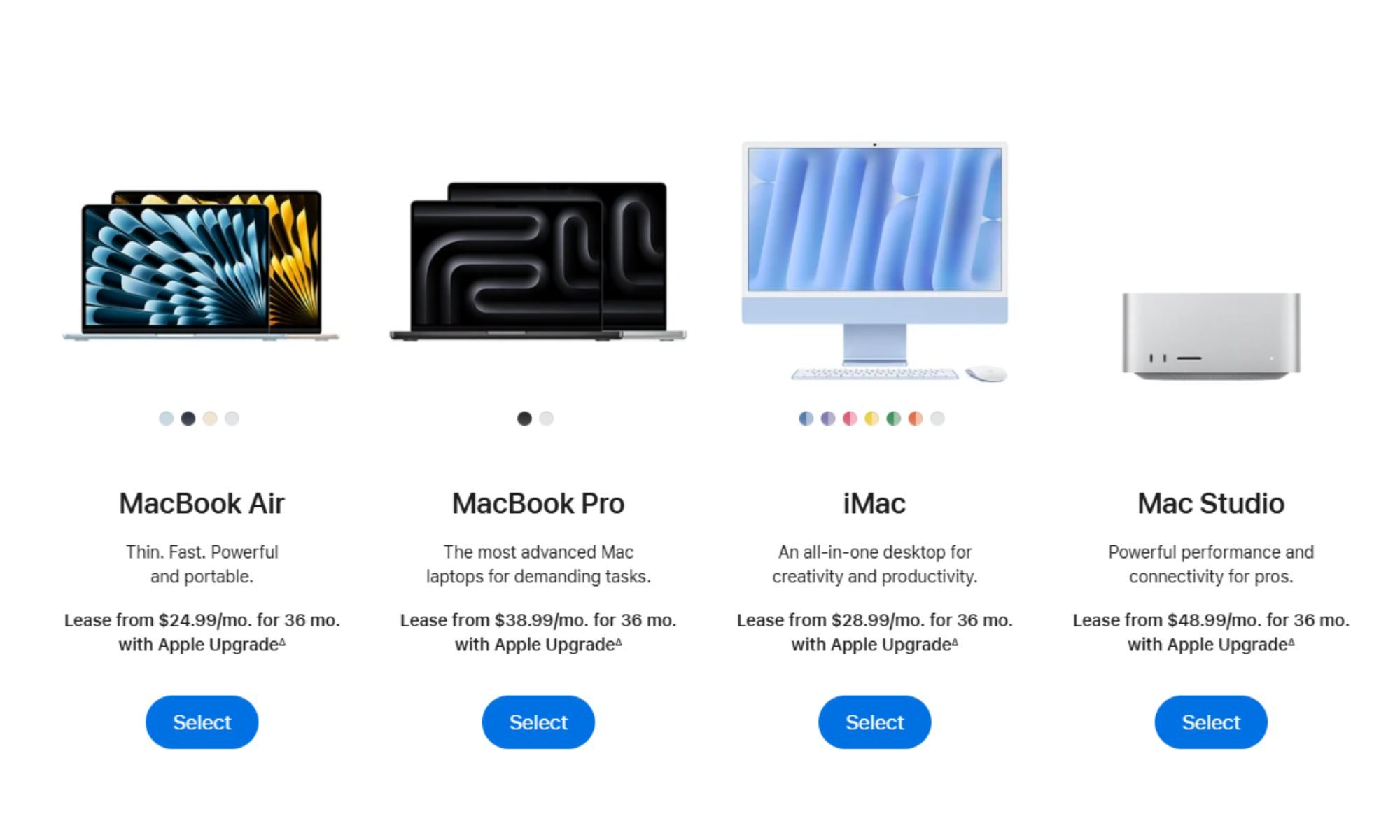

Apple doesn’t require a security deposit for the lease, but it also doesn’t allow customers to make a down payment to reduce their monthly payments. The one lever customers do have is a trade-in, which can reduce the monthly rate for the length of the initial lease.
What you’re actually committing to
Signing up is simple on paper. Apple requires a Klarna account and runs only a soft credit check, so applying won’t affect credit scores, but Klarna then owns the relationship for the life of the lease, handling billing through its own app rather than Apple’s.
The terms get more complicated after that. Upgrading to a new device before a lease ends is allowed, but the fee for doing so grows the more payments are still owed, which turns an early upgrade into a calculated cost rather than a simple swap. A device also has to come back in good condition when the term wraps up, or Apple will charge a damage fee, something customers can offset with an AppleCare plan, though it isn’t bundled into a lease price the way it was under the old iPhone Upgrade Program.
Apple is also offering a short window to walk away entirely. Canceling within 14 days of receiving a device cancels the lease outright, but missing that window means paying an early termination fee instead. Customers who ride out the full term get three options. They can upgrade and return the current device, leave the program and return it, or pay a one-time fee through Klarna to buy it outright. Waiting more than six months to decide removes the choice, since Apple will automatically charge the purchase fee by default.
Apple Upgrade retires a financing model Apple built around outright ownership and replaces it with one in which monthly payments don’t guarantee owning anything at all. Customers deciding whether to sign up should read the fee structure in Apple’s FAQ closely, since it does more to define the actual cost of the program than the marketing copy on the page.

Shared Sequencers and Their Impact on DeFi

Don’t arrest Zack Polanski over that Nigel Farage t-shirt

Uefa issues furious statement after reports Fifa plans to sell stakes in World Cup

Renter of Home in Anne Heche Crash Denies Settlement With Son

No Jackpot Winner as $257 Million Prize Rolls Over to $269 Million Monday Draw

Weekend Open Thread: Staud – Corporette.com

Ronaldo Club Is in Financial Trouble?Al-Nassr’s Financial Crisis ExplainedThe Truth $1 BILLION DEBT

He staged a series of car accidents for financial gain.#edit#viral#groe#fyp#foryou#shorts#drama#usa

This Story Will Change the Way You Think About Money #youtubeshorts #shorts
-

 Fashion4 days ago
Weekend Open Thread: Brooks Brothers
-

 NewsBeat7 days ago
How a former Blue Peter presenter stunned America’s Got Talent judges
-
 Business7 days ago
New Jersey voter registration controversy explained: How 6,600 noncitizens got on the rolls, and what happens next
-

 Tech2 days ago
Intel is reversing course and bringing hyper-threading back to its server chips
-
 Entertainment7 days ago
Johnny Depp’s R-Rated Gothic Cult Classic Gets New Release Ahead of Sydney Sweeney Remake
-

 Crypto World6 days ago
Ethics, other provisions in crypto Clarity Act to be further discussed
-

 Politics1 day ago
Luke Littler dismantles Gerwyn Price to retain title in Blackpool
-
 Sports2 days ago
Commonwealth Games boxing: Jadumani Singh seals dominant 5-0 win over Pakistan’s Sumama Rehman to enter quarter-finals | Commonwealth Games News
-

 Sports5 days ago
2026 3M Open leaderboard: Scottie Scheffler finds putter in Round 1, sits three back
-

 Fashion5 days ago
16 Dresses for the High Summer Event
-

 Politics8 hours ago
The Part of the Electric Transition Nobody Wants to Discuss
-

 News Videos5 days ago
The Peugeot Family: How 200 Years of an “Old Money” Dynasty Died in A Boardroom
-

 Politics2 days ago
Spain sweeps the board at 2026 World Cup with individual awards
-
 Entertainment4 days ago
A New Post-Apocalyptic Gundam Anime Series Blasts Into SDCC
-

 News Videos2 days ago
BITCOIN JUST ENTERED THIS CRITICAL ZONE…
-

 Crypto World2 days ago
XRP Ledger adds $2.6B as RWA inflows rank second
-

 Crypto World3 days ago
Ripple bought a bank in pieces. The $4 billion audit
-

 Crypto World5 days ago
Uniswap (UNI) pushes deeper into tokenized RWAs with permissioned trading pools
-

 Tech4 days ago
Anthropic launches Claude Opus 5, a cheaper AI model for coding, agents and enterprise workflows
-

 Entertainment3 days ago
Sara Gilson Killed By Husband After Viral “Pedophile” TikTok Video
You must be logged in to post a comment Login