

Crypto World
State Street targets stablecoin reserve boom with new money market fund

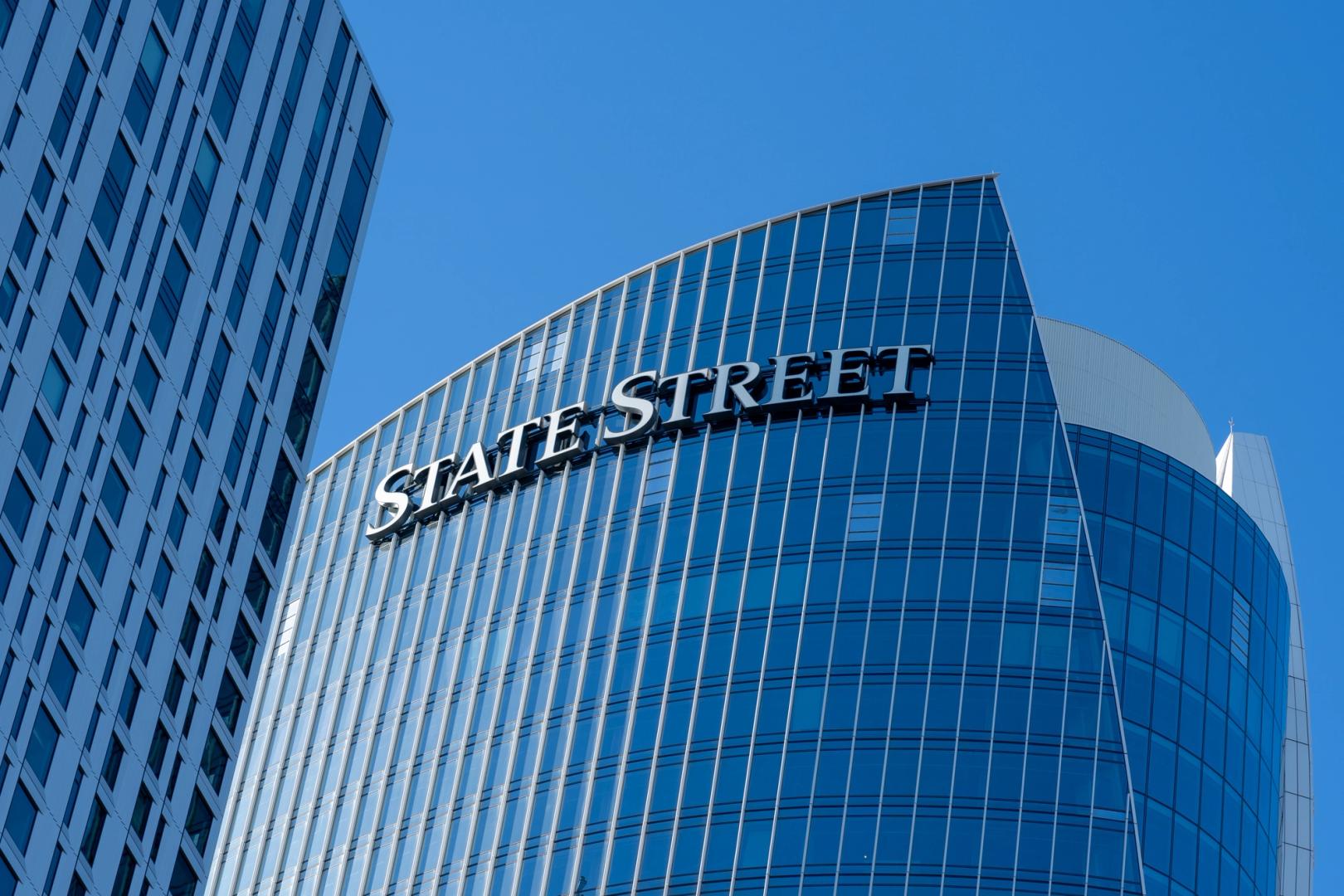
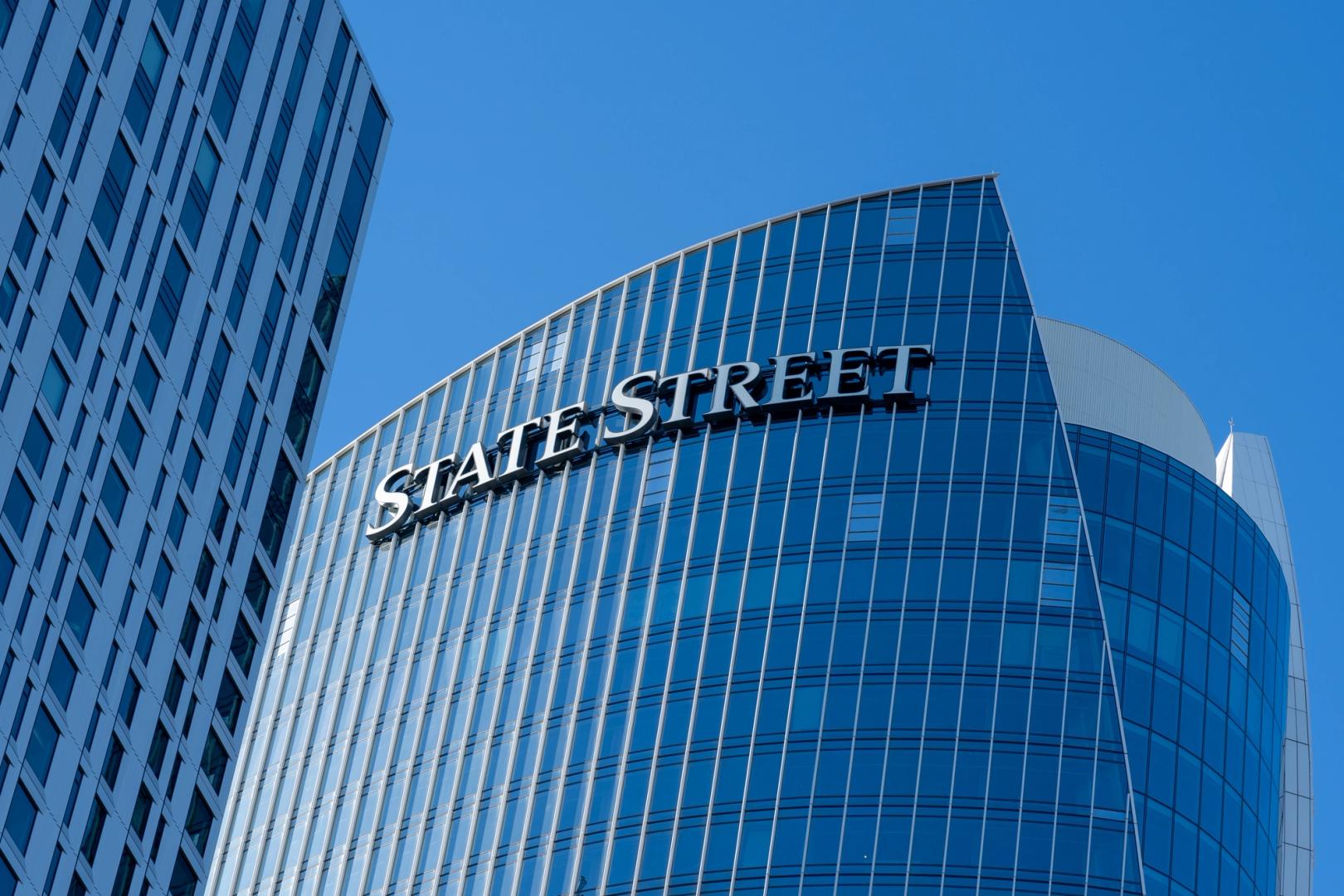
Wall Street’s largest asset managers are increasingly competing to manage the assets backing stablecoins, a market that could swell into the trillions of dollars as digital dollars become a larger part of the financial system.
State Street Investment Management introduced the State Street Stablecoin Reserves Money Market Fund on Tuesday, a government money market fund designed specifically for stablecoin issuers operating under the framework established by the GENIUS Act.
The fund’s introduction comes as traditional financial (TradFi) firms race to position themselves as key providers of reserve management services for stablecoin issuers. Stablecoins, which are typically pegged to the U.S. dollar, are backed by reserves that often include Treasury bills, cash and money market funds. As issuance grows, so does the pool of assets generating management fees for fund providers.
The fund’s initial investors include State Street Bank and Trust Company and Anchorage Digital, the crypto-focused bank that holds a federal charter in the United States.
Stablecoins have become one of the most sought-after opportunities in digital assets for traditional finance firms. Major asset managers, custodians and banks have spent the past year rolling out products aimed at tokenized cash markets and reserve management infrastructure.

Avalanche (AVAX) became one of the most discussed cryptocurrencies on Monday despite the broader market rally, as growing skepticism around the network fueled social media debates.
According to Santiment, many users are questioning whether Avalanche can still compete with faster-growing blockchains such as Solana and Sui.
Lagging Devs and Users
Much of the criticism has focused on concerns that developer activity, user adoption, and overall ecosystem growth are moving away from Avalanche toward rival networks. Santiment’s sentiment data revealed that market mood around AVAX has dropped sharply, pivoting from one of its most bullish phases earlier this year to one of its most bearish periods.
However, the analytics platform stated that extreme negative sentiment can sometimes create opportunities for reversals in the market. Despite the rising criticism, Avalanche continues to maintain institutional partnerships, government-linked initiatives, and its subnet technology, which remains a major feature of the network.
Meanwhile, stats from the Developer Report by Electric Capital revealed Solana leads with 795 full-time developers (each contributing 10+ days monthly), whereas Sui has 202 such developers, and Avalanche is behind with only 168. Furthermore, the total developer counts show Solana leading at 2,555, Sui at 656, and Avalanche at 484. The metric considers only original code authors, while excluding developers involved in merged pull requests, forked commits, and automated bot activity.
AVAX Market Performance
AVAX briefly moved above $7 this week as the broader crypto market recovered. The token gained nearly 4% in the past 24 hours. The rally also comes amid growing attention around FIFA’s partnership with Avalanche during the ongoing 2026 World Cup. FIFA is using a custom Avalanche blockchain to support ticketing, loyalty programs, and digital collectibles for fans across the world.
The Layer 1 network, announced in May 2025, powers FIFA Collect, the organization’s official collectibles platform developed with Modex. Fans can use Right-to-Ticket collectibles to access official World Cup tickets through a special portal before matches. The partnership has also reportedly helped Avalanche attract new users.
Zooming out, however, AVAX is still over 26% down over the past month. Additionally, the price has fallen by over 76% from its September 2026 high of $30.
The post Is Avalanche Falling Behind? Social Media Debates Heat Up Over AVAX Growth Slowdown appeared first on CryptoPotato.
Coinbase has unveiled an SEC-registered AI investment advisor alongside new trading products as the company has continued expanding beyond crypto in its push to become an “Everything Exchange.”
Summary
- Coinbase unveiled an SEC-registered AI advisor that can help users manage portfolios through natural language commands.
- The exchange plans to launch stock options, crypto options, prediction markets, and 24/7 stock index perps.
- Coinbase will expand its pre-IPO perpetuals program with upcoming offerings tied to OpenAI and Anthropic.
According to announcements made during Coinbase’s System Update event, the exchange is introducing an AI-powered advisory service, expanding access to derivatives and prediction markets, and preparing new pre-IPO trading products tied to some of the world’s largest private technology companies.
The latest product rollout comes as Coinbase continues adding traditional financial products to its platform after recently revealing plans to launch tokenized stocks backed one-for-one by underlying shares.
AI tools move closer to managing user portfolios
At the center of the announcements was Coinbase Advisor, which Chief Executive Officer Brian Armstrong described as one of the first SEC-registered AI-powered investment advisors in the world.
Armstrong said the tool will have access to a user’s portfolio information and account history, allowing customers to interact with the advisor using natural language commands.
“Speak to it in plain English to take action on your account. It will even prompt you with ideas you hadn’t thought of,” Armstrong said during the presentation.
Alongside the advisor, Coinbase revealed that artificial intelligence agents can now connect directly to its platform. Using systems such as ChatGPT or Claude, customers can establish trading rules and permit AI agents to execute trades on their behalf.
The announcement follows a growing industry focus on agentic finance. Earlier this week, crypto and stock trading platform Robinhood introduced AI-powered account management tools that allow clients to deploy automated agents to oversee trading activity.
New markets extend beyond crypto trading
Elsewhere during the event, Coinbase announced plans to launch stock options trading this summer, while crypto options are scheduled to arrive later this year.
The exchange also disclosed plans to offer perpetual-style stock index products that can be traded around the clock, including by users in the United States. The move would extend the 24/7 trading model commonly associated with crypto markets into equity-linked products.
Additional trading features unveiled at the event include time-based prediction markets that allow users to speculate on future price movements across digital assets such as Bitcoin, Ethereum, Solana, XRP, and Hyperliquid. According to Coinbase, contracts will cover periods ranging from 15 minutes to one year.
Private market exposure is also becoming a larger part of the company’s strategy. Coinbase announced plans to expand its pre-IPO perpetual contracts program following the launch of SpaceX pre-IPO perps ahead of the aerospace company’s record-setting public listing.
According to Coinbase, upcoming offerings will provide exposure to private companies, including OpenAI and Anthropic, before their shares become publicly available.
The new launches build on Coinbase’s previously announced tokenized stock initiative. The exchange has said those products will represent ownership interests backed 1:1 by underlying shares rather than synthetic instruments, derivatives, or IOUs.
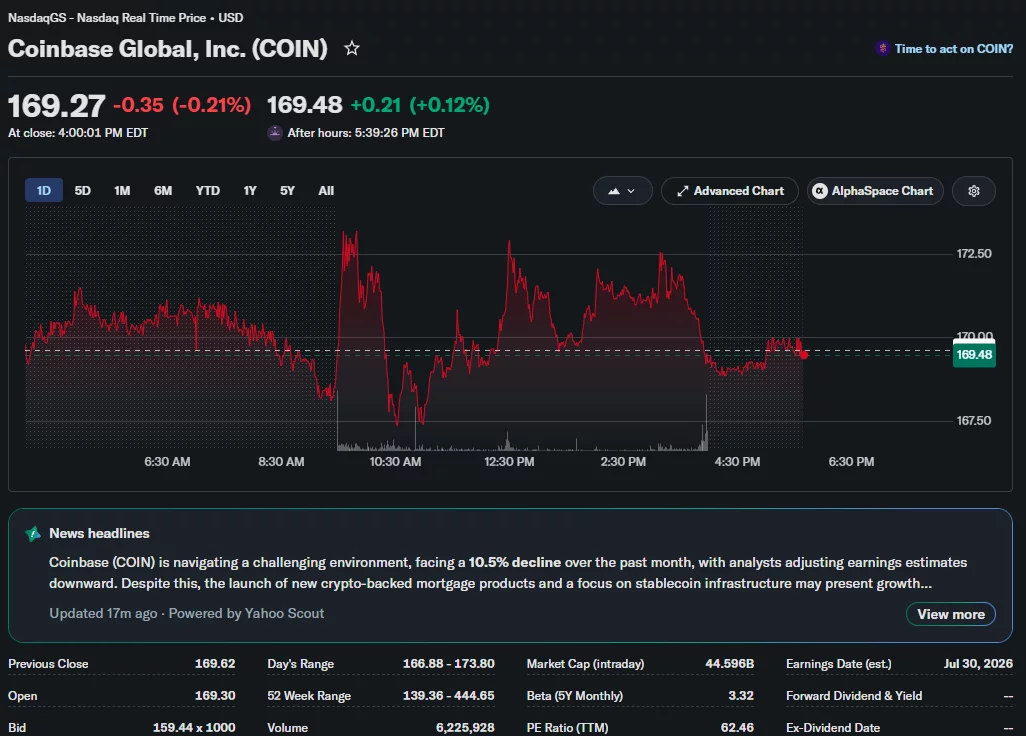
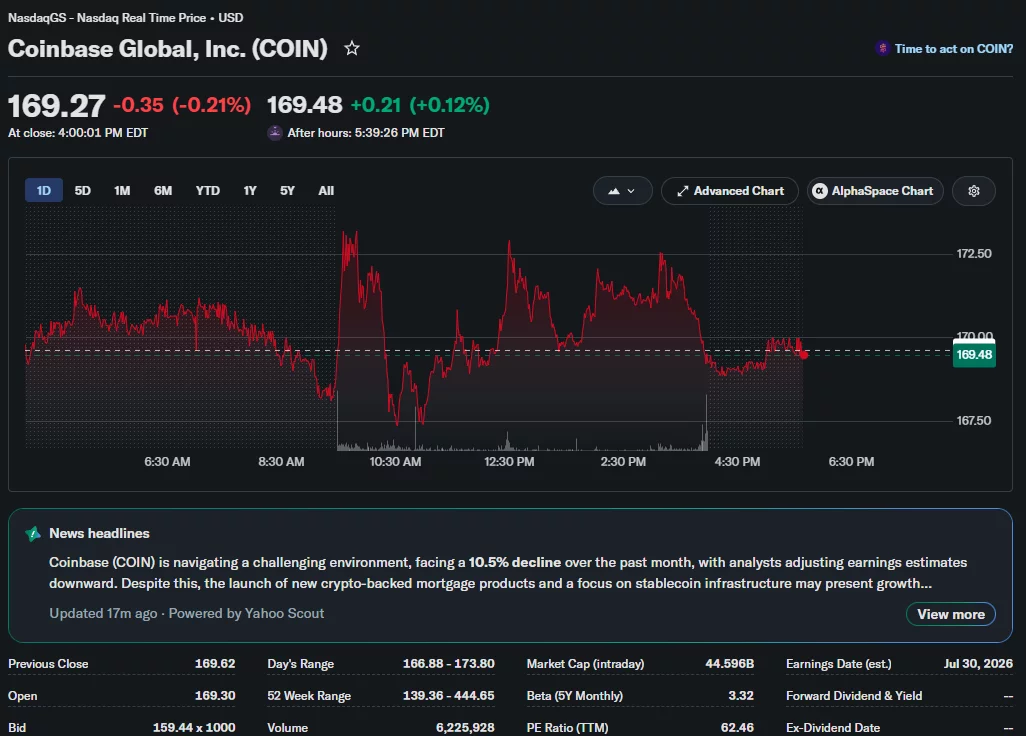
Investors responded positively to the announcements. Data from Yahoo Finance showed Coinbase shares climbing to roughly $170 during the trading session before easing slightly in after-hours trading. The stock exchanged hands near $169.2 at the time of writing.
Oil prices tumbled to two-month lows after the US and Iran reached a peace deal to reopen the Strait of Hormuz. Yet beneath the relief, traders are quietly positioning for a rebound.
The reason is a catch buried in the deal. Iran plans to charge a toll after a 60-day grace period, a cost the market may already be pricing into the months ahead.
An Iran Deal That Adds a Toll to a Fifth of Global Oil
The deal reopens the Strait of Hormuz, the waterway that carried roughly one-fifth of global oil before the war shut it. Before the conflict, ships paid nothing to pass.
Want more insights like this? Sign up for Editor Harsh Notariya’s Daily Newsletter here.
Iran now says it will collect “service fees” once a 60-day toll-free window ends. President Trump calls the reopening permanently toll-free, while Vice President JD Vance and Iran point to fees after the 60 days.
Markets took the truce as relief. Brent crude oil price fell about 5% to near $83, and WTI crude oil price slid to under $80, both at multi-month lows.
That drop reflects near-term supply relief. The futures curve tells a more cautious story.
The Curve Cooled, but Positioning Turned Bullish
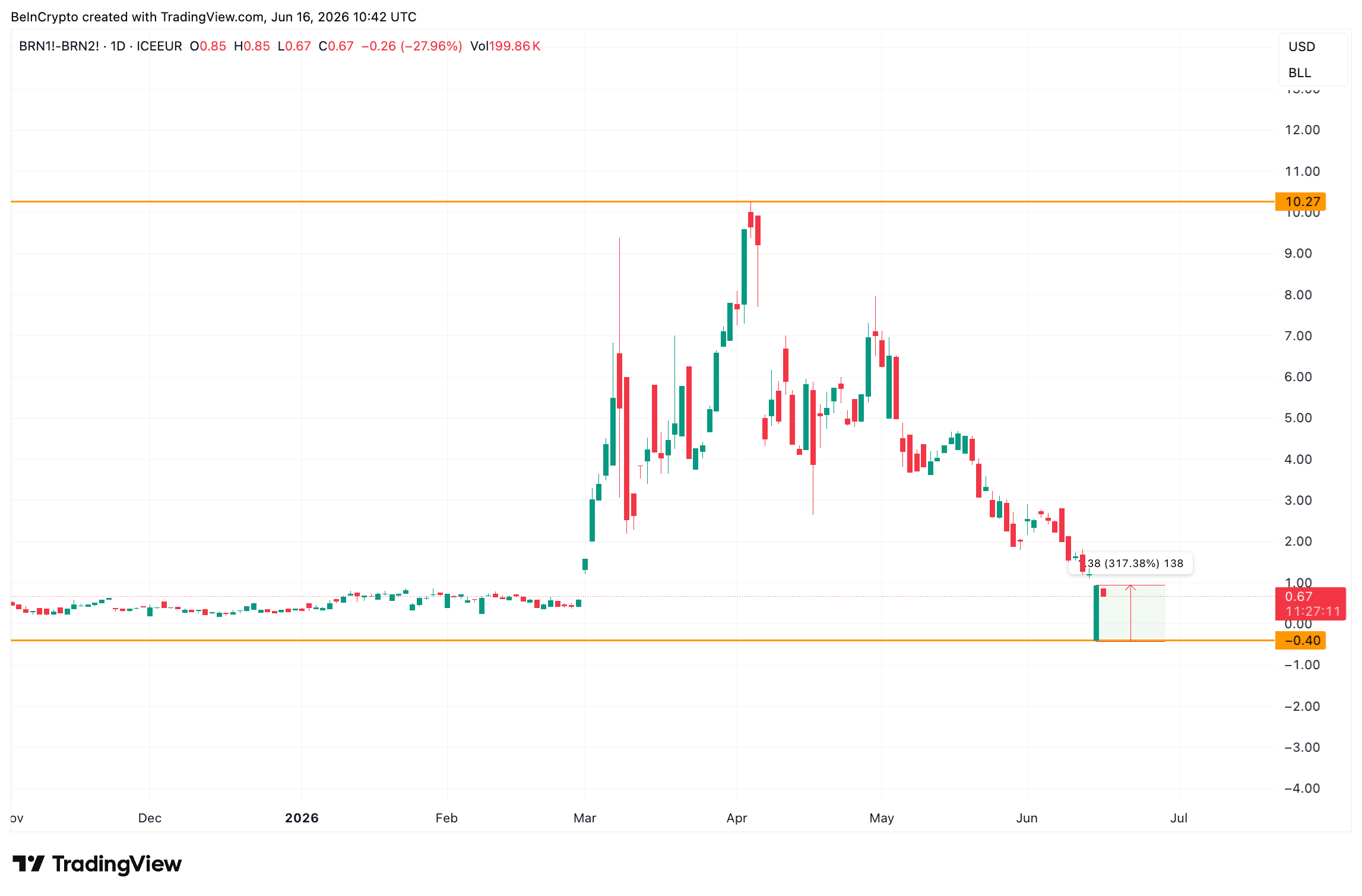
During the war, the backwardation in Brent went extreme. Backwardation means the front-month contract trades above the later-month contracts, a sign of near-term scarcity.
The spread between the first and second Brent contracts hit about $10.27 in April. It has since collapsed to roughly $0.67, so the market sees the immediate shortage easing. Still, the spread stays positive.
Brent shows mild backwardation rather than flipping into contango, where later months trade above the front. The near-term squeeze has cooled, but the market is not yet pricing a glut.

Positioning leans the other way. In the latest Commitments of Traders report, a weekly CFTC snapshot of who holds futures, speculators cut short bets by about 9,300 contracts by June 9.

Options say the same. On the United States Brent Oil Fund (BNO), the put-call ratio sat near 0.08, meaning calls vastly outnumbered puts. Call buying continued to grow, with the ratio dropping to 0.06 as the toll news broke.

So the curve has priced the reopening, while traders bet on what comes after. The size of that bet depends on the toll.

BRN2 is only about a month further out, and the front contract still trades above it, so the curve has calmed without turning bearish. That leaves room for the toll to retighten it, which aligns with the bullish positioning.
What a Hormuz Toll Could Do to Oil Prices
Here is the math. Before the war, Brent traded near $70 with zero transit cost. The Strait moves about 7.6 billion barrels of oil a year.
A toll of $0.50, $1, or $2 per barrel would hand Iran roughly $3.8 billion, $7.6 billion, or $15.2 billion a year. The $1 level is not hypothetical. During the conflict, an informal $1-per-barrel fee was being levied. Tolls of up to $2 million per voyage were reported.
The direct cost is small and mostly absorbed by producers at first. The bigger lever is the risk premium, the extra price markets pay for supply uncertainty.
That premium bites harder now because the cushion is thin. The US Strategic Petroleum Reserve, the national emergency stockpile, just hit a 43-year low.

From a normalized reopening near $80, analysts estimate a smooth toll could add $2 to $6, while a messy one could add $10 or more. That points to Brent in the high $80s to mid $90s, with a path back above $100 if the reopening turns disorderly.
To be clear, the $1 toll, or even $2, does not push Brent to $100. That tail runs through disruption, not the fee. A contested rollout that chokes traffic again would revive the war-era risk premium. That fear, not the charge, sent Brent above $100 during the conflict.
Expert and market signals line up with that risk.
Oil Prices, Forecasts, and the Bets Point the Same Way
Industry leaders have flagged the upside. Executives at Chevron and ExxonMobil warned the physical Brent oil price could spike toward $150 to $160 if inventories keep draining.
The US Energy Information Administration (EIA) expects Brent to average about $105 in June and July before easing later. Goldman Sachs trimmed forecasts on the deal but warned of renewed volatility if Hormuz does not reopen cleanly.
Prediction markets agree at the margin. On Polymarket, bettors put the odds of crude hitting a record at roughly 16% by December 31, still the most-backed window even after the deal cooled the odds.

For now, oil prices sit near two-month lows: Brent around $83 and WTI near $80. The next CFTC positioning report, the first to capture the toll news, will show whether the bullish lean held.
A clean, toll-free reopening would let oil prices keep easing toward the EIA’s high $70s path. A contested service-fee regime after 60 days would re-tighten the market and push it back toward the high $80s and beyond.
The post How Would a Hormuz Toll Affect Oil Prices? appeared first on BeInCrypto.

Jonathan Raa | Nurphoto | Getty Images
Artificial intelligence giant Anthropic shocked observers when it said Friday evening it disabled access to its Fable 5 and Mythos 5 models to comply with an order by the U.S. government.
But traders on prediction market platform Kalshi think it’s more likely than not that the Fable model returns to U.S. consumers as soon as July.
Traders place 58% odds Anthropic will restore access to Fable 5 before July 1. They think it’s even more likely it’s back by July 10, with a 74% chance it happens by then. For the event contract to resolve to “yes,” general access to the model must be restored to U.S. customers.
Access to Fable 5 was disabled after the U.S. government told Anthropic to suspend access to the technology for any foreign national, whether inside the country or outside of it. To ensure compliance, Anthropic disabled the model for all of its customers.
The decision came just days after the company announced Fable 5. Anthropic previously tussled with President Donald Trump’s administration when the Department of Defense in March labeled the company a supply chain risk.
Traders’ bullishness comes after Anthropic reportedly met with the Trump administration on Monday to discuss the model. It is not yet clear if that meeting yielded any progress between the two parties.
On Polymarket, traders place 67% odds access is restored to U.S. customers by July 1.
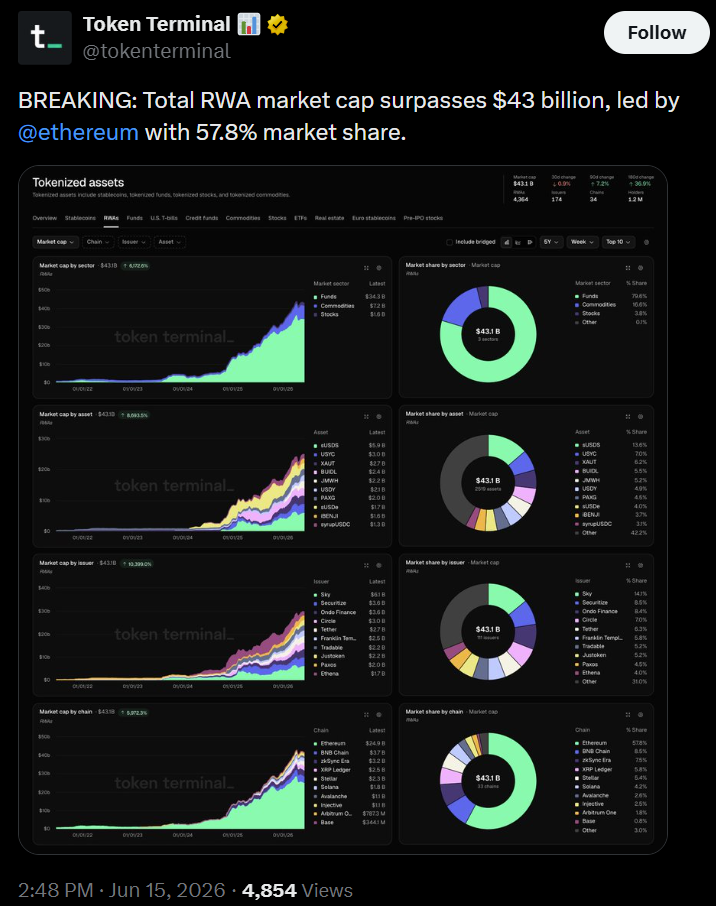
The market for tokenized real-world assets (RWAs) continues to expand despite broader weakness in crypto markets, with the value of onchain financial assets climbing sharply over the past six months as traditional financial products migrate onto blockchain rails.
According to Token Terminal, tokenized assets now exceed $43 billion in market value, up roughly 37% over the past 180 days.
The figures exceed those reported by other industry trackers, most notably RWA.xyz, which values the combined RWA market at less than $33 billion. The discrepancy likely reflects methodological differences, with Token Terminal including a broader range of tokenized financial assets.
Tokenized funds dominate the sector, accounting for nearly 80% of total market capitalization. Commodities rank a distant second at 16.6%, followed by tokenized stocks at 3.8%.
Source: Token Terminal
Ethereum remains the leading blockchain for tokenized assets, hosting 57.8% of total value. BNB Chain accounts for 8.5%, followed by zkSync Era (7.5%), XRP Ledger (5.8%) and Stellar (5.4%), reflecting the sector’s gradual expansion beyond Ethereum.
Sky is the largest issuer with $6.1 billion in tokenized assets, followed by Securitize and Ondo Finance at $3.6 billion each, according to Token Terminal.
Related: Crypto Biz: SpaceX fuels tokenization’s next boom
Tokenization moves beyond Treasurys
Tokenization has gained mainstream attention as major financial institutions embrace blockchain-based infrastructure. Earlier this week, Standard Chartered initiated coverage of Uniswap, arguing that the decentralized exchange’s UNI token could appreciate 40-fold by 2030 as tokenized assets increasingly migrate onchain.
The bank projects the decentralized finance sector will grow to $2.7 trillion over the same period, driven largely by the expansion of tokenized financial products.
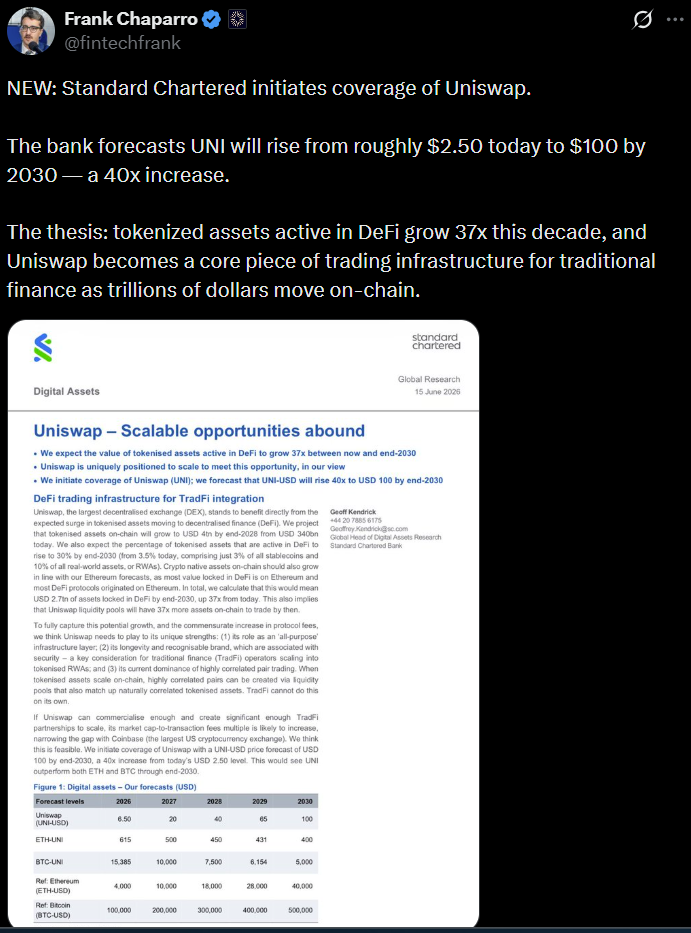
Source: Frank Chaparro
Citigroup has also turned bullish on tokenization, projecting that the market will reach $5.5 trillion by 2030 in its base case and up to $8.2 trillion in a bull scenario.
The bank argues the industry is moving beyond the pilot stage as regulatory clarity improves. Citi identified the Depository Trust & Clearing Corporation, the New York Stock Exchange and Nasdaq integrating tokenization into core issuance processes as key catalysts for growth.
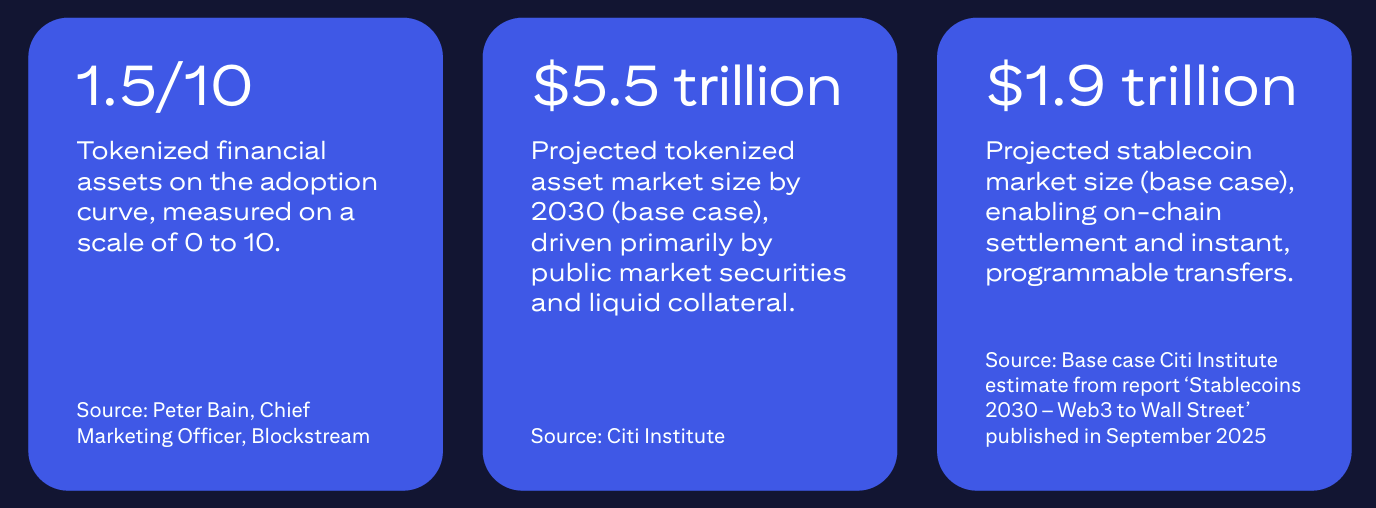
Stablecoins, which are often excluded from tokenization metrics, are expected to be a major driver of sector growth. Source: Citi
While tokenized funds and private credit continue to dominate the market, tokenized equities are gaining traction through platforms such as Ondo Markets and xStocks. The trend reflects a broader shift within the industry, with Binance Research recently concluding that RWA growth is becoming more diversified.
“2026 marks RWA tokenization’s maturation from a Treasury-dominated narrative into a diversified yield ecosystem,” Binance Research said in a report earlier this month.
Related: JPMorgan, Citi-backed Clearing House plans tokenized deposit network in 2027: WSJ


A coalition of American Indian tribes is seeking to block prediction market Kalshi and the Commodity Futures Trading Commission (CFTC) from undermining gaming laws on Indian land.
The legal challenge is made up of a series of amicus briefs filed this month by the “Tribal Amici,” a legal body consisting of 30 federally recognized Indian tribes and 11 different Indian regulatory agencies.
In an Amicus Brief — a brief that allows a third party outside the legal proceedings to offer their perspective on an ongoing case — filed on June 11, the Tribal Amici encouraged a court to deny Kalshi’s motion for preliminary injunction.
Meanwhile, a June 15 filing supported the State of New York’s opposition to the CFTC’s motion for a preliminary injunction.
In both cases, the tribal coalition claims that Kalshi and the CFTC’s actions would amount “to a sub silentio reversal of congressional policy and Supreme Court precedent” and “undermine existing tribal-state gaming compacts and regulatory frameworks.”
It argues the legal action would “allow prediction markets to offer sports-betting contracts subject to their own private regulation — not state or tribal regulation — on state and tribal lands; permit prediction markets to divert gaming revenues away from tribal and state governments; and diminish tribal self-determination.”
As such, tribes are seeking to maintain the freedom to regulate prediction markets like Kalshi, Polymarket, and the recently CFTC-approved Novig, when operating within American Indian jurisdictions.
Read more: Strategy’s BTC sale sends Polymarket into disarray
They also want to protect “vital” revenue that prediction markets are allegedly siphoning away, and which it’s claimed should be going to government services, tribal programs, and economic development aiding self-governance and self-sufficiency.
The Ohio federal court ruled against Kalshi’s 2025 lawsuit in March this year, stating that its sports event contracts aren’t “swaps.”
Kalshi is appealing this outcome and Ohio’s decision to reject the prediction market’s request for a preliminary injunction.
Meanwhile, the CFTC sued the State of New York in April this year, claiming it infringed on its area of jurisdiction when it sued Coinbase Financial Markets and Gemini Titan over alleged gambling promotion.
The Tribal Amici claims that the CFTC would undermine legal agreements between the New York tribes and the state that are approved by the United States and “carefully balance both tribal and state interests over the regulation of tribal gaming in New York.”
Prediction markets are wrangling with state lawmakers across America. This week, Polymarket joined Kalshi in filing a lawsuit against the state of Minnesota and its prediction market ban that comes into effect in August.
The CFTC is also considering classifying contracts involving terrorism, assassinations, war, gaming, or illegal activity as illegal and against the public interest.
All of this is happening while prediction markets are processing billions of dollars worth of funds on the back of sports contracts during the World Cup.
Bloomberg reports that Kalshi has already processed $5.1 billion in notional trading volume during the World Cup, while crypto analysts claim Polymarket attracted $1.6 billion in a single week.
Got a tip? Send us an email securely via Protos Leaks. For more informed news and investigations, follow us on X, Bluesky, and Google News, or subscribe to our YouTube channel.
Crypto World
Crypto News Just Turned Bullish: Coinbase CEO Brian Armstrong Calls a $60,000 Bitcoin Bottom While DOGE Holders Move to Pepeto
The biggest piece of crypto news this week came from the CEO of the largest US exchange, not a chart. Brian Armstrong said on June 15 he is “as bullish as ever” on Bitcoin and thinks the market has “probably bottomed” around $60,000, per Benzinga, expecting BTC far higher by 2030. In every cycle, those who act on a signal like this before the crowd walk away rich.
Bitcoin had already climbed back above $65,759. ETH sits at $1,818, and DOGE trades at $0.0885. Pepeto’s raise has pushed past $10.27 million with the fear gauge still at 12 and the Binance listing creeping nearer, and every round that closes lifts the price, so today’s entry disappears within the week.
On the Moonshots with Peter Diamandis podcast, Armstrong called Bitcoin “the new digital gold” and traced its four-year cycles from 2011 through 2025, per Benzinga. Citibank floated a $189,000 BTC target for the end of 2026.
When the head of the largest US exchange calls a floor near $65,759, that is the crypto news splitting early movers from those who circle back too late. The cycle keeps manufacturing fear while the biggest names in finance quietly build conviction, and the gap between the headlines and that behavior is where the cleanest entries hide.
Armstrong’s $60,000 Floor, Building Conviction, and the Presale Closing Before the Crowd Notices
Why the Crypto News Keeps Circling Back to Pepeto for Early Movers
Crypto news lately swings between fear readings and bullish calls from people like Armstrong, and Pepeto has become the line separating wallets that took a position from those still waiting. A bottom call from a major exchange CEO proves the biggest players see opportunity in a downturn. Upward of $10.27 million flowing into a presale at that same fear level shows the same instinct at the ground floor.
As large-cap outlooks point to a stronger second half, the wallets rotating into projects with real tools catch the recovery. Every swap on PepetoSwap runs fee-free, so a position builds rather than thinning across trades.
The scanner catches wallet clustering, the fingerprint of a coordinated dump, before your money is near it. And the bridge ties Ethereum, Solana, and BNB Chain together at no transfer cost, so a portfolio stays intact across chains.
The numbers carry the weight. Over $10.27 million sits locked at a fear reading of 12, as every round lifts the floor and burns shrink supply. SolidProof audited the entire contract set, and a former Binance developer built the route to listing. A 170% staking yield grows every wallet committed. The approaching listing turns an entry at $0.0000001876 into a return large caps need quarters to even approach.
Ethereum (ETH) Price at $1,818 as Armstrong’s Bottom Call Lifts Market Sentiment
Ethereum (ETH) trades at $1,818 per CoinMarketCap, up 9.2% on the day. ETH remains 65% under its $4,954 record from August 2025. Bitmine now holds over 5.5 million ETH, near 4.6% of supply, and Standard Chartered keeps a $7,500 year-end target. 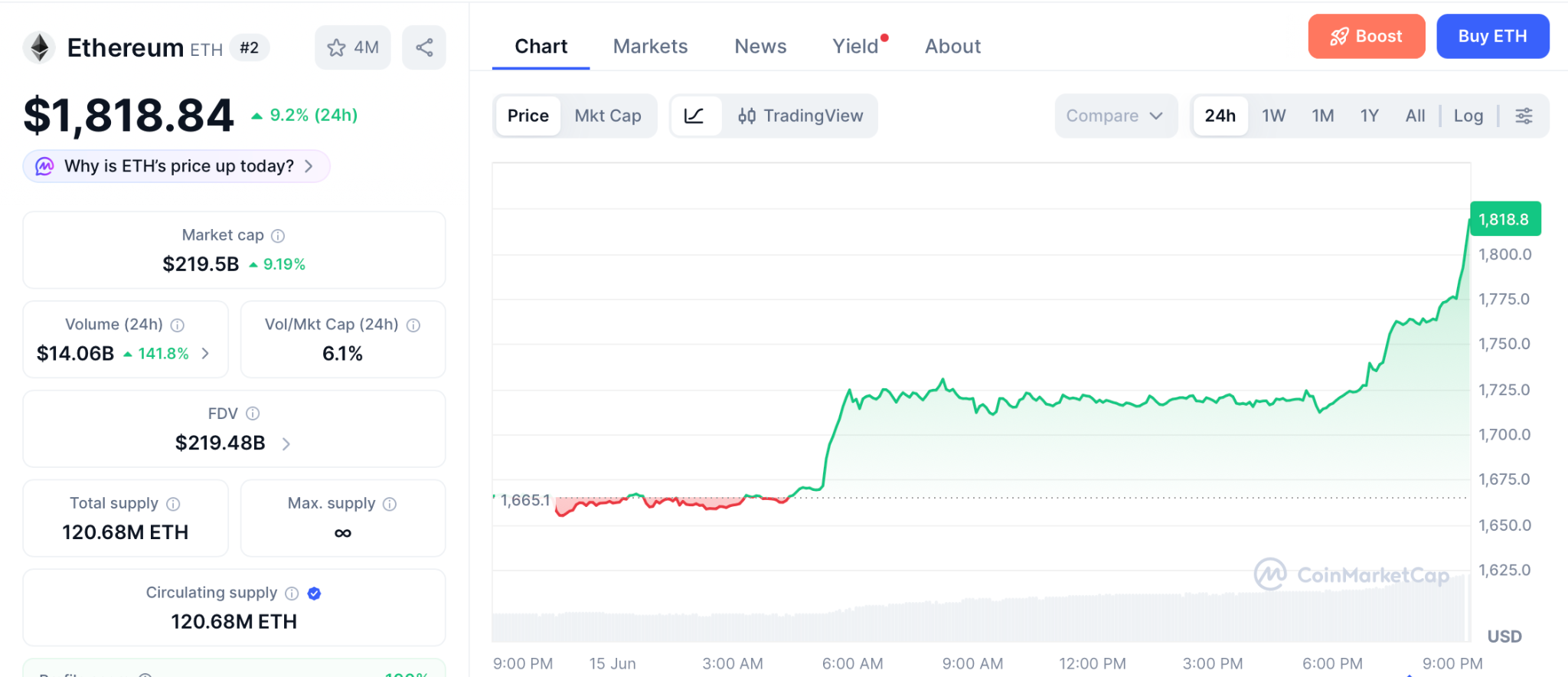
Ethereum (ETH) support holds at $1,600 with resistance at $1,850. Armstrong’s floor call adds confidence to the ETH case, but a 4.3x over a year is not what fractions-of-a-cent pricing delivers on a listing day.
Dogecoin (DOGE) Price at $0.0885 as Network Activity Climbs
Dogecoin (DOGE) sits at $0.0885 per CoinGecko, up 3.1% across the week. A joint SEC and CFTC framework labeled DOGE a digital commodity back in March 2026.
Dogecoin (DOGE) holds support at $0.080 with resistance at $0.095, and analysts flag $0.12 if that breakout sticks. The DOGE chart is turning up, but a 35% move on a $13.7 billion cap is not the return a single listing produces.
Conclusion
The crypto news signals recovery as Armstrong calls a bottom and conviction hardens. But a trillion-dollar asset class has a ceiling from here. The returns that change a life this cycle live in the presale lane.
Pepeto rewrites that math with real exchange tools and a listing that flips presale pricing into gains ETH and DOGE would need quarters to reach. Picture $1,000 today turning into $50,000 to $150,000 once trading opens. A mortgage gone.
A career you actually choose. Every crypto fortune began the same way: someone took the early entry before the crowd believed it and turned a tiny stake into money that changed everything. The Pepeto presale is that entry right now, and the wallets moving in today are choosing to be the next name people wish they had bet on early.
Click To Visit Pepeto Website To Enter The Presale

FAQs
Which crypto news matters most for investors right now?
The biggest crypto news right now is Coinbase CEO Brian Armstrong calling a Bitcoin bottom near $60,000 and projecting a much higher BTC price by 2030. Citibank’s $189,000 BTC target backs it, while Pepeto’s presale offers return distance institutional products cannot reach.
Should I buy Dogecoin at $0.0885?
Dogecoin (DOGE) trades at $0.0885 with a digital-commodity classification and a $0.12 ceiling once resistance at $0.095 breaks. Pepeto, by contrast, offers presale entry and listing upside through the Pepeto presale that DOGE cannot match at a $13.7 billion market cap.
Disclaimer: This is a Press Release provided by a third party who is responsible for the content. Please conduct your own research before taking any action based on the content.

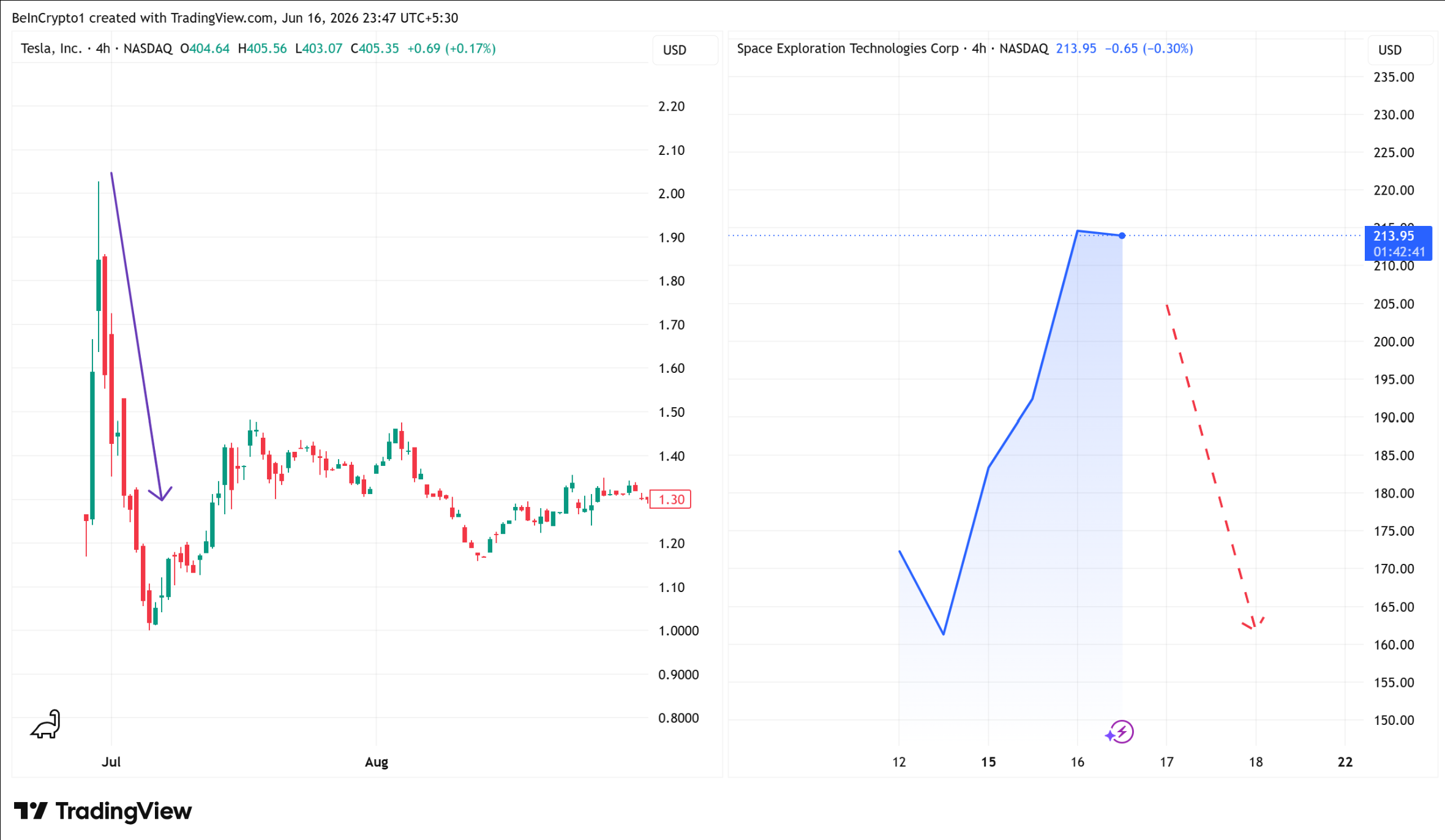
SpaceX stock is drawing crash warnings days after its record Nasdaq debut. Traders are comparing SPCX to Tesla’s volatile 2010 listing as the company nears a $3 trillion valuation.
The parallel has split market watchers. Some expect a steep correction once selling pressure builds, while others argue a tiny public float could keep prices elevated for months.

A record debut at a stretched valuation
SpaceX priced its shares at $135 on June 12 and raised about $75 billion, eclipsing Saudi Aramco’s $25.6 billion in 2019 to become the largest IPO in history. The debut instantly ranked it among the most valuable US companies.
SPCX has since climbed past its earlier opening level, trading roughly 56% higher near $213.95 as of this writing.
Prediction market Kalshi said SpaceX touched a $3 trillion valuation in after-hours trading on $18.7 billion in 2025 revenue.
That multiple dwarfs the levels from the stock’s earlier $2 trillion debut and exceeds anything Tesla carried at listing.
Why Some Traders See a SpaceX Stock Crash
Analyst Ted Pillows summed up the bearish case, framing SPCX as a replay of Tesla’s early path. Another widely shared post claimed Elon Musk ran the identical playbook at Tesla’s 2010 listing.
The record is messier than the meme. Tesla closed its first day 40.5% above its $17 offer price. It roughly doubled within months, then shed almost a quarter of its value in weeks.
The stock ended 2011 up just 7.3%, with no single 70% collapse before its later 300-fold climb.
“SpaceX $SPCX is following the Tesla $TSLA route. An initial pump of 60%-70% followed by a brutal 50% crash,” Ted Pillows wrote.
Investor Jo Bhakdi expects downward pressure from August, citing the thin float, forced index buying, and a valuation near 90 times 2026 revenue.
CNBC’s Jim Cramer echoed the unease, saying he likes the company but dislikes watching a meme-style climb with almost no sellers.
The Case for a Longer Squeeze
Conversely, others warn that betting on a crash misreads the supply. Investment adviser Thierry Borgeat argued that the same scarcity driving overvaluation also shields the price.
“Yes, the stock is expensive on every traditional measure… But price doesn’t fall just because it should. It falls when sellers outnumber buyers… Scarcity cuts both ways,” CFA Borgeat noted.
Demand has been intense. Bloomberg’s Eric Balchunas noted the number of ETFs holding SPCX jumped from four to about 120 in days.
With insiders locked up and retail reluctant to sell, buyers still outnumber sellers, much as they did while Tesla’s lofty valuation drew skeptics years ago.
The first real test arrives in August, when early lock-up expirations could finally add supply.
Until then, SpaceX stock looks set to trade on scarcity and sentiment rather than fundamentals, even as Musk’s soaring net worth keeps the spotlight bright.
The post SpaceX Stock Faces Tesla-Style Crash Fears as $3 Trillion Valuation Sparks Debate appeared first on BeInCrypto.
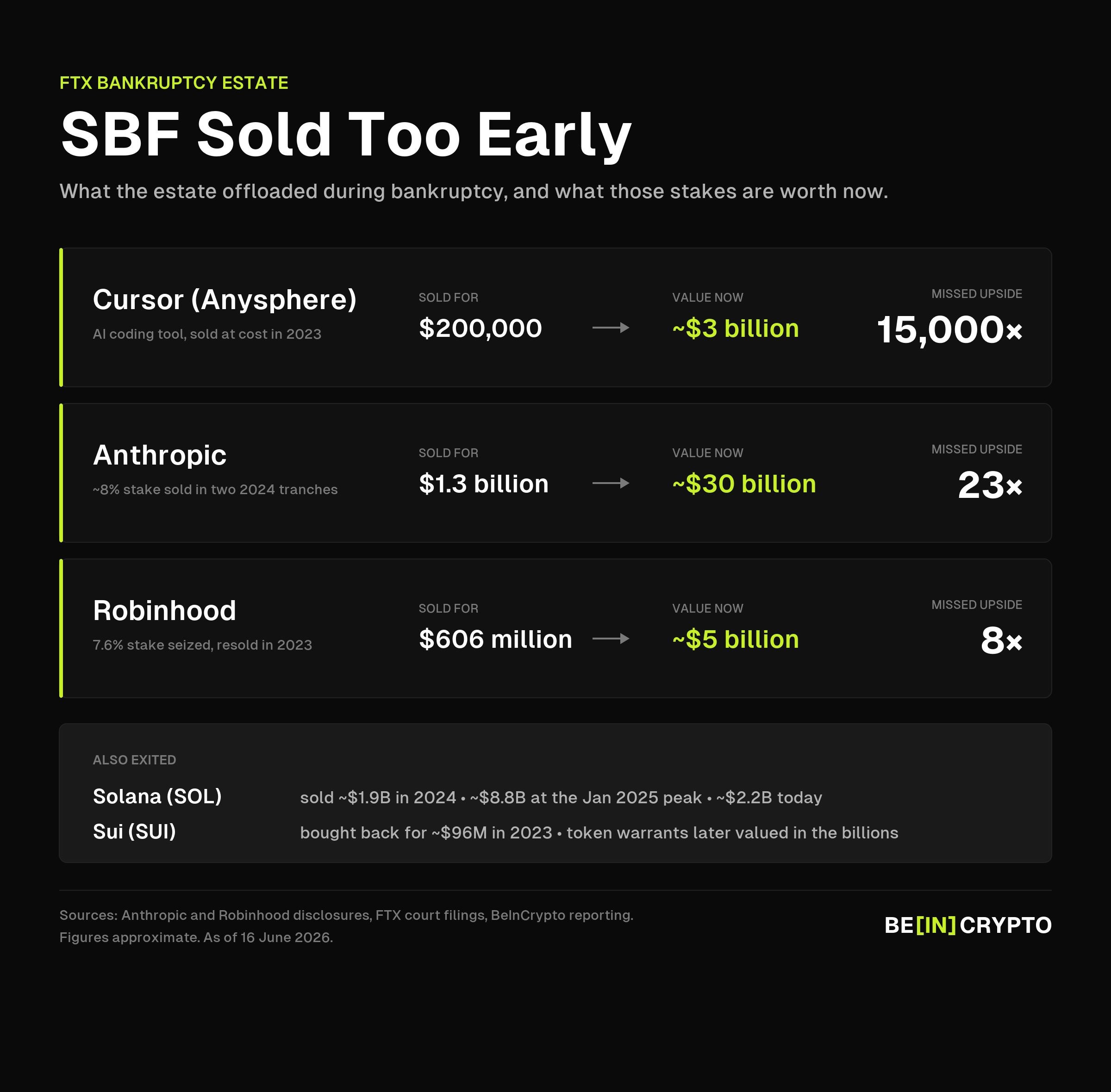
The same venture bets that helped build Sam Bankman-Fried’s empire have become a case study in selling too early.
As the FTX bankruptcy estate raced to repay creditors, it offloaded early stakes in companies that went on to rank among the most valuable names in AI and fintech, often for a tiny fraction of what they would later command.

“That guy knew how to trade with his client’s money, he just ran out of time,” one user quipped.
The Cursor stake sold at cost
Alameda Research wrote a $200,000 check into Anysphere, the maker of AI coding tool Cursor, during a 2022 pre-seed round.
With this, they secured roughly 5% of the company, according to Forbes’ accounting of the firm’s startup holdings.
In 2023, the estate sold that position back at cost, treating a then-obscure developer tool as a minor asset to clear.
The scale of the miss became clear this week, after SpaceX agreed to a $60 billion all-stock deal to acquire Cursor, building on a call option the rocket company first secured in April 2026.
At that valuation, the discarded 5% stake would be worth about $3 billion. On paper, a position the estate let go for pocket change would now rank among the most valuable assets it ever touched.
“SBF’s sleepless prison nights just got worse… In 2022, Alameda (FTX) dropped $200k into Cursor pre-seed → ~5% stake at a ~$4M valuation. FTX bankruptcy sold the entire position back at cost. Today, that 5% would be worth $3B – a 15,000x return,” commented John LeFevre.
Follow us on X to get the latest news as it happens
Anthropic Defines the Regret
FTX poured about $500 million into Anthropic in 2021, one of the largest private checks written into an AI lab before ChatGPT existed.
This left it close to an 8% holding in the company founded by former OpenAI researchers Dario and Daniela Amodei.
With court approval, the estate sold that stake in two 2024 tranches:
- About $884 million to a group of institutional buyers in March and
- A further $452 million that June, for roughly $1.3 billion combined.
Anthropic has since raised a $30 billion round at a $380 billion post-money valuation, per the company’s own disclosure.
That same 8% stake would now be worth more than $30 billion, an exit BeInCrypto flagged as a multi-billion-dollar miss while Bankman-Fried sat in prison.
“He made all these bets at 29, while running a $32B exchange…The estate just wasn’t allowed to hold them. Say whatever you want. The man had the eye,” investor Sjuul added.
The proceeds still helped push creditor recoveries toward full repayment.
However, the roughly 23-fold gap between the sale price and today’s value is the clearest sign of how distress selling clashed with frontier-tech timing.
Robinhood, Solana, Sui Round out the List
The pattern repeats across SBF’s other forced exits.
Emergent Fidelity Technologies, the Antigua-registered vehicle Bankman-Fried controlled, bought a 7.6% stake in Robinhood for about $648 million in 2022.
After the collapse, US prosecutors seized the shares, and in 2023 the US Marshals Service sold 55.3 million of them back to Robinhood at $10.96 apiece, a $605.7 million deal.
That same block would be worth more than $5 billion at Robinhood’s current valuation near $87 billion.

Solana (SOL) cuts closer to home, since Alameda had been one of the token’s earliest backers.
Under a court-approved process in 2024, the estate sold roughly 30 million locked SOL at about $64 each, with Galaxy Digital and Pantera Capital among the largest buyers.
SOL later peaked near $293 in early 2025 before sliding to about $74 today, which leaves those discounted Solana sales looking costly mainly against the 2025 highs rather than the current price.

In a separate 2023 settlement, Mysten Labs bought back FTX’s Sui (SUI) equity and token warrants for about $96 million, close to the roughly $101 million the exchange had paid a year earlier.
Taken together, the exits trace a portfolio of early access to standout companies undone by a bankruptcy that forced quick sales to repay defrauded customers.
“Sam Bankman-Fried is the greatest investor of all time…That means if he weren’t in jail today and still owned all this equity, he’d be worth ~$100 billion… He’d be top 20 richest people in the world,” stated Alex Finn, Founder/CEO of Henry Intelligent Machines PBC.
The estate, run by restructuring veteran John J. Ray III, needed cash on a court timeline rather than the patience a venture fund can afford.
Whether it sold too cheaply or simply could not wait is a debate that sharpens with every new funding round and acquisition tied to its former holdings.
The post SBF Sold Too Early: These Exited Bets Later Turned Into Multi-Billion Winners appeared first on BeInCrypto.
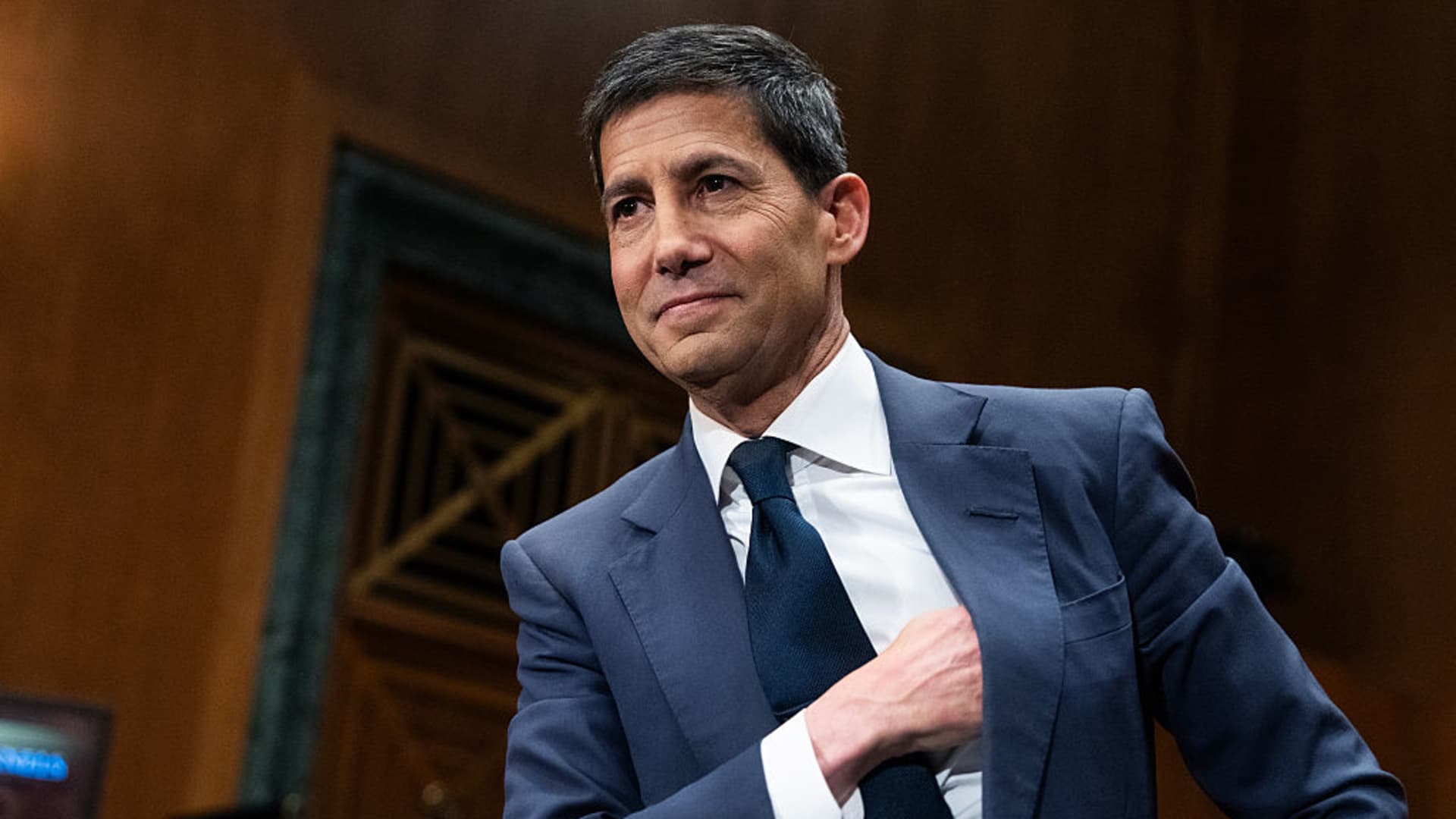
Kevin Warsh, nominee for chairman of the Federal Reserve, arrives for his Senate Banking, Housing and Urban Affairs Committee confirmation hearing in the Dirksen building, April 21, 2026.
Tom Williams | Cq-roll Call, Inc. | Getty Images
When the Federal Reserve wraps up its policy meeting Wednesday, one important thing could be missing — a dot.
The central bank’s Federal Open Market Committee is set to release its quarterly update of where individual officials expect interest rates to head this year and through 2028 and beyond. Markets closely parse the grid, known more commonly as the “dot plot,” for information on how Fed officials view the economy and its impact on monetary policy.
However, most Fed watchers on Wall Street expect new Chair Kevin Warsh won’t participate, either because he feels he’s not ready after having only been in office since May 22 — or simply because he doesn’t like the dot plot and its implications for “forward guidance.”
Declining to submit a dot would counter some 14 years of post-financial crisis practice for the Fed, and risk alienating other FOMC officials who favor the way it helps them communicate with the public. However, it also could be an effective first step for a central bank leader who has vowed fundamental changes for how the institution operates.
“It seems to me fairly likely that he doesn’t want to submit a rate forecast,” said Bill English, former head of monetary affairs at the Fed and now a professor at Yale. “There may be others on the committee who don’t particularly like the dot plot, who might be willing to do that, too.”
‘The Fed’s human’
Warsh objects to the dot plot and other methods of forward guidance because he believes they limit the Fed’s decision-making capabilities.
The dot plot belongs to a larger set of data called the Summary of Economic Projections, which also includes the outlook for unemployment, inflation and gross domestic product. The SEP is updated quarterly and includes the median outlook for each category and as such is not an official forecast but merely the midpoint of the range among FOMC meeting participants.
Bank of America economist Aditya Bhave expects Warsh won’t submit a dot, while Goldman Sachs economist David Mericle said in a note that, “We assume that Warsh will not submit dots in light of his past criticism of forward guidance, but we are not sure.”
During his confirmation hearing in April, Warsh cited the SEP as part of a broader problem at the Fed with overcommunication. Specifically, he cited the Fed’s mistaken “transitory” call on inflation in 2021-22 that led to a series of aggressive rate hikes to combat the biggest price surge in 40 years.
“The Fed tells the whole world what their dots are going to be, what their forecasts are going to be,” he said then. “Well, the Fed’s human. Then they hold onto those forecasts longer than they should. I think if the Fed were to wait until it gets into a meeting before making a decision, that incremental deliberation can keep the central bank from compounding its errors. I think these are big changes that are needed.”
Markets are watching
Still, markets hinge on the dot plot and the rest of the SEP, and may have to learn to live without it if Warsh has his way.
“To me it never made a lot of sense that [the SEP] at times was market moving, because its accuracy has been at best middling,” said Liz Ann Sonders, chief investment strategist at Charles Schwab. “But it is an avenue through which the Fed expresses a view, and the market tends to move on those views.”
Economist Claudia Sahm cautioned that should Warsh and others not participate, it could send the wrong message to markets. Specifically, she said investors could take the news to mean that Warsh is trying to “hide the hawkish shift” in the committee to fight inflation with elevated rates.
“Neutralizing the SEP this week might address some of Warsh’s concerns, but it would almost certainly create new ones,” wrote Sahm, chief economist at New Century Advisors. “A Fed that appears to be concealing its own debate could look complacent about inflation, which is exactly the credibility it can’t afford to lose.”
This meeting is expected to be an interesting test of Warsh’s new communications strategy.
In addition to his views on the dot plot and SEP, markets also will be watching for changes to the post-meeting statement and his views on whether he will continue to hold news conferences after each meeting.

Tom Lee’s Bold Prediction: Ethereum Could Explode 25X From Here

Boy dies following collision with parked lorry in Co Waterford

Krispy Kreme rolls out seasonal summer flavors


-

 Business2 days ago
No Jackpot Winner as $257 Million Prize Rolls Over to $269 Million Monday Draw
-

 Crypto World5 days ago
Oppenheimer backs SpaceX as $70 billion retail frenzy builds
-

 Fashion4 days ago
Weekend Open Thread: Tuckernuck – Corporette.com
-

 Crypto World5 days ago
Markets Rally as SpaceX IPO Looms Amid Iran Tensions and Inflation Surge
-
 Crypto World2 days ago
Zimbabwe Requires Crypto Businesses to Register Annually Under New FIU Regulations
-

 Tech4 days ago
NanoClaw integrates JFrog registries to secure AI agent downloads
-

 Business7 days ago
Thailand Ranks Second Worldwide for AI Adoption Growth, Microsoft Reports
-

 Tech4 days ago
This Week In Security: Microsoft On Microsoft, Register Your Domains, Linux On ARM, And FreeBSD Joins The File Cache Club
-

 Crypto World4 days ago
Bitget enters Argentina’s regulated crypto market through PSAV registration
-
 Tech5 days ago
Dutton Ranch star claims they ‘didn’t see any disruption’ on set following Chad Feehan’s exit from Yellowstone spinoff fueled by Taylor Sheridan clash rumors
-

 NewsBeat5 days ago
El Nino has formed in the Pacific and could set records, forecasters say
-

 Politics5 days ago
Politics Home | Healey Resignation Is “Colossal Failure Of Government”, Says Former Labour Defence Secretary
-
 Tech7 days ago
‘This is Seattle’s position on AI’: City Council votes unanimously to pause big new data centers
-
 Entertainment5 days ago
Donnie Wahlberg & More Heat Up Las Vegas at Circa’s Barry’s Downtown Prime
-
 Tech5 days ago
Opendoor Ends India Operations, Fueling a Bigger Conversation About AI and Outsourcing
-

 Sports5 days ago
First Time Since 1971: Australia Register Historic Low In ODI Cricket
-

 Politics5 days ago
Belfast burns, while Met chief points finger at Iran and Russia
-

 NewsBeat4 days ago
FBI searches office of Ohio voter registration group
-

 Business5 days ago
AT&T: Verizon's 27% Outperformance Sets Up A Solid Entry Point
-
 Politics5 days ago
Modi thanks Trump for wishes as US attacks Indian seafarers
You must be logged in to post a comment Login