

Crypto World
Strategy Inc Posts $12.54B Net Loss in Q1 2026 as Bitcoin Price Drop Hits Holdings Hard


TLDR:
-
- Strategy held 818,334 BTC as of May 3, 2026, reflecting a 22% year-to-date growth in bitcoin holdings.
- STRC preferred stock raised $5.58B year to date, scaling to $8.5B total in just nine months of existence.
- Strategy achieved a 9.4% BTC Yield and a $4.97B BTC Dollar Gain through the first four months of 2026.
- The company has met 23 consecutive preferred dividend payments, totaling over $693 million since early 2025.
- Strategy held 818,334 BTC as of May 3, 2026, reflecting a 22% year-to-date growth in bitcoin holdings.
Strategy Inc posted a net loss of $12.54 billion for the first quarter of 2026. The loss was driven by a $14.46 billion unrealized loss on its bitcoin holdings.
Bitcoin prices fell during the quarter, pulling down the carrying value of the company’s digital assets. Despite the loss, Strategy continued expanding its bitcoin position and raising capital through its preferred equity products.
Bitcoin Holdings Expand Even as Prices Fall
Strategy held approximately 818,334 BTC as of May 3, 2026, marking a 22% growth year to date. The average purchase price per bitcoin stood at roughly $75,537.
The company’s total digital asset cost basis reached $61.81 billion. The market value of those holdings came in at $64.14 billion, based on a bitcoin price of about $78,374 as of May 1.
The company achieved a BTC Yield of 9.4% year to date through its capital markets activity. It also recorded a BTC Gain of 63,410 bitcoins and a BTC Dollar Gain of approximately $4.97 billion.
These figures reflect Strategy’s ongoing effort to grow bitcoin holdings on a per-share basis. The metrics are used internally to assess whether capital raises are accretive to shareholders.
President and CEO Phong Le addressed the broader market environment during the earnings announcement. “Adoption of Bitcoin continues to grow in 2026. Digital Credit, highlighted by STRC, has been a big success,” Le said.
He pointed to rising institutional activity from major banks as further validation of the company’s direction. Morgan Stanley, Goldman Sachs, and Citi were among those named as expanding into bitcoin-related services.
Strategy raised $11.68 billion year to date to fund its bitcoin acquisition strategy. The company used proceeds from its at-the-market offering program, pulling in $7.37 billion during Q1 alone.
An additional $4.32 billion came in between April 1 and May 3. Cash and cash equivalents stood at $2.21 billion as of March 31, 2026, down slightly from $2.30 billion at year-end 2025.
Total revenues rose 11.9% year over year to $124.3 million for the quarter. Gross profit reached $83.4 million, with a gross margin of 67.1%, compared to 69.4% in Q1 2025.
The software business remained a stable contributor to overall operations. Strategy continues to describe itself as an industry leader in AI-powered enterprise analytics software.
STRC Preferred Stock Sees Strong Demand
Strategy’s STRC preferred stock raised $5.58 billion year to date, representing 189% growth. The product scaled to $8.5 billion in just nine months, making it the largest preferred stock by market capitalization globally.
Daily trading volume reached $375 million, while volatility dropped to 3%. STRC maintained that stability even through the recent bitcoin bear market.
CFO Andrew Kang highlighted the company’s dividend track record during the quarter. “We continue to extend our track record of servicing our dividends, having now met our payment obligations on time and in full across 23 consecutive distributions,” Kang said.
Total cumulative preferred dividends declared and paid have reached over $693 million since early 2025. Kang also cited a BTC Dollar Gain of approximately $5 billion through the first four months of the year.
Executive Chairman Michael Saylor spoke to the growing ecosystem around the STRC instrument. “STRC has scaled to $8.5 billion in just 9 months and is now the largest preferred stock by market cap in the world,” Saylor said.
He attributed the product’s performance to its design, which extracts bitcoin’s returns while engineering price stability.
Saylor added that the company has proposed doubling STRC’s dividend payment frequency to a semi-monthly schedule.
Over $150 million of STRC is now held in corporate treasuries, including Prevalon, Strive, and Anchorage. More than $270 million sits across DeFi protocols such as Apyx and Saturn.
Strategy carries a Sharpe ratio of 2.53 on STRC. The company positions itself as the dominant issuer of digital credit instruments in the world.
Operating Loss Widens Year Over Year
Strategy’s operating loss for Q1 2026 reached $14.47 billion, compared to $5.92 billion for Q1 2025. The unrealized bitcoin loss of $14.46 billion accounted for nearly all of that figure.
Under current accounting standards, bitcoin must be marked to fair value each reporting period. Any price decline flows directly into the income statement as an unrealized loss.
Net loss attributable to common stockholders was $12.77 billion, compared to $4.23 billion in Q1 2025. On a diluted per-share basis, the loss came in at $38.25, versus $16.49 in the prior-year period.
The company’s preferred dividends contributed to the gap between net loss and the figure attributable to common stockholders. Strategy has declared and paid $692.5 million in cumulative preferred dividends to date.
Strategy confirmed it does not expect to generate accumulated earnings and profits for U.S. federal income tax purposes.
Distributions on preferred equity instruments are therefore expected to be treated as non-taxable return of capital for the foreseeable future.
This treatment is expected to remain in place for at least ten years. Shareholders are advised to consult their own tax advisors regarding individual circumstances.
Despite the reported losses, Strategy maintained its standing as the world’s largest corporate bitcoin holder. The company stated that its combination of bitcoin treasury management and enterprise analytics software supports long-term value creation.
Strategy’s dashboard at strategy.com serves as a public disclosure channel for its holdings, KPIs, and securities data. A live webinar covering the Q1 results was held on May 5 at 5:00 p.m. ET.


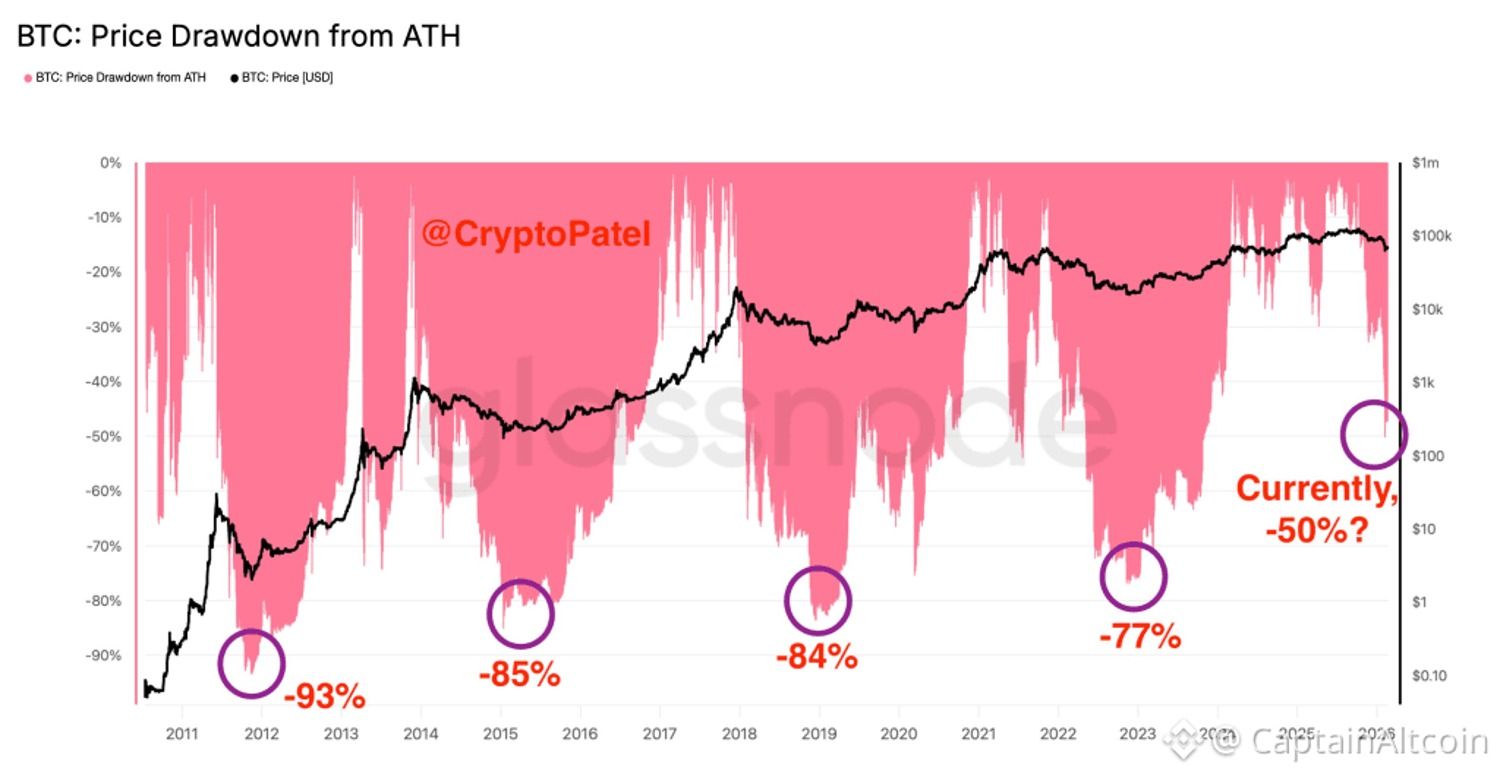
Bitcoin’s sharp fall is following the four-year cycle’s depth, slope, and timing; the selling from ETFs and Strategy and the mega-IPO liquidity drain are this cycle’s triggers, but the decline is on schedule.
- Bitcoin’s roughly 50% decline from the October 2025 peak is still in line with prior cycle behavior by depth, slope, and timing. Prior cycle lows followed about 12 months after the peak, and the current setup points to a Q4 2026 low window.
- ETF outflows and Strategy’s first Bitcoin sale in four years confirms both institutional bids behave as allocation capital rather than permanent holders.
- SpaceX, OpenAI, and Anthropic listings could pull risk capital away from crypto through mid-to-late 2026. After IPO lockups begin to expire, newly liquid employees and investors may recycle wealth into higher-beta assets, creating a potential liquidity tailwind for Bitcoin as the next cycle begins.
The Four-Year Cycle Framework
Bitcoin has moved in a four-year pattern since its first traded cycle. Peaks have arrived in late 2013, late 2017, late 2021, and late 2025. Troughs have followed roughly twelve months later: January 2015, December 2018, November 2022. The pattern has held across three complete cycles regardless of the prevailing narrative, retail-driven in 2017, institutional-curious in 2021, ETF-enabled & Bitcoin treasury companies in 2025.
Each cycle is anchored by the halving, which compresses new supply on a fixed schedule, and amplified by reflexive demand: rising price draws marginal capital, marginal capital lifts price further, leverage builds, and the structure eventually breaks. The unwind takes roughly a year. Terminal lows have arrived in Q4 of the year following the peak.
The post-ETF, post-corporate-treasury era was meant to break this pattern. Spot ETF approvals in January 2024 and Strategy’s aggressive accumulation through 2024–2025 introduced two persistent institutional bids that were expected to absorb cyclical selling and compress the drawdown.
Cycle
Peak
Trough
Time peak→trough
Peak-to-trough decline
1
November 2013
January 2015
~14 months
85%
2
December 2017
December 2018
~12 months
84%
3
November 2021
November 2022
~12 months
77%
4 (current)
October 2025
TBD (Q4 2026 base case)
–
50% (current)

The Decline Sits Mid-Pattern by Magnitude
The 50% selloff is shallow relative to the 77–85% distribution of prior cycle declines. Measured against time elapsed at the 7-month mark from peak, the current decline tracks prior periods closely:
Cycle
Drawdown 7 Months After Peak
Final Drawdown
2017–2018
Around −65%
−84%
2021–2022
Around −65%
−77%
2025–Present
50%
TBD
If the four-year template holds, current price sits closer to the midpoint than the terminus.

Source: https://www.bitcoincyclescomparison.com/
The Slope Matches Prior Four-Year Templates
The shape of the move may be more informative than the depth. The current sequence, a sharp post-peak selloff, multi-month consolidation, a spring rally into the 200-day moving average, and subsequent rejection, closely resembles the pattern observed during Bitcoin’s 2018 and 2022 bear-market rallies.
Bitcoin 2018 Price

Bitcoin 2022 Price

What’s Draining the Bid?
There are several potential explanations for the current sharp selloff.
Strategy made a wrong move
Strategy sold 32 bitcoin between May 26 and May 31, its first net disposal in four years. At $2.5 million the sale is immaterial.
The decision now looks like a huge mistake. A firm that genuinely needed to fund an ongoing obligation through Bitcoin sales would sell size quietly and raise real cash before the market repriced its intent. Selling a tiny token amount and announcing it does the reverse: it signals that the largest corporate holder is now a seller and invites everyone in the market to front-run the next sale.
A mega-IPO cycle is pulling risk capital
SpaceX, OpenAI, and Anthropic are set to raise more than $240 billion combined from June through year-end, a capital pull larger than every venture-backed US IPO since 2000 combined. SpaceX’s roadshow opens June 4, with pricing June 11 and first Nasdaq trading June 12, targeting a $75 billion raise at a $1.75 trillion valuation, of which roughly $22 billion is reserved for retail.
As we put in our March article:
The AI mega-IPO cycle creates a near-term liquidity headwind for Bitcoin via ETF flow compression, but reverses into a tailwind post-lockup, as newly liquid employees and insiders with above-average Bitcoin & Crypto appetite.
Related Reading: The $197 Billion Question: How the Mega IPO Wave Reshapes Capital Markets & Crypto
Spot ETFs flipped to net redemption
The May outflow was roughly ten times February’s $206 million redemption, suggesting institutions are derisking faster than price weakness alone would suggest. The reversal tracks the allocator behavior the IPO calendar predicts: freeing balance-sheet room ahead of a crowded equity supply.
Forward Implication: Cycle-Consistent Low Meets the IPO Calendar
Every prior cycle has bottomed in the same seasonal window. The 2018 low formed in December, the 2022 low in November. The four-year clock does not predict the price of the low. It predicts the timing: Q4 of the year following the peak. With the October 2025 top in place, that points to Q4 2026.
That timing now overlaps with an unusually large IPO calendar. The key macro implication is a two-step liquidity sequence: absorption first, release later. In the first phase, public-market capital is pulled toward mega-listings. That creates a plausible drain on marginal risk capital at the same time Bitcoin is moving through the cycle-consistent low window.
SpaceX is the clearest example. Its June IPO would absorb a large amount of risk capital upfront, while its phased lock-up schedule begins releasing insider liquidity through the second half of 2026, with broader liquidity available around the 180-day mark in December. That places the unlock-driven wealth-recycling phase almost directly on top of Bitcoin’s Q4 cycle-low window.
OpenAI and Anthropic extend the same logic. Their listings would draw capital into the IPO calendar first, while their eventual lock-up expirations would push additional liquidity into 2027. By then, the initial IPO demand has likely been absorbed, early gains may begin to cool, and newly liquid employees and venture investors can start reallocating into other high-beta assets.
Disclaimer: The information provided herein does not constitute investment advice, financial advice, trading advice, or any other sort of advice, and should not be treated as such. All content set out below is for informational purposes only.
The post BloFin Research: Bitcoin’s Sharp Fall Is on Schedule, Not Off the Rails appeared first on BeInCrypto.

Apex Group is providing fund management services for a tokenized real estate fund whose shares are being issued on Goldman Sachs’ Digital Asset Platform, GS DAP.
The fund was developed with Goldman Sachs, digital asset exchange Archax, real estate investment manager LRC Group and interoperability provider Ownera, Apex said Thursday.
“Tokenization at institutional scale depends on trusted, regulated infrastructure,” Apex Group’s global head of digital assets, Agnes Mazurek, said, adding that its participation reflects growing demand from managers and investors for blockchain-native solutions.
The project reflects a growing push by banks, fund administrators and regulated digital asset companies to move real-world asset funds onchain while preserving familiar governance, investor servicing and regulatory oversight.
Tokenized units issued via GS DAP
The fund’s shares are issued as digital tokens using Goldman Sachs’ Digital Asset Platform (GS DAP), a blockchain-based platform facilitating the issuance, settlement, custody and transfer of digital assets.
Launched in 2022, GS DAP is built on top of the privacy-focused Canton Network and Digital Asset’s smart contract language DAML.
“Issuing blockchain native fund units on GS DAP enables investment in real estate assets with precision while unlocking more seamless transferability in the future,” said Mathew McDermott, Goldman Sachs’ global head of digital assets and a board member at Digital Asset.

Source: Apex Group
As part of the collaboration, LRC Group, a pan-European real estate investment company, manages the fund, while RWA-focused Archax exchange acts as custodian and the initial distribution partner.
Ownera, a connectivity network for tokenized assets, provides the interoperability layer that connects issuers, custodians and distribution channels.
Cointelegraph reached out to Apex Group for additional details on the fund but had not received a response by publication.
Related: RWA market hits $51B as tokenized private credits surges: Bernstein
The project adds real estate to a growing list of institutional tokenization efforts, including tokenized money-market funds, private funds and collateral networks.
Apex Group previously collaborated with US crypto exchange Coinbase to launch a tokenized Bitcoin (BTC) yield fund on the Base blockchain in March.
Other investment banks such as JPMorgan have also expanded tokenization infrastructure through Kinexys, which focuses on payments, collateral and asset tokenization.
Magazine: 5 tech predictions the mainstream media got horribly wrong

Coinbase has unveiled a new suite of pre-IPO markets, kicking off with SpaceX. The offering provides users outside the United States exposure to private-company valuations before they go public, via a USDC-settled perpetual futures contract that tracks SpaceX’s estimated pre-listing price. The product is designed to operate around the clock, with no expiry or rollover, and profits and losses settled in USDC, according to a Coinbase blog post published Thursday.
According to Coinbase, positions can be opened and closed at any time, mirroring existing perpetual futures on the platform. If SpaceX eventually completes an IPO, those pre-IPO positions will automatically transition into a post-IPO perpetual futures contract that references the public listing. The rollout is not yet available to U.S. persons at launch and begins with eligible users in jurisdictions where private-market exposure is not restricted, reflecting ongoing regulatory considerations on offering private securities exposure in the United States.
Coinbase described the product as a way to broaden access to private market exposure, a space traditionally reserved for venture capital firms and institutional investors. SpaceX was chosen as the initial listing due to robust global demand for exposure to Elon Musk’s space and satellite company, the blog notes, underscoring the market’s appetite for high-profile private firms ahead of a potential public listing.
Key takeaways
- Coinbase launches a USDC‑settled pre-IPO perpetual futures market for SpaceX, expanding access to private-market exposure outside the United States.
- The contract features 24/7 trading with no expiry and automatic conversion to a post-IPO contract upon an IPO, with settlements in USDC.
- US-based users remain restricted at launch, as Coinbase rolls out the product to eligible non-U.S. jurisdictions where private-market exposure is accessible.
- The move is part of a broader push among crypto exchanges to tokenize or synthesize private-market exposure, intensifying competition in this space.
Coinbase’s pre-IPO markets: SpaceX as the inaugural listing
In its blog, Coinbase frames the SpaceX pre-IPO product as a first step in democratizing access to private markets—arena traditionally dominated by seasoned investors and institutions. The perpetual contract tilts toward a straightforward, trader-friendly model: trustless, 24/7 access to a synthetic representation of SpaceX’s pre-listing value, settled in stablecoins. The company emphasized that users can open and close positions at will, offering liquidity for a market that historically has lacked retail visibility.
Importantly, Coinbase confirms that a future IPO would trigger an automatic transition of these pre-IPO positions into post-IPO instruments, aligning with a seamless lifecycle from private to public market exposure. The announcement underscores the ongoing tension between investor demand for private-market visibility and the strict regulatory frameworks governing private securities in the United States. Coinbase did not respond to a request for comment by publication, according to the report.
A race to normalize pre-IPO exposure across major exchanges
The Coinbase move is not happening in a vacuum. It sits within a burgeoning trend as large crypto platforms seek to position themselves at the intersection of tokenized or synthetic private markets. Kraken’s parent company, Payward, announced a parallel initiative this week that would offer tokenized access to pre-IPO companies, aiming to broaden retail participation in upcoming listings.
Meanwhile, other exchanges have already rolled out analogous offerings. Binance has launched derivative products tied to high-profile private firms, including SpaceX, as part of a broader push into pre-IPO exposure. Bitget has also pushed forward with IPO Prime, a platform dedicated to pre-IPO investments, starting with a SpaceX-linked offering in its suite of services. These moves reflect a wider market appetite for fractionalized exposure to coveted private assets, even as traditional markets grapple with regulatory and valuation uncertainties.
The industry’s momentum toward private-market tokenization aligns with broader research about real-world assets (RWA) entering crypto platforms. A Bernstein study released in May estimated the RWA market at about $51 billion, up approximately 42% year-to-date, as investors chase fractional ownership of illiquid private assets. Other industry analyses note that tokenized stocks still form a modest share of RWAs, with activity concentrated in a few major tech names traded on offshore platforms.
Private-market momentum, valuations, and the road ahead
SpaceX remains a focal point of attention in private markets, with private valuations numbering in the trillions depending on the methodology and secondary pricing. Reuters has reported estimates placing SpaceX’s private-market value as high as roughly $1.75 trillion, illustrating the scale of demand for pre-IPO exposure to the company.
The market’s trajectory raises important questions for investors and builders alike. If pre-IPO products become more widespread, they could offer new avenues for portfolio diversification and risk management, but they also heighten concerns about liquidity, price discovery, and the reliability of private-valuation signals during times of market stress. Regulators have repeatedly warned that offering private-market securities exposure to retail investors involves intricate compliance hurdles, and firms launching these products may face evolving guidelines as more platforms participate in pre-IPO trading ecosystems.
Beyond SpaceX, the broader pre-IPO ecosystem continues to evolve as exchanges partner with banks, liquidity providers, and regulatory authorities to establish guardrails around timing, disclosures, and settlement practices. In this climate, investors should monitor how pre-IPO instruments price in relation to actual IPO timelines, how transitions to post-IPO listings are managed, and whether inflows or outflows align with the expected cadence of private-market activity.
Implications for investors, traders, and builders
For investors and traders, the emergence of pre-IPO perpetual futures presents a structured way to gain directional exposure to coveted private firms before public confirmation. It also introduces new considerations around risk tolerance, leverage, and liquidity—particularly in markets where the underlying private valuation is less transparent than a publicly traded equity. The US regulatory environment remains a critical variable; as long as access outside the United States is allowed, participants must weigh the trade-offs between convenience and the evolving oversight around private-market instruments.
From a builder’s perspective, the expanding appetite for real-world asset tokenization and pre-IPO access creates opportunities to design more robust risk controls, more transparent valuation methodologies, and more durable settlement mechanisms. The competition among exchanges to attract retail users with these products could spur faster innovation but also demands rigorous compliance and disclosure standards to protect less sophisticated participants.
What markets will watch next is how broadly the pre-IPO model is adopted across other high-profile private companies, how regulatory guidance evolves globally, and how price discovery for pre-IPO assets compares with post-IPO performance once a listing occurs. If the SpaceX product proves successful outside the US, it could catalyze a wider rollout with other blue-chip private firms, powering a more liquid, cross-border pre-IPO ecosystem—or, alternatively, highlighting the fragility of valuations detached from eventual public-market realities.
As readers track these developments, the central questions remain: Will pre-IPO synthetic exposure become mainstream among retail traders, or will it remain a niche tool for strategic players? How will valuation signals hold up as listings approach, and what safeguards will regulators demand to ensure fair access and transparent pricing? The coming quarters are likely to reveal how quickly the market can balance appetite for private-market exposure with the need for robust risk management and regulatory clarity.

XRP is attracting money, but not buyers. ETF products continue pulling in fresh inflows and exchange balances keep shrinking, yet price has fallen back to levels last seen in February. When a market stops responding to bullish developments, traders tend to focus less on the story and more on where the next support level sits.
News Background
• XRP marked its 14th anniversary this week, commemorating the 2012 genesis event that created the network’s 100 billion token supply.
• XRP investment products recorded $20.3 million in weekly inflows even as digital asset funds broadly suffered $1.5 billion in outflows.
• More than 25 million XRP left exchanges in recent days, extending a trend that typically signals longer-term accumulation rather than immediate selling pressure.
Price Action Summary
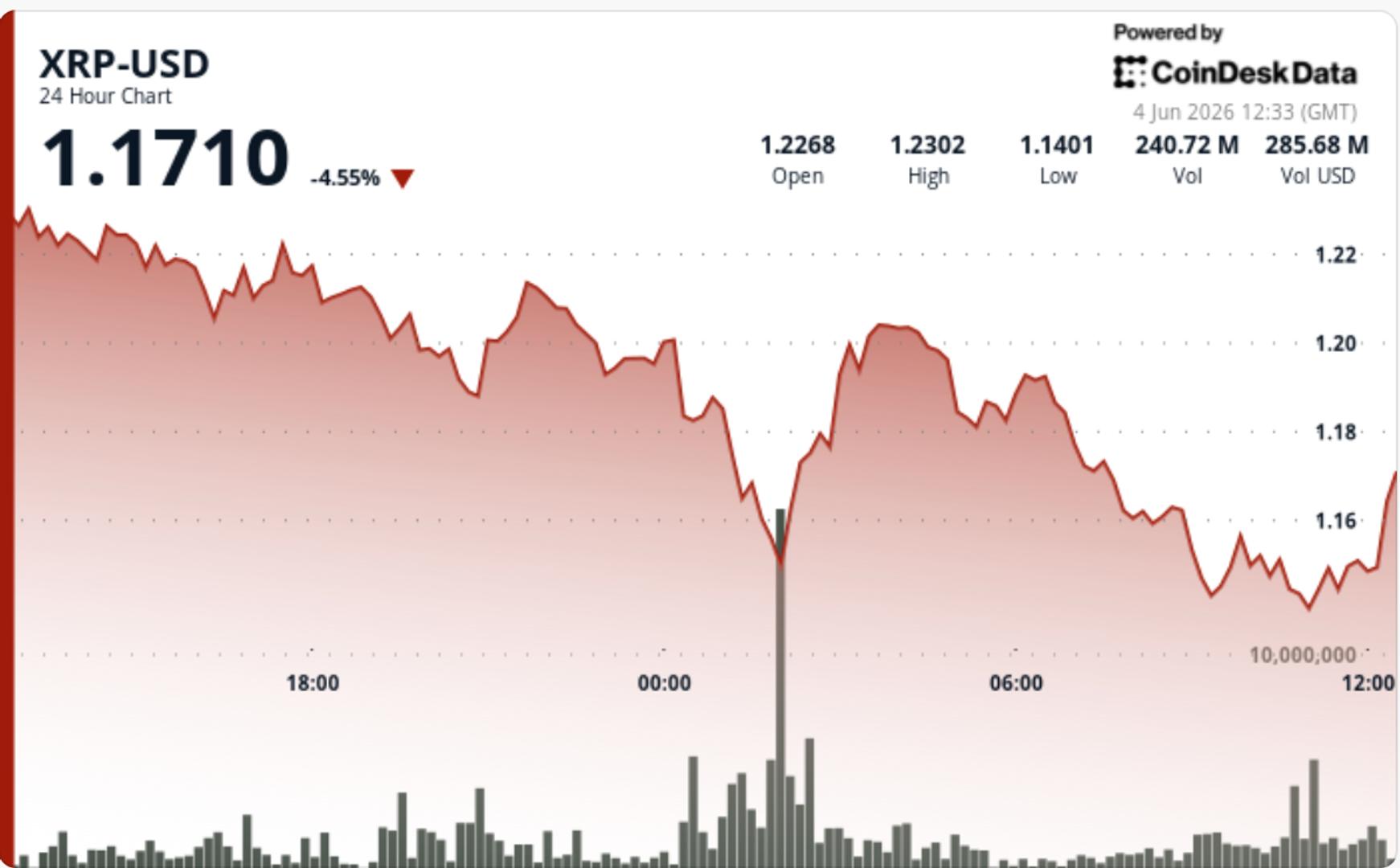
• XRP dropped from $1.2360 to $1.1497 during the 24-hour session, touching lows near $1.14 before recovering slightly.
• Volume surged to 248.2 million XRP during a support test, marking one of the largest trading bursts of the week.
• The selloff extended losses that began with the breakdown below $1.25, a level that had acted as support throughout much of the spring consolidation.
Technical Analysis
• XRP has now erased the entire $1.20-$1.60 trading range that defined the past four months, putting focus on support levels last tested during February’s selloff.
• The bigger issue is not the decline itself but the repeated failure of recovery attempts. Rallies in January stalled near $2.40, while a second rebound attempt in May failed around $1.54, reinforcing the broader downtrend.
• The monthly RSI has slipped below 43, a level reached only a handful of times in XRP’s history. Previous occurrences coincided with major market resets, though not necessarily immediate bottoms.
• A sharp bounce from the $1.14 area produced signs of short-term seller exhaustion, but volume outside the initial reversal remained largely routine, limiting confidence in the recovery.
What traders should watch
• $1.14-$1.15 is now the immediate support zone. A break lower shifts focus toward $1.11 and potentially the sub-$1.00 area highlighted by some bearish analysts.
• $1.28 has flipped from support into resistance and remains the first major level XRP would need to reclaim to stabilize sentiment.
• ETF inflows, exchange outflows and whale activity continue pointing toward accumulation underneath the surface. The problem for bulls is that price has yet to confirm any of it.
• XRP is approaching a genuine inflection point. Either buyers start defending the current range with conviction, or the market risks turning a four-month consolidation into a much larger breakdown.
When Zero Network announced it was shutting down last month, the reaction across crypto was weary: Another Ethereum layer-2 just bit the dust.
The closure joined a growing list of struggling rollups and came amid renewed debate about whether Ethereum’s sprawling layer-2 ecosystem has become too crowded. At the same time, Ethereum creator Vitalik Buterin has urged developers to rethink the network’s long-term scaling roadmap, while several major projects have shifted away from marketing themselves as general-purpose blockchains and toward more focused applications in payments, stablecoins and tokenized assets.
To many observers, the developments have revived a familiar question: Has Ethereum’s sprawling layer-2 ecosystem become too crowded?
Industry participants, however, argue the opposite.
“The thing to recognize is that anywhere where somebody would be running a smart contract on an existing blockchain, someone could equally run a layer two,” said Ben Fisch, co-founder and CEO of Espresso Systems. “We’re in a consolidation phase for general-purpose layer twos, not layer twos broadly.”
Ethereum layer-2s exploded over the past several years as improvements in rollup technology dramatically reduced the cost and complexity of launching new chains. Rollups work by processing transactions off Ethereum’s main blockchain, bundling hundreds of them together, and then periodically posting compressed transaction data back to Ethereum for settlement and security. The model allows applications to offer faster transactions and lower fees while still relying on Ethereum as the ultimate source of trust.
The result was a flood of networks built using infrastructure stacks such as Optimism’s OP Stack, Arbitrum Orbit and zkSync. But while launching a chain became easier, attracting users proved much harder.
“There were way too many general-purpose layer twos, which frankly don’t make sense as a product, because there’s no reason to have many, many versions of the same thing,” Fisch said.
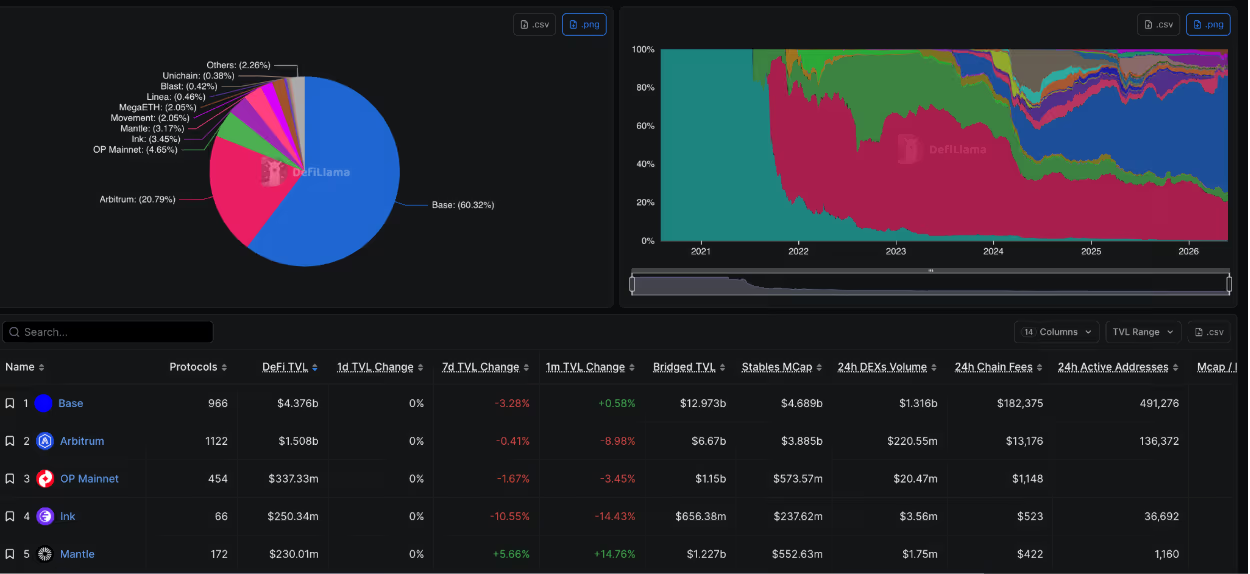
The numbers support that view. Today, activity across Ethereum’s layer-2 ecosystem remains heavily concentrated among a handful of networks. Base and Arbitrum alone account for more than 80% of layer-2 DeFi total value locked (TVL), according to DefiLlama data.

That concentration has only become more apparent as smaller chains struggle to maintain liquidity. Over the past six months, networks including Linea, World Chain, Starknet and Mantle have all seen declining bridge deposits. Linea’s deposits, for example, fell from $976 million in November 2025 to $367 million in May 2026, a decline of more than 60%.

“I think only a few L2s with clear financial demand will be able to sustain themselves over time,” said Alice Hou, a former research analyst at Messari, to CoinDesk.
For Hou, the key issue isn’t whether layer-2 technology works, it’s whether a network can generate enough activity to justify its existence.
“Without enough blockspace demand, user activity or developer traction, there is little reason to continue maintaining an L2,” she said.
Ironically, the economics of launching a rollup have never looked better. Ethereum’s Dencun upgrade, introduced in 2024, dramatically reduced the cost of posting rollup data to Ethereum through blobs. According to Messari research, data availability costs now represent only a small fraction of operator expenses for many OP Stack chains.
“From an operator perspective, it is definitely cheaper to run an L2 today,” Hou said. “The economics of launching an L2 have become easier, but the real challenge is still generating enough sustained demand to make the network worth operating.”
That dynamic has created a paradox. The barriers to creating a blockchain continue to fall, but the barriers to attracting users continue to rise. As a result, many teams are discovering that simply offering another Ethereum-compatible chain is no longer enough.
“People have realized that all the different general-purpose blockchains compete with each other,” Fisch said. “If you want to succeed, you need to build out a differentiated application.”
From infrastructure to applications
The shift is already visible across the industry. Several blockchain projects that once emphasized infrastructure are increasingly focusing on payments, stablecoins, tokenized assets and other application-specific markets. Traditional financial institutions may become some of the biggest beneficiaries.
Fisch pointed to asset managers launching tokenized money-market funds, stablecoin issuers and tokenized deposit platforms as examples of businesses that have clear reasons to operate on-chain. For those firms, a dedicated layer-2 can offer lower costs, greater control and more predictable performance than deploying directly as a smart contract.
“The technology decision to run as a layer two is simply an option of running an application onchain,” Fisch said.
Hou said she agreed that distribution matters more than technology.
“Only L2s with a solid existing user base and a clear reason to benefit from blockchain infrastructure should launch their own networks,” she said.
That helps explain why exchanges remain among the strongest candidates. Coinbase’s Base has become the dominant example, leveraging the exchange’s existing customer base while integrating users into Ethereum’s broader DeFi ecosystem.
“The question should not be, ‘Can this company launch an L2?’” Hou said. “It should be: ‘Does this business already have enough distribution, financial activity and ecosystem synergies to make an L2 meaningfully useful?’”
A different vision for the layer-2 landscape
The debate also reflects a deeper disagreement about what layer-2s are actually for. For years, Ethereum advocates framed rollups primarily as a scaling solution for Ethereum itself.
Fisch said he sees them differently.
“I don’t view layer twos as scaling Ethereum,” he said. “I view layer twos as leveraging the existing security properties of layer one.”
In that framework, Ethereum functions less as a destination and more as a settlement layer that applications can use when it makes sense.
“Ethereum is sort of a commodity that layer twos can choose to use,” Fisch said.
That vision aligns with a broader trend unfolding across crypto infrastructure. Rather than competing to become the next dominant blockchain, more projects are increasingly treating blockchains as modular components that can be assembled into larger products.
If that trend continues, the future Ethereum ecosystem may look very different from the one imagined during the rollup boom. Instead of hundreds of competing general-purpose chains fighting for liquidity, the winners could be a smaller number of networks tied to specific businesses, financial products and user communities.
Ether at $250,000 would make Ethereum a $30 trillion network, larger than the U.S. Treasury market and comparable to all the gold ever mined.
But that’s the target Bitmine chairman Tom Lee laid out at Proof of Talk in Paris this week, with the move pitched as a 50x from current levels on the back of AI-driven payments and a corporate validator takeover of the network.
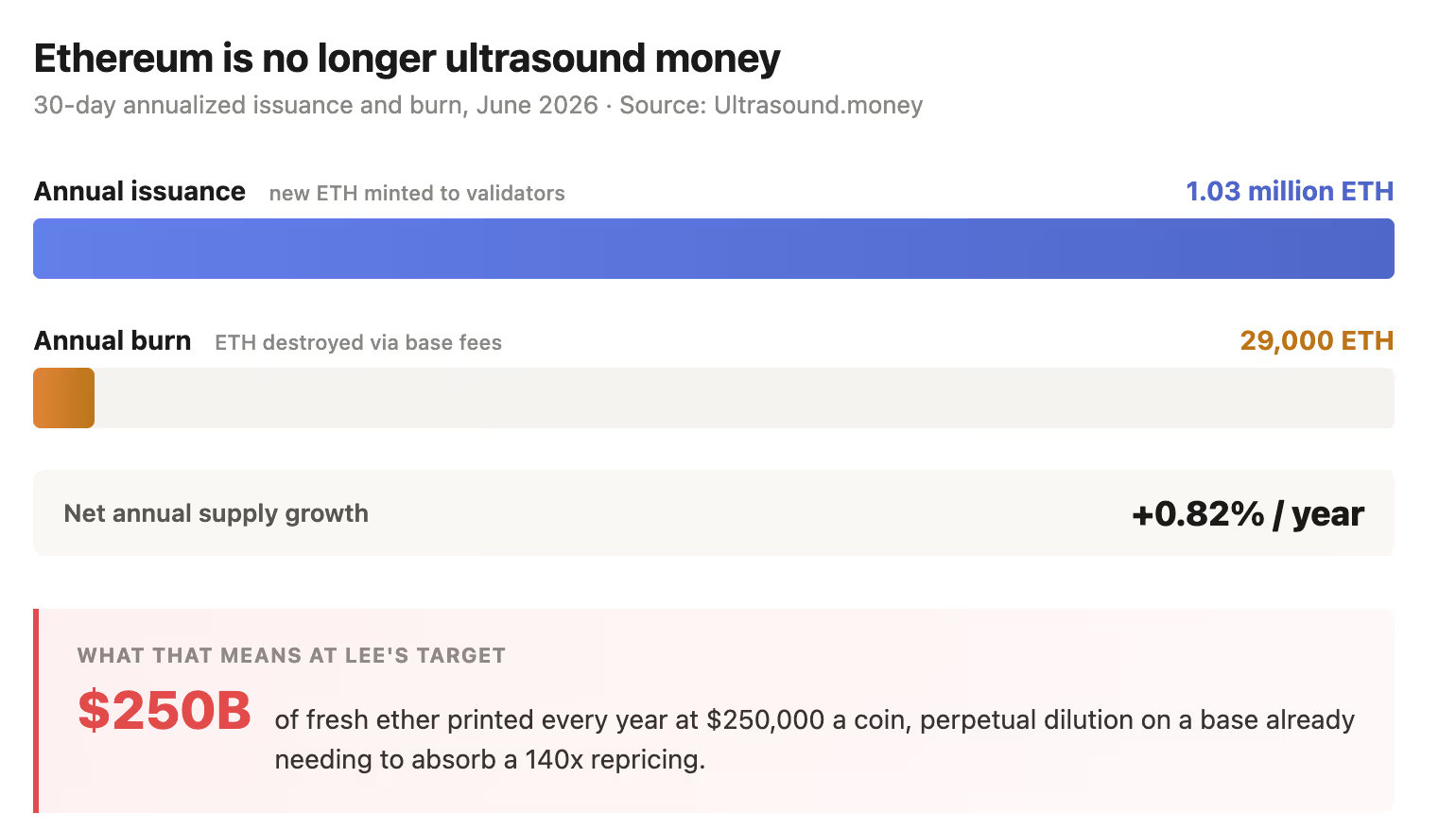
Let’s dive into the math of how that target may be reached, starting with supply. Ethereum’s circulating supply sits at 121.75 million ETH and is growing at 0.82% a year, because since the Dencun upgrade pushed most fee activity to cheaper layer-2 chains in 2024, the burn mechanism has collapsed to roughly 29,000 ETH a year against issuance of 1.03 million ETH.
At $250,000 a coin, that 0.82% drift turns into $250 billion of fresh ether issued every year.
The supply growth is not huge by itself. Gold supply expands at a similar pace, and the U.S. Treasury market grows much faster. Big assets can absorb new issuance if demand is strong enough.
However it puts to rest the old “ultrasound money” trade that was built on the idea that Ethereum could become a shrinking monetary asset while usage kept rising. That setup is not here right now. ETH supply is growing, slowly but steadily, so a 50x move has to come from demand doing almost all the work.

To get a sense of how far-out Lee’s target is, look at the ether-bitcoin ratio, which tracks how ether trades relative to bitcoin. The ratio has never crossed 0.15, a level it touched briefly at the 2017 peak. At today’s bitcoin price of $63,872, $250,000 ether would push that ratio to 3.91, more than 25 times that all-time high.
For the ratio to stay anywhere in its historical range while ether hits $250,000, bitcoin would have to rally to somewhere between $1.67 million and $2.94 million at the same time. So Lee’s call needs either bitcoin running alongside ether at similar multiples, or the pair breaking historical bounds wildly. Neither is in motion right now.

Lee further argued the Ethereum Foundation has dropped to roughly 0.1% of supply while corporate entities like Bitmine and SharpLink now control 7% of circulating ether collectively.
Public companies and governments hold 7.43 million ETH across 32 entities, or 6.16% of supply, with Bitmine alone at 5.42 million ETH and SharpLink at 869,000.
But holding ether and validating the network are different jobs. Validators are the operators that actually run the software securing Ethereum and earn the staking yield.
Of the 39.25 million ether currently staked, Lido, a decentralized staking protocol governed by a DAO of token holders, controls 19.4%, followed by Binance, ether.fi, Coinbase and Figment.
The top corporate treasuries are not running validators at anywhere near the scale Lee’s takeover thesis implies. Lido alone validates more ether than every public-company holder combined.

All in all, ether has to capture a chunk of global financial throughput that no asset has captured before, the burn has to outrun issuance again, the ETH-to-bitcoin pair has to recover more steeply than at any point in its history, and the corporate validator thesis has to actually translate into validating power.
The ETH-to-bitcoin pair turning on a real trend, not a one-week bounce, would be the first sign anything’s actually changing. Right now, however, the data tells a different one.
Bitcoin is currently knocking on the door that helped it bounce during the February crash at $60,000. The asset dumped toward $61,000 earlier today, which was hard to imagine just a few weeks ago when it traded above $82,000.
So, what could have prompted this massive 25% crash in well less than a month?
Investor Exodus
In general, falling prices require somebody selling, right? And it has to be in large quantities. The first that comes to mind are investors who had BTC exposure through the spot Bitcoin ETFs in the US. A simple look at the data provided from SoSoValue paints a clear and painful picture.
The funds have been deep in the red for 13 consecutive days, with the net outflows exceeding $500 million, $600 million, and even $700 million on some occasions. The net withdrawals have been in the billions of dollars for four straight weeks. The current one, even though the data is presented only until Wednesday, is on track to break the record, with already $1.4 billion in outflows.
This behavior is in stark contrast to the developments that took place by mid-May, when investors were rushing to pour funds into the ETFs.
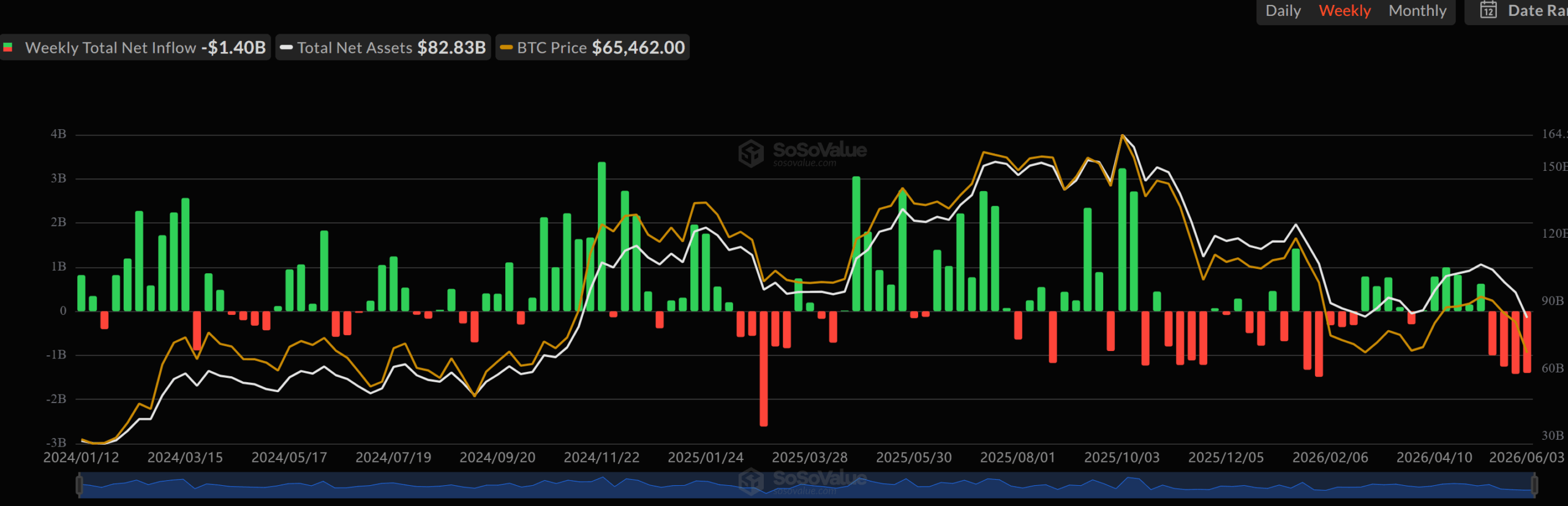
But, it’s not just ETF investors. Data shared by Ali Martinez shows a substantial uptick in the number of BTC sent to exchanges over the past week alone. Roughly 54,000 BTC (valued at $3.35 billion at today’s prices and at almost $3.8 billion when the transfers began) found their way to trading platforms, with the likely intention to be sold off.
54,000 Bitcoin bitcoin:native moved onto trading platforms over the past week. This spike in available supply of roughly $3.78 billion has increased short-term selling pressure, driving the price down to $65,300. https://t.co/AXEpKJPyND pic.twitter.com/pa5WPZXzUt
— Ali Charts (@alicharts) June 3, 2026
Strategy also sold. Yes, this one was speculated for weeks, but the actual confirmation could have been the necessary trigger for some investors to lose hope. Although the company disposed of a tiny portion of its massive BTC stash, the move was still categorized as bearish by many critics.
Mt. Gox also spread some FUD into the already fragile market, as on-chain data shows new BTC transfers to exchanges completed recently.
Iran-US and AI
A more macro reason came from the war front between the US and Iran (and several nearby nations). After weeks of a ceasefire but unsuccessful permanent peace negotiations, the US and Iran reinitiated the attacks against each other, which now involve Kuwait and other countries in the region as well.
History shows that risk-on assets like BTC do not react well to escalating war tensions. Recall that the asset dumped by several grand immediately after the initial strikes began in late February.
Lastly, Michael Saylor outlined the massive growth and hype of the artificial intelligence sector. He believes there’s a clear correlation between investor exodus from crypto and booming AI prices, which continues to harm the former’s progress. Nevertheless, he actually noted that such moments present opportunities.
Capital markets are funding the AI buildout at historic scale: ~$400B over 6 months. Bitcoin ETFs have seen ~$4B of outflows since May 14, pressuring $BTC. This is a capital rotation, not a Bitcoin impairment. Volatility creates opportunity.
— Michael Saylor (@saylor) June 4, 2026
So, What’s Next?
As usual, most crypto analysts are split on what could be around the corner for BTC. Some think a rebound is in the making, while others outlined lower price targets. Ali Martinez stands in the second corner. Basing his analysis on the MVRV pricing bands, he predicted that BTC could be on its way down to $55,000 or even $50,000. It’s worth noting that the cryptocurrency hasn’t traded at such low levels for almost two years.
CryptoQuant’s CEO, though, noted that there’s one major difference between bitcoin’s current state and that of two years ago. Although the price is relatively similar, he noted that short-term holders are “evolving into long-term holders” now, as the percentage of holdings from investors who had bought from 6 months to 2 years ago is up to 53% from 15% back in 2024.
Bitcoin is at the same price as two years ago, but one thing is different.
The 6m–2y cohort, who joined this cycle, now holds 53% of realized cap, up from 15% two years ago. Last cycle, Bitcoin bottomed when this hit 68%.
Short-term holders are evolving into long-term holders. pic.twitter.com/tfmLz3mFPS
— Ki Young Ju (@ki_young_ju) June 4, 2026
The post Bitcoin’s $20K Collapse: 6 Reasons Behind the Crash and What Happens Next? appeared first on CryptoPotato.
Crypto World
Scott Bessent Pushes CLARITY Act This Summer: Bitcoin Reserve Will Grow at “Deliberate Speed”

U.S. Treasury Secretary Scott Bessent is pushing hard for the Crypto CLARITY Act to clear Congress by summer 2026, and simultaneously urging patience on the Strategic Bitcoin Reserve.
That combination of urgency on legislation and caution on sovereign BTC accumulation tells you exactly where the administration’s priorities sit right now.
Bessent has described the Bitcoin Reserve as moving at “deliberate speed,” a phrase that signals intent without committing to a timeline.

The tension is real: the same administration that wants to position America as a crypto superpower is also the one pumping the brakes on its most headline-grabbing crypto policy.
Discover: The Best Crypto to Diversify Your Portfolio
CLARITY Act by Summer 2026: What Bessent’s Backing Actually Means for SEC vs. CFTC
The core problem the CLARITY Act solves is jurisdictional. For years, the SEC and CFTC have operated overlapping and often contradictory mandates over digital assets, leaving exchanges, developers, and institutional desks in a permanent state of legal ambiguity.
Bessent and the Department of the Treasury want that resolved, and they want it done through legislation rather than continued regulation by enforcement.
Bessent has framed the bill as “essential to the future viability of bitcoin and digital asset markets in the U.S.” and has publicly argued that even just progress toward passage would “greatly reassure the market” during periods of volatility.
— DustyBC Crypto (@DustyBC) June 3, 2026
 𝗝𝗨𝗦𝗧 𝗜𝗡:
  Treasury Secretary Scott Bessent says he is looking forward to the Clarity Act being passed this summer. pic.twitter.com/HW3zcGMRqm
The legislative path isn’t clean. Coinbase withdrew its support for the bill in January 2026, citing disputes over the treatment of stablecoin rewards, and that pullback contributed to committee delays that are still playing out.
Closed-door negotiations are ongoing in both chambers, and the stablecoin impasse remains the central sticking point heading into markup deadlines.
If the bill does pass, the structural impact on Crypto Regulation is significant. A clear SEC vs. CFTC boundary eliminates the ambiguity that has kept institutional players on the sidelines and inflated compliance costs across the industry.

Prediction market Polymarket is currently pricing in roughly a 59% probability that the CLARITY Act gets enacted by end of 2026, meaningful odds, but hardly a lock.
That’s a long-term bullish structural shift, not a near-term price catalyst, but the kind of framework change that underpins a sustained institutional accumulation cycle.
The Bitcoin Strategic Reserve: ‘Deliberate Speed’ Is Doing a Lot of Heavy Lifting
The Bitcoin Strategic Reserve, established under Executive Order 14233 signed in March 2025, currently holds an estimated $15–20 billion in BTC and other digital assets seized by U.S. law enforcement.
The order bars the government from selling any bitcoin once it enters the reserve, ending the longstanding practice of U.S. Marshals Service auctions of forfeited BTC.
Bessent confirmed on Fox Business that the U.S. will not purchase bitcoin on the open market. The reserve grows only through future confiscations, and the Treasury is exploring what Bessent called “budget-neutral pathways” to acquire more, think asset swaps or reallocation of existing digital-asset portfolios rather than net new taxpayer outlays.
JUST IN: — Bitcoin Magazine (@BitcoinMagazine) June 3, 2026
Treasury Secretary Scott Bessent says he's looking forward to working with lawmakers on the Strategic Bitcoin Reserve 
"We are proceeding with all deliberate speed. And we are making sure…we use best practices and things will be durable for the future"  pic.twitter.com/wMuttlfTlc
For traders expecting a sovereign buy-wall, that’s a cold shower. Given how quickly leveraged markets can destabilize around large BTC flows, Bessent’s caution on open-market purchases is probably the right call for systemic stability.
White House digital-asset adviser Patrick Witt has flagged a “significant announcement” on next steps for the reserve, including governance and custody frameworks, due “in the coming weeks.” That announcement will tell us whether “deliberate speed” means methodical or stalled.
The strategic framing matters too. At Davos, Bessent tied the reserve explicitly to Trump’s goal of making the U.S. a frontrunner in crypto innovation, calling it a strategic resource closely watched by foreign governments.
Washington is no longer treating bitcoin as contraband. That shift in posture, regardless of the reserve’s current size, carries weight and is likely to shape Bitcoin’s long-term price trajectory as sovereign interest deepens globally.
Two policies, two speeds. The CLARITY Act gets the urgency; the Bitcoin Reserve gets the caution. Bessent’s framing is disciplined, but the market will eventually demand more than deliberate.
Discover: The Best Token Presales
The post Scott Bessent Pushes CLARITY Act This Summer: Bitcoin Reserve Will Grow at “Deliberate Speed” appeared first on Cryptonews.
TLDR:
- Coinbase has launched a pre-IPO perpetual futures product, with SpaceX as the first available listing.
- The product is settled in USDC, trades 24/7, and is currently restricted to non-U.S. users only.
- Forbes estimates SpaceX’s $135 IPO share price could make Elon Musk the world’s first trillionaire.
- Reuters reports the SpaceX IPO is targeted for June 12, with prediction markets placing 91% odds on Musk.
Coinbase has introduced a pre-IPO perpetual futures product, allowing traders outside the United States to speculate on private companies before their public debut. SpaceX, owned by Elon Musk, is the first company listed on the platform.
The product is settled in USDC, trades around the clock, and positions carry over automatically once the IPO is complete. More listings across technology, AI, energy, and space sectors are expected soon.
SpaceX Takes Center Stage on Coinbase’s New Platform
Coinbase’s pre-IPO perp product gives traders direct exposure to SpaceX’s valuation ahead of its anticipated public listing.
Positions are opened using USDC, ensuring a stable settlement currency throughout the trading period. The product operates 24/7, meaning traders can react to new developments at any time.
Once SpaceX completes its IPO, all open positions will automatically convert based on the debut share price. This means traders stand to gain or lose depending on how closely pre-IPO valuations align with the actual listing price. Pre-market prices are historically volatile, so risks remain considerable.
Taking to X to explain the product’s purpose, Coinbase co-founder and CEO Brian Armstrong wrote, “Pre-IPO perps are great to get exposure to private companies before they go public (outside the U.S. only for now) and to help with price discovery.”
His post frames the product as both a speculative tool and a mechanism for establishing fair market value before a company lists publicly.
Currently, the product is restricted to users outside the United States. Coinbase has not disclosed a timeline for a potential U.S. rollout, though the platform confirmed additional pre-IPO listings are coming across multiple industries.
SpaceX IPO Could Make Musk the World’s First Trillionaire
The timing of Coinbase’s launch coincides with major news surrounding the SpaceX IPO itself. Forbes reported that a listing price of $135 per share could push Elon Musk’s net worth past the trillion-dollar mark. That would make him the first person in history to reach that milestone.
Reuters reported the IPO is targeted for June 12, placing the event just days away. On prediction market Myriad, users currently assign a 91% probability to Musk becoming a trillionaire before July. That level of confidence reflects strong market sentiment around the listing.
Perpetual futures, or perps, allow traders to go long or short on an asset without holding it directly. Unlike standard futures, perps carry no expiration date, making them suitable for longer-term speculation. The format gained widespread popularity last year through decentralized exchange Hyperliquid.
Coinbase’s product merges perps with pre-market trading, a structure already familiar in the crypto space. Pre-market token trading has been a common feature on exchanges, though price accuracy remains a known challenge given the speculative nature of early-stage listings.


Bitget, the world’s largest Universal Exchange (UEX), has added 15 tokenized stocks and ETFs as eligible margin assets within its Unified Trading Account and Multi-Asset Mode for USDT-M Futures. Effective June 4 (UTC+8), users can utilize select tokenized equities and ETFs as collateral while trading futures, expanding capital efficiency across multiple asset classes within a single account structure.
The newly supported assets include rAAPL, rAMZN, rMETA, rMU, rTSLA, rGOOGL, rNVDA, rINTC, rMSFT, rASML, rAVGO, rTSM, rQQQ, rSPY, and rSNDK. The update expands the utility of tokenized assets on Bitget by allowing users to deploy them beyond spot market exposure and integrate them into futures trading strategies.
“As tokenized assets continue to gain traction across global markets, users are looking for more ways to utilize their holdings across different trading activities,” said Gracy Chen, CEO at Bitget. “Adding tokenized stocks and ETFs as margin assets increases flexibility within the Unified Trading Account and supports a more seamless experience across crypto and traditional market products.”
Bitget’s Unified Trading Account allows users to manage spot assets, futures positions, and margin requirements through a consolidated framework. Under the Multi-Asset Mode for USDT-M Futures, eligible assets can contribute to margin requirements, helping users optimize capital allocation while maintaining exposure across different markets. The addition of tokenized stocks and ETFs further broadens the range of assets available within this system.
The launch reflects growing demand for trading infrastructure that connects digital assets with traditional financial markets. As tokenized equities gain adoption, traders increasingly look to move capital efficiently across products without transferring funds between separate accounts or converting holdings into a single settlement asset. Expanding margin eligibility supports this trend by increasing the practical utility of tokenized assets within a broader trading environment.
The announcement follows Bitget’s continued expansion of its Universal Exchange ecosystem, which brings together crypto assets, tokenized financial instruments, and derivatives trading under a single account. The platform currently offers access to more than 100 tokenized stocks, ETFs, commodities, foreign exchange products, and precious metals, giving users broader access to global financial markets through a unified trading experience.
For more information, visit: https://www.bitget.com/support/articles/12560603884658
About Bitget
Bitget is the world’s largest Universal Exchange (UEX), serving over 125 million users and offering access to over 2M crypto tokens, 100+ tokenized stocks, ETFs, commodities, FX, and precious metals such as gold. The ecosystem is committed to helping users trade smarter with its AI agent, which co-pilots trade execution. Bitget is driving crypto adoption through strategic partnerships with LALIGA and MotoGP™. Aligned with its global impact strategy, Bitget has joined hands with UNICEF to support blockchain education for 1.1 million people by 2027. Bitget currently leads in the tokenized TradFi market, providing the industry’s lowest fees and highest liquidity across 150 regions worldwide.
For more information, visit: Website | Twitter | Telegram | LinkedIn | Discord
For media inquiries, please contact: media@bitget.com
Risk Warning: Digital asset prices are subject to fluctuation and may experience significant volatility. Investors are advised to only allocate funds they can afford to lose. The value of any investment may be impacted, and there is a possibility that financial objectives may not be met, nor the principal investment recovered. Independent financial advice should always be sought, and personal financial experience and standing carefully considered. Past performance is not a reliable indicator of future results. Bitget accepts no liability for any potential losses incurred. Nothing contained herein should be construed as financial advice. For further information, please refer to our Terms of Use.
The post Bitget Expands Unified Trading Account with Tokenized Stocks as Margin Assets appeared first on BeInCrypto.

BloFin Research: Bitcoin’s Sharp Fall Is on Schedule, Not Off the Rails

RHOBH’s Dorit Says Only 1 Costar Congratulated Her on Book

Money – Cojo Crazy (Video Oficial)



-

 Tech6 days ago
Waymo dominates autonomous vehicle registrations as Tesla trails behind
-

 News Videos6 days ago
This is BROKEN! INSANE 5x MONEY CAR WASH WEEK! The NEW GTA Online UPDATE Today! (GTA5 New Update)
-
 Tech5 days ago
SpaceX just won a second Golden Dome contract. This one is $4.16 billion.
-

 Business3 days ago
Jade Biosciences, Inc. (JBIO) Discusses Positive Interim Results From JADE101 Phase I Healthy Volunteer Study and Development Plans Transcript
-

 News Videos6 days ago
SHE IS KILLING XRP!!! WATCH URGENT AND ACT FAST
-
 NewsBeat6 days ago
FIRST NIGHT REVIEW: Take That bring the Circus back to life in spectacular sun-soaked style
-

 Business5 days ago
Is the Spurs Phenom Already Better Than Prime Diesel?
-
Crypto World6 days ago
CFTC Has Approved the First Regulated Bitcoin Perpetual Contract in the U.S.
-

 Politics5 days ago
The House | Inside Andy Burnham’s Makerfield Campaign: “Nobody Thinks This Is In The Bag”
-

 Sports2 days ago
French Open 2026 results: Alexander Zverev beats Rafael Jodar and will play Jakub Mensik in semi-finals
-
 NewsBeat6 days ago
Novak Djokovic v Joao Fonseca LIVE: French Open latest scores and results after Jannik Sinner’s shocking collapse
-
 Entertainment6 days ago
Weak ‘Supergirl’ Box Office Tracking Amid Milly Alcock Backlash
-

 Tech2 days ago
CryZENx Releases Fresh Playable Content Deep Inside Jabu-Jabu for His Ocarina of Time Remake
-
 Crypto World6 days ago
Snowflake (SNOW) Stock Rallies on Strong Q1 Results and AI Product Growth
-

 Entertainment6 days ago
Maddox Jolie-Pitt Legally Requests to Drop Brad’s Surname
-

 Business5 days ago
Demand Conditions Improve In Chemicals Sector In April 2026
-
 Entertainment5 days ago
One of the Greatest Sitcoms of All Time Shoots Up Apple TV’s Charts 11 Years Later
-

 Tech6 days ago
This Week In Security: Ubiquiti Fixes, And FreeBSD Joins The Club You Don’t Want To Join
-
 Crypto World6 days ago
MicroStrategy Moves $30 Million in BTC to Coinbase Prime: Is the Bitcoin Sell-Off Already Here?
-
 Entertainment6 days ago
Bruce Willis’ Generosity Resurfaces Amid His Dementia
You must be logged in to post a comment Login