
Crypto World
Strategy is selling stock to pay dividends on stock



The company raised $544.5 million in one week by issuing common shares, bought no bitcoin with it, and put it in a reserve whose stated purpose is covering preferred dividends. The obligation runs $1.76 billion a year. The flywheel that made Strategy famous now turns in the opposite direction, and the coverage is calling it bullish.
Summary
- An SEC filing covering the week ended July 26 shows Strategy sold nearly 5.43 million Class A common shares through its at-the-market programme for $544.5 million in net proceeds.
- No bitcoin was purchased with those proceeds. Holdings stayed flat at 843,775 BTC at an average cost near $75,476, a total cost basis around $63.69 billion.
- The money went into a dedicated USD Reserve, now at $3.75 billion, whose board-approved purpose is paying preferred stock dividends and interest expenses as they come due.
- Those obligations run approximately $1.76 billion annually across five preferred series, and the STRC rate rose from 11.5% to 12.00% effective July 1.
- Strategy reports second-quarter results after the close today, having already disclosed an $8.32 billion quarterly loss on digital assets and a bitcoin position carried roughly $14 billion below cost.
For four years Strategy ran the most-copied machine in corporate finance, and its logic was simple enough to fit on a slide. Issue equity at a premium to the value of the bitcoin you hold, use the proceeds to buy more bitcoin, watch bitcoin per share rise, and let the premium justify the next issuance. Every digital asset treasury company that followed copied that loop, and this publication documented what happened when the premium compressed and the loop stalled. What has happened since is different and considerably less discussed. The loop has not stalled. It has reversed. In the week ended July 26, Strategy sold nearly 5.43 million common shares for $544.5 million, bought no bitcoin at all, and placed the money in a reserve dedicated to paying dividends on the preferred stock it issued to buy bitcoin in the first place. The company now raises equity from common shareholders to service instruments held by preferred shareholders, against a bitcoin position carried roughly $14 billion below what it cost. One outlet covered the same filing under a headline about an analyst seeing $570 a share. The arithmetic underneath deserves its own reading.
What the filings show
The weekly disclosures are the most useful documents Strategy produces, because they report activity, not strategy, and the last several tell a consistent story.
For the week ended July 26, the company sold approximately 5.43 million Class A common shares through its at-the-market offering programme, generating $544.5 million in net proceeds. Bitcoin holdings were unchanged at 843,775 BTC, acquired at an average cost of roughly $75,476 per coin for a total cost basis near $63.69 billion.
The USD Reserve rose to $3.75 billion, which the company describes as covering approximately 2.1 years of preferred dividends and interest.
Set that beside the quarter it just closed. The 8-K filed on July 6 disclosed an $8.32 billion loss on digital assets for the three months ended June 30, of which $8.31 billion was unrealised, against a carrying value of $49.67 billion and an aggregate purchase price of $63.94 billion. Because cost basis exceeded fair value at quarter end, the company recorded a valuation allowance fully offsetting the deferred tax benefit associated with the unrealised loss.
The same filing disclosed sales. Strategy sold 1,363 BTC between June 29 and June 30 for $80.8 million at an average of $59,256, then 2,225 BTC between July 1 and July 5 for $135.2 million at an average of $60,773. Both tranches went for roughly $15,000 per coin below the company’s average purchase price.
The stated use of proceeds was funding preferred stock distributions and replenishing the USD Reserve.
And the enabling authority was created days earlier. On June 29 the board approved a BTC Monetization Programme permitting up to $1.25 billion of bitcoin sales for reserve purposes, alongside a $2 billion buyback split between common stock and the preferred securities, and an increase in the STRC dividend rate to 12.00%.
The obligation, sized
The reason any of this is happening is a fixed annual cash cost that most coverage of Strategy treats as a footnote.
The company has issued five preferred series, and each carries a dividend rate. STRK pays 8.00%. STRF pays 10.00%. STRD pays 10.00%. STRC, the variable-rate series, moved to 12.00% effective for record dates from July 1, payable semi-monthly. A euro-denominated series trades in Luxembourg. Together with interest expense, those obligations total approximately $1.76 billion a year.
That figure is the fulcrum of the entire situation, and three properties of it matter.
It is cash, and it is contractual. Bitcoin appreciation does not pay a preferred dividend. Only dollars do, and the company holds an asset that produces none. Every dollar of that $1.76 billion must come from somewhere other than the bitcoin, unless the bitcoin is sold.
It is senior to the common. Preferred holders receive their distributions before common shareholders receive anything, which is the ordinary structure of preferred equity and is worth stating because it determines who bears the cost of servicing it.
And it is not collateralised by the bitcoin. Strategy’s own disclosures state plainly that the preferred securities are not collateralised by the company’s bitcoin holdings and hold only a preferred claim on residual assets. The 12% yield on STRC is not a claim on 843,775 bitcoin. It is a claim on whatever is left after everything else, funded in practice by whatever the company can raise or sell.
Put those together and the machine’s current operation becomes legible. The obligation is fixed and in dollars, the asset produces no dollars, so the dollars come from issuing shares, and the shares are issued by the common holders whose claim sits behind the obligation being paid.
The inversion
It is worth putting the old flywheel and the new one side by side, because the same activities appear in both and they mean opposite things.
The original loop. Strategy trades at two to three times the market value of its bitcoin. It issues equity into that premium. Because it pays roughly a third to a half of net asset value for each dollar raised, the issuance is accretive: bitcoin per share rises even as share count grows. Existing holders benefit from the dilution. Reflexively, the rising bitcoin-per-share figure supports the premium that permits the next raise.
The current loop. The premium has compressed to roughly one times net asset value, from historical levels of two to three. At that multiple, issuing equity is no longer accretive; each new share buys approximately its own proportional share of bitcoin, and existing holders gain nothing from the dilution. The proceeds do not buy bitcoin at all. They fund a reserve that pays preferred dividends. Bitcoin per share falls, because the count rises and the holdings do not.
Same at-the-market programme, same filings, opposite economics. Under the original loop, dilution was the mechanism by which common holders got richer. Under the current one, dilution is the mechanism by which preferred holders get paid.
The company’s own framing does not dispute the mechanics, and its case is a liquidity case, not an accretion case: a reserve covering 2.1 years of obligations removes the risk of a forced bitcoin sale at a bad price and requires no recovery in the bitcoin price to function. That is a real argument, and it is a different argument from the one that made the stock famous.
The dilution fight, both sides
Two camps have formed around exactly this question, and both deserve their strongest version.
The critics’ case, argued most publicly by Peter Schiff, is that repeated issuance at or near one times net asset value dilutes common shareholders while the bitcoin position sits underwater relative to cost. The sharper version notes that Strategy had signalled restraint on dilution once the premium compressed, and then kept selling shares anyway to prioritise the cash buffer. On this reading, common holders are being diluted to guarantee a 12% coupon to a different class of security, and the company is choosing preferred solvency over common value.
The defenders’ case, argued by Benchmark’s Mark Palmer among others, is that near-term dilution is outweighed by the removal of refinancing and dividend-payment risk. A balance sheet with 2.1 years of coverage cannot be forced into distressed bitcoin sales, which protects the asset base for a recovery. On this reading the dilution buys optionality, and a company that survives a drawdown intact captures the upside that a forced seller does not. Palmer’s price target sits at $570; the consensus across fourteen analysts is near $321.
Both are internally coherent, and the disagreement is really about time horizon. The critics are pricing the next several quarters, in which dilution is certain and recovery is not. The defenders are pricing a cycle, in which survival is the precondition for everything else. Neither side disputes the arithmetic, which is unusual and clarifying.
What both sides skip is the third party. The preferred holders are receiving 8% to 12% on instruments explicitly not secured by the bitcoin, funded by equity issuance from a company whose asset is carried $14 billion below cost. That is a good deal while the equity market remains willing to buy the shares. It is a claim on residual assets if it stops.
What the market has already said
Prices are the compressed version of all of the above, and they have moved.
The common has fallen sharply, down roughly 68% over a twelve-month period at one point during this stretch, and traded near $101 around the time the buyback was announced. Management repurchasing common at that level was read as a signal that the company considered its own shares cheap relative to their bitcoin content even at a one-times multiple, which is a defensible reading and also an admission about where the multiple is.
The preferred has its own signal. STRC traded below its $100 par value ahead of the rate increase, which is the market pricing dividend-coverage risk, not dividend generosity. Raising the rate to 12.00% and moving to semi-monthly payments are both responses to that: a higher coupon and more frequent cash make the instrument easier to hold at par. The reserve build is the third response, and the most expensive.
There is also a legal overhang. A law firm announced an investigation in late June, and the announcement coincided with pressure on the shares. Investigations of this kind are common for companies whose stock has fallen steeply and frequently produce nothing, and they also raise the cost of every capital markets decision while they run.
The copycats have no buffer
The reason this matters beyond one company is that Strategy’s template was copied across dozens of listed vehicles, and almost none of them have the balance sheet to run the manoeuvre currently underway.
The template as copied had three components: raise capital, buy a token, trade above net asset value so the next raise is accretive. Most imitators skipped the fourth thing Strategy built, which was a capital structure deep enough to survive the premium disappearing. Strategy has a $21 billion equity offering authorisation, an at-the-market programme capable of moving half a billion dollars in a week, five preferred series across two exchanges, a $2 billion buyback authorisation, a $1.25 billion monetisation programme, and a $3.75 billion cash reserve. That is not a treasury company. It is a capital markets operation with a treasury attached.
The vehicles that copied the visible half face the same arithmetic with none of that. A listed treasury company at one times net asset value cannot issue accretively, and one below it cannot issue at all without visibly destroying value. If it also carries fixed obligations, the only remaining source of cash is selling the asset, which is the outcome Strategy has spent $3.75 billion specifically to avoid. Our audit of an XRP treasury vehicle arriving at its listing gate with holdings more than fifty percent below cost describes what that position looks like before any buffer exists.
There is a further asymmetry worth naming. Strategy’s preferred instruments trade, which gives the market a continuous read on whether coverage is believed. STRC below par is a signal, and the company has responded to that signal twice, with a rate increase and a reserve build. Most imitators have no comparable instrument and therefore no comparable signal, which means their solvency questions surface later and more abruptly.
So the sector reading is not that Strategy is in trouble. It is that Strategy is executing an expensive, visible, well-capitalised response to a problem every vehicle built on its template shares, and that most of them cannot execute the same response. What the archetype does with a $3.75 billion buffer is what the imitators will have to do without one.
What tonight’s print should answer
Strategy reports second-quarter results after the close today, with a webinar following. The headline loss is already public, so the useful content is elsewhere.
Whether the equity issuance continues at this pace. Half a billion dollars in a single week is a rate that, sustained, would add several billion in dilution over a year. Guidance on the reserve target relative to the $3.75 billion already held is the number that matters.
Whether the BTC Monetization Programme gets used. The $1.25 billion authorisation from June 29 remains largely available. Drawing on it would mean choosing bitcoin sales over further dilution, which is a real strategic choice with a visible constituency on each side.
Whether the preferred stack grows. New issuance in the preferred tier would raise the annual obligation above $1.76 billion, which is the number every other decision here is measured against.
And what management says about accretion. For four years the company reported bitcoin per share as its central metric because the loop made it rise. It now falls with every issuance. How that is addressed on the call, or whether it is addressed, is the clearest available signal about how the company understands its own position.
Where the reserve came from matters
One more distinction deserves drawing, because “building a cash reserve” sounds prudent in a way that obscures who paid for it.
There are three ways a company can fund a dollar reserve. It can generate operating cash flow, which Strategy’s software business does at a scale immaterial against a $1.76 billion obligation. It can borrow, which adds interest expense to the very cost it is trying to cover and requires a lender comfortable with the collateral. Or it can sell claims on itself, either equity or the asset.
Strategy has chosen the third, in both forms. Roughly $544.5 million came from selling common shares in a single week. Roughly $216 million came from selling bitcoin at prices about $15,000 below cost. Both transfer value out of the existing common holders’ claim: the first by dividing the same asset base across more shares, the second by shrinking the asset base itself at a realised loss.
That is not a criticism of prudence. A reserve genuinely removes forced-seller risk, and forced selling during a drawdown is how treasury companies die rather than merely disappoint. The point is narrower: the reserve is not new value created by the company. It is existing value converted from a volatile form into a liquid one, at a cost borne by one class of shareholder for the benefit of another, and the conversion happened at prices the company itself would have called unattractive eighteen months ago.
The version of this that would change the assessment is operating cash flow large enough to cover the obligation, which would make the preferred coupon self-funding and the entire discussion moot. Strategy does not have that and has never claimed to. What it has is an asset that appreciates sometimes and a coupon that comes due every fifteen days.
What to watch after
The weekly filings. They are the highest-frequency disclosure Strategy produces and they report the actual activity: shares sold, proceeds, bitcoin bought or sold, reserve balance. Read them as a series rather than individually; the trend in bitcoin per share is the whole story in one line.
The reserve against the obligation. Coverage of 2.1 years is comfortable. What matters is the direction: whether the reserve grows faster than the obligation, and at what cost in dilution.
STRC against par. The preferred trading at or above $100 means the market believes coverage. Below par means it does not, and the company has already raised the rate once in response.
Bitcoin’s price relative to $75,476. That is the average cost basis. Above it, the position is profitable and every argument here softens. Roughly $15,000 below it, which is where recent sales executed, every sale realises a loss and every dilution decision gets harder.
Whether the sector follows. Strategy is the archetype, and the treasury companies built on its template face the same arithmetic with less capital and shorter histories. Our coverage of one such vehicle arriving at its listing more than fifty percent underwater describes what this looks like without a $3.75 billion buffer.
The metric that stopped working
One detail deserves separate treatment because it is the cleanest illustration of what has changed, and it is a metric Strategy invented.
For years the company reported bitcoin per share as its headline performance measure, and it was the right measure for the strategy it was running. If you issue equity at a premium and spend the proceeds on bitcoin, the number rises, and it rises specifically because of the dilution that would ordinarily be a cost. Bitcoin per share made the loop legible: it converted an unconventional capital structure into a single figure that either went up or did not. Investors learned to watch it, imitators learned to report it, and it became the sector’s standard.
That metric now moves the wrong way by construction. Issuing shares while holdings stay flat reduces bitcoin per share mechanically, and the current programme does exactly that at a rate of roughly half a billion dollars a week. Selling bitcoin to fund dividends reduces it twice, through both the numerator and, if paired with issuance, the denominator. There is no configuration of the present strategy in which the company’s own signature metric improves.
Which creates a communication problem with no clean answer. Abandoning the metric invites the observation that it was only ever reported while it flattered. Retaining it means publishing a declining number every week. Reframing it, toward liquidity coverage or years of dividend runway, is the most likely path and is also an admission that the measure of success has changed from accumulation to survival.
Watch which of those three the company chooses, because it is the most honest available indicator of how management understands its own position. Metrics get retired when strategies do, and the retirement usually precedes the acknowledgment by several quarters.
Frequently Asked Questions
What did Strategy’s latest filing actually disclose?
For the week ended July 26, 2026, the company sold approximately 5.43 million Class A common shares through its at-the-market programme for $544.5 million in net proceeds, purchased no bitcoin, held holdings steady at 843,775 BTC at an average cost near $75,476, and lifted its dedicated USD Reserve to $3.75 billion, described as roughly 2.1 years of preferred dividend and interest coverage.
Why is Strategy issuing shares if it is not buying bitcoin?
To fund a cash reserve whose board-approved purpose is paying preferred stock dividends and interest as they come due. Those obligations total approximately $1.76 billion annually across five preferred series and must be paid in dollars, while bitcoin produces no cash flow. The alternatives are selling bitcoin or issuing equity, and the company has chosen mostly the latter.
How is this different from Strategy’s original strategy?
It is the inverse. The original loop issued equity at two to three times net asset value, making each raise accretive because proceeds bought more bitcoin per share than the dilution cost. With the multiple compressed near one times, issuance is no longer accretive, and the proceeds fund dividends rather than purchases, so bitcoin per share falls with each raise.
Are the preferred dividends secured by the bitcoin?
No. Strategy’s own disclosures state that the preferred securities are not collateralised by its bitcoin holdings and hold only a preferred claim on residual assets. The 8% to 12% yields are claims on the company generally, funded in practice by capital raising and, when authorised, bitcoin sales.
Has Strategy sold bitcoin?
Yes. It sold 1,363 BTC between June 29 and June 30 for $80.8 million, and a further 2,225 BTC between July 1 and July 5 for $135.2 million, roughly $216 million in total at average prices around $15,000 below its own cost basis. Proceeds funded preferred distributions and replenished the reserve. A $1.25 billion monetisation authorisation remains largely unused.
What is the argument that this is bullish?
That a reserve covering 2.1 years of obligations eliminates the risk of forced bitcoin sales at distressed prices, requires no recovery in bitcoin to function, and preserves the asset base for an eventual upcycle. On this view, near-term dilution buys survival, and survival is what allows a treasury company to capture a recovery. Benchmark’s price target is $570 against a consensus near $321.
What is the argument that it is not?
That issuing equity at or near one times net asset value transfers value from common shareholders to preferred holders, that the company signalled restraint on dilution once the premium compressed and then continued selling shares anyway, and that bitcoin per share, the metric the company itself made central, now declines with every raise.
What should investors watch tonight and afterward?
Whether the pace of equity issuance continues, whether the bitcoin monetisation authorisation gets used, whether the preferred stack grows and raises the annual obligation above $1.76 billion, how management addresses bitcoin per share, and in the weekly filings afterward, the direction of the reserve relative to the obligation and of STRC relative to its $100 par. This is educational analysis, not investment advice.
Disclaimer: This article is for information and educational purposes only and does not constitute financial or investment advice. Figures reflect regulatory filings and reporting available at the time of writing and change with each disclosure. Nothing here is a recommendation to buy, sell, or hold any security or asset. Always do your own research. Information is accurate as of July 30, 2026.



Binance.US has moved closer to entering the U.S. prediction market business after confirming plans to seek a federal license that would let it offer regulated event contracts to retail customers.
Summary
- Binance.US plans to apply for a CFTC license to launch a regulated prediction market platform in the U.S.
- The move advances the exchange’s earlier strategy to expand into derivatives and event contracts beyond spot crypto trading.
- Robinhood’s latest earnings have shown strong growth in event contract revenue as more trading platforms enter the market.
- State lawsuits and conflicting court rulings continue to create legal uncertainty for prediction market operators despite federal oversight efforts.
According to Journalist Eleanor Terret, citing comments from Binance.US Chief Executive Officer Stephen Gregory at the Rare Evo conference in Las Vegas, reported that the exchange plans to apply for a Commodity Futures Trading Commission-designated contract market (DCM) license in August.
If approved, the license would allow Binance.US to list futures, options and event-based contracts under CFTC oversight, adding a new business line beyond its existing spot cryptocurrency services.
The application also moves forward a strategy Gregory outlined earlier this month, when he said the exchange intended to pursue licenses for derivatives, perpetual futures and prediction markets as part of its expansion plans.
Binance.US moves ahead with prediction market plans
A designated contract market license would place Binance.US alongside a small but expanding group of federally regulated prediction market operators.
Kalshi and Polymarket US already operate in the segment, while Gemini secured its own CFTC license earlier this year. Coinbase has also entered the market through a partnership with Kalshi that offers event contracts to U.S. users.
Competition continues to grow outside the crypto-native exchanges as well. The Wall Street Journal reported last week that Robinhood has discussed adding prediction market contracts from Crypto.com to its brokerage platform, extending the list of financial companies exploring the product category.
The latest move also builds on Binance.US’ recovery strategy. Gregory told earlier this month that the company wanted to regain the roughly 20% share of the U.S. crypto exchange market it once held before regulatory challenges reduced its business. Alongside lower trading fees and renewed liquidity efforts, he identified prediction markets and derivatives as products that could create additional revenue streams, subject to regulatory approvals.
Event contracts have attracted major trading platforms
Interest in prediction markets has accelerated as several companies look beyond traditional crypto trading.
Robinhood’s latest quarterly earnings illustrate that trend. The brokerage reported $156 million in revenue from event contracts during the second quarter, more than 10 times the level recorded a year earlier. According to the company’s earnings release, customers traded more than 13.6 billion event contracts during the quarter, making the category its fastest-growing source of transaction-based revenue.
While Robinhood’s cryptocurrency transaction revenue fell 38% year over year, event contracts, options and equities helped lift total quarterly revenue to a record $1.31 billion.
For Binance.US, the expansion could complement its existing business as the exchange continues rebuilding after several years of regulatory setbacks. Gregory previously said the company had already restored U.S. dollar banking services in most supported states and was working to attract customers back through lower trading costs and stronger liquidity.
CFTC approval may not end legal uncertainty
Federal approval, however, would not remove every legal hurdle facing prediction market operators.
Multiple states continue arguing that sports-related event contracts fall under state gambling laws even when platforms operate under federal commodities regulation.
The legal disagreement intensified this week after a federal judge in Wisconsin rejected the CFTC’s request to stop the state from enforcing its gambling laws against platforms including Kalshi, Polymarket, Crypto.com, Robinhood and Coinbase. Judge William Griesbach ruled that the agency had not demonstrated that sports event contracts qualify as swaps under the Commodity Exchange Act for purposes of obtaining a preliminary injunction.
The court also concluded that Wisconsin’s gambling laws were not preempted by federal commodities regulations, allowing the state’s enforcement effort to continue while litigation proceeds. The CFTC has said it will appeal the decision.
Elsewhere, federal courts have reached different conclusions. Minnesota temporarily blocked enforcement of its prediction market ban, while courts in New York, Michigan and Washington have issued rulings that favored state enforcement in separate disputes. The conflicting outcomes have left operators without a consistent legal standard across the country.
Rule changes remain under review
At the regulatory level, the CFTC is still reviewing proposed amendments to Rule 40.11, which would establish a formal process for evaluating event contracts tied to gaming, war, terrorism, assassination and unlawful activity.
The proposal has drawn comments from exchanges, legal experts, sports organizations and state governments. Earlier this week, attorneys general from 44 states urged the Commission to withdraw and rewrite the proposal, arguing that it extends beyond the authority granted under the Commodity Exchange Act and enters an area traditionally regulated by states.
The National Football League has also called for tighter safeguards on sports prediction markets, including stronger integrity protections and longer regulatory review periods before new contracts become effective. By contrast, the National Hockey League and Major League Baseball have entered commercial partnerships with prediction market platforms.
Separately, the CFTC’s Division of Market Oversight reminded designated contract markets that new event contracts should be submitted with contract-specific legal analysis and settlement details rather than through broad template certifications.


U.S. Securities and Exchange Commission Chair Paul Atkins said the regulator is prepared to write crypto market rules if Congress fails to pass the CLARITY Act, offering an agency-led fallback as Senate negotiations continue.
Summary
- SEC Chair Paul Atkins says agency rules could proceed if Congress fails to pass CLARITY.
- Senate Banking advanced the bill 15-9, but the full Senate has not voted on it.
- Agency rulemaking cannot independently grant the CFTC statutory authority over digital commodity spot markets nationwide.
Atkins told CNBC that the SEC was “ready, willing and able” to address issues covered by the bill through its existing authority. However, he said legislation remained the preferred route because “statute is the way to future-proof something.” His comments describe the agency’s intended approach rather than a completed rulemaking action.
On July 28, Atkins also said publicly that the SEC was providing Congress with technical assistance as lawmakers worked on the legislation.
SEC can act, but it cannot replace Congress
The SEC has already placed several crypto initiatives on its 2026 regulatory agenda. Atkins said the agency intends to create clearer rules for crypto fundraising, custody and the trading of tokenized securities onchain.
However, the SEC is considering proposals covering crypto assets, broker-dealers and market structure. Those projects could clarify token offerings, financial responsibility requirements and trading through securities exchanges or alternative trading systems.
However, agency rules have limits. The SEC cannot independently give the Commodity Futures Trading Commission broad statutory authority over digital commodity spot markets. It also cannot permanently stop a future SEC administration from revising or withdrawing regulations.
Atkins acknowledged that distinction in earlier remarks, saying notice-and-comment rules could strengthen the SEC’s approach but that legislation offered the strongest protection against future policy reversals.
CLARITY Act has cleared committees but not the Senate
The House passed the Digital Asset Market Clarity Act in July 2025 by a 294-134 vote. The Senate Agriculture Committee later advanced its Digital Commodity Intermediaries Act in January 2026, proposing a CFTC registration system for digital commodity trading platforms.
Meanwhile, the Senate Banking Committee approved its version of the CLARITY Act by a 15-9 vote on May 14. The committee said the legislation would divide oversight between the SEC and CFTC while creating disclosure, registration and customer-protection rules.
Sen. Cynthia Lummis released updated legislation on July 22 that merged work from both Senate committees. She described the coming weeks as potentially the “last real chance” to pass the framework for several years. That statement reflects her political assessment, not a formal legislative deadline.
As of July 30, the full Senate had not voted on the merged bill. It would still need sufficient support to overcome procedural hurdles, pass the chamber and reconcile any differences with the House-approved text.
Negotiations have continued over ethics rules for elected officials and restrictions on rewards paid to stablecoin holders. Banking groups argue that interest-like stablecoin products could draw deposits away from traditional lenders, while crypto companies say broad limits could restrict lawful customer rewards.
Neither position has become final law. The updated Senate materials include separate sections addressing stablecoin interest and ethics, showing that both subjects remain part of the negotiations.
In addition, CLARITY Act passage odds fell to 27% on Polymarket on July 29 as traders reacted to the delayed Senate timetable. That figure represents prediction-market pricing and does not provide an independent forecast of congressional action.
What happens if Congress does not act
The SEC could publish proposed rules under the Administrative Procedure Act. The process would normally include public comments, commission consideration and possible revisions before any final rule takes effect.
Such rules could provide clearer treatment for token issuance, registered intermediaries and securities trading. However, they would not create the full SEC-CFTC division of authority proposed by the CLARITY Act.
Congress may still take up the merged legislation later in 2026. Until a floor vote is scheduled, the SEC’s regulatory agenda will continue moving separately from the bill.
No verified cryptocurrency price movement can be attributed solely to Atkins’s comments. The next confirmed developments will depend on either formal Senate floor action or the publication of SEC rule proposals.


Ostium has concluded that its July exploit originated from compromised off-chain infrastructure rather than a flaw in its smart contracts, after an investigation found the attacker manipulated price reporting to drain 23.75 million USDC from the protocol’s liquidity vault.
Summary
- Ostium said its investigation found the July exploit originated from compromised off chain infrastructure rather than a flaw in its smart contracts.
- Fraudulent BTC USD price reports allowed the attacker to drain 23.75 million USDC from the protocol’s OLP liquidity vault.
- The protocol said automated monitoring detected the attack, trading resumed on July 23, and user collateral remained unaffected.
- A recovery plan for affected liquidity providers is being finalized and will be shared in a separate update.
According to Ostium’s post-mortem published on Wednesday, the attacker gained unauthorized access to the protocol’s off-chain infrastructure and used it to submit fraudulent BTC-USD price reports.
The manipulated reports allowed the attacker to create artificial trading profits at the expense of the public OLP vault, while the protocol found no evidence that its smart contracts or governance multisigs had been compromised.
Ostium says exploit bypassed off-chain systems
During its investigation, Ostium said the initial breach occurred outside the protocol’s on-chain infrastructure. The team stated that its findings did not identify any vulnerability in the protocol’s smart contract logic or any compromise involving the multisigs responsible for governing the protocol.
Instead, the attacker abused forwarder paths that the protocol already recognized as valid. Ostium explained that the exploit began with a small test transaction involving a 100 USDC position, producing roughly 897.8 USDC in artificial profit before the attacker expanded the operation.
Following the successful test, the attacker executed the primary batch of transactions, transferring about 11.9 million USDC to a beneficiary wallet. Ostium said six additional standalone exploit cycles followed, bringing the total loss from the OLP vault to 23.75 million USDC.
Earlier reporting from blockchain security firm Blockaid had attributed the incident to a compromised oracle signer private key, saying the attacker bypassed the protocol’s price verification process by submitting manipulated price reports through a registered PriceUpKeep forwarder. At the time, Blockaid estimated that between $11.86 million and $18 million USDC had been withdrawn during approximately 20 trading loops, based on the exploit activity visible on-chain while the attack was still unfolding.
Automated monitoring limited additional losses
While the exploit succeeded in draining funds from the liquidity vault, Ostium said its automated monitoring systems detected the abnormal activity before additional withdrawals could take place. The protocol subsequently halted trading while its investigation continued and has since migrated to a new production environment with updated security controls.
Trading resumed on July 23 after the migration was completed.
Ostium also said trader collateral remained unaffected throughout the incident because user margin stayed inside the protocol’s trading contracts rather than the compromised liquidity pool.
The team added that it is still finalizing a separate recovery plan for liquidity providers whose funds were affected by the exploit. According to the protocol, further details will be released in a dedicated update.
Oracle infrastructure remained central to the attack
Although Ostium’s latest report attributes the incident to unauthorized access to its off-chain infrastructure, its findings are consistent with the attack path previously outlined by Blockaid, which concluded that compromised signing credentials allowed fraudulent price reports to pass the protocol’s verification process.
According to Blockaid’s earlier analysis, the attacker repeatedly opened and closed positions through delegated actions after submitting favorable future-dated price reports. Because the manipulated reports appeared valid to the protocol, each trading cycle generated profits for the attacker while transferring losses to the OLP liquidity vault instead of relying on a vulnerability in the smart contract code itself.
The incident has drawn attention to the security of supporting infrastructure that decentralized finance protocols rely on for external market data. In Ostium’s case, both the protocol’s post-mortem and Blockaid’s earlier investigation concluded that the exploit did not originate from flaws in the core smart contracts.
Ostium exploit followed Nasdaq partnership
The exploit occurred only weeks after Ostium expanded its institutional presence through a partnership with Nasdaq announced in May. At the time, the protocol said Nasdaq’s market data would support equity perpetual products listed on the platform.
Ostium also disclosed during that announcement that it had processed more than $50 billion in cumulative trading volume.
Before the exploit, the protocol had raised approximately $27.8 million from investors including General Catalyst, Jump Crypto, Coinbase Ventures, Wintermute and GSR, according to previous company disclosures.
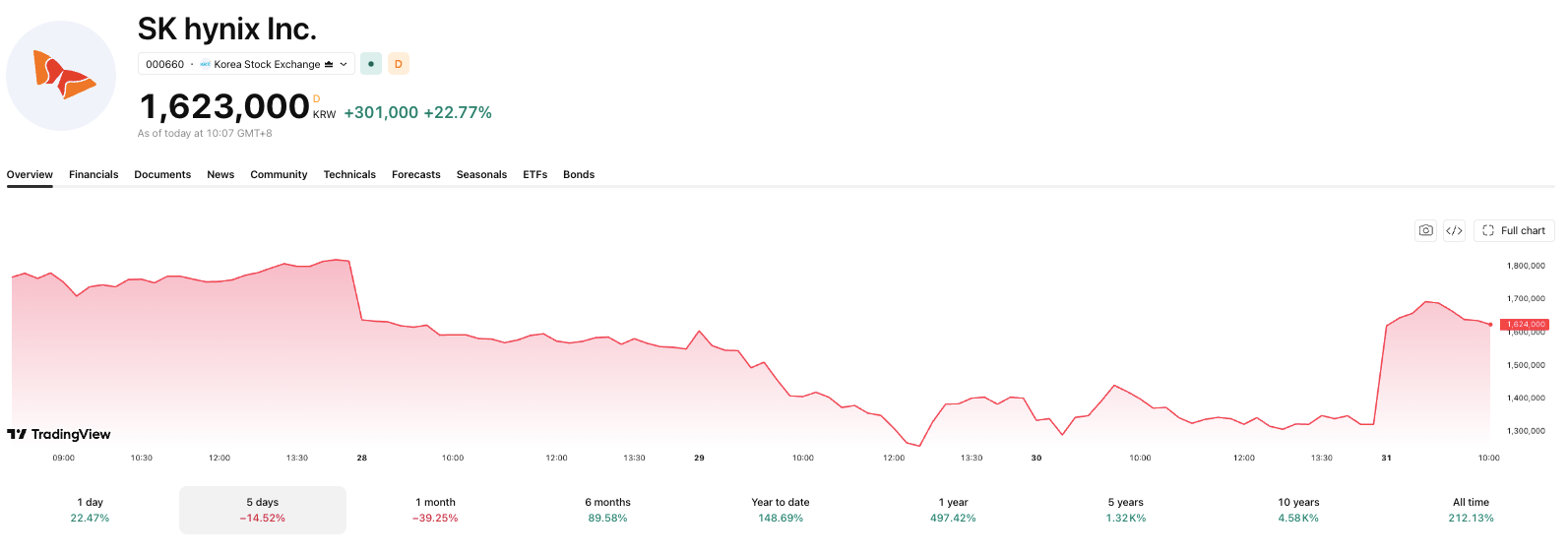
On-chain analytics platform Lookonchain tracked a whale that turned a multi-million-dollar loss into a $6.44 million profit in the days leading up to and following the Korean chipmaker’s earnings.
SK Hynix’s stock had been facing a prolonged and substantial downturn as appetite cooled for AI infrastructure companies. However, an impressive earnings result turned things around quickly.
A Rocky Three-Day Trade
Wallet 0xC8b5 opened a 3x leveraged long on 37,229 units of SKHX on July 29. SKHX is a Hyperliquid perpetual contract that tracks SK Hynix’s share price rather than the stock itself. The $37.3 million position briefly showed a $778,000 gain, per Lookonchain.
That gain evaporated fast. A day later, the position’s value fell to $34.28 million. The wallet then faced a $2.26 million unrealized loss, according to a follow-up post. Lookonchain noted the trader had lost more than $1 million on each of the previous three trades. That pattern pointed to another costly bet.

The reversal came just as fast. The position’s value climbed to roughly $43 million. The whale now sits on a $6.44 million profit, fully recovering its earlier losses.
Why the Swing Was So Violent
SK Hynix posted record Q2 operating profit on July 29. Surging demand for its HBM4 memory chips drove the results. Yet the stock initially whipsawed lower. Investors weighed South Korea’s broader market selloff and lingering doubts about AI infrastructure spending.
That reversed on July 31. SK Hynix shares surged as much as 28.59% to ₩1,700,000 on the Korea Exchange. It marked their sharpest single-day move in years.
Strong earnings from Amazon and Microsoft sparked a broader AI-stock rally. SK Group Chairman Chey Tae-won added momentum with a rare direct share purchase.
The episode follows a separate $57 million liquidation event on the same SKHX market days earlier. That event underscored how thin the margin for error has become. Leveraged bets that track SK Hynix’s earnings swings now carry real risk.
The post SK Hynix Trader Turns $2.26M Loss Into $6.44M Profit on Earnings Spike appeared first on BeInCrypto.


Canadian Bitcoin hardware maker Coinkite has warned users of its Coldcard Mk3 signing device to move funds from wallets whose seed phrases were generated on affected firmware.
On Thursday, Coinkite said seeds created on an Mk3 running firmware version 4.0.1, released in March 2021, or any later Mk3 version may put funds at risk. The issue extends through version 5.0.3, the final firmware supporting the Mk3, while the Mk4, Q and Mk5 are not affected, according to the company’s early analysis.
The warning comes as Bitcoin security specialists examine an unexplained, coordinated sweep involving 594.48 BTC from single-signature addresses. However, no definitive public evidence has established that the Mk3 issue caused those transfers.
“Out of an abundance of caution,” Coinkite urged affected users to generate a new seed on an unaffected device, verify its backup and receive address, send a small test transaction and only then move the remaining funds. The company said its investigation is ongoing and promised a formal technical review.
Coinkite said its early analysis indicates that affected seeds used with a BIP-39 passphrase face minimal risk, stressing that this refers to a passphrase rather than the Coldcard PIN.
Experts examine 594 BTC sweep
The sweep attracted attention after a Reddit user said funds had been drained from a wallet whose seed was generated on a Coldcard Mk3 bought in May 2021.
The user said the seed was later restored onto a Coldcard Mk4 in January 2026, meaning it had subsequently been entered into a second device. The account is self-reported and does not establish a connection between Coldcard and the broader sweep.
In a preliminary analysis posted on Friday, AnchorWatch CEO and co-founder Rob Hamilton said that 1,324 unspent transaction outputs were swept across 500 transactions within a three-block window, moving 594.48 BTC.
At the time of writing, the 594.48 BTC was worth approximately $38.3 million, based on a Bitcoin price of $64,364.07, according to CoinGecko.
Hamilton said all the addresses involved were single-signature and that 562 BTC was later consolidated into another address. “At a glance, this looks like there was flawed entropy in wallet generation somewhere along the way,” he wrote.
Related: Thousands of crypto wallets at risk from ‘Ill Bloom’ vulnerability: Coinspect
Separately, Wizardsardine CEO Kevin Loaec said his current hypothesis is that a low-entropy random-number generator, potentially in a software library, secure element or particular device batch or firmware version, produced wallet seeds with insufficient randomness.
He suggested that an attacker who knew of the flaw may have used an AI-generated script to brute-force affected wallets, but searched only a limited range of BIP-84 derivation paths. That could explain why the sweep appears concentrated in native SegWit addresses and why some wallets were only partially drained, though Loaec stressed that the theory remains unconfirmed.
Loaec warned that, if his hypothesis is correct, wallets that were only partially drained may remain at risk of further theft. He added that funds held in other address types could also be exposed if the attacker expands the scan to include them.
Magazine: Inside the ‘fake police raid’ that forced a $1M Bitcoin transfer


Aave founder Stani Kulechov said on July 30 that the lending protocol plans to retire dozens of low-use asset reserves and wind down its deployments on six blockchain networks.
Summary
- Aave proposal targets six deployments holding $12.8 million supplied and $4.1 million in outstanding debt.
- Fifty low-adoption reserves and twenty-one matured Pendle tokens account for most assets under review today.
- Users can retain existing positions initially, but freezes and higher rates will encourage orderly exits.
The changes cover approximately $98.1 million in supplied assets and $15.6 million in debt. However, the measures originate from an Aave governance proposal and require DAO approval before full implementation.
The proposal would remove 50 individual reserves, retire 21 matured Pendle principal tokens and close 25 reserves across Sonic, Scroll, zkSync, Metis, Soneium and Aptos.
Aave’s six smaller markets have lost most deposits
The six complete deployments hold $12.8 million in combined supply and $4.1 million in debt. Sonic is the largest, with $7.6 million supplied and $2.7 million borrowed. Its deposits have fallen 74% over six months.
Scroll deposits declined 86% to $2.2 million, while zkSync fell 88% to $844,000. Metis and Soneium dropped to $297,000 and $173,000, respectively. Aptos liquidity fell 94% over six months, leaving $1.7 million supplied and $719,000 borrowed.
LlamaRisk said these deployments generated too little revenue to cover the cost of maintaining price feeds, monitoring systems and operational support. That conclusion reflects the risk provider’s assessment and remains subject to governance review.
Fifty reserves face removal across larger deployments
The remaining proposal targets 50 low-adoption reserves and 21 matured Pendle principal tokens across 11 Aave deployments. Together, they account for $85.3 million in supplied assets and $11.5 million in debt.
Assets marked for removal include low-use collateral, older bridged tokens and duplicate versions of assets that now have native alternatives. For example, bridged USDC variants would be removed from some markets where native USDC is already available.
The largest affected positions include the FBTC and eBTC wrappers on Ethereum. Together, they hold about $16.3 million in supply but only around $63,000 in borrowing. Their balances have fallen sharply because the expected demand for using them as collateral did not develop.
As previously reported, Aave DAO began exploring Pendle principal tokens in 2025. The latest proposal would retire 21 tokens that have reached maturity while allowing newer maturities to replace them where appropriate.
Aave would initially freeze affected reserves and reduce supply and borrowing caps to one unit. Existing positions could remain open, but users would be unable to make new deposits, borrow more funds or use the affected assets as fresh collateral.
For markets with outstanding loans, the proposal would raise the reserve factor, directing more interest to the Aave treasury and reducing returns for suppliers. Whole-market closures would use a 99% reserve factor and a 5% base borrowing rate to encourage borrowers to repay and depositors to withdraw.
If borrowers do not repay, risk managers could raise borrowing rates further. Liquidation thresholds may also be reduced gradually when officials determine that remaining collateral positions create excessive exposure.
Once positions have largely unwound, Aave plans to replace live price feeds with fixed-price oracles before completely retiring the six markets.
DAO approval remains the next step
The proposal is currently at the Aave Request for Comment stage. Under the standard governance process, an ARFC normally proceeds to an off-chain Snapshot vote before reaching a binding Aave Improvement Proposal and on-chain vote.
Therefore, users do not need to close their positions immediately solely because of Kulechov’s announcement. The exact implementation schedule will depend on community feedback, voting and the preparation of the required technical transactions.
The move marks a retreat from Aave’s earlier push to deploy broadly across emerging networks. Aave previously expanded to Linea after receiving DAO approval.
At the same time, the protocol is concentrating resources on Aave V4, institutional markets and higher-use deployments. As crypto.news reported, the DAO approved $25 million in funding to support that strategy.
Aave remains the largest decentralized lending protocol, with about $14.5 billion in total value locked across 23 chains.
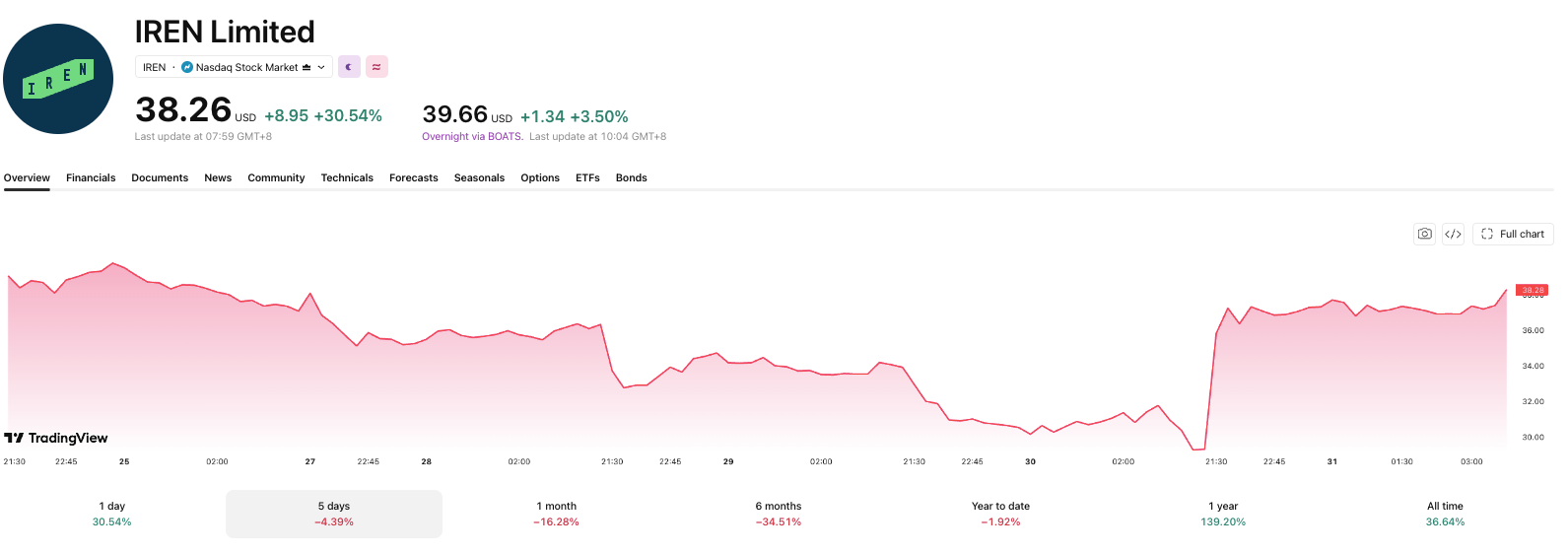
Bitcoin miner IREN Limited (NASDAQ: IREN), another company that has pivoted to AI infrastructure, jumped 30% on July 30, clawing back losses from a broader sell-off in AI infrastructure stocks.
Co-CEO Daniel Roberts told investors that customer demand for IREN’s computing capacity outstrips what the company can build right now.
CEO Points to Contracted Revenue, Not the Stock Price
Rather than address the recent volatility directly, Roberts used a post on X to redirect attention to the business itself. He said signed contracts already cover 85% of IREN’s $4 billion-plus 2026 annualized revenue run-rate target. Construction crews are actively working the company’s sites right now, he added.
“What we know today: demand for our capacity exceeds everything we can build, 85% of our $4bn+ 2026 target is signed, and there are thousands of people on our sites right now pouring concrete and racking GPUs. We’ve been through way worse than this. Back to it.”
— Daniel Roberts, Co-CEO, IREN
Prepayments Ease Funding Concerns
The rally builds on $2.8 billion in AI cloud contracts IREN signed earlier in July with Microsoft, NVIDIA, Perplexity, and Figure AI. Several of the newer multi-year deals include customer prepayments. These payments cover roughly 45% of the related GPU capital costs, easing investor worry over how IREN funds its buildout.
IREN’s stock had fallen more than 30% over the prior month, alongside peers like TeraWulf and Applied Digital. The drop reflected a wider correction across bitcoin miner stocks pivoting toward AI hosting.
Trading volume on the rebound hit nearly 73 million shares, well above IREN’s roughly 53 million average, consistent with a short-covering squeeze layered on top of the fundamental news.

Whether the rebound holds may depend on how IREN’s contracted revenue converts into cash flow as its 1.2 gigawatt 2027 capacity target approaches.
The post Bitcoin Miner IREN Stock Surges 30% After CEO Says Demand Outstrips Supply appeared first on BeInCrypto.
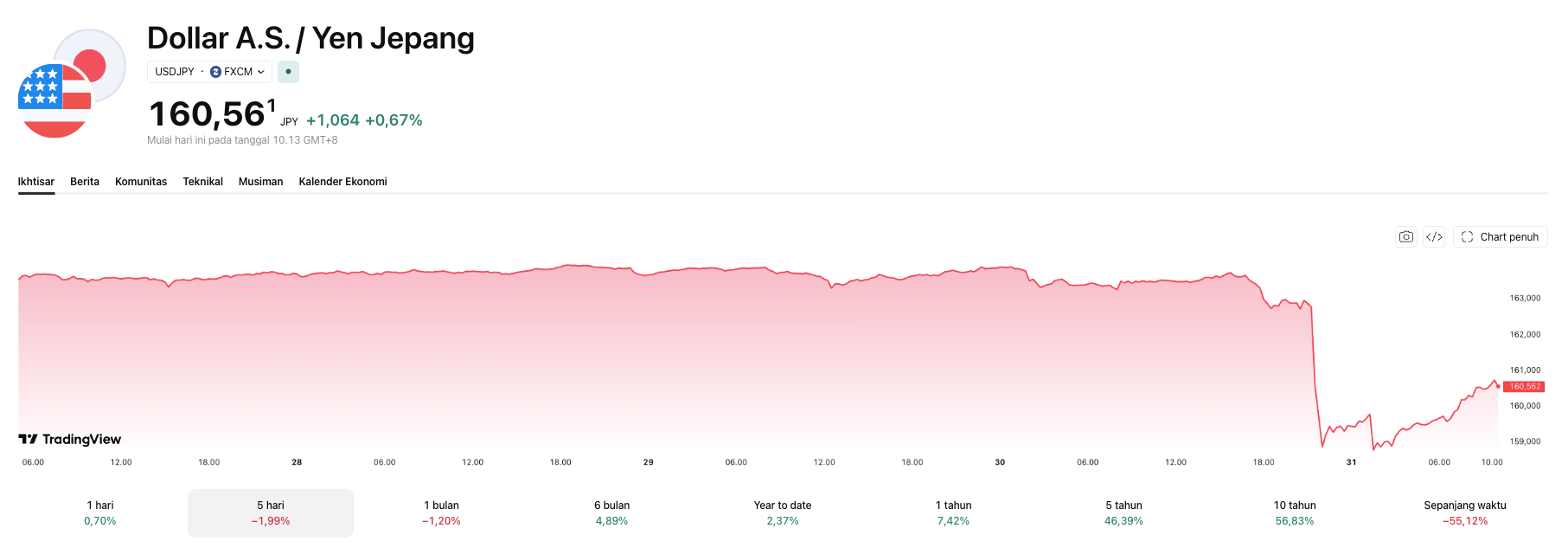
The Bank of Japan is set to hold its policy rate at 1% on Friday. Confirmed currency intervention sent the Japanese Yen (JPY) surging against the US Dollar (USD) before partly reversing.
A market source told Reuters that Japan carried out yen-buying, dollar-selling intervention overnight. The move pulled the currency off a 40-year low in its biggest single-day jump since January 2023.
A Yen Rally Already Fading
USD/JPY tumbled from above 163 to below 158 on Thursday. The pair then climbed back to 160.175 in early Friday trading as the intervention effect began to fade.
Still, the reversal shows how quickly currency moves can unwind without follow-through signals from the central bank itself.

Rodrigo Catril, senior FX strategist at National Australia Bank, said the timing suited Japan’s weaker dollar and calmer risk sentiment.
“If you want to kind of intervene, it’s probably quite a good time.”
Rodrigo Catril, National Australia Bank
The Bank of Japan raised its policy rate to 1% in June, the highest level in 31 years. Analysts expect Friday’s meeting to hold that rate while striking a hawkish tone. A Reuters poll points to another hike, to 1.25%, by year-end.
The Fed’s Hold Adds Pressure
The Federal Reserve also held rates steady Wednesday, its fifth straight pause. Traders questioned the central bank’s resolve on inflation, weakening the dollar broadly. That adds pressure on Kazuo Ueda, the Governor of the Bank of Japan (BOJ), to sound convincingly hawkish.
The US Dollar Index (DXY) fell 0.7% in the previous session, Reuters reported. The index was on pace for a 1.5% weekly drop.
That broader dollar weakness narrows the gap between the Fed’s benchmark rate and the BoJ’s 1% level. Traders use that spread to fund the yen carry trade, borrowing cheap yen to buy higher-yielding dollar assets.
The strategy only works if the rate gap holds and the yen doesn’t strengthen too quickly. A narrower gap or a stronger yen could unwind those trades fast, adding another reason to watch Ueda’s tone closely.
The post BoJ Holds Rates at 1%: Will Japan’s Yen Intervention Hold? appeared first on BeInCrypto.

Senate Minority Leader Chuck Schumer has introduced legislation aimed at creating a dedicated US anti-corruption bureau, arguing that existing oversight is not designed to stop presidents from profiting while in office—an accusation he ties directly to President Donald Trump’s cryptocurrency-related investments.
Schumer’s proposal, the Anti-Corruption Bureau Creation Act, would establish a new federal agency with authority to “investigate, enforce, and prevent executive branch corruption,” according to a Thursday announcement from Schumer’s office. The bill also seeks to consolidate key ethics and enforcement bodies under one roof—an approach lawmakers supporting the measure say could strengthen accountability more than the current “patchwork” of watchdogs.
Key takeaways
- Schumer’s bill would create a new federal anti-corruption bureau with investigative, enforcement, and preventive powers focused on executive branch conduct.
- The legislation points to reported Trump earnings from investments, including cryptocurrency exposure, as part of a broader argument for tighter safeguards.
- The proposed bureau would incorporate the Federal Election Commission, the Office of Government Ethics, and the Office of Special Counsel into a single structure.
- Supporters are also pushing the measure alongside continued negotiations over the Senate’s crypto market-structure effort, the CLARITY Act, which still lacks a scheduled vote.
- Even if the bureau legislation clears Congress, Trump could veto it; overriding a veto would require a two-thirds majority in both chambers.
A new enforcement model pitched as a response to crypto-related conflicts
In a statement released with the bill introduction, Schumer said he had introduced the Anti-Corruption Bureau Creation Act to address executive branch corruption more directly. The proposal is built around Congress’ findings—stated in the bill text—that Trump disclosed earning more than $2 billion from investments in 2025, including $1.4 billion associated with cryptocurrency, and that his family holds more than $1 billion in a crypto fund tied to foreign governments.
Schumer framed the new agency as having “real teeth,” emphasizing that it would include enforcement authority rather than acting only as a monitor. He also said the bureau would be staffed by a bipartisan group of seven members confirmed by the Senate.
To address remedies for wrongdoing, the bill includes mechanisms allowing private citizens and state authorities to pursue recovery of funds that Schumer described as stolen from Americans “through corruption.”
“This new bureau is one where these institutions work in symbiosis, strengthening each other and eliminating barriers between them which often got in the way,” Schumer said. “It replaces a broken patchwork of watchdogs, none of which were built for this moment, with one, powerful anti-corruption agency, ready to act anywhere, anytime corruption strikes.”
White House pushes back on conflict claims tied to investment accounts
The anti-corruption push arrives amid persistent Democratic criticism of Trump’s involvement in the crypto industry while in office. Schumer’s office noted concerns that have also hovered over the Senate’s broader crypto policy effort, the Digital Asset Market Clarity (CLARITY) Act.
While the White House agreed to certain ethics provisions in CLARITY, many lawmakers have argued those changes do not adequately address potential conflicts of interest.
In a statement to Cointelegraph, White House Principal Deputy Press Secretary Anna Kelly reiterated the administration’s position that there were “no conflicts of interest” related to Trump’s investments. Kelly said the investments were “held in fully discretionary accounts managed by independent third-party financial institutions.”
Consolidating ethics and enforcement under one “roof”
A notable feature of Schumer’s bill is its plan to reorganize parts of the federal oversight landscape. The proposal would place the US Federal Election Commission, the Office of Government Ethics, and the Office of Special Counsel “under one roof” within the new bureau.
The intent, as described in Schumer’s remarks, is to reduce the friction between agencies and streamline action when corruption is alleged—an argument he made by contrasting the proposed bureau with what he characterized as outdated or mismatched oversight structures.
Schumer introduced the bill with cosponsors Andy Kim, Alex Padilla, and Jeff Merkley.
What’s happening with the Senate’s CLARITY Act remains uncertain
Schumer’s anti-corruption initiative is moving alongside a separate, more technical fight in the Senate: whether and when the CLARITY Act will advance.
The article notes that the Senate has just over a week before lawmakers break for a month-long state work period. That calendar pressure is heightening uncertainty for pending legislation, including CLARITY, especially as lawmakers face the prospect of competing priorities ahead of the 2026 midterms.
As of Thursday, the Senate had not scheduled a vote on the CLARITY Act, despite encouragement from some Republican lawmakers and industry figures. Former Securities and Exchange Commission official John Reed Stark said the situation is difficult to predict, describing “enormous drama” surrounding the bill and stating that experts he spoke with could not confidently forecast what would happen that week.
Industry leaders have also signaled confidence while acknowledging timing risks. Coinbase CEO Brian Armstrong said the bill was at the “one-yard line,” while Senator Cynthia Lummis continued pushing for a vote, according to posts cited in the report.
Legislative math: momentum doesn’t eliminate veto risk
Even if Schumer’s anti-corruption bureau legislation gains traction, it still faces major hurdles. The bill would require Republican support in both chambers to pass, with the party holding only a slim majority in the Senate. If it clears the Senate and House before 2028, President Trump could still veto the legislation.
Overriding a presidential veto would require a two-thirds majority in both the House and Senate, leaving the outcome dependent on whether Democrats can sustain enough cross-party backing.
For crypto watchers, the near-term focus is likely to split: whether the Senate can find a path forward on the CLARITY Act before its schedule runs out, and whether Schumer’s anti-corruption bureau proposal gains enough bipartisan traction to survive both legislative and veto thresholds—especially given the ongoing dispute over how (or whether) current ethics arrangements address potential conflicts tied to crypto.


Samsung SDS has identified stablecoin infrastructure as the first major collaboration area under its investment in Dunamu, outlining plans to combine blockchain, AI and cloud technologies as part of its digital asset strategy.
Summary
- Samsung SDS said its investment in Dunamu is part of a strategy to build digital asset infrastructure rather than a financial investment.
- The company is discussing stablecoin infrastructure, AI powered payments and virtual asset financial systems with Dunamu.
- Samsung SDS reported 17% cloud revenue growth and a 75% jump in external cloud business during the second quarter.
- The company plans to expand its AI infrastructure from 110 MW today to more than 800 MW by 2031.
According to Samsung SDS during its second-quarter earnings conference call on Wednesday, the company has been discussing stablecoin infrastructure, AI-powered next-generation payments and virtual asset financial system integration with Dunamu, the operator of South Korea’s largest cryptocurrency exchange Upbit.
Samsung SDS has outlined how its Dunamu investment will be used
Samsung SDS President Lee Joon-hee said the company’s stake in Dunamu was made to enter the digital asset infrastructure business rather than as a financial investment. He said Samsung SDS intends to combine Dunamu’s blockchain operating experience with its own IT services, artificial intelligence, cloud computing and cybersecurity capabilities to strengthen digital financial infrastructure.
Lee added that the companies are considering business opportunities spanning stablecoin infrastructure, AI-based payment systems and system integration services built around virtual assets. According to Samsung SDS, discussions are continuing as both sides work toward developing concrete business models.
The comments provide the clearest description yet of Samsung SDS’s plans after it invested in Dunamu earlier this year.
In May, Samsung Securities, Samsung SDS and Samsung Card agreed to acquire a combined 4% stake in Dunamu for 612.8 billion won, or about $408 million, by purchasing 1.39 million shares from Kakao-linked entities. Samsung SDS acquired a 1% stake, while Samsung Securities purchased 2% and Samsung Card acquired the remaining 1%.
At the time, Samsung SDS said it planned to combine its AI, cloud, security and data management services with Dunamu’s blockchain expertise, while Dunamu said it expected cooperation on blockchain investment products, payment infrastructure and AI-related blockchain applications.
Stablecoin plans extend Samsung’s digital asset push
The latest comments come less than a week after Samsung Electronics disclosed plans to bring stablecoin support to Samsung Wallet.
During the Galaxy Unpacked event on July 24, Samsung Electronics said the wallet application will support stablecoins alongside payments, rewards and digital assets, although it did not disclose launch dates, supported tokens, blockchain networks or regional availability.
Product manager Lee Dinham said at the event that Samsung Wallet would expand beyond conventional payment functions to include stablecoins, allowing users to transfer digital value directly from compatible Galaxy devices.
Together, the wallet announcement and Samsung SDS’s latest remarks indicate that Samsung’s digital asset initiatives now extend from consumer payment products to the infrastructure supporting blockchain-based financial services.
The direction also differs from Samsung’s response to Open Standard’s proposed OUSD stablecoin consortium earlier this month. According to South Korean newspaper Chosun, Samsung said it had not held formal consultations with Open Standard and did not know what role it was expected to play after being listed as a founding consortium member. Dunamu, Shinhan Bank and K-Bank also told the newspaper they were still reviewing the proposal and had not approved participation.
Cloud growth has supported Samsung SDS results
Samsung SDS disclosed alongside the conference call that second-quarter revenue increased 5.9% year over year to 3.7178 trillion won, while operating profit rose 0.7% to 231.8 billion won. Net profit climbed 4.6% to 184.1 billion won.
IT services revenue reached 1.7625 trillion won, up 5% from a year earlier.
Cloud operations remained the fastest-growing segment. Revenue from the cloud business increased 17% to 779.4 billion won, while external cloud business revenue jumped 75% year over year.
According to Samsung SDS, cloud service provider revenue grew 24% as demand for Samsung Cloud Platform increased and GPU-as-a-Service deployments expanded across public-sector and enterprise customers. Cloud management services revenue also rose 17%, supported by AI transformation projects in the financial sector and enterprise resource planning deployments within South Korea’s shipbuilding industry.
AI infrastructure expansion will also support blockchain services
Alongside its blockchain plans, Samsung SDS said it continues expanding AI infrastructure and enterprise AI offerings.
The company said it was recently selected as a core operator under South Korea’s government-backed GPU infrastructure program and launched an NPU-as-a-Service product based on FuriosaAI’s Renegade neural processing chip. It has also secured AI-related projects with Woori Bank and the Export-Import Bank of Korea while maintaining partnerships with OpenAI, Anthropic and Google Cloud for generative AI services.
Samsung SDS currently operates about 110 megawatts of AI infrastructure and plans to expand capacity to 230 megawatts by 2029. According to the company, that figure is expected to exceed 800 megawatts by 2031 when design, construction and operational projects are included.
The infrastructure buildout accompanies Samsung SDS’s strategy of pairing its cloud and AI capabilities with Dunamu’s blockchain platform as the companies continue discussions around stablecoin infrastructure, digital asset payment systems and virtual asset financial technology services.

Binance.US targets prediction markets with CFTC license bid: report

Tennessee Football Star Suspended Over $427 Airline Ticket

Skill Financial Planning yang Harus Kamu Kuasai Biar Gaji Gak Cuma Numpang Lewat

Renter of Home in Anne Heche Crash Denies Settlement With Son

No Jackpot Winner as $257 Million Prize Rolls Over to $269 Million Monday Draw

Weekend Open Thread: Staud – Corporette.com
Skill Financial Planning yang Harus Kamu Kuasai Biar Gaji Gak Cuma Numpang Lewat

BREAKING: Lummis UNVEILS new crypto bill, BLASTS the ‘BANKERS’

Money-lisa blackpink |mirrored dance tutorial |slow mode _ 0.75x speed #lisa#blackpink#money #shorts
-

 Fashion6 days ago
Weekend Open Thread: Brooks Brothers
-
 Sports4 days ago
Commonwealth Games boxing: Jadumani Singh seals dominant 5-0 win over Pakistan’s Sumama Rehman to enter quarter-finals | Commonwealth Games News
-

 Business1 day ago
Why Trees Belong on the Risk Register
-

 Tech4 days ago
Intel is reversing course and bringing hyper-threading back to its server chips
-

 Crypto World5 days ago
Ripple bought a bank in pieces. The $4 billion audit
-

 Politics4 days ago
Luke Littler dismantles Gerwyn Price to retain title in Blackpool
-
 Entertainment7 days ago
A New Post-Apocalyptic Gundam Anime Series Blasts Into SDCC
-

 Politics3 days ago
The Part of the Electric Transition Nobody Wants to Discuss
-

 News Videos4 days ago
BITCOIN JUST ENTERED THIS CRITICAL ZONE…
-

 Fashion7 days ago
16 Dresses for the High Summer Event
-

 Business2 days ago
Major shareholder moves on Canyon
-

 Crypto World5 days ago
XRP Ledger adds $2.6B as RWA inflows rank second
-

 Politics5 days ago
Spain sweeps the board at 2026 World Cup with individual awards
-

 News Videos15 hours ago
Bitcoin Enters the 3rd Stage of the Bear Market
-
 Entertainment2 days ago
‘Stargate’ Creator’s New Sci-Fi Series Returns for Season 3 Tomorrow
-

 Entertainment5 days ago
Sara Gilson Killed By Husband After Viral “Pedophile” TikTok Video
-

 Tech6 days ago
Anthropic launches Claude Opus 5, a cheaper AI model for coding, agents and enterprise workflows
-

 Crypto World2 days ago
Kraken Enables Retail Access to Jersey Mike’s IPO via Tokenized Shares
-

 News Videos2 days ago
Claude: Build Financial Dashboards in Minutes (2026)
-

 Politics11 hours ago
Luke Littler’s dominance sparks GOAT debate
You must be logged in to post a comment Login