

Crypto World
Strategy May Sell Bitcoin Before Year-End, Says Michael Saylor


TLDR
- Strategy may sell some Bitcoin before the end of the year as part of its capital management plan.
- Michael Saylor said the company evaluates equity, credit, cash, and Bitcoin sales continuously.
- The firm aims to increase Bitcoin per share, total holdings, and enterprise value over time.
- Saylor said a mixed funding approach performs better than relying on a single method.
- Strategy could sell Bitcoin with a higher cost basis depending on market conditions.
Strategy may sell some Bitcoin before the end of the year, according to Executive Chairman Michael Saylor. He said the company evaluates multiple funding options, including equity, credit, and Bitcoin sales. Strategy aims to increase Bitcoin per share and overall enterprise value over time.
Strategy Considers Bitcoin Sales in Capital Planning
Michael Saylor said Strategy may sell Bitcoin as part of a broader capital management plan. He explained that decisions depend on market conditions and financial obligations.
“I think it’s not unlikely that we’ll sell some Bitcoin,” Saylor said during a retail investor Q&A. He added that the company has not finalized the amount.
Strategy reviews funding options using a data-driven approach. It evaluates whether liabilities should be covered by cash, equity, credit, or Bitcoin.
Saylor said models relying on one funding method tend to underperform. He stated that a mixed approach often produces better outcomes.
The company holds Bitcoin with cost bases ranging from $10,000 to $125,000. Saylor said Strategy could sell higher-cost coins if needed.
He also noted that Bitcoin sales would not necessarily affect dividend tax treatment. Strategy expects return-of-capital treatment for preferred dividends.
Executives said decisions can be made quickly when conditions change. However, they emphasized a long-term focus on Bitcoin per share growth.
STRC Dividend Changes and Broader Strategy Focus
Strategy addressed investor questions about STRC, its flagship credit product. Saylor said the firm may adjust dividends to support trading near the $100 target.
The company plans to shift STRC dividends from monthly to semimonthly payments. This change remains subject to shareholder approval.
Saylor said Strategy is not legally required to defend the $100 price. However, he described it as a central business objective.
The company has taken steps to strengthen STRC performance. These include raising dividends and building a U.S. dollar reserve.
Strategy also repurchased senior debt to improve its balance sheet. Executives said STRC stability remains a key performance measure.
CEO Phong Le said the firm considered changes for other preferred products. However, Strategy chose to focus on STRC first.
Saylor confirmed the company will not retire other preferred securities. These include STRF, STRD, and STRK.
He added that convertible bonds remain senior liabilities. Strategy plans to retire them over time.
In a separate CNBC interview, Saylor said Bitcoin could reach $1 million eventually. He linked this outlook to institutional demand and digital credit products.
Strategy executives said their long-term focus remains on Bitcoin yield and digital credit growth. They continue to educate investors on the company’s model.


Bitcoin price action cooled after a brief flirtation with the upper sub-legendary zone around $78,000, with traders refraining from a clean breakout toward $82,000 despite improving risk appetite in some corners of the market. A mix of macro headwinds and an ongoing outflow dynamic from US-listed spot Bitcoin ETFs kept the path to a sustained rally uncertain, even as institutional-focused traders increased their bullish exposure in the near term.
Data from market-tracking platforms show top traders lifting their Bitcoin long positions relative to shorts, a signal that the $76,000 support floor remains key, but not a guarantee of immediate upside. At the same time, broader fundamentals are weighing on the upside potential: a shaken macro backdrop, a softer near-term retail outlook, and concerns about the trajectory of U.S. monetary policy have tempered breakout expectations. This environment poses questions for whether the market can sustain momentum beyond the 76k–82k zone in the weeks ahead.
Key takeaways
- Top traders boosted their long exposure, reinforcing the $76,000 support floor as a credible near-term base, with the long-to-short ratio rising to a two‑week high.
- Macro pressures and persistent ETF outflows temper near-term upside, keeping a full breakout to $82,000 unlikely without a shift in the broader risk backdrop.
- Bitcoin’s price dynamics showed a small Coinbase premium/discount mismatch, alongside about $2.07 billion in net outflows from US-listed spot ETFs since mid‑May, signaling tepid institutional demand.
- Market structure signals—neutral perpetual funding rates and a rebalancing of long and short positions—suggest bulls are building slowly, but a decisive move remains data-dependent.
Bitcoin (BTC) traded around the mid-to-high $70,000s on Thursday, borrowing momentum from a period of tentative resilience but failing to sustain gains beyond the $78,000 area. The week’s readings point to a market where professional traders are more confident on a floor near $76,000, even as the broader macro stage keeps the door open to pullbacks if risk appetite fades.
The core question for traders remains: can constructive positioning overcome the macro drag? The answer appears nuanced. On one hand, top-tier traders have tilted longer, betting that the current support zone will hold and that favorable or stable macro conditions can unlock a move toward higher levels. On the other hand, outsized external pressures—rising energy costs, a cautious consumer sector, and the potential for tighter monetary policy—keep the door ajar for a retest of prior resistance levels rather than a clear, immediate breakout.
Trader positioning and the price backdrop
Market analytics indicate a shift in sentiment among the most active Bitcoin traders. The long-to-short ratio at major venues has climbed, signaling more optimistic positioning on the baseline assumption that $76,000 acts as a robust magnet for prices in the near term. At Binance, for several days the balance tilted modestly toward longs, while at OKX, traders trimmed shorts in a similar time frame. Despite these shifts, the net reading across exchanges has remained roughly neutral, underscoring a cautious, not exuberant, stance among professional participants.
The posture among top traders matters because it can foreshadow how price action unfolds when the market encounters fresh catalysts. A firming of long exposure around a sturdier support zone can translate into quick price stabilization if momentum builds. Conversely, if macro headwinds intensify or demand remains fragile, even a solid base may not translate into a sustained up-leg.
Macro headwinds and the policy outlook
A portion of the market’s hesitance stems from a confluence of macro factors. Retail demand has shown fragility, with major consumer-facing firms’ guidance reflecting the squeeze from higher costs and inflation. Walmart shares slid around 7% after guiding for 2027 with a cautious tone, citing persistent cost pressures, including elevated oil prices, and highlighting that low-income consumers are navigating financial distress. This dynamic feeds into a broader retail outlook that can cool optimism for a rapid reacceleration in consumer-led demand for risk assets.
Oil markets have remained tight, with Brent crude holding above $95 per barrel as supply dynamics and Middle East tensions persist. The geopolitical backdrop compounds inflation concerns and leaves little room for aggressive easing by policymakers in the near term. In the United States, these dynamics have fed expectations of potential rate adjustments, even as market participants weigh the timing and magnitude of any future hikes.
On the policy front, futures-implied probabilities point to a non-trivial chance of rate hikes by September. The market-implied odds for higher rates have risen in recent weeks, with traders pricing in around a 37% probability of a rate increase by September, according to tools that aggregate futures data. This marks a shift from the prior month and contributes to the sense that the monetary base could continue expanding in a manner that affects liquidity and risk assets differently than in a period of looser policy.
Flows, pricing signals, and what to watch next
Trading dynamics around price discovery also reflect evolving demand and liquidity conditions. The Bitcoin price on Coinbase traded with a slight premium/discount signal relative to other major exchanges quoted in USDT, marking a nuanced snapshot of cross-exchange demand. In parallel, net flows out of US-listed Bitcoin spot exchange-traded funds have remained negative, with about $2.07 billion exiting since May 12. These outflows reduce the immediate availability of price-supportive demand from a broad retail and institutional ETF channel, in turn complicating the path to a sustained breakout.
Meanwhile, the structure of Bitcoin futures markets shows a more balanced stance. The perpetual futures funding rate has hovered in a neutral zone since early this week, signaling that funding costs are not systematically biasing the market toward easy long accumulation. The current annualized rate around 7% contrasts with a mid‑May spike where shorts were paying as much as 13% to carry their positions, a sign that speculative leverage swung more aggressively in the direction of selling earlier in the month.
Taken together, the data suggest that while bulls have a foothold at the $76,000 level, a clear move toward $82,000 hinges on a shift in the broader macro environment—whether from a cooling inflation regime, a rebound in consumer demand, or a dovish tilt in policy expectations that can draw back the rate-hike narrative. Absent such a change, the market may continue trading in a range with modest upside potential rather than a decisive breakout.
In practical terms, investors and traders should monitor several developing signals: (1) any sustained improvement in macro indicators that can tilt Fed expectations toward a softer stance, (2) changes in ETF inflows or new product launches that could re-engage broad retail or institutional demand, and (3) price action around the $76,000–$78,000 region that could act as a fulcrum for the next directional move. With the balance of momentum currently dependent on external forces, the near-term risk-reward favors a cautious posture rather than a bold bet on a rapid ascent to new highs.
What remains uncertain is how quickly macro and policy drivers will align with on-chain and market sentiment shifts. Traders will be watching whether the $76,000 floor proves resilient in the face of evolving headwinds or whether fresh catalysts—positive macro data, renewed ETF inflows, or a shift in risk appetite—can unlock a move toward higher ground in the weeks ahead.
As the market edges forward, the crucial test will be whether the sum of these signals can overcome the layered frictions weighing on Bitcoin’s ascent. The coming data prints and policy signals will be decisive for whether the market can stage a meaningful breakout beyond current resistance or stay tethered to the more modest gains built around a stabilized base.
Key takeaways:
- Top traders boosted their Bitcoin long-to-short ratios, strengthening the $76,000 support floor.
- Macroeconomic pressures and persistent Bitcoin ETF outflows are capping immediate Bitcoin breakout potential to $82,000.
Bitcoin (BTC) flirted with $78,000 on Thursday but failed to sustain its bullish momentum after a disappointing outlook from US retailer Walmart and growing signs of a more restrictive US monetary policy. Despite weakening macroeconomic conditions, professional Bitcoin traders increased their bullish exposure. Is a rally to $82,000 the next step?
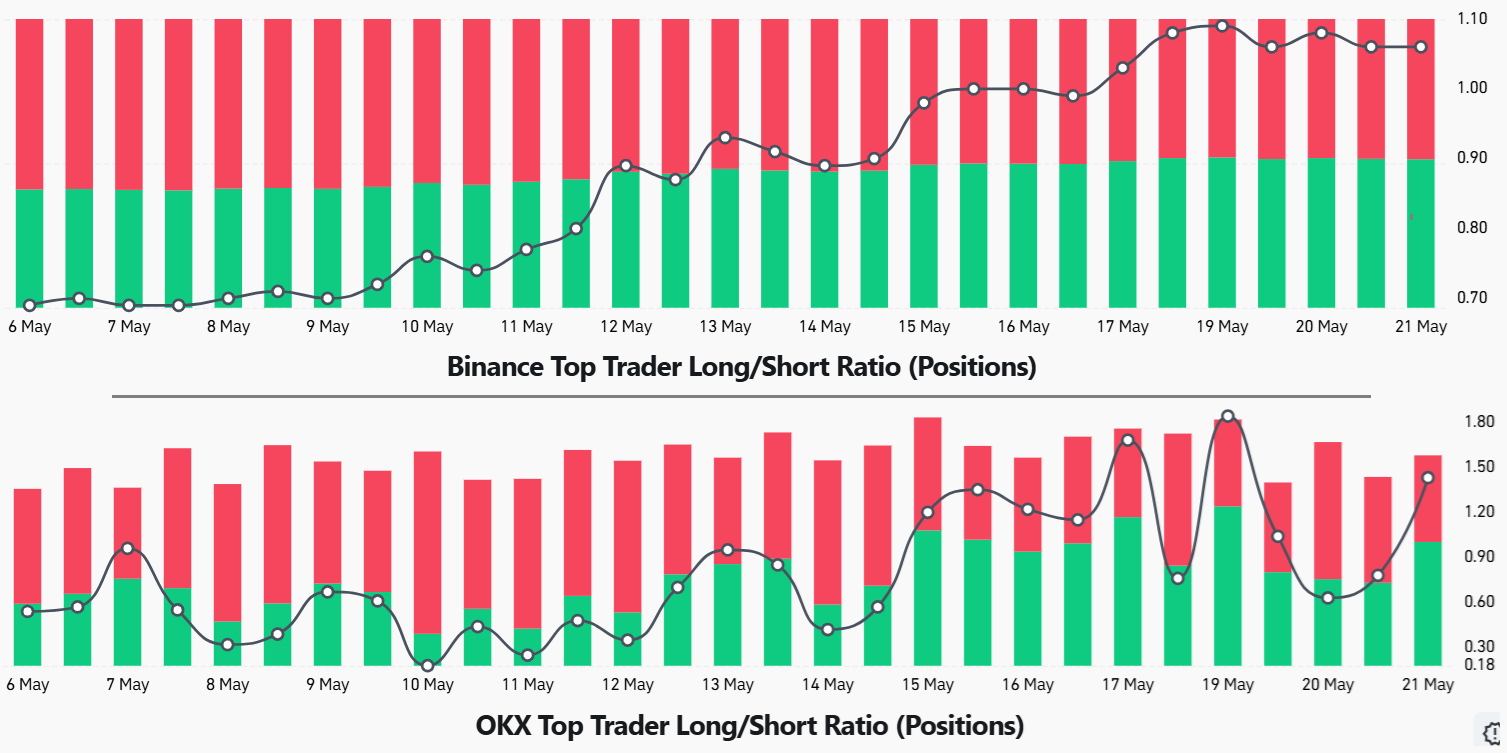
Top traders’ Bitcoin long-to-short position at Binance & OKX. Source: CoinGlass
Top traders’ long-to-short ratio jumped to its highest level in 2 weeks, indicating growing confidence in the $76,000 support level. At Binance, the ratio remained near 8% favoring longs (buy) for three days, while traders at OKX reduced their shorts (sell) between Wednesday and Thursday. Still, in absolute terms, the long-to-short indicator remains neutral.
Worsening economy and high oil prices prompt US rate hike fears
Part of this lack of confidence can be pinned to worsening economic growth perspectives. Walmart (WMT US) saw its shares decline 7% after issuing weak 2027 guidance due to persistently high oil prices. Walmart CFO John Furner said low-income consumers are “navigating financial distress.” The company acts as a proxy for US retail data due to its massive $178 billion quarterly sales.
The prolonged war in Iran and the subsequent partial closure of the Strait of Hormuz have kept crude Brent oil prices sustained above $95 for the past month. The US Federal Reserve (Fed) has less room to maneuver due to this upward inflationary pressure. Traders are now anticipating interest rate hikes, marking a complete turnaround from the previous month’s expectations.
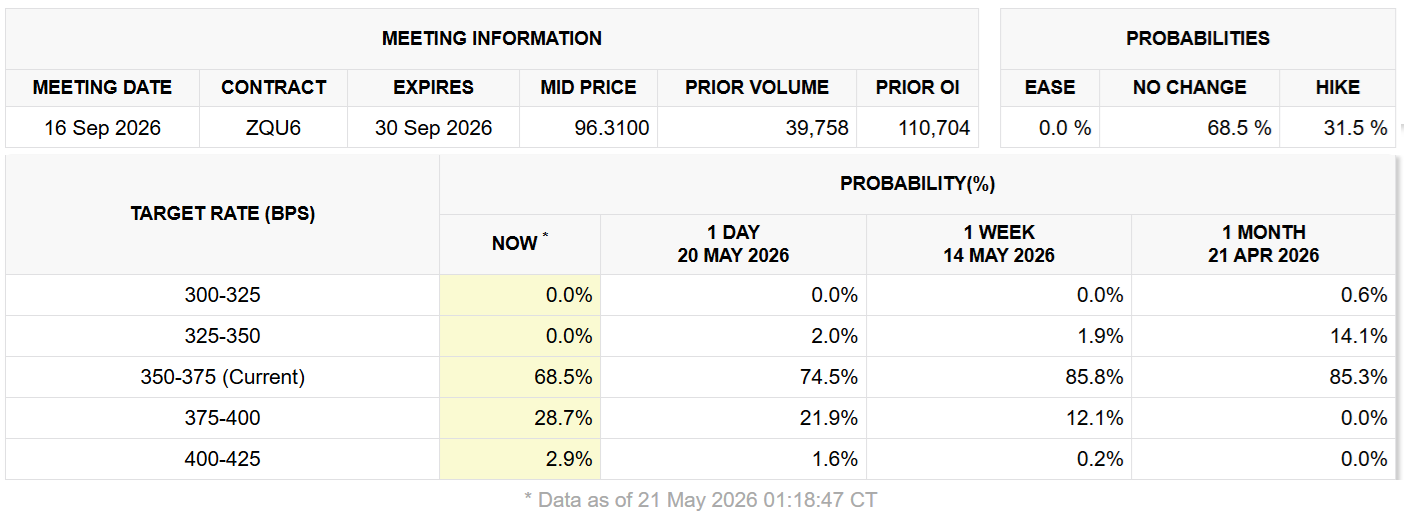
FOMC interest rate target probabilities for Sept. 2026. Source: CME Group FedWatch Tool
The implied odds of interest rate hikes by September, based on government bond futures markets, have jumped to 37%, up from 0% one month prior. Thus, regardless of the strength of the S&P 500 Index, investors anticipate accelerated growth in the monetary base, as higher interest rates negatively affect the $39 trillion US government debt.
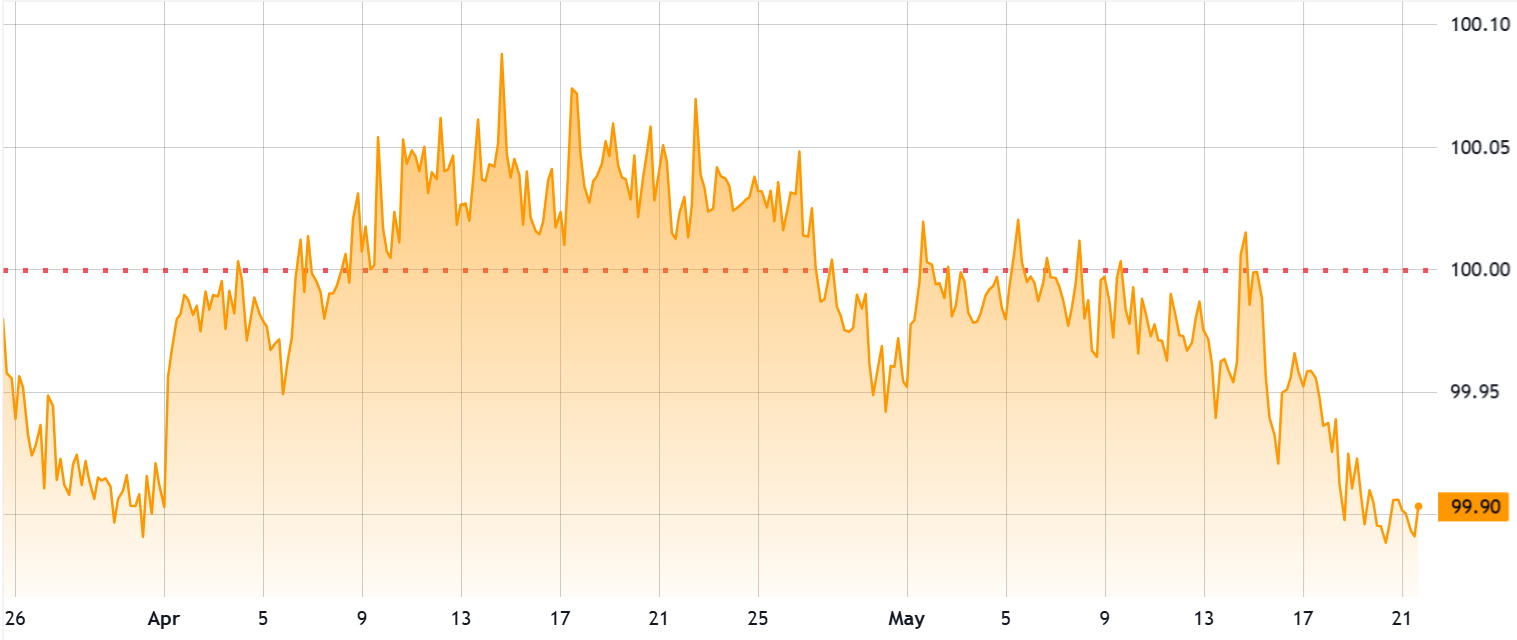
Bitcoin/USD at Coinbase vs. Bitcoin/USDT at major exchanges. Source: TradingView / Cointelegraph
The Bitcoin price at Coinbase traded at a 0.10% discount relative to Bitcoin prices at major exchanges quoted in USDT. This negative Coinbase Bitcoin premium is typically associated with weak institutional demand, which aligns with the $2.07 billion net outflows from US-listed Bitcoin spot exchange-traded funds (ETFs) since May 12.
Related: Chance of new Bitcoin lows ‘extremely slim’ as long-term holders’ supply tops 15M BTC
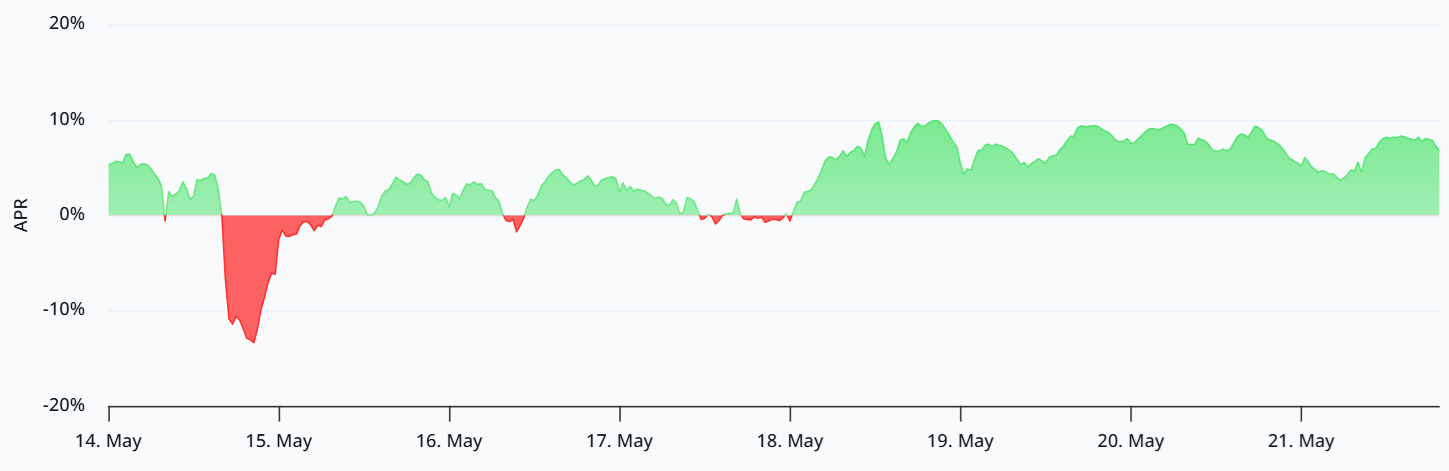
Bitcoin perpetual futures annualized funding rate. Source: Laevitas
The Bitcoin perpetual futures funding rate has maintained neutral levels since Monday, reversing the trend from the prior week. The current 7% rate is far from being bullish, but it marks a complete turnaround from May 14 when shorts (sellers) paid 13% to keep their positions open.
Given the uncertain perspectives for global economies, the odds of a sustained Bitcoin bull run to $82,000 in the near term appear low. Still, the reduction in top traders’ short positions and a balanced perpetual futures funding rate indicate that bulls are gradually building confidence in the $76,000 support level.

Key Highlights
- AMD begins EPYC “Venice” manufacturing utilizing TSMC’s advanced 2nm process technology.
- Production facilities in Taiwan and Arizona expand AMD’s manufacturing footprint for AI and enterprise markets.
- EPYC “Venice” delivers superior power efficiency and next-level high-performance computing features.
- Future 6th Gen “Verano” EPYC processors will target cloud infrastructure and artificial intelligence applications.
- Strategic TSMC collaboration reinforces AMD’s position with cutting-edge packaging innovations.
Advanced Micro Devices (AMD) stock finished trading at $444.46, reflecting a decline of $3.12 or 0.70%, following moderate recovery during the session. The semiconductor manufacturer is accelerating production of its upcoming EPYC server processor, internally designated “Venice.” This development represents a significant achievement in data center chip evolution and worldwide fabrication capacity growth.
Advanced Micro Devices, Inc., AMD
EPYC Venice Chips Enter Manufacturing Phase
The “Venice” server processor from AMD has commenced production operations in Taiwan leveraging TSMC’s state-of-the-art 2nm manufacturing process. Production capacity will subsequently extend to TSMC’s fabrication site in Arizona. This strategic initiative enables AMD to manufacture powerful computing solutions tailored for cloud infrastructure, corporate data centers, and artificial intelligence applications.
This processor represents the inaugural high-performance computing chip manufactured on TSMC’s 2nm technology platform. AMD seeks to enhance both processing power and power consumption efficiency for contemporary digital infrastructure. The production expansion corresponds with escalating worldwide requirements for scalable and efficient server processing units.
AMD incorporates sophisticated packaging methodologies, encompassing TSMC’s SoIC-X and CoWoS-L technologies. These advanced techniques improve performance metrics, interconnectivity, and component integration throughout data center implementations. This engineering approach enables AMD to address mounting computational requirements with efficiency and dependability.
Artificial Intelligence and Enterprise Computing Growth
With artificial intelligence operations becoming increasingly sophisticated, the central processing unit serves an essential function in data transfer, network management, and storage orchestration. AMD’s EPYC processor lineup now facilitates expansion for enterprise, cloud, high-performance computing, and AI implementations. The Venice manufacturing ramp guarantees computing systems satisfy elevated performance standards.
This capacity expansion underscores AMD’s commitment to geographically distributed manufacturing operations. Production sites in Taiwan and Arizona deliver operational resilience and regional production optimization. This manufacturing blueprint supports international clientele and reinforces AMD’s supply chain infrastructure.
AMD’s product timeline features the forthcoming “Verano” 6th Generation EPYC processor lineup. Verano emphasizes performance-per-dollar-per-watt optimization and targets cloud computing and AI workload environments. Advanced memory technologies, including LPDDR compatibility, additionally enhance bandwidth capabilities and processing efficiency.
Long-Term TSMC Manufacturing Alliance
AMD and TSMC maintain their ongoing collaboration focused on process technology and architectural innovation. Their manufacturing partnership supports both upcoming CPU generations and comprehensive AI infrastructure development. Merging industry-leading process nodes with sophisticated chip designs facilitates accelerated deployment of unified computing platforms.
TSMC’s 2nm process technology establishes the groundwork for AMD to manufacture high-performance processors at global scale. This enables uniform performance characteristics, enhanced energy efficiency, and manufacturing adaptability. The partnership positions AMD to broaden its competitive position in server markets and cloud computing sectors.
Advanced packaging capabilities and semiconductor innovations strengthen AMD’s market differentiation. Through utilization of TSMC’s fabrication and packaging expertise, AMD guarantees optimized performance and system reliability. This strategic approach reinforces its data center product portfolio amid intensifying computational requirements.

A regulatory push in South Korea over a 22% tax on crypto investment gains has entered a pivotal phase. A petition urging the government to scrap or revise the levy has surpassed the threshold for the Finance and Economic Planning Committee to formally review objections to the new tax regime. The petition’s momentum signals growing domestic scrutiny of a policy designed to tax crypto profits alongside broader asset classes.
The 22% tax, scheduled to take effect in January 2027, aims to formalize a long-debated approach to crypto earnings. Critics argue the levy would create financial and reporting burdens for investors and could hamper mobility for younger people already priced out of housing markets, according to the petition’s authors. The push has gained significant traction on social platforms and government portals, highlighting a regulatory moment as authorities weigh implementation and potential carve-outs or exemptions.
The petition now exceeds 52,000 signatures, well above the initial threshold, according to official records from the South Korea Assembly. The growing backing underscores concerns that the tax might shift capital flows or talent away from the domestic crypto sector if implemented as proposed.
“If taxation is enforced in order to secure short-term tax revenues, it is likely to lead to greater losses in the long term, namely, a contraction of industry and an outflow of capital and talent abroad.”
The debate occurs as South Korea cements its status as a central hub for crypto activity in the Asia-Pacific region. Yonhap, citing local data, noted that about 32% of the population owned cryptocurrencies in March 2025. While ownership has cooled somewhat in the face of ongoing price pressure, the country remains a focal point for exchange activity, innovation, and regulatory development.
In context, the broader policy landscape continues to trend toward tighter controls and higher compliance burdens for the industry. A related development referenced by observers concerns forthcoming rules around tokenized securities as part of broader regulation of digital assets, which regulators have signaled will be accompanied by risk-based oversight and licensing considerations.
Key takeaways
- The South Korean 22% crypto gains tax faces formal review after a petition threshold was met, signaling intensified regulatory scrutiny ahead of a 2027 rollout.
- Petition authors argue the tax, coupled with narrower favorable treatment for other assets, could undercut market share and long-term growth, warning of potential capital and talent outflows.
- Market indicators show a material contraction in domestic crypto activity, with holdings and daily volumes declining as regulatory measures tighten.
- Regulators have proposed stricter AML/KYC controls, including automatic flagging of large transfers involving foreign wallets, prompting pushback from exchanges on operational burdens.
Market dynamics and tightening controls
Industry data indicate a sharp decline in the value of crypto held domestically, dropping from about 121.8 trillion won in January 2025 to roughly 60.6 trillion won in February 2026. Daily trading volumes on South Korea’s five largest exchanges—Upbit, Bithumb, Coinone, Korbit and Gopax—fell from about $11.6 billion in December 2024 to around $3 billion in February 2026, underscoring a tightened market environment amid evolving regulatory requirements. CoinGecko data cited the volumes as a barometer of relatively cautious investor activity during a period of policy flux.
Regulatory authorities have also sharpened oversight through AML and KYC measures. In March, the Financial Services Commission and the Financial Intelligence Unit proposed automatic flagging of all crypto transactions over 10 million won ($6,630) sent to or from foreign wallets. Industry associations have argued that such reporting would impose operational burdens on exchanges and could raise compliance costs without delivering commensurate risk mitigation.
These steps come as the country contends with a broader push to balance innovation with investor protection and financial stability. The dynamic is being watched closely by exchanges, institutional investors, and global observers who are weighing how South Korea’s approach fits into evolving cross-border regulatory standards and potential alignment with broader market frameworks.
Beyond domestic measures, observers note a broader regulatory cadence shaping the sector—one that intersects with international standards and regional policy initiatives. While details vary by jurisdiction, the global trend toward enhanced transparency, licensing, and supervisory oversight remains a central driver of strategic planning for crypto firms seeking to operate in multiple markets. In related coverage, Cointelegraph reported on forthcoming July rules for tokenized securities in South Korea, illustrating how policy shifts can redefine product categories and licensing requirements for market participants.
Policy context and institutional implications
South Korea’s evolving regime sits within a global environment of intensified crypto regulation. The country’s tax policy, AML/KYC enhancements, and licensing expectations intersect with international efforts to standardize oversight and enforcement. For exchanges and financial institutions, the immediate implications lie in compliance design, tax reporting complexities, and capital-planning considerations tied to a potentially more burdensome operating landscape. Firms operating in or with exposure to the Korean market must assess licensing trajectories, cross-border transaction controls, and the interplay between domestic rules and international regulatory expectations.
For policymakers, the central questions include how to calibrate tax policy to support innovation while preserving tax revenue and financial stability, and how to align domestic rules with evolving international standards without stifling growth. The petition’s momentum highlights the importance of stakeholder engagement in shaping the practical dimensions of taxation, reporting obligations, and enforcement priorities in a fast-moving sector.
Institutions should monitor not only the petition’s progression through the Finance and Economic Planning Committee but also the government’s response to tightening AML/KYC rules and the potential for phased or alternative frameworks that could soften the impact on smaller participants while preserving safeguards.
What changes next is contingent on committee deliberations, regulatory consultations, and the industry’s ability to demonstrate cost-effective compliance and robust risk controls. The coming months will reveal whether adjustments to the tax design or transitional relief measures emerge, or whether the 2027 implementation timeline remains unchanged.
Closing perspective: As South Korea navigates a pivotal policy crossroads, lenders, exchanges, and funds with exposure to the Korean market should prepare for ongoing regulatory development, heightened reporting expectations, and potential shifts in investment strategies in response to the evolving tax and compliance regime.

South Korea’s planned 22% tax on crypto investment gains is moving into a new phase as a petition against the regime surpasses the threshold for a formal review. The petition, calling for scrapping or revising the tax, has crossed 50,000 signatures and now sits above 52,000, triggering the Finance and Economic Planning Committee to consider objections to the new framework. The tax is slated to take effect in January 2027, a timeline critics say could burden investors and curb innovation at a time when Korea remains a major crypto hub in the Asia-Pacific region.
The petition’s authors argue that taxing crypto gains at 22% while granting other asset classes preferential treatment undermines Korea’s competitiveness in the global crypto market. In a translated statement included with the petition, they warned that short-term revenue motives could backfire, leading to long-term losses for the economy as talent and capital move abroad.
“If taxation is enforced in order to secure short-term tax revenues, it is likely to lead to greater losses in the long term, namely, a contraction of industry and an outflow of capital and talent abroad.”
The growing support for the petition underscores a broader debate about how to tax digital assets without stifling growth in a sector that many investors view as a strategic pillar for the country’s future fintech ecosystem. The petition’s momentum comes alongside other policy headlines and a broader tightening of regulatory controls on crypto activity.
Key takeaways
- Petition against the 22% crypto tax has surpassed 52,000 signatures, meeting the threshold that triggers official consideration by Korea’s Finance and Economic Planning Committee.
- The tax is scheduled to begin in January 2027, with critics arguing it imposes burdens on investors and could dampen Korea’s crypto innovation and talent retention.
- Market data show a notable contraction in Korea’s crypto sector, even as the country remains a regional hub; total holdings and trading volumes have declined since late 2024.
- Tighter AML/KYC measures are tightening the regulatory envelope, including automatic flagging of crypto transfers above 10 million won to or from foreign wallets.
- Ownership remains sizable but fragile: Yonhap reported about 32% of the population owned crypto as of March 2025, a figure under pressure as prices and regulations weigh on participation.
Policy review in motion as petition grows
At the heart of the current debate is a straightforward question: how should Korea tax gains from digital assets in a manner that preserves competitiveness while funding public needs? The petition asserts that the 22% levy, which would apply to investment gains on crypto assets, would add a disproportionate burden on individual investors and could distort tax equity when compared with other asset classes. The petition’s authors contend that a rushed or overly aggressive approach could deter participation in Korea’s crypto markets and push builders and capital toward friendlier jurisdictions.
The formal review triggered by the petition does not guarantee a change in policy, but it does elevate the policy discussion to the legislative stage. Stakeholders across the crypto industry—exchanges, wallets, and advisory firms—have been watching closely as the country tests a balance between tax stability, consumer protection, and market vitality.
Market dynamics amid tighter rules and a cooling market
Even as policy discussions intensify, industry data paints a picture of a sector under pressure. Korea has long been a major crypto participant, but several metrics point to a contraction in recent years. Yonhap, citing local data, reported that ownership of cryptocurrencies stood at about 32% of the population in March 2025. While that figure signals broad familiarity with digital assets, it also sits against a backdrop of price volatility and regulatory scrutiny that has tempered enthusiasm.
Numbers on market size and activity illustrate the trend. Industry data show that the total value of crypto held by Koreans declined from around 121.8 trillion won (approximately $83.3 billion) in January 2025 to about 60.6 trillion won (roughly $41.4 billion) in February 2026. In the same period, daily trading volumes on the country’s five largest exchanges—Upbit, Bithumb, Coinone, Korbit, and Gopax—fell sharply, from about $11.6 billion in December 2024 to around $3 billion in February 2026. Analysts describe a move toward the broader stock market or other asset classes as part of a shifting investment calculus amid regulatory tightening and crypto price pressure.
Analysts and industry observers point to a tightening regulatory regime as a key factor. In particular, Korea’s Financial Services Commission (FSC) and the Financial Intelligence Unit (FIU) proposed measures in March 2026 that would require automatic flagging of crypto transactions above 10 million won ($6,630) sent to or from foreign wallets. While policymakers argue these steps improve AML outcomes and market integrity, critics say the operational burden could dampen exchange activity and complicate cross-border trading for ordinary investors. Industry associations have pushed back against such reporting requirements, cautioning that they could impose substantial compliance costs and hinder everyday usage of crypto services.
South Korea’s regulatory trajectory sits within a broader regional context where jurisdictions are recalibrating how to treat digital assets—balancing consumer protection, tax revenue, and market growth. The effect on korean exchanges, liquidity, and competitiveness will be an important reference point for other markets watching for federal or provincial-level policy templates.
What comes next for policy and participation
With the petition now positioned to prompt formal consideration, observers will be watching not only for a potential revision to the tax rate but also for any adjustments to enforcement timelines, reporting requirements, or grace periods that might accompany a policy shift. The government’s stance remains that tax policy should reflect risk management, revenue needs, and fair treatment of different asset classes; the counterargument emphasizes the need to protect Korea’s market share as a leading crypto hub and to avoid inadvertently driving activity underground or abroad.
Readers should monitor statements from the Finance and Economic Planning Committee, as well as updates from the FSC and FIU, for signals about any forthcoming amendments or clarifications. In parallel, industry groups and users will likely rally behind or challenge specific provisions, particularly around reporting obligations and the treatment of gains versus other investment instruments.
For context, Korea’s policy environment continues to evolve in tandem with related developments, including reported moves toward tokenized securities rules slated for July and ongoing debates about how best to tax and regulate digital assets. As the landscape shifts, market participants will weigh how any potential changes could affect holdings, liquidity, and the practicalities of trading across borders.
Related reading: coverage of Korea’s tokenized securities framework and broader regulatory stance offers additional context for how crypto policy is evolving in one of Asia’s most active markets.
In the near term, the main watch is how the Finance and Economic Planning Committee interprets and acts on the petition, and whether policymakers offer adjustments that could steer the tax regime toward a balance between revenue needs and market vitality. The outcome will likely influence not only investors’ approach to Korea’s crypto markets but also the strategic considerations of exchanges, developers, and users navigating Korea’s increasingly complex regulatory terrain.


Syndicate Labs, Everclear, and ZERO Network all announced wind-downs today, a single-day convergence that underscores widening cracks in the blockchain infrastructure layer. Syndicate Labs, a startup backed by venture capital firm a16z that raised more than $27 million since its founding, said it… Read the full story at The Defiant

Bitget has launched a global campaign called the “Gold Fast or Go Home Challenge” to promote faster access to gold CFD trading through its mobile application. The campaign follows the company’s decision to move traditional finance products to a first-level homepage tab inside the app.
The update allows users to access gold CFDs, forex pairs, commodities, and indices with fewer navigation steps. As a result, Bitget aims to improve execution speed for traders who actively monitor macro-sensitive markets such as gold.
The challenge asks participants to record themselves opening the Bitget app, entering the TradFi section, and completing an XAUUSD trade in the shortest possible time. Users then share their attempts on social media platforms as part of a global speed-focused trading competition.
Bitget designed the campaign around accessibility and execution efficiency. The exchange also linked the initiative to the growing popularity of short-form trading content across digital platforms.
Bitget Expands Unified Multi-Asset Access
The campaign also reflects Bitget’s wider strategy to integrate traditional financial products into crypto-native trading environments. The platform currently supports crypto assets, tokenized stocks, ETFs, forex products, commodities, and precious metals within one trading ecosystem.
Users can access multiple asset classes through a single account structure instead of switching between separate platforms or wallets. According to the company, this setup reduces trading friction and improves capital movement between markets.
Gracy Chen said users increasingly move between crypto and traditional markets during periods of macroeconomic volatility. She stated that the platform aims to simplify access to these products while supporting faster execution inside the app environment.
Bitget repositioned its TradFi section to the homepage earlier in 2026 as part of a broader effort to streamline trading activity across asset categories. The company stated that execution speed and market accessibility remain central to its Universal Exchange strategy.
Gold Trading Activity Gains Momentum
Global gold trading activity has continued to increase as investors monitor inflation trends, interest rate expectations, geopolitical tensions, and central bank gold purchases. During volatile market periods, many traders use gold CFDs to gain exposure to macro-sensitive assets without leaving digital trading ecosystems.
Across crypto platforms, demand for gold-related products has expanded alongside interest in diversified trading options. Exchanges now compete to provide unified access to crypto and traditional financial products through a single interface.
Bitget stated that its TradFi expansion aligns with broader market demand for integrated multi-asset trading. The platform currently serves users across more than 150 regions and continues expanding access to tokenized and traditional financial instruments within one ecosystem.

Ripple Prime expanded its institutional strategy after integrating with crypto platform EDX Markets. The partnership introduced unified access to spot trading and perpetual futures through centralized clearing and netting services. However, Ripple USD (RLUSD) became the main settlement asset, while XRP remained absent from the public-facing framework.
RLUSD Takes Center Stage in Institutional Expansion
Ripple Prime confirmed that the EDX integration supports institutional trading with centralized operational infrastructure. The framework combines spot markets and perpetual futures under one settlement structure. Consequently, RLUSD now serves as the preferred collateral and settlement asset within the system.
EDX Markets operates with backing from major financial firms, including Citadel Securities and Fidelity Investments. These firms continue supporting regulated digital assets with lower volatility exposure. Therefore, RLUSD fits institutional compliance demands more effectively than XRP.
Ripple structured RLUSD as a dollar-backed stablecoin for regulated financial environments. The asset provides predictable settlement conditions for clearing operations and margin management. Meanwhile, the company positioned the stablecoin as a bridge between traditional finance and digital asset infrastructure.
XRP Shifts Away from Public Settlement Narrative
The EDX announcement triggered debate across the XRP community and institutional trading circles. Market participants questioned XRP’s absence from the partnership’s settlement structure and marketing material. Consequently, discussions emerged about XRP’s long-term role inside Ripple’s institutional strategy.
Evernorth Treasury, identified as a large institutional XRP holder, responded with a technical document addressing the issue. The report argued that RLUSD and XRP serve separate functions within Ripple’s broader ecosystem. Furthermore, the document described RLUSD as an external compliance-friendly layer for regulated finance.
The report also positioned XRP as a decentralized bridge asset operating beneath institutional settlement systems. According to the analysis, XRP continues to support instant asset conversion across different liquidity environments. However, the token no longer appears positioned as the primary public settlement product for Wall Street partnerships.
Ripple Separates Compliance Layer from Core Infrastructure
Ripple’s latest institutional direction reflects growing pressure from regulators and financial institutions across the digital asset sector. Stablecoins continue attracting interest because they reduce volatility risks during large-scale settlement operations. As a result, RLUSD now occupies a stronger position in Ripple’s enterprise-facing strategy.
RLUSD remains connected to banking reserves and compliance oversight through centralized issuer controls. Authorities can freeze wallets or enforce regulatory actions under existing financial rules. Therefore, traditional financial firms consider the stablecoin more compatible with institutional risk frameworks.
XRP operates differently because the token functions through a decentralized ledger infrastructure without centralized issuer intervention. Ripple now appears to separate its regulated financial products from its decentralized liquidity network. Consequently, RLUSD leads the institutional narrative, while XRP continues to support backend liquidity and cross-asset transfers.
Ripple Balances Institutional Demand and Crypto Infrastructure
Ripple has continued expanding its institutional business following years of regulatory disputes in the United States. The company increasingly focuses on payment infrastructure, tokenized finance, and regulated digital asset products. Meanwhile, RLUSD represents Ripple’s strongest push into traditional financial settlement markets.
The broader crypto industry also shows rising demand for stablecoin-based settlement systems among exchanges and institutional firms. Several trading platforms now prefer dollar-backed digital assets for collateral and operational efficiency. Therefore, Ripple’s RLUSD strategy aligns with the broader industry movement toward regulated digital dollar products.
XRP remains one of Ripple’s core ecosystem assets despite reduced visibility in institutional marketing campaigns. The token continues supporting liquidity operations across Ripple’s blockchain infrastructure and payment systems. However, RLUSD now dominates the company’s Wall Street-facing expansion strategy and institutional clearing narrative.
Crypto World
Miner Perpetua Resources secures $2.9 billion U.S. loan for Idaho gold, antimony project

The Stibnite Gold Project from Perpetua Resources is a proposed open-pit gold and antimony mine in a remote area of the Payette National Forest in Valley County, Idaho, as seen aboard an EcoFlight.
Sarah A. Miller | Idaho Statesman | Tribune News Service | Getty Images
Mining company Perpetua Resources has secured a $2.9 billion loan from the U.S. Export-Import Bank, CNBC has learned. The deal comes as the U.S. looks to secure access to critical minerals and break China’s stronghold on essential supply chains.
The financing, which is the largest loan under EXIM’s “Make More in America” initiative and the agency’s fourth largest loan on record, will fund Perpetua’s Stibnite Gold project in Idaho. The mine will also produce antimony, which is essential for defense applications – including for munitions – as well as semiconductor manufacturing and renewable energies including solar panels and wind turbines, among other things.
Perpetua shares rose more than 12% on the news.
The U.S. Geological Survey deems antimony a “critical mineral.” There are no antimony mines currently in operation in the U.S. China is the dominant producer of antimony globally, satisfying more than half of U.S. demand, according to USGS.
The Stibnite site is the only source of domestic antimony that can meet the U.S.’ requirements for weapons production, according to the company, with the ability to supply about 35% of U.S. demand within the first six years of production.
This is the latest in a string of deals from the government focused on shoring up domestic production of critical minerals, especially as China has in the past weaponized natural resources by curbing exports.
In February, the White House unveiled “Project Vault,” a first-of-its-kind public-private partnership focused on stockpiling minerals. The $12 billion initiative includes $10 billion in funding from the Export-Import Bank, and an additional $2 billion in private capital.
The administration has also taken equity stakes in mining companies directly, including rare earths producer MP Materials. In July the Pentagon announced an investment in the company that includes an offtake agreement as well as a price floor. The U.S. was once the largest rare earths producer, but output plummeted after China flooded the market and depressed prices. The government has also inked deals with miners including USA Rare Earth, Lithium Americas and Trilogy Metals. Shares of all three stocks traded higher on Thursday.
Perpetua has begun construction on the Stibnite site and said it should be operational in 2029. The company is working with the Department of Defense to supply antimony, and is in the process of securing additional commercial partners.

MoonPay is launching MoonPay Trade, a new institutional platform that promises banks and fintechs unified access to tokenized assets, DeFi protocols and stablecoin liquidity across more than 200 blockchains.
Summary
- MoonPay Trade targets banks, fintechs and enterprises with one interface for tokenized assets and DeFi
- The platform will serve as the execution layer for MoonPay Institutional
- It supports tokenized fund subscriptions, collateral transfers and on-chain lending via Aave, Morpho and Maple
According to CoinDesk, MoonPay introduced on May 21 MoonPay Trade as a dedicated trading and execution stack for its institutional clients. The platform is aimed at banks, fintech companies and enterprise clients, offering a single gateway to tokenized assets, DeFi protocols and stablecoin liquidity that spans more than 200 blockchain networks.
According to Keith Grossman, President of Moonpay, the new layer of crypto payments will contain built in execution layers able to seamlessly integrate and provide the ability to make retail payments.
The President recently posted on social media a Fox News anchor making the argument that “stablecoins are the future.”
Accordingly, MoonPay said MoonPay Trade will act as the core execution layer for its newly launched MoonPay Institutional business, which the company built on top of its recent acquisition of Israeli digital asset security firm Sodot.
In this way, MoonPay Institutional is designed to serve financial institutions, asset managers, trading firms and exchanges, providing secure key management, cross‑chain collateral management and access to digital asset markets and DeFi.
From retail on‑ramps to institutional rails, where does Moonpay stand?
Since its inception, MoonPay has been best known as a retail fiat‑to‑crypto on‑ramp embedded in wallets, exchanges and consumer apps. MoonPay Trade marks a shift toward deeper infrastructure: rather than just selling crypto to end users, the company now wants to power banks and fintechs as they plug into tokenized capital markets and DeFi liquidity.
MoonPay now says Trade will support tokenized fund subscriptions, allowing institutions to buy into tokenized funds and structured products directly on chain, using stablecoins and tokenized cash equivalents as rails.
The platform also supports collateral transfers, enabling institutions to move tokenized collateral across chains and venues, and integrates with DeFi protocols such as Aave, Morpho and Maple Finance so that clients can lend, borrow and generate yield directly on chain through a single interface.
Under the hood, MoonPay is leaning on the multi‑party computation (MPC) wallet technology it acquired with Sodot to secure institutional keys and automate complex on‑chain workflows without exposing private keys or requiring clients to manage raw wallets. The company says it now serves more than 30 million customers across 180 countries and works with over 500 enterprise clients, experience it plans to leverage as it pivots toward being an institutional DeFi access layer.
Competing for institutional DeFi flow, how do other DeFi players stack up?
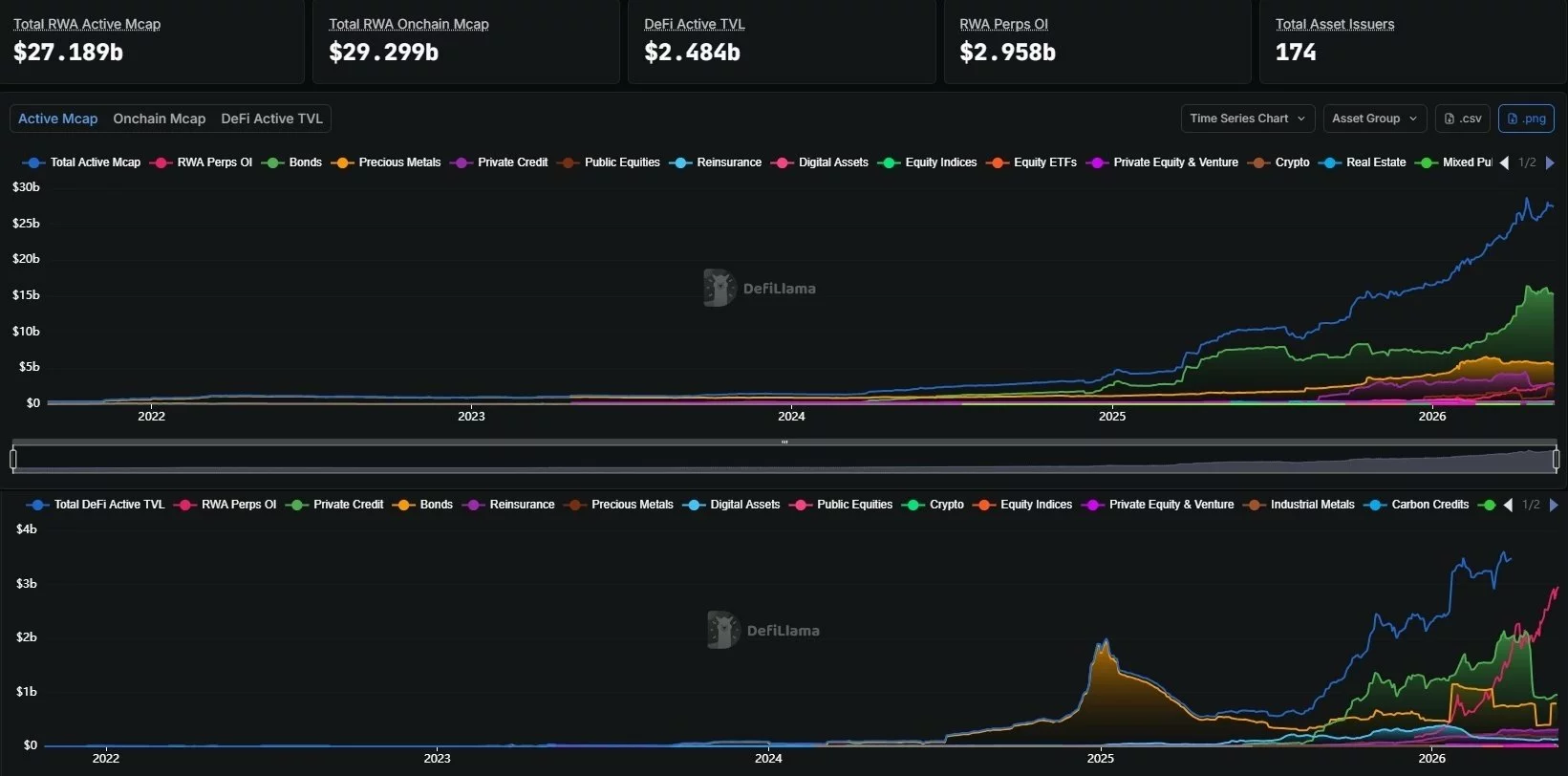
This all comes as only an estimated 10% of RWA Liquidity is active in DeFi protocols. As of May 21, research by Tanaka shows the RWA market is exploding, but DeFi is barely participating: only about 10% of tokenized assets sit in DeFi, and of roughly 7 billion dollars in tokenized gold and commodities on-chain, just 184 million dollars is actually deployed in DeFi protocols.
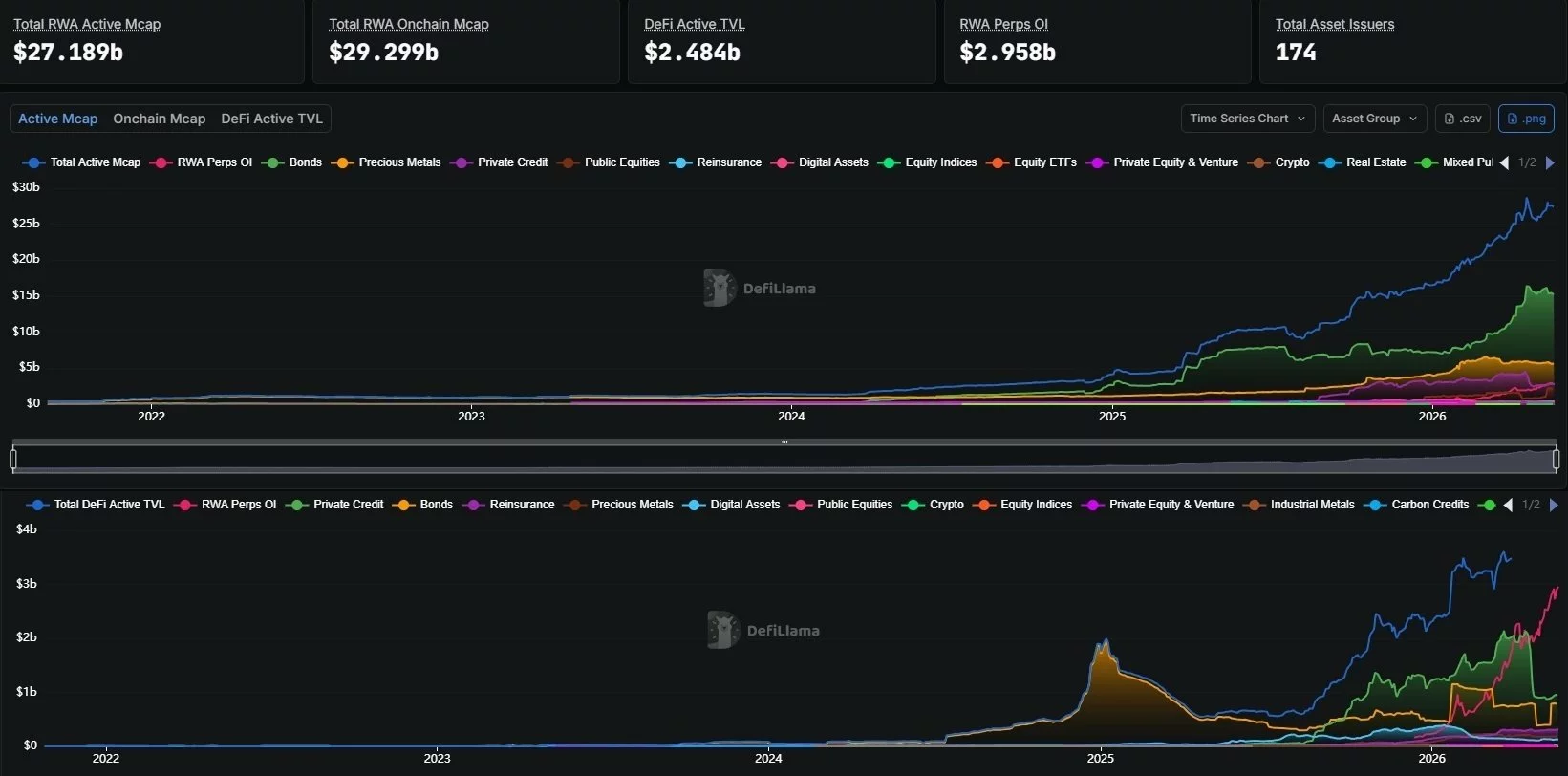
MoonPay Trade thus drops into an increasingly crowded field of institutional DeFi access platforms, where players like Fireblocks, Circle, Coinbase and BitGo are all vying to become the default pipes into tokenized funds and on‑chain credit markets.
The company’s pitch now seems to be a combination of consumer reach, stablecoin infrastructure, and new institutional custody and execution stack can make it an all‑in‑one gateway for banks and fintechs that do not want to stitch together multiple vendors.
In that sense, MoonPay Trade is both a product launch and a strategic reorientation, signaling that the company intends to compete not just as a retail checkout button, but as a full‑stack infrastructure provider for the era of tokenized and composable finance.

Bitcoin Longs Jump as US Macro Data Weakens; Could $82K Be Next?

Racing world mourns the death of two-time NASCAR champion Kyle Busch

Can OpenAI’s ‘Master of Disaster’ Fix AI’s Reputation Crisis?


-

 Crypto World6 days ago
BloFin War of Whales 2026 Grand Prix opens registration for $5M trading championship
-

 Fashion6 days ago
Weekend Open Thread: Theory – Corporette.com
-

 Crypto World6 days ago
E-Estate Announces 1 Year Live: Washington DC Summit as Real Estate Tokenization Enters Its Next Phase
-

 Tech7 days ago
Tech Moves: Microsoft AI leader jumps to OpenAI; former AI2 exec joins Meta; and more
-

 Tech6 days ago
Google reimburses Register sources who were victims of API fraud
-

 Business6 days ago
H&R Real Estate Investment Trust (HR.UN:CA) Q1 2026 Earnings Call Transcript
-

 Sports6 days ago
Napoleonic enters 2026 Doomben 10,000 field via Abounding withdrawal
-

 Crypto World6 days ago
BeInCrypto 100 Institutional Awards Nomination: KAST for Best Digital Assets Neobank and Best Digital Assets Fintech
-

 Entertainment6 days ago
David Letterman Returns to Late Show, Blasts Cancellation
-
 Crypto World6 days ago
Bitcoin Battles US Bond Nerves With BTC Price Dip Toward New May Lows
-

 Crypto World6 days ago
ICE and CME urge US regulators to curb Hyperliquid energy trading
-
 Crypto World6 days ago
Wall Street’s Boldest Gold Prediction Has Russians Rushing to Buy
-

 Fashion5 days ago
On the Scene at Gucci’s Cruise Show in New York City: Mariah Carey, Kim Kardashian, Lindsay Lohan, Iman, and More!
-

 Crypto World6 days ago
IREN closes $3 billion convertible notes deal amid AI infrastructure expansion
-

 Fashion6 days ago
Trending Western Style Vests Perfect for Summer
-

 Politics6 days ago
Watch: far-right flag-fanatics run over victim, attack locals – Setup By the Left wing for your entertainment
-

 Fashion6 days ago
Creative Ideas for Custom T-Shirts
-

 Fashion5 days ago
Amazon Sundays: Memorial Day Hosting
-
 Fashion6 days ago
Philip Jones Wedding Jewellery For Women
-

 Crypto World6 hours ago
Blockchain.com files with SEC for U.S. IPO
You must be logged in to post a comment Login