

Crypto World
Strategy Raises $544.5M and Buys Back STRC Shares

Strategy, the business intelligence firm that has built the largest corporate Bitcoin treasury, continued adjusting its capital structure last week through a combination of stock sales and preferred share repurchases.
Strategy sold 5,429,160 shares of its Class A common stock (MSTR) through its at-the-market (ATM) offering program between July 20 and July 26, generating $544.5 million in net proceeds.
The MSTR share price was up more than 2% in Monday’s premarket activity, according to Yahoo Finance. The STRC preferred shares were up 2.3% to $88.90 ahead of the Nasdaq open.
The company also repurchased 288,930 shares of its STRC preferred stock for $25 million, according to a Form 8-K filed with the US Securities and Exchange Commission on Monday.
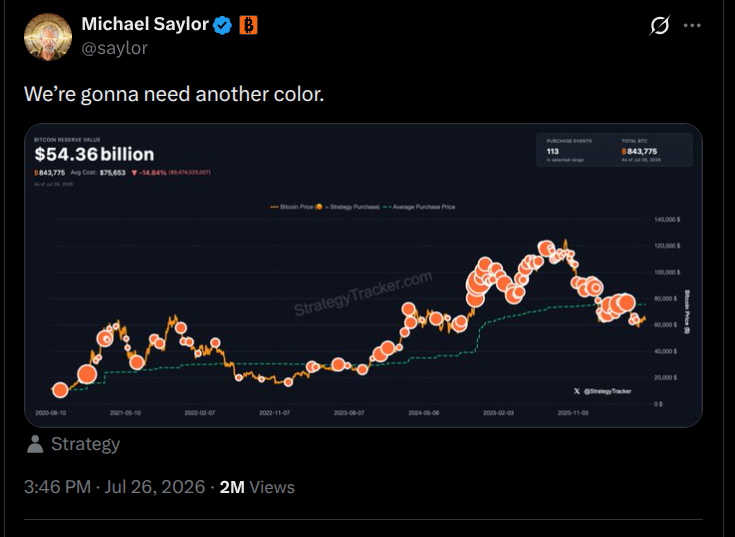
The update comes after Strategy executive chairman Michael Saylor sparked speculation on Sunday with his “We’re gonna need another color” post on X, which some market observers interpreted as a hint at a new move involving the company’s preferred stock strategy.
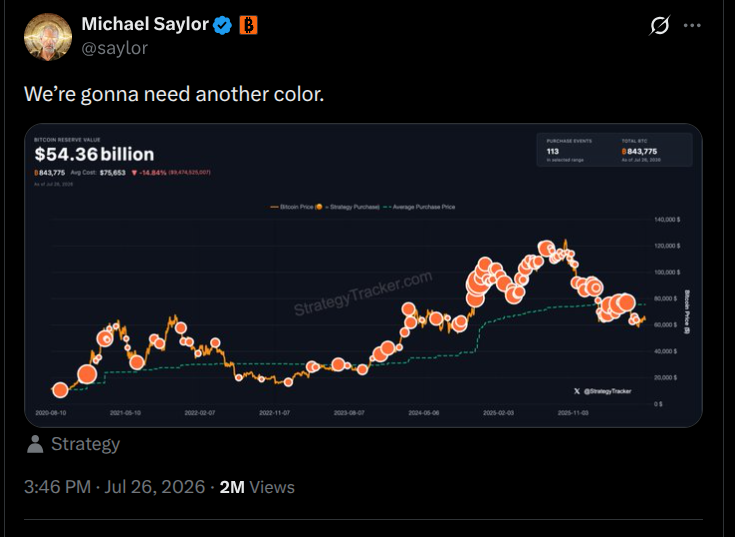
Source: Michael Saylor on X.com
Stock sales boost dollar reserve $3.75B
Following additional capital raised through its ATM stock offering program, Strategy increased its US dollar reserve to $3.75 billion as of July 26, up from $3.225 billion the previous week.
However, Strategy reported no Bitcoin purchases or sales during the July 20-26 period, leaving its holdings unchanged at 843,775 BTC, acquired at an average purchase price of $75,476 per Bitcoin, or $63.69 billion in aggregate. The biggest crypto was last trading hands at roughly $64,971 at time of publication.
Related: Strive’s SATA recovers most of June decline, trades within 3% of par
Strategy’s growing cash reserve highlights management’s efforts to maintain liquidity as it expands its capital markets activity through common stock offerings and preferred stock instruments. The reserve is intended to support dividend payments on preferred stock and interest payments on the company’s outstanding debt.
Saylor sparks debate over BTC future role for banks
The update came shortly after Saylor reignited a debate over whether banks have a place in Bitcoin’s future after arguing that the crypto asset’s growth depends on integration with traditional financial institutions.
Saylor wrote on X on Sunday that rejecting Bitcoin’s links to financial infrastructure would deny access to most potential users. His comments drew criticism from some BTC supporters, who contend that greater involvement from banks conflicts with the network’s original goal of enabling transactions without intermediaries.
Several users pushed back against Saylor’s argument by citing Bitcoin’s white paper, which introduced the asset as a peer-to-peer electronic cash system designed to remove the need for financial institutions. The exchange highlighted a growing divide between advocates who view banks as necessary gateways for mainstream adoption and those who see them as a threat to Bitcoin’s decentralized foundation.
Magazine: Strategy became a symbol of the dot-com crash: Could history repeat?



“Digital assets are becoming an increasingly important component of diversified investment portfolios,” Amy Oldenburg, head of digital asset strategy at Morgan Stanley, said in a press release. “As client interest in digital assets continues to grow, we’re focused on providing a range of digital asset solutions that allow investors to diversify their portfolios across traditional and decentralized asset classes while also adhering to Morgan Stanley’s standards for governance, infrastructure and risk management.”
Both products charge a 0.14% expense ratio — the lowest on the market — and plan to stake a portion of their ether or SOL holdings, with any staking rewards passed through to investors rather than kept by Morgan Stanley.
The products build on the Morgan Stanley Bitcoin Trust (MSBT), which debuted earlier this year and had gathered more than $381 million in assets under management through July 16. The bitcoin fund tracks the CoinDesk Bitcoin Benchmark Rate.
BlackRock, which owns the largest spot bitcoin ETF on the market, recently brought its first crypto income ETF to the market, as clients are increasingly looking for steady income from their long-term bitcoin investments.
Morgan Stanley also enters the market with a built-in distribution advantage. Its wealth management business includes roughly 16,000 financial advisors overseeing more than $9 trillion in client assets, while its ownership of E*TRADE gives the firm a direct line to millions of self-directed investors.

A federal judge has temporarily blocked Minnesota from enforcing a first-of-its-kind law that would have prohibited prediction markets in the state.
The latest decision hands a temporary legal victory to Kalshi, Polymarket, and the US Commodity Futures Trading Commission (CFTC).
Early Court Victory
According to Reuters, US District Judge Katherine Menendez granted a preliminary injunction after finding that the state law, which was due to take effect on Saturday, is likely preempted by the federal Commodity Exchange Act. The ruling allows Kalshi and Polymarket to continue offering event contracts to users in Minnesota while the lawsuit proceeds.
The dispute began after Governor Tim Walz signed legislation in May that made it a criminal offense to operate, host, or promote prediction markets in the state. Unlike other states that have challenged companies such as Kalshi by arguing they were operating unlicensed gambling businesses under existing gaming laws, Minnesota enacted a law that aimed specifically at prediction markets.
Judge Menendez said several event contracts offered by Kalshi and Polymarket likely qualify as “swaps” under federal law. Because the CFTC regulates swaps, she found that federal law is likely to override Minnesota’s ban on prediction markets. Despite this, she noted that the court could narrow the injunction later if it determines that not every event contract listed on the platforms falls within that definition.
For now, however, she said preserving the status quo is appropriate while the court fully considers the merits of the case.
The decision was welcomed by both platforms. A spokesperson for Kalshi, Elisabeth Diana, for one, said the ruling confirms that states cannot prohibit activities outside their jurisdiction. Meanwhile, Minnesota Attorney General Keith Ellison said the state disagrees with the decision and will continue defending the law while arguing,
“Prediction markets are gambling, plain and simple, and Minnesota has every right to keep predatory gambling out of our communities.”
Compliance and Legal Battles
The latest ruling comes as Kalshi continues to face legal restrictions in Massachusetts, Michigan, Nevada and Washington. Earlier this year, the company also stepped up enforcement of its own trading rules.
In April, it suspended three US political candidates after finding they had traded on contracts tied to elections in which they were running. The platform described the activity as political insider trading and said it violated its CFTC-approved rules. Minnesota State Senator Matt Klein and Texas candidate Ezekiel Enriquez each placed trades worth less than $100 on their own races and accepted fines and five-year suspensions.
Virginia candidate Mark Moran received a larger fine and a five-year ban after making multiple trades and refusing to settle. Moran said he placed the bets to test Kalshi’s enforcement process.
A month later, federal prosecutors charged Google software engineer Michele Spagnuolo, known online as “AlphaRaccoon,” with allegedly using confidential Google search data to make about $1.2 million by trading on Polymarket. Authorities said he accessed nonpublic “Year in Search 2025” rankings before they were released and placed bets on a related prediction market.
The post Minnesota’s Prediction Market Ban Hits Legal Roadblock After Federal Court Ruling appeared first on CryptoPotato.


But evidence points away from exploitation, a CoinDesk Research report found in July. If someone had minted counterfeit ZEC, the obvious next step would be to move it out and sell it, which would show up as funds leaving the pool. However, Orchard’s balance grew steadily through the four years the flaw was open, including through last year’s price rally, when cashing out would have been most profitable.
Developers patched the bug within days, but the patch could not account for the four years it was open. A zero-knowledge proof reveals nothing beyond the facts that it verified, so the chain holds no record of whether any Orchard transaction actually moved, and nobody can prove counterfeit coins were never created.
The turnstile is an answer to that. Money crossing into or out of a shielded pool is public even when the transactions inside are not, so the network already knows how much ZEC went into Orchard and will not release more than that. Any counterfeit coins sitting inside are stuck there.
As of press time, 1,500 ZEC have already moved into the new pool, according to a tracker.
Ironwood also launched with two protections Orchard never had. The record each coin leaves on the chain is built to stay recoverable if quantum computers eventually break the cryptography now securing it, a property specified under ZIP 2005 and in place from the first block.
Crypto World
The Clarity Act failed to drive up BTC, ETH prices; how EX DeFi enabled holders to earn $70,000 monthly

Disclosure: This article does not represent investment advice. The content and materials featured on this page are for educational purposes only.
Crypto market volatility and regulatory developments are driving interest in cloud mining platforms like EX DeFi as investors explore alternative digital asset strategies.
Summary
- EX DeFi gains attention as crypto volatility drives investor interest in cloud mining and alternative income strategies.
- Market uncertainty boosts demand for cloud mining platforms like EX DeFi as investors seek diversified crypto participation.
- EX DeFi highlights automated cloud mining services amid Bitcoin and Ethereum volatility following regulatory developments.
Recently, the US Clarity Act continued to advance. The market generally believes that a clearer regulatory framework for digital assets will help improve long-term transparency in the industry and create a clearer regulatory environment for institutional participation.

Bitcoin nearly fell below $63,000 during last night’s sell-off, while Ethereum dropped to $1,860, with 24-hour trading volume more than doubling.
According to Coinglass data, over $670 million was liquidated in the cryptocurrency market in the past 24 hours, including $533 million in long positions being wiped out.
Amidst increased market volatility, more and more investors are seeking diversified participation methods beyond simply holding cryptocurrencies, hoping to hedge against market volatility risks through stable cash flow.
Amid market volatility, cloud mining has regained attention
Since July, major digital assets such as Bitcoin, Ethereum (ETH), and XRP have been fluctuating around key price levels, making investors increasingly eager for stable returns. The emergence of the EX DeFi cloud mining platform has injected new options and vitality into the market.
Compared to traditional mining, which requires purchasing mining rigs and incurring electricity and equipment maintenance costs, cloud mining lowers the barrier to entry. Users do not need to deploy specialized equipment and can participate in digital asset mining through the platform’s computing power services, even during market volatility, and obtain substantial returns. This is one of the key reasons why more and more investors have been paying attention to cloud mining in recent years.
As a digital asset cloud mining platform, EX DeFi supports major cryptocurrencies such as BTC, ETH, DOGE, and XRP. Through intelligent mining and computing power allocation, it helps users achieve stable returns of up to $50,000 per month.
Why are more and more investors joining EX DeFi?
As the digital asset market matures, more and more investors are placing greater emphasis on long-term participation experiences, rather than just focusing on short-term price fluctuations.
EX DeFi, through cloud deployment and automated computing power management, helps users avoid the complex processes of mining machine procurement, equipment maintenance, and mining farm operation, enabling more ordinary users to participate in digital asset mining.
With this unique core advantage, EX DeFi is rapidly gaining favor among global cryptocurrency investors — whether they are complete beginners or seasoned investors seeking long-term, stable returns, they can all obtain a low-cost, high-efficiency, and sustainable source of passive income here.
Key advantages of EX DeFi:
1. Energy Efficiency: The platform uses clean energy sources such as solar, wind, and hydropower to power its data centers, improving energy utilization efficiency while reducing the energy consumption of traditional mining, providing stable support for computing power services.
2. Payment Methods: Supports cryptocurrencies and cryptocurrencies within cryptocurrencies, including BTC, ETH, DOGE, SOL, XRP, USDC, LTC, and USDT.
3. Affiliate Program: The affiliate program offers a 3% + 2% profit margin and referral bonuses up to $50,000.
4. Compliance and Transparency: Security and transparency of mining and energy information ensure reliable and stable data and services.
5. Security and Stability: The platform utilizes Cloudflare enterprise-grade network protection, McAfee® security system, and two-factor authentication (2FA) to further enhance account and data security, and provides 24/7 support.
How to earn mining rewards through the EX DeFi Platform?
1. Go to the EX DeFi website and create an account and automatically receive a $17 bonus.
2. Choose a mining contract that matches your budget and contract duration. (Minimum deposit $100)
3. Once mining begins, your earnings will be automatically credited to your account within 24 hours.
Featured Mining Contracts
BTC (Beginner Trial Contract): Investment of $100, Term: 2 days, Daily Yield: $4, Total Profit: $100 + $8
DOGE (Golden Shell Mini Dogecoin Pro): Investment of $500, Term: 6 days, Daily Yield: $6.5, Total Profit: $500 + $39
BTC (Canaan-Avalon-A1466): Investment of $1,000, Term: 10 days, Daily Yield: $13.4, Total Profit: $1,000 + $134
LTC (Bitmain Antminer L7): Investment of $5,000, Term: 20 days, Daily Yield: $73.5, Total Profit: $5,000 + $1,470
BTC (Bitmain S19K-Pro): Investment of $10,000, Term: 30 days, Daily Yield: $161, Total Profit: $10,000 + $4,830
BTC/DOGE/LTC (ANTSPACE-HK3): Investment of $50,000, Term: 37 days, Daily Yield: $870, Total Profit: $50,000 + $32,190
Visit the official website for more information on the potential returns of EX DeFi contracts.
Summary
The continued progress of the Clarity Act has brought positive expectations for establishing a clearer regulatory framework for the US digital asset market. However, in the short term, cryptocurrency prices are still affected by multiple factors such as the macroeconomy, geopolitics, and market sentiment, and have not continued to rise despite regulatory progress.
In an environment where market volatility remains high, EX DeFi provides investors with a safe, low-cost, and high-return way to participate. This cloud mining model not only reduces short-term risks but also provides a stable cash flow, with monthly returns up to $50,000, making it an optimal choice for investors seeking sustained growth.
For more information, visit the official website.
Disclosure: This content is provided by a third party. Neither crypto.news nor the author of this article endorses any product mentioned on this page. Users should conduct their own research before taking any action related to the company.


Morgan Stanley Investment Management has launched exchange-traded products tracking Ethereum and Solana, expanding the Wall Street bank’s digital asset lineup beyond Bitcoin.
Summary
- MSSE and MSOL began trading on NYSE Arca, providing exposure to Ether and Solana.
- Both products charge a 0.14% annual management fee and include staking.
- Morgan Stanley becomes the first US bank-affiliated asset manager to issue Ethereum and Solana funds.
- The launch comes as crypto ETF flows remain mixed during a wider market downturn.
Morgan Stanley launches MSSE and MSOL
Morgan Stanley Investment Management announced the launch of the Morgan Stanley Ethereum Trust and Morgan Stanley Solana Trust on Tuesday. The products trade on NYSE Arca under the tickers MSSE and MSOL, respectively.
MSSE seeks to track the performance of Ether, while MSOL follows SOL, the native asset of the Solana network. Both products charge an annual management fee of 0.14%, placing them among the lowest-cost US crypto exchange-traded products.
The launch followed the completion of the funds’ registration and listing process. NYSE Arca approved the products after Morgan Stanley submitted the required filings to the US Securities and Exchange Commission.
Although commonly described as ETFs, Morgan Stanley officially classifies MSSE and MSOL as exchange-traded products. Like spot crypto ETFs, they hold digital assets and allow investors to gain price exposure through traditional brokerage accounts without managing wallets or private keys.
Staking adds another source of returns
Both products can stake a portion of their holdings to earn blockchain rewards. Staking involves committing tokens to help validate transactions and secure a proof-of-stake network.
Regulatory filings show that MSSE plans to stake between 50% and 80% of its Ether. MSOL may stake up to 100% of its Solana holdings. Figment, Galaxy’s blockchain infrastructure business, and Coinbase Canada are listed among the staking providers.
Service providers and custodians will retain up to 5% of the staking rewards, with the remaining rewards allocated to the funds. However, returns will still depend largely on ETH and SOL price movements, while staking introduces additional operational, liquidity, and network risks.
Morgan Stanley’s entry could increase fee pressure across the US crypto fund market. Its 0.14% charge is below the management fees attached to many competing Ethereum and Solana products, although investors must also consider tracking differences and how each issuer distributes staking income.
US investors gain bank-backed crypto access
MSSE and MSOL are the first Ethereum and Solana exchange-traded products issued by an asset manager affiliated with a US bank. Their arrival gives US investors another regulated route to gain crypto exposure through taxable brokerage and eligible investment accounts.
Morgan Stanley entered the market earlier this year with the Morgan Stanley Bitcoin Trust, which trades under the MSBT ticker. The Bitcoin product held about $392 million in net assets as of July 24, according to the asset manager’s product page.
The bank has also expanded direct crypto access through E*TRADE, allowing customers to buy and sell Bitcoin, Ethereum, and Solana through accounts linked to crypto infrastructure provider Zerohash. Morgan Stanley has separately applied to establish a national trust bank focused on digital assets.
Its role in institutional crypto markets also extends beyond its own products. LMAX Group recently appointed Morgan Stanley and KBW to examine a potential sale or public listing that could value the trading company at up to $5 billion. LMAX is considering a direct sale, a special purpose acquisition company merger, or an initial public offering, with a Nasdaq listing reportedly its preferred route.
Crypto ETF flows remain uneven
Morgan Stanley’s launch comes during an uneven period for US crypto funds. Bitcoin ETFs have recorded three consecutive sessions of net outflows following a seven-day inflow streak, according to SoSoValue data.
Ethereum funds have posted net inflows on six of the past eight trading days. Solana products recorded four inflow days over the same period, alongside two sessions with no net flows.
Those mixed figures coincide with renewed weakness across the crypto market. Bitcoin pulled back after retesting the $65,000 level, while ETH and SOL also faced selling pressure as traders reduced exposure to risk assets.
The launch nevertheless broadens Morgan Stanley’s crypto offering during a period when traditional financial companies continue building digital asset products despite weaker prices. Initial trading volumes and asset inflows into MSSE and MSOL will show whether the bank’s brand, low fee, and staking structure can attract investors from established rivals.


Perpetual futures have become one of crypto’s defining financial products, but DRW CEO Don Wilson says much of what people think they know about them is wrong.
In a series of posts on X, Wilson argued that perpetual futures — or “perps” — are simply futures contracts without an expiration date. The features often associated with crypto perpetuals, such as high leverage, auto-deleveraging (ADL) and around-the-clock trading, are characteristics of how some crypto exchanges chose to implement the products, not the contracts themselves.
“Most of what people think they know about ‘perps’ … has nothing to do with the contract itself,” Wilson wrote.
His comments come as interest in bringing perpetual futures into regulated U.S. markets continues to grow. Several exchanges and market participants have explored launching perpetual futures beyond crypto, though questions remain over how the products should be regulated and whether they fit within existing futures or swaps frameworks. Kalshi, which saw perps trading explode shortly after launching, recently submitted a proposal with regulators to expand its offerings to precious metals.
Unlike traditional futures markets, crypto exchanges like Hyperliquid operate continuously, use digital collateral and can calculate margin requirements in real time. Those technological differences allowed exchanges to offer products with higher leverage and alternative liquidation mechanisms, including ADL, which automatically reduces winning positions when losing traders cannot cover their losses.
Wilson said those design choices should not be confused with perpetual futures themselves.
“I’m not a fan of ADL,” he wrote, adding that there is “no reason it needs to be used for perps.”
Instead, Wilson argued that digital payment rails create opportunities to improve risk management. Traditional clearinghouses generally calculate margin once a day, with market participants often having until the following business day to post additional collateral. Because markets can move significantly during that window, clearinghouses require relatively large initial margin buffers.
With real-time settlement, however, exchanges can recalculate margin continuously and require traders to post collateral immediately, reducing the need for large upfront margin requirements while maintaining the same level of protection, Wilson said. Whether exchanges choose to translate those efficiencies into higher leverage is a business decision, not a defining feature of perpetual futures.
Wilson said the real innovation of perpetual futures is that they eliminate the need for investors to repeatedly roll expiring contracts, reducing transaction costs, market impact and roll slippage while allowing positions to more closely track the front of the futures curve.
He also urged regulators to focus on economic substance rather than legal labels.
“There’s no reason to treat perpetuals as swaps simply because they don’t expire,” Wilson wrote. “Economically, they’re futures.”
Wilson concluded by calling for perpetual futures to be available across a broader range of markets, including commodities, securities and crypto, arguing that they should be viewed as another tool for price discovery and risk management rather than as a crypto-specific innovation.

Bitcoin slipped to ten-day lows at the opening of Wall Street on Tuesday, extending a broader risk-off move that followed a sharp sell-off in Asia-linked equities. As traders digested renewed pressure on global technology and AI supply chains, BTC trading weakened alongside US market futures before and during the start of US hours.
Crypto positioning also took a hit. Liquidation data indicates long positions were forced out quickly, with CoinGlass reporting more than $510 million wiped out over roughly 24 hours as the decline accelerated. Meanwhile, key benchmarks in semiconductor-heavy markets fell hard—underscoring how strongly crypto is still reacting to traditional market stress.
Key takeaways
- Bitcoin’s move to ten-day lows coincided with a US equities sell-off after steep declines in Asian markets.
- Semiconductor stocks led the reversal in Asia, with South Korea’s KOSPI closing down 10.8% in a day.
- Crypto derivatives liquidations for long positions surpassed $510 million over 24 hours, according to CoinGlass.
- BTC/USD dipped below $63,000 for the first time since July 17, setting up fresh levels traders will watch for follow-through.
- Analysts point to uncertainty around hyperscaler AI capex returns and intensifying competition from open-source AI.
Semiconductors trigger a wider risk-off swing
Tuesday’s pressure on Bitcoin was not isolated to crypto. Semiconductor losses spilled from Asia into US trading, amplifying the day’s bearish tone. In South Korea, the KOSPI Index finished down 10.8% in the session, with SK Hynix dropping 14.8%—a move that signals how quickly investors are repricing expectations for memory and chip-related demand.
The weakness wasn’t confined to one market. Japan’s Kioxia Holdings fell 18.3% on the day, highlighting a broader reset across parts of the semiconductor supply chain rather than a single company-specific issue.
In the US, the Nasdaq Composite was down more than 1% at the time of writing, as tech exposure dragged. Micron Technologies also reflected the intensity of the sell-off: the stock fell by over 10% at the open, then failed to sustain a rebound and reached its lowest levels since May 22.
AI infrastructure spending meets sharper scrutiny
A core theme behind the equity drawdown appears to be intensifying questions over the durability of hyperscaler capital expenditure. Investors are increasingly focused on whether the economics of large-scale AI infrastructure builds can justify the magnitude and pace of spending.
Coverage cited in the source notes that combined 2026 capex guidance from major hyperscalers—Alphabet, Microsoft, Amazon, and Meta—was tracking toward roughly $725–730 billion, with Wall Street projections suggesting it could rise toward $900 billion in 2027. Additional detail referenced alongside this is that Alphabet reported its first cash burn on record in the second quarter, totaling $5.9 billion, even as its cloud unit posted 82% growth.
For crypto traders, the implication is straightforward: if equities react to doubts about AI spending returns, high-beta assets like Bitcoin can face correlated selling pressure—especially when leverage is already elevated in crypto markets.
At the same time, the competitive narrative around AI is adding another layer of uncertainty. The source points to Moonshot AI’s Kimi K3 open-source model, launched two weeks prior to the report’s timeframe and benchmarked against leading proprietary systems from firms such as Anthropic and OpenAI. The argument being circulated is that if similar model capabilities can be achieved at lower cost, parts of the return assumptions for Western hyperscaler spending may be less certain.
Bitcoin breaks key levels as liquidations mount
Crypto didn’t escape the macro pressure. TradingView data referenced in the source shows BTC/USD dipping below $63,000 for the first time since July 17 as the day’s sell-off expanded into US hours.
As spot price weakness drew in leveraged participants, derivatives flows accelerated. CoinGlass liquidation data cited in the article indicates long liquidations cleared in excess of $510 million over 24 hours—an outcome consistent with sharp downside moves where stop-losses and margin calls cascade quickly.
On the risk side, the source includes commentary from CoinAnk warning of a potential long liquidation cascade below $64,700. CoinAnk noted that “extremely large long liquidity has accumulated below this level,” and added that upward movement may face less immediate resistance, with the $65,800 to $66,200 band described as a “major short liquidation zone.”
This framework matters for market participants because it ties price action to the mechanics of liquidation-driven volatility. When large clusters of orders sit near defined technical levels, the market can shift rapidly—not only because of new information, but because positioning unwinds.
What to watch next
Bitcoin’s next move will likely depend on whether the broader equity stress stabilizes or intensifies, especially as investors continue to reassess hyperscaler spending and AI infrastructure return assumptions. For traders and risk managers, the immediate focus should be on whether BTC can reclaim levels above recent breakdown points or whether liquidation dynamics extend further through the zones highlighted by CoinAnk and the broader long liquidations tracked by CoinGlass.

SBI Holdings has restructured a wholly owned subsidiary around the Canton Network, extending its institutional blockchain strategy beyond Ripple and the XRP Ledger.
Summary
- SBI Digital Practice will build financial infrastructure and applications on the Canton Network.
- SBI said Canton connects more than 600 institutions and supports over $6 trillion in assets.
- The restructuring adds Canton to SBI’s work across XRP Ledger, Solana, stablecoins, and tokenized securities.
- Canton’s link to tokenized U.S. Treasuries gives the Japanese expansion a direct U.S. market connection.
SBI creates dedicated Canton Network business
SBI Holdings announced on July 28 that SBI Security Solutions had changed its name to SBI Digital Practice Co. Ltd., effective June 22.
The wholly owned subsidiary will now operate as SBI’s dedicated on-chain finance business specializing in the Canton Network. SBI has also renewed the company’s management structure to support the change.

SBI Digital Practice will plan, develop, and operate financial infrastructure and applications for institutions using Canton. Its services will cover implementation support, regulatory compliance, and transaction systems spanning different countries and currencies.
The subsidiary is based in Roppongi, Tokyo, and is led by representative director Ryo Shimotsu. SBI retains full ownership of the business.
SBI said it expects more financial products and transactions to move onto blockchain networks. The company wants the new unit to help banks and other financial institutions adopt the technology while meeting rules in their respective markets.
SBI has participated in Canton as a Super Validator, a network role involved in transaction approval and management, according to the company’s July 28 announcement.
SBI’s expansion does not signal a Ripple exit
The restructuring broadens SBI’s blockchain operations but does not indicate that the group is abandoning Ripple or the XRP Ledger.
SBI and Ripple established SBI Ripple Asia in 2016 to promote Ripple-based payment infrastructure across the Asia-Pacific region. Their joint venture has remained one of Ripple’s main institutional relationships in the region.
SBI Ripple Asia has continued developing XRP Ledger services, including a token issuance platform designed to help businesses create digital assets under Japanese regulatory requirements.
Canton serves a different part of SBI’s strategy. While Ripple’s infrastructure has mainly supported payments, stablecoins, and token issuance, the new subsidiary will focus on institutional financial infrastructure, cross-border securities, and systems that require transaction privacy.
The move therefore points to a multichain model in which SBI selects different networks for different financial products rather than depending on a single blockchain ecosystem.
Solana and Ondo deals widen SBI’s multichain strategy
Canton is the latest addition to a broader series of tokenization projects announced by SBI.
Earlier in July, SBI Global Asset Management partnered with regulated real-world asset exchange DigiFT to launch the SBI Japan High Dividend Equity Strategy Token, or JX token, on Solana. The product gives eligible institutional and accredited investors on-chain access to a Japanese equity strategy managed by SBI Asset Management.
DigiFT described JX as the first listed-equity strategy from a Japanese asset manager to be brought on-chain through its regulated infrastructure. The token does not distribute dividends directly, with returns instead reflected through the underlying growth strategy.
SBI also reached an agreement with Ondo Finance to tokenize Japanese equities and use its yen-backed JPYSC stablecoin for settlement and collateral. Ondo Global Markets (BVI) Limited will issue the products, while SBI plans to distribute them through its financial platforms.
The related tokens have not been registered under the U.S. Securities Act and cannot be offered to U.S. persons unless registered or covered by an exemption, according to the partnership announcement.
SBI separately acquired a majority stake in Singapore exchange Coinhako on July 16 after receiving approval from the Monetary Authority of Singapore. The deal gives SBI another regulated distribution channel for digital assets in Asia.
Canton connects SBI to U.S. Treasury tokenization
SBI said Canton has more than 600 participating institutions, including Goldman Sachs, BNP Paribas, Franklin Templeton, Broadridge, and Euroclear. It placed the value of assets represented on the network above $6 trillion.
The U.S. connection comes through the Depository Trust & Clearing Corporation. DTCC and Digital Asset announced plans in December 2025 to tokenize a subset of U.S. Treasury securities held at the Depository Trust Company on Canton.
The partners targeted a controlled production launch during the first half of 2026, followed by a broader rollout based on market demand. A July transaction conducted through Tradeweb later paired an on-chain U.S. Treasury with USDCx and settled the assets through Canton.
SBI has not disclosed specific customers, launch dates, or revenue targets for its new subsidiary. Its latest restructuring nevertheless places Canton alongside Ripple, Solana, Ondo, JPYSC, and Coinhako within a wider institutional digital asset strategy.

BitMEX’s closure is no longer an isolated event. Within days, BitMart announced its own wind-down, while AscendEX had already confirmed it would cease operations earlier this month. Three centralized crypto exchange platforms exiting within weeks have shifted attention from individual failures to whether the industry is entering a new phase of consolidation.

The timing comes as trading activity remains well below previous bull market peaks. Retail participation has cooled, compliance costs continue rising, and liquidity is increasingly flowing toward a handful of global exchanges. Together, those trends are making it harder for smaller and mid-sized platforms to compete.
The growing list of exchange closures has also reignited debate over regulation. Former Binance CEO Changpeng Zhao, known as CZ, argued that years of regulatory pressure under the Biden administration accelerated industry consolidation by making it significantly harder for smaller exchanges to survive. While each exchange cited different reasons, analysts increasingly see the closures as symptoms of broader structural change.
Sad to see BitMex go. Some thoughts: — CZ
BitMex pioneered 100x perps in crypto back in 2014. Delivery futures existed before then, making Fridays hectic.
BTC deposits only, one chain only, withdrawals only once per day, through a multi-sig wallet. The constraints that seemed… https://t.co/8kP8byy37y
 BNB (@cz_binance) July 23, 2026
Discover: The Best Crypto to Diversify Your Portfolio
Crypto Exchange Consolidation Leaves Little Room for Smaller Platforms
BitMEX pioneered the perpetual swap in 2016 and later became the world’s largest crypto derivatives exchange. At its peak, the platform controlled roughly 57% of the global derivatives market. Its decline accelerated after U.S. authorities charged the exchange in 2020 with violating anti-money laundering and Bank Secrecy Act requirements.
Co-founders Arthur Hayes, Ben Delo, and Samuel Reed later pleaded guilty, while BitMEX paid substantial financial penalties and strengthened its compliance program. The changes reshaped its business model, ending the anonymous high-leverage trading that helped build its early success.
Meanwhile, Binance, Bybit, and OKX expanded with deeper liquidity, broader product offerings, and stronger fiat infrastructure. BitMEX later introduced spot trading and additional services, but those efforts failed to restore its competitive position as traders increasingly migrated elsewhere.
BitMart’s shutdown and AscendEX’s earlier exit reinforce the same trend. Each exchange faced different challenges, yet all struggled as compliance costs rose and competition intensified. A proposed class action lawsuit against former BitMEX executives also added reputational pressure, although the allegations remain unproven.
Trade Crypto on Bybit and Get a Chance to Win Our $1,000 USDT Airdrop
Regulation and Lower Trading Activity Reshape the Industry
The recent closures reflect broader structural changes across the crypto industry. Retail trading has slowed since the previous bull market, while Bitcoin ownership has increasingly shifted toward long-term holders. Lower speculative activity has reduced trading revenue, making it harder for smaller exchanges to remain profitable.
At the same time, Europe’s Markets in Crypto Assets regulation has raised compliance requirements across the European Union. Similar regulatory frameworks are emerging elsewhere, increasing legal and operational costs. Larger exchanges can spread those expenses across millions of users, while smaller competitors often cannot.
For customers, BitMEX has already halted new registrations and will enter reduced-only mode before its September closure. BitMart and AscendEX have also instructed users to withdraw assets within their respective timelines. Together, the three exits suggest the crypto exchange market is becoming increasingly concentrated among a few large global operators.
Discover: The Best Token Presales
The post Crypto Exchange Shakeout Deepens as BitMEX, BitMart, and AscendEX Exit the Market appeared first on Cryptonews.
Digital infrastructure company Core Scientific more than doubled its second-quarter revenue as rapid growth in its artificial intelligence and high-performance computing (HPC) colocation business continued to reshape its earnings profile following its pivot beyond Bitcoin mining.
The company reported Tuesday that Q2 revenue increased to $164.2 million, up from $78.6 million a year earlier. Colocation revenue accounted for $136.7 million of the total, compared with just $10.6 million in the same period last year, while gross profit increased to $70 million from $5 million.
Despite the revenue surge, Core Scientific reported a net loss of $1.15 billion, driven primarily by a non-cash accounting charge related to the rising value of outstanding warrants as its share price increased.
The results underscore how several Bitcoin mining companies have diversified into AI and HPC infrastructure, seeking more stable, long-term revenue streams as demand for data center capacity surges.
Once one of the world’s largest publicly traded Bitcoin miners, Core Scientific now generates the bulk of its revenue from colocation services while maintaining a comparatively modest Bitcoin treasury of fewer than 1,000 BTC, according to industry data.
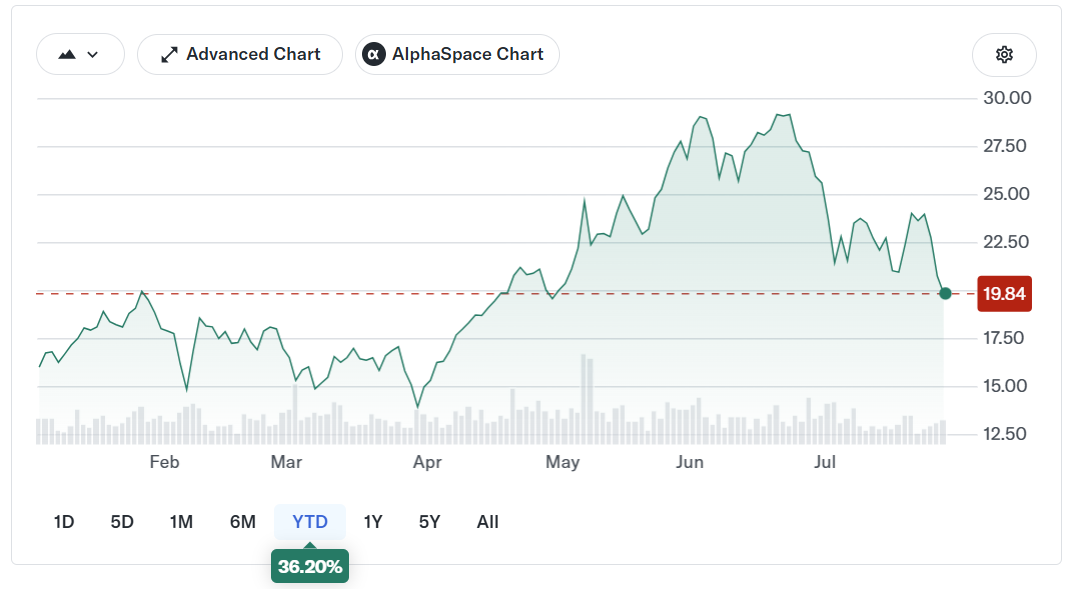
Core Scientific shares fell more than 4% following the earnings release, trimming its year-to-date gains.
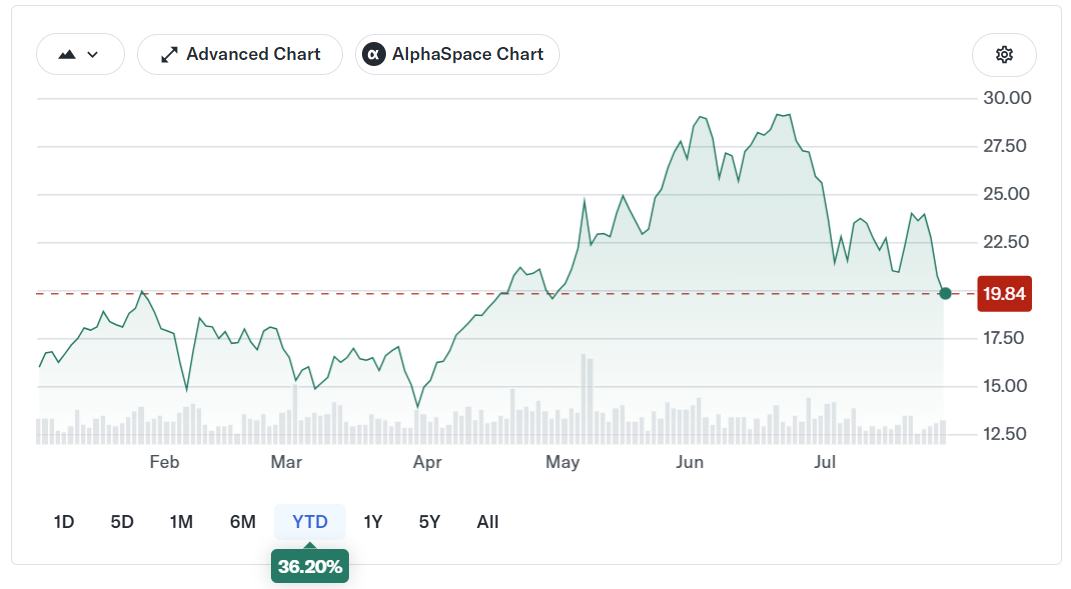
Core Scientific (CORZ) stock is up 36% this year. Source: Yahoo Finance
Related: CoreWeave shows how crypto-era infrastructure quietly became AI’s backbone
AMD partnership expands AI footprint
Alongside its earnings, Core Scientific announced a partnership with Advanced Micro Devices (AMD), the semiconductor company that designs CPUs and AI-focused graphics processors competing with Intel (INTC) and Nvidia (NVDA).
The agreement could ultimately support up to 2.5 gigawatts of leasable data center capacity. It is initially anchored by 15-year agreements covering 530 megawatts across several US sites beginning in 2027, with the potential to expand over time.
Core Scientific said the broader partnership has the potential to generate more than $14 billion in contracted base revenue, while its total leased customer power capacity now stands at roughly 1.1 GW, representing more than $24 billion in potential contracted revenue.
Earlier this month, IREN disclosed $2.8 billion in cloud contracts with AI developers, while Hut 8 unveiled a $9.8 billion lease agreement with an unnamed customer for capacity at its AI data campus.
Related: Crypto market breakout could accelerate as AI trade cools, analyst says

MycoTechnology, Adorvia Biotechnology form sugar-reduction partnership

Morgan Stanley debuts ether (ETH) and solana (SOL) ETPs after bitcoin fund success

Social Thinks Is Included In Her Booking Contract

Renter of Home in Anne Heche Crash Denies Settlement With Son

No Jackpot Winner as $257 Million Prize Rolls Over to $269 Million Monday Draw

Weekend Open Thread: Staud – Corporette.com

Old Money Doesn’t Carry Birkins Anymore. Here’s Why

GOLD LIVE – XAUUSD Forex Detector Live Trading Session# 465 #crypto #forexlive #forexdetector

Nirmala Sitharaman’s 5 Smart Financial Tips Everyone Should Follow Money Management Secrets
-

 Fashion4 days ago
Weekend Open Thread: Brooks Brothers
-
 Business7 days ago
New Jersey voter registration controversy explained: How 6,600 noncitizens got on the rolls, and what happens next
-

 Tech2 days ago
Intel is reversing course and bringing hyper-threading back to its server chips
-
 Entertainment7 days ago
Johnny Depp’s R-Rated Gothic Cult Classic Gets New Release Ahead of Sydney Sweeney Remake
-
 Sports2 days ago
Commonwealth Games boxing: Jadumani Singh seals dominant 5-0 win over Pakistan’s Sumama Rehman to enter quarter-finals | Commonwealth Games News
-

 Crypto World6 days ago
Ethics, other provisions in crypto Clarity Act to be further discussed
-

 Politics1 day ago
Luke Littler dismantles Gerwyn Price to retain title in Blackpool
-

 Sports5 days ago
2026 3M Open leaderboard: Scottie Scheffler finds putter in Round 1, sits three back
-

 Fashion5 days ago
16 Dresses for the High Summer Event
-

 Politics9 hours ago
The Part of the Electric Transition Nobody Wants to Discuss
-

 News Videos5 days ago
The Peugeot Family: How 200 Years of an “Old Money” Dynasty Died in A Boardroom
-

 Politics2 days ago
Spain sweeps the board at 2026 World Cup with individual awards
-
 Entertainment4 days ago
A New Post-Apocalyptic Gundam Anime Series Blasts Into SDCC
-

 News Videos2 days ago
BITCOIN JUST ENTERED THIS CRITICAL ZONE…
-

 Crypto World3 days ago
Ripple bought a bank in pieces. The $4 billion audit
-

 Crypto World2 days ago
XRP Ledger adds $2.6B as RWA inflows rank second
-

 Crypto World5 days ago
Uniswap (UNI) pushes deeper into tokenized RWAs with permissioned trading pools
-

 Tech4 days ago
Anthropic launches Claude Opus 5, a cheaper AI model for coding, agents and enterprise workflows
-

 Entertainment3 days ago
Sara Gilson Killed By Husband After Viral “Pedophile” TikTok Video
-

 Crypto World7 days ago
Sablier Labs Enters Maintenance Mode, Halts Development
You must be logged in to post a comment Login