

Crypto World
Strategy’s Bitcoin Model Under Pressure, Grayscale Warns

Strategy’s leveraged Bitcoin model is stressed, which could limit the firm’s ability to keep buying BTC and potentially force further sales, according to Grayscale.
“The shift in approach from one of the world’s largest BTC holders has weighed on market sentiment,” said Zach Pandl, Grayscale’s head of research, on Thursday.
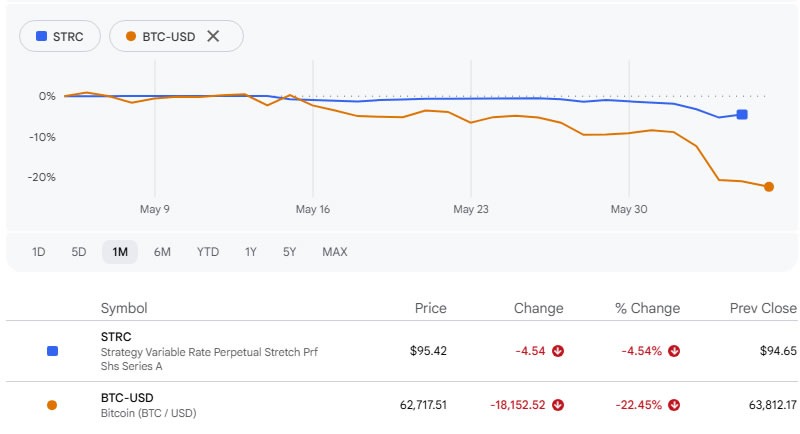
Michael Saylor’s Strategy sold 32 BTC on Monday, a tiny fraction of its total holdings of 843,706 BTC, but enough to rattle market sentiment as the asset has tanked by 16% since the sale.
Strategy also sold $128 million worth of shares, and its stock value has declined by 12.8% since the sale to a two-month low of $126 on Thursday.
BTC losses accelerated after Strategy sold and STRC declined. Source: Google Finance
Pandl warned this could have a greater impact on Stretch (STRC), the firm’s variable rate preferred equity instrument.
Stretch is designed to trade at a share price of around $100 and pay a dividend of 11.5%, but it is currently trading below that at around $95, meaning investors require a higher rate of return.
If Strategy raises its dividend to compensate investors, it increases cash obligations, potentially forcing more BTC sales and further price pressure in a negative feedback loop.
“Strategy’s levered business model is under pressure, and this has increased the volatility for the BTC market as a whole,” said Pandl.
He added that Grayscale thinks that Strategy will have a “limited ability to accumulate more tokens at current share prices for both STRC and MSTR.”
Related: Saylor downplays Bitcoin slide as Strategy faces $11B paper loss
Goldbug Peter Schiff said something similar on X on Thursday. If Strategy is forced to increase the dividend to return STRC to $100, the company “will run out of cash much sooner, pulling forward Bitcoin sales to fund payments.”
Pandl concluded, stating that less Bitcoin in leveraged corporate holdings would be healthier for the broader market and ecosystem.
“For the health of the Bitcoin ecosystem over the long run, less BTC on levered DAT [digital asset treasury] balance sheets and more on diversified corporate balance sheets will be a positive, in our view.”
It’s not all bearish for Saylor’s Strategy
Augustine Fan, partner at crypto software firm SignalPlus, told Cointelegraph on Friday that markets are blaming Strategy’s recent sales and STRC’s discount to par for driving the latest sell-off, “but the reality is that even the most ardent supporters are running out of reason to be structurally bullish.”
“All focus will be on the MSTR situation to see how Saylor manages to handle his liquidity strains by balancing dividend payments against STRC and the DAT holdings.”
Jeff Ko, chief analyst at CoinEx, told Cointelegraph that Strategy’s first Bitcoin sale was an “important psychological trigger” for this week’s selloff.
However, he said the move was more constructive than the market reaction implied, as it gives the company more flexibility.
“Greater flexibility around selling Bitcoin can help Strategy manage balance sheet risk more prudently, rather than forcing itself into a one-way accumulation strategy under all market conditions.”
Magazine: Korea’s first memecoin rug-pull case, China’s crypto rules review: Asia Express

Crypto World
Critical Zcash Vulnerability Revealed by Founder: Key Details and ZEC Outlook (Expert Take)
Zcash’s native cryptocurrency, ZEC, crashed by roughly 45% today, as the market reacted to a notable disclosure from the protocol’s founder, Zooko Wilcox, and other key ecosystem figures.
The post explained that researchers had recently found and patched a critical vulnerability associated with Zcash’s Orchard shielded pool – one that could have allowed an attacker to create unlimited counterfeit ZEC without being detected.
This brought to light one of the most serious kinds of bugs a cryptocurrency could face: one that threatens the integrity of the coin’s supply.
It’s worth noting that the authors said they believe previous exploitation was unlikely; however, they also acknowledged that because of the protocol’s privacy features, there is no cryptographic way to prove today whether or not the bug itself was exploited before it was patched.
What Happened to ZEC on June 5th, 2026?
As seen in the chart below, ZEC experienced a massive crash on June 5th, 2026, losing more than 45% of its value and plummeting from above $600 to around $300 in a matter of hours. The sudden move followed a disclosure from the protocol’s founder, bringing to light a massive vulnerability that may have allowed attackers to mint counterfeit tokens.
Let’s dive a bit deeper.

According to Zooko’s post on Twitter, security researcher Taylor Hornby discovered the vulnerability on May 29th, 2026, while reviewing the protocol’s Orchard circuit. To those unaware, Orchard is one of Zcash’s shielded pools – the part of the protocol that makes private transactions possible.
Hornby had been hired by Shielded Labs back in April 2026 to conduct ongoing security research on the protocol. His job was to look for hidden flaws before malicious hackers could find it.
The discovery came relatively short after Antrophic released its Opus 4.8 AI model on May 28th. In fact, Hornby used this same model as part of a targeted audit of the Orchard circuit. He combined AI-assisted review with traditional security research, and one day later he found the bug and disclosed it to the Zcash Open Development Lab, or ZODL for short.
ZODL then coordinated an emergency response throughout the entire Zcash ecosystem, completing the fix by June 2nd, and thereby closing the window of risk. But that’s not the end of the story, because the bug could have caused damage before it was fixed. Allow me to explain.
Why This Bug Was So Serious
Put in simple terms, the vulnerability could have allowed for someone to create fake ZEC inside Orchard.
Cryptocurrencies usually rely on very strict rules to prevent counterfeiting. A blockchain must absolutely know, at all times, that coins being spent really exist and that no one is secretly creating more than allowed. Zcash has a maximum supply of 21 million ZEC, similar to Bitcoin’s fixed-supply model. If someone is able to create unlimited fake ZEC, that would undermine one of the most basic and fundamental promises of the system itself.
— zooko
ⓩ (@zooko) June 4, 2026

The vulnerability was caused by what the authors described as an “under-constrained” element in the Orchard circuit. Now, a circuit is a mathematical system used to verify that a private Zcash transaction follows the rules without revealing sensitive details. These are the details about the sender, the receiver, and the amount.
“Under-constrained” here means that the circuit did not fully check something it was supposed to be checking. In this case, the flaw enabled the insertion of false inputs into a core cryptographic operation, elliptic curve multiplication, while still making the proof appear valid.
The researcher reportedly built a complete exploit and tested it in a local environment. During that test, the exploit generated virtually unlimited undetectable counterfeit ZEC. The authors admitted that if the same tool had been used on mainnet before the fix, it would have generated counterfeit ZEC directly in the real Zcash wallet.
The Tradeoff for Privacy
The crucial part of this disclosure is not only that the bug existed, but that Zcash’s privacy design makes it impossible to prove whether it was ever exploited before the fix. And it has been here for a while. To be precise – since Orchard was activated in May 2022. So that’s over 4 full years it could have been exploited.
Zcash’s protocol is designed so that shielded transactions do not reveal public details about who sent the funds, who received them, or how much was transferred. That privacy is the whole point of the system. At the same time, though, it makes forensic analysis that much harder.
On a traditional public and transparent blockchain, investigators are able to trace abnormal coin creation or suspicious transaction patterns. In Orchard, the relevant information, which could essentially point to any potential damages, is hidden by design. As a result, the authors concluded that there is no definitive cryptographic way of determining whether counterfeited coins were created before the vulnerability was patched.
It’s important to note that this doesn’t mean that counterfeiting happened – it just means there’s no way to prove it doesn’t.
Authors Think Exploitation Was Unlikely: Here’s Why
Despite the serious nature of the vulnerability, the authors argue that prior exploitation was probably unlikely.
The first reason they outline is that the vulnerability had gone unnoticed for years, despite Zcash’s protocol being reviewed by experienced security engineers and cryptographers. Orchard was activated back in May 2022, as we mentioned above, which means that the bug was there for four years without it being discoverd (or at least not that we know of such discovery).
The second reason is that Hornby was onboarded to specifically search for deep protocol vulnerabilities, and this discovery was not accidental. It was the result of focused security effort using advanced tools and expert judgment.
They also argued that the vulnerability was patched within just a few days after discovery. That said, the authors were very careful in asking the users not to simply trust their judgment, proposing a more formal way of restoring trust.
What’s Next?
First things first, Shielded Labs is working with other Zcash devs on a possible network upgrade that would allow users to reliably verify the integrity of the ZEC supply.
This idea involves creating a new shielded pool and using “turnstile accounting” for coins leaving Orchard. Put simply, this would create a migration path that’s more controlled. Coins could move from the old pool to the new one under rules that are designed to make sure that more ZEC cannot come out than it legitimately went in.
Naturally, this kind of network upgrade wouldn’t take place automatically – it would need community support through the normal government process.
In regards to ZEC’s price action, which is probably one of the things that many users are mostly concerned with, CryptoPotato reached out to leading analytics firm Nansen for an opinion. Commenting on the matter was Nicolai Sondergaard, Research Analyst, who said:
“What markets are reacting to is the part that cannot be fully resolved by the patch. Due to the privacy design of Orchard, there is no cryptographic way to audit whether someone exploited this before the fix. The Zcash team has said exploitation is unlikely, for reasonable reasons, but they have been explicit that they cannot prove it. That is a genuine supply integrity problem. A network upgrade is being proposed that would migrate coins to a new shielded pool with turnstile accounting, allowing independent verification. Until that is live and audited, the honest answer is that current ZEC supply cannot be certified clean.
The price reaction reflects that uncertainty more than the bug itself. A patched vulnerability in a minor privacy coin would ordinarily be a footnote. The -30% move is the market assigning non-trivial probability to the scenario where some counterfeiting did occur and is permanently undetectable without the proposed upgrade.”
Opus 4.8 and Its Role in Discovering this Zcash Vulnerability
One of the most impressive parts of this story is the role of AI-assisted security research.
Taylor Hornby used Anthropic’s Opus 4.8 model as part of the review that led to the discovery.
This doesn’t mean that AI “found the bug on its own.” The disclosure makes it clear that the process involved a very experienced professional, a targeted review, custom tooling, and expert analysis. However, it also shows that AI systems may increasingly become part of high-stakes security work, especially in complex cryptographic systems, where even the smallest mistakes can have disproportionately large consequences.
Shielded Labs said it’s now accelerating this kind of proactive research.
The post Critical Zcash Vulnerability Revealed by Founder: Key Details and ZEC Outlook (Expert Take) appeared first on CryptoPotato.
Crypto World
Recent Ripple (XRP) Developments, Bitcoin (BTC) Price Forecasts, and More: Bits Recap June 5
Ripple’s cross-border token is down 14% for the week, but the company continues to score major wins in global expansion and important partnerships.
Bitcoin (BTC) has also plunged substantially, with numerous popular analysts expecting further declines, while Cardano (ADA) collapsed to its lowest level since 2020.
XRP Price Crash
Several days ago, Ripple teamed up with the Turkish crypto platforms BiLira, Bitexen, and Bitlo to boost adoption and usage of RLUSD. Later on, Mastercard expanded its infrastructure to enable merchants and partners to settle transactions in multiple cryptocurrencies, including the USD-pegged stablecoin.
In addition, Ripple strengthened its presence in the United States by opening an expanded office in Washington, D.C., while the spot XRP ETFs remained predominantly positive.
Despite the favorable news, XRP tumbled by 14% over the past week and currently trades at around $1.13 (per CoinGecko). Its poor condition mirrors the collapse of the broader crypto market, where Bitcoin (BTC) slipped to around $61,000 and altcoins like Zcash (ZEC) and Bitcoin Cash (BCH) nosedived by nearly 30%.
Another worrying factor is the recent whale activity. As CryptoPotato reported, this cohort of investors has sold or redistributed 50 million coins in the span of seven days, further spreading panic that could prompt smaller players to cash out as well.
BTC’s Heavy Bleeding
The primary cryptocurrency has lost over $20,000 in the past month alone and recently dropped to approximately $61,000, its lowest mark since February. As of press time, it trades at around $62,800, representing a 15% decline on a weekly scale.
Unsurprisingly, the downward move has resulted in a wave of bearish predictions. Ali Martinez recently opined that the plunge below $72,000 has put BTC in “a vulnerable position,” with the MVRV Pricing Bands suggesting the next major support lies between $50,000 and $54,000.
For his part, Ted labeled $49,000 “a good bottom zone,” comparing the scenario to the August 2024 low. Of course, the well-known crypto critic Peter Schiff was also vocal, envisioning a $20,000 catastrophe if BTC breaks $50,000.
“It should be a quick fall below $20K, which should be a big enough drop to shake the conviction of long-term HODLers, causing many to finally throw in the towel,” he added.
ADA’s Meltdown
Cardano’s native cryptocurrency is among the most heavily affected coins from the market crash. It fell to $0.15 (the lowest point since the end of 2020) before slightly rebounding to around $0.165.
One of the main factors in ADA’s collapse was Charles Hoskinson’s recent announcement. Cardano’s founder said he’s “taking a break,” while also warning about an upcoming “wave of failures in the ecosystem.”
The only positive recent development related to ADA is Cardano’s partnership with the Brazilian Olympic Committee (COB). However, it wasn’t enough to stop the asset’s free fall.
The post Recent Ripple (XRP) Developments, Bitcoin (BTC) Price Forecasts, and More: Bits Recap June 5 appeared first on CryptoPotato.
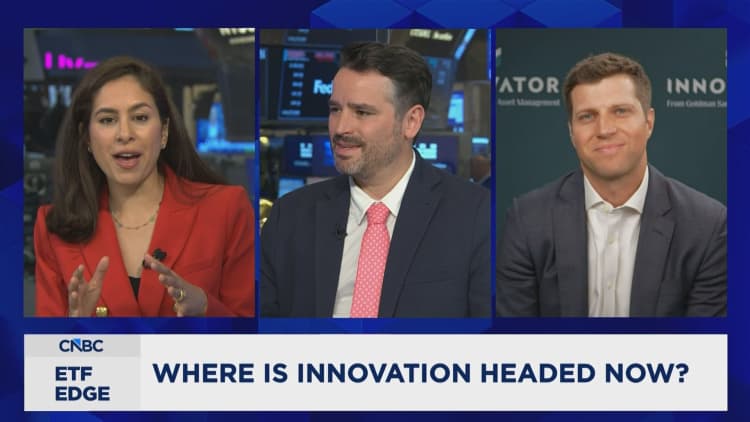

The next massive gains in artificial intelligence may come from thousands of miles away.
Tim Urbanowicz, chief investment strategist at Innovator from Goldman Sachs Asset Management, is urging investors to look beyond their backyards to the emerging markets.
“[It’s] where a lot of the big money can be made on the AI trade,” he told CNBC’s “ETF Edge” this week – calling it “the next big wave.”
Urbanowicz is particularly bullish on Taiwan and South Korea when it comes to the AI build-out. He notes they are a big part of the broad iShares MSCI Emerging Markets ETF, which is up 26% as of Thursday’s close.
“These are major players in the AI trade and the AI space where valuations really haven’t gone up as much as they have in the U.S.” he said. “There’s still a lot of runway in our view to provide outsized gains with this AI trade.”
The iShares MSCI Taiwan ETF is up almost 67% so far this year while the iShares MSCI South Korea ETF market has risen 109%, as of Thursday’s U.S. close. Both Taiwan- and South Korea-focused ETFs hold several AI memory-related chip names.
In a special note to CNBC, Urbanowicz highlighted the actively managed Goldman Sachs ActiveBeta Emerging Markets Equity ETF as a way for investors to gain exposure to potential AI-driven gains in emerging markets.

Getting exposure to AI abroad
Yet, Urbanowicz isn’t abandoning the domestic trade when it comes to AI.
“We think the U.S. is still positioned for success,” he said.
Crypto World
BTC sentiment hit peak bearishness at recent price lows, peak bullishness near tops: Crypto Daily
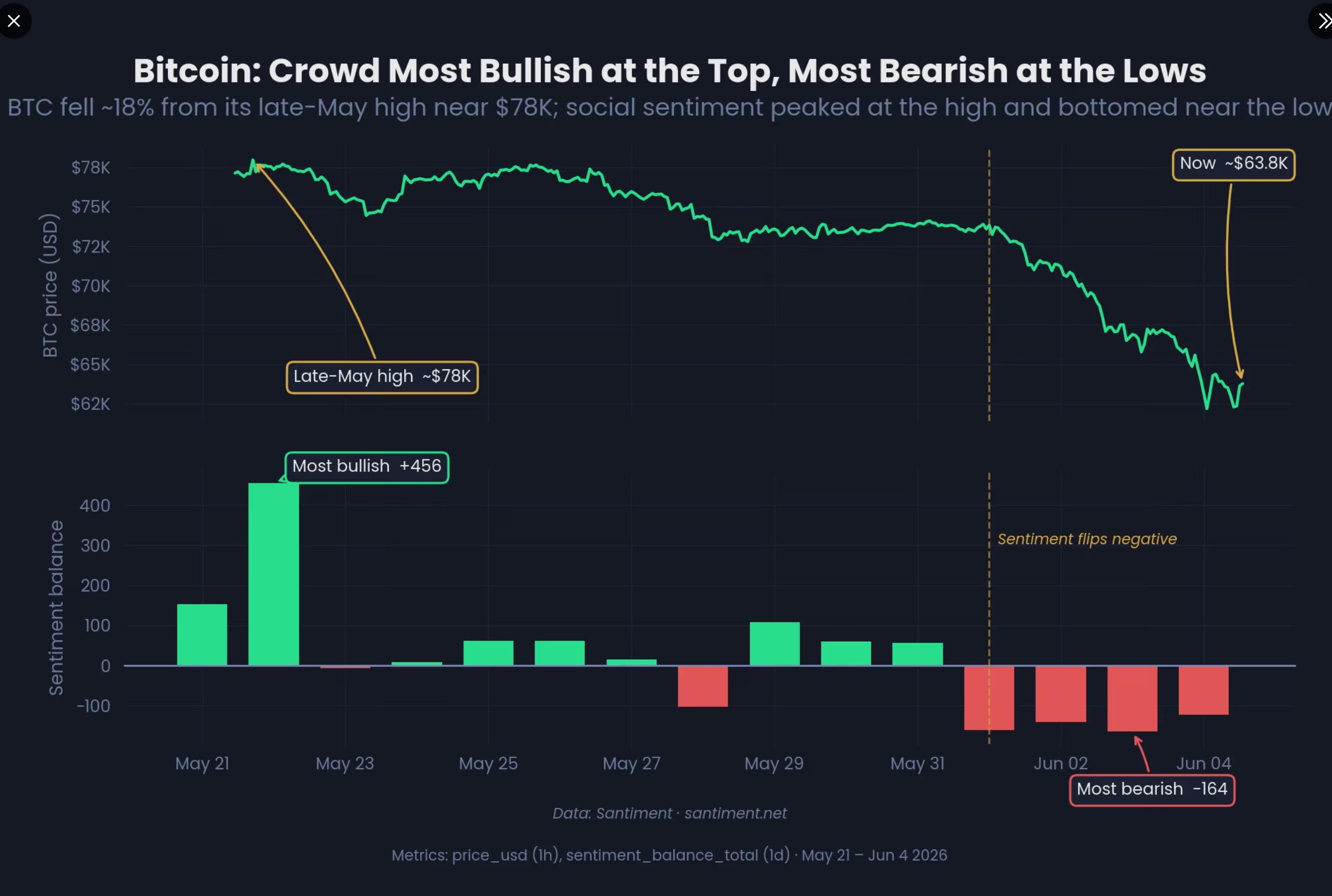
In recent weeks, bitcoin sentiment has been most bullish when the price was highest and most bearish exactly when it was most stressed, according to Santiment data covering May 21 through June 4.
Peak bullishness hit on May 22, with bitcoin near its high of $78,000 for the period. The most bearish came June 3, with bitcoin near the low. While sentiment is not a timing tool, peak conviction at the highs and peak fear at the lows is the inverse of where the trade usually pays.

Bitcoin was recently trading near $62,400, down about 20% from the late-May peak. The risk picture has cracked alongside it.
The investments into artificial intelligence (AI) companies that pulled global equities to record highs this year has stalled after Broadcom’s chip forecast fell short of expectations. South Korea’s KOSPI index fell 4.7%, and the won and Indonesia’s rupiah are at multiyear lows as capital flees emerging Asia.
U.S. spot bitcoin ETFs ended a 13-day, $4.4 billion outflow streak on Thursday with a tiny $3.05 million inflow. Spot ether ETFs ended their parallel 17-session streak with $19.30 million on the same day. Both numbers are too small relative to the streaks they ended to call it a regime change.
Friday’s U.S. nonfarm payrolls report at 8:30 a.m. ET is the binary catalyst. A soft print revives Federal Reserve interest-rate cut expectations under new Chair Kevin Warsh and likely takes risk assets back up, while a hot print may extend the unwind.
And keep an eye on how bitcoin behaves at the $60,000 round number if it gets tested before the data lands. Stay alert!
Read more: For analysis of today’s activity in altcoins and derivatives, see Crypto Markets Today . For a comprehensive list of events this week, see CoinDesk’s “Crypto Week Ahead.”
What’s trending
Today’s signal

The chart shows weekly changes in bitcoin’s market capitalization relative to an index of altcoins that excludes the 10 largest tokens.
Bitcoin has underperformed for several weeks as the altcoin measure became stronger, and the ratio recently tested a resistance level that has persisted for over a year.
If declines in zcash, hyperliquid and near continue, the chances are that it will drop further back.
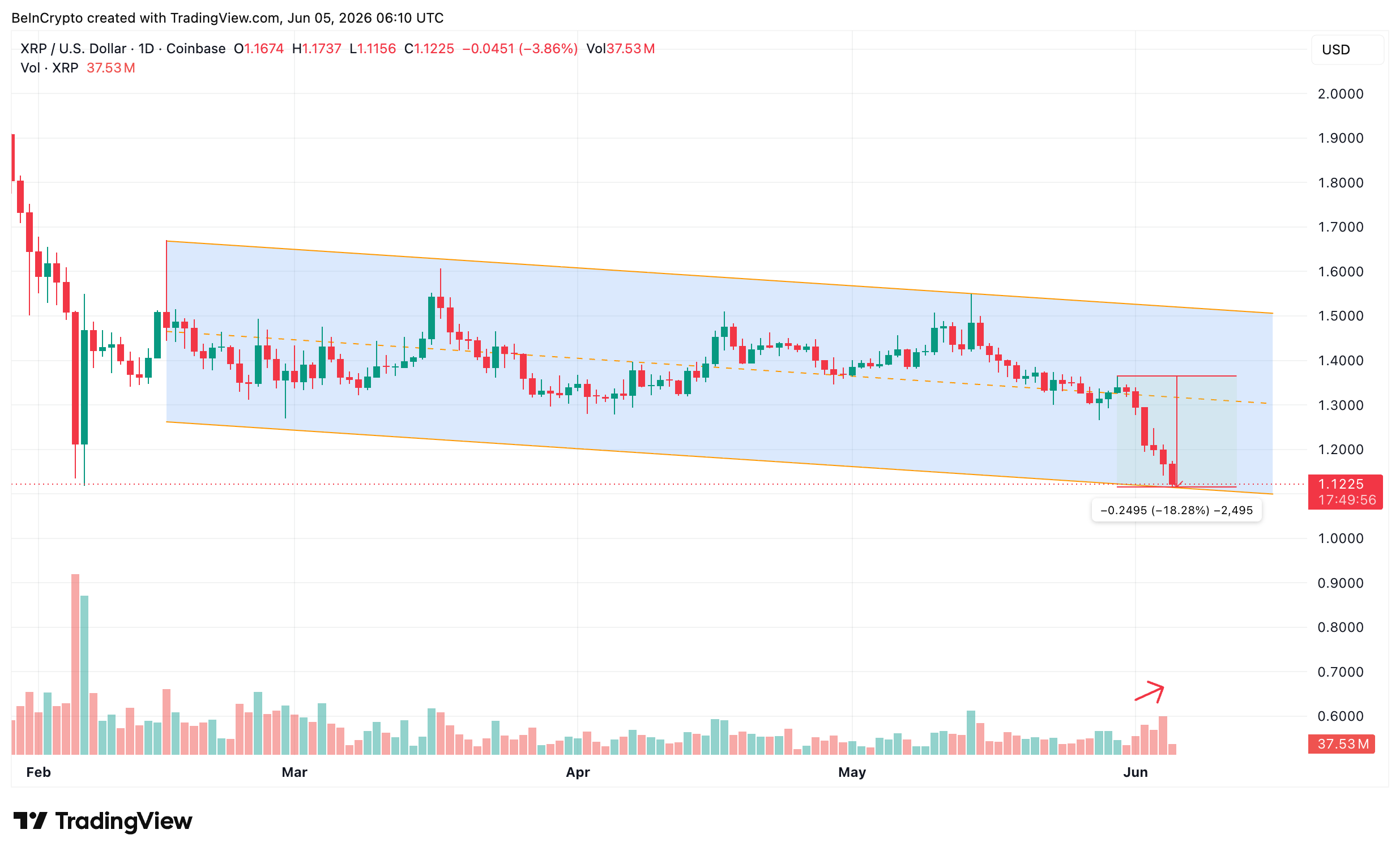
The XRP price fell to around $1.12, down close to 4% on the day, after derivatives funding spiked to its highest level in over a year and then unwound into a sharp 18% slide from late May.
The setup pairs a record long-positioning signal with a falling price channel, while a surge in steady spot buying complicates a purely bearish read. Each layer feeds the next.
Price Channel Weakens as Sell Volume Builds
The XRP price has traded inside a falling channel since February 15, a pattern where price drifts lower between two parallel down-sloping lines. It now sits near the lower line, the first sign of structural strain.
Want more token insights like this? Sign up for Editor Harsh Notariya’s Daily Crypto Newsletter here.
Sell-side volume has risen steadily since May 31, adding force to the move toward that lower boundary. Rising volume into a channel edge often precedes a test of whether the pattern holds.

That mix frames the bull and bear split early. A bounce off the lower line would keep the channel intact and favor the bulls. A clean break lower would open the bearish path. What turned the screw, however, was not the chart alone. It was a record in the derivatives market.
Record Funding Rate Signals a Crowded Long Trade
XRP’s funding rate, a recurring fee that longs pay shorts when bullish bets dominate, surged to about 0.0456 on June 1. That marks its highest reading in more than a year. The very next day deeper corrections across the crypto market started.
The spike points to heavy long positioning piled into one side of the trade. Set against the calmer readings through April and May, the jump shows a sudden crowd of leveraged buyers.

Crowded longs raise the risk of a cascade. When price slips, those positions face liquidation, and forced selling can feed on itself in a long flush.
That derivatives stress explains the speed of the drop. Yet it also hints the crash may be leveraged-driven rather than a broad exit, which the next signal supports.
Spot Buyers Step In Even as XRP Price Falls
Here the story turns against a fully bearish read. XRP’s exchange net position change, a metric tracking coins moving onto or off exchanges, has stayed negative since May 16, meaning more coins are leaving exchanges than arriving.
Coins leaving exchanges usually signals accumulation rather than intent to sell. Since May 30, the XRP price has corrected about 18%, falling from $1.34 toward current levels.
Over that same window, net outflows deepened from roughly negative $456 million to about negative $3.24 billion, a rise of close to 610%. That is a steep jump in buying pressure against a falling price.

The chart’s rising sell volume and the deepening exchange outflows seem to clash, but they are not measuring the same thing. The sell volume comes from a single venue on the price chart, a one-exchange read of activity. The exchange net position change, by contrast, tracks cumulative daily rolling flows across all exchanges, and it shows coins still leaving rather than arriving.
A burst of selling on one venue can sit alongside net accumulation everywhere else. Set against the record funding spike, that points to leveraged positioning as the more likely driver of the drop than a broad spot exit.
This tension sets up the price levels that now decide the direction.
XRP Price Levels That Decide the Next Move
The XRP price now trades near $1.12, and the levels drawn from the May 14 swing high and May 30 swing low frame both cases.
On the bear side, $1.11 is the pivot. A daily close below it would break the falling channel, and the channel projects a possible move of roughly 26% toward the $0.89 to $0.82 zone if selling holds. Below $1.11, the next support sits near $1.07.
On the bull side, a reclaim of $1.13 and then $1.18 would weaken the breakdown case. With funding already turning negative as the spike unwinds, continued spot buying could pressure late shorts, and a push above $1.18 could spark a short squeeze.

The risk to watch is repeated bottom-fishing. Traders adding fresh longs into a weak tape may still face liquidation until a clear bottom signal appears. For now, $1.11 separates a channel hold from a deeper bearish leg, while $1.18 is the line bulls must reclaim to flip momentum.
The post One Record Funding Spike Sent XRP Price Tumbling, but Dip Buying Surged 610% appeared first on BeInCrypto.
Key Highlights
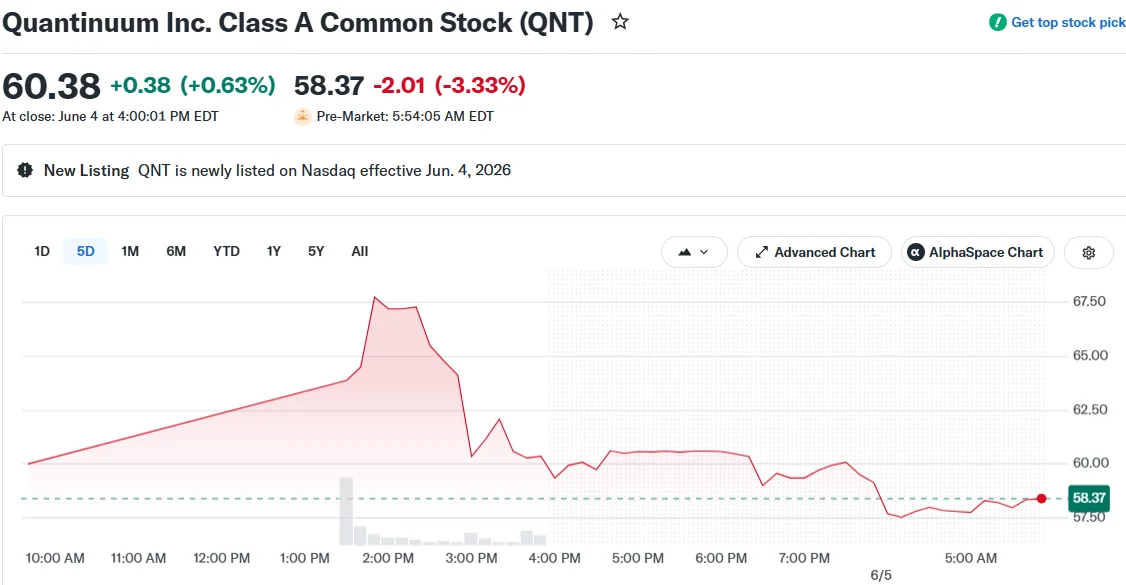
- The quantum computing company secured $1.68bn through its initial public offering, selling 28 million shares at $60 apiece—exceeding the projected $53–$55 price range
- Shares began trading at $68 on June 4, representing a 13.3% increase over the offering price and delivering a $17.63bn valuation
- The former Honeywell quantum division now trades publicly on the Nasdaq exchange with the symbol “QNT”
- Competing quantum firm IonQ (IONQ) has surged approximately 52% year-to-date, reaching a valuation around $25.47bn
- The company has recently established preliminary agreements with Mitsubishi Electric and secured a letter of intent from the US Commerce Department’s CHIPS R&D Office
On June 4, Quantinuum, the quantum computing division spun out from Honeywell, commenced public trading on the Nasdaq under the symbol “QNT,” securing $1.68bn in capital.
The firm set its offering price at $60 for each share, distributing 28 million shares to investors. This pricing exceeded the initial guidance range of $53 to $55 per share.
Shares launched at $68, marking a 13.3% surge above the offering price. When trading concluded on debut day, Quantinuum’s total valuation reached $17.63bn.
J.P. Morgan and Morgan Stanley served as primary bookrunners for the offering, with support from Jefferies, Evercore ISI, and additional underwriters.
The underwriting syndicate received a 30-day greenshoe option allowing them to acquire an extra 4.2 million shares at the IPO price to satisfy excess demand.
Quantinuum’s Position Relative to IonQ
The public offering arrives during a period of heightened investor interest in quantum computing technologies. IonQ (IONQ) has climbed roughly 52% in 2025, pushing its valuation to approximately $25.47bn—significantly higher than Quantinuum’s opening valuation.
Quantinuum positions itself as an integrated quantum computing provider, delivering a comprehensive platform designed for practical quantum applications. The company’s technology relies on QCCD architecture and reportedly achieved the industry’s highest average two-qubit gate fidelity as of December 31, 2025.
The firm serves clients across pharmaceutical development, materials research, financial services, and government applications. Headquartered in Broomfield, Colorado, Quantinuum maintains operations across the United States, United Kingdom, Germany, Japan, Qatar, and Singapore.
The company emerged in late 2021 from the combination of Honeywell Quantum Solutions and Cambridge Quantum.
Strategic Partnerships and Government Funding Initiatives
In September 2025, Honeywell secured approximately $600m in financing for Quantinuum at a $10bn pre-money valuation. These proceeds were designated for large-scale quantum system development and the rollout of the Helios next-generation platform, which became operational in November 2025.
Immediately before going public, Quantinuum disclosed a non-binding memorandum of understanding with Mitsubishi Electric. The partnership aims to investigate quantum computing applications in industrial engineering and design workflows, with initial efforts concentrating on computer-aided engineering and simulation technologies.
In May 2025, Quantinuum also entered into a letter of intent with the CHIPS R&D Office at the US Department of Commerce. This agreement outlines prospective federal support for developing fault-tolerant trapped-ion quantum computing systems.
The initiative includes partnerships with component suppliers such as GlobalFoundries and Monarch Quantum to manufacture specialized semiconductor and photonic elements.
The offering officially completed on June 5, 2026, as scheduled.

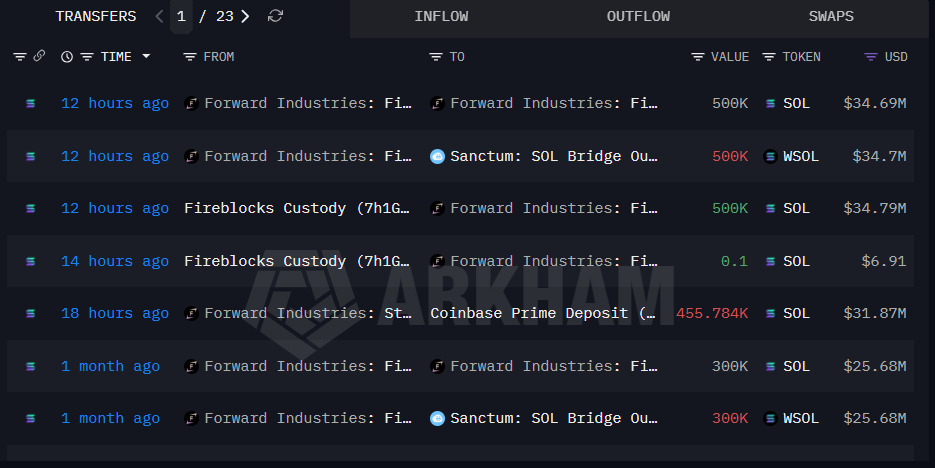
Forward Industries transferred roughly $31.9 million worth of Solana tokens to Coinbase Prime Thursday, according to blockchain data, marking its first onchain activity in a month.
Data from Arkham Intelligence shows a wallet tied to the Nasdaq-listed company moved 455,784 SOL to the institutional trading platform. The transfer comes as the firm sits on steep unrealized losses tied to its large-scale bet on the token.
The deposit to Coinbase Prime does not necessarily confirm an immediate sale but is commonly interpreted as a precursor to trading activity, particularly for institutional holders seeking liquidity or risk reduction.
Shares of Forward Industries were down about 6% in the pre-market on Friday following the transfer, trading at $3.97, down from Thursday’s close of $4.22, according to Yahoo Finance data.
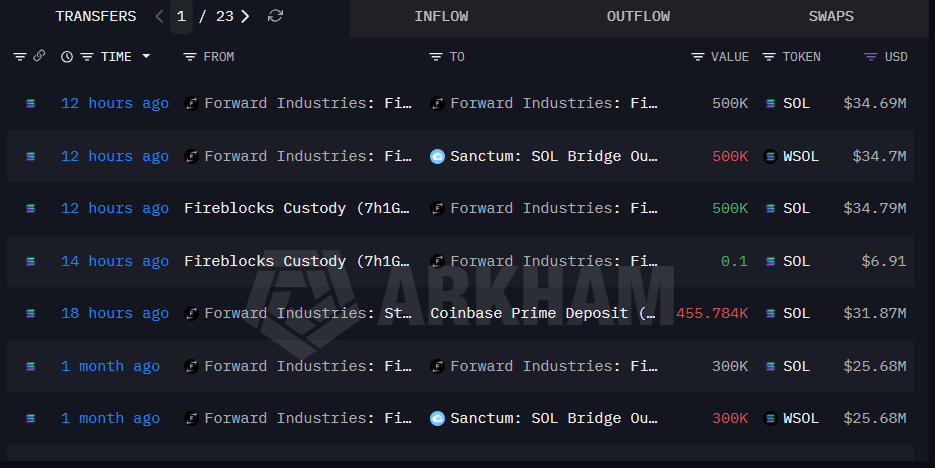
Forward Industries moves 455,784 SOL to Coinbase Prime. Source: Arkham
The move comes as publicly listed companies that adopted crypto treasury strategies face mounting pressure from the sector’s prolonged downturn, with several firms sitting on significant unrealized losses and investors increasingly focused on balance sheet risk.
Forward Industries began accumulating Solana in September 2025 as part of a treasury strategy that positioned it as the largest corporate holder of the asset, according to a December shareholder update.
Related: Solana open interest drops 30% as altcoins slump: Is $68 SOL next?
The company said it had purchased about 6.83 million SOL for approximately $1.59 billion at an average cost of $232.08 per token.
The SOL price has since fallen by roughly 72%, according to CoinGecko data, trading at around $64.63 at the time of writing. That would value the company’s original holdings at about $441 million, implying an unrealized loss of roughly $1.15 billion.
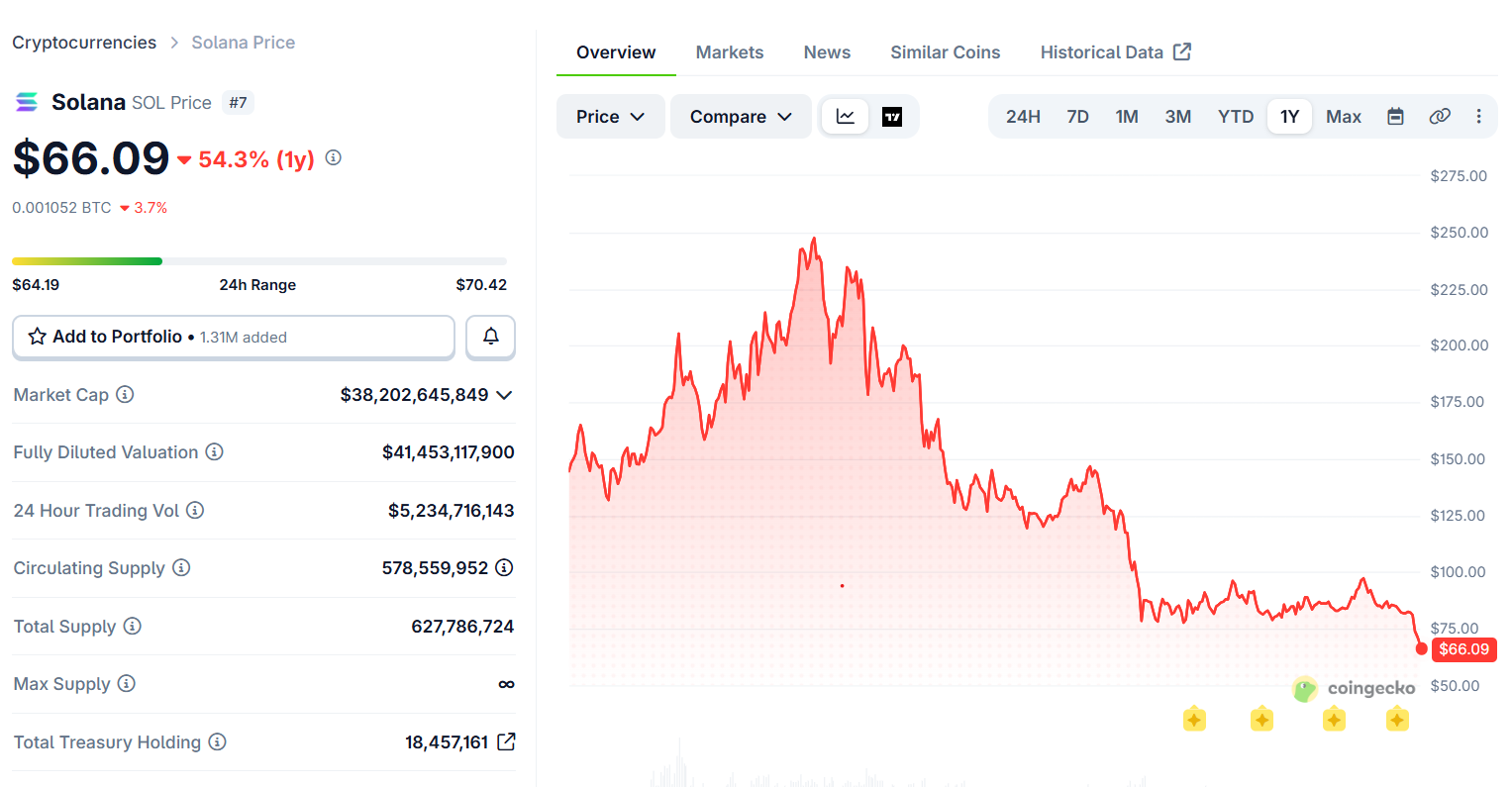
Solana price has slumped 72% since September 2025. Source: Coingecko
Forward Industries remains the largest publicly listed Solana holder with more than 7 million SOL, according to the most recent data available.
Corporate crypto treasuries face mounting pressure
The move comes amid broader signs of strain across corporate crypto treasury strategies. On Thursday, publicly listed digital asset firm FG Nexus reportedly sold an additional $17.8 million in Ether, adding to a series of disposals across the sector.
Strategy, the largest corporate Bitcoin holder, is also facing mounting pressure after Bitcoin’s recent decline pushed the unrealized loss on its holdings to about $11.2 billion.
The company disclosed this week that it sold 32 BTC for roughly $2.5 million, its first Bitcoin sale since December 2022, when it sold 704 BTC as part of a tax-loss harvesting transaction before repurchasing more Bitcoin days later.
Market Moves: Why is Ethereum Foundation selling? BTC futures warning signs
Crypto World
BNB price tests critical support as bearish market and technicals point to more downside
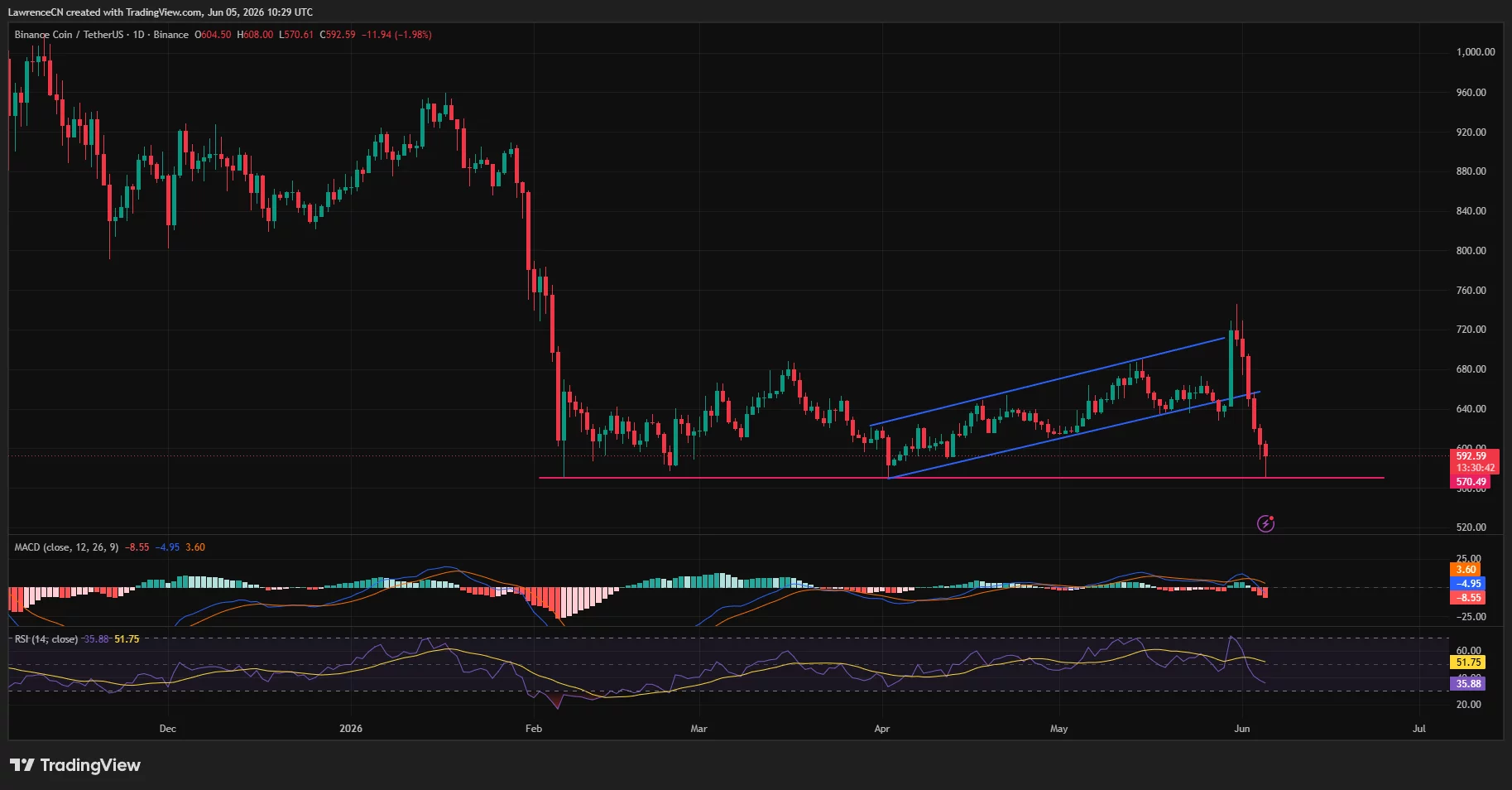
BNB price has fallen sharply from its recent highs and has now retested a major support zone as heavy liquidations, deteriorating market sentiment, and weakening technical indicators weigh on the token.
Summary
- BNB price has dropped 20% from its recent high and is testing key support near $570.
- A bearish channel breakdown and weakening momentum indicators suggest further downside risk.
- Major liquidation clusters near $620 and $680 could limit any short-term recovery.
According to data from crypto.news, BNB (BNB) was trading near $592 on June 5 after briefly hitting a year-to-date low of $573 earlier in the session. So far, the token has fallen roughly 20% from its recent peak above $740, erasing much of the rally that followed enthusiasm surrounding VanEck’s spot BNB ETF launch and renewed activity across the BNB Chain ecosystem.
Profit-taking accelerated after BNB entered deeply overbought territory near the cycle highs. The pullback quickly spread across derivatives markets as leveraged long positions were unwound. CoinGlass data showed more than $1 billion in crypto futures liquidations over a 24-hour period, adding fresh selling pressure across major digital assets.
At the same time, risk appetite deteriorated across the broader market. U.S. spot Bitcoin ETFs extended a record 13-session outflow streak, with roughly $4.4 billion leaving the products during the period.
The withdrawal of institutional capital from Bitcoin coincided with a sharp decline in total crypto market capitalization, limiting demand for higher-beta assets such as BNB.
Binance-specific developments also arrived during the selloff. The exchange confirmed it would discontinue support for selected stock-token products on June 5 as part of a platform restructuring effort.
Although the changes do not directly affect BNB Chain operations, the announcement came as traders were already reducing exposure amid heightened regulatory uncertainty and worsening market conditions.
Macro conditions have offered little support. Persistent inflation data, including an ISM Manufacturing Prices Paid reading above 80, has reinforced expectations that the Federal Reserve will maintain higher interest rates for longer. The prospect of delayed rate cuts has pressured speculative assets throughout the week.
Technical breakdown places $570 support in focus
On the daily chart, BNB price has broken below an ascending parallel channel that had guided price action higher since April. Sellers also forced a move beneath the channel’s lower trendline near $640, turning a previously bullish structure into a bearish breakdown.
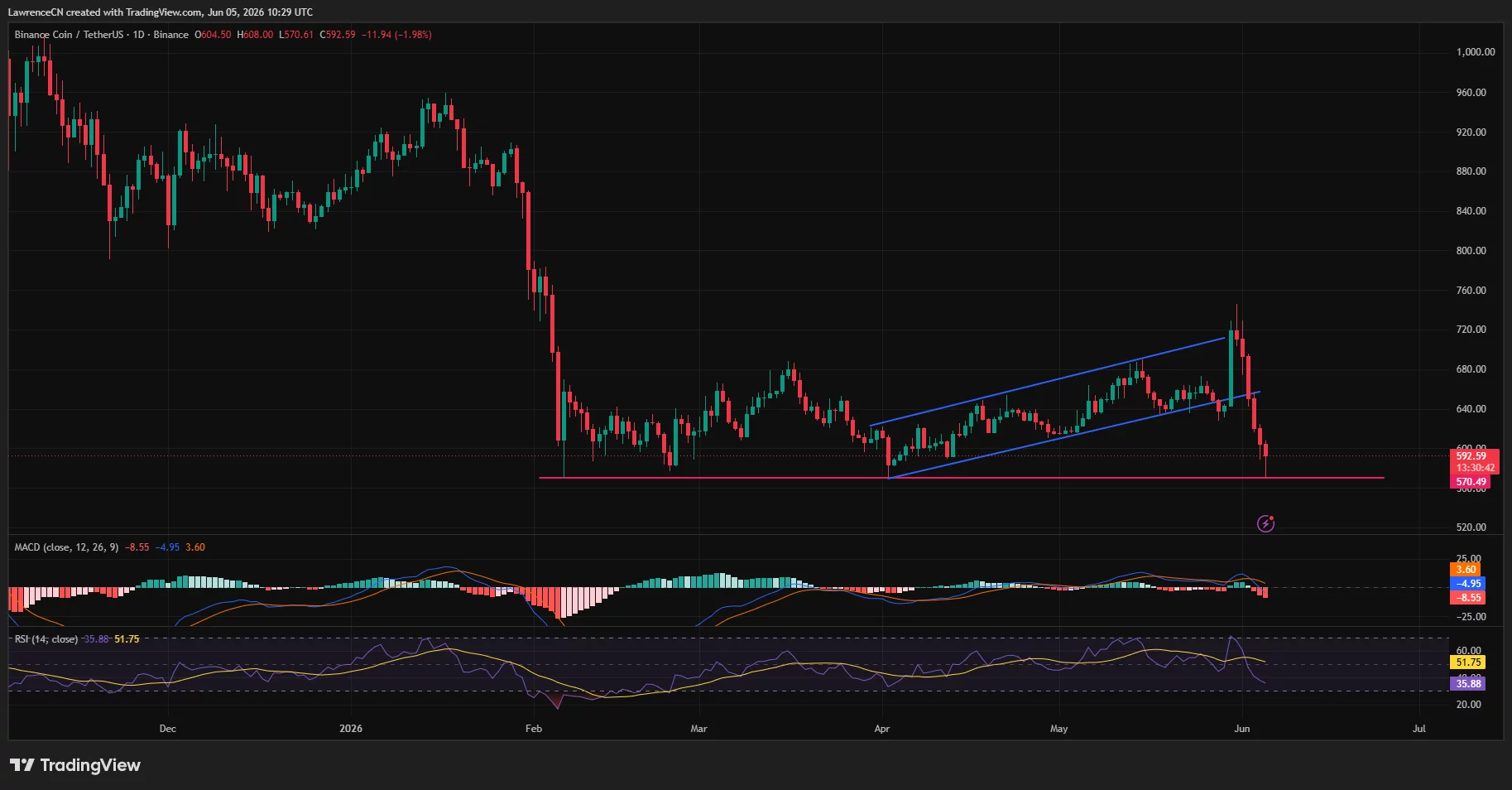
For now, a key support zone for BNB sits near $570, an area that has repeatedly attracted buyers since February. Thursday’s decline briefly tested that level before a modest rebound emerged. A decisive break below $570 could expose the February lows near $550 and potentially open the door toward the psychological $500 region.
Momentum indicators have weakened considerably during the decline. The MACD has completed a bearish crossover while the histogram continues printing expanding red bars below the zero line. Meanwhile, the Relative Strength Index has fallen to around 36, its lowest reading in several months, showing sellers retain control despite increasingly oversold conditions.
Commenting on the setup, market commentator BATMAN argued that BNB may be repeating a previous market structure that preceded a major selloff earlier this year.
“A fakeout above resistance, rejection at the 200EMA, and a MACD bearish cross point to downside pressure.”
Liquidation clusters highlight key recovery hurdles
Derivatives positioning suggests that any rebound may encounter significant resistance overhead. CoinGlass liquidation heatmaps show one of the largest short-term liquidity clusters sitting near the $620 area, while a larger concentration of leveraged positions remains between $680 and $700.
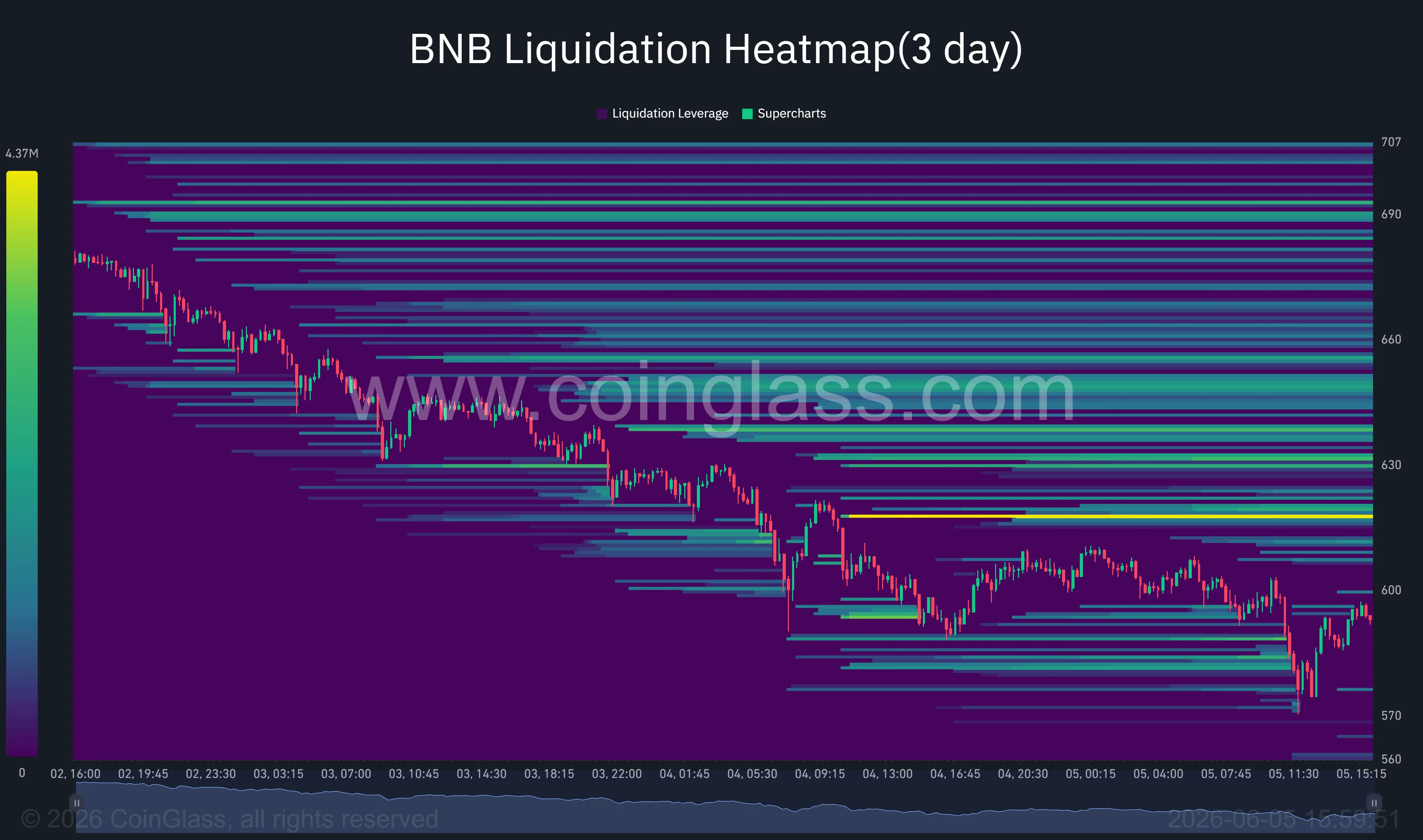
Those levels align closely with the former channel support and recent breakdown zone, making them important areas to watch if buyers attempt a recovery.
Until then, the path of least resistance remains lower. BNB would likely need to reclaim the $620 region and close back inside the broken channel before traders begin discussing a return toward $680 and the recent highs above $740.
For now, the $570 support zone remains the most important level on the chart as traders assess whether the latest selloff represents a temporary capitulation event or the beginning of a deeper correction.
Disclosure: This article does not represent investment advice. The content and materials featured on this page are for educational purposes only.

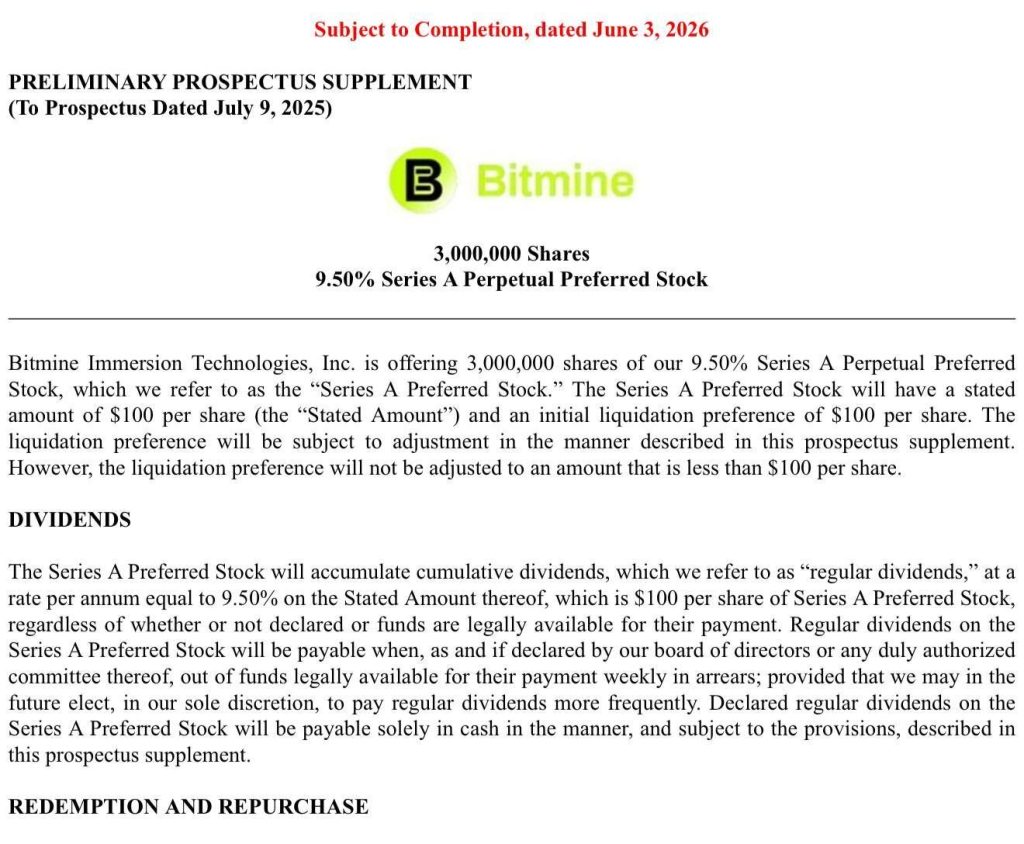
In Ethereum News today, BitMine Immersion Technologies filed with the SEC on Wednesday to launch a Series A Perpetual Preferred Stock offering, 3 million shares at $100 per share, carrying a 9.5% cumulative annual dividend, with proceeds earmarked explicitly for Ethereum acquisition, ETH staking infrastructure expansion, and ecosystem investment.
The offering mirrors the structure pioneered by Bitcoin treasury firm Strategy, but with a mechanism Bitcoin cannot replicate: staking.
The question the market is now asking is whether BitMine’s move is a one-off capital raise or the visible edge of a broader miner rotation, from hashrate-dependent revenue toward institutionalized ETH staking yields as a business model.

Discover: The Best Crypto to Diversify Your Portfolio
Ethereum News: Mining Strategy vs. Staking Model: Why the Treasury Pivot Makes Financial Sense, and Where It Doesn’t
The core argument for this pivot is structural. Bitcoin mining generates revenue through block rewards and transaction fees, but it requires continuous capital expenditure on hardware, energy contracts, and cooling infrastructure.
Margins compress every halving cycle. ETH staking, by contrast, generates yield on a balance sheet asset, currently in the range of 3% to 5% annualized, without the same operational overhead.
BitMine’s preferred stock structure sharpens that argument. Strategy sold 32 BTC earlier this year, its first Bitcoin sale since 2022, specifically to fund dividend payments on its STRC preferred stock, which carries an 11.5% dividend.
That sale briefly pushed Bitcoin below $62,000 and triggered broader market risk-off behavior. BitMine’s counter-positioning is explicit: a firm holding large ETH reserves can fund dividend obligations through staking yields rather than liquidating the underlying asset. That is a materially different capital structure.
BitMine Chairman Thomas Lee pressed this point at the Proof of Talk conference in France, arguing that ETH digital asset treasuries could use staking yields to fund grants for the Ethereum ecosystem, turning yield generation into both a financial and a governance flywheel.
The company’s stated intent to expand its validator infrastructure through MAVAN, its proprietary staking initiative, signals this is operational planning, not just talking-point positioning.
Standard Chartered’s head of digital assets research, Geoffrey Kendrick, has argued that this structural advantage, staking-funded operations versus forced coin sales, is a core reason ETH treasury firms may outperform their Bitcoin equivalents over time.
What the Bull Case Misses: Staking Yields Are Not Fixed, and the Transition Costs Are Real
The staking-yield-as-dividend argument holds only if Ethereum staking returns remain stable enough to cover preferred stock obligations.
They are not fixed. ETH staking APY fluctuates with network participation rates, MEV conditions, and protocol-level changes.
A 9.5% preferred dividend funded by 3% to 5% staking yield is not self-sustaining without additional ETH accumulation or supplementary revenue, which is precisely why BitMine’s press release lists acquisition of additional ETH as a primary use of proceeds.
Mining companies also carry legacy operational structures that pure treasury firms do not. Debt covenants, physical infrastructure costs, and shareholder expectations built around mining economics do not dissolve overnight.
The transition from mining strategy to staking treasury is not a balance sheet reclassification; it is a business model overhaul with execution risk at every stage.
Concentration risk compounds the picture. BitMine has publicly targeted control of approximately 5% of Ethereum’s total circulating supply.
Analysts have flagged that a single corporate holder at that scale becomes a key variable in ETH price dynamics, amplifying both the upside and the mark-to-market downside.
The mining strategy argument and the treasury argument are not the same argument. One is about operational efficiency. The other is about market structure. In other news, Ethereum ecosystem infrastructure is improving in ways that make large-scale staking operations more viable, but that does not eliminate the balance sheet risk of holding a concentrated, volatile asset on a leveraged capital structure.
Discover: The Best Token Presales
The post Ethereum News Today: BitMine to Raise $300M in Preferred Stock to Buy ETH appeared first on Cryptonews.

A high-profile shift in Strategy’s Bitcoin strategy is drawing attention from investors and analysts as Grayscale cautions that the firm’s levered BTC exposure is increasingly stressed. The development could limit Strategy’s ability to continue purchasing Bitcoin and may force additional sales if the balance sheet dynamics tighten further. The week’s activities centered on Michael Saylor’s Strategy unit, which sold 32 BTC on Monday — a tiny portion of its roughly 843,706 BTC hoard — while also unloading $128 million in STRC shares. Market reaction followed, with Strategy’s stock retreating to a two-month low near $126 and Bitcoin trading under pressure in the ensuing days, having fallen roughly 16% since the sale was announced.
Grayscale’s head of research, Zach Pandl, argued that the pivot away from what has been one of the world’s largest Bitcoin holders has weighed on sentiment around the asset and the broader ecosystem. The levered nature of Strategy’s business model, combined with the need to sustain or grow dividends on STRC, could compel more Bitcoin sales if cash obligations rise, Pandl said.
The week’s moves also highlight the tension between Strategy’s balance sheet needs and the impact on Bitcoin markets, a theme that has drawn commentary from multiple corners of the crypto industry.
Market dynamics: leverage, liquidity, and sentiment
At the core of the discussion is Strategy’s reliance on a levered Bitcoin program, which Pandl describes as under strain. If the firm needs to raise cash to support STRC’s dividend or to fund ongoing obligations tied to its balance sheet, more BTC sales could be on the table. In the immediate aftermath of the Monday sale, Strategy’s publicly traded equity, STRC, slid meaningfully, and the parent stock, MSTR, traded down to a two-month low around $126 per share. The rapid price moves underscored how a single, modest BTC liquidation can ripple through related assets and sentiment, particularly when investors are skittish about leverage in crypto balance sheets.
Market observers highlighted that Strategy’s decision to realize BTC and to adjust its equity instruments has contributed to a broader mood of caution around big, leveraged crypto plays. The sell-off fed into a broader narrative about risk appetite for BTC-centric strategies and the degree to which corporate treasuries should carry crypto exposure versus more diversified asset mixes. Google Finance charts cited in market chatter showed BTC losses accelerating in the wake of Strategy’s disclosures, reinforcing the notion that leverage can magnify downside in uncertain markets.
STRC, MSTR, and the dividend calculus
Strategy’s STRC instrument is designed to track near its $100 target while delivering an 11.5% dividend, but the market price has hovered around the mid-$90s. That gap implies a higher required yield for investors, potentially constraining Strategy’s ability to sustain generous payouts without raising cash elsewhere. Pandl noted that if Strategy raises the STRC dividend to restore the payout toward the $100 mark, cash obligations would rise further, potentially necessitating more BTC sales to bridge funding gaps. Such dynamics create a feedback loop: higher distributions increase selling pressure on BTC, which can reinforce negative sentiment and erode the equity value of STRC and MSTR alike.
Grayscale’s assessment extends to Strategy’s broader capacity to accumulate additional tokens at current share prices for both STRC and MSTR. The firm’s view, according to Pandl, is that Strategy would face a limited ability to increase token holdings under prevailing pricing, a constraint that could weigh on the company’s long-term positioning in the BTC market.
In broader commentary, market observers cautioned that while the sales are negative near term, they may also grant Strategy more balance-sheet flexibility. Jeff Ko, chief analyst at CoinEx, described the initial Bitcoin sale as an important psychological trigger for the week’s pullback but argued the move could be constructive in the bigger picture by giving Strategy more room to manage risk. “Greater flexibility around selling Bitcoin can help Strategy manage balance sheet risk more prudently, rather than forcing itself into a one-way accumulation strategy under all market conditions,” Ko said.
“For the health of the Bitcoin ecosystem over the long run, less BTC on levered balance sheets and more on diversified corporate balance sheets will be a positive, in our view.”
Perspectives from the broader crypto lens
Not all voices in the space view Strategy’s actions in the same light. Augustine Fan, partner at crypto software firm SignalPlus, argued that the market’s blame for Strategy’s sales and STRC’s discount to par may be overemphasized, suggesting that even the most ardent supporters are recalibrating their bullish theses amid a shifting macro backdrop. “All focus will be on the MSTR situation to see how Saylor manages liquidity strains by balancing dividend payments against STRC and the DAT holdings,” Fan told Cointelegraph.
Peter Schiff, the well-known macro commentator, joined the discussion, warning that if Strategy must lift dividends to return STRC to parity, the company could run into cash constraints sooner than anticipated, potentially accelerating Bitcoin sales to fund payments. The crosswinds underscore a broader reality: leverage and dividend requirements can outpace the market’s tolerance for drawdowns in crypto assets, placing a premium on cash management discipline.
What comes next for Strategy and the market
While the near-term trajectory remains unclear, the episode reinforces several enduring themes for crypto markets: the impact of corporate-level leverage on Bitcoin demand, the sensitivity of crypto-linked equities to token movements, and the delicate balance between dividends, liquidity, and asset accumulation. The sequence of sales has shifted sentiment around Strategy’s strategic footing, even as some analysts emphasize the potential long-run benefits of a more diversified asset base and clearer risk controls.
As Saylor and his team navigate liquidity pressures and dividend commitments, investors will be watching for any further BTC dispositions, updates on STRC’s yield and pricing dynamics, and how MSTR’s broader cash flows evolve in a market that remains highly sensitive to macro twists and regulatory signals.
In summary, the episode highlights how a single leverage-driven strategy can seed broader market reactions, particularly when an asset like Bitcoin sits at the center of a complex corporate treasury plan. For readers and market participants, the important question is not only what happens next in Strategy’s portfolio but how the crypto ecosystem adapts as leveraged holdings compress, cash needs rise, and balance sheets recalibrate in real time.
What to watch next: look for any official disclosures from Strategy regarding future BTC sales, STRC dividend adjustments, and MSTR cash-flow updates. The effect on BTC’s price trajectory and on related crypto equities will likely hinge on the pace and scale of further balance-sheet actions, as well as investor appetite for leveraged crypto exposure in a higher-rate, more regulated environment.

Mothin Ali condemns firebomb attack on Muslim Green party activists

Who is Real Madrid’s €150m mystery transfer target? Perez drops major hint | Football News
NVIDIA Thinks Its New Chip Will Revolutionize PCs



-

 News Videos7 days ago
This is BROKEN! INSANE 5x MONEY CAR WASH WEEK! The NEW GTA Online UPDATE Today! (GTA5 New Update)
-

 Business4 days ago
Jade Biosciences, Inc. (JBIO) Discusses Positive Interim Results From JADE101 Phase I Healthy Volunteer Study and Development Plans Transcript
-
 Tech6 days ago
SpaceX just won a second Golden Dome contract. This one is $4.16 billion.
-

 News Videos7 days ago
SHE IS KILLING XRP!!! WATCH URGENT AND ACT FAST
-

 Sports3 days ago
French Open 2026 results: Alexander Zverev beats Rafael Jodar and will play Jakub Mensik in semi-finals
-
 NewsBeat6 days ago
FIRST NIGHT REVIEW: Take That bring the Circus back to life in spectacular sun-soaked style
-

 Business6 days ago
Is the Spurs Phenom Already Better Than Prime Diesel?
-

 Tech3 days ago
CryZENx Releases Fresh Playable Content Deep Inside Jabu-Jabu for His Ocarina of Time Remake
-
 NewsBeat7 days ago
Novak Djokovic v Joao Fonseca LIVE: French Open latest scores and results after Jannik Sinner’s shocking collapse
-
 Crypto World7 days ago
CFTC Has Approved the First Regulated Bitcoin Perpetual Contract in the U.S.
-

 Politics6 days ago
The House | Inside Andy Burnham’s Makerfield Campaign: “Nobody Thinks This Is In The Bag”
-

 Entertainment7 days ago
Maddox Jolie-Pitt Legally Requests to Drop Brad’s Surname
-
 Entertainment7 days ago
Bruce Willis’ Generosity Resurfaces Amid His Dementia
-
 Entertainment6 days ago
Weak ‘Supergirl’ Box Office Tracking Amid Milly Alcock Backlash
-
 Crypto World7 days ago
Snowflake (SNOW) Stock Rallies on Strong Q1 Results and AI Product Growth
-
 Entertainment6 days ago
One of the Greatest Sitcoms of All Time Shoots Up Apple TV’s Charts 11 Years Later
-

 Business6 days ago
Demand Conditions Improve In Chemicals Sector In April 2026
-

 Tech7 days ago
This Week In Security: Ubiquiti Fixes, And FreeBSD Joins The Club You Don’t Want To Join
-
Crypto World2 hours ago
LBank Surpasses 25 Million Users Worldwide as AFA Partnership Continues to Drive Global Growth
-
 Crypto World7 days ago
MicroStrategy Moves $30 Million in BTC to Coinbase Prime: Is the Bitcoin Sell-Off Already Here?
You must be logged in to post a comment Login