

Crypto World
Sui Launches Gasless Stablecoin Transfers With Support From Fireblocks


[PRESS RELEASE – Grand Cayman, Cayman Islands, May 20th, 2026]
A new protocol-level feature enables peer-to-peer stablecoin transfers on Sui without requiring users to hold SUI, dropping current stablecoin transfer fees to $0.00.
Sui, where money moves as freely as messages, today announced the launch of gasless stablecoin transfers, a new protocol-level feature that enables users and businesses to send supported stablecoins on Sui without paying gas fees or managing a separate SUI token balance. With the feature now rolling out to validators, stablecoin transfer fees are $0.00 on the Sui network.
With support live from major stablecoins, including USDsui, suiUSDe, AUSD, FDUSD, USDB, USDC, and USDY, the feature is designed to simplify payment workflows and remove one of the largest friction points in stablecoin mass adoption: the requirement to hold a separate token to complete transactions.
Fireblocks, the enterprise platform securing more than $14 trillion in digital asset transactions, has integrated the new solution prior to the rollout as part of Sui’s broader payments ecosystem expansion. In addition, many institutional custodians and retail-facing wallets will support gasless transactions at launch, enabling users to send select stablecoins without holding or spending SUI on transaction fees.
“Stablecoins are becoming a core part of global finance, but the infrastructure around them still creates unnecessary complexity,” said Adeniyi Abiodun, Co-Founder and CPO of Mysten Labs, the original contributor to Sui. “From the start, we’ve said it should not cost individuals fees to move their own money. With gasless stablecoin transfers, we are one step closer in making Sui the global rail for payments, whether they are for businesses, AI agents, and consumers.”
Fireblocks’ support further strengthens the institutional accessibility of Sui’s payments infrastructure by enabling enterprises and financial service providers to securely access and manage stablecoin activity on the network through trusted digital asset infrastructure.
“The future of payments will run on stablecoin rails, but the experience for institutions still needs to catch up,” said Ran Goldi, SVP Payments & Network at Fireblocks. “Sui is making all the right moves, with gasless stablecoin transfers that removes a major point of friction for enterprises building onchain payment flows and customer experiences.”
Gasless stablecoin transfers represent a structural change to how single and batched peer-to-peer transfers of supported stablecoins operate on Sui Mainnet and are not a subsidy, sponsorship program, or temporary promotional initiative. In a competitive market where margins are everything, the launch positions Sui as the default stablecoin infrastructure for businesses looking to cut complexity and overhead costs, traders who are tired of failed transactions or the friction of fees, and AI agents, who will objectively choose the cheapest path of least resistance to execute autonomous payments.
Since August 2025, Sui has surpassed $1 trillion in stablecoin transfer volume, while its stablecoin ecosystem has continued to expand rapidly across institutional, retail, and developer use cases. Sui’s horizontally scalable architecture and object-centric design allow the network to support high-frequency payment activity with predictable performance and low operational overhead, making it well-suited for emerging payment applications, agentic commerce, and enterprise-grade financial systems.
These new protocol mechanisms work by dramatically cutting processing costs, and gasless stablecoin transfers build on that foundation to eliminate gas pre-funding and volatile treasury management entirely. The result is simpler infrastructure for institutions, and an operational and cost model that makes agentic commerce and autonomous systems work. Free transfers mean gas fees never rival or exceed the value of the payment itself, making micropayments viable at any scale.
Recent momentum across the Sui ecosystem underscores rising demand for scalable financial infrastructure and stablecoin-based payments. In 2026 alone, four SUI exchange-traded products from 21Shares, Grayscale, and Canary Capital launched globally, expanding institutional access to the Sui ecosystem. At the same time, marquee stablecoin initiatives, including Bridge-issued Sui Dollar (USDSui) and Ethena-issued eSui Dollar (SuiUSDe), have continued to expand Sui’s growing digital dollar ecosystem and strengthen its position as infrastructure for internet-scale finance.
Gasless stablecoin transfers are now rolling out on Sui Mainnet. To learn more about payments on Sui, visit https://www.sui.io/payments.
Contact: media@sui.io
About Sui
Sui, where money moves as freely as messages, is a next-generation Layer 1 blockchain built for scalable finance and global payments. Founded by the core team behind Meta’s stablecoin initiative and powered by an object-centric model, Sui makes assets, permissions, and user data programmable and ownable. Sui’s primitives offer builders everything they need to create high-performance payments and financial applications, including instant agentic payments. Users can learn more at sui.io.
About Fireblocks
Fireblocks is the world’s most trusted digital asset infrastructure company, empowering organizations of all sizes to build, manage and grow their business on the blockchain. With the industry’s most scalable and secure platform, we streamline stablecoin payments, settlement, custody, tokenization, trading, accounting operations, and compliance reporting — enabling everything from institutional finance to consumer-facing digital experiences across the largest ecosystem of banks, payment providers, stablecoin issuers, exchanges and custodians. Thousands of organizations — including Worldpay, BNY, Galaxy, and Revolut — trust Fireblocks to secure more than $14 trillion in digital asset transactions across 150+ blockchains. Users can learn more at fireblocks.com.
The post Sui Launches Gasless Stablecoin Transfers With Support From Fireblocks appeared first on CryptoPotato.



Missouri has sued the operator of crypto ATM network CoinFlip, accusing the company of knowingly facilitating fraudulent transactions and profiting from them through excessive fees charged at its kiosks across the state.
Attorney General Catherine Hanaway’s office filed the action. The state is seeking civil penalties of up to $1.826 million and a court order blocking further operations in Missouri.
Follow us on X to get the latest news as it happens
Missouri Sues CoinFlip Alleging Fraud Facilitation
The lawsuit follows a probe Hanaway opened in December into several crypto kiosk operators after reports of scams targeting Missouri residents. The same investigation also examined Bitcoin Depot. The firm filed for Chapter 11 bankruptcy this month.
Meanwhile, CoinFlip currently runs 136 kiosks in Missouri and 4,229 nationwide, according to its locations page. The case is the latest in a wave of state and municipal actions against crypto kiosk operators, with several jurisdictions moving to restrict or ban the machines outright.
“Bitcoin and crypto ATMs are the new getaway cars for fraud, whisking away innocent people’s money to scammers, never to return,” said Attorney General Hanaway.
CoinFlip Pushes Back, Calls Suit Meritless
In a statement shared with BeInCrypto, a company spokesperson rejected the allegations and said CoinFlip has actively lobbied for tougher consumer protection rules in Missouri and other states.
“Attorney General Hanaway’s lawsuit is meritless. It’s a misguided attack on the company that has spent years urging the passage of cryptocurrency kiosk consumer protection laws in Missouri and across the country… CoinFlip will fight this lawsuit aggressively, and we look forward to demonstrating that these allegations are baseless,” the spokesperson told BeInCrypto.
The spokesperson also added that CoinFlip was a key force behind Missouri’s 2025 cryptocurrency kiosk consumer protection legislation.
The company worked directly with state lawmakers to secure mandatory licensure, stronger compliance standards, and meaningful consumer protection requirements to shield Missourians from scammers.
Subscribe to our YouTube channel to watch leaders and journalists provide expert insights
The post Missouri Sues CoinFlip, Crypto ATM Operator Calls Lawsuit “Meritless” appeared first on BeInCrypto.
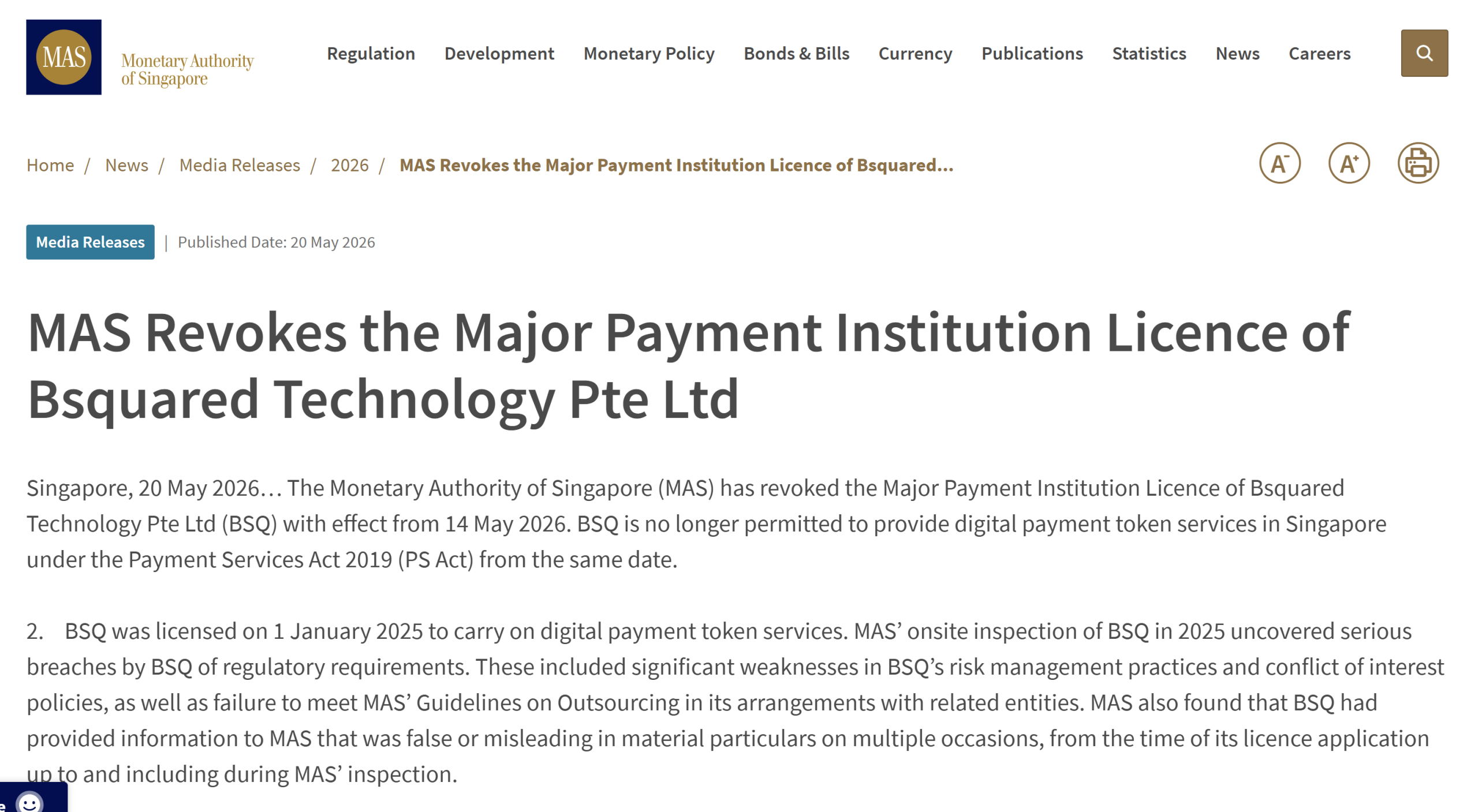
Singapore’s central bank has pulled the crypto payment license of Bsquared Technology Pte. Ltd., stripping the firm of its right to provide digital payment token services after uncovering a series of breaches.
In a Wednesday announcement, the Monetary Authority of Singapore (MAS) said it revoked Bsquared’s Major Payment Institution Licence after an on-site inspection found weaknesses in the company’s risk management practices and conflict-of-interest policies, as well as failures to comply with the regulator’s outsourcing guidelines.
MAS said Bsquared provided false or misleading information on multiple occasions, from its initial license application through the inspection itself.
Bsquared, also known as BSQ, obtained its license 16 months ago after receiving approval to offer digital payment token services under Singapore’s Payment Services Act 2019.
Related: Singapore’s OCBC launches tokenized gold fund on Ethereum and Solana
MAS orders Bsquared to submit a closure certificate
The company is required to submit a closure certificate from its auditors confirming that all customer funds have been returned to their recipients. Bsquared told MAS it held no outstanding customer assets.
“MAS takes a serious view of the breaches committed by BSQ, and is reviewing the responsibilities of key officers of BSQ,” the central bank added.
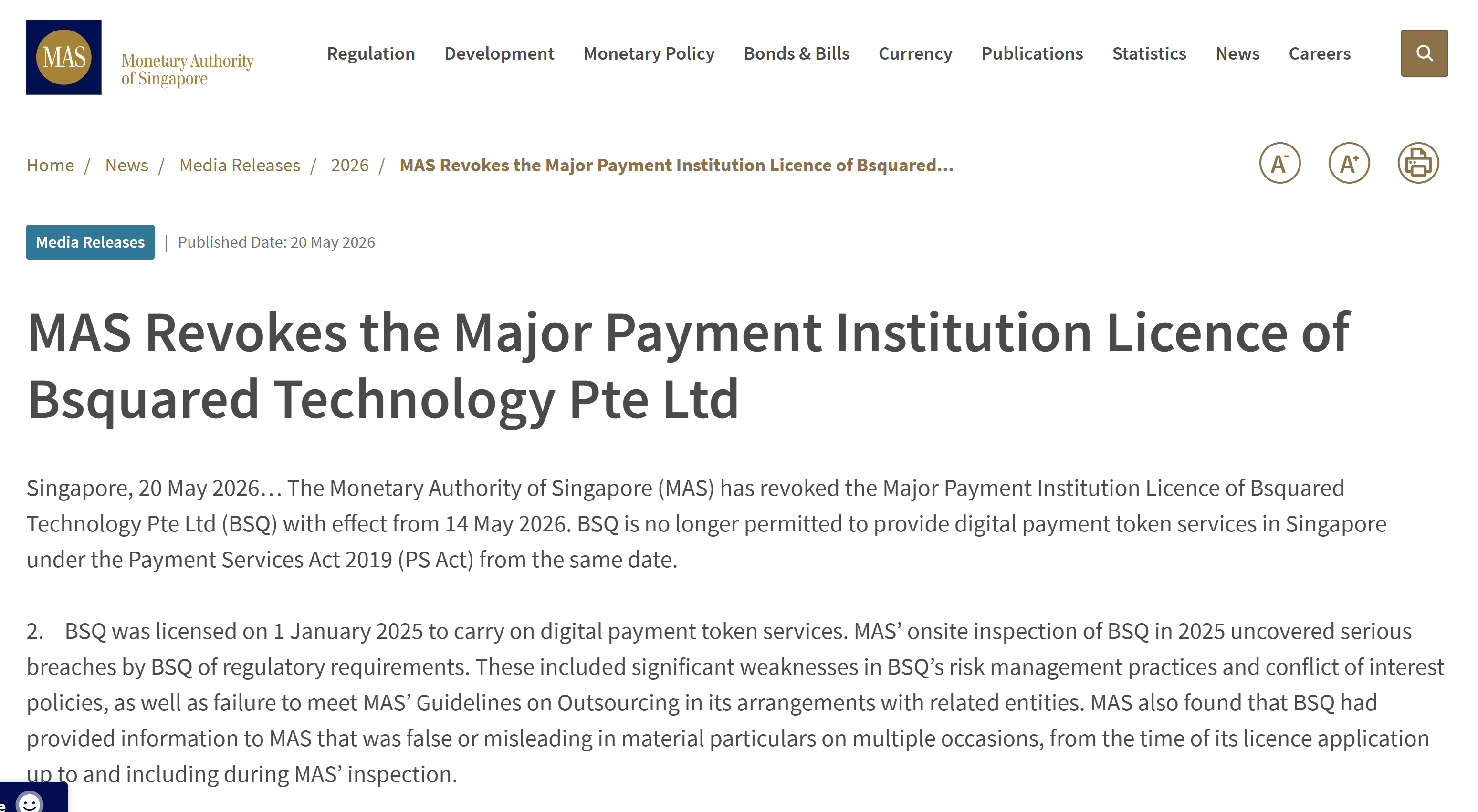
MAS revokes Bsquared’s license. Source: MAS
MAS has granted 37 digital payment token services licenses so far, and revocations remain uncommon. Last year, MAS rejected an application from AmazingTech, the operator of Tokenize Xchange, and the Commercial Affairs Department subsequently launched a probe into the company.
Related: Crypto dispute over Resupply exploit lands in Singapore harassment court
Singapore pushes deeper into digital asset infrastructure
Singapore has built a reputation as one of Asia’s leading crypto hubs, home to regional offices of Coinbase and Ripple, as well as the global headquarters of Crypto.com.
The city-state is also cementing its position as a leading hub for integrating traditional finance with digital assets.
Last month, Singapore Gulf Bank launched a service allowing institutional clients to mint and redeem stablecoins directly from their bank accounts via the Solana blockchain, enabling 24/7 settlement between fiat and digital assets.
Magazine: Guide to the top and emerging global crypto hubs — Mid-2026


Binance has launched perpetual futures that allow users to trade the anticipated valuations of private companies before they go public. The first contract to go live is tied to SpaceX, a company expected to debut at a valuation of $2 trillion or more.
The “Pre-IPO Perpetual Contracts” are designed to provide retail traders with early exposure to high-profile initial public offerings (IPOs), a market segment historically reserved for institutional investors and venture capital firms. The first listing, SPCXUSDT, will be margined and settled in the dollar-pegged stablecoin tether and is based on the expected market valuation of Elon Musk’s Space Exploration Technologies Corp. (SpaceX).
The move marks the expansion of Binance’s derivatives product suite into traditional finance territory.
“Pre-IPO perpetual futures is another example of how Binance is democratizing access to market opportunities by combining crypto-native infrastructure with major financial events. As interest in public listings continues to grow, we’re giving users a more flexible way to engage with anticipated IPOs earlier,” Shunyet Jan, head of spot and derivatives business at Binance, said in the press release shared with CoinDesk.
“This launch reflects our vision for Binance as a financial super app — one that offers access to an expanding range of financial opportunities that have traditionally been more difficult to reach,” Jan added.
These pre-IPO contracts are built on the same perpetual futures rails used for crypto trading. Before a company’s public debut, the contract price will reflect publicly available signals, such as private funding rounds and announced IPO price ranges. Once the stock begins trading on a secondary exchange, the contract will transition to reflect the shares’ live market performance.
SpaceX filed its S-1 registration statement with the Securities and Exchange Commission (SEC) on Wednesday, disclosing holdings of 18,712 BTC at a cost basis of roughly $35,000 per bitcoin. The filing also revealed $4.69 billion in first-quarter revenue and a $4.28 billion net loss and suggests at a possible Nasdaq debut next month.
Traders on the decentralized betting platform Polymarket are pricing in more than a 70% chance that the IPO will ultimately close above $2 trillion. Reuters reported that SpaceX is targeting a valuation of around $1.75 trillion for its planned listing.
Binance’s recent listing of SpaceX pre-IPO futures follows comparable offerings from OKX, Crypto.com, and Hyperliquid’s Trade.xyz. Trade.xyz’s SpaceX perpetual futures launched on May 18 with a reference price of $150 per share, implying a $1.78 trillion valuation, and generated an impressive $33 million in trading volume on the first day alone.
The growing number of SpaceX pre-IPO markets may be taking capital and, more importantly, attention away from major cryptocurrencies.
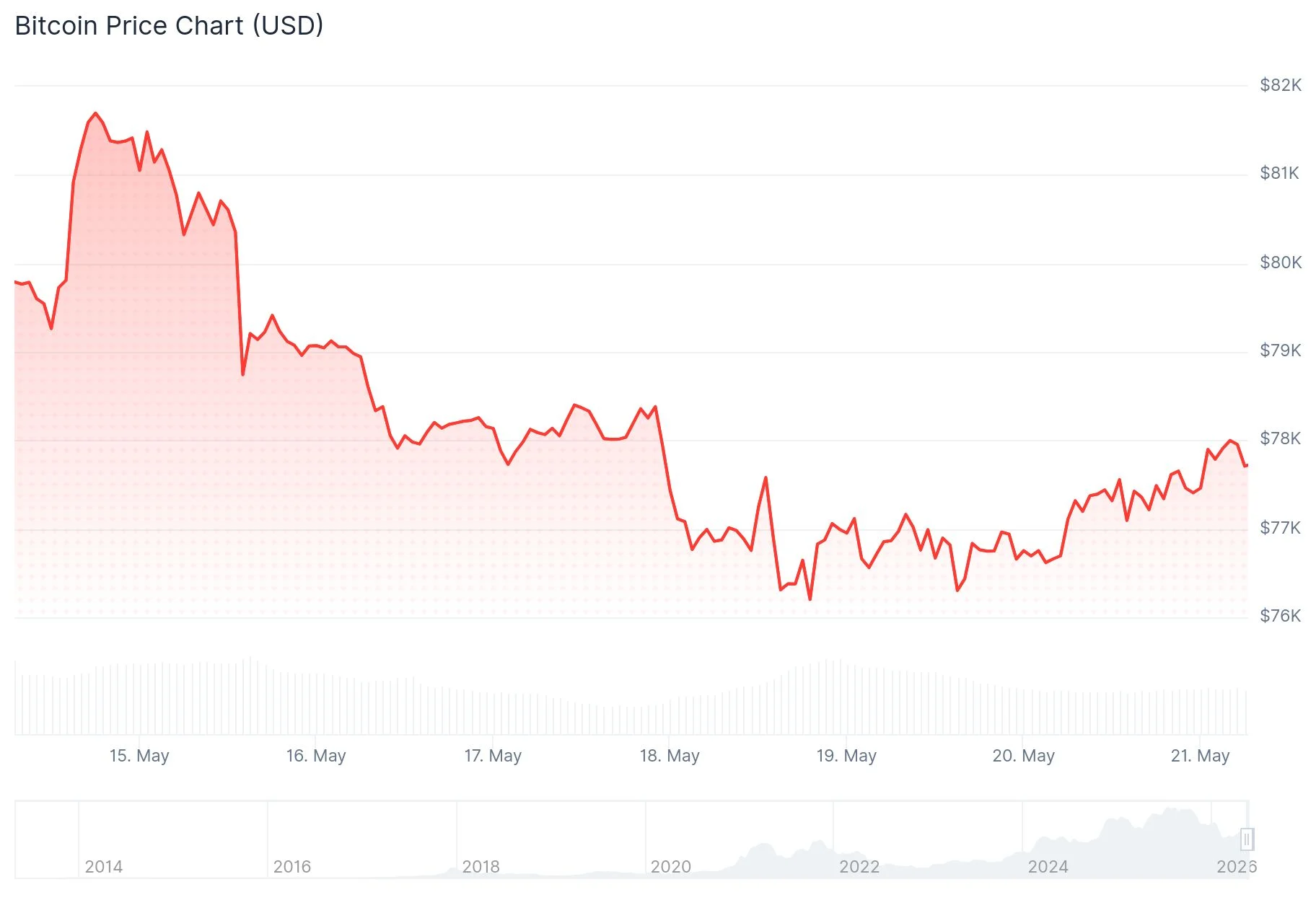
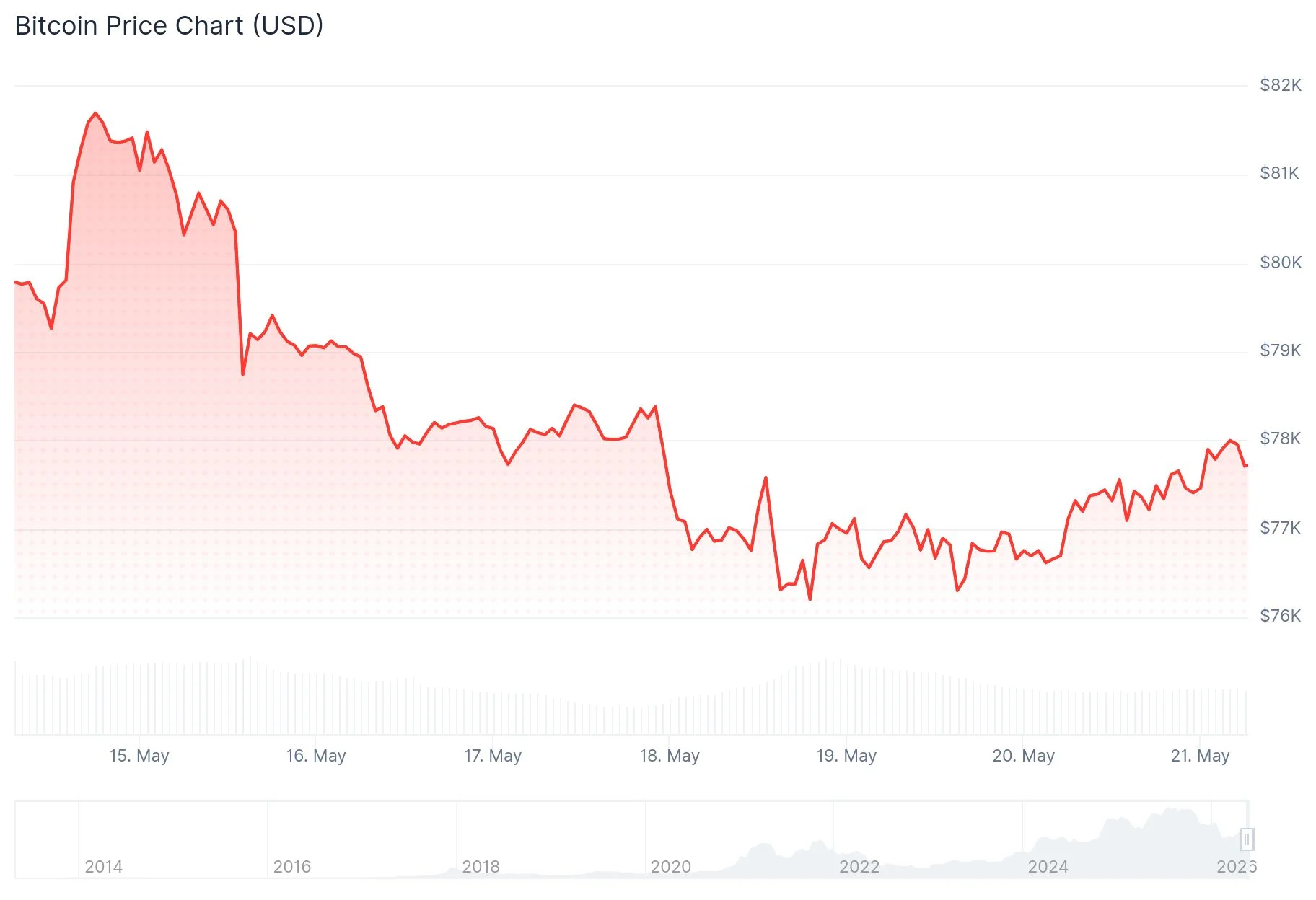
It could be more than a coincidence that bitcoin’s price rally ran out of steam at around $80,000 a week ago and prices have since pulled back to under $78,000.
Traditional market analysts are concerned that SpaceX’s upcoming IPO, expected to be the largest stock debut in history, could divert significant capital away from other segments of the U.S. market, including European IPOs.
Deepwater Asset Management’s Gene Munster captured the sentiment on X, noting that SpaceX’s blockbuster IPO filing on Wednesday “sucked the air out of the NVDA quarter,” even as the AI chipmaker delivered blowout quarterly earnings. Nvidia shares still ended the day flat at $220.60.
“Yes, NVDA crushed earnings,” Munster said. “But SpaceX’s positioning as a sovereign AI company offers a more compelling long-term (10-year) growth story.” He added that Nvidia and SpaceX together could reach a combined market capitalization of $7 trillion.
Crypto World
Market Wrap: Nvidia (NVDA) Earnings Disappoint Bulls While Bitcoin (BTC) Clings to $77K Support
Key Highlights
- Nvidia delivered earnings that exceeded Wall Street forecasts, yet shares dipped approximately 1% in extended trading as the market sought more robust AI demand indicators
- SpaceX submitted its S-1 filing with the Securities and Exchange Commission, offering investors an unprecedented glimpse into its financial position before June roadshow presentations
- Bitcoin climbed 0.8% to approximately $77,576 but has retreated from its recent peak above $82,000 reached after favorable U.S. Senate crypto bill advancement
- Minutes from the Federal Reserve meeting suggested potential rate increases if inflation persists above the 2% target, creating headwinds for digital asset valuations
- European banking alliance Qivalis expanded by 25 members, reaching 37 financial institutions spanning 15 nations, working toward a euro-backed stablecoin launch
American equity futures declined Thursday following Nvidia’s quarterly results, which fell short of the exceptional performance market participants anticipated. Simultaneously, Bitcoin maintained its position above the $77,000 threshold as cryptocurrency traders navigated concerns over tightening monetary policy.
Nvidia Surpasses Forecasts Yet Fails to Satisfy Bulls
Nvidia unveiled its quarterly performance following market close, exceeding analyst projections for both top-line revenue and bottom-line earnings. The chipmaker also provided optimistic guidance for semiconductor demand.
However, market participants were anticipating more substantial indications of artificial intelligence chip appetite. The stock retreated approximately 1% during after-hours sessions.
Dow Jones Industrial Average futures declined 0.2%. Contracts linked to the S&P 500 dropped 0.1%, while Nasdaq 100 futures retreated roughly 0.3%.
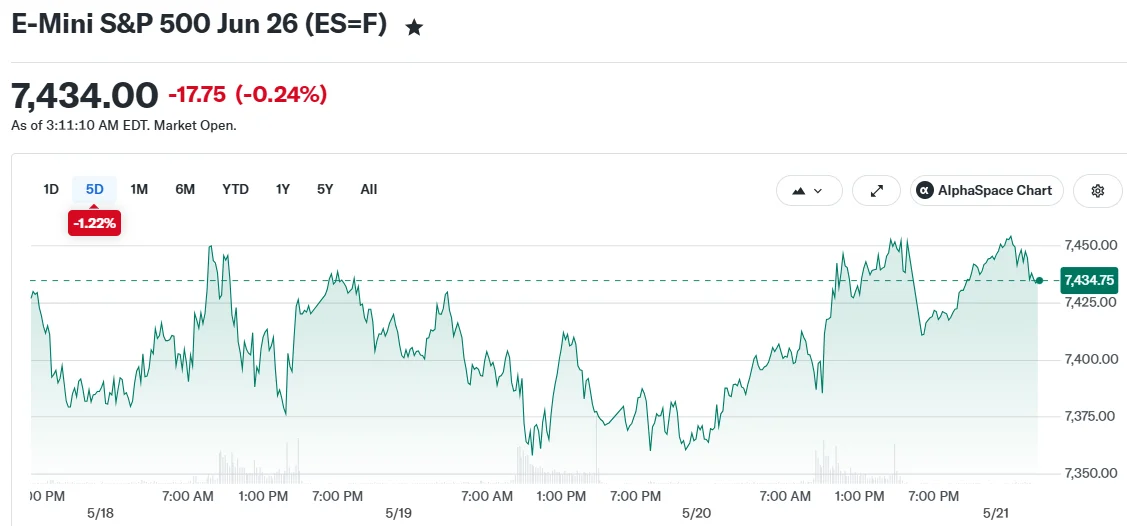
Moments after Nvidia’s disclosure, SpaceX submitted its S-1 registration document to the SEC. The paperwork provided an uncommon public window into the aerospace company’s financial health.
SpaceX has scheduled investor presentations for June, marking another milestone toward potential public market participation.
Before the closing bell, equities had advanced after President Trump indicated the United States was approaching the “final stages” of diplomatic talks with Iran. Crude oil prices retreated following this announcement.
The quarterly reporting period continues its conclusion, with Walmart, Ross Stores, Workday, and Zoom scheduled to announce results Thursday.
Bitcoin Finds Footing While Rate Uncertainty Limits Upside
Bitcoin advanced 0.8% to roughly $77,576 Wednesday, attempting to halt a five-session decline.
The leading digital currency by market capitalization had surged beyond $82,000 last week following the U.S. Senate Banking Committee’s approval of significant cryptocurrency regulation. Since that milestone, prices have gradually eroded.
Nexo Dispatch analyst Dessislava Ianeva observed that spot market appetite has weakened since mid-May, with net outflows persisting for nine straight trading days ending May 19. She emphasized that daily transaction volumes remain subdued.
Federal Reserve meeting records published Wednesday revealed that a majority of policymakers consider rate increases would probably be warranted should inflation remain elevated above the 2% objective.
Recent inflation metrics have reflected the influence of climbing energy costs. Year-over-year consumer price acceleration reached its strongest reading since May 2023, while producer price expansion registered its largest jump since December 2022.
Elevated borrowing costs typically create resistance for speculative investments including digital currencies.
Most alternative cryptocurrencies posted modest gains. Ethereum increased 0.8%, XRP rose 0.7%, and Solana climbed 2%.
In related developments, European banking coalition Qivalis welcomed 25 additional members, expanding its network to 37 financial institutions operating across 15 countries. Participants include ING, BNP Paribas, BBVA, and Nordea.
Qivalis intends to introduce a euro-denominated stablecoin before year-end. The consortium is framing the initiative as a European counterweight to American leadership in digital payment infrastructure.

Crypto World
Nvidia (NVDA) Stock Slides in After-Hours Trading Despite Crushing Q1 Earnings Expectations

Key Highlights
- Nvidia exceeded Q1 earnings projections with adjusted EPS of $1.87 versus the Street’s $1.77 expectation, while revenue reached $81.6B against a forecast of $79.19B.
- The company’s Q2 revenue outlook of $91B significantly surpassed analyst predictions of $87.36B.
- Management authorized an $80B stock buyback initiative and dramatically increased its quarterly dividend from 1 cent to 25 cents per share.
- Jensen Huang, Nvidia’s CEO, introduced the “Vera” CPU platform, positioning it as an entry point into a $200B addressable market with projected sales of $20B by fiscal year-end.
- Shares declined approximately 1.6% during after-hours sessions as market participants assessed intensifying competition from proprietary chip development.
Nvidia’s shares settled at $223.47 during Wednesday’s regular trading session ahead of its post-market earnings announcement. The stock retreated roughly 1.6% in after-hours activity despite delivering impressive financial results.
The chip giant recorded fiscal first-quarter revenue of $81.62B, surpassing the analyst consensus of $78.86B. Adjusted earnings per share reached $1.87, exceeding the Street’s $1.77 projection by ten cents.
The company’s data center segment generated $75.2B during the quarter, outpacing the $72.8B estimate. This division continues to serve as Nvidia’s primary growth driver.
For the current quarter, management issued guidance of $91B with a 2% variance in either direction, comfortably beating Wall Street’s $87.36B projection. The upper boundary suggests potential revenue approaching $92.8B.
The company unveiled an $80B share repurchase authorization while simultaneously raising its quarterly dividend payment from 1 cent to 25 cents—representing an extraordinary 2,400% increase.
Vera CPU Launch Targets Massive New Opportunity
During the earnings conference call, Jensen Huang highlighted Nvidia’s newly announced “Vera” central processing unit, describing it as an entry into a $200B total addressable market. The executive stated that Nvidia anticipates generating $20B in Vera-related revenue by the conclusion of the current fiscal year.
Importantly, this $20B projection was excluded from Nvidia’s previous $1 trillion revenue estimate that encompassed Blackwell and Rubin AI accelerators through 2027. Huang indicated that Vera is expected to emerge as the company’s second-largest revenue generator outside that trillion-dollar framework.
“All of our customers are quite excited about Vera,” Huang stated during the analyst call.
However, he acknowledged a significant challenge. “My sense is that we’ll be supply-constrained through the entire life of Vera Rubin,” he noted, referencing the integrated platform scheduled for release later this year.
To address potential supply chain bottlenecks, Nvidia’s supply commitments expanded to $119B in Q1, marking an increase from the previous quarter’s $95.2B.
Rising Competitive Pressures
The after-hours price decline appears linked to mounting concerns among investors regarding custom chip development by Nvidia’s largest customers.
Alphabet, Amazon, and Microsoft are projected to allocate more than $700B toward AI infrastructure investments in 2025, representing a substantial increase from approximately $400B in 2024. A meaningful portion of these expenditures is directed toward proprietary semiconductor solutions aimed at decreasing dependence on Nvidia’s products.
Intel and AMD are simultaneously expanding their presence in the inference chip space, which is gaining prominence as artificial intelligence workloads transition from model training to deployment and execution.
Nvidia has responded proactively. Earlier in March, the company introduced a new central processing unit and AI system incorporating technology from Groq, a startup specializing in inference-optimized chips.
Huang highlighted an emerging subsector within the data center business—AI-focused cloud service providers—where revenue levels matched those from major hyperscale operators while demonstrating superior sequential growth. “We should be growing faster than hyperscale capex,” Huang remarked.
According to InvestingPro data, Nvidia has received 34 upward EPS revisions against just one downward revision over the past 90 days, with the platform assigning its financial health an “excellent performance” rating.
The stock has appreciated 17.73% during the previous three-month period and has gained 69.55% year-over-year.
Disclosure: This article does not represent investment advice. The content and materials featured on this page are for educational purposes only.
AJC Mining gains attention as cloud mining platforms evolve beyond traditional crypto mining models.
Summary
- AJC Mining offers beginner-friendly cloud mining with automated contracts, daily settlements, and no hardware setup required.
- Cloud mining in 2026 now includes apps, marketplaces, and hosted systems, with AJC Mining targeting easy beginner access.
- AJC Mining simplifies Bitcoin and Dogecoin mining through cloud contracts, reducing technical and equipment barriers.
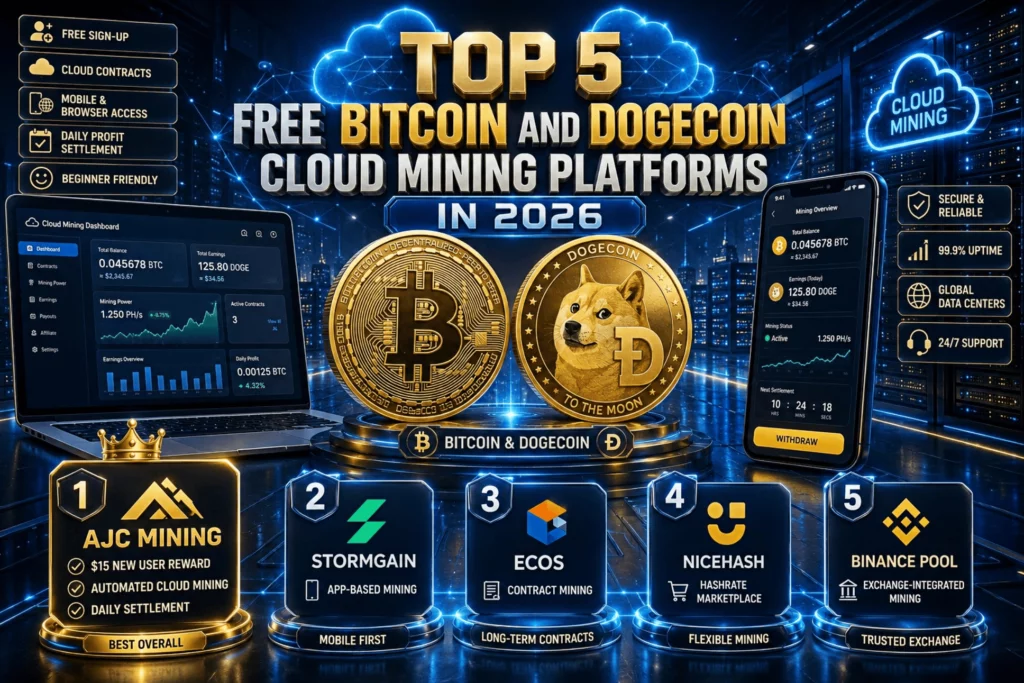
As more users search for easier ways to understand Bitcoin mining and Dogecoin cloud participation, mobile-first platforms and browser-based dashboards continue gaining visibility as alternatives to hardware-heavy mining setups.
As users continue searching for questions like what Bitcoin mining is, how cloud mining works, and whether mobile-friendly mining options still exist in 2026, platform-based mining access remains an area of interest.
Compared with buying hardware, managing electricity costs, or operating mining rigs directly, cloud mining platforms are often seen as a more accessible starting point for beginners.
In real use, “free” rarely means unlimited mining at no cost forever. More often, it refers to free registration, app access, welcome rewards, trial contracts, beginner dashboards, or activation features that help users understand how a platform works before choosing larger participation plans.
That is why comparison roundups still matter for users trying to understand how cloud mining platforms operate and which services may be easier to approach.
What “free” usually means in 2026
Free cloud mining usually refers to:
- Free account registration
- App or browser-based platform access
- Welcome rewards or onboarding bonuses
- Trial or entry-level contracts
- Dashboard access before selecting paid plans
- Automated mining participation under separate platform terms
Top free cloud mining platforms in 2026
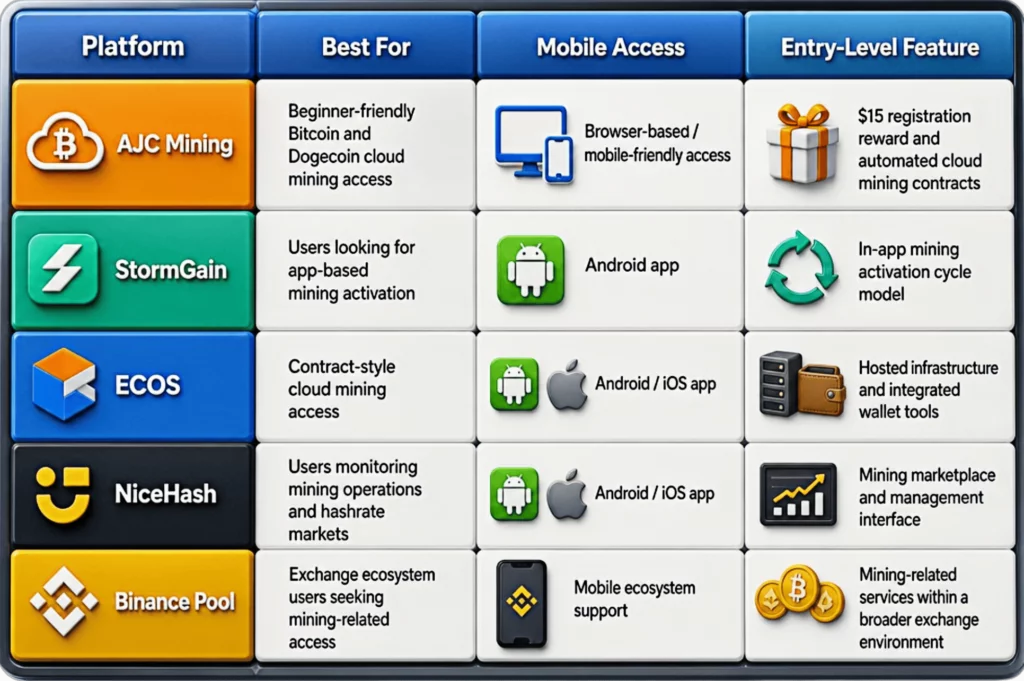
The comparison above reflects the different ways users approach mining in 2026. Some prefer simple onboarding, some want structured cloud mining contracts, while others prefer marketplace tools or exchange-integrated mining ecosystems.
1. AJC Mining — Best for beginners seeking automated cloud mining access
AJC Mining can be understood as a beginner-friendly cloud mining platform designed for users who want to explore Bitcoin and Dogecoin mining participation without buying or maintaining physical mining machines.
For users with no prior mining experience, AJC Mining offers a relatively simple onboarding process. The platform focuses on cloud computing power deployment, fixed-term contract options, and automated daily settlement according to contract terms.
This makes AJC Mining suitable for users who want a lower-barrier entry point into cloud mining while avoiding hardware setup, technical configuration, heat management, and manual operation.
How do users join AJC Mining?
The process for joining AJC Mining is designed to be simple for new users.
Step 1: Register an account
Users can register through the official AJC Mining website. After successful registration, new users receive a $15 reward.
(Click here to register now and claim a reward.)
Step 2: Select a cloud mining contract
AJC Mining offers both short-term and longer-term cloud mining contracts. Users can choose based on:
- Budget
- Contract duration
- Profit goals
- Preferred mining strategy
Step 3: Activate the contract
Once a contract is selected, the system automatically deploys cloud computing power. Earnings are settled daily according to the contract terms, and no manual mining operation is required from the user.
AJC Mining cloud mining contract reference
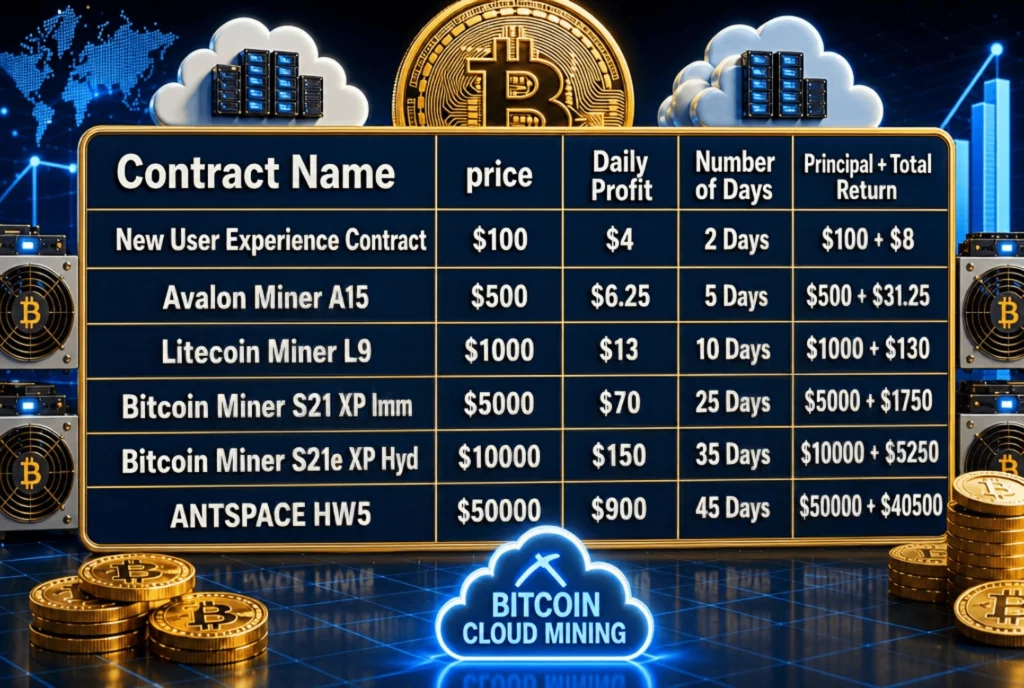
These contracts represent different levels of computing power and participation strategies. AJC Mining emphasizes:
- Fixed-term cloud mining contracts
- Daily profit settlement
- Fully automated mining operations
- Beginner-friendly access
- No hardware purchase or maintenance required
(Click to view more cloud mining contracts.)
2. StormGain — Best for users who want an app-oriented mining experience
StormGain is often discussed by users looking for a mobile-first cloud mining experience. Its app-based interface makes it easier for users to activate mining-related features without navigating a complex technical dashboard.
This convenience helps explain why StormGain continues to appear in beginner-focused mining discussions. It may appeal to users who want a lighter app experience rather than a traditional contract-style cloud mining setup.
3. ECOS — Best for structured contract-style cloud mining access
ECOS is often included in cloud mining roundups because it presents hosted mining through a more structured contract-style model. This type of setup may suit users who prefer clearly defined participation terms, contract durations, and platform-managed infrastructure.
For users who want something more organized than simple app activation, ECOS remains a commonly referenced option.
4. NiceHash — Best for users interested in mining marketplace tools
NiceHash is less of a typical “free mining app” and more of a mining marketplace and management environment. It gives users visibility into hashrate markets, mining power activity, and operational tools.
This makes NiceHash more suitable for users who want to understand mining power markets or manage mining-related activity with more control.
5. Binance Pool — Best for exchange-integrated mining access
Binance Pool stands out because it connects mining-related services with the broader Binance exchange ecosystem. For users already operating within Binance’s platform environment, this integrated structure may feel easier than using a separate standalone mining service.
Its appeal comes from ecosystem convenience, especially for users who prefer having exchange, wallet, and mining-related services in one place.
Why Bitcoin and Dogecoin cloud mining continue to attract attention
Bitcoin remains the best-known digital asset by market value, while Dogecoin continues to attract everyday interest from retail crypto participants. Together, they represent two highly visible but very different parts of the digital asset market.
Many users searching for how to mine cryptocurrency or how cloud mining works are not necessarily trying to build large mining operations. More often, they are looking for easier ways to understand the process and decide whether a mobile-friendly or browser-based platform makes more sense than running mining hardware directly.
Cloud mining platforms continue to attract attention because they reduce several traditional barriers, including:
- Hardware purchase costs
- Machine maintenance
- Electricity and heat management
- Technical configuration
- Direct mining operation
How to choose the right cloud mining platform
Every platform works differently, and “free” does not mean the same thing everywhere. Before choosing a platform, users usually compare:
- What the free registration or reward actually includes
- Whether the service is app-based, browser-based, or contract-based
- How clearly the platform explains its mining model
- Whether fees, returns, contract terms, and withdrawal rules are disclosed
- Whether the platform is built for beginners or advanced users
- Whether daily settlement and contract details are transparent
A practical starting approach is often to begin with a lower-barrier platform, review the dashboard and platform rules carefully, and only then decide whether to commit more time or capital.
Frequently asked questions
What is Bitcoin mining?
Bitcoin mining is the process of using computing power to validate transactions and help secure the Bitcoin blockchain. Cloud mining generally allows users to access mining participation through remote infrastructure instead of owning and operating mining machines themselves.
What is Dogecoin cloud mining?
Dogecoin cloud mining refers to participating in Dogecoin-related mining through hosted computing power or platform-based infrastructure. Instead of running hardware directly, users access mining services through a cloud mining provider.
What does “free cloud mining” usually mean?
Usually, it refers to free registration, platform access, welcome rewards, trial contracts, app features, or limited activation periods. It does not usually mean unlimited mining forever at zero cost.
How can beginners start exploring cloud mining?
Beginners often start with platforms that offer simple registration, beginner dashboards, automated contracts, and clear explanations of how mining participation works. AJC Mining, for example, provides a registration reward and automated cloud mining contract options for new users.
Can users mine crypto on a phone or laptop?
Serious direct mining on a phone or laptop is generally not practical anymore. In most cloud mining models, mobile devices and laptops are mainly used for account access, contract management, and dashboard monitoring while the actual mining infrastructure runs remotely.
How should beginners choose a platform?
Beginners should look for platforms that clearly explain their mining model, provide transparent contract details, disclose fees and withdrawal rules, and offer a user-friendly dashboard.
Conclusion
The cloud mining landscape in 2026 is no longer defined by a single type of product. Users can now choose between automated cloud mining contracts, mobile-first mining apps, hosted infrastructure platforms, mining marketplaces, and exchange-linked mining ecosystems.
For users exploring Bitcoin and Dogecoin mining participation, a practical starting point is usually a platform that clearly explains its access model and reduces the hardware, setup, and technical barriers involved in traditional mining.
AJC Mining stands out in this comparison because it offers a beginner-friendly registration process, a $15 new user reward, automated contract activation, and daily profit settlement based on selected contract terms. For users who want a simpler way to understand cloud mining without managing physical equipment, AJC Mining may be a suitable platform to explore.
As always, users should compare platform terms carefully, understand what “free” really means, and review contract rules, risks, fees, and withdrawal conditions before participating.
For more information, visit the official website.
Disclosure: This content is provided by a third party. Neither crypto.news nor the author of this article endorses any product mentioned on this page. Users should conduct their own research before taking any action related to the company.

EUR/USD and GBP/USD have moved into recovery mode following a sharp test of key support levels, although the market remains cautious ahead of the release of important macroeconomic data from the US, the eurozone and the UK. Earlier this week, the European currencies came under pressure: GBP/USD fell towards the 1.3300 area, while EUR/USD tested support at 1.1600. However, the successful defence of these levels triggered active profit-taking on the US dollar and a subsequent corrective rebound in the European currencies.
In the coming trading sessions, investors’ attention will focus on the publication of PMI business activity indices in the eurozone, the UK and the US, as well as US housing market data and jobless claims statistics. The market is assessing signs of a further slowdown in the US economy following recent indications of weakening business activity, which is partly limiting the potential for further dollar appreciation.
EUR/USD
The EUR/USD pair recovered after testing support at 1.1600. Technical analysis of EUR/USD points to the possibility of growth towards 1.1670–1.1700, as a bullish piercing candlestick pattern has formed on the daily timeframe. Should yesterday’s low be broken, the pair may decline towards the 1.1540–1.1500 area.
Key events for EUR/USD:
- today at 10:15 (GMT+3): France Manufacturing PMI;
- today at 10:30 (GMT+3): Germany Composite PMI;
- today at 15:30 (GMT+3): Philadelphia Fed Manufacturing Index (US).

GBP/USD
The GBP/USD pair fell sharply at the start of the week towards the important support level at 1.3300. The rebound from this support, followed by a recovery towards 1.3440, allowed a bullish engulfing reversal pattern to form. Technical analysis of GBP/USD suggests the potential for further growth towards 1.3520–1.3550 if the pair manages to consolidate above 1.3460. A move below yesterday’s low could trigger another test of 1.3300.
Key events for GBP/USD:
- today at 11:30 (GMT+3): UK Composite PMI;
- today at 16:45 (GMT+3): US Manufacturing PMI;
- today at 18:00 (GMT+3): speech by Bank of England Governor Bailey.

Overall, EUR/USD and GBP/USD are attempting to extend their recovery after sharply testing key support levels. However, the market has yet to receive sufficient fundamental confirmation for the formation of a полноценный upward trend. Upcoming macroeconomic data from the US, the eurozone and the UK will be the key driver of further price action: weak US figures could increase pressure on the dollar and support further gains in the European currencies, while stronger data may return the market to a bearish scenario and keep trading confined within established ranges.
Trade over 50 forex markets 24 hours a day with FXOpen. Take advantage of low commissions, deep liquidity, and spreads from 0.0 pips (additional fees may apply). Open your FXOpen account now or learn more about trading forex with FXOpen.
This article represents the opinion of the Companies operating under the FXOpen brand only. It is not to be construed as an offer, solicitation, or recommendation with respect to products and services provided by the Companies operating under the FXOpen brand, nor is it to be considered financial advice.


Missouri has sued GPD Holdings LLC, the company behind CoinFlip, alleging the crypto ATM operator enabled scam transactions and used poorly disclosed fees.
Summary
- Missouri sued CoinFlip, alleging crypto ATMs enabled scams against seniors and veterans.
- State seeks Missouri ban, restitution, and civil penalties of up to $1.826 million.
- Bitcoin Depot’s bankruptcy shows crypto ATM operators face mounting legal and regulatory pressure.
Missouri Attorney General Catherine Hanaway filed the case against GPD Holdings LLC, doing business as CoinFlip, on May 21. Her office said the company allegedly “knowingly facilitating fraudulent transactions and profiting from them” through cryptocurrency kiosks across the state.
The complaint asks the court to declare that CoinFlip’s conduct violated the Missouri Merchandising Practices Act. The state also wants to stop CoinFlip from operating in Missouri, recover restitution for consumers, and impose $1,000 per violation, capped at $1.826 million for the past five years.
State cites seniors, veterans and hidden fees
Hanaway’s office said the case centers on scam activity that used crypto ATMs to move victims’ money quickly and with limited recovery options. The office said these transactions can carry poorly disclosed fees and are often hard to trace once completed.
The AG also pointed to fraud risks for seniors and veterans. In the lawsuit notice, Hanaway said “Bitcoin and crypto ATMs are the new getaway cars for fraud,” adding that her office would focus on protecting Missourians, especially older residents and veterans.
Investigation began after statewide scam reports
The lawsuit follows a December 2025 investigation into cryptocurrency kiosk operators in Missouri. At the time, the attorney general said the office was reviewing claims tied to “hidden fees and deceptive charges” and scam activity involving Bitcoin ATMs.
The state said common warning signs include urgent calls, claims of legal trouble, demands for secrecy, and instructions to withdraw cash before sending it through a crypto ATM. It urged affected consumers to contact law enforcement, the FBI’s IC3 portal, and the attorney general’s office.
According to the AG’s office, the Missouri State Highway Patrol’s Missouri Information Analysis Center and the St. Louis Fusion Center linked 350 crypto cases over the past two years to cryptocurrency ATMs. The office also cited FTC data showing crypto ATM fraud losses rose nearly tenfold from 2020 to 2023.
Crypto ATM pressure widens across states
CoinFlip’s own locator page lists 136 CoinFlip ATM locations in Missouri, including machines in St. Louis, Columbia, Kansas City, Springfield, and other cities. The Missouri AG release said CoinFlip operates more than 140 kiosks in the state.
Related coverage shows that the crypto ATM sector is under pressure beyond Missouri. Bitcoin Depot filed for Chapter 11 bankruptcy in Texas after regulatory actions, legal cases, and falling revenue weighed on its business. A May 18 report said Bitcoin Depot had also taken its global ATM network offline.
CoinFlip has published scam-prevention material warning that crypto transactions are final and irreversible. Its terms page also warns users that fraudulent transactions may result in loss of money or cryptocurrency. The Missouri lawsuit now tests whether those warnings and controls were enough under state consumer protection law.

The U.S. Securities and Exchange Commission is pausing the rollout of a new wave of “novel ETFs,” including those designed to let investors bet on the outcomes of real-world events, so regulators can weigh their implications before approving them. In a Wednesday statement, SEC Chair Paul Atkins said that “novel products raise novel questions” and directed the agency’s staff to solicit public feedback on how to respond to these applications.
The pause comes as Bitwise filed in February for a series of prediction-market ETFs under the PredictionShares brand to track U.S. election results, with Roundhill Investments and GraniteShares also pursuing prediction-market ETF filings in the same month. Prediction markets have surged in crypto discourse over the past year and a half, evolving into a notable use case within the space. Analysts note the regulatory attention surrounding these instruments as they move toward traditional market structures.
Prediction markets—where participants trade contracts tied to the outcome of events—have become one of crypto’s hottest themes in recent times. Industry observers estimate that these markets now clear more than $15 billion in monthly trading volume, spanning sports, elections, financial results, and other events. The prospect of a prediction-market ETF is to give mainstream investors a way to gain exposure to these binary event contracts through a familiar brokerage account, echoing the broader trend of bringing crypto and related innovations into traditional financial rails.
Bloomberg ETF analyst Eric Balchunas described the SEC’s stance as one of deliberate caution, noting that the regulator is “clearly wrestling” with how to handle this new asset class—much as it grappled with spot crypto ETFs before approving them in early 2024. Balchunas suggested the agency wants to feel comfortable with prediction-market ETFs before it “opens the barn door.”
Source: Eric Balchunas
Looking ahead, the delay coincides with broader regulatory dynamics around prediction markets and related platforms. Kalshi and other prediction-market operators have faced ongoing legal challenges in several U.S. state courts, underscoring the regulatory complexity as the sector seeks broader legitimacy. Kalshi’s litigation and expectations around state-level outcomes feed into the SEC’s careful approach to approving any product that could unlock significant exposure to probabilistic event outcomes.
Key takeaways
- The SEC is delaying novel ETF applications, including prediction-market ETFs, to solicit public input and assess regulatory implications.
- Bitwise, with its PredictionShares line, and rivals Roundhill and GraniteShares are among the firms that filed for prediction-market ETFs in February, aiming to translate binary-event contracts into tradable securities.
- Prediction markets already generate substantial activity—roughly $15 billion per month—highlighting why a regulated ETF path is attractive to institutional and retail investors alike.
- The regulatory mood around novelty in ETFs has warmed in recent years, but the SEC’s cautious stance on these products signals ongoing risk assessment before broader rollout.
- Legal challenges facing prediction-market platforms, including Kalshi, add to the uncertainty about how courts and regulators will shape the space’s future.
Regulatory caution and the evolving path for innovation
The SEC’s emphasis on “novel questions” reflects a broader tension in the market between innovation and investor protection. Atkins’ call for public feedback signals a methodical approach: regulators want to hear how these products would function in real markets, which risks they pose, and how they would be integrated into existing disclosure, settlement, and liquidity frameworks. This stance aligns with a historical pattern in which the agency tests the waters before greenlighting more complex or controversial products, even after adopting more flexible listing standards in recent years.
Beyond prediction-market ETFs, the agency has been reported to be considering an “innovation exemption” that could allow tokenized stock trading to run on crypto rails. Such a policy, if adopted, would translate shares of widely followed corporations—like Apple, Nvidia, and Tesla—into tokenized, on-chain equivalents that could be traded within crypto ecosystems. While this remains speculative, the possibility underscores the SEC’s willingness to rethink traditional boundaries between conventional securities markets and digital-asset infrastructure. For now, the focus remains on carefully vetting how novel ETFs would operate in the regulated environment.
The current environment also reflects a broader push to formalize crypto-adjacent products within mainstream financial channels. The launch of spot crypto ETFs earlier this year marked a notable milestone in investor access, and the regulatory apparatus is now testing similar pathways for other innovative vehicles, including those tied to event outcomes. The outcome of these deliberations will influence not only product design and disclosure requirements but also the speed at which new market infrastructures—bridging traditional finance and crypto-native models—will gain legitimacy among institutional participants.
Prediction markets: from niche use case to mainstream instrument?
Prediction markets exist at the intersection of finance, information markets, and behavioral science. By aggregating diverse viewpoints on the probability of a future event, these markets purportedly reflect a collective intelligence that can be applied to forecasting and hedging. The sector’s momentum has drawn attention from a broad range of participants, including traditional asset managers curious about non-correlated exposure and crypto-native firms seeking broader institutional acceptance. A dedicated ETF would, in theory, provide custody, tax reporting, and liquidity channels familiar to traditional investors, potentially expanding participation beyond crypto-native traders.
Yet regulatory and legal questions remain central. Kalshi and related platforms have already pressed for broader access in the face of state-level challenges, illustrating a regulatory patchwork that could shape the feasibility and design of any ETF. The SEC’s current pause suggests that, even as interest grows, a cautious, evidence-based approach will govern the path forward. Observers will be watching closely to see how the agency reconciles investor protection with innovation, and whether a future approval would come with strict prerequisites on product design, disclosure, and governance.
What comes next for tokenized stock ideas and other innovations
While the focus of the current wave is clearly on prediction-market ETFs, regulators’ discussions about tokenized stock trading add another layer to the broader reform agenda. If an innovation exemption progresses, tokenized equities could gain a formal foothold in regulated markets, potentially altering liquidity dynamics and cross-asset competition. Market participants would need to digest the implications for price discovery, settlement timelines, and cross-border operations, as tokenized equities blend the advantages of crypto rails with the protections of traditional securities regimes.
For investors and builders, the immediate takeaway is that the regulatory blueprints for novel ETFs and tokenized securities are still taking shape. The SEC’s public-consultation approach means market participants should prepare for a longer, more consultative process than a straightforward binary approval. In the near term, expect continued regulatory signaling, more formal comment periods, and potentially more test cases as firms align product design with the agency’s evolving framework.
As this space evolves, the next milestones to watch include the SEC’s release of feedback from its public solicitation, any refined criteria for prediction-market ETFs, and whether tokenized-stock initiatives advance toward a formal exemption or dedicated rulebook. The convergence of traditional fund architecture with event-driven and tokenized strategies could redefine how investors access non-traditional exposures, but the path will likely remain incremental and tightly regulated.
Readers should stay attentive to the regulator’s responses and to ongoing court developments affecting prediction-market platforms. The evolving balance between innovation and protection will continue to shape which products make it to market and how they’re designed to protect everyday investors.
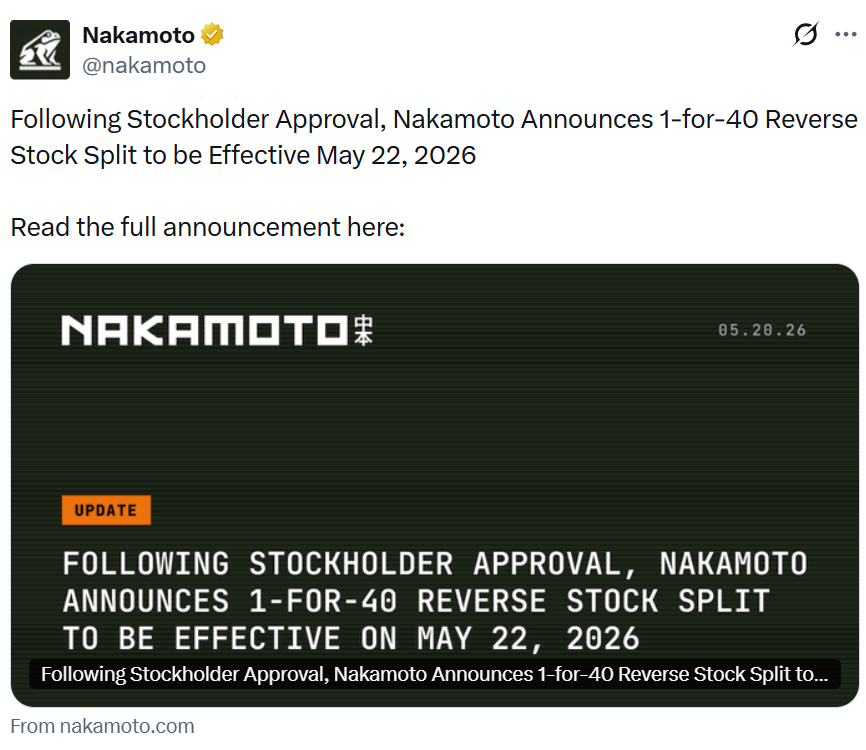
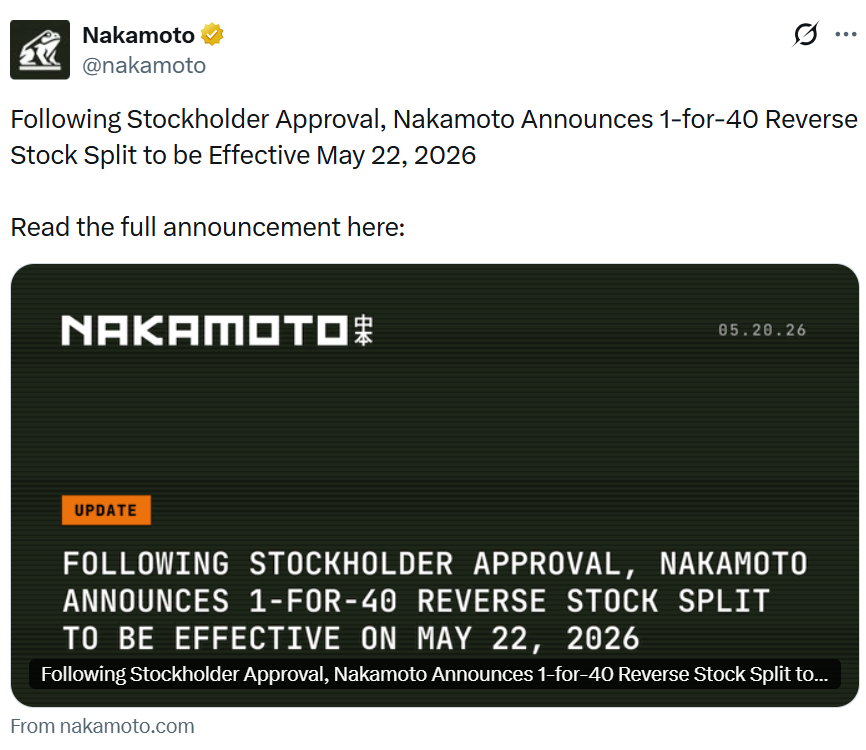
Bitcoin treasury company Nakamoto is moving ahead with a shareholder-approved 1-for-40 reverse stock split on Friday in an effort to avoid delisting from the Nasdaq Stock Exchange.
The company received a notice from the Nasdaq on Dec. 10, warning that its stock price had fallen below the $1 minimum for 30 consecutive business days, according to an SEC filing. Nakamoto has until June 8 to address the issue and keep its stock above $1 for at least 10 days.
A reverse stock split reduces the number of shares outstanding. In a 1-for-40 split, every 40 shares are combined into one. After completion, Nakamoto’s total common shares will drop from 696.1 million to 17.4 million, the company said Wednesday.
“The reverse stock split is intended to increase the per-share trading price of the company’s common stock to regain compliance with the $1 minimum bid price requirement for continued listing on the Nasdaq Global Market,” it added.
Crypto treasury companies have been in a downturn since 2025, with many companies’ stock prices falling below the value of the crypto on their balance sheets, Standard Chartered reported last September.
Wojciech Kaszycki, chief strategy officer of crypto infrastructure and treasury company BTCS, told Cointelegraph in March that treasury companies will likely start merging and consolidating this year to stay afloat.
Nakamoto’s share price, NAKA, closed 16 cents on Wednesday, down 7.5%, according to Google Finance. It is down more than 99% from May last year, when it traded above $25 shortly after the company unveiled its Bitcoin treasury strategy and merger with health care provider KindlyMD.
Source: Nakamoto
Nakamoto posts $238.8 million net loss in Q1
Nakamoto shareholders approved a reverse split ratio range of 1-for-20 to 1-for-50 at a special meeting on May 8. The shares are expected to undergo the change on Friday, according to Nakamoto.
The company announced its first-quarter financial results on May 14, recording a 500% quarter-over-quarter increase in revenue but a $238.8 million net loss, with more than $102 million attributed to a mark-to-market loss on its 5,058 Bitcoin (BTC) treasury after the cryptocurrency fell 23% during the quarter.
Related: Tether buys SoftBank’s stake in Bitcoin company Twenty One Capital
Most Bitcoin treasury companies, aside from Strategy and Metaplanet, have slowed Bitcoin buying over the past 12 months, while others have started tapping their Bitcoin treasuries to pay off debt. The Genius Group liquidated its entire treasury holdings of 84 Bitcoin in February to help pay debts.
Nakamoto didn’t buy any Bitcoin during the quarter but sold 284 Bitcoin on March 31 to cover operational expenses.
Nakamoto’s current holdings make it the 20th largest Bitcoin treasury company according to BitcoinTreasuries.Net, just behind ProCap Financial, which holds 5,457 Bitcoin. The leading treasury is Michael Saylor’s firm Strategy, with more than 843,000 Bitcoin on its balance sheet.
Magazine: eToro founder timed Bitcoin top perfectly due to belief in 4-year cycles

Crypto Gold Live Trading| 19 MAY #vinbullindia #livetrading #vinbulllive #live #trading

Welsh baby’s eye ‘flicker’ was sign of one-in-a-million neurological condition

At Close of Business podcast May 21 2026


-

 Crypto World5 days ago
BloFin War of Whales 2026 Grand Prix opens registration for $5M trading championship
-

 Fashion6 days ago
Weekend Open Thread: Theory – Corporette.com
-

 Crypto World6 days ago
E-Estate Announces 1 Year Live: Washington DC Summit as Real Estate Tokenization Enters Its Next Phase
-

 Tech6 days ago
Tech Moves: Microsoft AI leader jumps to OpenAI; former AI2 exec joins Meta; and more
-

 Tech5 days ago
Google reimburses Register sources who were victims of API fraud
-
 Crypto World7 days ago
Google’s Gemini AI Predicts Incredible Solana Price by the End of 2026
-

 Business6 days ago
H&R Real Estate Investment Trust (HR.UN:CA) Q1 2026 Earnings Call Transcript
-
 Entertainment7 days ago
Zara Larsson Has Blunt Response To Chris Brown Diss
-

 Sports5 days ago
Napoleonic enters 2026 Doomben 10,000 field via Abounding withdrawal
-

 Crypto World5 days ago
BeInCrypto 100 Institutional Awards Nomination: KAST for Best Digital Assets Neobank and Best Digital Assets Fintech
-
 Crypto World5 days ago
Bitcoin Battles US Bond Nerves With BTC Price Dip Toward New May Lows
-

 Fashion4 days ago
On the Scene at Gucci’s Cruise Show in New York City: Mariah Carey, Kim Kardashian, Lindsay Lohan, Iman, and More!
-
 Crypto World5 days ago
Wall Street’s Boldest Gold Prediction Has Russians Rushing to Buy
-

 Crypto World5 days ago
ICE and CME urge US regulators to curb Hyperliquid energy trading
-

 Fashion5 days ago
Trending Western Style Vests Perfect for Summer
-

 Politics6 days ago
DWP PIP Timms review continues to be an absolute farce
-

 Entertainment6 days ago
David Letterman Returns to Late Show, Blasts Cancellation
-

 Crypto World5 days ago
IREN closes $3 billion convertible notes deal amid AI infrastructure expansion
-
 Crypto World6 days ago
Lido Finance Selects Chainlink CCIP as the Official Cross-Chain Infrastructure for wstETH Security
-

 Fashion4 days ago
Amazon Sundays: Memorial Day Hosting
You must be logged in to post a comment Login