


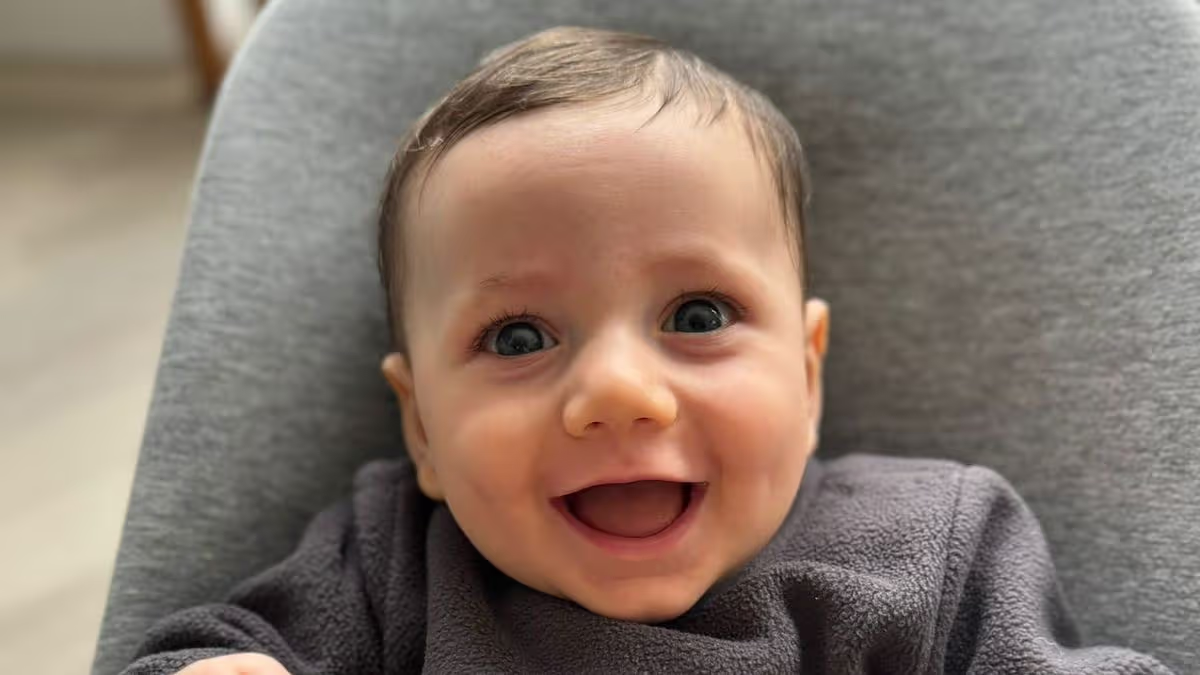
Rupert Smith’s eyes would flicker ‘from side to side, up and down’, before finally ‘locking to the side’
A baby was diagnosed with an incurable, one-in-a-million condition – after his parents noticed his eyes would “flicker from side to side”. Rupert Smith, who turns one on May 28, was diagnosed with alternating hemiplegia of childhood (AHC) in January this year.
His parents, David, 40, and Siobhan Smith, 36, first noticed baby Rupert’s eyes were “flickering from side to side, up and down” before “locking to the side” when he was just two weeks old. Rupert was also having breathing difficulties and episodes of his body tensing up, but extensive testing returned normal results.
But when Rupert had to be resuscitated at six months, genetic testing finally revealed the ultra-rare condition. Since, mum Siobhan had to perform CPR in Tesco on her little boy before he was airlifted to hospital and he now requires round-the-clock care to manage unpredictable episodes of paralysis, seizures and serious medical emergencies. Two big emergencies have followed at eight and 11 months old.
The life-threatening, progressive condition is linked to no fewer than seven neurological conditions, including tremors, Parkinson’s, ADHD, autism, stroke, Alzheimer’s, cerebral palsy, and epilepsy.
As a result, he is in the care of neurology, respiratory, cardiology, physiotherapy, speech and language, dietetic, hospice and community nurse care down the chain from Great Almond Street hospital to Alder Hey Children’s Hospital in Liverpool.
The family are now fundraising £1.5m to prepare them for an emergency trip to the US for treatment, and a cure if it becomes available, and to fund research and raise awareness. David, a police officer from Broughton, North Wales, said: “At about two weeks old we noticed his eyes were flickering side to side, up and down, then they’d lock to one side, so we had him tested for neuroblastoma but that came back okay.
“Then he started having rigid episodes where his whole body would tense up, along with the eye movements, which they thought was epilepsy but those tests were normal.”
The family were asked by the NHS, who were “learning on the job” given the rarity of the condition, to film his seizures to help them gain a better understanding.
David said: “They were so confused to what it was. The testing started at two weeks old, but in hindsight we think the stress of being born was why he was struggling to breathe in that first week. It’s incredibly difficult, we’re both absolutely exhausted and anxious.
“This is our life, it’s completely changed since he was born. You plan your life around a baby, get excited, plan for them to meet their brothers. There’s a huge psychological, financial impact on us, and Rupert’s health is so uncertain, so our future is too.”
Rupert was thought to be healthy beyond some breathing difficulties, when he was born in May 2025. But when his parents noticed his abnormal eye movements and breathing difficulties they took him to hospital.
Tests for neuroblastoma, lumbar Punctures, EEGs, ECGs, MRI and CT scans and cameras down his throat returned normal results. It was only after his first near-death episode the genetic condition was revealed. The condition is extremely hard to manage, because health episodes can be prompted by a huge variety of inconspicuous causes.
Siobhan, a pharmacy technician, told Talk to the Press: “We’re on edge all the time. You can’t take your eyes off him at all. It’s very unpredictable, one minute he can be smiling, next minute he’s having a life-threatening seizure.
“It’s not something Dave or me carry, it’s just a misspelling in his genes. Episodes are triggered by stress on the body; if he’s tired, hungry, too excited, too hot, cold, exposed to water. Even going outside can cause a seizure.
“This last set of seizures – over 48 hours he probably had 12 – was triggered we think by teething. Something as little as that can cause a significant event. We have his oxygen, rescue medications with us everywhere we go.
“We can’t allow him to become too excited, too upset or too happy because that can trigger something. To not allow your child to be too happy is really hard to take. But he’s still so smiley, and so determined.”
The family are fundraising, with proceeds being split towards preparing the family for an emergency trip, and funding research into cures and treatments. They have raised £285,000 so far – and say the extra money raised will go to funding the research of the condition through research foundations RARE Hope CareAHC (focused on a cure) and For Henry AHC (focused on treatment).
The family are hopeful a trip to the US for treatment can happen soon, with specialist consultations and clinical trials on the horizon. The family say “emerging therapies such as Antisense Oligonucleotide (ASO) therapy and genome editing show genuine promise”.
Siobhan said: “He has two brothers, George, who’s six, and Henry, who’s four, and they’re obviously aware of it, but don’t know how life-threatening it is. It’s difficult for them because Rupert’s spent a lot of time in hospital and they’ve been passed from pillar to post.
“But they love him, and he adores them. They stimulate him, perhaps that’s why he’s so determined, because he sees his brothers and wants to do what they’re doing.
“We’d do anything for him. He’s beautiful, everyone who meets him falls in love with him. That’s why we’ve got so much support, everyone wants to do what they can to help because he’s so resilient. But there’s only so much you can take, he’s had to deal with more than most people do in their life, and he’s not even one yet.”
Dave and Siobhan’s brother, Liam, are flying out to Boston for a conference on AHC research progress and its future in June, but Rupert is not well enough to travel yet.
Instead, he will mark his first birthday on May 28 when over 50 landmarks, including the CN Tower in Toronto, Ally Pally and Cardiff Castle will light up with “Rupert’s Rainbow” to raise awareness.
Siobhan said: “Time is critical. We’re hoping treatment comes through in 12 months, and a cure hopefully in a couple of years. But we’ll need to fund Rupert’s treatment to allow him to develop normally while they work on it. We just need to be in a position to pounce on it when treatment or a cure is available. We’re hopeful.”
Rupert’s fundraiser can be found here






































You must be logged in to post a comment Login