
Crypto World
Swift Starts Blockchain Ledger Pilot for Tokenized Deposits With 17 Banks

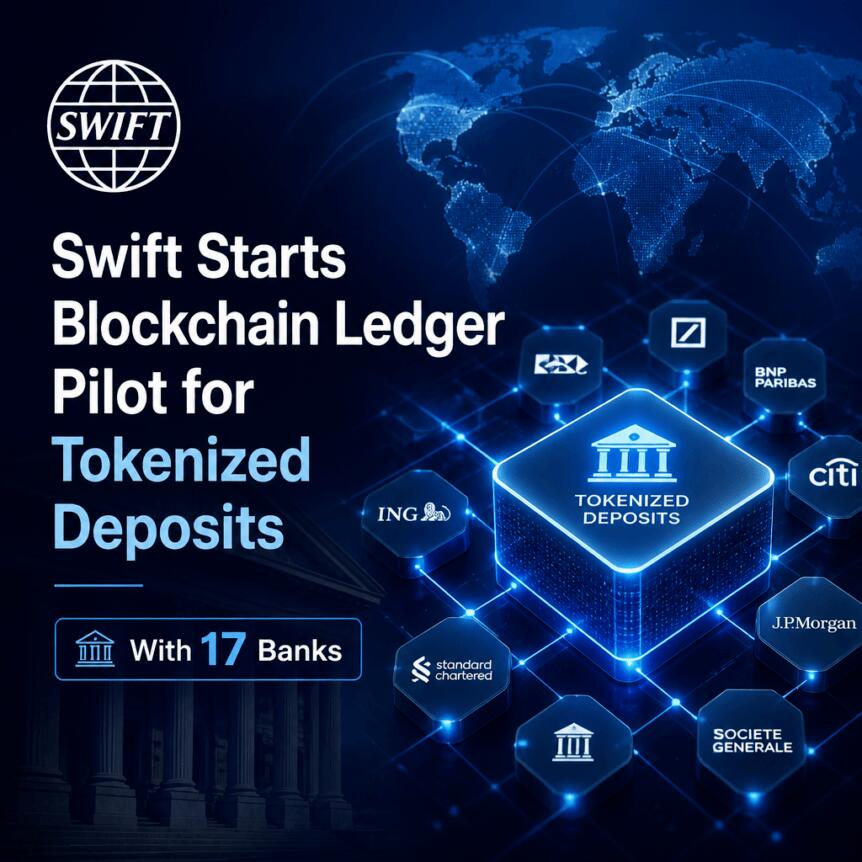
SWIFT says its blockchain-based ledger for financial messaging is now ready for initial use, marking a meaningful step toward giving banks a more clock-agnostic way to move value across borders. After nine months of development, SWIFT announced that 17 major institutions are preparing to pilot cross-border payments using tokenized bank deposits on the platform, with an initial controlled go-live phase expected to follow.
According to SWIFT, participating banks—including HSBC, Citigroup, BNP Paribas, UBS, ANZ, DBS, and Standard Chartered—will test how tokenized deposits can support 24/7 cross-border payments, including overnight and weekend transactions, while keeping the compliance, credit, risk, and control standards built into existing payment processes.
Key takeaways
- SWIFT’s blockchain ledger is reported as ready for initial use after nine months of development.
- 17 banks plan to pilot cross-border transfers using tokenized bank deposits on the SWIFT platform.
- The initiative targets 24/7 settlement behavior, extending payment availability beyond traditional banking hours.
- SWIFT emphasizes that the approach aims to preserve existing compliance, credit, risk, and control requirements.
- SWIFT indicated further expansion of the ledger’s functionality and availability after the first limited rollout.
From messaging to tokenized deposits
SWIFT’s role in global finance is largely about connectivity: its interbank messaging network links more than 11,500 banks and financial institutions across over 200 countries and territories. While SWIFT already supports rapid message delivery on its existing rails—SWIFT said 75% of payments reach the beneficiary bank within 10 minutes, often in seconds—the new effort focuses on what happens when settlement needs to operate regardless of the time of day.
The company’s announcement frames the ledger as an extension of SWIFT’s “resilient global platform,” intended to help “regulated digital assets” move across borders with greater velocity and flexibility. In remarks shared in the announcement, Thierry Chilosi, SWIFT’s chief business officer, said the ledger allows tokenized value to move internationally while maintaining the same levels of resiliency, security, and compliance that global finance expects.
For market participants, the practical significance is not just the use of blockchain, but the target operational outcome: keeping established governance structures while enabling payment flows that are less dependent on bank working hours.
Why the pilot matters for cross-border payments
In SWIFT’s description, the pilots are designed to test cross-border payment capabilities using tokenized deposits, without discarding the compliance and risk frameworks embedded in current processes. That emphasis is important because many tokenization efforts struggle with the same central question: how to integrate new settlement mechanics into existing regulatory and institutional controls.
SWIFT said the ledger will allow participating banks to support 24/7 cross-border payments, explicitly including overnight and weekend activity. That directly addresses a longstanding operational bottleneck in traditional payment infrastructure, where cut-off times and settlement windows can constrain responsiveness—especially for time-sensitive transfers.
It also places SWIFT in the middle of a broader shift in financial infrastructure: banks are increasingly exploring tokenized assets and settlement, but they want that evolution to happen within trusted, regulated systems rather than as isolated experiments.
Part of a wider push toward tokenized settlement
SWIFT’s move lands amid a series of parallel developments from major financial players that point to renewed momentum in tokenized deposits and securities infrastructure.
Earlier, a consortium of banks—including JPMorgan Chase, Bank of America, Citibank, Barclays, BNY, and Wells Fargo—announced plans to launch a tokenized deposit network in the first half of 2027. The Clearing House would operate the network and connect traditional payment rails with digital asset infrastructure to enable 24/7 settlement.
In the markets sphere, the New York Stock Exchange previously partnered with tokenization platform Securitize to build blockchain-based infrastructure for tokenized stocks and exchange-traded funds. Separately, the parent company of the NYSE, Intercontinental Exchange (ICE), has also shared plans for a tokenized securities venue aimed at 24/7 trading, instant settlement, stablecoin-based funding, and onchain settlement.
Taken together, these efforts suggest a sector-wide attempt to reduce the friction between “tokenized” workflows and the operational realities of regulated financial institutions. SWIFT’s pilot is another data point in that transition, particularly because SWIFT is not an issuer or a single-venue market—it is the messaging backbone for interbank communication globally.
What to watch next after initial go-live
SWIFT said it plans to expand the ledger’s functionality and availability after the initial controlled go-live phase. That sequencing matters: a controlled rollout typically helps institutions validate technical performance and governance requirements before scaling participation or expanding use cases.
For users ranging from treasury teams to payments operators, the next milestones will likely center on practical interoperability—how efficiently tokenized deposit transfers work across participating institutions and how smoothly the ledger integrates into existing operational and compliance routines. Investors and builders in digital asset infrastructure will also want to monitor whether SWIFT’s ledger becomes a repeatable baseline for cross-border settlement beyond the pilot group, or whether it remains a narrow-use experiment before wider adoption.
In the near term, the most important question is whether the pilots can demonstrate that 24/7 tokenized cross-border payments can coexist with established financial controls at scale. If SWIFT’s expansion follows the same logic, the ledger could become a significant bridge between traditional messaging standards and the settlement expectations of modern commerce.

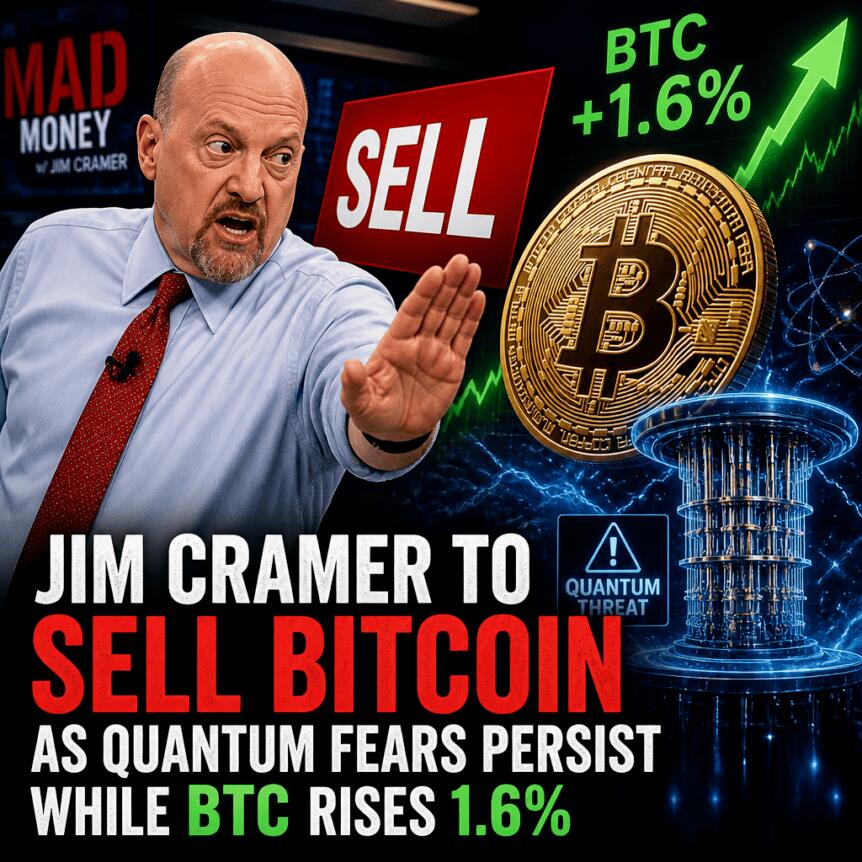
Bitcoin has found itself at the center of a new wave of quantum-computing anxiety after Jim Cramer said he plans to sell his holdings. Speaking on a Friday episode of CNBC’s “Mad Money,” the former hedge fund manager pointed to remarks made the day before by IBM CEO Arvind Krishna, who suggested investors should treat quantum risk as something to be “paranoid” about within the next few years.
Cramer’s comments arrive as market conditions also appear to be softening. While Bitcoin traded above $63,500 at the time of the report—up 1.7% on Tuesday—it remained down roughly 27% year-to-date, according to TradingView data. At the same time, blockchain and exchange liquidity indicators cited in the report pointed to reduced activity and increased selling behavior among large holders.
Key takeaways
- Jim Cramer said he plans to sell all his Bitcoin, citing concerns about quantum computing risks raised by IBM CEO Arvind Krishna.
- Blockchain analytics referenced by Lookonchain show at least one large Bitcoin wallet moved roughly 16,400 BTC after a period of inactivity.
- Crypto liquidity signals cited from Kaiko data suggest spot trading activity on leading exchanges fell to about $15 billion last week—lowest levels of 2026 in the referenced dataset.
- Industry views remain split on when practical quantum threats to Bitcoin could materialize, with timelines ranging from “decades” to “3–5 years.”
Cramer turns quantum fears into a concrete portfolio decision
In his Friday “Mad Money” segment, Cramer said: “I’m going to sell mine [Bitcoin],” directly tying his decision to quantum computing concerns. The impetus was an earlier conversation with IBM CEO Arvind Krishna, who told Cramer to be “paranoid” about the potential threat quantum computing poses to cryptocurrencies over the next three to four years.
The significance for investors is less about whether Cramer personally controls market outcomes and more about how mainstream commentary can sharpen attention on long-term security assumptions. Quantum computing is widely discussed in crypto circles because it could, in theory, undermine certain cryptographic protections if the necessary computational capability becomes feasible.
Still, not all investors interpret quantum talk the same way. The report notes that some market participants leaned into the “inverse Cramer” meme—an investment philosophy that effectively bets against Cramer’s calls—suggesting that certain traders may view Cramer’s bearish stance as a contrarian signal rather than a risk indicator.
Large-holder activity surfaces as exchange liquidity cools
Separate from Cramer’s remarks, the report highlights whale wallet movement alongside weakening trading activity. According to blockchain analytics platform Lookonchain, a whale wallet labeled bc1qpt transferred its entire Bitcoin holdings of 16,400 BTC—worth about $1 billion—into a new address after seven months of inactivity.
Lookonchain’s report of the transfer was paired with a liquidity reference from crypto intelligence platform Kaiko, as shared by The Kobeissi Letter. The cited metric claims that daily cryptocurrency trading activity across the leading 44 spot exchanges fell to about $15 billion last week, described as the lowest level of 2026 in that dataset.
In a Tuesday X post, The Kobeissi Letter characterized the move as part of a broader liquidity contraction, stating it represented a roughly 70% decline from January peak levels and that “crypto market liquidity is drying up.”
For traders, the pairing matters: a wallet moving substantial funds after a long idle period can reflect many possibilities—risk management, restructuring, or trading plans—but when it coincides with lower liquidity, it can heighten sensitivity to price moves. Liquidity tends to influence how easily large orders can be absorbed without significant slippage.
Quantum timelines remain contested—what “risk” actually means
While Cramer focused on a near-term window (three to four years, based on Krishna’s remarks), the report underscores that the broader industry is not aligned on when quantum capabilities could become practically relevant for Bitcoin.
In November 2025, Blockstream CEO Adam Back reportedly said Bitcoin faces no meaningful quantum threat for at least the next 20 to 40 years. That perspective suggests a long runway for preparation, implying that immediate panic is likely unwarranted.
By contrast, the report cites an April report from Bernstein that argues Bitcoin could have roughly three to five years to prepare for a post-quantum security upgrade. That timeline compresses the decision window for developers and infrastructure operators and would support the idea that planning should not be deferred.
Adding another layer, the report includes an assessment from Bitget Wallet research analyst Lacie Zhang, who told Cointelegraph that Back’s view is “more accurate and measured,” and that practical quantum threats capable of breaking Bitcoin’s cryptography remain highly unlikely within the next decade.
What remains uncertain across all viewpoints is the translation from “theoretical vulnerability” to “real-world break.” Even when the cryptographic risk is discussed in terms of quantum computing, the market relevance depends on when systems capable of executing the necessary computations will be available, stable, and accessible at a scale that meaningfully threatens the security assumptions behind Bitcoin.
Why this story matters beyond headlines
Even if the exact timeline is disputed, the combination of high-profile mainstream comments and ongoing technical debate may increase investor attention on how Bitcoin and the wider ecosystem plan for a post-quantum world. The report references earlier coverage about Bitcoin’s quantum upgrade path and notes that discussions in the sector have already moved toward considering upgrade mechanisms, including what changes could be made and what would not.
For market participants, the immediate takeaway is twofold. First, quantum talk can influence sentiment even when implementation details are years away, so traders may watch for whether additional infrastructure or policy discussion emerges. Second, the liquidity backdrop described in the report suggests that even routine flows—like large wallet moves—could be more noticeable if trading depth continues to decline.
Going forward, investors should watch for updates that connect the debate to concrete milestones: technical proposals and timelines for post-quantum readiness, as well as whether exchange liquidity stabilizes or continues to drift lower alongside large-holder activity.


XAUt added to its bullion backing during gold’s worst quarter since 2013, as tokenized commodity holder counts continued to rise.


Disclosure: This article does not represent investment advice. The content and materials featured on this page are for educational purposes only.
New data shows individual investors still hold the majority of Bitcoin supply, outpacing institutions, corporations, funds, and government wallets.
Summary
- New data shows individuals still hold roughly two-thirds of Bitcoin, outweighing institutions and ETFs.
- Most Bitcoin is still held by private investors, with institutions controlling only a small share, data shows.
- Institutions may be buying Bitcoin, but individuals still account for the largest share of holdings.
The past few years have been filled with talk about how institutions have swallowed up the Bitcoin supply. Yet data shows that an overwhelming amount is still held by individuals.
Surprisingly, new data has shown that individuals still retain the most Bitcoin by market share. They hold significantly more than businesses, funds, and ETFS, and even Satoshi-era wallets. Over the past few years, there has been much speculation about the buy-and-hold tactics of corporations and institutions. Yet it may be individuals who are choosing to cling to their crypto.
Bitcoin’s current market segmentation
With the global geopolitical situation in turmoil, people have been flocking away from risk assets like cryptocurrency in droves. At the time of writing, Bitcoin price stands at $63,730. In the past five days, it has moved within a margin between $60,000 and $65,000, with little sign of breaching the upward curve. For many, this shows that people are not buying, but also not selling, creating stagnation. Yet it is those who hold cryptocurrencies that throw up the most surprises.
A recent study taken from public wallet data has shown that individuals hold 66% of the Bitcoin supply. Mapping wallets that are known to interact with exchanges, custodians, and large holders, it painted a picture of marginal institutional and corporate holdings. In contrast, only 7.8% was given over to businesses, with 7.2% in funds and ETFS. Satoshi-era wallets had 4.6%, while governments held only 2.1%.
Together, the entire institutional investment sector, incorporating businesses and trading bodies, only holds 15% of the supply. Accounting for the remainder, only 4.5% of Bitcoin is left to be mined. An estimated 7.7% of the remainder has been lost. That means 19% spans the other categories, with the rest, roughly two-thirds, held by private individuals.
The social media paradox
This also dispels a recent theory that a lack of social media chatter regarding Bitcoin and Ethereum has been driven by institutional adoption. In July, data was published that showed mentions of the two terms were at their lowest levels in two months on the platform X. Bitcoin mentions had dropped to around 130,000, while Ethereum had fallen to 40,000 per week.
Reports on the data highlighted this as a shift to institutional buying. In particular, many highlighted it as a regression to a time back in 2020, before the institutional era emerged. Yet the new data suggest that there may be other reasons at play, especially as institutions do not hold the amount that people believed.
Firstly, it could be that X is just losing users. This is a trend that has been ongoing, with 33 million users leaving between January 2024 and 2025. These people may have drifted to other places to discuss cryptocurrency. It could be on Reddit, or it could be on private messaging apps like Telegram.
It could also be that people are just going elsewhere for their information. With crypto more widely known about, people are more savvy. Regulatory announcements and the inflows and outflows of ETF products all provide better benchmarks than a speculator on X.
Lastly, crypto may not be as new and exciting as it once was. It has given way to talks about tokenization, and even AI has grabbed many of the headlines that it once promised as a harbinger of a brave new world. As it is no longer the coolest, newest cat in town, less is being spoken about it. By no means does this mean people have lost interest, but it simply signals that people are now accepting it.
How should this impact trading?
During periods of volatility, retail investors are often prone to more emotional trading. They can sell and buy fast, as opposed to companies that have to make long-term decisions, signed off by many people. This has mainly been the reason given for Bitcoin’s current stagnation.
Yet it seems that the opposite is true and that retail investors are actually building resilience. HODL is the sector name for “Hold on for dear life,” which means you keep hold of Bitcoin until it grows exponentially in value. Many investors have held on through tumultuous market cycles. In fact, whales who are private buyers who hold large amounts can often change market courses if they begin to buy up or even dump their cryptocurrency. This suggests that they still do play a huge part in the direction prices can take.
What this does show is that despite what media outlets and those in the crypto industry are saying, the field is still extremely decentralized. For all the hype of institutional adoption and government backing, Bitcoin, particularly, is still held by individuals. Those wanting to see how this changes in the near future must watch inflows and outflows to ETF products, as well as changes to government legislation, not just in the US but beyond.
Disclosure: This content is provided by a third party. Neither crypto.news nor the author of this article endorses any product mentioned on this page. Users should conduct their own research before taking any action related to the company.


Bitcoin miners with operations in Texas are not expected to be impacted by a moratorium on approval of data center projects connected to the state’s grid operator ordered by Governor Greg Abbott, Bernstein analysts said Tuesday.
Abbott on Monday directed the Public Utility Commission of Texas and the Electric Reliability Council of Texas (ERCOT) to audit all data centers seeking to connect to the state’s power grid. The duration of the audit was not specified and comes amid increasing public backlash to the pace of data center build-out across the state, The Texas Tribune reported.
Bernstein analysts told clients on Tuesday that as most of the Bitcoin (BTC) miners operating in Texas are under contract for approved electric capacity, those operations are unlikely to be impacted by the moratorium.
“However, we believe, this audit throttles speculative data center pipeline and makes genuine sites with development history more valuable,” the research team led by Gautam Chhugani said in their note. “Bitcoin mining sites are favorably placed with the longest gestation, self-funding infra and local community management,” they said.
They said that the local operations of Cipher Digital (CIFR), Core Scientific (CORZ) and CleanSpark (CLSK) could be the miners most exposed to future public opposition to data center expansion, particularly during ERCOT’s approval process to convert their pipeline assets into grid-connected power capacity.
“We believe with increasing political opposition to new data center projects and fresh capacity being throttled by moratoriums/state directives, the approved MWs become more valuable,” they said, highlighting the Texas mining operations of IREN (IREN), which is fully ERCOT grid approved, as are the operations of Riot Platforms (RIOT).
CIFR shares were down more than 7% in Tuesday’s premarket trading, according to Yahoo Finance data. The miner reported second-quarter results earlier Tuesday, posting a loss of $0.65 per diluted share, widening from last year’s loss of $0.12 per diluted share.
Related: Bitcoin may find bear market bottom in August: 10x Research

Migration is rarely the result of a single heat wave. It is the culmination of years of mounting losses that steadily erode income, health, and hope.
Consider Santuben Kantibhai, a farmer from Gujarat, India. Over the past two years, her family has endured a cascade of climate and economic shocks. A severe heatwave destroyed much of their standing crop, causing her family’s income to plummet. At the same time, her father—a co-earner who relied on farm labor and daily wage work—developed cataracts that gradually robbed him of his eyesight, making it increasingly difficult for him to help their family earn a living. When another heatwave struck in 2025, crop yields fell again just as his condition required surgery. For Santuben, the question is not whether heat is becoming more dangerous; she already knows it is. It is how many more failed harvests and lost workdays can her family absorb before staying becomes impossible.

A Kalshi advertisement at a bus stop in Washington, D.C., March 19, 2026.
Daniel Heuer | Bloomberg | Getty Images
Prediction market platform Kalshi is announcing Tuesday a new partnership with compliance technology company Comply as its push into institutional trading continues, the company told CNBC exclusively.
Comply — which works with more than 5,000, primarily financial, firms — is adding Kalshi’s prediction markets trade data to its regulatory software.
The platform gives companies who use Comply’s technology, for traditional securities and digital assets, the ability to see employees’ trades on event contracts, to make sure they’re following a company’s policies and not using material, non-public information to trade. The technology will also extend to Kalshi’s perpetual futures contracts, too.
“Most firms are still figuring out what a reasonably designed prediction market compliance program looks like, and that’s exactly where we come in,” said Comply’s chief regulatory service officer Jamila Mayfield in a statement. “Comply brings both the technology and the regulatory expertise to build programs that hold up under scrutiny.”
Comply’s technology already covers prediction market trades on platform Polymarket through a partnership with ZenLedger, a cryptocurrency tax management and accounting company, according to a press release.
Kalshi’s partnership with Comply follows a similar one between the prediction market and StarCompliance, another compliance technology company that allows clients to see employees’ trades, announced in June.
Max Crowley, vice president of business development at Kalshi, told CNBC in an interview that these compliance partnerships come up as the company has continued to have conversations with firms potentially interested in institutional trading. Many are used to technology like that of Comply’s when trading on traditional assets, and expect the same if they’re to move into the prediction market space, he said.
“We’re actively working with institutions, and I think, more and more we’ve heard from these firms… ‘Do we have compliance surveillance on our side?’” Crowley said. “We have an internal surveillance team, every day we’re actively going through all the activity that is happening on the platform… But then firms say, ‘that’s all good, but we also need visibility.’”
CNBC previously reported that companies across sectors are grappling with the rise of prediction markets, and legal experts said few — beyond highly-regulated financial institutions with large compliance departments — have figured out how to alter their internal policies surrounding the new asset class for employees.
Sudhir Jain, Kalshi’s chief compliance officer, said some companies may be considering blocking their employees from trading outright on any event contract as a policy. However, he said technology like Comply’s can avoid protocols like that.
“Without knowing what employees are doing, their only choice is to say, from a policy perspective, don’t trade at all,” Jain said. “Now they have the data; they can monitor it.”
Disclosure: CNBC and Kalshi have a commercial relationship that includes customer acquisition and a minority investment.

Key takeaways
- Dogecoin is trading near $0.070 after declining 3.5% last week.
- DOGE’s long-to-short ratio rose to a one-month high of 1.25, signaling bullish positioning.
- Funding rates remain positive at 0.0074%, indicating stronger demand for long positions.
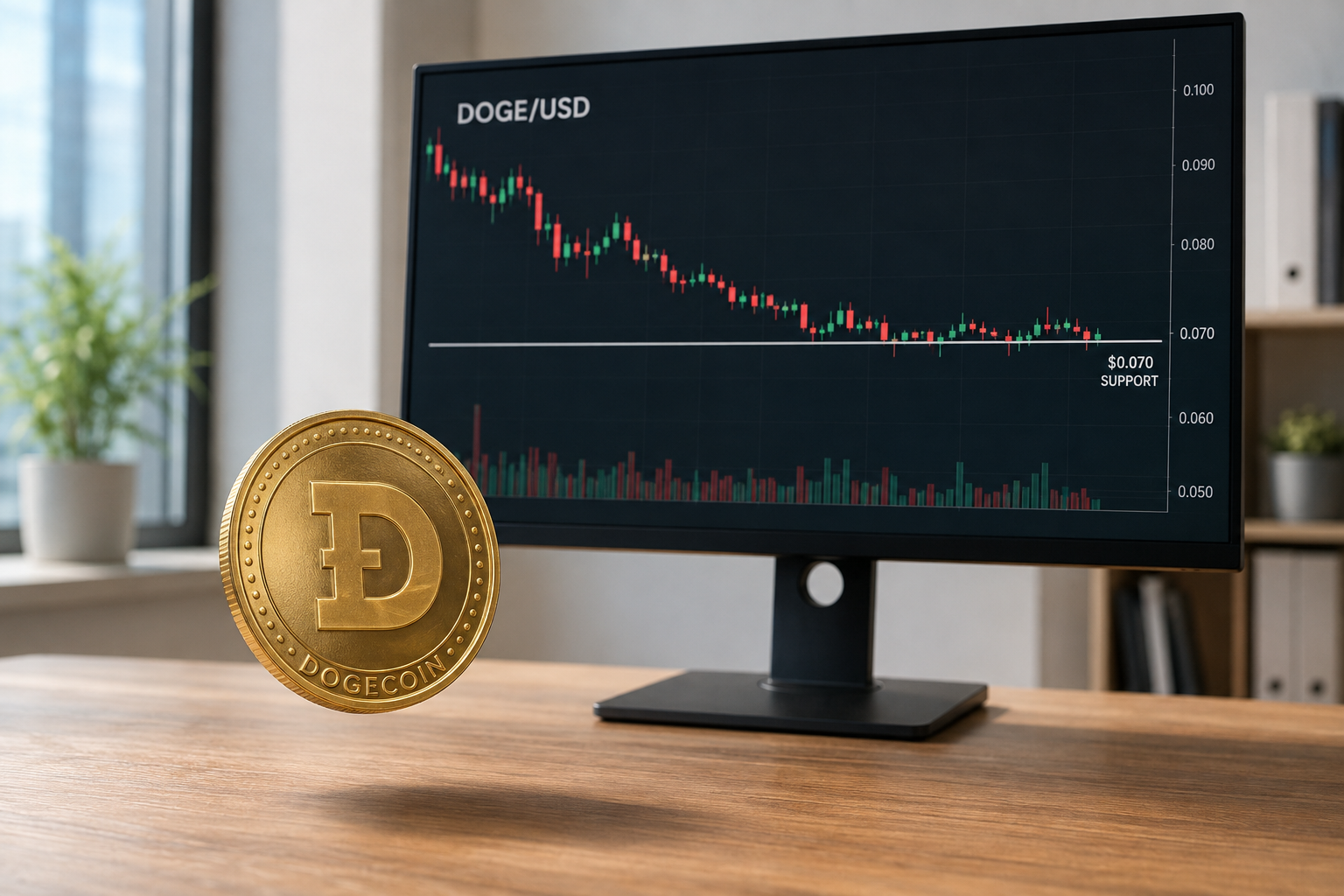
Dogecoin (DOGE) is holding steady near $0.070 at the time of writing on Tuesday after falling 3.5% last week.
Although the broader technical trend remains bearish, improving derivatives data and bullish divergences across key momentum indicators suggest that selling pressure may be easing. This setup could support a short-term recovery if buyers defend the current support zone.
Derivatives data supports a bullish DOGE outlook
Dogecoin derivatives traders are showing signs of growing optimism. The DOGE long-to-short ratio climbed to 1.25 on Tuesday, its highest level in more than a month, according to CoinGlass.
A reading above 1 indicates that long positions outnumber shorts, suggesting more traders expect the price to rise.
Dogecoin’s funding rate also supports this bullish outlook. The rate turned positive on July 24 and stood at 0.0074% on Tuesday.
Positive funding rates mean traders holding long positions are paying those with short positions, typically reflecting stronger demand for bullish exposure.
Dogecoin technical outlook: Bullish divergence emerges
Dogecoin is trading near $0.070 on Tuesday but remains below its major moving averages, maintaining a bearish near-term structure.
The 50-day, 100-day, and 200-day Exponential Moving Averages are located at $0.075, $0.083, and $0.100, respectively. These levels are expected to act as resistance during any recovery attempt.
However, momentum indicators suggest bearish pressure is beginning to fade. DOGE formed a lower price low on August 1 while the daily Relative Strength Index registered a higher low. This bullish divergence indicates that selling momentum is weakening despite the decline in price.
The Awesome Oscillator reinforces this signal. Its recent lows have been rising while DOGE continues to trade near its price lows, suggesting that downside momentum is losing strength.
Immediate support is located at the horizontal level of $0.070. If DOGE loses this level, the yearly low at $0.067 would become the next key support. A decisive daily close below $0.067 could trigger further losses toward the psychological level of $0.065.

The 50-day EMA at $0.075 represents the first major resistance level. Above it, DOGE could encounter selling pressure around the descending trendline breakout area near $0.080, followed by the 100-day EMA at $0.083 and horizontal resistance at $0.088.
A stronger recovery would require Dogecoin to reclaim the 200-day EMA at $0.100 and the major horizontal barrier at $0.102. Moving above these levels would help ease the prevailing bearish outlook.


Italy’s largest bank Intesa Sanpaolo increased its staked Ether ETF position to $7.1 million while reducing its holdings in two spot Bitcoin ETFs.
Crypto World
Korean Buyers Are Stacking XRP 2-to-1 Against Sellers: XRP Price Prediction Says 80-Day Downtrend About to Break?
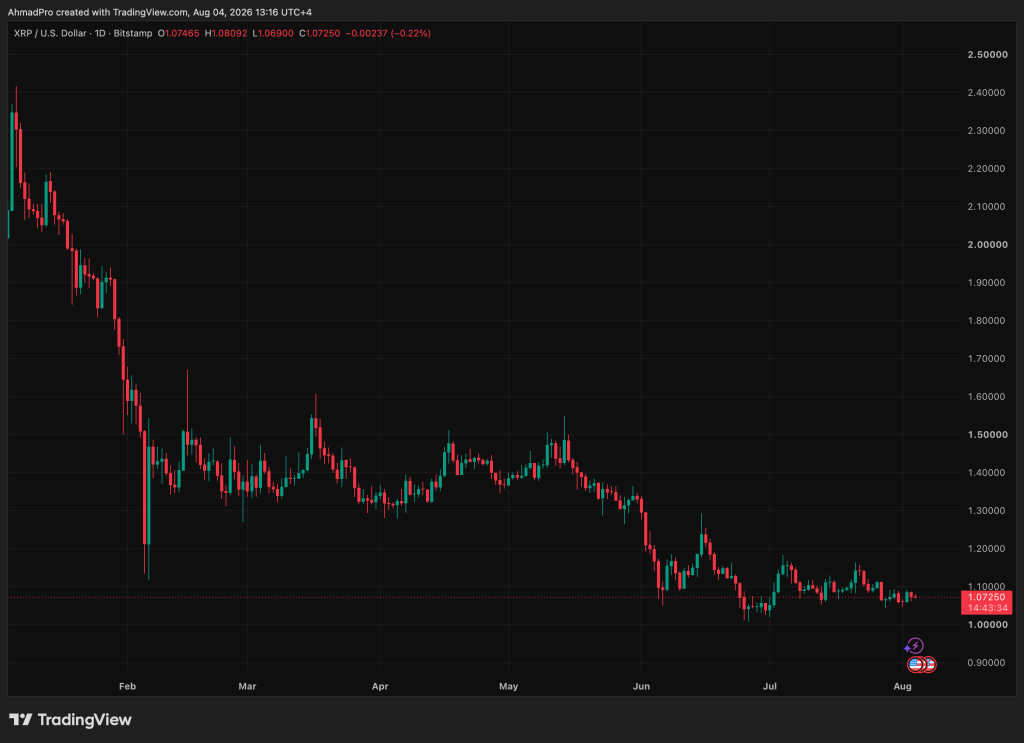
In the latest XRP price prediction, XRP price is trading at $1.0732, down 0.99% in the last 24 hours, yet the more interesting story sits just beneath the surface. A 4% bounce off the August lows is testing an 80-day falling channel, and one technical level will confirm whether this move has legs or fades, as every prior rally since May has. South Korea is making its position clear. The rest of the market hasn’t decided yet.
XRP market cap sits at approximately $68.27 billion with a circulating supply of 62 billion tokens and 24-hour trading volume around $877 million, stable, not explosive.
On Upbit, XRP ranks third among 275 Korean won-denominated markets by 24-hour volume, behind only Tether and Bitcoin. More telling: combined Upbit and Bithumb bids within 1% of spot outweigh asks by roughly two to one, a 34% gap in favor of buyers. That is not noise, that is deliberate accumulation posture from Korean retail.
The bounce is real. Whether it breaks the channel is a separate question, and the answer has direct implications for where capital rotates next.
Discover: Everyone’s Got a Take. Get Free $25 to Actually Trade Yours
XRP Price Prediction: Can XRP Price Break the 80-Day Downtrend This Week?
XRP’s 24-hour range has been tight, $1.0701 to $1.0841, with the XRP price currently sitting at $1.0732. The 7-day range tells a wider story, roughly $1.07 to $1.18, mapping cleanly to 2 zones traders are watching.
Support at $1.07-$1.08 has absorbed selling pressure over multiple sessions. Resistance at $1.15 to $1.18 is where every recent rally attempt has stalled.
The defining technical factor right now is the falling channel that has capped XRP since May 14. Day-to-day wicks inside that structure are largely noise.

A daily close above the upper channel boundary, somewhere in the $1.15 to $1.18 zone depending on the channel’s trajectory, would be the first confirmation of a genuine trend shift. Until then, each bounce is a probe, not a reversal.
A confirmed daily close above $1.18 breaks the channel and reopens the path toward $1.30 and beyond, with Korean bid depth suggesting buyers are positioned for exactly that scenario.
XRP oscillating in the $1.07 to $1.15 band while broader macro data keeps institutional risk appetite suppressed is the more likely near-term path. A daily close below $1.07 breaks the local floor, exposes the $0.98 to $1.00 zone, and invalidates the accumulation thesis entirely.
Volume at current levels does not signal conviction either way. A breakout without volume expansion of at least 40 to 50% above the 7-day average should be treated with skepticism. The channel break is the signal. Confirmation is everything.
Discover: Your Market Calls Are Worth Something. Start With Free $25 on Kalshi
LiquidChain Could be The XRP of This Cycle
XRP is holding support and showing demand-side strength in Korea, but at a $68 billion market cap, the asymmetric upside that early crypto allocators chased simply isn’t here anymore.
That math is straightforward. For traders tracking this rally and considering where asymmetry actually lies right now, the infrastructure presale space is worth a closer look.

LiquidChain ($LIQUID) is a Layer 3 infrastructure project positioning itself as the cross-chain liquidity layer, fusing liquidity from Bitcoin, Ethereum, and Solana into a single execution environment.
The architecture includes a Unified Liquidity Layer, Single-Step Execution, Verifiable Settlement, and a Deploy-Once model that lets developers access all three ecosystems without redeployment overhead.
The presale is currently priced at $0.01486 per $LIQUID, with $929,335.42 raised to date. The project’s fundraising trajectory has already drawn attention as it nears the $1 million milestone. As with any early-stage presale, smart-contract risk and execution uncertainty are live considerations; DYOR applies here more than anywhere.
Discover: Get Paid to Be Right, $25 to Start on Kalshi
The post Korean Buyers Are Stacking XRP 2-to-1 Against Sellers: XRP Price Prediction Says 80-Day Downtrend About to Break? appeared first on Cryptonews.
The primary cryptocurrency rose 1.5% in the last 24 hours and currently trades at around $63,500, even as Strategy announced its third BTC sale this year.
However, three important signals point to a potential pullback forming beneath the surface.
The Factors in Question
The renowned analyst Ali Martinez revealed that over 20,000 BTC (worth more than $1.2 billion) have hit exchanges in the past week or so. CryptoQuant’s data shows that the total figure has climbed to around 2.72 million, the highest since the start of July.
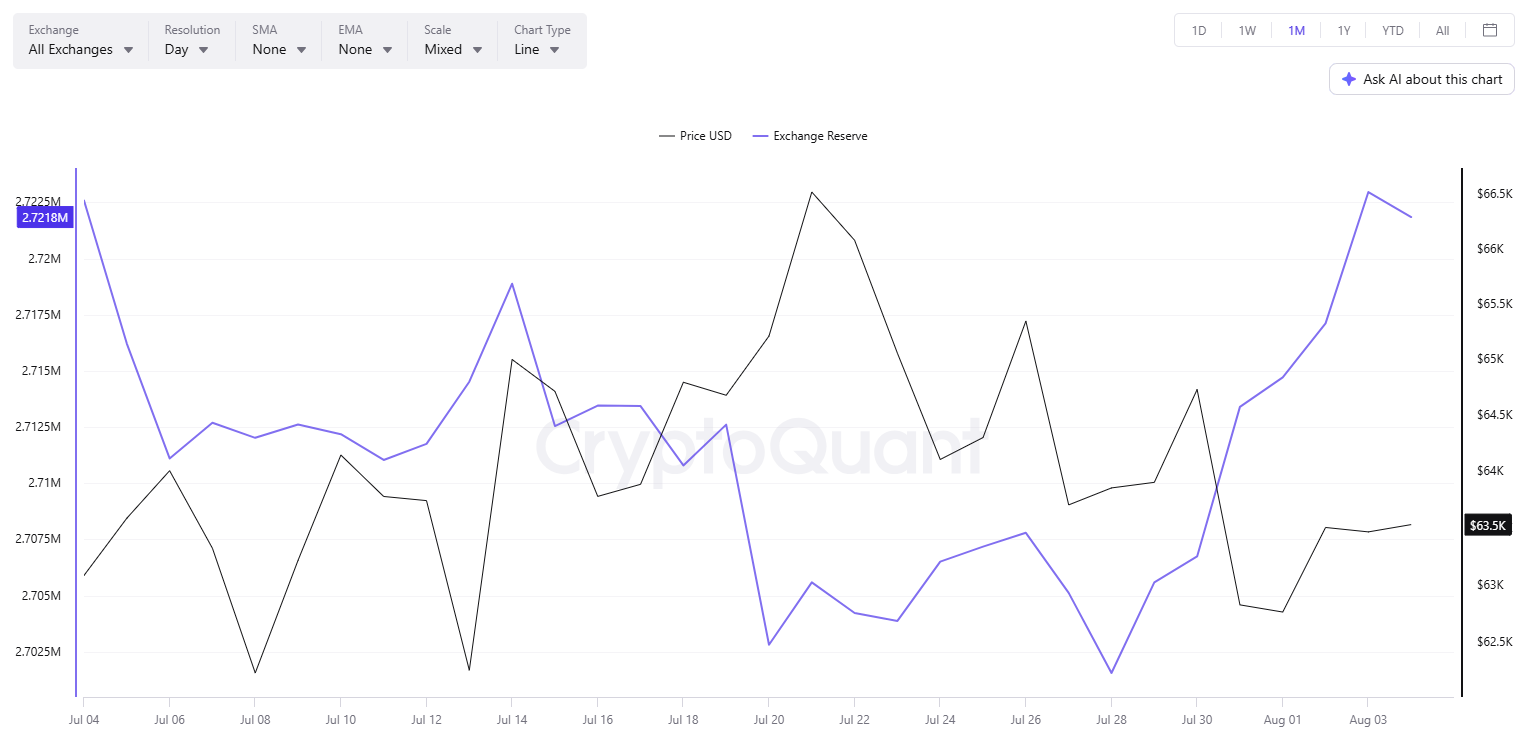
This suggests that some investors have abandoned self-custody methods and flocked to centralized platforms, increasing immediate selling pressure, or, as Martinez said:
“When coins move onto trading platforms, it often signals rising sell-side pressure. Keep an eye on this trend.”
It’s worth noting, though, that there might be another reason why investors are sending BTC to exchanges. The recent Coldcart saga has rattled trust in self-custody methods, which could lead to more bitcoin sitting on trading platforms, not necessarily for immediate selling.
Martinez also presented a second bearish signal, noting that BTC miners have sold roughly 1,774 units (worth around $112 million) over the past week. He argued the move signals another wave of profit-taking and something that could negatively impact the asset’s valuation in the short term.
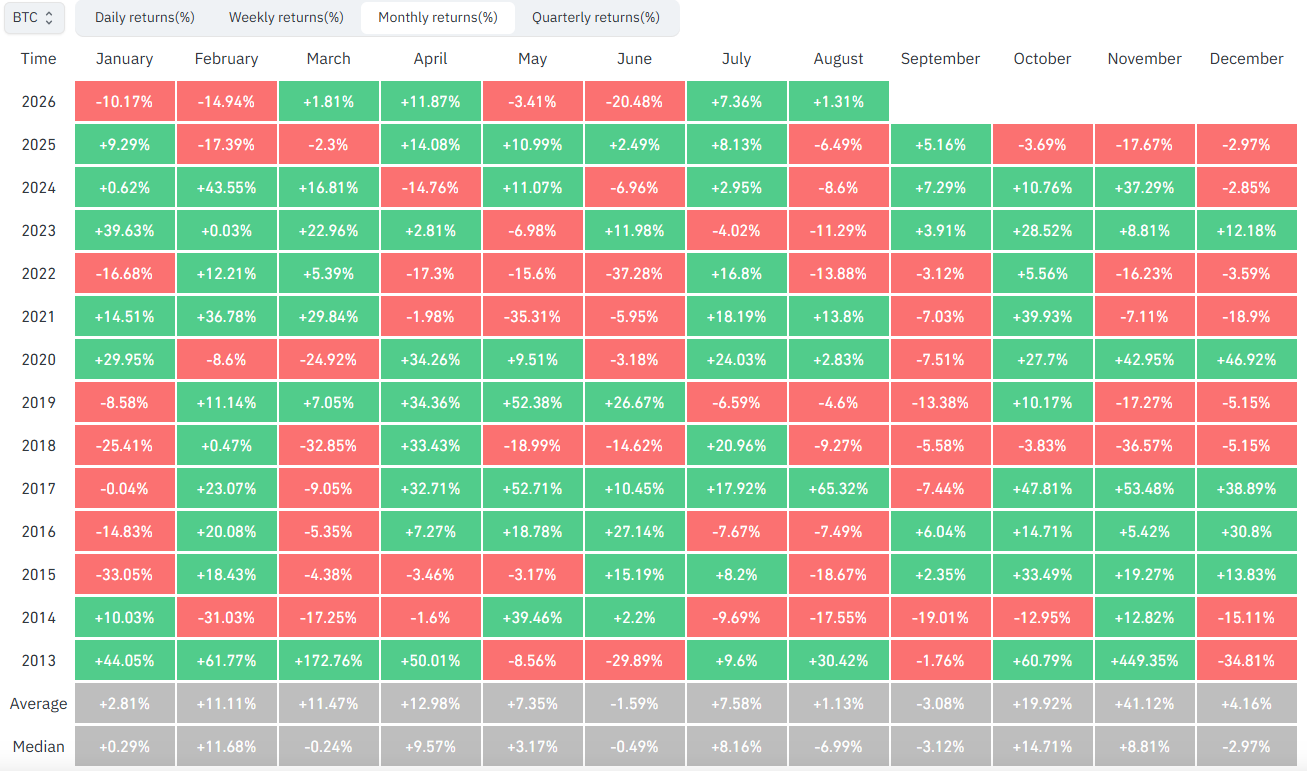
The third factor is Bitcoin’s seasonal performance. The asset has finished August in red territory 9 out of 13 times, adding further uncertainty amid the challenging times.
Final Flushout This Month?
Many analysts believe that the bear market is far from being over, expecting BTC to collapse to multi-year lows in the following weeks. X user Rekt Fencer spotted the formation of a potential final bull trap, which could result in a major crash to around $30,000 later in August.
Not long ago, Martinez presented a rather controversial theory. He claimed that bulls should actually welcome a potential dip to $60K since it could validate a classic inverse head-and-shoulders pattern that might push BTC to as high as $74,000. According to MikybullCrypto, the setup has already been completed:
“Breakout is next. $80K is the magnet target.”
The post 3 Signs Bitcoin (BTC) Could Be Ready for Another Pullback appeared first on CryptoPotato.

Yellow YAG Produces Powerful Pulses In Les’ Leftover Laser

MUDDY Puddle 2 MONEY Puddle Tutorial… (iPhone)

South Korean students detained after protest at US air base

Renter of Home in Anne Heche Crash Denies Settlement With Son

No Jackpot Winner as $257 Million Prize Rolls Over to $269 Million Monday Draw

Weekend Open Thread: Staud – Corporette.com
MUDDY Puddle 2 MONEY Puddle Tutorial… (iPhone)

Oliver Exposes Trump’s Crypto Scheme #crypto #worldlibertyfinancial #trump #donaldtrump #johnoliver

World Liberty Financial is being sued by one of its biggest investors, Justin Sun
-

 Business6 days ago
Why Trees Belong on the Risk Register
-

 Fashion4 days ago
Weekend Open Thread: Wit & Wisdom
-

 Politics4 days ago
Meta enters AI-training agreement with far-right ‘propaganda rag’ Newsmax
-
 Entertainment7 days ago
‘Stargate’ Creator’s New Sci-Fi Series Returns for Season 3 Tomorrow
-

 Crypto World3 days ago
MicroStrategy Post-Earnings CLARITY Act Push Could Add New Catalyst for Its Stock
-

 Politics6 days ago
Reform UK betrays West Mids residents by running from party pledges
-

 Business6 days ago
Major shareholder moves on Canyon
-

 Crypto World3 days ago
XRP Ledger v3.3.0 brings five institutional features
-

 News Videos5 days ago
Bitcoin Enters the 3rd Stage of the Bear Market
-

 Crypto World7 days ago
Kraken Enables Retail Access to Jersey Mike’s IPO via Tokenized Shares
-

 Politics5 days ago
Luke Littler’s dominance sparks GOAT debate
-

 Sports5 days ago
Seema Kaliramna Wins Discus Throw Bronze, Takes India’s CWG Medals Tally To 17
-

 News Videos7 days ago
Claude: Build Financial Dashboards in Minutes (2026)
-

 Crypto World4 days ago
New York sues Kalshi over prediction market gambling
-

 Crypto World2 days ago
Crypto PAC spending tops $2M in Michigan House race
-

 Business7 days ago
Johnson & Johnson agrees to $5.5B settlement over talc cancer claims
-

 Business4 days ago
Trump Announces Hamas Disarmament Agreement as Iran Strikes Kuwait Air Base and US Attacks Pause Overnight
-

 Politics2 days ago
Zack Polanski: an incitement to murder Nigel Farage?
-

 Tech6 days ago
Gemini can now summarize the messiest comment threads in Google Docs
-

 Tech2 days ago
ESET tracks rise in malicious AI skills and adaptable malware
You must be logged in to post a comment Login