

Crypto World
Tether Plans GELT Stablecoin Under Georgia Crypto Rules



Stablecoin issuer Tether and the government of Georgia plan to launch a stablecoin called “GELT” that would represent the Georgian lari under the country’s digital asset regulatory framework.
On Monday, Tether said the stablecoin is expected to support cross-border commerce and digital payments in Georgia. The company said GELT’s structure, rollout and regulatory implementation will be announced at a later stage.
The plan builds on Georgia’s recent efforts to develop rules for digital assets and stablecoins, including a framework covering reserve management, redemption rights, issuer oversight and Anti-Money Laundering compliance. In March, the National Bank of Georgia said it had developed rules for the initial offering of “stable virtual assets,” including requirements for full reserve backing, offering documents and external auditor verification.
Georgian Prime Minister Irakli Kobakhidze said the partnership with Tether would help lay the foundations for a more connected and transparent financial world. National Bank of Georgia President Natia Turnava said the central bank welcomes the collaboration as part of its strategy to advance digital financial infrastructure.
The announcement did not say who would legally issue GELT, where reserves would be held, or whether holders would have direct redemption rights. The company also did not provide a definite launch timeline.
Tether acknowledged Cointelegraph’s request for comment. Cointelegraph reached out to the National Bank of Georgia for more information, but did not receive a response by publication.
Georgia released stablecoin rules in March
On March 6, the National Bank of Georgia released rules covering stablecoin issuance. The framework said a stablecoin offering in Georgia cannot be provided without prior written consent from the National Bank.
It applies to virtual asset service providers, or VASPs, registered with the central bank, while companies that are not registered as VASPs must obtain registration before conducting a stablecoin offering or providing related services. The central bank said stablecoins in circulation must be fully backed by reserve assets that meet liquidity and credit quality requirements.
Related: Tether buys SoftBank’s stake in Bitcoin company Twenty One Capital
The rules also require issuers to prepare documents related to the initial issuance and submit them for external auditor verification, according to the central bank. The regulator said the framework intends to improve consumer protection, risk management and alignment with international standards.
GELT to join Tether’s non-dollar stablecoin lineup
The GELT stablecoin would join Tether’s smaller lineup of currency-specific stablecoin products beyond its flagship USDT. Tether has previously launched tokens pegged to the Mexican peso and offshore Chinese yuan and has also announced plans for a United Arab Emirates dirham-pegged stablecoin.
Tether’s Mexican peso-pegged MXNT launched in 2022 with initial support on Ethereum, Tron and Polygon. Its offshore Chinese yuan-pegged CNHT was created in 2019 and later expanded to Tron, while the planned UAE dirham token was announced in 2024 with backing from liquid UAE-based reserves.
The company has also developed market-specific stablecoin products. In January 2026, Tether launched USAT as a US-regulated dollar stablecoin aimed at the American market.
Tether has also wound down some of its earlier non-USDT stablecoins. The company stopped minting its euro-pegged EURT and said redemptions ended in November 2025, while its offshore Chinese yuan-pegged CNHT is set to become non-redeemable in February 2027.
Magazine: ETH bears growling, Tom Lee’s buying, XRP to ‘explode’: Market Moves


Disclosure: This article does not represent investment advice. The content and materials featured on this page are for educational purposes only.
Bitcoin use expands beyond trading as users shop, travel, and buy gift cards directly via CoinsBee.
Summary
- CoinsBee lets users buy gift cards with Bitcoin and other cryptocurrencies across 5,000+ brands in 185 countries.
- The platform supports fast crypto payments, with digital gift card codes delivered shortly after blockchain confirmation.
- Crypto users are increasingly turning to gift cards for borderless spending, added privacy, and practical everyday use of Bitcoin.
Cryptocurrency has evolved far beyond simple trading and investing. Today, Bitcoin holders can use their digital assets to shop, play games, travel, and more without ever converting them to traditional cash.
Today, anyone can buy gift cards with Bitcoin on CoinsBee in just a few clicks and turn their crypto into instant access to thousands of brands.
What is CoinsBee and how it lets people buy gift cards with Bitcoin
CoinsBee bridges the gap between crypto ownership and real-world usability by letting users spend Bitcoin directly on digital products, with no fiat conversion required.
The platform supports over 5,000 brands across 185+ countries, spanning entertainment, gaming, travel, and e-commerce. Once payment is confirmed on the blockchain, the gift card code arrives in the inbox within minutes, no hassle.
Step-by-step guide to purchasing gift cards with bitcoin on CoinsBee
Getting started with Bitcoin payments for gift cards on CoinsBee is refreshingly straightforward. Here’s how the process works from start to finish:
- Browse the Catalog: Head to CoinsBee.com and explore the shop. Browse by category — e-commerce, gaming, entertainment, travel, food, fashion, and more—or search directly for a specific brand.
- Select the Gift Card: Click on the desired brand, choose a preferred gift card value, and confirm the country of residence to ensure the card is redeemable in that region.
- Choose Crypto: At checkout, select Bitcoin (or any of the 200+ supported coins) as the payment method. A wallet address and QR code will be generated for the transaction.
- Complete the Payment: Send the exact amount of Bitcoin from a personal wallet to the provided address. The transaction is processed quickly on the blockchain.
- Receive the Voucher Instantly: Once payment is confirmed, the gift card code is delivered to the provided email address, ready to use.
This seamless flow is what makes the CoinsBee experience so appealing: it’s fast, intuitive, and requires zero crypto-to-fiat conversion.
Benefits of using Bitcoin for gift cards instead of traditional payment methods
There are compelling reasons why more shoppers are choosing Bitcoin payments for gift cards over conventional debit or credit card transactions:
- Privacy: Bitcoin transactions don’t require handing over sensitive banking information. Purchases remain discreet and off the traditional financial grid.
- Borderless Spending: CoinsBee supports customers in 185+ countries. No matter where someone is, they can shop globally without currency conversion fees eating into their budget.
- Security: Blockchain-based payments are highly tamper-resistant. Practicing secure Bitcoin shopping online through a reputable platform like CoinsBee means transaction data is protected from the ground up.
- No Chargebacks or Freezes: Unlike credit cards, Bitcoin transactions are final and irreversible, eliminating the risk of chargebacks or account freezes that can delay a purchase.
- Put Crypto to Practical Use: Rather than leaving Bitcoin sitting idle in a wallet, gift cards allow spending it on real-world goods and services today.
The ability to practice secure Bitcoin shopping online while accessing thousands of beloved brands is a powerful combination that traditional payment methods simply can’t match for crypto holders.
Tips to maximize savings when buying gift Cards on CoinsBee
Getting the most out of every Bitcoin spent is a smart crypto strategy. Here are some insider tips for the savvy CoinsBee shopper:
- Use the Right Denomination: When possible, buy a gift card for an amount that matches the intended spend precisely. Unused balances can be tricky to redeem fully across different platforms.
- Buy Multi-purpose Cards: Cards like Amazon or PayPal gift vouchers offer the broadest spending flexibility, giving the most bang for the Bitcoin.
- Time Purchase with the Market: If transacting during a period of higher BTC valuation, purchasing power naturally stretches further.
Taking a few extra minutes to apply these strategies can meaningfully improve the experience every time digital gift cards are purchased with crypto.
Common mistakes to avoid when using Bitcoin for gift cards
Even experienced crypto users can run into snags. Here’s what to watch out for when using Bitcoin for online shopping.
- Sending the Wrong Amount: Always double-check the required amount before completing the transaction.
- Using the Incorrect Network: Make sure Bitcoin is sent through the correct network to avoid delays or lost funds.
- Ignoring Fees: Transaction fees can affect the final amount. Ensure enough is sent to cover both the purchase and the fee.
- Skipping Final Checks: Take a moment to review all details before confirming the payment.
Avoiding these pitfalls ensures a smooth, stress-free experience every time CoinsBee is used as a trusted crypto gift card platform.
Final thoughts
Crypto is becoming a practical tool for everyday use. It offers flexibility, speed, and independence from traditional systems.
When buying gift cards with Bitcoin on CoinsBee, digital assets are turned into something immediately useful. The process is fast, accessible, and designed for modern users.
For those exploring how to use Bitcoin for online shopping, this is one of the easiest ways to begin.
Frequently Asked Questions (FAQs)
Can I buy any gift card with Bitcoin on CoinsBee?
CoinsBee offers an extensive catalog of over 5,000 brands across categories such as e-commerce, gaming, entertainment, travel, food, fashion, electronics, and more. While the selection is vast, availability can vary by country. Always check whether a specific gift card is supported in a specific region before completing checkout.
Is it safe to use Bitcoin to purchase gift cards on CoinsBee?
Yes. CoinsBee is a well-established crypto gift card platform with strong ratings. The platform uses secure payment processing and blockchain-based transactions, which are inherently tamper-resistant. Practicing secure Bitcoin shopping online through CoinsBee is considered safe, provided a reputable wallet is used and standard crypto security practices are followed.
Are there fees when buying gift cards with Bitcoin on CoinsBee?
CoinsBee’s pricing is transparent and straightforward. The platform does not impose hidden charges beyond the listed gift card price. However, always factor in standard Bitcoin network (miner) fees when sending a transaction, as these are determined by the blockchain itself and not by CoinsBee.
How long does it take to receive a gift card after paying with Bitcoin?
In most cases, delivery is nearly instant. Once the Bitcoin payment is confirmed on the blockchain, CoinsBee automatically emails a voucher code. Delivery typically occurs within minutes of a confirmed transaction. If any delays are experienced, check the spam folder first and then reach out to CoinsBee’s support team.
Can I use cryptocurrencies other than Bitcoin on CoinsBee?
Absolutely. While Bitcoin is the most popular choice, CoinsBee supports over 200 cryptocurrencies, including Ethereum, Litecoin, Dogecoin, XRP, USDT, TON, and many others. The platform also integrates Binance Pay and Crypto.com Pay for added convenience, making it one of the most versatile crypto gift card platforms available to shoppers worldwide today.
Disclosure: This content is provided by a third party. Neither crypto.news nor the author of this article endorses any product mentioned on this page. Users should conduct their own research before taking any action related to the company.

Fortune’s investigation into SpaceX and Antonio Gracias’s Valor Equity Partners reveals more than $20 billion in related party GPU leasing deals reclassified as debt, a governance tangle that could reverberate through Musk linked AI and potentially crypto risk capital.
Summary
- Valor funds hold over 500 million SpaceX Class A shares worth an estimated $90 billion to $140 billion at rumored IPO valuations
- Three xAI GPU lease agreements with Valor, guaranteed by SpaceX, total close to $20 billion in obligations
- PwC pushed to book roughly $9 billion of those leases as related party debt on SpaceX’s balance sheet
- The structure amplifies governance and concentration risk around Musk adjacent AI, infra and crypto narratives
According to Fortune, Valor entities controlled by Antonio Gracias collectively own more than 500 million Class A shares of SpaceX, about 7.3 percent of the company, making him the second largest individual shareholder after Elon Musk.
At the $1.75 trillion valuation SpaceX is targeting in its IPO, that stake would be worth roughly $90 billion, and if the company lists closer to $2 trillion, the value jumps past $140 billion, instantly placing Gracias in the global wealth elite.
How big is Valor’s SpaceX stake and why do the leases matter?
The same reporting details that, beginning last October, an xAI subsidiary inside SpaceX called CTC signed an equipment lease agreement with Valor for high end AI infrastructure hardware, specifically Nvidia GPUs used to power xAI data centers.
Two more GPU leases followed in January and April, and together the three Valor agreements obligate the xAI unit to pay close to $20 billion over their terms, with SpaceX itself guaranteeing the payments if the subsidiary cannot cover them.
Fortune notes that Valor entities have already collected about $885 million from the leases in 2025 and another $857 million in the first two months of 2026, turning the structure into a substantial income stream for Musk’s long time ally ahead of the IPO.
Auditors at PwC concluded that the transactions “were loans in substance, not leases,” forcing SpaceX to record around $9 billion of the arrangement as related party debt owed to Valor on its balance sheet.
That reclassification lands on top of an already heavy debt load, after earlier reporting showed SpaceX’s total debt climbing to roughly $23 billion in 2025, much of it tied to lease style financing for xAI’s GPU buildout.
This means IPO investors are not just betting on rockets and satellites but on a deeply intertwined capital stack where Musk’s AI venture, Valor’s compute funds, and SpaceX’s own guarantees all sit on top of the same risk pyramid.
Why does this matter for AI and crypto capital flows?
The GPU leasing deals with Valor do not exist in a vacuum; they sit alongside xAI’s pursuit of up to $20 billion in additional chip financing, structured through vehicles where Valor, Apollo, Nvidia and other creditors fund Nvidia hardware that is then leased back to xAI.
In one such structure described by Bloomberg and summarized by CryptoRank, roughly $7.5 billion of equity and up to $12.5 billion of debt would be used to buy GPUs, with xAI leasing them for five years and Nvidia itself contributing as much as $2 billion of equity.
Apollo meanwhile has announced a $3.5 billion capital solution for Valor Compute Infrastructure to support a $5.4 billion acquisition and lease of data center hardware, including Nvidia GB200 GPUs, to an xAI subsidiary, underscoring how much Wall Street credit is now tied to Musk’s AI stack.
As ChainCatcher’s summary of the Fortune report points out, this lattice of leasebacks and guarantees raises classic governance questions, because one of SpaceX’s directors stands on both sides of the trade and collects debt service from a company he helps oversee.
If regulators, ratings agencies, or public market investors decide that these arrangements are too close to self dealing or that the leverage profile is under disclosed, the immediate impact would be a higher cost of capital or tighter covenants for Musk linked AI and infra vehicles.
That in turn filters into the broader risk complex where Musk names occupy outsize mindshare, from xAI tokens and AI infrastructure plays on public markets to private rounds for data center projects that often overlap with crypto, edge computing and decentralized infrastructure pitches.
Any serious hit to the perceived integrity or solvency of the SpaceX xAI Valor triangle would likely compress valuations and risk appetite across adjacent narratives, reducing the marginal dollar available for speculative bets, including Musk inspired AI and crypto crossovers.
/Given how quickly capital rotates between AI, meme driven crypto and high beta tech, a governance scandal around these leases might not be a chain level shock, but it would be a liquidity and trust event for one of the main narrative engines driving flows into the riskiest parts of the market.

Squid has moved quickly to stress that a recent $3 million exploit targeted a third party Gnosis Safe module called SquidRouterModule, not its core cross chain routing contracts, after 86 wallets on Ethereum and Base were drained in under two hours.
Summary
- Blockaid flagged an active exploit on the SquidRouterModule affecting 86 Gnosis Safes
- Around $3 million to $3.2 million was stolen and swapped into DAI via Uniswap
- The vulnerability was a fixed string “message security” check that attackers reused
- Squid says its main 0xce16F router contract and user funds are unaffected
According to on chain security firm Blockaid, the attack centered on a Gnosis Safe module named SquidRouterModule deployed on Ethereum and Base, which was used by some multisig owners to route cross chain transactions involving Squid and other protocols.
Blockaid reported that over roughly two hours the attacker siphoned funds from 86 Gnosis Safe wallets, with total losses of about $3 million to $3.2 million, before consolidating the proceeds into a single address holding just over 3.07 million DAI.
In a detailed summary, KuCoin’s news desk cites Blockaid and Squid as saying the stolen tokens were swapped into DAI via a custom Uniswap V3 pool set up by the attacker, who then aggregated the drained funds into one wallet to simplify laundering.
The core bug sat inside the SquidRouterModule’s “message security” logic: Binance Square coverage explains that the module simply accepted a constant string provided by the caller as proof that a message was valid, which meant anyone who could see the contract code could copy the string and pass arbitrary call data.
CoinNess reports that the attacker exploited this public fixed string verification to execute arbitrary calls from the affected Safes, effectively granting themselves permission to move assets out of the multisigs without owner confirmation.
How did the SquidRouterModule exploit drain 86 Gnosis Safes?
Binance’s incident note describes it bluntly, saying the design “accepted a fixed string provided by the caller for message security,” a pattern that eliminated any real authentication and opened a direct path for draining funds from integrated wallets.
This is a known class of risk for Gnosis Safe modules, as earlier research by OpenZeppelin showed that any attached module can execute transactions from a wallet without owner approval if its internal checks are weak or misconfigured.
In this case, the unsafe module was branded with the Squid name but was developed and deployed by a third party integrator, not by the Squid team or its core protocol maintainers.
Why is Squid distancing its core router from the hack?
In an official X post, Squid stated that “this incident is unrelated to Squid’s core protocol and contracts,” and emphasized that its main routing contract, identified on chain but “was not involved in any of the malicious transactions.”
KuCoin’s write up notes that Squid clarified the SquidRouterModule “was neither developed, deployed, nor operated by them; the name was independently chosen by a third party when integrating with Squid,” and that it sits completely outside the architecture of the core router.
The team further stressed that users’ funds, existing approvals and protocol level integrations remain secure, and that “Squid’s core cross chain routing remains unaffected,” while it continues to monitor the situation and coordinate with security firms.
Despite this, the optics are bad: as the KuCoin piece points out, headlines inevitably pair “Squid” with “hack,” even though the blast radius is limited to a sloppy Safe module whose only real connection to the project is the branding and its use of Squid as one of several integrated routers.
Security researchers have long warned that Gnosis Safe’s power comes with a caveat that any module plugged into a Safe can execute transactions without owner confirmations if its logic is flawed, which is exactly what happened here once the fixed string check was bypassed.
For the broader cross chain and wallet extension ecosystem, the SquidRouterModule incident is another concrete example of how composability plus lazy security assumptions in peripheral modules can open attack surfaces completely outside a protocol’s own contracts and audits.
It also underlines a painful reality for infrastructure teams like Squid, which Axelar describes as “a protocol that enables cross chain liquidity routing and swaps through a single SDK”: even when your own contracts are sound, third party wrappers can still drag your brand into exploit headlines if they fail basic security hygiene.
A credible Iran–US peace memorandum that ends the current war and reopens the Strait of Hormuz would likely bleed some “war hedge” premium out of Bitcoin in the short term, while strengthening the longer term case for BTC as states quietly diversify away from the dollar in a more multipolar Gulf.
Summary
- Draft MOU aims to end hostilities, reopen Hormuz and start nuclear and sanctions talks
- Reduced war risk is modestly bearish for Bitcoin’s immediate “crisis hedge” narrative
- Sanctions relief and petrodollar shifts could push states toward BTC and stablecoins over time
Axios reports that US and Iranian negotiators are closing in on a one page memorandum that would end the current war and reopen the Strait of Hormuz to normal shipping, set to launch thirty to sixty days of talks on nuclear limits and phased sanctions relief.
Reuters is adding that Tehran is reviewing a US proposal under which it would cap uranium enrichment at lower levels and accept tighter inspections, while Washington would gradually ease oil and banking sanctions and allow access to parts of roughly $10 billion to $20 billion of frozen assets.
What does Hormuz opening mean for crypto?
How could an Iran peace MOU move Bitcoin in the near term?
Reporting on the economic fallout of the war notes that fears of a prolonged Hormuz disruption had added a double digit percentage “war premium” to Brent, pushing prices well above $100 and stoking stagflation worries before headlines about talks pulled crude back toward double digits.
When tail risk in energy and shipping recedes, traditional “fear hedges” like gold and, to a lesser degree, Bitcoin tend to give back some gains as capital rotates into high beta equities and credit, especially if lower oil also takes pressure off bond yields and central bank tightening.
Crypto media has already framed the Iran peace trade as a volatility catalyst: one widely circulated analysis notes that a failed April ceasefire attempt contributed to sharp swings across BTC and altcoins, and that a durable deal would likely compress implied volatility as traders unwind wartime hedges.
If Donald Trump then signs and sells the MOU as proof that “peace through strength” worked, the first order move is classic relief rally behavior where Bitcoin trades more like a high beta risk asset than a pure geopolitical hedge, meaning it may underperform the parts of the market that benefited directly from lower oil and credit spreads.
How does sanctions relief and a new Gulf order change Bitcoin’s longer term bid?
The more interesting impact is structural rather than tactical.
Investigations into Iran’s war economy have highlighted the regime’s use of crypto rails for sanctions evasion, with reports of state linked networks using Bitcoin and other coins to facilitate oil sales and move value outside the US controlled banking system.
A peace framework that unfreezes assets and relaxes oil sanctions, as described by Axios, Iran International and Arab News, reduces the immediate need for those shadow channels, which is superficially bearish for “Iran demand” but misses the bigger point about sovereign hedging behavior.
Once Iran is partially readmitted to the formal system, its leadership will be intensely aware that sanctions could snap back in any future confrontation, and that awareness usually drives diversification of reserves away from pure dollar exposure into gold, other currencies and increasingly digital assets such as Bitcoin and dollar stablecoins.
At the same time, any deal that reopens Hormuz while cementing a more multipolar Gulf order accelerates quiet experiments in non dollar oil settlement between Iran, China, Russia and their partners, and that dynamic is exactly where neutral settlement rails and crypto based instruments start to look attractive at the margins.
Analysts tracking the economic impact of the war already emphasize that the core shift is from a unipolar US security umbrella to a contested regional architecture, and in that world demand for censorship resistant, seizure resistant assets and rails tends to rise over five to ten year horizons even if near term war premia fade.
So a signed Iran peace MOU probably takes some air out of Bitcoin’s crisis hedge trade in the weeks after the announcement, but it also nudges the system toward a more fragmented, sanctions weaponized order in which states are more likely to hold, use and build around Bitcoin and crypto infrastructure as part of their long term insurance portfolio.


The ICON Network will be permanently shut down on December 31, 2026, with ICX holders given until that date to migrate at a 1:1 ratio into SODA on SODAX, after which the legacy chain will exist only as a read only archive.
Summary
- ICON will cease operations and go offline on December 31, 2026, after an economic shutdown phase
- The final deadline to swap ICX for SODA is December 31, 2026, with one way migration from September 30
- Liquidity and incentives have already moved to SODAX, and Kraken has added SODA to its listing roadmap
In a series of blog posts, the ICON Foundation outlined a phased wind down of the ICON Layer 1 that ends with a full shutdown of the network at the close of 2026 and a transition of the ecosystem to the SODAX stack, where SODA becomes the primary token.
An earlier update confirmed that as of March 26, 2026, the ICON Network has entered “economic shutdown,” with all ICX emissions and staking rewards halted and the chain kept alive only to support migration to SODA on the Sonic network.
The latest roadmap sets December 31, 2026 as the final date: after that point, the ICON blockchain will be switched to a read only archive for historical transaction queries, and no further ICX to SODA conversions will be possible.
Until then, ICX holders can migrate via the official dashboard at sodax.com/migrate at a fixed 1:1 ratio, with the Foundation stressing in February and March posts that “the ICON blockchain will remain live” specifically so users retain full access to their balances during the wind down.
However, starting September 30, 2026, the migration path will become one way: the Foundation says that two way swaps between ICX and SODA will be disabled, and only ICX to SODA conversions will be supported as value is consolidated into the new token with a fixed max supply of 1.5 billion.
Economically, everything has already shifted.
Why is ICON shutting down and what is the SODAX migration plan?
Binance Square posts and the Foundation’s own schedule note that SODAX Stake launched on March 16, 2026 and SODAX Pool on March 31, with protocol fee backed rewards beginning for SODAX Pool on April 2 and for SODAX Stake on April 8, creating strong incentives for ICX holders to migrate and stake.
A separate TradingView alert and SODAX’s X account confirm that centralized exchange support is also lining up: Kraken has placed SODAX on its listing roadmap, and exchanges such as Kraken and Coinone have announced they will support ICX to SODA migration for custodial balances, reducing friction for users who keep assets off chain.
What happens to ICON users and liquidity after the shutdown date?
Once the ICON Network is turned off at year end 2026, it will exist only as a static ledger.
The Foundation says a read only archive will be made available so that users, auditors and explorers can still query historical transactions, but live block production and state changes will stop, and any ICX left un migrated will be effectively stranded on an inert chain.
That mirrors other recent shutdowns in the sector, such as Zero Network and Bit.com, which have set hard withdrawal or migration cutoffs and warned users that assets left behind could become permanently unrecoverable once infrastructure is decommissioned.
In ICON’s case, the team emphasizes that it has deliberately staged the process over many months: economic activity and rewards stopped in March, two way migration continues in the interim, one way ICX to SODA swaps begin at the end of September, and the absolute final migration deadline is December 31.
By that point, the intention is that all meaningful liquidity, DeFi activity and governance has moved to the SODAX protocol, where SODA and its derivative xSODA govern a fee funded staking and pooling model on Sonic rather than the inflationary, emission driven economics that powered the original ICON L1.
For ICX holders, the message from both the Foundation and ecosystem validators is blunt: the network’s economic lifecycle is over, rewards are gone, and the only rational path forward is to migrate to SODA, stake or pool in the new environment, and stop treating ICON as an active settlement layer well before the December 31, 2026 shutdown switch is flipped.
Key takeaways:
- Declining oil prices boosted global stock markets, helping lift Bitcoin back to $77,000 amid reduced inflation fears.
- $2.66 billion spot Bitcoin ETF outflows have kept professional crypto traders from turning resoundingly bullish.
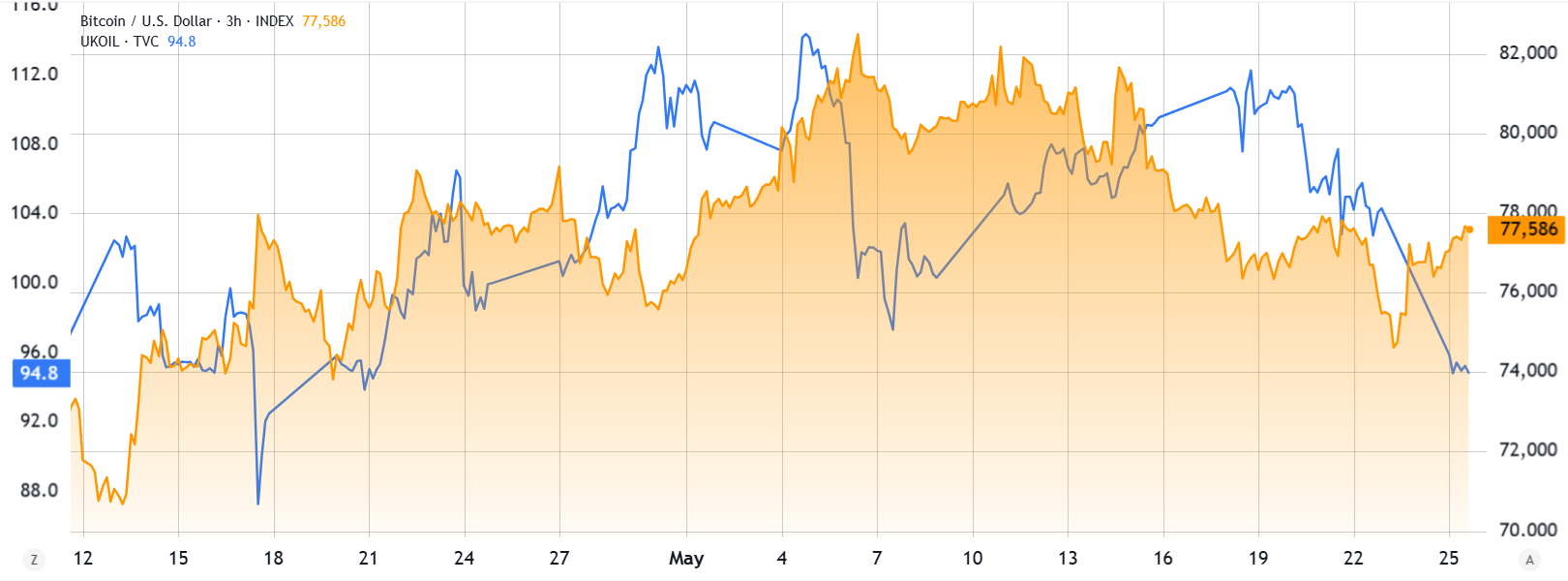
Bitcoin (BTC) reclaimed the $77,000 level on Monday following a recovery in global stock markets. US President Donald Trump stated on Saturday that talks with Iran to reopen the Strait of Hormuz were progressing, causing crude Brent oil prices to retreat to a five-week low and setting the stage for a potential Bitcoin price run to $82,000.

Crude Brent oil futures (left) vs. Bitcoin/USD (right). Source: TradingView
Global stock markets reacted positively on Monday, with a 2.9% gain in Japan’s Nikkei 225 Index and France’s CAC 40 closing up 1.8%. Reduced inflationary pressure from oil prices caused yields on 5-year Eurozone government bonds to hit 2.64%, their lowest level in five weeks. This prospect of reduced geopolitical risk prompted investors to rotate cash positions back into bonds and equities.
Despite the overall drop in risk perception, professional Bitcoin traders refused to flip bullish.

Bitcoin 3-month futures basis rate. Source: Glassnode
Bitcoin 3-month futures contracts traded at a 2% annualized premium (basis rate) relative to spot markets, indicating a lack of demand for bullish leveraged positions. Under neutral conditions, this indicator typically ranges between 5% and 10% to compensate for capital costs. Still, one could argue that low leverage remains constructive as long as the $74,000 support holds.
Bitcoin spot ETF outflows and Strategy’s focus on reducing debt
Recent outflows from spot Bitcoin exchange-traded funds (ETFs) likely contributed to the bulls’ lack of confidence.

US-listed Bitcoin spot ETFs daily net flows, USD. Source: SoSoValue
US-listed spot Bitcoin ETFs experienced $2.66 billion in net outflows since May 7. Despite representing less than 3% of total assets under management, the shift signals fading appeal for institutional investors. Strategy’s (MSTR) pause on Bitcoin acquisitions to repurchase some of its convertible bonds has also fueled concerns.

Strategy (MSTR US) debt profile. Source: Strategy
The company held $8.7 billion in convertible debt with an average maturity of less than 4 years. Strategy’s decision to focus on Bitcoin yield per share might temporarily hold back additions to its 843,738 BTC reserves, but it benefits shareholders by reducing financial leverage and lowering potential share issuance.
Related: Why is Bitcoin falling despite pro-crypto Kevin Warsh becoming Fed chair?
It remains unclear what could flip Bitcoin traders’ sentiment in a favorable direction, especially as the stock market—particularly the tech sector—continues to dominate investors’ attention. With earnings on the rise, Nvidia’s board approved an additional $80 billion share repurchase program, strengthening investment appeal despite a record-high market capitalization.
Bitcoin’s odds of reclaiming $82,000 likely depend on greater visibility into global economic growth prospects. A potential deal between the US and Iran is certainly a step in the right direction, but as long as spot Bitcoin ETF flows remain negative, investor sentiment may remain subdued.
Coinhouse has secured Crypto Asset Service Provider accreditation from the French AMF under MiCA, giving the Paris based firm an EU wide passport for brokerage, custody, transfers and advisory on digital assets as France’s national PSAN regime sunsets.
Summary
- Coinhouse’s PSCA authorization from the AMF upgrades its earlier PSAN registration into a full MiCA license
- The license covers seven crypto services, including custody, execution, transfers, advice and portfolio management
- Law firm De Gaulle Fleurance advised Coinhouse through the accreditation, ahead of the July 1, 2026 MiCA deadline
In a press release dated May 21, 2026, De Gaulle Fleurance said it advised Coinhouse “on obtaining its Crypto Asset Service Provider (PSCA) accreditation from the French Financial Markets Authority (AMF),” framing the approval as the culmination of a multi year compliance process that began with Coinhouse’s registration as a Digital Asset Service Provider (PSAN) in 2020.
The firm notes that the authorization was granted under the Markets in Crypto Assets regulation and that, as a result, “Coinhouse is now fully compliant with European regulatory requirements and can offer its crypto asset services across all Member States of the European Union.”
How did Coinhouse obtain PSCA status under MiCA?
Finyear reports that Coinhouse, founded in 2014 as “La Maison du Bitcoin,” received MiCA accreditation under AMF reference A2026 013, with the license allowing it to operate as a PSCA for a broad scope of activities including buying and selling crypto assets, exchanging them for funds or other crypto assets, custody and administration, and the transfer of crypto assets on behalf of clients.
On LinkedIn, Coinhouse chief executive Nicolas Louvet highlighted that the company has been granted MiCA authorization “for 7 different services, including investment advice and crypto portfolio management,” confirming that the mandate goes beyond basic brokerage and custody into higher value advisory and discretionary management.
The AMF’s public white list shows COINHOUSE SAS as an authorized crypto asset service provider in France, confirming that the firm is now one of the relatively small group of entities that have completed the MiCA licensing process ahead of the July 2026 cutoff.
De Gaulle Fleurance partner Anne Maréchal is quoted in the release as saying that obtaining PSCA accreditation “marks a crucial step for Coinhouse, which can now operate within a robust and harmonized regulatory framework across Europe” and that the case illustrates “the importance of an approach based on regulatory foresight, compliance and strategic support for players in the crypto asset sector.”
Why does this MiCA license matter in the EU timeline?
Coinhouse’s upgrade from PSAN registration to full PSCA status comes against the backdrop of a hard regulatory deadline.
The AMF reiterated in February that Digital Asset Service Providers which operated under the French national regime before MiCA must obtain PSCA authorization by July 1, 2026 if they want to keep serving clients in France; beyond that date, only MiCA authorized Crypto Asset Service Providers can legally operate.
A Cointribune analysis of the French transposition notes that “from July 1, 2026, providers not authorized as PSCAs must cease their activity in France while awaiting their authorization,” and that firms which continue to offer services without the license face up to two years in prison and a €30,000 fine under the Monetary and Financial Code.
Compliance vendor Unit21 similarly describes July 1, 2026 as “the hard cutoff that every crypto asset service provider operating in the EU needs to take seriously,” emphasizing that after that date, operating without MiCA authorization is simply illegal and that national authorities can impose fines of up to 12.5 percent of a firm’s global annual turnover for serious violations.
By securing its license more than a year ahead of that deadline, Coinhouse gains two advantages.
First, it can continue serving French clients without interruption while competitors that have not yet applied will either have to rush their files or plan an exit.
Second, MiCA gives it passporting rights across the European Union, meaning Coinhouse can expand its services to retail, corporate and institutional clients in other Member States through a single authorization rather than a patchwork of national registrations.
Coinhouse already offers services in several French speaking markets, including Belgium and Luxembourg, and now intends to “continue rolling out its offering to retail, corporate and institutional investors in the coming months” across more of the EU, according to the De Gaulle Fleurance release.
In that sense, this PSCA license is not just a regulatory box check but a commercial weapon: in an environment where many smaller PSANs are still “mute” about their plans, as Reuters recently reported via the AMF, Coinhouse is positioning itself as one of the first fully MiCA compliant gateways between traditional European capital and regulated crypto asset services.
High-leverage trader James Wynn has declared that the “lottery ticket” phase of memecoins is finished, arguing the sector is now saturated and structurally tilted toward insiders at the top.
Summary
- Wynn says memecoins are “dead” as a once-in-a-lifetime niche gives way to saturated markets and diluted market caps.
- Critics note Wynn made and lost nearly $100 million on high-leverage bets before calling time on the sector.
- On-chain and market data suggest not a disappearance of memecoins, but a brutal survival-of-the-fittest regime.
James Wynn, the hyper-leveraged crypto trader who turned a roughly $7,000 bet on Pepe (PEPE) into about $25 million before later losing close to $100 million on Bitcoin and meme coin positions, now says the memecoin dream is effectively over. In a post on X to his more than 36,000 followers, Wynn wrote, “I’m pretty sure meme coins are dead, I’m pretty confident they’ll never really come back,” arguing that what “was once a niche of a lifetime if you lived through it from 2017-2024” has been saturated by supply and financialized extraction.
He claimed that going from “a few K into a million dollars is like winning the lottery now. Borderline impossible,” framing today’s memecoin landscape as a system where “they’ll all supply controlled (yes needed), but ultimately just profit making machines for people at the top.” Wynn’s pivot comes less than a year after he allegedly amassed between $80 million and $87 million through aggressive, 20x–40x leveraged trades on Hyperliquid, at one point running a 40x Bitcoin long worth roughly $1.25 billion that briefly showed around $100 million in unrealized profit before cascading liquidations erased nearly the entire haul.
Wynn’s rise, crash, and backlash
Wynn first rose to prominence in 2023 as a “high-risk leverage trader and memecoin maxi,” after parlaying a small PEPE position into tens of millions of dollars and then recycling those gains into even larger directional bets. According to reporting on his trades, he built his fortune on the very dynamics he now criticizes: thin-liquidity tokens, community-driven hype, and reflexive leverage that could push valuations from under $10 billion toward the $100 billion range for the wider memecoin sector in a single cycle.
In May 2025, Wynn’s luck turned violently. After opening a massive 40x Bitcoin long with an entry near $107,993, his position was progressively liquidated as BTC slid below $106,330 and then toward $104,150, crystallizing losses that reports put at nearly $100 million in less than a week and marking one of the largest documented on-chain trading wipeouts. Crypto.news later detailed how, despite losing almost $100 million, Wynn quickly returned to Hyperliquid, selling about $4.12 million in Hyperliquid (HYPE) tokens and re-entering with a new 945 BTC long using 40x leverage, a position sized around $99.7 million at the time.
Community reaction to his latest comments has been sharply divided. One X user, posting under the handle @0xVengeanceArab, dismissed Wynn’s comments by referencing alleged $25 million liquidations and multiple rug-like meme launches, telling him to “just shut fuck up,” while another, @wocknottriss, wrote that the trader has “been wrong about everything in the past 11 months,” calling his bearishness on memes a contrarian bullish signal.
Traders and builders active in the space argue that what has died is not memecoins themselves, but the uniquely forgiving market structure that allowed near-random tickets to 100x with minimal diligence. An account named Pump Research wrote in reply that “Memecoins aren’t dead, the easy money phase is,” adding that “what’s dying is low-quality launches with no community” while “projects with real holders who actually believe and stick around” are the ones surviving as capital gets choosier.
Analysts tracking the sector describe exactly that polarization. Research highlighted by 0x资讯 suggests that while total meme coin market capitalization climbed from around $20 billion in 2024 to as high as a projected $140 billion, the spoils have concentrated into a handful of blue-chip names like Dogecoin (DOGE), Shiba Inu (SHIB), and PEPE, with large numbers of low-quality tokens effectively zeroed out. Crypto.news has likewise chronicled how Dogecoin’s market cap alone punched through $60 billion during the last cycle as it rallied to roughly $0.428, cementing DOGE as a structural large-cap asset even as smaller memes came and went.
Even within PEPE, where Wynn first achieved notoriety, recent coverage shows a more mature, range-bound market rather than a casino where any wallet can spin a $7,000 ticket into life-changing wealth. As of early 2026, PEPE has traded near $0.0000043, down roughly 64% over the year but still supported by around $600 million in 24-hour volume, with technical setups focused on incremental mean reversion instead of parabolic blow-offs.
Other commentators see structural changes in token design as the final blow to the old memecoin fantasy. As one account, @yourr_finans, put it, going from “2,000 to 1 million tokens did more damage than any bear market,” with “lottery odds” moving from improbable to “actual lottery odds” as supply structures and launch mechanics were optimized to extract value for insiders while stapling tokens to nominal “utility.”
For Wynn, the conclusion is that the sector “needs to evolve into something else,” even if he admits he doesn’t yet know what form that next speculative meta will take. Whether that future belongs to DOGE-scale brands, utility-wrapped memes, or entirely new cultural formats, the one constant is that the free lunch he and others feasted on from 2017 to 2024 is gone—and that the people now calling memecoins “dead” are often the same ones who helped build, and then break, the game.
In previous crypto.news coverage, the site profiled Wynn as “crypto’s boldest whale,” detailing his $1.1 billion Bitcoin perp bet on Hyperliquid and Moonpig (MOONPIG) punts that pushed the token’s market cap to about $80 million during one of its spikes. Another crypto.news report documented how Wynn’s side wallet later dumped roughly 10.9 million MOONPIG tokens worth about $120,000, underscoring the reflexive, whale-driven flows that have come to define the memecoin economy he now declares finished.


Moomoo crypto is now live in Texas, giving investors access to 52 cryptocurrencies with zero commission trading.
Summary
- Texas investors can now trade 52 cryptocurrencies on Moomoo Crypto at zero commission with a transaction fee as low as 0.49%, the lowest rate in the platform’s US rollout.
- Moomoo simultaneously launched Direct Crypto Deposit and Withdraw, allowing all US users to transfer digital assets between external Web3 wallets and their moomoo accounts.
- Moomoo Crypto is now live in California, New Jersey, Pennsylvania, and Texas, with a limited-time Bitcoin rewards programme for new crypto users at launch.
Moomoo announced the expansion of its cryptocurrency trading services to Texas on May 22, alongside the launch of its Direct Crypto Deposit and Withdraw feature for all US users. Texas investors can now trade 52 cryptocurrencies through Moomoo Crypto at zero commission, with a transaction fee as low as 0.49%.
“We are actively expanding access to crypto trading across the U.S. while continuing to build additional features aimed at enhancing the investing experience,” said Albi Mema, Director of Crypto Operations at Moomoo U.S. The Texas rollout extends Moomoo Crypto’s coverage to a fourth major US state, following California, New Jersey, and Pennsylvania.
What moomoo’s Direct Crypto Deposit and Withdraw feature does
The new wallet feature allows users to move supported digital assets between external Web3 wallets and their moomoo accounts in either direction. Users can bring crypto in from outside wallets, convert holdings into fiat, and deploy across moomoo’s broader lineup of equities and options within a single account interface.
Moomoo is a subsidiary of Futu Holdings (NASDAQ: FUTU). The Texas licence approval follows a graduated state-by-state licensing process requiring individual money transmitter or broker-dealer compliance before crypto trading is enabled for residents.
The launch positions moomoo to compete with retail multi-asset platforms that have struggled to retain crypto users as market conditions fluctuate. Crypto.news has reported on Robinhood’s Q1 2026 crypto revenue falling 47% year over year, highlighting how volatile digital asset trading volumes can be across retail platforms. Moomoo’s all-in-one strategy, bundling crypto with equities and options in a single account, is designed to reduce that cyclical exposure.
What the Texas launch adds to moomoo’s US crypto strategy
Texas is one of the largest retail investment markets in the United States by total brokerage account volume. Adding the state brings moomoo’s crypto service to four of the most active retail trading states in the country. Crypto.news has tracked how competing retail platforms are pursuing similar multi-asset consolidation strategies to maintain user engagement through market cycles.
The platform is offering a limited-time Bitcoin rewards programme for new crypto users as part of the Texas launch. The Bitcoin (BTC) price page tracks live movements for users who take up that programme during the launch window.
MoonPay ChatGPT app is now the first crypto onramp inside OpenAI’s platform, supporting Bitcoin, XRP and Solana.
Summary
- MoonPay launched a dedicated app in ChatGPT’s App Store on May 22, making it the first and only crypto onramp integrated inside OpenAI’s chatbot.
- Users ask ChatGPT about a crypto asset and request a purchase amount, then receive a MoonPay checkout link to complete KYC and payment at moonpay.com.
- The app supports Bitcoin, XRP, Ethereum, Solana, USDC and 100-plus tokens across 30-plus chains in 160-plus countries via card, Apple Pay or bank transfer.
MoonPay launched a dedicated app inside ChatGPT’s App Store on May 22, allowing users to generate cryptocurrency purchase links without leaving OpenAI’s chatbot. The company called itself “the first and only crypto onramp integrated in ChatGPT” in its announcement post.
The integration supports Bitcoin, XRP, Ethereum, Solana, USDC, and more than 100 other digital assets across more than 30 chains. Users complete KYC and payment on moonpay.com after the chatbot generates a checkout link, with payment options including card, Apple Pay, Google Pay, and bank transfer.
How the MoonPay ChatGPT integration works in practice
Users search for MoonPay in ChatGPT’s Apps section, connect their account, and then ask the chatbot about a cryptocurrency before requesting a specific purchase amount. ChatGPT fills in the asset, chain, and amount automatically and generates a checkout link. Returning MoonPay customers can use saved payment methods without setting up a new account.
“We’ve seen this with commerce and AI, where a lot of people get shopping recommendations within ChatGPT,” said Kevin Arifin, MoonPay Blockchain Engineer and Product Lead. “Now people are starting to do financial research within ChatGPT as well, and it’s always been surprising to me that there hasn’t been an on-ramp where you could buy crypto within ChatGPT.”
Arifin described the app’s role as educational. “It’s like a broker that sits by you, not making financial recommendations, but educating you about the asset you’re buying,” he said. The app is designed for mainstream consumers learning how crypto works through conversation, not autonomous AI trading.
What the launch means for MoonPay’s broader AI strategy
Crypto.news has reported on MoonPay’s acquisition of Dawn Labs and its launch of the Dawn CLI for AI-driven prediction market strategies. Crypto.news has also covered MoonPay Trade, an institutional platform providing banks and fintechs unified access to tokenized assets, DeFi and stablecoin liquidity.
MoonPay joins Kraken, OKX, CryptoAudit, and RealOpen as crypto-related apps active in the ChatGPT App Store. MoonPay’s integration is the only one allowing direct purchases rather than querying blockchain data. The Bitcoin price (BTC) and XRP (XRP) price pages track live movements for users who engage with either asset through the ChatGPT app.

18 Most Extremely R-Rated, Ultra-Graphic, Sci-Fi TV Shows

BLACK SWAN THEN RISE OF XRP! – XRP KEEPS LEAVING EXCHANGES? – TOKENIZATION BOOM WILL SKYROCKET XRP!

Andy Burnham needs a lesson from the City before ever becoming Prime Minister

US brings back mandatory military draft registration

Steven Gerrard disagrees with Gary Neville over ‘shock’ Chelsea and Arsenal claim | Football

Register Renaming | Hackaday
BLACK SWAN THEN RISE OF XRP! – XRP KEEPS LEAVING EXCHANGES? – TOKENIZATION BOOM WILL SKYROCKET XRP!

The Financial Advice Every Middle-Class Family Needs #shorts #marathi #investing Marathi Podcast

A Financial Reckoning Is Upon Us And Cryptocurrency & Bitcoin Investors Will Make Out Like Bandits
-

 Crypto World4 days ago
Blockchain.com files with SEC for U.S. IPO
-

 Fashion3 days ago
Holiday Weekend Open Thread – Corporette.com
-

 Business4 days ago
Dell Technologies DELL Stock Surges 15% on AI Server Momentum and Analyst Upgrades in 2026
-

 Crypto World4 days ago
Bitcoin Accumulation Weakens as BTC Realized Losses Hit $600M
-

 Crypto World4 days ago
Space X IPO Is ‘Bad News’ for Tech Stocks: But What About Bitcoin?
-

 Politics3 days ago
Makerfield: a tale of two social-media histories
-

 Crypto World3 days ago
Robinhood crypto COO Tanya Denisova exits
-

 Crypto World4 days ago
MicroStrategy’s Saylor Says Miners No Longer Set Bitcoin Price, Another Force Has Taken Over
-

 Business1 day ago
NYT Strands Answers May 24 2026 Revealed for Puzzle No. 812 Theme Summer Essentials
-

 Crypto World4 days ago
AI infrastructure race heats up as IREN pitches full-stack strategy, WhiteFiber lands $160M deal
-
 Tech4 days ago
A 0.12% parameter add-on gives AI agents the working memory RAG can’t
-

 Tech4 days ago
WhatsApp ads could make Irish debut after discussions with DPC
-

 Tech4 days ago
You Can Now Add ChatGPT To PowerPoint
-

 Business4 days ago
Trump Invests $1M-$5M in Kura Sushi USA Chain With 27 California Locations
-
 NewsBeat5 days ago
Charity run by Reform leader Malcolm Offord accused of ‘law breaking’ over Scottish registration
-

 Sports4 days ago
2026 CJ Cup Byron Nelson leaderboard: Brooks Koepka finds putting stroke in Round 1
-

 Crypto World5 days ago
Exa Labs raises $250 million in funding led by a16z
-
Business4 days ago
Goldman Sachs reinstates Ageas stock coverage with neutral rating
-

 Crypto World4 days ago
Trump Media’s Bitcoin Stash Shrinks Again as 2,650 BTC Lands on Crypto.com
-
 Business4 days ago
Marine engineering firm Avantis eyeing expansion on equity boost
You must be logged in to post a comment Login