
Crypto World
Tether Sued Over Frozen ‘Pig Butcher’ Coins, 6,600 Students Get Crypto Loans: Asia Express

THAILAND
Thai businessmen sue Tether for freezing $42M in $61M pig butchering case
Two Thai businessmen have sued stablecoin issuer Tether in a New York district court, claiming it illegally froze $42.4 million in Tether USDt (USDT) in October, as part of a broader case tied to a pig butchering scheme.
The plaintiffs claimed that Tether illegally froze the $42 million without a warrant in October 2025, following an informal request from US Homeland Security Investigations.
Authorities in the Eastern District of North Carolina only issued a seizure warrant for the funds later in February 2026. The warrant directed the burn and reissuance of the tokens to a government wallet.
While the plaintiffs didn’t dispute their involvement in the investment scam, the lawsuit tests the freezing authority of stablecoin issuers.
Thailand adopts crypto Travel Rule with self-custodial wallet checks
Thailand is tightening oversight of crypto transfers, including transactions involving self-custodial wallets, as it moves to align with global Anti-Money Laundering (AML) standards.
Thailand’s Securities and Exchange Commission (SEC) issued new Travel Rule regulations requiring digital asset operators to collect information about parties involved in crypto transfer.
The rules will take effect on Feb. 27, 2027.
Thailand SEC proposes retail access to regulated overseas crypto derivatives
Thailand’s Securities and Exchange Commission (SEC) has proposed allowing intermediaries to facilitate retail access to certain digital asset derivatives traded overseas.
Under the proposal, eligible products would need to resemble crypto derivatives traded in Thailand, including their underlying assets, maturity, leverage and settlement methods.
The products must also trade on an exchange that uses a central counterparty for clearing and is overseen by a regulator belonging to specified international regulatory or exchange groups.
The consultation remains open until Sept. 30.
ASIA
Pencil Finance completes $1M onchain lending cycle for 6.6K students in Southeast Asia
Pencil Finance has completed a $1 million onchain student loan cycle, offering financing to 6,600 students in Southeast Asia who were underserved by traditional lenders.
Of the 6,600 students across 118 schools and universities in Southeast Asia, about 1,050 received direct funding. Pencil said the loans were designed for students underserved by traditional lenders, with 50% female borrowers and 93% stemming from lower-income households.
Pencil Finance claims this is the first-ever fully onchain lending cycle financing student loans transparently recorded on the blockchain network.
Asia crypto custody deals from Ripple and Coincheck
Ripple has partnered with digital asset infrastructure company SettleMint to offer financial institutions solutions for custody, issuance and management of tokenized assets across their full lifecycle.
Digital asset service provider Coincheck Group has also partnered with wallet infrastructure provider DFNS to build digital asset wallet technology and custody services in Japan.
SINGAPORE
Singapore weighs recognizing some foreign-issued stablecoins
The Monetary Authority of Singapore (MAS) is reconsidering its earlier restriction on stablecoins issued across multiple jurisdictions, proposing a route for some jointly issued tokens to qualify under its regulatory framework.
Under one proposal, stablecoins jointly issued by a Singapore issuer and a foreign issuer could be regulated under the framework and labeled “MAS-regulated stablecoins,” provided that the associated risks are sufficiently mitigated.
MAS is also considering recognizing a limited number of foreign-issued stablecoins regulated under comparable overseas frameworks, citing their potential use in cross-border wholesale transactions.
AUSTRALIA

Australia warns unlicensed crypto firms of fines up to 10% of annual turnover
Australian crypto companies relying on temporary regulatory relief have until Sept. 30 to apply for a financial services license or risk penalties, including fines reaching 10% of their annual turnover.
The Australian Securities and Investments Commission (ASIC) said businesses requiring an Australian Financial Services license must apply for one or seek changes to an existing license before the deadline.
ASIC has recorded more than 45 digital asset-related license applications to date.
UAE
Standard Chartered launches spot Bitcoin and Ether trading in UAE
London-headquartered multinational bank Standard Chartered has launched spot Bitcoin and Ether trading for institutional clients in the United Arab Emirates (UAE).
The move makes Standard Chartered the first global bank to offer institutional digital asset trading in the region and the first Global Systemically Important Bank (G-SIB) with a similar offering, the bank said.
JAPAN
Japan’s Remixpoint dumps altcoins
Remixpoint, one of Japan’s largest corporate Bitcoin holders, sold all its altcoins, leaving about 1,506 BTC ($115 million) as its only cryptocurrency holding as it concentrates its crypto strategy around Bitcoin.
Remixpoint sold its Ether, Solana, XRP and Dogecoin holdings for a combined 878.8 million yen ($5.5 million), generating a 117.8 million yen ($736,000) gain, according to a Wednesday company disclosure.
The company recorded gains on its ETH, SOL and XRP sales but sold its DOGE holdings at a 3.26 million yen ($20,000) loss.
Japanese regulator seeks stablecoin tax exemption
Japan’s Financial Services Agency (FSA) submitted a request to exempt trust-type stablecoins from mandatory tax filings starting in fiscal year 2027.
Metaplanet moves 4,800 BTC worth $377M to Coinbase
The Japanese Bitcoin treasury company has transferred 10,270 BTC to Coinbase Prime this week, triggering speculation about the company selling its holdings.
Japan’s FSA Warns Hong Kong-Based IZAKA-YA Over Unregistered Services
Japan’s Financial Services Agency issued a formal warning to Hong Kong-based Izakaya Limited, alleging its cryptocurrency exchange services are unregistered.
SBI Holdings Takes 20% Stake in Indonesia’s Ajaib Group
Japan’s SBI Holdings will spend $270 million to acquire a 20% stake in Indonesian online brokerage Ajaib Group. The aim is to expand its crypto business across the region and to promote SBI’s yen stablecoin JPYSC.
HONG KONG

Hashkey joins DTCC working group as first Asian crypto service provider
Hashkey joined the Depository Trust & Clearing Corporation’s (DTCC) Digital Assets Advisory Services Industry Working Group as its first Asian digital asset service provider.
Hashkey joins over 100 other global financial institutions including JPMorgan Chase, Goldman Sachs, Nasdaq and the New York Stock Exchange.
DTCC custodies $114 trillion in liquid assets, including stocks and exchange-traded funds. Its working group was formed to connect traditional finance with decentralized finance (DeFi) infrastructure. DTCC plans to launch access to tokenized securities in October.
Bitcoin Asia conference ‘subdued’
The mood at Bitcoin Asia in Hong Kong was subdued according to the South China Morning Post.
Despite a pep talk by Binance founder Changpeng Zhao who declared Bitcoin “will for sure become more important than gold” the bear market hangover was all too evident.
“Psychologically, I think this has been one of the hardest bear markets we’ve had, because this time it wasn’t just the price of bitcoin that took a hit,” said Brandon Green, CEO of conference organiser BTC, during his opening address.
“This time, the Bitcoiners’ ego also took a hit.”
OSL Group Reports 65.8% Revenue Surge
Hong Kong-based digital asset firm OSL Group reported a 65.8% revenue increase in its first-half financial results.
SFC warns Star Bridge Capital is unlicensed
Hong Kong’s Securities and Futures Commission has added Star Bridge Capital Group to its Alert List following forced liquidation anomalies and millions in trader losses.
KOREA
Mirae Asset lays out crypto, stablecoin, tokenization plans for Digital X
South Korean financial group Mirae Asset plans to build a 150 trillion won ($109 billion) digital asset business around Digital X, the crypto exchange formerly known as Korbit, according to The Korea Times.
The report said Digital X will focus on crypto, stablecoins, real-world assets and security token offerings, with plans to tokenize physical assets including gold, silver and electricity.
The expansion plans follow Mirae Asset Consulting’s acquisition of a 97.15% stake in Korbit in July for a cumulative 141.4 billion won. The exchange was subsequently rebranded as Digital X, marking the first time an affiliate of a South Korean financial group acquired control of a domestic crypto exchange.
Cointelegraph publishes long-form journalism, analysis and narrative reporting produced by Cointelegraph’s in-house editorial team with subject-matter expertise. All articles are edited and reviewed by Cointelegraph editors in line with our editorial standards. Some articles contain affiliate links, from which Cointelegraph may earn a commission. These relationships do not influence which products we review or our editorial conclusions. Content published in here does not constitute financial, legal or investment advice. Readers should conduct their own research and consult qualified professionals where appropriate. Cointelegraph maintains full editorial independence.

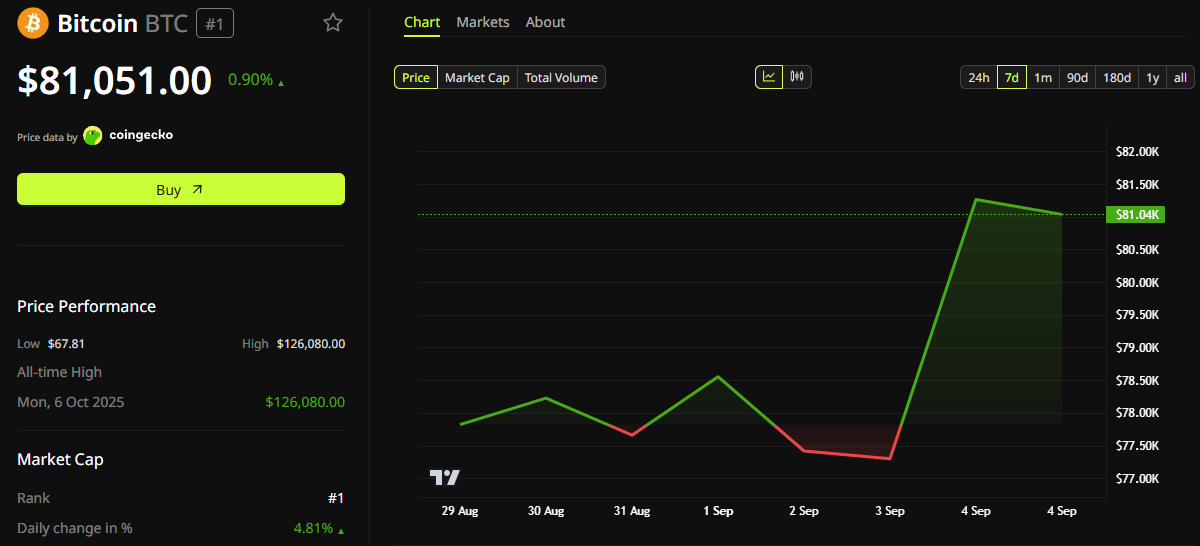
Odds of a September Federal Reserve rate hike fell back to a coin-flip on Friday, a sharp reversal after the probability touched 70% just a day earlier and sat as low as 37% a week before that.
The swing tracks a rally that has pushed Bitcoin (BTC) toward $82,000.
Rate Bets Whipsaw Ahead of the September Meeting
The CME Group (Chicago Mercantile Exchange) FedWatch tool now shows the September 16 meeting split almost evenly between holding the benchmark rate at 3.50-3.75% and lifting it a quarter point to 3.75-4.00%.
The tool had assigned the hike a 70% probability as recently as Thursday.
The FedWatch data also pushed back the timeline for a second hike. A move to the 4.00-4.25% range isn’t priced as the most likely outcome until the March 2027 meeting. Rather than December 2026 as futures had implied earlier in the week.
Iran and Oil Are Driving the Volatility
The odds have been whipsawing alongside oil prices and bond yields tied to the Iran conflict, which has kept traders guessing on inflation.
Fed Chair Kevin Warsh faced a market split on the hike question at Jackson Hole, and the central bank remains divided over whether to keep tightening.
Bitcoin has moved in step with the shifting rate outlook. The asset blasted past $80,000 this week as talk of an end to the Iran war spread, and traded near $81,000 on Friday, up roughly 5% over 24 hours.

A lower hike probability typically eases pressure on Treasury yields and the dollar. These are both tailwinds for Bitcoin’s price action this week.
Whether that holds through the September 16 decision may depend on how the Iran situation, and the next inflation print, develop in the coming days.
The post Fed Rate Hike Odds Fall to 50/50: Will Bitcoin's Rally Above 80,000 Hold? appeared first on BeInCrypto.


Standard Chartered has expanded institutional Bitcoin and Ether spot trading to the UAE through its DIFC branch, giving eligible clients access to deliverable crypto trades through the bank’s existing electronic trading systems.
Summary
- Standard Chartered has launched institutional Bitcoin and Ether spot trading in the UAE through its DIFC branch.
- Eligible clients can trade BTC and ETH through the bank’s existing electronic trading channels and FX interfaces.
- Clients can settle trades with a custodian of their choice, including Standard Chartered’s UAE digital asset custody service.
- The bank said it is the first G-SIB to provide institutional digital asset spot trading in the UAE.
Standard Chartered said on Sept. 3 that the service makes it the first Global Systemically Important Bank to offer institutional digital asset spot trading in the UAE and the only global bank currently providing the capability in the region.
Eligible institutional clients can trade Bitcoin and Ether through Standard Chartered’s electronic channels using interfaces already employed for foreign exchange trading. Settlement can be handled through a custodian selected by the client, including the bank’s own UAE digital asset custody service.
The launch combines trading and custody capabilities that Standard Chartered has been building separately in the UAE since 2024, while extending a spot trading business first introduced through its UK branch last year.
Standard Chartered brings Bitcoin and Ether trading to DIFC
Trading is being offered through Standard Chartered DIFC, the bank’s branch in the Dubai International Financial Centre.
Clients will receive deliverable Bitcoin and Ether instead of gaining exposure through a derivative tied to the price of either cryptocurrency. Standard Chartered began offering the same type of institutional trading through its UK branch in July 2025, becoming the first G-SIB to provide deliverable Bitcoin and Ether spot trading to institutional clients.
As crypto.news previously reported, the UK service was introduced for institutional customers including corporations, asset managers and professional investors, with transactions available through the bank’s existing FX trading interfaces.
The UAE deployment brings that trading setup into the same market where Standard Chartered already operates regulated digital asset custody.
Rola Abu Manneh, chief executive officer for the UAE, Middle East and Pakistan at Standard Chartered, said the country’s regulatory framework had supported institutional participation in digital assets.
“Extending our Bitcoin and Ether spot trading capability to institutional clients is a significant step in broadening our regulated digital asset proposition in the market,” Abu Manneh said.
She said combining execution with custody, governance and the bank’s international network gives institutional clients a more integrated route into digital asset markets.
UAE clients can separate execution from custody
Standard Chartered will not require clients using the new trading service to hold their Bitcoin or Ether with the bank.
Institutions can instead settle transactions through a custodian of their choice, giving them the ability to separate trade execution from asset storage. Standard Chartered’s own digital asset custody platform remains one of the available options.
The bank launched that custody service in the UAE in September 2024 after receiving a license from the Dubai Financial Services Authority within DIFC. Bitcoin and Ether were the first supported assets, while Brevan Howard Digital was named the inaugural client.
Its role in UAE institutional crypto infrastructure later expanded through a collateral mirroring program with OKX in April 2025.
Under the arrangement, institutional customers can keep eligible collateral with Standard Chartered while using its value for trading on OKX. The assets remain with the bank instead of being transferred directly to the exchange, while corresponding collateral balances are mirrored into client trading accounts.
The program began in the UAE with support from Brevan Howard and Franklin Templeton.
In April 2026, the framework was extended to BlackRock’s tokenized U.S. Treasury fund BUIDL. Eligible institutional and VIP clients can use BUIDL as collateral while Standard Chartered holds the fund off exchange.
OKX handles margining and liquidation within its trading system, while clients retain ownership of the tokenized fund and its yield under the structure.
DIFC provides the regulated base for the trading service
Christopher Parsons, senior executive officer at Standard Chartered DIFC, said the financial center provides a base from which international financial institutions can deploy services across regional markets.
“Extending our institutional digital asset trading capability through the Centre demonstrates the strength of that model,” Parsons said, citing the combination of Standard Chartered’s markets business, international network and regulated DIFC presence.
Standard Chartered has used DIFC for several parts of its institutional digital asset business. Its custody platform operates from the financial center, while some collateral arrangements involving digital assets are structured around assets held by the bank in Dubai.
The bank’s digital asset operations extend outside the UAE through its corporate and investment bank and associated ventures.
Its institutional strategy covers custody, trading and tokenization, while Zodia Markets operates in digital asset trading infrastructure and Libeara develops tokenization products.
Standard Chartered has meanwhile continued to add regulated digital asset services in other financial centers. In Hong Kong, its local banking unit became the first bank distributor of the HKDAP stablecoin in August, giving eligible institutional clients and partners access to the regulated Hong Kong dollar-backed token.
HKDAP is issued by Standard Chartered-backed Anchorpoint, which received one of Hong Kong’s stablecoin issuer licenses in April. The token entered controlled beta access for institutions and professional investors, with uses including payments, fiat conversion and tokenized asset settlement.
Standard Chartered Bank Hong Kong plans to introduce subscription and settlement services for tokenized money market funds during the fourth quarter of 2026.
Standard Chartered extends a trading model launched in the UK
The UAE service follows more than a year of development around Standard Chartered’s direct institutional crypto trading business.
When the UK operation went live in July 2025, Bitcoin and Ether trades were integrated into existing institutional trading platforms so clients could access crypto through infrastructure already used for traditional markets.
Standard Chartered said at the time that the setup was intended to allow institutions to transact and manage digital asset exposure within its regulated banking environment.
The bank has since tested other structures linking crypto trading with traditional financial market infrastructure. Its digital asset activities span direct spot execution, custody, collateral services and tokenization, while its venture businesses provide separate trading and tokenized asset capabilities.
For UAE clients, the Sept. 3 rollout adds direct Bitcoin and Ether execution to the custody infrastructure Standard Chartered has operated in DIFC since September 2024.
Institutions using the service can route trades through the bank’s electronic trading channels and choose where the resulting assets are held, including settlement into Standard Chartered’s own custody platform.
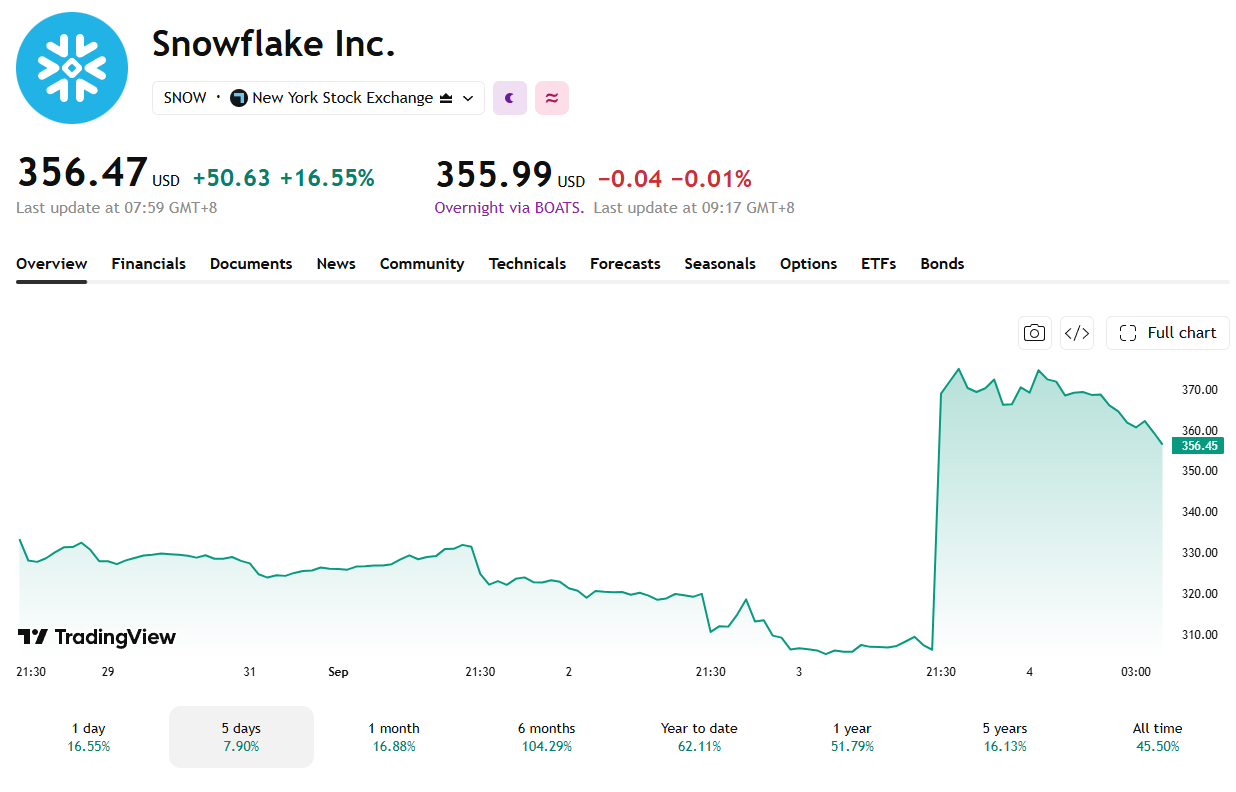
Snowflake’s upbeat AI outlook is turning into a broader software trade, with a wave of enterprise names rallying alongside it and Jim Cramer flagging more room to run.
The move adds to a stretch of earnings this season where AI-linked spending has repeatedly rewarded shareholders, even as some investors question how long richly priced software names can keep climbing.
AI is Driving the Software Firm
Snowflake shares jumped 23% on Thursday after the cloud data platform lifted its fiscal 2027 product revenue forecast to $6.07 billion, up from $5.84 billion, alongside a 37% year-over-year jump in second-quarter product revenue.

CEO Sridhar Ramaswamy said artificial intelligence (AI) tools are now driving growth across Snowflake’s core platform, not just its standalone AI products, calling it a compounding “flywheel effect” for the business.
Shares hit their highest level since December 2021, adding roughly $25 billion in market value in the move. The stock has now climbed 39% for the year, more than triple the S&P 500’s 12% gain over the same stretch.
Software Stocks Move Together
The rally spilled into peers. ServiceNow, Salesforce’s record earnings run, Atlassian, Adobe, and Intuit all climbed between 3.5% and 6%, while the iShares Expanded Tech-Software Sector ETF added 3%.
Morgan Stanley analysts said the pattern of consistently faster growth in recent quarters shows AI is meaningfully driving usage of Snowflake’s own platform, beyond its dedicated AI tools.
At least 34 brokerages raised their price targets following the results, according to data compiled by LSEG, with Wells Fargo issuing a Street-high call of $525. Snowflake now trades near 15 times forward revenue, well above the software-sector ETF’s 7.4 times, and its 121.8 times forward earnings dwarfs Datadog’s 72.7 times and MongoDB’s 52.1 times.
CNBC’s Jim Cramer weighed in after the report, flagging a huge move still ahead for the stock, and calling it the cleanest way for cautious enterprises to buy AI compute on demand.
So Snowflake remains the best way for the uncertain to get compute but Broadcom tells a story of an explosion of business coming. Snowflake will have a huge move…
— Cramer
The reaction echoes a pattern seen elsewhere this earnings season, including Salesforce’s own AI-driven breakout and software stocks rebounding after months of AI-replacement fears.
Whether that momentum holds may depend on how quickly Snowflake and its peers can turn rising AI demand into durable margin, rather than just top-line growth.
The post Snowflake's AI-Fueled Beat Sparks Software Rally: Will Others Follow? appeared first on BeInCrypto.


The Wyoming Stable Token Commission adopted Chainlink Proof of Reserve on Sept. 2 to publish near-real-time reserve and supply data for the state-issued Frontier Stable Token, or FRNT.
Summary
- Wyoming adopted Chainlink Proof of Reserve to publish verified FRNT reserve and supply data onchain.
- The Network Firm examines reserve balances while Chainlink distributes resulting verification data across supported blockchains.
- Wyoming already publishes daily FRNT attestations, compared with monthly disclosures required under federal stablecoin law.
- Secure Mint remains under adoption and would block issuance whenever verified reserves trail token supply.
- FRNT launched in January, backed by dollars and short-term U.S. Treasury securities, according to Wyoming.
The integration combines independent examinations conducted by The Network Firm with Chainlink’s infrastructure. The Network Firm checks reserve assets and outstanding token balances under standards established by the American Institute of Certified Public Accountants.
Chainlink then delivers the resulting verification data onchain. The arrangement gives users a more recent view of FRNT’s backing than periodic reports alone, according to the joint announcement.
Chainlink reserve data supplements daily attestations
Wyoming already publishes daily FRNT reserve attestations through the commission’s website. Proof of Reserve adds an automated onchain distribution layer to those independent examinations.
However, an onchain feed does not independently inspect cash or Treasury securities. It publishes data produced through the underlying examination process. Its reliability therefore depends on the accuracy of the reserve records, the external examiner and Chainlink’s data-delivery infrastructure.
The commission described the integration as providing “near real time” verification. It did not disclose the precise update frequency, the data feed’s contract addresses or the conditions that would trigger an alert when reserve coverage changes.
Proof of Reserve also does not remove the need for financial audits, custody controls or public reporting. It offers an additional way for applications and market participants to access the reported reserve position onchain.
Wyoming says FRNT exceeds federal disclosure rules
The commission said its daily reporting and onchain verification “meet and exceed” the federal baseline established by the GENIUS Act. That comparison represents Wyoming’s assessment rather than a separate determination from a federal regulator.
NEW: @wyostable adopts Chainlink Proof of Reserve to set a new United States standard for digital asset transparency 🇺🇸
Via Chainlink, FRNT exceeds GENIUS Act requirements & becomes the first stablecoin issued by a U.S. public entity to publish verified reserve data onchain. pic.twitter.com/sk7gjRGzer
— Chainlink (@chainlink) September 2, 2026
The federal law requires permitted payment stablecoin issuers to publish monthly reports covering reserve composition and outstanding supply. Those reports must receive an independent examination, while company officers must certify their accuracy.
Wyoming argues that monthly reports provide only a point-in-time view and leave a gap between reporting dates. Daily attestations and an onchain data feed can narrow that gap, although they do not guarantee that reserves cannot change between updates.
The GENIUS Act also contains requirements beyond reserve disclosures, including rules governing permitted assets, redemptions and regulatory supervision. The commission’s announcement focused on transparency and did not claim that Proof of Reserve replaces those obligations.
Secure Mint would connect reserves directly to issuance
Wyoming is also adopting Chainlink’s Secure Mint feature. The feature is not yet confirmed as operational for FRNT.
Once implemented, Secure Mint would require verified reserves to equal or exceed FRNT’s outstanding supply before allowing new tokens to be issued. A failed reserve check would prevent additional minting until the reported coverage returned to the required level.
The commission said this structure could reduce the risk of an “infinite-mint attack,” where an attacker exploits issuance controls to create unbacked tokens. Secure Mint would address one part of that risk by placing a reserve condition inside the minting process.
Its effectiveness will depend on implementation details that have not been published. These include update intervals, emergency controls, administrator permissions and procedures for handling inaccurate or unavailable reserve data.
FRNT expands its use of Chainlink infrastructure
Wyoming publicly launched FRNT on Jan. 7, 2026. The commission says the token is backed by U.S. dollars and short-term U.S. Treasury securities. Income generated from the reserves supports the state’s School Foundation Program.
The reserve verification announcement follows Wyoming’s migration of FRNT’s cross-chain infrastructure from LayerZero to Chainlink’s Cross-Chain Interoperability Protocol.
As crypto.news previously reported, Wyoming moved FRNT to Chainlink after completing a security review in August. CCIP now serves as the token’s exclusive cross-chain infrastructure under a multiyear agreement.
FRNT is available across eight public blockchains, including Ethereum, Solana, Base, Avalanche, Arbitrum, Optimism, Polygon and Hedera. The commission previously used LayerZero to support transfers between those networks.
Earlier crypto.news coverage documented how Wyoming prepared FRNT for public distribution through partners including Kraken and Visa. The token later became publicly available in January after its technical mainnet deployment in 2025.
The next confirmed milestone will be the activation of Secure Mint. Wyoming has not announced a launch date, leaving the reserve-gated issuance system as a planned feature rather than a current protection.


Taiwan’s Financial Supervisory Commission has said nine supporting regulations for its new Virtual Asset Service Act, including detailed stablecoin rules, could be formally introduced as early as the first quarter of 2027.
Summary
- Taiwan’s FSC is preparing nine regulations under the Virtual Asset Service Act, including rules covering stablecoins.
- The regulations could be formally published and implemented as early as the first quarter of 2027.
- Taiwanese financial firms are assessing stablecoins for cross border payments, custody, tokenization and other digital asset services.
- Industry executives see stablecoins and blockchain as potential infrastructure for payments and financing across Taiwan’s semiconductor supply chain.
Financial Supervisory Commission Chairman Peng Jinlong said at the FinTechOn 2026 and Asia FinTech Alliance Summit in Taipei on Sept. 2 that global discussions around virtual assets and stablecoins have moved from whether they should be developed to how they should be properly regulated.
Taiwan’s legislature passed the Virtual Asset Service Act in its third reading on June 30, establishing a licensing framework for crypto businesses and rules governing stablecoin issuance.
The FSC is now working on nine subsidiary regulations needed to implement the legislation, Peng said. Stablecoin requirements will form part of that package, with the regulator targeting the first quarter of next year for their publication and implementation.
Taiwan stablecoin rules move toward implementation
Once the new law and supporting regulations take effect, Peng expects Taiwan’s virtual asset and stablecoin sector to enter a new stage under formal supervision.
The Virtual Asset Service Act requires crypto businesses to obtain FSC approval before operating and covers exchanges, trading platforms, transfer providers, custodians, underwriters and lending businesses. Existing companies registered under Taiwan’s previous anti-money laundering regime have been given a transition period to move into the licensing system.
Stablecoin issuers face a separate approval process involving both the FSC and Taiwan’s central bank. Issuers will be required to maintain full reserve backing, place reserve assets in trust and comply with audit and disclosure requirements.
Crypto.news previously reported in July that the legislation moved Taiwan away from a system largely based on AML registration toward supervision covering operations, customer protection, cybersecurity, market conduct and financial reporting.
The framework developed from an FSC draft released in March 2025, which set out proposed licensing standards for virtual asset businesses and requirements for stablecoin issuers. Earlier proposals contemplated allowing banks to issue New Taiwan dollar-pegged stablecoins subject to regulatory approval.
Peng said rapid development in artificial intelligence and blockchain technology is pushing Taiwan and other financial markets toward a model in which traditional finance, digital finance and blockchain-based finance operate alongside one another.
Taiwan has taken a similar regulatory approach to AI. The FSC has published six core principles and related guidelines for financial institutions using artificial intelligence and plans to expand work involving AI-based fraud prevention and financial data applications while keeping risks under control.
Stablecoins emerge as an option for semiconductor payments
The discussion around stablecoins is extending into Taiwan’s semiconductor supply chain, where companies process large volumes of international payments, trade financing and corporate treasury transactions.
Taiwan Semiconductor Industry Association executive director Lu Chaoqun said AI is driving rapid expansion in the global semiconductor business. Global semiconductor annual revenue approached $800 billion in 2025 and could exceed $1.5 trillion this year, according to Lu.
He projected the industry could challenge $2 trillion in annual revenue within the next two to three years and potentially reach approximately $3 trillion by 2035. Taiwan’s semiconductor industry cluster, meanwhile, is moving toward a scale of $1 trillion.
Taiwanese manufacturers assemble and ship roughly 90% of the world’s AI servers and account for around 76% of global semiconductor foundry revenue, Lu said. Components and finished goods move across borders every day, creating payment, financing and corporate capital management requirements alongside physical supply chains.
Factories and logistics networks can operate around the clock, while international payments remain constrained by banking hours, time zones and settlement procedures.
Lu said stablecoins, blockchain technology and financial technology have consequently become urgent infrastructure for supply-chain companies handling cross-border payments, trade financing and treasury management. He argued that financial institutions should work as partners to AI, semiconductor and technology companies instead of limiting their role to providing financial services.
Programmable payments could connect supply chains
Taiwan FinTech Association Chairwoman Wang Li-ling said advances in AI, blockchain, stablecoins and programmable payments are bringing goods, information and money flows closer together within global supply chains.
Under such systems, AI could forecast demand while logistics systems adjust automatically, blockchain networks verify transactions and documents, and programmable payment systems release funds when agreed conditions have been met.
For stablecoins, Wang said the important part is not the “coin” but whether trust can be established behind the “stable” component.
She said stablecoins could make liquidity management more efficient for multinational businesses, shorten settlement periods for importers and exporters, and potentially lower payment costs for small and medium-sized businesses in emerging markets participating in international supply chains.
Cross-border use would require regulation extending beyond individual jurisdictions, Wang said. Reserve management, redemption, technology and regulatory standards would need sufficient cross-border trust, while the increased use of AI in decisions involving goods, capital allocation and supplier risk would raise questions involving data quality, cybersecurity, privacy, model governance and responsibility.
Taiwan has been tightening the infrastructure surrounding crypto transfers as the licensing system takes shape. In August, the FSC proposed expanded Travel Rule requirements for domestic virtual asset transfers, including additional identification requirements for transactions above NT$30,000.
The regulator intends to extend the framework to transfers between Taiwanese and overseas virtual asset service providers by the end of 2027.
Financial institutions assess stablecoin opportunities
Cathay Financial Holdings senior executive vice president Sun Chih-te said digital assets and stablecoins have moved from an area once treated as peripheral by traditional financial institutions toward a new area of financial development.
Large financial institutions can no longer remain outside the sector, he said, though mainstream adoption still faces issues involving market scale, regulation and customer experience.
Cathay is evaluating opportunities involving stablecoins, digital asset custody, cross-border payments and tokenization, according to Sun. The financial group wants to examine potential expansion into digital asset lending and trading while studying applications across insurance, asset management, wealth management and securities businesses.
Cross-border payments are among the applications Cathay considers most capable of reaching scale in the immediate future. The company is evaluating the role it could play within such an ecosystem and which partners could participate.
Taiwan had been considering a banking role in stablecoin issuance well before passage of the Virtual Asset Service Act. An earlier FSC proposal envisioned locally issued stablecoins pegged to the New Taiwan dollar, with issuers subject to regulatory approval and oversight involving the central bank.
Sun said regulatory requirements need to be clear and fair while providing room for innovation alongside anti-money laundering, know-your-customer, security and compliance obligations. Restricting development to the safest possible areas, he said, could leave projects stuck at the proof-of-concept stage.
Stablecoin-based cross-border payments would require a degree of regulatory coordination between markets so different systems can work together, according to Sun.
Customer experience will ultimately determine whether digital asset products move beyond trials, he said. Stablecoins and other digital asset services would need to deliver improvements in actual use, not simply offer faster, cheaper or more efficient transactions in theory.
“Getting to 90% is not enough,” Sun said, arguing that the final 10% can determine whether an innovation remains a concept or becomes a solution adopted by the mainstream market.
Asia FinTech Alliance Chairwoman Tsai Yu-ling said the organization now connects 16 Asian markets and is working to help participating economies share experience and develop common solutions. Its newly launched AFA Awards will support fintech companies seeking expansion across those markets, giving selected businesses what Tsai described as a faster route into the alliance’s 16-market network.


Echo Base formed an ad hoc committee of BitMart claimholders on Sept. 2, following the crypto exchange’s decision to wind down its operations.
Summary
- Echo Base formed an ad hoc committee representing BitMart customers with assets frozen after shutdown.
- Echo Base says BitMart never answered its proposed $10 million restructuring commitment submitted August 6.
- The committee retained two law firms and is assessing bankruptcy, regulatory and other recovery options.
- No court has determined whether customers retain ownership rights over assets held through BitMart accounts.
- BitMart appointed restructuring counsel and promised users a detailed roadmap by September 9, 2026 publicly.
In a statement shared directly with crypto.news, Echo Base said the committee represents a “significant and growing aggregate balance” of frozen customer assets. It did not disclose the number of participating claimholders or the value of their claims.
The special situations firm said the group retained Young Conaway Stargatt & Taylor and Ashbury Legal. The committee is considering restructuring, regulatory and insolvency remedies.
Echo Base says its $10 million offer went unanswered
Echo Base said it submitted a written proposal to BitMart management on Aug. 6. The proposal offered up to $10 million to sponsor a pre-negotiated bankruptcy filing.
According to the statement, the money would cover professional and administrative expenses through confirmation of a restructuring plan. Echo Base said BitMart did not respond. Crypto.news could not independently verify the communications between the companies.
Echo Base also described a dispute involving one of its affiliates. It said the affiliate requested a withdrawal on July 24, approximately 31 hours before BitMart announced its closure.
The affiliate allegedly made 15 attempts to contact the exchange before delivering a formal demand on Aug. 8. Echo Base said BitMart neither executed the withdrawal nor identified a contractual or legal reason for withholding the assets. BitMart has not publicly addressed that specific account.
BitMart is considering a different restructuring plan
BitMart announced its orderly wind-down on July 26. It suspended new registrations, deposits and new orders before ending trading services on Aug. 26.
The exchange initially said it planned to cease platform operations on Jan. 31, 2027. Withdrawals would remain available, although BitMart warned that compliance reviews and heavy demand could delay processing.
As crypto.news previously reported, BitMart’s shutdown sent BMX down more than 60% within 24 hours. BitMart attributed the closure to its operating conditions, the market environment and its future strategy.
However, BitMart changed course on Aug. 21. In an official update, the company said it was developing a possible restructuring plan as an alternative to a full wind-down.
That plan “may include” phased business resumptions and creditor distributions, BitMart said. The exchange appointed White & Case as restructuring counsel and promised another update by Sept. 9.
Claimholders are considering court proceedings
Echo Base said the committee is studying whether qualifying creditors could commence or join an involuntary insolvency proceeding. The firm stressed that no decision had been made.
An involuntary U.S. bankruptcy petition must meet statutory requirements governing creditor eligibility, claim amounts and disputed debts. A court would ultimately decide whether any petition could proceed. The committee is an independently organized group, not a statutory creditors’ committee appointed within an existing bankruptcy case.
Echo Base also argues that BitMart’s user agreement does not transfer ownership of deposited assets to the exchange. That remains the committee’s legal position rather than a court ruling. The treatment of customer crypto would depend on the relevant contracts, entities, jurisdictions and any eventual proceeding.
“BitMart still has time to run an orderly wind-down. What it does not have is anyone willing to put capital behind one. Out of court there is no stay, so a single claimant can stall the process for everyone, and any holder the company cannot reach retains its claim indefinitely. That is not a wind-down, it is an open liability with a queue attached.” said Echo Base’s chief executive Roshan Dharia.
Dharia added that Echo Base had offered “capital at risk” to support a court-supervised process. He said the proposal had remained outstanding since Aug. 6.
The Sept. 9 roadmap is the next deadline
BitMart’s promised Sept. 9 update should clarify whether it will pursue a partial reopening, creditor distributions or its original closure schedule. The exchange has not publicly accepted Echo Base’s proposal.
Echo Base said it remains willing to negotiate with BitMart and its advisers. Until an agreement or court filing emerges, the committee’s recovery options remain under review and the status of individual frozen withdrawals may differ.


A hacker associated with the third wave of Coldcard wallet thefts began converting stolen Bitcoin into Ether through THORChain on Sept. 3, according to Galaxy Research’s Alex Thorn.
Summary
- Third-wave Coldcard attacker moved roughly 10% of stolen Bitcoin through THORChain into Ether this week.
- Researchers traced the swaps to a new Ethereum address and shared details with relevant authorities.
- Around 90% of the third-wave funds remained unmoved when Galaxy researcher Alex Thorn reported transfers.
- THORChain repeatedly refunded some swap attempts, prompting the attacker to resubmit transactions, Thorn reported Wednesday.
- Coinkite says affected seeds require migration because installing corrected firmware cannot repair existing wallet credentials.
The transactions moved approximately 10% of the Bitcoin controlled by that attacker, Thorn said. Roughly 90% remained at its original addresses when he published the update.
Researchers traced the swaps through THORChain to a newly identified Ethereum address. Thorn said he shared the address with law enforcement, crypto companies and other organizations monitoring the stolen assets.
Coldcard hacker encounters failed THORChain swaps
THORChain allows users to exchange native assets across blockchains without depositing funds into a centralized exchange. The protocol can therefore convert native Bitcoin into Ether without relying on a conventional custodial platform.
However, not every transaction succeeded. Thorn said the hacker appeared to be experiencing technical problems while attempting to process the swaps.
“The hacker appears to be having some issues swapping all the funds through THORChain — they keep getting refunded and he keeps retrying,” Thorn said.
The cause of the refunds was not immediately confirmed. Possible explanations include liquidity limitations, transaction settings or protocol safeguards, but no verified technical assessment had established the reason.
The movement represented the first detected onchain transfer from the original addresses associated with the first three attack waves, according to Thorn. Analysts will now monitor whether the resulting ETH moves to centralized exchanges, bridges or privacy services.
Galaxy traced 1,789 Bitcoin to the thefts
Galaxy Research previously attributed the loss of 1,789.28 BTC across 8,865 addresses to the Coldcard vulnerability. The Bitcoin was worth approximately $114.7 million when stolen.
As crypto.news previously reported, approximately 87% of the identified Bitcoin remained unmoved as of Aug. 25. The estimate included funds linked to multiple attackers and attack waves, not only the wallet now using THORChain.
Galaxy’s figures partly relied on 221 victim reports covering 790.72 BTC. Onchain analysis identified additional affected addresses beyond those reported directly by customers.
The total remains an estimate because researchers have identified several attacker patterns with different levels of confidence. Galaxy has distinguished its high-confidence attribution from other addresses that may also relate to the vulnerability.
Earlier attackers used cryptocurrency mixers
The latest THORChain swaps are separate from earlier laundering activity attributed to other attackers. CertiK reported in August that wallets linked to the broader incident sent 64 BTC and 200 ETH toward cryptocurrency mixers.
In related coverage, crypto.news found that one attacker retained 1,159 BTC while another began mixing smaller amounts. The different movements suggest that several parties may have exploited the same weakness.
Mixers and cross-chain swaps can complicate tracking, but they do not automatically make funds untraceable. Investigators can continue following transfers when assets enter and leave public protocols.
Centralized exchanges remain potential intervention points because they conduct identity and sanctions checks. Thorn said the new Ethereum destination had been distributed to relevant companies so they could identify subsequent deposits.
Coldcard users still need new wallet seeds
The theft was linked to weak seed generation in Coldcard firmware released from 2021. The vulnerability reduced the randomness protecting some wallet credentials, allowing attackers to calculate private keys without physically accessing the devices.
Coinkite, Coldcard’s manufacturer, says corrected firmware is available across affected models. Its current security guidance states that previously generated vulnerable seeds still require migration.
Installing updated firmware does not repair a seed created under the affected software. Users must generate a new seed with corrected firmware and transfer their Bitcoin to addresses controlled by that new wallet.
Meanwhile, the attacker also remained active after the largest theft waves had ended. On Aug. 29, an address linked to the operation swept Bitcoin from a deliberately weakened researcher wallet, according to Thorn. Researchers created the wallet to test whether the attacker continued searching for predictable private keys. Its rapid compromise indicated that automated scanning remained active nearly one month after the first large thefts.
coldcard hackers are still active. here, a hacker swept keys that were generated with 5 dice rolls of added entropy 🎲 https://t.co/vJ9U7w9JxL
— Alex Thorn (@intangiblecoins) August 28, 2026
The incident has also prompted closer examination of how hardware wallets generate recovery phrases. Unlike phishing attacks, the Coldcard thefts did not require victims to approve transactions or reveal credentials. The exposed seeds contained insufficient randomness, allowing attackers to derive keys remotely and identify funded addresses on Bitcoin’s public ledger. As crypto.news previously explained, the firmware flaw weakened seeds generated on affected devices, meaning secure storage practices could not protect funds tied to those credentials.
Galaxy and other investigators are expected to continue watching the new Ethereum address. No public recovery, arrest or official identification of the attacker had been announced when the transfers were reported.
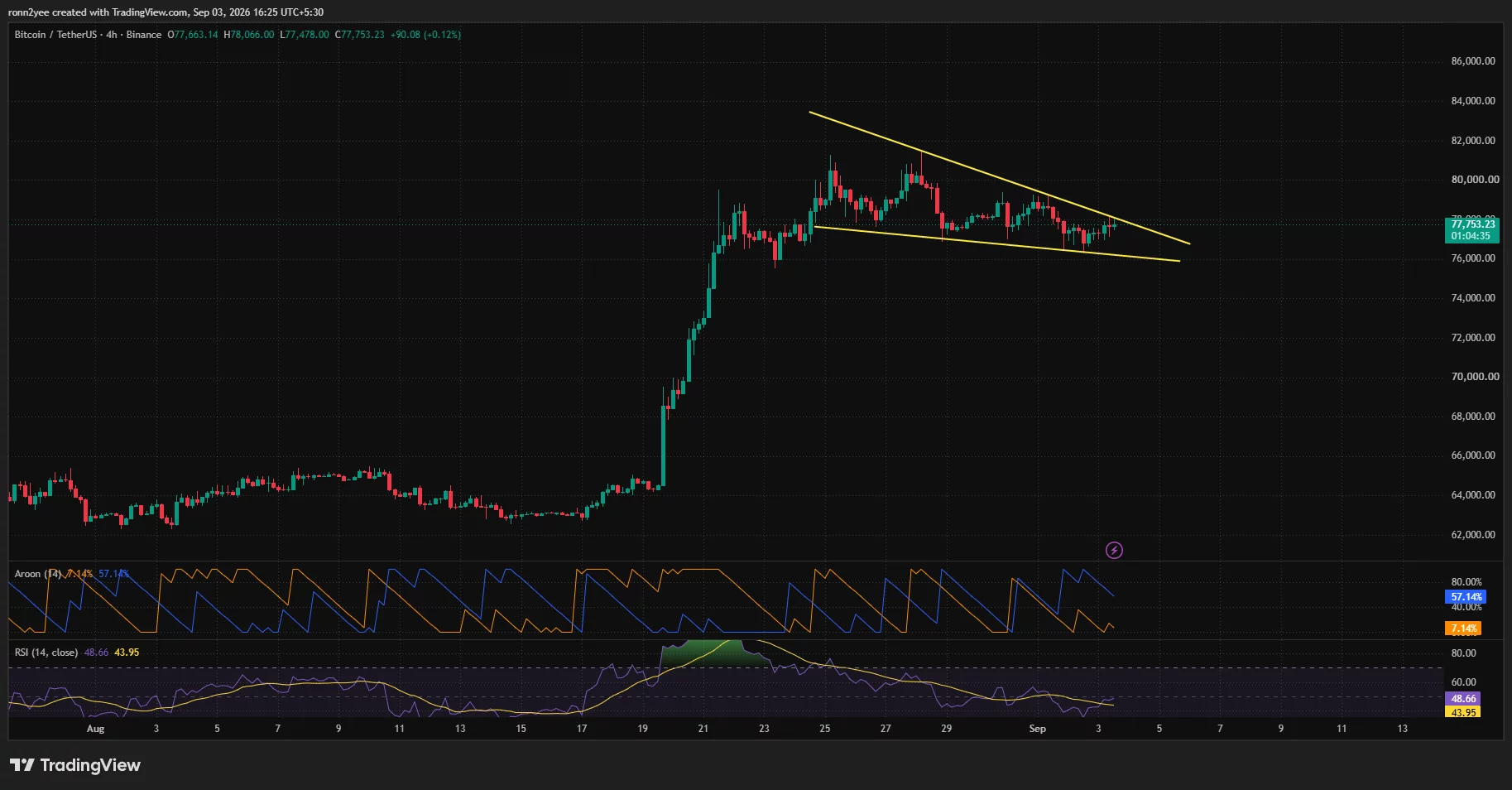
Bitcoin price held near $77,700 on Sept. 3 after recovering from an intraday low around $76,264, but weakening spot demand and $236.5 million in US ETF outflows kept the rebound under pressure.
Summary
- Bitcoin price recovered above $77,000 after buyers defended the $76,000–$76,500 liquidity zone.
- US spot Bitcoin ETFs recorded $236.5 million in net outflows during the latest session.
- A falling wedge places immediate resistance near $78,000, followed by $79,500 and $80,300.
- Positive daily money flow and stronger Aroon readings show sellers have not regained full control.
Bitcoin price holds above $77,000
According to data from crypto.news, Bitcoin (BTC) price traded around $77,700 at the time of writing, up about 1.2% over 24 hours after moving between $76,264 and $78,184.
The recovery followed another test of the $76,000 area, where the CoinGlass one-week liquidation heatmap showed a large concentration of leveraged positions. Buyers prevented a sustained break below that zone, allowing Bitcoin to move back toward $78,000.
Price action on the 4-hour chart remains compressed inside a falling wedge. The upper boundary sits near $78,000, while the lower trendline approaches $76,000. Falling wedges can precede an upside move, but Bitcoin has not confirmed a breakout.
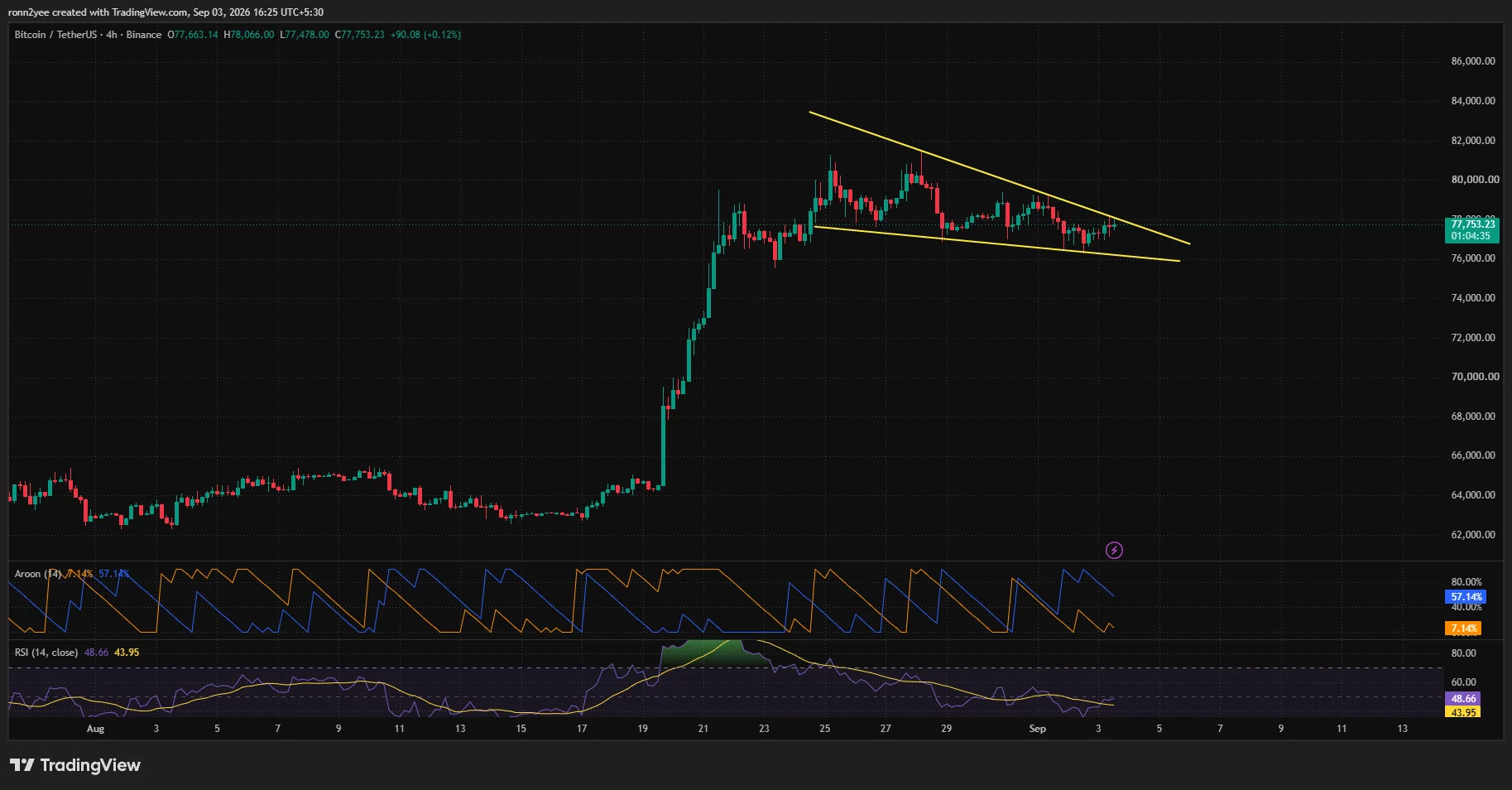
The pattern developed after BTC repeatedly failed to hold above $80,000 in late August. The market has since formed lower highs while continuing to find demand between $76,000 and $77,000.
ETF outflows add to weaker Bitcoin demand
SoSoValue data showed that US spot Bitcoin ETFs recorded $236.46 million in net outflows during the latest reported trading session. Bitwise’s BITB was the only fund to post a net inflow.
The withdrawals removed a source of spot buying as Bitcoin struggled to recover above $78,000. They also followed signs that the demand supporting the August rally was beginning to fade.
CryptoQuant analyst Darkfost reported that Bitcoin’s apparent demand turned negative again on Sept. 2. The metric compares newly mined supply with changes in inactive holdings to estimate whether the market is absorbing available coins.
Market analyst Rain said the negative reading indicated that newly issued and previously inactive Bitcoin was no longer being absorbed at the same pace. Rain linked the change to BTC’s brief decline toward $76,400 and warned that continued weakness could turn $77,000 from support into resistance.
Demand data alone does not determine Bitcoin’s next move, but negative readings combined with ETF withdrawals leave the market more dependent on short-term buyers.
Bitcoin liquidity builds on both sides
The CoinGlass heatmap showed the nearest large downside liquidity cluster around $75,900–$76,200. A break below that area could trigger forced selling and expose $74,000, followed by the 4-hour breakout base near $72,000.
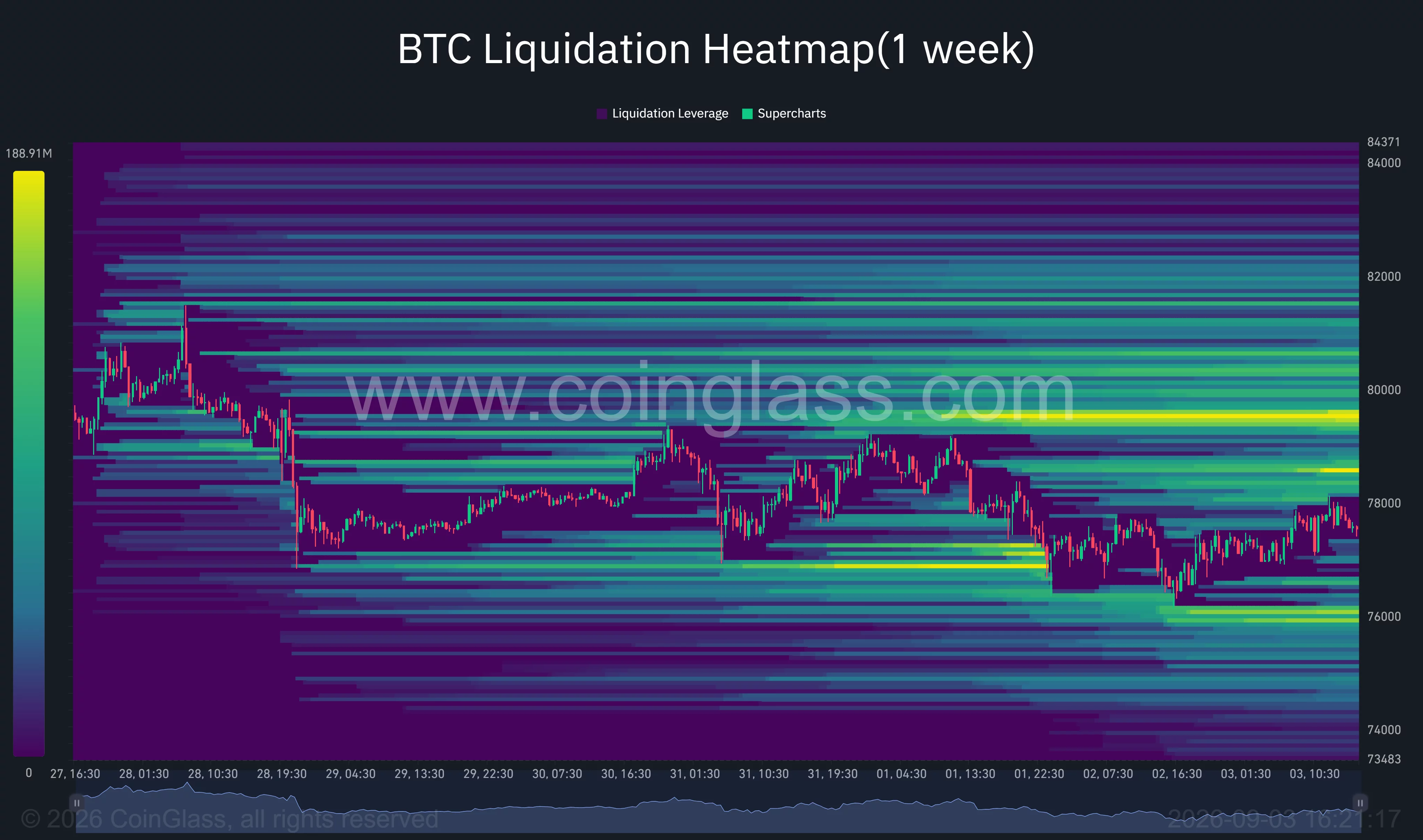
Larger pools of liquidity sit above the current price. The first cluster appears around $78,500–$78,800, with a denser band near $79,500. Further concentrations are visible between $80,000 and $80,500 and around $81,500.
Those levels could attract price if Bitcoin clears the falling wedge, but they may also act as resistance as leveraged traders close positions.
An analyst posting as Crypto with Haris identified $76,000 as the key short-term support. He projected a move toward $73,000 if that floor breaks and said his bearish view would be invalidated if Bitcoin reclaimed and held the $80,000–$83,000 range. His targets represent a personal forecast rather than a confirmed market outcome.
Technical indicators favor consolidation
Bitcoin’s 4-hour relative strength index stood at 48.66, slightly above its signal average of 43.95. The reading reflects neutral momentum and gives BTC room to move in either direction without entering overbought or oversold conditions.
The Aroon Up indicator registered 57.14%, compared with 7.14% for Aroon Down. The gap suggests recent highs are forming more frequently than new lows, giving buyers a limited short-term advantage despite the declining price channel.
The daily chart carries a stronger structure. Bitcoin remained above its 20-day simple moving average at $74,622 and well above the 50-day average at $68,428. The 100-day and 200-day averages stood near $66,303 and $69,586, respectively.
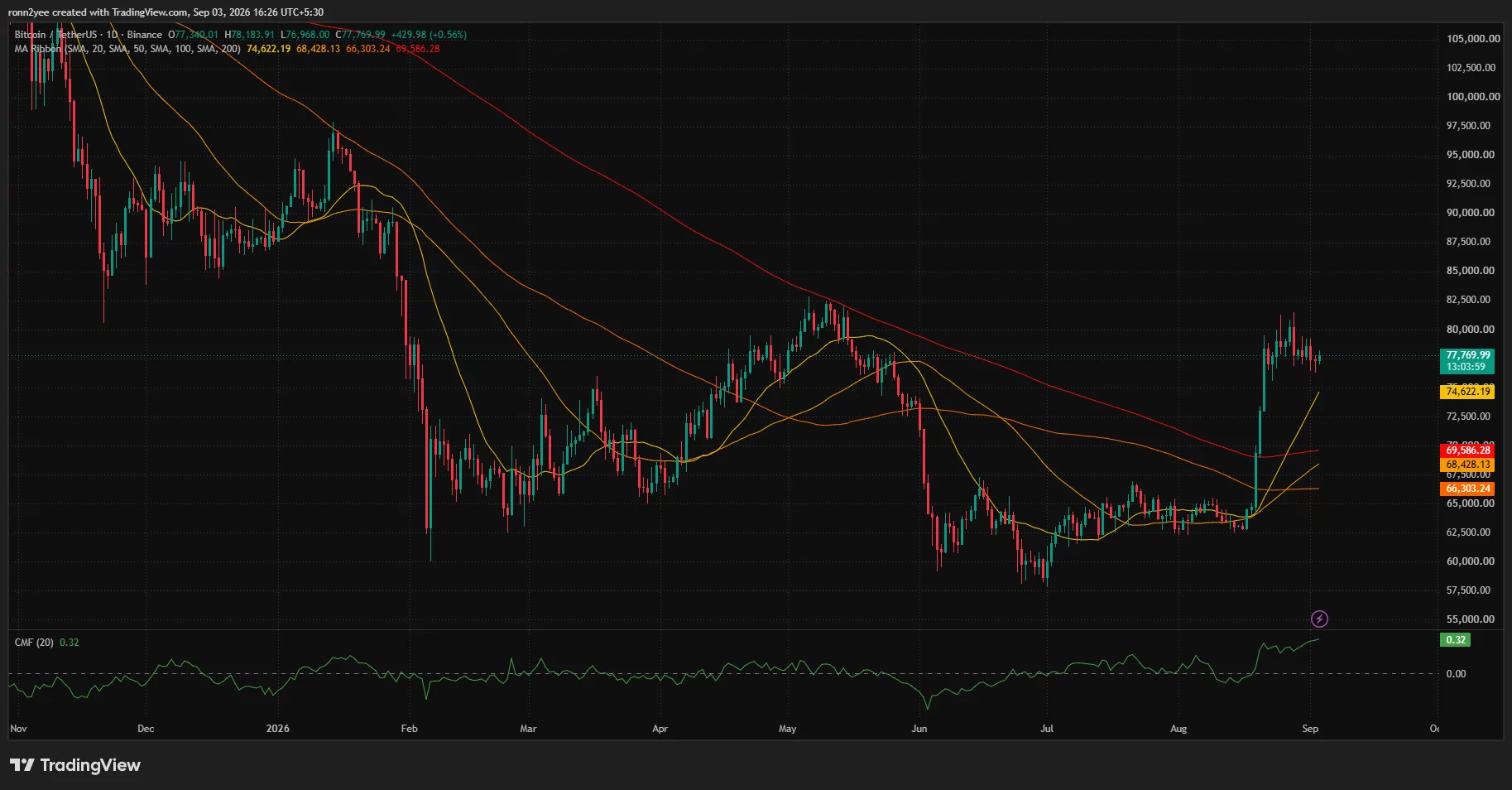
Chaikin Money Flow was positive at 0.32, showing that buying pressure continued to exceed selling pressure on the daily timeframe. The reading conflicts with the weaker apparent-demand signal, indicating that capital flow and on-chain demand have not deteriorated uniformly.
A 4-hour close above $78,000 would break the wedge’s upper trendline and put $79,500–$80,300 back in focus. Bitcoin would then need to clear the May resistance area near $82,800 to strengthen the broader recovery.
Failure to hold $76,000 would weaken the pattern and raise the risk of a move toward $74,000 and $71,800.
Fed rate expectations remain a US risk
US monetary policy remains another source of uncertainty for Bitcoin. Markets assigned about a 64% probability to a 25-basis-point Federal Reserve rate increase at the Sept. 16 meeting, following Chair Kevin Warsh’s warning about persistent inflation.
The 10-year Treasury yield remained near 4.8%, giving investors a higher-yielding alternative to non-yielding assets such as Bitcoin. Reuters reported that government debt, capital demand linked to artificial intelligence investment, and expectations for a higher neutral interest rate were contributing to pressure in the bond market.
For US traders, the immediate setup centers on the $76,000–$78,000 range. A confirmed move outside the falling wedge would provide a clearer signal, while ETF flows and the Sept. 16 Fed decision could determine whether Bitcoin challenges $80,000 or returns toward lower support.
Disclosure: This article does not represent investment advice. The content and materials featured on this page are for educational purposes only.
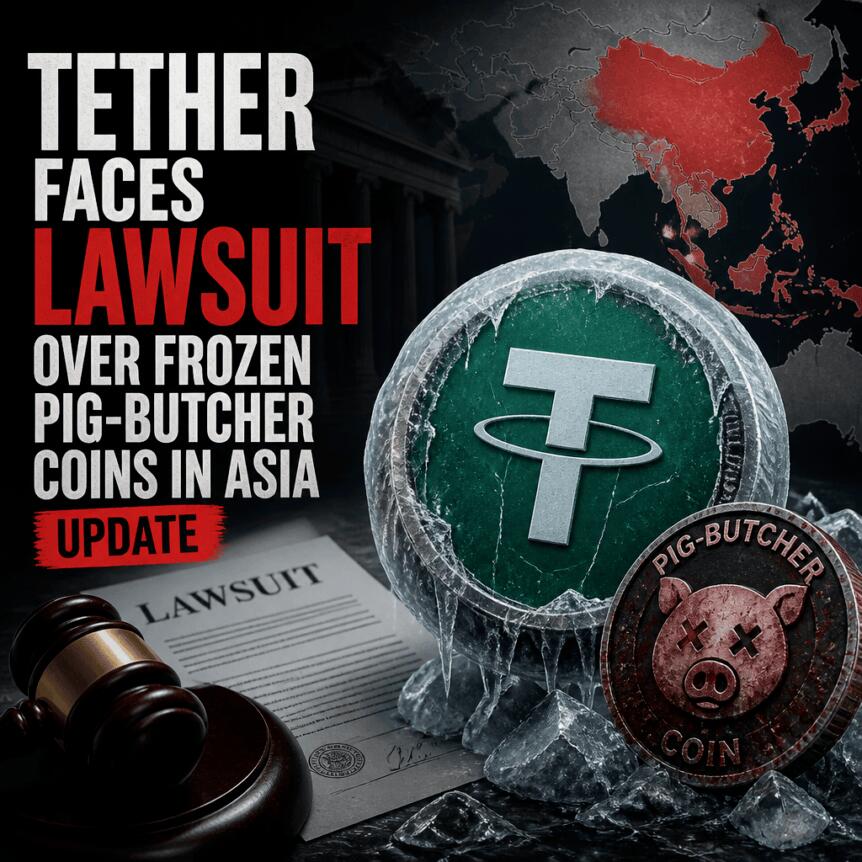
Two Thai businessmen have filed a lawsuit in a New York district court accusing Tether of unlawfully freezing $42.4 million in Tether USDt (USDT) during a pig butchering investment fraud case. The plaintiffs say the stablecoin issuer acted without a warrant in October 2025 after receiving an informal request from U.S. Homeland Security Investigations.
The dispute arrives as regulators across Asia tighten rules on crypto transfers and market access—ranging from Thailand’s move to implement the Travel Rule with checks for self-custodial wallets to Singapore and Australia laying out clearer pathways for stablecoins and licensed crypto derivatives.
Key takeaways
- Thai plaintiffs allege Tether illegally froze $42.4M in USDT without a warrant in October 2025, with an official seizure warrant issued later in February 2026.
- Thailand’s SEC has issued Travel Rule regulations that require digital asset operators to collect transfer-party information; implementation is set for Feb. 27, 2027.
- Thailand’s SEC is also consulting on letting intermediaries enable retail access to certain overseas crypto derivatives, subject to product and venue criteria.
- Singapore is reassessing its approach to stablecoins issued in multiple jurisdictions, proposing a route for some jointly issued tokens and a limited recognition framework for comparable foreign-issued stablecoins.
- Australia’s regulator warns unlicensed crypto firms to apply for financial services licensing by Sept. 30 or face penalties, including fines up to 10% of annual turnover.
Tether freeze challenge in Thailand’s pig butchering case
According to Cointelegraph’s report referencing the lawsuit, two Thai businessmen are suing Tether in New York over an alleged stablecoin freeze tied to a pig butchering scheme. The plaintiffs claim that in October 2025, Tether froze $42.4 million in USDT as part of the broader enforcement action, after receiving an informal request linked to U.S. Homeland Security Investigations.
The key point in the complaint is procedural: the plaintiffs say Tether froze the funds without a warrant. Cointelegraph further notes that authorities in the Eastern District of North Carolina issued a seizure warrant later—directing the burn and reissuance of the tokens to a government wallet—described as having been issued in February 2026.
While the plaintiffs reportedly did not dispute their involvement in the underlying investment scam, the lawsuit is framed around the scope and limits of stablecoin issuers’ freezing powers. The case therefore tests how far issuers can go based on informal requests before formal legal authorization is issued.
Thailand tightens crypto transfer controls with Travel Rule
Thailand is moving toward tighter oversight of crypto transfers as the country seeks alignment with global Anti-Money Laundering (AML) standards. The Thai Securities and Exchange Commission (SEC) has issued Travel Rule regulations requiring digital asset operators to collect information about parties involved in crypto transfers.
Cointelegraph reports that the rules include checks that cover transactions involving self-custodial wallets—an area that often complicates compliance because counterparties control private keys outside an operator’s custody model. The regulations are scheduled to take effect on Feb. 27, 2027.
For market participants, the operational implication is straightforward but significant: exchanges, brokers, and other regulated intermediaries will need to strengthen data collection and transfer screening processes well ahead of the effective date. Compliance teams will also need to think through how information can be captured consistently when transfers touch wallets that are not held by service providers.
Thailand consults on retail access to overseas crypto derivatives
In a separate move, Thailand’s SEC has proposed a framework that would allow intermediaries to facilitate retail access to certain digital asset derivatives traded overseas. Cointelegraph notes that eligible products would need to resemble crypto derivatives traded in Thailand, including key economic and trading features such as underlying assets, maturity, leverage, and settlement methods.
The proposal also sets conditions for where and how these derivatives are traded. The products must be listed on an exchange that uses a central counterparty for clearing and is overseen by a regulator belonging to specified international regulatory or exchange groups.
The consultation remains open until Sept. 30. If adopted, this could broaden retail exposure to derivative products—though only within a structured perimeter tied to clearing arrangements and recognized oversight. Participants will likely be watching how Thailand defines “eligible products” in practice and how it evaluates comparable overseas venues.
Singapore and Australia push clearer stablecoin and licensing rules
Singapore’s approach to stablecoins is also evolving. According to Cointelegraph, the Monetary Authority of Singapore (MAS) is reconsidering an earlier restriction on stablecoins issued across multiple jurisdictions. The regulator is proposing a pathway in which some jointly issued tokens could qualify under Singapore’s regulatory framework and be labeled as “MAS-regulated stablecoins,” provided relevant risks are sufficiently mitigated.
Cointelegraph also reports MAS is considering recognizing a limited number of foreign-issued stablecoins regulated under comparable overseas frameworks. The rationale, as described in the report, is that such tokens may support use cases like cross-border wholesale transactions—suggesting MAS is balancing market utility with regulatory control.
Australia is taking a different tack: enforcement deadlines. Cointelegraph reports that Australia’s securities regulator ASIC told crypto firms relying on temporary regulatory relief to apply for a financial services license or make changes to existing licenses by Sept. 30. ASIC warned that businesses failing to do so could face penalties, including fines reaching 10% of annual turnover.
Cointelegraph notes ASIC has recorded more than 45 digital asset-related license applications to date. For firms operating in Australia, this is a reminder that “temporary relief” is time-bounded and that licensing preparation—not business-as-usual—may be the main differentiator between being able to continue serving customers and being forced to adjust operations.
Across these developments, a common thread emerges: regulators are moving from broad policy statements toward concrete compliance mechanics—whether that means warrant-backed freezing standards, Travel Rule data requirements (including self-custodial transfers), or market access and licensing deadlines. Readers should watch for how courts interpret stablecoin freeze authority in the Tether case, and whether regulators in Thailand, Singapore, and Australia publish implementation details that could determine who qualifies under the new frameworks.
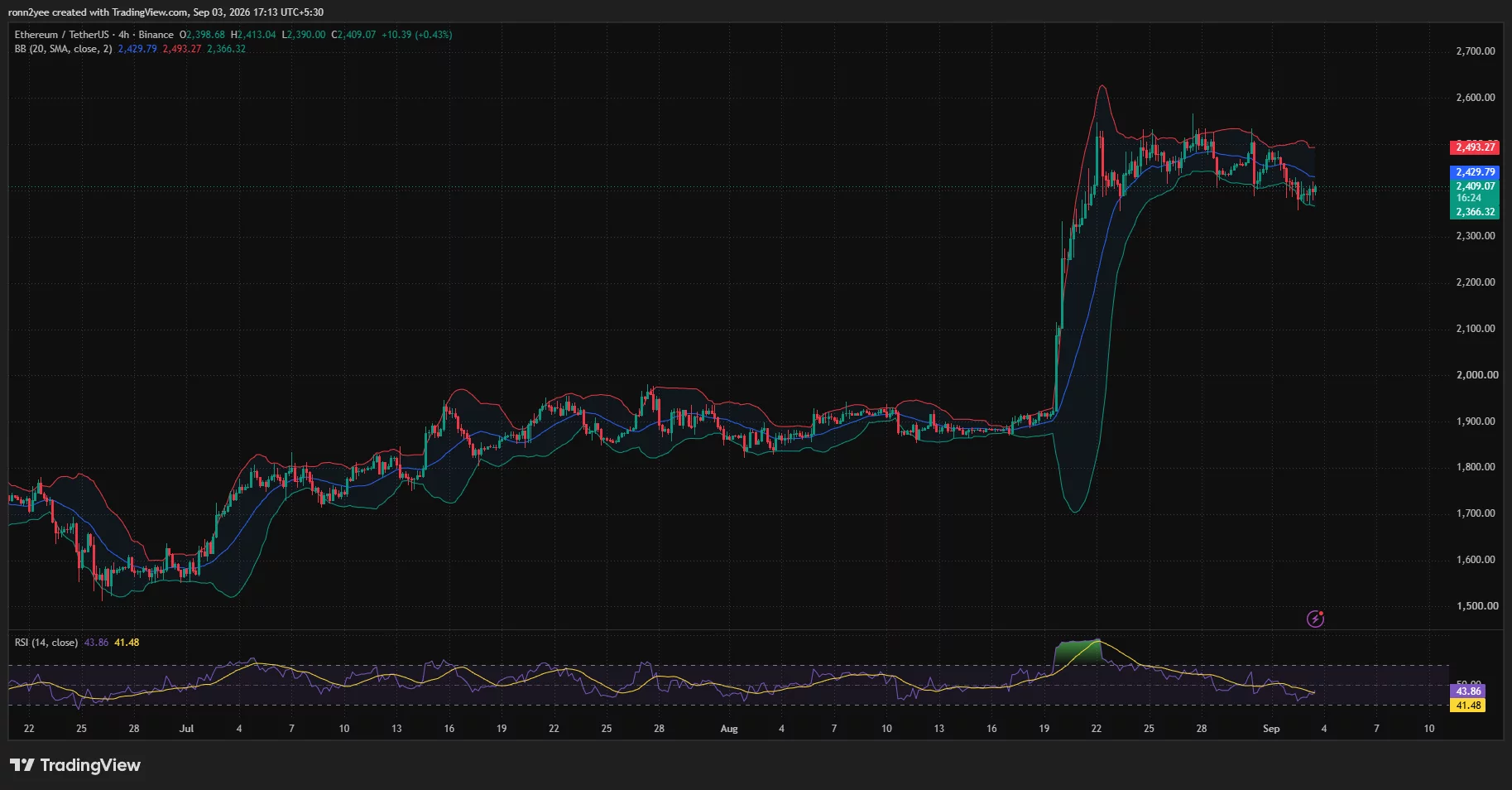
Ethereum price recovered above $2,400 on Sept. 3 after falling to $2,370, but weakening short-term momentum and nearby liquidation clusters leave the breakout vulnerable.
Summary
- Ethereum price recovered to about $2,408 after falling as low as $2,370 during the daily session.
- The 4-hour RSI stands at 43.86, while ETH remains below the Bollinger Bands’ $2,430 midpoint.
- Positive daily CMF and a bullish moving-average crossover show that the wider recovery remains intact.
- A daily or weekly close below $2,350 could expose the $2,200 support zone.
According to data from crypto.news, Ethereum (ETH) price traded around $2,408 at the time of writing, up 0.66% during the current daily session after opening near $2,392. The token moved between an intraday low of $2,370 and a high of $2,419.
The rebound returned ETH above the closely watched $2,400 level, but the token remains below the $2,438 Fibonacci retracement area and the $2,500–$2,550 resistance zone. Sellers have repeatedly defended the upper region since Ethereum’s late-August rally stalled near $2,550.
Wider risk sentiment also remains fragile. Renewed fighting between the United States and Iran pushed Brent crude to a six-week high of $97.39 on Sept. 3, according to Reuters, raising concerns that higher energy costs could keep inflation elevated.
Markets are also preparing for the Federal Reserve’s Sept. 16 decision. Rate expectations have shifted rapidly, with prediction market Kalshi placing the probability of a 25-basis-point increase at 53% at the time of writing. A rate increase would raise the relative appeal of yield-bearing assets and could pressure cryptocurrencies and other risk assets.
Ethereum price loses short-term momentum
The 4-hour chart shows that Ethereum has started forming lower highs after its late-August advance. ETH currently trades below the Bollinger Bands’ middle line at $2,429.79, which acts as the first short-term resistance.
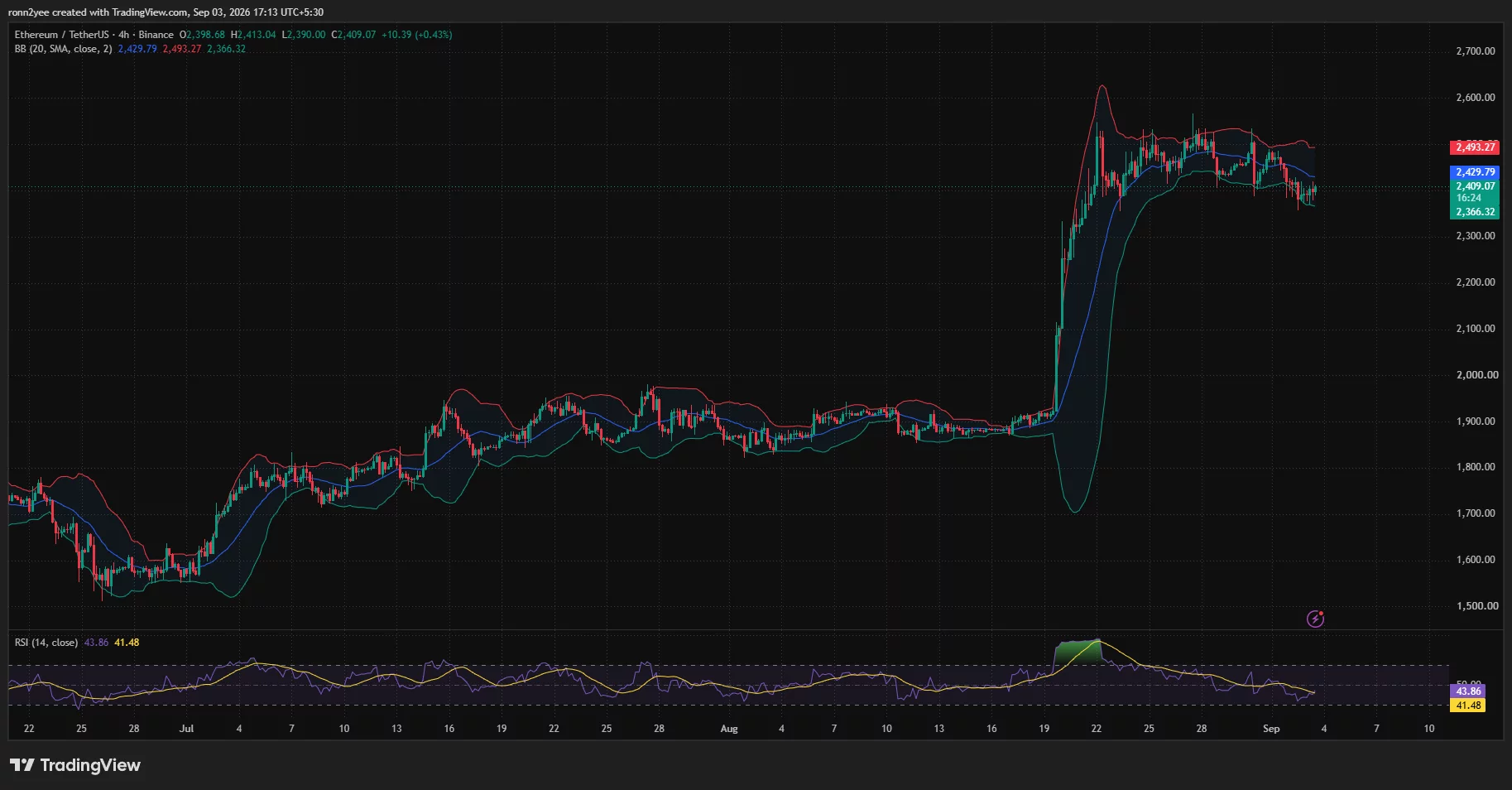
The upper Bollinger Band sits at $2,493.27, placing it near the lower edge of the wider $2,500–$2,550 supply zone. A 4-hour close above the midpoint could allow ETH to retest that resistance, while a break through the upper band would strengthen the case for another move toward $2,550.
Momentum has not yet supported that outcome. The 4-hour relative strength index stands at 43.86, below the neutral 50 level. Its signal average is lower at 41.48, showing a small recovery in momentum but no clear bullish reversal.
The lower Bollinger Band at $2,366.32 closely matches the session low and provides the nearest technical support. Losing that line would put $2,350 in focus, followed by the breakout region around $2,200.
Daily Ethereum chart retains its bullish structure
Ethereum’s daily structure remains stronger than its 4-hour setup. ETH continues to trade well above its 50-day simple moving average at $2,064.47 and its 200-day average at $2,031.85.
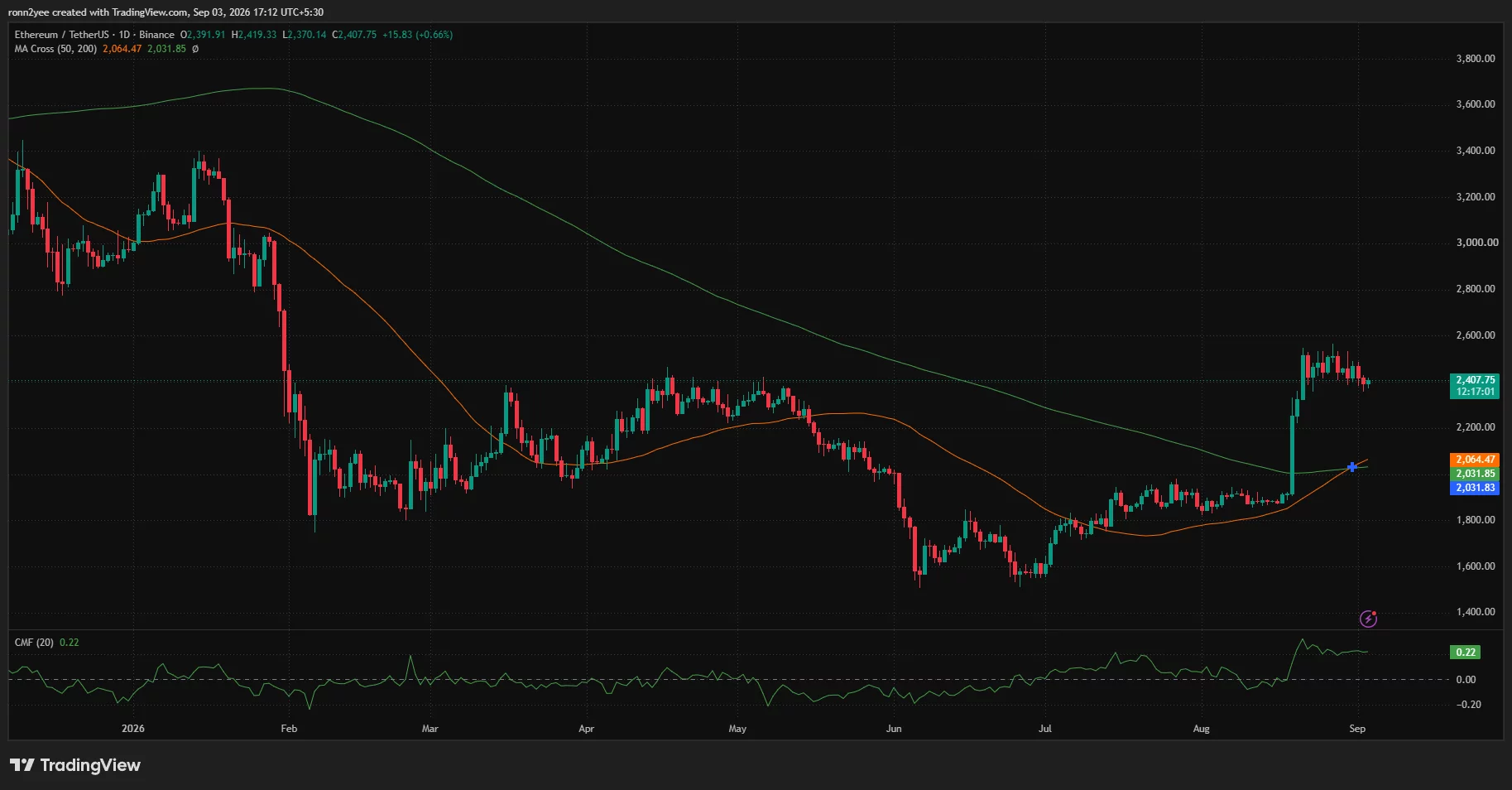
The 50-day average has also moved above the 200-day line, forming a bullish crossover. Such a crossover indicates that medium-term price momentum has improved relative to Ethereum’s longer-term trend, although it does not prevent a short-term correction.
Chaikin Money Flow supports the wider bullish structure. The indicator stands at 0.22, showing that buying pressure has remained stronger than selling pressure during the measured period. However, CMF has flattened after rising sharply during the August breakout, suggesting that capital inflows are no longer accelerating.
Crypto trader Daan Crypto Trades identified $2,400 as the key level separating a normal breakout retest from a deeper reversal. According to the analyst, a failure to hold the zone would send ETH back into its previous range and weaken the recent breakout structure.
Ted Pillows placed the next downside trigger slightly lower. The analyst said a weekly close below $2,350 could open the path toward $2,200, while resistance remains concentrated around $2,540 and $2,800.
ETH liquidation map shows pressure on both sides
CoinGlass’ one-week Ethereum liquidation heatmap shows leveraged positions accumulating immediately above and below the current price.
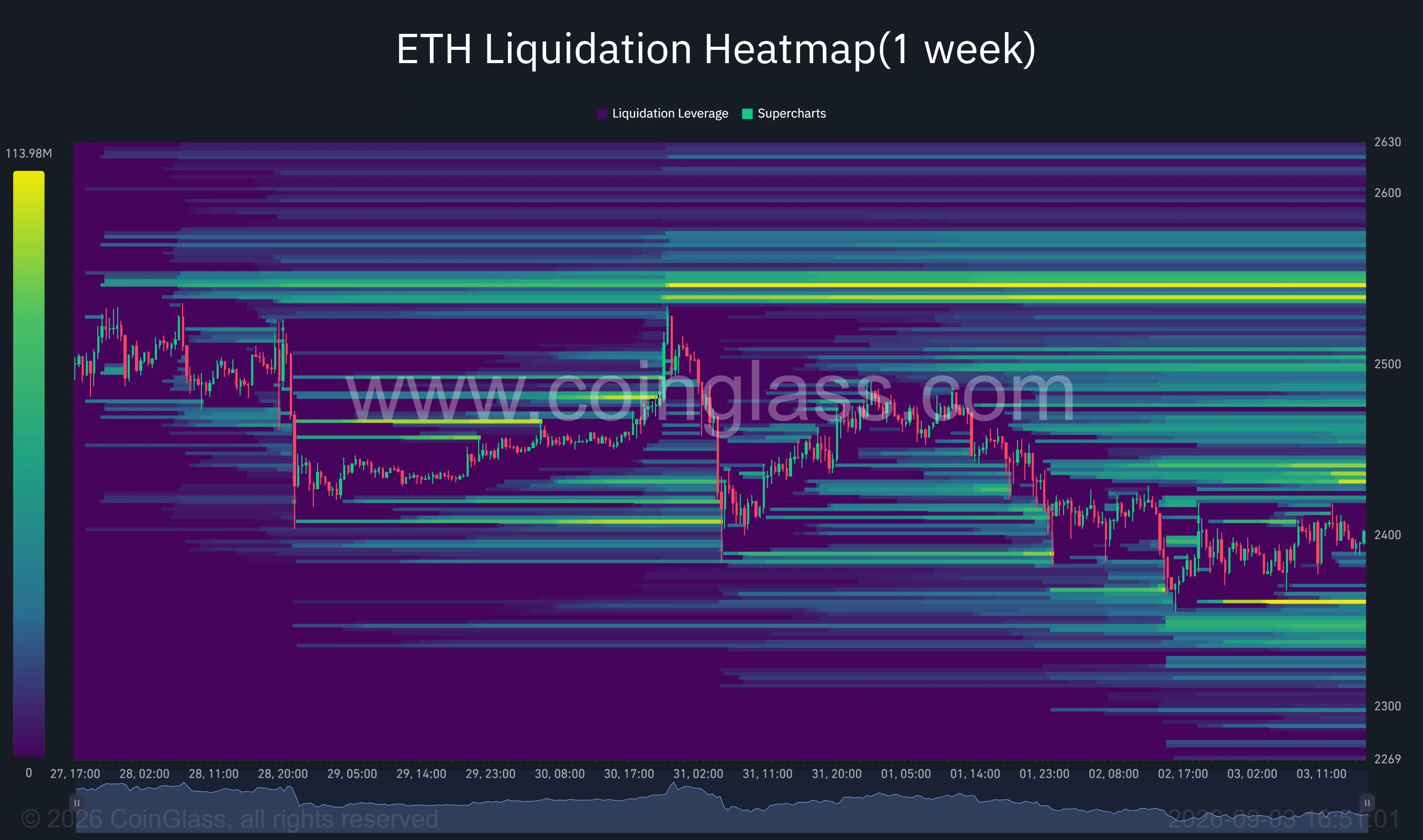
The closest large downside cluster appears around $2,350–$2,360. A move into that area could liquidate leveraged long positions, adding forced selling and increasing the risk of a brief drop below support.
Liquidity has also gathered around $2,430–$2,450, creating a nearby target if buyers hold $2,400. A move through that range could force short traders to close positions and help accelerate a rebound toward $2,500.
The largest visible liquidation concentration sits much higher, around $2,535–$2,550. That cluster overlaps with Ethereum’s recent price peak and the resistance cited by analysts, making it the main upside target if ETH regains momentum.
Liquidation heatmaps show where leveraged positions may face pressure, but they do not guarantee that price will reach those levels. New positions and closed trades can also change the size of each cluster over time.
Can Ethereum price hold above $2,400?
Ethereum needs a daily close above $2,400 and a move through the 4-hour Bollinger midpoint at $2,430 to stabilize its short-term structure. Reclaiming $2,450 would shift attention toward $2,493 and the heavier resistance between $2,500 and $2,550.
Failure to hold $2,400 would return focus to the lower Bollinger Band near $2,366. A decisive close below $2,350 would weaken the August breakout and could expose $2,200, where the previous consolidation range and technical support converge.
The daily moving averages and positive CMF still favor the broader recovery, but the 4-hour chart shows that sellers retain control of short-term momentum. Ethereum therefore remains at a decision point, with $2,350–$2,400 serving as support and $2,430–$2,550 forming the main recovery barrier.
Disclosure: This article does not represent investment advice. The content and materials featured on this page are for educational purposes only.

King Charles’ cheeky Bayeux Tapestry joke leaves people in stitches

Public trust in politicians drops amid voter cynicism

Fed Rate Hike Odds Fall to 50/50: Will Bitcoin's Rally Above 80,000 Hold?





-

 Fashion6 days ago
Weekend Open Thread: Maeve – Corporette.com
-

 Crypto World1 day ago
CLARITY Act could advance within weeks, Atkins says
-

 Business6 days ago
Onto Innovation Stock: AI’s Next Bottleneck Is Yield (NYSE:ONTO)
-

 Crypto World6 days ago
Bitcoin price tests $82K resistance as Brandt stays long
-
 Tech5 days ago
Hugging Face built a $4.5 billion empire on free AI models. Now Nvidia is buying it for $12.9 billion
-

 Business6 days ago
iPhone 18 Pro Pre-Orders Could Shift to Saturday as Apple Reportedly Avoids September 11 Anniversary
-

 Crypto World2 days ago
Elon Musk Says Grok 4.7 Lands in 10 Days and Will Beat Every Model
-
 Entertainment7 days ago
‘Adults’ Creators Break Down Season 2’s Most Shocking Moments and Tease a Potential Season 3
-

 News Videos5 days ago
Charlie Munger on Robinhood: No one should believe that Robinhood’s trades are free
-

 Tech6 days ago
PaperCut releases second emergency patch for exploited flaws
-
 Crypto World2 days ago
Bitcoin slips below $77.5K as macro pressure offsets ETF inflows
-

 Crypto World21 hours ago
Kalshi seeks CFTC approval for WTI perpetual
-

 Tech5 days ago
Tamagotchi Ring Takes the 30-Year Digital Pet and Places it on Your Finger
-

 Tech5 days ago
As the influencer economy drives retail sales, Seattle startup raises $22M to play matchmaker
-

 News Videos5 days ago
News kii Crypto ugu danbeeyey & Suuqa oo dhaqaaqey
-
 NewsBeat5 days ago
Trump posts AI video of ‘Lake America’ being protected by an army of bequiffed ‘Donald Ducks’
-
 Entertainment4 days ago
Taylor Swift Reportedly ‘Frustrated’ With Travis Kelce After ‘Short’ Honeymoon
-

 Business6 days ago
Apple Confirms September 9 iPhone Launch Event as Tim Cook Prepares to Hand CEO Reins to John Ternus
-
 Business2 days ago
Oil Price Today (September 2): Crude oil nears $97 as war tensions escalate. Will it hit $100 again?
-
 Entertainment6 days ago
Kendall Jenner’s Circle Concerned About Jacob Elordi Romance
You must be logged in to post a comment Login