

Crypto World
The civil war inside Cardano: Hoskinson vs the foundation

Cardano launched its on-chain governance system in 2025 with the promise that ADA holders would finally control the network’s $470 million treasury. Eighteen months later, that promise is producing exactly what it was designed to: a community that is now openly rejecting funding proposals from the project’s founder. Charles Hoskinson is in a public, escalating dispute with the Cardano Foundation, Emurgo, and the DRep voter base he helped create. Three concurrent governance battles in 2026 have already shaped how Cardano’s treasury gets spent, who controls the next generation of protocol development, and whether the network can preserve its identity as crypto’s “science coin” while its own elected representatives vote against research funding. This is the story almost no major outlet is telling properly.
Summary
- Cardano’s DRep governance system has repeatedly voted against treasury proposals backed by Charles Hoskinson, Emurgo, and Input Output Global during multiple disputes in 2026.
- A proposed 32.9 million ADA research funding request tied to Leios scaling and quantum-resistant cryptography faced overwhelming opposition from DRep voters ahead of the June 8 vote deadline.
- Tensions between Hoskinson, the Cardano Foundation, and community delegates have raised questions about who now controls Cardano’s long-term direction and treasury spending priorities.
The promise and the trap
Cardano spent more than seven years building toward Voltaire, the governance era that would hand control of the network from its founding entities to its community of (ADA) holders. When the Plomin hard fork activated in early 2025, the system went live. ADA holders could now delegate their voting rights to “DReps” (Delegated Representatives), the on-chain equivalent of elected officials, who would vote on protocol changes and treasury withdrawals. The Cardano Constitution, ratified in 2024, gave DReps real authority. The treasury, which had grown to hundreds of millions of ADA from transaction fees and reserves, would be spent only with DRep approval.
This was the dream. A blockchain that did what most crypto projects only said they did: handed real power to its users.
What nobody quite anticipated is what happens when the founder of a network disagrees with the network’s elected representatives.
The first warning came in late 2025 with the Genesis ADA dispute. The first major test came in April 2026 when the Cardano Summit 2026 budget proposal hit the DRep voting system. And the third, still unfolding as of late May 2026, is the rejection of Input Output Global’s “Cardano Vision 2026” research proposal, which would fund the foundational work on Leios scaling and quantum-resistant cryptography. All three battles trace to the same underlying fault line: who decides what Cardano is for, and who gets to spend its money to get there.
The story is not, strictly, about Hoskinson. It is about what happens to a project’s founding figure when the governance system they helped design starts producing outcomes they did not expect. And it is happening, in public, with documented statements from every named participant, on a chain where every vote is permanently recorded.
The Genesis ADA dispute: who owns what
The first fight set the tone for everything that followed.
In November 2025, the major Cardano organizations (IO, Emurgo, the Cardano Foundation, Midnight Foundation, and Intersect) submitted a joint proposal to withdraw 70 million ADA from the on-chain treasury to fund what they described as critical 2026 integrations: stablecoin partnerships, custody providers, analytics services, cross-chain bridges, and price feed oracles. At the prevailing ADA price, this was roughly $18 million worth of treasury draw.
Some community members pushed back. The argument was that Genesis ADA, the initial token allocations given to IO, Emurgo, and the Cardano Foundation when the network launched, should cover these integration costs rather than the community treasury. The implication was clear: if the founding entities benefit from these integrations, the founding entities should pay for them.
Hoskinson responded on November 30 during a livestream he titled “Genesis ADA.” The remarks were direct. Genesis ADA was not a community treasury, he said. It was private earnings from the early-stage risk taken by the founding entities when the project could have failed. The allocations to IO and Emurgo were “rewards for building the original infrastructure, funding early operations, and supporting” the network during a period of regulatory uncertainty. They were not, and had never been, public funds. Calls to redirect them now were “retroactive and unfounded,” he argued, because many of today’s integrations did not even exist when Genesis ADA was defined.
The deeper point, which Hoskinson made openly in the same livestream, was that the Genesis ADA debate was a proxy for something larger. Cardano was preparing for what he called a “pentad” governance restructure in 2026, moving from the original three-entity model (IO, Emurgo, Cardano Foundation) to a five-entity executive layer, adding the Midnight Foundation and Intersect. The expanded structure, he argued, was needed to compete with “large and aggressive industry players” and coordinate negotiations for major infrastructure deals.
The community pushback held. The 70 million ADA request became one of the most-discussed treasury proposals in Cardano’s history, and the underlying tension between “private earnings” and “community treasury” did not resolve. It carried into 2026.
The Summit 2026 vote: the first time DReps said no
The second battle was procedurally smaller than the Genesis ADA dispute, but politically larger, because it produced a clean, public, on-chain outcome.
In April 2026, Emurgo submitted a treasury withdrawal proposal to fund the Cardano Summit 2026 in Berlin and presence at Token 2049 in Singapore. The original request was for 14.07 million ADA, roughly $3.66 million at the time. The 2025 edition of the Summit had been approved under the same governance framework, and the funding had passed, so Emurgo went into the 2026 vote expecting a similar outcome.
That is not what happened.
DReps pushed back immediately. The 2026 budget nearly doubled the 2025 cost. ADA’s price had fallen sharply through Q1 2026, sitting in the $0.24 to $0.30 range, and community sentiment had shifted toward what one DRep called “doing more with less.” The proposal’s gross budget was $2.26 million against a revenue target of only $450,000, an imbalance that became a focal point of criticism. The Cardano Foundation, in an unusual move for a major founding entity, abstained from the vote rather than backing Emurgo’s request, stating it wanted “to avoid directing the outcome.”
Hoskinson weighed in publicly. On April 11, 2026, he posted to X, arguing that “parties” would not save ADA’s price. Infrastructure would. He proposed the same money could fund “up to six permanent offices worldwide that would operate like a hub in Buenos Aires,” shifting Cardano’s outreach model from event-based marketing to permanent local presence. He went further: the treasury, he argued, should stop issuing “free grants” entirely, and funded projects should return up to 30 percent of capital to the treasury, which would then buy ADA from the market, creating natural buy pressure.
The original proposal failed. Emurgo submitted a revised version requesting 7.8 million ADA (approximately $1.95 million), with the Foundation contributing an additional $380,000 internally. The revised version was, by analyst accounts, materially stronger than the original. The Cardano Foundation again abstained from voting on it, formally noting it wanted the community to decide independently.
The Summit vote was, in plain terms, the first time the Cardano Foundation and Emurgo discovered they no longer set the budget themselves. DReps did. And the DReps, weighted by ADA delegations, were not in the mood to approve eight-figure event sponsorships during a price downturn.
The IO research proposal: the most consequential vote yet
The third battle is the most important one, and the one most likely to define what Cardano looks like in 2027 and beyond.
In May 2026, Input Output Global submitted a proposal titled “Cardano Vision 2026: Human Centred, Scalable, Post Quantum Secure – IO Research.” The request was for 32.9 million ADA in treasury funding (roughly $8.6 million at the prevailing price) to fund advanced research initiatives, including the Leios scaling technology and quantum-resistant cryptography. Leios is Cardano’s next-generation consensus protocol upgrade, designed to sharply raise the network’s transaction throughput, targeting the 2030 scaling strategy of 27 million monthly transactions. Quantum-resistant cryptography is the long-horizon defense against the threat that future quantum computers could break the elliptic curve cryptography that secures every major blockchain today.
This was, in IO’s framing, the foundational research that would keep Cardano relevant for the next decade.
DReps started voting against it almost immediately.
As of the week of May 19, 2026, with the vote scheduled to close on June 8, 86.72 percent of votes are “No,” with only 13.28 percent supporting the proposal. Among the most influential opposing voices was a DRep operating under the name YUTA, who announced an abstention vote and argued the proposal “mixes valuable research with what he considers unnecessary treasury spending.” YUTA’s stated preference was for the proposal to be split into separate submissions, so DReps could approve the Leios scaling work without simultaneously approving everything else IO had bundled with it.
A separate cluster of Japanese DReps voted against the proposal on different grounds, raising structural concerns about how IO was using the treasury to fund what they saw as work that should be covered by Genesis ADA allocations. The argument echoed the November 2025 Genesis dispute almost verbatim, but with sharper teeth: this time, the DRep system was actually voting, and the votes were going against IO.
Hoskinson’s response was extraordinary by any measure of crypto founder discourse. He warned, publicly, that if the proposal failed, IO would not resubmit it. He warned that “layoffs could follow if proposals fail.” He warned that ADA’s “downturn could become permanent if Cardano loses its research-driven edge.” He criticized opposing DReps as undermining “years of technological progress” for the sake of “ADA’s temporary price downturn.” And he warned that Cardano risked losing its identity as the “science coin,” the reputation it had built over “more than a decade of development and hundreds of millions of dollars invested in peer-reviewed research and academic rigor.”
The framing was that DReps voting against the proposal were not just rejecting a budget request. They were rejecting the foundational identity of Cardano itself.
DReps kept voting no.
What the three fights have in common
Step back from the specifics of each battle, and a pattern emerges that explains all three.
The Cardano governance system was designed to give ADA holders real authority over treasury spending. The system is now exercising that authority. The DReps who hold delegated voting rights are not, on net, voting the way the founding entities want them to vote.
This is not a failure of the governance system. It is the system working exactly as designed. The unstated assumption among many of the project’s founding entities had been that Voltaire would produce a decentralized rubber stamp for proposals the founding entities themselves brought forward. The reality has been the opposite: DReps are rejecting proposals, including high-profile ones, from the project’s most senior figures.
There is a price dimension to all of this that cannot be ignored. ADA has been trapped in the $0.24 to $0.30 range since January 2026, down sharply from earlier highs. Treasury proposals that fund event marketing, large research initiatives, or anything that does not produce immediate measurable value have become much harder to pass in this environment. The community has, in effect, become a fiscal hawk. DReps are protecting the treasury because the treasury’s purchasing power has shrunk, and they want to see clear returns on what little spending does occur.
There is also a structural dimension. The Cardano Foundation expanded its DRep delegation program in January 2026, adding 220 million ADA across 11 DReps. The move was designed, by the Foundation’s framing, to distribute voting power more broadly and maintain coordinated governance participation. The unintended effect has been to create a class of DReps who are accountable to no single entity, and who can vote against any of the founding organizations, including the Foundation itself. The Foundation’s abstention on the Summit 2026 votes is, in part, an acknowledgment that the Foundation itself can no longer count on the community to follow its lead.
And there is a personal dimension. Hoskinson’s public communication style has, by his own admission, contributed to the friction. In a Thanksgiving 2025 livestream, he openly accepted “responsibility for some of the tension” and urged the ecosystem “not to polarize.” The months that followed did not produce a less polarized ecosystem. The April 2026 “no more parties” post, the criticisms of DReps as undermining Cardano’s research mission, and the recurring framing of disputes as existential threats to the project have not lowered the temperature.
The deeper question is whether Cardano’s founder still has the political capital to push proposals through a governance system designed to operate without him.
The Foundation’s careful position
The Cardano Foundation deserves separate attention because its conduct during these three battles has been notably different from Emurgo’s, and notably different from IO’s.
The Foundation has not, in any of the three disputes, openly opposed Hoskinson. It has also not, in any of the three disputes, openly backed him. On the Summit 2026 vote, the Foundation abstained both times, formally stating its reasons. On the Genesis ADA dispute, the Foundation did not weigh in publicly. On the IO research proposal, the Foundation has stayed largely silent.
What the Foundation has done is build governance infrastructure. The January 2026 DRep delegation expansion put 220 million ADA into circulation across 11 DReps. The Foundation has introduced new standards (CIP-0113, the Programmable Tokens standard) and backed tokenization initiatives. It has, in effect, focused on the structural work of making governance function rather than on the political work of taking sides in any particular vote.
The Hoskinson-Foundation tension has surfaced periodically. In November 2025, Hoskinson posted criticism of the Foundation’s spending discipline, framing it as resistance to “accountability, oversight, or real KPIs.” The Foundation’s community and governance lead, Nicolas Cerny, responded by pushing back against what he called “CF derangement syndrome” and advising community members to practice “critical thinking rather than simply parroting the talking points of certain individuals.” The exchange, conducted publicly on X, was unusually sharp for an organization-to-founder communication in crypto.
The Foundation’s quieter posture in 2026 may reflect an institutional judgment that the public fights are not worth having. Or it may reflect a strategic patience: if Hoskinson’s relationship with the DRep community keeps deteriorating, the Foundation’s careful neutrality becomes more valuable, not less.
Either way, the asymmetry between the Foundation’s silence and Hoskinson’s public statements is one of the most telling features of the current dynamic.
What this means for ADA holders
For an ADA holder, the civil war has direct, material consequences that extend beyond founder drama.
Treasury spending is now harder to approve. This is, on balance, neutral or positive for ADA’s price in the short term, because every rejected proposal is a smaller draw against the treasury, which means less sell pressure from funded projects converting ADA to fiat. The Summit 2026 rejection alone kept approximately $3.66 million of ADA out of the market. The IO research proposal, if it fails as currently projected, would keep an additional $8.6 million from being sold.
Treasury spending is also slower. The lag between proposal submission and DRep vote, combined with the now-common pattern of revisions and resubmissions, means projects requesting funding face longer timelines and more uncertainty. This is good for fiscal discipline. It is bad for execution speed, particularly for time-sensitive infrastructure work.
The most consequential outcome for ADA holders is what happens to the founder. If Hoskinson follows through on the warning that IO will not resubmit the research proposal if it fails, the Cardano Vision 2026 research initiative would not proceed in its current form. IO’s research division has been one of the project’s strongest differentiators, the source of the peer-reviewed papers, academic partnerships, and “science coin” reputation that has carried Cardano through multiple downturns. If that engine slows, Cardano’s competitive position against Ethereum, Solana, and the broader Layer-1 field changes materially.
For now, the situation is unresolved. The IO research proposal vote closes June 8, 2026. The pentad governance restructure is still under discussion. The Summit 2026 revised vote is still active. Each of these has the potential to either de-escalate the tension or sharpen it further, and there is no clear signal yet which direction the next round will move.
The deeper question
Strip away the specifics, and Cardano is testing a question every other major crypto project will eventually have to answer.
What happens when a network’s governance system, designed to give power to its community, starts producing outcomes the founding figures of the network disagree with?
The honest answer is that this is what decentralization actually looks like. Bitcoin’s founder is gone. Ethereum’s founder has explicitly stepped back from operational influence. Cardano’s founder is still active, still vocal, and still convinced his vision for the project is the correct one, but the governance system he helped design no longer requires the community to agree with him.
That is not a failure mode. That is a feature. But it is a feature that produces visible discomfort when it operates against the founder’s preferences, and the discomfort is now public, ongoing, and documented on-chain.
Cardano’s civil war is therefore not a crisis. It is a test. The project that emerges from 2026 will be either one where DReps and the founding entities have learned to coordinate productively, or one where the founding entities accept reduced political influence over a system that has, by design, outgrown them.
Both outcomes are plausible. Neither is settled.
The Pi Network community has spent years asking when tier-1 listings would arrive. The Cardano community is asking a harder question: when the founder of the network and the community of the network disagree, who actually decides?
The answer, on chain, is increasingly clear. The DReps decide. Whether Hoskinson can rebuild political capital with that community, or whether Cardano will keep shipping through a governance system that no longer defers to him, is the story to watch through the rest of 2026 and into 2027.
For now, the votes are running. The proposals are being rejected. And the man who built the system that produced this outcome is, by his own framing, watching his project lose the identity he spent over a decade building.
That is the civil war. It is happening in public, in real time, and it is shaping Cardano in ways the project’s founder did not anticipate when the system that produced it was first designed.
This article is for informational purposes and does not constitute financial or investment advice. Governance votes and ecosystem disputes evolve quickly; the figures and statements described reflect reporting available as of late May 2026. Always do your own research.



Coinbase this afternoon launched two onchain USDC lending vaults built on Morpho and curated by Steakhouse Financial, giving users their first choice of risk profile when lending from the exchange: a conservative Prime tier backed by blue-chip crypto collateral, and a Higher Yield tier drawing on… Read the full story at The Defiant
LG Electronics is building a blockchain-based advertising network on its own Arbitrum-derived Layer 2, according to an exclusive report by Fortune published Thursday. The company describes the project as a pilot with no commercial launch date set. The South Korean electronics giant, known for TVs… Read the full story at The Defiant
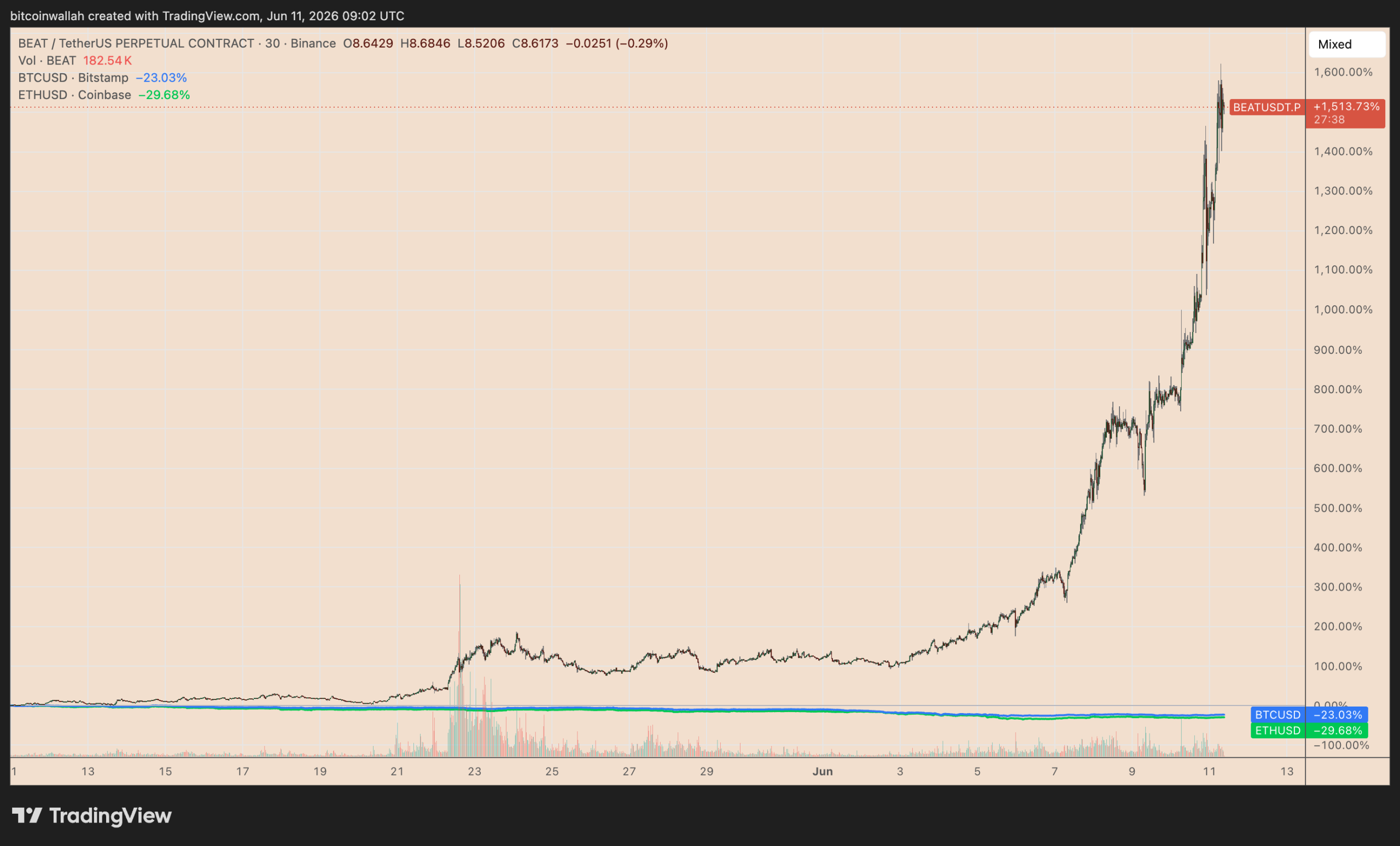
BEAT, the native token of AI music platform Audiera, has exploded higher over the past month, surging more than 1,500% to a record high of $9.20 even as Bitcoin (BTC) and Ether (ETH) fell roughly 25% and 30%, respectively, in the same period.
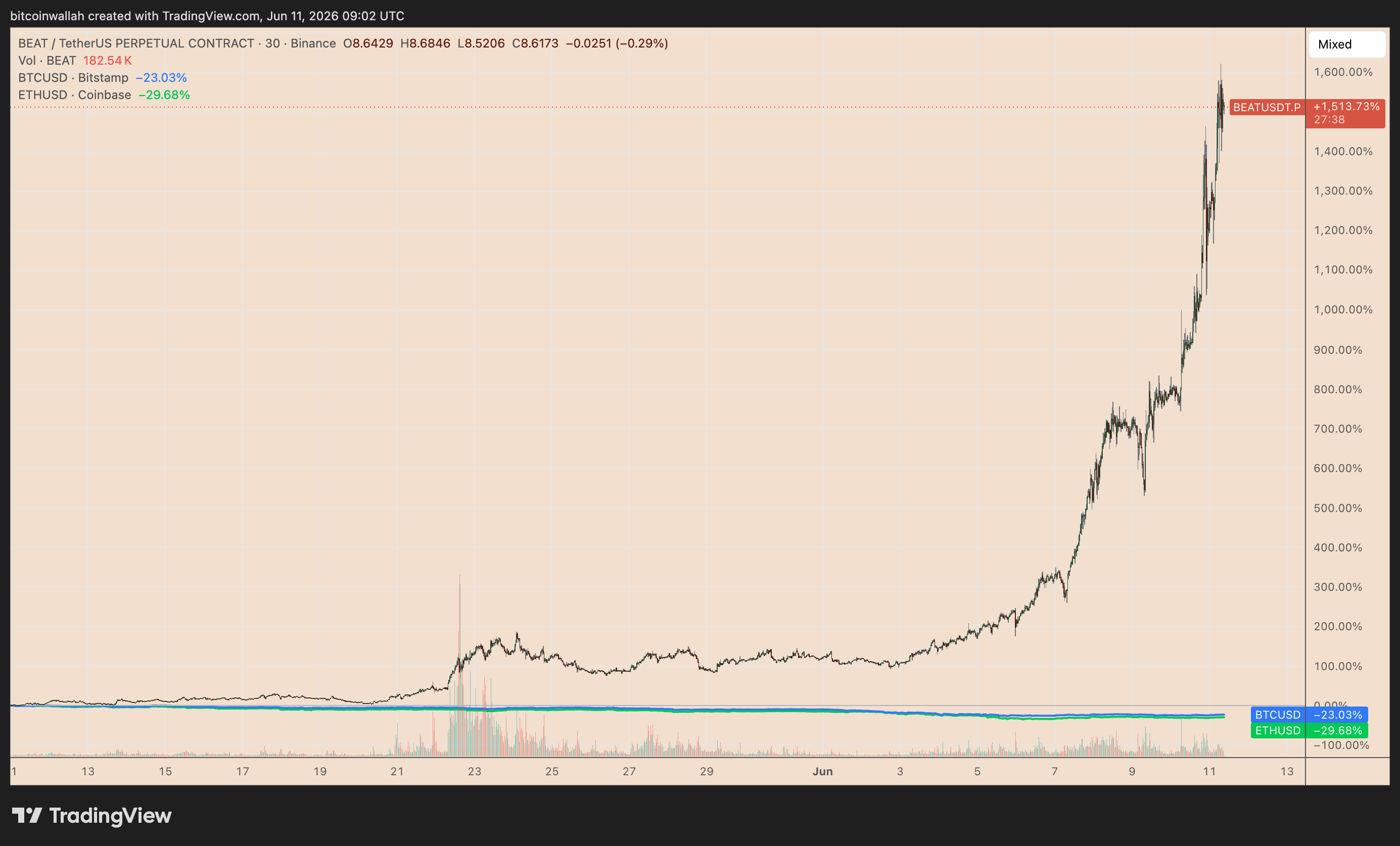
BEAT/USD vs. BTC/USD and ETH/USD 1-month price performance. Source: TradingView
Key takeaways:
- Strong platform revenues mixed with excessive short liquidations send BEAT’s price higher.
- The AI token is now at its most overbought stage, which may prompt a 35% dip in the coming days.
Why is Audiera’s BEAT price up so much?
BEAT’s sharp outperformance has turned it into one of crypto’s hottest AI-linked trades, driven by a mix of platform revenue claims, token burns, and short liquidations.
Audiera revenue and token burns strengthen BEAT bull case
BEAT’s rally has gained momentum from Audiera’s revenue-and-burn model, which has given traders a stronger value-capture story to chase.
The project reported 772,045 BEAT in weekly revenue between June 1 and June 8, worth about $2.87 million at its stated price of $3.712. During the same period, Audiera said it burned 770,545 BEAT, taking the total burned supply to 12.35 million BEAT.
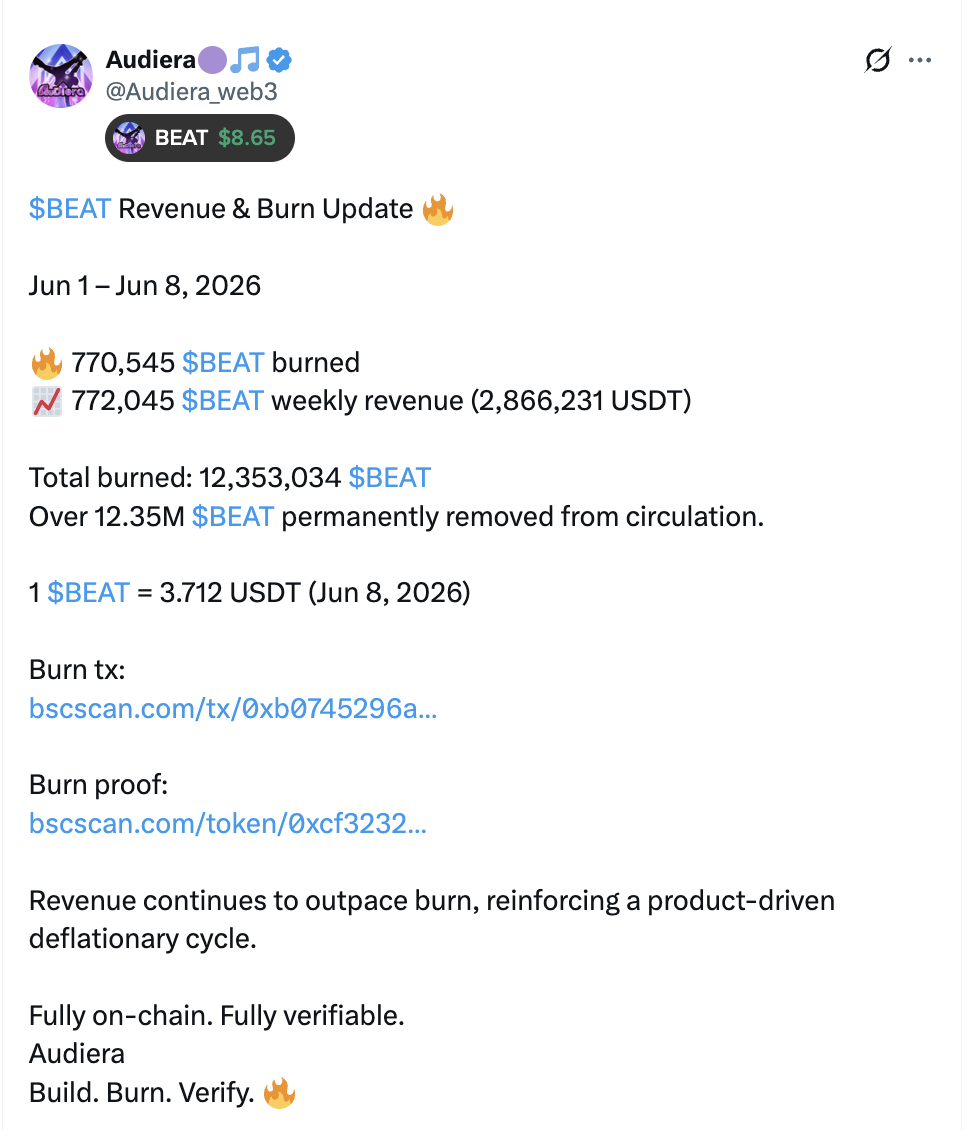
Source: X
Burns reduce BEAT’s available or future supply against its fixed 1 billion-token cap, strengthening the scarcity narrative when demand is rising.
This resembles Hyperliquid’s HYPE token economics, which have seen 120% price gains so far in 2026.
Related: Hyperliquid bear turns bullish after losing over $46M shorting HYPE
However, Hyperliquid has already shown strong product-market fit in perpetual trading, while Audiera’s model remains newer and less tested. That leaves BEAT vulnerable to sharp profit-taking if revenue slows, burn activity weakens, or speculative demand cools.
Short squeeze helps fuel BEAT rally
BEAT’s rally has received a strong boost from derivatives liquidations, particularly from traders betting against higher prices.
Since May, BEAT has seen $28.72 million in short liquidations, compared with $13.74 million in long liquidations. That means bearish traders lost more than twice as much as bullish traders during the rally.
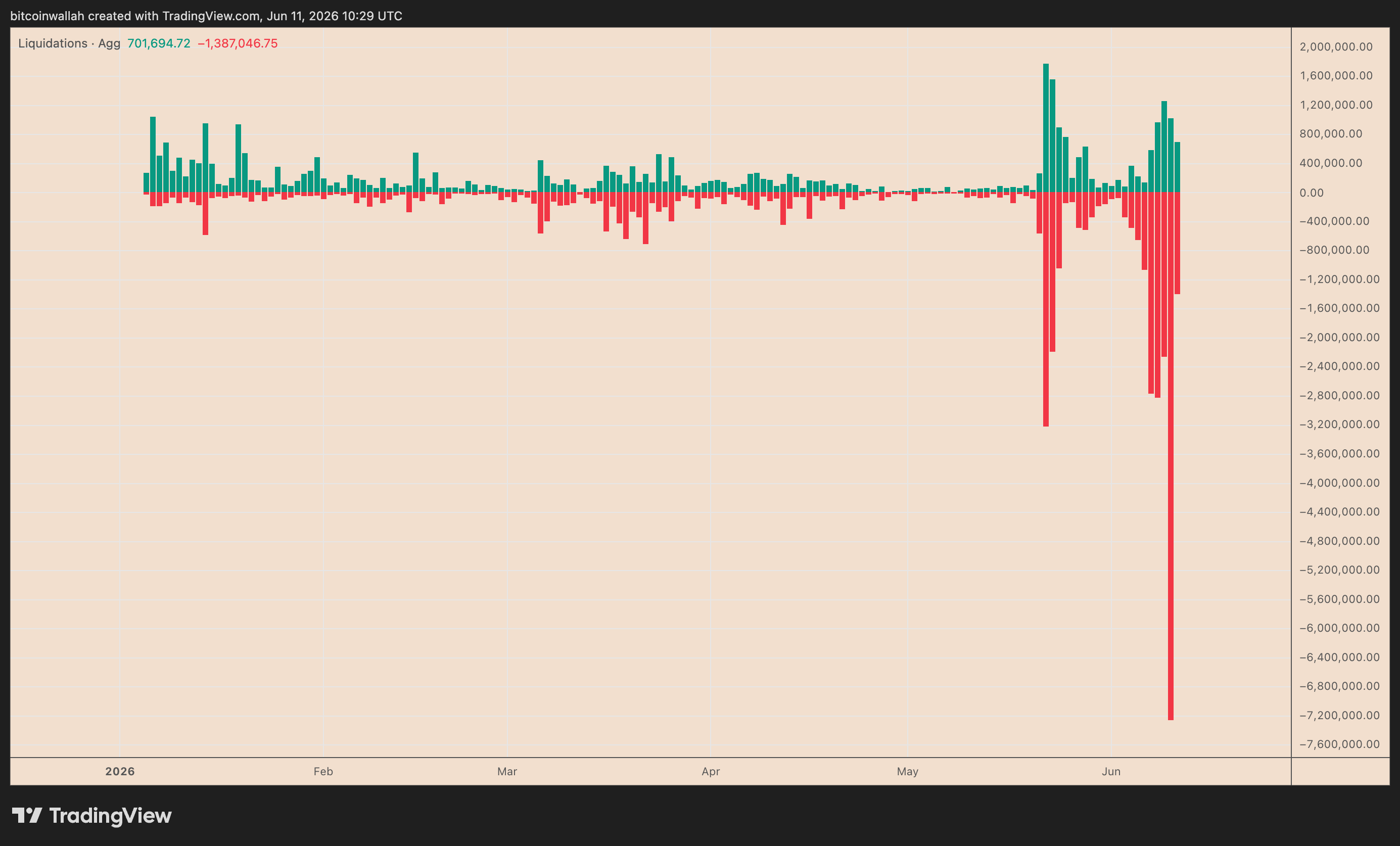
BEAT’s daily aggregated liquidation bar chart. Source: TradingView
This imbalance points to a classic short squeeze. As the BEAT price kept rising, traders holding short positions were forced to close their bets. Since closing a short position requires buying back the token, those liquidations added more upward pressure to the price.
That helped turn BEAT’s rally from a strong uptrend into a vertical move.
However, it also means part of the surge came from forced buying rather than steady spot demand. Once short-liquidation pressure fades, BEAT may need fresh buyers to keep the rally going.
BEAT price may decline 35% in June
BEAT’s price explosion over the past month has made its relative strength index (RSI), which gauges momentum, the most overbought on record.
As of Thursday, BEAT’s daily RSI reading was 96.87, way above its overbought threshold of 70. In other words, the Audiera token’s rally remains vulnerable to a sharp pullback if buyers lose momentum or early investors start booking profits.
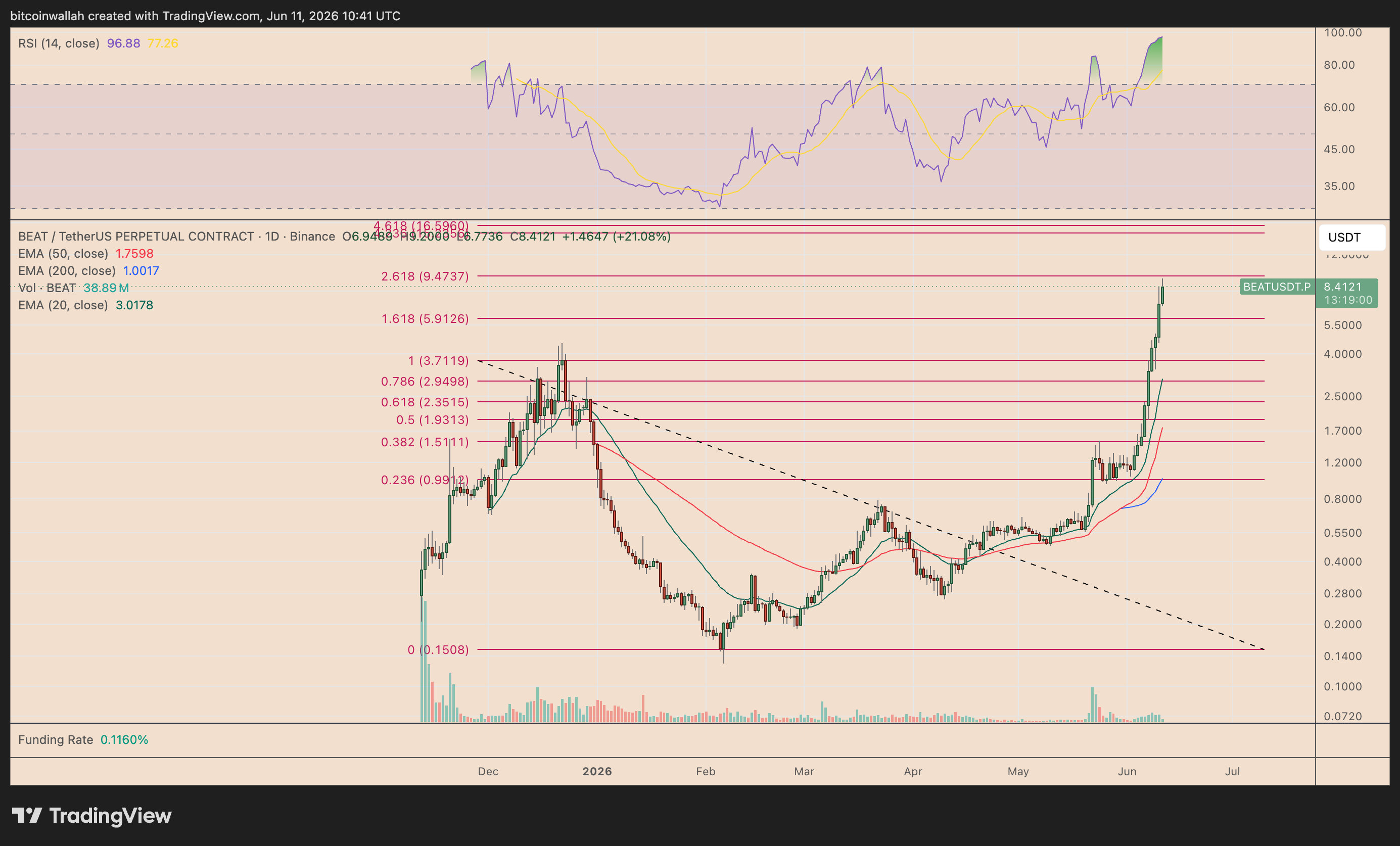
BEAT/USDT daily price chart. Source: TradingView
A decisive pullback from the $9.47 resistance level, which aligns with the 1.618 Fibonacci retracement line, increases the odds of BEAT falling toward the 1.0 Fib line at around $3.71, down roughly 35% from the current price, in June.
Conversely, a clear breakout above the $9.47 resistance level raises BEAT’s potential to rise toward its 4.236 Fib line above the $15 mark in the coming weeks.
The 2026 FIFA World Cup could mark a breakout moment for prediction markets, with Coinbase emerging as one of the biggest winners, according to a new research report from Bernstein.
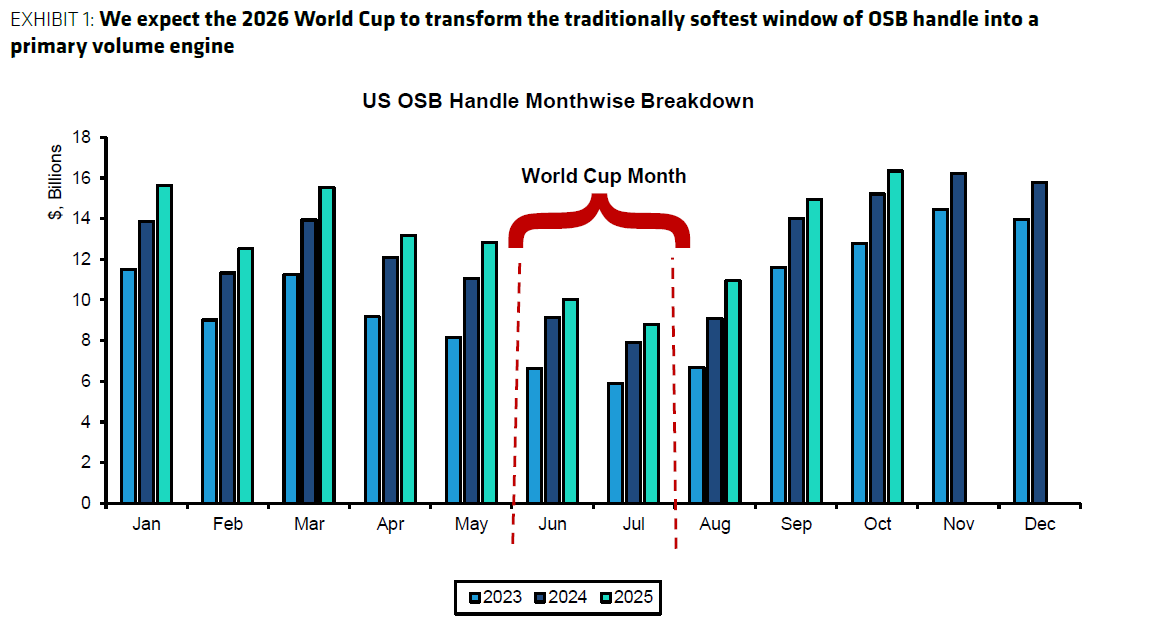
Published Thursday, the Bernstein analysts estimate the expanded tournament will generate more than $3 billion in incremental sports betting handle and $5 billion to $10 billion in additional consumer prediction market volume, as 104 matches transform what is typically the slowest period for online sports betting.
FIFA expects the month-long tournament to attract roughly 6 billion viewers worldwide, up from an estimated 5 billion during the 2022 World Cup in Qatar. Matches are scheduled to start today.
Bernstein said Coinbase has established itself as a major player in the sector, surpassing $100 million in annualized prediction market revenue in March, just months after launching the product.
As Cointelegraph reported, the crypto exchange rolled out prediction markets nationwide through a partnership with Kalshi, allowing users in all 50 US states to trade event contracts tied to sports, politics, culture and other real-world outcomes.
Robinhood is also expected to benefit from the tournament. Bernstein noted that the brokerage is using the event to launch Rothera, its own US Commodity Futures Trading Commission (CFTC)-licensed exchange and clearinghouse for prediction markets.
“[W]e expect prediction markets to be the biggest driver of incremental revenue for Robinhood,” the analysts wrote, forecasting roughly $586 million in prediction market revenue for 2026.
Bernstein expects the FIFA World Cup to transform the slowest months for online sports betting into a major driver of betting and prediction market volumes. Source: Bernstein
Related: Coinbase fends off Nevada’s emergency bid to halt prediction markets
Sports emerge as prediction markets’ biggest growth driver
Prediction markets have become one of crypto’s fastest-growing use cases, expanding even as the broader digital asset market has cooled.
An April report by Bitget Wallet and Polymarket found that monthly prediction market trading volume reached nearly $26 billion, with retail traders accounting for more than 80% of users.
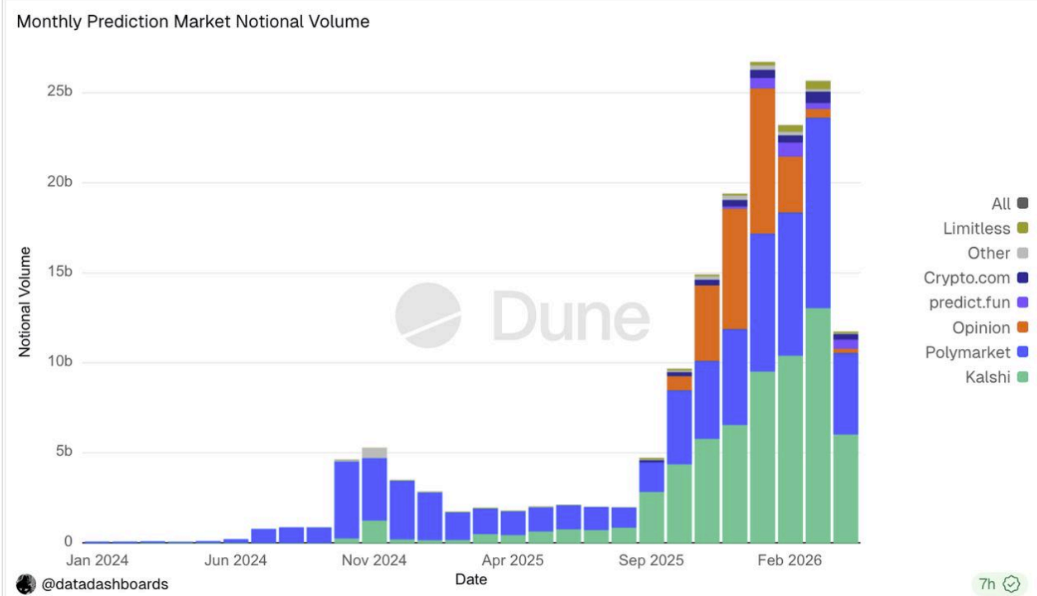
Prediction market volumes have grown considerably since late 2025. Source: Bitget Wallet
The report also pointed to a structural shift in user behavior. Rather than attracting activity around one-off events such as elections, prediction markets are increasingly retaining users across recurring categories, with sports emerging as the largest segment.
In March alone, sports betting accounted for more than 39% of prediction market volumes, according to Bitget Wallet and Polygon.
The CFTC on Wednesday issued draft rules for prediction markets signaling that sports event contracts are generally not contrary to the public interest even though federal law classifies them as “gaming.”
Related: Kalshi, Polymarket eye $20B valuations in potential fundraising: WSJ
Key takeaways:
- Surging oil prices and rising producer inflation have pushed traders to price in a stricter US Fed monetary policy.
- Massive spot Bitcoin ETF outflows in June show the cryptocurrency is currently failing to act as a stock market hedge.
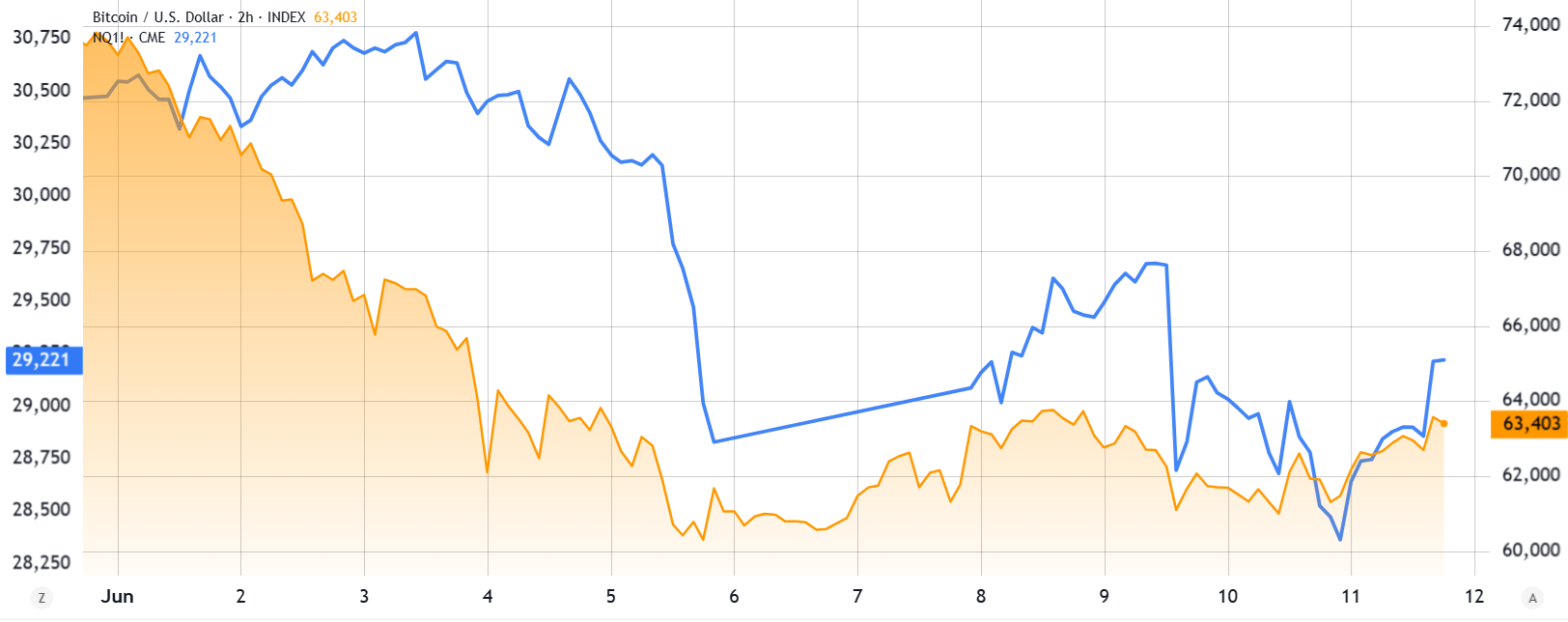
The Nasdaq 100 Index dropped 7.5% in the seven days leading up to June 10, wiping out $2.7 trillion in market value. The fallout represents more than twice the entire Bitcoin (BTC) market capitalization and has put traders on alert, especially as inflation data feels the heat from high oil prices. Traders now fear that Bitcoin support near $60,000 stands at risk.
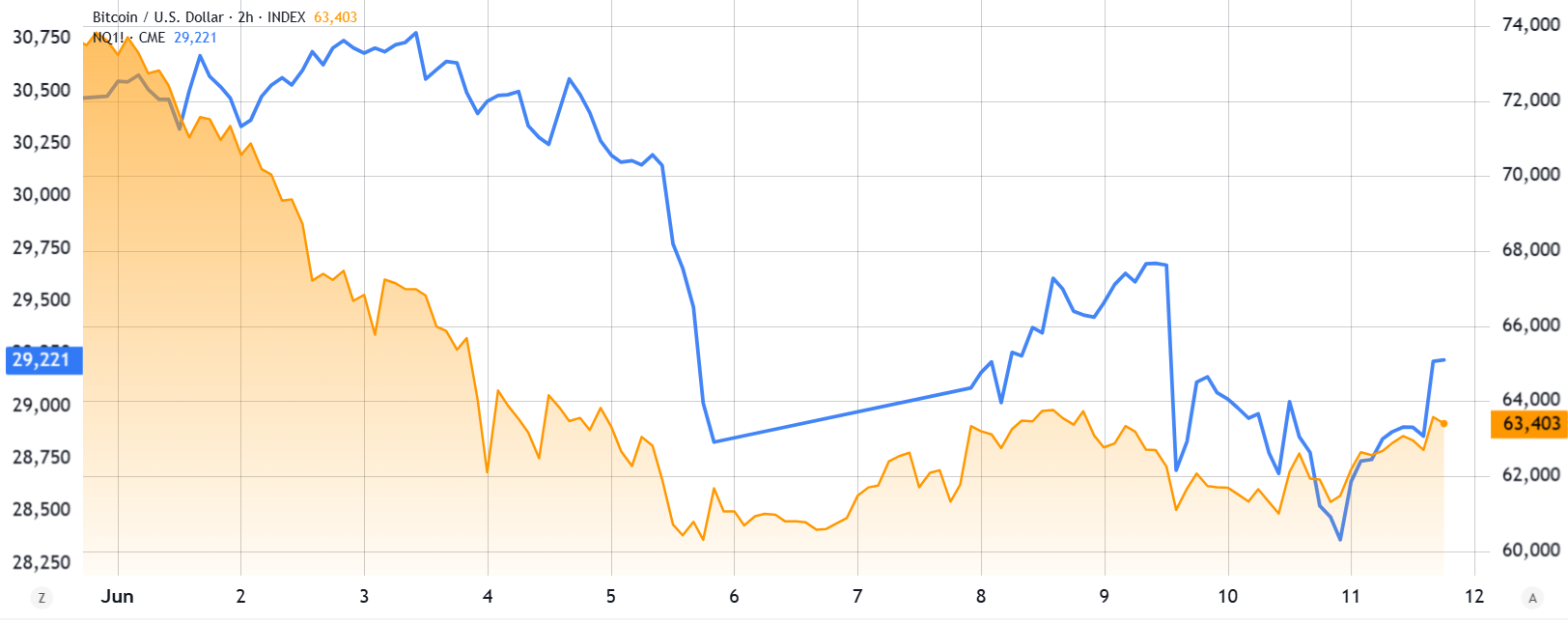
Nasdaq 100 futures (left) vs. Bitcoin/USD (right). Source: TradingView
The ongoing war in Iran has driven Brent crude oil prices above $90, prompting investors to fear an economic slowdown and to price in a tighter monetary policy for longer than previously anticipated. Regardless of job market conditions, money available for consumption tends to decline.
The US Labor Department reported Thursday that its producer price index jumped 6.5% from May 2025, the highest level since 2022. Traders now anticipate 40% odds of an interest rate increase by the US Fed by September, up from 5% one month prior, according to the CME FedWatch Tool.
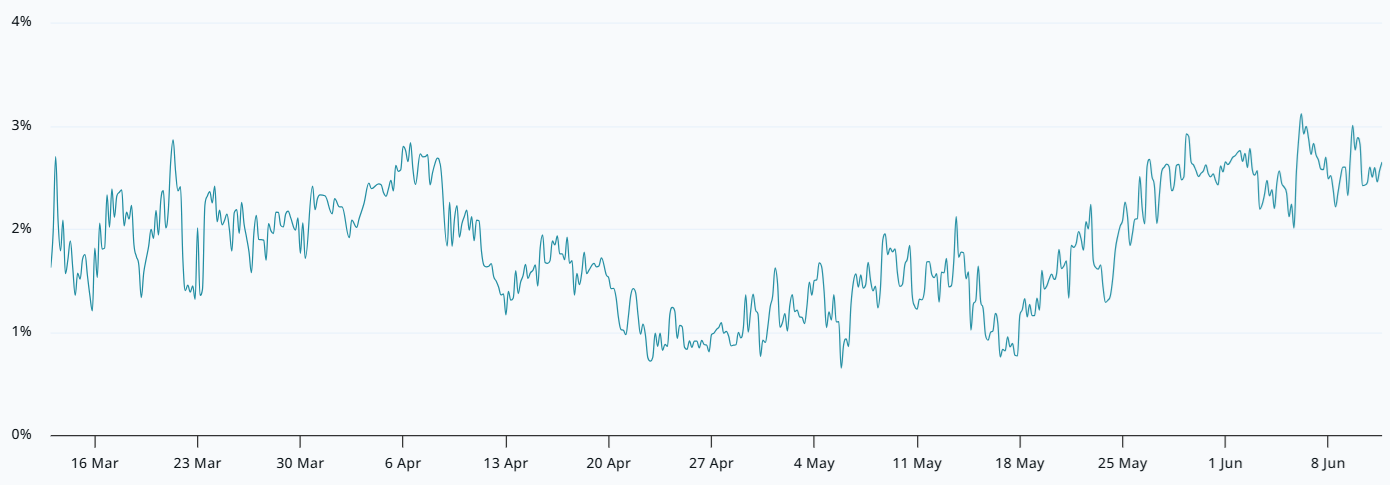
Bitcoin 2-month futures annualized basis rate. Source: Laevitas
Bitcoin futures contracts traded below the 4% neutral premium relative to regular spot markets on Thursday, indicating low demand for bullish leverage. Meanwhile, the upcoming $75 billion SpaceX (SPCX US) IPO was oversubscribed by more than 2x, signaling investors are not yet ready to abandon hope of further tech sector growth.
AI infrastructure companies are in desperate need of cash to fuel their build-outs, which partially explains the negative market reaction. Google (GOOG US) announced plans to raise $80 billion, while Oracle (ORCL US) and Super Micro Computer (SMCI US) followed suit with $40 billion and $7 billion, respectively. The Friday debut of SpaceX shares will likely set the tone for upcoming IPOs.
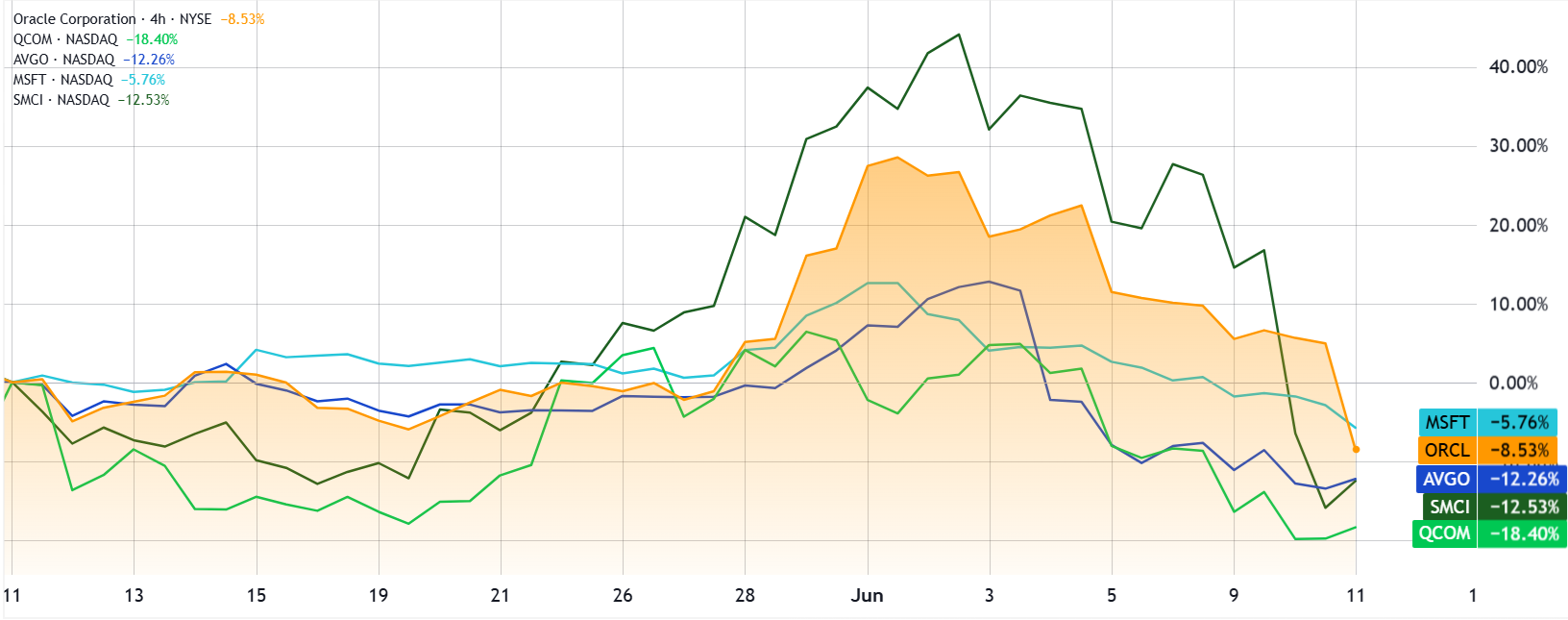
Selected AI sector stock performances. Source: TradingView & Cointelegraph
It seems premature to deem the AI sector a bubble after SpaceX marked the largest IPO in history at a $1.77 trillion valuation. Moreover, the US stock market reacted positively after US President Donald Trump called off planned strikes on Iran, citing renewed negotiations to reopen the Strait of Hormuz.
Strategy accumulation pause amid spot Bitcoin ETF outflows
Bitcoin’s decline coincided with Strategy’s (MSTR US) decision to temporarily halt its Bitcoin accumulation to reduce convertible debt. As a result, Strategy’s cash position declined to seven months of dividend coverage, while its preferred variable Stretch (STRC US) shares distanced themselves from the $100 level that would allow further equity issuance.
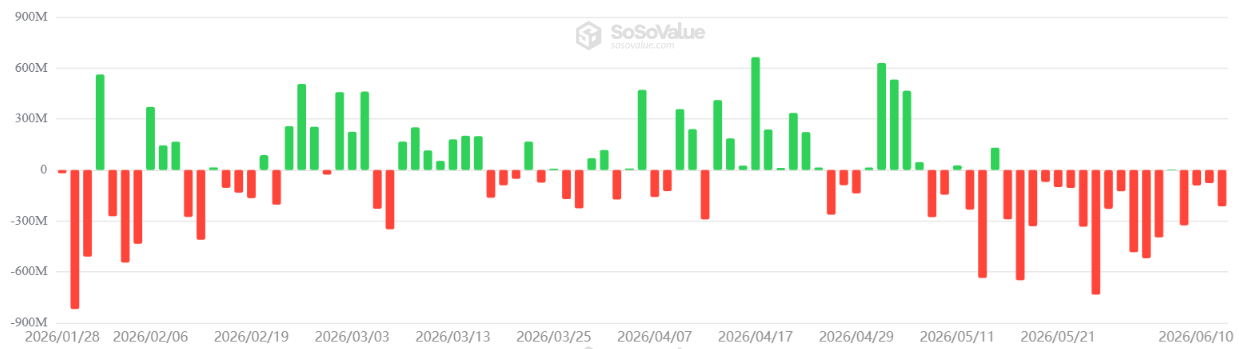
US-listed Bitcoin spot ETFs daily net flows, USD. Source: SoSoValue
The $1.9 billion in outflows from spot Bitcoin exchange-traded funds (ETFs) in June reinforced bearish sentiment, as the indicator serves as a proxy for institutional demand. Presently, Bitcoin can hardly be considered a hedge against an eventual stock market sell-off; the odds of a further correction below $60,000 should not be ruled out.
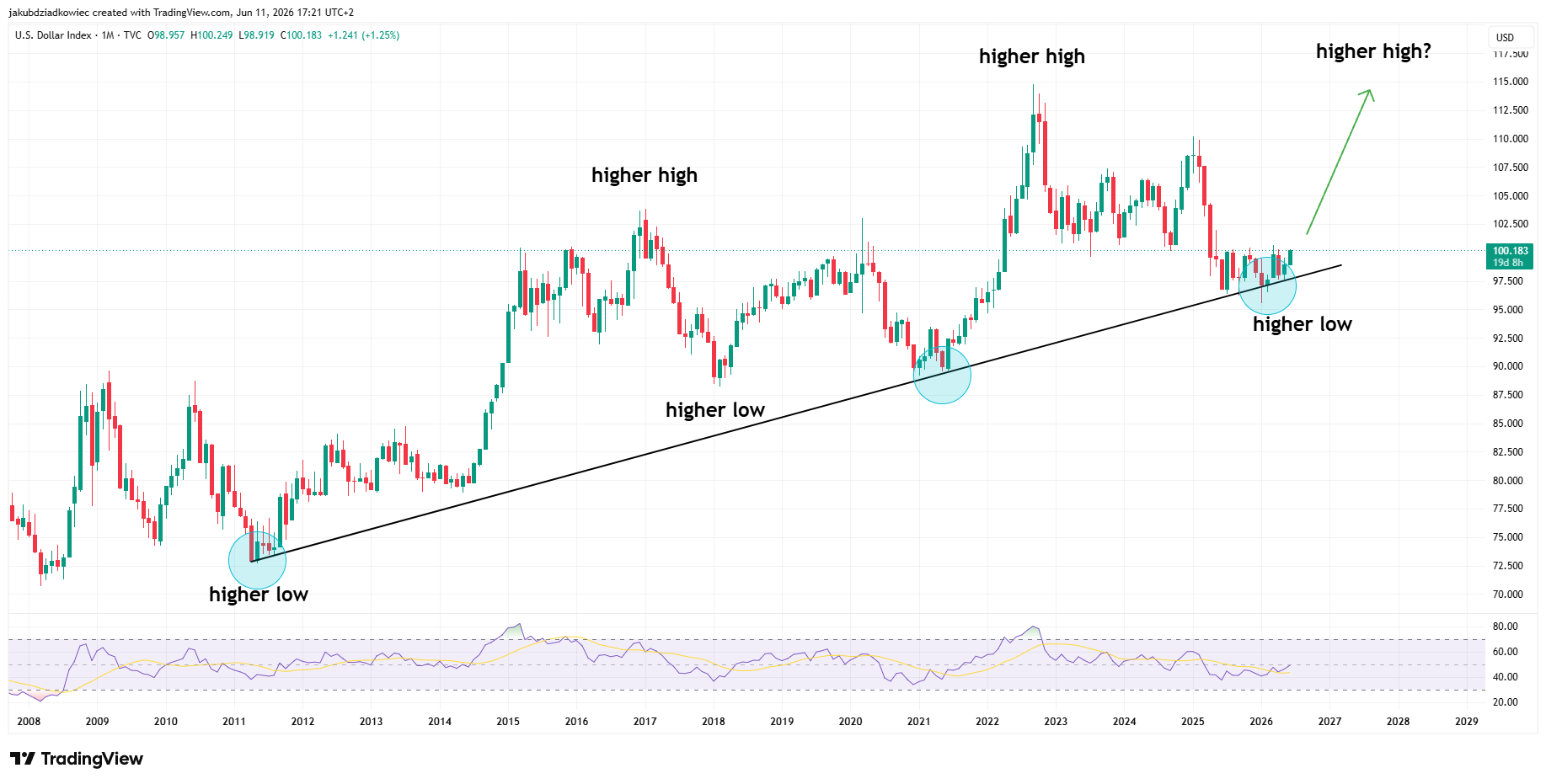
The US Dollar Index (DXY) trades near 100.2 after retesting an ascending trendline that has supported it since May 2011. A resistance zone at 100.5 still caps the recovery.
BeInCrypto examined the monthly, weekly, and daily charts to map the next likely move. The Federal Reserve (Fed) meeting on June 16-17 could decide the direction.
US Dollar Index Defends a Trendline That Has Held Since 2011
The monthly chart shows an ascending trendline that has defined the dollar’s long-term direction since May 2011. The line was almost retested in June 2014 and confirmed again in June 2021.
In February 2026, the index returned to this line once more. So far, the level has held.
The broader structure also remains constructive. DXY has printed a series of higher lows and higher highs over the past 15 years, including the 2022 peak near 115.

If the trendline holds, the current retest may become the next higher low. A repeat of previous cycles could then push the index above 115.
Dollar strength matters for crypto investors because of Bitcoin’s (BTC) long-running inverse correlation with DXY. However, the monthly relative strength index (RSI) remains neutral and signals no clear momentum.
Weekly Chart Still Treats the Recovery as a Correction
The weekly timeframe complicates the bullish picture. DXY climbed in a parabolic run from December 2020 until September 2022, peaking at 114.80. The breakdown from that parabola started a long distribution period and a downtrend.
Within that downtrend, the index printed a swing high near 110.18 in early 2025. The decline that followed bottomed at 95.55.

From this perspective, the ongoing recovery looks like a correction rather than a new uptrend. The key area sits near 99.5 to 100, where former support has turned into resistance.
A weekly close above this zone would validate the bullish breakout scenario. A rejection, in contrast, would likely resume the slide back to 95.55. Meanwhile, the weekly RSI reads 57, which indicates neutral momentum.
DXY Price Prediction Hinges on the 100.5 Resistance Zone
The daily chart provides the most detailed view of the battle. A support area near 97.5 has been retested twice, forming a double bottom or W pattern.
The measured target of this formation sits at 101.07, nearly 1% above the current price. However, the pattern remains unconfirmed. Resistance at 100.4 to 100.5 still caps the index, and DXY was rejected from this zone twice in March.
A second structure adds a bearish angle. Recent price action has formed an ascending wedge, a pattern that typically resolves downward. Its target lies near 98.5, roughly 1.7% below current levels. That target coincides with the 0.618 Fibonacci retracement at 98.547.

The daily RSI stands at 67 and approaches the overbought threshold of 70. Because the wedge’s upper band overlaps the resistance zone, a rejection on the first attempt looks likely.
Analysts have recently called DXY the most accurate macro indicator for Bitcoin’s direction, so crypto traders should watch these levels closely.
The Fed’s June 16-17 meeting is the nearest catalyst, with markets still pricing a possible rate hike in December. A daily close above 100.5 would open the path to 101.07 and revive the long-term rebound thesis, while a wedge breakdown would expose 98.5 first.
The post Is the US Dollar Index (DXY) Headed Higher After a 15-Year Trendline Retest? appeared first on BeInCrypto.
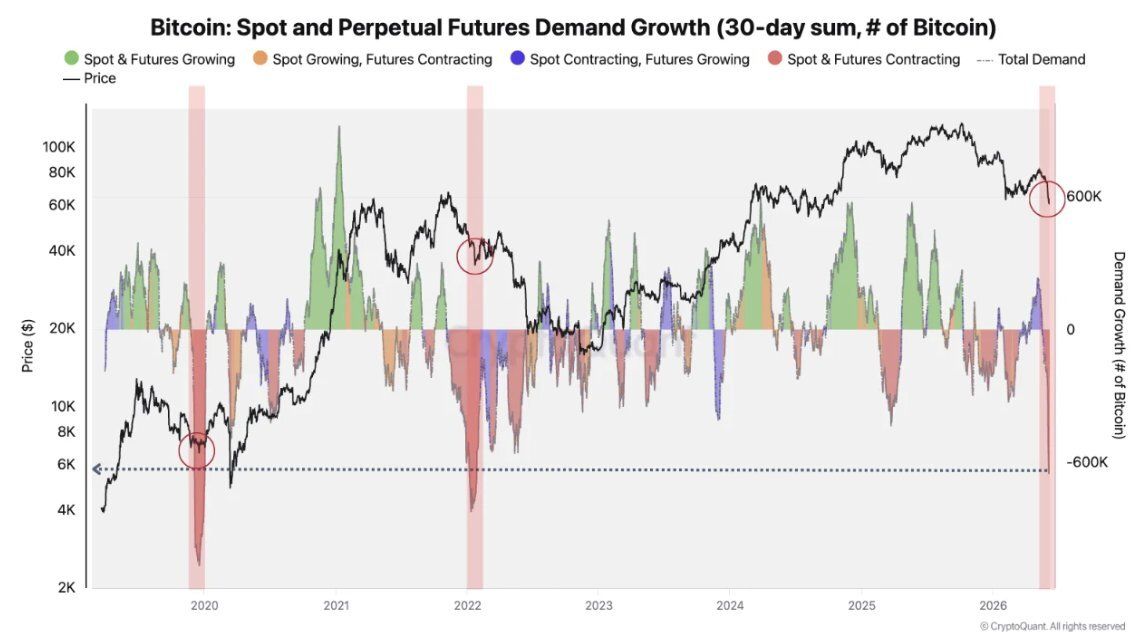
Bitcoin (BTC) demand has contracted to a level last seen only three times since 2019, according to CryptoQuant data. The 30-day growth of combined spot and perpetual futures demand has fallen toward minus 650,000 BTC.
A separate metric from Capriole Investments paints a similar picture. Apparent Demand sits near the bottom of its four-year range while BTC trades near $62,800.
CryptoQuant Sees Rare Bitcoin Demand Contraction
Only two comparable readings exist on the chart. They appeared before the COVID crash in early 2020 and during the 2022 bear market.
The structure of the decline matters as much as its depth. Spot demand and perpetual futures demand are shrinking at the same time. The weakness, therefore, extends beyond leveraged speculation, a dynamic flagged in an earlier CryptoQuant warning on demand imbalances.

In a QuickTake post, CryptoQuant analyst MoneroDV_ argued that the reading marks the start of an unstable phase rather than a finished correction. He wrote on CryptoQuant:
“The most probable path is an initial expansion in volatility, followed by a period of price “anesthesia”: weak momentum, compressed activity and prolonged sideways action. That phase may be psychologically more damaging than the sell-off itself.”
History adds an important nuance. The deeper minus-650,000 BTC zone has marked the beginning of an unstable phase, not a final low. Recoveries toward the higher support zone aligned more closely with the March 2020 and late 2022 bottoms. A similar recovery would offer the first sign of the signal flipping.
Capriole Data Confirms the Weakness but Offers a Caveat
Charles Edwards, CEO of Capriole Investments, highlighted a second bearish signal this week. Apparent Demand measures whether new buying absorbs fresh coin issuance and long-dormant supply returning to circulation.
The metric currently shows a minus 8,761 BTC balance. That value sits in the bottom 2.6% of its four-year range. Meanwhile, the 30-day trend has remained persistently negative, suggesting weak conditions over the next 7 to 30 days. Edwards wrote on X:
“Yikes. Bitcoin rarely does much positive when Apparent Demand is down.”

Still, the indicator carries a caveat that complicates the bearish case. Capriole’s own analysis notes that the metric’s direct predictive statistics are weak, with negligible forward correlation.
The reading works as a secondary bearish input rather than a dominant price driver. That distinction separates it from the sharper CryptoQuant signal driving the current bear market debate.
BTC Price Prediction Hinges on the $59,000 Support
BTC traded near $62,833 at press time, up 2.7% over 24 hours, according to market data. The price remains nearly 50% below its cycle high above $120,000, set in late 2025.
Persistent spot Bitcoin ETF outflows have removed a key source of structural buying through May and June. With demand growth deeply negative, fewer marginal buyers stand ready if selling resumes.
The June low near $59,000 now acts as the key support, roughly 6% below current levels. A decisive break could expose the realized price near $53,600, about 15% below spot. Earlier research identified that area as a historical floor.
In contrast, a daily close above $66,000 would weaken the bearish thesis and suggest demand is returning. A reversal in ETF flows remains the most likely catalyst for such a recovery.
Until then, both datasets point in the same direction. BTC either defends $59,000 through the anesthesia phase or revisits levels last seen at the cycle’s start.
The post Bitcoin Demand Collapses to Level Seen Only 3 Times Since 2019 appeared first on BeInCrypto.
Ether futures traders are piling into leveraged bets even as the ether price remains under pressure in 2026. Binance’s open interest in ETH futures has surged to about 3.7 million ETH, accounting for more than 44% of total Ether futures exposure and marking a new all-time high for the exchange.
Analysts note that the move comes amid mounting geopolitical uncertainty and softer macro indicators. CryptoQuant data highlighted the fresh peak on Binance, underscoring a shift in risk appetite within the derivatives space even as spot prices lag.
Key takeaways
- Binance ETH futures open interest hits about 3.7 million ETH, representing over 44% of global Ether futures exposure.
- Taker buy-sell activity on the weekly average climbs to around 1.0 on Binance, up from 0.95, indicating a more balanced market after a stretch of selling pressure.
- Across all exchanges, the taker buy-sell ratio rises to 1.0 from 0.94 in two weeks, signaling increasing buyer participation in market orders.
- Perpetual futures activity surges relative to spot, with Binance’s perp-spot volume imbalance near 0.90 and a 30-day Z-score of 2.53, suggesting rising leveraged bets outpacing spot demand.
- Inter-exchange positioning diverges: Binance’s 30-day open interest increases by about 616,400 ETH (the strongest since 2019), while Gate.io shows a decline of roughly 631,700 ETH.
- Liquidation risk remains pronounced, with heatmaps showing nearly $8 billion in short positions clustered between $2,200 and $2,400, and sizable long and short liquidation exposure near key levels around $1,500 and $1,800.
Open interest surge highlights rising leverage in ETH futures
Data compiled from CryptoQuant points to an elevated risk posture among ETH futures traders. Binance’s open interest stands near 3.7 million ETH, a fresh record for the exchange, and this figure constitutes a substantial portion of total ether futures activity globally. The size of the position book implies that even modest price swings could trigger outsized margin calls and rapid liquidations if market sentiment shifts abruptly.
The persistence of high leverage comes as Ether’s price retreat so far in 2026 contrasts with robust activity in the futures market. While spot demand remains uncertain, derivatives traders have continued to express a willingness to take on risk, suggesting that some market participants anticipate a more decisive price move in the near term rather than a slow grind higher.
Market breadth shifts: a more balanced but still fragile derivative landscape
The ratio of taker buys to sells—an indicator of immediate demand in the order book—has inched toward a balanced stance. Binance’s weekly average taker buy-sell ratio rose to 1.0 from 0.95, a signal that buyers are re-entering the market after a period dominated by sellers. Across all exchanges, the broader market shows a similar uptick, with the ratio moving from 0.94 to 1.0 over the past two weeks. While this suggests a pickup in market-order activity from buyers, the level of overall leverage remains high, meaning risk can materialize quickly if liquidity thins or price moves reverse.
In parallel, the tilt toward derivatives over spot activity intensified. Perpetual futures volume on Binance has surged relative to spot trading, with the perp-spot volume imbalance hovering near record levels around 0.90 and a 30-day Z-score of 2.53. This paints a picture of a market where leveraged bets are expanding faster than the underlying cash market—an environment prone to sharp reversals if headlines or macro data shift sentiment.
Inter-exchange positioning reveals shifting liquidity dynamics
A closer look at exchange-level metrics shows a bifurcated picture. Binance registered a 30-day jump in open interest of approximately 616,400 ETH—the strongest reading since 2019—indicating fresh capital inflows into the exchange’s ETH futures book. In contrast, Gate.io recorded a significant decline of about 631,700 ETH in the same window. The divergence hints at liquidity moving within the ecosystem, with traders reallocating risk across venues or adjusting strategies in response to evolving funding costs, liquidity conditions, and risk controls.
The shifting open interest landscape matters because it concentrates risk into a smaller set of venues and can amplify price impacts if lightning-fast liquidations occur on days of heightened volatility. For traders, it underscores the importance of monitoring where liquidity sits and how quickly it can move in response to price dynamics or regulatory developments that affect margin requirements and funding rates.
Liquidation risk map: a pressure point for near-term price moves
Risk analytics show a delicate balance in the current setup. Heatmaps indicate that roughly $8 billion in short positions are clustered in a liquidity corridor between $2,200 and $2,400. This area could become a magnet for liquidations if ETH tests higher levels, creating a squeeze dynamic for leveraged longs. Conversely, there is substantial exposure to liquidations on the long side: about $1.72 billion in long liquidations sits below the current price around $1,500, while roughly $1.90 billion in short liquidations sits near $1,800. The proximity of these pools suggests a tight tether between bullish and bearish bets, where a relatively small move could trigger a cascade of liquidations in either direction.
Such asymmetries in liquidation exposure highlight the risk of abrupt spikes in funding costs and price volatility as traders adjust to evolving risk controls and margin requirements across major exchanges. The current configuration implies that both sides of the book remain vulnerable to rapid price transitions if liquidity pockets are tested simultaneously by macro surprises or shifts in trader sentiment.
As ETH traders weigh the next moves, a few lines of development will bear watching. First, any sustained move in open interest away from its current high plateau could signal a shift in where leverage concentrates, potentially altering price pressure in the weeks ahead. Second, a broadening of risk appetite across more venues could spread liquidity more evenly, reducing the likelihood of single-exchange bottlenecks during stress. Finally, the trajectory of macro and geopolitical cues will continue to influence funding costs and margin dynamics, feeding into how quickly leveraged positions unwind or extend their gains.
In the near term, traders should remain mindful of the entrenched leverage in the Ether market and the concentrated risk around key strike zones. A break above or below the $2,000–$2,400 range could trigger a wave of liquidations that either accelerates upside momentum or deepens downside pain, depending on the narrative driving risk appetite at the moment.
Readers should stay tuned for updates as derivatives data evolve, and as macro developments unfold that could recalibrate the balance between leveraged bets and underlying demand. The next moves in ETH futures open interest, funding costs, and liquidation heatmaps will likely offer early signals about how the market judges the path for Ether in the months ahead.

SpaceX is officially set for the largest IPO on record.
Elon Musk’s reusable rocket company is raising $75 billion, selling 555.6 million shares for $135 a piece, according to a filing with the Securities and Exchange Commission. The deal values SpaceX at $1.77 trillion, making it the seventh most-valuable U.S. company, ahead of Tesla, Musk’s electric vehicle maker.
SpaceX’s Nasdaq debut will come Friday, when the masses will have their first opportunity to buy into the 24-year-old company. Betting on SpaceX at this price is largely a wager on Musk, as the company is burning cash and is far smaller by revenue than any of its trillion-dollar peers.
SpaceX said in its prospectus that revenue increased 15% to $4.69 billion in the first quarter from $4.07 billion a year earlier. For all of last year, revenue jumped 33% to $18.67 billion. The company recorded a net loss in the latest quarter of $4.28 billion after losing $4.94 billion in 2025.
In addition to its space business, Musk’s company owns the Starlink satellite internet service, which accounts for the bulk of its revenue and is the only profitable unit, and artificial intelligence division xAI, which merged with SpaceX in February.
SpaceX said in its IPO filing that capital expenditures in the first quarter reached $10.1 billion, more than doubling from a year earlier. The vast majority of those costs — $7.7 billion — were for AI, with the rest spent on space and connectivity.
The company has racked up a cumulative deficit of around $41.3 billion since it was founded in 2002. It warned investors in its prospectus that it may not achieve profitability in the future.
Some of the IPO drama was removed last week, when SpaceX set a fixed price of $135 a share. New issuers would typically offer a price range that allows a company and its advisers to gauge demand sensitivity at different levels, but SpaceX took a take-it-or-leave-it approach after a slew of testing-the-waters meetings leading up to the roadshow launch.
Goldman Sachs is the lead banker for the offering, followed by Morgan Stanley, Bank of America, Citigroup and JPMorgan Chase.
With the IPO, Musk is poised to be the world’s first trillionaire. His stake in SpaceX is worth $866.5 billion, adding to his Tesla holdings that are valued at about $320 billion, not including some options. For the 54-year-old Musk, the SpaceX offering comes 16 years after he took Tesla public.
Musk controls over 82% of voting power at SpaceX, giving him virtually complete control over the board.
Two Wall Street firms initiated coverage of SpaceX on Thursday. Oppenheimer opened with an outperform rating and a 12- to 18-month price target of $190, implying a gain of 40% from the IPO price. Analyst Timothy Horan wrote that the company’s diversified portfolio makes it attractive for investors.
“We see potential for SPCX to leverage terrestrial compute expertise as a bridge (and possible back-up plan) to enable key scale and cost advantages,” he wrote. Horan called it the “only vertically-integrated AI company with the required capital, data, LLMs, hardware, manufacturing and engineering talent,” and said “its space infrastructure appears structurally advantaged.”
Meanwhile, New Street Research initiated coverage with a $165 price target, and said it views xAI as a $575 billion business, “relative to expectations for OpenAI and Anthropic.”
While SpaceX’s IPO is roughly three times the size of the largest U.S. IPO in history, it could be challenged by what’s to come. Anthropic and OpenAI, which are each valued at close to $1 trillion by private investors, have confidentially filed to go public less than four years into the generative AI boom. Those deals could happen this year.


DBS Bank, Singapore's largest lender by assets, plans to offer tokenized physical gold to retail customers through its digibank app in the second half of 2026. Each DBS Physical Gold Token will be backed by one gram of gold held in a dedicated bank vault in Singapore. DBS announced the product… Read the full story at The Defiant

Coinbase Adds Two USDC Lending Vaults on Morpho, With a Choice of Risk Tier
Knicks radio analyst responds to backlash over hot mic remark shading Taylor Swift

DON’T Make THESE Financial MISTAKES in your 20s! | Ankur Warikoo Hindi



-

 Fashion6 days ago
Weekend Open Thread: Evereve – Corporette.com
-
 Crypto World6 days ago
Jensen Huang Approves Samsung, SK Hynix, and Micron for NVIDIA (NVDA) HBM4 Memory Supply
-

 Crypto World4 days ago
Anatomy of the June crypto crash: Fed, Iran, Saylor
-
 Entertainment5 days ago
The Best Mystery Series of All Time Is Surging on Streaming 30 Years After It Ended
-

 NewsBeat4 days ago
Alexander Zverev wins the French Open to finally earn a 1st Grand Slam title
-

 Tech6 days ago
Suspicious Polyfill login prompts pop up on Toshiba, Muji websites
-
 Crypto World5 days ago
Senator Cynthia Lummis Calls CLARITY Act the Most Consequential Financial Legislation of This Generation
-

 Tech7 days ago
Microsoft launches MXC, an OS-level sandbox for AI agents, with OpenAI and Nvidia already on board
-

 Tech5 days ago
Microsoft unveils seven homegrown AI models in new bid for ‘long term self-sufficiency’
-

 Business7 days ago
(VIDEO) Justin Bieber Delivers Surprise Happy Birthday Serenade to Diners at Los Angeles Mexican Restaurant
-
 NewsBeat4 days ago
Alexander Zverev conquers demons and outlasts Flavio Cobolli to win French Open for first major title
-
 Business5 days ago
The Pain Points Taking a Fragile Tech Rally Down a Notch
-

 Business4 days ago
High Stakes for Wembanyama as New York Pushes for 3-0 Lead
-
 Crypto World4 days ago
Eli Lilly (LLY) Stock Surges 4% Following Breakthrough Sleep Apnea Trial Results
-

 Tech6 days ago
Von der Leyen’s AI envoy pick draws conflict-of-interest fire
-

 Tech6 days ago
Meta steals a tactic from Tesla and builds data centers in tents
-
Crypto World7 days ago
LBank Surpasses 25 Million Users Worldwide as AFA Partnership Continues to Drive Global Growth
-

 Tech6 days ago
Hackers now exploit SolarWinds Serv-U flaw to crash servers
-

 Crypto World4 days ago
Trump’s AI Ownership Plan Could Benefit Anthropic at OpenAI’s Expense
-
 Sports2 days ago
Bangladesh beat Australia after 20 years in ODIs, register only their second win over six-time world champions | Cricket News
You must be logged in to post a comment Login